By Ronia Cabansag and Adam Yahya Rayes, Michigan Public

The Great Lakes News Collaborative includes Bridge Michigan; Circle of Blue; Great Lakes Now at Detroit PBS; Michigan Public, Michigan’s NPR News Leader; and The Narwhal who work together to bring audiences news and information about the impact of climate change, pollution, and aging infrastructure on the Great Lakes and drinking water. This independent journalism is supported by the Charles Stewart Mott Foundation. Find all the work HERE.


It feels natural to say that there are five Great Lakes. It’s the kind of fact that feels as old and real as the lakes themselves.

But what if it isn’t true?

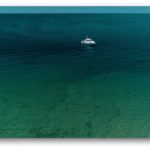
There may actually be four Great Lakes: “Lake” Huron and “Lake” Michigan could actually be considered “lobes” of one big lake — big enough to unseat Lake Superior as the world’s largest freshwater lake by surface area.

“They share a lake level. When the wind’s not blowing, they tend to be at the same level,” said Eric Anderson, director of hydrologic science and engineering at the Colorado School of Mines. “So if one goes up, the other one goes up. If one goes down, the other one does as well.”

The idea that Michigan’s mitten is hugged by one big U-shaped lake is not some new concept that you’ll only find buried in niche scientific studies.

It’s not very well known, but you don’t have to scroll far on WikipediaMichigan.gov or other very-public facing sources to find references to Lake Michigan-Huron.

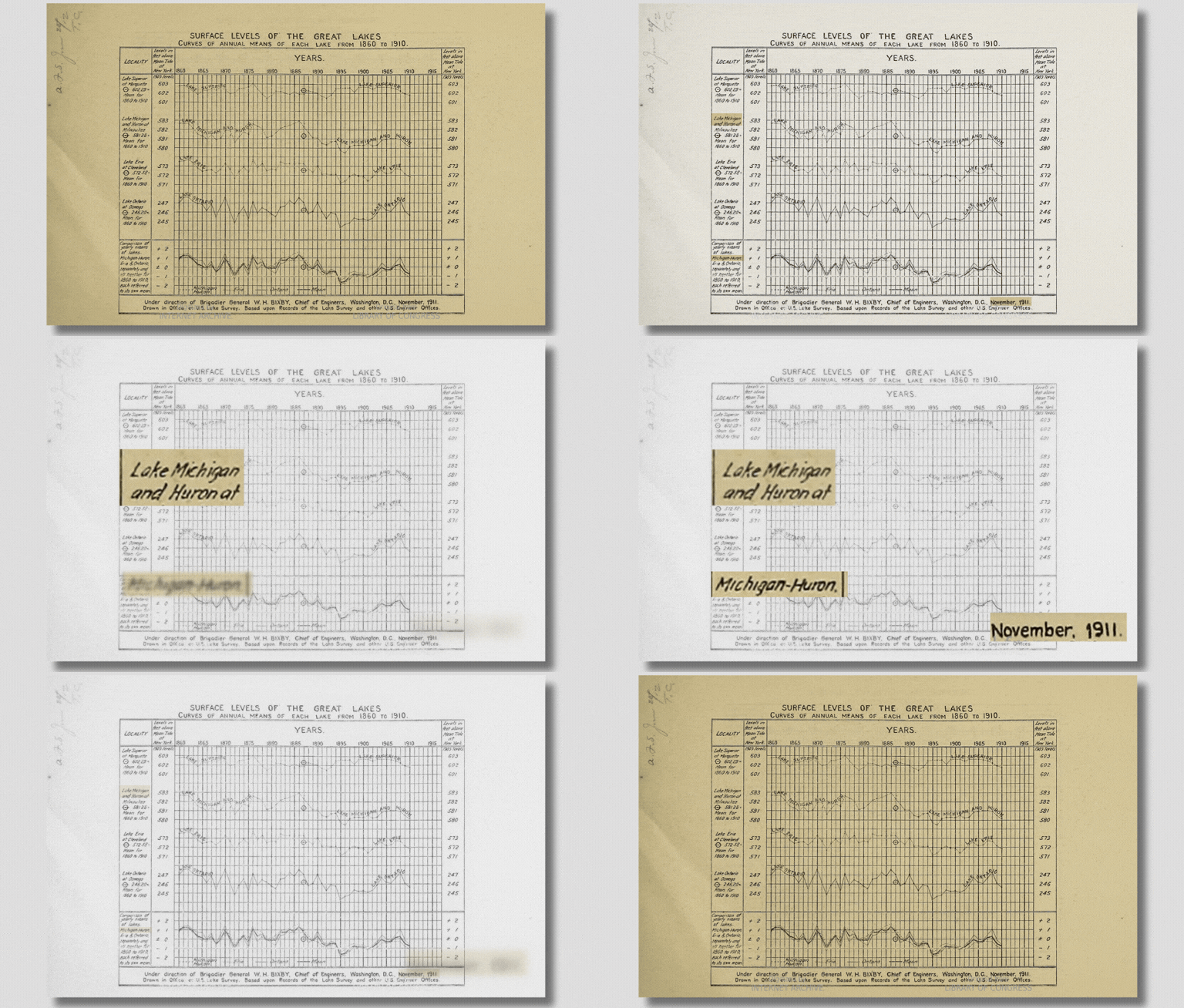
The oldest scientific record of it we found was from 1911.

This official U.S. Lake Survey document, dated 1911, references a combined “Lake Michigan and Huron” in measurements of the lake’s water levels. (Document: Library of Congress, accessed via HathiTrust. GIF: Adam Yahya Rayes | Michigan Public)

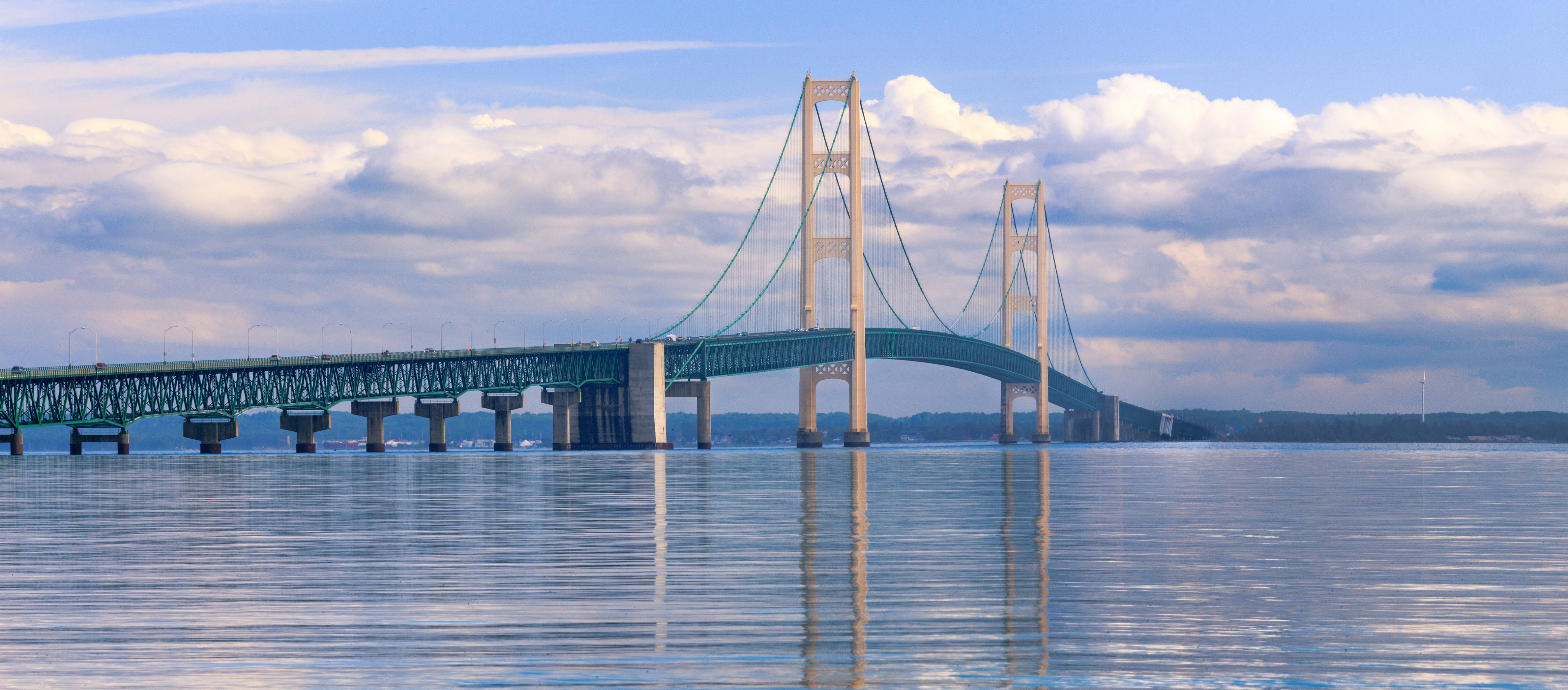
It’s not just the lake level that leads hydrologists to describe Huron and Michigan as one lake. The two bodies of water have another special connection: the straits of Mackinac.

At about five miles wide, the straits are a large body of water that flows in both directions between the Huron and Michigan lobes. This creates unique conditions for what Anderson called a “bi-lake seiche.” Seiches are standing waves that go back and forth across a body of water.

“Think about them as maybe like two water beds connected by some weird piece of material,” he said. “If you were to jump on the one water bed, right, you would create a giant wave that moves into the other one.”

That also means that any contaminants that spill into one body could easily end up in the other, Anderson said, especially if the spill happens near the straits.

But, Anderson said Michigan and Huron also have their own separate seiches. Plus, they each have their own circulation, water quality, and weather patterns. When he’s creating models to give people warnings about dangerous conditions, Anderson said it’s usually limited to one side or the other.

“In almost every other way, these lakes behave like two separate lakes,” he said. “Also just culturally and personally, because these lakes are so big, it’s really hard to think you’re experiencing the same thing in Chicago that you are in Georgian Bay.”

“Odawa Lake” and other names

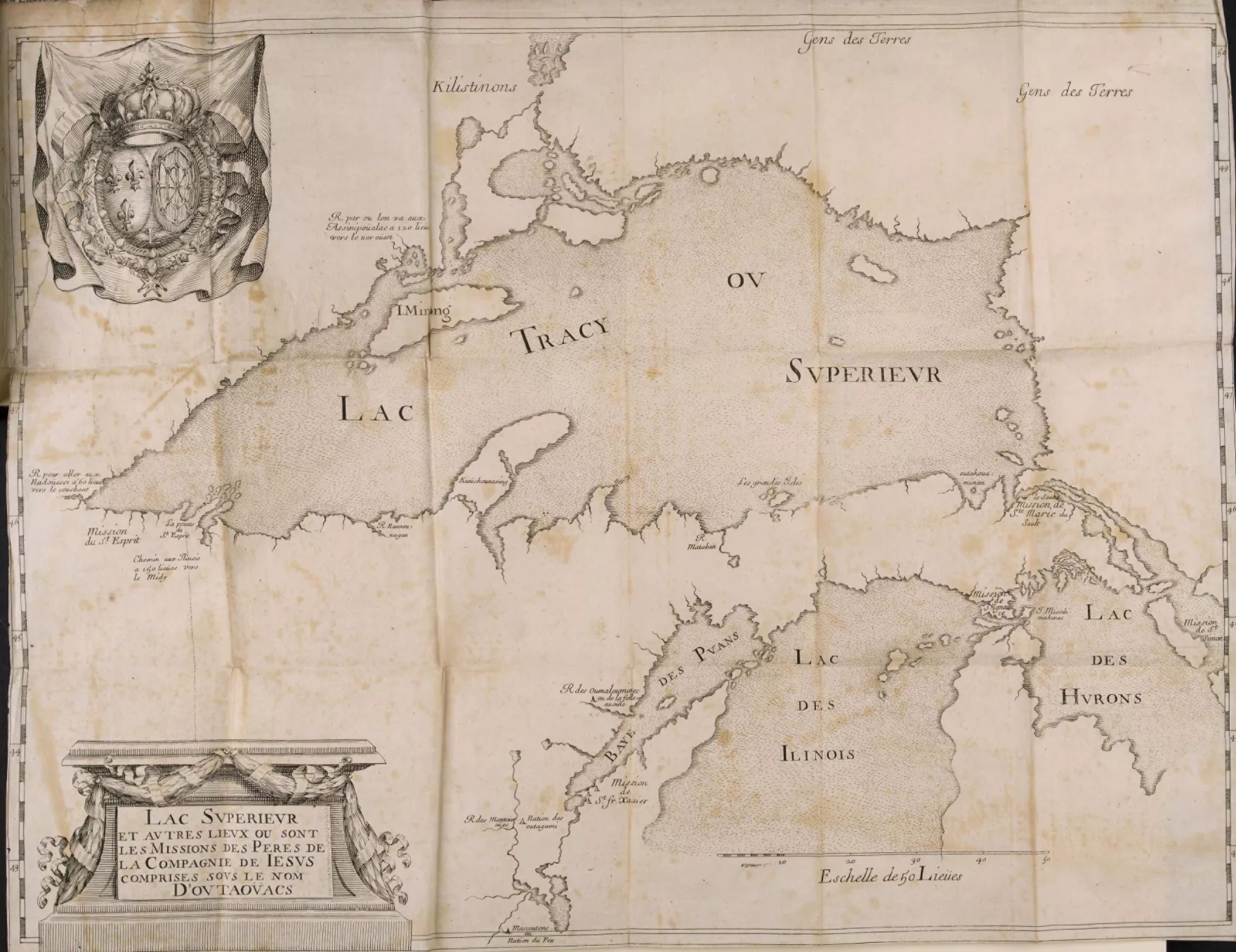
The earliest maps of the Great Lakes we know of are several hundred years old. Those maps, made by French explorers, refer to Michigan and Huron as separate lakes.

This map was created by French Jesuit missionaries in the 1600’s. It shows what are now known as Lake Huron and Lake Michigan (which they called “Lake of the Illinois” at the time) as separate lakes. The straits of Mackinac are not labeled. (Bibliothèque et Archives nationales du Québec)

“I think it’s important to note that there are different names for these lakes that predate European contact,” said Eric Hemenway, humanities program manager for the University of Michigan’s School for Environment and Sustainability. “And there’s a different view of the lakes that is still with us.”

Hemenway is Anishinaabe — the collective name for indigenous peoples who lived in the Great Lakes region — and Odawa (also called “Ottawa”). His Odawa name is Gaanaybik (Ge-na-bik).

“So in my mind, as the singular Odawa guy from living on Lake Michigan, to me [Huron and Michigan] are one body of water,” he said. “And all of our villages historically were right on both sides.”

Hemenway used to do archival work for the Little Traverse Bay Bands of Odawa Indians. Historically, he said, the tribe called Huron and Michigan “Odawa Lake.”

“There’s no wall, there’s no giant barrier,” he said. “The important part is who lived where … I can’t say it’s exclusively ours. You know, we named the lake after us, but there were other tribes that lived on the lake.”

Hemenway said Anishinaabe peoples had many different ways of naming and categorizing the lakes. Some did consider Huron and Michigan to be separate lakes or bodies.

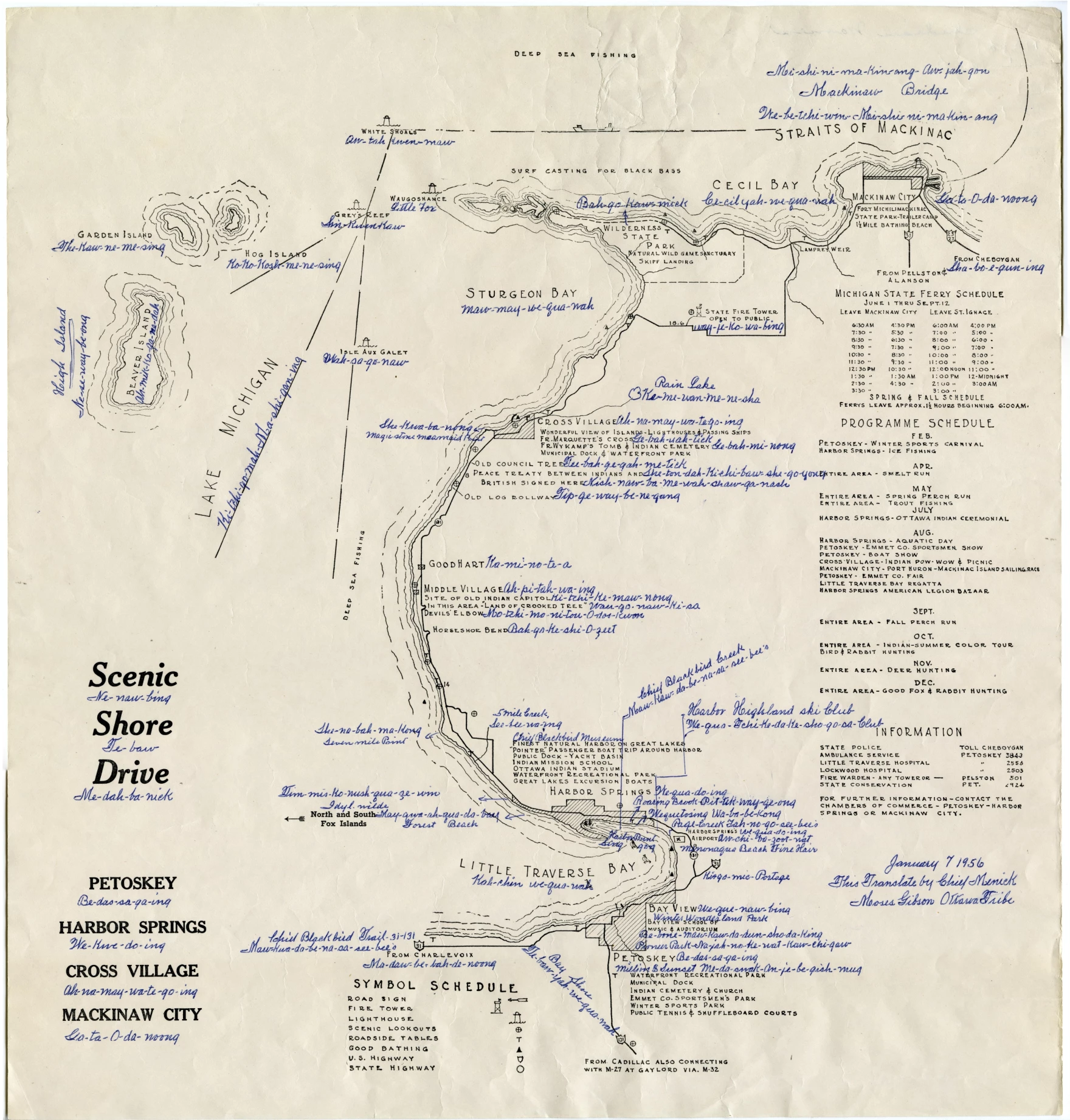
This map contains hand written notes from 1956 that are likely traditional Anishinaabe names and descriptions for areas around northern Lake Michigan, including a name for the lake itself. Hemenway said it’s not clear to him if that is a translation of the lake’s modern name or if it is “one of the old names for Lake Michigan.” (Bentley Historical Library)

“We live in these boundaries all the time. And so, trying to pull back and not look at the boundaries is really difficult,” he said. “But if you start seeing it as one, I think you start seeing the effort and responsibility shifts. We all have a part in this.”

Guests:

  • Eric Anderson, director of hydrologic science and engineering at the Colorado School of Mines.
  • Eric Hemenway, humanities program manager for the University of Michigan’s School for Environment and Sustainability.

The post Are Michigan and Huron actually one large Great Lake? appeared first on Great Lakes Now.
Original Article

Great Lakes Now

Great Lakes Now

https://www.greatlakesnow.org/2026/07/08/are-michigan-and-huron-actually-one-large-great-lake/
Michigan Public

By Kelly House, Bridge Michigan

The Great Lakes News Collaborative includes Bridge Michigan; Circle of Blue; Great Lakes Now at Detroit PBS; Michigan Public, Michigan’s NPR News Leader; and The Narwhal who work together to bring audiences news and information about the impact of climate change, pollution, and aging infrastructure on the Great Lakes and drinking water. This independent journalism is supported by the Charles Stewart Mott Foundation. Find all the work HERE.


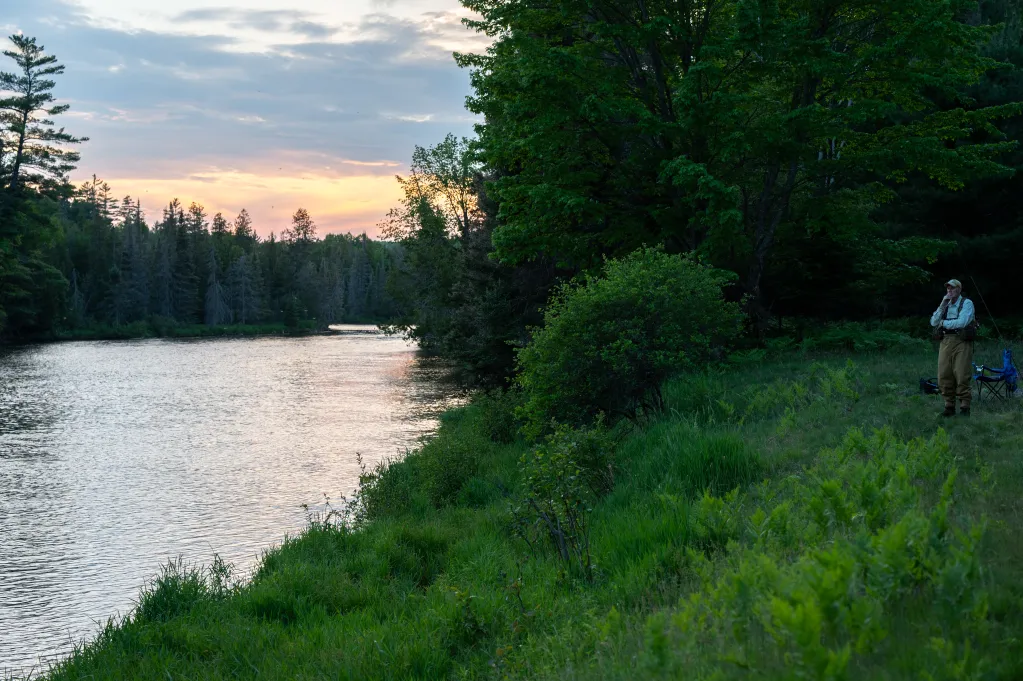
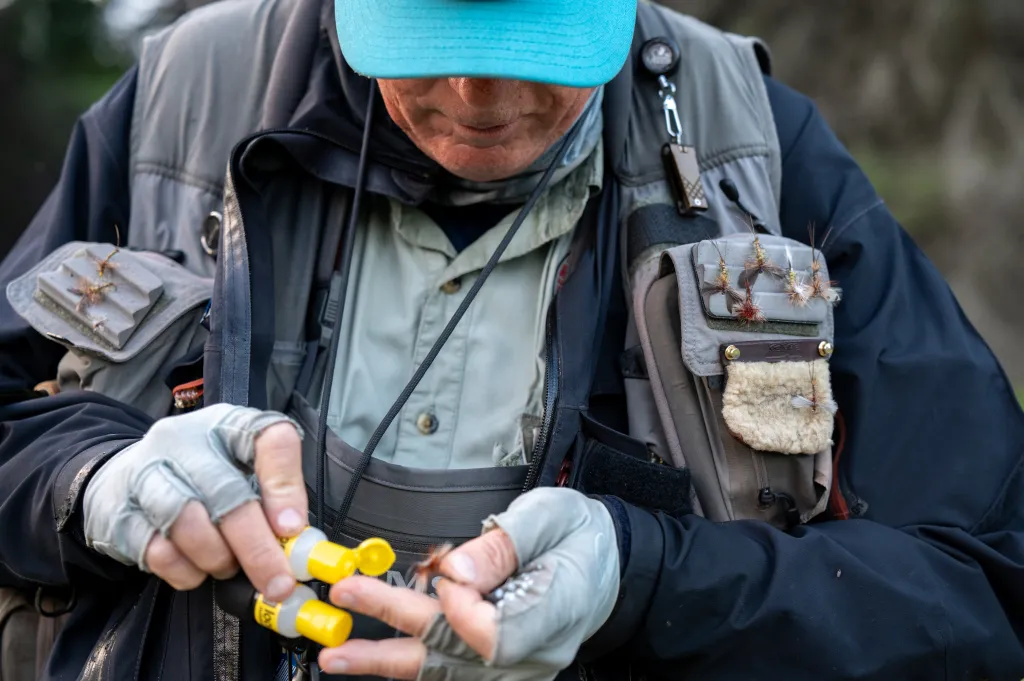
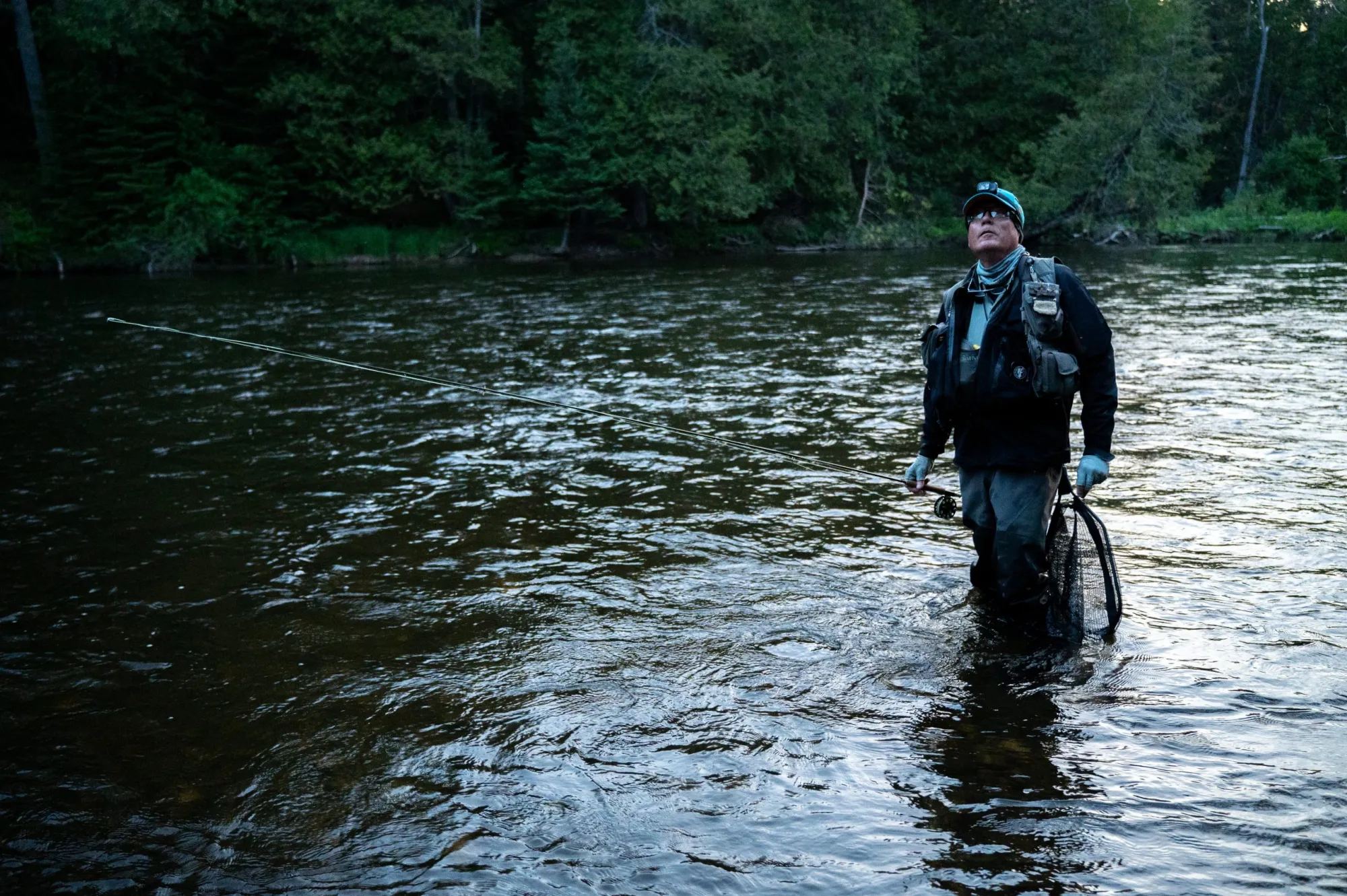
On any given summer evening along this storied Michigan river, Tom Buhr can be found fly fishing in cold, rushing water that makes him feel “more complete and better” than anywhere on Earth.

Fifty miles downstream on a pontoon in one of the Au Sable’s lake-like reservoirs, Douglas Ridenour can relate to the feeling. 

The agreement ends there.

Despite a shared love for the river, the men stand on opposite sides of a struggle for its future, prompted by Consumers Energy’s proposal to sell 13 century-old Michigan dams — including six on the Au Sable — to a private equity firm.

For the company, it’s a financial decision designed to avoid hundreds of millions in maintenance costs and liability for high-hazard structures that don’t generate enough electricity to pay their way.

For many residents along the nationally-renowned 138-mile waterway that originates north of Grayling and empties into Lake Huron at Oscoda, a regulatory review of the deal has become a proxy for a deeper battle over whether the dams should exist at all.

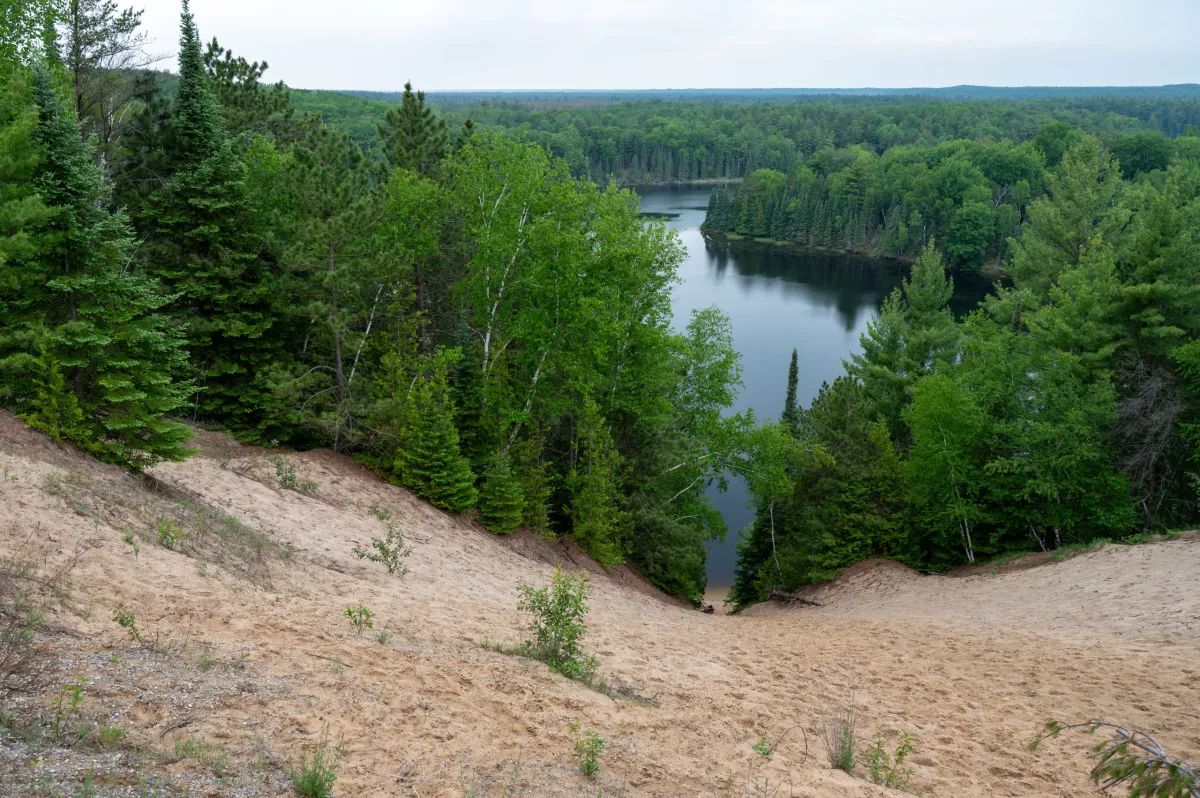
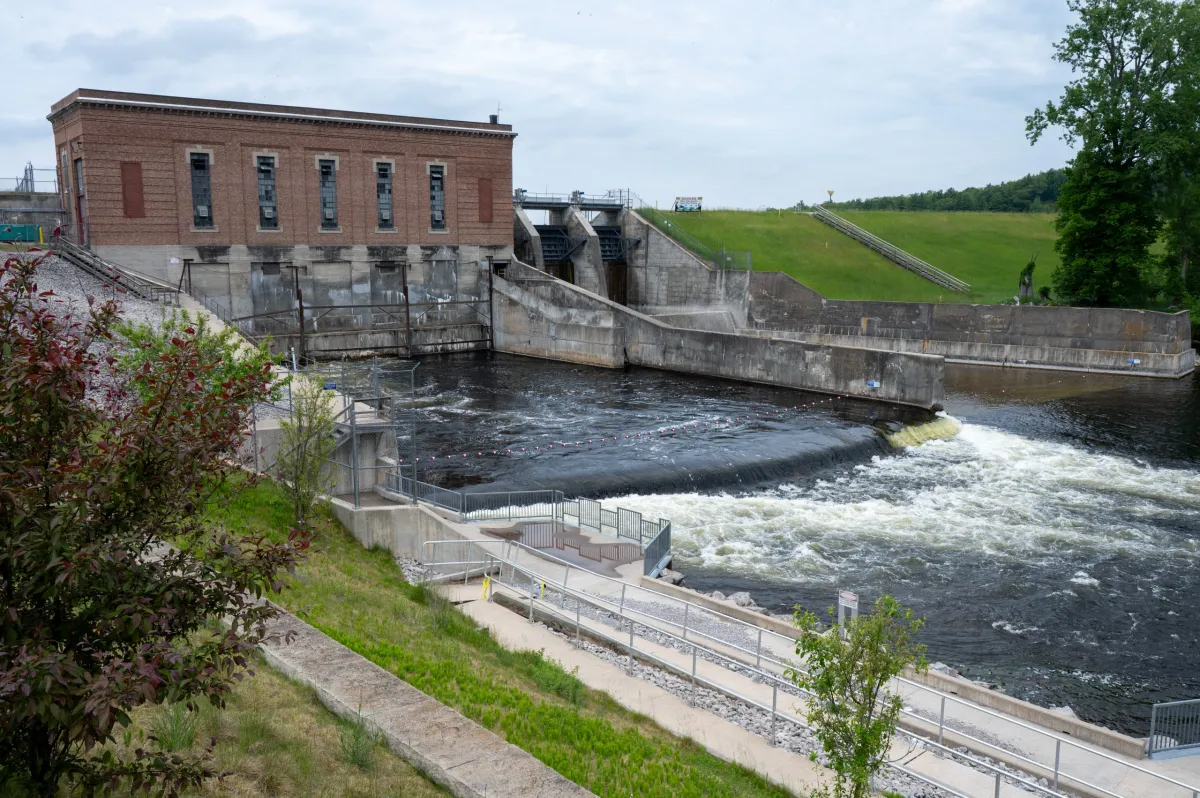
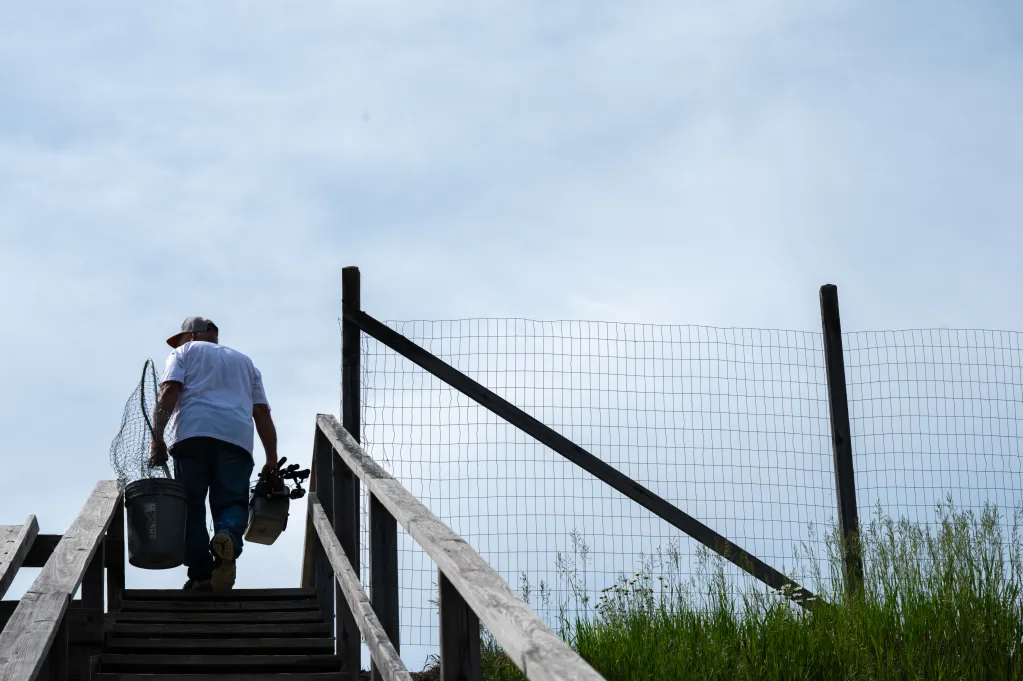
Foote Pond Overlook is located at the top of a steep sand bluff known as Champagne Hill, offering visitors panoramic views in Oscoda Township. On a warm summer weekend, the Au Sable River below is often packed with boaters and swimmers. (Ella Miller/Bridge Michigan)

The struggle for the future of the Au Sable mirrors a national debate. It pits environmentalists and fly fishers like Buhr, who favor free-flowing rivers with colder water and more fish, against flatwater enthusiasts like Ridenour who value the lakefront living created by reservoirs.

Across the country, “you’ve got old mill dams and old power dams that were important things at the time, but now maybe aren’t,” said Bob Dalton, a national dam safety expert based in Illinois. The question then becomes “what are we going to do now, and what’s it going to look like 100 years from now?”

At stake are not just the environment and ways of life for water users, but public safety, taxpayer dollars and the future of scores of businesses and communities that have popped up along the artificial lakes.

A nationwide issue

Across the nation, thousands of dams have exceeded the standard 50-year lifespan and face mounting maintenance costs.

https://infogram.com/1p0l5rdkgwkqeduem6jqddgdjqcnpkyg301

The average US dam is 65 years old, while Michigan’s average is 80.

Consumers Energy’s 13 dams on the Au Sable, Grand, Kalamazoo, Manistee and Muskegon rivers average 106 and generate only 1% of the utility’s annual power output, while the cost to maintain them keeps growing.

In view of that math, Consumers wants to sell them for $1 apiece before their federal operating licenses expire in the coming years. The proposition has drawn rebuke from critics, who fear new owners won’t pay to keep the structures safe.

A state judge has advised utility regulators to reject the sale in a final decision expected this September. 

Consumers officials say such an outcome would lead them to seek removal of all 13 dams — an effort sure to trigger yet more regulatory review and intense public debate.

Federal records show licenses for another 15 Michigan hydropower dams will expire in the coming decade, likely prompting similar debates about whether to keep, sell or remove them.

Nationwide, some 100 dams were dismantled last year, including six in Michigan. Experts expect the number to keep climbing as owners look to avoid costly repairs. 

Foote Dam is one of six hydroelectric dams on the Au Sable River, located in Oscoda Township. Completed in 1918, the dam is the farthest downstream of the six and is nine miles away from the Au Sable’s mouth at Lake Huron. (Ella Miller/Bridge Michigan)

Here on the Au Sable, uncertainty about the fate of its six dams has reignited an age-old debate about what a river should be, and who gets to decide.

“Rivers are defined as flowing water,” said Bryan Burroughs, executive director of the river advocacy group Michigan Trout Unlimited. “You shut that off, and it’s going to cause a lot of problems.”

But to folks like Ridenour, who lives near the lowest Au Sable dam and has been recreating in its reservoir for more than 50 years, the impoundments enhance the river’s variety in ways too important to lose.

The Au Sable in its current configuration is “100% nature,” Ridenour said, but “I have no interest in being here if the river is only 20 feet wide.”

The river of dreams

Unlike other regions, where coldwater rivers are disappearing due to climate change, Ice Age glaciers blessed Michigan with a sandy landscape rich in frigid springs that produce blue-ribbon trout rivers.

The Au Sable stands out among them, a mystique owing to good publicity and relative proximity to Michigan’s population hubs.

The river’s easy accessibility from Detroit, Flint or Saginaw has won it some influential boosters, from early 1900s lumber baron William Mershon to the founders of Trout Unlimited, a national river advocacy group that was born on its banks

Au Sable disciples often describe it in near-spiritual terms: An 8-mile stretch near Grayling is known as “the holy waters.” A sign downtown glorifies it as “the best of all rivers.” People interviewed for this story called it “my cathedral,” “my happy place,” and “the place where I’m most at peace.”

On a late spring evening, it’s easy to understand the hype. 

Bullfrogs bellow in the cedar swamps, trout leap from the water to feed on mating mayflies, loons glide between cattails and wild rice beds in stillwater reservoirs surrounded by towering dunes.

But pristine as the Au Sable may seem, it has been dramatically altered by humans — a period Buhr, the fisherman who has written two books about the river, laments as its “225-year monetization.”

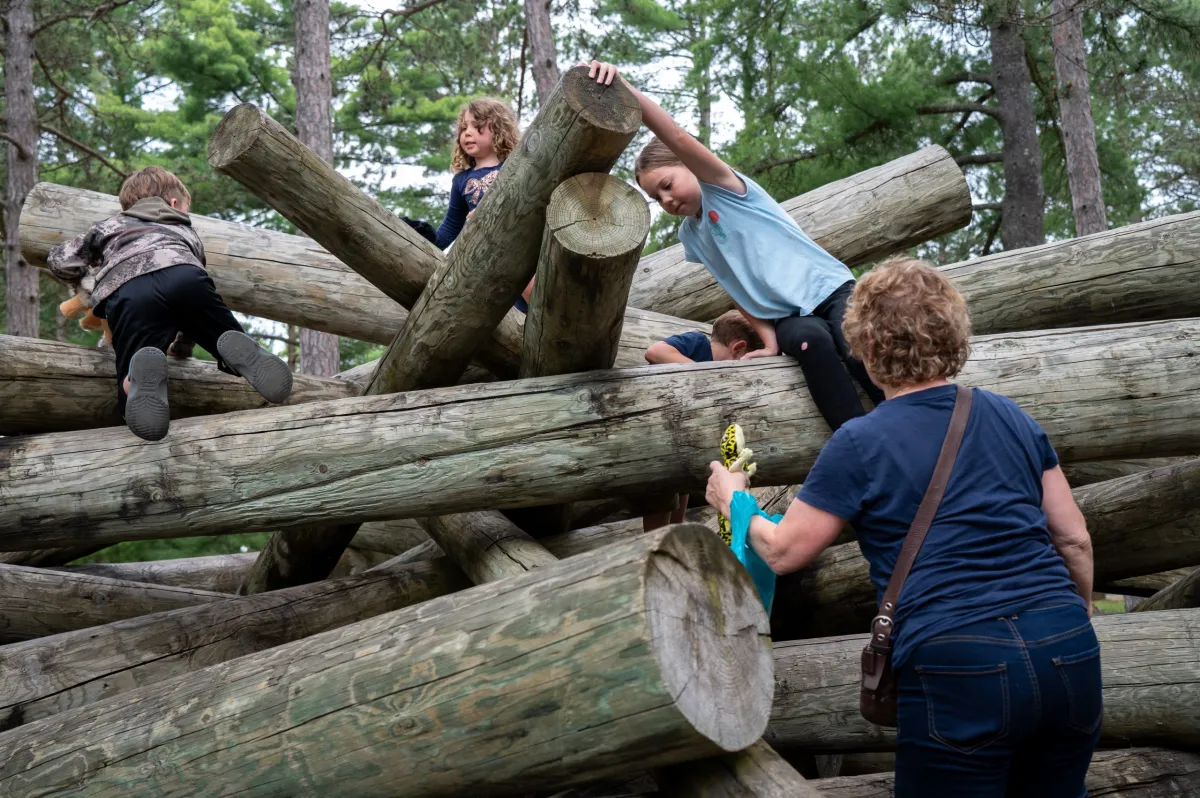
Ezra Ferrier, 8, Gabriella Ferrier, 4, Clement Ferrier, 2, and Cece Ferrier, 10, of Monroe, scale a log jam with help from their grandma during a visit to Lumberman’s Monument Visitor Center in Oscoda Township. The site teaches visitors about the history of the area’s lumber industry through interpretive signs, exhibits, demonstrations and programming. (Ella Miller/Bridge Michigan)

The fur trade virtually emptied the watershed of its beavers. Unregulated commercial and sport fishing drove Arctic grayling to local extinction and dramatically reduced sturgeon, walleye, whitefish and sucker populations. Timber companies razed the pine forests, leaving the Au Sable sunbaked and sand-choked.

The subsequent building of hydroelectric dams fragmented the river into seven sections, submerging 59 miles between Mio and Oscoda under vast artificial lakes and prompting generations of debate about whether it was a good idea.

Should they stay or should they go?

Few along this river seem to be comfortable with Consumers’ plan to essentially give the dams away to a Maryland-based private equity firm in a deal that would cost ratepayers $3.4 billion and leave few guarantees about the structures’ future.

Prospective owner Confluence Hydro has vowed to shore up the dams to keep them operating for decades to come, but the deal doesn’t hold the company to those vows. 

Many, including the judge who recommended denying the sale, wonder how Confluence intends to turn a profit on such costly assets. They fear the answer lies in skipping maintenance required for safety, or selling off thousands of acres of landholdings that surround the dams.

But given Consumers’ vow to dismantle the dams if the sale doesn’t proceed, some fans of the impoundments are willing to take the gamble.

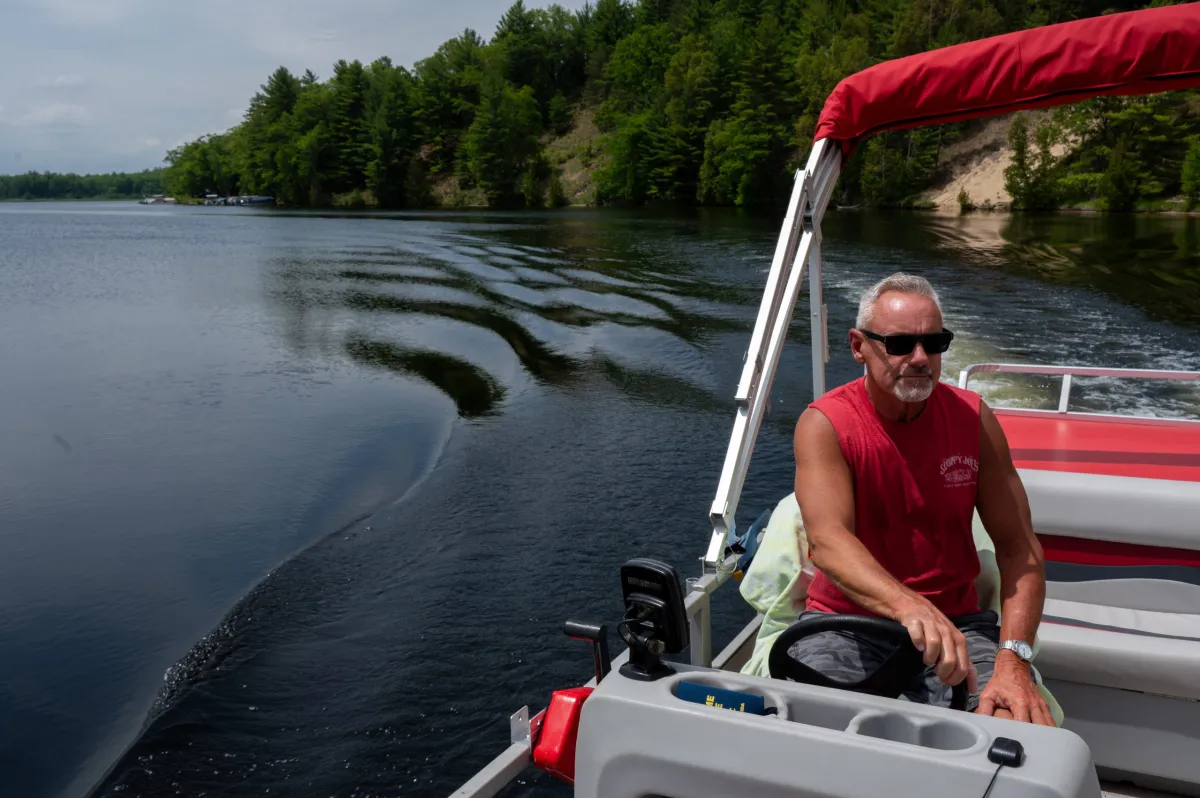
Douglas Ridenour, 68, takes his 50-year-old pontoon boat for a ride around Foote Dam Pond in Oscoda Township. Ridenour has been visiting Foote Dam Pond for decades, but moved there six years ago in his retirement to take advantage of the recreational opportunities the reservoir provides. He’s one of dozens of homeowners who have leased access to dock their boats in the reservoir. (Ella Miller/Bridge Michigan)

“They are the only horse traveling in our direction right now,” said Ridenour, the reservoir resident who co-administers a pro-dams Facebook group that has grown to 3,400 members. “So we kind of feel like the only choice we have is to hop on.”

The environmentalists and trout fishing enthusiasts who oppose dams see that as a perilous choice. In their eyes, removal is the best way to eliminate safety risks posed by the aging structures while righting a historic wrong.

Thanks to decades of tree-planting, sediment removal and other restoration work, the Au Sable has partly recovered from its industrial past, said Karen Harrison, president of the local Trout Unlimited chapter, “but it can come further.”

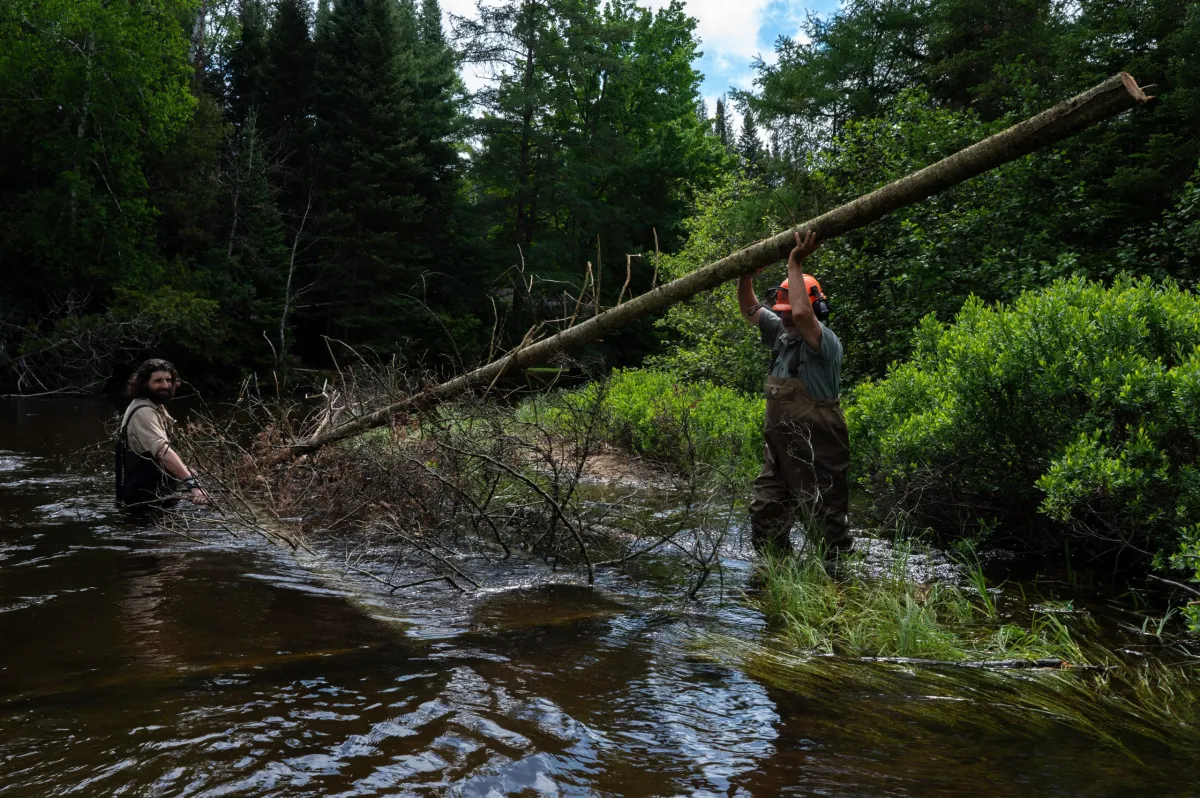
Retired Michigan Department of Natural Resources Fisheries Biologist Steve Sendek, right, and son Alex Sendek, of Grayling, push a dead pine tree they cut down into the Au Sable River, which will be used to repair a woody trout habitat first created by the DNR about 50 years ago, in Grayling Township. When the DNR stopped maintaining the habitats in the late 1990s, Sendek stepped in with the help of funding from local organizations to hire a crew to restore them each summer. The woody habitats provide trout with a place to conserve their energy and take shelter from predators. “We’re taking care of that original investment the DNR put into the fish habitats and making sure it stays functional for a long time,” Sendek said. (Ella Miller/Bridge Michigan)

The dams block migratory fish from their habitat, contributing to sharp declines for a host of species. They trap sediment, starving the river of nutrients while muck piles up in the reservoirs. Fish die in the spinning hydroelectric turbines and the sun beats down on the pooled water, warming it to unsafe temperatures for coldwater fish.

Three of the Au Sable dams warm the river so badly they violate state standards, complicating their path to relicensing. 

Were it not for the dams, officials with the Michigan Department of Natural Resources have estimated, the lower Au Sable river could support millions of salmon and steelhead, tens of thousands of lake sturgeon and abundant trout, walleye, whitefish and other species.

Experience with other dam removals has shown changes can happen quickly. 

Burroughs of Trout Unlimited recalls a dam removal on another Michigan river, in which “before we even finished with the excavator, we saw trout moving upstream.”

Old dams are also prone to failure without constant maintenance — which Buhr called his primary reason for supporting removal. 

“They aren’t getting any younger,” he said. “I think getting the dams out — or at least most of them — has to be done from a safety standpoint.” 

And then there’s the question of cost: By Consumers’ estimate, removing all 13 dams would be tens of millions of dollars cheaper for its ratepayers than keeping them in place and relicensing them, although critics on both sides have disputed that math.

“We have a responsibility to prioritize customer affordability in decisions about the future of the dams,” company spokesperson Katie Carey said.

But in the communities surrounding the dams, removal is seen as a threat to local economies and a way of life. 

In their century of existence, the dams have helped cultivate a multi-million-dollar tourism economy in a region with few other economic opportunities.

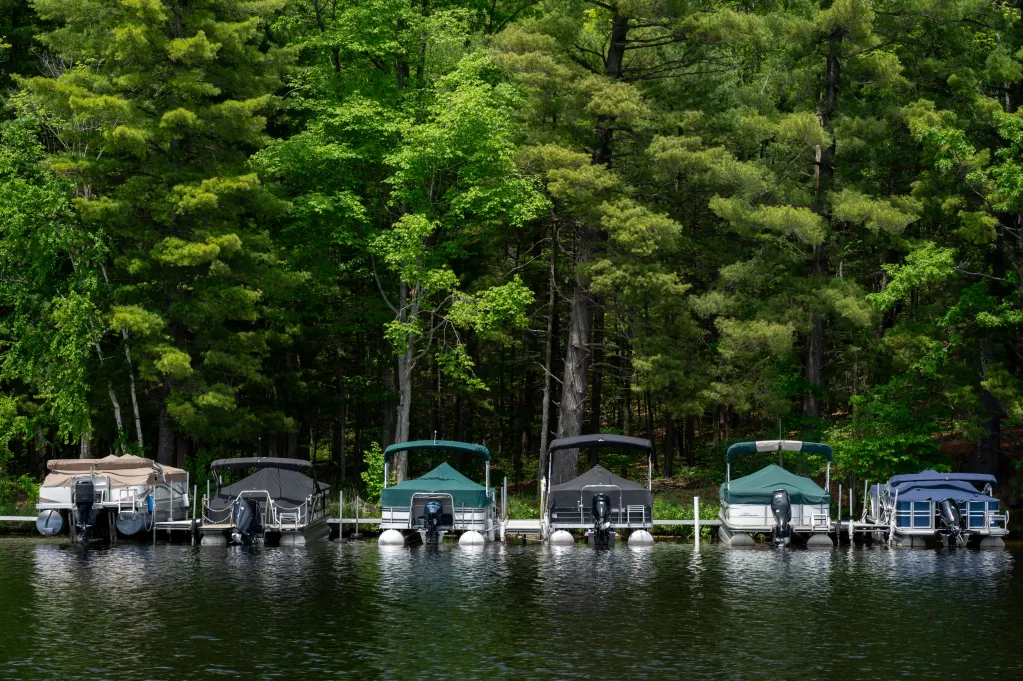
Public boat ramps and campgrounds have cropped up along their collective 10 square miles of reservoirs, attracting swimmers and water skiers, pontoon cruisers and RVers who supply welcome business to area restaurants, bait shops and grocery stores. 

While Consumers owns much of the shoreline and bottomlands, it has leased dock access to hundreds of private residents, making them de-facto lakefront homeowners. It’s not clear what would happen to that land if the reservoirs were drained.

Portaging over the dams has become a rite of passage for participants in the river’s annual canoe marathon, which boasts Consumers Energy as its chief sponsor. 

And while the dams have displaced coldwater and migratory fish, they’ve created habitat for lake species like bass, perch and bluegill. The lowermost barrier — Foote — blocks invasive sea lamprey that might otherwise travel upstream to spawn by the millions.

If all that went away, “there goes the summer revenue,” said Debbie Sytek, who manages the office at Alcona Park, a 440-site campground on the reservoir created by the thirdmost-downstream dam.

With a summer staff of 23 people, Alcona Park qualifies as a major employer in an area this remote.

“What draws people here is the pond,” Sytek said. “The beauty, the slowness … What does this park look like if the water’s not there?”

Economic studies commissioned by Consumers found that removing the Au Sable dams would reduce gross regional product by $8.7 million while costing 278 jobs. 

“It’ll be another Air Force leaving the area,” predicted 68-year-old Ray Rolwing, who owns a home near Cooke Pond and remembers the boarded up shops and population exodus that followed the military’s 1993 closure of its Oscoda base.

Fans of flowing rivers have criticized the analyses by Public Sector Consultants, arguing a free-flowing river has greater economic potential than researchers acknowledged.

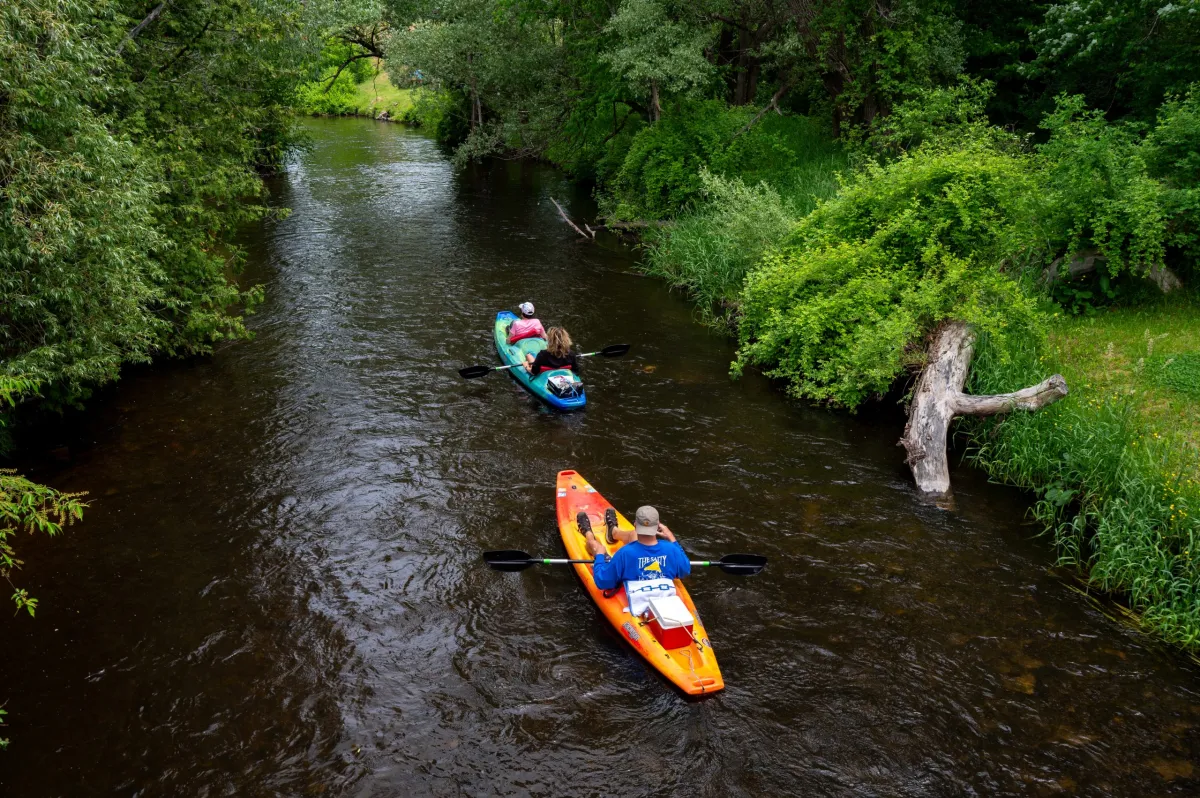
A group of kayakers take off on a trip down the Au Sable River from Carlisle Canoe Livery in Grayling. Known for its clear waters, steady currents and scenic views, the Au Sable River is one of the most popular spots in Michigan for paddlers. (Ella Miller/Bridge Michigan)

Upstream of the dams, in the reaches famous for their stable currents and abundant trout, canoe liveries, fly shops, motels and restaurants bustle with visitors all summer. As diminishing snowpack imperils coldwater rivers from Montana to Minnesota, some predict Michigan’s reliable springfed flows will become an even bigger draw.

“People will travel from all over the world to fish a run of Atlantic salmon up the world-famous Au Sable, or to fish for trout in sections of river that haven’t been fished for a hundred years,” predicted Josh Greenberg, a fishing lodge owner who leads the conservation group Anglers of the Au Sable.

Room for compromise?

In view of the tradeoffs, some on the Au Sable see room for a compromise in which some dams stay and others go.

Many see Foote Dam — where Ridenour lives — as a strong candidate to stay in place. Beyond its utility as a lamprey barrier, it impounds the river’s largest and most popular reservoir, generates more electricity than any of the other five dams, and needs the least near-term investment, according to 2022 estimates Consumers shared with area residents.

Many dam opponents see the upper impoundments — Mio, Alcona and Loud — as prime targets for removal. Taking them out would mitigate the river’s temperature problems while extending its free-flowing section by dozens of miles.

Savings from decommissioning rather than repairing the dams, Buhr suggested, could compensate residents who’ll lose lakefront property while helping affected communities transition to a river-based economy.

“I won’t be satisfied unless the local economy and property owners are satisfied,” he said.

It’s a reasonable prospect to Curtis Township Supervisor Kevin Perry, whose community surrounds the Alcona Dam.

“I would rather not lose the dam, because let’s face it, change always hurts,” Perry said. But “if you market it correctly,” an undammed river could become an asset, just as the reservoirs are today.

Back at Alcona Park, campers Marjon and Michael Jones spent a recent breakfast pondering what such an arrangement would mean for them. 

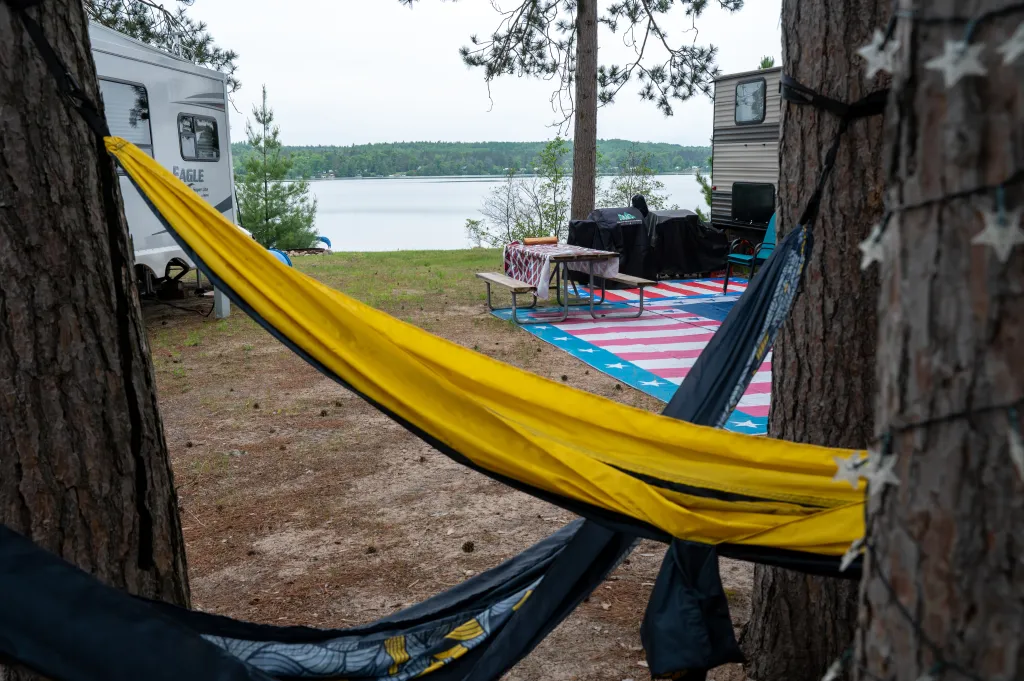
Every summer for the past 16 years, the Detroiters have parked their RV along the shoreline and spent the season fishing, boating and watching sunsets over the Alcona Dam Pond. 

Were it to be replaced with a narrow river, Michael said, “we would have to go somewhere else.”

Marjon agreed. But noting Michigan has thousands of other lakes to explore, she said she would still support dam removal.

“In spite of how much we love this place,” she said, “if you really want things natural, then dams are an unnatural thing.”

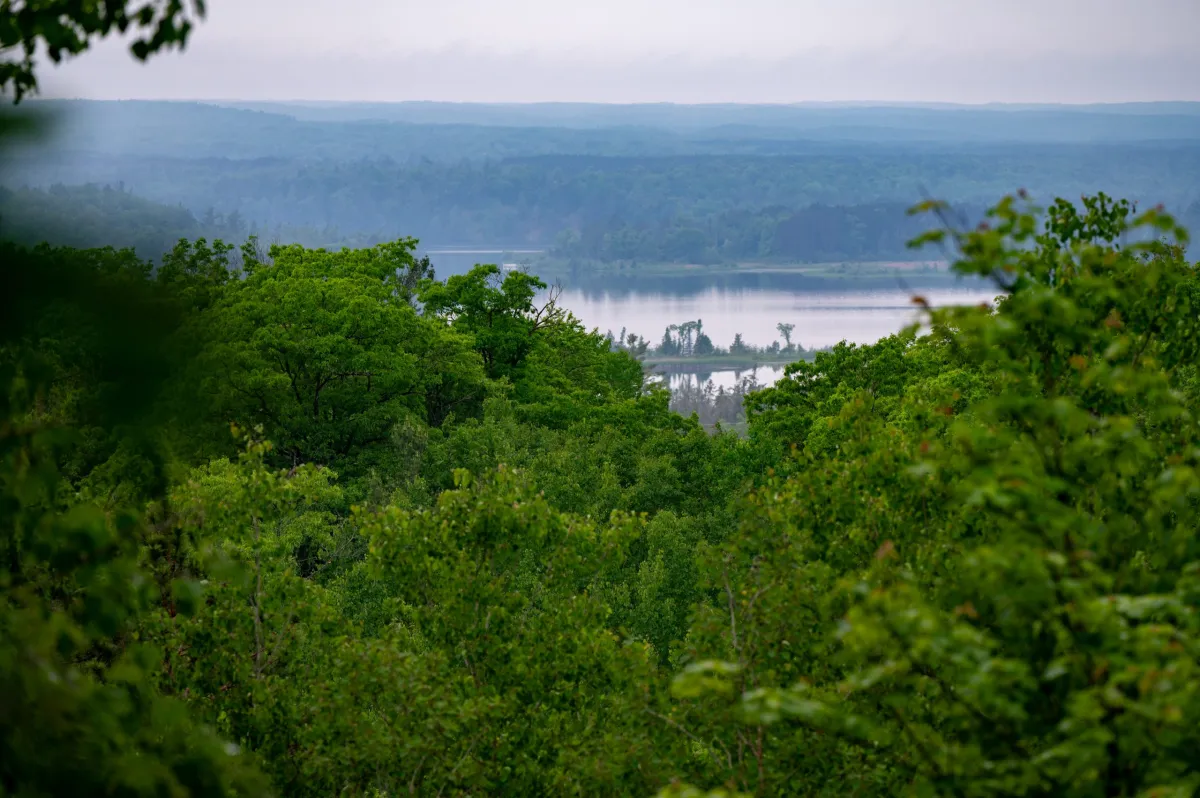
An overlook gives visitors a view of the Au Sable River from the AuSable Valley Scenic Vista in Glennie. Designated a “blue ribbon trout stream” by the Michigan Department of Natural Resources, the 138-mile river is known for its clear waters and abundant recreational opportunities. (Ella Miller/Bridge Michigan)

The post On fabled Au Sable River, a fight for soul of Michigan’s holy waters appeared first on Great Lakes Now.

Original Article

Great Lakes Now

Great Lakes Now

https://www.greatlakesnow.org/2026/07/07/on-fabled-au-sable-river-a-fight-for-soul-of-michigans-holy-waters/

Bridge Michigan

This article was republished here with permission from Great Lakes Echo.

By Samantha Ku, Great Lakes Echo


A newly restored reef at Channel Island in Saginaw Bay is intended to support native fish spawning and increase their numbers, ensuring the sustainability of local fisheries.

Construction to restore the nearshore fish spawning reef ended last October. 

Recreational fishing is an economic boon to the Lake Huron region, according to Jeffrey Jolley, a fisheries unit supervisor with the Michigan Department of Natural Resources.

“The excellent fishery attracts anglers from all over the state, and they spend money on fuel, tackle, restaurants and shops, and hotels and rentals,” Jolley said.

Therefore, protecting fish habitats is crucial to the local economy, he said.

The construction is an additional reef restoration following the restoration of the Coreyon Reef site and is intended to support a network of spawning reefs and nursery habitat, according to Michigan Sea Grant.

The Coreyon Reef site is a 2-acre offshore rocky habitat about 10 miles north of the Quanicassee River, northwest of the Channel Island site.

By studying the Coreyon Reef, researchers gather valuable data on the spawning habitats of native species. 

According to Michigan Sea Grant, researchers from the state DNR and Purdue University documented lake whitefish and walleye spawning on the reef between 2020 and 2022.

Initial results from the study indicate that fish species don’t show a particular preference for any specific type of cobble that makes up the reef structure.

Following the completion of the project at the Channel Island Reef, fish activity will be monitored by partners in the restoration, said Meaghan Gass, an MSU Extension educator with Michigan Sea Grant.

“With the two completed sites, researchers are able to compare nearshore and offshore locations,” Gass said.

Channel Island is also called Shelter Island, Spoils Island and the U.S. Army Corps Confined Disposal Facility.

Its newly built reef is about 570 feet long and 190 feet wide. It rises about 3 to 4 feet above the lake bottom and sits at least 5.5 feet below the water’s surface, even when water levels are low.

The artificial reefs are built from a mound of rocks that are distinctly different from coral reefs found in the ocean, Gass said. 

Nearly 20,000 tons of natural limestone, delivered by barge, forms the Channel Island Reef, she said. 

“Historically, inner Saginaw Bay had rocky underwater reefs formed by glacial deposits,” Gass said.

Gass said the rocky underwater reefs provided safe spaces for native fish to lay eggs because crevices among the rocks protect eggs and young fish from predators and strong currents.

The importance of native fish protection for the Lake Huron fishery lies in preserving the ecological balance that has developed over thousands of years, according to Jolley.

“Our native fish species evolved here through the forces of natural selection over millennia, adapting to local conditions, prey, predators and seasonal changes,” Jolley said.

In contrast, invasive species are often introduced abruptly, without natural checks and balances, allowing them to outcompete or prey on native fish, disrupt habitats and destabilize food webs, Jolley said.

Jolley said although some invasive species can temporarily provide new fishing opportunities, they often reduce long-term stability of ecosystems.

In contrast, native species support more resilient, diverse and sustainable fisheries, delivering lasting ecological and economic benefits.

However, artificial reefs designed to support native fish spawning habitats may also benefit invasive species.

“Round goby, an invasive species that prefers rocky habitats, will likely colonize the reef,” Jolley said.

While gobies can prey on fish eggs, native predators such as smallmouth bass feed heavily on them and are also attracted to the area. 

The reef structure and placement support native species like smallmouth bass and walleye, which depend on clean, stable substrate for spawning and feeding, Jolley said.

“This interaction is expected to balance out naturally as predator-prey relationships stabilize,” Jolley said.

According to Jolley, community engagement is crucial for further restoration projects.

Jolley said public opinion often centers on safety, navigation features and aesthetics, as people seek to balance these considerations with the ecological benefits of habitat restoration.

“We have consistently engaged local communities on past, current and future projects,” Jolley said.


The post Lake Huron artificial reef restores fish spawning habitat appeared first on Great Lakes Now.

Original Article

Great Lakes Now

Great Lakes Now

https://www.greatlakesnow.org/2026/04/30/lake-huron-artificial-reef-restores-fish-spawning-habitat/

Great Lakes Echo

By Brian Allnutt, Planet Detroit

This article was republished with permission from Planet Detroit. Sign up for Planet Detroit’s weekly newsletter here.


Water levels on the Great Lakes and Lake St. Clair continued to decline below long-term averages over the winter, just a few years after lakes hit record highs in 2019 and 2020.

Lake levels are expected to begin their seasonal rise and stay close to long-term averages, according to the U.S. Army Corps of Engineers’ six-month forecast issued March 4.  

The recent decline in Great Lakes water levels hasn’t been especially steep, but the overall trajectory of lake levels is one of increasing variability, according to Yi Hong, a research scientist at the Cooperative Institute for Great Lakes Research.

Lake Michigan and Lake Huron, which are technically two lobes of a single lake, saw record highs in 2020 less than a decade after being hit by record lows in 2012 and 2013, Corps records show.

Climate change-driven extreme storms and heatwaves are influencing lake level variability, but there isn’t enough data to show if levels will trend lower or higher over the long-term, Hong said.

Over the next six months, the Corps predicts water levels will stay below long-term averages on all the lakes, except possibly Lake Ontario.

Lake Michigan and Lake Huron will be the farthest below average. From March to August, levels will be 4 to 7 inches below last year’s levels and 11 to 12 inches below the long-term average. Closer to Detroit, Lake St. Clair will see water levels 6 to 10 inches below last year and 5 to 7 inches below the long-term average.

Megan Royal, a Corps hydraulic engineer, said the agency doesn’t anticipate any water level issues in the shipping channels and harbors used by Great Lakes freighters. Sediment can occasionally move into navigation channels and harbors, requiring emergency dredging, she said.

In an interview with Maritime Reporter TV, Eric Peace, vice president of the Lake Carriers Association, said Great Lakes shipping is negatively impacted by several factors, including severe weather over the fall and early ice cover. Dredging will continue to be a challenge for the industry, he said. 

Dry falls, hot summers contribute to lake level declines

A pattern of dry fall seasons from 2023-2025 contributed to the Great Lakes’ falling water levels, Royal told Planet Detroit.

Last summer’s heat also led to near record-high lake temperatures, producing significant evaporation when the winter’s extremely cold air passed over relatively warm water, she said.

“Evaporation is very difficult to measure because of just how large the lakes are,” Royal said, adding that modeling showed evaporation from all the lakes except Lake Erie was above average from October to January.

The rate of decline in lake levels is beginning to stabilize as a drought eases in parts of the Great Lakes Basin and snowmelt drives runoff into the lakes, she said.  

The National Weather Service’s Climate Prediction Center forecasts above normal precipitation across nearly all the U.S. portion of the Great Lakes Basin over the next three months. Temperatures in these areas mostly have equal chances of being above or below normal over the same time period.

The post Great Lakes water levels decline from record highs: What the forecast says appeared first on Great Lakes Now.

Original Article

Great Lakes Now

Great Lakes Now

https://www.greatlakesnow.org/2026/03/10/great-lakes-water-levels-decline-from-record-highs-what-the-forecast-says/

Planet Detroit

Ontario is subsidizing an energy project in Georgian Bay despite expert advice

By Fatima Syed, The Narwhal

The Great Lakes News Collaborative includes Bridge Michigan, Circle of Blue, Great Lakes Now at Detroit PBS, Michigan Public and The Narwhal who work together to bring audiences news and information about the impact of climate change, pollution, and aging infrastructure on the Great Lakes and drinking water.

Read Now at Great Lakes Now.

Original Article

Great Lakes Now

Great Lakes Now

https://www.greatlakesnow.org/2025/11/ontario-is-subsidizing-an-energy-project-in-georgian-bay-despite-expert-advice/
The Narwhal

Great Lakes slightly colder than usual ahead of summer

By Emilio Perez Ibarguen, Bridge Michigan

The Great Lakes News Collaborative includes Bridge Michigan; Circle of Blue; Great Lakes Now at Detroit PBS; Michigan Public, Michigan’s NPR News Leader; and The Narwhal who work together to bring audiences news and information about the impact of climate change, pollution, and aging infrastructure on the Great Lakes and drinking water.

Read Now at Great Lakes Now.

Original Article

Great Lakes Now

Great Lakes Now

https://www.greatlakesnow.org/2025/05/great-lakes-slightly-colder-than-usual-ahead-of-summer/

Bridge Michigan

Points North: The Longest Paddle

By Ellie Katz, Interlochen Public Radio

Points North is a biweekly podcast about the land, water and inhabitants of the Great Lakes.

This episode was shared here with permission from Interlochen Public Radio. 

In the summer of 2015, Traci Lynn Martin’s mom was in the final weeks of a battle with cancer.

Read Now at Great Lakes Now.

Original Article

Great Lakes Now

Great Lakes Now

https://www.greatlakesnow.org/2025/05/points-north-the-longest-paddle/

Interlochen Public Radio

Fish, mines and Indigenous Rights ensnared in court case in northern Ontario

By Emma McIntosh, The Narwhal

Emma and photographer Christopher Katsarov Luna spent four days in northwestern Ontario, including visits to White Lake and Netmizaaggamig Nishnaabeg.

The Great Lakes News Collaborative includes Bridge Michigan, Circle of Blue, Great Lakes Now at Detroit PBS, Michigan Public and The Narwhal who work together to bring audiences news and information about the impact of climate change, pollution, and aging infrastructure on the Great Lakes and drinking water.

Read Now at Great Lakes Now.

Original Article

Great Lakes Now

Great Lakes Now

https://www.greatlakesnow.org/2025/04/fish-mines-and-indigenous-rights-ensnared-in-court-case-in-northern-ontario/

The Narwhal

A Great Lakes ‘Pompeii’? Lake Huron’s depths hold secrets of human history

By Kelly House and Aaron Martin, Bridge Michigan

The Great Lakes News Collaborative includes Bridge Michigan; Circle of Blue; Great Lakes Now at Detroit PBS; Michigan Public, Michigan’s NPR News Leader; and The Narwhal who work together to bring audiences news and information about the impact of climate change, pollution, and aging infrastructure on the Great Lakes and drinking water.

Read Now at Great Lakes Now.

Original Article

Great Lakes Now

Great Lakes Now

https://www.greatlakesnow.org/2025/01/a-great-lakes-pompeii-lake-hurons-depths-hold-secrets-of-human-history/

Bridge Michigan

The fight to keep grass carp out of the Great Lakes

By Matt McIntosh, The Narwhal

The Great Lakes News Collaborative includes Bridge Michigan, Circle of Blue, Great Lakes Now at Detroit PBS, Michigan Public and The Narwhal who work together to bring audiences news and information about the impact of climate change, pollution, and aging infrastructure on the Great Lakes and drinking water.

Read Now at Great Lakes Now.

Original Article

Great Lakes Now

Great Lakes Now

https://www.greatlakesnow.org/2024/11/the-fight-to-keep-grass-carp-out-of-the-great-lakes/

The Narwhal

Missed calls, forgotten instructions: Inside an oil spill cleanup on Toronto waterways

By Emma McIntosh, The Narwhal

The Great Lakes News Collaborative includes Bridge Michigan; Circle of Blue; Great Lakes Now at Detroit Public Television; Michigan Public, Michigan’s NPR News Leader; and The Narwhal who work together to bring audiences news and information about the impact of climate change, pollution, and aging infrastructure on the Great Lakes and drinking water.

Read Now at Great Lakes Now.

Original Article

Great Lakes Now

Great Lakes Now

https://www.greatlakesnow.org/2024/08/missed-calls-forgotten-instructions-inside-an-oil-spill-cleanup-on-toronto-waterways/

The Narwhal

NOAA GLERL Physical Scientist James Kessler recently received a NOAA National Ocean Service (NOS) Peer Recognition Award for outstanding day-to-day collaborative efforts involving crosscutting programmatic tasks that contributed to the accomplishments of the NOS mission.  Peer Recognition “Rafting” Awards recognize … Continue reading

Original Article

NOAA Great Lakes Environmental Research Laboratory

NOAA Great Lakes Environmental Research Laboratory

https://noaaglerl.blog/2024/03/06/noaa-glerl-physical-scientist-receives-noaa-national-ocean-service-peer-recognition-award/

Gabrielle Farina

Many people have questions about the historically low Great Lakes ice cover this winter, and we’ve got answers! NOAA GLERL’s Bryan Mroczka (Physical Scientist) and Andrea Vander Woude (Integrated Physical and Ecological Modeling and Forecasting Branch Chief) answer the following … Continue reading

Original Article

NOAA Great Lakes Environmental Research Laboratory

NOAA Great Lakes Environmental Research Laboratory

https://noaaglerl.blog/2024/02/22/qa-with-noaa-scientists-causes-and-impacts-of-2024s-historically-low-great-lakes-ice-cover/

Gabrielle Farina

Points North: Can AI Caribou Lead Us To Our Prehistoric Past?

Points North is a biweekly podcast hosted by Daniel Wanschura and Morgan Springer about the land, water and inhabitants of the Great Lakes.

This episode was shared here with permission from Interlochen Public Radio. 

At the bottom of Lake Huron there’s a ridge that was once above water.

Read Now at Great Lakes Now.

Original Article

Great Lakes Now

Great Lakes Now

https://www.greatlakesnow.org/2024/01/points-north-can-ai-caribou-lead-us-to-our-prehistoric-past/

Interlochen Public Radio

Tracing for human remains on shipwrecks with environmental DNA

Out of three locations around the world, the Great Lakes region was chosen to host a new Department of Defense study. The Defense POW/MIA Accounting Agency, or DPAA, is actively engaged in the Missing in Action Recovery and Identification Project. Its goal is to locate and repatriate the remains of military personnel in conflict areas to provide closure to their families.

Read Now at Great Lakes Now.

Original Article

Great Lakes Now

Great Lakes Now

https://www.greatlakesnow.org/2023/10/tracing-for-human-remains-on-shipwrecks-with-environmental-dna/

Lisa John Rogers

Science Says What? Bacteria in Lake Huron sinkhole do a daily tango

Science Says What? is a monthly column written by Great Lakes now contributor Sharon Oosthoek exploring what science can tell us about what’s happening beneath and above the waves of our beloved Great Lakes and their watershed.

Earlier this year, a group of Michigan scientists published a study in The Journal of Great Lakes Research entitled “Extant mat microbes synchronize vertical migration to a diel tempo.”

Got that?

Read Now at Great Lakes Now.

Original Article

Great Lakes Now

Great Lakes Now

https://www.greatlakesnow.org/2023/06/science-says-what-bacteria-lake-huron-sinkhole-daily-tango/

Sharon Oosthoek

New NASA satellite helps scientists understand Great Lakes

This article was republished here with permission from Great Lakes Echo.

By Jack Armstrong,  Great Lakes Echo

NASA’s new satellite is a huge upgrade for measuring Earth’s surface water that could help scientists. It’s like swapping out your old iPhone for a new model with a better camera, and it could help us better understand the Great Lakes.

Read Now at Great Lakes Now.

Original Article

Great Lakes Now

Great Lakes Now

https://www.greatlakesnow.org/2023/06/new-nasa-satellite-helps-scientists-understand-great-lakes/

Great Lakes Echo

Anishinaabe tribes work to save a fish significant to their culture and an important source of protein

By Lester Graham, Michigan Radio

The Great Lakes News Collaborative includes Bridge Michigan; Circle of Blue; Great Lakes Now at Detroit Public Television; and Michigan Radio, Michigan’s NPR News Leader; who work together to bring audiences news and information about the impact of climate change, pollution, and aging infrastructure on the Great Lakes and drinking water.

Read Now at Great Lakes Now.

Original Article

Great Lakes Now

Great Lakes Now

https://www.greatlakesnow.org/2023/05/anishinaabe-tribes-work-save-fish-significant-culture-important-source-protein/

Michigan Radio

New Great Lakes book challenges readers with mystery, facts and whimsy

What is President Abraham Lincoln’s connection to a current vexing Great Lakes threat? Traveling south to Canada, right? And why would France go to court over a Great Lakes issue?

Those are some of the questions Traverse City author Dave Dempsey asks in his latest book, The Great Lakes: Fact or Fake.

Read Now at Great Lakes Now.

Original Article

Great Lakes Now

Great Lakes Now

https://www.greatlakesnow.org/2023/05/great-lakes-book-challenges-readers-mystery-facts-whimsy/

Gary Wilson

Folk singer-songwriter Gordon Lightfoot dies at 84

TORONTO (AP) — Gordon Lightfoot, the folk singer-songwriter known for “If You Could Read My Mind” and “Sundown” and for songs that told tales of Canadian identity, died Monday. He was 84.

Representative Victoria Lord said the musician died at a Toronto hospital. His cause of death was not immediately available.

Read Now at Great Lakes Now.

Original Article

Great Lakes Now

Great Lakes Now

https://www.greatlakesnow.org/2023/05/ap-folk-singer-songwriter-gordon-lightfoot-dies/

The Associated Press

Artificial reefs bring wild lake trout to Lake Huron

This article was republished here with permission from Great Lakes Echo.

By Daniel Schoenherr, Great Lakes Echo

The ecological success of artificial reefs in Lake Huron’s Thunder Bay could teach people how to restore fish populations across the world.

Ellen Marsden, a fisheries and wildlife expert from the University of Vermont, spearheaded the construction of 29 reefs built with small stones – cobble aggregate – in Thunder Bay in 2010.

Read Now at Great Lakes Now.

Original Article

Great Lakes Now

Great Lakes Now

https://www.greatlakesnow.org/2023/03/artificial-reefs-bring-wild-lake-trout-to-lake-huron/

Great Lakes Echo

Multi-million dollar restoration projects proposed for the Saginaw Bay watershed; paid with settlement money from corporate polluters

By Lester Graham, Michigan Radio

The Great Lakes News Collaborative includes Bridge Michigan; Circle of Blue; Great Lakes Now at Detroit Public Television; and Michigan Radio, Michigan’s NPR News Leader; who work together to bring audiences news and information about the impact of climate change, pollution, and aging infrastructure on the Great Lakes and drinking water.

Read Now at Great Lakes Now.

Original Article

Great Lakes Now

Great Lakes Now

https://www.greatlakesnow.org/2023/03/restoration-projects-proposed-saginaw-bay-watershed-settlement-money-corporate-polluters/

Michigan Radio

Long-lost ship found in Lake Huron, confirming tragic story

By John Flesher, Associated Press

TRAVERSE CITY, Mich. (AP) — Even for the Thunder Bay area, a perilous swath of northern Lake Huron off the Michigan coast that has devoured many a ship, the Ironton’s fate seems particularly cruel.

The 191-foot (58-meter) cargo vessel collided with a grain hauler on a blustery night in September 1894, sinking both.

Read Now at Great Lakes Now.

Original Article

Great Lakes Now

Great Lakes Now

https://www.greatlakesnow.org/2023/03/ap-long-lost-ship-found-in-lake-huron/

The Associated Press

1st missile strike at aerial object over Lake Huron missed

By Tara Copp, Associated Press

BRUSSELS (AP) — The first U.S. missile fired at an unidentified aerial object over Lake Huron missed the target and “landed harmlessly” in the water before a second one successfully hit, the chairman of the Joint Chiefs of Staff said Tuesday.

The acknowledgment of the errant missile by Gen.

Read Now at Great Lakes Now.

Original Article

Great Lakes Now

Great Lakes Now

https://www.greatlakesnow.org/2023/02/ap-1st-missile-strike-aerial-object-over-lake-huron-missed/

The Associated Press

Lake sturgeon added to endangered list, but things are looking up

Lake sturgeon, one of the largest and oldest species of fish in the Great Lakes, are in more trouble than we thought.

In December, the International Union for the Conservation of Nature downgraded its status from Least Concern to Endangered based on shrinking populations over the past three generations, which is between 250 and 300 years for this long-lived fish.

Read Now at Great Lakes Now.

Original Article

Great Lakes Now

Great Lakes Now

https://www.greatlakesnow.org/2023/02/lake-sturgeon-added-to-endangered-list-but-things-are-looking-up/

Brian Owens

‘Unidentified object’ downed over Lake Huron, 3rd this week

By Colleen Long, Lolita C. Baldor and Zeke Miller, Associated Press

WASHINGTON (AP) — President Joe Biden on Sunday ordered an “unidentified object” shot down with a missile by U.S. fighter jets Sunday over Lake Huron, and it was believed to be the same one tracked over Montana and monitored by the government beginning the night before, U.S.

Read Now at Great Lakes Now.

Original Article

Great Lakes Now

Great Lakes Now

https://www.greatlakesnow.org/2023/02/ap-unidentified-object-downed-over-lake-huron/

The Associated Press

Lakes Michigan and Huron join list of lakes with PFAS-tainted smelt

By Kelly House, Bridge Michigan

The Great Lakes News Collaborative includes Bridge Michigan; Circle of Blue; Great Lakes Now at Detroit Public Television; and Michigan Radio, Michigan’s NPR News Leader; who work together to bring audiences news and information about the impact of climate change, pollution, and aging infrastructure on the Great Lakes and drinking water.

Read Now at Great Lakes Now.

Original Article

Great Lakes Now

Great Lakes Now

https://www.greatlakesnow.org/2023/02/lakes-michigan-huron-pfas-tainted-smelt/

Bridge Michigan

Scientists: Atmospheric carbon might turn lakes more acidic

By John Flesher, Associated Press

TRAVERSE CITY, Mich. (AP) — The Great Lakes have endured a lot the past century, from supersized algae blobs to invasive mussels and bloodsucking sea lamprey that nearly wiped out fish populations.

Now, another danger: They — and other big lakes around the world — might be getting more acidic, which could make them less hospitable for some fish and plants.

Read Now at Great Lakes Now.

Original Article

Great Lakes Now

Great Lakes Now

https://www.greatlakesnow.org/2023/01/ap-atmospheric-carbon-lakes-more-acidic/

The Associated Press

Biden’s signature advances major projects in water bill

By Michael Phillis, Associated Press

President Joe Biden signed a large defense bill on Friday that includes a water bill that directs the Army Corps of Engineers on major infrastructure projects to improve navigation and protect against storms worsened by climate change.

The biggest project by far this year is a $34 billion Texas coastal barrier featuring massive floodgates and other structures to protect the Houston region with its concentration of oil refineries and chemical plants, at risk during major hurricanes.

Read Now at Great Lakes Now.

Original Article

Great Lakes Now

Great Lakes Now

https://www.greatlakesnow.org/2022/12/ap-bidens-signature-advances-major-projects-water-bill/

The Associated Press

Michigan tribes, state reach tentative deal on Great Lakes fishing access

By Kelly House, Bridge Michigan

The Great Lakes News Collaborative includes Bridge Michigan; Circle of Blue; Great Lakes Now at Detroit Public Television; and Michigan Radio, Michigan’s NPR News Leader; who work together to bring audiences news and information about the impact of climate change, pollution, and aging infrastructure on the Great Lakes and drinking water.

Read Now at Great Lakes Now.

Original Article

Great Lakes Now

Great Lakes Now

https://www.greatlakesnow.org/2022/12/michigan-tribes-state-reach-tentative-deal-great-lakes-fishing-access/

Bridge Michigan

Ian Outside: A Drummond Island summer recap … as winter gets here

Editor’s Note: Look for coverage of Great Lakes recreation and adventure in this new monthly feature. The author, Ian Solomon, founded Amplify Outside, a nonprofit dedicated to increasing access and representation by Black people in the outdoors, starting in the Great Lakes region. Find more about him HERE.

Life slows, that’s what I’ve come to love most about the changing seasons especially in the Great Lakes.

Read Now at Great Lakes Now.

Original Article

Great Lakes Now

Great Lakes Now

https://www.greatlakesnow.org/2022/12/drummond-island-summer-recap-as-winter-gets-here/

Ian Solomon

Detroit church to remember sailors lost on the Great Lakes

DETROIT (AP) — Sailors who lost their lives in shipwrecks on the Great Lakes and Michigan waterways will be remembered at a historic church in downtown Detroit.

The annual Great Lakes Memorial service will be held at 3 p.m. Sunday and will be livestreamed from Mariners’ Church along the Detroit River.

Read Now at Great Lakes Now.

Original Article

Great Lakes Now

Great Lakes Now

https://www.greatlakesnow.org/2022/11/ap-detroit-church-to-remember-sailors-lost-on-great-lakes/

The Associated Press

Surf and Turf: The Great Lakes Now Episode Quiz

Great Lakes Now tries to make every episode interesting and educational.

In “Surf and Turf,” dig into the future of land use in the Great Lakes as needs grow for both housing and agriculture, then join an eFoiling adventure on Lake Huron, and keep up with news about the lakes you love with The Catch!

Read Now at Great Lakes Now.

Original Article

Great Lakes Now

Great Lakes Now

https://www.greatlakesnow.org/2022/11/surf-and-turf-the-great-lakes-now-episode-quiz/

Anna Sysling

Every summer, NOAA GLERL scientists travel far and wide across the Great Lakes region to study the biological, chemical, and physical properties of these amazing lakes. A portion of this fieldwork contributes to a larger project called the Cooperative Science and Monitoring Initiative – or CSMI – which helps us take a deeper dive into studying a different Great Lake each year. 2022 was Lake Huron’s turn to shine, and GLERL's efforts focused on benthic and spatial surveys in Thunder Bay and Saginaw Bay. Continue reading

Original Article

NOAA Great Lakes Environmental Research Laboratory

NOAA Great Lakes Environmental Research Laboratory

https://noaaglerl.blog/2022/10/26/lessons-from-lake-huron-a-look-back-at-noaa-glerls-2022-fieldwork-for-the-cooperative-science-and-monitoring-initiative/

Gabrielle Farina

The Debut of “Ian Outside”

Editor’s Note: Look for coverage of Great Lakes recreation and adventure in this new monthly feature. The author, Ian Solomon, founded Amplify Outside, a nonprofit dedicated to increasing access and representation by Black people in the outdoors, starting in the Great Lakes region. Find more about him HERE.

From the Detroit River to the shores of Tawas Bay, I chased the last bite of summer I could manage. 

Read Now at Great Lakes Now.

Original Article

Great Lakes Now

Great Lakes Now

https://www.greatlakesnow.org/2022/10/the-debut-of-ian-outside/

Ian Solomon

Mapping the Great Lakes: Underwater discoveries await

Love staring at a map and discovering something interesting? Then “Mapping the Great Lakes” is for you. It’s a monthly Great Lakes Now feature created by Alex B. Hill, a self-described “data nerd and anthropologist” who combines cartography, data, and analytics with storytelling and human experience.

Read Now at Great Lakes Now.

Original Article

Great Lakes Now

Great Lakes Now

https://www.greatlakesnow.org/2022/09/mapping-the-great-lakes-underwater-discoveries-await/

Alex Hill

State cracks down on Flint company after Flint River spill

FLINT, Mich. (AP) — State regulators on Monday ordered a Flint chemical company to truck wastewater to a water treatment plant, weeks after it was blamed for an oily discharge in the Flint River.

The 11-page order describes disputes between Lockhart Chemical and the Department of Environment, Great Lakes and Energy.

Read Now at Great Lakes Now.

Original Article

Great Lakes Now

Great Lakes Now

https://www.greatlakesnow.org/2022/09/ap-state-cracks-down-on-flint-company/

The Associated Press

Sinkhole Science and other underwater research

The mysterious sinkholes in northern Lake Huron, discovered 20 years ago, have attracted researchers from around the world who are working to understand their origin and science.

Great Lakes Now wrote about the work in the article “Ancient Analog: What can Lake Huron’s cyanobacteria tell us about the earth’s past or about other planets?” and took you there with this segment:

Producer David J.

Read Now at Great Lakes Now.

Original Article

Great Lakes Now

Great Lakes Now

https://www.greatlakesnow.org/2022/09/sinkhole-science-and-other-underwater-research/

GLN Editor

A look back on Queen Elizabeth’s Great Lakes tour

Queen Elizabeth II left her mark in the Great Lakes region, from joining President Dwight D. Eisenhower at the opening of the St. Lawrence Seaway to sailing on Lake Michigan and Lake Huron.

Following the Thursday news of the longest-reigning British monarch’s passing, PBS stations across the nation broadcasted programs commemorating her life and local news organizations reported on the late queen’s special connection to the region, highlighting the 45-day tour of Canada and the Great Lakes she took in 1959.

Read Now at Great Lakes Now.

Original Article

Great Lakes Now

Great Lakes Now

https://www.greatlakesnow.org/2022/09/look-back-on-queen-elizabeths-great-lakes-tour/

GLN Editor

Setting Lake Erie limits

The total allowable catch (TAC) for yellow perch and walleye went up this year in Lake Erie. The raise is indicative of booming walleye population in recent years as well as a healthy perch population in most areas of the lake.

The walleye TAC rose 18% from 12.28 million fish in 2021 to 14.53 million this year, with yellow perch rising 15% from 6.23 million pounds last year to 7.18 million pounds this year.

Read Now at Great Lakes Now.

Original Article

Great Lakes Now

Great Lakes Now

https://www.greatlakesnow.org/2022/08/setting-lake-erie-limits/

James Proffitt

New stamps celebrate NOAA marine sanctuaries’ landscapes and marine life

Ever visited a U.S. national marine sanctuary and look forward to another trip? If so, you can have inspiration through a new set of postage stamps.

In honor of the 50th anniversary of the NOAA’s National Marine Sanctuary System, the U.S. Postal Service is releasing 16 new postage stamps showing scenes from sanctuaries around the world.

Read Now at Great Lakes Now.

Original Article

Great Lakes Now

Great Lakes Now

https://www.greatlakesnow.org/2022/08/stamps-celebrate-noaa-landscapes-marine-life/

Tynnetta Harris

Michigan panel wants more details on Great Lakes oil tunnel plan

By John Flesher, AP Environmental Writer

TRAVERSE CITY, Mich. (AP) — A Michigan regulatory panel said Thursday that it needs more information about safety risks before it can rule on Enbridge Energy’s plan to extend an oil pipeline through a tunnel beneath a waterway linking two of the Great Lakes.

Read Now at Great Lakes Now.

Original Article

Great Lakes Now

Great Lakes Now

https://www.greatlakesnow.org/2022/07/ap-michigan-panel-details-great-lakes-pipeline-tunnel/

The Associated Press

The Catch: Shoreline shipwrecks

This month of The Catch features a look at shoreline shipwrecks in Michigan.

Author and editorial director of MichiganTrailMaps.com Jim DuFresne published a “Landlubbers Guide to Shoreline Shipwrecks,” and takes Great Lakes Now on a virtual tour of some of his favorites which include wrecks on the shores of Sleeping Bear Dunes and Isle Royale National Park.

Read Now at Great Lakes Now.

Original Article

Great Lakes Now

Great Lakes Now

https://www.greatlakesnow.org/2022/06/the-catch-shoreline-shipwrecks/

GLN Editor

Around the Lakes: Trails to follow for the best view of birds

A lakeside view and twittering morning avian chorus make for a great combination, and all along the Great Lakes there are plenty of great locations to experience both those things.

Installing a bird feeder is an easy way to enjoy birds right outside your door, but county parks and birding walks are a great way to learn about birds too, Kimberly Kaufman said in an interview with Great Lakes Now.

Read Now at Great Lakes Now.

Original Article

Great Lakes Now

Great Lakes Now

https://www.greatlakesnow.org/2022/06/trails-for-best-view-of-birds/

Natasha Blakely

Water test: a long history and hopeful future of human impact on Great Lakes ecology

This article was republished here with permission from Great Lakes Echo.

By Kurt Williams, Great Lakes Echo

Editor’s note: This is the last in a series of stories about profound ecological changes that test our ability to manage the Great Lakes.

Read Now at Great Lakes Now.

Original Article

Great Lakes Now

Great Lakes Now

https://www.greatlakesnow.org/2022/06/history-future-human-impact-great-lakes-ecology/

Great Lakes Echo

Great Lakes water levels could increase on average from 19 to 44 centimeters in the next few decades, study says

New research into Great Lakes water levels looks farther into the future to predict how much climate change will increase lake levels in four of the five Great Lakes.

The predictions for the levels between now and 2050 show average increases from 2010-2019 levels of Lake Superior rising 19 centimeters (7.5 inches), Lake Erie 28 centimeters (11 inches) and lakes Michigan and Huron by 44 centimeters (17.3 inches).

Read Now at Great Lakes Now.

Original Article

Great Lakes Now

Great Lakes Now

https://www.greatlakesnow.org/2022/06/great-lakes-water-levels-increase-next-few-decades/

Natasha Blakely

JEWEL OF THE GREAT LAKES: Keeping our waters clean, one butt at a time

By Darby Hinkley, The Alpena News

This article is part of a collaboration between The Alpena News and Great Lakes Now at Detroit Public Television to bring audiences stories about the Great Lakes, especially Lake Huron and its watershed.

ALPENA — In her experience picking up litter along the Lake Huron shoreline, Meag Schwartz has seen a whole lot of cigarette butts.

Read Now at Great Lakes Now.

Original Article

Great Lakes Now

Great Lakes Now

https://www.greatlakesnow.org/2022/06/keeping-waters-clean/

The Alpena News

JEWEL OF THE GREAT LAKES: Group battles invasive species

By Steve Schulwitz, The Alpena News

This article is part of a collaboration between The Alpena News and Great Lakes Now at Detroit Public Television to bring audiences stories about the Great Lakes, especially Lake Huron and its watershed.

ALPENA – Aquatic invasive species continue to spread and threaten the ecosystem in the waterways near Alpena, local environmental professionals say.

Read Now at Great Lakes Now.

Original Article

Great Lakes Now

Great Lakes Now

https://www.greatlakesnow.org/2022/06/group-battles-invasive-species/

The Alpena News

JEWEL OF THE GREAT LAKES: Keeping pollutants out

By Julie Riddle, The Alpena News

This article is part of a collaboration between The Alpena News and Great Lakes Now at Detroit Public Television to bring audiences stories about the Great Lakes, especially Lake Huron and its watershed.

ALPENA — Spring showers may bring spring flowers, but they can also carry pollutants into the lake that provides Alpena’s drinking water and many tourism dollars.

Read Now at Great Lakes Now.

Original Article

Great Lakes Now

Great Lakes Now

https://www.greatlakesnow.org/2022/06/keeping-pollutants-out/

The Alpena News

Coast Guard: Oil spill closes shipping on St. Mary’s River

SAULT STE. MARIE, Ontario. (AP) — An oil spill temporarily closed shipping traffic on the St. Marys River between Ontario and Michigan’s Upper Peninsula, the U.S. Coast Guard said Thursday.

The 5,300-gallon (20,063-liter) spill originated from Algoma Steel in Sault Ste. Marie, Ontario, around 10:30 a.m. Thursday.

The 75-mile (121-kilometer) river connects Lake Superior and Lake Huron and serves as part of the border between Michigan and Ontario.

Read Now at Great Lakes Now.

Original Article

Great Lakes Now

Great Lakes Now

https://www.greatlakesnow.org/2022/06/ap-coast-guard-oil-spill-shipping/

The Associated Press