By Sarah Cwiek, Michigan Public

The Great Lakes News Collaborative includes Bridge Michigan; Circle of Blue; Great Lakes Now at Detroit PBS; Michigan Public, Michigan’s NPR News Leader; and The Narwhal who work together to bring audiences news and information about the impact of climate change, pollution, and aging infrastructure on the Great Lakes and drinking water. This independent journalism is supported by the Charles Stewart Mott Foundation. Find all the work HERE.


Compounds from the family of chemicals known as PFAS can suppress the body’s ability to mount a defense against new pathogens — and the effects can last well into adulthood.

That’s one conclusion from a new Michigan State University study that looked at how people in two West Michigan communities that had PFAS-contaminated water responded to the virus that causes COVID-19.

Courtney Carignan, an environmental epidemiologist and the lead researcher for the MSU team, had already been conducting PFAS impact studies in Parchment and Cooper Township near Kalamazoo. Both communities were home to paper mills, and in 2018, state testing found that public water supplies had been historically contaminated.

Carignan said it’s well-established that PFAS chemicals are immunotoxic in children, but it’s been harder to study that impact on adults. That’s because adult immune systems have already been exposed to a number of pathogens that trained their immune systems to respond by producing antibodies, the frontline “soldiers” of immune response.

So when the COVID pandemic struck, Carignan and her team took the opportunity to look at the immune responses in adults participating in the existing research. And what they found was striking: a strong link between blood levels of a certain PFAS compound — perfluorohexanesulfonic acid, or PFHxS — and fewer defensive antibodies being produced in response to COVID exposure through vaccination.

“And so we infer then that people who have higher exposures, if they’re producing less antibodies, then their bodies are less able to fight an infection,” Carignan said.

“It reinforces what we know about these contaminants — that they have been phased out of use because they’re known to be harmful, that they are immunotoxic, and that these effects persist into adulthood.”

Carignan added that while some classes of PFAS have been phased out, including PFHxS, thousands more remain in use.

They’re known as “forever chemicals” because of how long they take to break down in the environment and in human bodies. In addition to immunotoxic properties, they’re also known endocrine disruptors and linked to multiple types of cancer.

PFAS are so prevalent in the environment that nearly everyone has some level of them present in their body. However, Carignan said there doesn’t appear to be a link to suppressed immune response correlated with those lower levels.

“Most of us, unfortunately, do have these chemicals in our body,” she said. “[But] at those levels, we don’t really see not producing enough antibodies to be protected.”

The study comes at a time when the U.S. is still debating PFAS standards for drinking water. The U.S. Environmental Protection Agency finalized its first enforceable drinking water standards for certain PFAS chemicals in 2024, but implementation timelines and enforcement for some compounds have since been pushed back, according to Carignan. Michigan, however, has its own standards.

“I think Michiganders can know that our state is doing more than other states, and we have more protections,” Carignan said. “That’s a good thing.”

The post MSU study: PFAS can affect immune response appeared first on Great Lakes Now.

Original Article

Great Lakes Now

Great Lakes Now

https://www.greatlakesnow.org/2026/04/13/msu-study-pfas-can-affect-immune-response/
Michigan Public

Madison: join us for the 17th annual Wild & Scenic Film Festival

For the seventeenth year, River Alliance of Wisconsin and the Barrymore Theatre will be proud hosts of the Wild & Scenic Film Festival in Madison. The evening of films, curated by River Alliance, is guaranteed to leave you inspired to get outside, paddle and be a voice for our waters.

Wild & Scenic Film Festival

Thursday, April 30

Barrymore Theatre, 2090 Atwood Ave. Madison, WI 

Doors open at 6 p.m.

Program begins at 7 p.m.

Buy tickets online or skip the fees and buy tickets from Barrymore Theatre ticket outlets.

2026 film program

A girl sits at the edge of a river on a rafting trip and journals about her experience.

Beyond Beliefs

A young woman from Cleveland, Ohio earns a scholarship to attend a 4-day river trip through the wild Green River’s Gates of Lodore Canyon. The only catch … she doesn’t know how to swim and is terrified of water. Join Danielle and her peers on this wonderful journey, and bear witness to her inspiring first-hand account of what it took to go beyond her beliefs about water, and how that expanded the vision for her future.

Who will love this movie: river rafting enthusiasts and those who know it’s never too late to learn a skill.


A man walks through a lush, green forest

HYPERSCALED

Increased energy and water demands from the rapid development of large data centers driven by technological advancements like AI are increasing threats to communities across the Southeast. HYPERSCALED unearths the real world cost of AI as residents fight to get answers about the costly impacts of this water and energy sucking industry. Much like a vampire, the proposed “Project Marvel” is projected to consume unprecedented amounts of water and energy from the backyards of concerned communities.

Who will love this movie: those who are concerned about the community impacts of data centers.


A man holds a book up so his child can see. His child is sitting and pointing a hair dryer at his dad.

A Little Story About Forever

This short film about forever unfolds from the POVs of father (max) and son (kip) as they attempt to write a book about what forever means. The father feels overwhelmed by all of the threats to forever, like forever chemicals, and calls an unlikely hero – Kenosha’s own Mark Ruffalo – to ask for help seeing the big picture.

Who will love this movie: people who love creative animation in film and parents looking for inspiration on how to talk to their kids about how to take care of our planet.


The Klamath River runs naturally through an area that once was the Iron Gate dam.

Native to the Klamath

The Klamath River is currently going through one of the largest transformations in history. “Native to the Klamath” intertwines environmental restoration, reconciliation ecology, social justice, and traditional ecological knowledge. Hear the story of this river renewal through the words of the Klamath River peoples who live by the sacred obligation of stewardship.

Who will love this movie: paddlers and those inspired by river restoration.


Gigiigemin Baaga’adoweyang “We are healed by stickball”

In its creation story, the game of Baaga’adowewin is given as a gift and tool for life. After forced assimilation, the game was suppressed and remained dormant for almost a century. This film shares the return of Baaga’adowewin, or stickball, as Ojibwe communities walk the path of cultural revitalization and exercise their treaty rights to continue to heal from historical traumas and overcome challenges of today. 

Who will love this movie: la crosse players, athletes and Wisconsin historians.


A man uses an all-terrain wheelchair to hike a trail through the woods.
Accessible travel

Accessible, Inclusive Travel on the Oregon Coast

The Oregon Coast is leading the way in making travel more accessible and inclusive for everyone. From wheelchair-friendly beaches to thoughtful design in coastal towns, this stunning region is ensuring that people of all abilities can experience its beauty. Learn about the innovative programs and community-driven efforts that are changing the travel landscape on the Oregon Coast.

Who will love this movie: anyone who agrees that the outdoors is truly for every body. 


Havasupai Tribal members perform traditional dances and songs in protest of the Canyon Uranium Mine on the south rim of Grand Canyon. "We are on the fronts lines of contamination if this mine leaks. It will contaminate our water and kill our people," says Carletta Tulusi, a former tribal council member attending the gathering below Red Butte, the Havasupai sacred peak.

Monumental Moment

For years, shy teenager Maya Tilousi-Lyttle has protested uranium mining near the Grand Canyon alongside her mother, Havasupai advocate Carletta Tilousi. In August 2023, Maya spoke at the podium as President Biden declared the Baaj Nwaavjo I’tah Kukveni – Ancestral Footprints of the Grand Canyon National Monument — a landmark protection for land sacred to Indigenous peoples for millennia. But lawsuits filed in 2025 now threaten that designation. The fight isn’t over. Maya’s generation must make their voices heard.

Who will love this movie: youth climate justice activists, those who oppose extractive industries, and anyone inspired by Grand Canyon vistas


A man in a button-up shirt stands facing the camera in front of a wall with Explorers Club flags.

The Book of George

George McKenzie Jr. grew up in Brooklyn and found his calling through wildlife photography — swapping street life for the Everglades, capturing everything from city pigeons to elusive panthers. Now a National Geographic Explorer, George is on a deeper mission: empowering kids of color to engage with conservation. In a field that remains predominantly white, he’s living proof that your background shouldn’t limit your dreams or your impact.

Who will love this movie: wildlife photography enthusiasts and those who have a passion for mentoring youth.


This message is made possible by generous donors who believe people have the power to protect and restore water. Subscribe to our Word on the Stream email newsletter to receive stories, action alerts and event invitations in your inbox.  Support our work with your contribution today.

The post Madison: join us for the 17th annual Wild & Scenic Film Festival appeared first on River Alliance of WI.

Original Article

Blog - River Alliance of WI

Blog - River Alliance of WI

https://wisconsinrivers.org/wild-and-scenic-2026/
Allison Werner

Data Center bills in the Wisconsin State Legislature

On February 17, 2026 the Wisconsin Senate Committee on Utilities, Technology, and Tourism held a hearing on data center development bills. River Alliance’s Agriculture and Policy Director Mike Tiboris attended the hearing and submitted the following testimony on why our state should pause new data center construction until our leaders fully understand the implications of how industries with extreme energy and water demands will have on our resources.

Chair Bradley and the members of the Committee on Utilities, Technology, and Tourism:

Thank you for holding this hearing for several bills on the emerging issues related to data center development in Wisconsin. River Alliance of Wisconsin has registered neutral on SB 729 and opposed on both SB 843 and AB 840 as written. River Alliance is a statewide nonprofit, nonpartisan advocacy organization that empowers people to protect and restore Wisconsin’s waters at a local level. The organization’s supporters include more than 5,000 individuals and businesses and nearly a hundred local watershed organizations. 

All of these bills recognize that we must thoughtfully confront the sudden construction pressure from a rapidly evolving technology. Our concern is that we do not allow Wisconsin’s water, among our most valuable public assets, to be mortgaged for unproven benefits and without adequate protection. A medium-sized data center consumes as much water as 1000 households per year for cooling (110 million gallons). Rapid and improperly regulated data center construction poses a potentially serious threat to our natural water resources. The benefits to Wisconsin of data center construction are unproven, but the hazards to our water are quite clear. Data centers directly use water to cool servers that generate heat either through evaporative cooling or through the addition of contaminants that can be discharged in wastewater and enter the environment. Further, these facilities may invite the construction of new hydropower facilities on already taxed river systems and cause aging, outdated, facilities to stay online. Often touted as “green”, hydropower operations can cause myriad negative environmental impacts, from preventing fish migrations to reducing water quality and water quantity at critical times of the year, affecting aquatic life and recreation.

Our preference in this moment of uncertainty would be to pause all new data center construction until we can develop appropriate legislative mechanisms for managing its downsides. Legislators’ recently proposed moratorium on data center construction should be used to give the Legislature time to create thoughtful controls that ensure new data centers actually benefit Wisconsinites and do not cause problems we could avoid if we took the time to prepare for them. Our abundant natural water and land resources are an obvious attraction for companies that want to build projects in Wisconsin, but we should be very careful to make sure the benefits are not simply handed to companies to export from the state for their own profit at the cost of damage to an irreplaceable public good and, at best, uncertain employment or tax benefits.


SB 729

River Alliance has registered neutral on SB 729. We are supportive of the bill’s emphasis on making sure that data centers pay for the energy that they use and that their usage does not drive up the cost of energy for Wisconsin homeowners. Similarly, it is common sense that such large water users should be required to report on their usage when it accounts for 25 percent or more of the total water usage of all customers for a water utility. Enforcing transparency about usage will help communities, utilities, and municipalities respond appropriately to water demand increases that could have very negative effects on local water sources, ecosystem health, and the costs of water provision.

We support the idea of encouraging data centers to rely on renewable wind and solar energy sources. SB 729 would require that at least 70 percent of the total annual electric energy used by the buildings be derived from renewable resources, as defined under s.16.75(12)(a)4. The definition of “renewable energy” referenced, however, includes hydropower, and we do not support the construction of new hydroelectric generation facilities to power data centers. 

Many people believe that hydropower, which uses dams and gravity to spin electricity generating turbines, is a clean, climate-smart, energy source. This is a misconception. While wind and solar power offer renewable low-carbon energy and are generally cheaper than fossil fuels, hydropower can cause environmental damage. Dams and reservoirs alter river flows, raise water temperature, degrade water quality, increase sedimentation in reservoirs, and prevent migrations of fish and native mussels harming aquatic ecosystems and Wisconsin communities. Reservoirs are a significant source of greenhouse gas emissions, predominantly methane, an especially potent greenhouse gas, that results from eutrophication and harmful algal blooms.

Again, River Alliance supports the approach that SB 729 takes to create water usage transparency and accountability, to ensure that the costs of new energy and water demand are borne by the data centers and not by other customers, and to encourage the use of renewable energy like wind and solar as power sources. We are concerned that, in its current form, the bill will encourage expansions of hydropower generation that will extensively damage aquatic ecosystems and may be more destructive to the climate than fossil fuel use in some cases.


SB 843 and AB 840

The above reasons also underwrite our opposition to both of these bills as written. The bills require that “any renewable energy facility that primarily serves the load of a data center must be located at the site of the data center.” (Section 2. 196.492(2), lines 16-17). Again, using the definition of renewable energy from s. 196.378 (1)(fg), we are concerned this will encourage the construction of new, environmentally damaging, hydropower facilities. Limiting the use of renewable energy to sources constructed on site is unnecessarily restrictive and would likely have the effect of discouraging renewable energy use entirely. Because the bills do not explicitly require that data center owners pay the full cost of their energy use, this will drive up the cost of energy for Wisconsin residents while increasing pollution.

However, the requirements to require reporting to the DNR about annual water usage and to ensure that the costs of reclamation and failure of the facility are borne by the data center owners are sensible. 

We are encouraged by the serious interest the Legislature is taking in managing the environmental consequences of data center construction. Given the likelihood that the industry will expand rapidly in the coming years, we hope this is the beginning of a sustained conversation about how to ensure that the benefits of data centers accrue to Wisconsinites and that these do not come with irreparable harm to our land and water resources.

– Mike Tiboris, Agriculture and Policy Director


This message is made possible by generous donors who believe people have the power to protect and restore water. Subscribe to our Word on the Stream email newsletter to receive stories, action alerts and event invitations in your inbox.  Support our work with your contribution today.

The post Data Center bills in the Wisconsin State Legislature appeared first on River Alliance of WI.

Original Article

Blog - River Alliance of WI

Blog - River Alliance of WI

https://wisconsinrivers.org/data-center-bills/

Allison Werner

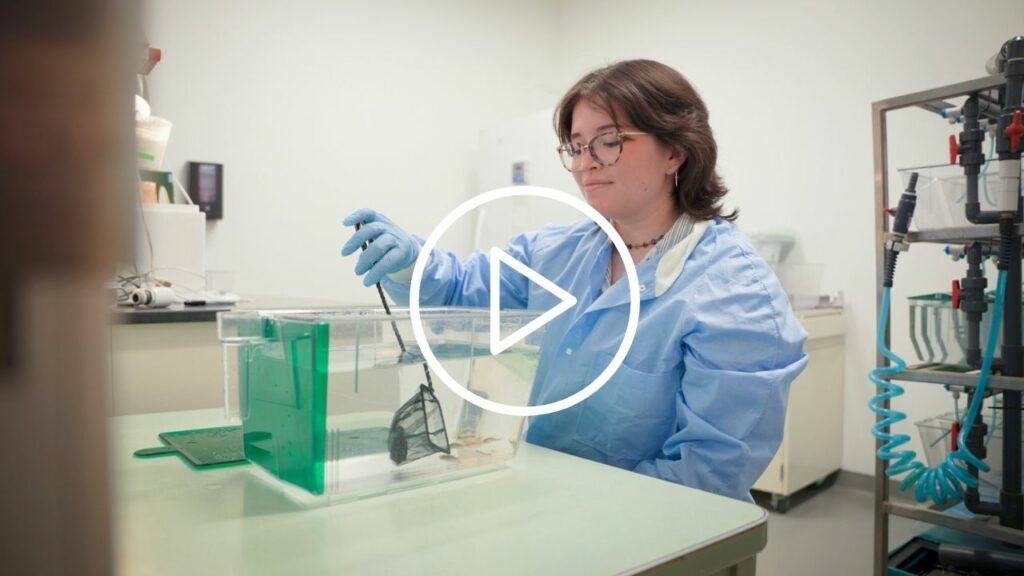
Video thumbnail showing a student working with zebra fish in a lab

Watch “How do PFAS affect Wisconsin’s fish?” (Video by Bonnie Willison / ASC)

In order to become big fish, baby fish face seemingly impossible odds. They evade predators, find food, and fend off disease — all while being smaller than the size of a fingernail. But what if contaminants in the water affect their ability to respond to those challenges and survive?

With funding from Wisconsin Sea Grant, University of Wisconsin–La Crosse Professor Tisha King-Heiden is studying how per- and polyfluoroalkyl substances, or PFAS, impact the nervous and immune systems of young fish. PFAS are a family of chemicals found in non-stick and waterproof household products, from food packaging to dental floss. They’re widespread in lakes and rivers across Wisconsin. 

“What I’m interested in is how exposure to environmental contaminants during early stages of embryonic development can lead to adverse health effects later on in life,” said King-Heiden. 

Her work on the project is personal. King-Heiden lives on French Island in Campbell, Wisconsin, where the groundwater is contaminated with PFAS. 

“It hit home pretty hard. I’ve been on bottled water now for going on five years,” she said. “So I just wanted to try to contribute a little bit more to understanding what the risks are and what they aren’t, because there’s still quite a few unknowns.”

New PFAS, new fish

With over 7,000 types of PFAS, King-Heiden is zeroing in on three newer chemicals: PFHxS, PFUNdA, and PFNA. Not much is known about how they affect fish, as past studies have primarily focused on older, “legacy” PFAS that are no longer used but remain in the environment. 

 ”The vast majority of information we have is on PFOA and PFOS. So those are […] the original PFAS chemicals,” she said.

PFHxS, PFUNdA, and PFNA have slightly different chemical structures than the legacy PFAS, which may affect how they accumulate in and affect fish. 

Another novel aspect of King-Heiden’s project is the type of fish she’s studying: fathead minnow, walleye, and sturgeon. Many PFAS studies use zebrafish, a popular lab species from southern Asia.

“I wanted to try something different and start working with some other prevalent species that are more ecologically and culturally relevant to people living in Wisconsin,” she said.

Measuring tail flicks and body bends

To evaluate the effects of PFAS on fish, King-Heiden and her team are collecting data on hatching success, growth, and immune system responses. They’ve also developed a series of behavioral tests to gauge how the nervous system develops.

The first test? Watching fish embryos for tail flicks.

“It’s the same thing that humans feel when they can start to feel the fetus moving,” said King-Heiden. “If they are flicking their tails too much, or if they’re not flicking them enough, it can give us an idea of how PFAS is impacting that nervous system development.”

After the fish hatch, the team then measures how well they can respond to stimuli. King-Heiden explained that during this time, fish develop neurons along their body that help them sense movement in the water. And when they do detect movement — a lurking predator, perhaps — the fish bends into the shape of “C” and swims away. It’s called a C-start response.

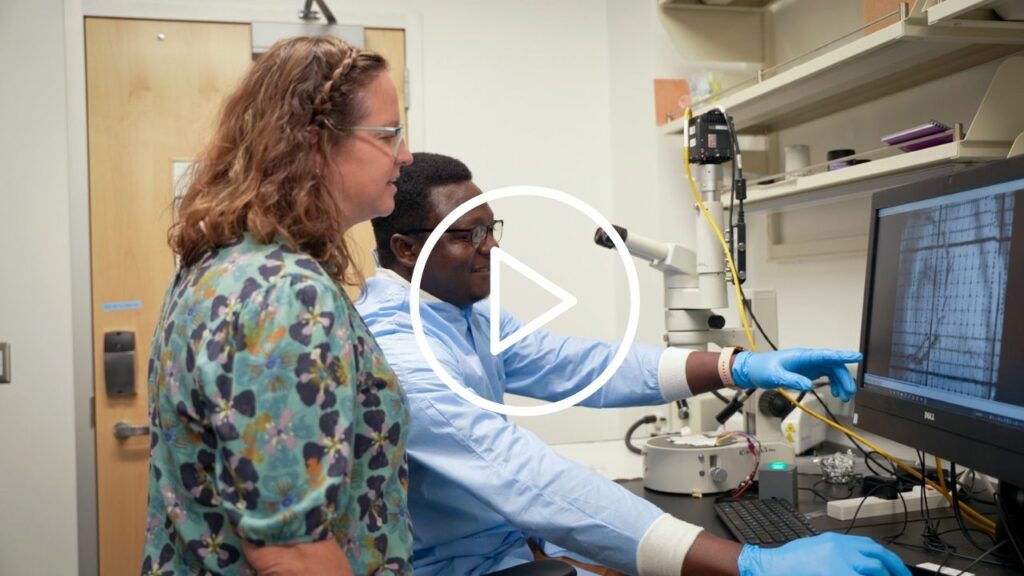
Video thumbnail showing Tisha King-Heiden and a student looking at a computer

Watch “The C-start: Sea Grant funded research.” (Video by Bonnie Willison / ASC)

“It’s an autonomic reflex, like the knee-jerk reflex,” she said. 

Using a high-speed camera, the team measures how long it takes for a fish to respond to a vibration sent through the water. The longer the response time, the more likely the neurons are damaged. 

The final behavioral test raises the stakes. Instead of contending with vibrations, a baby fish is placed in a container with a hungry adult fish.

“We give them a certain amount of time and see if the fish can actually escape that predator,” King-Heiden said. Cumulatively, the tests can indicate how the nervous system is developing and how baby fish might survive in the wild.

Protecting wild fish and people

While PFAS concentrations in lakes and rivers may not be high enough to kill baby fish, they could make them more susceptible to predation and disease. King-Heiden said that could spell trouble for wild fish populations, especially if they’re dealing with other issues, like invasive species. 

“If you add other environmental contaminants and stressors like disease to that mix, you can exacerbate the problem,” she said. 

Human health is also a concern, as people catch and eat fish from contaminated water. Understanding if and how the new PFAS accumulate in tissues of fish can help set consumption advisories that keep people safe. King-Heiden is also developing a communication campaign to engage local communities around PFAS, fish, and human health.

“We can try to help explain why it’s important for us to spend the money to clean up PFAS, to spend the money to support the research that’s going to find the most cost-effective way of cleaning up our drinking water for both human health as well as our wildlife,” she said. 

The post Measuring the impact of PFAS on Wisconsin’s fish first appeared on Wisconsin Sea Grant.

Original Article

News Releases | Wisconsin Sea Grant

News Releases | Wisconsin Sea Grant

https://www.seagrant.wisc.edu/news/measuring-the-impact-of-pfas-on-wisconsins-fish/

Jenna Mertz

PFAS compromise bills must limit spills law exemptions

UPDATE – March 17: River Alliance of Wisconsin applauds the Wisconsin State Senate for unanimously approving PFAS bills AB 130 and AB131 to send the bills to Governor Evers to sign. On February 20, the Wisconsin State Assembly voted unanimously on bills that would release the long-awaited PFAS trust fund money to help fund PFAS remediation projects.

Clean water advocates voiced clear concerns during the years-long debate over spending the state budget funds and how to define innocent landowners. Ultimately legislators wrote a compromise that will make some needed progress in creating remediation grants and some limited exemptions to the state’s Spills Law.

It is because of people living with PFAS pollution who have tirelessly steered legislators into action to meaningfully release funds for drinking water remediation in Wisconsin. We encourage Governor Evers to sign this legislation and state legislators to continue to work to ban the use of PFAS-style chemicals.


On January 21, 2026, state legislators held another hearing on policies and funding for addressing PFAS contamination. The bills are the result of many months of debate and compromise. Through the whole process, we’ve listened to leaders of impacted communities and experts across the state and held firm on three core issues.

We insisted that since the 2023 state budget was passed, the Joint Finance Committee has always had the power to release the over $125 million of funds earmarked for action on PFAS. Though JFC leaders refused to release the money to communities with contaminated water, this legislation would finally move dollars out the door.

We insisted that our state should not make Swiss cheese out of our Spills Law with broad and vague exemptions for corporate pollution accountability. While we would prefer fewer exemptions to the Spills Law, we understand the need to exempt truly passive receivers, like farmers.

Finally, we insisted that there was no community left behind when it comes to accessing the funds needed to test, filter and remediate drinking water resources. We cannot support a bill that would create new policies and grant programs without hiring state experts to administer grants and enforce laws. The only way we would support this legislation is with an amendment to hire adequate DNR staff.

With the legislative session winding down and elections coming this fall, legislators are under pressure to have some progress to report to their constituents. Governor Evers has signaled his optimistic support for this compromise. However, from the start, this bill was an effort to exempt big businesses under the guise of helping innocent landowners. Adding further exemptions to protect already identified polluters is unacceptable.

It is only due to the many hours – years, in fact – of vocal members of impacted communities and clean water advocates that got PFAS contamination to be a household word and to push state leaders to do the right thing for our water.

We’re only at the beginning of providing remedies for communities living with water pollution. The people of Wisconsin cannot wait for funds from lawsuit settlements over PFAS pollution to get help for their drinking water. The state legislature must release the funds, hire the staff, and set their sights on the next step which is to ban PFAS-style chemicals and prevent further damage to our water.

Contacting your legislators will make an impact. 

Please contact your State Representative to let them know the people of Wisconsin have waited for action on PFAS for far too long and they should support Assembly Substitute Amendment 1 to AB 131, and Assembly Substitute Amendment 1 to AB 130 without further exemptions. 


This message is made possible by generous donors who believe people have the power to protect and restore water. Subscribe to our Word on the Stream email newsletter to receive stories, action alerts and event invitations in your inbox.  Support our work with your contribution today.

The post PFAS compromise bills must limit spills law exemptions appeared first on River Alliance of WI.

Original Article

Blog - River Alliance of WI

Blog - River Alliance of WI

https://wisconsinrivers.org/pfas-bill-compromises/

Allison Werner

By Kelly House, Bridge Michigan

The Great Lakes News Collaborative includes Bridge Michigan; Circle of Blue; Great Lakes Now at Detroit PBS; Michigan Public, Michigan’s NPR News Leader; and The Narwhal who work together to bring audiences news and information about the impact of climate change, pollution, and aging infrastructure on the Great Lakes and drinking water. This independent journalism is supported by the Charles Stewart Mott Foundation. Find all the work HERE.

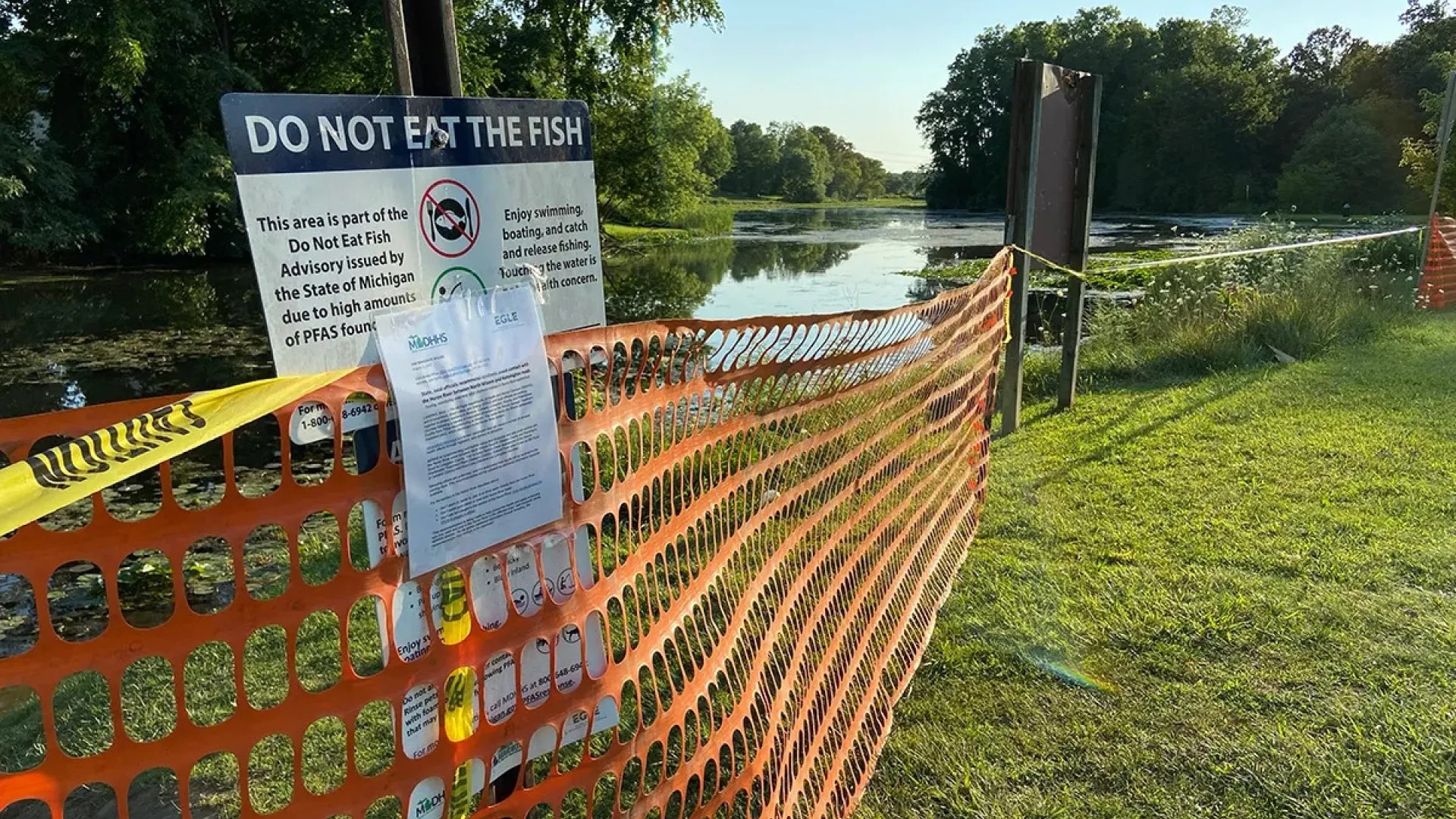
In the years since Michigan’s PFAS crisis became public knowledge, widespread contamination has prompted a growing list of “do not eat” advisories in waterways across the state.

But a study published this month in the Journal of Great Lakes Research offers hope that, one day, the fish could be safe to eat again.

The study was conducted by researchers in the former US Environmental Protection Agency Office of Research and Development, which the Trump administration has since dismantled amid a broad push to curtail federal oversight and loosen regulations on a host of chemicals, including PFAS.

Using decades’ worth of archived lake trout and walleye samples originally collected to track older pollutants like mercury and PCBs, scientists discovered PFAS levels in Great Lakes fish have declined significantly since the late 2000s, when manufacturers began phasing out once-common compounds like PFOS and PFOA amid growing regulatory pressure.

“The ecosystem responded very quickly to these changes in industrial production,” said Sarah Balgooyen, a lead author of the study and former EPA chemist who is now a researcher at the Colorado School of Mines.

A growing body of research has linked certain PFAS (an acronym for a class of thousands of chemicals known as per- and polyfluoroalkyl substances) to cancer, thyroid problems and developmental, fertility and immunity challenges.

The research team tested for 45 compounds, using fish taken from the Great Lakes between 1975 and 2020. They found that average contamination levels by 2020 had reached their lowest since the 1980s.

In Lake Erie, for example, PFAS levels in the freeze-dried tissue samples peaked at close to 450 nanograms per gram in 2005 but were closer to 50 nanograms per gram in 2020. In Lake Michigan, levels reached a high of about 150 nanograms per gram in 2010 before drifting down to about 80 nanograms per gram in 2020.

“We hope to see that trend continue,” Balgooyen said.

That’s welcome news to Chris Matteson, a 76-year-old from Muskegon who has been fishing in the Great Lakes since the days when factories lined the shore, spewing effluent so foul that, “if you could see a foot into the water, that was pretty good.”

“I’ve been through a lot of fish warnings,” Matteson said.

Although PFAS manufacturers have known their products are toxic since at least the 1970s, the public wouldn’t learn until decades later. Unregulated use of the so-called “forever chemicals” allowed them to escape into the environment, poisoning drinking water and embedding in the bodies of humans, fish and wildlife.

Only in recent years — after a series of contamination scandals — have state and federal governments begun regulating PFAS and investigating the extent of the pollution.

In 98 Michigan water bodies, some fish species are so full of PFAS that state health officials say it’s not safe to eat them. Health advisories in hundreds more water bodies call for limiting meals to anywhere from 16 servings a month to six a year.

Michigan Department of Health and Human Services spokesperson Lynn Sutfin said agency staff are reviewing the study.

For now, she said, “our advice for anglers remains the same: To learn how to choose safer fish to eat, follow the Eat Safe Fish Guides.”

Find out whether your local fishing spot is affected here.

Gary Ankley, a former EPA research toxicologist and coauthor on the study, said the declining PFAS levels are encouraging. But there is no way to know how low PFAS levels will ultimately fall.

Known as “forever chemicals” because they don’t break down readily in the environment, some amount of PFAS will remain in the lake indefinitely, Ankley predicted.

Balgooyen cautioned that the study offers only a partial picture of PFAS risks in the lakes.

While manufacturers have largely stopped using the so-called “long-chain” PFAS compounds that tend to bioaccumulate in fish, many have switched to new “short-chain” compounds that do not.

The health risks of those newer compounds have not been well-studied.

“We’re seeing decreases in these compounds that we know are harmful, which is great,” Balgooyen said. “But there’s still this unknown component of the replacement chemicals.”

Citing evidence that PFAS is more toxic than previously thought, state and federal regulators in recent years have lowered allowable PFAS levels in drinking water and taken other steps to discourage the chemicals’ use.

Seeking to make the EPA more business-friendly, the Trump administration has reversed some of those actions, announcing plans to loosen PFAS drinking water standards and requirements for manufacturers to report their PFAS use.

EPA Administrator Lee Zeldin called those “commonsense” changes that would lower costs for industries and water providers while still protecting the public.

But Matteson, the Muskegon fisherman, views the administration’s loosening of environmental regulations differently.

“The companies will go back to the easiest, cheapest way to do anything,” he said. “Most likely, it isn’t environmentally friendly.”

The post PFAS levels are declining in Great Lakes fish, new research shows appeared first on Great Lakes Now.

Original Article

Great Lakes Now

Great Lakes Now

https://www.greatlakesnow.org/2026/01/26/pfas-levels-are-declining-in-great-lakes-fish-new-research-shows/

Bridge Michigan

It hadn’t been a successful morning for the Great Lakes Eagle Health team.

Traveling by boat, truck, and foot, the team was searching for active eagle nests along the Wisconsin River in Nekoosa, Wisconsin. Tree one was a dud, and tree two, a heartbreaker. Dan Goltz, one of the team’s climbers and a wildlife biologist with the Wisconsin Department of Natural Resources, scaled a 70-foot tree only to be met with a gentle breeze blowing through an empty nest.

“It’s always a nice view,” he sighed, coiling his rope for the next climb. 

The team, however, had reason to be optimistic about tree number three, located on the grounds of a paper products factory on the river.

For one, it was streaked with whitewash, or eagle poop. Loathe to defecate inside their nests, baby eagles poop off the sides, spraying the ground with what looks like white paint. Fresh whitewash usually indicates an active nest. 

The second promising sign was that the tree was a white pine — Goltz’s favorite. Unlike cottonwoods, whose deeply furrowed bark could chip off under the pressure of spurred boots, white pines are smooth and offer stability. Goltz’s footholds would be more secure, and his climb, safer. Snapping on a hot pink helmet, he spiked his shoes into the trunk and began to haul himself upward.

And then there was what was happening above Goltz’s head. A bald eagle, clear against the high-noon sky, flew into view and began to circle and chirp. A second soon joined to voice its displeasure at the man approaching the nest.

“That’s a great sign when you hear the bird chirping at you like that,” said Brian Dhuey, WDNR research technician, peering through the trees. “It means there’s something to protect.”

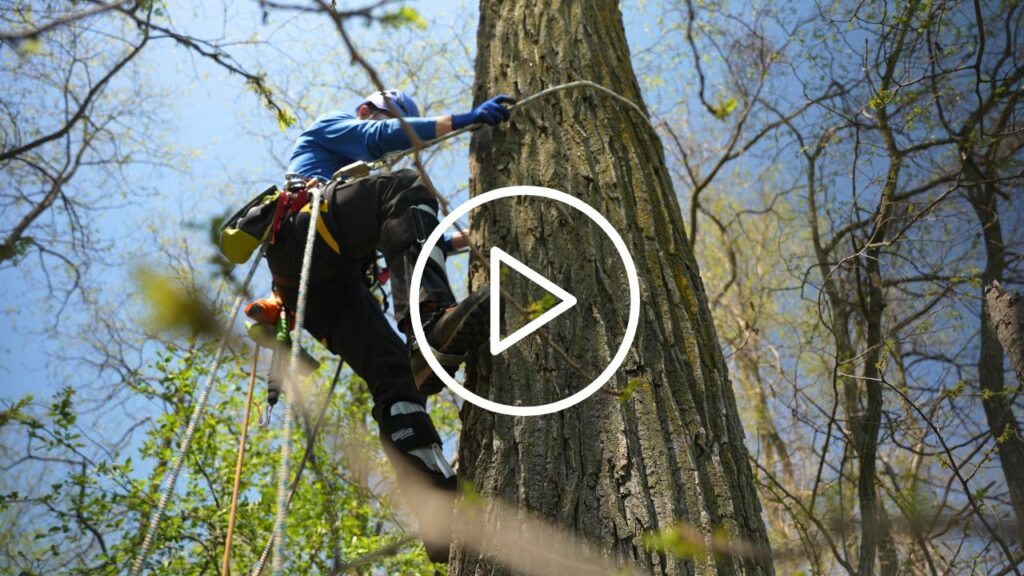
A professional tree climber begins to climb a tree.

Learn about tree climbing from Great Lakes Eagle Health Project team member Matt Stuber. (Video by Bonnie Willison / ASC)

The presence of the eagles energized the team on the ground. Lindsey Long, a WDNR wildlife veterinarian, kneeled on a blue tarp and began to unpack her sampling equipment: tubes, syringes, glass slides, a small machine that repels mosquitoes. Two volunteers huddled closer and listened as she explained protocol for taking blood. Dhuey shuffled among the dry leaves.

Now, they waited. Necks craned toward the sky, the team watched Goltz climb, hoping for news of a bird.

What eagles can tell us

The Great Lakes Eagle Health Project has tracked contaminant levels in bald eagles across Wisconsin since 1990. Currently funded by the National Oceanic and Atmospheric Administration (NOAA) and U.S. Geological Survey, the project brings together federal, state, tribal, and academic partners to test eagles for a variety of pollutants, like heavy metals and PCBs, and investigate how they’re affecting eagle health.

In 2023, Wisconsin Sea Grant’s emerging contaminants specialist Gavin Dehnert joined the project to investigate a new problem: per- and polyfluoroalkyl substances, or PFAS. 

Dubbed “forever chemicals,” PFAS don’t break down easily and are found in common household products like non-stick pans and water-repellant clothing. They’re harmful to human health and have been found in high concentrations in drinking water in communities across Wisconsin, like French Island and Marinette.

Dehnert, who has studied PFAS in maple syrup, wild rice, and fish, said eagles are what’s known as a “sentinel species,” organisms that can alert humans to environmental toxins — like a canary in a coal mine. Due to their diet, bald eagles are particularly good indicators of how much PFAS are in the environment.

“They eat a lot of the same foods that we do,” said Dehnert, like fish and deer. “And because they also eat both aquatic and terrestrial food sources […], they give us a really good idea of how much contamination is in the area.”

Two young eagles with entirely dark brown bodies in a nest.

Eaglets in the nest. (Photo by Matt Stuber)

The team exclusively takes blood samples from baby eagles, called nestlings, that are younger than 12 weeks old. Because they cannot fly, the nestlings’ main exposure to PFAS is from the food their parents bring. This means that their blood samples provide clues to how contaminants are moving through and accumulating in the food web.

Each year, the team chooses different sampling sites. In May of 2025, they focused on the Wisconsin River, spending two weeks sampling eagles from Prairie du Chien to Minocqua.

“Because the Wisconsin River is so long and vast, it gives us a really good gradient of how these PFAS levels are changing,” said Dehnert. The team expects levels to be higher in the middle section of the river due to the presence of industries that have historically used PFAS.

In addition to measuring PFAS levels, Dehnert and Emily Cornelius Ruhs, an ecoimmunologist and postdoctoral researcher at the Field Museum, are studying how the contaminants affect eagle health, specifically their physical bodies and immune function. Do PFAS weaken eagles’ ability to fight off illness? Do they impact hormone levels? How are eagles growing and developing?

“We don’t know a lot about it or how it impacts wildlife,” said Cornelius Ruhs.

But a lot of information can be gleaned from a blood sample.

Landing the bird

The news was good. Secured to the tree with ropes, Goltz had peered across the eagles’ platform of sticks and declared there was not one, but two nestlings in tree number three. The task now was to safely transport the birds through the canopy to the team below.

Long mused at the feat from her spot on the blue tarp.

“The climber has to get that in a bag by himself,” she said. “It’s pretty amazing, the skillset that they have. Both of our climbers are also really, really, good at bird handling and are really conscientious.”

The climbers use what’s essentially a chicken hook — a tripod leg with a hook on the end — to coax the eagles toward their bag. Goltz’s hook had green glitter on it, which, he deadpanned, mesmerized the birds.

A joke, perhaps, but sometimes the rally cap prevails. Goltz’s bag lowered into view, and Dhuey swiftly claimed it.

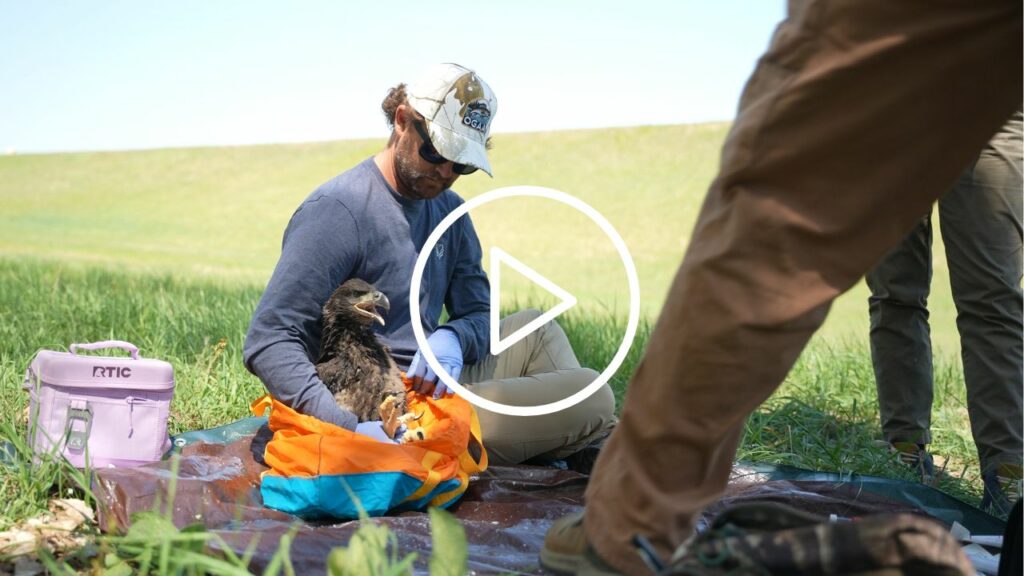
Bird in tow, Dhuey walked back over to the team. He weighed the bird, still in its drawstring pouch, and knelt next to Long. With blue surgical gloves on their hands, they peeled back the bag to reveal the fluffy bundle they’d been chasing all morning. Dhuey held the bird as Long made final preparations for the blood draw.

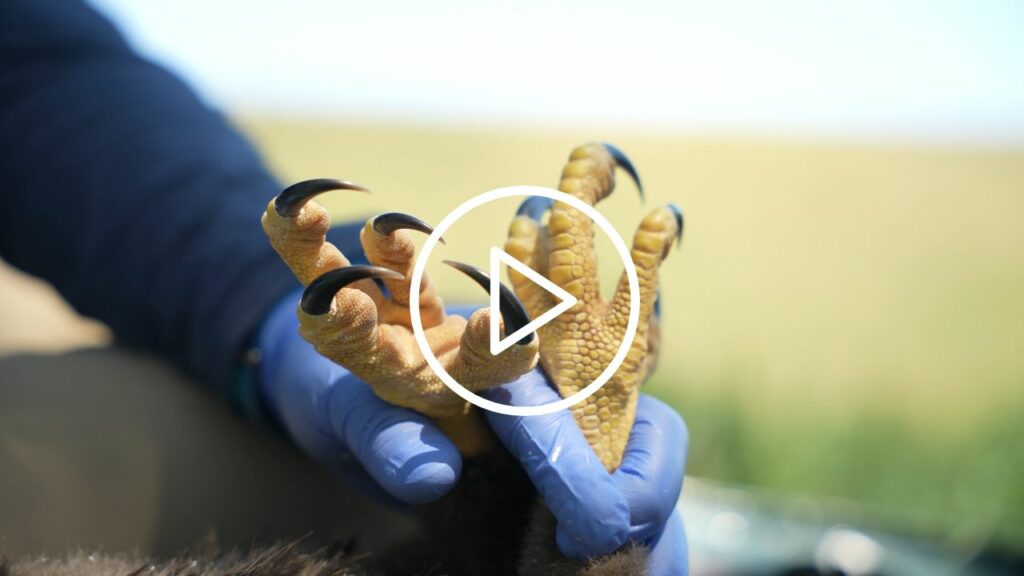
“Want to see a baby dragon?”

Close-up of an eaglet's talons.

See the scientists sampling eaglets on the ground in this video. (Video by Bonnie Willison / ASC)

Chocolate brown with sulfurous yellow feet, the nestling was no less striking than its parents. Its talons were curved and black, and under Dhuey’s strategic grip, they looked positively reptilian. The eaglet looked around at the team, a breeze riffling its feathers.

Long was ready. She helped Dhuey lay the nestling on its back and covered its head to keep it calm. One hand holding the feet, one hand unfurling the wing, Dhuey secured the bird. Long grabbed the syringe. The choreography between them was familiar and swift, two researchers practiced in the art of data collection.

Long crouched over the wing. Earlier, she said taking blood from an eagle is like taking blood from a human. Cold temperatures and dehydration can make the draw harder.

“Sometimes we have to do a little manipulation,” said Long, “just like if you’re at the hospital and they’re like, can you pump? Or, you need to move your arm a certain way or make a shift.”

On this unusually warm day in early May, the eagle wasn’t cold or dehydrated. Dark red began to spiral through a thin tube into the syringe.

Keeping eagles in the sky

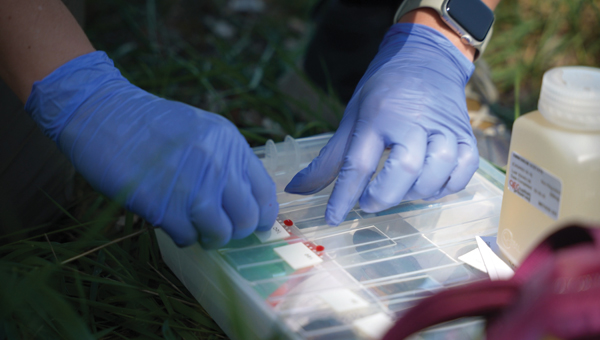
Once collected, the blood samples are smeared onto slides and prepared for further testing. That’s where ecoimmunologist Cornelius Ruhs comes in. Her job is to decode what the blood says about the nestlings’ health.

“The blood sample is used for many things. The first one is a white blood cell count,” she said. “And that’s pretty much the same as what you would get at a doctor’s office, like a CBC or blood panel.”

Cornelius Ruhs also measures total antibody levels in the bird’s blood, levels of two different thyroid hormones, and corticosterone, a stress hormone. Additionally, the team is running a new test that’s only been done on humans and other primates. Known as an “ex vivo blood challenge,” the test mimics bacterial and viral infections in a tube containing live blood from the bird. The blood can then be sent off and analyzed for how it responded to the challenges.

Gloved hands holding glass slides with single drops of red blood on them over a container of glass slides.

Emily Cornelius Ruhs smears blood samples onto slides. (Photo by Bonnie Willison / ASC)

All these data points tell a story about how well a baby eagle can fight off infection, like bird flu. The hypothesis is that “being exposed to high levels of PFAS might cause [eagles] to not respond as well or mount a response to a viral or a bacterial challenge,” said Cornelius Ruhs.

And that’s a concern for an iconic bird that was, in the 1960s, nearly extinct. “Bald eagles have been hit so hard by contaminants in the past, like DDT,” said Cornelius Ruhs.

Prior to being banned in 1972, DDT was widely used to kill mosquitoes, but it also weakened the eggshells of birds like bald eagles that ate contaminated fish. The eggs cracked under the weight of the incubating birds, causing reproduction rates to fall.

Long-term studies like the Great Lakes Eagle Health Project, however, can sound the alarm before something like that happens again. Bald eagles are beloved birds, and many folks want to continue seeing them thrive.

“This project is really special, I think, to all of us, not just because we get along so well and we all enjoy working with each other, but just because of the uniqueness to it,” said Cornelius Ruhs. “I don’t think a lot of people get to work with these large, majestic animals.”

A good day’s work

In under 10 minutes, the team had taken blood and measured beak, wings, and feet. Dhuey then snapped a lightweight metal band to the eagle’s ankle, a way to track and identify the bird. The cuff glinted like new jewelry above the outsized yellow feet.

Long and Dhuey then gently folded the bag over the bird to be ferried back up the tree as quickly as it came down.

The experience at tree number three went unrivaled. After lunch — the team had gotten ice cream, they claimed, to ensure their good fortune — they found an unoccupied nest in a cranberry bog and ended the day with another eagle-less climb up a tall white pine near the river.

Gavin Dehnert takes an eaglet out of a bag to start sampling.

It’s not every day that you get to handle baby bald eagles. Team co-leader Gavin Dehnert reflects on the awe he feels every time he’s in the field in this video. (Video by Bonnie Willison / ASC)

It was clear that camaraderie kept the team going, even during the busts. They work two weeks together every year, crammed in aluminum boats, fighting heat and mosquitoes, processing blood samples in hotel parking lots. Several team members said they spend the weeks following field season looking out of car windows, looking for nests. They can’t help it.

This spring, it’s the Mississippi River.

“Every day is just getting us back to eagle sampling field season,” said Cornelius Ruhs.

***

The University of Wisconsin Aquatic Sciences Center administers Wisconsin Sea Grant, the Wisconsin Water Resources Institute, and Water@UW–Madison. The center supports multidisciplinary research, education, and outreach for the protection and sustainable use of Wisconsin’s water resources. Wisconsin Sea Grant is one of 34 Sea Grant programs supported by the National Oceanic and Atmospheric Administration in coastal and Great Lakes states that encourage the wise stewardship of marine resources through research, education, outreach, and technology transfer.

The post Dispatches from a sentinel species: Measuring PFAS and overall health in bald eagles first appeared on Wisconsin Sea Grant.

Original Article

News Releases | Wisconsin Sea Grant

News Releases | Wisconsin Sea Grant

https://www.seagrant.wisc.edu/news/eagles/

Jenna Mertz

$18M approved in bill credits for Pennsylvania customers in ‘forever chemicals’ settlement

Catch the latest updates on what’s happening with PFAS in the Great Lakes region. Check back for more PFAS news roundups every other week on our website.


The Pennsylvania Public Utility Commission recently approved a proposal from the Pennsylvania-American Water Company (PAWC) to issue over $18 million in bill credits to customers.

Read Now at Great Lakes Now.

Original Article

Great Lakes Now

Great Lakes Now

https://www.greatlakesnow.org/2025/11/more-than-18m-approved-in-bill-credits-for-pennsylvania-customers-in-forever-chemicals-settlement/

Lisa John Rogers, Great Lakes Now

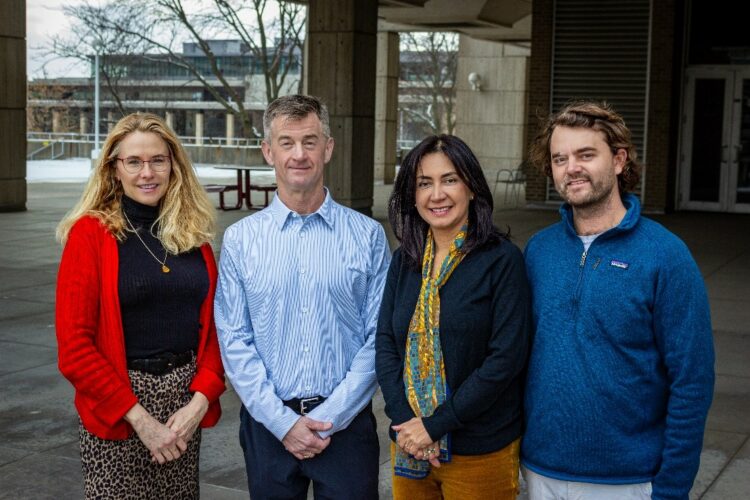
The PFAS research team: Lyn van Swol, Bret Shaw, Cristina Carvajal, Gavin Dehnert.

The PFAS research team: Lyn van Swol, Bret Shaw, Cristina Carvajal, Gavin Dehnert. Image credit: Hannah Hein of University of Wisconsin–Madison

A new study recently published in the “Journal of Environmental Health shows that large numbers of Americans are searching online for ways to reduce their exposure to PFAS, a group of synthetic “forever chemicals” found in everything from nonstick pans to takeout containers.

The research also showed that when people did search for PFAS — which is short for per- and polyfluoroalkyl substances — they focused specifically on how to filter the chemicals from their drinking water.

“People are clearly trying to take action,” said Bret Shaw, a professor in the Department of Life Sciences Communication and the Division of Extension at the University of Wisconsin–Madison and co-author of the study. “They’re looking for actionable steps they can take to protect their families, and public health messaging needs to support their informational needs. We need to focus on actionable advice.”

Shaw and the study’s authors analyzed Google search data using Semrush, a digital analytics platform, to find out what kinds of questions people are asking about PFAS in drinking water.

These substances have the attention of scientists and environmental agencies because they don’t break down easily, which is what makes them useful in consumer products but also concerning for human health. Research has linked PFAS compounds to a range of problems such as cancers, reproductive issues, immune system effects, and more. The U.S. Environmental Protection Agency says nearly everyone in the U.S. has detectable levels of PFAS in their blood.

The research team’s goal is to help create messages that use the language audiences use and answer the questions they are asking. Their findings showed that nearly half of all PFAS- and water-related searches are about how to filter or remove them from tap water. Other common queries included things like “What are PFAS in water?” and questions about PFAS in bottled or sparkling water.

Interestingly, while “PFAS” had high search volume, other more specific terms like “PFOA” or “PFOS” didn’t, and even the commonly used phrase “forever chemicals” wasn’t searched as often.

“If your public health info doesn’t use the words people are typing into Google, they’re probably not going to find it,” said Tim Holland, lead author and Ph.D. student at UW–Madison’s Nelson Institute for Environmental Studies. “Even if it’s accurate, it’s not helpful if it doesn’t show up.”

The study suggests that public health communicators could improve outreach and communication efforts by focusing on search behavior, especially for issues like PFAS, where the science is complex and the interest in taking action has increased.

“In order to best communicate PFAS, it is essential to know what people are searching for,” said Gavin Dehnert, an emerging contaminants scientist and one of the research authors with Wisconsin Sea Grant. “It allows communicators to meet people where they are to create conversation around a difficult subject.”

Other co-authors include Professor Lyn Van Swol and Rachel Hutchins from the Department of Communication Arts at UW–Madison. Other partners include UW–Madison Division of Extension, the Wisconsin Department of Health Services, the Wisconsin Department of Natural Resources, Public Health Madison & Dane County, and the UniverCity Alliance.

The study is part of a larger project coordinated by Illinois-Indiana Sea Grant that addresses PFAS knowledge gaps in the Great Lakes region.

***

The University of Wisconsin Aquatic Sciences Center administers Wisconsin Sea Grant, the Wisconsin Water Resources Institute, and Water@UW.  The center supports multidisciplinary research, education, and outreach for the protection and sustainable use of Wisconsin’s water resources. Wisconsin Sea Grant is one of 34 Sea Grant programs supported by the National Oceanic and Atmospheric Administration in coastal and Great Lakes states that encourage the wise stewardship of marine resources through research, education, outreach, and technology transfer.

The post New study shows Americans searching for ways to reduce PFAS exposure through drinking water first appeared on Wisconsin Sea Grant.

Original Article

News Releases | Wisconsin Sea Grant

News Releases | Wisconsin Sea Grant

https://www.seagrant.wisc.edu/news/new-study-shows-americans-searching-for-ways-to-reduce-pfas-exposure-through-drinking-water/

Andrew Savagian

Baby bald eagles tested positive for PFAS and other legacy contaminants


Catch the latest updates on what’s happening with PFAS in the Great Lakes region. Check back for more PFAS news roundups every other week on our website.


According to reporting by MLive, two researchers are studying blood samples from bald eagles across Michigan and the Great Lakes basin for evidence of chemical exposure to things like PFAS, DDT or PCBs — which were both banned in 1972 and 1979.

Read Now at Great Lakes Now.

Original Article

Great Lakes Now

Great Lakes Now

https://www.greatlakesnow.org/2025/07/baby-bald-eagles-tested-positive-for-pfas-and-other-legacy-contaminants/

Lisa John Rogers, Great Lakes Now

Wisconsin DNR expands private well PFAS testing to five Oneida County townships

By Katie Thoresen, WXPR

This story was originally published by WXPR. WXPR is a community-licensed public radio station serving north central Wisconsin and adjacent areas of Michigan’s Upper Peninsula. Listen to their stories here.

People on private wells in five Oneida County Townships in Wisconsin may be offered free PFAS testing.

Read Now at Great Lakes Now.

Original Article

Great Lakes Now

Great Lakes Now

https://www.greatlakesnow.org/2025/07/wisconsin-dnr-expands-private-well-pfas-testing-five-oneida-county-townships/

WXPR

‘Forever chemicals’ found nationwide in Canada, CBC map shows

Catch the latest updates on what’s happening with PFAS in the Great Lakes region. Check back for more PFAS news roundups every other week on our website.


CBC News released an interactive map illustrating PFAS hotspots across Canada, revealing widespread “forever chemical” contamination in every province and territory.

Read Now at Great Lakes Now.

Original Article

Great Lakes Now

Great Lakes Now

https://www.greatlakesnow.org/2025/05/forever-chemicals-found-nationwide-in-canada-cbc-map-shows/

Donte Smith

EPA Outlines New PFAS Strategy Amid Expert Concerns

Catch the latest updates on what’s happening with PFAS in the Great Lakes region. Check back for more PFAS news roundups every other week on our website.

On May 14, the U.S. Environmental Protection Agency (EPA) announced their plan to roll back significant portions of the Biden administration’s first nationwide drinking water standard for PFAS.

Read Now at Great Lakes Now.

Original Article

Great Lakes Now

Great Lakes Now

https://www.greatlakesnow.org/2025/05/epa-outlines-new-pfas-strategy-amid-expert-concerns/

Donte Smith

EPA nixes PFAS grants, teases new strategy

Catch the latest updates on what’s happening with PFAS in the Great Lakes region. Check back for more PFAS news roundups every other week on our website.

On April 15, U.S. Environmental Protection Agency (EPA) staff were told to cancel tens of millions of dollars worth of pending and active grants.

Read Now at Great Lakes Now.

Original Article

Great Lakes Now

Great Lakes Now

https://www.greatlakesnow.org/2025/04/epa-nixes-pfas-grants-teases-new-strategy/

Lisa John Rogers, Great Lakes Now

Susan Crawford’s Wisconsin Supreme Court win could be a win for PFAS

Catch the latest updates on what’s happening with PFAS in the Great Lakes region. Check back for more PFAS news roundups every other week on our website.

On Tuesday, April 1, Susan Crawford won Wisconsin’s contentious Supreme Court election.

Read Now at Great Lakes Now.

Original Article

Great Lakes Now

Great Lakes Now

https://www.greatlakesnow.org/2025/04/susan-crawfords-wisconsin-supreme-court-win-could-be-a-win-for-pfas/

Lisa John Rogers, Great Lakes Now

Veteran Great Lakes advocate cautions on prioritizing economic development over protecting the environment

Rolling back clean water protection, gutting agencies and defunding science, research and monitoring is a non-starter for the Great Lakes region, says Ann Arbor environmental advocate Laura Rubin.

She was reacting to the new U.S. Environmental Protection Agency (EPA) administrator Lee Zeldin’s recently released economy-oriented plan for the agency under President Donald Trump.

Read Now at Great Lakes Now.

Original Article

Great Lakes Now

Great Lakes Now

https://www.greatlakesnow.org/2025/02/veteran-great-lakes-advocate-cautions-prioritizing-economic-development-over-protecting-environment/

Gary Wilson, Great Lakes Now

New York’s proposed PFAS legislation and other Great Lakes states latest efforts to combat ‘forever chemicals’

Catch the latest updates on what’s happening with PFAS in the Great Lakes region. Check back for more PFAS news roundups every other week on our website.

On February 5, New York state lawmakers announced a group of five bills aimed to reduce per- and polyfluoroalkyl substances (PFAS) exposure for New York residents.

Read Now at Great Lakes Now.

Original Article

Great Lakes Now

Great Lakes Now

https://www.greatlakesnow.org/2025/02/new-york-proposed-pfas-legislation-other-great-lakes-states-efforts-combat-forever-chemicals/

Lisa John Rogers, Great Lakes Now

Wisconsin is still sitting on $125 million for PFAS cleanup

This article, first posted here, was republished with permission from Wisconsin Watch.

By Bennet Goldstein, Wisconsin Watch

A year and a half after Wisconsin lawmakers earmarked $125 million to clean up toxic “forever chemicals” known as PFAS, the funds have yet to flow to contaminated communities.

Read Now at Great Lakes Now.

Original Article

Great Lakes Now

Great Lakes Now

https://www.greatlakesnow.org/2025/02/wisconsin-is-still-sitting-on-125-million-for-pfas-cleanup/

Wisconsin Watch

CDC awards biomonitoring grants to Great Lakes states, future funding unclear

This article was republished here with permission from Great Lakes Echo.

By Isabella Figueroa, Great Lakes Echo

New grants to Great Lakes states to measure harmful chemicals in marginalized communities are facing uncertainty under increased White House scrutiny on federal spending.

In September 2024, the Centers for Disease Control and Prevention awarded a first round of $5 million across six state biomonitoring programs that measure chemicals in people.

Read Now at Great Lakes Now.

Original Article

Great Lakes Now

Great Lakes Now

https://www.greatlakesnow.org/2025/02/cdc-awards-biomonitoring-grants-to-great-lakes-states-future-funding-unclear/

Great Lakes Echo

Blue Tech challenge aims at gathering business solutions to Great Lakes problems

By Izzy Ross, Interlochen Public Radio

This coverage is made possible through a partnership with IPR and Grist, a nonprofit independent media organization dedicated to telling stories of climate solutions and a just future.

A business competition to tackle environmental and infrastructure issues in the Great Lakes kicked off last week.

Read Now at Great Lakes Now.

Original Article

Great Lakes Now

Great Lakes Now

https://www.greatlakesnow.org/2025/02/blue-tech-challenge-aims-at-gathering-business-solutions-to-great-lakes-problems/

Interlochen Public Radio

Study shows smart watch wristbands contain PFAS, meanwhile EPA tracks nine new versions of ‘forever chemicals’

Catch the latest updates on what’s happening with PFAS in the Great Lakes region. Check back for more PFAS news roundups every other week on our website.

A new study out of Notre Dame shows that some smart watch wristbands, often labeled as waterproof, contain unusually high levels of “forever chemicals.” In a university press release, it was noted that nine out of the 22 bands tested, showed elevated levels of a per- and polyfluoroalkyl substance (PFAS).

Read Now at Great Lakes Now.

Original Article

Great Lakes Now

Great Lakes Now

https://www.greatlakesnow.org/2025/01/study-shows-smart-watch-wristbands-contain-pfas-meanwhile-epa-tracks-nine-new-versions-of-forever-chemicals/

Lisa John Rogers, Great Lakes Now

Caption: Gavin Dehnert, an emerging contaminants scientist at Wisconsin Sea Grant, investigates the impact of emerging contaminants on aquatic ecosystems. Photo Credit: Wisconsin Sea Grant.

Coastal and estuarine waters are important for human and ecosystem health. Contaminants of emerging concern (CECs) are regularly detected in these waters; however, little is known about how they are transported, where they accumulate and their final destinations. There is also a lack of research on the health risks they pose to humans and aquatic life. It is critical to continue to support ongoing monitoring efforts and to address knowledge gaps around CEC exposures, which Sea Grant has established with previous funding.

For the last four years, Congress has directed Sea Grant to collaborate with state agencies and universities to expand emerging contaminant research and monitoring. Sea Grant is pleased to announce two projects receiving approximately $984,000 in federal funding in 2024. These projects were competitively selected through an opportunity focused on CECs. The projects, detailed below, will lead regional research competitions in the Southeast and Great Lakes regions focused on addressing CEC information needs. 

2024 project descriptions:

Wisconsin Sea Grant

Quantifying the health impacts of emerging and legacy contaminants on an apex bird predator in the Great Lakes region

Federal funding: $484,400

Project lead: Christina Remucal and Gavin Dehnert

Wisconsin Sea Grant plans to sample bald eagle nestlings, game fish and water from areas in Wisconsin, Minnesota and Michigan known to have per- and polyfluoroalkyl substances (PFAS) contamination. Researchers anticipate elevated PFAS levels near historical contamination sites and expect varying levels in game fish, which could lead to updating fish consumption guidelines. This study will inform long-term monitoring and bioremediation efforts and provide insights into the potential health impacts on both humans and wildlife. The findings will benefit local communities, including tribal nations, by offering updated fish consumption recommendations and contributing to future PFAS research.

The National Sea Grant Law Center

Strengthening and expanding regional CEC initiatives to promote research-to-application partnerships

Federal funding: $500,000

Project lead: Stephanie Otts

The National Sea Grant Law Center will assess and address the risks posed by contaminants of emerging concern to local communities through an interdisciplinary approach that involves both science and outreach. They will provide funding to the South Carolina Sea Grant Consortium for research projects through their contaminants grant program and will support partnership development in the Great Lakes and Southeast regions through a competitive grant process. The expected outcomes include a better understanding of the types, prevalence and movement of contaminants in the Southeast, stronger collaboration between researchers and policymakers in both regions, the creation of research-to-application partnerships that can serve as future models, and improved integration of research into policy decisions.


The post Sea Grant announces new projects to address community needs regarding contaminants of emerging concern first appeared on Wisconsin Sea Grant.

Original Article

News Releases | Wisconsin Sea Grant

News Releases | Wisconsin Sea Grant

https://www.seagrant.wisc.edu/news/sea-grant-announces-new-projects-to-address-community-needs-regarding-contaminants-of-emerging-concern/

Wisconsin Sea Grant

PFAS Roundup: Minnesota votes to continue conservation and PFAS cleanup, Indiana ends firefighter foam collection program

Over 77% of voters in Minnesota approved an extension of the Environmental and Natural Resources Trust Fund (ENRTF), that will continue to pay for conservation efforts for another 25 years. Funding for this casts a wide net, from outdoor education and trail investments, to invasive species and PFAS removal. The ENRTF was approved as an amendment to the Minnesota Constitution of the State in 1988, and generates funding from the Minnesota State Lottery. 

Read Now at Great Lakes Now.

Original Article

Great Lakes Now

Great Lakes Now

https://www.greatlakesnow.org/2024/11/pfas-roundup-minnesota-votes-to-continue-conservation-and-pfas-cleanup-indiana-ends-firefighter-foam-collection-program/

Lisa John Rogers, Great Lakes Now

Students at Michigan State and Wisconsin win EPA funding for environmental health innovations

This article was republished here with permission from Great Lakes Echo.

By Isabella Figueroa, Great Lakes Echo

Student researchers from Michigan State University and the University of Wisconsin are among the winners of an Environmental Protection Agency contest for innovations in sustainability.

Read Now at Great Lakes Now.

Original Article

Great Lakes Now

Great Lakes Now

https://www.greatlakesnow.org/2024/11/students-at-michigan-state-and-wisconsin-win-epa-funding-for-environmental-health-innovations/

Great Lakes Echo

Mining is back in Michigan’s Upper Peninsula. Here’s how it works

By Kelly House, Bridge Michigan

The Great Lakes News Collaborative includes Bridge Michigan; Circle of Blue; Great Lakes Now at Detroit Public Television; Michigan Public, Michigan’s NPR News Leader; and The Narwhal who work together to bring audiences news and information about the impact of climate change, pollution, and aging infrastructure on the Great Lakes and drinking water.

Read Now at Great Lakes Now.

Original Article

Great Lakes Now

Great Lakes Now

https://www.greatlakesnow.org/2024/10/mining-is-back-in-michigans-upper-peninsula-heres-how-it-works/

Bridge Michigan

PFAS Roundup: Vice President Harris supports Michigan-led plan to provide medical care for military victims of PFAS

Michigan Democratic Sen. Debbie Stabenow and Rep. Dan Kildee introduced The Veterans Exposed to Toxic PFAS Act in July of 2023. Recently, Vice President Kamala Harris announced her support for the bill as a part of her presidential campaign. If passed, this would make it easier for veterans who were exposed to perfluoroalkyl and polyfluoroalkyl substances (PFAS) while serving to access medical benefits and disability. 

Read Now at Great Lakes Now.

Original Article

Great Lakes Now

Great Lakes Now

https://www.greatlakesnow.org/2024/10/pfas-roundup-vice-president-harris-supports-michigan-led-plan-to-provide-medical-care-for-military-victims-of-pfas/

Lisa John Rogers, Great Lakes Now

PFAS Roundup: Minnesota PFAS regulation said to be the strictest

In a few months, many products with “forever chemicals” will be officially banned in Minnesota. Known as Amara’s Law, starting January 1, 2025 resident’s won’t be able to sell or distribute products with intentionally added PFAS from cookware, cosmetics, dental floss, juvenile products, menstruation products, textile furnishing, ski wax, upholstered furniture, cleaning products, or carpets and rugs — accirding to Vice Magazine.

Read Now at Great Lakes Now.

Original Article

Great Lakes Now

Great Lakes Now

https://www.greatlakesnow.org/2024/09/pfas-roundup-minnesota-pfas-regulation-said-to-be-the-strictest/

Lisa John Rogers, Great Lakes Now

Wisconsin Supreme Court to hear case with broad implications for PFAS cleanup

By Danielle Kaeding, Wisconsin Public Radio

This article was republished here with permission from Wisconsin Public Radio.

The Wisconsin Supreme Court will hear a case that could have sweeping effects on state environmental regulators’ authority to force businesses to clean up PFAS pollution under the state’s spills law.

Read Now at Great Lakes Now.

Original Article

Great Lakes Now

Great Lakes Now

https://www.greatlakesnow.org/2024/09/wisconsin-supreme-court-to-hear-case-with-broad-implications-for-pfas-cleanup/

Wisconsin Public Radio

PFAS Roundup: Four Great Lakes’s states selected to test residents annually for environmental chemical exposure

Six states were selected by the U.S. Centers for Disease Control (CDC), to be awarded $5 million in order to test residents for environmental chemical exposures — like PFAS. Four out of the six states are located along the Great Lakes including Michigan, Minnesota, Wisconsin, and New York. These biomonitoring grants start September 2024 and go until 2027. 

Read Now at Great Lakes Now.

Original Article

Great Lakes Now

Great Lakes Now

https://www.greatlakesnow.org/2024/09/pfas-roundup-four-great-lakess-states-selected-to-test-residents-annually-for-environmental-chemical-exposure/

Lisa John Rogers, Great Lakes Now

PFAS Roundup: Wisconsin PFAS remediation funds still frozen due to partisan divide

Last week, Eau Claire, Wisconsin finally broke ground on a $20 million PFAS removal facility. The previous year, the city filed a lawsuit against multiples chemical manufacturers, demanding they cleanup after more than half of the city’s wells shutdown in 2021 due to contamination. However, many other municipalities across Wisconsin remain in a state of limbo.

Read Now at Great Lakes Now.

Original Article

Great Lakes Now

Great Lakes Now

https://www.greatlakesnow.org/2024/08/pfas-roundup-wisconsin-pfas-remediation-funds-still-frozen-due-to-partisan-divide/

Lisa John Rogers, Great Lakes Now

PFAS Roundup: Government of Canada introduces potential plan for product-related PFAS regulation

Last month, the Government of Canada announced a plan to expand product-related regulations for per- and polyflourinated substances (PFAS). The Minister of Environment and Climate Change plus the Minister of Health are considering whether PFAS qualify for the Watch List under section 75.1 of the Canadian Environmental Protection Act, 1999 (CEPA).

Read Now at Great Lakes Now.

Original Article

Great Lakes Now

Great Lakes Now

https://www.greatlakesnow.org/2024/08/pfas-roundup-government-of-canada-introduces-potential-plan-for-product-related-pfas-regulation/

Lisa John Rogers, Great Lakes Now

PFAS Roundup: EPA adds 12 more versions of PFAS to freshwater fish monitoring while federal farm bills focus on “forever chemicals”

On Thursday, July 11, the U.S. Environmental Protection Agency (EPA) updated recommendations under the Clean Water Act, adding twelve versions of PFAS to the contaminant list along with amphetamine, three cyanotoxins, a flame retardant, and lead. The EPA noted that these are all pollutants that states, territories, and Tribes are recommended to monitor in local freshwater fish.

Read Now at Great Lakes Now.

Original Article

Great Lakes Now

Great Lakes Now

https://www.greatlakesnow.org/2024/07/pfas-roundup-epa-adds-12-more-versions-of-pfas-to-freshwater-fish-monitoring-while-federal-farm-bills-focus-on-forever-chemicals/

Lisa John Rogers, Great Lakes Now

PFAS News Roundup: End of Chevron deference may intensify drinking water contamination by further delaying PFAS cleanup, experts warn

In an article by the Wisconsin Examiner, legal experts cited the myriad of ways the Supreme Court ruling on Loper Bright Enterprises v. Raimondo, which overturned the Chevron deference, will likely harm future PFAS litigation. The decision came just days after a group of utilities and chemical companies filed three lawsuits in the U.S.

Read Now at Great Lakes Now.

Original Article

Great Lakes Now

Great Lakes Now

https://www.greatlakesnow.org/2024/07/pfas-news-roundup-end-of-chevron-deference-may-intensify-drinking-water-contamination-by-further-delaying-pfas-cleanup-experts-warn/

Lisa John Rogers, Great Lakes Now

PFAS News Roundup: 3M scientist exposes 50 years of PFAS deceit just as the ‘forever chemicals’ are found in Great Lakes precipitation

In a ProPublica story, former 3M chemist Kris Hansen details how the chemical giant hid the dangers of PFOS from employees and the public. She was asked by senior scientist Jim Johnson to retest for what are now known as “forever chemicals” in human blood samples from the general population, in 1997.

Read Now at Great Lakes Now.

Original Article

Great Lakes Now

Great Lakes Now

https://www.greatlakesnow.org/2024/05/pfas-news-roundup-3m-scientist-exposes-50-years-of-pfas-deceit-just-as-the-forever-chemicals-are-found-in-great-lakes-precipitation/

Mia Litzenberg

PFAS New Roundup: PFAS are shown to be unique bipartisan voting concern in Wisconsin

Nearly 70% of Wisconsin voters polled by Marquette University Law School showed concern about PFAS in drinking water. A uniquely uniting force from across the political aisle, which is not reflected at the state level. Last week, elected officials were once again deadlocked over how to spend the $125 million that was set aside — in May 2023 — to solve the crisis.

Read Now at Great Lakes Now.

Original Article

Great Lakes Now

Great Lakes Now

https://www.greatlakesnow.org/2024/04/pfas-new-roundup-pfas-are-shown-to-be-unique-bipartisan-voting-concern-in-wisconsin/

Lisa John Rogers, Great Lakes Now

Good news for Michigan smelt season: PFAS levels lower than feared

By Kelly House, Bridge Michigan

The Great Lakes News Collaborative includes Bridge Michigan; Circle of Blue; Great Lakes Now at Detroit PBS; Michigan Public, Michigan’s NPR News Leader; and The Narwhal who work together to bring audiences news and information about the impact of climate change, pollution, and aging infrastructure on the Great Lakes and drinking water.

Read Now at Great Lakes Now.

Original Article

Great Lakes Now

Great Lakes Now

https://www.greatlakesnow.org/2024/04/good-news-for-michigan-smelt-season-pfas-levels-lower-than-feared/

Bridge Michigan

State legislature’s inaction on PFAS continues

Governor Evers addresses reporters in front of empty Joint Finance committee seats.One would be forgiven if you thought that by creating a $125 million in funding to help affected communities deal with PFAS in the budget that the legislature was actually concerned about the issue and ready to act.



Unfortunately, everything they have done since they approved the state budget undercuts that conclusion. Today is the latest example in which the Joint Finance Committee refused to answer the Governor’s call for a special session to allocate this money. This ignores the urgent need to send these funds to affected communities, and the calls from dozens of citizens asking the Committee to act.

This follows more than nine months of the negotiations around SB 312, a critically flawed bill the state legislature authored to direct the DNR on how to deal with PFAS. The bill, SB 312, didn’t specifically include funding. Worse, it gave polluters too many loopholes to avoid accountability. The Governor vetoed the bill and we supported that action.

While legislators debated SB 312, state budget funds were already approved and waiting to be released to the DNR to help affected communities with water testing, research, and provide safe drinking water to Wisconsin families. The Joint Finance Committee has had the power to release these funds, but partisan political power plays are getting in the way of meaningful action.

The funds would have been released pursuant to the Department of Natural Resources’ February request to allow the following:

  • provide safe drinking water to affected communities,
  • fund more water testing,
  • help municipal water treatment facilities and businesses find alternatives for clean
  • drinking water,
  • help those with contaminated private drinking wells,
  • cover costs with disposal of contamination, and
  • support further research into the PFAS problem.

The DNR’s formal request for state budget funds has clear direction for the agency to take action to reduce or prevent exposure to PFAS chemicals in water. The funding requested is aligned with the programs in SB 312 that everyone agrees with, and which passed both houses of the legislature.

This is an urgent matter that has been waiting for action for more than 280 days. Wisconsinites deserve action, not meaningless arguments about “legislative intent,” and should not have to wait any longer for access to safe water.

Read more about this issue in the Milwaukee Journal Sentinel, Wisconsin Public Radio, and via the Associated Press.

– Stacy Harbaugh, Communications Director


This message is made possible by generous donors who believe people have the power to protect and restore water. Support our work with your contribution today.

The post State legislature’s inaction on PFAS continues appeared first on River Alliance of WI.

Original Article

Blog - River Alliance of WI

Blog - River Alliance of WI

https://wisconsinrivers.org/pfas-inaction-continues/

Allison Werner

PFAS News Roundup: Landmark EPA decision implements first nation-wide PFAS limit in drinking water

In Fayetteville, North Carolina on Wednesday, April 10, the Environmental Protection Agency (EPA) announced the nation’s first ever drinking water standards for PFAS. Limits will be capped at the lowest possible limit, about 4 parts per trillion. The Biden-Harris Administration concurrently announced a $1 billion investment to update water treatment plants around the country.

Read Now at Great Lakes Now.

Original Article

Great Lakes Now

Great Lakes Now

https://www.greatlakesnow.org/2024/04/pfas-news-roundup-landmark-epa-decision-implements-first-nation-wide-pfas-limit-in-drinking-water/

Lisa John Rogers, Great Lakes Now

Person wearing a suit jacket standing at a podium with clasped hands. A second tall person stands in the background.

U.S. Rep. Mark Pocan announcing a nearly $1 million investment in PFAS research. Photo by Wisconsin Sea Grant.

During a press event at the University of Wisconsin-Madison Water Sciences and Engineering Lab (WSEL) yesterday, U.S. Rep. Mark Pocan announced $963,000 in funding for a new Center of Excellence in PFAS Environmental Science.

PFAS stands for per- and polyfluoroalkyl substances, a class of chemicals used in everyday items such as nonstick cookware, food packaging and stain-repellent products. Many PFAS resist degradation and are highly mobile in the environment. As a result, these chemicals have been detected across the globe and are directly impacting drinking water, as well as fisheries. They are known to cause negative health effects in people.

“UW-Madison is one of the premier research institutions in the United States and it was an honor to secure these federal funds for them,” Pocan said, “PFAS chemicals have been detected throughout our water table, contaminating both surface and groundwater systems. This funding will be used to help conduct research to improve the quality of Wisconsin’s drinking water by removing these harmful PFAS chemical compounds from the environment.”

Close-up of person with long hair.

Sea Grant Interim Director Christy Remucal will lead a new Center of Excellence in PFAS Environmental Science. Photo by Wisconsin Sea Grant.

Sea Grant Interim Director Christy Remucal will lead the new center. She was unable to attend yesterday’s event but provided information to be shared on her behalf. “This support will allow researchers to advance actional research on PFAS. This is necessary to safeguard water quality and protect public health,” she wrote.

The center will be housed at WSEL, which currently offers the only accessible instrumentation on campus for measuring PFAS in environmental samples. In a proposal first suggesting the center, Remucal wrote, “Typical funded research projects support one researcher at a time. This funding will support multiple scientists through a collaborative Center of Excellence framework, enabling scientists to take a holistic approach to address this complex issue for the first time.”

Despite joking that he could explain the chemical makeup of the more than 9,000 PFAS and how the new center would address them, Pocan turned to others at the event during a tour of the lab to gain an understanding of current and future work.

That work will be expanded thanks to the purchase of a state-of-the-art mass spectrometer, using a portion of the new funding. Standard techniques allow researchers to now measure only about 40 different PFAS. The new instrumentation will allow researchers to study more PFAS chemicals.

The new instrument will also have high-resolution capabilities that let scientists detect and identify PFAS they currently can’t measure. This will advance the field of environmental forensics, which uses PFAS chemistry to identify the sources of contamination. This is critical for cleaning up and preventing PFAS contamination.

Three people standing in a line talking.

U.S. Rep. Mark Pocan learns about current PFAS instrumentation from Zhao Yang (center) and Kaitlyn Gruber (left) in Christy Remucal’s lab. Photo by Wisconsin Sea Grant.

This investment also means researchers will increase the quantity of samples processed in the lab. Sample preparation is very time consuming and often limits how many samples can be analyzed. Through the center, Remucal plans to purchase things like automated extraction equipment that will let researchers process more samples.

In her supplied remarks, Remucal noted that researchers are making progress in learning about PFAS and coming up with solutions to address them, especially here in Wisconsin.

Remucal noted the number of researchers in Wisconsin who study PFAS has grown dramatically in the last five years. She wrote that work is ongoing to understand the fate of PFAS and how they are impacting the Great Lakes, quantify the amount of PFAS in waste materials, determine toxicity, find new detection techniques and, finally, conceive of ways to contain or remediate the chemicals.

Sea Grant is currently funding PFAS research in Lake Superior to determine if PFAS accumulate at higher levels at the surface water in foams and ice as compared to lower water depths. If that is the case, it can complicate representative sample collection. A second project will provide a quantitative understanding of PFAS moving through groundwater near Lake Michigan. A final effort is looking at toxicity and bioaccumulation of different types of PFAS in larval fish.

The post New federal funding will boost holistic PFAS research first appeared on Wisconsin Sea Grant.

Original Article

News Releases | Wisconsin Sea Grant

News Releases | Wisconsin Sea Grant

https://www.seagrant.wisc.edu/news/new-federal-funding-will-boost-holistic-pfas-research/

Moira Harrington

During a press event at the University of Wisconsin-Madison Water Sciences and Engineering Lab (WSEL) yesterday, U.S. Rep. Mark Pocan announced $963,000 in funding for a new Center of Excellence in PFAS Environmental Science.

PFAS stands for per- and polyfluoroalkyl substances, a class of chemicals used in everyday items such as nonstick cookware, food packaging and stain-repellent products. Many PFAS resist degradation and are highly mobile in the environment. As a result, these chemicals have been detected across the globe and are directly impacting drinking water, as well as fisheries. They are known to cause negative health effects in people.

“UW-Madison is one of the premier research institutions in the United States and it was an honor to secure these federal funds for them,” Pocan said, “PFAS chemicals have been detected throughout our water table, contaminating both surface and groundwater systems. This funding will be used to help conduct research to improve the quality of Wisconsin’s drinking water by removing these harmful PFAS chemical compounds from the environment.”

Group of people standing behind another person in forefront who is speaking.
U.S. Rep. Mark Pocan announcing nearly a $1 million investment in PFAS research. Photo by WRI.

University of Wisconsin Water Resources Institute Interim Director Christy Remucal will lead the new center. She was unable to attend yesterday’s event but provided information to be shared on her behalf. “This support will allow researchers to advance actional research on PFAS. This is necessary to safeguard water quality and protect public health,” she wrote.

Close-up of person with shoulder-length brown hair.
WRI Interim Director Christy Remucal will lead a new Center of Excellence in PFAS Environmental Science.

The center will be housed at WSEL, which currently offers the only accessible instrumentation on campus for measuring PFAS in environmental samples. In a proposal first suggesting the center, Remucal wrote, “Typical funded research projects support one researcher at a time. This funding will support multiple scientists through a collaborative Center of Excellence framework, enabling scientists to take a holistic approach to address this complex issue for the first time.”

Despite joking that he could explain the chemical makeup of the more than 9,000 PFAS and how the new center would address them, Pocan turned to others at the event during a tour of the lab to gain an understanding of current and future work.

That work will be expanded thanks to the purchase of a state-of-the-art mass spectrometer, using a portion of the new funding. Standard techniques allow researchers to now measure only about 40 different PFAS. The new instrumentation will allow researchers to study more PFAS chemicals.

The new instrument will also have high-resolution capabilities that let scientists detect and identify PFAS they currently can’t measure. This will advance the field of environmental forensics, which uses PFAS chemistry to identify the sources of contamination. This is critical for cleaning up and preventing PFAS contamination.

This investment also means researchers will increase the quantity of samples processed in the lab. Sample preparation is very time consuming and often limits how many samples can be analyzed. Through the center, Remucal plans to purchase things like automated extraction equipment that will let researchers process more samples.

Three people wearing lab safety glasses stand and have a conversation.
U.S. Rep. Mark Pocan learns about current PFAS instrumentation from Zhao Yang (center) and Kaitlyn Gruber (left) in Christy Remucal’s lab. Photo by WRI.

In her supplied remarks, Remucal noted that researchers are making progress in learning about PFAS and coming up with solutions to address them, especially here in Wisconsin.

Remucal also noted the number of researchers in Wisconsin who study PFAS has grown dramatically in the last five years. She wrote that work is ongoing to understand the fate of PFAS and how they are impacting the Great Lakes, quantify the amount of PFAS in waste materials, determine toxicity, find new detection techniques and, finally, conceive of ways to contain or remediate the chemicals.

Through WRI, a researcher is also currently studying PFAS levels in subsistence goods relevant to Indigenous communities—walleye, maple sap and wild rice.

Another current PFAS project is quantifying PFAS export from contaminated soil to underlying groundwater aquifers, and determining how long the contaminated soil can serve as a source of PFAS in the future.

The post New federal funding will boost holistic PFAS research first appeared on WRI.

Original Article

News Release | WRI

News Release | WRI

https://www.wri.wisc.edu/news/new-federal-funding-will-boost-holistic-pfas-research/

Moira Harrington

PFAS News Roundup: MIT chemists designed a sensor that detects PFAS

Keep up with PFAS-related developments in the Great Lakes area with Great Lakes Now’s biweekly headline roundup.

Click on the headline to read the full story:


Indiana

A bill to secure industry use of toxic PFAS is dead – for now.

Read Now at Great Lakes Now.

Original Article

Great Lakes Now

Great Lakes Now

https://www.greatlakesnow.org/2024/03/pfas-news-roundup-mit-chemists-designed-a-sensor-that-detects-pfas/

Kathy Johnson, Great Lakes Now

Efforts to thwart regulation of PFAS polluters move down parallel tracks

This article, first posted here, was republished with permission from Wisconsin Watch.

By Bennet Goldstein, Wisconsin Watch

Last week, a divided Wisconsin Court of Appeals upheld a lower court ruling that limited the Wisconsin Department of Natural Resources’ ability to regulate PFAS and other emerging contaminants under the state’s long-standing spills law.

Read Now at Great Lakes Now.

Original Article

Great Lakes Now

Great Lakes Now

https://www.greatlakesnow.org/2024/03/efforts-to-thwart-regulation-of-pfas-polluters-move-down-parallel-tracks/

Wisconsin Watch

Groundwater is an important source of drinking water in Wisconsin. Image credit: David Nevala

When you turn on a faucet and a stream of cool, clear water pours out, that convenience can mask where the water comes from—underground. It’s there, and in great quantities. In fact, Wisconsin has so much groundwater – 1.2 quadrillion gallons – that if it were on the surface, it would submerge Packer fans in 100 feet of the wet stuff.

Just because groundwater is out of sight, doesn’t mean it’s out of mind – or use. Where does your drinking water come from? For 70 percent of us in the state, it’s thanks to the vast stores of groundwater in aquifers that not only quench our thirst but also fuel the operations of our power plants, breweries, factories and farms. The remaining 30 percent of Wisconsinites get their drinking water from the Great Lakes.

Wisconsin has more than 800,000 private wells and in excess of 11,000 public water systems. In all, Wisconsin’s annual average water withdrawal is 1.91 trillion gallons (some of that comes from surface water, such as lakes Michigan and Superior).

With so much demand and use, groundwater is clearly valuable. And, just as in the case of surface water, we need to be responsible stewards of it. That’s worth noting as the 2024 Groundwater Awareness Week (March 4 – 10) rolls around.

One manifestation of that stewardship is the work done by our sister organization, the University of Wisconsin Water Resources Institute (WRI). WRI runs a statewide research competition through the Groundwater Research Advisory Council (GRAC). As its basic function, the GRAC ensures that Wisconsin citizens have an adequate supply of high-quality groundwater and it funds university scientists to look into current topics such as per- and polyfluoroalkyl (PFAS) in numerous Wisconsin communities and pathogens in drinking water in the Driftless Area.

An example of past impactful GRAC research looked into naturally occurring radium in drinking water serving residents of Waukesha, which led to a binational decision a few years ago to allow that city to secure water from Lake Michigan, even though it lies outside of the Great Lakes Basin.

WRI also offers a robust information transfer program highlighting the work of water scientists through news stories, podcasts and videos. Finally, the WRI supports the Wisconsin Water Library, a resource with more than 30,000 holdings of all types of water-related material free for circulation to any state resident. The library further curates and distributes water-themed learning kits for children in the K-12 educational system.

To access these resources about the veritable tide below your feet—groundwater—and other water information, visit wri.wisc.edu.


The post During Groundwater Awareness Week (March 4-10), consider the tide under your feet first appeared on Wisconsin Sea Grant.

Original Article

Blog | Wisconsin Sea Grant

Blog | Wisconsin Sea Grant

https://www.seagrant.wisc.edu/blog/during-groundwater-awareness-week-march-4-10-consider-the-tide-under-your-feet/

Moira Harrington

River Alliance urges Governor Evers to veto PFAS bill

River Alliance of Wisconsin urges Governor Evers to veto Senate Bill 312.

“PFAS is an urgent issue that needs to be addressed in a serious way,” said River Alliance of Wisconsin Executive Director Allison Werner. “Instead we’ve watched the state legislature play partisan games to score political points with special interest groups like Wisconsin Manufacturers and Commerce. Senate Bill 312 is not the progress we need on PFAS.”

To be clear, Senate Bill 312 does not include an appropriation of funds. Without an appropriation, the bill does not spend the $125 million dollars that the Joint Finance Committee added to the state budget. It would take additional action by the legislature to approve the costs of the programs in SB 312. In addition, PFAS are widespread and expensive to clean up. $125 million is nowhere near enough to meet the current needs of homeowners and municipalities with polluted drinking wells.

If approved, SB 312 would make it harder for the state to hold those responsible for pollution accountable, and severely limit the amount of cleanup that can be done. SB 312 would also limit grant programs only to PFAS substances for which there are standards. As we have seen with the Department of Natural Resources’ past attempts to create groundwater standards for PFAS, this legislature has little interest in such standards being created, thus also limiting any potential impact of SB 312.

For those reasons, the Governor should veto SB 312.

For real progress on PFAS, the Joint Finance Committee should approve the DNR’s request from last December that would allow them to do more testing, get clean drinking water to those who need it, and begin cleanups. The state legislature can and should also let the DNR move ahead with improving groundwater standards on PFAS in drinking water.

“When we play a partisan game with our water, all Wisconsinites lose in the protection of our health and our environment,” said Werner.


This message is made possible by generous donors who believe people have the power to protect and restore water. Support our work with your contribution today.

The post River Alliance urges Governor Evers to veto PFAS bill appeared first on River Alliance of WI.

Original Article

Blog - River Alliance of WI

Blog - River Alliance of WI

https://wisconsinrivers.org/veto-sb-312/

Allison Werner

PFAS News Roundup: CDC encourages doctors to start testing for PFAS

Keep up with PFAS-related developments in the Great Lakes area with Great Lakes Now’s biweekly headline roundup.  

Click on the headline to read the full story:  


Michigan

PFAS contamination has grown in Michigan to the point that some Michiganders say … — Michigan Radio 

Michiganders have been talking about what kind of presidential leadership they would like to see on “forever chemicals.” 

PFAS, clean energy and EVs get funding in Whitmer budget plan, but enviros want transit prioritized — Michigan Advance 

Gov.

Read Now at Great Lakes Now.

Original Article

Great Lakes Now

Great Lakes Now

https://www.greatlakesnow.org/2024/02/pfas-news-roundup-cdc-encourages-doctors-start-testing-for-pfas/

Kathy Johnson

The PFAS research team: Lyn van Swol, Bret Shaw, Cristina Carvajal, Gavin Dehnert. Image credit: Hannan Hein of University of Wisconsin-Madison

A team from the University of Wisconsin-Madison received a grant from Illinois-Indiana Sea Grant to study PFAS (per- and polyfluoroalkyl substances) messaging to water users in Wisconsin with a special focus on Latinos, since they are the largest and fastest-growing minority group in the state.

PFAS, sometimes called “forever” chemicals, are found in various products and can contaminate drinking water. High levels of PFAS have been linked to health risks, such as increased cholesterol levels, decreased vaccine response, risk of thyroid disease, lower birth weights and reduced fertility in women. However, health risks at lower levels are uncertain. Communicating these risks effectively to increase understanding, avoid undue fear and provide recommendations for behaviors people can do to reduce risks is crucial to the 70% of Wisconsinites who depend on municipal water supplies.

“The Wisconsin Department of Natural Resources now requires monitoring for PFAS in municipal water supplies and reporting when any are detected at over 70 parts per trillion,” said Lyn van Swol, principal investigator and a professor with UW-Madison’s Department of Communication Arts. “Given these new requirements and uncertainty about the health effects of PFAS, particularly at lower levels, public health educators are struggling with how to communicate with the public about the presence of PFAS in their municipal water supplies.”

Van Swol and the grant team will work to develop effective communication strategies about PFAS risks, focusing on engaging messages that encourage actions such as using water filtration systems. They will do this in three parts. First, they will gather data on people’s internet searches related to PFAS information. Second, they will test specific messages with municipal water users, and finally, test which messages engage social media audiences.

They will share their results via webinars, news releases and collaborations with Spanish-speaking media. The team will also develop resources for environmental and health communication professionals designed to enhance public understanding and proactive response to PFAS exposure in their communities.

The grant team is comprised of van Swol and Bret Shaw, professor with the Department of Life Sciences Communication and an environmental communication specialist with UW-Division of Extension; Gavin Dehnert, emerging contaminant scientist with Wisconsin Sea Grant; and Cristina Carvajal of Wisconsin Eco-Latinos.

Other partners include UW-Madison Extension, the Wisconsin Department of Health Services, the Wisconsin Department of Natural Resources, Public Health Madison & Dane County and the UniverCity Alliance.

The study is part of a larger project coordinated by Illinois-Indiana Sea Grant that addresses PFAS knowledge gaps in the Great Lakes region.

The post PFAS in municipal drinking water: New grant designed to improve risk communication in Wisconsin first appeared on Wisconsin Sea Grant.

Original Article

News Releases | Wisconsin Sea Grant

News Releases | Wisconsin Sea Grant

https://www.seagrant.wisc.edu/news/pfas-in-municipal-drinking-water-new-grant-designed-to-improve-risk-communication-in-wisconsin/

Marie Zhuikov

PFAS News Roundup: Researchers fear PFAS factory air emissions contribute to widespread contamination in North Carolina

Keep up with PFAS-related developments in the Great Lakes area with Great Lakes Now’s biweekly headline roundup. 

Click on the headline to read the full story: 


Indiana 

Bill to allow industry use of some toxic PFAS passes Indiana House  — WFYI 

A bill that would change the definition of toxic PFAS to exclude chemicals Indiana manufacturers want to continue using passed the House on Tuesday. 

Read Now at Great Lakes Now.

Original Article

Great Lakes Now

Great Lakes Now

https://www.greatlakesnow.org/2024/01/pfas-news-roundup-researchers-fear-pfas-factory-air-emissions-contribute-to-widespread-contamination-in-north-carolina/

Kathy Johnson

Defense Department to again target ‘forever chemicals’ contamination near Michigan military base

By Todd Richmond, Associated Press

The U.S. Department of Defense plans to install two more groundwater treatment systems at a former Michigan military base to control contamination from so-called forever chemicals, U.S. Rep. Elissa Slotkin’s office announced Friday.

Environmentalists say the systems will help prevent PFAS from spreading into the Clarks Marsh area and the Au Sable River near the former Wurtsmith Air Force Base in Oscoda on the shores of Lake Huron.

Read Now at Great Lakes Now.

Original Article

Great Lakes Now

Great Lakes Now

https://www.greatlakesnow.org/2024/01/ap-defense-department-to-again-target-forever-chemicals-contamination-near-michigan-military-base/

The Associated Press

PFAS News Roundup: ‘Forever chemicals’ in fish, building a better response to PFAS contamination

Keep up with PFAS-related developments in the Great Lakes area with Great Lakes Now’s biweekly headline roundup.

Click on the headline to read the full story:

Illinois

Military investigators make disturbing discovery at O’Hare and Midway airports: ‘It’s there forever‘ — The Cool Down

For years, Chicago and military firefighters used a firefighting foam known as AFFF, which contains toxic PFAS.

Read Now at Great Lakes Now.

Original Article

Great Lakes Now

Great Lakes Now

https://www.greatlakesnow.org/2024/01/pfas-news-roundup-forever-chemicals-in-fish-building-a-better-response-to-pfas-contamination/

Kathy Johnson

PFAS experts gather to address growing chemical crisis

In light of the ongoing PFAS crisis, stricter groundwater regulations were part of a Michigan statewide effort to protect resident’s health and improve water quality. This was before 3M corporation sued the state to invalidate these new rules. 3M prevailed in the lower courts and the state is currently awaiting a decision for an appeal filed with the Michigan Supreme Court.

Read Now at Great Lakes Now.

Original Article

Great Lakes Now

Great Lakes Now

https://www.greatlakesnow.org/2023/12/pfas-experts-gather-address-growing-crisis/

Kathy Johnson