By Vivian La, IPR

This story is made possible through a partnership between Interlochen Public Radio and Grist, a nonprofit environmental media organization.


Researchers from the University of Notre Dame have developed the most comprehensive look yet at how PFAS moves through the food web in the Great Lakes.

The study published this spring in the Journal of Environmental Quality analyzed 42 years of studies and combined nearly 2,500 samples of algae, fish, birds and other organisms — in what’s called a meta-analysis — to identify trends.

PFAS refers to a group of man-made and long-lasting compounds linked to a range of human health issues. It can enter waterways through landfills, wastewater and industrial facilities.

“What we’re finding is that the food web itself is a vehicle for transferring these chemicals from one organism to another,” said Gary Lamberti, aquatic science professor at Notre Dame and a study co-author. “So it’s a more holistic view than we’ve known before.”

The study identified a dramatic decrease over the last two decades of one PFAS chemical known as PFOS, following a voluntary phase out by industries in the early 2000s.

“If we stop manufacturing these chemicals, they will eventually reduce in concentration in the food web,” Lamberti said. “That’s kind of good news for how we can manage these chemicals.”

Those declines were seen in the lower Great Lakes — Ontario and Erie — likely because these areas are home to the heavy industries that used the chemical.

But there was little to no decline in PFOS in the upper Lakes Superior, Michigan and Huron, most likely because the water bodies are larger that the lower lakes. In contrast to the shallower Lakes Erie and Ontario, water can stay in the upper lakes anywhere from about 60 to 170 years.

The study also confirmed that these chemicals increase in concentration as they travel up the food chain. Algae and plants have the lowest concentration, according to the study, because they grow and die quickly.

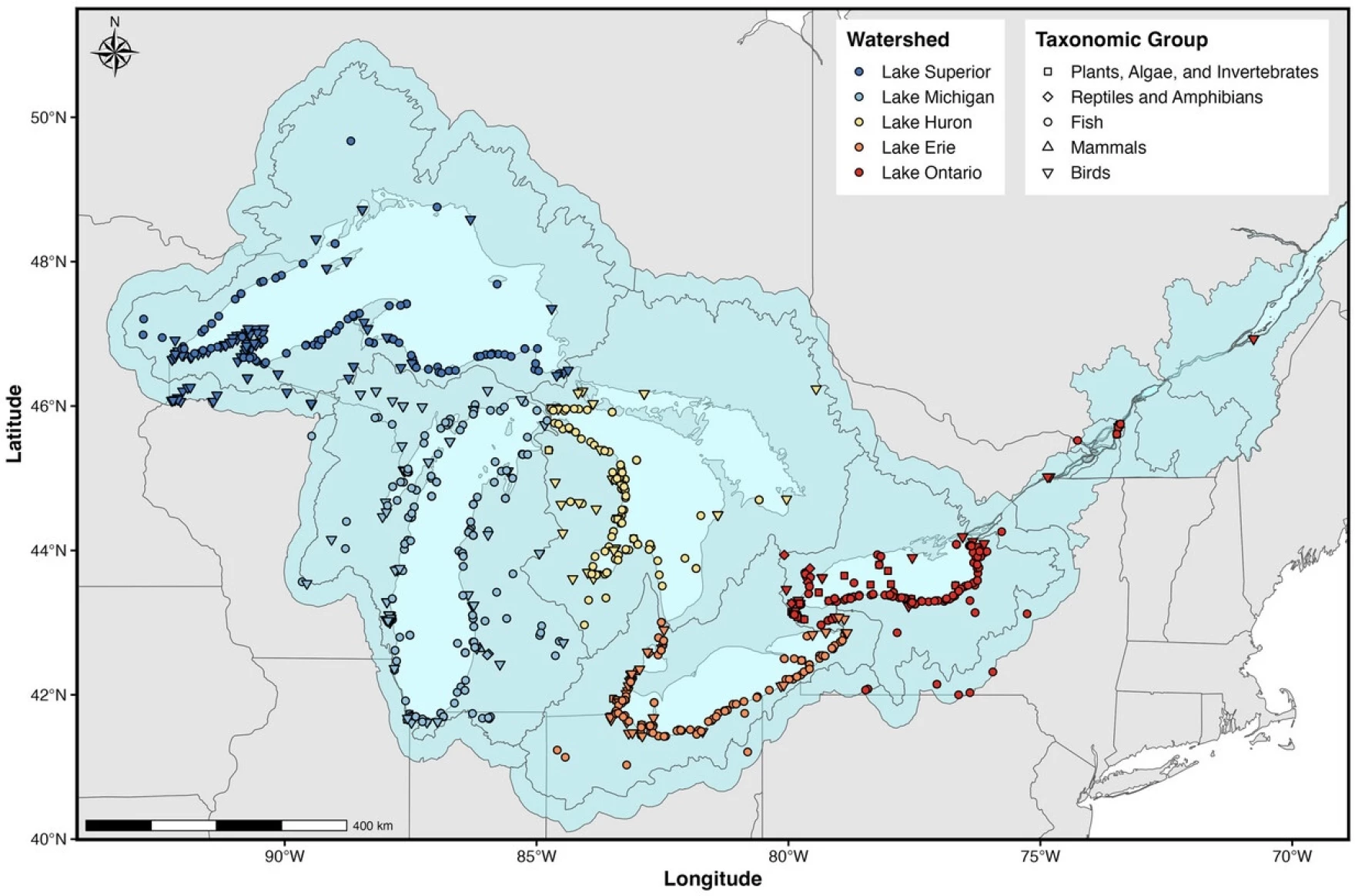
A map showing where samples included in the study were taken from the Great Lakes. (Image courtesy of the Journal of Environmental Quality)

But predators like salmon and eagles had the highest concentration because they’re eating a large amount of prey that have a lot of accumulated PFAS.

Potentially dangerous levels of these chemicals in fish have prompted warnings across the state on how much is safe to eat. Michigan has been testing fish for PFAS since 2012.

“If we can understand what the PFAS levels are in the food web, we can better communicate the risk of consuming those potentially toxic food sources,” said Katherine Manz, an environmental health professor at the University of Michigan who was not involved in the study.

But because PFAS chemicals are in everyday products and they’re very hard to avoid, Manz said her best advice is to use less. Online databases can help consumers avoid certain chemicals.

Manz said the study also pointed out some interesting gaps in research on PFAS dynamics, like a lack of data on certain species.

It was easy to find PFAS data on salmon, trout, and some birds, Lamberti said. But information on the “less glamorous” smaller fish, invertebrates or algae was harder.

The study only focused on six of the PFAS chemicals most commonly tested for, but there are more than 15,000 types out there, according to the National Institutes of Health.

Tools to analyze the range of these chemicals are still evolving, said Vernon Lalone, CEO of Traverse City-based startup Wave Lumina that’s developing a rapid testing kit for PFAS in water and soil.

“It’s like a chicken and an egg situation,” said Lalone, who wasn’t involved in the study. “You’ve got to have an analytical method that’s robust and reliable enough to measure these things before you can regulate them at certain limits.”

Lamberti said there’s still plenty of questions about how these chemicals will shift in the lakes as temperatures rise due to climate change, ice formation shifts and as industries introduce new chemicals.

“Anything we put into the Great Lakes will be there for an extremely long time, not only the water, but all the chemicals that it has, so we have to be very cognizant of how we treat the lakes and what we put into them,” Lamberti said.


The post New study traces PFAS in Great Lakes food webs over 40 years appeared first on Great Lakes Now.

Original Article

Great Lakes Now

Great Lakes Now

https://www.greatlakesnow.org/2026/07/01/new-study-traces-pfas-in-great-lakes-food-webs-over-40-years/
Interlochen Public Radio and Grist

By Isabella Figueroa Nogueira, Bridge Michigan

The Great Lakes News Collaborative includes Bridge Michigan; Circle of Blue; Great Lakes Now at Detroit PBS; Michigan Public, Michigan’s NPR News Leader; and The Narwhal who work together to bring audiences news and information about the impact of climate change, pollution, and aging infrastructure on the Great Lakes and drinking water. This independent journalism is supported by the Charles Stewart Mott Foundation. Find all the work HERE.


Unlike most fourth-graders, AJ Beaudion likes to leave recess five minutes early.

It’s part of his job.

At 9 years old, Beaudion is the composting manager at Hayes Elementary School in Livonia. His responsibilities include arriving on time during kindergarten through fourth-grade lunch to help sort the food waste, stacking compostable trays and placing them into bins destined for an offsite facility where they’ll be turned into rich soil.

“It’s important to help the Earth,” said Beaudion.

An unknown number of schools across Michigan have, like Hayes, taken up composting initiatives. But coalitions of education and anti-food waste groups, including Make Food Not Waste and the Detroit Food Policy Council, want to see more.

They’ve begun lobbying state legislators in hopes of securing $3 million for a pilot grant program that would allow schools across the state to replicate the program at Hayes Elementary. 

After an unsuccessful attempt to secure funding for the fiscal year that starts in October, they’re starting conversations early in hopes of succeeding next year. 

“If you get kids young learning about these things and thinking about what happens when they are done with the food on their plate, you’re teaching them to reduce waste and think about how things can be repurposed instead of going to a landfill,” said Amy Kuras, the program manager at Food Policy Council.

According to the Michigan Department of Environment, Great Lakes, and Energy, Michiganders landfill up to 2 million tons of food waste each year — nearly a fifth of all waste sent to municipal landfills. 

Michigan’s K-12 schools, which dole out millions of meals each day, contributed 17,200 tons in 2024.

Beyond taking up limited space, landfilled food contributes to climate change by breaking down to produce methane, a greenhouse gas 28 times more potent than carbon dioxide. 

Nationwide, food waste sent to landfills emits 270 million metric tons of greenhouse gases — an impact equivalent to putting 24 million more gas-powered cars on the road, according to EGLE.  

The Michigan Healthy Climate Plan calls for the state to cut food waste in half by 2030, with strategies ranging from reducing school cafeteria waste to promoting curbside compost pickup programs, drop-off locations and collection sites for businesses. 

A nascent effort

In school cafeterias across the state, uneaten meals and discarded packaging fill trash cans quickly, turning lunch periods into an environmental liability. 

Lunchtime at Hayes Elementary looks different.

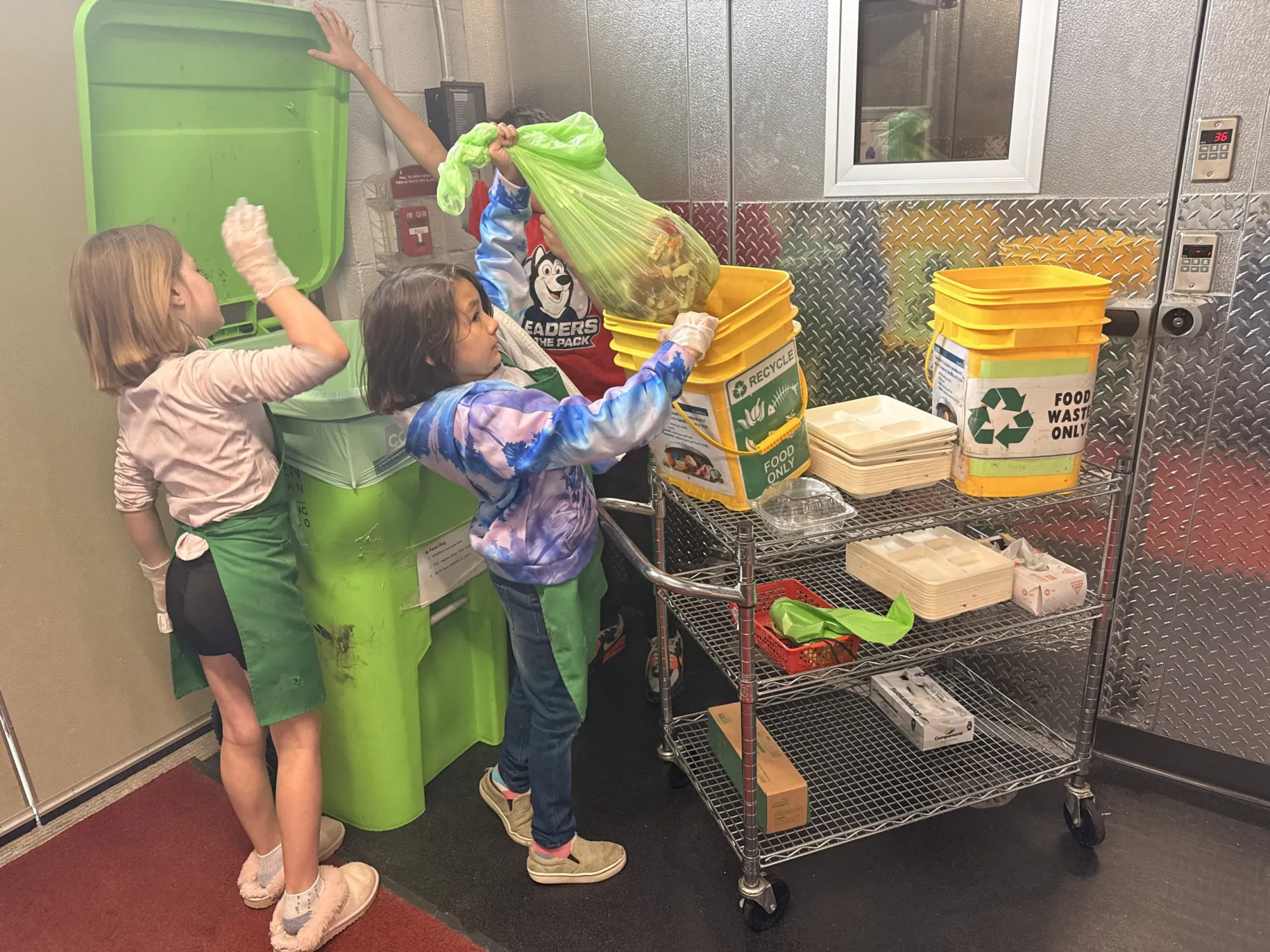
There, students end their lunch period with a stop at waste disposal stations overseen by student volunteers like Beaudion. 

The volunteers act as traffic directors, helping their peers sort each waste item into the correct bin: A banana peel is placed into a composting bucket while the sticker on the peel becomes trash.

“We get to save our Mother Nature, and there is a lot of plastic,” fourth-grader Mustafa Yakliftin told Bridge Michigan as he was finishing up his lunch. “Composting saves all our waste. Plastic takes more than 300 years to go away.”

Hayes is one of several Michigan schools, from metro Detroit to Genesee County, that have begun compost cafeteria scraps.

But with $3 million, Kuras said, the state could help more schools pay for compost bins, educational materials, staff training and infrastructure needed to set up their own composting programs.

She acknowledged the idea may be a tough sell as lawmakers contend with shrinking state revenue.

“Funds are tight and there are a lot of competing priorities in the Legislature,” she said. 

State Budget Office spokesperson Lauren Leeds said none of the draft budgets proposed by Gov. Gretchen Whitmer or the state House or state Senate include funding for food waste diversion initiatives.

Spokespeople for state Sen. Sarah Anthony, D-Lansing, the Senate budget chair, declined to comment, while House Republicans spokesperson Gideon D’Assandro and state Rep. Ann Bollin, R-Brighton, the House budget chair, did not respond to questions from Bridge Michigan. Spokespeople for Whitmer redirected Bridge to the State Budget Office.

Composting in action

Hayes Elementary’s composting program began with a waste audit in 2016.

“We analyzed only one bag of trash and the small group of kids that I got together to do this waste audit could see that one bite was taken out of the middle of a grilled cheese sandwich and they just thought that was ridiculous,” said Christine Lakatos, an art teacher and Green Team leader at Hayes Elementary.

So Lakatos and her students sought to do something about it. The school contracted with a company called My Green Michigan to build a composting program that now diverts nearly 10,000 pounds of cafeteria food scraps annually.

Sixty miles north, Davison Community School District runs a similar program in four of the district’s nine schools, said Food Services Director Jennifer Lutze.  

Davison administrators used excess money in the district’s food service fund to purchase stainless steel trays and reusable sporks, a change that reduced waste and saved roughly $11,000. 

James Emmerling, the district’s science and health coordinator, said the district used the savings to fund its composting program, which has diverted an estimated 23 tons of food waste from landfills this year.

“If you can eat it, it can go in there,” Lutze said of the bins that have become a staple in participating cafeterias.

Sold as a soil amendment to landscape supply companies Hammond Farms and Spurt, the composted material improves overall soil properties and creates a better environment for root growth.

Implementing those systems is not always straightforward, said Lakatos. Schools must balance waste reduction goals with operational realities like busy lunch schedules and limited staffing and funds.

But it’s worth the effort, Lakatos said, because it reduces waste while instilling sustainable habits that students carry into adulthood.

The post In school cafeterias, kids fight Michigan’s food waste problems appeared first on Great Lakes Now.

Original Article

Great Lakes Now

Great Lakes Now

https://www.greatlakesnow.org/2026/06/17/in-school-cafeterias-kids-fight-michigans-food-waste-problems/

Bridge Michigan

By Isabella Figueroa Nogueira, Bridge Michigan

The Great Lakes News Collaborative includes Bridge Michigan; Circle of Blue; Great Lakes Now at Detroit PBS; Michigan Public, Michigan’s NPR News Leader; and The Narwhal who work together to bring audiences news and information about the impact of climate change, pollution, and aging infrastructure on the Great Lakes and drinking water. This independent journalism is supported by the Charles Stewart Mott Foundation. Find all the work HERE.


Unlike most fourth-graders, AJ Beaudion likes to leave recess five minutes early.

It’s part of his job.

At 9 years old, Beaudion is the composting manager at Hayes Elementary School in Livonia. His responsibilities include arriving on time during kindergarten through fourth-grade lunch to help sort the food waste, stacking compostable trays and placing them into bins destined for an offsite facility where they’ll be turned into rich soil.

“It’s important to help the Earth,” said Beaudion.

An unknown number of schools across Michigan have, like Hayes, taken up composting initiatives. But coalitions of education and anti-food waste groups, including Make Food Not Waste and the Detroit Food Policy Council, want to see more.

They’ve begun lobbying state legislators in hopes of securing $3 million for a pilot grant program that would allow schools across the state to replicate the program at Hayes Elementary. 

After an unsuccessful attempt to secure funding for the fiscal year that starts in October, they’re starting conversations early in hopes of succeeding next year. 

“If you get kids young learning about these things and thinking about what happens when they are done with the food on their plate, you’re teaching them to reduce waste and think about how things can be repurposed instead of going to a landfill,” said Amy Kuras, the program manager at Food Policy Council.

According to the Michigan Department of Environment, Great Lakes, and Energy, Michiganders landfill up to 2 million tons of food waste each year — nearly a fifth of all waste sent to municipal landfills. 

Michigan’s K-12 schools, which dole out millions of meals each day, contributed 17,200 tons in 2024.

Beyond taking up limited space, landfilled food contributes to climate change by breaking down to produce methane, a greenhouse gas 28 times more potent than carbon dioxide. 

Nationwide, food waste sent to landfills emits 270 million metric tons of greenhouse gases — an impact equivalent to putting 24 million more gas-powered cars on the road, according to EGLE.  

The Michigan Healthy Climate Plan calls for the state to cut food waste in half by 2030, with strategies ranging from reducing school cafeteria waste to promoting curbside compost pickup programs, drop-off locations and collection sites for businesses. 

A nascent effort

In school cafeterias across the state, uneaten meals and discarded packaging fill trash cans quickly, turning lunch periods into an environmental liability. 

Lunchtime at Hayes Elementary looks different.

There, students end their lunch period with a stop at waste disposal stations overseen by student volunteers like Beaudion. 

The volunteers act as traffic directors, helping their peers sort each waste item into the correct bin: A banana peel is placed into a composting bucket while the sticker on the peel becomes trash.

“We get to save our Mother Nature, and there is a lot of plastic,” fourth-grader Mustafa Yakliftin told Bridge Michigan as he was finishing up his lunch. “Composting saves all our waste. Plastic takes more than 300 years to go away.”

Hayes is one of several Michigan schools, from metro Detroit to Genesee County, that have begun compost cafeteria scraps.

But with $3 million, Kuras said, the state could help more schools pay for compost bins, educational materials, staff training and infrastructure needed to set up their own composting programs.

She acknowledged the idea may be a tough sell as lawmakers contend with shrinking state revenue.

“Funds are tight and there are a lot of competing priorities in the Legislature,” she said. 

State Budget Office spokesperson Lauren Leeds said none of the draft budgets proposed by Gov. Gretchen Whitmer or the state House or state Senate include funding for food waste diversion initiatives.

Spokespeople for state Sen. Sarah Anthony, D-Lansing, the Senate budget chair, declined to comment, while House Republicans spokesperson Gideon D’Assandro and state Rep. Ann Bollin, R-Brighton, the House budget chair, did not respond to questions from Bridge Michigan. Spokespeople for Whitmer redirected Bridge to the State Budget Office.

Composting in action

Hayes Elementary’s composting program began with a waste audit in 2016.

“We analyzed only one bag of trash and the small group of kids that I got together to do this waste audit could see that one bite was taken out of the middle of a grilled cheese sandwich and they just thought that was ridiculous,” said Christine Lakatos, an art teacher and Green Team leader at Hayes Elementary.

So Lakatos and her students sought to do something about it. The school contracted with a company called My Green Michigan to build a composting program that now diverts nearly 10,000 pounds of cafeteria food scraps annually.

Sixty miles north, Davison Community School District runs a similar program in four of the district’s nine schools, said Food Services Director Jennifer Lutze.  

Davison administrators used excess money in the district’s food service fund to purchase stainless steel trays and reusable sporks, a change that reduced waste and saved roughly $11,000. 

James Emmerling, the district’s science and health coordinator, said the district used the savings to fund its composting program, which has diverted an estimated 23 tons of food waste from landfills this year.

“If you can eat it, it can go in there,” Lutze said of the bins that have become a staple in participating cafeterias.

Sold as a soil amendment to landscape supply companies Hammond Farms and Spurt, the composted material improves overall soil properties and creates a better environment for root growth.

Implementing those systems is not always straightforward, said Lakatos. Schools must balance waste reduction goals with operational realities like busy lunch schedules and limited staffing and funds.

But it’s worth the effort, Lakatos said, because it reduces waste while instilling sustainable habits that students carry into adulthood.

The post In school cafeterias, kids fight Michigan’s food waste problems appeared first on Great Lakes Now.

Original Article

Great Lakes Now

Great Lakes Now

https://www.greatlakesnow.org/2026/06/17/in-school-cafeterias-kids-fight-michigans-food-waste-problems/

Bridge Michigan

By Isabella Figueroa Nogueira, Bridge Michigan

The Great Lakes News Collaborative includes Bridge Michigan; Circle of Blue; Great Lakes Now at Detroit PBS; Michigan Public, Michigan’s NPR News Leader; and The Narwhal who work together to bring audiences news and information about the impact of climate change, pollution, and aging infrastructure on the Great Lakes and drinking water. This independent journalism is supported by the Charles Stewart Mott Foundation. Find all the work HERE.


Unlike most fourth-graders, AJ Beaudion likes to leave recess five minutes early.

It’s part of his job.

At 9 years old, Beaudion is the composting manager at Hayes Elementary School in Livonia. His responsibilities include arriving on time during kindergarten through fourth-grade lunch to help sort the food waste, stacking compostable trays and placing them into bins destined for an offsite facility where they’ll be turned into rich soil.

“It’s important to help the Earth,” said Beaudion.

An unknown number of schools across Michigan have, like Hayes, taken up composting initiatives. But coalitions of education and anti-food waste groups, including Make Food Not Waste and the Detroit Food Policy Council, want to see more.

They’ve begun lobbying state legislators in hopes of securing $3 million for a pilot grant program that would allow schools across the state to replicate the program at Hayes Elementary. 

After an unsuccessful attempt to secure funding for the fiscal year that starts in October, they’re starting conversations early in hopes of succeeding next year. 

“If you get kids young learning about these things and thinking about what happens when they are done with the food on their plate, you’re teaching them to reduce waste and think about how things can be repurposed instead of going to a landfill,” said Amy Kuras, the program manager at Food Policy Council.

According to the Michigan Department of Environment, Great Lakes, and Energy, Michiganders landfill up to 2 million tons of food waste each year — nearly a fifth of all waste sent to municipal landfills. 

Michigan’s K-12 schools, which dole out millions of meals each day, contributed 17,200 tons in 2024.

Beyond taking up limited space, landfilled food contributes to climate change by breaking down to produce methane, a greenhouse gas 28 times more potent than carbon dioxide. 

Nationwide, food waste sent to landfills emits 270 million metric tons of greenhouse gases — an impact equivalent to putting 24 million more gas-powered cars on the road, according to EGLE.  

The Michigan Healthy Climate Plan calls for the state to cut food waste in half by 2030, with strategies ranging from reducing school cafeteria waste to promoting curbside compost pickup programs, drop-off locations and collection sites for businesses. 

A nascent effort

In school cafeterias across the state, uneaten meals and discarded packaging fill trash cans quickly, turning lunch periods into an environmental liability. 

Lunchtime at Hayes Elementary looks different.

There, students end their lunch period with a stop at waste disposal stations overseen by student volunteers like Beaudion. 

The volunteers act as traffic directors, helping their peers sort each waste item into the correct bin: A banana peel is placed into a composting bucket while the sticker on the peel becomes trash.

“We get to save our Mother Nature, and there is a lot of plastic,” fourth-grader Mustafa Yakliftin told Bridge Michigan as he was finishing up his lunch. “Composting saves all our waste. Plastic takes more than 300 years to go away.”

Hayes is one of several Michigan schools, from metro Detroit to Genesee County, that have begun compost cafeteria scraps.

But with $3 million, Kuras said, the state could help more schools pay for compost bins, educational materials, staff training and infrastructure needed to set up their own composting programs.

She acknowledged the idea may be a tough sell as lawmakers contend with shrinking state revenue.

“Funds are tight and there are a lot of competing priorities in the Legislature,” she said. 

State Budget Office spokesperson Lauren Leeds said none of the draft budgets proposed by Gov. Gretchen Whitmer or the state House or state Senate include funding for food waste diversion initiatives.

Spokespeople for state Sen. Sarah Anthony, D-Lansing, the Senate budget chair, declined to comment, while House Republicans spokesperson Gideon D’Assandro and state Rep. Ann Bollin, R-Brighton, the House budget chair, did not respond to questions from Bridge Michigan. Spokespeople for Whitmer redirected Bridge to the State Budget Office.

Composting in action

Hayes Elementary’s composting program began with a waste audit in 2016.

“We analyzed only one bag of trash and the small group of kids that I got together to do this waste audit could see that one bite was taken out of the middle of a grilled cheese sandwich and they just thought that was ridiculous,” said Christine Lakatos, an art teacher and Green Team leader at Hayes Elementary.

So Lakatos and her students sought to do something about it. The school contracted with a company called My Green Michigan to build a composting program that now diverts nearly 10,000 pounds of cafeteria food scraps annually.

Sixty miles north, Davison Community School District runs a similar program in four of the district’s nine schools, said Food Services Director Jennifer Lutze.  

Davison administrators used excess money in the district’s food service fund to purchase stainless steel trays and reusable sporks, a change that reduced waste and saved roughly $11,000. 

James Emmerling, the district’s science and health coordinator, said the district used the savings to fund its composting program, which has diverted an estimated 23 tons of food waste from landfills this year.

“If you can eat it, it can go in there,” Lutze said of the bins that have become a staple in participating cafeterias.

Sold as a soil amendment to landscape supply companies Hammond Farms and Spurt, the composted material improves overall soil properties and creates a better environment for root growth.

Implementing those systems is not always straightforward, said Lakatos. Schools must balance waste reduction goals with operational realities like busy lunch schedules and limited staffing and funds.

But it’s worth the effort, Lakatos said, because it reduces waste while instilling sustainable habits that students carry into adulthood.

The post In school cafeterias, kids fight Michigan’s food waste problems appeared first on Great Lakes Now.

Original Article

Great Lakes Now

Great Lakes Now

https://www.greatlakesnow.org/2026/06/17/in-school-cafeterias-kids-fight-michigans-food-waste-problems/

Bridge Michigan

By Isabella Figueroa Nogueira, Bridge Michigan

The Great Lakes News Collaborative includes Bridge Michigan; Circle of Blue; Great Lakes Now at Detroit PBS; Michigan Public, Michigan’s NPR News Leader; and The Narwhal who work together to bring audiences news and information about the impact of climate change, pollution, and aging infrastructure on the Great Lakes and drinking water. This independent journalism is supported by the Charles Stewart Mott Foundation. Find all the work HERE.


Unlike most fourth-graders, AJ Beaudion likes to leave recess five minutes early.

It’s part of his job.

At 9 years old, Beaudion is the composting manager at Hayes Elementary School in Livonia. His responsibilities include arriving on time during kindergarten through fourth-grade lunch to help sort the food waste, stacking compostable trays and placing them into bins destined for an offsite facility where they’ll be turned into rich soil.

“It’s important to help the Earth,” said Beaudion.

An unknown number of schools across Michigan have, like Hayes, taken up composting initiatives. But coalitions of education and anti-food waste groups, including Make Food Not Waste and the Detroit Food Policy Council, want to see more.

They’ve begun lobbying state legislators in hopes of securing $3 million for a pilot grant program that would allow schools across the state to replicate the program at Hayes Elementary. 

After an unsuccessful attempt to secure funding for the fiscal year that starts in October, they’re starting conversations early in hopes of succeeding next year. 

“If you get kids young learning about these things and thinking about what happens when they are done with the food on their plate, you’re teaching them to reduce waste and think about how things can be repurposed instead of going to a landfill,” said Amy Kuras, the program manager at Food Policy Council.

According to the Michigan Department of Environment, Great Lakes, and Energy, Michiganders landfill up to 2 million tons of food waste each year — nearly a fifth of all waste sent to municipal landfills. 

Michigan’s K-12 schools, which dole out millions of meals each day, contributed 17,200 tons in 2024.

Beyond taking up limited space, landfilled food contributes to climate change by breaking down to produce methane, a greenhouse gas 28 times more potent than carbon dioxide. 

Nationwide, food waste sent to landfills emits 270 million metric tons of greenhouse gases — an impact equivalent to putting 24 million more gas-powered cars on the road, according to EGLE.  

The Michigan Healthy Climate Plan calls for the state to cut food waste in half by 2030, with strategies ranging from reducing school cafeteria waste to promoting curbside compost pickup programs, drop-off locations and collection sites for businesses. 

A nascent effort

In school cafeterias across the state, uneaten meals and discarded packaging fill trash cans quickly, turning lunch periods into an environmental liability. 

Lunchtime at Hayes Elementary looks different.

There, students end their lunch period with a stop at waste disposal stations overseen by student volunteers like Beaudion. 

The volunteers act as traffic directors, helping their peers sort each waste item into the correct bin: A banana peel is placed into a composting bucket while the sticker on the peel becomes trash.

“We get to save our Mother Nature, and there is a lot of plastic,” fourth-grader Mustafa Yakliftin told Bridge Michigan as he was finishing up his lunch. “Composting saves all our waste. Plastic takes more than 300 years to go away.”

Hayes is one of several Michigan schools, from metro Detroit to Genesee County, that have begun compost cafeteria scraps.

But with $3 million, Kuras said, the state could help more schools pay for compost bins, educational materials, staff training and infrastructure needed to set up their own composting programs.

She acknowledged the idea may be a tough sell as lawmakers contend with shrinking state revenue.

“Funds are tight and there are a lot of competing priorities in the Legislature,” she said. 

State Budget Office spokesperson Lauren Leeds said none of the draft budgets proposed by Gov. Gretchen Whitmer or the state House or state Senate include funding for food waste diversion initiatives.

Spokespeople for state Sen. Sarah Anthony, D-Lansing, the Senate budget chair, declined to comment, while House Republicans spokesperson Gideon D’Assandro and state Rep. Ann Bollin, R-Brighton, the House budget chair, did not respond to questions from Bridge Michigan. Spokespeople for Whitmer redirected Bridge to the State Budget Office.

Composting in action

Hayes Elementary’s composting program began with a waste audit in 2016.

“We analyzed only one bag of trash and the small group of kids that I got together to do this waste audit could see that one bite was taken out of the middle of a grilled cheese sandwich and they just thought that was ridiculous,” said Christine Lakatos, an art teacher and Green Team leader at Hayes Elementary.

So Lakatos and her students sought to do something about it. The school contracted with a company called My Green Michigan to build a composting program that now diverts nearly 10,000 pounds of cafeteria food scraps annually.

Sixty miles north, Davison Community School District runs a similar program in four of the district’s nine schools, said Food Services Director Jennifer Lutze.  

Davison administrators used excess money in the district’s food service fund to purchase stainless steel trays and reusable sporks, a change that reduced waste and saved roughly $11,000. 

James Emmerling, the district’s science and health coordinator, said the district used the savings to fund its composting program, which has diverted an estimated 23 tons of food waste from landfills this year.

“If you can eat it, it can go in there,” Lutze said of the bins that have become a staple in participating cafeterias.

Sold as a soil amendment to landscape supply companies Hammond Farms and Spurt, the composted material improves overall soil properties and creates a better environment for root growth.

Implementing those systems is not always straightforward, said Lakatos. Schools must balance waste reduction goals with operational realities like busy lunch schedules and limited staffing and funds.

But it’s worth the effort, Lakatos said, because it reduces waste while instilling sustainable habits that students carry into adulthood.

The post In school cafeterias, kids fight Michigan’s food waste problems appeared first on Great Lakes Now.

Original Article

Great Lakes Now

Great Lakes Now

https://www.greatlakesnow.org/2026/06/17/in-school-cafeterias-kids-fight-michigans-food-waste-problems/

Bridge Michigan

Going Country at Farrand Hall

Situated in a town of a little over a thousand people in Colon, Michigan, is an idyllic and pastoral outdoor dining experience just 250 feet from a main road. Guests are recommended to order a glass of wine, wander the property grounds, and soak in their surroundings before taking a seat at a banquet-style table.

Read Now at Great Lakes Now.

Original Article

Great Lakes Now

Great Lakes Now

https://www.greatlakesnow.org/2025/11/going-country-at-farrand-hall/

S. Nicole Lane

Spring Break Staycation: Foraging with the Family

This is a part of “A Year in the Wild Kitchen of the Great Lakes,” a series in partnership with expert forager Lisa M. Rose, with the mission of nurturing a deeper connection with the natural world through foraging. To get started with your foraging journey, begin here with our “Framework to Sustainable and Safe Practices.” 

This spring break, transform your usual holiday into an educational excursion that connects your family with the natural world.

Read Now at Great Lakes Now.

Original Article

Great Lakes Now

Great Lakes Now

https://www.greatlakesnow.org/2025/04/spring-break-staycation-foraging-with-the-family/

Lisa M. Rose

How community gardens serve as ‘third places’ for Detroiters

Toward the end of 2023, I was newly unemployed and living by myself for the first time. 

In between jobs, searching for employment and a means of fulfillment and community, I began to reflect on how my mom got into gardening. In the dead of winter, memories of childhood summers spent pulling weeds, tilling soil and fleeing the occasional garter snake alongside her began to color my mind. 

Read Now at Great Lakes Now.

Original Article

Great Lakes Now

Great Lakes Now

https://www.greatlakesnow.org/2025/04/community-gardens-third-places-for-detroiters/

Ethan Bakuli

Tapping Into Tradition: It’s Maple Syrup Season

This is a part of “A Year in the Wild Kitchen of the Great Lakes,” a series in partnership with expert forager Lisa M. Rose, with the mission of nurturing a deeper connection with the natural world through foraging. To get started with your foraging journey, begin here with our “Framework to Sustainable and Safe Practices.”

In the Great Lakes, the maple syrup harvest season begins when daytime temperatures rise above freezing while nights remain cold — typically from mid to late February for much of the region, and a bit later further north.

Read Now at Great Lakes Now.

Original Article

Great Lakes Now

Great Lakes Now

https://www.greatlakesnow.org/2025/03/tapping-into-tradition-its-maple-syrup-season/

Lisa M. Rose

Winter Wellness Pantry: Elderberry Elixir

Part of “A Year in the Wild Kitchen of the Great Lakes,” a series in partnership with expert forager Lisa M. Rose, with the mission of nurturing a deeper connection with the natural world through foraging. To get started with your foraging journey, begin here with our “Framework to Sustainable and Safe Practices” and check out Part 1 of “Winter Wellness Pantry” for tips and tricks to stay healthy this winter with wild herbs of the Great Lakes. 

Read Now at Great Lakes Now.

Original Article

Great Lakes Now

Great Lakes Now

https://www.greatlakesnow.org/2025/01/winter-wellness-pantry-elderberry-elixir/

Lisa M. Rose

Climate takes its toll on the “cherry capital of the world”

By Izzy Ross, Interlochen Public Radio

This coverage is made possible through a partnership with IPR and Grist, a nonprofit independent media organization dedicated to telling stories of climate solutions and a just future.

Walking between rows of dormant cherry and apple trees in mid-November, Raul Gomez, operations manager at Wunsch Farms on the Old Mission Peninsula, pointed out sweet cherry varieties like black pearls.

Read Now at Great Lakes Now.

Original Article

Great Lakes Now

Great Lakes Now

https://www.greatlakesnow.org/2024/12/climate-takes-its-toll-on-the-cherry-capital-of-the-world/

Interlochen Public Radio

Smashing pumpkins in Traverse City to reduce trash

By Izzy Ross, Interlochen Public Radio

This coverage is made possible through a partnership with IPR and Grist, a nonprofit independent media organization dedicated to telling stories of climate solutions and a just future.

Nine-year-old Gunner Vistisen was wearing goggles, a wooden mallet in hand, standing near a blue tarp lined with pumpkins on a lot in Traverse City.

Read Now at Great Lakes Now.

Original Article

Great Lakes Now

Great Lakes Now

https://www.greatlakesnow.org/2024/11/smashing-pumpkins-in-traverse-city-to-reduce-trash/

Interlochen Public Radio

A Foraged Great Lakes Woodland Chai Tea

This story is a part of “A Year in the Wild Kitchen of the Great Lakes,” a series in partnership with expert forager Lisa M. Rose, with the mission of nurturing a deeper connection with the natural world through foraging. To get started with your foraging journey, begin here with our “Framework to Sustainable and Safe Practices.”

As the season shifts and the air chills, I find myself drawn to the warmth and sustenance that the wild foods of fall offer — from roots to mushrooms to nuts to herbs — and take great satisfaction in concocting nourishing recipes for my family and friends.

Read Now at Great Lakes Now.

Original Article

Great Lakes Now

Great Lakes Now

https://www.greatlakesnow.org/2024/10/a-foraged-great-lakes-woodland-chai-tea/

Lisa M. Rose

Nibi Chronicles: Manoomin as medicine

“Nibi Chronicles,” a monthly Great Lakes Now feature, is written by Staci Lola Drouillard. A Grand Portage Ojibwe direct descendant, she lives in Grand Marais on Minnesota’s North Shore of Lake Superior. Her nonfiction books “Walking the Old Road: A People’s History of Chippewa City and the Grand Marais Anishinaabe” and “Seven Aunts” were published 2019 and 2022, and the children’s story “A Family Tree” in 2024.

Read Now at Great Lakes Now.

Original Article

Great Lakes Now

Great Lakes Now

https://www.greatlakesnow.org/2024/10/nibi-chronicles-manoomin-as-medicine/

Staci Lola Drouillard

Nibi Chronicles: The Gift of Manoomin

“Nibi Chronicles,” a monthly Great Lakes Now feature, is written by Staci Lola Drouillard. A Grand Portage Ojibwe direct descendant, she lives in Grand Marais on Minnesota’s North Shore of Lake Superior. Her nonfiction books “Walking the Old Road: A People’s History of Chippewa City and the Grand Marais Anishinaabe” and “Seven Aunts” were published 2019 and 2022, and the children’s story “A Family Tree” in 2024.

Read Now at Great Lakes Now.

Original Article

Great Lakes Now

Great Lakes Now

https://www.greatlakesnow.org/2024/09/nibi-chronicles-the-gift-of-manoomin/

Staci Lola Drouillard

Northeast Ohio composters reduce emissions from food waste, one pile at a time

By Zaria Johnson, Ideastream Public Media

This story was originally published by Ideastream.

In Northeast Ohio, composting is becoming more common due, in part, to local organizations sharing knowledge, resources and the benefits of composting for the planet.

Leftovers often end up in the trash rather than in our stomachs.

Read Now at Great Lakes Now.

Original Article

Great Lakes Now

Great Lakes Now

https://www.greatlakesnow.org/2024/09/northeast-ohio-composters-reduce-emissions-from-food-waste-one-pile-at-a-time/

Ideastream Public Media

Oberlin Food Hub brings fresh produce to Ohio’s food banks while supporting local farmers

By Zaria Johnson, Ideastream Public Media

This story was originally published by Ideastream.

One in seven Ohioans faces food insecurity, according to Feeding America. This story is part of a “Sound of Us” series in partnership with Lorain County’s Second Harvest Food Bank.

Read Now at Great Lakes Now.

Original Article

Great Lakes Now

Great Lakes Now

https://www.greatlakesnow.org/2024/08/oberlin-food-hub-brings-fresh-produce-to-ohios-food-banks-while-supporting-local-farmers/

Ideastream Public Media

A Fleeting Wild Taste of Spring Ephemerals: Ramps and Ostrich Fern

This story is a part of “A Year in the Wild Kitchen of the Great Lakes,” a series in partnership with expert forager Lisa M. Rose with the mission of nurturing a deeper connection with the natural world through foraging. 

The Importance of Ecological Awareness in Foraging

As we delve into the world of foraging, it’s crucial to cultivate an understanding of the ecosystems we interact with, especially when harvesting wild plants like ramps (wild leeks) and ostrich ferns.

Read Now at Great Lakes Now.

Original Article

Great Lakes Now

Great Lakes Now

https://www.greatlakesnow.org/2024/04/a-fleeting-wild-taste-of-spring-ephemerals-ramps-and-ostrich-fern/

Lisa M. Rose

Good news for Michigan smelt season: PFAS levels lower than feared

By Kelly House, Bridge Michigan

The Great Lakes News Collaborative includes Bridge Michigan; Circle of Blue; Great Lakes Now at Detroit PBS; Michigan Public, Michigan’s NPR News Leader; and The Narwhal who work together to bring audiences news and information about the impact of climate change, pollution, and aging infrastructure on the Great Lakes and drinking water.

Read Now at Great Lakes Now.

Original Article

Great Lakes Now

Great Lakes Now

https://www.greatlakesnow.org/2024/04/good-news-for-michigan-smelt-season-pfas-levels-lower-than-feared/

Bridge Michigan

Your Foraging Journey: A Framework to Sustainable and Safe Practices

Foraging connects us with the natural world, offering a pathway to understand the land, its cycles, and the bountiful edible plants that grow wild around us. Whether you’re a novice eager to explore the greens outside your doorstep or an experienced forager looking to deepen your practice, this guide provides essential insights into starting your foraging journey, identifying plants, harvesting sustainably, and ensuring safety.

Read Now at Great Lakes Now.

Original Article

Great Lakes Now

Great Lakes Now

https://www.greatlakesnow.org/2024/04/your-foraging-journey-a-framework-to-sustainable-and-safe-practices/

Lisa M. Rose

Twenty companies pledge to use all parts of Great Lakes fish by 2025

This article was republished here with permission from Great Lakes Echo.

By Shealyn Paulis, Great Lakes Echo

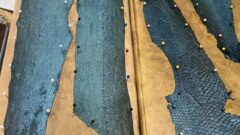
Fish-leather purses and wallets may make their way into Great Lakes fashion with an initiative to use 100% of commercially caught fish by 2025.

One of the latest projects of a binational Great Lakes organization is to fully use the region’s whitefish, lake trout, yellow perch, walleye and white sucker.

Read Now at Great Lakes Now.

Original Article

Great Lakes Now

Great Lakes Now

https://www.greatlakesnow.org/2024/01/twenty-companies-pledge-to-use-all-parts-of-great-lakes-fish-by-2025/

Great Lakes Echo

‘A valuable resource’: Traverse City restaurants aim to reduce food waste, greenhouse gases

By Izzy Ross, Interlochen Public Radio

This coverage is made possible through a partnership between IPR and Grist, a nonprofit independent media organization dedicated to telling stories of climate solutions and a just future.

On an early Thursday evening, people are seated around the dining room of Trattoria Stella, an Italian restaurant on the ground floor of the Grand Traverse Commons, just outside the city’s downtown area.

Read Now at Great Lakes Now.

Original Article

Great Lakes Now

Great Lakes Now

https://www.greatlakesnow.org/2024/01/a-valuable-resource-traverse-city-restaurants-aim-to-reduce-food-waste-greenhouse-gases/

Interlochen Public Radio

I Speak for the Fish: Carp are crazy about corn

I Speak for the Fish is a monthly column written by Great Lakes Now Contributor Kathy Johnson, coming out the third Monday of each month. Publishing the author’s views and assertions does not represent endorsement by Great Lakes Now or Detroit Public Television. 

Read Now at Great Lakes Now.

Original Article

Great Lakes Now

Great Lakes Now

https://www.greatlakesnow.org/2023/11/i-speak-for-the-fish-carp-are-crazy-about-corn/

Kathy Johnson

Eat Your Heartland Out: You, Too, Can Be a Galley Steward

Eat Your Heartland Out is a Taste Awards nominated  program about the intersection of food and culture in the American Midwest. The show is produced by the Heritage Radio Network, a leader in culinary audio storytelling and distributed on the Public Radio Exchange (PRX), which provides content to public radio affiliates across the United States.

Read Now at Great Lakes Now.

Original Article

Great Lakes Now

Great Lakes Now

https://www.greatlakesnow.org/2023/08/eat-your-heartland-out-can-be-galley-steward/

Capri S. Cafaro

Eat Your Heartland Out: Great Wine on the Great Lakes

Eat Your Heartland Out is a Taste Awards nominated  program about the intersection of food and culture in the American Midwest. The show is produced by the Heritage Radio Network, a leader in culinary audio storytelling and distributed on the Public Radio Exchange (PRX), which provides content to public radio affiliates across the United States.

Read Now at Great Lakes Now.

Original Article

Great Lakes Now

Great Lakes Now

https://www.greatlakesnow.org/2023/07/eat-your-heartland-out-great-wine-great-lakes/

Capri S. Cafaro

Eat Your Heartland Out: Touring Thunder Bay’s Craft Brewery Scene

Eat Your Heartland Out is a Taste Awards nominated  program about the intersection of food and culture in the American Midwest. The show is produced by the Heritage Radio Network, a leader in culinary audio storytelling and distributed on the Public Radio Exchange (PRX), which provides content to public radio affiliates across the United States.

Read Now at Great Lakes Now.

Original Article

Great Lakes Now

Great Lakes Now

https://www.greatlakesnow.org/2023/07/eat-your-heartland-out-touring-thunder-bays-craft-brewery-scene/

Capri S. Cafaro

Eat Your Heartland Out: How to Feed A Great Lakes Freighter Crew

Eat Your Heartland Out is a Taste Awards nominated  program about the intersection of food and culture in the American Midwest. The show is produced by the Heritage Radio Network, a leader in culinary audio storytelling and distributed on the Public Radio Exchange (PRX), which provides content to public radio affiliates across the United States.

Read Now at Great Lakes Now.

Original Article

Great Lakes Now

Great Lakes Now

https://www.greatlakesnow.org/2023/06/eat-your-heartland-out-how-to-feed-great-lakes-freighter-crew/

Capri S. Cafaro

Culinary masters aboard Great Lakes freighters: Navigating the high seas of flavor

Freighters are mysterious creatures, grazing the horizon at what seems a glacier’s pace, laden with commodities like coal or iron ore.  We accept them as part of the Great Lakes’ landscape, but we don’t often think about what it takes to run them. 

It turns out, it takes a sizable team.

Read Now at Great Lakes Now.

Original Article

Great Lakes Now

Great Lakes Now

https://www.greatlakesnow.org/2023/05/culinary-masters-great-lakes-freighters-navigating-high-seas-flavor/

Capri S. Cafaro

These 3 Detroit restaurants are tackling climate change in the kitchen

By Nina Ignaczak, Planet Detroit

This story is part of a collaborative series from the Institute for Nonprofit News, Planet Detroit, Tostada Magazine, Energy News Network, The Land, and Borderless Magazine examining climate resilience across the Great Lakes.

Read Now at Great Lakes Now.

Original Article

Great Lakes Now

Great Lakes Now

https://www.greatlakesnow.org/2023/01/detroit-restaurants-tackling-climate-change-kitchen/

Institute for Nonprofit News

Ian Outside: A Drummond Island summer recap … as winter gets here

Editor’s Note: Look for coverage of Great Lakes recreation and adventure in this new monthly feature. The author, Ian Solomon, founded Amplify Outside, a nonprofit dedicated to increasing access and representation by Black people in the outdoors, starting in the Great Lakes region. Find more about him HERE.

Life slows, that’s what I’ve come to love most about the changing seasons especially in the Great Lakes.

Read Now at Great Lakes Now.

Original Article

Great Lakes Now

Great Lakes Now

https://www.greatlakesnow.org/2022/12/drummond-island-summer-recap-as-winter-gets-here/

Ian Solomon

Opposition to CAFOs Mounts Across the Nation

By Keith Schneider, Circle of Blue

The Great Lakes News Collaborative includes Bridge Michigan; Circle of Blue; Great Lakes Now at Detroit Public Television; and Michigan Radio, Michigan’s NPR News Leader; who work together to bring audiences news and information about the impact of climate change, pollution, and aging infrastructure on the Great Lakes and drinking water.

Read Now at Great Lakes Now.

Original Article

Great Lakes Now

Great Lakes Now

https://www.greatlakesnow.org/2022/12/opposition-to-cafos-mounts-across-nation/

Circle of Blue

Know Your State Foods

Do you know if your state has an official food or drink? If you live in the Great Lakes region, chances are your state boasts multiple official foods, drinks and even crops. Some of them – not all – a part of the region’s water-related culture, history and traditions.

Each state chooses their respective official delicacy for a variety of reasons.

Read Now at Great Lakes Now.

Original Article

Great Lakes Now

Great Lakes Now

https://www.greatlakesnow.org/2022/10/know-your-state-foods/

Capri S. Cafaro

Coastal craft beers come to Lake Superior

“Craft beers inspired by Lake Superior.”

That’s how Sleeping Giant Brewing Company describes its menu. Founded in 2012, this Canadian beer brand was the first independent brewery to open in Thunder Bay, Ontario. And its beer is more than just inspired by the lake.

Sleeping Giant uses roughly 50,000 liters of lake water per month to produce beers with colorful names like Northern Logger and Mr.

Read Now at Great Lakes Now.

Original Article

Great Lakes Now

Great Lakes Now

https://www.greatlakesnow.org/2022/10/coastal-craft-beers-come-to-lake-superior/

Capri S. Cafaro

Minnesota Ojibwe harvest sacred, climate-imperiled wild rice

By Giovanna Dell’Orto, Associated Press

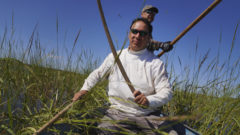
ON LEECH LAKE, Minnesota (AP) — Seated low in her canoe sliding through a rice bed on this vast lake, Kendra Haugen used one wooden stick to bend the stalks and another to knock the rice off, so gently the stalks sprung right back up.

Read Now at Great Lakes Now.

Original Article

Great Lakes Now

Great Lakes Now

https://www.greatlakesnow.org/2022/09/ap-minnesota-ojibwe-harvest-sacred-wild-rice/

The Associated Press

Detroit and Toronto among Time Magazine’s “50 Greatest Places”

Two Great Lakes cities are among “The World’s 50 Greatest Places of 2022” as compiled by Time magazine.

Detroit and Toronto made the list along with destinations on all the continents and in outer space. The magazine said the list came from its “international network of correspondents and contributors, with an eye toward those (destinations) offering new and exciting experiences.”

What puts these key Great Lakes cities in such company?

Read Now at Great Lakes Now.

Original Article

Great Lakes Now

Great Lakes Now

https://www.greatlakesnow.org/2022/07/detroit-toronto-time-50-greatest-places/

Sandra Svoboda

The Great Lakes sugaring season is changing

An area like the Great Lakes that has rain and higher temperatures in the summer, followed by a cold, snowy winter, is best suited for maple production.

But the Great Lakes maple season is evolving as climate change increasingly impacts maple syrup production with shorter harvest seasons, less sugar production and unreliable sap flow.

Read Now at Great Lakes Now.

Original Article

Great Lakes Now

Great Lakes Now

https://www.greatlakesnow.org/2022/04/great-lakes-sugaring-season/

Capri S. Cafaro

Small portions: Michigan puts PFAS advisory on Lake Superior rainbow smelt

By Kelly House, Bridge Michigan

The Great Lakes News Collaborative includes Bridge Michigan; Circle of Blue; Great Lakes Now at Detroit Public Television; and Michigan Radio, Michigan’s NPR News Leader; who work together to bring audiences news and information about the impact of climate change, pollution, and aging infrastructure on the Great Lakes and drinking water.

Read Now at Great Lakes Now.

Original Article

Great Lakes Now

Great Lakes Now

https://www.greatlakesnow.org/2022/03/pfas-advisory-lake-superior-rainbow-smelt/

Bridge Michigan

Thousand Island Dressing Mystery: Uncertain origins of one of America’s favorite sauces

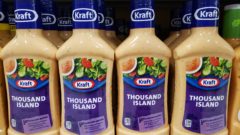
What do you get when you mix mayonnaise, a vaudeville star, two swanky hotels and a fisherman’s wife?

If you guessed Thousand Island dressing and an age-old mystery, you’d be correct. 

Today, Thousand Island dressing is bottled and sold in grocery stores nationwide. You may even find a simplified version of the dressing (mayonnaise, ketchup or tomato puree, and pickle relish) at your favorite burger spot, masquerading as their “special” or “secret” sauce.

Read Now at Great Lakes Now.

Original Article

Great Lakes Now

Great Lakes Now

https://www.greatlakesnow.org/2021/07/thousand-island-dressing-uncertain-origins/

Rachel Duckett

PFAS News Roundup: PFAS in Lake Superior smelt, McDonalds drops PFAS packaging, White House weakened EPA guidelines

PFAS, short for per- and polyfluoroalkyl substances, are a group of widespread man-made chemicals that don’t break down in the environment or the human body and have been flagged as a major contaminant in sources of water across the country.

Keep up with PFAS-related developments in the Great Lakes area.

Read Now at Great Lakes Now.

Original Article

Great Lakes Now

Great Lakes Now

https://www.greatlakesnow.org/2021/01/pfas-news-lake-superior-smelt-wisconsin-settlement-mcdonalds-epa/

Natasha Blakely

Great Lakes Gift Guide 2020: Remember that road trip, boat ride, microbrew or sweatshirt you should’ve bought with this list

Want to give your loved ones a holiday gift that connects to that summer trip up north or the fall color tour you took together? 

Or maybe you have a trip planned for after the COVID-19 vaccines have been distributed and want to give them something to remind them they have something to look forward to. 

Read Now at Great Lakes Now.

Original Article

Great Lakes Now

Great Lakes Now

https://www.greatlakesnow.org/2020/12/great-lakes-gift-guide-2020-list/

Natasha Blakely

Virus threat creates unease in Michigan summer tourism haven

TRAVERSE CITY, Mich. (AP) — Clare Nagrant earns her living from tourism, so she’s taken a beating during the coronavirus-imposed shutdown. A few months ago, she was juggling four jobs. Now she’s down to one part-time gig with a distillery that stayed open by adding hand sanitizer to its product line.

Read Now at Great Lakes Now.

Original Article

Great Lakes Now

Great Lakes Now

https://www.greatlakesnow.org/2020/05/ap-coronavirus-covid-19-michigan-traverse-city-tourism/

The Associated Press