By Vivian La and Ed Ronco, IPR

This story is made possible through a partnership between Interlochen Public Radio and Grist, a nonprofit environmental media organization.


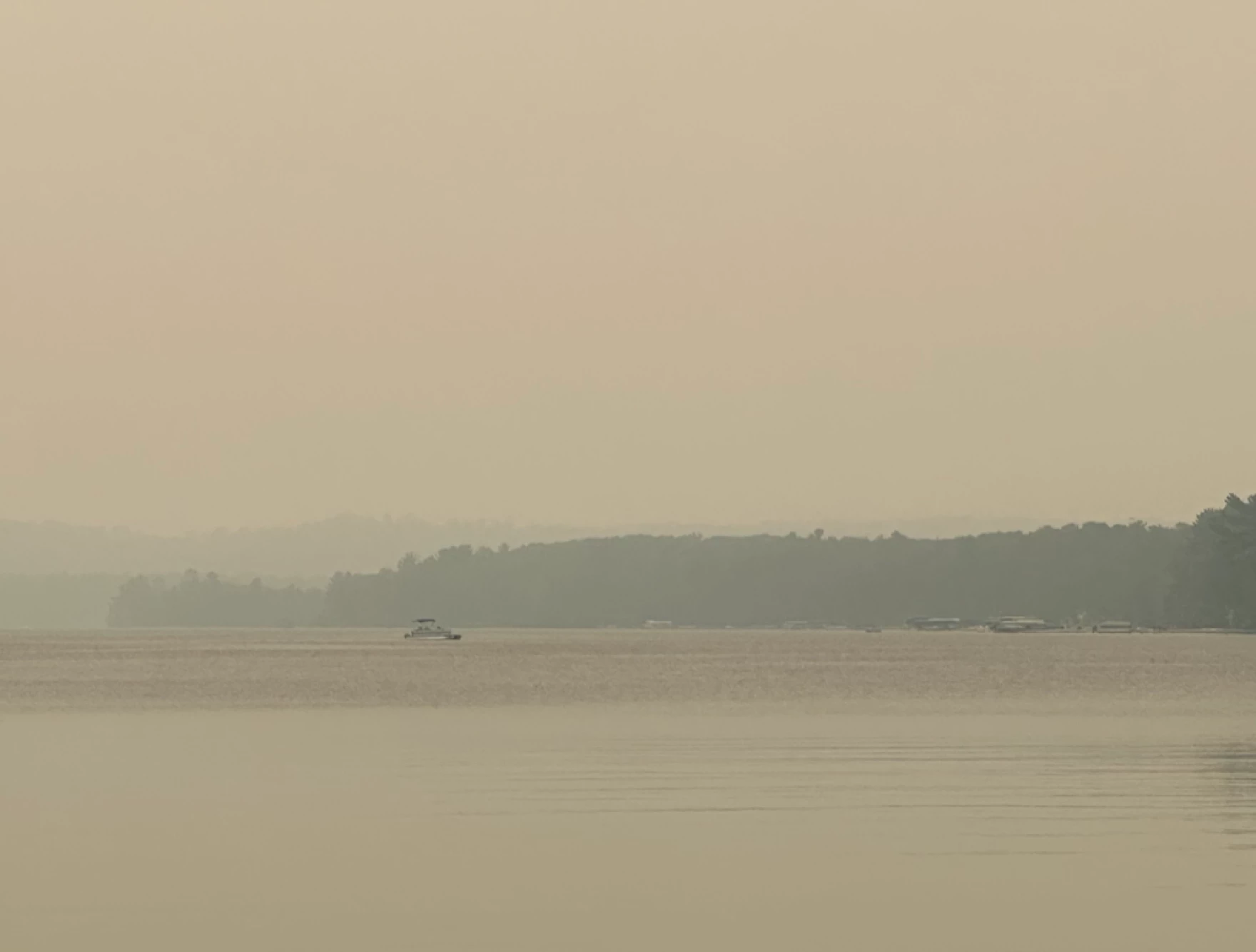
Northern Michigan is enveloped in a thick blanket of brown smoke from wildfires in Minnesota and Canada.

“We currently can’t see across (Lake Charelvoix),” said Jenny Clasman, executive director of the Boyne Area Chamber of Commerce, which canceled an outdoor concert set for Wednesday night. “I can see across the street, but it’s definitely foggy, cloudy. There is ash on our cars right now and it smells like burning tires.”

Clasman, who has asthma, said she was having a hard time breathing and was wearing an N-95 mask outdoors.

And she might not get much relief this week.

“It’s going to be with us certainly for Thursday, and there’s a pretty good chance it’s going to hang around into the day on Friday before we can really start to displace it,” said Jeff Zoltowski, a meteorologist at the National Weather Service office in Gaylord.

The fires are hundreds of miles away from Michigan, but until they settle down or go out altogether, off-and-on smoke will be possible as long as the winds are coming out of the northwest.

“It’s a really, really thick plume of smoke. It’s being added to continually,” said Jim Haywood, senior meteorologist with EGLE. “We’re seeing new fires breaking out all the time.”

Haywood said smoke forecasts currently look ahead 48 hours, and are issued with help from meteorologists across the Midwest.

Because of how aggressive the fires are, EGLE said their air quality alert will extend into Thursday and possibly Friday.

Health impacts

Most of northern Michigan was under an air quality alert. At a monitoring station in Houghton Lake, the air quality was listed as “unhealthy for sensitive groups” on Wednesday afternoon. In Seney, in the Upper Peninsula, the air quality was “unhealthy,” meaning all populations were at risk of adverse effects.

It’s recommended that people avoid any strenuous outdoor activity because of high levels of fine particulate matter, which can cause health problems when inhaled. Children, older adults, or people with respiratory and cardiovascular disease are particularly vulnerable.

Northern Michigan is also under a heat advisory, with high humidity and temperatures expected to stay in the upper 80s well into the weekend.

Wildfire smoke can exacerbate health issues from extreme heat, said Lisa Del Buono, a retired doctor in Traverse City and founder of the nonprofit Michigan Clinicians for Climate Action.

“When there are two hazards being described, we have a tendency in our communication and in our brains to silo the issues, but they tend to work together and sometimes have compounding effects,” she said.

Under both a heat advisory and air quality alert, Del Buono recommends running the air conditioner and making sure the filter inside is clean.

She also suggested checking in on neighbors because heat and smoke can sometimes trigger heart attacks, stroke, or preterm deliveries.

Days like this with multiple hazards are a reminder that northern Michigan is vulnerable to the impacts of climate change, Del Buono said. Average summer temperatures in Michigan have increased by 2.3 degrees Fahrenheit, according to data from the research nonprofit Climate Central.

Hotter temperatures around the U.S. and Canada are making the conditions that can cause fires to ignite and burn more common.

From her vantage point about halfway out Old Mission Peninsula, Del Buono said she had lost sight of an island that’s usually in view, just about a mile away.

“Right now, I can’t even see the water at all, let alone the island or across the bay,” she told IPR.

“We are not avoiding the impacts of climate change, as we can see looking out the window right now,” Del Buono said. “All of this is tough on our health.”

Canceled plans

Clasman, who leads the Boyne Area Chamber of Commerce, said it was disappointing to have to cancel tonight’s event, but it was also an easy decision.

“I do worry about people getting sick,” she said. “I do worry about the ERs filling up this evening, and I definitely don’t want to be contributing to that.”

Boyne City’s weekly Evenings at the Gazebo Summer Music Series hardly ever cancels an event. Even when it rains they move to a pavilion at Veterans’ Park.

Wednesday night’s act, the Traverse City-based duo “Dags Und Timmah!” will return on Aug. 19, air quality permitting.

Clasman said it’s the third year they’ve dealt with smoke drifting into the area but this is the worst it’s been.

“I’ve never had ash on the car. That’s new,” she said. “I’ve never smelled burning tire. That’s new.”


The post Air quality alerts issued for northern Michigan as wildfire smoke blankets region appeared first on Great Lakes Now.
Original Article

Great Lakes Now

Great Lakes Now

https://www.greatlakesnow.org/2026/07/15/air-quality-alerts-issued-for-northern-michigan-as-wildfire-smoke-blankets-region/

Interlochen Public Radio

By Vivian La, IPR

This story is made possible through a partnership between Interlochen Public Radio and Grist, a nonprofit environmental media organization.


Researchers from the University of Notre Dame have developed the most comprehensive look yet at how PFAS moves through the food web in the Great Lakes.

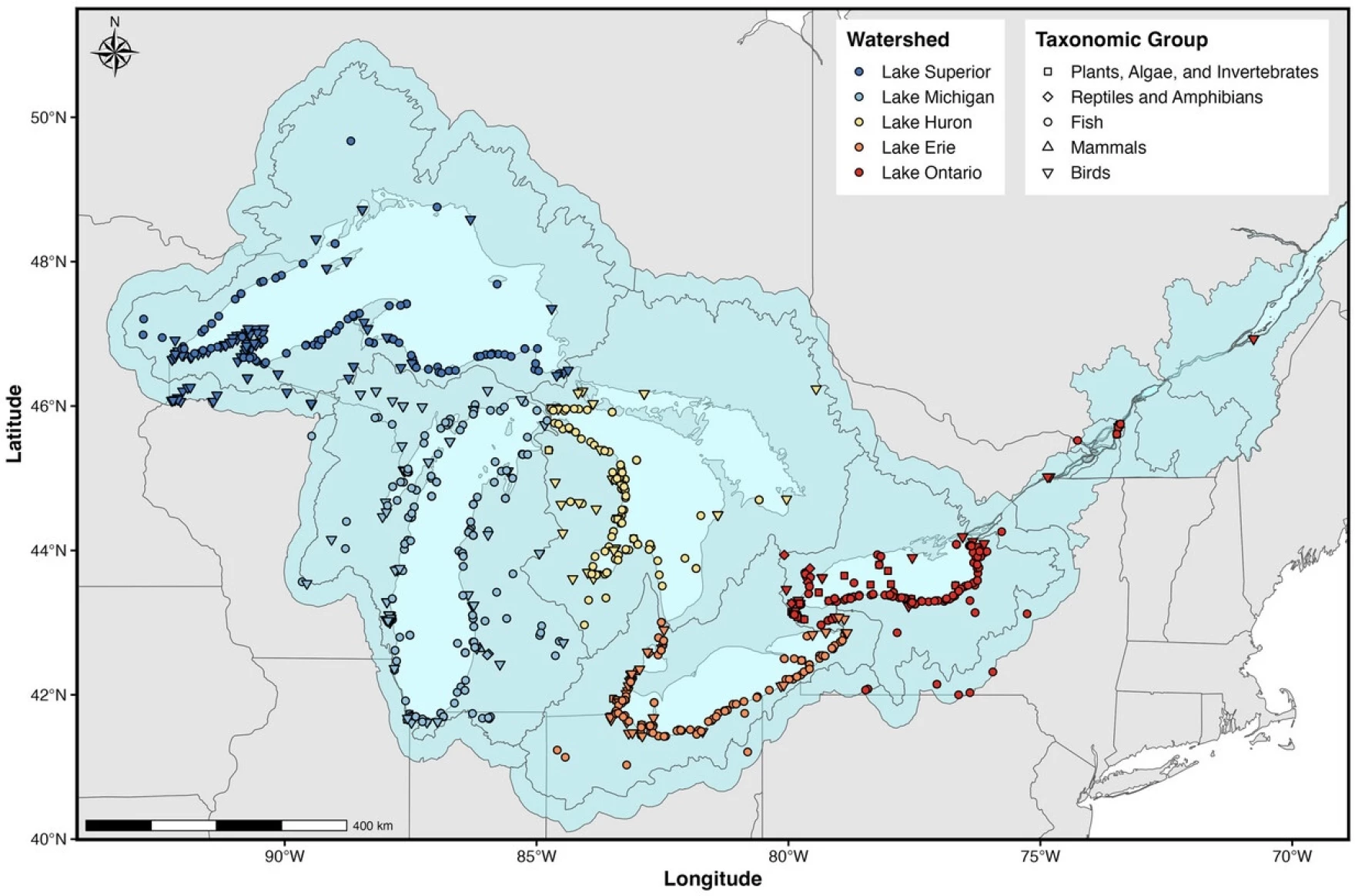
The study published this spring in the Journal of Environmental Quality analyzed 42 years of studies and combined nearly 2,500 samples of algae, fish, birds and other organisms — in what’s called a meta-analysis — to identify trends.

PFAS refers to a group of man-made and long-lasting compounds linked to a range of human health issues. It can enter waterways through landfills, wastewater and industrial facilities.

“What we’re finding is that the food web itself is a vehicle for transferring these chemicals from one organism to another,” said Gary Lamberti, aquatic science professor at Notre Dame and a study co-author. “So it’s a more holistic view than we’ve known before.”

The study identified a dramatic decrease over the last two decades of one PFAS chemical known as PFOS, following a voluntary phase out by industries in the early 2000s.

“If we stop manufacturing these chemicals, they will eventually reduce in concentration in the food web,” Lamberti said. “That’s kind of good news for how we can manage these chemicals.”

Those declines were seen in the lower Great Lakes — Ontario and Erie — likely because these areas are home to the heavy industries that used the chemical.

But there was little to no decline in PFOS in the upper Lakes Superior, Michigan and Huron, most likely because the water bodies are larger that the lower lakes. In contrast to the shallower Lakes Erie and Ontario, water can stay in the upper lakes anywhere from about 60 to 170 years.

The study also confirmed that these chemicals increase in concentration as they travel up the food chain. Algae and plants have the lowest concentration, according to the study, because they grow and die quickly.

A map showing where samples included in the study were taken from the Great Lakes. (Image courtesy of the Journal of Environmental Quality)

But predators like salmon and eagles had the highest concentration because they’re eating a large amount of prey that have a lot of accumulated PFAS.

Potentially dangerous levels of these chemicals in fish have prompted warnings across the state on how much is safe to eat. Michigan has been testing fish for PFAS since 2012.

“If we can understand what the PFAS levels are in the food web, we can better communicate the risk of consuming those potentially toxic food sources,” said Katherine Manz, an environmental health professor at the University of Michigan who was not involved in the study.

But because PFAS chemicals are in everyday products and they’re very hard to avoid, Manz said her best advice is to use less. Online databases can help consumers avoid certain chemicals.

Manz said the study also pointed out some interesting gaps in research on PFAS dynamics, like a lack of data on certain species.

It was easy to find PFAS data on salmon, trout, and some birds, Lamberti said. But information on the “less glamorous” smaller fish, invertebrates or algae was harder.

The study only focused on six of the PFAS chemicals most commonly tested for, but there are more than 15,000 types out there, according to the National Institutes of Health.

Tools to analyze the range of these chemicals are still evolving, said Vernon Lalone, CEO of Traverse City-based startup Wave Lumina that’s developing a rapid testing kit for PFAS in water and soil.

“It’s like a chicken and an egg situation,” said Lalone, who wasn’t involved in the study. “You’ve got to have an analytical method that’s robust and reliable enough to measure these things before you can regulate them at certain limits.”

Lamberti said there’s still plenty of questions about how these chemicals will shift in the lakes as temperatures rise due to climate change, ice formation shifts and as industries introduce new chemicals.

“Anything we put into the Great Lakes will be there for an extremely long time, not only the water, but all the chemicals that it has, so we have to be very cognizant of how we treat the lakes and what we put into them,” Lamberti said.


The post New study traces PFAS in Great Lakes food webs over 40 years appeared first on Great Lakes Now.

Original Article

Great Lakes Now

Great Lakes Now

https://www.greatlakesnow.org/2026/07/01/new-study-traces-pfas-in-great-lakes-food-webs-over-40-years/

Interlochen Public Radio and Grist

By Vivian La, IPR

This story is made possible through a partnership between Interlochen Public Radio and Grist, a nonprofit environmental media organization.


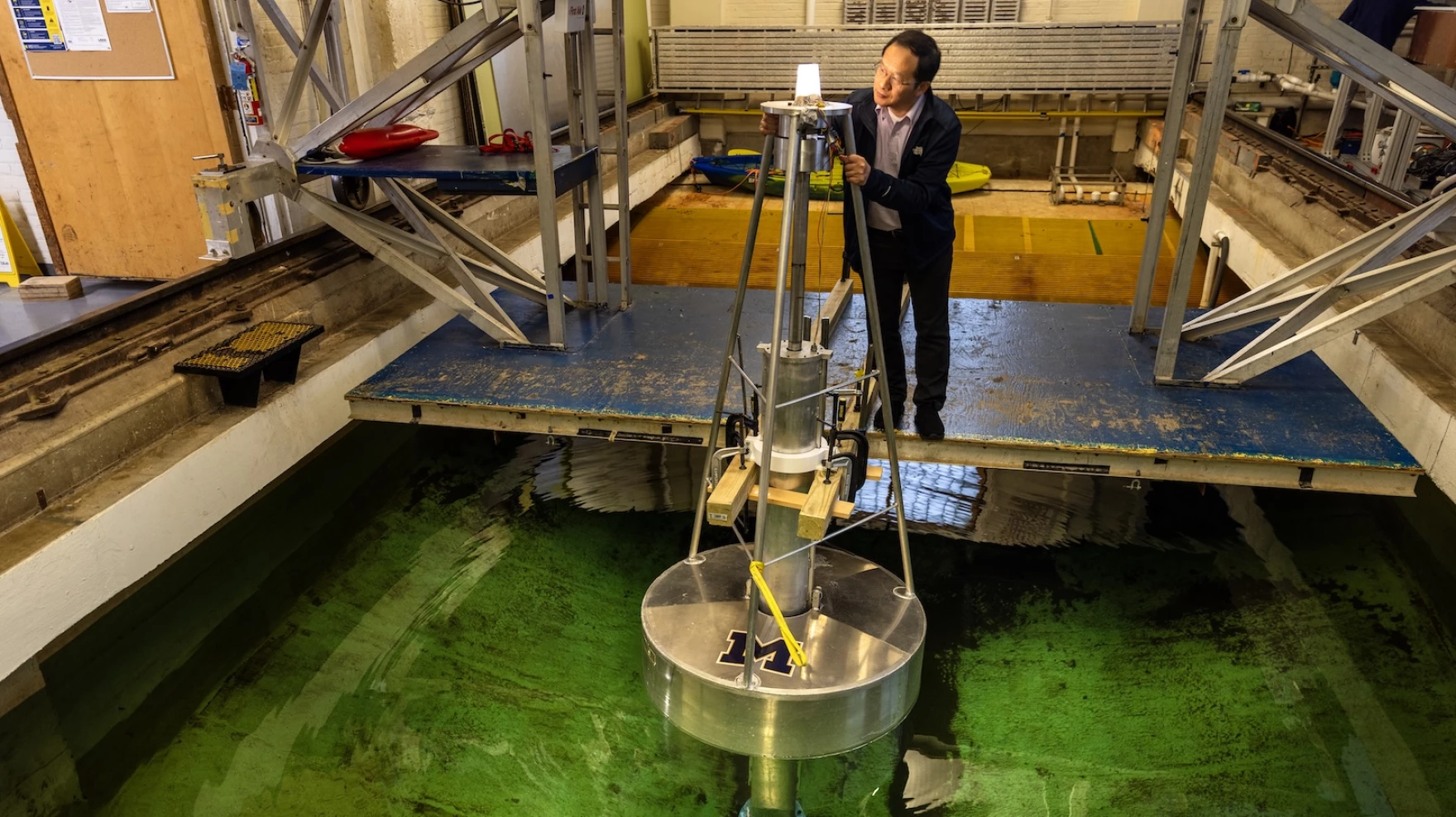
A group of University of Michigan researchers will test devices that convert wave energy into electricity off the shores of Beaver Island this week, as part of an ongoing effort to improve power reliability for residents.

The prototypes — which look like small boats framed with PVC pipes — were designed with input from Beaver Island residents over the course of two years. The upcoming demonstration will help researchers improve their devices and get public feedback.

“We need to work with the community together to identify the need and design together with them,” said Lei Zuo, an engineering professor at the University of Michigan and lead researcher on the wave power project.

Through workshops with the research team, residents told researchers that they want more reliable power to the local airport, especially during emergencies.

Power to the community of about 600 permanent residents comes from the mainland through diesel generators and sensitive underwater electric cables. Outages are common during storms.

These frequent blackouts on the island have led to a natural interest among residents around local renewable energy sources, said Seamus Norgaard, a part-time island resident.

Several residents already power their homes and businesses with solar panels or geothermal energy. And the remote island has previously received federal funds to improve access to clean power.

“It’s a combination of looking at cost savings and also wanting to be independent and not dependent on the mainland for everything. And then also the environmental outlook,” he said.

Despite how much potential wave power has, it isn’t commonly used to power local electric grids because of how expensive and challenging it can be to install. The technology is still new and there isn’t a standardized design yet, said Saied Bayat, one of the researchers on the team.

So while waves on the Great Lakes are smaller and more seasonal than on oceans, research here could help improve this technology as a whole, he said. And it’s an ideal experimental bathtub.

“The Great Lakes provide real-world wave conditions while being much easier, safer, and less expensive to access than most ocean sites,” Bayat said.

After the demonstration, the U of M researchers will go back to improving the prototype. They plan to install a final version in the coming years.

The wave power demonstration will take place during Beaver Island’s 10th annual sustainability fair.

“There is that excitement about these new futures and cleaner sources, and more locally produced, dependable sources of energy,” he said.

The fair is this Saturday, featuring events across the island. The wave energy demonstration starts at 10 a.m. at the Central Michigan University boathouse near Whiskey Point.


The post Could waves become power for Beaver Island? Researchers deploy new tech to find out appeared first on Great Lakes Now.

Original Article

Great Lakes Now

Great Lakes Now

https://www.greatlakesnow.org/2026/06/24/could-waves-become-power-for-beaver-island-researchers-deploy-new-tech-to-find-out/

Interlochen Public Radio and Grist

By Vivian La, IPR

This story is made possible through a partnership between Interlochen Public Radio and Grist, a nonprofit environmental media organization.


As Michigan faces an aging farmer population, communities are looking for ways to shore up the next generation of growers. But people looking to get in the field face challenges like high costs, access to land and a shifting climate.

Tucked on farmland at the southern edge of Traverse City, one program wants to solve some of these problems by letting aspiring farmers learn by doing.

The Great Lakes Incubator Farm attracts students from all over the country. Over the course of seven months, they learn topics like pest management, how to drive a tractor and what to include in a farm business plan.

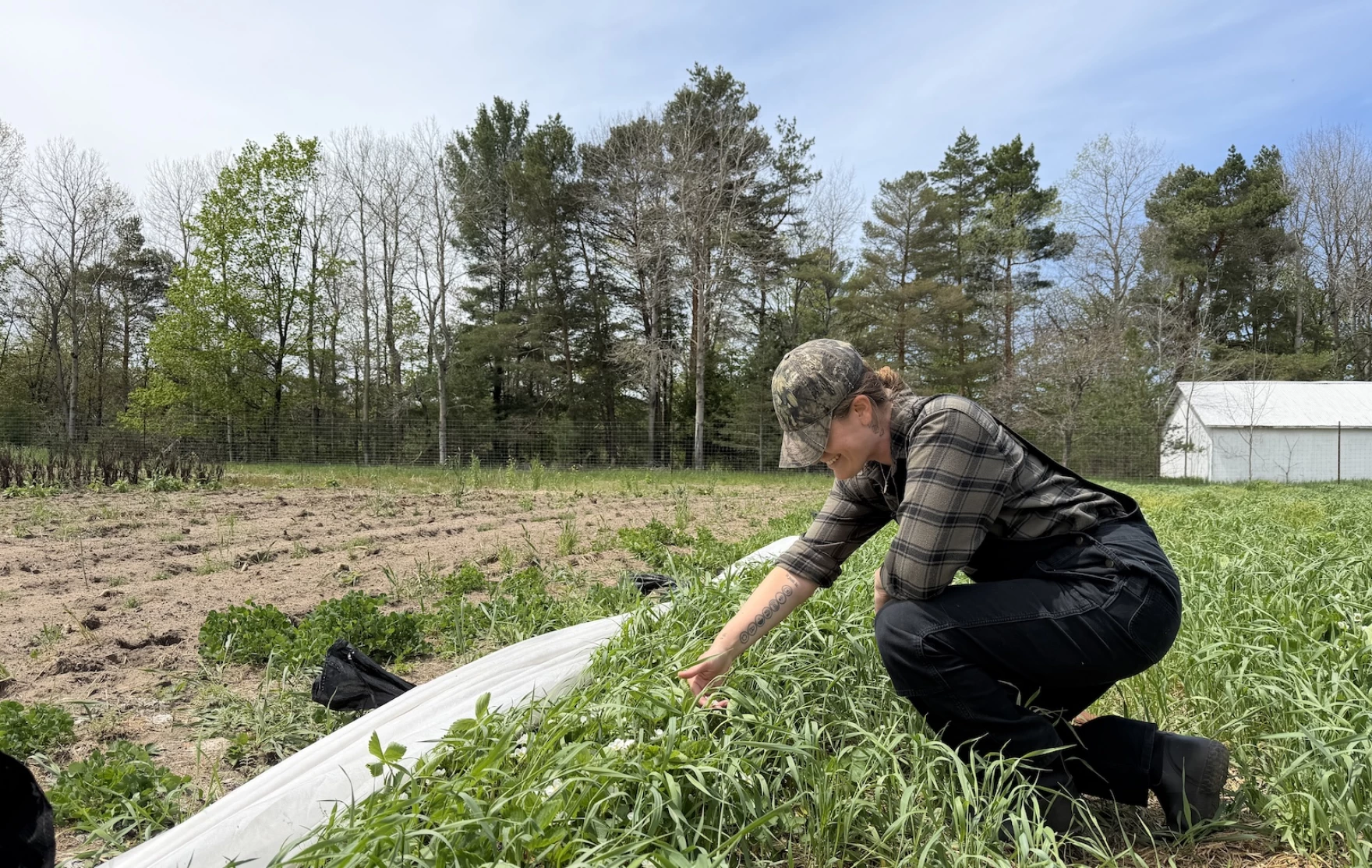
“Nobody gets into farming for sane reasons, other than the sanity of knowing where your food comes from and just general health,” said 33-year-old Rachel Greenberg, a student farmer from Indianapolis. “The challenges are pretty never-ending.”

Those challenges include high costs, access to land and volatile weather. Farm bankruptcies last year were up 46% nationally, according to a National Farm Bureau report. As land prices rise due to demand from developers, more than 50,000 acres of farmland has been lost in the last two decades, according to research.

Despite headwinds, the student farmers said they’re driven by wanting to know where their food comes from, to contribute to local communities and teach others to do the same.

‘Pay it forward’

The farm training program — a project of the Grand Traverse Conservation District — has fewer economic pressures than running a farm business, Greenberg said. The fruits and vegetables that students grow will go to locals who have already committed to buying the season’s produce, and leftovers will go to food rescue operations. Unlike a traditional business, the goal isn’t to make a profit.

“The whole incubator idea is something you see a lot in the world of entrepreneurship, and it’s beautiful that somebody saw that and was like, ‘Why don’t we just do that with farming?’” Greenberg said.

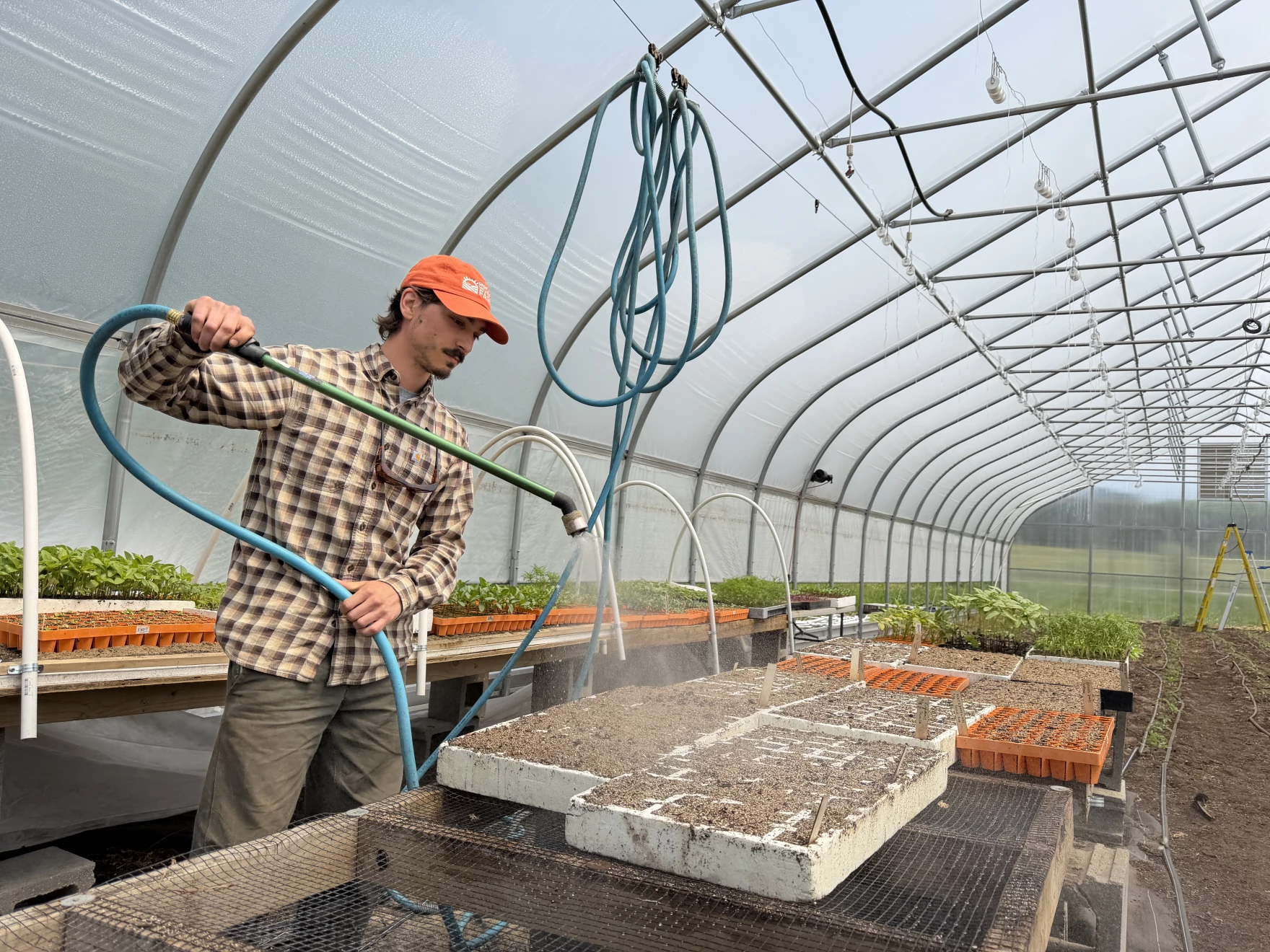
Troy Saruna, 28, said at a time where climate change is driving more severe weather, he wants to better understand his impact on the natural world. Saruna worked in conservation around the country prior to the program, and has no farming experience.

Student farmer Troy Saruna waters seedlings in the greenhouse at the Great Lakes Incubator Farm. (Photo credit: Vivian La/IPR News)

The training program focuses on teaching regenerative agriculture, which refers to practices that could reduce the pollution causing climate change by improving soil health.

“Our food systems are just so inextricably tied to the health of the planet,” Saruna said. “I’m just really interested in striking up a new balance where I can understand, interpret and just develop some new instincts in terms of feeding myself and having thriving communities that also support wildlife.”

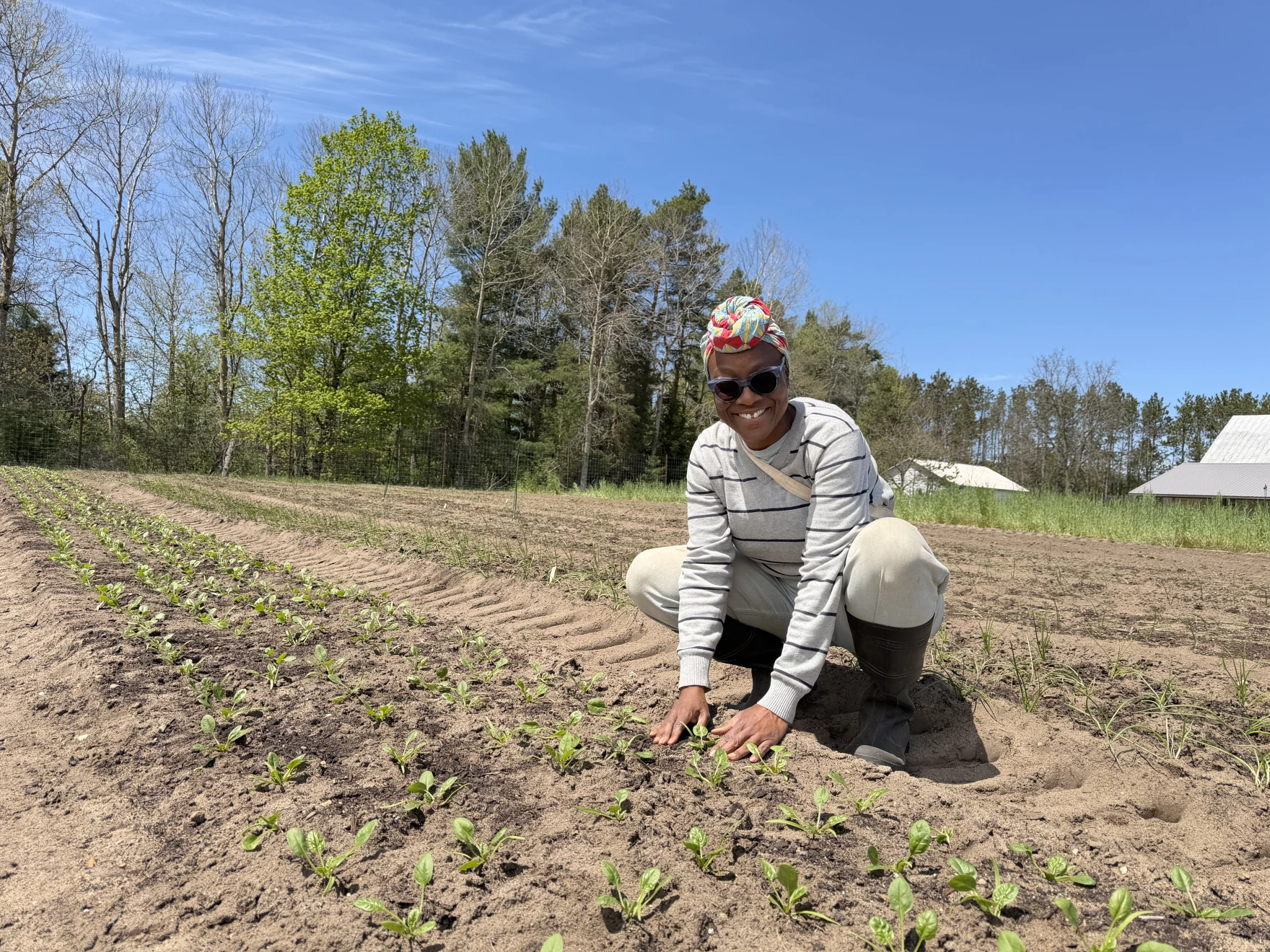
Farmers with some experience also find the program helpful to dive deeper into certain skills. Shanaya Holmes, 49, runs a small 4-acre farm in Alabama.

Student farmer Shanaya Holmes kneels by a row of spinach. (Photo credit: Vivian La/IPR News)

She’s looking to learn how to grow in a different climate and to improve her record keeping — tracking what’s been planted, what soil was used or how much money was spent on equipment.

“It’s a challenge to switch that button off to come inside and do bookwork, bookwork, bookwork when you’re so used to outside, outside, outside,” she said.

Adam Brown, the farm’s manager and instructor, said the farmer training program is meant to be a stepping stone.

“It’s really built for anybody who can then filter out and work anywhere in the food system, either manage a farm, start their own business, or any rung of that ladder where people can just help out in the food system,” Brown said.

Brown wouldn’t have pursued farming himself if it wasn’t for a similar training program he did 15 years ago on the West Coast. He has a background in ecology.

“I can pay it forward, my lessons, and all the wisdom that I learned throughout my years of farming, and be a mentor to these other people, and I feel like it’s super important,” he said.

Funding the future

The training program, now in its second year, is one of the only programs of its kind in northern Michigan, according to data from Michigan State University.

The Great Lakes Incubator Farm relies mostly on a nearly $700,000 federal grant from the U.S. Department of Agriculture aimed at supporting beginner farmers. That grant ends after this season and Brown plans to reapply for USDA funding this year.

Still, the agency is undergoing changes as it works to match the president’s priorities. Last year, the USDA canceled $148 million in grants — including some in the beginner farmer program — to comply with the president’s early executive orders targeting climate action, environmental justice, and diversity, equity, and inclusion.

Brown said there’s not many large pools of money like this USDA grant program that support efforts to train the next generation of farmers. The Great Lakes Incubator Farm is also supported by some state grants.

Adam Brown sits on a tractor at the Great Lakes Incubator Farm. He teaches students at the farm and says there needs to be more training programs like this to support an aging farmer population. (Photo credit: Vivian La/IPR News)

Lack of consistent funding is a big reason we don’t see more of these training programs, said Jon LaPorte, a farm business management educator for Michigan State University Extension.

“It’s almost like a double-edged sword that they’re trying to help people get started, but then they’ve got the same struggles of staying sustainable themselves,” he said.

That means as the share of young people in farming grows in Michigan, programs to support them might be harder to come by, LaPorte said. Farmers under the age of 45 increased by more than 3,000 people between 2017 and 2022, according to the USDA’s census. Sustaining that growth is a challenge.

“Because of those hurdles, they don’t all stay in, and what we want to see is more of those people being able to stay in, having more farms, more diversity of farms,” he said. “More people involved in agriculture at that level is really, really important.”

There are still resources available, said Katie Brandt, who leads MSU’s Organic Farmer Training Program in East Lansing. MSU Extension put together a beginner farmer’s guide in partnership with the USDA last year. And many farms across the state often accept volunteers for work, she said.

Brown, the farm manager, said students in the training program learn that the growing season doesn’t always go smoothly — and things like frost damage on plants is just part of the job.

“This is a great space for failure too, right? Because there’s not a whole lot of risk here,” he said. “It’s a perfect, experimental type of atmosphere.”


The post This northern Michigan program hopes to cultivate the next generation of farmers appeared first on Great Lakes Now.

Original Article

Great Lakes Now

Great Lakes Now

https://www.greatlakesnow.org/2026/05/29/this-northern-michigan-program-hopes-to-cultivate-the-next-generation-of-farmers/

Interlochen Public Radio and Grist