Could waves become power for Beaver Island? Researchers deploy new tech to find out
By Vivian La, IPR
This story is made possible through a partnership between Interlochen Public Radio and Grist, a nonprofit environmental media organization.
A group of University of Michigan researchers will test devices that convert wave energy into electricity off the shores of Beaver Island this week, as part of an ongoing effort to improve power reliability for residents.
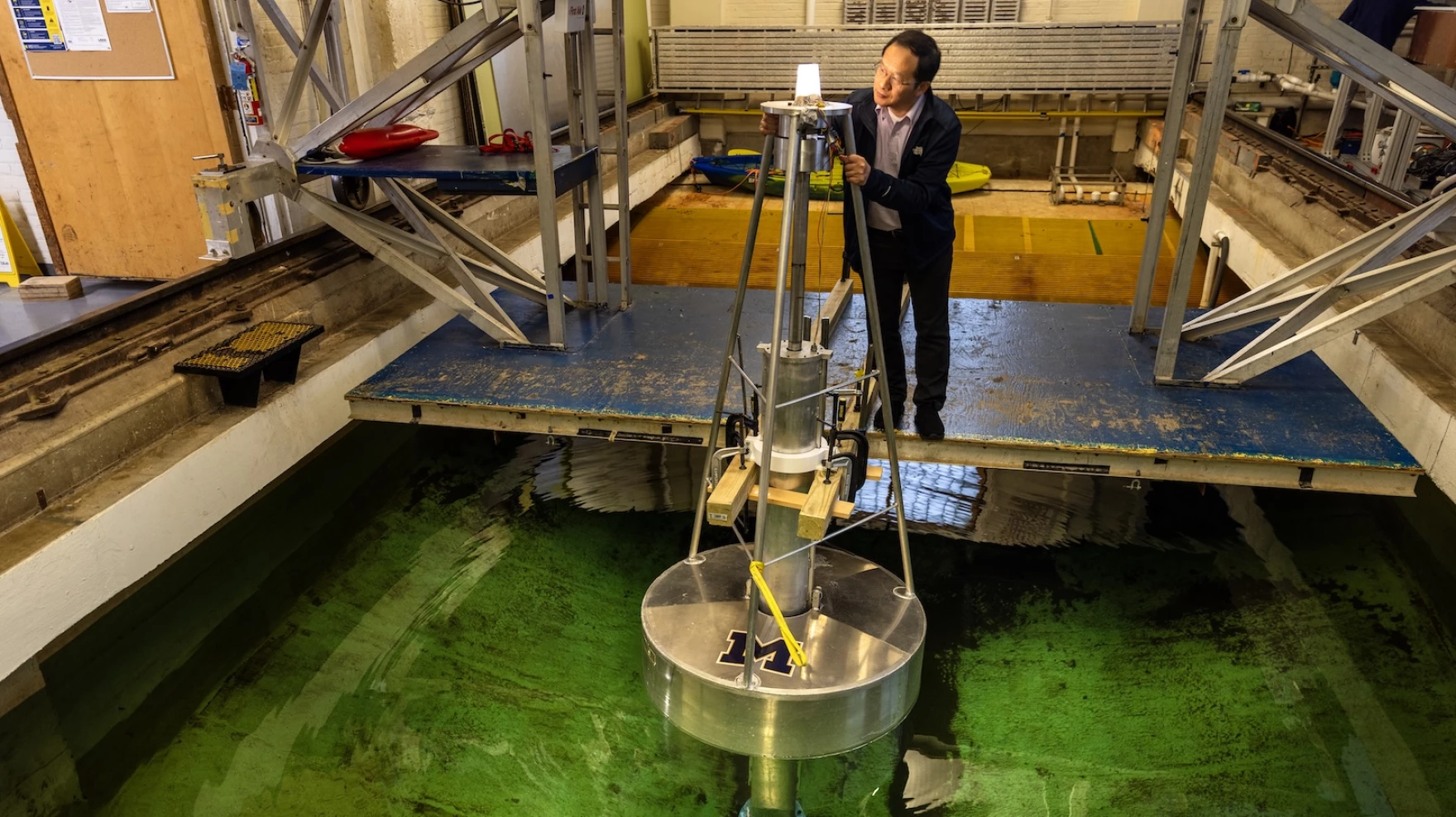
The prototypes — which look like small boats framed with PVC pipes — were designed with input from Beaver Island residents over the course of two years. The upcoming demonstration will help researchers improve their devices and get public feedback.
“We need to work with the community together to identify the need and design together with them,” said Lei Zuo, an engineering professor at the University of Michigan and lead researcher on the wave power project.
Through workshops with the research team, residents told researchers that they want more reliable power to the local airport, especially during emergencies.
Power to the community of about 600 permanent residents comes from the mainland through diesel generators and sensitive underwater electric cables. Outages are common during storms.
These frequent blackouts on the island have led to a natural interest among residents around local renewable energy sources, said Seamus Norgaard, a part-time island resident.
Several residents already power their homes and businesses with solar panels or geothermal energy. And the remote island has previously received federal funds to improve access to clean power.
“It’s a combination of looking at cost savings and also wanting to be independent and not dependent on the mainland for everything. And then also the environmental outlook,” he said.
Despite how much potential wave power has, it isn’t commonly used to power local electric grids because of how expensive and challenging it can be to install. The technology is still new and there isn’t a standardized design yet, said Saied Bayat, one of the researchers on the team.
So while waves on the Great Lakes are smaller and more seasonal than on oceans, research here could help improve this technology as a whole, he said. And it’s an ideal experimental bathtub.
“The Great Lakes provide real-world wave conditions while being much easier, safer, and less expensive to access than most ocean sites,” Bayat said.
After the demonstration, the U of M researchers will go back to improving the prototype. They plan to install a final version in the coming years.
The wave power demonstration will take place during Beaver Island’s 10th annual sustainability fair.
“There is that excitement about these new futures and cleaner sources, and more locally produced, dependable sources of energy,” he said.
The fair is this Saturday, featuring events across the island. The wave energy demonstration starts at 10 a.m. at the Central Michigan University boathouse near Whiskey Point.
The post Could waves become power for Beaver Island? Researchers deploy new tech to find out appeared first on Great Lakes Now.
Great Lakes Now
https://www.greatlakesnow.org/2026/06/24/could-waves-become-power-for-beaver-island-researchers-deploy-new-tech-to-find-out/