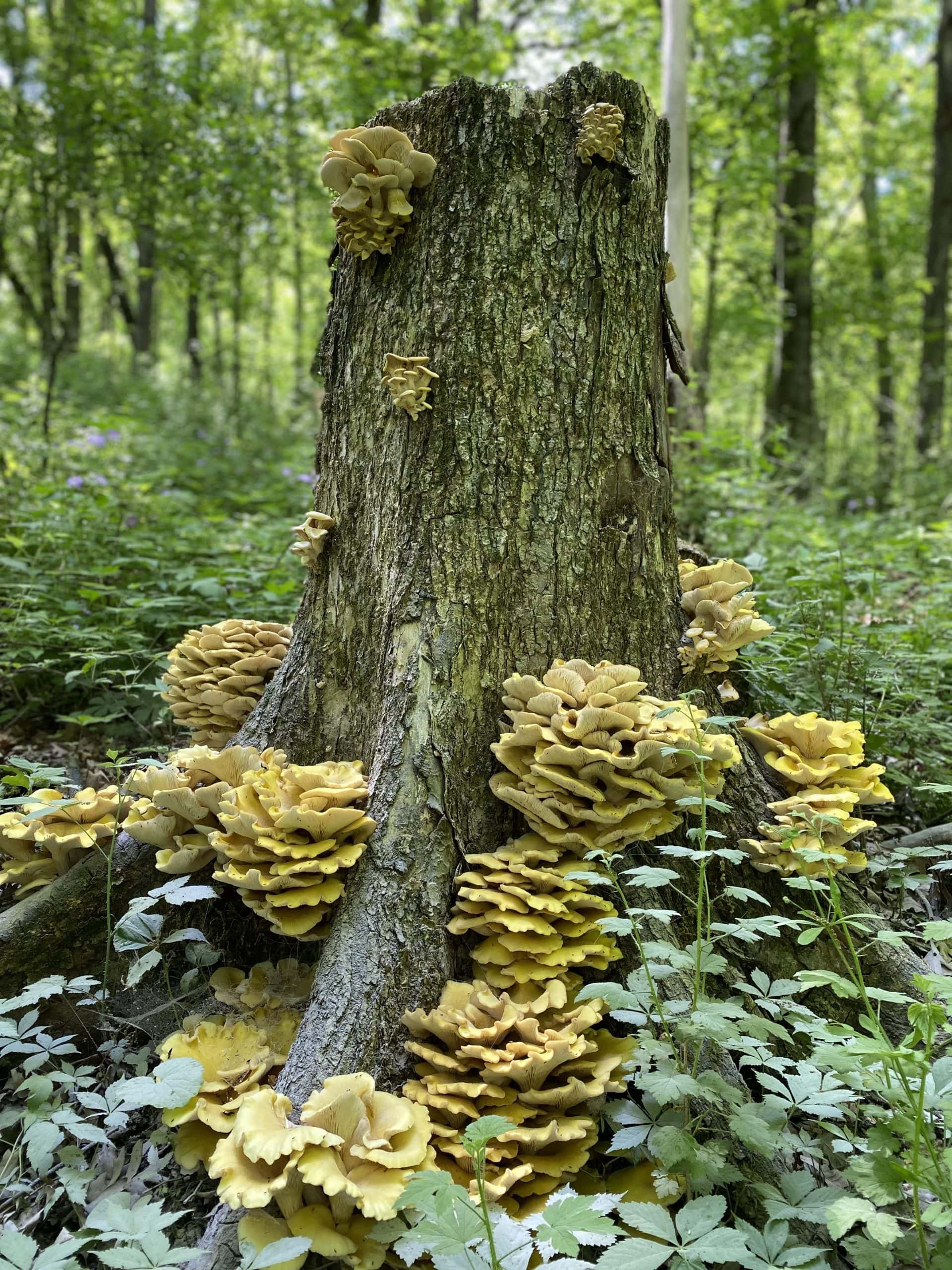
This Earth Day, Detroit PBS programming is focusing on turning land back into something wild. Better known as “rewilding,” a large-scale conservation effort that usually involves reintroducing keystone plant or animal species to reestablish the health of a local ecosystem. 

In the Great Lakes region, Illinois recently made history by being the first state in the nation to make rewilding part of its official strategy. As of January 1, 2026, the “Illinois Rewilding Law” is now in effect. According to the Chicago Tribune, the law empowers the Illinois Department of Natural Resources to go after projects that restore land to its natural state.

“The law could encompass the reintroduction of keystone species that improve ecosystems, like beavers and bison. But officials and environmentalists say closing the federal gaps in wetland protection is their focus right now,” wrote Christiana Freitag at the Chicago Tribune

After the Supreme Court case Sackett v. EPA rolled back federal wetland protections, Illinois became especially vulnerable considering it already lost 90% of its swamps. Chicago was built on wetlands, which are important when considering water quality and flood prevention — this is especially significant, as Chicago has dealt with severe flooding

An international effort

British author and conservationist Isabella Tree joins our Detroit PBS colleagues to discuss her non-fiction book “Wilding: Returning Nature to Our Farm.” On April 29, be sure to check out their live event with PBS Books Readers Club, from 8 to 9 p.m. ET. 

Tree’s book details her process of rewilding her 3,500 acre estate in Sussex, England. After visiting an arborculturist to save their oak trees, Tree and her husband were inspired to change everything they were doing with their land. After it was depleted by centuries of farming, they transformed it into a healthy haven for the littlest bugs and grazing animals, all by planting native flora and fauna. 

“I think the only answer to eco anxiety is to get your hands dirty and do something,” said Tree. “And the joy that can come from even transforming a window box… so that you’re now attracting night flying moths and hoverflies and all the forgotten pollinators, you’re making a difference. And that feels just so fantastic.”

Be sure to also check out the upcoming documentary, Wilding (inspired by the book) that premieres on PBS, on April 22. 

What you can do

For those who would like to feel more involved in helping our ecosystem, Doug Tallamy wants private property owners to know they have a role in the conservation movement. Tallamy calls this the Homegrown National Park movement. 

“Most people have too much lawn,” said Tallamy. 

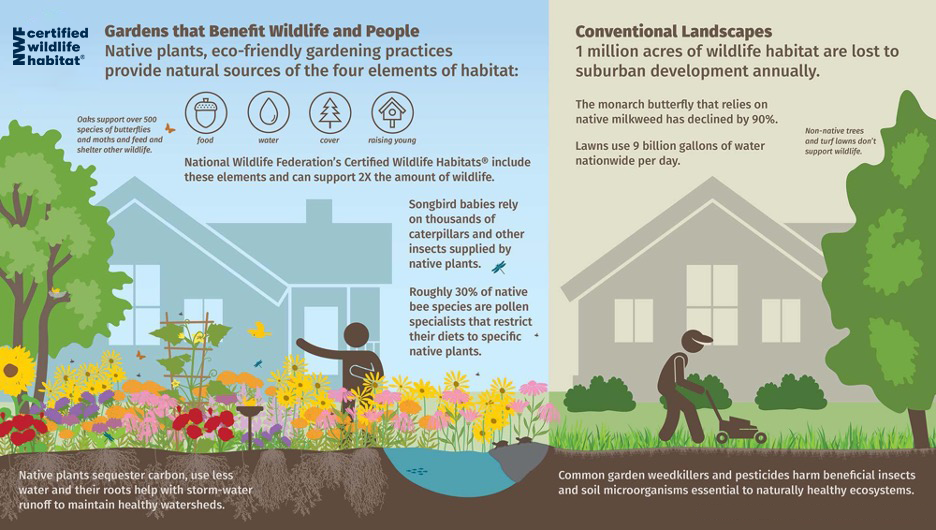
According to the author, entomologist, biologist and conservationist we have 44 million acres of lawn in this country. When there’s a storm event, most of those pesticides, fertilizers and herbicides run off into the watershed. He said, if we’re going to put plants in our yards, why not use ones that do everything we need to conserve and protect our environment? Native plant alternatives to grass help guard our watershed, help the food web, support pollinators and are often better at sequestering carbon.

(Credit: National Wildlife Federation)

 “The point is, what you’re doing is creating connectivity,” said Tallamy. “If you and a bunch of other people do it, then outside of the parks and preserves it’s not no man’s land, there is some habitat.”

For more information, watch Great Lakes Now’s latest interview: 

The post Rewilding, a new way to heal the land this Earth Day appeared first on Great Lakes Now.

Original Article

Great Lakes Now

Great Lakes Now

https://www.greatlakesnow.org/2026/04/22/rewilding-a-new-way-to-heal-the-land-this-earth-day/

Lisa John Rogers, Great Lakes Now

By Vivian La and Lyndsey Gilpin

This was originally published on Grist and has been adapted to include up-to-date information for northern Michigan. Find the full toolkit here.


With waters rising around Northern Michigan, the risk of flooding and dam failure is affecting people across the region. That’s why it’s critical to know where to find accurate information and have a plan. Here’s a resource guide with updated information. We will continue to update this and add more response and recovery resources.

How to pack an emergency kit

As you prepare for a disaster, it’s important to have an emergency kit ready in case you lose power or need to leave your home. Review this checklist from the Federal Emergency Management Agency, for what to pack so you can stay safe, hydrated, and healthy. (FEMA has these resources available in multiple languages here.)

Here are some of the most important things to have in your kit:

  • A list of phone numbers for your city or county emergency services, police departments, local hospitals, and health departments
  • Water (one gallon per person per day for several days)
  • Food (at least a several-day supply of non-perishable food) and a can opener
  • Medicines and documentation of your medical needs
  • Identification and proof of residency documents (see a more detailed list below)
  • A flashlight 
  • A battery-powered or hand crank radio
  • Backup batteries
  • Blanket(s) and sleeping bags
  • Change of clothes and closed-toed shoes
  • First aid kit (The Red Cross has a list of what to include)
  • N-95 masks, hand sanitizer, and trash bags 
  • Wrench or pliers 
  • Cell phone with chargers and a backup battery
  • If you have babies or children: diapers, wipes, and food or formula
  • If you have pets: food, collar, leash, and any medicines needed

FEMA has activities for kids to make this process more fun; the ASPCA also has useful guidelines for people with pets.

Don’t forget: Documents

One of the most important things to have in your emergency kit is documents you may need to prove your residence, demonstrate extent of damage, and to vote. FEMA often requires you to provide these documents in order to receive financial assistance after a disaster. Keep these items in a water- and fire-proof folder or container. You can find more details about why you may need these documents here.

  • Government-issued ID, such as a drivers’ license, for each member of your household
  • Proof of citizenship or legal residency for each member of your household (passport, green card, etc.)
  • Social Security card for each member of your household
  • Documentation of your medical needs, including medications or special equipment (oxygen tanks, wheelchairs, etc.)
  • Health insurance card
  • Car title and registration documents
  • Pre-disaster photos of the inside and outside of your house and belongings
  • For homeowners: copies of your deed, mortgage information, and home insurance policy, if applicable
  • For renters: a copy of your lease and renters insurance policy
  • Financial documents such as a checkbook or voided check

Planning for people with disabilities

Disabled people have a right to all disaster alerts in a format that is accessible. The Partnership for Inclusive Disaster Strategies, a disability-led nonprofit focused on disasters, has a list of these rights. The organization also runs a hotline for any questions: (800) 626-4959 or hotline@disasterstrategies.org.

FEMA has a list of specific planning steps for people with disabilities. Some of these recommendations include:

  • Contact your local emergency management office to ask about voluntary registries for people with disabilities to self-identify so they can access targeted assistance during emergencies and disasters. 
  • If you use medical equipment that requires electricity, ask your health care provider about what you may be able to do to keep it running during a power outage.
  • Wear medical alert tags or bracelets. Also add pertinent medical information to your electronic devices.
  • In your emergency kit, have your prescription information and medicines, as well as contact information for people who can help care for you or answer questions.

Finding shelter and staying safe

Shelter

If flooding risk forces you from your home, there are several ways to find a shelter.

Floodwater safety

  • Never wade in floodwaters. They often contain contaminated runoff from sewer systems, animal waste, physical objects, and downed power lines. 
  • If a road is flooded, turn around. According to NWS, it takes just 12 inches of water to carry away most cars. 
  • When you come in contact with flood water, be sure to wash exposed skin immediately. Wear rubber boots, gloves, and goggles. Here are more tips on floodwater safety from the CDC, including emergency wound care.

Power outages

You may experience a power outage before or during a disaster. Here are some ways to prepare and stay safe:

  • Your utility company may alert you of changes, so sign up for texts or calls from them. You can also usually report outages to your utility company by calling or filling out forms online.  
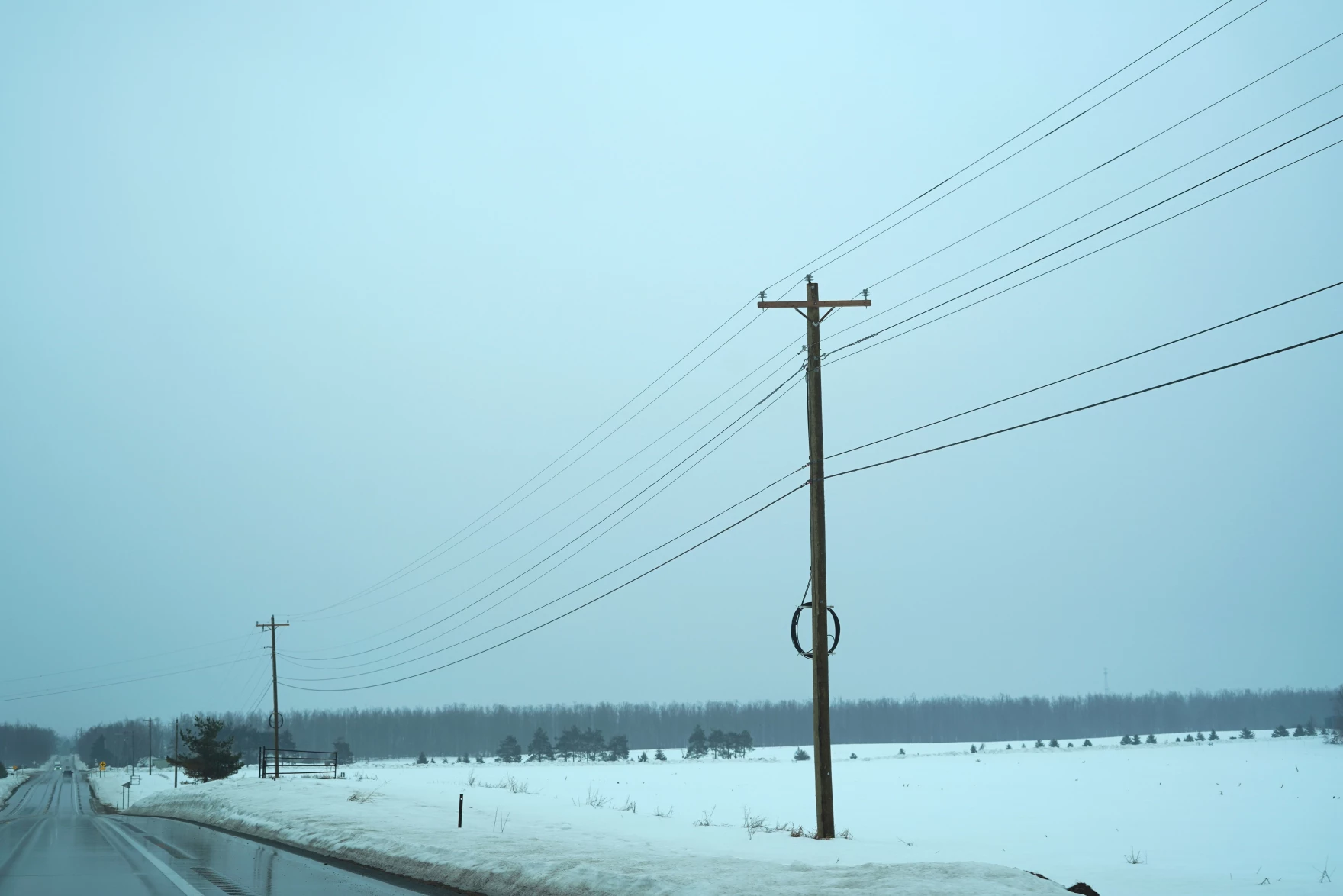
  • Stay away from downed power lines, stray wires, and debris in contact with them, as they can deliver fatal shocks.
  • If your power does go out, keep your refrigerator closed as much as possible and eat perishable food first. Get some coolers with ice if possible, and if you’re in doubt about any food, throw it out. 
  • Unplug appliances and electronics, and use flashlights instead of candles to reduce the risk of fire.
  • If you use a generator, make sure you know the best practices. Find more information about types of generators here, and learn how to use them safely
  • Carbon monoxide poisoning is one of the leading causes of death after a storm that knocks out power. Do not use a gas stove to heat your home and do not use barbecues, grills, or other outdoor cooking equipment inside, because they can generate carbon monoxide. If you have a generator, keep it outside in a well ventilated area away from windows. The Red Cross has more generator safety tips

You can find more power outage safety tips here, from the Energy Education Council.

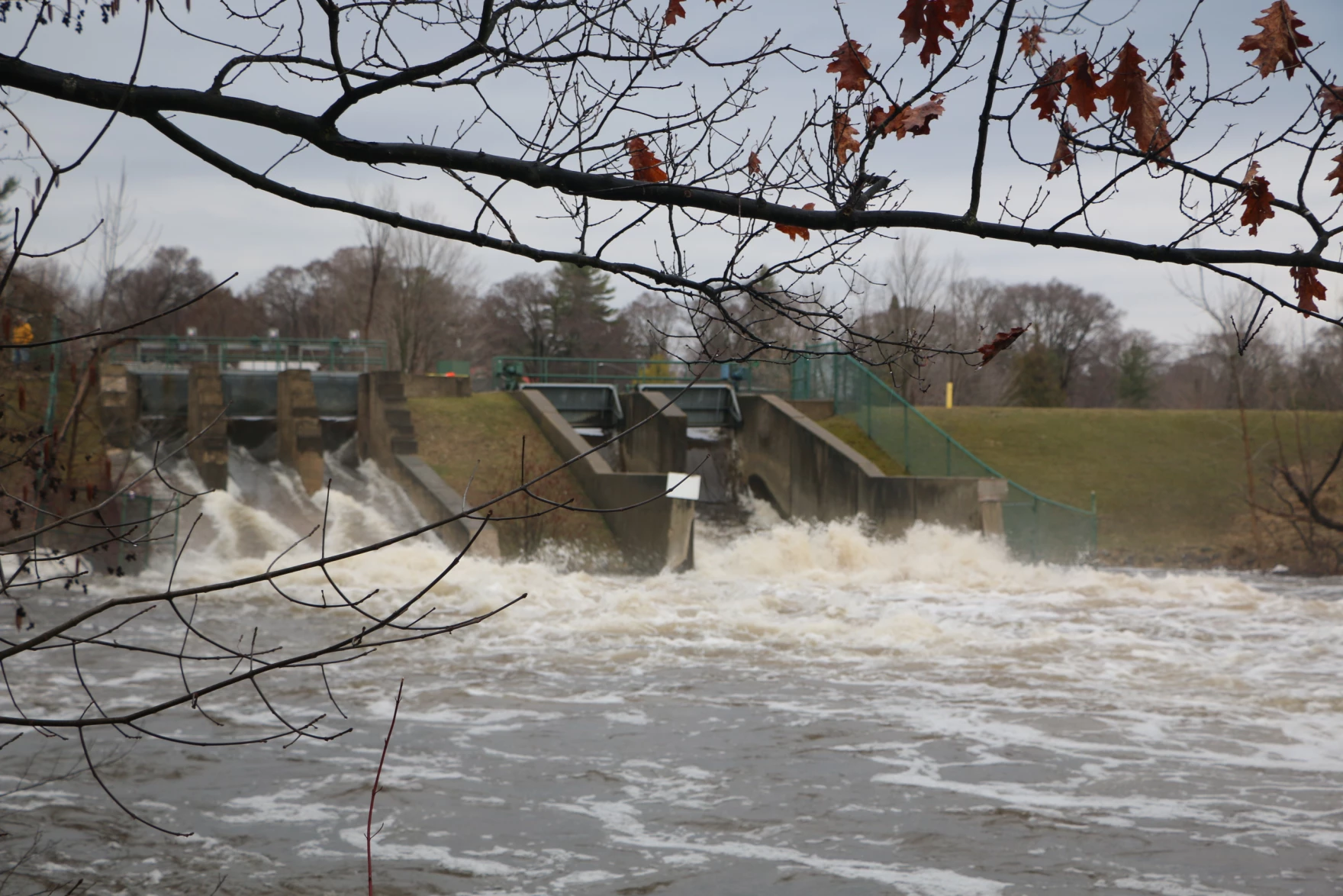
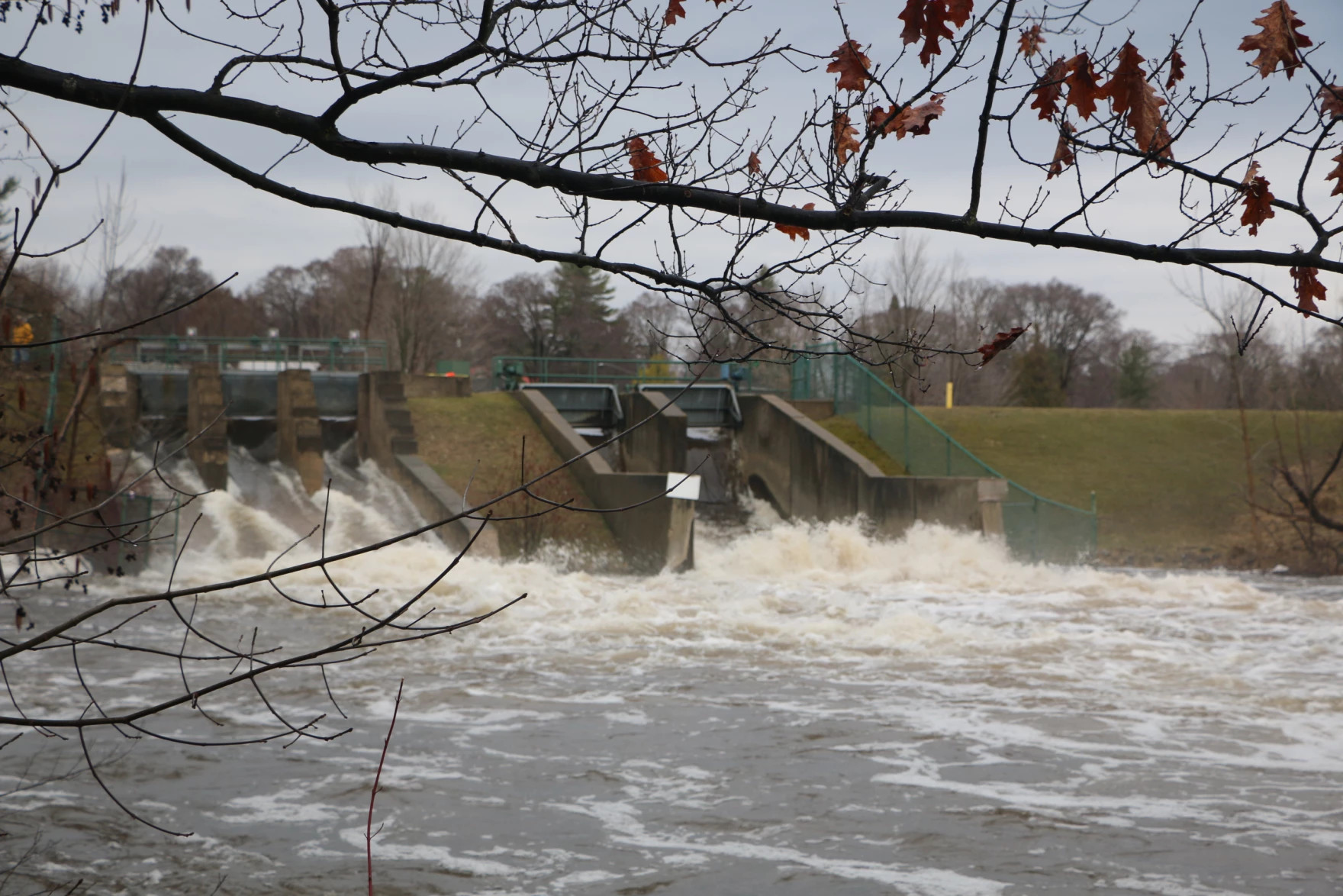
Water rushing through the spillway at the Bellaire Dam on Monday, April 13, 2026. (Photo: Austin Rowlader/IPR News)

Signs and symptoms of illness

Carbon monoxide poisoning: It can take just minutes to get carbon monoxide poisoning. Be on the lookout for nausea, a mild headache, and shortness of breath. More severe cases can cause confusion, chest pain, dizziness, severe headaches, and loss of coordination. The Mayo Clinic has more information on what to look out for, and FEMA has information on how to prevent carbon monoxide leaks.

Tetanus: This is an infection caused by bacteria. It’s rare, but can be more common after disasters because it’s more likely people come into contact with rusty nails, needles, or contaminated dirt. The most common symptom, which can occur anywhere from three to 21 days after exposure, is lockjaw. Tetanus is easily prevented with a vaccine. Read more here from the CDC.

Mutual aid
Mutual aid is a voluntary, collaborative exchange of resources, money, and services among community members. These groups are often local or regional, and they are more nimble and quick to respond in emergency situations because of their decentralized nature. Depending on how much funding comes in after a disaster, mutual aid groups can directly send money to those in need, purchase supplies, set up distribution sites, and more.

Planning an evacuation route

It is important to have a plan in case there’s an evacuation order in your area, or if you decide you want to evacuate on your own.

FEMA also has a list of key things to know when making an evacuation plan.

  • Choose several places you could go in an emergency — maybe a friend or family member’s house in another city, or a hotel. Choose destinations in different directions so you have options. If you have pets, make sure the place you choose allows them, as shelters usually only allow service animals.  
  • Make sure you know several routes and other means of transportation out of your area, in case roads are closed.
  • Keep a full tank of gas in your car if you know a disaster may be coming, and keep your emergency kit in your car or in an easily accessible place.
  • Come up with a plan to stay in touch with members of your household in case you are separated. Check with your neighbors as well. 
  • Unplug electrical equipment, except for freezers and refrigerators, before you evacuate. If there’s already damage to your home in any way, shut off water, gas, and electricity. 

Always heed the advice of local officials when it comes to evacuations. Your state or county may have specific routes and plans in case there are mandatory evacuations.

Protecting and preparing your home

It’s impossible to know what might happen to your home during a disaster, but there are many best practices to keep your belongings and property as safe as possible.

Below is a list of ways to protect your home from water and wind damage, gathered from the National Flood Insurance Program and local government sources.

  • Take photos of your home and property so you have evidence of what it looked like before any damage occurs, in case you need to file an insurance claim or apply for federal aid.
  • Move your most valued belongings to a high, safe place, such as an attic. 
  • Clear your gutters and downspouts when you know a big rain is coming, and make sure they’re pointed downhill, away from your home.
  • Clear storm drains and drainage ditches of debris.
  • Elevate your utilities, including electrical panels, propane tanks, sockets, wiring, appliances, and heating systems, if possible, and anchor them in place.
  • Get a sump pump if you are a homeowner. A working sump pump and a water alarm can minimize flood damage in your basement. Install a battery-operated backup pump in case the power goes out. 
  • Seal any cracks in your foundation with mortar, caulk, or hydraulic cement. 
  • Secure outdoor items so they don’t blow or wash away.
  • If you’re in a hurricane-prone area, install storm shutters. There are many products for every budget; some are temporary and some are permanent. 
  • Secure loose roof shingles, which can create a domino effect if wind starts to take them off. 

How to document flood damage

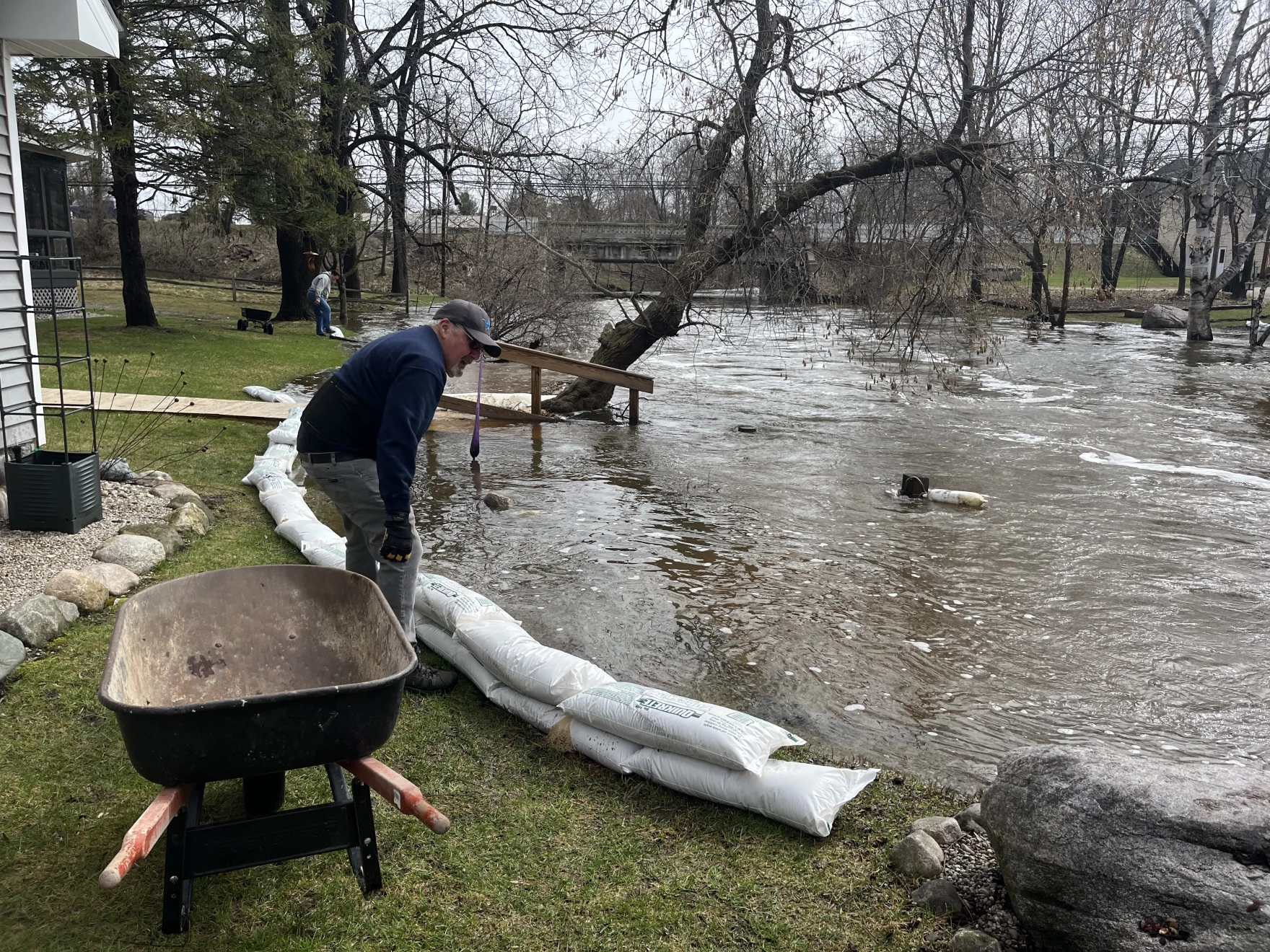
Fred Chacon, Bellaire resident of 12 years, places sandbags between his house and the Intermediate River, just downstream of the Bellaire Dam. (Photo: Claire Keenan-Kurgan/IPR News)

If you’ve already seen damage from flooding and it’s safe to return home, it’s critical that you photograph everything that was damaged and gather any documents you can salvage for insurance claims and government aid applications.

Before you begin:

  • Turn off your electricity and gas (here’s how).
  • Have a first aid kit handy.
  • Make sure your tetanus shot is up to date (your state or county health department may offer free tetanus vaccines if you need one; it’s best to call them to find out).
  • Look at the structural integrity of the building before entering, and do not go inside if it looks like there is any potential for something to collapse. Do not touch anything electrical if in doubt about the state it’s in. 
  • Wear protective clothing: long sleeves and pants, goggles, leather, rubber or plastic gloves, closed-toed and/or sturdy boots or shoes, a respirator or N95 mask, and a Tyvek suit if you can find one. Check with your aid distribution sites for tools, personal protective equipment, and cleaning materials. 
  • Do not attempt to drive or wade through floodwaters, which can sweep you away even if it doesn’t seem deep, and can be contaminated or contain dangerous debris. Do not touch any debris or materials that may be contaminated by toxic chemicals (you may need special equipment or PPE to handle burned or flooded debris). 

Take photos and videos

Whether you have insurance and are filing a claim, or you do not have flood insurance and you’re applying for federal assistance from FEMA, you’ll need a lot of evidence to prove the damage was caused by a disaster. 

  • Gather any photos of your house or apartment from before the crisis so you can more easily document your losses. 
  • Take photos of the outside and inside of your home or apartment, including damaged personal property, and label them by room before you remove anything. 

If you have insurance, take photos of the make, model, and serial number for appliances and anything else of value. Provide receipts to your adjuster to document damage for your claim.

This was originally published on Grist and has been adapted to include up-to-date information for northern Michigan. Find the full toolkit here.

The post Here’s how to prepare, as more rain falls on northern Michigan appeared first on Great Lakes Now.

Original Article

Great Lakes Now

Great Lakes Now

https://www.greatlakesnow.org/2026/04/20/heres-how-to-prepare-as-more-rain-falls-on-northern-michigan/

Grist and Interlochen Public Radio

By Paula Gardner, Kelly House and Ron French, Bridge Michigan

The Great Lakes News Collaborative includes Bridge Michigan; Circle of Blue; Great Lakes Now at Detroit PBS; Michigan Public, Michigan’s NPR News Leader; and The Narwhal who work together to bring audiences news and information about the impact of climate change, pollution, and aging infrastructure on the Great Lakes and drinking water. This independent journalism is supported by the Charles Stewart Mott Foundation. Find all the work HERE.


CHEBOYGAN — Local, state and federal officials were aware of the dangers posed by the Cheboygan Lock and Dam for years before floodwaters pushed it to the brink of collapse, records show.

Yet they failed to compel private owners to repair the nonfunctional hydro plant connected to the publicly-owned dam —  a critical piece of its ability to pass floodwaters downstream. 

The facility that houses the plant, once a Charmin toilet paper mill, changed hands repeatedly over decades as it fell into disrepair. 

Now taxpayers are helping bankroll a desperate effort to bring the plant back online before the dam fails and sends a wall of water toward downtown Cheboygan.

“I’m very concerned that this was not handled properly,” said Richard Sangster, a Cheboygan County commissioner and former Cheboygan mayor, about federal regulatory actions over several years.

The property is now owned by Hom Paper XI, LLC, a business controlled by former NFL linebacker Thomas Homco. He did not return voicemails left by Bridge Michigan. 

State and local officials did what they could, Cheboygan County Sheriff Todd Ross said Thursday.

“We didn’t wait ‘til the last minute,” Ross said. “It’s privately owned. There’s only so much we can do.”

A public tally of taxpayer costs associated with the round-the-clock repair wasn’t available Thursday, but estimates from a few years ago indicated the plant needed at least $1 million in repairs.

‘Safety concerns have been raised many times’

Records show the agency that primarily regulates hydropower dams, the Federal Energy Regulatory Commission, sent warning letters for years to a shifting cast of owners while granting multiple extensions.

Among the issues they cited: missing inspection records and malfunctioning equipment that was crucial to passing water in the event of a flood.  

As far back as 2019, regulars warned about cracked concrete and damaged retaining walls and gates that could help the dam manage flooding, records show.

In 2021, FERC told the plant’s then owners that “multiple items are overdue and completion dates are rapidly approaching.”

The plant was cited 16 times in 10 months for safety violations by Occupational Safety and Health Administration before a fire closed it altogether in September 2023, records indicate.

That prompted more orders for repairs and more extensions from FERC. Records indicate state officials said they were aware of the issues but had no role in enforcement.

“Safety concerns have been raised many times,” Sangster said, adding “you wouldn’t even be able to measure how detrimental” a dam failure would be. 

“In my eyes, it appears like total neglect on their behalf,” he added about FERC.

‘No simple answer’

FERC spokesperson Celeste Miller did not respond to detailed questions from Bridge about oversight of the hydro plant property and instead put out a statement noting the agency’s role in the ongoing emergency response in Cheboygan.

“Above all, our priority is to coordinate with all involved partners to safeguard both the community and the environment,” Miller wrote.

The crisis comes six years after the privately-owned Midland dams failed following a similar pattern of regulatory delay. Michigan legislators vowed to make dam safety a priority after Midland, but ultimately didn’t act on proposed reforms.

A solution “keeps getting kicked down the road …  now we’ve got a whole community in peril because it was mismanaged by (private owners),” state Sen. John Damoose, R-Harbor Springs, said after touring the dam with Gov. Gretchen Whitmer.

“This is a problem that could happen all over the state,” Damoose said. “‘It got our attention a few years ago in Midland, but now we’re seeing that it was not an isolated thing and we need to take some serious looks at how we allow this to go on.”

Whitmer said “there’s no simple answer” due to a “complicated web of privately owned and publicly owned (dams.)”

“We have made some long overdue investments in some of our infrastructure,” she said.

Complicated history

Like many dams in Michigan, the Cheboygan complex was once owned by utilities to generate power for the region. 

By 1967, when Consumers Energy sold it to the state of Michigan for $1, it was no longer generating power but the deeper Cheboygan River created by the dam had become a valued link between Lake Huron and the Inland Waterway, a 40-mile-long network of popular rivers and lakes.

In 1983, Procter & Gamble took over the hydroelectric side of the facility, securing a licensing exemption from FERC and striking a deal to give the state some continued say over water flows through the now-privatized portion of the complex. 

But soon after pouring millions into upgrading the hydro facility, the company shuttered its Cheboygan operation in 1990, eliminating 300 jobs and commencing the slow decline of the historic mill. 

Eventually, a company named Great Lakes Tissue bought the plant and was urged by FERC for years to make repairs.

It sold the business before a June 2022 deadline to ensure the gates that allowed water to flow through the hydro plant were functioning properly.

It’s not clear whether the work was ever completed. Nor is it clear whether federal regulators were aware of subsequent ownership changes.

Great Lakes Tissue Company was still the listed owner on FERC’s license exemption well into 2025.

Tug-of-war

While the hydro side of the dam complex sat idle following the fire, state Department of Natural Resources officials in charge of the rest of the dam publicly warned its closure would make it hard to manage water levels in the Cheboygan River.

The plant had accounted for about 30% of the river’s flow to Lake Huron, they said.

“Boaters and residents … may experience larger water level fluctuations,” stated a 2024 agency announcement.

Bridge Michigan was not able to discern what steps, if any, DNR officials took to try to compel action.

Agency spokesperson Ed Golder said he was not able to immediately answer related questions from Bridge Michigan while the agency deals with emergency response in Cheboygan.

Josef Greenberg, a spokesperson for the Michigan Department of Environment, Great Lakes and Energy, which regulates dams in the state that are not regulated by FERC, said state officials had communicated with federal counterparts about the issues at the dam, but did not play a regulatory role.

In the fire’s aftermath, federal officials continued issuing letters flagging unresolved safety issues at the hydro plant, some of them dating back years.

They pressed current and past owners for clarity about who was in charge, a process complicated by a flurry of legal disputes between parties with a stake in the floundering business.

Eventually, Hom Paper emerged as the rightful owner in FERC’s eyes, and the agency ordered the company to either restore the hydro plant to working condition or risk losing the license exemption that allows it to generate hydropower.

Company lawyer Tyler Tennent initially responded that doing so was no longer economically feasible: “Hom Paper XI, LLC no longer intends or desires to operate the hydroelectric machinery,” Tennent wrote in August 2025.

Then Hom Paper found a potential buyer, asking FERC for repeated extensions of time to repower the plant while it worked to finalize the deal.

The would-be buyer: HydroMine Cheboygan LLC, a Wyoming-based corporation spearheaded by Roy Davis, a self-proclaimed  “blue-collar mechanic that fixes things,” who has restarted power operations at other aging dams in Eaton Rapids and Hubbardston.

“Hom Paper and HydroMine are very near to having a signed agreement,” Hom’s lawyer, Tyler Tennent, wrote to FERC in January.

Tennent told regulators HydroMine was negotiating water management agreements with the DNR and working with Consumers Energy to repower the site.

“We appreciate FERC’s continued patience,” he wrote.

Three months later, the plant remained nonfunctional Thursday night, reducing the Cheboygan dam’s ability to pass floodwater that had climbed within five inches of its crest.

Residents in the floodzone have been urged to prepare for evacuation in case of dam failure.

Looking ahead

An estimated 75 Consumers Energy workers have been at the dam to get the privately owned hydroelectric power plant running, Michigan State Police said Thursday. 

By Thursday evening, signs pointed that restoration would be imminent, said Bruce Straub, Consumers’ incident commander.

Preserving dam integrity across northern Michigan will be important to the region once the crisis abates, said Sharen Lange, a Cheboygan business owner active in economic development, including on Cheboygan Commons.

Many in the area keep talking about who should own the hydro plant, Lange said. Others are saying that the city or county could take action. 

“We know that it being in private hands has produced a really bad result,” Lange said. 

The post Michigan feared Cheboygan Dam danger for years before rains pushed it to brink appeared first on Great Lakes Now.

Original Article

Great Lakes Now

Great Lakes Now

https://www.greatlakesnow.org/2026/04/17/michigan-feared-cheboygan-dam-danger-for-years-before-rains-pushed-it-to-brink/

Bridge Michigan

By Héctor Alejandro Arzate

This story was originally published by Grist. Sign up for Grist’s weekly newsletter here.


As a row crop farmer in St. Joseph, Missouri, Joe Lau said he’s noticing more extreme weather these days. 

Warmer seasons throughout the year. Quarter-inch predictions of rain stamped out by storms that bring 3 inches. Increased pressure from pests on his corn. He’s also noticed that spring is coming earlier. 

The USA National Phenology Network shows that this year spring arrived three to five weeks earlier than the average between 1991 to 2020 in much of the central U.S. and two to three weeks earlier in southern Midwest states. 

“I have allergies bad,” said Lau, who also grows soybeans. “And this year in particular, it’s hit me hard. It’s wild that we are talking about allergy issues in winter, but that’s technically the reality of it.”

Last month, Climate Central, a nonprofit specializing in communicating climate science, published an analysis that found that spring is trending to an earlier arrival from 1981 to 2025 in most of the United States.

On average, leaves now emerge six days earlier than they did in 1981 in 88 percent, or 212 out of 242, of major U.S. cities. For example, in Lau’s city of St. Joseph, Missouri, the spring leaves tend to arrive two days earlier. 

An earlier spring could have consequences for the agriculture industry, ecology, and more.

Where are spring leaves arriving earlier?

Climate Central used open-access data that was collected by the USA National Phenology Network, a group of volunteers and researchers who study seasonal events — like when migratory birds arrive, leaves emerge, and fruit ripens —  among plants and animals to determine ecosystem health. 

The analysis is based on the NPN’s first leaf index maps, which use models to predict the start of spring. To work, the models are fed data like temperature and the start date of the annual “leaf-out” — when leaves first emerge —  for the early spring plants of lilacs and honeysuckle, which are found throughout the U.S.

“That very leading edge of spring is drifting earlier and has drifted, in some cases, a whole lot earlier in just that last few decades,” said Theresa Crimmins, the NPN’s director, in a briefing last month.

Climate Central’s analysis found that many Mississippi River basin cities are seeing earlier spring, including Hazard, Kentucky, which is seeing leaves arrive 11 days earlier. Both Memphis, Tennessee, and St. Louis, Missouri, are leafing out seven days earlier. New Orleans, Louisiana, is two days earlier.

While most of the lower 48 states are experiencing an earlier spring, the report did find an exception in the Northern Rockies and Plains region. There, spring temperatures have either cooled or warmed “relatively slowly” since 1970, according to the report.

Kaitlyn Trudeau, a climatologist with Climate Central, said the differences in how much earlier spring is coming from place to place are likely due to what she calls “climate controls” — such as latitude, elevation, wind patterns, proximity to bodies of water, ocean currents, and topography. 

“All of those different factors really dictate what your local climate is like generally,” Trudeau said.

What does early spring mean for agriculture and more?

The early arrival of spring can have widespread impacts, said Trudeau. People with seasonal allergies, like Lau, will be exposed to more pollen because plants get more time to produce and release it.

Warmer temperatures can also cause birds to migrate too soon. One of the busiest migratory routes, or flyways, in North America moves along the Mississippi River. Each year, about half of all migratory bird species on the continent follow it to get from as far north as Canada to Central and South America, and then back.

When birds migrate too soon, said Trudeau, they miss out on the peak abundance of food. They can fall out of sync with insects or the flowers they pollinate, which can affect other species, too.

“That can cause this ecological mismatch,” Trudeau said.

Earlier springs can also put the agriculture industry at financial risk, she said. Whether it’s corn, soybeans, or specialty fruits, these crops can get hit with a hard freeze following an early leaf-out — also known as a false spring. It could lead to major economic damage in the agriculture industry, said Trudeau.

In 2017, a hard freeze in the southeastern U.S. destroyed fruit crops like peaches, pears, blueberries, strawberries, and even grass for livestock. It led to more than $1 billion dollars in losses for the agriculture industry, according to a report from NOAA.

“We are so dependent upon what happens in the natural environment,” Trudeau said. “And so when things start to shift and change, it’s also going to cause pretty widespread impacts for our lives.”

Growers of specialty crops — such as apricot trees or iris flowers — will be particularly vulnerable. Row crop farmers, like Lau, have more technology to aid them. He said seed treatments have allowed soybean farmers to plant earlier and grow longer, increasing their production. 

So the effects of an earlier spring have been “minimal” for him.

“From purely a row-crop production standpoint, the springs have been very favorable for us,” said Lau.

One thing that does have him worried is the bug activity out in his fields — they’ve been plentiful with the warmer weather. 

“I raise all non-GMO corn and so I don’t have the insect traits bred into the corn genetically modified, and so that does concern me that we’re kind of relying on what nature hands us,” Lau said. 

While farmers and communities are doing their part to innovate and adapt to continue producing, Trudeau said addressing the root of climate change is the most urgent need.

“There is no substitute for dramatically reducing our carbon pollution,” she said.

This story is a product of the Mississippi River Basin Ag & Water Desk, an independent reporting network based at the University of Missouri in partnership with Report for America, with major funding from the Walton Family Foundation.

The post Climate experts say spring is coming earlier. How will that affect agriculture and ecosystems? appeared first on Great Lakes Now.

Original Article

Great Lakes Now

Great Lakes Now

https://www.greatlakesnow.org/2026/04/16/climate-experts-say-spring-is-coming-earlier-how-will-that-affect-agriculture-ecosystems/

Grist

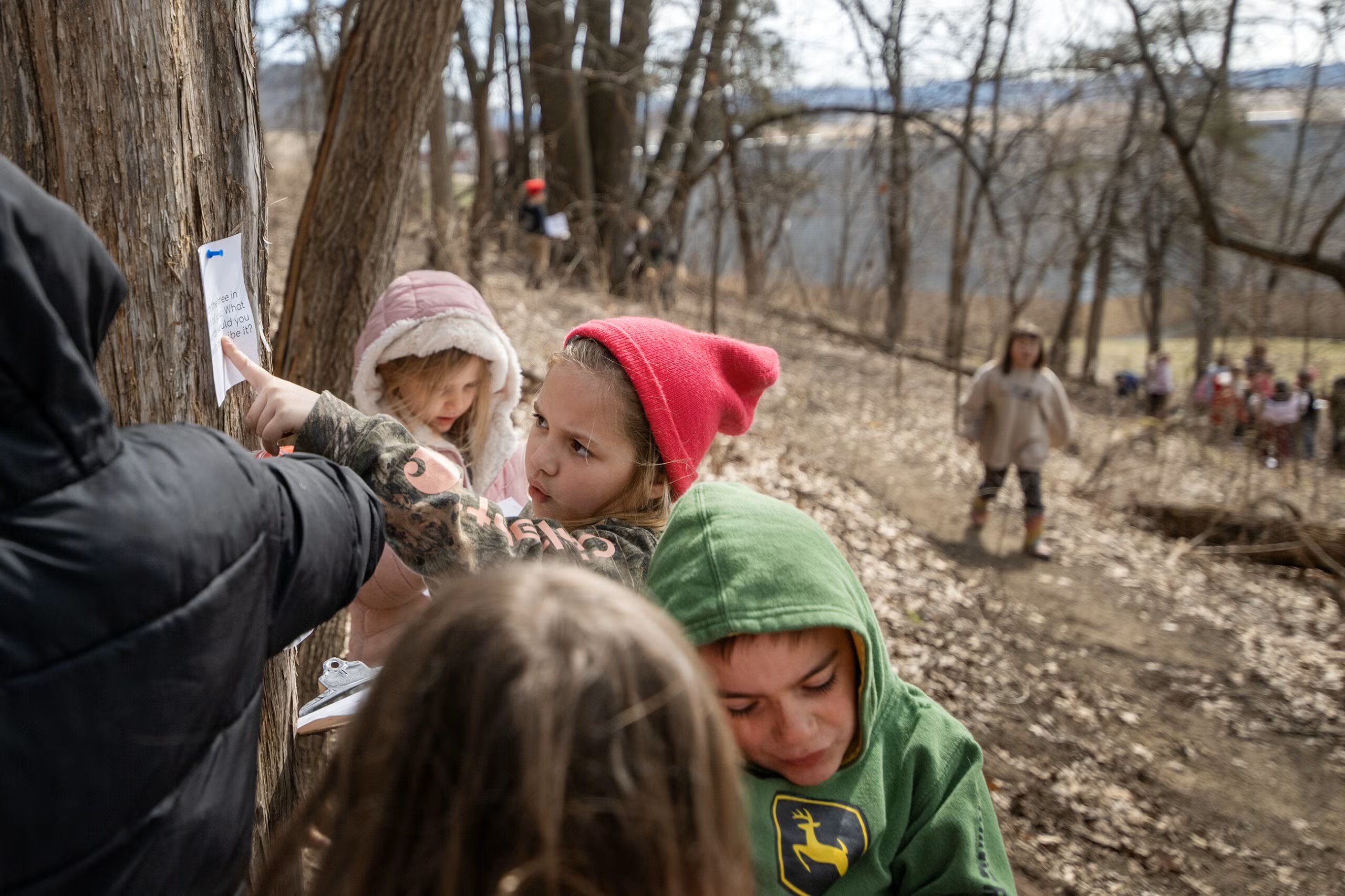
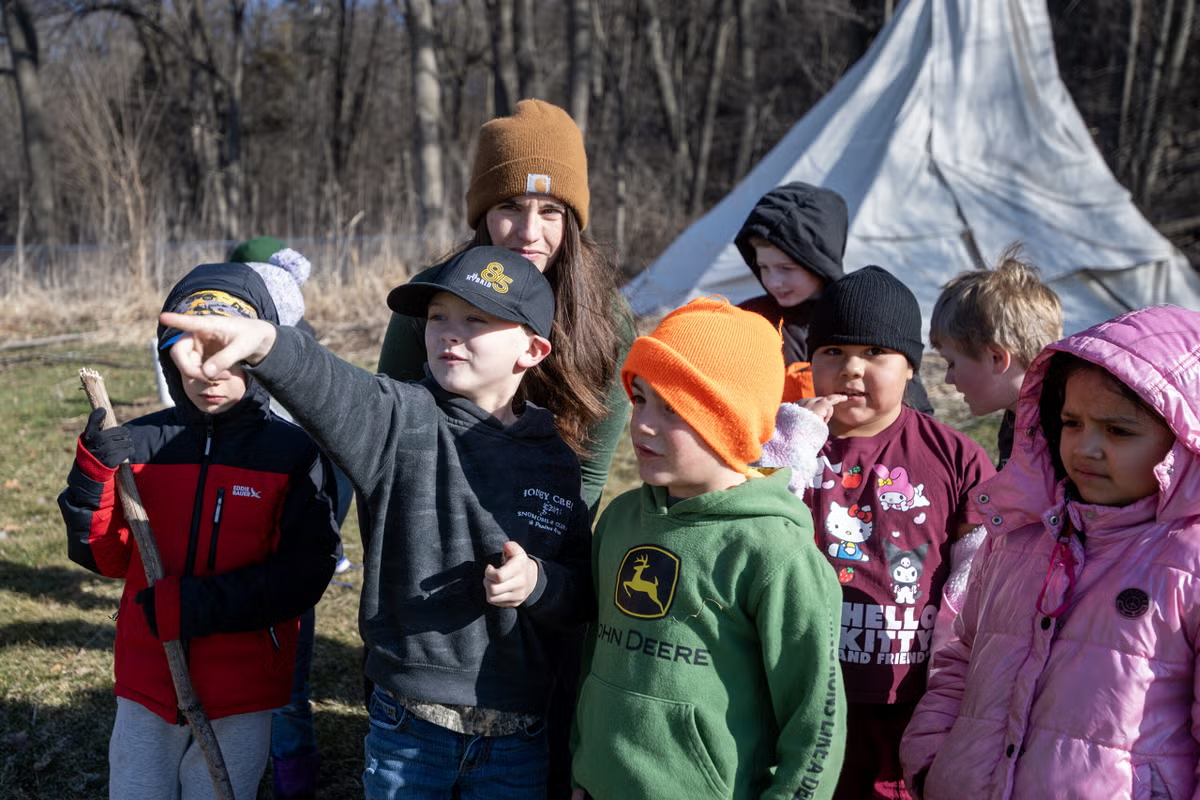
Once a week, first and second graders at Tower Rock Elementary School in Sauk County step into a classroom without walls. 

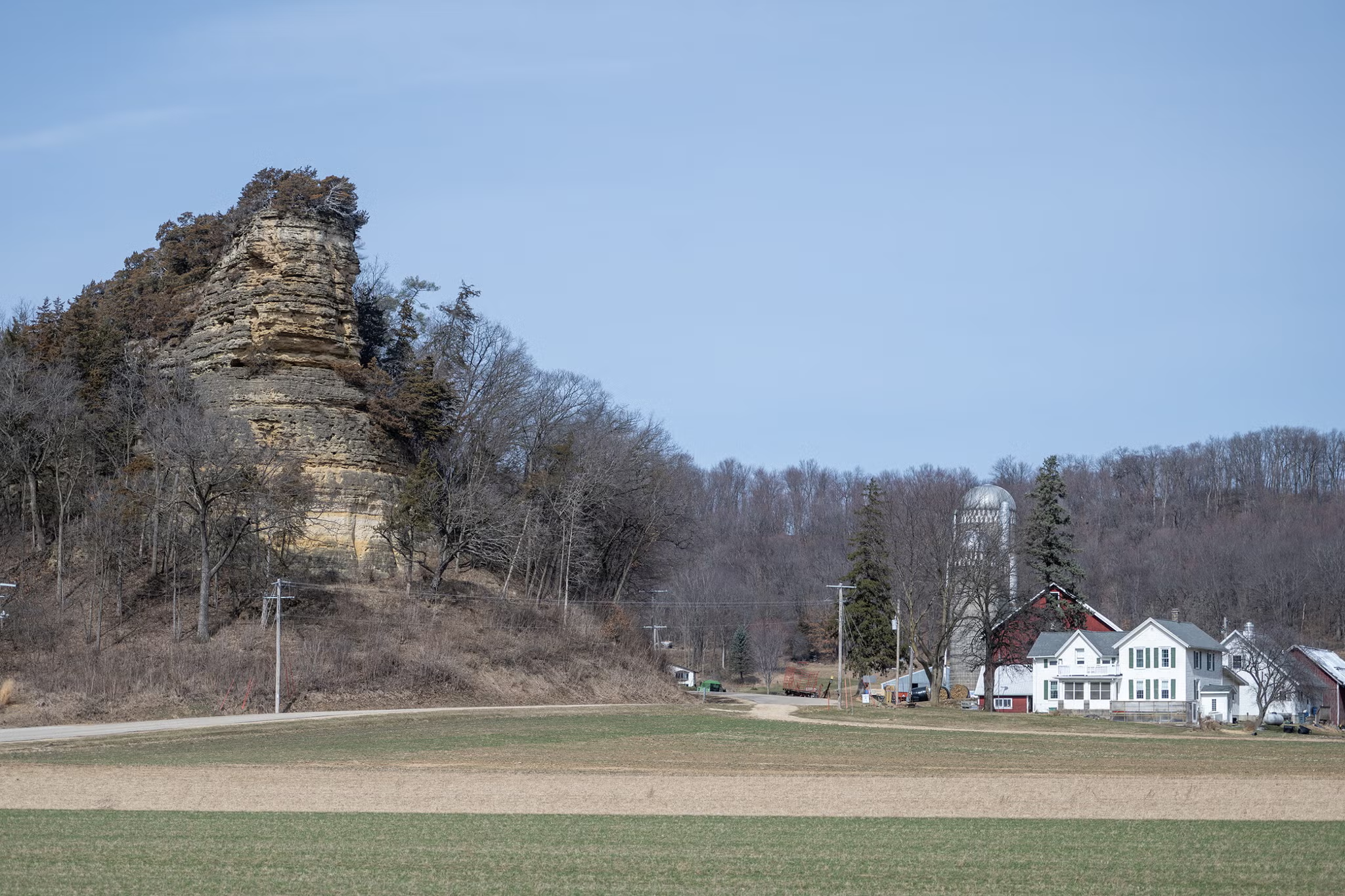
About 25 students, accompanied by three teachers, spend the day in their outdoor classroom tucked into nearby woods with a soaring sculpted bluff — called Tower Rock — in the school’s shadow.

Students follow a science and social studies-based curriculum on topics like insects and space, along with practical lessons like how to dress for the cold. 

In March, days before Blizzard Elsa blanketed the state with snow, first graders in the outdoor learning program prepared to blast off to Saturn. In small groups, students rode an imaginary rocket ship, learning about the planets while in their outdoor environment. 

Angus Mossman, left, leads an outdoor lesson on planets Thursday, March 12, 2026, at Tower Rock Elementary School in Prairie du Sac, Wis. Angela Major/WPR

Nature-based education and outdoor classrooms are expanding in Wisconsin and across the country. The concept of teaching outdoors got a boost during the pandemic. But now, according to Natural Start Alliance, there are more than 1,000 nature classroom programs in pre-schools nationwide. That’s up from a few dozen a decade ago. 

Teachers at Tower Rock want students to learn about the environment under their feet.

“It’s more than sitting in a classroom and saying, ‘We live in a beautiful area, you should protect it.’” JoAnnah Sorg, a teacher at Tower Rock, told WPR’s “Wisconsin Today.” “We go out there and we’re like, ‘Look at all of this. You want this to be here for your family someday. You want to continue to enjoy this, so we need to work to take care of it.’”

The landscape near Tower Rock Elementary School on Thursday, March 12, 2026, in Prairie du Sac, Wis. Angela Major/WPR

Keeping special places special

According to the state Department of Public Instruction, there are at least 17 schools that have a dedicated outdoor learning day in Wisconsin. Tower Rock, which launched its program in 2021, is one of a handful of public, non-charter schools in Wisconsin with this learning model. 

That means all first and second graders who attend Tower Rock participate. There is no waiting list, application or fees. Neurodivergent students and students with disabilities receive accommodations to participate. 

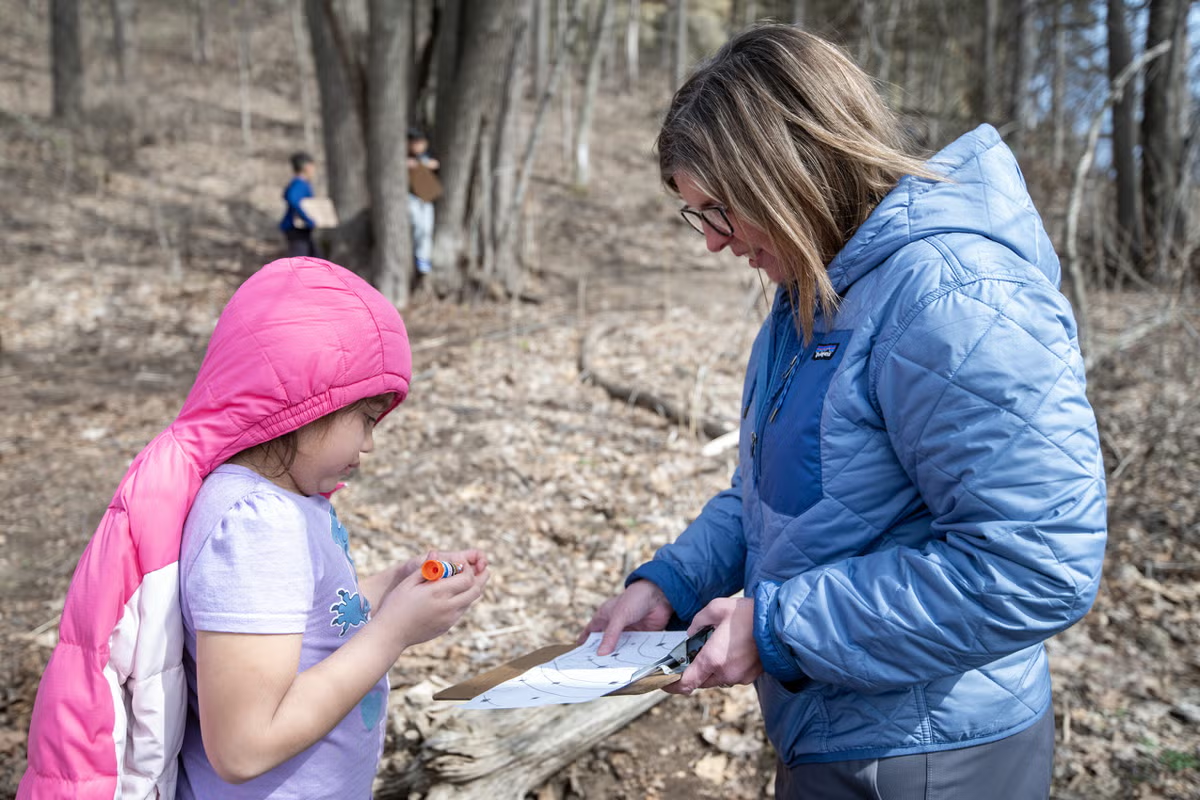
Principal Kelly Petrowski, right, helps a student with a science lesson Thursday, March 12, 2026, at Tower Rock Elementary School in Prairie du Sac, Wis. Angela Major/WPR

The school only cancels the outdoor program when the windchill factor plummets below zero. But this isn’t recess or free play. Every outdoor learning day is guided by a curriculum with a “place-based learning” model in mind, where educators use the local community and environment as a foundation for study. 

Sorg has been at Tower Rock for 15 years. She and two other educators, Dylan Edwards and Angus Mossman, run the program. Together, they build lessons and plan field trips to state parks and protected areas in Sauk County, an agricultural community on the banks of the Wisconsin River. 

Mossman went to Tower Rock and his mother still teaches there. He said many people leave Sauk County not realizing the beauty of it. The majority of the rural community is dedicated to farmland, but there are more than 22,000 acres of dedicated natural parks and open spaces, 63 lakes and nearly 160 miles of rivers and creeks, according to Explore Sauk County, the county’s tourism website.  

“There’s a lot of focus on getting urban students exposed to nature and I think there’s not a lot of focus on exposing kids in rural areas to nature,” Mossman said. 

“I want kids to realize that this is a special place and if people care about it, it will stay a special place. And if people don’t care about it, it might not stay a special place,” Mossman added. “I think (children) have it in their hearts to learn that.”

Students operate an imaginary spaceship with teacher JoAnnah Sorg as they learn about science outdoors Thursday, March 12, 2026, at Tower Rock Elementary School in Prairie du Sac, Wis. Angela Major/WPR
Angus Mossman tells a story as students gather to listen Thursday, March 12, 2026, at Tower Rock Elementary School in Prairie du Sac, Wis. Angela Major/WPR
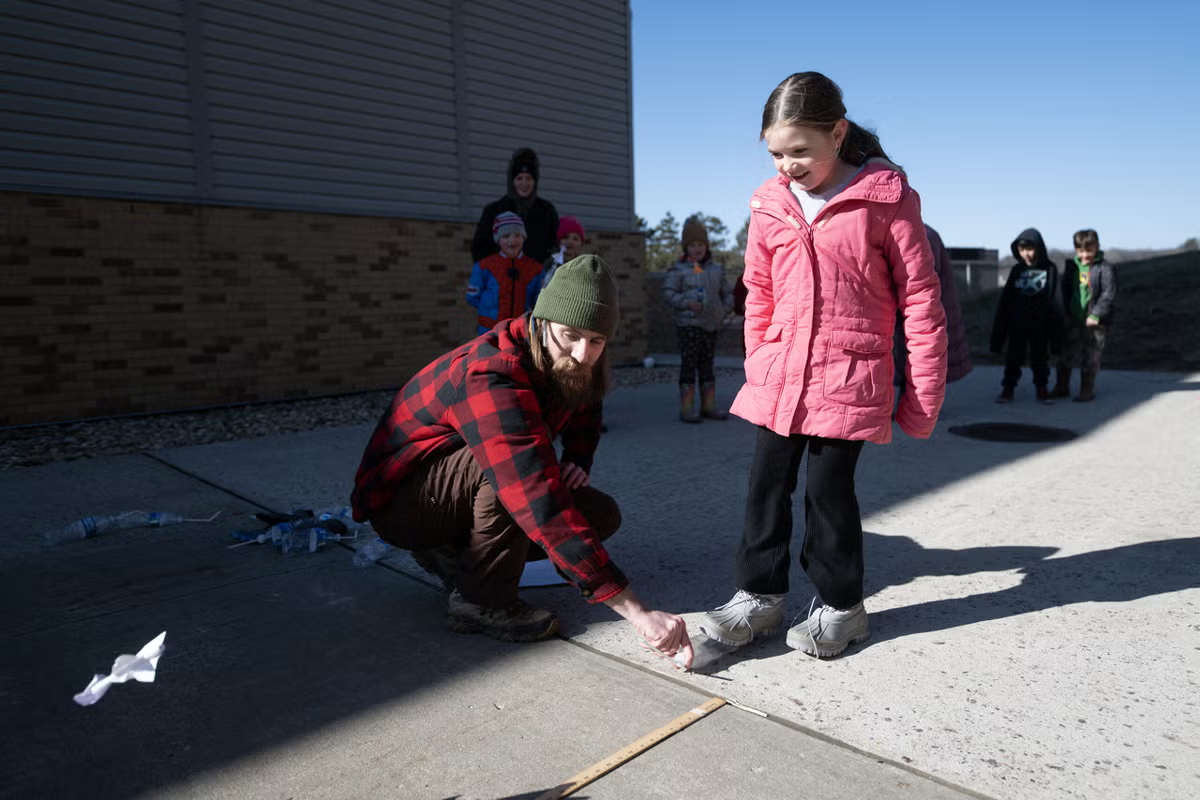
Teacher Dylan Edwards, left, helps students launch rockets using a water bottle Thursday, March 12, 2026, at Tower Rock Elementary School in Prairie du Sac, Wis. Angela Major/WPR

The wonder of bees and spiders

Since the program started, students have helped to restore a native prairie and learned about the federally endangered rusty patch bumble bee, which is rare, but can be found in Wisconsin. 

“In first and second grade, I was really, really scared of bees,” said Bentley Hughbanks, a fifth grader who went through the outdoor learning program. “I was insanely scared to the point where on a field trip, I didn’t want to go because of the bees. But now I’ve overgrown my fear of bees.”

“I realized that they don’t mess with you unless you mess around with them,” Bentley said. 

There are countless stories from students overcoming fears, educators said. Students who didn’t like spiders now prevent others from squishing them. One student asked his parents to stop using ant poison in the garage. And another wants to be an ornithologist.  

First-grade students participate in a lesson on space Thursday, March 12, 2026, at Tower Rock Elementary School in Prairie du Sac, Wis. Angela Major/WPR

“A powerful thing about outdoor learning and the experience we can give the kids here is that we’re teaching their hearts and not just teaching their minds,” Mossman said. 

Sorg recalled one student who struggled academically in the classroom but on an outdoor learning day found the perfect way to pack snow into a bucket for building a structure, and the other students followed his lead.

“The power that it gave him among his peers to be able to have that opportunity to shine and have that moment — he didn’t get a lot of those moments in the classroom during the day,” she said. 

Finding those moments is one benefit of outdoor learning. Research shows it can also promote concentration, perseverance and creativity, said Christy Merrick, director of the Natural Start Alliance

“(Nature) is a space that is always changing. Nature is not static,” Merrick said. “It’s keeping things interesting for students. It tends to promote very active, hands-on learning, which we know is a very effective way for children to learn when they’re young.”

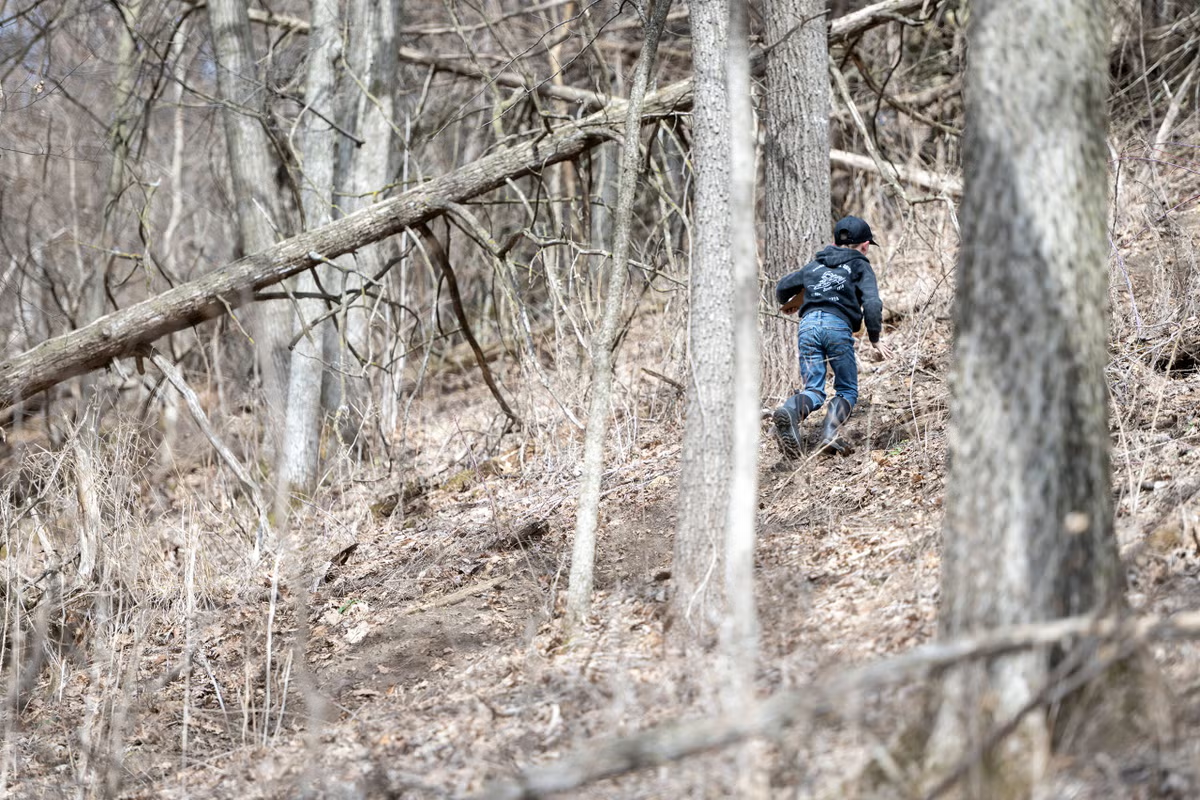
Students explore the woods during a lesson Thursday, March 12, 2026, at Tower Rock Elementary School in Prairie du Sac, Wis. Angela Major/WPR

An outdoor program like this is unique and requires a reliable funding stream. The teachers say it takes additional work to keep the program going. Each year, they apply for about $5,000 of local and state grants, Mossman said. The Community Foundation of South Central Wisconsin accepts donations on behalf of the school and other programs like it. The school also hopes to create an endowment. 

Outdoor learning is starting to become part of the fabric of attending Tower Rock. Now some fifth graders, like Brooks Mack, have younger siblings there, too.

“I can help (my brother) out. He asks me questions when he gets home, like, ‘We did this today but I didn’t quite understand it.’ So I get to answer those questions and other kids ask me questions, too,” Brooks said. “Sometimes I get to answer, which feels good.”

The post Nature is the classroom at this central Wisconsin elementary school appeared first on Great Lakes Now.

Original Article

Great Lakes Now

Great Lakes Now

https://www.greatlakesnow.org/2026/04/16/nature-is-the-classroom-at-this-central-wisconsin-elementary-school/

Wisconsin Public Radio

Internal government emails show staff at the Canada Water Agency trying to make sense of Prime Minister Mark Carney’s budget cuts in response to questions from the media.

The Canada Water Agency launched in October 2024 to help protect Canada’s fresh water, including leading restoration work to clean up the Great Lakes, Lake Winnipeg and other important sources of drinking water. Canada is home to 20 per cent of the world’s fresh water, which is being threatened by climate-driven floods, droughts and algal blooms, as well as industrial contamination and other groundwater stressors.

Carney’s first federal budget proposed $3.8 million in lower spending by 2029-30 at the agency, and a further $1.2 million categorized as a separate “ongoing,” or permanent spending reduction, for a total of $5 million in cuts. They were part of Carney’s $60 billion in proposed cuts — split into $48 billion in spending reductions through 2029-30, and a further $12 billion in “ongoing” cuts with no given end date.

The Narwhal reported on the budget in November, summarizing the government’s proposal as cutting $5 million in total spending at the agency over a number of years. After that story was published, the agency emailed The Narwhal with a request for a “small correction,” asking that figure be changed to $3.8 million.

When The Narwhal asked the agency why it shouldn’t include the $1.2 million in ongoing spending cuts in the figure — which would make it $5 million — internal emails released under Access to Information law show staff reached out to Finance Canada, sharing a screenshot of the budget’s spending review page for the agency with the proposed “ongoing” cut circled in red. 

“Hello Finance Department colleagues, we are fact-checking an article in The Narwhal that mentions the [agency]’s budget cuts, and just want to make sure we are understanding the budget chart correctly,” the agency wrote. 

The water agency asked the Finance Department whether the $5-million figure, which it had already asked The Narwhal for a correction on, was in fact, correct.

After the Finance Department said it would look into the matter, the water agency asked for guidance on how to explain the permanent portion of the spending reductions to journalists.

“Do you have messaging you can share around communicating the ‘ongoing’ to the media?” the staff member asked.

The next day, an official at Finance Canada said the story did not need a correction after all.

Canada Water Agency to cut 13 jobs, but continue restoration and protection of fresh water

Last month, a Canada Water Agency planning document showed how it expected to absorb the first three fiscal years’ worth of cuts, amounting to $2.6 million by 2028-29. One result was the loss of roughly 13 jobs, or what’s known as full-time equivalent positions, from a workforce of 223.

It said it was also planning on “modernizing government operations” and “leveraging new technology” as well as making administrative and support functions more efficient.

At the same time, the agency plans to keep conducting water quality and ecosystem restoration, including in the Great Lakes, it said.

The federal budget says cuts are necessary to “rein in government spending” from pandemic highs. Carney has gone on to trumpet other multibillion-dollar investments in areas like the military, technology and infrastructure that could in turn pose new environmental challenges for water.

Last week, the Canada Water Agency took on a new task when the Carney government promised $3.8 billion to “protect nature” as part of a new environmental strategy. The agency will be working on the country’s first National Water Security Strategy meant to reflect Indigenous knowledge systems including water stewardship.

The Narwhal emailed the Canada Water Agency asking how its spending cuts will affect freshwater stewardship and restoration work.

A spokesperson said the government’s budget cuts would not impact the agency’s “planned activities, staffing and funding commitments for restoration and protection” of its eight freshwater ecosystem initiatives through Canada’s Freshwater Action Plan, a “signature” federal program.

The program includes the Great Lakes, lakes like Simcoe and Winnipeg and rivers like the St. Lawrence in Ontario and Quebec, and the Mackenzie in the Northwest Territories. Former prime minister Justin Trudeau’s 2023 federal budget allocated $650 million over 10 years to these freshwater initiatives.

Federal funding for freshwater protection has been important in Ontario in recent years, because the province has not invested as much in ecosystem restoration, according to an environmental scientist at the University of Windsor. Photo: Christopher Katsarov Luna / The Narwhal

“Like all federal organizations, the Canada Water Agency is contributing to the government’s plan to reduce spending, eliminate duplicative programs and focus resources on core priorities,” the spokesperson wrote.

“The agency remains fully committed to delivering on its mandate to improve freshwater management in Canada by providing leadership, effective collaboration federally and improved coordination and collaboration with provinces, territories and Indigenous Peoples to proactively address national and regional transboundary freshwater challenges and opportunities.”

The agency also told The Narwhal the reduction in jobs would be staggered, with four next fiscal year, followed by another four the year after and five more after that.

Asked how the agency was planning for the budget’s proposed $1.2 million in permanent cuts, the spokesperson reiterated the budget review was meant to ensure government spending was sustainable and funding cost-effective programs and activities.

Federal funds support water conservation in Ontario and the Great Lakes

The spending reductions come at a time when the Ontario government is amalgamating its watershed protection agencies, called conservation authorities, from 36 to nine, as well as moving to give itself the power to dictate more rules around drinking water

Federal funding has been important for conservation authorities because Ontario has not been investing as much in community science and ecosystem restoration, Catherine Febria, the Canada Research Chair in freshwater restoration ecology, said. 

An associate professor at the University of Windsor’s Great Lakes Institute for Environmental Research, Febria said that the federal “scale of investment is something that the province was never able to do.”

“That was really exciting, it was like a leapfrog in progress with this single initiative, and a number of large-scale projects were invested in [over] the first two years,” she said, naming the freshwater ecosystem initiatives in places like the Great Lakes as one example.

The federal government and Ontario have been working together “for over 50 years” through a series of agreements on protecting and conserving the Great Lakes, the spokesperson for the Canada Water Agency said. 

As one example, the Canada-Ontario Agreement on Great Lakes Water Quality and Ecosystem Health lays out how the two will coordinate protection efforts.

“This partnership has led to remarkable improvements, including dramatic reductions in harmful pollutants, and the return of pollution-sensitive species such as bald eagles,” the spokesperson wrote.

Ontario’s Ministry of the Environment, Conservation and Parks did not respond to questions from The Narwhal about how much provincial funding was going towards efforts to restore freshwater ecosystems, and to what extent the ministry was working with the federal water agency.

Febria said given the federal water agency is still relatively new, it’s still not clear what its full mandate will be, not to mention if or how the proposed cuts will impact its work or what exactly may be lost.

She said another Carney initiative, directing $1.7 billion toward a series of scientific initiatives, including research awards attracting high-level talent from abroad, holds promise. Some of the research awards will focus on water security, environment and climate resilience. 

Still, it’s a “tricky balance,” she added, between investing in research and also carrying out on-the-ground work to improve local areas.

“I think we need both,” she said. “When the pendulum swings towards a whole bunch of researchers, that’s great, but at the end of the day, we still need people and organizations and communities on the ground.”

The post Canada Water Agency wasn’t quite sure how to explain Carney’s budget cuts to the public, documents show appeared first on Great Lakes Now.

Original Article

Great Lakes Now

Great Lakes Now

https://www.greatlakesnow.org/2026/04/15/canada-water-agency-wasnt-quite-sure-how-to-explain-carneys-budget-cuts-to-the-public-documents-show/

The Narwhal

Internal government emails show staff at the Canada Water Agency trying to make sense of Prime Minister Mark Carney’s budget cuts in response to questions from the media.

The Canada Water Agency launched in October 2024 to help protect Canada’s fresh water, including leading restoration work to clean up the Great Lakes, Lake Winnipeg and other important sources of drinking water. Canada is home to 20 per cent of the world’s fresh water, which is being threatened by climate-driven floods, droughts and algal blooms, as well as industrial contamination and other groundwater stressors.

Carney’s first federal budget proposed $3.8 million in lower spending by 2029-30 at the agency, and a further $1.2 million categorized as a separate “ongoing,” or permanent spending reduction, for a total of $5 million in cuts. They were part of Carney’s $60 billion in proposed cuts — split into $48 billion in spending reductions through 2029-30, and a further $12 billion in “ongoing” cuts with no given end date.

The Narwhal reported on the budget in November, summarizing the government’s proposal as cutting $5 million in total spending at the agency over a number of years. After that story was published, the agency emailed The Narwhal with a request for a “small correction,” asking that figure be changed to $3.8 million.

When The Narwhal asked the agency why it shouldn’t include the $1.2 million in ongoing spending cuts in the figure — which would make it $5 million — internal emails released under Access to Information law show staff reached out to Finance Canada, sharing a screenshot of the budget’s spending review page for the agency with the proposed “ongoing” cut circled in red. 

“Hello Finance Department colleagues, we are fact-checking an article in The Narwhal that mentions the [agency]’s budget cuts, and just want to make sure we are understanding the budget chart correctly,” the agency wrote. 

The water agency asked the Finance Department whether the $5-million figure, which it had already asked The Narwhal for a correction on, was in fact, correct.

After the Finance Department said it would look into the matter, the water agency asked for guidance on how to explain the permanent portion of the spending reductions to journalists.

“Do you have messaging you can share around communicating the ‘ongoing’ to the media?” the staff member asked.

The next day, an official at Finance Canada said the story did not need a correction after all.

Canada Water Agency to cut 13 jobs, but continue restoration and protection of fresh water

Last month, a Canada Water Agency planning document showed how it expected to absorb the first three fiscal years’ worth of cuts, amounting to $2.6 million by 2028-29. One result was the loss of roughly 13 jobs, or what’s known as full-time equivalent positions, from a workforce of 223.

It said it was also planning on “modernizing government operations” and “leveraging new technology” as well as making administrative and support functions more efficient.

At the same time, the agency plans to keep conducting water quality and ecosystem restoration, including in the Great Lakes, it said.

The federal budget says cuts are necessary to “rein in government spending” from pandemic highs. Carney has gone on to trumpet other multibillion-dollar investments in areas like the military, technology and infrastructure that could in turn pose new environmental challenges for water.

Last week, the Canada Water Agency took on a new task when the Carney government promised $3.8 billion to “protect nature” as part of a new environmental strategy. The agency will be working on the country’s first National Water Security Strategy meant to reflect Indigenous knowledge systems including water stewardship.

The Narwhal emailed the Canada Water Agency asking how its spending cuts will affect freshwater stewardship and restoration work.

A spokesperson said the government’s budget cuts would not impact the agency’s “planned activities, staffing and funding commitments for restoration and protection” of its eight freshwater ecosystem initiatives through Canada’s Freshwater Action Plan, a “signature” federal program.

The program includes the Great Lakes, lakes like Simcoe and Winnipeg and rivers like the St. Lawrence in Ontario and Quebec, and the Mackenzie in the Northwest Territories. Former prime minister Justin Trudeau’s 2023 federal budget allocated $650 million over 10 years to these freshwater initiatives.

Federal funding for freshwater protection has been important in Ontario in recent years, because the province has not invested as much in ecosystem restoration, according to an environmental scientist at the University of Windsor. Photo: Christopher Katsarov Luna / The Narwhal

“Like all federal organizations, the Canada Water Agency is contributing to the government’s plan to reduce spending, eliminate duplicative programs and focus resources on core priorities,” the spokesperson wrote.

“The agency remains fully committed to delivering on its mandate to improve freshwater management in Canada by providing leadership, effective collaboration federally and improved coordination and collaboration with provinces, territories and Indigenous Peoples to proactively address national and regional transboundary freshwater challenges and opportunities.”

The agency also told The Narwhal the reduction in jobs would be staggered, with four next fiscal year, followed by another four the year after and five more after that.

Asked how the agency was planning for the budget’s proposed $1.2 million in permanent cuts, the spokesperson reiterated the budget review was meant to ensure government spending was sustainable and funding cost-effective programs and activities.

Federal funds support water conservation in Ontario and the Great Lakes

The spending reductions come at a time when the Ontario government is amalgamating its watershed protection agencies, called conservation authorities, from 36 to nine, as well as moving to give itself the power to dictate more rules around drinking water

Federal funding has been important for conservation authorities because Ontario has not been investing as much in community science and ecosystem restoration, Catherine Febria, the Canada Research Chair in freshwater restoration ecology, said. 

An associate professor at the University of Windsor’s Great Lakes Institute for Environmental Research, Febria said that the federal “scale of investment is something that the province was never able to do.”

“That was really exciting, it was like a leapfrog in progress with this single initiative, and a number of large-scale projects were invested in [over] the first two years,” she said, naming the freshwater ecosystem initiatives in places like the Great Lakes as one example.

The federal government and Ontario have been working together “for over 50 years” through a series of agreements on protecting and conserving the Great Lakes, the spokesperson for the Canada Water Agency said. 

As one example, the Canada-Ontario Agreement on Great Lakes Water Quality and Ecosystem Health lays out how the two will coordinate protection efforts.

“This partnership has led to remarkable improvements, including dramatic reductions in harmful pollutants, and the return of pollution-sensitive species such as bald eagles,” the spokesperson wrote.

Ontario’s Ministry of the Environment, Conservation and Parks did not respond to questions from The Narwhal about how much provincial funding was going towards efforts to restore freshwater ecosystems, and to what extent the ministry was working with the federal water agency.

Febria said given the federal water agency is still relatively new, it’s still not clear what its full mandate will be, not to mention if or how the proposed cuts will impact its work or what exactly may be lost.

She said another Carney initiative, directing $1.7 billion toward a series of scientific initiatives, including research awards attracting high-level talent from abroad, holds promise. Some of the research awards will focus on water security, environment and climate resilience. 

Still, it’s a “tricky balance,” she added, between investing in research and also carrying out on-the-ground work to improve local areas.

“I think we need both,” she said. “When the pendulum swings towards a whole bunch of researchers, that’s great, but at the end of the day, we still need people and organizations and communities on the ground.”

The post Canada Water Agency wasn’t quite sure how to explain Carney’s budget cuts to the public, documents show appeared first on Great Lakes Now.

Original Article

Great Lakes Now

Great Lakes Now

https://www.greatlakesnow.org/2026/04/15/canada-water-agency-wasnt-quite-sure-how-to-explain-carneys-budget-cuts-to-the-public-documents-show/

The Narwhal

This article was republished here with permission from Great Lakes Echo.

By Addie Tussing, Great Lakes Echo


Every year, thousands of hopeful hunters apply for one of only 260 licenses to hunt elk in Michigan. 

The state Department of Natural Resources (DNR) received a record-breaking 47,493 applicants in 2025. 

“It’s a chance for folks in Michigan who are used to some similar hunting experiences, but with the added uniqueness and challenges of pursuing a different animal,” said Brent Rudolph, the deer, moose and elk specialist with the DNR. 

Michigan’s original native elk disappeared in 1875 due to overhunting and habitat loss. They were reintroduced in 1918, and populations have since stabilized, according to Rudolph. 

“We are working on viewing the uniqueness that they bring to the communities where they’re around, and then balance the efforts to manage their population to minimize potential conflicts,” he said.

In 2025, Michigan hunters shot 153 elk. The DNR estimates Michigan’s elk population to be around 1,100 animals.

Every year, the National Resources Commission works alongside the DNR to create quotas to control the number of elk that can be taken. 

“Our five-year average has been around a 72% success rate in fulfilling those quotas,” said Rudolph, while “the 2025 success rate was 64%.”

Brent Henige of New Lothrop shot this-559 pound bull on Dec.13, 2025.

Licenses are awarded to applicants through a random drawing. Once selected, they receive specific information on the hunting period and type of license they have received. 

“Some receive licenses that are ‘any elk,’ which mean they can pursue bulls, which is often the preferred target because they are antlered animals,” said Rudolph. 

Some, however, receive licenses for antlerless-only elk to control the number of females in the population.

There are two hunting periods: The first consists of three independent sessions throughout August and September, and the second from Dec. 13-21. The second period poses challenges to some hunters because of unpredictable weather conditions and proximity to the holiday season. 

When selected, “you will have an opportunity to hunt in one of two core elk range units” said Rudolph. 

Hunters are restricted to the land of the Pigeon River Country State Forest and what is referred to as the “Elk management Unit X” land, both in the Northern Lower Peninsula near Gaylord. 

As the 2025 hunt came to a close, the DNR drafted an alternative to its current Elk Conservation and Management Plan

The proposal aims to lengthen both the first and second hunt periods, and most notably, consolidate the first hunt into one continuous period. 

“We are aiming to make it more convenient for hunters having a more contiguous period so they could choose when they’re able to participate,” says Rudolph, who said that the change will give hunters who aren’t local more leeway, increasing the success rate of the first hunt. 

According to the DNR, the proposed first period would be 30 days from September to the beginning of October, and the second period would run from Dec. 1st to the 15th. 

They intend to shift the first hunt to begin at later dates to avoid hot weather which is both uncomfortable to hunt in and leads to more elk meat spoiling. 

The new dates for the second hunt would be more accessible to hunters who celebrate holidays towards the end of December. 

Michigan residents were given the opportunity for public comment on the proposed regulations. 

Seventy-three residents emailed their thoughts to the DNR before the Jan. 23 cutoff. Rudolph said 63% supported the change and about 27, or 37%, were opposed to some aspect.

While a majority supported the proposed regulations, many were concerned that the new timeline would overlap with the days to hunt bears. 

“Some hunters can pursue bear[s] with dogs, and hounds moving through could make hunters anxious or could just lead to some conflicts,” said Rudolph. 

Chad Sides, who chairs the Michigan Elk Country Association, a conservation organization based in Gaylord, is weighing the benefits of the proposition. 

“It could be beneficial if implemented properly,” Sides said. “It may provide a better experience for the hunters and have a better hunt.” 

On the other hand, Sides said he is apprehensive about the elk population going forward. “I hope that the state realizes that our herd is significantly down from years past.”

A more successful hunt could decrease the population at a more rapid rate, Sides said. 

The regulations will be finalized during the Natural Resources Commission’s April meeting. 

Before then, Rudolph and the DNR will try to reduce conflict with the bear hunting season. “We will be making some adjustments to the proposed dates and lengths to still reach the original objectives.”

Rudolph said the elk hunt is a vital and unique resource in Michigan.

“We’re happy to be able to take input on how we can try and best accommodate some of the diverse opinions people have,” he said.

The post Michigan mulls changes in elk hunt regulations appeared first on Great Lakes Now.

Original Article

Great Lakes Now

Great Lakes Now

https://www.greatlakesnow.org/2026/04/10/michigan-mulls-changes-in-elk-hunt-regulations/

Great Lakes Echo

By Sarah Shemkus

This story was originally published by Canary Media.

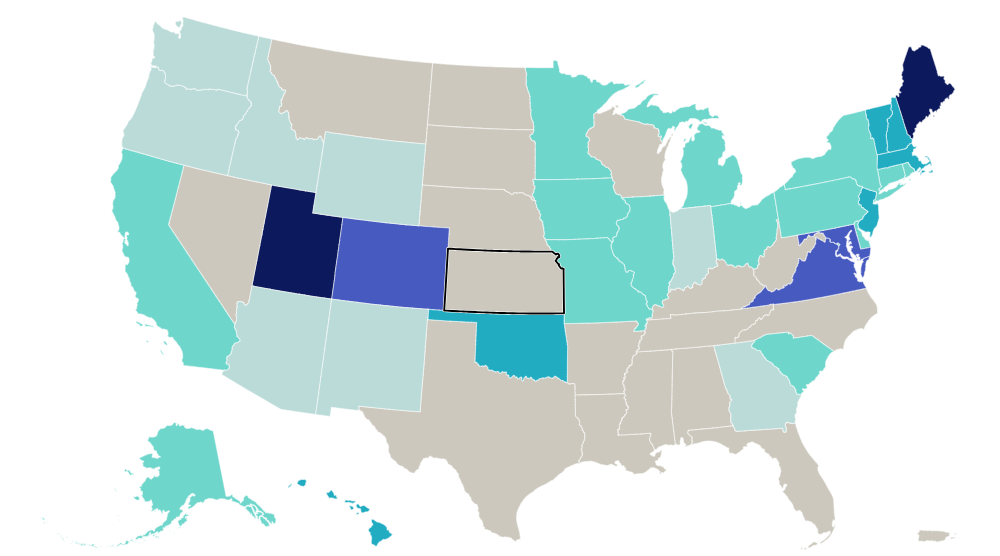
Balcony solar is one of the hottest ideas in renewable energy right now. Boosters say the systems — DIY kits that can be plugged right into a standard outlet — save users money without any need for subsidies, government incentives, or utility permission.

As Americans continue to struggle with soaring power prices, about half the states in the U.S. are considering legislation to pave the way for residents to adopt plug-in solar and start generating some of their own electricity from their own backyard or porch.

“It’s about energy affordability,” said Cora Stryker, co-founder of Bright Saver, a nonprofit that promotes plug-in solar. ​“Every legislator wants their constituency to have less trouble meeting their energy demands.”

As these efforts work their way through the legislative process, we will be monitoring the action here, using information from Bright Saver and bill-tracking databases.

Latest action: Maine Gov. Janet Mills (D) signed the state’s plug-in solar bill into law on April 6.

The post Which Great Lakes states are advancing balcony solar? appeared first on Great Lakes Now.

Original Article

Great Lakes Now

Great Lakes Now

https://www.greatlakesnow.org/2026/04/10/which-great-lakes-states-are-advancing-balcony-solar/

Canary Media

By Danielle Kaeding, Wisconsin Public Radio

This article was republished here with permission from Wisconsin Public Radio.


A union leader representing federal Forest Service employees in Wisconsin says workers may have to move as part of the Trump administration’s plan to shutter regional offices.

The Forest Service announced Tuesday that the agency is moving its headquarters to Salt Lake City and closing nine regional offices, including in Milwaukee. Administrative and technical support in those offices will shift to six operational service centers, one of which will be located in Madison. The overhaul will also include 15 state directors to oversee operations in one or more states.

Brian Haas is president of the National Federation of Federal Employees Local 2165. The union represents employees in the Milwaukee regional office and the Chequamegon-Nicolet National Forest. He said the restructuring mostly affects Milwaukee-area employees. Union officials estimate around 50 employees may be affected.

“The regional office actually already was hit a lot harder by people leaving, retiring, taking the different buyouts,” Haas said. “They’re already really down in their numbers.”

Haas said workers have been told they can continue working for the service as long as they’re willing to relocate or change job descriptions. When the reorganization was first announced last year, he said many employees transferred or relocated amid Trump’s return-to-office order.

The number of Forest Service employees in Wisconsin dropped from 645 to 539 between federal fiscal year 2025 and 2026, according to federal workforce data.

The U.S. Department of Agriculture, which houses the Forest Service, has been shifting thousands of employees out of Washington. Around 260 employees in the nation’s capital will be expected to relocate to Salt Lake City, according to the Associated Press.

“This is about building a Forest Service that is nimble, efficient, effective and closer to the forests and communities it serves,” Forest Service Chief Tom Schultz said in a statement.

Trump administration officials said the move will improve forest management, save taxpayer money and boost employee recruitment.

“The official stance from the administration is that it is not a reduction in force, but the reality on the ground is that it is going to continue to drive people to leave the agency,” Haas said.

A USDA spokesperson said employees will receive information about relocation timelines, options and resources to support their decisions. The agency said the number of staff that will be moved beyond the nation’s capital is unknown at this time.

Current and former Forest Service employees say the Trump administration’s actions over the past year have created chaos and uncertainty with few answers. The elimination of regional offices and shift to state-based hubs will take place over the coming year.

No changes for national forest in Wisconsin, research facilities close

The Chequamegon-Nicolet National Forest, or CNNF, has 235 employees who would be unaffected, according to Kaleigh Maze, a forest spokesperson. Maze said the forest and its district offices would see no changes to staffing.

“The Chequamegon-Nicolet National Forest is committed to ensuring that all operations — including wildfire readiness and response — continue without interruption,” Maze said.

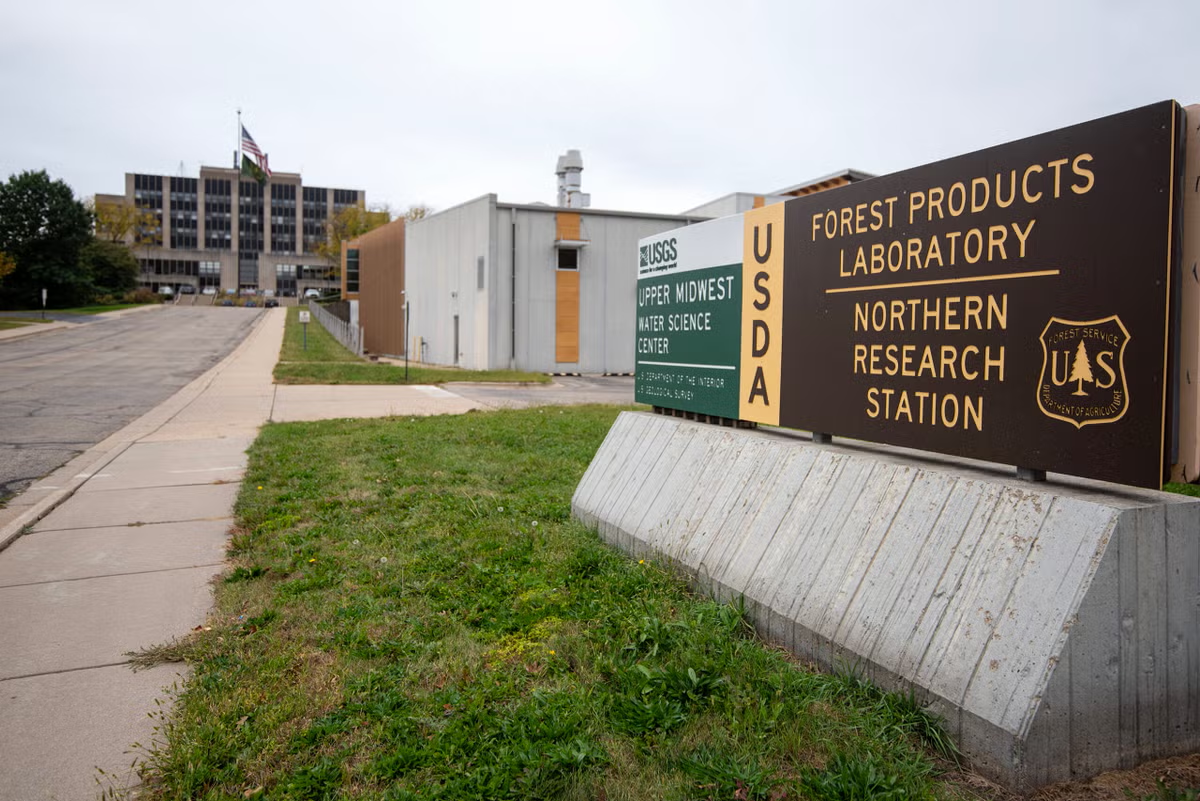
Forest Service research facilities in 31 states will also close and be combined under a single research organization in Colorado. The agency’s website shows Rhinelander and Madison research sites would not be affected, but Haas said Rhinelander employees may also be required to move. As of 2023, the agency’s Forest Products Lab in Madison had 80 research scientists and 168 support staff.

Two other facilities are slated for closure in Wisconsin Rapids and Prairie du Chien. Paul Strong, former forest supervisor of the CNNF, said he’s unfamiliar with those sites and questioned whether USDA facilities may have been mistakenly included.

The USDA Forest Products Laboratory on Thursday, Oct. 16, 2025, in Madison, Wis. Angela Major/WPR

The Forest Service said a single research organization would speed up the use of science in forest management and reduce duplication. Strong told WPR’s “Wisconsin Today” it’s unclear what the move will mean for existing and long-term research projects.

“What I think we should be concerned about is what kind of pressure and stress this puts on employees and how they’re being treated as public servants,” Strong said.

Under the reorganization, the Forest Service said there will be no changes to firefighters or their positions. But the Trump administration is seeking to bring firefighting efforts under a single agency, which would affect thousands of employees if implemented.

Former U.S. Forest Service Chief Mike Dombeck served during the Clinton administration and lives in Wisconsin. He said he supports efforts to streamline the agency, noting past proposals to reorganize offices failed due to lacking support from congressional lawmakers.

Even so, he noted a similar attempt to move the Bureau of Land Management during Trump’s first term was later reversed. Dombeck said restructuring will likely cause the agency to lose more staff who choose not to uproot their families. He also fears the agency will lose ground on managing 193 million acres of national forests, climate change and wildland firefighting issues.

“I think this will be a real wake-up call to what the real values of national forests are,” Dombeck said. “We need to really ask this administration: what is the end game when we take a look at this level of chaos?”

Editor’s note: This story was updated with staffing figures on the Chequamegon-Nicolet National Forest from the U.S. Forest Service.

Wisconsin Public Radio, © Copyright 2026, Board of Regents of the University of Wisconsin System and Wisconsin Educational Communications Board.

The post Forest Service workers in Wisconsin may have to move after reorganization, union leader says appeared first on Great Lakes Now.

Original Article

Great Lakes Now

Great Lakes Now

https://www.greatlakesnow.org/2026/04/08/forest-service-workers-in-wisconsin-may-have-to-move-after-reorganization-union-leader-says/

Wisconsin Public Radio

The Trump administration plans to close four US Forest Service research facilities in Michigan, shifting scientists out of the state as it reorganizes and consolidates the agency.

Officials have not announced a closure date for the facilities, located in the Lower Peninsula communities of East Lansing and Wellston, between Manistee and Cadillac, and the Upper Peninsula communities of Houghton and L’Anse, saying changes will be implemented over the next year.

The Forest Service headquarters will also move from Washington, DC, to Salt Lake City in what Agriculture Secretary Brooke Rollins described as a measure to save money, boost logging and put workers “closer to the landscapes we manage.”

“Establishing a western headquarters in Salt Lake City and streamlining how the Forest Service is organized will position the Chief and operation leaders closer to the landscapes we manage and the people who depend on them,” Rollins said in a news release.

The announcement prompted dismay in Houghton, where workers with the US Forest Service Northern Research Station collaborate closely with researchers at Michigan Technological University and the Michigan Department of Natural Resources. A smaller group in L’Anse conducts forest inventories and analysis.

“It’s very disappointing,” said David Flaspohler, dean of the university’s College of Forest Resources and Environmental Science. “I understand priorities change from one administration to the next, and this administration is interested in increasing the volume of timber that is coming off of the national forests. To do that in a sustainable, safe way, you have to have people that are trained in the latest science and silviculture.”

Flaspohler estimated between 20 and 25 people work at the Houghton station, including scientists and other staff. The station has a “multidecadal history of partnerships” with researchers and foresters in the UP, he said. 

The heavily forested Upper Peninsula contains more than 8 million acres of forestland, split roughly evenly between private or locally owned timberland and state and federal forests.

Beyond conducting research that aims to keep northern forests healthy and productive, Flaspohler said, the lab is an important economic contributor to a region with scarce jobs.

“This lab with its many employees — who all had salaries and invested in the region just like any employed person does — that’s going to be lost.”

Two-thirds of facilities cut 

The Michigan facilities are part of a network of 57 nationwide. Nineteen will remain following the closures, with the Forest Service instead establishing regional hubs that serve multiple states. 

A Madison, Wisconsin, hub will serve Michigan, Illinois, Indiana, Iowa, Wisconsin, Minnesota and Missouri.

Michigan DNR spokesperson John Pepin said leaders in the state Forestry Resources Division are not yet sure how the changes will affect the state agency, which works closely with federal partners. 

“It’s pretty apparent that the details and individual impacts to a lot of programs are not worked out yet,” Pepin said. 

The biggest change appeared to be in Houghton, Pepin said. The facility houses the Northern Institute for Applied Climate Science, which Pepin said is relocating to Fort Collins, Colorado.

He said DNR and university officials in Michigan and other Great Lakes states “have worked closely” with the institute for many years assessing the climate vulnerability of forests, developing adaptation strategies and applying it to forest management.

It wasn’t clear whether layoffs would occur as part of the reorganization, but the administration’s announcement emphasized the reduction of “administrative duplication.”

“The Forest Service will provide employees and partners with detailed transition guidance as different milestones approach,” stated an agency release.

Agency spokespeople did not immediately respond to emailed questions from Bridge Michigan. 

Phone calls to Forest Service facilities in Houghton and Lansing were not answered. A person who picked up the phone in the Huron-Manistee National Forest, which includes the Wellston office, declined to comment. Bridge Michigan was unable to locate a phone number for the L’Anse facility.

While an agency press release described the move as a “structural reset and a common-sense approach to improve mission delivery,” some critics have described it as an effort to shrink the Forest Service and shift its mission away from protecting forests and toward logging and privatization.

Utah has been a frequent battleground for debates about public lands, from the fight over Bears Ears National Monument to a lawsuit by the state of Utah that aimed to take control of millions of acres of federal land and Utah Senator Mike Lee’s repeated efforts to sell off public land

“This reorganization will wreak havoc on the Forest Service management and organization, adding fuel to the unpopular narrative by officials like Senator Mike Lee that public lands should be sold off to private industry” said Josh Hicks, Conservation Campaigns Director at The Wilderness Society. “At a time when wildfires are getting worse, and access to public lands is already under strain, the last thing we need is an unnecessary reorganization.”

The post Trump administration plans closure of 4 Michigan forestry research centers appeared first on Great Lakes Now.

Original Article

Great Lakes Now

Great Lakes Now

https://www.greatlakesnow.org/2026/04/06/trump-administration-plans-closure-of-4-michigan-forestry-research-centers/

Bridge Michigan

By Janelle D. James, Bridge Michigan

The Great Lakes News Collaborative includes Bridge Michigan; Circle of Blue; Great Lakes Now at Detroit PBS; Michigan Public, Michigan’s NPR News Leader; and The Narwhal who work together to bring audiences news and information about the impact of climate change, pollution, and aging infrastructure on the Great Lakes and drinking water. This independent journalism is supported by the Charles Stewart Mott Foundation. Find all the work HERE.


More than a decade after the idea first surfaced, a revamped proposal to buy Belle Isle and turn the public park into a privately funded housing, entertainment and retail district is drawing sharp criticism from Michigan officials and the Belle Isle Conservancy, who call the idea unrealistic. 

Southfield-based real estate developer Rodney Lockwood has proposed buying Detroit’s Belle Isle for $1 billion and transforming it into a high-density “special economic zone” with high-income housing, mixed-use developments and more than 100 restaurants.

Lockwood’s firm stirred debate last week with the release of a poll it had commissioned. But the Michigan Department of Natural Resources, which manages the island as a state park under a 30-year lease agreement with the city, told Bridge Michigan it has no plans to take Lockwood up on the offer. 

“This proposal is not something the Michigan DNR has been involved in and it’s not something the state is considering,” Tom Bissett, assistant chief of the DNR’s Parks and Recreation Division, said in a statement. 

“Since assuming management of Belle Isle in 2014 through a lease with the city, the state has focused on investing in the historic park, recognizing the central role Belle Isle plays in the life of Detroit and its residents,” he said.

The Belle Isle Conservancy, a nonprofit that partners with the state and city to protect the island, was even more forceful in dismissing Lockwood’s redevelopment plans. 

“Belle Isle is a public park. Period,” said Meagan Elliott, president and CEO of the Belle Isle Conservancy. “The Belle Isle Conservancy has not been consulted at all on this dystopian plan. Our face-to-face community engagement this summer touched 12,000 people, showing that residents endorsed the idea of the Belle Isle Commons and more recreation offerings.” 

Lockwood could not be reached for comment. 

The idea, which he first wrote about in a 2013 novel set 30 years in the future, would rely on private investment, with the aim of turning the island into a global hub like Singapore or Dubai. It’s estimated that the project would create 20,000 construction jobs over 10 years and generate nearly $200 million in annual tax revenue, he told a local news outlet last week.

Lockwood first floated the idea more than a decade ago, before the island became a state park, when it was under city control and facing years of deferred maintenance, budget shortfalls, deteriorating infrastructure, reduced services and concerns about safety and upkeep.

It’s the latest proposal from Lockwood for Detroit land in recent years. In 2019, along with businessman Larry Mongo, Lockwood sought to redevelop a golf course that makes up about half of Palmer Park.

A Mitchell Research & Communications poll conducted for Lockwood’s company — Belle Isle Freedom City — and released last week purported to show state and local support for the concept.

But a press release noted the many steps it would require — passage of legislation by Congress, the state and the city to create the “special economic zone” — and critics noted a small number of Detroit residents were surveyed. 

“The (poll) Mitchell Research released this week had a sample of less than 200 people,” said Elliott, the Belle Isle Conservancy CEO. “This ridiculous plan is a great reminder of just how lucky we are to have this world-class park as a public asset for everyone.”

The Belle Isle Conservancy has its own plans for the island. The Belle Isle Commons proposal includes a public square near the aquarium and conservatory designed to improve connectivity and create gathering spaces without relying on cars.

The state, meanwhile, has invested more than $178 million in improvements at Belle Isle, which is the most visited state park with 5.5 million annual visitors, according to the DNR. 

The post Michigan shuts down Belle Isle redevelopment plan critics call ‘dystopian’ appeared first on Great Lakes Now.

Original Article

Great Lakes Now

Great Lakes Now

https://www.greatlakesnow.org/2026/04/03/michigan-shuts-down-belle-isle-redevelopment-plan-critics-call-dystopian/

Bridge Michigan

By Jennifer Wybieracki, Inside Climate News

This article originally appeared on Inside Climate News, a nonprofit, non-partisan news organization that covers climate, energy and the environment. Sign up for their newsletter here.


Julissa Hernandez was at work when she saw the news, in 2024, that a young mother, Chianti Means, had jumped to her death at Niagara Falls State Park, taking her two young children, a 9-year-old and 5-month old baby, with her. When Hernandez called her dad later that day, she realized that Means was a second cousin who used to babysit her.

Hernandez feels like she often hears stories from her friends and people in the community about another person trying to commit suicide or another person dying. Hernandez and Donte West, a high school classmate, recall at least five students who died by suicide during their time at Niagara Falls High School. 

“Even if the signs are there, people just excuse it, because that’s just how the people in the Falls are,” Hernandez said.

Once celebrated as the honeymoon capital of the world, Niagara Falls is now better known for its environmental and mental health challenges, with data showing higher suicide rates a growing body of research suggesting a link between these issues and local conditions.

Niagara County Health Assessment data indicate that the area has elevated air pollution levels and suicide rates higher than the state average, at 14.2 per 100,000 individuals. ZIP codes in Niagara Falls report the highest rates of youth asthma-related emergency room visits. New research correlates air pollution with mental health disorders, such as depression

Environmental and genetic factors influence the developing brain. Researchers are still exploring exactly how air pollution impacts young minds, but several studies have found that high levels of particulate matter 2.5 microns, or PM2.5, in the air can affect brain chemistry, leading to increased aggression and a loss of emotional control. Other forms of air pollution have been linked to the development of mental health disorders such as anxiety, psychosis and neurocognitive disorders such as dementia. 

Niagara County no longer has active Environmental Protection Agency Air Quality monitors for PM2.5 or NO2 and the New York Department of Environmental Conservation’s monitor list shows many Niagara sites closed before 2012. Factories such as Covanta and Goodyear still report emissions to the state and the EPA under their Title V permits, however, the reports do not reflect the air quality experienced by residents in surrounding neighborhoods. The area’s air quality is now estimated using regional models and data from neighboring counties, leaving uncertainty about what residents in Niagara Falls are actually breathing.

A view of Niagara Falls State Park. Credit: Matt Hofmann

study published in 2025 found 36 links between ambient air pollutants and adverse mental health disorders such as autism spectrum disorder and attention deficit hyperactivity disorder (ADHD).

Psychologist John Roberts and a team from the University at Buffalo took this research one step further and examined how air pollution exposure affecting mental health might be correlated with historical redlining in several cities in New York state, including Niagara Falls. 

Redlining was a structural racism practice conducted across the United States beginning in the 1930s that involved denying mortgages to residents of racial or ethnic minorities. Roberts’ study looked at the impact of ambient air pollutant levels on emergency room visits for mental disorders and how those visits varied across neighborhoods affected by redlining. Overall, they found that both PM2.5 and NO2 were elevated and significantly associated with mental health disorder-related emergency room visits in historically segregated New York state neighborhoods. 

“We looked at the overall concentration levels of air pollutants across regions [in the city] and found that there were elevated levels in the redlined neighborhoods,” Roberts said. “So the discriminated neighborhoods had greater pollutants, because there’s more industry or disposal wastes there.”

That means young adults in Niagara Falls are at risk, facing the adverse health effects of intensive, concentrated industry pollution. [StoryGISMap

In the early 1900s, engineers were drawn to the region’s potential for harnessing hydropower. This hydroelectricity enabled electrochemical processes that use electric currents to trigger chemical reactions to produce compounds such as chlorine and caustic soda, or to extract aluminum from aluminum oxide. This process made Niagara Falls home to factories that produced defensive chemicals and materials used for building atomic bombs during World War II. Radioactive slag still plagues the city years later. [Source]

It also brought companies such as Hooker Chemical, which became notorious for the Love Canal catastrophe, where leaking industrial waste from a toxic chemical dump, on which a Niagara Falls neighborhood was built, led to a landmark environmental disaster that helped spark the modern environmental movement and prompted the establishment of the Comprehensive Environmental Response, Compensation and Liability Act (CERCLA) in 1980. Today, it appears history is repeating itself, only now, the federal government is removing limits and regulations on toxic emissions. 

Since President Donald Trump’s second term began, his administration has moved quickly to slash EPA funding and weaken emissions standards for major industries. Congress overturned Biden administration rules regulating seven toxic air pollutants, marking the first efforts to curb the Clean Air Act since its inception.

The rollbacks threaten cities like Niagara Falls, where factories still operate near residential neighborhoods.

In 2025, the Niagara Falls City School District lost nearly $734,000 in funding to provide support services for students and families after the Trump administration cut funding for two school-based mental health grants.

That funding cut impacted the Niagara Falls Student Champion Team, a student group Hernandez and West were both a part of before they graduated. Members focus on mental health awareness and trauma-informed learning. The students meet with the office manager from the University at Buffalo’s Institute on Trauma and Trauma-Informed Care School of Social Work twice a month to learn about trauma, its causes and how to be sensitive when discussing traumatic experiences. Students also share ideas and develop strategies to support their school’s and community’s mental health efforts. 

The team is still active this school year, but has scaled back its activities due to budget cuts.

With the death of another student at the beginning of the last school year, the district administration arranged for the team to present what they’ve learned to Niagara Falls’ mayor and city council in early 2025. In May, during Mental Health Awareness Month, the team also presented before the Buffalo Bills Foundation, a philanthropic arm of the NFL team that supports organizations that are committed to improving the quality of life in the Western New York region, which donated $10,000 to support trauma-informed care training. 

The school district used to conduct Youth Risk Behavior Surveys, but hasn’t since 2019. The surveys found that high school students in the city of Niagara Falls reported feeling more sad or hopeless in the past year than students statewide. More than 43 percent of students reported serious difficulty concentrating, remembering or making decisions due to physical, mental or emotional problems. 

Niagara Falls High School is surrounded by powerplant and factories. Niagara resident Amanda West says she can feel the exhaust chemicals on her skin when she goes outside sometimes. Photo by Matt Hofmann.

In response, the Niagara Falls school district has hired 18 social workers for the district over the last seven years. Before that, there were zero. Each district school also has a family support center which offers students and their families food, clothing and services they need to set students up for success. The district also offers Say Yes Buffalo opportunities which provides students tuition and support to increase the rates of high school and post-secondary completion.

“[The surveys] showed that suicide and suicide ideation is high,” district Superintendent Mark Laurrie said. “I think that comes from a lot of people feeling hopeless. I think that poverty causes a lack of schema, and people can’t see what they can become, or what they can do, because we’re surrounded by poverty.”

Roberts added that aside from poverty, family conflict, abuse, discrimination and other social trauma as a child can create a negative cognitive schema, which changes one’s basic beliefs and values about themself and changes their capacity for feeling in control. He said environmental stressors, such as pollution and violence that are elevated in sacrifice zones, make matters more difficult. 

While the district is developing more resources for students, the high school still sits across the street from some of the city’s largest polluters.

Hernandez and West describe the school as run-down and likened it to a prison. They said they felt stressed at school because when they looked out their classroom windows, all they saw were factories.

“We don’t got much going for us in terms of positivity,” Hernandez said. 

Hernandez was born and raised in Niagara Falls, but she lived with family in North Carolina for eighth and ninth grade, during the COVID-19 pandemic. She noticed her skin cleared up and her asthma symptoms disappeared after she left Niagara Falls. She was able to start running again, which is something she had to give up years ago because she could never catch her breath.

Julissa Hernandez played several sports throughout childhood, her favorite being softball. Credit: Matt Hofmann

Hernandez grew up participating in a wide range of sports, including softball, soccer, lacrosse, track, dance, cheerleading and gymnastics. As she got older, her asthma got worse, forcing her to gradually drop every sport. She believes the poor air quality in Niagara Falls contributed to her asthma complications.

Hernandez is now an early childhood education major at Niagara University. After graduation, she hopes to become a teacher with newly acquired trauma-informed tools to help students and educate parents and guardians. West joined the team after seeing their presentation to the Niagara Falls City Council and was interested in learning and advocating for students who don’t have safe living environments. He had an aunt and a cousin who died by suicide.

“If you’re around nothing but drama and chaos, you’re not gonna be able to focus or feel right,” West said “There is no room for somebody to get their mental state right if they don’t even know how to do it.”

Christen E. Civiletto, born and raised in the city, is now a lawyer, an environmental law adjunct professor at The University at Buffalo and author of the forthcoming book “Thundering Waters: The Toxic Legacy of Niagara Falls,” set for release in June. She has spent more than 20 years researching contamination in Niagara Falls. 

“People are sick in numbers too high to ignore. Niagara Falls’ children are bearing the brunt of harm from past and ongoing pollutionthese are generational harms that must be addressed before any hope of restoration in the Falls is possible,” she said.

“If you’re around nothing but drama and chaos, you’re not gonna be able to focus or feel right,” West said “There is no room for somebody to get their mental state right if they don’t even know how to do it.”

Christen E. Civiletto, born and raised in the city, is now a lawyer, an environmental law adjunct professor at The University at Buffalo and author of the forthcoming book “Thundering Waters: The Toxic Legacy of Niagara Falls,” set for release in June. She has spent more than 20 years researching contamination in Niagara Falls. 

“People are sick in numbers too high to ignore. Niagara Falls’ children are bearing the brunt of harm from past and ongoing pollutionthese are generational harms that must be addressed before any hope of restoration in the Falls is possible,” she said.

Brian Archie, a lifelong Niagara Falls resident, is tackling the city’s health epidemic from two angles. He is a current member of the Niagara Falls City Council and also serves as the executive director of the Creating a Healthier Niagara Falls Collaborative (CAHNF), which focuses on building community by improving the social determinants of health. The collaborative also educates residents about topics  such as air quality and mental health.

The Community Foundation of Greater Buffalo recently awarded the collaborative $10,000 to host a youth workshop on organizing and environmental justice.

The collaborative also partners with the Buffalo Clean Air Coalition, a nonprofit that develops grassroots leaders who organize their communities to lead environmental justice and public health campaigns in western New York.

The coalition hosted three environmental justice meetings in Niagara Falls in between June and October.

Brian Archie speaks at an event in the spring of 2025. Credit: Jennifer Wybieracki

Archie and the Niagara Falls City Council are teaming up with residents to develop programs and policies that aim to improve mental well-being and physical health. Last fall, Niagara Falls became a New York state Climate Smart Community, a state program that provides climate assistance to local governments. 

“If I’m not working to change our city, then I’m complacent,” said Archie.

Despite the legacy of pollution and intergenerational trauma there are still these places where hope is alive and community persists. Just like the Love Canal Homeowners Association back in the 1970s, the community is fighting back. 

“There’s this rule in organizing that if we can get just 3.5 percent of a population united behind a shared goal, we can make societal changes,” said Bridge Rauch, Clean Air Coalition environmental justice coordinator. “Three or four people out of 100 and you can make a lot of things happen.”

With citywide groups such as CAHNF and student-led groups such as the National Champion Team, Rauch feels like the sky’s the limit.

“Ultimately, I believe basic organizing is what will restore deep democracy and build community across movements and demographics, and allow us to tackle the issues of the 21st century,” said Rauch. 

Donte West at his graduation in June 2025. Credit: Matt Hofmann

In June 2025, West sat in a half-filled auditorium for the Coalition’s first ever environmental justice meeting for Niagara Falls residents. He listened to Rauch speak about his city’s history, including the Love Canal catastrophe and asked questions, including why he wasn’t taught about the environmental threats in school. 

“I don’t know why it isn’t brought up, it could literally happen again,” West said. “Trauma is passed down generation after generation, and people don’t know how to stop it.”

Reporting for this project was supported by the Pulitzer Center

The post How Two Teens in Niagara Falls Are Confronting Pollution and a Mental Health Crisis appeared first on Great Lakes Now.

Original Article

Great Lakes Now

Great Lakes Now

https://www.greatlakesnow.org/2026/04/01/how-two-teens-in-niagara-falls-are-confronting-pollution-and-a-mental-health-crisis/

Inside Climate News

By Leah Borts-Kuperman, The Narwhal

The Great Lakes News Collaborative includes Bridge MichiganCircle of BlueGreat Lakes NowMichigan Public and The Narwhal who work together to bring audiences news and information about the impact of climate change, pollution, and aging infrastructure on the Great Lakes and drinking water. This independent journalism is supported by the Charles Stewart Mott Foundation.


Mycologist Aishwarya Veerabahu regularly walks the forests near her home in Wisconsin, marvelling at the myriad shapes and colours of mushrooms, sometimes foraging for something to bring home and sauté in garlic and butter. It’s a landscape she knows well, but in the last few years, she’s been noticing a worrying and unfamiliar presence: vibrant yellow, tightly clustered invasive making itself at home. 

Known as golden oyster, it’s a ’shroom completely altering native fungi communities in North America.

“Golden oysters will grow in an order of magnitude more than any other mushroom that you’d see. If you come up on a log with golden oysters on it, there’s always a ton of them, multiple clusters,” Veerabahu said.

The popular mushrooms, often found on menus and supermarket shelves, are native to forests in Russia and Asia. They were first brought to North America in the early 2000s for cultivation, and took to the forests by 2010, expanding their numbers and range rapidly.

“There are some times where I’ve gone through a forest and teared up because I know that there are other mushrooms that were in that wood that aren’t there anymore,” Veerabahu said. “It can be a very sad thing when now it’s just dominated by this one species.”

A researcher at the University of Madison-Wisconsin, Veerabahu published a study last August that used data from citizen scientists to confirm the trend she’s been seeing locally. Golden oyster mushrooms — scientific name Pleurotus citrinopileatus— are quickly invading North America, including Ontario. 

And, scientists say, a booming home-growing trend may be accelerating their spread into forests and impacting biodiversity.

Golden oysters have been found in 25 states, “after escaping cultivation” of commercial growers and hobbyists. They’ve made their way to Ontario, where there have been more than 80 sightings logged on the iNaturalist app of the clusters growing out of dead hardwood in forests, provincial parks and even residential neighbourhoods. 

While most golden oysters in Canada are still concentrated closer to the border with the United States, the species has already travelled as far north as Magnetawan, Ont., near Parry Sound, and is increasingly established around Georgian Bay, on Lake Huron. The speed and distance of its spread has been surprising, Veerabahu said.

“It has thoroughly been unleashed and rapidly spread over the course of a short decade,” she said, adding that the mushrooms have more recently appeared in Quebec. “The best thing that we can do now is to try and prevent it from getting to new regions.” 

Provincial invasive species regulations don’t capture golden oyster mushrooms

Cassidy Mailloux is a guide at the Ojibway Prairie Complex in Windsor, Ont., who takes guests through the nature reserves year-round. She’s also working on a biodiversity study of the region’s native mushrooms as part of her master’s degree at the University of Windsor and has posted golden oyster sightings on iNaturalist, observations that helped inform Veerabahu’s study.

“We’ve only seen it in one of our parks out of the entire complex … and that’s one of our heavily foot-trafficked and most travelled parks,” she said, adding that this is a good sign that the invasion “hasn’t fully taken off yet.”

Still, she worries about the effect of invasive golden oysters on rarer species of fungi, such as the coral pink marulius, which is uncommonly reported but in large abundance in the Ojibway Prairie Complex. 

“I’m worried the golden oyster mushroom might take precedence,” Mailloux said, given golden oysters are an aggressive species that can grow quickly and prolifically in many kinds of wood and even sawdust — unlike some native species that require specific conditions to thrive. Both the city and her organization are still trying to figure out the best way to manage the invasive — and say visitors documenting sightings can inform this work. 

“Encouraging citizens to upload these observations can really help management and our ecosystem,” Mailloux said, “and just keeping a track on how bad it might be getting in the area.”

Despite the threat, the Government of Ontario has not added live oyster mushrooms to its prohibited or restricted invasive species lists, which would make it illegal to import, buy, sell — or sometimes even possess — an ecologically harmful strain.

Without this regulation, Veerabahu said, live cultures continue to be transported across borders. And, she said once golden oysters colonize an area, fewer other unique fungal species will be found there. The communities that do exist are also entirely changed. 

“Let’s say in an uncolonized dead tree, you had a nice, rich community of fungi A, B, C, D, E. Once golden oyster colonizes, now it’s golden oyster and fungi X, Y, Z,” Veerabahu said. 

This makes her concerned about a domino effect because fungal communities are primary wood decomposers of forests, playing an important role in cycling nutrients and storing carbon. “The identity of which species are able to coexist in that space is changing.” 

Monica Liedtke, terrestrial invasive plant coordinator for the Invasive Species Centre, in Sault St. Marie, Ont., agreed. She told The Narwhal via email that non-native invasive fungi can significantly disrupt Ontario’s ecosystems and environmental processes that have developed over thousands of years.

“When non-native invasive fungi establish, they can interfere with important symbiotic relationships between native fungi, trees and plants,” Liedtke told The Narwhal. Golden oysters can quicken the rate of wood decay, which then impacts the birds and bugs that use dead and dying trees for homes and food. “Over time, these disruptions can affect biodiversity across the entire ecosystem.”

Meanwhile, climate change is creating warmer conditions that will make Ontario even more hospitable to these mushrooms, allowing them to expand their range. Veerabahu and her team used a climate prediction model developed by NASA to predict what might happen in the next 15 years. The model predicted that the North American region climatically suitable for golden oyster mushrooms to grow would almost double. 

Grow-your-own mushroom kits threaten Ontario forests

Kyle McLoughlin, an arborist and supervisor of forest planning and health for the City of Burlington, said the reason he fears golden mushrooms is exactly why they’re popular among amateur growers.

“From an ecological perspective, they don’t have a niche. They can go anywhere. They’re very wide-ranging. They’re very comfortable in a lot of different types of wood and a lot of different environments,” McLoughlin said of golden oysters. “This is also why you can grow them so well.”

Kits with detailed growing instructions are readily available on the internet, with prices between $20 and $40. These are a “major source of their invasion,” McLoughlin said. 

“It’s literally being introduced into people’s homes and their properties through grow kits,” McLoughlin said. “We shouldn’t be selling people potential invasive species to bring into their homes.”

Still, grow kits remain widely sold with little public awareness of the risks. Consumers are often not warned when they buy a grow kit that tossing spent soil onto the compost pile, or leaving a kit outdoors, could unintentionally help an invasive spread.

There are some ways people can help slow the spread if they spot oyster mushrooms. If someone sees a log on their own property pop with golden oysters for the first time, it could be helpful to burn it, Veerabahu explained. People can also forage the mushrooms from forested areas, collecting them in closed containers to prevent spores from spreading.

The challenge is to muster enough public awareness and political will before things get out of control.

“It’s kind of like cockroaches. Once you start to see them, you know there’s a heck of a lot more in your walls,” McLoughlin said. “They are putting billions of spores into the air when they’re fruiting. And this is happening constantly.”

Some companies that have sold these kits around the world, like Far West Fungi, North Spore and MycoPunks have since discontinued some products due to concern. In a blog post titled “Yellow Oyster Disaster Zone,” MycoPunks wrote: “No shade intended on any other vendors who choose to keep selling golden oyster kits … we’ve all got our own different moral codes, but it’s not something we feel able to do in good conscience any more.”

But, given a lack of regulation in the province, it’s still easy to import kits from within Canada or around the world to grow in Ontario.

“Gardeners [and] hobby farmers should carefully consider the species they are cultivating. Choosing native species helps to reduce ecological risk,” Liedtke, from the Invasive Species Centre, said. Some kits sell species such as lion’s mane or chestnut mushrooms, which are both edible and native to Ontario. 

For those who are growing golden oysters, the Invasive Species Centre advises that used grow kits should be sealed in a garbage bag and left in the sun for several days to a week; this process, called solarization, helps kill remaining spores and fungal material. Then, the bag should be disposed of in municipal waste — not compost. 

“Neither the producer nor the consumer wants to be part of that spread,” Veerabahu said. “The mushroom grow kits are a huge point of concern. They’re essentially a live culture that can be transported anywhere, but they’re not being regulated and I’ll never blame hobby mushroom growers for that.”

The post Spore loser: the DIY mushroom-growing trend invading Ontario forests appeared first on Great Lakes Now.

Original Article

Great Lakes Now

Great Lakes Now

https://www.greatlakesnow.org/2026/03/31/the-diy-mushroom-growing-trend-invading-ontario-forests/

The Narwhal

By Vivian La, IPR

This story is made possible through a partnership between Interlochen Public Radio and Grist, a nonprofit environmental media organization.


No one wants to drive in an ice storm.

But one year ago — during the devastating northern Michigan ice storm that knocked down trees, snapped utility poles, and took out power for thousands — Wanda Whiting had to get her husband to a hospital. He was having a heart episode and calling an ambulance to their rural home in Lewiston would take too long. She had no choice but to brave the roads.

While driving the route almost exactly a year later, Whiting recalled the mess of dropped power lines and broken poles “like matchsticks” that littered the highway shoulder along the 20-mile stretch to Gaylord

“These were all down. Everything was down. These poles are all broken, snapped,” she said. Whiting remembered getting lost on dark roads with dead streetlights. She was trying to meet an ambulance at a halfway point. Arriving at the rendezvous parking lot, she had to drive across thick wires that had fallen on the roadway.

Her husband made it to the hospital. And eventually, in the weeks that followed, the power lines and poles went back up.

But Whiting can’t help but wonder how those wires will fare whenever she sees a forecast for snow and ice. And if there’s an alternative solution.

“And if it meant going underground, then by God, go underground,” she said.

After the storm

Burying power lines often comes up as a potential solution for preventing outages and minimizing the costs of storm recovery. And for good reason — underground wires are proven to increase reliability, according to researcherselectric utilities and regulators.

Now, as recovery from the ice storm continues a year later, some residents are calling for a more reliable grid that can withstand worsening extreme weather.

But burying lines is expensive, and utilities say those costs often outweigh potential benefits.

Last year, the storm knocked out power for some 200,000 people. Recovery cost utilities hundreds of millions of dollars, leading to increased electric bills for ratepayers across the region, as emergency federal aid hit delays.

The state’s largest electric co-op, Great Lakes Energy Cooperative, saw more than 66,000 power outages last year from the storm, and recovery costs totaled more than $150 million. In response to the storm, the co-op implemented a policy in December that requires any new lines to be installed underground, in an effort to increase resiliency.

“I think there’s reliability benefits for our membership, because it’s going to help prevent outages over the long term,” said Shari Culver, chief operating officer for Great Lakes Energy.

IPR reached out to the other hard-hit electric cooperative — Presque Isle Electric & Gas Co-Op — for comment about burying lines, but they declined due to ongoing discussions with federal agencies about pending storm relief funds.

Consumers Energy, another large electric provider in the region, says they hear from customers “consistently” about burying more lines. Last week, the Michigan Public Service Commission approved a $276.6 million rate hike for Consumers Energy — the largest increase in decades — to improve reliability for customers, which includes undergrounding some lines. Regulators said a typical residential customer using 500 kilowatt-hours a month will see an increase of $6.46, or 6.1%, in their monthly bill.

“There’s no better way to improve the resilience of the grid than just to get the lines out of the way of all the trees and ice and wind. Now, it comes at a cost,” said Greg Salisbury, Consumers Energy’s senior vice president of electric distribution. The company estimates it’s about $400,000 per mile to bury a line.

This year, Consumers Energy plans to bury more than 10 miles of lines around the state. That’s a small number, compared to the nearly 100,000 miles in the utility’s system, of which about 15% is already underground.

“Our viewpoint is that each circuit needs to be treated with the right interventions to get the best outcomes for the best cost for those customers,” Salisbury said.

To bury or not to bury

Burying power lines is relatively easier and cheaper with new construction, as crews install other utilities like water or gas. It’s in relocating the existing overhead lines where expenses for construction, labor and materials can add up quickly.

Burying electric lines isn’t a one-size-fits-all approach, either. Smaller utilities like Traverse City Light & Power (TCLP) are dealing with a different environment than rural co-ops, for example. In the city, there are more sidewalks, buildings, streets and other wires.

“There’s just not a lot of room to place that equipment in town without getting easements and such,” said Tony Chartrand, director of electric engineering and operations for TCLP, which has more than 170 miles of electric lines over 16 square miles in the city.

But, Chartrand said, for the municipal electric utility, there are still situations where burying makes more sense than stringing wires from poles. About half of TCLP’s lines are already buried, most running through conduit pipes, which protect wires from the elements or from accidental damage from other utility work.

TCLP tries to be proactive with burying power lines in hard-to-reach areas, like in people’s backyards, Chartrand said. In some cases, burying a residential line is cheaper than the costs of repairing aboveground wires after a tree falls on it.

Still, buried lines present their own challenges if there’s an outage. Unlike the clear visual cue of a branch hanging from overhead wires, problems underground require more equipment to find and fix.

“There’s times where, even if it is in conduit, we can’t just pull the wire out. We actually have to dig it up. And of course, that’s a whole ordeal and takes a lot of time,” Chartrand said.

There’s a lot of attention on grid reliability right now, he said.

“Part of that solution is undergrounding lines. But it’s not necessarily undergrounding everything. It’s trying to balance that cost with the benefit that we’re trying to do,” Chartrand said.

Ice storms and climate change

That balance could get harder to find as extreme weather worsens with climate change. Research suggests that northern Michigan could see more ice storms in the future, as a warming world shifts the range for freezing rain further north.

“Places where it used to be cold, below freezing all the time, it’s not always below freezing anymore,” said Richard B. Rood, a professor emeritus at the University of Michigan who studies how ice and freezing rain are changing.

It often takes big storms, like last year’s, for governments, utilities and people to spend money on planning for a warming world. And Rood sees that as a problem.

“You can’t think of what we’re experiencing as, ‘this is how it used to be, and this is where it will be.’ You are right in the middle of the change here,” Rood said.

Some policy experts say we won’t see more buried lines without significantly bringing down the costs to utilities. Eric Paul Dennis, research associate of infrastructure policy at the Citizens Research Council, said that could involve improving how we coordinate infrastructure projects so you only “dig once.”

“No one thinks that the best option is to operate outdated unreliable infrastructure and just fix it when it goes down,” he said. “But there are trade-offs. Investments must be recovered in rates. No option will be one hundred percent reliable.”

Still, only considering costs to utilities leaves out how much society benefits from having reliable electric service — roads are safer, food doesn’t spoil, people contribute to the economy.

“This is not because the utilities or people who run them don’t care, this is just the system we have,” Dennis said.

The post The northern Michigan ice storm battered the electric grid. Is burying power lines the solution? appeared first on Great Lakes Now.

Original Article

Great Lakes Now

Great Lakes Now

https://www.greatlakesnow.org/2026/03/30/the-northern-michigan-ice-storm-battered-the-electric-grid-is-burying-power-lines-the-solution/

Interlochen Public Radio

By Juanpablo Ramirez-Franco

This coverage is made possible through a partnership between WBEZ and Grist, a nonprofit environmental media organization.

Illinois is in the midst of a public health crisis. Nearly 1.5 million service lines — the pipes that carry drinking water to homes and businesses — contain or are suspected to contain lead, a neurotoxin linked to cognitive, reproductive and cardiovascular problems.

Now, public health and workforce advocates want to turn the state’s long-overdue pipe replacement backlog into a statewide economic engine, creating up to 90,000 jobs over a decade.

A recent report proposes a plan to replace the state’s staggering inventory of toxic lead pipes and create tens of thousands of jobs. To do so, the analysis calls on state and local officials to fast-track pipe replacements for communities that have suffered from the most lead exposure and to use the projects to build a more diverse local workforce. It also urges the Illinois General Assembly to help plug a multibillion-dollar budget gap for lead pipe replacements.

“The longer we put off taking care of our water infrastructure, the more expensive it’s going to get, the more that we’re going to be looking at water rates increasing to deal with that, and the more people are going to be in the position where they’re not going to have access to safe and clean drinking water,” said Justin Williams, a senior manager at the Metropolitan Planning Council, one of the policy think tanks that helped develop the plan. “And that’s not a situation we should be in as a state or region.”

Several other regional and national nonprofits also worked on the analysis, including Current, a water solutions hub; Elevate, an organization working on water and energy affordability issues; and HIRE360, a workforce development group.

Illinois has the most lead pipes in the country. The state estimates it has 667,000 known lead service lines and another 820,000 suspected lines. Chicago alone accounts for nearly 30 percent of those pipes.

Replacing these service lines is expensive. In a 2022 report, the Illinois Environmental Protection Agency found that a single service line replacement can cost anywhere from $4,000 to $13,000 across the state. In Chicago, the price tag is even higher: City officials estimated that replacements cost more than $30,000 per line on average.

State officials have estimated that replacing all the known or suspected lead pipes across Illinois could cost between $6 billion and $10 billion. The Biden-era Infrastructure Investment and Jobs Act, also known as the bipartisan infrastructure law, set aside $15 billion over five years to help states replace lead pipes. Illinois is estimated to receive about $1 billion, but given the state’s unique needs, that number “is probably on the low side,” Williams said.

The report makes the case that state lawmakers must approve dedicated, sustained and predictable funding to close the multibillion-dollar shortfall. Without long-term guarantees, replacements will likely remain inefficient and delayed.

“It’s a bit of a chicken and egg: Unless you know how much money is going to be allocated to this — how many opportunities are coming down the pipe — they’re not going to add additional people to apprenticeship programs,” said Jay Rowell, executive director at HIRE360.

Using workforce projections from the American Water Works Association and the U.S. Environmental Protection Agency, the report’s authors calculated that already allocated federal funds could generate approximately 2,000 direct jobs and 9,000 indirect jobs. If legislatures closed the multibillion-dollar funding gap, those figures could jump substantially to 35,000 direct jobs and 55,000 indirect jobs — a total of 90,000 jobs over a decade.

“We’re calling attention not only to the problem, but also to some of the opportunities to get more candidates engaged in apprenticeships,” Rowell said. “This is a really big problem that needs very thoughtful, state-led solutions.”

A major pillar of the report is diversifying the building trades. An analysis of Chicago’s workforce found that only 3.8% of registered apprentices are women and just 10% are Black. To bridge this gap, the report advocates for requiring utilities and municipalities to include diversity and equity requirements in project contracts.

The report’s authors argue that Illinois has the rare opportunity to tackle two challenges at once: address its toxic legacy while laying the groundwork for a more inclusive economy. The financial and political hurdles remain high, but advocates say the cost of inaction is higher.

“We are the envy of the world in terms of our access to fresh drinking water,” Williams said. “We need to be really thoughtful stewards of that, and that means investing in that the same way we invest in other infrastructure.”

The post Can replacing Illinois’ toxic lead pipes lead to a workforce boom? appeared first on Great Lakes Now.

Original Article

Great Lakes Now

Great Lakes Now

https://www.greatlakesnow.org/2026/03/30/can-replacing-illinois-toxic-lead-pipes-lead-to-a-workforce-boom/

WBEZ

By Kathiann M. Kowalski

This story was originally published by Canary Media.


Ohio regulators have blocked yet another major solar project because of local pushback, even though a significant number of public comments opposing the array appear to be fabricated. It’s the latest blow to solar in a state that defers to local governments on renewable energy, but not on fossil fuels.

The Ohio Power Siting Board decided last Thursday to deny a permit for the 94-megawatt Crossroads Solar Grazing Center, which would combine solar panels with sheep grazing in central Ohio. Although the project otherwise met all legal requirements, the board concluded that it ​“fails to serve the public interest.”

Regulators acknowledged that Crossroads Solar would have statewide benefits, create jobs, and increase local tax revenue. But they said the project’s merits are outweighed by the existence of ​“consistent and substantial opposition” from local governments and nearby residents.

Critics of the decision are troubled that the regulators basically shrugged off the fact that a substantial number of public comments filed in opposition to Crossroads Solar were duplicative, anonymous, or seemingly faked. A recent Canary Media review found that dozens of comments contained apparent lies about people’s names or residence in Morrow County, where the project site is located. The board acknowledged those concerns in its ruling but asserted that substantial public opposition existed regardless of the potentially fabricated comments.

The controversy about those false comments, along with anonymous or multiple submissions, feeds into broader criticism that the board has reduced renewable energy siting to a local popularity contest.

“When the volume of public input is prioritized over its substance, it weakens trust in the process and makes it harder to build the energy system Ohio needs,” said Nathan Rutschilling, managing director of energy policy for the Ohio Environmental Council.

Like many states, Ohio faces soaring electricity demand and rising power bills. Clean energy could help address those challenges — provided it can get built.

“If we’re going to deny solar the ability to compete in Ohio’s marketplace, I think that’s going to result in an artificially high price for Ohio consumers,” said Democratic state Sen. Kent Smith, who is a nonvoting member of the siting board. He described the board’s Crossroads Solar denial as ​“a dangerous thing for the state in terms of both affordability and reliability.”

An uphill battle for Crossroads Solar

State and local restrictions on renewable energy have proliferated across the country in recent years, and Ohio is no exception. The state’s wind and solar developers face hurdles that fossil fuel companies do not, thanks to a 2021 law that lets counties ban renewable energy developments — an authority they do not have over oil, gas, and coal projects.

Morrow County instituted such a ban across half its townships last year. But because Crossroads Solar was in the regional grid operator’s queue before the 2021 state law took effect, it is exempt from the blanket prohibition.

However, for the past few years, the Ohio Power Siting Board and its staff have denied or recommended against permits for solar farms when all nearby local governments have been against a project. The Ohio Supreme Court has not yet ruled on a legal challenge to that practice, even though oral argument was held more than a year ago.

Initially, it seemed as if Crossroads Solar might escape this fate. Although Morrow County commissioners and the boards of trustees in two townships where parts of the project would be built were against it, the board in a third township — Cardington — remained neutral. Since opposition wasn’t unanimous, the siting board’s staff recommended in early December that regulators deem the project in the public interest.

But shortly after that recommendation, meeting minutes show that one Cardington township trustee changed his position because the staff report ​“did not set well with him.” That led the Cardington trustees to pass a 2–1 resolution opposing Crossroads Solar. The switch-up ultimately resulted in the siting board staff reversing its stance, filing testimony in January that encouraged regulators to rule against the project.

The Power Siting Board relied on that reversal to declare that Crossroads Solar was not in the public interest. It also asserted that there was ​“strong, united opposition to the project” by people in the area. It’s worth noting, however, that many locals supported Crossroads Solar. Its developer, Open Road Renewables, found that nearly half the public comments from people in nearby towns approved of the project, once the duplicate, anonymous, and unverifiable submissions were removed.

Siting practices under fire

The Crossroads Solar case exposes deeper flaws in Ohio’s renewable energy siting process, some say.

It’s problematic that a single person’s vote on a town council ​“essentially derailed the whole project,” said Heidi Gorovitz Robertson, a professor at Cleveland State University’s College of Law. She argued that instead of reciting objections, regulators should evaluate whether those concerns have a factual basis and whether a developer’s plans already address them — and then decide whether any remaining issues actually justify denying a permit.

In the case of Crossroads Solar, Open Road Renewables agreed to address specific concerns about the project. In a late December settlement with the Ohio Environmental Council, the Ohio Chamber of Commerce, and various landowners, the company promised to follow best practices to keep roads clear and clean, use panels with an antireflective coating, minimize impacts to agriculture during construction, file a sheep-grazing plan to manage vegetation, work with a landscaping company to screen the panels from public view, and more.

But the Power Siting Board wasn’t swayed by the compromise, noting that the local governments and individual opponents who intervened in the case didn’t take part in the settlement negotiations, despite being invited to do so.

The board also appeared to buy into several obviously unfounded objections to Crossroads Solar, said Craig Adair, vice president of development at Open Road Renewables. For example, its ruling cited community skepticism about the company’s intention to graze sheep around the panels, since no contracts for such an arrangement had yet been signed. The board also noted opponents’ fears that the permit would later be transferred to another firm that wouldn’t make good on Open Road Renewables’ promises.

But the application’s commitment to use sheep would become part of the permit conditions, Adair noted. And, as a matter of basic contract law, any company that acquired the project would be subject to the same conditions as Open Road Renewables regarding permits, leases, easements, and other agreements.

The board also didn’t examine whether local governments’ objections to Crossroads Solar were based on misinformation, such as a laundry list of concerns about fires, contaminated drinking water, heat islands, and stray voltage.

“It’s taking fact and truth out of the equation, and it’s truly about concerns and politics,” said Doug Herling, a vice president at Open Road Renewables.

Instead, the board ​“denied a project that has no fuel requirements while we’re in the middle of an oil and gas crisis,” Herling continued, referencing the current supply disruptions caused by war in the Middle East. He also pointed out that solar can be built faster than gas plants, which face yearslong supply chain backlogs, and it doesn’t emit planet-warming and health-harming pollution.

Herling and Adair said the company plans to ask the board to reconsider its ruling. 

Meanwhile, the permit denial ​“sends a dangerous signal to investors,” Adair said.

“I wish the state of Ohio luck in meeting its power needs and keeping power prices from going through the roof,” he said. For renewable energy developers, ​“it’s now a game of Russian roulette as to whether you would get a permit and what those criteria are.” 

The post Ohio blocks big solar farm, despite apparently fake public comments appeared first on Great Lakes Now.

Original Article

Great Lakes Now

Great Lakes Now

https://www.greatlakesnow.org/2026/03/26/ohio-blocks-big-solar-farm-despite-apparently-fake-public-comments/

Canary Media

This story is part of a Great Lakes News Collaborative series called Shockwave: Rising energy demand and the future of the Great Lakes. The Great Lakes region is in the midst of a seismic energy shakeup, from skyrocketing data center demand and a nuclear energy boom, to expanding renewables and electrification. In 2026, the Great Lakes News Collaborative will explore how shifting supply and demand affect the region and its waters.

The collaborative’s five newsrooms — Bridge Michigan, Circle of Blue, Great Lakes Now, Michigan Public and The Narwhal — are funded by the Charles Stewart Mott Foundation.


The energy system in the Great Lakes region, as in most parts of North America, is wasteful. Stupendously wasteful.

Consider these data points. Two-thirds of the energy generated by the 2,100-megawatt Pickering Nuclear Generating Station, east of Toronto, comes in the form of heat, not electricity. The excess heat is transferred to cooling water that is dumped into Lake Ontario.

For data centers, a booming, voracious energy user, nearly all the electricity that enters a facility to power servers turns into heat. Ejecting that heat so that the servers continue to support Zoom calls and ChatGPT queries can consume gobs of energy and water.

Even underground business and household waste holds wasted energy. Sewage flows in pipes at an average temperature of roughly 60 degrees F, a thermal energy source waiting for an enterprising soul to tap into and extract the heat.

A movement is underway to do just that – mine the region’s power plants, data centers, and sewers for heat and use it to develop cleaner, cheaper energy that helps reduce or remove carbon emissions from heating and cooling. The same practices cut the expense of adding new electric generating capacity.

Such a transformation is certainly possible and has been embraced in northern Europe. But it will not be easy here. Though the physics and equipment for waste-heat recovery are tested and proven, other barriers – financial, organizational, and political – are more formidable hurdles for a region and a country in which energy efficiency is less valued than energy expansion.

“It’s not a technology issue,” said Luke Gaalswyk, president and CEO of Ever-Green Energy, a district energy company based in St. Paul, Minnesota, that is eyeing wastewater as a heat source. “The engineering of this is well understood. It’s an awareness issue, it’s a funding issue, it’s a priority issue. We, the United States, don’t have the same policy frameworks or funding mechanisms that Europeans do as it relates to these sorts of projects and incentivizing waste-heat recovery.”

Gaalswyk and others see tantalizing opportunities for waste heat in aiding the region’s electric transition. The benefits include cheaper energy, less exposure to fossil fuel price fluctuations, fewer carbon emissions, less land disruption to build new generating and transmission capacity, and less thermal pollution into waterways. But getting there, they say, requires foundational shifts in understanding, attitudes, and public policy. 

Digital Crossroad, a data center facility in Hammond, Indiana, sits on the shore of Lake Michigan. Nearly all the electricity that enters a data center turns into waste heat. Photo © J. Carl Ganter/Circle of Blue

A New Energy Scenario 

Electricity demand in the Great Lakes is growing, in some states for the first time in decades. If the projected buildout occurs, data centers will gobble electricity while the climate-friendly push to electrify everything boosts demand for electrons. 

Thermal networks, such as district heating systems that circulate hot water or steam to multiple buildings, garner less attention. Comparable to a home radiator at scale, they have been part of the urban energy landscape for more than a century, predating the invention of the gas-powered automobile. College campuses have them, as do hospital complexes. Cities like St. Paul, Chicago, Rochester, and Lansing use district heating or cooling in their downtown cores. Toronto has a district cooling system that uses water drawn from deep in Lake Ontario to cool 80 buildings.

Waste heat – or, heat that is currently regarded as waste – could be a new reservoir of energy for district heating systems.

To find one source, building owners need only to look beneath their basements. Promoting sewer thermal energy is a passion project for Paul Kohl, the board chair of the Sewer Thermal Energy Network, a trade association founded in 2023 to advocate for an unsung energy source. “We thought, let’s get people talking about it,” he said.

Kohl’s primary pitch is that sewer thermal energy goes hand-in-hand with reducing greenhouse gas emissions from buildings. Say an office complex wants to stop burning fuel oil for heat and instead wants to install a heat pump. An air-source heat pump, which extracts heat from ambient air, is a common option. But it can be problematic in an era of constrained electricity supply.

“What we’re finding is there are certain entities that are really excited about electrifying their building stock but they’re running into electrical demand problems,” Kohl said. “They can’t get enough electricity from the supplier.”

Enter sewer thermal. The building owner could instead tap into the sewer line running beneath the property and circulate the wastewater through a water-based heat pump that extracts the heat. The sewage is always contained and is not a health risk for those in the building. The water-based heat pump still uses electricity, but because of water’s superior capacity to transfer heat, its electricity demand is about half that of an air-based unit. In short, the well-understood thermal dynamics of water translates into substantial energy savings.

The sewer is a heat resource that constantly renews itself – people take showers, do laundry, and wish dishes every day, using hot water in the process. The heat that went into the water could be used again. So why aren’t there more such systems? Kohl cited two major obstacles. One is knee-jerk revulsion, typically from the general public. “The ‘ick’ factor,” he said. 

The second is an unwillingness from utilities to allow other organizations to access their pipe infrastructure when it is not the utility’s mandate to do so. The utilities, he said, are more concerned with regulatory compliance and ensuring the integrity of their pipes.

Asked if his organization operates like a matchmaker, uniting parties that otherwise might not have met, Kohl turned the analogy around. A matchmaker works only if there are willing participants, he said. “A lot of water and wastewater utilities are the consummate bachelors. So they’re like, ‘If I never have to do this, great.’”

What brings utilities into the market? Progressive leadership, Kohl said.

The 800-megawatt Palisades Nuclear Plant, in Covert Township, Michigan, shuttered in 2022. Holtec, the plant owner, is preparing to restart the facility while also building a pair of 340-megawatt small modular reactors on the site. Photo J. Carl Ganter/Circle of Blue

Leading Lights

That leadership is on display in pockets around the Great Lakes region, from both the public and private sectors. 

In St. Paul, Ever-Green Energy has drawn up plans to tap the heat in the 172,000,000 gallons of wastewater that flows daily out of the Metropolitan Council’s treatment plant and into the Mississippi River. The $150 million project would use the wastewater heat to replace the natural gas that currently fuels half of the district energy system, which is the largest hot water system in the United States.

Project proponents, including the City of St. Paul and Ever-Green, applied for the U.S. Environmental Protection Agency’s climate pollution reduction grant in 2024 but they were not selected. (Ever-Green’s wastewater heat project in Duluth also was not selected for the grant.) Though Clean Heat St. Paul, as the project is known, is currently unfunded, leaders continue to advocate for it.

“It presents an enormous opportunity for our community, for our state, to build a project that would generate global recognition around what’s possible with linking up wastewater and district heating,” Gaalswyk said.

Across the border, Toronto Western Hospital, part of the city’s leading hospital system, partnered with Noventa, an energy company, to install the world’s largest raw sewage thermal system. Completed in 2025, the project provides about 90 percent of the hospital’s heating and cooling. 

Also in Toronto, Enwave, a district energy company, operates the Deep Lake Water Cooling system that uses cold water drawn from Lake Ontario to cool 115 buildings before the water is sent to taps as drinking water. Enwave, which operates systems across eastern Canada, is now adapting that system to utilize waste heat from the cooling operations so that heating and cooling work in tandem. At the same time, the company is considering sewer heat recovery from a wastewater treatment plant in Mississauga, Ontario.

“The idea is you’re trying to capture waste heat in whatever form you can find it in,” said Carson Gemmill, vice president for solutions and innovations at Enwave.

More trade associations are embracing that logic. The Boltzmann Institute, a group of engineers focused on obstacles to electrification, persuaded the Ontario Society of Professional Engineers to start a campaign in September 2025 to advocate for thermal energy systems. Since the province is considering new nuclear power plants and building small modular reactors, including four 300-megawatt units at Darlington Nuclear Generating Station, the institute would like to see their designs incorporate waste heat reuse.

“In Ontario, the heat rejected from nuclear power plants is quite a bit greater than the heat required for heating with natural gas in the whole province,” said Michael Wiggin, a Boltzmann Institute director who is also leading OSPE’s thermal energy advocacy. “So there’s an enormous possibility to use the heat from these power plants to heat cities.”

Waste heat can flip conventional narratives on their head. Data centers today are maligned for their energy needs. Yet what if their waste heat was put to beneficial use? 

That’s the objective in Lansing, Michigan, where Deep Green, a London-based company, has proposed a 24-megawatt, $120 million data center project that would transfer its waste heat into a district heating system run by the Lansing Board of Water and Light, a water and power provider. The Lansing City Council is set to vote on the project on April 6.

“Previously, we didn’t consider heat as an asset because we didn’t need to,” Mark Lee, CEO of Deep Green, wrote in a January 2026 blog post. “There was an abundance of power, cheap energy, and less awareness of environmental impact. That’s changing: electricity prices are high, grids are congested, and there’s pressure to meet net-zero and [environmental, social, and governance] targets.”

Barriers to Entry

Even with these first steps, energy experts agree that North America, as a whole, is playing catch-up. Scandinavian countries have been reusing waste heat for decades. Stockholm has a 3,000-kilometer district energy pipe network that serves 800,000 residents and more than 90 percent of the city’s buildings. More than 30 data centers feed waste heat into the system. In Oslo, sewer thermal provided nearly 7 percent of the energy for the city’s district heating system in 2025. As a whole, the system provides 30 percent of Oslo’s heating and hot water demand. China, a more-recent entrant in the market, has developed world-champion projects in Qingdao and elsewhere.

Committed cities and governments can reach scale quickly. “The Chinese had nothing hardly in the early 90s, now they’ve got perhaps the most district heating installed capacity in the world,” Wiggin said.

Rapid growth in waste-heat recovery will not happen in the Great Lakes region on its own. Without policy signals, electric companies, data center operators, and water utilities don’t have the incentives to innovate and cooperate, Kohl said. And for waste heat, collaboration is the key to success.

What are those policy signals? Gaalswyk focused on carrots: tax breaks for companies that install heat recovery systems and a quicker permitting process for those that incorporate efficiency measures.

Wiggin, by contrast, outlined the sticks. A tax on waste heat. State or provincial efficiency standards.

Kohl mentioned both measures. Massachusetts, he noted, set aside state funds for waste-heat recovery feasibility studies. New York, meanwhile, passed a law in 2022 to develop a regulatory framework for thermal energy networks. The law requires the largest investor-owned utilities to submit pilot projects for development.

Those in the district energy industry see waste heat as a massive opportunity, one that begins in the early stages of project development, whether it’s a data center or a nuclear power station. Incorporating waste-heat recovery into a project’s initial design is easier than retrofitting the facility in the future.

“Our thesis is data center projects that are bringing additional layers of community benefit to communities will find more success in building trust and gaining the necessary social license to operate,” Gaalswyk said. “A really important aspect of that is heat recovery, free heat.  Again, it’s not a technology issue. We have the heat pumps, we have the industry that can design heat offtake. It’s a matter of figuring out how to get a diverse stakeholder group to work together to realize these benefits in tandem.”

The post The Great Lakes Are Wasting a Massive Source of Clean Energy appeared first on Great Lakes Now.

Original Article

Great Lakes Now

Great Lakes Now

https://www.greatlakesnow.org/2026/03/24/the-great-lakes-are-wasting-a-massive-source-of-clean-energy/

Brett Walton, Circle of Blue

New York’s Scajaquada Creek was the site of a more subdued, long-term environmental catastrophe compared to its infamous neighbor, the Love Canal. Instead of a chemical company burying thousands of tons of toxic waste over a couple decades, the suburban Buffalo stream was the site of industrial and municipal waste disposal. This went on for nearly a century before several miles of it were literally buried in a massive public works project in the 1920s. Only in recent decades has serious attention been given to transforming Scajaquada back into some version of a healthy stream.  

“We like to say Scajaquada Creek encapsulates everything you could do wrong to a creek,” said Jill Spisiak Jedlicka, executive director at Buffalo Niagara Waterkeeper.  “It’s only 13 miles long with a small watershed. It’s really an example of what not to do to a creek.” 

Since before the turn of the century the stream, which forms in Lancaster about 14 miles east of downtown Buffalo, had been mistreated. For decades its main function was to carry away raw sewage in addition to a steady flow of waste from the region’s industries. Scajaquada Creek has remained in such bad shape that in 2014 western New York artist and conservationist Alberto Rey included it in his Biological Regionalism series which includes waters in the greatest of distress.  

“It was buried because it was actually voted on in a public referendum in the 1920s. The creek was so polluted they said ‘The creek must go,’” Spisiak Jedlicka explained. “So they buried it underground, instead of addressing the problem.”  

Subsequently, portions of the creek which were buried became new land that was later developed.  Today there  are roads and parking lots sitting directly atop the creek as it makes its way to the Niagara River near its confluence with Lake Erie, then Lake Ontario. In addition to hiding a portion of the stream a century ago, wetlands that once helped mitigate pollution have been largely eliminated in the name of development. A shopping mall was built in 1989 which destroyed 65%of the watershed’s wetlands. In addition, raw sewage dumped into the creek from municipalities meant the waterway was loaded with human waste and bacteria. According to The Investigative Post, in May 2014 raw sewage combined with stormwater overflow was dumped into Scajaquada on 283 separate discharges.  

Reports from the same year indicate that decaying fecal matter covered the creek bed, as thick as five feet in some places. In addition, polychlorinated biphenyls (PCBs) and other dangerous chemicals were found in quantities high enough for the New York Department of Health to issue advisories against consumption of any fish from the stream.     

Scajaquada sewage 

Here Scajaquada Creek emerges from several miles in one portion of the creek that was buried in the 1920s. (Photo Credit: James Proffitt)

While there have been murmurs of “daylighting” portions of the creek, the consensus is that’s not likely to happen. But in recent years, ideas and money have made their way into the hands of those working to fix the creek. While heavy industry is no longer the creek’s major polluter, the population at large is.  

During the last several days of 2025, reports estimate that at least 37 million gallons of untreated or partially treated sewage flowed into the Buffalo-area waterways during a rain and snow-melt event.  

Buffalo’s combined sewer overflow (CSO) system, where stormwater inundates city sewer systems during heavy rains, is currently the major polluter of the creek. During heavy precipitation events, stormwater flows into sewer lines beneath the city and when too much water inundates the system, the storm water combines with raw sewage and often flows into Scajaquada. 

According to Rosaleen Nogle, principal sanitary engineer for the Buffalo Sewer Authority, more than 95% of Buffalo’s infrastructure is the CSO system, and that isn’t likely to change anytime soon.  

“In an older city like Buffalo, it’s very difficult to separate because there’s so much infrastructure underground already,” she said, citing right-of-ways that include gas, electric and cable lines. “Not only is it much more difficult, it’s much more expensive.” 

Nogle said the installation of innovative systems like “Smart Sewer” stations are helping to alleviate CSO events. Those systems open and close underground gates during heavy rains channeling stormwater into available underground pipes. Utilizing some of the city’s older and larger pipes to store CSO for future treatment prevents stormwater runoff combined with sewage from entering streams and rivers.  

“Basically it’s storing in place using the excess space we have,” she said. “We have about 10 installations today and we’re continuing to advance the use of this technology to manage our system and store where we have the capacity, optimizing the amount of flow coming through our treatment plant.” 

Overflows during storm events have led to litigation. The New York Department of Environmental Conservation filed its most recent lawsuit against BSA for failing to meet terms of a prior long term control plan. That litigation, according to Jedlicka, was a formality needed to reach a new agreement between the state and the Buffalo Sewer Authority in an ongoing effort to improve Scajaquada and other streams in the region.  

Bright spots in a dark history 

Buffalo Niagara Waterkeepers efforts to improve Scajaquada are persistent including public awareness campaigns like this banner at Hoyt Lake in Buffalo. (Photo Credit: James Proffitt)

While there are plenty of downsides to Scajaquada, there are upsides, too. Like the fact that despite pollution, a wide variety of wildlife still call it home. Surveys included in a 2024 Army Corps of Engineers study indicates the presence of turtles, beaver, fox and mink in the stream and its smaller tributaries. Flying residents include songbirds, owls, hawks, ducks, herons and swans, among others. A surprising amount of fish species are also found in the stream.  

Likely the most well-known residents are found at Forest Lawn, a 269-acre cemetery in the heart of the city. It’s the site where the longest hidden portion of the creek emerges from a tunnel. 

“We have a lot of Canada geese here, I’d say that’s our bread-and-butter,” explained, Jennifer Kovach, executive administrative assistant. “Sometimes people mention coyotes, I’m not sure if we have any right now, but every so often we’ll get them. And we’ve had an owl that’s been nesting here so we have baby owls every spring and little mink that run through, and wood chucks. But the best-known is the deer. We hear about them every day.” 

The deer she mentions are a small herd including several leucistic individuals (all white, yet not albino) that reside at Forest Lawn, on the banks of Scajaquada. 

“One time we had a deer out on Delaware Avenue and someone called to let us know our deer left,” she chuckled. “I told them, it’s not our deer and they have free will so they can leave and come back, whatever they want to do.” 

Kovach said because of the large number of trees at Forest Lawn, during spring the cemetery becomes a birding hotspot. 

“We’re on the flight path for migrating warblers so lots of birders will come and literally stake out all day in the spring with their long lens cameras and get some spectacular shots,” she said. 

According to Kovach, improvements to the creek are an ongoing endeavor.  

“We work with Buffalo Niagara Waterkeeper and did a really big restoration project on the creek about seven years ago,” she said. “We’re constantly doing work on the creek. Down near the S-curves we restored the wetlands where it used to be kind of a big pit. Now it’s all native grass species and native trees and it’s really a beautiful area to walk around in.” 

Waterkeeper is engaged in spring shoreline cleanups as well as smaller, focused cleanups in addition to public awareness campaigns.  

“We’ve witnessed local anglers fishing it, in particular certain immigrant communities who rely on it despite the consumption warnings,” Jedlicka said. “They actually catch fish, like bottom-feeding carp and so we try to do some outreach with that. There are some people that paddle the headwaters, but for the most part in the lower creek people don’t come into contact with the water.” 

New projects to help Scajaquada 

Despite pollution a wide variety of birds mammals and fish persist on the creek including the most-polluted stretches. (Photo Credit: James Proffitt)

Water quality improvement projects meant to help the stream were announced by the NYDEC on Jan. 17. The Buffalo Sewer Authority  will receive $10 million to install infrastructure to reduce CSO events on both Scajaquada and nearby Black Rock Canal. An additional $10 million in water quality improvements will take place in the Town of Cheektowaga to renovate a half mile of sewer infrastructure including 1,200 manhole covers to reduce CSO during storms. 

Jedlicka said ongoing partnerships have helped the efforts, including funding from the Margaret L. Wendt Foundation and the Ralph Wilson Jr. Foundation. And the continuing cleanup couldn’t be done without Mother Nature, as well.  

“You have to remember the creek water isn’t polluted 100 percent of the time,” she explained. “It’s fed by clean, cold spring water so there’s a lot of natural inputs that help keep the creek alive so that when there’s not an overflow happening, it can sustain fish and wildlife which is why we keep working at this — if we can just eliminate as much discharge as we can and mitigate it, the creek will begin to repair itself. It’s not all doom and gloom.”  

The post Scajaquada Creek, a Cautionary Tale appeared first on Great Lakes Now.

Original Article

Great Lakes Now

Great Lakes Now

https://www.greatlakesnow.org/2026/03/18/scajaquada-creek-a-cautionary-tale/

James Proffitt, Great Lakes Now

By Leah Borts-Kuperman, The Narwhal

The Great Lakes News Collaborative includes Bridge MichiganCircle of BlueGreat Lakes NowMichigan Public and The Narwhal who work together to bring audiences news and information about the impact of climate change, pollution, and aging infrastructure on the Great Lakes and drinking water. This independent journalism is supported by the Charles Stewart Mott Foundation.

In February 2025, a small freshwater stream in Newmarket, Ont., was saltier than the ocean. The source? Winter road salt, washing off local parking lots and highways into the Lake Simcoe watershed.

As a result, concentrations of chloride — one of two minerals that make up table salt — in Western Creek exceeded 26,000 milligrams per litre of water. Meanwhile seawater typically sits at 19,400 milligrams of chloride per litre of water, according to the local conservation authority

For Christopher Wellen, an environmental scientist focused on hydrology and associate professor at Toronto Metropolitan University, this finding was not surprising: the Simcoe region, and many others across southern Ontario, have big salt problems. 

“It washes away from the roads, but it doesn’t just disappear,” Wellen said. “It goes where the water goes — that’s our groundwater, it’s our lakes, it’s our rivers — and has effects there.” 

For decades, the concentration of road salt in Lake Simcoe has been on the rise: 120,000 tonnes of it are used by communities in the watershed annually, Lake Simcoe Region Conservation Authority has reported. That amounts to roughly 227 kilograms of salt per person in the region every year.

Heavy salting in winter is not unusual, but Lake Simcoe has been monitored for decades, so it can act as a case study of exactly what happens when this much road salt is being applied. And it illuminates the environmental impact across the province where high-traffic areas, surrounded by cities, towns and a dense network of roadways, are inundated with salt.

Road salt and fresh water

Road salt is primarily made up of sodium chloride and is used to remove ice from roadways in the winter. But oversalting has widespread impacts on ecosystems, harming aquatic life and depleting biodiversity year-round.

“Every organism that lives in streams and rivers and lakes … has tolerances for all sorts of things like temperature fluctuations and salt fluctuations,” Wellen said. “If the water becomes too salty, they can find it really difficult to reproduce and thrive and continue to exist, basically.”

All this chloride does not break down, or simply wash away. It accumulates over time. 

“It’s quite possible that, if things don’t change, the food web could be quite affected,” Wellen added. The problem starts at the bottom of the food chain, he said, and makes its way up.

Since fish are mobile, they can generally avoid areas with high salt concentrations. The pronounced impacts are on the more stationary species, like critters that live in riverbeds. They also make up the base of the food chain, so when they are unable to survive the salty water, organisms higher up lose their food supply.

The Lake Simcoe Region Conservation Authority says on its website that winter salt has become a topic of “great concern” in the watershed, particularly because there isn’t an effective way to remove it. And Lake Simcoe, the largest lake wholly in southern Ontario, supplies drinking water for hundreds of thousands of residents — with hundreds of thousands more relying on groundwater aquifers in the watershed.

How salty is Lake Simcoe?

In Canada, the federal government provides long- and short-term guidelines for exposure to chloride before aquatic life is affected. At a concentration of 640 milligrams of chloride per litre of water for as little as 24 hours, aquatic life could be severely affected. For longer-term exposure, concentrations beyond 120 milligrams of chloride​ per litre of water would see harm to aquatic life such as a fish species declining over time.

David Lembcke, director of watershed science and monitoring at Lake Simcoe Region Conservation Authority, jokingly equates the latter threshold to a pack-a-day cigarette habit: “You’re going to have long-term impacts from that. There are some sensitive biota in the lake that will probably have reproductive, developmental, long-term impacts at those levels.” 

The authority produced a report more than a decade ago that already showed chloride concentrations were impacting these aquatic species in 64 per cent of the Lake Simcoe watershed.

In the lake itself, the concentration in February was around 61 milligrams of chloride​ per litre of water, Lembcke said, which is about half of the long-term exposure guideline set by the province. But that level has been steadily increasing by 0.7 milligrams of chloride per litre of water annually, according to the conservation authority. Elsewhere in the watershed, especially in tributaries in urban areas like Hotchkiss Creek and West Holland River, concentrations regularly exceed both guidelines, Lembcke said, and long after winter ends.

“We have this incredibly persistent, relentless increasing trend in lake [salt] concentrations,” Lembcke said. “Certainly the potential is there: if we don’t curb the amount of salt that we’re using, drinking water could be impacted.”

For drinking water, the Ontario objective is 250 milligrams of chloride​ per litre of water, but this is based on taste, not health considerations. For people who need to limit their sodium intake for things like high blood pressure, or kidney or liver diseases, Health Canada recommends that salt in water shouldn’t exceed 20 milligrams per litre.

In Waterloo, Ont., groundwater and consequently drinking water has already been impacted; given high concentrations in some areas, the city has to mix groundwater from different wells to average out chloride levels across the region. They’ve campaigned hard for curbing road salt use, since current water and wastewater treatment doesn’t remove salt, and the municipality explains on their website that removing it requires expensive, energy-intensive treatment. And that would mean higher water costs for the community.

How do you solve a problem like road salt?

While some communities look to solutions such as replacements for road salt, they also carry their own challenges: alternatives like beet juice or sodium acetate can be prohibitively expensive, and their long-term effects on ecosystems aren’t entirely known. 

Some experts and activists are looking to stop the problem at its source. Commercial parking lots are among the biggest culprits for oversalting, likely since they are liable for any injury that occurs on snow or ice on their properties.

“The problem that we keep seeing is that small businesses or big parking lots are oversalting, and it’s a perverse incentive structure where they feel like they have to do it to protect themselves against the slip and fall [lawsuits],” Jonathan Scott, executive director of the Rescue Lake Simcoe Coalition, said. Scott is chair of the Nottawasaga Valley Conservation Authority and a Bradford West Gwillimbury councillor.

“It’s not any safer. It’s worse for the environment. It’s worse for small businesses in terms of increased costs,” he said.

Proponents including Scott and Lembcke are arguing to modernize the law by offering limited liability, or a stronger defence against being sued, to those businesses who get an accepted certification such as Smart About Salt, and learn how to implement best salting practices for public safety and the environment alike. 

“If you’re following best practices and if you’re doing the right thing as a winter maintenance operator, that should be a defence for the operator and the property owner against slip and fall claims,” Scott said. “It seems like such a simple pro-business, pro-environment legal reform that wouldn’t cost us anything.” 

Scott points to New Hampshire, a state with comparable winter conditions to Ontario, as an example. The state reduced its salt pollution by 25 to 45 per cent by granting limited liability protection to certified commercial salt applicators. 

Wellen and his team have done modelling studies to see what would happen if a legal reform like this was adopted in the Lake Simcoe area; he said the results are promising, finding it could decrease the concentrations in the lake significantly by the end of the century.

But the province, who would have to make that regulatory change, has yet to sign on.

“It seems to be one of those problems that’s entirely of our own making, in which case it should be something that we can fix,” Lembcke said. “I’m optimistic that it’s something that we can address.”

— With files from Fatima Syed

The post Winter road salt is threatening Lake Simcoe and Ontario watersheds year-round appeared first on Great Lakes Now.

Original Article

Great Lakes Now

Great Lakes Now

https://www.greatlakesnow.org/2026/03/18/winter-road-salt-is-threatening-lake-simcoe-and-ontario-watersheds-year-round/

The Narwhal

STURGEON BAY, WISCONSIN — It’s midmorning in late February, and Bruce Smith is regaling two ice fishing buddies when a tug on his line interrupts the story.

“There we go!” he shouts as a shimmering 23-inch whitefish appears through a hole in the ice. “That’ll make a nice filet.”

No sooner has Smith tossed it into a cooler than his buddy Terry Gross reels in another one. Five minutes later came another bite, then another, until by 10:30 a.m. the trio had hauled in 15 fish — halfway to their daily limit, even after putting several back. 

Welcome to southern Green Bay. Or as Smith likes to call it, “Whitefish Town, USA.”

Once written off as too polluted to support many whitefish, the shallow, narrow bay in northwest Lake Michigan has produced an unlikely population boom in recent years, even as the iconic species vanishes from most of the lower Great Lakes. The collapse has dealt a blow to Michigan’s environmentcultureeconomy and dinner plates.

Oddly enough, nutrient pollution from farms and factories may help bolster the bay’swhitefish population, spawning a world-class recreational fishing scene while helping a handful of commercial fisheries in Michigan and Wisconsin stay afloat despite the collapse in the wider lake.

“This is a paradise,” Smith said. “The best fishing I can ever remember, for the species I want to catch.”

Terry Gross, 63, hauls in a large whitefish in the ice fishing shanty he shares with Ed Smrecek, 73. Both men are from Appleton, Wisconsin. (Daniel Kramer for Bridge Michigan)

As scientists work to understand what makes Green Bay unique, their findings could aid whitefish recovery efforts throughout the Great Lakes. Michigan biologists, for example, have drawn inspiration from Green Bay’s sheltered, nutrient-rich waters as they attempt to transplant the state’s whitefish into areas with similar characteristics.

“Having places they (whitefish) are doing well … gives us context for the places that they aren’t doing well,” said Matt Herbert, a senior conservation scientist with the Nature Conservancy in Michigan. “It helps us to figure out, how can we intervene?”

But lately, sophisticated population models have shown fewer baby fish making their way into the Green Bay population, prompting worries that Lake Michigan’s last whitefish stronghold may be weakening.

A Great Lakes miracle

Not long ago, it seemed impossible that a fishery like this could ever exist in Green Bay.

Before the Clean Water Act of 1972 and subsequent cleanup efforts, paper mills along the lower Fox River — the bay’s largest tributary — dumped toxic polychlorinated biphenyls (PCBs) into the water without restraint while silty, fertilizer-soaked runoff poured off upstream farms.

Southern Green Bay was no place for “a self-respecting whitefish,” said Scott Hansen, senior fisheries biologist with the Wisconsin Department of Natural Resources.

Lake Michigan’s much larger main basin, meanwhile, was full of them. 

Commercial fisherman Todd Stuth’s business got 80% of its catch from the open waters of Lake Michigan before the turn of the millenium. Now, 90% comes from Green Bay.

How did things change so dramatically?

Invasive mussel shells are more common than pebbles on a Lake Michigan beach near Petoskey.  (Kelly House/Bridge Michigan)

First, invasive filter-feeding zebra and quagga mussels arrived in the Great Lakes from Eastern Europe and multiplied over decades, eventually monopolizing the nutrients and plankton that fish need to survive. Whitefish populations in lakes Michigan and Huron have tanked as a result.

Fortunately for Wisconsin and a sliver of Michigan’s Upper Peninsula, Hansen said, “Southern Green Bay kept building.”

In the late 1990s, scientists began spotting the fish in Green Bay area rivers where they hadn’t been seen in a century. Soon the species started showing up during surveys of lower Green Bay. By the early 2010s, models show the bay was teeming with tens of millions of them.

It’s not entirely clear what caused the whitefish revival, but most see cleaner water as part of the equation.

A decades-long restoration project has cleared away more than 6 million yards of sediment laced with PBCs and nutrient-laced farm runoff from the Fox River and lower Green Bay. Phosphorus concentrations near the rivermouth have declined by a third over 40 years — though they’re still considered too high.

“Pelicans are back, and the bird population seems to be thriving,” said Sarah Bartlett, a water resources specialist with the Green Bay Metropolitan Sewerage District, which monitors the bay’s water quality. “And now we have this world-class fishery.”

Hansen’s theory is that back when whitefish were still abundant in Lake Michigan, some wanderers strayed into the newly hospitable bay and decided to stay. Or maybe they were here all along, waiting for the right conditions to multiply.

Either way, the bay has become a lifeline for whitefish and the humans that eat them.

“I feel very fortunate that the bay is doing as well as it is,” said Stuth, who chairs the state commercial fishing board. 

As commercial harvests in the Wisconsin waters of Lake Michigan plummeted from more than 1.6 million pounds in 2000 to less than 200,000 pounds in 2024, harvests in Green Bay skyrocketed from less than 100,000 pounds to more than 800,000.

The bay has also become more important to fishers in Michigan, which has jurisdiction over a portion of its waters.

While the state’s total commercial harvests from Lake Michigan have plummeted 70% since 2009 to just 1.2 million pounds annually, the decline would be steeper were it not for stable stocks in the bay. Once accounting for just a sliver of the catch, the bay now makes up more than half.

Vytautas Majus, who lives in Chicago, left the city at 2 a.m. to be on the ice fishing for whitefish by 7 a.m. Behind him, the horizon is dotted with ice shanties and anglers also hoping to land a whitefish. (Daniel Kramer for Bridge Michigan)

A recreational ice fishing scene has sprung up too, with thousands of anglers taking to the ice each winter, contributing tens of millions to the local economy.

Ironically, the bay’s lingering nutrient pollution may be helping to some extent – a dynamic also seen in Michigan’s Saginaw Bay. 

Nutrients like phosphorus and nitrogen are the building blocks of life, fueling the growth of aquatic plants and algae at the base of the food web. Plankton eat the algae, small fish eat the plankton, and big fish eat the small fish.

Unlike the main basins, where mussels have hogged nutrients and starved out whitefish, polluted runoff leaves the shallow bays with more than enough for the mussels and everything else. 

Some have even suggested Michigan and its neighbors should start fertilizing the big lakes in hopes of giving whitefish a boost, Herbert said, but “there’s the question of feasibility.” 

First, because the lakes are far deeper and wider than the bays, it would take vast quantities to make an impact. And while excess nutrients may help feed fish, they could also cause oxygen-deprived dead zonesharmful algae blooms and other serious problems.

Green Bay is already offering other lessons for Michigan, though. 

Inspired by whitefish’s return to the bay’s rivers, biologists including Herbert are trying to coax Michigan whitefish to spawn in rivers that connect to nutrient-rich rivermouths like Lake Charlevoix. 

The hope is that if hatchlings can spend a few months fattening up before migrating into the mussel-infested big lake, they’ll stand a better chance of surviving.

Scientists in Green Bay are also tracking whitefish movements, hoping to figure out where they spawn and what makes those habitats special. That kind of information could prove useful to recovery efforts throughout the Great Lakes, said Dan Isermann, a fish biologist with the US Geological Survey.

Living in ‘the good old days’

“We’re really lucky to have what we have here,” said JJ Malvitz, a commercial fishing guide who owes his career to Green Bay’s whitefish resurgence. 

But he lives with fear that “the good old days are now.”

(Courtesy of Wisconsin Department of Natural Resources)

Stocks have shrunk by half since the mid-2010s, according to population models fed with data from DNR surveys and commercial and recreational harvests. The adult whitefish seem to be fat and healthy. But for reasons unknown, fewer of their offspring have been making it to adulthood.  

It’s possible the bay’s population is just leveling off after a period of strong recruitment, Hansen said, “but we want to be vigilant.”

A recent string of lackluster winters adds to the concern. Whitefish lay their eggs on ice-covered reefs. When that protective layer fails to form or melts off early, the eggs can be battered by waves or enticed to hatch early, out of sync with the spring plankton bloom that serves as their main food source.

As whitefish disappeared from the main basin of Lake Michigan, they experienced a resurgence in Green Bay that still isn’t fully understood. (Courtesy of Wisconsin Department of Natural Resources)

While this winter was icier than most, climate change is making low-ice winters more frequent.

“Whitefish are a cold-water species, and we know that’s not where the trends are going,” Hansen said.

Time to cut back?

So far, Wisconsin officials haven’t lowered Green Bay’s annual whitefish quota of 2.28 million pounds, evenly split between the commercial and sport fisheries. Commercial boats are limited to fish bigger than 17 inches, while recreational anglers are limited to 10 fish a day of any size.

But during a recent presentation to the state’s Natural Resources Board, Hansen said it’s time to start keeping closer tabs on the population. 

“If these trends continue,” he said, “We need to have some more serious discussions amongst ourselves about lowering the exploitation rates.”

Malvitz, the guide, believes it’s time for commercial and recreational anglers to collectively agree to harvest fewer fish. He would be satisfied with a five-fish limit for recreational anglers along with smaller quotas for the commercial fishery, which harvests far more fish. 

The bay’s whitefish reappeared quickly and unexpectedly, he said. Who’s to say they couldn’t disappear just as fast?

“I don’t want to be standing on the shore in five years saying ‘remember when,’” he said. 

Stuth, the commercial fishing board chair, isn’t ready to accept tighter quotas in the bay, but said population models should be closely watched. If the declines continue, he said, cuts may be on the table.

“A very conservative approach is going to be necessary,” he said. “Because it’s our last stronghold. If that goes away, what do we have?”

The post A Wisconsin whitefish refuge offers lessons for Michigan. But will it last? appeared first on Great Lakes Now.

Original Article

Great Lakes Now

Great Lakes Now

https://www.greatlakesnow.org/2026/03/12/a-wisconsin-whitefish-refuge-offers-lessons-for-michigan-but-will-it-last/

Kelly House, Bridge Michigan

By Richelle Wilson, Wisconsin Public Radio

This article was republished here with permission from Wisconsin Public Radio.


Paul Ehorn started scuba diving as a teenager in the early 1960s. On his first dive, he was wearing a self-assembly wetsuit he purchased from a Montgomery Ward catalog for $28.

“The water’s cold, probably the low 40s, and I came up just shivering uncontrollably,” Ehorn told WPR’s “Wisconsin Today.” “All I could say was, ‘How long before we can go back in?’”

“I was hooked. That was it,” he added. “It just became a passion and obsession.”

After that, it wasn’t long before Ehorn picked up some sonar gear and started what would become a lifelong career as a shipwreck hunter. Now 80 years old, he has discovered 15 shipwrecks in the Great Lakes. 

His latest find, which he announced to the public in February, is Lac La Belle, a luxury steamer that sank in Lake Michigan more than 150 years ago. The ship has been on Ehorn’s radar from the beginning due to his interest in wooden steamers and because it’s “close to home,” he said in the press release. 

After nearly 60 years of searching, Ehorn got the clue he needed and finally located the sunken wreckage about 20 miles offshore between Racine and Kenosha.

“It was just a wonderful day,” Ehorn said. “Beautiful wreck, it turned out.”

A scuba diver approaches the bow of the Lac La Belle. Photo courtesy of Paul Ehorn

Ehorn and his crew first found the wreckage of Lac La Belle in 2022, but he waited to publicly share his discovery until conditions were right to go down for a dive to film the ship and create a 3D model. Documenting the shipwreck is an important part of the process to educate the public and give historians a unique view into the past.

“All of our wrecks on the Great Lakes have a shelf life — they’re not going to look like this in 100 years,” said Brendon Baillod, president of the Wisconsin Underwater Archaeology Association. “I have to commend Paul for really wanting to do that photogrammetry model, because that’s a good standard for recording exactly how that wreck was at the time he found it.”

As a maritime historian, Baillod has researched a number of Great Lakes shipwrecks. His book “Fathoms Deep But Not Forgotten: Wisconsin’s Lost Ships” includes an entry for Lac La Belle that details its history carrying passengers and cargo — first between Cleveland and Lake Superior starting in 1864, and later on a trade route between Milwaukee and Grand Haven, Michigan. 

On Oct. 13, 1872, the ship sank a couple hours after departing Milwaukee due to a leak that sprung during a storm. The ship was carrying cargo and 53 passengers. Eight people died after one of the lifeboats capsized.

“The Lac La Belle is a time capsule. It’s an underwater museum from 1872,” Baillod told “Wisconsin Today.” “It played such a pivotal role not just in the industrialization of America, but in Milwaukee’s history.”

The steamer Lac La Belle docked in Milwaukee in 1872. This image is from an original stereoview by W. H. Sherman. Image courtesy of Brendon Baillod

A ‘golden age’ of shipwreck discovery

The Great Lakes are home to an estimated 6,000 to 10,000 shipwrecks, most of which remain undiscovered, according to the Wisconsin Water Library

But more of these sunken ships are being found, Baillod said, due to advancements in affordable technology and with the help of citizen scientists who are becoming more aware of shipwreck history.

“It’s kind of the golden age, I guess you might say, of shipwreck discovery on the Great Lakes,” he said, “and a tremendous opportunity for us to tell the stories of these ships that played such a huge role in the cultural history of the Midwest, and Wisconsin in particular.”

And the race is on to find more of these wrecks, as invasive quagga mussels congregate around shipwrecks and damage what remains.

For shipwreck hunters, the mussels are a double-edged sword: Despite the damage they cause, the mussels also are clarifying the water, making shipwrecks easier to spot. Whereas Lake Michigan used to have only about 5 or 10 feet of visibility underwater, now divers have a much clearer view.

“We called it ‘Braille diving.’ You’d go down and you’d have to get within a couple of feet of the shipwreck,” Baillod said. “Now, you go down there and you can see sometimes 50, 80, 100 feet — you can see the whole ship.”

While that has created opportunities for “beautiful underwater photos of these shipwrecks” and raised public awareness, Baillod said, the quagga mussels are ultimately decimating the food web and changing Lake Michigan’s biome, leading to the collapse of native species like whitefish.

Baillod is one of the founders of the Ghost Ships Festival, an annual community event to promote research, education and public awareness of Wisconsin’s shipwreck history. This year, the event is being held in Manitowoc on Friday, March 6 and Saturday, March 7 and includes a presentation from Ehorn about his discovery of the Lac La Belle.

“We’re trying to educate the public about the Great Lakes maritime history and about the role these ships played in building America back in the 1800s,” Baillod said. “And we’re having a lot of success — people are learning about it.”

The post Shipwreck hunter discovers sunken 150-year-old luxury liner off the coast of Wisconsin appeared first on Great Lakes Now.

Original Article

Great Lakes Now

Great Lakes Now

https://www.greatlakesnow.org/2026/03/10/shipwreck-hunter-discovers-sunken-150-year-old-luxury-liner-off-the-coast-of-wisconsin/

Wisconsin Public Radio

“This story was originally published by Grist. Sign up for Grist’s weekly newsletter here.”

The Canadian oil pipeline giant Enbridge will pay Wisconsin law enforcement for riot suits, training, and hours spent policing protests, according to an agreement approved by two counties last week. The secretive arrangement offers an uncapped funding source to local sheriffs as the company prepares for disruptive, Indigenous-led resistance to the controversial Line 5 reroute.

Last Tuesday, Enbridge began construction on a 41-mile segment of Line 5, which carries around 540,000 barrels of oil and natural gas liquids daily from a transfer point in Superior, Wisconsin, to Sarnia, Ontario. The pipeline is designed to send fossil fuels from Canada’s tar sands region and the Bakken fracking fields to U.S. refineries before shipping much of the refined products back into Canada. 

The proposed reroute comes after the Bad River Band of Lake Superior Chippewa fought for years to force Enbridge to shut down an existing 12-mile segment of the pipeline that passes through the tribe’s reservation. After several of the pipeline’s easements expired in 2013, the Bad River Band declined to renew them over concerns about a potential oil spill. Enbridge continued operating, and in 2023, a federal judge ruled that the company was illegally trespassing and ordered it to shut down the reservation segment by June 2026. 

Enbridge appealed, and last Friday, the same judge that issued the trespass decision lifted the June deadline until the appeal is resolved. Bad River’s leaders want the pipeline stopped altogether, arguing that the reroute would surround the reservation and threaten the tribe’s treaty-protected watershed and wild rice beds. Tribal nations have also joined the state of Michigan in demanding that a separate section of corroding Line 5 pipeline be shut down under the Straits of Mackinac, which connects Lake Huron and Lake Michigan. However, under President Donald Trump, the federal government has repeatedly weighed in in favor of keeping Line 5 oil flowing. Shortly after taking office, Trump declared a national energy emergency to speed up the development of fossil fuel projects. Under this directive, the Army Corps of Engineers expedited a permit last spring to build a tunnel for Line 5 under the straits. The move prompted several tribal nations in the region to withdraw from pipeline talks in protest.

Anticipating significant public pushback against the reroute construction, Enbridge and the Wisconsin Counties Association negotiated the Public Safety Expense Reimbursement Agreement. The agreement is designed specifically to address the cost of potential protests, allowing police and public safety agencies along Line 5 to submit invoices for an array of expenses. Eligible costs include daily patrols of the construction area, crowd control, police coordination with Enbridge, education programs, and Enbridge trainings on “human trafficking and cultural awareness” — an attempt to thwart transient construction workers who use trafficked women for sex. Firearms, tasers, K-9 units, and recording devices will not be reimbursed. 

An account manager appointed by the Wisconsin Counties Association will review the reimbursement requests before Enbridge pays the police via an escrow account. 

At Ashland County’s Board of Supervisors meeting last week, about a dozen people spoke out against the account. Riley Clave, a community member, told the board the agreement “would be turning our public service into private security.” Another commenter, Soren Bvennehe, called the agreement “a blatant conflict of interest,” arguing that paying the sheriff’s office incentivizes preferential treatment for the company.

Wenipashtaabe Gokee, a citizen of the Red Cliff Band of Lake Superior Chippewa, raised concerns about the disproportionate policing of Indigenous people in the area. She noted that the Ashland County Sheriff’s Office, which would be tasked with policing Indigenous-led protests against Line 5, already has a presence on the Bad River Reservation — in 2017, her 14-year-old nephew, Jason Pero, was killed by an Ashland County sheriff’s deputy in front of his home. “We’re already targeted,” Gokee said during the hearing. She also pointed to a 2019 state law making it a felony to trespass on the property of oil pipeline companies, part of a wave of anti-protest legislation passed nationwide following the 2016 Dakota Access pipeline protests. 

Those in favor of the agreement repeatedly expressed their desire to avoid raising taxes or using sparse county resources to police the pipeline. County officials asserted that they would rather have local law enforcement respond to protests than private security. Andy Phillips, a lawyer for the Wisconsin Counties Association, estimated the counties will face “millions” in pipeline-related public safety expenses. The agreement includes no cap on reimbursements and does not specify that the money has to come from Enbridge. “We didn’t care where it came from,” Phillips said, so long as the burden did not fall on taxpayers.

Bayfield County Sheriff Tony Williams noted his chief deputy is already making a list of equipment, including helmets and shields. “I think that cost was up to $60,000,” Williams said, adding, “I don’t know if it’s fair to put the cost back on the community and the taxpayers if we can get a billion-dollar company to pay us back.” 

Ashland and Iron counties ultimately approved the agreement, while Bayfield County rejected it.

The approved agreement includes a clause stating that all communications regarding the reimbursements are highly confidential, citing unspecified risks to public health and safety. “The clause in the agreement is wildly over broad,” said Bill Lueders, president of the Wisconsin Freedom of Information Council, arguing that it looks like an attempt to “tip the balance” of the state’s public records laws. 

Enbridge spokesperson Juli Kellner said, “Enbridge does not believe local communities and taxpayers should be saddled with these extra costs associated with Line 5 construction and offered a constructive solution.” 

Funding arrangements like this emerged after the 2016 Standing Rock protests against the Dakota Access pipeline, which cost North Dakota $38 million in policing and other protest-related bills. The state spent years in court attempting to get the federal government to pay the costs, even after Energy Transfer donated $15 million to offset the bill. In 2019, South Dakota, under then-governor Kristi Noem, drafted legislation to establish a protest-policing fund for the Keystone XL pipeline, before the project was canceled by the Biden administration.

The model was successfully tested in Minnesota during construction of Enbridge’s Line 3 pipeline expansion. There, the state Public Utilities Commission established an Enbridge-funded escrow account that ultimately reimbursed $8.6 million to 97 public agencies for everything from energy drinks to zip ties and porta potties. 

In the aftermath of Line 3, several people arrested during the protests pursued legal motions arguing that the escrow account created an unconstitutional police bias that violated their rights to due process.

While Minnesota’s escrow manager was state-appointed, Wisconsin’s manager will be appointed by the Wisconsin Counties Association — an organization that a judge ruled in 2014 is not subject to public records requests. The Wisconsin Counties Association did not reply to requests for comment.

Dawn Goodwin, a White Earth Nation member who worked with the nonprofit Indigenous Environmental Network to fight Line 3 in Minnesota, attended the recent Ashland County meeting. She said she watched trust in law enforcement deteriorate in counties that accepted Enbridge’s reimbursements. In her own county, however, the sheriff decided not to submit any invoices to the company.

“Our sheriff told me he took an oath to uphold the First Amendment,” Goodwin recalled. ”He held to that.”

This article originally appeared in Grist at https://grist.org/indigenous/enbridge-paid-police-to-protect-one-pipeline-now-it-wants-to-do-it-again-in-wisconsin/.

Grist is a nonprofit, independent media organization dedicated to telling stories of climate solutions and a just future. Learn more at Grist.org

The post Enbridge paid police to protect one pipeline. Now it wants to do it again in Wisconsin. appeared first on Great Lakes Now.

Original Article

Great Lakes Now

Great Lakes Now

https://www.greatlakesnow.org/2026/03/09/enbridge-paid-police-to-protect-one-pipeline-now-it-wants-to-do-it-again-in-wisconsin/

Grist

Six Nations of the Grand River is one of the most highly populated Indigenous communities in Canada with around 29,000 residents. A primary source of water is from the McKenzie Creek, which is mostly used for agricultural purposes for the Six Nations and non-Indigenous communities throughout the watershed. 

According to a recent study, Ontario’s McKenzie Creek watershed is likely to face increasing levels of water scarcity throughout the rest of the century. This research examines how water scarcity, due to factors like climate change, land use and water consumption, will have impacts for agricultural production for the Six Nations.

“I live on reserve and it’s just something that you don’t really think about on a daily basis until you’re actually living it, where you see your appliances die early because of the hardness of the water,” said Six Nations Senior Manager of the Environment Sara Curley-Smith.

Of the water available for Six Nations, the people here also face ongoing challenges with water quality. This compounds the effects of water insecurity.

“You have the majority of families at Six Nations that are water insecure already, so if they’re water insecure in good times, you can’t imagine what’s coming our way in the next 50 years,” said emeritus professor of Indigenous Studies at McMaster University Dawn Martin-Hill, who was also involved with the study.

Martin-Hill leads the Ohneganos Indigenous Water Research Program, which the study was a part of. She is also part of an initiative to create a Haudenosaunee Environmental Research Institute that centers Indigenous knowledge to better understand these issues. Part of her interview is also featured in the article, “Water is Life, Six Nations lead international approach to long-standing water insecurity.”

“In the design of the project we consulted with the environmental folks at Six Nations, the fish and wildlife folks, leaders, traditional knowledge holders, we just got a sense of what their concerns and priorities were,” Martin-Hill said. “Climate change came up quite a bit because cities and towns have access to that information and modeling, whereas reserves and reservations do not.”

Throughout the project process, Indigenous traditional knowledge holders helped guide the scientists on where and when to conduct the research, Martin-Hill said.

This led to a focus on the McKenzie Creek subwatershed, which was understudied compared to the Grand River watershed, according to Tariq Deen, lead author of the study at McMaster University.

Map of the study area for “Blue and Green Water Scarcity in the McKenzie Creek Watershed of the Great Lakes Basin.” Credit: Dr. Tariq Deen

“That’s why that project was so beneficial in terms of process, because traditional ecological knowledge was the foundation of it,” said Smith.

Traditional ecological knowledge incorporates Western and Indigenous knowledge together in dialogue, Martin-Hill said, to better understand the environment.

The McMaster University study based its projections of water scarcity off of the Intergovernmental Panel on Climate Change (IPCC) Representative Concentration Pathway scenarios 4.5 and 8.5, which signify medium and high greenhouse gas emission and climate warming levels. 

The study by hydrologists and geographers looks at the projected levels for two types of water; blue and green water. While the study anticipates increased levels of water scarcity for both types of water in the future, Six Nations has already experienced these challenges. 

Blue water is fresh water that can be extracted for human activities.

To account for blue water scarcity, the study used two scenarios. The first was a low estimate scenario using monthly agricultural water consumption patterns. The second scenario estimated higher water consumption using the maximum amount of water that could be extracted, assuming this would occur with warming climate trends and an increase in agriculture.

“Under that scenario, we saw that blue water scarcity would increase to a level where it would negatively affect the ecosystem,” said Deen.

Another study on the Grand River watershed from the University of Guelph found similar trends in blue water scarcity considering increasing water demands due to climate change.

“This is a common trend where if you have more withdrawals and more agriculture use, there would be some scarcity that would be coming in,” said author and University of Guelph associate professor in water resources engineering Prasad Daggupati.  

However, water use data for the Six Nations was not included in the water scarcity estimates of the McMaster University study. This is because the Grand River Conservation Authority, who manages the McKenzie Creek watershed, does not collect water use data for the Six Nations. This means the water scarcity levels projected in both blue water scenarios are a low estimate.

“Under climate change scenarios, we saw that green water scarcity would increase throughout the next century,” Deen said.

Similar future patterns for green water scarcity were also found in the University of Guelph study, which used the same Representative Concentration Pathways to account for future impacts of climate change. 

Green water is the type of water that remains in the soil for plant growth.

“Moving into the future, obviously with increased precipitation, there would be more evapotransportation happening up, which would result in having less soil water available, which is green water,” said Daggupati.

Evapotranspiration is the process where water on land and in plants evaporates into the air.  

On top of agriculture and climate factors, corporations like Nestlé and BlueTriton have a history of extracting water without consulting and securing consent from Six Nations.

“We believe there are good veins of water that are much deeper than what wells were dug to, and that’s the water that Nestlé had been taking which we didn’t know about – 3.6 million liters every day for the last decade,” Martin-Hill said. 

The Six Nations pursued legal action and were able to get Nestlé and BlueTriton to stop their water extraction operations under previous laws requiring Indigenous consultation.

“The problem however has been made much worse because of the Bill 5 that the new federal government and Doug Ford passed so that they can bypass any kind of consultation for development, such as water extraction,” Martin-Hill said. 

According to Smith, this is a big issue because 70% of the community relies on groundwater. This issue is further exacerbated by the potential for wells running dry and the inability to support the agriculture that a lot of people at Six Nations rely on.

“I think our people have a problem with the way Western science compartmentalizes and silos things such as water,” Martin-Hill said. “We see ourselves as a part of the natural world.”

The post Climate change is worsening water crisis for Canada’s largest First Nations population appeared first on Great Lakes Now.

Original Article

Great Lakes Now

Great Lakes Now

https://www.greatlakesnow.org/2026/03/04/climate-change-is-worsening-water-crisis-for-canadas-largest-first-nations-population/

Mia Litzenberg, Great Lakes Now

By Juanpablo Ramirez-Franco, WBEZ

This coverage is made possible through a partnership between WBEZ and Grist, a nonprofit environmental media organization.

Under the warm light of a hanging lamp, Marty Landorf carefully crumbled the dried flower head of a black-eyed Susan between her fingers, teasing apart the chaff to uncover its puny black seeds. Each one was destined for long-term cold storage alongside roughly 46 million other seeds at the Chicago Botanic Garden.

Every seed in the garden’s vault is different. Some seeds have hooks. Others verge on microscopic. A few carry a sharp, deterring scent. And some, like the airborne seeds of the milkweed, the host plant for monarch caterpillars, are fastened to silky fluff that drifts everywhere, hitching rides on volunteers’ clothes and following them home.

“Fluff is fun,” Landorf said laughing, seated alongside five other volunteers cleaning, counting, and sorting seeds at a long metallic table in the garden’s seed bank preparation lab.

For all their variation, these seeds share a common trait: They’re native to the Midwest. These species genetically adapted over thousands of years and sustain the region’s ecosystems. That evolutionary inheritance makes them indispensable for restoring the nation’s remaining prairies, wetlands, and woodlands.

Seeds displayed at the seed bank in the Carr Administrative Center of the Chicago Botanic Gardens on February 10, 2026. | Manuel Martinez/WBEZ

The problem: Native seeds are in short supply. And climate change is intensifying demand.

“Climate change is affecting our weather and the frequency of natural disasters,” said Kayri Havens, chief scientist at the Chicago Botanic Garden. “Wildfires becoming more common, hurricanes becoming more common — that increases the need for seed.”

In 2024, the Chicago Botanic Garden, a 385-acre public garden and home to one of the nation’s leading plant conservation programs, helped launch the Midwest Native Seed Network, a first step in improving the region’s fragile seed supply. The coalition now includes roughly 300 restoration ecologists, land managers, and seed growers across 150 institutions in 11 states. Together, they are researching which species are most in demand, where they are likely to thrive, and what it will take to produce them at scale and get them in the ground.

The collaborative is compiling information on seed collection, processing, germination, and propagation while identifying regional research gaps and planning collaborative projects to close them. For example, the network is currently collecting research on submerged aquatic plants such as pondweeds, and other species that are challenging to germinate, like the bastard toadflax, a partially parasitic perennial herb.

“We’re addressing these local, regional, and national shortages of native seed that are really just hindering our ability to restore really diverse habitats, build green infrastructure, and support urban gardens,” said Andrea Kramer, director of restoration at the Chicago Botanic Garden.

Sarah Hollis-research assistant at the Chicago Botanic Gardens in Highland Park Illinois tours the seed bank in the Carr Administrative Center on February 10, 2026. | Manuel Martinez/WBEZ

Last year, the network undertook its first major project: a large-scale survey of more than 50 partners across the region. The results were stark. More than 500 are effectively unavailable for restoration. In some cases, it’s because no one grows them. In others, the seeds are available, but the cost — even at a couple of dollars per packet — becomes prohibitive when restoration projects require thousands of pounds. And for certain finicky species, the bottleneck is technical: Researchers and growers still don’t fully understand how to germinate them reliably or help them thrive in restoration settings.

Kramer said that ultimately the goal is to connect the people who need seeds with those who know how to grow them. While the network does not sell seeds, it works with organizations and partners that do. “We are using the network to help elevate what we all know and share what we know to make it easier,” she said.

The shortage itself is not new. In 2001, following sweeping wildfires in the West, Congress tasked federal agencies, including the Bureau of Land Management and the U.S. Forest Service — which combined manage approximately one-fifth of the nation’s public lands — to craft an inter-agency, public-private partnership to increase the availability of native seeds. But according to a 2023 report, which identified the lack of native seeds as a major obstacle for ecological restoration projects across the United States, those efforts remain unfinished.

Wildfires have scorched more than 170 million acres in the U.S. between 2000 and 2025, according to the National Interagency Fire Center. In 2020 alone, the Bureau of Land Management purchased roughly 1.5 million pounds of seed to rehabilitate burned landscapes. In a bad fire year, the agency can buy as much as 10 million pounds.

Marta Raiff, a volunteer, at the Chicago Botanic Gardens in Highland Park Illinois works on separating the seeds from the chaff at the seed bank in the Carr Administrative Center on February 10, 2026. | Manuel Martinez/WBEZ

The 2021 Bipartisan Infrastructure Law dedicated $1.4 billion for ecosystem restoration over five years, including $200 million for the National Seed Strategy, a coalition of 12 federal agencies and various private partners established in 2015 to provide genetically diverse native seeds for restoration. The following year, the Inflation Reduction Act invested nearly $18 million to develop an interagency seed bank for native seeds. And in 2024, the Interior Department announced an initial round of $1 million for a national seed bank for native plants.

“The U.S. does have a major seed bank run by the [Department of Agriculture], and it mostly banks crops,” said Havens, the scientist at the Chicago Botanic Garden.“But we don’t have that kind of infrastructure in place for native seed.”

Momentum for establishing a native seed bank stalled following funding cuts by the Trump administration. In early 2025, the Department of Government Efficiency cut 10 percent of the staff at the National Plant Germplasm System, which is home to one of the largest and most diverse plant collections in the world.

Marty Landorf, a volunteer, at the Chicago Botanic Gardens in Highland Park Illinois works on separating the seeds from the chaff at the seed bank in the Carr Administrative Center on February 10, 2026. | Manuel Martinez/WBEZ

“If something isn’t supported on a national level, then it becomes incumbent on states and regions to do that kind of work,” Havens said. “So that’s why we’re focusing right now in the Midwest.”

The network is the first of its kind in the Midwest, though similar initiatives have been active elsewhere in the country for years. Today, there are more than 25 similar networks operating across the U.S. In the western United States, these coalitions have come together in response to post-wildfire restoration projects.

“One of the reasons why we were among the first is because of this federal land ownership that we have in the West, whereas in the Midwest, it’s more private land,” said Elizabeth Leger, a professor at the University of Nevada in Reno and co-founder of the Nevada Native Seed Partnership. More than 90% of all federal land is located in 11 western states.

Kramer said she hopes to run the seed availability survey again in 20 years and get a different response.

“I want them to say, ‘We have access to all the seed we need,’” said Kramer. “And we can move on to the next challenging question, like, ‘Why isn’t the seed establishing in my restoration? Or, how do we manage the next challenge coming with climate change?’”

This story has been updated with the correct spelling of Elizabeth Leger’s name.

The post A network is racing to save the Midwest’s native seeds appeared first on Great Lakes Now.

Original Article

Great Lakes Now

Great Lakes Now

https://www.greatlakesnow.org/2026/03/03/a-network-is-racing-to-save-the-midwests-native-seeds/
WBEZ

Mike Shriberg, University of Michigan

What began as a straightforward question from one water-quality advocate has morphed into a high-stakes battle over an oil pipeline at the highest levels of the U.S. government – with implications that go far beyond the fate of a technical legal conflict.

The question arose after a 2010 Enbridge Energy oil spill in Michigan. The advocate asked what other Michigan waterways were at risk from crude oil spills. But in the wake of, among other issues, two ships doing damage to an underwater section of another Enbridge oil pipeline, the conflict has now come all the way to the U.S. Supreme Court.

On Feb. 24, 2026, the justices heared oral arguments and will thereafter deliberate about the future of Enbridge Energy’s Line 5 oil pipeline, which runs through Michigan and Wisconsin.

As a water policy scholar with a focus on the Great Lakes, I have participated directly in the Line 5 debate as a gubernatorial appointee to an advisory board, as well as analyzed its implications. I see this moment in the Supreme Court as one layer of a complex debate that Line 5 has stirred up about states’ rights, Indigenous rights and the future of the fossil fuel economy.

Enbridge Energy vs. Dana Nessel

The actual issue in front of the Supreme Court is procedural: In 2019, Michigan Attorney General Dana Nessel sued Enbridge in a Michigan state court, seeking to shut down the pipeline, alleging “violations of the public-trust doctrine, common-law public nuisance, and the Michigan Environmental Protection Act.” Federal law allowed Enbridge to seek to move the case to federal court within 30 days of the initial filing.

Enbridge did not do so, but the Canada-based multinational company has since argued that it still should be allowed to deal with the case in federal court, as it is doing in a similar case brought by Michigan Gov. Gretchen Whitmer in 2020.

The specific question before the Supreme Court is a very technical legal one: Even though Enbridge failed to request the move to federal court in a timely way, should that prevent Enbridge from moving it later?

A sensitive waterway

There is no debate that Line 5’s crossing of the Straits of Mackinac – which separate Michigan’s Upper and Lower Peninsulas right where Lakes Michigan and Huron meet – lies within Michigan’s territorial boundaries.

The lawsuits from Nessel and Whitmer are attempting to stop Enbridge from operating the pipeline in this sensitive area of the Great Lakes.

The risks became clearer to the public when a ship’s anchor struck the underwater pipeline in 2018 and another ship damaged one of the pipe’s supports in 2020. In the 2018 incident, some fluid – not crude oil – leaked into the lake water.

But Enbridge is refusing to shut the pipeline down. The company says the dispute belongs in federal court because state laws and regulations generally do not apply to this pipeline, which carries mostly Canadian oil to mostly Canadian refineries, using Michigan and the Great Lakes as a shortcut. Enbridge maintains that a treaty with Canada supersedes state authority.

The ruling from the Supreme Court will likely be narrow and procedural. However, all parties seem to agree that the decision will also have much wider consequences, including being a key determinant and signal of states’ rights to protect their waterways and other natural resources in the face of industry opposition.

Bad River Band vs. Enbridge Energy

Meanwhile, in Wisconsin, the Line 5 oil pipeline passes through the reservation of the Bad River Band of Lake Superior Chippewa, and the pending legal outcome in a separate federal court case is well beyond procedural.

The band revoked Enbridge’s easement in 2013, but Enbridge has refused to remove the pipeline, so – after years of failed negotiations – the Bad River Band sued in 2019.

U.S. District Judge William Conley ruled in 2023 that Enbridge had been trespassing for 10 years and awarded US$3 million in damage payments. Conley gave Enbridge until June 2026 to find an alternative route around the Bad River Band’s land, or shut the pipeline down.

As this date approaches with no clear resolution in sight, the Trump administration joined Enbridge in seeking to reverse that decision and keep Line 5 open. While Conley’s decision is being contested by both Enbridge and the Bad River Band in an appeals court one level below the U.S. Supreme Court, the status of the pipeline during this legal process is very much in question.

Line 5 cannot operate without the Bad River Band reservation section, but the deeper issue is about Indigenous peoples’ rights to control their own lands and future on reservations. If Enbridge wins, many analysts believe that Indigenous rights to self-determination on reservations will be significantly eroded.

Attempts to reroute

Enbridge has a two-pronged strategy to save Line 5 from decommissioning: fight in the courts against the state of Michigan and the Bad River Band, while simultaneously working to reroute the pipeline around these problematic areas.

In the Straits of Mackinac, that means attempting to put Line 5 in a tunnel underneath Lake Michigan. This requires federal permits – which will likely be issued soon – as well as state permits. The permission issued by the Michigan Public Service Commission to build the tunnel is being challenged in the Michigan Supreme Court, while advocates are pressuring Whitmer not to issue another state permit that is also required.

The situation is similar in Wisconsin, where federal permits for rerouting the pipeline outside the reservation – but not beyond the watershed serving the Bad River Band’s land – were issued in October 2025 by the Trump administration. The state permit is caught up in legal and political challenges.

In each case, the immediate issue is about the direct environmental impacts of the projects. But also in each case, the underlying battle is about the long-term effects of projects involving fossil fuels. Environmental advocates want the state and federal agencies to consider the permits in light of the potential for more climatic, health and environmental damage from burning the oil the pipeline carries. Enbridge and its allies want to focus narrowly on local ecological impacts and not on the larger debate about the future of fossil fuels.

The bigger debate

As the highest court in the land considers what some might see as a very mundane and localized issue, I believe it’s useful to peel back the layers and see deeper meaning. Jeffrey Insko, an American studies professor at Oakland University and tireless chronicler and analyst of the Line 5 saga, summarizes this depth well:

“If shutting down Line 5 were about nothing more than getting an aging pipeline out of the water, if it weren’t about addressing the climate crisis, about reducing fossil fuel consumption, about a habitable future, about cultivating better relations with the more-than-human world, about respecting Indigenous rights and lifeways, it wouldn’t be a movement worth having. It would just be a technical problem with a technical solution, one that basically accepts the way things are. But shutting down Line 5 is ultimately a step toward changing the way things are.”

The Supreme Court’s ruling may be on technical grounds, but its repercussions could be very wide indeed.

This story was updated Feb. 24, 2026, with the fact that oral arguments at the Supreme Court had concluded.

Mike Shriberg, Professor of Practice & Engagement, School for Environment & Sustainability; Director of the University of Michigan Water Center, University of Michigan

This article is republished from The Conversation under a Creative Commons license. Read the original article.

The post Supreme Court’s Michigan pipeline case is about Native rights and fossil fuels, not just technical legal procedure appeared first on Great Lakes Now.

Original Article

Great Lakes Now

Great Lakes Now

https://www.greatlakesnow.org/2026/03/02/supreme-courts-michigan-pipeline-case-is-about-native-rights-and-fossil-fuels-not-just-technical-legal-procedure/

The Conversation

By Elaine Anselmi, The Narwhal

Photography by Carlos Osorio

The Great Lakes News Collaborative includes Bridge MichiganCircle of BlueGreat Lakes NowMichigan Public and The Narwhal who work together to bring audiences news and information about the impact of climate change, pollution, and aging infrastructure on the Great Lakes and drinking water. This independent journalism is supported by the Charles Stewart Mott Foundation.


The cold snap held its grip on southern Ontario for weeks. On the shores of Lake Erie, some speculated this could be the year the ice makes it all the way across — something that hasn’t happened in three decades.

Erie, the shallowest of the Great Lakes, typically sees the most ice cover. Still, the most recent full freeze-up was in 1996, according to National Oceanic and Atmospheric Administration data.

On a Sunday in early February, as ice cover crept over 95 per cent, locals and visitors braved frigid temperatures to look out across the frozen surface. 

Among them was photographer Carlos Osorio, who captured the lake and the people who set out across it — on foot, studded-tire bicycle or all-terrain vehicle. Wind had sculpted blowing snow into rippling waves, as if the water, on a blustery summer day, suddenly stood still.

“When you think about water freezing, you think about smooth ice, and then you come here and the ice almost looks like frozen waves,” Frank said. “You can just imagine the water swelling up and down, but it’s not, it’s just frozen.”

Jay Augustine, a four-year resident of Crystal Beach, Ont., rode his bike with studded tires on the frozen lake.
In Port Colborne, Ont., the Welland Canal that opens into Lake Erie froze over in the cold snap of early 2026.
The town of Crystal Beach, Ont., crawls with tourists in the summer, but the snow-covered sand and piers sat quiet on a cold day in February.

“This is exceptional,” Gerald Meyering said, marveling at the amount of ice and snow on the lake, compared to recent mild winters.

— With files from Carlos Osorio

The post ‘So still, so quiet’: Lake Erie, frozen in a moment of time appeared first on Great Lakes Now.

Original Article

Great Lakes Now

Great Lakes Now

https://www.greatlakesnow.org/2026/02/24/so-still-so-quiet-lake-erie-frozen-in-a-moment-of-time/

The Narwhal

This story is part of a Great Lakes News Collaborative series called Shockwave: Rising energy demand and the future of the Great Lakes. The Great Lakes region is in the midst of a seismic energy shakeup, from skyrocketing data center demand and a nuclear energy boom, to expanding renewables and electrification. In 2026, the Great Lakes News Collaborative will explore how shifting supply and demand affect the region and its waters.

The collaborative’s five newsrooms — Bridge Michigan, Circle of Blue, Great Lakes Now, Michigan Public and The Narwhal — are funded by the Charles Stewart Mott Foundation.


COVERT TOWNSHIP, Mich. – As a study in troubled operation, the Palisades Nuclear Plant once was ranked by the federal government as one of the four worst-performing nuclear power stations in the country. The 51-year-old facility closed in 2022, joining Big Rock Point near Charlevoix and 11 other nuclear plants decommissioned outside Michigan in what appeared to represent the sunset of the era of splitting atoms to produce electricity.

Not so fast. Sometime in the next few months a New Jersey-based company called Holtec International is expected to finish renovating Palisades, fire up the old reactor, and add 800 megawatts of generating capacity to Michigan’s electricity supply. It would be the first time a decommissioned nuclear plant has ever restarted in the United States. 

And that’s not the only game-changing nuclear development occurring at the Palisades site along the Lake Michigan shoreline in the state’s southwest corner. Holtec is busy seeking permission from the Nuclear Regulatory Commission, the federal licensing and safety agency, to start construction for a new 680-megawatt nuclear generating station next door to the old reactor. The company wants to power the new plant with not one but two 340-megawatt advanced small modular reactors. 

So-called “SMRs” are now viewed by the industry, government, utilities, and big energy consumers as one of the go-to electrical generating technologies of the 21st century. Holtec’s planned Pioneer I and II small reactors, and its Palisades reactor restart, signal the opening of a new era of electrical supply and demand in the Great Lakes basin. 

Holtec’s commitment to nuclear power, like other developers in the U.S. nuclear sector, is motivated by several converging and unconfirmed projections that are prompting billions of dollars in investment. By far the most important are that the cost of building nuclear plants will fall, and that demand for electricity will significantly increase. Nuclear developers and utility executives have embraced both optimistic scenarios, especially that electrical demand could increase as much as 50 percent by mid-century, driven by data center construction, new manufacturing plants, growing cities, and electrified transportation. Both of Holtec’s projects in Michigan, and several more developments by other companies in Wisconsin, Ohio, Illinois, and Ontario, are giving nuclear power new purchase in the region’s energy landscape.

One of the most influential supporters is Michigan Gov. Gretchen Whitmer, who is positioning Michigan at the lead of the nuclear revival era. She declared in a statement that opening Palisades and adding the SMR plant “will lower energy costs, reaffirm Michigan’s clean energy leadership, and show the world that we are the best place to do business.” 

Gov. Whitmer signed legislation in 2023 mandating that 100 percent of the state’s electricity come from “clean power” sources, among them nuclear energy. Michigan awarded Holtec $300 million to restart Palisades, a portion of the public funding package that included $1.52 billion in loan guarantees from the U.S. Department of Energy. The Energy Department also awarded Holtec $400 million more to develop the new SMR plant. 

A study of SMR development by the Department of Energy in 2023 found that construction costs for the first plants, like the one Holtec is planning, will be high because of limits on the supply chain providing parts, construction experience, and unknown interest rates for financing. At current estimates of SMR construction costs of $12 million to $15 million per megawatt, Holtec’s 680-megawatt plant could be put into operation at a cost of $7 billion to $10 billion.

Michigan’s bid to stimulate new markets for nuclear energy, moreover, are still dogged by old concerns about safety, waste management, and the cost of construction and operation. Three public interest groups filed a federal lawsuit in November asserting that opening the old Palisades reactor was illegal and unsafe. The case is pending in Federal District Court in Grand Rapids.

Safety, Cost, Waste Addressed

By any measure, managing high-level radioactive waste from commercial reactors has not changed much in the last half century and persists as an issue because no permanent waste repository has been established in the U.S. But other considerations of the risks, benefits, and cost of nuclear power are tilting in new directions, especially for SMR plants like the one Holtec is proposing in Michigan. 

SMR developers make a consistent case for proceeding with the new technology. 

Water consumption looks to be an environmental advantage, particularly in water-abundant regions like the Great Lakes. Holtec’s environmental statement filed with the NRC reports that the two reactors will draw 25,000 gallons a minute for operation, as much as 36 million gallons a day. At that rate the new plant, which is 15 percent smaller than the existing Palisades plant, will withdraw 75 percent less water. 

Because of its more compact 123-acre footprint, the new Holtec plant would easily fit onto the 438-acre site that already encompasses the existing reactor. It will transmit electricity with the existing powerlines and infrastructure. And like other commercial reactors, SMRs don’t discharge climate-warming gases, a big factor in why nuclear power has gained considerably more support in public polling in recent years.

When it comes to operational safety, Holtec and other SMR plant developers say their designs also answer that concern. The advanced modular reactors are smaller and contain less fuel, produce lower levels of radiation, and can operate at a lower temperature and pressure than big conventional reactors. Those properties enable engineers to design a reactor that can be cooled with water or air, and can be shut down with gravity-fed systems that don’t rely on mechanical pumps. 

“When it comes to safety the question is, ‘How do I keep this cool?’” said Brendan Kochunas, associate professor of nuclear engineering at the University of Michigan. “And that comes back to the amount of fuel that you have in the core. SMRs have smaller cores. There’s less heat being produced so you need to remove less heat.”

Industry executives assert that because the reactors are smaller than conventional 1,000-megawatt plants, they will require fewer construction materials, take fewer years to build, and be less expensive to operate. Industry executives say their goal is to standardize designs so that parts can be manufactured and new reactors can be assembled and shipped on trucks or by rail.  And because SMR plants have multiple reactors, one can be shut down for maintenance while the others continue operating. 

“In discussions we’ve had about small modular reactors, there may be lower upfront costs and potentially faster deployment because you don’t have quite as much concrete,” said Scott Burnell, the spokesman for the NRC in an interview. “And once you get into operation, the concept is you’ve got several small reactors running. If you bring one down for maintenance, you still have others running, generating profit.”

Race For Orders

Holtec is competing with 30 other SMR developers in the U.S. to be among the first to bring its reactor to market. Patrick O’Brien, the Holtec spokesman, explained that the company has spent 15 years designing the SMR-300, preparing architectural plans for the generating station, and keeping the NRC informed of its activities. Though the SMR-300 has not received an operating license, O’Brien said Holtec is confident it will be approved and the plant would be operating in 2032. “A lot of the work was done up front,” he said. “We’re anticipating two and a half more years’ worth of licensing work from the NRC. And two and a half years of construction.”

That’s an optimistic schedule for new nuclear plants. NuScale, an SMR designer based in Oregon, licensed its first 66-megawatt reactor with the NRC in 2023. It has yet to build a new plant. NuScale’s first project to install seven SMRs at a 462-megawatt plant in Idaho collapsed after construction cost estimates increased from under $4 billion to more than $9 billion. 

The NuScale experience reveals that uncontrolled costs are a primary impediment not just for big traditional reactors but also to SMR development. SMRs don’t exist in North America or Europe, and just three SMRs operate in the world – two 35-megawatt reactors operating on a ship in Russia and a third 125-megawatt SMR in China. “One always has to remember that these are experimental technologies,” said Joseph Romm, a physicist and senior research fellow at the University of Pennsylvania. “Both the Russian and Chinese reactors had huge cost overruns.”

According to an important study published last year by the University of Michigan, SMRs also may produce new environmental risks that could attract more review. Small reactors, for instance, have the potential to introduce new and unregulated byproducts and increased levels of radioactivity due to the demand for highly enriched uranium fuel, according to the report, “The Reactor Around The Corner.” 

Another likely environmental risk is deploying small reactors to power big industrial projects in the world’s wild and undeveloped places. SMRs pack a lot of energy into a small and portable power source, said the report’s authors, who projected that the small reactors will enable construction of big mines and industrial plants in terrain that has been too expensive to reach or entirely inaccessible. “SMRs will introduce and exacerbate direct and indirect environmental harms, especially on marginalized communities, that complicate the justification for using them to mitigate climate change,” they wrote.

Midwest Familiarity with Atomic Technology 


To date, elected leaders and residents in Michigan and the other Great Lakes states have responded to the opening of a new era of nuclear development with much more enthusiasm than alarm. That may be due principally to the region’s pioneering role in fostering atomic energy. The first nuclear chain reaction occurred at the University of Chicago in 1942. Argonne National Laboratory opened in Illinois in 1946 to serve as the center of atomic research and technology development. The Shippingport Atomic Power Station in Pennsylvania opened in 1957 as the first commercial nuclear generating station.

Not since the height of commercial nuclear energy construction in the 1960s and 1970s have Great Lakes states seen such a concentration of new nuclear projects either underway or planned. The Palisades restart would push the number of operating nuclear reactors in the eight states to 24, second only to the more than 30 big reactors operating in the six Southeast states. 

More big reactors could be on the way. DTE Energy notified the NRC last year that it is actively studying the development of a new reactor at its Fermi Nuclear Generating Station south of Detroit along Lake Erie. 

SMR plants, too, are attracting attention in the Great Lakes basin. Ontario Power Generation is constructing a 1,200-megawatt plant, composed of four 300-megawatt SMRs, at its Darlington Nuclear Generating Station along the shore of Lake Ontario. It could be the first operating commercial SMR plant in North America. 

Utah-based EnergySolutions is proposing to build “new nuclear generation” along the Lake Michigan shoreline in Wisconsin at the Kewaunee Power Station, which closed operation in 2013. Oklo Inc., a California company, is proposing a SMR reactor in Portsmouth, Ohio, where a closed federal plant once enriched uranium for nuclear weapons. The University of Illinois notified the NRC that it is developing a gas-cooled SMR research reactor at its campus in Champaign-Urbana. 

The surge of interest is the second time this century that utilities, government, and investors have tried to revive nuclear power in the U.S., and is driven by many of the same factors. One is federal policy to promote nuclear projects. The second is a tide of government financing that can be traced back to 2021 when President Biden signed the $1.2 trillion Infrastructure Investment and Jobs Act that directed $8 billion to nuclear energy. Three years later Biden signed the ADVANCE Act to make it easier and less expensive for nuclear plant developers to license their designs with the NRC.

President Trump also supports nuclear energy. He signed four executive orders in 2025 to accelerate the deployment and integration of advanced nuclear reactor technologies, and directed federal agencies to take aggressive action to build a nuclear production industry to mine and enrich uranium and construct manufacturing plants to fabricate fuel, reactors, and parts. Earlier this month, the Department of Energy exempted SMRs from National Environmental Policy Act review. 

Westinghouse late last year signed an agreement with the U.S. government to build ten 1,000-megawatt reactors in the U.S. That agreement is tied to the pact that President Trump reached with Japan last October to finance $332 billion “to support critical energy infrastructure in the United States” including the construction of ten Westinghouse AP1000 reactors and SMRs. The president also wants to develop the capacity to recycle nuclear fuel to reduce highly radioactive waste. 

Trump’s goal is to quadruple electrical generation capacity from nuclear power from 97 gigawatts today, powered by 94 operating reactors, to 400 gigawatts by 2050.

In the last five years Congress has enacted more than $20 billion in direct appropriations for nuclear energy programsalong with tax credits and federal loan authority that add billions more in federal support for existing and advanced reactors. 

U.S. technology giants like Amazon, Google, Meta, and Microsoft also are getting involved. 

Company executives are establishing formal agreements with nuclear developers to build and buy power for their data centers. Meta, for instance, has an agreement with Oklo Inc. to build a proposed 1,200-megawatt SMR plant in Ohio. The high-tech stalwarts also joined 14 major global banks and financial institutions, 140 nuclear industry companies, and 31 countries in signing a pledge last year in Texas to support tripling global nuclear capacity by 2050.

Just Marketing?

The big unknown is how much of this fervor is grounded in reality, and how much is hype and marketing. During the last attempt to revive nuclear energy in the U.S., from 2007 to 2010, the NRC counted over 20 nuclear plant proposals to review. But the heat of atomic hope quickly cooled as fracking started to produce ample supplies of natural gas, and much less expensive wind and solar power was gaining momentum. Just two new reactors that started construction during that period actually got built and began operating at Georgia Power’s Plant Vogtle. It took the utility 15 years to finish the project in 2024 at a cost of more than $30 billion. 

“Some vendors are overselling the vision,” said Kochunas of the University of Michigan. “I hope we do see some SMRs. They still have challenges in their economics. For it to succeed, one of these companies is going to need to establish a pretty substantial order book.” 

Could that be Holtec? 

“Yes,” Kochunas said. “I think they’ll get that built in Michigan. If they execute the project successfully, they will have opportunities to build more of them. Hopefully, you’ll see people lining up to get them. But if the execution of the project goes poorly and there’s significant delays and cost overruns and problems, it’s going to be hard to change that first impression.”

The post A nuclear shift buoyed by billions, and the waters of the Great Lakes appeared first on Great Lakes Now.

Original Article

Great Lakes Now

Great Lakes Now

https://www.greatlakesnow.org/2026/02/18/a-nuclear-shift-buoyed-by-billions-and-the-waters-of-the-great-lakes/

Keith Schneider, Circle of Blue

This story is part of a Great Lakes News Collaborative series called Shockwave: Rising energy demand and the future of the Great Lakes. The Great Lakes region is in the midst of a seismic energy shakeup, from skyrocketing data center demand and a nuclear energy boom, to expanding renewables and electrification. In 2026, the Great Lakes News Collaborative will explore how shifting supply and demand affect the region and its waters.

The collaborative’s five newsrooms — Bridge Michigan, Circle of Blue, Great Lakes Now, Michigan Public and The Narwhal — are funded by the Charles Stewart Mott Foundation.


A six-decade history in the Great Lakes region of ecosystem and water protection is being put to the test as a dynamic era of energy investment, rising electricity demand, aging assets, and political intervention dawns across the basin.

The energy story emerging today is one of tumultuous change in energy supply and demand coupled with conflicting state and federal objectives that are colliding with a buzzy economic narrative centered around AI and data centers. Electricity consumption in the basin’s eight states and two provinces is climbing for the first time in at least a decade. 

Forecasts show electricity demand in the region growing 2 to 3 percent annually over the next 10 years. The Trump administration, meanwhile, is injecting carbon-promoting policies into energy markets, requiring coal power plants in Michigan and Indiana to continue operating beyond their announced closure dates while also slowing the solar and wind projects, two energy sources that emit no climate-altering carbon and use little to no water. 

Along with coal, another water-intensive energy source is being revived or reimagined to satisfy projected electricity demands. With nearly $3 billion in federal and state financing, the 55-year-old Palisades Nuclear Generating Station is preparing to restart after a four-year shutdown. When it does, the old reactor will draw 98,000 gallons a minute, 141 million gallons a day from Lake Michigan.  

In addition to these legacy energy sources, new gas-fired power plants, battery storage, transmission lines, and a planned new nuclear plant north of Benton Harbor, Michigan, are being added to keep pace with demand. Agriculture, the region’s biggest water consumer and water polluter, is playing a larger role in energy production – by converting corn into biofuel and producing methane from manure in industrial-scale biodigesters

Liquid fuels also remain in the spotlight due to the lingering question of Line 5, an oil pipeline that crosses the Straits of Mackinac. The future of the 73-year-old pipeline is the subject of several lawsuits, with key legal and permitting decisions expected in 2026.

This is the first article in our “Shockwave” project, a series of reports that will investigate the rapid evolution of the energy landscape in the Great Lakes region and the consequences the new era will have for one of the world’s largest reserves of fresh water. Produced by the five partners of the Great Lakes News Collaborative — Bridge Michigan, Circle of Blue, Great Lakes Now, Michigan Public, and The Narwhal — Shockwave will document the depth and breadth of the region’s energy transformation and its influence on water use and pollution.

“As electricity demand is soaring, in part due to data centers, we’re seeing changes in water use, we’re seeing changes in electricity consumption,” said Mike Shriberg, director of the University of Michigan Water Center. “And how our region responds to that over the long term will have a massive impact for the Great Lakes and for our energy future.”

Altogether, these changes amount to an inflection point in the region’s energy policy, one with as many questions as answers. Will data center demand and the White House’s lifeline to fossil fuel units jeopardize state clean energy targets? Will the numerous binational, regional, and state-level consultative bodies enable collaboration that reduces harm to waterways? Can local officials, researchers, and lawmakers assemble the data to inform their responses? Will a decade-long decline in the energy sector’s water use continue or stall? Will the projected data center demand for electricity materialize or will the energy buildout result in stranded assets?

What is certain is that the energy playing field today is set up for a different game than just a few years ago. These are still early days, but the region, its $9.3 trillion economy, its border-crossing energy infrastructure, and its world-class environmental riches stand at the threshold of a profound shift in some of its basic economic inputs and assumptions.

A Detroit Edison worker guides the unloading boom of the freighter Walter J. McCarthy, Jr. to a coal chute at the Monroe power plant in Monroe, Michigan, in this image from 1997. Photo © J. Carl Ganter/Circle of Blue

Top-Down Orders

The changes begin at the top. 

For political, ideological, and grid reliability reasons the Trump administration is adamant on propping up fossil fuels and shepherding a nuclear power revival. It is doing so through executive orders and agency action. 

The Department of Energy issued a series of emergency orders to prevent the coal-fired J.H. Campbell Power Plant, in West Olive, Michigan, on the shore of Lake Michigan, from shutting down last year. It issued a separate order in December to prevent the closures of the R.M. Schahfer Generating Station and F.B. Culley Generating Station in Indiana. 

In addition, the administration extended the deadline for closing coal waste dumps in Illinois, Indiana, and Ohio, though none is directly within the basin. Though the administration asserts it is “clean,” coal is the dirtiest and among the thirstiest sources of electricity. 

The Department of Energy excluded small modular reactors, or SMRs, and other “advanced” nuclear generation technologies from National Environmental Policy Act review. SMR developers promote the new reactors as more mobile and less risky than the older generation of big reactors. SMRs are under development or have been proposed in Ontario, Illinois, Ohio, Michigan, and Wisconsin. 

Canada, too, has announced national energy strategies that appear certain to affect Great Lakes waters. Rebuffed and taunted by tariffs imposed by President Trump, Prime Minister Mark Carney told an audience at the World Economic Forum in Davos last month, “We are an energy superpower.” Carney outlined his plan for $1 trillion in fast-tracked Canadian investments in energy, AI, and critical minerals. He also promoted a national infrastructure campaign for oil pipelines, electricity transmission lines, and mines.

Big political announcements are reinforced by facts on the ground. The numbers tell a story of rapid growth in electricity demand that has analysts reaching back decades for a historical equivalent. Some compare it to the push for rural electrification in the United States after the Second World War. Already rising, electricity demand in the Great Lakes region could soar ever higher if high-tech corporate interest in data centers manifests as real-world construction. This comes as NERC, a North American regulatory agency, warns that the Great Lakes region faces high risk of electricity shortfalls in the next five years due to rising demand and power plant retirements.

This represents a head-spinning, era-defining reversal in electrical demand. In Wisconsin, electricity sales had been on a downward slope since the Great Recession began in 2007. By one estimate, data center electricity demand in the state will increase seven-fold by 2030, amounting to more than 4 percent of its electricity consumption. Data center load in northern Illinois has climbed 27 percent annually between 2022 and 2025, according to ComEd, the region’s electric utility. 

DTE Energy, the largest Michigan electric utility, announced a deal last fall to provide power to the 1,383-megawatt Green Chile Ventures data center in Washtenaw County. The Michigan Public Service Commission conditionally approved the state’s first “hyperscale” development in December. 

Consumers, the second largest electric provider in Michigan, has 9,000 megawatts of projects in its development pipeline, mostly for data centers and manufacturing.

Meta, the parent company of Facebook, announced a 20-year deal with Vistra last month to buy 2,100 megawatts from three nuclear plants while also expanding the generating capacity at those facilities. The agreement covers Perry and Davis-Besse, both located along Lake Erie in Ohio, as well as Beaver Valley, in Pennsylvania along the Ohio River. Meta also signed an agreement with California-based Oklo Inc. to build a 1,200-megawatt SMR plant in Ohio.

The rise in electricity demand could pose a challenge to state renewable energy goals. Illinois has a target of 100 percent clean energy by 2050. For Michigan’s electric utilities, the deadline is sooner: 100 percent clean energy by 2040.

That shift to renewables and the closure of water-intensive coal plants has been a net benefit for Great Lakes water so far. Water is drawn from lakes and rivers to cool the equipment at thermoelectric power stations, a category that includes fossil fuels and nuclear. Water withdrawals in the basin for thermoelectric power are down 24 percent compared to a decade ago, according to a University of Michigan report prepared for the Conference of Great Lakes St. Lawrence Governors and Premiers. That decline is true for power plants that use once-through cooling as well as for those that have recirculating systems that reduce withdrawals but increase consumption.

There are “substantial water savings as the region transitions away from traditional fossil fuels,” the report found. Besides water demand, the shift away from thermoelectric plants means fewer fish sucked into cooling-water pipes or trapped against their screens. It means less thermal pollution of nearshore waters and rivers. It means less mercury deposited into waterways from coal plant air emissions. 

The downward trend could shift upwards this year when the Palisades nuclear plant is scheduled to open, and may tilt higher as another shuttered nuclear plant in Wisconsin could reopen and new SMR plants come online. For data centers, the largest piece of their water use is not in direct operations. It is through the electricity they consume.

Years ago, the Great Lakes Commission, which represents the eight basin states and two Canadian provinces, was thinking about the same questions of water supply. In 2011, the commission published the findings from a multi-year project to identify water quality and quantity vulnerabilities in the U.S. portion of the Great Lakes basin due to thermoelectric power generation. 

The analysis, led by Sandia National Laboratories, considered multiple power generation projections and assessed three energy-related risk factors for the region’s water resources: water quality, thermal pollution of waterways, and low stream flows. It was the first model to consider water resources in future electricity scenarios for the region. A fifth of the basin’s 102 sub-watersheds scored a high risk in at least two categories.

The commission published the analysis, but largely moved on. No follow-up review was completed to determine the project’s effectiveness in shaping policy, said Erika Jensen, the commission’s executive director.

Today with data centers commanding so much attention, the water-energy connection resurfaced. That focus is partly due to growing public pushback against data center growth. Lawmakers in Indiana, Michigan, and Minnesota have introduced legislation to mandate more transparency from data center operators on their water and energy use.

At its meeting last October, the Great Lakes Commission signaled its reengagement when the commissioners – largely high-ranking state officials and lawmakers – signed two new resolutions related to energy and water. One resolution encourages water reuse for industry, where appropriate. The other, on the water-energy nexus, asserts the “importance of coordinating and integrating water, energy, and sustainable resource management” in the face of data center development and related industries that are poised to increase energy demand and water use.

The resolutions reaffirmed that energy and water are back on the table at the highest levels, Jensen said. “We’re just getting restarted right now.”

Digital Crossroad, a data center facility in Hammond, Indiana, sits on the shore of Lake Michigan. Photo © J. Carl Ganter/Circle of Blue

Looking Back, Looking Forward

Electricity is only part of the region’s evolving energy story. Aging legacy assets are also a part of the mix. 

The most noteworthy of these older assets is Line 5, the 645-mile oil pipeline that runs from Superior, Wisconsin, to Sarnia, Ontario. Enbridge, the Canadian company that owns the pipeline, wants to drill a tunnel to house the structure so that it does not sit exposed on the lakebed. Michigan officials are seeking to shut down the line. Lawsuits are proceeding in both state and federal courts, with a U.S. Supreme Court hearing later this month to determine the appropriate venue. 

The outcome will be a bellwether for energy policy, Shriberg said. “It’s really symbolic and may be determinant of which direction this region and this country is headed on energy and water issues.”

Reliable water and cheap energy are foundational economic pieces. Historically, these resource inputs were the great engines of the Great Lakes economy. Water-intensive industries – tanneries, breweries, pulp mills, manufacturers and the like – were drawn to a region where they could extract water and pump out profits. Nuclear and coal-fired power plants were installed on the shores of Michigan, Ontario, Huron, Superior, and Erie, the source of water to cool their electricity-generating equipment.

Today a different set of businesses has entered the market. The entire sweep of large water users catalyzed by the new energy economy – semiconductors, battery manufacturers – need to be part of the water-use equation, said Alaina Harkness, CEO of Current, a Chicago-based organization focused on water innovation.

“If we had better policy and planning frameworks, this could be a great place to do that relative to some of the water-scarce regions in the rest of the country,” Harkness said. “But again, we’ve got to shift our frameworks, got to look much more at water reuse and these water-energy connections.”

There is indeed opportunity in the new energy landscape, said Liesl Clark, director of climate action engagement at the University of Michigan and the former head of the state environment agency. Not just for a foothold in the 21st century economy, but also for continuing on a low-carbon path and strengthening the policies that ensure the region’s water is not abused in the process.

“How do we make sure we’re doing it in the most protective way possible in the state?” Clark asked.

As the new energy era takes shape, that is a prevailing question not just for Michigan but for the region as a whole.

The post The energy boom is coming for Great Lakes water appeared first on Great Lakes Now.

Original Article

Great Lakes Now

Great Lakes Now

https://www.greatlakesnow.org/2026/02/12/the-energy-boom-is-coming-for-great-lakes-water/

Brett Walton, Circle of Blue

Catch the latest energy news from around the region. Check back for these monthly Energy News Roundups.

Michigan is taking on oil companies. Its approach hasn’t been tried before. In a lawsuit filed in federal court, the state’s attorney general, Dana Nessel, accused four companies and an industry lobbying group of forming a “cartel” and colluding to undermine research on climate change and suppress the growth of renewable energy and electric vehicles. Michigan has some of the highest electricity rates in the region, and the measures the companies took to prevent competition with gasoline vehicles inflated costs for ratepayers, the suit alleged.

A bribery trial is underway in Ohio for two former FirstEnergy executives accused of orchestrating the largest public corruption scheme in state history. Prosecutors allege former CEO Chuck Jones and senior vice president Michael Dowling paid a $4.3 million bribe to Sam Randazzo, the former chairman of Ohio’s Public Utilities Commission. Attorneys for former Ohio House Speaker Larry Householder, who was convicted in federal court of taking a $61 million bribe from FirstEnergy in exchange for favorable legislation, said he is open to taking a plea deal to avoid a state trial.

Burning trash and wood for electricity can officially qualify as carbon-free in Minnesota. The state’s 2023 clean energy law requires all electricity generated in Minnesota to come from carbon-free sources by 2040. State utility regulators decided burning trash or biomass can be considered carbon-free under the law if a life-cycle analysis shows burning would result in fewer carbon emissions than another disposal method. Only a tiny fraction of Minnesota’s power comes from burning trash and biomass, but environmental groups are concerned the practice will become more widespread as a result of regulators’ decision.

Another shuttered nuclear site is attracting notice. This time, it’s in Wisconsin. EnergySolutions, the Utah company that owns the Kewaunee Power Station site near Lake Michigan, announced it has notified federal regulators of its plans to pursue new nuclear generation at the site. In a statement, Ken Robuck, the company’s president and CEO, called the notice an “important milestone” for nuclear power in Wisconsin. EnergySolutions is currently studying the site’s “suitability for new nuclear construction,” he said.

And months after Michigan announced it was canceling support for a controversial EV battery plant due to its lack of progress, both sides are saying they’re owed money. Nessel, the state’s attorney general, has joined the effort to recover millions in incentives paid to Gotion, Inc. for the central Michigan factory. Gotion said in a court filing that it plans to seek damages from the township where the factory was proposed, arguing the delay was the township’s fault. The company appears to have abandoned the project.

More energy news, in case you missed it:

  • Federal regulators are nearing a decision on the proposed Line 5 pipeline tunnel under the Straits of Mackinac.
  • Ontario is fast-tracking a proposed nickel mine, which its developer said could start construction later this year and be operational by the end of 2028.
  • Illinois Gov. JB Pritzker signed an energy reform package that will fund battery storage and lift the state’s moratorium on large nuclear plants, among other measures.
  • Crews demolished multiple units of the more than 2,000-megawatt W. H. Sammis coal plant in eastern Ohio following the plant’s closure a few years ago.
  • Pennsylvania Gov. Josh Shapiro said he wants more data centers built in the state — and more protections in place for ratepayers.

The post Michigan accuses oil companies of blocking EVs, inflating power costs appeared first on Great Lakes Now.

Original Article

Great Lakes Now

Great Lakes Now

https://www.greatlakesnow.org/2026/02/10/michigan-accuses-oil-companies-of-blocking-evs-inflating-power-costs/

Nicole Pollack, Great Lakes Now

By Vivian La, Interlochen Public Radio

This coverage is made possible through a partnership between IPR and Grist, a nonprofit environmental media organization.

Michigan researchers have gone back in time to get a picture of ice cover on the Great Lakes since the late 19th century.

Using historical temperature records from weather stations around the region, researchers improved their understanding of where ice might have formed and for how long it lasted — spanning the last 120 years.

Their findings were published in the journal Scientific Data last month. Researchers said this new data record could help with efforts like research on fish in the winter, regional climate and improving safety on the ice.

“Lake ice is really part of the system, part of our life. It matters [for] our culture, regional weather, safety, everything,” said Ayumi Fujisaki-Manome, study co-author and associate director for the Cooperative Institute for Great Lakes Research at the University of Michigan.

There’s a “pretty good satellite record” of Great Lakes ice cover from the last 45 years, she said. But research into the region’s historical climate requires a longer timescale and there isn’t good data specific to ice.

According to researchers, there’s a general gap in scientific knowledge about winter on the Great Lakes — buoys get pulled out because of harsh conditions.

There are good weather observations, though. And air temperature is a good proxy for ice cover on the lakes because ice typically forms when there’s several cold days in a row.

To peer into the past, researchers looked at temperature records from weather stations all around the Great Lakes, limiting their study to stations with the most consistent data since 1897.

They calculated ice cover using this information, and the end result was a dataset that can be compared to present day conditions. Researchers said it can inform future research on how animals behave during the winter, for example.

“A lot of the biological conditions under ice are really poorly understood,” said Katelyn King, fisheries research biologist for the Michigan Department of Natural Resources and the study’s lead author. King is using the data set to study the historic decline of whitefish in the Great Lakes.

King said this dataset is a helpful baseline as the region continues to shift under climate change. Research shows that average temperatures in the region have increased in the last two decades, frost seasons are shortening, and heavy snow or rainstorms are becoming more frequent.

Still, year-to-year variability is the new normal. Ice cover on the Great Lakes was relatively close to average last winter, but followed historic lows the season prior.

And so far this winter, cold temperatures in recent weeks have contributed to some of the highest ice cover on the Great Lakes in years, according to data tracked by the U.S.’s National Oceanic and Atmospheric Administration.

“These really extreme years where we have really cold weather or really warm weather is just a sign that long-term climate is changing,” King said. “It really affects all of us in our day-to-day.”

The post New ice cover data offers insight into whitefish declines, climate change appeared first on Great Lakes Now.

Original Article

Great Lakes Now

Great Lakes Now

https://www.greatlakesnow.org/2026/02/04/new-ice-cover-data-offers-insight-into-whitefish-declines-climate-change/

Interlochen Public Radio

By Fatima Syed, The Narwhal

The Great Lakes News Collaborative includes Bridge Michigan; Circle of Blue; Great Lakes Now at Detroit PBS; Michigan Public, Michigan’s NPR News Leader; and The Narwhal who work together to bring audiences news and information about the impact of climate change, pollution, and aging infrastructure on the Great Lakes and drinking water. This independent journalism is supported by the Charles Stewart Mott Foundation.

The Ontario government is moving ahead with plans to transfer management of 60 per cent of Wasaga Beach from the province to the town, despite receiving feedback from thousands of Ontarians decrying the proposal as potentially endangering sensitive piping plover habitat and affecting beach access.

The Doug Ford government received 14,233 comments over a 30-day period last summer, about 98 per cent of which were in opposition to the proposal. Many expressed concerns that erasing provincial protection could mean the loss of sand dunes in favour of hotels, condos and other beachfront development.

“We did not consider any changes to the proposal based on the feedback received, given the Town of Wasaga Beach’s commitments to keeping the beach public, not building on the beach and protecting environmentally sensitive dunes,” the government said in its decision.

Under Ontario’s Environmental Bill of Rights, the government is required to post moves with environmental or energy implications to the publicly accessible Environmental Registry of Ontario to allow for widespread feedback from industry, experts and residents. (The Ford government has, though, exempted several projects and types of notices from the registry, such as the Ontario Place redevelopment and permits to harm at-risk species, under Bill 5.)

Last June, the Ford government posted its decision to amend the Provincial Parks and Conservation Reserves Act, the legislation which created more than 340 parks across Ontario. The amendment would permit the transfer of 60 hectares, or three per cent, of Wasaga Beach Provincial Park, which protects the world’s longest freshwater beach and surrounding natural areas, to the town’s management to help boost tourism and the local economy.

The transfer includes more than half, or 60 per cent, of the beachfront, which contains all the sand dunes and vegetation that serve as nesting area for the piping plover.

Among the roughly two per cent of respondents that supported the move for the sake of economic development and revitalization, there was also a push for “continued environmental management and continued public access.”

Most of the comments on the registry posting highlighted the consequences of losing this beach environment, or even threatening it with increased development.

“Once this precedent is set, we risk irreversible environmental degradation, reduced public access and the commercialization of what should remain a protected, public space for generations to come,” one local resident wrote. “Tourism and environmental stewardship are not mutually exclusive, and development must not come at the cost of conservation.”

“Public land — especially waterfront property as ecologically and recreationally important as Wasaga Beach — should remain in public hands and under provincial protection,” another wrote.

None of this swayed the province. The amendments to enable the transfer were passed in Ontario’s 2025 budget, released last fall. With the recent decision, the government will now advance the transfer to the town.

This is not the first time the Ford government has disregarded feedback through the Environmental Registry of Ontario. The Auditor General of Ontario has repeatedly called out this government for failing to adhere to its own laws — at times “deliberately” — that require it to meaningfully consult the public through the registry.

In late 2022, for example, the government received more than 30,000 comments about its plans to remove 7,400 acres of land from the protected Greenbelt. In spite of this, “no changes were made to the proposal as a result of public consultation,” the government’s posting on the registry read.

In choosing not to consider any changes based on public feedback, the government’s decision said the lands removed from provincial protection in Wasaga Beach “will continue to be subject to Ontario’s species protection and environmental laws.”

However, shortly before announcing this transfer, the Ford government weakened species protections through its controversial Bill 5, as well as exempting certain postings from the environmental registry. The provincial parks legislation was the last law standing to protect plover habitat in Wasaga Beach.

The post Ontario will sever Wasaga Beach park despite 98% disapproval in public comments appeared first on Great Lakes Now.

Original Article

Great Lakes Now

Great Lakes Now

https://www.greatlakesnow.org/2026/01/27/ontario-will-sever-wasaga-beach-park-despite-98-disapproval-in-public-comments/

The Narwhal

By Kelly House, Bridge Michigan

The Great Lakes News Collaborative includes Bridge Michigan; Circle of Blue; Great Lakes Now at Detroit PBS; Michigan Public, Michigan’s NPR News Leader; and The Narwhal who work together to bring audiences news and information about the impact of climate change, pollution, and aging infrastructure on the Great Lakes and drinking water. This independent journalism is supported by the Charles Stewart Mott Foundation. Find all the work HERE.

In the years since Michigan’s PFAS crisis became public knowledge, widespread contamination has prompted a growing list of “do not eat” advisories in waterways across the state.

But a study published this month in the Journal of Great Lakes Research offers hope that, one day, the fish could be safe to eat again.

The study was conducted by researchers in the former US Environmental Protection Agency Office of Research and Development, which the Trump administration has since dismantled amid a broad push to curtail federal oversight and loosen regulations on a host of chemicals, including PFAS.

Using decades’ worth of archived lake trout and walleye samples originally collected to track older pollutants like mercury and PCBs, scientists discovered PFAS levels in Great Lakes fish have declined significantly since the late 2000s, when manufacturers began phasing out once-common compounds like PFOS and PFOA amid growing regulatory pressure.

“The ecosystem responded very quickly to these changes in industrial production,” said Sarah Balgooyen, a lead author of the study and former EPA chemist who is now a researcher at the Colorado School of Mines.

A growing body of research has linked certain PFAS (an acronym for a class of thousands of chemicals known as per- and polyfluoroalkyl substances) to cancer, thyroid problems and developmental, fertility and immunity challenges.

The research team tested for 45 compounds, using fish taken from the Great Lakes between 1975 and 2020. They found that average contamination levels by 2020 had reached their lowest since the 1980s.

In Lake Erie, for example, PFAS levels in the freeze-dried tissue samples peaked at close to 450 nanograms per gram in 2005 but were closer to 50 nanograms per gram in 2020. In Lake Michigan, levels reached a high of about 150 nanograms per gram in 2010 before drifting down to about 80 nanograms per gram in 2020.

“We hope to see that trend continue,” Balgooyen said.

That’s welcome news to Chris Matteson, a 76-year-old from Muskegon who has been fishing in the Great Lakes since the days when factories lined the shore, spewing effluent so foul that, “if you could see a foot into the water, that was pretty good.”

“I’ve been through a lot of fish warnings,” Matteson said.

Although PFAS manufacturers have known their products are toxic since at least the 1970s, the public wouldn’t learn until decades later. Unregulated use of the so-called “forever chemicals” allowed them to escape into the environment, poisoning drinking water and embedding in the bodies of humans, fish and wildlife.

Only in recent years — after a series of contamination scandals — have state and federal governments begun regulating PFAS and investigating the extent of the pollution.

In 98 Michigan water bodies, some fish species are so full of PFAS that state health officials say it’s not safe to eat them. Health advisories in hundreds more water bodies call for limiting meals to anywhere from 16 servings a month to six a year.

Michigan Department of Health and Human Services spokesperson Lynn Sutfin said agency staff are reviewing the study.

For now, she said, “our advice for anglers remains the same: To learn how to choose safer fish to eat, follow the Eat Safe Fish Guides.”

Find out whether your local fishing spot is affected here.

Gary Ankley, a former EPA research toxicologist and coauthor on the study, said the declining PFAS levels are encouraging. But there is no way to know how low PFAS levels will ultimately fall.

Known as “forever chemicals” because they don’t break down readily in the environment, some amount of PFAS will remain in the lake indefinitely, Ankley predicted.

Balgooyen cautioned that the study offers only a partial picture of PFAS risks in the lakes.

While manufacturers have largely stopped using the so-called “long-chain” PFAS compounds that tend to bioaccumulate in fish, many have switched to new “short-chain” compounds that do not.

The health risks of those newer compounds have not been well-studied.

“We’re seeing decreases in these compounds that we know are harmful, which is great,” Balgooyen said. “But there’s still this unknown component of the replacement chemicals.”

Citing evidence that PFAS is more toxic than previously thought, state and federal regulators in recent years have lowered allowable PFAS levels in drinking water and taken other steps to discourage the chemicals’ use.

Seeking to make the EPA more business-friendly, the Trump administration has reversed some of those actions, announcing plans to loosen PFAS drinking water standards and requirements for manufacturers to report their PFAS use.

EPA Administrator Lee Zeldin called those “commonsense” changes that would lower costs for industries and water providers while still protecting the public.

But Matteson, the Muskegon fisherman, views the administration’s loosening of environmental regulations differently.

“The companies will go back to the easiest, cheapest way to do anything,” he said. “Most likely, it isn’t environmentally friendly.”

The post PFAS levels are declining in Great Lakes fish, new research shows appeared first on Great Lakes Now.

Original Article

Great Lakes Now

Great Lakes Now

https://www.greatlakesnow.org/2026/01/26/pfas-levels-are-declining-in-great-lakes-fish-new-research-shows/

Bridge Michigan

By Kyrmyzy Turebayeva

A new study documents a fivefold increase in shoreline armoring along Lake Michigan’s Eastern coast.

From 2014 to 2021, the length of engineered structures built to protect the shore from erosion grew by nearly five times.

Rising water levels and increased wave activity prompted many coastal communities to install seawalls, rock revetments and other protective structures, the study said.

“Armoring changes how sediment moves within the coastal system and how beaches recover after high lake levels, so we wanted to precisely document the scale of this process,” said Ethan Theuerkauf, the study’s lead author and a professor of geography, environment and spatial sciences at Michigan State University.

Researchers compared shoreline armoring data from 2014, collected by the National Oceanic and Atmospheric Administration, with high-resolution coastal imagery taken in 2021 after the period of peak water levels.

“The goal was not to classify different types of structures but to document the total length of shoreline that had been altered by human activity,” Theuerkauf said. “This provides a foundation for future work that can examine how armoring changes coastal systems.

The analysis revealed a substantial increase in the use of engineered structures along the shoreline.

“We had seen this anecdotally in the field and heard it from communities and agencies: During the period of rising water levels from 2014 to 2020, a large amount of shoreline armoring was installed,” Theuerkauf said.

The study found that the most substantial increase occurred along the southern third of the Lake Michigan coast, where some areas are now almost fully armored. In northern regions, the increase was smaller, but even there new armoring appeared on stretches that had previously remained natural.

“Because there was no updated documentation of how shoreline armoring changed during the period of rising lake levels, decision-makers had very little understanding of the scale of the issue,” Theuerkauf said. Our data can help develop strategies aimed at keeping the Lake Michigan coast as natural as possible while still providing protection where it is truly needed.

One notable example identified by researchers is Chikaming Township in Southwest Michigan’s Berrien County, where hard shoreline armoring is restricted. That area showed substantially lower levels of armoring than in neighboring municipalities.

“This example demonstrates that policies restricting armoring can have a real impact on the character of the shoreline,” said Theuerkauf.

The results of the study, published in the Journal of Great Lakes Research, have implications for shoreline management, Theuerkauf said.

“Homeowners can see how widespread and potentially impactful these practices have become. And government agencies can better understand how permitting decisions influence the functioning of Michigan’s coast,” he said.

Shoreline armoring is a common measure to protect property from erosion. It helps prevent damage to homes, roads and infrastructure. But widespread use of hard structures changes sediment movement along the coast and may affect beach recovery after periods of high water.

Shoreline armoring influences both the ability of beaches to recover after high lake levels and public access to the coast.

The extent of armoring was greater than the research team expected.

“There were places where the shoreline was almost completely armored. And nearly every city or township in Michigan had at least some amount of armoring,” Theuerkauf said.

Particular concern arises in Northern Michigan, where many natural, minimally developed shorelines remain and are important for tourism.

“These are the areas where coastal managers need to be especially careful when making future armoring decisions,” Theuerkauf said.

The researchers are now studying how beaches recover after periods of high water and how shoreline armoring affects this process.

“This work directly informs our research on coastal changes related to shoreline armoring and will help guide future coastal management policy,” Theuerkauf said.

The post Growth in shoreline armoring is reshaping Michigan’s Lake Michigan coast appeared first on Great Lakes Now.

Original Article

Great Lakes Now

Great Lakes Now

https://www.greatlakesnow.org/2026/01/21/growth-in-shoreline-armoring-is-reshaping-michigans-lake-michigan-coast/

Great Lakes Echo

By Danielle Kaeding, Wisconsin Public Radio

This article was republished here with permission from Wisconsin Public Radio.

A new contaminant may threaten the health of America’s national bird.

Findings from a long-running project have already shown high levels of PFAS in nestling bald eagles across Wisconsin. Now researchers are looking to gauge the effects on their health.

The Great Lakes Bald Eagle Health Project has been tracking levels of heavy metals and other contaminants in nesting eagles across Wisconsin since 1990. In 2023, researchers at Wisconsin Sea Grant, the Wisconsin Department of Natural Resources and the Field Museum of Natural History in Chicago began collecting blood samples from eaglets along the south shore of Lake Superior and the Apostle Islands. In 2024, they sampled birds in the Green Bay area and Lake Michigan shoreline, as well as along the Wisconsin River from Prairie du Chien to Minocqua last year.

Researchers collected samples from 50 eaglets in each region to better understand the health effects of PFAS on the birds, said Gavin Dehnert, an emerging contaminant scientist with Wisconsin Sea Grant.

“They haven’t left the nest yet, and all of their food source is coming from the parents. So they give us a really good understanding of the contaminants within about a 3- to 5-mile radius of the nest,” Dehnert said.

He and partners on the project worked with a tree climber to collect eaglets that are about 5 to 9 weeks old, which are brought down to the ground for a suite of health checks similar to those conducted by a veterinarian.

Researchers also measured around 40 different PFAS, or per-and polyfluoroalkyl substances, in blood samples. An analysis showed the highest PFAS levels of up to 600 parts per billion in samples taken from birds nesting on the middle portion of the Wisconsin River, from the Rhinelander area to a dam near Sauk City, Dehnert said.

Samples also showed PFOS, one of the most widely studied PFAS chemicals, made up as much as 90 percent of the total PFAS. Dehnert noted fish consumption guidelines advise people not to eat fish that contain PFOS levels above 40 parts per billion.

“Our levels that we’re finding in the eaglets are 10 times higher than that,” Dehnert said.

While eagles aren’t on the dinner menu, the levels indicate significant contamination. Total PFAS levels in the Apostle Islands region ranged from 300 to 400 parts per billion and around 200 parts per billion in the Green Bay area of Lake Michigan.

Emily Cornelius Ruhs, a postdoctoral research scientist with the Field Museum, said blood samples with higher levels of PFAS showed a decline in natural antibody levels and white blood cell counts when exposed to bacteria in a lab. Researchers conducted the test to mimic bacterial or viral infections.

“In those eagles that are highly contaminated with PFAS, what we’re seeing is that some of those immune function markers are out of whack a little bit,” Cornelius Ruhs said.

Even though results show a weaker immune response in the birds, they’re not dropping dead out of the sky, said Sean Strom, the DNR’s fish and wildlife toxicologist.

“But what we’re starting to see is that eagles with higher levels of PFAS may not be as healthy as less contaminated birds,” Strom said.

Researchers fear that may reduce their ability to respond to new infections, such as the H5N1 bird flu. Their findings are in line with studies that show reduced antibody response to vaccines in people who have higher PFAS levels in their blood. The so-called forever chemicals have also been linked to kidney and testicular cancer, as well as reduced fertility in women.

Dehnert and Cornelius Ruhs said their working theory is that PFAS contamination in the Lake Superior region may have stemmed from a 2018 oil refinery explosion in Superior. That’s due to high levels of certain chemicals associated with firefighting foam that contain PFAS.

For the middle portion of the Wisconsin River, they speculate contamination may come from spreading of industrial sludge from paper mills due to a chemical that’s commonly found in nutrient-rich material. Dehnert said they didn’t find a clearcut cause or chemical fingerprint in the Green Bay and Lake Michigan area.

While those theories are plausible, Strom said they’re not proven. He believes contamination probably comes from multiple sources.

Either way, Strom noted that people are eating the same fish the eaglets are consuming. Researchers agree the birds can give researchers a good sense of how PFAS are affecting the health of both wildlife and humans. They hope to finalize and release their findings in the coming months.

Wisconsin Public Radio, © Copyright 2026, Board of Regents of the University of Wisconsin System and Wisconsin Educational Communications Board.

The post High PFAS levels in Wisconsin eaglets may reduce their ability to fend off illness appeared first on Great Lakes Now.

Original Article

Great Lakes Now

Great Lakes Now

https://www.greatlakesnow.org/2026/01/09/high-pfas-levels-in-wisconsin-eaglets-may-reduce-ability-to-fend-off-illness/

Wisconsin Public Radio

This article was republished here with permission from Great Lakes Echo.

By Kyrmyzy Turebayeva, Great Lakes Echo

More than 30 years ago, a group of scientists planted just 4,200 seeds of the rare Pitcher’s thistle (Cirsium pitcheri) in the sandy dunes of the Great Lakes. At the time, no one knew if the new populations would survive.

Today, three decades later, the restored populations are thriving and spreading. This unexpected success became the foundation for a newly published scientific paper in Annals of Botany.

The study was authored by research ecologists with the U.S. Geological Survey Noel Pavlovic and A. Kathryn McEachern, along with conservation scientist Jeremy Fant at the Chicago Botanic Garden, whose genetic research made it possible to view the restoration of the rare plant not only as a field experiment, but as a long-term genetic survival strategy.

Pitcher’s thistle grows only on the Western Great Lakes sand dunes.

To most visitors, it looks like an ordinary wildflower: a spiky, silvery-green plant with cream-to-light-pink flowers.

To scientists, it represents the fragile coastal ecosystems of the region.

Sand mining, residential development and recreational activities have historically been threats to sand dunes which serve as a natural gateway to the shoreline and protect the coast from erosion.

In the late 1980s, Michigan designated areas along the Lake Michigan and Lake Superior shorelines as “critical dune areas” in an effort to protect these ecosystems.

In 1988, it was listed as threatened by the Fish and Wildlife Service.

“In 1988, I was working as a statistician for the National Park Service at Indiana Dunes National Park,” Pavlovic recalled.

“That’s when graduate student McEachern from the University of Wisconsin joined us,” he said.

“She was exploring research topics on dune ecosystems, and our supervisor suggested that we study Pitcher’s thistle, which was about to be listed as a threatened species. I hired a technician, and the three of us began studying this plant together.”
Once it was federally listed, a recovery team was established with representatives from federal and state agencies. Pavlovic became the team leader, helping shape the official recovery strategy for the species.

That meant Pavlovic was not only studying the plant – he was actively involved in defining how the government might protect it.

The plant became the focus of McEachern’s dissertation and took a job with the National Park Service in California after finishing her doctorate.

“Meanwhile, my colleague, a long-term technician, and I continued monitoring the plants at Indiana Dunes, while McEachern returned nearly every summer to help with field surveys,” Pavlovic said.

In 1994, the team launched a historic reintroduction effort.

They collected 4,200 seeds from 54 maternal lines and planted them at Indiana Dunes National Park – now part of the Portage Lakefront and Riverwalk – across three stages of habitat succession: early sites dominated by bare sand, mid-stage areas with a mix of marram grass and sand, and late successional habitat dominated by little bluestem grass.

“Everything begins at the foredune, where shifting sands are stabilized by marram grass, and Pitcher’s thistle thrives under the same conditions.”

“Farther inland,” he continued, “secondary dunes develop as the sand stabilizes, and over time grasses give way to shrubs and eventually forests.”

“This gradual transformation is known as ecological succession, and we placed our research plots across these different stages to understand how Pitcher’s thistle responds to changing habitats,” he said.

It was not a large number of seeds. And planting was done only during the first year.

After that, no more seeds or plants were introduced, and the scientists stepped back and let nature take over.

“Pitcher’s thistle has a very interesting life history,” Pavlovic explained. “Everything starts from seeds”

“In the first year, a tiny seedling appears. If it survives, the second year it becomes a juvenile plant. Over the next few years it continues to grow.”

“It can flower anywhere between 3 and 8years of age — and then it dies. Unlike many perennials, it only blooms once. It has a single chance to reproduce,” Pavlovic said.

The populations were monitored for more than 30 years, with genetic sampling of both native and reintroduced populations in 2009.

“The populations at Indiana Dunes were small, scattered and genetically vulnerable.We already knew from earlier studies that genetic diversity was especially low in southern Lake Michigan. That’s why we decided to mix seeds from different local populations,” Pavlovic said.

High seedling mortality, limited seed numbers and the risk of losing genetic diversity made failure a real possibility.

“We never expected these populations to survive this long,” he said.

“We used just 4,200 seeds, and seedling mortality was very high. We assumed genetic diversity would collapse. But it didn’t. The plants survived, and the populations began expanding. It’s truly remarkable.”

The two surviving populations, out of three, also showed higher genetic diversity than native populations, showing seed mixing was effective.

The researchers also discovered that deliberately sowing seeds into the sand was more effective than simply scattering seeds across the surface.

“These dunes are home to many unique species, and Pitcher’s thistle is symbolic of these ecosystems,” Pavlovic said.

“ Its flowers provide essential nectar for pollinators, and its seeds feed birds like American goldfinches. Many dune plants were also used by Indigenous peoples for food, dyes and crafts.”

This isn’t just about saving one rare flower — it’s about preserving an entire living landscape,” Pavlovic said.

The post How seeds from the past are saving a unique flower of the Great Lakes appeared first on Great Lakes Now.

Original Article

Great Lakes Now

Great Lakes Now

https://www.greatlakesnow.org/2026/01/02/how-seeds-from-the-past-are-saving-a-unique-flower-of-the-great-lakes/

Great Lakes Echo

By Kelly House, Bridge Michigan

The Great Lakes News Collaborative includes Bridge Michigan; Circle of Blue; Great Lakes Now at Detroit PBS; Michigan Public, Michigan’s NPR News Leader; and The Narwhal who work together to bring audiences news and information about the impact of climate change, pollution, and aging infrastructure on the Great Lakes and drinking water. This independent journalism is supported by the Charles Stewart Mott Foundation. Find all the work HERE.

Changes to Michigan’s energy sector are expected to dominate the headlines in 2026, with big implications for the state’s environment.

From data centers, coal plants and solar arrays to petroleum pipelines and aging dams, energy-related decisions next year that could shape Michigan’s environment for decades to come, affecting everything from which fish can survive in rivers to how quickly the state’s utilities ditch planet-warming fossil fuels. 

Here are the topics to watch:  

Data centers

Swift and secretive dealmaking involving some of the world’s most powerful corporations. 

Vast quantities of money, land and electricity. 

Promises of prosperity from a booming industry, coupled with fears that Michiganders could be left holding the bag in a bust.

Given those dynamics, it’s no wonder data centers became one of Michigan’s biggest environmental and political issues in 2025. And the debate shows no signs of letting up in 2026.

“It’s not going away,” said Sarah Mills, a land use planning expert at the University of Michigan who advises local officials as they consider how to respond to the data center boom.

“I’m telling you, like, two weeks ago, the priest talked about it at church.”

Tech giants OpenAI, Oracle and Related Digital expect to break ground soon on Michigan’s first hyperscale data center in Saline Township, a milestone hailed by some as a win for Michigan, and maligned by others as an example of corporations railroading communities.

Developers have approached multiple other communities with data center proposals, prompting pushback from neighbors and fears that rapid expansion of the energy and water-hungry industry could imperil Michigan’s environment and drive up utility rates.

Support and opposition blurs party lines. Data center supporters include President Donald Trump, a Republican, and Gov. Gretchen Whitmer, a Democrat. Both contend the facilities are important to state and national economic development and national security interests.

Meanwhile, bipartisan criticism has emerged in response to Michigan’s tax breaks for the industry and regulators’ approval of data center deals with limited public scrutiny. They note that the facilities employ few permanent workers and have overtaxed water and energy supplies in some other data center-heavy states.

Michigan’s two largest utilities, Consumers Energy and DTE Energy, both say they’re in late-stage negotiations to bring on several gigawatts’ worth of new data centers in the near future.

“We’re talking about doubling our entire electricity demand,” said Bryan Smigielski, a Michigan organizer with the Sierra Club. “There’s no way to do that in a sustainable manner.”

The next year will be crucial for both sides, as developers continue to pursue deals and local governments decide whether to grant them access to the land they need to operate.

Michigan’s energy transition

More than two years after state lawmakers passed a law requiring utilities to get all of their power from designated “clean” sources by 2040, Michiganders will get their first glimpse next year at how the largest utilities plan to meet that goal.

Both DTE Energy and Consumers Energy, the monopoly utilities that provide electricity to the vast majority of Michigan households, are scheduled to file so-called integrated resources plans next year with the Michigan Public Service Commission. 

The long-range planning documents spell out how utilities plan to meet demand over the next 20 years. Because of the new climate law, they also must include details about how they’ll invest in clean energy to get off fossil fuels.

Both utilities contend they’re on track to meet the 2040 deadline, along with an interim deadline to reach 50% renewables by 2030. 

But they have a long way to go. Right now, about 12% of Michigan’s in-state electricity generation is from renewable sources.

Concern has emerged recently that growing demand from data centers could make it harder for utilities to make the transition. A single hyperscale facility typically consumes as much power as a large American city.

And at least in the near-term, DTE Energy is planning to power the Saline Township facility largely with fossil fuel energy generated by ramping up production at existing power plants.

“We cannot build renewables fast enough to avoid at least a temporary increase in greenhouse gas emissions” from data centers, said Douglas Jester, managing partner at the energy consulting firm 5 Lakes Energy.

Over the longer term, utilities will need to build even more solar arrays, wind farms or other approved clean energy to meet rising data center demand while still complying with the state’s clean energy law. Adding a single 1 gigawatt data center to the grid would require an extra 10,000 acres of solar arrays if utilities looked to power it exclusively with solar.

That raises big questions about where that energy infrastructure might be built and how utilities will add it to a power grid that’s already facing lengthy interconnection backlogs.

Palisades power plant

Against that backdrop, the Palisades nuclear plant has emerged as a controversial answer to Michigan’s energy supply conundrum.

It seems all but certain that the shuttered facility on Michigan’s southwestern shoreline will reopen in 2026, as the federal and state governments pour money into an effort to boost Michigan’s supply of carbon-free energy during a time of rising demand.

Subsidies for the project now top $3.5 billion. 

A nuclear plant control room
A training facility at the Palisades nuclear plant includes technology dating back to the 1970s, when the plant came online. Nuclear energy proponents want Michigan to be ground zero for an industrywide renaissance. (Kelly House/Bridge Michigan)

The federal government has authorized a $1.5 billion loan plus $1.3 billion in grants to help two rural electric cooperatives buy power from the plant and another $400 million to build additional reactors at the site. Michigan taxpayers have chipped in another $300 million. 

“I’ll keep working with anyone to grow Michigan’s economy and build a more affordable, clean energy future right here in Michigan,” said Whitmer, a supporter of the restart plan. 

Officials with Holtec Energy, the plant’s owner, began refueling the facility in October and say they’re on track to start generating power as soon as year’s end. But as of early December, federal officials were still inspecting the plant and opponents were fighting on multiple fronts to prevent the restart. 

Arguing the promise of emissions-free energy is not worth the risk of reopening a 54-year-old plant that has a history of problems, three anti-nuclear groups filed a November lawsuit contending the restart scheme should never have received regulatory approval.

“They’re making a mockery of safety regulations and even laws,” said Kevin Kamps, a Kalamazoo-based radioactive waste specialist with Beyond Nuclear. His group will likely file additional suits if the Nuclear Regulatory Commission allows the plant to reopen.

And then there’s the issue of what to do with the spent nuclear fuel. The United States still has no permanent storage location for the stuff, so, for now, it’d be held indefinitely in storage casks situated on concrete pads near the Great Lakes shoreline. 

Line 5

After years of delays, cost overruns, lawsuits and political controversy, 2026 could be the year Michigan learns for sure whether Enbridge Energy will build the Line 5 tunnel.

Federal regulators say they’ll decide by spring whether to grant key permits for the proposed concrete-lined tunnel beneath the Straits of Mackinac, where Enbridge has said since 2018 it plans to reroute the petroleum pipeline that currently poses an oil spill risk in the open water of the Straits. 

But this fall, they announced they’re also studying a separate option that would involve drilling a narrow borehole hundreds of feet underground and snaking the pipeline through it.

While pipeline fans and foes await decisions on the federal permit and a separate state permit that Enbridge needs to begin tunnel construction, the US Supreme Court is preparing to issue a key ruling pertaining to Attorney General Dana Nessel’s yearslong effort to shut down the pipeline.

The court will decide which court  — federal or state — should decide whether the pipeline shuts down. 

It may sound insignificant, but onlookers widely agree that a state court is more likely to side with Nessel, while a federal court is more likely to side with Enbridge.

Climate change

So far, Michigan is seeing its most normal winter in years, by historic standards.

Snowpack across much of the state is at or above average, temperatures have been seasonally chilly, and a brave few are already augering fishing holes into the ice as Great Lakes bays freeze over.

Downtown Gaylord
Michigan has endured a string of lackluster winters, including in 2024, when the ice spire outside Gaylord City Hall was rapidly melting on an early February day. (Kelly House/Bridge Michigan)

But the respite from a string of lackluster winters and smoky, hot summers can’t mask the fact that Earth’s atmosphere is steadily warming, with consequences reverberating into the Great Lakes region’s ecosystem.

Bridge has written extensively about how climate change affects Michigan, from lost winter pastimes to disappearing fish and worsening storm damage. It’s impossible to say what sort of climate disruption is in store for Michigan in 2026, but you can bet on more coverage about how the global changes are hitting home locally. 

The post 5 Michigan environment stories to watch in 2026 appeared first on Great Lakes Now.

Original Article

Great Lakes Now

Great Lakes Now

https://www.greatlakesnow.org/2025/12/30/5-michigan-environment-stories-to-watch-in-2026/

Kelly House, Bridge Michigan

By Nina Misuraca Ignaczak, Planet Detroit

This article was republished with permission from Planet Detroit. Sign up for Planet Detroit’s weekly newsletter here.


Lead exposure remains a serious health risk in Michigan, but many residents don’t know whether their water system complies with state rules or whether their service line contains lead.

Utilities must notify customers of sampling results and the presence of lead or galvanized lines. Yet, these notices don’t always reach people — leaving families unsure about their potential exposure and what steps to take.

Depending on where you live in Michigan, you may have recently received updates from your water utility about compliance with state and federal Lead and Copper Rule requirements.

Most utilities completed their annual lead and copper sampling by Sept. 30, and Michigan regulators have since notified communities that exceeded the lead action level. If you live in one of those areas, you should have been told.

Utilities must also notify all residents served by lead, unknown, or galvanized-previously-connected service lines. You should have received this notice last November, and the next round is due by Dec. 31.

Michigan is simultaneously working to remove an estimated 580,030 lead and galvanized service lines statewide. About 11% — roughly 69,891 lines — were replaced from 2021 to 2024. Progress varies by water system, and many still lack complete inventories or are behind on required reporting.

To help residents see the whole picture, Planet Detroit and Safe Water Engineering created the Michigan Lead Service Line Tracker. This statewide dashboard shows how much progress each water system is making in identifying and replacing lead service lines. This guide explains what the dashboard includes, how to use it, how to protect yourself from drinking water risks, and what to do if your community is not keeping pace with Michigan’s Lead and Copper Rule.

The Michigan Department of Environment, Great Lakes, and Energy (EGLE) releases lead sampling data on a separate timeline, so limited information is available: the full set of 2024 compliance results and the 2025 action-level exceedances.

Without a complete 2025 dataset, we chose not to include 2025 sampling results in the dashboard at this time. Stay tuned for future updates as more data becomes publicly available.

Why this matters

Lead exposure remains a major environmental health threat across Michigan. Lead is a well-documented neurotoxin with no safe level of exposure. Even small amounts can affect learning, behavior, and long-term health. Planet Detroit’s reporting has highlighted several statewide concerns:

  • Children face the greatest risk. Lead can harm brain development, lower IQ, and affect attention and learning. Infants who consume formula mixed with contaminated water are particularly vulnerable.
  • Pregnant people are also at higher risk. Lead exposure is linked to high blood pressure, premature birth, miscarriage, and reduced fetal growth.
  • Adults can experience cardiovascular and kidney impacts. Long-term exposure is associated with hypertension, decreased kidney function, and increased risk of heart disease.
  • Exposure often tracks with inequity. Many of the state’s highest concentrations of lead service lines — and some of the slowest replacement rates — are in communities that have faced historic underinvestment.
  • Installation work can temporarily increase lead levels. Disturbing old pipes during replacement can cause short-term spikes, underscoring the need for filters and clear public communication.

Michigan’s 20-year replacement mandate is designed to reduce these risks, but the pace of removal varies, and residents often struggle to get clear information about what’s happening in their communities.

Many drinking water systems still have thousands of known or suspected lead lines, and some continue to exceed state or federal lead limits. Planet Detroit’s reporting has shown:

  • Significant regional differences in replacement speed, with some systems moving quickly and others reporting little to no progress.
  • Inconsistent public notification, including instances where residents weren’t told about lead exceedances, construction schedules, or mandatory notification that a lead or unknown service line serves a home.
  • Higher risks in historically under-resourced communities, where lead lines and aging infrastructure tend to be concentrated.

Checking the dashboard is one of the simplest ways for residents to understand how their water system is performing under Michigan’s 20-year replacement mandate.

How to use the lead service line dashboard

Follow these steps to look up your water system and interpret what you’re seeing.

In the middle, click Search Systems and type the name of your water system — usually a city, township, or regional authority. Select it from the dropdown to open its profile.

2. Review your system’s profile card

Each water system has a standardized card with key information required under Michigan’s Lead and Copper Rule. The card shows:

  • Population Served: The estimated number of people receiving water from the system.
  • Known Lead Lines: Service lines confirmed to be made of lead. These are the highest-priority lines for replacement. Example: 1,999 lead lines.
  • Lines Replaced: The number of lead or galvanized lines that have been removed and replaced with safer materials between 2021 and 2024.
    Example: 96 lines replaced.
  • Galvanized (GPCL)  Lines that are galvanized steel but were previously connected to lead pipe. These are considered “galvanized requiring replacement” under federal rules.
  • Unknown Material Service lines where the material is not yet confirmed. To protect your health, these should be treated as though they are lead until they are confirmed to be a non-lead material.
  • Total to Be Identified and/or Replaced: The combined number of known lead lines, GPCL lines, plus all unknowns that must be resolved through inspection or replacement.
  • Replacement Progress: The percentage of replacements completed between 2021 and 2024. During this four-year period, water systems were required by the Michigan Lead and Copper Rule, as enforced by EGLE, to complete an average of 20% of their total lead service line replacements.
  • Compliance Status: Indicates whether the utility has met state inventory and reporting requirements. Systems that have replaced at least 20% of the required lines between 2021 and 2024 are compliant.

This card is your quick snapshot of how well your water system is doing compared with state requirements and nearby communities.

3. Check the statewide map for context

The map shows systems by color:

  • Green: Compliant
  • Red: Not compliant

If your system appears in red while neighboring systems are green, that may signal slow progress or reporting problems.

4. Look for missing or incomplete data

If the card shows large numbers of unknown materials, low replacement counts, or a noncompliance flag, the system may be struggling to meet Michigan’s 20-year replacement mandate. A large, future project can bring a water utility into compliance.

The sooner the lead pipes are removed, the sooner the residents experience the public health benefits.

What the numbers mean for your household

  • Lead or galvanized lines: These carry the highest risk of lead release, especially during construction or partial replacements.
  • Unknown lines: To protect your health, treat these as lead until they are confirmed to be non-lead materials. Many Michigan systems still have thousands of unknown materials.
  • Low replacement progress: Systems with single-digit progress may struggle to meet Michigan’s 20-year requirement, leaving residents with long wait times and extended exposure to lead in drinking water.
  • Exceedances: If your system exceeds the lead action level, it must accelerate replacement and notify residents.

If your water system has a high proportion of lead or unknown lines, or if you know or think you have a lead service line, request or purchase a certified lead-reducing filter. The Michigan Department of Health and Human Services has some filter distribution programs targeted to specific communities in Michigan. You can also check whether your service line is lead using your utility’s inspection program.


Featured image: Close up shot of some metal pipes. (Photo Credit: iStock)

The post How to check if your Michigan water system is replacing lead pipes appeared first on Great Lakes Now.

Original Article

Great Lakes Now

Great Lakes Now

https://www.greatlakesnow.org/2025/12/10/how-to-check-if-your-michigan-water-system-is-replacing-lead-pipes/

Planet Detroit

By Christian Thorsberg, Circle of Blue

The Great Lakes News Collaborative includes Bridge Michigan, Circle of Blue, Great Lakes Now at Detroit PBS, Michigan Public and The Narwhal who work together to bring audiences news and information about the impact of climate change, pollution, and aging infrastructure on the Great Lakes and drinking water. This independent journalism is supported by the Charles Stewart Mott Foundation. Find all the work HERE.


In early August, days after thousand-year rain fell on southeastern Wisconsin, officials waded through the devastation’s wake — and liked what they saw.

Beyond the overflowing banks of the Little Menomonee River, which surged six feet in less than 10 hours, floodwaters were deep enough to support swimming beavers and waterfowl. On farmland near the northern border of Milwaukee, 70 acres of standing rainwater overtopped boots. Further south, in the town of Oak Creek, another 114 acres of public grassland resembled an aboveground pool.

These inundated sites worked exactly as intended. All were purposefully restored wetlands, which are often called “nature’s kidneys” for their ability to absorb excess water that would otherwise cause harm to infrastructure, homes, and sewage systems during storms.

“Water needs space to expand, to flow,” said Kristin Schultheis, a senior project planner with the Milwaukee Metropolitan Sewerage District (MMSD). “It’s not destructive when it has its room.”

The three locations were recently completed Greenseams projects, a flood mitigation program that acquires and protects undeveloped wetlands. The effort is a testament to a long-standing cohesion of environmental policy, dedicated funding, and sound climate science in Wisconsin.

Over 25 years, Greenseams has applied $30 million in state and federal grants to conserve 5,825 acres of wetlands in the Milwaukee area. Their collective storage capacity totals 3.2 billion gallons of water. Though neither MMSD nor the state Department of Natural Resources (DNR) quantified the role wetlands played in August’s storm, the Union of Concerned Scientists estimate these natural floodplains prevent $4.56 billion each year in flood-related damages in Wisconsin.

“As catastrophic as the flooding was, it would have been so much worse without the investments that MMSD and others have made,” Democratic state Rep. Deb Andraca told Circle of Blue.

Despite these benefits, Wisconsin’s wetland development program is in serious trouble, just as they are in other Great Lakes states. On both the state and federal levels, legislation that safeguards surface waters that produce wetlands is eroding. A lapse in federal disaster assistance means the importance of local, preventive action has never been greater.

This week, wetland protections took an additional, drastic hit on the federal level. The Trump Administration’s EPA and Army Corps of Engineers proposed new rules that would strip protections for up to 85 percent of the country’s wetlands, totaling 55 million acres.

“We’ve forgotten that we have clean water because of the Clean Water Act,” Jim Murphy, the National Wildlife Federation’s senior director of legal advocacy, said in a statement. “This rule would further strip protection from streams that flow into the rivers and lakes that supply our drinking water. The wetlands now at risk of being bulldozed filter our water supplies and protect us from floods.”

And a funding source in Wisconsin specifically intended to conserve land that can be used to produce new wetlands — called the Knowles-Nelson Stewardship Fund — faces an uncertain future in the state Legislature.

Created in 1989, the state has invested more than $1.3 billion into the stewardship fund. As of 2020, more than 90 percent of Wisconsin residents lived within a mile of property that received Knowles-Nelson investments. A significant portion of these projects have gone to wetland restoration. Of the $30 million MMSD has spent on lands for Greenseams wetlands, $7 million has come from the Knowles-Nelson fund.

But amid ongoing tensions between Gov. Evers, a Democrat, and the Republican-led Wisconsin Senate, the new two-year state budget, signed in July, did not renew the Knowles-Nelson Stewardship Fund.

Both Republican and Democratic lawmakers have introduced dueling bills this legislative session to save the fund, which would otherwise expire in 2026 and leave a massive financial hole for environmental groups.

“It’s just another example of partisanship getting in the way of a project that we know so many Wisconsinites like,” Rep. Andraca said. “I get more mail on Knowles-Nelson than anything else, from people wanting to save it.”

A Wetter Climate Means Future Flooding

Added up, the flurry of changes amount to weakening government support for conserving existing wetlands and developing new ones. It couldn’t come at a worse time. 

Fueled by warmer air lifting water into the atmosphere, climate change is projected by century’s end to dump 6 more inches of annual rainfall on Great Lakes states, according to NOAA data.

In Wisconsin, precipitation has already increased by 20 percent since 1950, and is expected to continue to rise. The likelihood of flooding remains high, with these deluges predicted to come in erratic, concentrated bursts.

But the landscape now is ill-suited to receive more moisture. Across the Great Lakes basin, floodplains have been overwhelmingly filled, to communities’ detriment. Recent damaging floods in IndianaOhio, and Illinois — which have each lost between 85 percent and 90 percent of their own historic wetlands — serve as a costly reminder of this change.

Wisconsin, which has retained roughly half of its wetland cover since pre-colonization, now finds itself at an uncertain tipping point. Decisions made today will affect lives during the next great deluge.

“I think everyone should have a new appreciation for wetlands. We need to recognize that making small investments helps all of us,” Rep. Andraca said. “If we’re cutting back on basic science, staff, and people who have expertise, we’re not going to make smart decisions, and that’s going to impact everyone down the road.”

Communities Left ‘On Their Own’ After Floods

In Milwaukee-area neighborhoods without substantial floodplains, August’s storm and subsequent flash flooding prompted emergency evacuations and swift-water rescues. Crop fields submerged. Cars deteriorated in city lots. Suburban roads were made inaccessible. Nearly 50,000 residences and businesses across six counties lost power.

After the storm, Gov. Evers estimated the flooding had caused at least $33 million worth of home damages alone, with another $43 million accrued in public sector losses. Later that month, he requested $26.5 million in federal assistance.

The governor’s appeals for assistance were denied. The Trump administration has apparently politicized FEMA’s disaster aid programs. In a reversal from earlier commitments made by the Trump administration, FEMA announced in October it would halt all aid for the state the president flipped red in the 2024 election. Of the six counties in need of funds, two — Milwaukee and Door — voted Democrat that year.

“Denying federal assistance doesn’t just delay recovery, it sends a message to our communities that they are on their own,” Evers, who has recently feuded with Trump over immigration policy and other spending cuts, said in a statement.

The denial stands out amidst a backdrop of recently approved flood-assistance packages for Republican-led Missouri, Nebraska, North Dakota, and Alaska.

FEMA “categorically refutes” that their funding follows partisan lines. This month a coalition of 12 states — including Michigan and Wisconsin — filed suit against the agency and Department of Homeland Security for restricting grants, an act amounting to what they say is “an inconsistent patchwork of disaster response across the Nation.”

They also accused the agency of slowly unloading the responsibility of disaster financing solely onto states altogether, a move that magnifies the importance of local momentum for pre-emptive flood mitigation.

“In southeast Wisconsin in particular, this issue exemplifies how the protection or lack of protection in an area can impact such a wide swath of stakeholders,” said Tressie Kamp, assistant director of the Center for Water Policy at University of Wisconsin-Milwaukee.

State and Federal Protections Weaken

For the better part of the last 20 years, wetlands in Wisconsin were doubly protected by both state and federal environmental legislation. But key changes on both levels, in quick succession, have left thousands of acres of floodplains vulnerable to filling.

The first action came in 2018, when the Wisconsin Legislature introduced an exemption in state law allowing for the filling of wetlands that were not protected by the federal government. At the time, this constituted a relatively small amount of habitat in Wisconsin.

But this change had massive consequences just a few years later, when, in 2023, the U.S. Supreme Court significantly rolled-back its definition of federally protected waters. Suddenly, wetlands in Wisconsin and across the country that were not permanently connected to a navigable stream, river, or lake were legally eligible to be filled.

In the two years since this decision, officials in Wisconsin have noted developers taking advantage of its large swath of unprotected areas. “It makes it easier [to fill wetlands] when there’s only one entity regulating it,” said Chelsey Lundeen, the wetlands mitigation coordinator for the Wisconsin DNR.

The U.S. Army Corps of Engineers determines if a wetland is eligible to be filled. According to Joseph Shoemaker, the Corp’s Wisconsin East Branch Chief, Section 404 of the Clean Water Act — which pertains to wetland filling or dredging — is now “the most common reason people request that we review federal jurisdiction over aquatic resources,” he said.

Between 2018 and 2022, the number of acres of wetlands filled steadily rose each year, from 2.5 acres to 40 acres, according to Kamp. This rise is likely to continue, she said, as the Army Corps streamlines their permitting processes.

In January, the matter was addressed with even greater haste when President Trump issued an executive order directing the Corps to speed up its review for filling wetlands, encouraging more development projects.

The southeast region of Wisconsin, which receives the highest number of requests, is particularly vulnerable to these fillings, said Tom Nedland, a wetland identification coordinator with the Wisconsin DNR. “As the state’s largest population center,” he said, “development pressure is high.”

Reliable Funding Sources Disappear

The state’s looming loss of the Knowles-Nelson Stewardship Fund is magnified by the Trump Administration’s freezing and outright cancellation of hundreds of millions of dollars of federal grants for conservation initiatives.

In Ozaukee County, several wetland restoration projects — completed just before August’s historic flooding, supported by the federal Great Lakes Restoration Initiative  — are telling examples of what might be missed during the next great deluge.

Wetlands at Mineral Springs Creek, Mequon County Park and Golf Course, and the Little Menomonee Fish and Wildlife Preserve all showed “proof of concept” this summer, said Andrew Struck, the county’s director of planning and parks.

“We didn’t get any complaints about flooding that we were constantly hearing about,” Struck said. “We retained a good amount of water during that event…so I think we’ve seen that as being very successful.”

But big challenges lay ahead, with potentially devastating consequences. For county neighbors living along Lake Michigan’s shoreline — where unchecked drainage and stormwater runoff are causing erosion and slumping — the future of wetland restoration could very well determine the fate of their properties.

“We’re also trying to do some of this work on private lands,” Struck said. “We have a comprehensive goal of managing the water, and also managing infrastructure. But we face a lot of challenges. Funding is disappearing from the landscape.”


Catch more news at Great Lakes Now: 

Intense rainfall means more floods. What can we do?

This wetland fight could go to the Supreme Court


Featured image: Wetlands at Tendick Nature Park in Saukville, Wisconsin. Photo by Christian Thorsberg/Circle of Blue.

The post The Next Deluge May Go Differently appeared first on Great Lakes Now.

Original Article

Great Lakes Now

Great Lakes Now

https://www.greatlakesnow.org/2025/12/09/the-next-deluge-may-go-differently/

Circle of Blue

By Ellie Katz, Interlochen Public Radio

This article was republished with permission from Interlochen Public Radio.


The U.S. Army Corps of Engineers recently revived an alternative to the Line 5 tunnel. The new option was proposed in a supplemental environmental impact statement published by the federal agency last month.

The Army Corps is now proposing to use a technique called horizontal directional drilling, or HDD, which was tabled as an option for replacing the pipeline in 2018. HDD would create a narrow borehole to house the pipeline in the Straits of Mackinac, as opposed to the tunnel that’s been at the center of criticism and lawsuits for several years.

Public comment on the Army Corps’ new proposal is due by the end of the week. An online public comment session on Wednesday went for nearly three hours. The majority of those speaking were against the project, raising fears about a potential oil spill in the Straits of Mackinac and voicing frustration with the new drilling option.

“This proposal before you is a bait and switch,” said Lauren Sargent of Ann Arbor. “We were talking about a tunnel. Now what we’re talking about is essentially fracking technology below the Straits.”

Horizontal drilling is not the same as fracking, but is sometimes used to drill wells for fracking.

Joseph Torres, a business agent for Pipeliners Local Union 798, spoke in favor of the continued operation of Line 5 regardless of the method used to replace it.

“Building this pipeline, whether going through a tunnel or by HDD, is a safer option compared to transporting resources by railcar or truck,” Torres said. “I do believe that maintaining the integrity of Line 5 is crucial and shutting it down will impact citizens and our economy.”

In email to Interlochen Public Radio, an Enbridge spokesperson Ryan Duffy said there is confusion surrounding the new horizontal directional drilling alternative.

“This is not something we proposed,” Duffy wrote. “Nothing has changed on our end, we are still planning to build the tunnel.”

According to an online timeline, U.S. Army Corps expects to issue a decision on the Line 5 project in spring 2026.


Featured image: A view of part of the Enbridge Energy Line 5 pumping station near Mackinaw City, Michigan on the south side of the Straits of Mackinac. (Photo: Lester Graham/Michigan Radio)

The post Tensions flare as Line 5 public comment deadline nears appeared first on Great Lakes Now.

Original Article

Great Lakes Now

Great Lakes Now

https://www.greatlakesnow.org/2025/12/05/tensions-flare-as-line-5-public-comment-deadline-nears/

Interlochen Public Radio