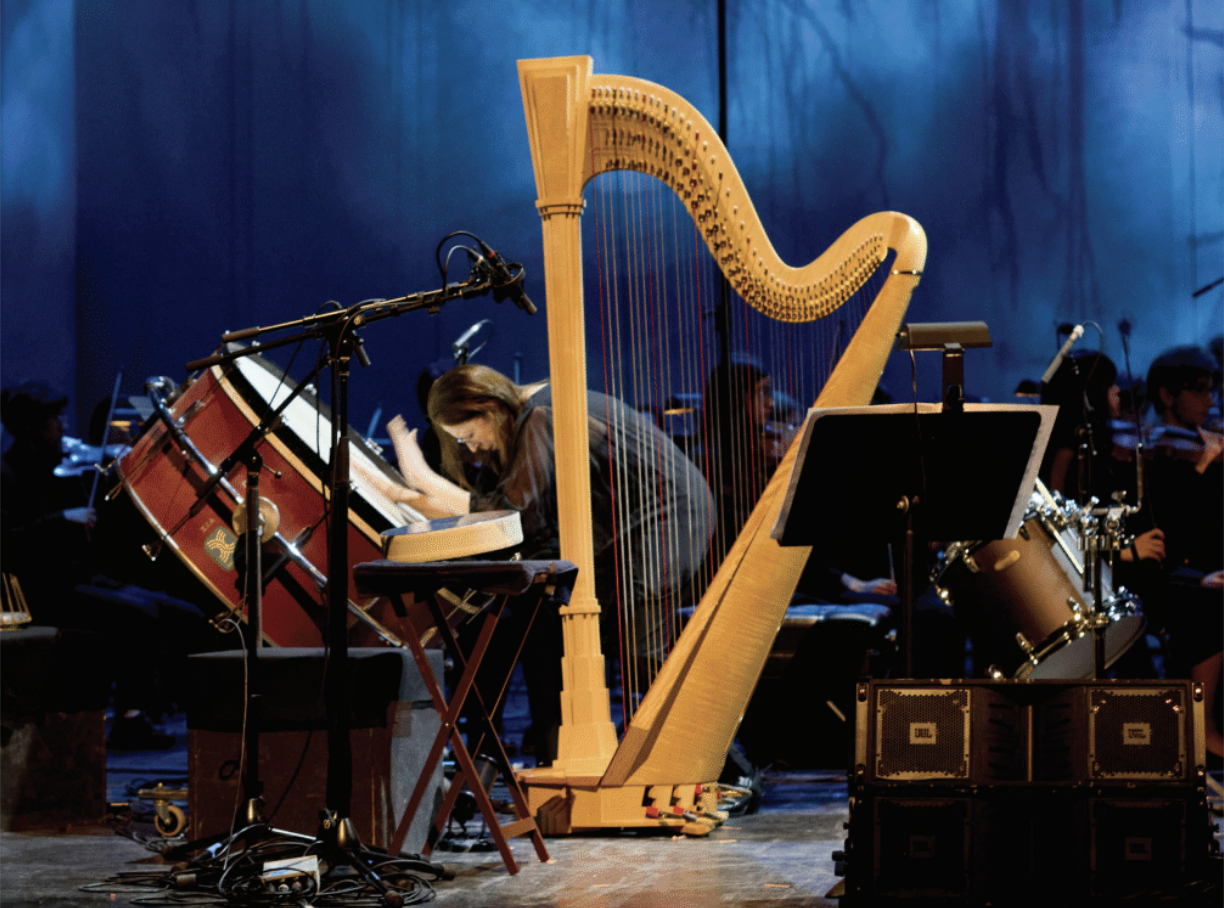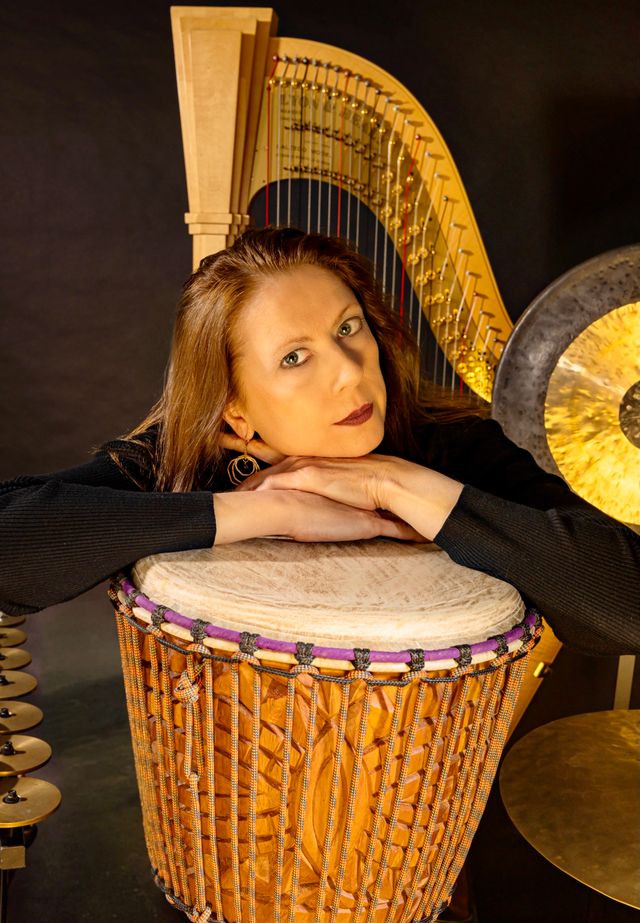
Yolanda Kondonassis is a musician working in the Great Lakes region, formerly at the Cleveland Institute of Music, she will begin teaching at the University of Michigan School of Music, Theatre and Dance in the fall. Now, the Grammy-nominated harp soloist performs on the harp and drums, on a new album commissioned by the Interlochen Arts Academy, called “Terra Infirma.” 

“Terra Infirma” had its digital premiere on April 17, ahead of Earth Day, and was composed by Reena Esmail for a collaboration with Kondonassis. Esmail started writing the concerto in January 2025, while living in Altadena, CA as the catastrophic wildfires began to enclose her neighborhood. The concerto also references Esmail’s extensive studies of Hindustani music — specifically the raags (or ragas) of Deepak, which are fabled to evoke uncontrollable fire. The piece also required another song or raag of Megh, which brings the rain as it is typically sung during monsoon seasons. 

For Earth Day, Christa Grix from Detroit’s Jazz and Classical station WRCJ 90.9 FM (also owned and operated by Detroit PBS), discusses this groundbreaking new work in conversation with Kondonassis. They also touch on Kondonassis’s nonprofit, Earth at Heart, which encourages conservation awareness and action through music and the arts. 

For the full interview, you can listen here:

The interview below was recorded, transcribed and edited for length and clarity.

Christa Grix: It gives me great pleasure to welcome my guest, Yolanda Kondonassis, a globally renowned harpist, composer, harp pedagogue, author, recording artist and environmental activist.

Yolanda Kondonassis: Thank you so much for having me. 

CG: I have admired you for most of my professional career, and I’m also aware of Reena Esmail. I do the programming at WRCJ, and I heard her music about a year ago, and I said, that is a composer to pay attention to. So, I can’t imagine anything better than the two of you collaborating on this project, “Terra Infirma.” And I’d like you to tell us all about it. 

YK: You know, the best things in life, I think, happen kind of organically, and because of that, they tend to evolve for all the right reasons. Reena and I probably first met virtually about five years ago. And we met through our husbands, who are both very active musicians. 

My first experience with Reena was through my “Five Minutes for Earth” project, which was my most recent album, where I commissioned a whole bunch of folks to write a roughly five minute piece that was inspired by Earth.

She’s just such an intelligent, curious person, and we have very much the same sensibility when it comes to creating art. Our environmental concerns and everything we do to make sure the planet will be around for many, many years to come — art should be approached the same way, that term “sustainability” should apply to both.

And I think her music has sustainability. So much art right now is created extremely quickly; premiered, quickly; consumed, quickly and then almost discarded. We don’t really hear much about it again, and this is not musical fast food.

Portrait of the composer, Reena Esmail. Photo: Rachel Gracia.

CG: No, it is absolutely not.

YK: It had about a four year gestation period. We talked about all sorts of different iterations this might take. And finally, we had one kind of seminal conversation where it was like, what sound, what sonic element would really bring the harp to life in a way it hadn’t been before?

I’ve kind of always been sort of a closet percussionist. And I thought, well, you know, the harp is a percussion instrument. What if you actually wrote a concerto for harp and percussion, and I do both, and how would that look?

It just was such an amazing experience to learn about all these different percussion equipments. I play 18 different percussion pieces, and I’m shoving my harp across the stage, in a sort of a metaphorical journey.

CG: Could you tell me a little bit more about those logistical challenges? Principally, being a harpist, I know it’s no small feat to move a harp. And for our listeners, let me mention that the harp is about six feet tall and weighs about 80 pounds, so when you’re talking about moving — and as I understand— the harp is a main character in a musical drama. Is that correct? 

YK: You said it. I just get excited every time I think about the genesis of this piece. Because initially we thought, okay, we’ll put you on stage. We’ll surround you with a ton of percussion, you may have to get up at some point. And then as we really started talking about the subject matter…

What if the harp actually, and to some degree, me as a performer were like a protagonist in this story of what we face environmentally? And what if the harp almost symbolized Earth as a “not” inanimate protagonist. And as anybody who plays the harp knows, that is not an inanimate object. You’ve got to be a harp whisperer, to play that thing. 

It evolved from the idea of me sitting in one place on stage in my usual concerto position, surrounded by percussion to “what if you walked on stage just without a harp and started doing something percussive?” And from that, it evolved into this idea that my harp starts on one side of the stage. And throughout the journey of this piece, it is a journey, I literally shove it from one percussion battery to another.

CG: So, not on a dolly or anything like that. You shove it?

YK: Yes, and so that shoving was literally built into the choreography. Then, of course, we said, well, this is getting very theatrical. What if one of the movements was incorporated at a theatrical element where you’re literally walking around the stage? Maybe you’re rimming a singing bowl. Maybe you’re exploring while the orchestra does something else. So, it really kind of stretched me to my limit. 

Portrait of harpist and percussionist Yolanda Kondonassis. Photo: Laura Watilo Blake.

CG: We all know that you’re a passionate advocate for the environment. What inspired you to do so much for the environment and for Mother Earth?

TK: I think that when something evolves over time you begin to invest in it, emotionally and otherwise. And really, when I started truly thinking about the environment is when I had my daughter in 2002. As we know, when you have a child, you start thinking farther ahead than we do when we don’t. 

I did an album called “Music of Hovhaness,” a piece on there was called, “Spirit Of Trees.” This was 20 years ago, and I thought, this music is so inspiring to me. This sounds like I’m walking through the woods and this is incredible, just being struck with the way music can conjure both a visual image and inspiration. I thought, wouldn’t it be great if we set it up so that my royalties from this album went to the Rainforest Alliance? And that was kind of the first little foray into all of this. 

That eventually led to establishing my nonprofit called Earth at Heart, and writing a kids book called My Earth, My Home. You know, one thing kind of leads to another. I wanted to kind of wrap my artistic life around this unifying mission. At a certain point, I think during covid, is when I started thinking, okay, great, I’ve been doing this for decades. I played in every part of the world I could have ever dreamed of. I’ve played the traditional repertoire. I’ve commissioned some great pieces. What’s my mission, what’s my unifying idea. 

And so it was a great kind of incubator during the pandemic to develop some ideas and to really have the time to follow through on them, because for busy musicians, that’s the tough part. It’s like we’re always full of ideas, but it’s the time to develop them and let them sit a minute and germinate and marinate before you take the next step. 

It’s been a wonderful way to combine passions. I don’t pretend to be a climate scientist, but what I can do is work on inspiring action, inspiring awareness of things. And what better way to do that than music? I think if anybody hears this piece, “Terra infirma,” they might even be inspired to learn more about it, and in learning more about it, who knows, they might become really inspired to think about environmental concerns in a way they hadn’t before. When they’d been thrown stats and statistics and, quite honestly, very scary stuff. What a better way to reach people than through music?

Both Reena and I talked about how we didn’t want “Terra Infirma” to be some sort of musical Armageddon, even though the reality is very scary. But, I think the only way we address any problem is with hope, hope that we can do something, hope that our actions will have an effect. 

“Terra Infirma” premiered live on October 30, 2025 at Interlochen Arts Academy. As of April 17, listeners will find the album digitally on all streaming platforms.  


The post When Music Meets Climate Crisis: A New Concerto Echoes the Planet’s Fragility appeared first on Great Lakes Now.

Original Article

Great Lakes Now

Great Lakes Now

https://www.greatlakesnow.org/2026/04/21/when-music-meets-climate-crisis-a-new-concerto-echoes-the-planets-fragility/

Lisa John Rogers, Great Lakes Now

Eat Your Heartland Out: Touring Thunder Bay’s Craft Brewery Scene

Eat Your Heartland Out is a Taste Awards nominated  program about the intersection of food and culture in the American Midwest. The show is produced by the Heritage Radio Network, a leader in culinary audio storytelling and distributed on the Public Radio Exchange (PRX), which provides content to public radio affiliates across the United States.

Read Now at Great Lakes Now.

Original Article

Great Lakes Now

Great Lakes Now

https://www.greatlakesnow.org/2023/07/eat-your-heartland-out-touring-thunder-bays-craft-brewery-scene/

Capri S. Cafaro

Edmund Fitzgerald 2021: Attend a shipwreck memorial service in person or virtually

“The legend lives on…”

Nov. 10 has been an unassailable part of Great Lakes culture and history since 1975 when the SS Edmund Fitzgerald sank in Lake Superior with its entire crew of 29 and was immortalized in the famous song by Gordon Lightfoot.

The ship went down in Lake Superior, near Whitefish Point, but it’s a piece of history that connects people all around the region who care about the lakes and their history or have experienced their own loss.

Read Now at Great Lakes Now.

Original Article

Great Lakes Now

Great Lakes Now

https://www.greatlakesnow.org/2021/11/edmund-fitzgerald-shipwreck-memorial-service-2021/

Natasha Blakely

Summer Fun Yet to Come: As times change, so do boat shows

At the 2020 Cleveland Boat Show, just before the pandemic struck, big changes were already afoot in the industry.

“I brought a huge lawn into the Cleveland Boat Show in 2020 so that people could stand around and play cornhole and relax, people could sit around a picnic table and drink beer and kids could run around,” said Michelle Burke, president of the Lake Erie Marine Trades Association.

Read Now at Great Lakes Now.

Original Article

Great Lakes Now

Great Lakes Now

https://www.greatlakesnow.org/2021/09/summer-boat-shows-change/

James Proffitt

Thousand Island Dressing Mystery: Uncertain origins of one of America’s favorite sauces

What do you get when you mix mayonnaise, a vaudeville star, two swanky hotels and a fisherman’s wife?

If you guessed Thousand Island dressing and an age-old mystery, you’d be correct. 

Today, Thousand Island dressing is bottled and sold in grocery stores nationwide. You may even find a simplified version of the dressing (mayonnaise, ketchup or tomato puree, and pickle relish) at your favorite burger spot, masquerading as their “special” or “secret” sauce.

Read Now at Great Lakes Now.

Original Article

Great Lakes Now

Great Lakes Now

https://www.greatlakesnow.org/2021/07/thousand-island-dressing-uncertain-origins/

Rachel Duckett

Ancient human remains unearthed at proposed Kohler golf course site in Wisconsin

This article, first posted here, was republished with permission from Wisconsin Watch.

By Jim Malewitz, Wisconsin Watch

Archeologists have unearthed human remains of Native Americans who lived up to 2,500 years ago during excavations of the Sheboygan County site along Lake Michigan where Kohler Co.

Read Now at Great Lakes Now.

Original Article

Great Lakes Now

Great Lakes Now

https://www.greatlakesnow.org/2021/06/ancient-human-remains-kohler-golf-course-wisconsin/

Wisconsin Watch

I Speak for the Fish

I Speak for the Fish is a new monthly column written by Great Lakes Now Contributor Kathy Johnson, coming out the third Monday of each month. Publishing the author’s views and assertions does not represent endorsement by Great Lakes Now or Detroit Public Television.

Read Now at Great Lakes Now.

Original Article

Great Lakes Now

Great Lakes Now

https://www.greatlakesnow.org/2021/05/i-speak-for-the-fish/

Kathy Johnson

Conservation Coordination: Black Lake sturgeon fishing highlights contrasts between Native and state approaches

The brief Black Lake sturgeon season which garners so much attention each year is over, but not for everyone.

The public face of the season usually begins and ends on a bitter-cold Saturday morning after six anglers spear their fish. After that, it’s over for citizens of Michigan and other states who travel for the opportunity to catch a big, long, tasty prehistoric fish.

Read Now at Great Lakes Now.

Original Article

Great Lakes Now

Great Lakes Now

https://www.greatlakesnow.org/2021/05/black-lake-sturgeon-fishing-indigenous-culture-conservation/

James Proffitt

Great Lakes Sanctuaries: Two more National Marine Sanctuaries in the region see the finish line

Growing up in Alpena, Audrey Garant could not wait to leave her hometown in Michigan’s northeast Lower Peninsula. But years later, moving back, seeing the Great Lakes Maritime Heritage Center built and getting to experience it changed things for her.

“It’s my place to kind of disappear,” she said.

Read Now at Great Lakes Now.

Original Article

Great Lakes Now

Great Lakes Now

https://www.greatlakesnow.org/2021/04/great-lakes-national-marine-sanctuaries/

Natasha Blakely

Michigan tribe seeks cultural property protection in path of Line 5 project

By Patrick Shea, Energy News Network

The discovery of a potential archaeological site in the Straits of Mackinac last fall has opened the door for a Michigan tribe to pursue a new, longshot legal strategy to stop the planned Line 5 pipeline tunnel project.

The Little Traverse Bay Bands of Odawa Indians passed a resolution in January instructing its historic preservation office to begin compiling research for an application to classify the straits as a Traditional Cultural Property, a rarely used federal designation under the National Register of Historic Places.

Read Now at Great Lakes Now.

Original Article

Great Lakes Now

Great Lakes Now

https://www.greatlakesnow.org/2021/04/cultural-property-protection-michigan-line-5/

Energy News Network

Duck Stamp: Little stamp has big impacts in the Great Lakes and nationwide

Waterfowl hunters began buying them nearly a century ago. Just after that, collectors joined the fun.

Since its inception in 1934 when Franklin D. Roosevelt signed the Migratory Bird Hunting and Conservation Stamp Act into law, the duck stamp (as it’s commonly known) has garnered more than $1 billion for habitat conservation in the national wildlife refuge system.

Read Now at Great Lakes Now.

Original Article

Great Lakes Now

Great Lakes Now

https://www.greatlakesnow.org/2021/04/duck-stamp-impacts-great-lakes-nationwide-refuge/

James Proffitt

Grants to help with repairs, rehabilitation at 3 lighthouses

NEWBERRY, Mich. (AP) — Repairs and restoration are coming to three historic lighthouses in Michigan.

More than $126,000 in grant funding from the Michigan State Historic Preservation Office have been awarded to the Crisp Point Light Historical Society, the North Manitou Light Keepers and St. Clair County Parks and Recreation.

Read Now at Great Lakes Now.

Original Article

Great Lakes Now

Great Lakes Now

https://www.greatlakesnow.org/2021/03/ap-grants-repairs-rehabilitation-3-lighthouses/

The Associated Press

Freighter Mystery: Can you help Great Lakes Now with more clues to identify people and places in a historic film?

The Great Lakes Now supervising producer, Rob Green, wants your help figuring out more about an old movie shot aboard a freighter. He’s done what he can to identify the ship, ports, time period and people in a mysterious black-and-white video he found in an online archive.

Green knows someone out there can help with more clues to answer: who shot this footage?

Read Now at Great Lakes Now.

Original Article

Great Lakes Now

Great Lakes Now

https://www.greatlakesnow.org/2021/03/freighter-mystery-identify-people-places-historic-film/

GLN Editor

Principled Poet: Michigan’s Alison Swan tackles environmental issues on an experiential level in new book

In a Great Lakes world dominated by policy proclamations, fights for funding and the never-ending conflict between the triad of politicians, business and environmental interests, Michigan poet Alison Swan operates on a different level.

Fully cognizant of these struggles, Swan engages them on a human and experiential level through her poetry by calling “the reader to witness, appreciate and sustain this world before it becomes too late,” as described on the cover of her new book, “A Fine Canopy.”

“A Fine Canopy” is a collection of poems based on Swan’s life-long personal experiences, diverse locales where she has lived and material collected over decades.

Read Now at Great Lakes Now.

Original Article

Great Lakes Now

Great Lakes Now

https://www.greatlakesnow.org/2021/01/michigan-alison-swan-environmental-experiential-poetry-book/

Gary Wilson

Lifeblood: Photographer shares the Lake Erie connection uniting shoreline residents

Along the shores of Lake Erie live a wide range of people whose lives might seem very familiar to or wildly distinctive from your own.

In the documentary photo series North of Long Tail, photographer Colin Boyd Shafer tells the stories of more than 20 residents of Lake Erie’s north shore.

Read Now at Great Lakes Now.

Original Article

Great Lakes Now

Great Lakes Now

https://www.greatlakesnow.org/2021/01/lifeblood-photographer-lake-erie-shoreline-residents/

Grace Dempsey

Church to honor 45th anniversary of Fitzgerald shipwreck

DETROIT (AP) — Mariners’ Church of Detroit will observe the 45th anniversary Sunday of the sinking of the Edmund Fitzgerald during its yearly memorial service for those who have died in Great Lakes shipwrecks.

The event will be live-streamed on Facebook for the first time, said the Rev.

Read Now at Great Lakes Now.

Original Article

Great Lakes Now

Great Lakes Now

https://www.greatlakesnow.org/2020/11/ap-church-anniversary-fitzgerald-shipwreck/

The Associated Press

Great Lakes Moment: Sacred Land of the Wyandot of Anderdon Nation

Great Lakes Moment is a monthly column written by Great Lakes Now Contributor John Hartig. Publishing the author’s views and assertions does not represent endorsement by Great Lakes Now or Detroit Public Television.

Metropolitan Detroit sits on the traditional territory of the Wyandot of Anderdon Nation.

Read Now at Great Lakes Now.

Original Article

Great Lakes Now

Great Lakes Now

https://www.greatlakesnow.org/2020/11/great-lakes-moment-wyandot-anderdon-nation-six-points/

John Hartig

Ancient stone patterns in Straits of Mackinac add new wrinkle to Line 5 pipeline debate

MACKINAW CITY, Mich. (AP) — Images from an underwater vehicle seem to reveal stone patterns on the bottom of the Straits of Mackinac in northern Michigan, possible evidence of Native American artifacts from thousands of years ago, a newspaper reported.

A group of amateur explorers raised money to look at Enbridge Inc.’s oil pipeline on the lake bottom.

Read Now at Great Lakes Now.

Original Article

Great Lakes Now

Great Lakes Now

https://www.greatlakesnow.org/2020/10/ap-ancient-stone-patterns-straits-mackinac-line-5-pipeline/

The Associated Press

In Michigan, rising lake levels disturb sacred ground

By Elena Bruess, Circle of Blue

At the shoreline, between lake and land, Melissa Wiatrolik reflects on those who were here before Michigan became Michigan. She had been raised in a community that honored the dead, that understood that their ancestors were always present. As a child, she had watched her own family clean the gravestones of those before her.

Read Now at Great Lakes Now.

Original Article

Great Lakes Now

Great Lakes Now

https://www.greatlakesnow.org/2020/09/michigan-rising-lake-levels-sacred-ground/

GLN Editor

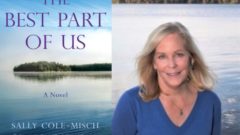
The Best Part of Us: Great Lakes author tackles conflict and culture in new novel

Generations of a family led by a strong patriarch clash over the future of a treasured Canadian vacation home. The local Ojibwe chief threatens to claim the land.

And a pristine but foreboding lake north of Lake Huron is an omnipresent part of the drama.

That’s the setting for The Best Part of Us, the debut novel by former international Great Lakes executive, Sally Cole-Misch.

Read Now at Great Lakes Now.

Original Article

Great Lakes Now

Great Lakes Now

https://www.greatlakesnow.org/2020/09/great-lakes-author-conflict-culture-novel/

Gary Wilson