By Naveena Sadasivam

This story was originally published by Grist. Sign up for Grist’s weekly newsletter here.


Last month, President Trump sat alongside executives of the largest tech companies in the country as they pledged to pay a fair share of the energy costs of their data center buildout. “Data centers … they need some PR help,” Trump said at the gathering. “People think that if the data center goes in, their electricity is going to go up.”

It’s not an entirely unfounded assumption.

As the tech industry has funneled billions of dollars into the AI boom over the last several years, it has simultaneously been expanding its fleet of computing powerhouses, which require vast amounts of energy to run. These facilities have been cropping up all over the country, from rural communities in eastern Pennsylvania to the cities of northern Utah. 

This boom coincides with a dramatic rise in U.S. electricity prices, driven by inflation and the rising cost of adapting to wildfires, hurricanes, and other extreme weather. But these massive facilities have also strained the grid — and in some cases — contributed to rising prices. For instance, last year, an independent monitor for PJM, the grid operator that serves 13 northeastern states and Washington, D.C., projected that powering data centers would result in higher electricity generation costs, which would ultimately be passed on to consumers. And in cases where the buildout hasn’t yet led to price hikes, utilities and grid operators expect that it’s just a matter of time if tech companies follow through on their plans. Indeed, the Federal Reserve Bank of Dallas estimates that with data center electricity demand expected to double in the next five years, wholesale power prices could rise by as much as 50 percent.

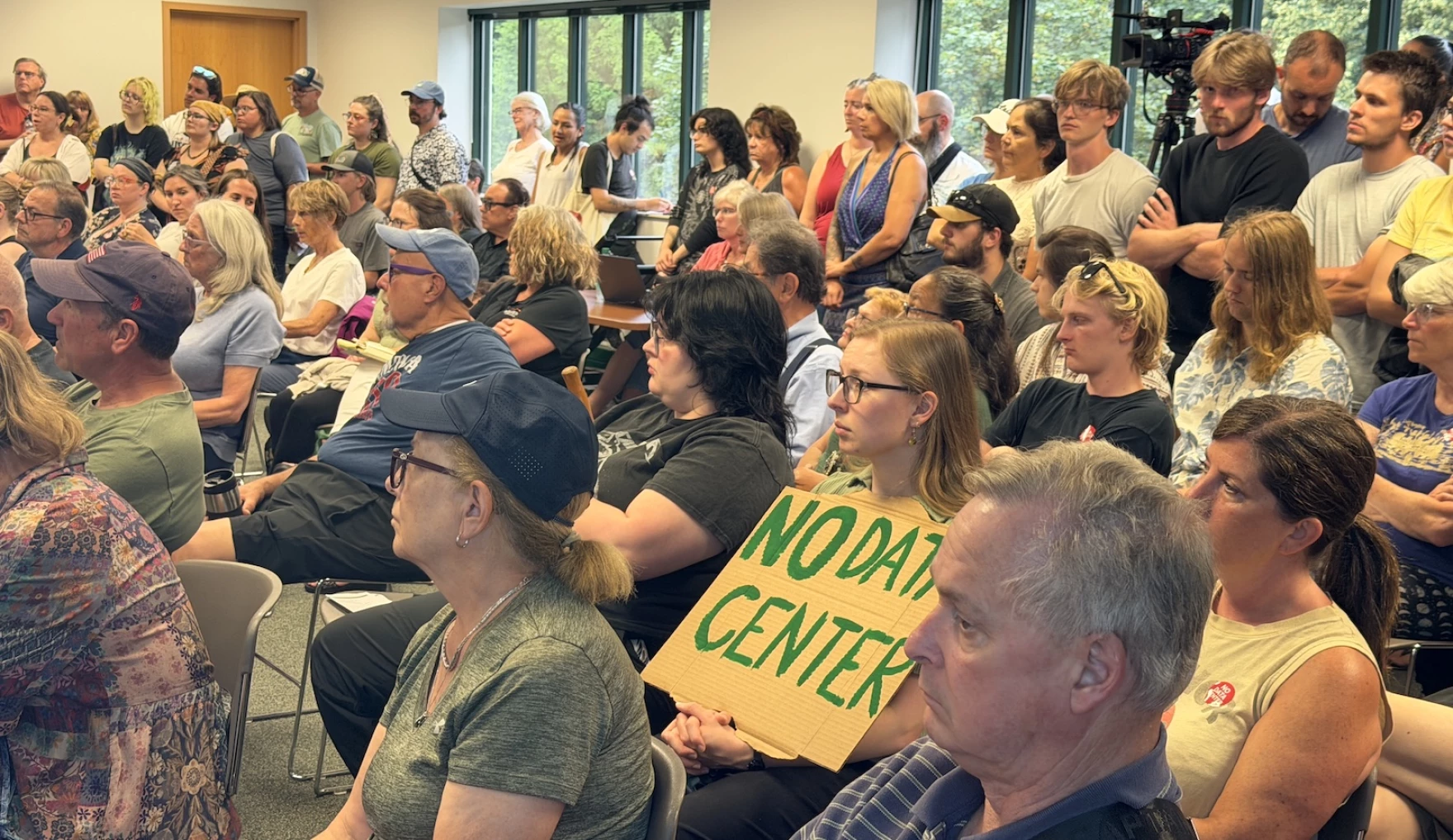
At a time when the cost of living has become untenable for many Americans, and consumers are setting aside ever greater shares of their income to pay energy bills, the possibility of further rate hikes to line the pockets of tech companies has prompted a massive backlash across the country. The White House gathering of tech executives appeared to be a response to the backlash. On March 4 at the event, they signed onto the “Ratepayer Protection Pledge.”

The pledge itself has few specifics or teeth. It’s a voluntary agreement by several prominent tech companies — including Microsoft, Meta, OpenAI, and Amazon — to secure their own power for data centers, pay for any powerlines or other infrastructure that utilities may need to build to move that power, and hire locally from the communities they build in. While in theory the agreement could help prevent Americans from having to bear the cost of the data center expansion, the White House hasn’t set up oversight mechanisms to ensure that they do. Several consumer and environmental advocates called the agreement “meaningless,” “unenforceable,” and ultimately, “nonsense.”

The United States has become ground zero for the global data center boom. The rapid buildout has left developers, tech companies, and the utility industry scrambling to secure more power. As a result, the wait for a data center to connect to the grid can be years in many parts of the country. Hyperscalers — companies that operate large data centers and provide vast computing power — have been trying to get around these wait times by signing long-term power purchase agreements with solar developers, building their own natural gas plants, and even retrofitting jet engines to generate electricity

“Every single data center in the future will be power limited,” said NVIDIA CEO Jensen Huang last year. “We are now a power‑limited industry.”

Outside of the White House, utilities, local regulators, and lawmakers have also been proposing various solutions to address the community backlash and allow for the continued building of more data centers. Some have implemented measures requiring data centers to pay the costs of generating and moving the electricity they use. Others have suggested that data center developers install solar and battery systems on-site, or that rates should be frozen for residents while utilities figure out how to handle the additional costs. And at least 11 states are considering legislation to temporarily ban new data centers while their impact on electricity prices and other concerns are addressed.

“You’re seeing states try to move quickly,” said Meghan Pazik, a senior policy associate in Public Citizen’s climate program. But “every state’s going to have a different approach to how far they want to go on data centers.”  

Many states are utilizing additional tariffs for data centers and other customers that pull large amounts of power from the grid. These facilities — referred to as “large load customers” — are required to pay more to make up for the added infrastructure costs that come with supplying them, as well as the risk if they end up walking away from the project, which would leave consumers on the hook for the investments. More than 30 states have proposed or implemented measures of this sort. 

Some hyperscalers are changing their approaches, too. In Minnesota, Google inked a deal with Xcel Energy, the state’s largest investor-owned utility, to bring 1,900 megawatts of clean energy onto the grid. The company is fully funding wind turbines, solar panels, and battery storage, as well as the costs of grid infrastructure upgrades to serve its data centers. And in Louisiana, Meta signed a deal with Entergy to help fund the construction of seven natural gas plants, more than 200 miles of transmission lines, and battery systems, among other infrastructure upgrades.

A recent report from the Searchlight Institute, a policy think tank, argues that this piecemeal approach to regulating the tech industry misses an opportunity to fund a large-scale upgrade of the grid. Although the surge in demand has largely been framed as a looming crisis, the report contends that the boom also creates a rare policy window: a chance to modernize the country’s electrical system and make long-delayed investments needed for the clean energy transition.

Utilities make roughly $35 billion in investments in transmission infrastructure every year — far short of what’s actually needed. Electricity demand is projected to double or triple in the next 25 years. The Searchlight Institute report proposes creating a dedicated grid infrastructure fund to accelerate the expansion. Under the plan, hyperscalers would pay into the fund in exchange for speedy connections. Money from the fund would be directed to utilities and other companies to build out the system, prioritizing clean energy along the way. And consumer and environmental advocates, along with other policymakers, would oversee the process to ensure funds are being distributed equitably and serve the needs of the public. 

Such a mechanism would ensure increased investments in clean energy, rather than the natural gas projects many tech companies are currently backing, while protecting consumers from increases in electricity prices.

“The hyperscalers need power,” said Jane Flegal, a senior fellow at the Searchlight Institute and author of the report. “They have a ton of capital. And rather than letting them continue to cut these one-off deals with utilities, we’ve got to find a better way to take advantage of the potential upside here and avoid the downside of them basically building a secondary grid behind the existing grid that benefits only them.”


The post Data centers are straining the grid. Can they be forced to pay for it? appeared first on Great Lakes Now.

Original Article

Great Lakes Now

Great Lakes Now

https://www.greatlakesnow.org/2026/04/14/data-centers-are-straining-the-grid-can-they-be-forced-to-pay-for-it/

Grist

CHICAGO, IL (March 10, 2026) – Today the Alliance for the Great Lakes released a Regional Playbook for Managing Data Center Impacts in the Great Lakes. The guide is designed for residents, concerned citizens, grassroots organizations, and local leaders across the Great Lakes region seeking clear, accessible information on the rapid growth of data centers and their impacts on water, energy, land use, community health, and local economies.

The Playbook brings together a compilation of ideas, data, and practical tools, drawing from existing toolkits, guidance documents, and best practices developed by state advocates, organizations, and communities across the Great Lakes region.  

“Communities across the Great Lakes are increasingly confronted by proposals for large-scale developments with significant water demands – from manufacturing plants, food and beverage facilities, and energy projects to data centers – that are not required to measure or publicly report how much water they use when they receive water from local municipal systems. These proposals often move quickly and can come with community and environmental impacts that are not always clearly explained to residents or local leaders,” said Maria Iturbide-Chang, Director of Water Resources.

 “The playbook is designed to inform Great Lakes residents about the processes and the potential consequences, identify the right questions to ask at the right moment, and navigate local and regional decision-making processes to ensure that we protect our Great Lakes, its water resources and the communities that depend on them.”

###

Contact: Don Carr, Media Director, Alliance for the Great Lakes dcarr@greatlakes.org 

More about data centers & water use

Read more about data centers in the Great Lakes region, how they use water, and their impact on our water resources.

Read More

The post New Great Lakes Data Center Playbook Gives Residents Tools to Ask the Right Questions to Reduce Impacts and Protect Water appeared first on Alliance for the Great Lakes.

Original Article

News - Alliance for the Great Lakes

News - Alliance for the Great Lakes

https://greatlakes.org/2026/03/new-great-lakes-data-center-playbook-gives-residents-tools-to-ask-the-right-questions-to-reduce-impacts-and-protect-water/

Judy Freed

Water-intensive data center development is rapidly growing across the Great Lakes region. To help make sense of the impacts, we released this guide for residents, concerned citizens, grassroots organizations, and local leaders seeking clear, accessible information. It describes how water is used in data centers and provides checklists to help communities understand potential impacts and ask the right questions at the right time.

This playbook does not take a position on whether any specific proposed data center is “good” or “bad” for a community. The goal is to ensure that, if data centers move forward, they operate in ways that maximize public benefits while minimizing harm to water resources, community well-being, and ecosystems.

A report cover that says "A Regional Playbook for Managing Data Center Impacts in the Great Lakes."

Download the playbook

Download checklists from the playbook

Data center impacts

Increased water and energy use from data centers could lead to strain on local water systems and increased prices for ratepayers, and ultimately, water shortages, groundwater conflicts, and aquifer contamination. Data centers can discharge wastewater that’s contaminated with pollutants, potentially damaging our lakes and rivers. Residents may already be seeing their energy bills rising because of unprecedented demand that large data centers put on local power systems. There is concern about similar increases in future drinking water and wastewater treatment costs.

Lack of transparency

While we know data centers require large amounts of water and energy, there are barriers to understanding their full impact on communities and the Great Lakes. Many data center developers rely on non-disclosure agreements (NDAs) to keep estimates of water use and consumption, cooling needs, and electricity demand secret, even when communities are being asked to approve zoning changes, tax abatements, or public infrastructure investments.

The transparency challenge is not unique to data centers. Many large water-using industries, such as pharmaceuticals, food and beverages, and manufacturing, are not required to measure or publicly report how much water they use when they connect to and receive water from local municipal systems. When they rely on city or town water supplies, their water use often remains largely invisible to the public and decision-makers.

Data centers also increase electricity demand, which in turn increases water use at power plants that also use water for cooling. Without transparent reporting on both energy consumption and associated water use, it is nearly impossible to understand how growth in the data center sector is increasing water use across the Great Lakes region.

These are just some of the impacts described in the playbook, along with the questions necessary to bring transparency to local data center development.

Local and regional action

As Maria Iturbide-Chang, Director of Water Resources, shared when the playbook was released, “The playbook is designed to inform Great Lakes residents about the processes and the potential consequences, identify the right questions to ask at the right moment, and navigate local and regional decision-making processes to ensure that we protect our Great Lakes, its water resources, and the communities that depend on them.”

This guide is grounded in the belief that informed communities are better equipped to shape outcomes that align with both local needs and regional responsibilities. Ultimately, state and regional action is needed to protect a water system shared across eight states. The playbook also looks to the future and outlines state policies necessary for the responsible, transparent, and sustainable development the Great Lakes need and deserve.

Join Us March 24

Join our experts to learn more about the Data Center Playbook. Ask your questions during this live event.

Register for the Webinar

The post Data Center Playbook appeared first on Alliance for the Great Lakes.

Original Article

News - Alliance for the Great Lakes

News - Alliance for the Great Lakes

https://greatlakes.org/2026/03/data-center-playbook/

Judy Freed

Data Center bills in the Wisconsin State Legislature

On February 17, 2026 the Wisconsin Senate Committee on Utilities, Technology, and Tourism held a hearing on data center development bills. River Alliance’s Agriculture and Policy Director Mike Tiboris attended the hearing and submitted the following testimony on why our state should pause new data center construction until our leaders fully understand the implications of how industries with extreme energy and water demands will have on our resources.

Chair Bradley and the members of the Committee on Utilities, Technology, and Tourism:

Thank you for holding this hearing for several bills on the emerging issues related to data center development in Wisconsin. River Alliance of Wisconsin has registered neutral on SB 729 and opposed on both SB 843 and AB 840 as written. River Alliance is a statewide nonprofit, nonpartisan advocacy organization that empowers people to protect and restore Wisconsin’s waters at a local level. The organization’s supporters include more than 5,000 individuals and businesses and nearly a hundred local watershed organizations. 

All of these bills recognize that we must thoughtfully confront the sudden construction pressure from a rapidly evolving technology. Our concern is that we do not allow Wisconsin’s water, among our most valuable public assets, to be mortgaged for unproven benefits and without adequate protection. A medium-sized data center consumes as much water as 1000 households per year for cooling (110 million gallons). Rapid and improperly regulated data center construction poses a potentially serious threat to our natural water resources. The benefits to Wisconsin of data center construction are unproven, but the hazards to our water are quite clear. Data centers directly use water to cool servers that generate heat either through evaporative cooling or through the addition of contaminants that can be discharged in wastewater and enter the environment. Further, these facilities may invite the construction of new hydropower facilities on already taxed river systems and cause aging, outdated, facilities to stay online. Often touted as “green”, hydropower operations can cause myriad negative environmental impacts, from preventing fish migrations to reducing water quality and water quantity at critical times of the year, affecting aquatic life and recreation.

Our preference in this moment of uncertainty would be to pause all new data center construction until we can develop appropriate legislative mechanisms for managing its downsides. Legislators’ recently proposed moratorium on data center construction should be used to give the Legislature time to create thoughtful controls that ensure new data centers actually benefit Wisconsinites and do not cause problems we could avoid if we took the time to prepare for them. Our abundant natural water and land resources are an obvious attraction for companies that want to build projects in Wisconsin, but we should be very careful to make sure the benefits are not simply handed to companies to export from the state for their own profit at the cost of damage to an irreplaceable public good and, at best, uncertain employment or tax benefits.


SB 729

River Alliance has registered neutral on SB 729. We are supportive of the bill’s emphasis on making sure that data centers pay for the energy that they use and that their usage does not drive up the cost of energy for Wisconsin homeowners. Similarly, it is common sense that such large water users should be required to report on their usage when it accounts for 25 percent or more of the total water usage of all customers for a water utility. Enforcing transparency about usage will help communities, utilities, and municipalities respond appropriately to water demand increases that could have very negative effects on local water sources, ecosystem health, and the costs of water provision.

We support the idea of encouraging data centers to rely on renewable wind and solar energy sources. SB 729 would require that at least 70 percent of the total annual electric energy used by the buildings be derived from renewable resources, as defined under s.16.75(12)(a)4. The definition of “renewable energy” referenced, however, includes hydropower, and we do not support the construction of new hydroelectric generation facilities to power data centers. 

Many people believe that hydropower, which uses dams and gravity to spin electricity generating turbines, is a clean, climate-smart, energy source. This is a misconception. While wind and solar power offer renewable low-carbon energy and are generally cheaper than fossil fuels, hydropower can cause environmental damage. Dams and reservoirs alter river flows, raise water temperature, degrade water quality, increase sedimentation in reservoirs, and prevent migrations of fish and native mussels harming aquatic ecosystems and Wisconsin communities. Reservoirs are a significant source of greenhouse gas emissions, predominantly methane, an especially potent greenhouse gas, that results from eutrophication and harmful algal blooms.

Again, River Alliance supports the approach that SB 729 takes to create water usage transparency and accountability, to ensure that the costs of new energy and water demand are borne by the data centers and not by other customers, and to encourage the use of renewable energy like wind and solar as power sources. We are concerned that, in its current form, the bill will encourage expansions of hydropower generation that will extensively damage aquatic ecosystems and may be more destructive to the climate than fossil fuel use in some cases.


SB 843 and AB 840

The above reasons also underwrite our opposition to both of these bills as written. The bills require that “any renewable energy facility that primarily serves the load of a data center must be located at the site of the data center.” (Section 2. 196.492(2), lines 16-17). Again, using the definition of renewable energy from s. 196.378 (1)(fg), we are concerned this will encourage the construction of new, environmentally damaging, hydropower facilities. Limiting the use of renewable energy to sources constructed on site is unnecessarily restrictive and would likely have the effect of discouraging renewable energy use entirely. Because the bills do not explicitly require that data center owners pay the full cost of their energy use, this will drive up the cost of energy for Wisconsin residents while increasing pollution.

However, the requirements to require reporting to the DNR about annual water usage and to ensure that the costs of reclamation and failure of the facility are borne by the data center owners are sensible. 

We are encouraged by the serious interest the Legislature is taking in managing the environmental consequences of data center construction. Given the likelihood that the industry will expand rapidly in the coming years, we hope this is the beginning of a sustained conversation about how to ensure that the benefits of data centers accrue to Wisconsinites and that these do not come with irreparable harm to our land and water resources.

– Mike Tiboris, Agriculture and Policy Director


This message is made possible by generous donors who believe people have the power to protect and restore water. Subscribe to our Word on the Stream email newsletter to receive stories, action alerts and event invitations in your inbox.  Support our work with your contribution today.

The post Data Center bills in the Wisconsin State Legislature appeared first on River Alliance of WI.

Original Article

Blog - River Alliance of WI

Blog - River Alliance of WI

https://wisconsinrivers.org/data-center-bills/

Allison Werner

A Michigan town hopes to stop a data center with a 2026 ballot initiative

By Tom Perkins, Inside Climate News

This article originally appeared on Inside Climate News, a nonprofit, non-partisan news organization that covers climate, energy and the environment. This is the second of three articles about Michigan communities organizing to stop the construction of energy-intensive computing facilities.

Read Now at Great Lakes Now.

Original Article

Great Lakes Now

Great Lakes Now

https://www.greatlakesnow.org/2025/10/michigan-town-effots-to-stop-data-center/

Inside Climate News

Are data centers a threat to the Great Lakes?

Benton Harbor on Lake Michigan’s southeast coast is known to visitors for its vacation feel and beautiful beaches.

But it’s also one of the poorest cities in Michigan. In recent years, the area has struggled to find the funds to invest in critical infrastructure, most noticeably for its water supply which until recently had tested for dangerously high levels of lead.

Read Now at Great Lakes Now.

Original Article

Great Lakes Now

Great Lakes Now

https://www.greatlakesnow.org/2025/05/are-data-centers-a-threat-to-great-lakes/

Stephen Starr, Great Lakes Now