Lake Huron artificial reef restores fish spawning habitat
This article was republished here with permission from Great Lakes Echo.
By Samantha Ku, Great Lakes Echo
A newly restored reef at Channel Island in Saginaw Bay is intended to support native fish spawning and increase their numbers, ensuring the sustainability of local fisheries.
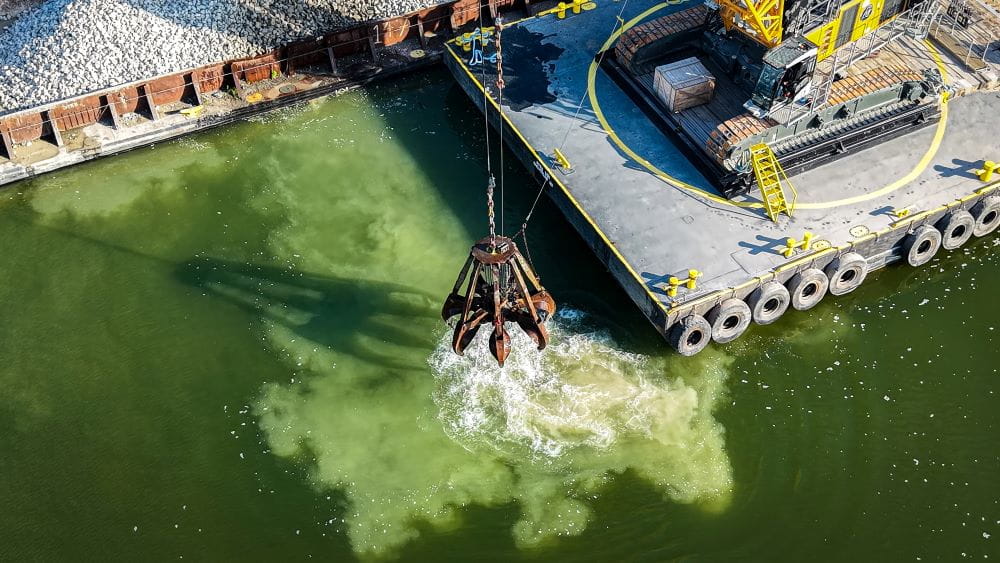
Construction to restore the nearshore fish spawning reef ended last October.
Recreational fishing is an economic boon to the Lake Huron region, according to Jeffrey Jolley, a fisheries unit supervisor with the Michigan Department of Natural Resources.
“The excellent fishery attracts anglers from all over the state, and they spend money on fuel, tackle, restaurants and shops, and hotels and rentals,” Jolley said.
Therefore, protecting fish habitats is crucial to the local economy, he said.
The construction is an additional reef restoration following the restoration of the Coreyon Reef site and is intended to support a network of spawning reefs and nursery habitat, according to Michigan Sea Grant.
The Coreyon Reef site is a 2-acre offshore rocky habitat about 10 miles north of the Quanicassee River, northwest of the Channel Island site.
By studying the Coreyon Reef, researchers gather valuable data on the spawning habitats of native species.
According to Michigan Sea Grant, researchers from the state DNR and Purdue University documented lake whitefish and walleye spawning on the reef between 2020 and 2022.
Initial results from the study indicate that fish species don’t show a particular preference for any specific type of cobble that makes up the reef structure.
Following the completion of the project at the Channel Island Reef, fish activity will be monitored by partners in the restoration, said Meaghan Gass, an MSU Extension educator with Michigan Sea Grant.
“With the two completed sites, researchers are able to compare nearshore and offshore locations,” Gass said.
Channel Island is also called Shelter Island, Spoils Island and the U.S. Army Corps Confined Disposal Facility.
Its newly built reef is about 570 feet long and 190 feet wide. It rises about 3 to 4 feet above the lake bottom and sits at least 5.5 feet below the water’s surface, even when water levels are low.
The artificial reefs are built from a mound of rocks that are distinctly different from coral reefs found in the ocean, Gass said.
Nearly 20,000 tons of natural limestone, delivered by barge, forms the Channel Island Reef, she said.
“Historically, inner Saginaw Bay had rocky underwater reefs formed by glacial deposits,” Gass said.
Gass said the rocky underwater reefs provided safe spaces for native fish to lay eggs because crevices among the rocks protect eggs and young fish from predators and strong currents.
The importance of native fish protection for the Lake Huron fishery lies in preserving the ecological balance that has developed over thousands of years, according to Jolley.
“Our native fish species evolved here through the forces of natural selection over millennia, adapting to local conditions, prey, predators and seasonal changes,” Jolley said.
In contrast, invasive species are often introduced abruptly, without natural checks and balances, allowing them to outcompete or prey on native fish, disrupt habitats and destabilize food webs, Jolley said.
Jolley said although some invasive species can temporarily provide new fishing opportunities, they often reduce long-term stability of ecosystems.
In contrast, native species support more resilient, diverse and sustainable fisheries, delivering lasting ecological and economic benefits.
However, artificial reefs designed to support native fish spawning habitats may also benefit invasive species.
“Round goby, an invasive species that prefers rocky habitats, will likely colonize the reef,” Jolley said.
While gobies can prey on fish eggs, native predators such as smallmouth bass feed heavily on them and are also attracted to the area.
The reef structure and placement support native species like smallmouth bass and walleye, which depend on clean, stable substrate for spawning and feeding, Jolley said.
“This interaction is expected to balance out naturally as predator-prey relationships stabilize,” Jolley said.
According to Jolley, community engagement is crucial for further restoration projects.
Jolley said public opinion often centers on safety, navigation features and aesthetics, as people seek to balance these considerations with the ecological benefits of habitat restoration.
“We have consistently engaged local communities on past, current and future projects,” Jolley said.
The post Lake Huron artificial reef restores fish spawning habitat appeared first on Great Lakes Now.
Great Lakes Now
https://www.greatlakesnow.org/2026/04/30/lake-huron-artificial-reef-restores-fish-spawning-habitat/