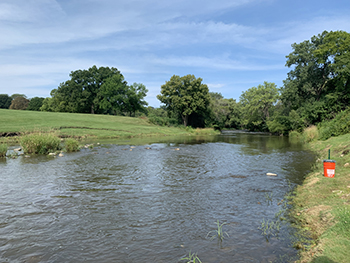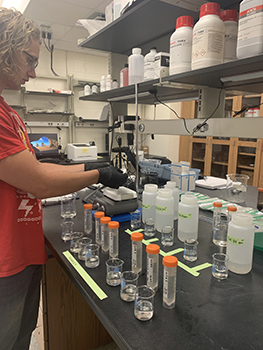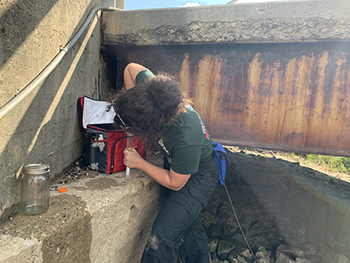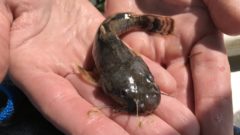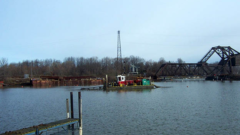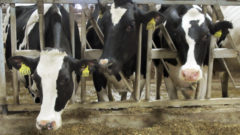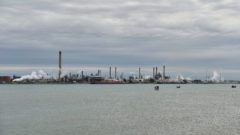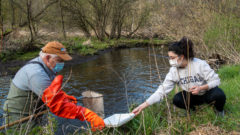
Once beset by industrial pollution, Rouge River on a slow path to recovery

By Kelly House, Bridge Michigan

The Great Lakes News Collaborative includes Bridge Michigan; Circle of Blue; Great Lakes Now at Detroit Public Television; and Michigan Radio, Michigan’s NPR News Leader; who work together to bring audiences news and information about the impact of climate change, pollution, and aging infrastructure on the Great Lakes and drinking water.

Read Now at Great Lakes Now.

Original Article

Great Lakes Now

Great Lakes Now

https://www.greatlakesnow.org/2023/05/once-beset-industrial-pollution-rouge-river-slow-path-recovery/
Bridge Michigan

PFAS News Roundup: West Michigan is showing PFAS levels higher than the national average

PFAS, short for per- and polyfluoroalkyl substances, are a group of widespread man-made chemicals that don’t break down in the environment or the human body and have been flagged as a major contaminant in sources of water across the country.

Keep up with PFAS-related developments in the Great Lakes area.

Read Now at Great Lakes Now.

Original Article

Great Lakes Now

Great Lakes Now

https://www.greatlakesnow.org/2023/05/pfas-news-roundup-west-michigan-pfas-levels-higher-than-national-average/

Kathy Johnson

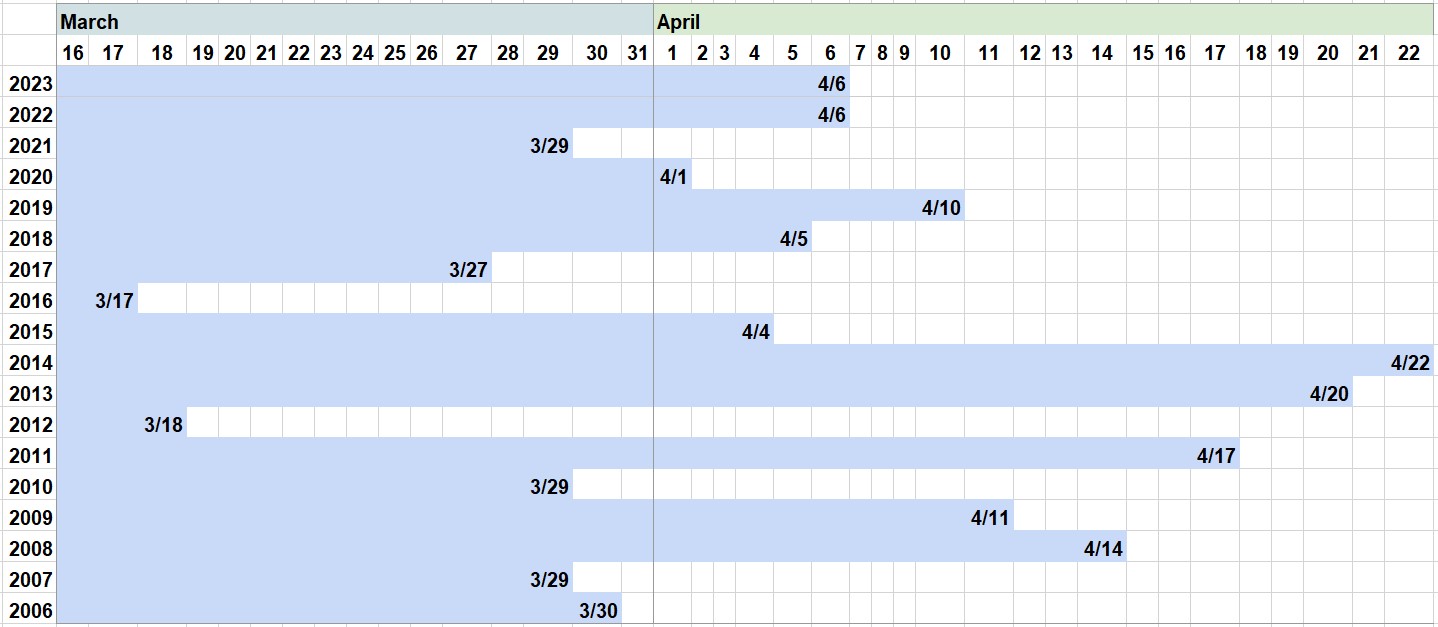
Ice out on Lake Winnebago was officially called by the Army Corps of Engineers on April 6, 2023 as determined by MODIS satellite imagery. Ice out (aka ice off) is when ALL ice is gone from the lake surface as observed by satellite.  This is important because ice out marks the date that the Army Corps transitions their management of Lake Winnebago from maintaining winter pool to focus on spring refill.

Ice out dates for Lake Winnebago 2006 to 2023 (Source: ACOE)

The Army Corps of Engineers – Chicago District manages water levels for Lake Winnebago by regulating outflow at the dams in Menasha and Neenah under the Federal Marshall Order of 1886. The Marshall Order is intended for flood risk management.

The Marshall Order defines the limits of regulation for Lake Winnebago:

  • May 1st to October 1st (navigation season):
    • High end of limit: 3.45 ft.
    • Low end of limit: 0.18 ft.
  • October 2nd to April 30th:
    • High end of limit: 3.45 ft.
    • Low end of limit: 1.68 ft

While meeting their mission of flood risk management is the priority, the Army Corps also tries to meet the needs of various stakeholders within their operating limits. This requires finding a reasonable balance among multiple competing interests. Each year, with stakeholder input, the Army Corps sets their annual regulation strategy which guides their daily management decisions.

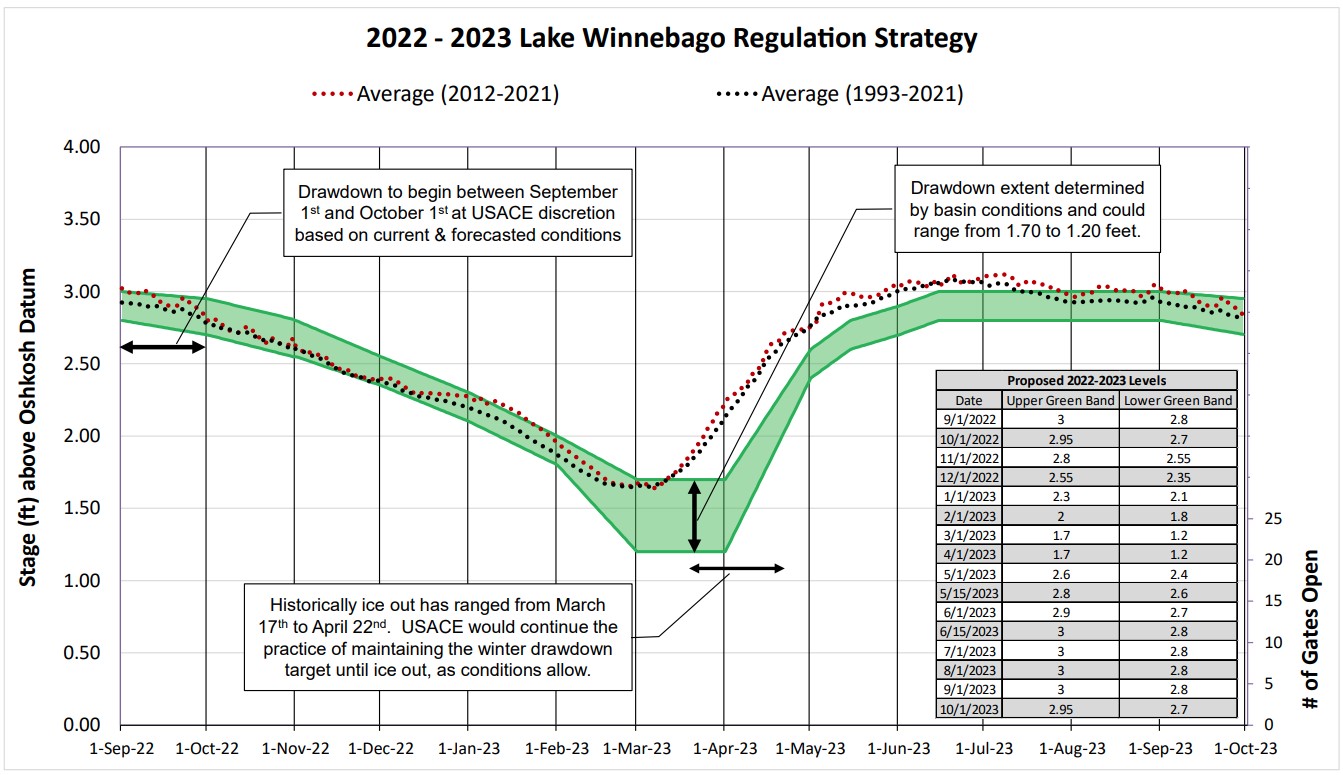
Their annual regulation strategy represents that balance and can be broken down by certain times of the year: fall drawdown, winter pool, spring refill, and summer pool. Water level targets are set along this strategy in a schedule. These targets are listed in the Army Corps 2022 – 2023 Lake Winnebago Regulation Strategy (shown in the image below). The green band in the annual strategy represents the “target band”. The Army Corps tries to hold water levels within this band. The dotted lines represents the average lake level across all years as noted in the key.

Average Water Level for Lake Winnebago

Lake level for Lake Winnebago is an average of readings from four gages located around the lake and is in reference to the Oshkosh Datum.

Fall Drawdown: As of the 2021/2022 regulation strategy, fall drawdown has been scheduled to begin between Sept 1 and Oct 1 each year at the discretion of the Army Corps through an adaptive decision making process.

Winter Pool: Each February, the Army Corps evaluates basin conditions and the forecast to determine their winter drawdown target.

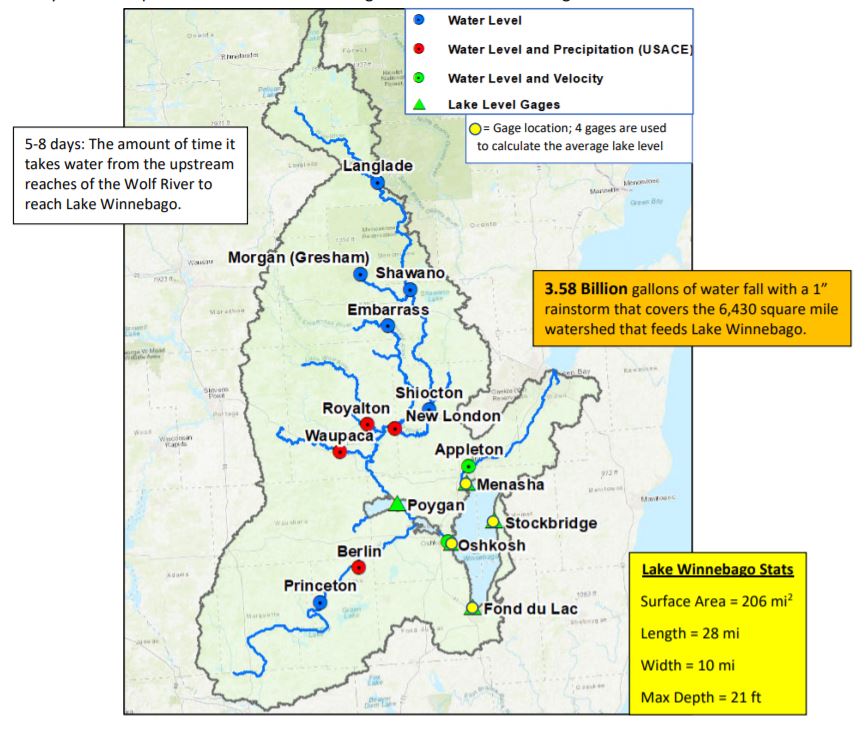
The Army Corps draws down Lake Winnebago every winter to reduce the risk of damage caused by ice shoves, protect shoreline properties, and provide enough space within the lake to hold excess water that flows into Lake Winnebago each spring (snow melt and rain storm runoff from a 5,900 square mile watershed). The 2023 winter drawdown target operating band for Lake Winnebago this year was 1.25 ft to 1.3 ft.

Spring refill: When the Army Corps determines ice out has occurred on Lake Winnebago based on satellite imagery, spring refill is triggered. For many boaters, people interested in habitat protection, and stakeholders working to restore the lakes, refill is of particular interest. According to the most recent annual strategy, refill targets are as follows:

  • May 1st – 2.5 ft (Operating band: 2.4 to 3.6 ft)
  • June 1st – 2.8 ft (Operating band: 2.7 to 3.9 ft)
  • June 15th – 2.9 ft (Operating band: 2.8 to 3.0 ft)

Summer Pool: The Army Corps tries to maintain the lake within a target band for summer recreation navigation.

The total seasonal water elevation change is typically about 1.8 ft in a given year.

Recent conditions:

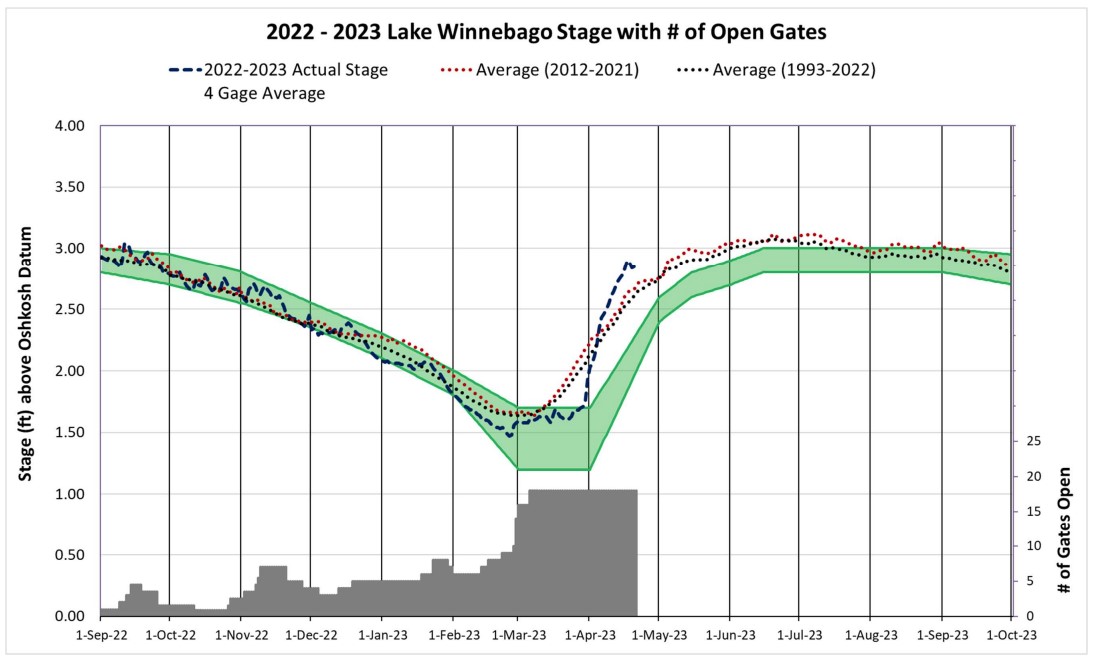
Despite having all available gates open at the dams since March 6, 2023, the average level of Lake Winnebago has been well above the target band since the beginning of April. This is likely due to the lake not being drawn down far enough or early enough to accommodate spring runoff from snow melt and precipitation. When inflows to Lake Winnebago exceed outflow capacity of the gates, the lake begins to rise uncontrolled. Overshooting the target band increases risk of flooding, significantly damages habitat and limits water quality restoration gains (among other impacts).

A graph from April 21, 2023 shows the recent average lake level (dashed line). Hopefully, precipitation will ease up and the Army Corps will be able to regain control before too much damage is done to the wetlands and aquatic habitat.

Additional Water Level Related Information:

1.) Water Level Management for the Winnebago Waterways: This report describes water level management including the process of developing an annual strategy, the considerations for the strategy, and the reason the strategy (schedule) is in its current form. CLICK HERE for the report.

This report is part of a larger planning effort for the Winnebago Lakes. The rest of the lake plan can be found here: https://fwwa.org/lake-management-planning-2/

2.) Winnebago Water Level Assessment Team (WWLAT): This is a stakeholder group that holds discussions about water levels independent of the Army Corps public input process. The website for the Team provides information about the background, past recommendations, and more. Interested stakeholders are welcome to participate. Link: https://fwwa.org/winnebago-waterways/wwlat/

3.) The Army Corps provides access to a lot of data and information through their Lake Winnebago webpage: CLICK HERE

Winnebago Waterways is a Fox-Wolf Watershed Alliance recovery initiative. Contact us at wwinfo@fwwa.org

The post Ice-Out officially called for Lake Winnebago – April 6, 2023 appeared first on Fox-Wolf Watershed Alliance.

Original Article

Fox-Wolf Watershed Alliance

Fox-Wolf Watershed Alliance

https://fwwa.org/2023/04/27/ice-out-officially-called-for-lake-winnebago-april-6-2023/?utm_source=rss&utm_medium=rss&utm_campaign=ice-out-officially-called-for-lake-winnebago-april-6-2023

Korin Doering

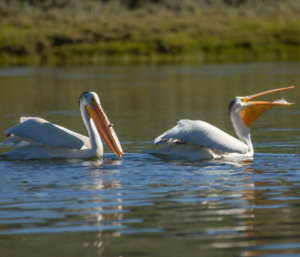
The American White Pelican (Pelecanus erythrorhynchos) used to be a rare sight in Wisconsin, now these birds, with wingspans up to 9 feet, are frequently spotted in large numbers in the Winnebago System! The American White Pelican has an orange, long, pouched bill (beak) that can grow a protrusions during the breeding season. The tips of their bills have a small hook at the tip. Their necks are long, and their bodies are usually snowy white with black flight feathers. Their legs and feet are orange though younger birds’ can appear more gray-pink and darken with age, and their feet are webbed. Adult pelicans can weigh about 16 pounds, making them one of the heaviest flying bird species.

American White Pelicans are piscivorous, meaning they primarily eat fish. The American White Pelican forages for food mostly in shallow waters in open areas of marshes, lakes, rivers, and ponds but can forage in deeper water. American White Pelicans do not submerge or dive for food. Instead, they dip their bill into the water and scoop up prey into their pouch, then tip their bill above their head to swallow. A typical pelican can reach down to about 3 feet below the surface of the water, and can eat about 3 pounds of fish a day! In Wisconsin, pelicans have been recorded eating common carp, as well as other fish species. They can also eat amphibians like frogs and invertebrates like crayfish. Pelicans sometimes work together to forage for food. A group of pelicans can corral fish into shallow areas or to the center of a U formation or circle to more easily catch prey.

Adult American White Pelicans on Water (National Park Service)

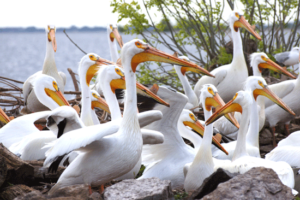
Pelicans at a nesting colony (Winnebago Waterways User Submitted Photo)

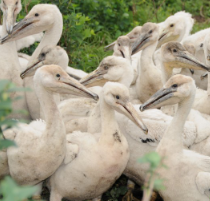
Young Pelicans (USDA)

Pelicans start to breed when they reach about 3-6 years old and travel to their breeding colonies in March – May. These colonies are typically on islands. Nests are built on the ground in colonies with other pelicans, as well as other bird species like cormorants and gulls. Usually pelicans lay 2 eggs. The eggs and hatched young are vulnerable to predators like eagles, foxes, and raccoons. Studies show that pelicans can live up to 30 years.

Historically, American White Pelicans were found in Wisconsin but their population sharply declined in the late 1800s – 1900s due to hunting and habitat loss. In the last 20-25 years, their populations have grown tremendously in Wisconsin, prompted likely by loss of breeding grounds in the West but also due to habitat restoration projects and pollution cleanup. In the lower Green Bay area, the number of white pelicans grew from about 250 in 2005 to more than 3,000 in 2021. Protecting their habitat and water quality is important to their continued success in the Winnebago System.

Winnebago Waterways is a Fox-Wolf Watershed Alliance recovery initiative. Contact us at wwinfo@fwwa.org

The post Species Spotlight: American White Pelican appeared first on Fox-Wolf Watershed Alliance.

Original Article

Fox-Wolf Watershed Alliance

Fox-Wolf Watershed Alliance

https://fwwa.org/2023/04/26/species-spotlight-american-white-pelican/?utm_source=rss&utm_medium=rss&utm_campaign=species-spotlight-american-white-pelican

Katie Reed

Forest to MI Faucet: Using trees to keep water sources pristine

By Lester Graham, Michigan Radio

The Great Lakes News Collaborative includes Bridge Michigan; Circle of Blue; Great Lakes Now at Detroit Public Television; and Michigan Radio, Michigan’s NPR News Leader; who work together to bring audiences news and information about the impact of climate change, pollution, and aging infrastructure on the Great Lakes and drinking water.

Read Now at Great Lakes Now.

Original Article

Great Lakes Now

Great Lakes Now

https://www.greatlakesnow.org/2023/04/forest-to-mi-faucet-using-trees-to-keep-water-sources-pristine/

Michigan Radio

Lifetime Business Member of Fox-Wolf Watershed Alliance.

A huge thank you to Rob and his team at Motto Inc. (pictured above), a locally owned and operated business, for their continued support of Fox-Wolf Watershed Alliance’s water quality initiatives in the Winnebago Waterways Recovery Area. Last year, Motto Inc. donated $18,262 to Fox-Wolf Watershed Alliance. This year they beat their own record by donating $25,000! Their donation will have an even bigger impact because a percentage was matched by the Greater Green Bay Community Foundation’s Give Big Green Bay program.

In addition to their generous donation, Motto Inc. has volunteered with Fox-Wolf Watershed Alliance. Last winter, the Motto Inc. team volunteered to sow native plants and take care of them over the winter. These plants will be used in our shoreline restoration projects!

Motto Inc. is also a business member of 1% for the Planet, which connects businesses and individuals who pledge to give 1% of their sales back to the planet each year with approved environmental nonprofits around the world. This partnership will help Fox-Wolf Watershed Alliance connect with more businesses who share the same values of promoting water quality and environmental stewardship.

Motto Inc. lives up to their commitment through quality branded products and their ongoing support of various causes that improve the community and environment. We invite you to learn more about this local business by visiting their website: www.mottoinc.com

Thank you to Rob and his Motto Inc. team for their continued support!

The Winnebago Waterways Program facilitates regional coordination and implementation of recovery efforts for the Winnebago Lakes and surrounding watersheds. Priority implementation projects are outlined in the Winnebago Waterways Lake Management Plan. Winnebago Waterways is a program of the Fox-Wolf Watershed Alliance. The Fox-Wolf Watershed Alliance is an independent non-profit organization that works to protect and restore the water resources of the Fox-Wolf River Basin. We are focused on finding cost effective, science-based solutions. To meet our goals, we work with partners to maximize efficiencies, bringing resources to those who are already doing great work while utilizing our strengths to fill gaps when needed.

About 1% for the Planet

1% for the Planet is a global organization that connects dollars and doers to accelerate smart environmental giving. Through business and individual memberships, 1% for the Planet inspires people to support environmental organizations through annual membership and everyday actions. The organization advises on giving strategies, certifies donations and amplifies the impact of the network.

Started in 2002 by Yvon Chouinard, founder of Patagonia, and Craig Mathews, founder of Blue Ribbon Flies, their members have given more than $250 million to environmental nonprofits to date. Today, 1% for the Planet is a network of more than 3,000 business members, an expanding core of individual members and thousands of nonprofit partners in more than 90 countries.

If you are interested in learning more about 1% for the Plant and how to become a business partner, please contact Korin at korin@fwwa.org.

Questions? Comments? Send us an email at wwinfo@fwwa.org.

Follow the Fox Wolf Watershed Alliance on social media: Winnebago Waterways on Facebook and @WinnWaterways on Twitter!

Winnebago Waterways is a Fox-Wolf Watershed Alliance program. The Fox-Wolf Watershed Alliance is an independent nonprofit organization that identifies and advocates effective policies and actions that protect, restore, and sustain water resources in the Fox-Wolf River Basin.

The post Local Business Continues Support of Water Quality Initiatives appeared first on Fox-Wolf Watershed Alliance.

Original Article

Fox-Wolf Watershed Alliance

Fox-Wolf Watershed Alliance

https://fwwa.org/2023/04/26/local-business-continues-support-of-water-quality-initiatives/?utm_source=rss&utm_medium=rss&utm_campaign=local-business-continues-support-of-water-quality-initiatives

Katie Reed

Information from the Butte des Morts Conservation Club – original post here: Butte des Morts Conservation Club Facebook

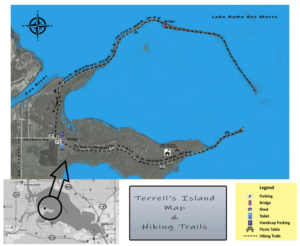
Terrells Island Trails will be open to the public starting Monday, May 8th, 2023. Trails are open from sunrise until one hour before sunset, unless otherwise posted.
Please Note: Trail is no longer a loop. There is a turn around.
*Frank & Alice Kachur Trail is 2.1 miles one way
*Schoolhouse Trail is 1.5 miles one way
  • Please throw away all trash in receptacle at trail entrances
  • Pets should be leashed and remove/clean up all animal waste
  • Anglers – no fishing from bridge-leave no trash behind
Enjoy!

Winnebago Waterways is a Fox-Wolf Watershed Alliance recovery initiative. Contact us at wwinfo@fwwa.org

The post Terrells Island Trails to Open on May 8, 2023 appeared first on Fox-Wolf Watershed Alliance.

Original Article

Fox-Wolf Watershed Alliance

Fox-Wolf Watershed Alliance

https://fwwa.org/2023/04/25/terrells-island-trails-2023/?utm_source=rss&utm_medium=rss&utm_campaign=terrells-island-trails-2023

Katie Reed

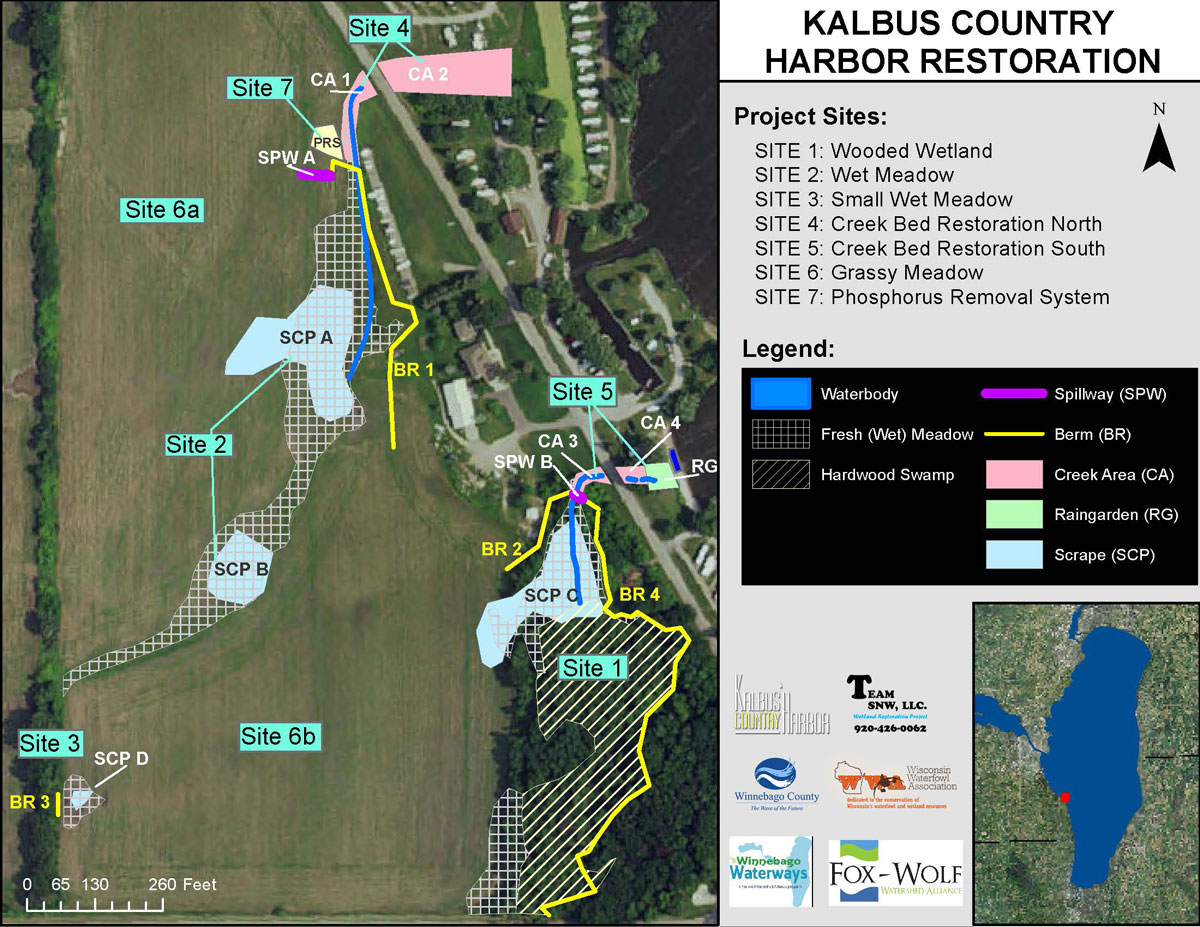
We are looking for 10-15 volunteers to help plant 2,720 plant plugs for a wetland restoration on the west side of Lake Winnebago.

Volunteers are needed May 5th, 6th, and possibly 7th at Kalbus Country Harbor in Oshkosh. Each day will start at 9:00 am. Volunteers are welcome to volunteer as much or as little as available.

To sign up, please contact John by May 1st at: 920-426-0062 (via text or call) or email kalbuscamping@gmail.com

We will have some tools available, but recommend bringing what you prefer to use with you, dress for the weather, and be prepared to get dirty. For those who sign-up, John will follow  up with additional details.

Read more about the Kalbus restoration project: CLICK HERE

Project site map

Project funding and partners:

Winnebago Waterways is a Fox-Wolf Watershed Alliance recovery initiative. Contact us at wwinfo@fwwa.org

The post Volunteers needed – Wetland Restoration Planting appeared first on Fox-Wolf Watershed Alliance.

Original Article

Fox-Wolf Watershed Alliance

Fox-Wolf Watershed Alliance

https://fwwa.org/2023/04/19/kalbus-wetland-project-volunteers/?utm_source=rss&utm_medium=rss&utm_campaign=kalbus-wetland-project-volunteers

Korin Doering

Library

Joint Action Plan for Clean Water Infrastructure and Services in the Great Lakes Region: Project Archive

This project has ended. Archived project materials are available below. 

The Great Lakes Commission’s Clean Water Infrastructure and Services Working Group developed a Joint Action Plan for Clean Water Infrastructure and Services in the region that outlines actions to address a backlog in needed upgrades and repairs to water-related infrastructure in the eight Great Lakes states and two provinces over the next 20 years — everything from wastewater treatment plants to stormwater pipes and drinking-water filtration systems. This backlog is conservatively estimated to cost $271 billion, and many experts believe that figure is a significant underestimate. The plan also calls for a better understanding the state of regional water infrastructure and the true needs to achieve a 21st century system.

The Action plan was endorsed by the full Commission at its 2017 Annual Meeting.

• Joint Action Plan

• Appendices

GLC Resolution 

For More Information

Nicole Zacharda
Program Manager, Great Lakes Commission
734-971-9135
nzacharda@glc.org

Original Article

Great Lakes Commission

Great Lakes Commission

https://www.glc.org/work/water-infrastructure-action-plan

Laura Andrews

Library

ErieStat: Project Archive

This project has ended. Archived project materials are available below. For information about ongoing work in this area, please visit the Blue Accounting website: www.blueaccounting.org/issue/eriestat/

Excess phosphorus entering Lake Erie contributes to the formation of harmful algal blooms and dead zones, which can be dangerous for fish, wildlife and people. Under the Great Lakes Water Quality Agreement, the U.S. and Canada agreed to work together to reduce to amount of phosphorus entering the western and central basins of Lake Erie by 40 percent (from 2008 levels).  ErieStat is part of the Great Lakes Commission’s groundbreaking Blue Accounting program and brings together water quality experts to discuss and agree on methods to measure progress toward the 40% reduction goal.

The nutrient annex of the Great Lakes Water Quality Agreement (Annex 4) set the goal of a 40% reduction in the amount of total and dissolved reactive phosphorus entering the western and central basins of Lake Erie. ErieStat is a web-based platform, developed by a binational workgroup of water quality professionals and designed to track progress toward the binational phosphorus reduction goals. ErieStat also shares the strategies and investments intended to achieve the shared goal of phosphorus reduction in western and central Lake Erie.

Learn More about ErieStat

Tracking progress toward a healthier Lake Erie

Lake Erie has a significant social and economic impact on the surrounding region. Currently, harmful algal blooms (HABs) and seasonal hypoxia, which are thought to be the result of excessive phosphorus (P) loading, threaten the water quality and biodiversity of the lake. Recognizing the substantial threat HABs and hypoxia present to the surrounding region, governors and premieres agreed to reduce P loading by 40% (from 2008 loads) by 2025 in the 2015 Collaborative agreement. In the same year, the Great Lakes Commission’s own Lake Erie Nutrient Targets report established similar goals and a set of 10 steps to achieve the targets. Both of those efforts gained further support when the governments of Canada and the United States formally adopted a 40% reduction goal in February 2016 through Annex 4 of the 2012 Great Lakes Water Quality Agreement between the two nations.

ErieStat is a web-based platform for tracking progress toward the goal of a 40% reduction in phosphorus loads to the western and central basins of Lake Erie. ErieStat provides valuable services to the states of Indiana, Michigan, Ohio, Pennsylvania, and New York and the province of Ontario as these governments work to implement policies and programs to achieve the binational phosphorus reduction goal.

Reducing P loading is expected to substantially decrease the intensity and frequency of HABs while also reducing the areal extent of the hypoxic zone within the central basin, therefore improving water quality for surrounding communities that depend on Lake Erie for safe drinking water and the Lake’s ecosystem as a whole.

ErieStat was led by a team from the Great Lakes Commission. Guidance for ErieStat came from our Steering Committee and Content Advisory Group, which include members from state, provincial, and federal government; academic research institutions; nonprofit organizations; and other experts in the region.

Reducing Phosphorus into Lake Erie

Excess phosphorus entering Lake Erie contributes to the formation of harmful algal blooms and dead zones, and can be dangerous for fish, wildlife and people.

In June 2015, the Governors of Michigan and Ohio and Premier of Ontario signed a Collaborative Agreement to work together toward a 40% reduction in the amount of total and dissolved reactive phosphorus entering Lake Erie’s Western Basin by the year 2025, with an interim goal of a 20% reduction by 2020. In the same year, the Great Lakes Commission’s own Lake Erie Nutrient Targets report established similar goals and a set of 10 steps to achieve the targets. Both of those efforts gained further support when the governments of Canada and the United States formally adopted a 40% reduction goal for phosphorus in the western and central basins in February 2016 through Annex 4 of the 2012 Great Lakes Water Quality Agreement between the two nations. The Commission is working closely with Annex 4 in developing ErieStat.

Project Documents (password protected)

Project Documents (password protected)

These documents are archived for project team members only and are not available for public download.


For More Information

Nicole Zacharda
Program Manager, Great Lakes Commission
734-971-9135
nzacharda@glc.org

Original Article

Great Lakes Commission

Great Lakes Commission

https://www.glc.org/work/eriestat

Laura Andrews

For Ann Arbor water managers, ongoing battle to keep toxic chemicals at bay

By Kelly House, Bridge Michigan

This story is part of a Great Lakes News Collaborative series investigating the region’s water pollution challenges. Called Refresh, the series explores the Clean Water Act’s shortcomings in the Great Lakes, and how the region can more completely address water pollution in the next 50 years.

Read Now at Great Lakes Now.

Original Article

Great Lakes Now

Great Lakes Now

https://www.greatlakesnow.org/2023/02/for-ann-arbor-water-managers-ongoing-battle-to-keep-toxic-chemicals-at-bay/
Bridge Michigan

Until now, such a two-year water quality environmental technology degree was nonexistent.

The post New Northwestern Michigan College two-year degree readies students for water technology jobs first appeared on Great Lakes Echo.

Original Article

Great Lakes Echo

Great Lakes Echo

http://greatlakesecho.org/2023/01/13/new-northwestern-michigan-college-two-year-degree-readies-students-for-water-technology-jobs/

Guest Contributor

A Michigan State University study estimates that up to $5.9 million annually in economic activity is lost in Michigan’s small portion of Lake Erie due to harmful algal blooms.

The post Lake Erie algae mucks up fishing trips first appeared on Great Lakes Echo.

Original Article

Great Lakes Echo

Great Lakes Echo

http://greatlakesecho.org/2022/12/15/lake-erie-algae-mucks-up-fishing-trips/

Guest Contributor

Opposition to CAFOs Mounts Across the Nation

By Keith Schneider, Circle of Blue

The Great Lakes News Collaborative includes Bridge Michigan; Circle of Blue; Great Lakes Now at Detroit Public Television; and Michigan Radio, Michigan’s NPR News Leader; who work together to bring audiences news and information about the impact of climate change, pollution, and aging infrastructure on the Great Lakes and drinking water.

Read Now at Great Lakes Now.

Original Article

Great Lakes Now

Great Lakes Now

https://www.greatlakesnow.org/2022/12/opposition-to-cafos-mounts-across-nation/

Circle of Blue

The Ohio Department of Natural Resources (DNR) and Environmental Protection Agency have demonstrated a new technology designed to reduce harmful algal blooms as part of a wide range of efforts on both sides of the Canada-U.S. border to address the threat of Eutrophication on the Great Lakes and other inland bodies of water.

The post New technology provides hope for the Great Lakes’ polluted waters first appeared on Great Lakes Echo.

Original Article

Great Lakes Echo

Great Lakes Echo

http://greatlakesecho.org/2022/10/12/new-technology-provides-hope-for-the-great-lakes-polluted-waters/

Guest Contributor

In A Year of Water Quality Reckoning, National Imperative is Impeded

By Keith Schneider, Circle of Blue

The Great Lakes News Collaborative includes Bridge Michigan; Circle of Blue; Great Lakes Now at Detroit Public Television; and Michigan Radio, Michigan’s NPR News Leader; who work together to bring audiences news and information about the impact of climate change, pollution, and aging infrastructure on the Great Lakes and drinking water.

Read Now at Great Lakes Now.

Original Article

Great Lakes Now

Great Lakes Now

https://www.greatlakesnow.org/2022/09/year-of-water-quality-reckoning-national-imperative-impeded/

Circle of Blue

The Lake Michigan and Lake Huron waters governed by an 1836 treaty are at the heart of negotiations between Michigan, the federal government and Native American tribes to determine how much and what kinds of fish can be harvested by recreational, state-licensed and Native American commercial fishers. Much has changed since the treaty was signed, notably because of invasive mussels. But change created by human activity was underway even before the signatories to the Washington Treaty ink dried in Washington D.C. in March 1836. 

The post Water test: human impact on Great Lakes waters predates quagga mussel invasion first appeared on Great Lakes Echo.

Original Article

Great Lakes Echo

Great Lakes Echo

http://greatlakesecho.org/2022/06/24/water-test-human-impact-on-great-lakes-waters-predates-quagga-mussel-invasion/

Guest Contributor

Michigan watersheds are still wracked with pollution from decades ago, along with new runoff. Gov. Gretchen Whitmer’s MI Healthy Climate Plan would make preserving land and water a statewide priority. 

The post Watershed groups fight decades-old pollution first appeared on Great Lakes Echo.

Original Article

Great Lakes Echo

Great Lakes Echo

http://greatlakesecho.org/2022/06/06/watershed-groups-fight-decades-old-pollution/

Guest Contributor

While forests are known to enhance the water quality of nearby watersheds, oftentimes people don’t recognize forests' role in providing clean drinking water, according to a new study from Michigan State University. The research was conducted at three watersheds in Michigan: the heavily urbanized Detroit River Watershed, the less populated and heavily forested Au Sable River Watershed and the more populated agricultural, forested and urban Lower Grand River Watershed.

The post Study finds need for public to see connection between forests and clean drinking water first appeared on Great Lakes Echo.

Original Article

Great Lakes Echo

Great Lakes Echo

http://greatlakesecho.org/2022/05/26/study-finds-need-for-public-to-see-connection-between-forests-and-clean-drinking-water/

Guest Contributor

Feb. 15, 2022

By Jennifer A. Smith

Winter in Wisconsin is road salt season, as workers try to ensure our roadways are as safe and non-slippery as possible during bouts of snow and ice.

Yet, as public information campaigns like Wisconsin Salt Wise point out, the application of road salt comes with trade-offs. Salt, or sodium chloride, can harm freshwater ecosystems. According to Salt Wise, “It only takes one teaspoon of salt to pollute five gallons of water to a level that is toxic to native aquatic organisms.” It can also impact drinking water.

And, as research currently underway at the University of Wisconsin-Milwaukee (UWM) is uncovering, increased levels of chloride from road salt can persist in surface waters even in the summer—when no salt is being applied—because it appears to be stored in groundwater.

Dr. Charles Paradis

The study, “Mass Discharge of Road Salt via Groundwater to Surface Waters in Southeastern Wisconsin,” is investigating two sites in Racine County along the Root River: one urban, the other rural. Led by Assistant Professor Charles Paradis, this work is being funded by the University of Wisconsin Water Resources Institute in its 2021-23 cycle.

Working with Paradis are graduate student Leah Dechant and, through UWM’s Support for Undergraduate Research Fellows (SURF) program, several undergraduate students.

Ultimately, the work that Paradis and his student team are doing can help policy makers make the best possible decisions when it comes to road salting practices. Said Paradis, “Clearly, road salt is good for public safety, but it may not be so good for environmental health, so where’s that balance? If we give this information to those who set that policy and practice road salt application, maybe they can do so in way that is best suited to balance public safety and environmental health.”

Paradis first became interested in the issue after a 2019 talk given by Cheryl Nenn of Milwaukee Riverkeeper about her annual Milwaukee river basin quality report. Nenn also pointed Paradis to a report put out by the Southeastern Wisconsin Regional Planning Commission (SEWRPC). Laura Herrick, a SEWRPC environmental engineer, had written about road salt in river water and noted elevated chloride concentrations in the Root River during the summertime.

As Paradis recalled, “They proposed the hypothesis that road salt is being stored in the groundwater that is connected to the river, and the groundwater serves as a continuous, long-term source for chloride to enter the river.”

One of two study sites along the Root River, pictured in the summertime. (Submitted photo)

What the SEWRPC observation needed was better testing, and Paradis was eager to dig further. He needed high-frequency samples of chloride and flow measurements at multiple locations along the Root River in the summer. That’s where graduate student Dechant and the undergraduates have been a major asset.

Field sampling began in July 2021. From July to September, surface water samples were collected three days per week. Moving into the fall, sampling shifted into a biweekly mode using the same locations and procedures.

Half of the samples undergo high-level isotopic and chemical analysis by Timothy Wahl, an associate investigator on the project, at the UWM School of Freshwater Sciences. The other half of the samples are subject to benchtop pH and alkalinity low-level testing in the Paradis lab.

UW-Milwaukee undergraduate Dylan Childs prepares water samples for analysis in the lab. (Submitted photo)

For Dylan Childs, one of the undergraduates who has worked on the project, the process has been rewarding. “’I’ve really come to enjoy the scientific method and research in general,” he said. “This was probably the first research project where I got to go out in the field, and it was a lot of fun having that hands-on experience, as well as going in to the lab, too. I felt so much more involved.”

Added Childs, a senior geology major from Stoughton, “Having this additional research experience as an undergrad has definitely helped me home in on what I want to do with my future.” Undergraduates Autumn Routson and Samuel Sellars have also contributed to the project.

In addition to people power, the research is aided by technology. United States Geological Survey (USGS) gauging stations are located at the study sites. These stations beam publicly accessible data, including flow data, to the internet. Continuous monitoring devices on loan from SEWRPC have also helped; these record temperature, conductivity—a proxy for chloride—and depth round the clock.

In the field, UW-Milwaukee graduate student Leah Dechant works with water samples collected from the Root River. (Submitted photo)

Through data collected from the USGS gauging stations, the loaned monitoring devices and water samples collected in the field, the team is capturing a much richer picture of what’s actually happening in the Root River. Paradis has noted that chloride concentrations in the river water have remained relatively constant—even when flow has increased and one might expect to see dilution as a result. This lends credence to the hypothesis that chloride is being stored in groundwater, providing a continuous source.

While almost a year and half of the project period still remains, Dechant will present the team’s findings so far in a poster session at this year’s conference for the Wisconsin Section of the American Water Resources Association (AWRA), which will take place March 10-11.

The post UW-Milwaukee researchers examine road salt’s year-round impact on Wisconsin rivers first appeared on WRI.

Original Article

News Release | WRI

News Release | WRI

https://www.wri.wisc.edu/news/uw-milwaukee-researchers-examine-road-salts-year-round-impact-on-wisconsin-rivers/

Jennifer Smith

Drinking Water News Roundup: Toxic algae blooms in Indiana, First Nations $8B settlement, Wisconsin lead pipe replacement funding

From lead pipes to PFAS, drinking water contamination is a major issue plaguing cities and towns all around the Great Lakes. Cleaning up contaminants and providing safe water to everyone is an ongoing public health struggle. 

Keep up with drinking water-related developments in the Great Lakes area. 

Click on the headline to read the full-story:

Indiana: 

  • More blue-green algae could drive up drinking water bills in Indiana’s larger cities —WFYI Indianapolis 

The increasingly warm air and heavy rain showers have caused a rise in toxic algae blooms, which has led to fish sickness, beach closures, and drinking water pollution.

Read Now at Great Lakes Now.

Original Article

Great Lakes Now

Great Lakes Now

https://www.greatlakesnow.org/2022/01/drinking-water-news-roundup-toxic-algae-blooms/

Maya Sundaresan

Library

Issue Brief: Mercury Contamination in the Great Lakes Basin

This summary proceedings provides a detailed report on the presentations and discussions that occurred during a 2021 symposium and workshop on exploring science-based strategies for environmental dredging windows in Lake Michigan. The document also includes a discussion of common themes, findings and next steps to inform future work in the area of environmental dredging windows.

Published October 2021  | Download PDF

Original Article

Great Lakes Commission

Great Lakes Commission

https://www.glc.org/library/2021-glc-issue-brief-mercury

Laura Andrews

Great Lakes Moment: Endangered catfish indicates improving health of the Detroit and St. Clair rivers

Great Lakes Moment is a monthly column written by Great Lakes Now Contributor John Hartig. Publishing the author’s views and assertions does not represent endorsement by Great Lakes Now or Detroit Public Television.

A small catfish that is endangered in both Michigan and Ontario is making a comeback thanks to improved water quality and artificial reef construction in the Detroit and St.

Read Now at Great Lakes Now.

Original Article

Great Lakes Now

Great Lakes Now

https://www.greatlakesnow.org/2021/11/endangered-catfish-health-detroit-rivers/

John Hartig

The NOAA Great Lakes Environmental Research Laboratory (GLERL) and Michigan Technological University (MTU) Great Lakes Research Center recently teamed up on the deployment of a wave glider in Lake Superior. The chemical and biological data collected will help researchers understand … Continue reading

Original Article

NOAA Great Lakes Environmental Research Laboratory

NOAA Great Lakes Environmental Research Laboratory

https://noaaglerl.blog/2021/10/12/noaa-wave-glider-gathers-key-data-during-25-day-cruise-in-lake-superior/

Margaret Lansing

Great Lakes Moment: Lessons from the Ashtabula River cleanup

Great Lakes Moment is a monthly column written by Great Lakes Now Contributor John Hartig. Publishing the author’s views and assertions does not represent endorsement by Great Lakes Now or Detroit Public Television.

When the Ashtabula River and Harbor was identified as a Great Lakes pollution hotspot, or Area of Concern, in 1985, few people thought the day would ever come when it was cleaned up and no longer a detriment to the community and Lake Erie.

Read Now at Great Lakes Now.

Original Article

Great Lakes Now

Great Lakes Now

https://www.greatlakesnow.org/2021/10/great-lakes-moment-lessons-ashtabula-cleanup/

John Hartig

Library

Exploring science-based strategies for environmental dredging windows in Lake Michigan

This summary proceedings provides a detailed report on the presentations and discussions that occurred during a 2021 symposium and workshop on exploring science-based strategies for environmental dredging windows in Lake Michigan. The document also includes a discussion of common themes, findings and next steps to inform future work in the area of environmental dredging windows.

Published October 2021  | Download PDF

Original Article

Great Lakes Commission

Great Lakes Commission

https://www.glc.org/library/2021-env-dredging-windows

Laura Andrews

Soil Erosion, Sedimentation and Water Quality in the Great Lakes Region: A report to the USDA – Soil Conservation Service

Soil Erosion, Sedimentation and Water Quality in the Great Lakes Region: A report to the USDA – Soil Conservation Service.

Published August 1988  |  Download PDF

Original Article

Great Lakes Commission

Great Lakes Commission

https://www.glc.org/library/1988-soil-erosion-sedimentation-water-quality-in-the-great-lakes-region

Laura Andrews

Four years ago, NOAA’s Great Lakes Environmental Research Laboratory (GLERL) and the Cooperative Institute for Great Lakes Research (CIGLR) began providing an Experimental Lake Erie Hypoxia Forecast Model to warn stakeholders of low-oxygen upwelling events that can cause water quality … Continue reading

Original Article

NOAA Great Lakes Environmental Research Laboratory

NOAA Great Lakes Environmental Research Laboratory

https://noaaglerl.blog/2021/09/14/from-safe-drinking-water-to-sustainable-fisheries-noaa-glerls-experimental-lake-erie-hypoxia-forecast-is-even-more-useful-than-anticipated/

Gabrielle Farina

Sensors provide a real-time glimpse at Chicago River quality

CHICAGO (AP) — Rowers, kayakers and other users of the Chicago River are getting a real-time look at one measure of water quality in the system that weaves through downtown and several neighborhoods.

Chicago nonprofit Current in 2019 installed three sensors in the river’s three main branches to continuously estimate the amount of bacteria from human and other warm-blooded animals’ waste.

Read Now at Great Lakes Now.

Original Article

Great Lakes Now

Great Lakes Now

https://www.greatlakesnow.org/2021/09/ap-sensors-chicago-river-quality/

The Associated Press

Great Lakes in Peril: Invasives, pollution, climate change

By Lester Graham, Michigan Radio

The Great Lakes News Collaborative includes Bridge Michigan; Circle of Blue; Great Lakes Now at Detroit Public Television; and Michigan Radio, Michigan’s NPR News Leader; who work together to bring audiences news and information about the impact of climate change, pollution, and aging infrastructure on the Great Lakes and drinking water.

Read Now at Great Lakes Now.

Original Article

Great Lakes Now

Great Lakes Now

https://www.greatlakesnow.org/2021/08/great-lakes-peril-invasives-pollution-climate-change/

Michigan Radio

Illinois sues owner of plant where fire prompted evacuations

CHICAGO (AP) — Illinois prosecutors on Friday sued the owner of a chemical plant where a fire last month sent dark smoke and ash into the air for days and prompted evacuations, saying the company should be held accountable for air and water pollution and hazards that still exist.

Read Now at Great Lakes Now.

Original Article

Great Lakes Now

Great Lakes Now

https://www.greatlakesnow.org/2021/07/ap-illinois-sues-owner-plant-fire-evacuations/

The Associated Press

Court: DNR can impose farm conditions, consider well impact

MADISON, Wis. (AP) — Wisconsin regulators can impose operating conditions on factory farms and consider high-capacity wells’ cumulative environmental impacts when deciding whether to grant permits, the state Supreme Court ruled Thursday.

The decisions mark a major win for conservationists and clarify that the Department of Natural Resources has broad authority to protect Wisconsin’s waters.

Read Now at Great Lakes Now.

Original Article

Great Lakes Now

Great Lakes Now

https://www.greatlakesnow.org/2021/07/ap-dnr-farm-conditions-well-impact/

The Associated Press

Dealing with the soup of chemicals that can get into your drinking water

By Lester Graham, Michigan Radio

The Great Lakes News Collaborative includes Bridge Michigan; Circle of Blue; Great Lakes Now at Detroit Public Television; and Michigan Radio, Michigan’s NPR News Leader; who work together to bring audiences news and information about the impact of climate change, pollution, and aging infrastructure on the Great Lakes and drinking water.

Read Now at Great Lakes Now.

Original Article

Great Lakes Now

Great Lakes Now

https://www.greatlakesnow.org/2021/07/soup-chemicals-drinking-water/

Michigan Radio

Public Resource: Around the Great Lakes, everyday people help make science possible

Collecting data for scientific research across large geographic areas can be challenging, but researchers have found an easy solution – the public.

The Huron River watershed covers 900 square miles, and the Huron River Watershed Council has been collecting data from the watershed for years. Yet collection from such an expansive area would not have been possible without the help of an army of dedicated citizen, or community, scientists.

Read Now at Great Lakes Now.

Original Article

Great Lakes Now

Great Lakes Now

https://www.greatlakesnow.org/2021/06/great-lakes-everyday-people-science-public/

Noah Bock

Owner of closed power plant to remove toxic waste near river

SPRINGFIELD, Ill. (AP) — The owner of an abandoned power plant has agreed to clean up toxic waste dumped into the flood plain of the Vermilion River, boosting efforts to protest Illinois’ lone national scenic river.

Under a deal brokered by the Illinois attorney general’s office, Texas-based Vistra on Monday agreed to drain pits of water-soaked coal ash along the Middle Fork Vermilion River, about 120 miles (193.12 kilometers)south of Chicago.

Read Now at Great Lakes Now.

Original Article

Great Lakes Now

Great Lakes Now

https://www.greatlakesnow.org/2021/06/ap-closed-power-plant-toxic-waste-illinois-river/

The Associated Press

Tests show PFAS contamination in 500 French Island wells

LA CROSSE, Wis. (AP) — More than 500 wells on French Island have been contaminated with some level of PFAS chemicals, according to final results of state testing.

The La Crosse Tribune reported Friday that 538 wells on the island just west of La Crosse showed some level of the chemicals and 165 of them had levels above the state’s recommended 20 parts per trillion hazard standard.

Read Now at Great Lakes Now.

Original Article

Great Lakes Now

Great Lakes Now

https://www.greatlakesnow.org/2021/06/ap-tests-pfas-contamination-500-french-island-wells/

The Associated Press

Big Convener: Watershed councils provide critical support across municipal boundaries

For Rebecca Esselman, the mission is clear even if there isn’t a big spotlight on her work.

Her goal is to protect the Huron River and its environs, a diverse 900 square miles of land that includes farmland, urban centers, suburban sprawl and intact forest. The river itself runs for 125 miles before emptying into Lake Erie.

Read Now at Great Lakes Now.

Original Article

Great Lakes Now

Great Lakes Now

https://www.greatlakesnow.org/2021/06/michigan-watershed-council-support-municipal-boundaries/

Gary Wilson

PFAS News Roundup: Companies hid dangers from FDA, professor documents stories, study shows high levels in fertilizer

PFAS, short for per- and polyfluoroalkyl substances, are a group of widespread man-made chemicals that don’t break down in the environment or the human body and have been flagged as a major contaminant in sources of water across the country. 

Keep up with PFAS-related developments in the Great Lakes area. 

Read Now at Great Lakes Now.

Original Article

Great Lakes Now

Great Lakes Now

https://www.greatlakesnow.org/2021/06/pfas-news-professor-stories-study-high-levels-fertilizer/

Noah Bock

Hundreds of lakes in U.S., Europe are losing oxygen

Oxygen levels have dropped in hundreds of lakes in the United States and Europe over the last four decades, a new study found.

And the authors said declining oxygen could lead to increased fish kills, algal blooms and methane emissions.

Read Now at Great Lakes Now.

Original Article

Great Lakes Now

Great Lakes Now

https://www.greatlakesnow.org/2021/06/ap-hundreds-lakes-united-states-europe-losing-oxygen/

The Associated Press

A new Environmental Protection Agency mobile app will help communities track water quality at their beaches.

The post A new EPA app aims to help track water quality at beaches first appeared on Great Lakes Echo.

Original Article

Great Lakes Echo

Great Lakes Echo

http://greatlakesecho.org/2021/05/14/a-new-epa-app-aims-to-help-track-water-quality-at-beaches/

Guest Contributor

Controversial Indiana environmental bills inch near passage

INDIANAPOLIS (AP) — Lawmakers approved two environmental bills Tuesday that critics say could damage the state’s ecosystems by scaling back current policy affecting water, energy and other resources.

A measure seeking to remove protections from Indiana’s already diminished wetlands would eliminate a 2003 law that requires the Indiana Department of Environmental Management to issue permits in a state-regulated wetland and end enforcement proceedings against landowners allegedly violating current law.

Read Now at Great Lakes Now.

Original Article

Great Lakes Now

Great Lakes Now

https://www.greatlakesnow.org/2021/04/ap-controversial-indiana-environmental-bills-near-passage/

The Associated Press

Wisconsin Supreme Court weighs state power to protect water from farm pollutants

This article, first posted here, was republished with permission from Wisconsin Watch.

By Royce Podeszwa and Jim Malewitz, Wisconsin Watch

The state Supreme Court on Monday heard arguments in a case that could determine whether the Wisconsin Department of Natural Resources failed to adequately protect water from manure pollution when awarding a permit to a giant dairy farm in northeastern Wisconsin — or whether the agency lacks the authority to issue such restrictions.

Read Now at Great Lakes Now.

Original Article

Great Lakes Now

Great Lakes Now

https://www.greatlakesnow.org/2021/04/wisconsin-supreme-court-protect-water-farm-pollutants/

Wisconsin Watch

Local Governments, Organizations Ask Indiana Legislators to Consider Alternatives to Bill Repealing State Wetland Protections

By Enrique Saenz, Indiana Environmental Reporter

More than 60 organizations, including local governments, environmental and conservation groups and water management agencies, sent a letter to Indiana state legislators, asking them to consider policy changes instead of supporting a bill seeking to remove all state protections for Indiana wetlands.

Read Now at Great Lakes Now.

Original Article

Great Lakes Now

Great Lakes Now

https://www.greatlakesnow.org/2021/04/local-governments-environmental-organizations-indiana-legislators-state-wetland-protections/

Indiana Environmental Reporter

Salt Levels: The effects of wintertime de-icing linger in Toronto-area rivers in the summer

As spring comes to the Great Lakes region and icy roads and sidewalks become a distant memory, a new study shows the salt we apply over the winter can linger in summertime rivers at alarming levels.

The University of Toronto study measured chloride in four Greater Toronto Area rivers and found it was high enough in many locations to put at least two-thirds of aquatic life at risk during early stages of their development.

Read Now at Great Lakes Now.

Original Article

Great Lakes Now

Great Lakes Now

https://www.greatlakesnow.org/2021/03/salt-levels-wintertime-de-icing-toronto-rivers-summer/

Sharon Oosthoek

Fried, baked or mashed, we love our potatoes. What we don’t love is drinking water with lots of nitrate — a form of nitrogen that fuels a robust potato crop because it acts as a fertilizer. In the Central Sands area of the state, which is where most spuds are grown, drinking water is groundwater and groundwater can bear the brunt of unwelcome potato cultivation effects.

“When you look at impacts on the groundwater system from typical cropping systems in the Central Sands, they tend to leach nitrate,” said Kevin Masarik. “Potatoes are particularly challenging because the hill and furrow system tends to promote both (water) recharge, as well as nitrate leaching loss due to the high nitrogen demand of that particular crop.”

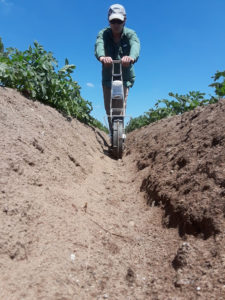
Although he’s not armed with regulatory suggestions — or even salt, butter and sour cream — Masarik is coming for those potatoes. The researcher from the University of Wisconsin-Stevens Point and University of Wisconsin-Madison Division of Extension is armed with a one-row hand planter, and rye, millet and oat seeds. He’s got in mind science-based solutions, not potato-growing restrictions or even gastronomical intentions.

University of Wisconsin-Stevens Point student Nick Koschak plants oat, rye and millet to build biomass in the furrows between potatoes. Photo: Kevin Masarik

With two years of funding from the University of Wisconsin Water Resources Institute, he’s pursuing what he termed an outside-the-box idea for assessing whether this tasty tuber can be cultivated in a way that reduces the movement of nitrite into the groundwater.

In children six months and younger, nitrate promotes the oxidation of hemoglobin to methemoglobin that limits blood’s ability to bind and transport oxygen, depriving the infant of oxygen. Nitrate has also been linked to cancer, thyroid disorders, birth defects and hypertension. Both state health and agricultural officials name nitrate as the most widespread groundwater contaminant in Wisconsin affecting both municipal and private water systems. Because groundwater also makes its way to surface waters, rivers, lakes, streams and wetlands can see higher nitrate levels with one result being increased algae growth, disrupting ecosystems.

Masarik said for the last 20 or 30 years, when the cause and extent of nitrate in groundwater has been documented, there’s been a simultaneous gap. “We’ve been good at pointing out that there’s a problem, but we haven’t been good at pointing out what the solution is.”

He continued, “In the last five years, I’ve been trying to switch the questions that I’m interested in devoting my time and attention to, investigating potential solutions that significantly improve water quality. And that’s what this project was born out of.”

“Investigating in-season cover crops for reducing nitrate loss to groundwater below potatoes” is an aptly descriptive title of what the project is doing: interseeding cover crops — the rye, millet and oats — among potato rows to see if these added plants will take up the excess nitrate and thereby improve water quality.

Critically, the project also needs to ensure that the potato harvest isn’t hindered nor yield significantly reduced by the additional vegetation between rows.

In a study plot, interseeding crops in potato cultivation rows did not interfere with harvest. Photo: Kevin Masarik

Masarik is grateful for the cooperation of Portage County farmer Justin Isherwood who in 2020 provided a test plot. “It’s (the study) giving me the book,” Isherwood said. “We know a lot of things in agriculture. There are a few things in agriculture we don’t know. Kevin is giving me those letters and the alphabet. He’s giving me the language of the landscape.”

Isherwood is game to again participate in the study this year. “It’s exciting to be a part of the science and to be involved in the discovery.”

Discoveries of last year will be applied. For example, rye is likely to be removed from the seed mix because it put early energy into root growth, resulting in slow above-ground growth. The rye was then shaded out by potato plants. Other plants, though, “Did have some success. I think it showed that the amount of biomass accumulation and the amount of nitrogen that the interplanting, or that cover crop, was able to capture is significant enough that this could be viable,” Masarik said, as enthusiasm bubbled. He said he is energized for the coming growing season. “I enjoy talking about it. I’m pretty excited about it.”

Masarik also wanted to talk about potato growers, who he termed as wanting to be proactive on the nitrate-loading challenge. “It’s all about establishing the plots and making sure that biomass we’re able to grow in that space is successful. If it’s successful, then what is the impact on the actual crop itself. If the impact isn’t too great, it might be a viable strategy. It might not be something that growers would naturally want to do. I think they are looking for solutions.”

 Kevin Masarik is a researcher with the University of Wisconsin-Stevens Point and University of Wisconsin-Madison Division of Extension. Photo: UW-Stevens Point

This project is also about building blocks. To gauge the effectiveness of this approach on water quality, it builds on Masarik’s earlier refinement of methods to track groundwater quality by drawing samples from temporary wells dug with a bucket auger to sample the top of the water table. This establishes a baseline, then he returns in 12 months, repeating the process to check what effect the interseeding might have on groundwater quality. The goal is determining a statistically significant difference that he pegged at minimum of 20% of change.

A second and future building block is if this effort, which Masarik called a proof of concept, is successful it can be used with other crops to reduce nitrate leaching in those fields.

The post Experimental cultivation method could mean healthy potato yield and healthier water first appeared on WRI.

Original Article

News Release – WRI

News Release – WRI

https://www.wri.wisc.edu/news/experimental-cultivation-method-could-mean-healthy-potato-yield-and-healthier-water/

Moira Harrington

H2Ohio: Agency directors focus on wetlands, farmer subsidies, replacing lead lines

The first full-year report for Ohio Gov. Mike DeWine’s much-publicized H2Ohio water quality initiative is out.

Introduced in 2019, the plan has already reaped benefits for Ohio residents and will continue to expand in its scope, according to officials charged with its implementation.

The report was offered in a web presentation by Ohio Department of Agriculture Director Dorothy Pelanda, Ohio Department of Natural Resources Director Mary Mertz and Ohio Environmental Protection Agency Director Laurie Stevenson.

Read Now at Great Lakes Now.

Original Article

Great Lakes Now

Great Lakes Now

https://www.greatlakesnow.org/2021/03/h2ohio-agency-directors-wetlands-lead-agriculture/

James Proffitt

Save Water, Save Nature:  Kids calendar art contest promotes healthy water management

Hundreds of artistic entries from 4th and 5th grade students came in for this year’s Oakland County Water Resources Commissioner’s Kids Clean Water Calendar Contest, and Great Lakes Now Host Ward Detwiler had to decide which drawings would be printed for each month.

“Fortunately, because I’d done this last year, I knew how hard it was going to be,” Detwiler said.

Read Now at Great Lakes Now.

Original Article

Great Lakes Now

Great Lakes Now

https://www.greatlakesnow.org/2021/03/kids-calendar-art-contest-healthy-water-management/

Sandra Svoboda

In the April installment of Wisconsin Sea Grant’s “Lake Talks,” Sarah Balgooyen will discuss “Forever Chemicals: PFAS in the Green Bay Watershed.”

The Lake Talks are informal, interactive science presentations on Great Lakes issues, especially those involving Lake Michigan. In light of the ongoing pandemic, spring 2021 Lake Talks are being offered via Zoom.

Balgooyen will speak Thursday, April 15, from 7-8 p.m. (Register now for this Zoom webinar.)

Dr. Sarah Balgooyen at work in a laboratory on the UW-Madison campus. (Photo: Bonnie Willison)

PFAS are a category of chemicals frequently found in firefighting foams, Teflon and many other common products. They are a hot topic in water research because they are estimated to contaminate the drinking water of 16.5 million people in the United States alone, and much more needs to be understood about these chemicals.

One site of concern in Wisconsin is the Tyco Fire Products facility in Marinette. These concerns involve not only drinking water from private wells in the area, but also the possibility for contaminants to get into the bay of Green Bay and, ultimately, out into Lake Michigan.

Balgooyen, who completed her Ph.D. at UW-Madison in 2019, has been studying this area as the J. Philip Keillor Water Science Fellow at Wisconsin Sea Grant.

In this informal talk geared toward a general audience, Balgooyen will talk about her research process and what she’s found so far. There will also be time during the hour for audience questions. This Zoom webinar is free and open to all.

For connection information for future talks, visit the Lake Talks page of the Wisconsin Sea Grant website, or follow Wisconsin Sea Grant on Facebook or Twitter. You can register for Sarah Balgooyen’s talk now.

For questions about this series, contact Wisconsin Sea Grant science communicator Jennifer Smith.

The post Informal science talk to address PFAS in the Green Bay watershed first appeared on Wisconsin Sea Grant.

Original Article

News Releases – Wisconsin Sea Grant

News Releases – Wisconsin Sea Grant

https://www.seagrant.wisc.edu/news/informal-science-talk-to-address-pfas-in-the-green-bay-watershed/

Jennifer Smith