Research delayed: Megan Mader
Great Lakes Echo
http://greatlakesecho.org/2020/05/22/research-delayed-megan-mader/
Coronovirus one more danger of fieldwork to study the impact of people on the ecology of drowned river mouths.
Great Lakes Echo
http://greatlakesecho.org/2020/05/22/research-delayed-megan-mader/
By John Flesher, AP Environmental Writer
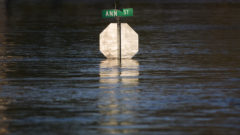
TRAVERSE CITY, Mich. (AP) — It took seven years to settle on a plan for cleansing two rivers and floodplains polluted with dioxins from a Dow Chemical Co. plant in central Michigan. The work itself has lasted nearly twice as long, with plenty still to do.
Great Lakes Now
https://www.greatlakesnow.org/2020/05/ap-michigan-flood-pollution-dioxins-superfund-site/
A USGS hydrologic technician finishes installation of a rapid-deployment streamgage on the Tittabawassee River in Midland, Michigan. A USGS crew in the distance makes streamflow measurements using a boat-mounted acoustic Doppler current profiler.(Credit: Tom Weaver, USGS)
The USGS Tittabawassee River in Midland streamgage measured record water levels, called river stage, at about 35 feet on Wednesday. This level is the highest ever recorded during the streamgage’s 84 years of record, and exceeds the previous highest stage by about two feet. Water levels are beginning to recede as of this morning, and two two-person USGS crews are on site measuring streamflow. They also installed a rapid-deployment gage to provide backup to the permanent streamgage at the Midland site.
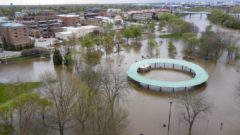
Strong storms passed through parts of the Midwest starting last Thursday, causing minor-to-major flooding in some lower Michigan locations. On Tuesday, May 19, two large dams on the Tittabawssee River failed in succession, causing two lakes upstream of Midland to drain. The USGS crews will continue to monitor water levels and streamflow as flooding continues.
Elsewhere in Michigan, the USGS Rifle River streamgage near Sterling crested on Tuesday with a record streamflow of 7,460 cubic feet per second. There are currently four single-person USGS crews measuring streams throughout lower Michigan, not including the Midland-based crews, and they will continue to monitor flooding for at least another day.
Information collected by the USGS during flooding is critical for resource managers and emergency responders to help protect life and property. The USGS coordinates efforts with the National Weather Service, US Army Corps of Engineers, Bureau of Reclamation and many local and state partners.
There are about 200 streamgages in Michigan that measure water levels, streamflow and rainfall. When flooding occurs, USGS crews make numerous streamflow measurements to verify the data USGS provides to federal, tribal, state and local agencies, as well as to the public.
For more than 125 years, the USGS has monitored flow in selected streams and rivers across the U.S. The information is routinely used for water supply and management, monitoring floods and droughts, bridge and road design, determination of flood risk and for many recreational activities.
Access current flood and high flow conditions across the country by visiting the USGS WaterWatch website. Receive instant, customized updates about water conditions in your area via text message or email by signing up for USGS WaterAlert. See where floodwaters go by following a stream trace at Streamer. View water data on your mobile device. Learn how a USGS streamgage works.
USGS News: Upper Midwest Water Science Center
https://www.usgs.gov/news/usgs-crews-measure-major-flooding-lower-michigan

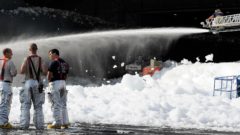
PFAS, short for per- and polyfluoroalkyl substances, are a group of widespread man-made chemicals that don’t break down in the environment or the human body and have been flagged as a major contaminant in sources of water across the country.
Keep up with PFAS-related developments in the Great Lakes area.
Great Lakes Now
https://www.greatlakesnow.org/2020/05/pfas-epa-limits-new-york-burn-plant-wisconsin/
COVID-19 has devastated communities across the Great Lakes region, and has deepened many already existing racial and social inequities in public health outcomes, access to safe and clean drinking water, and many other areas. At the same time, many HOW Coalition members and other organizations are working within the communities that the Coronavirus pandemic has hit the hardest, advocating for and providing relief to those who need it most.
To support in these efforts, the HOW Coalition is offering help to member NGOS and frontline groups, and to facilitate members helping other members in this time of crisis. Working with our network of Coalition members, the Governance Board, and the Equity Advisory and Action Committee, we are offering financial resources and human resources (technical, policy, research, communication skills) through a small grant program (details below).
We recognize that many of our member groups and frontline groups and individuals need additional financial resources along with additional skills-based resources during the pandemic. Through the Coalition’s relationships we hope to identify and provide these needed resources.
The HOW Coalition has up to $25,000 in funds and is developing a resource bank of skills and services available from HOW member groups. The HOW Coalition is starting this effort with $25,000 but we are seeking opportunities to increase the amount of these funds.
Please click here to see the application.
HOW is accepting applications from member frontline groups that focus on providing needed funds or resources to organizations for services during the pandemic. Preference will be given to HOW member groups and we will encourage membership for others.
Applications can be brief and should not exceed one page. Applications MUST include:
Please do not exceed one page for the narrative of the application. Typical awards will be between $1,000-5,000.
Applications will be reviewed on a rolling basis. You can expect a response within 2 weeks from your application. There is no deadline for application.
Examples of project or needs that would be fundable include (but are not limited to):
Research—research on public drinking water stations, policy options, or other strategy
Trainings–remote work skills and tools, outreach strategies, cultural sensitivity
Writing–grant deliverables, translation services, press releases
Communications—assistance with setting up email list serves, zoom meetings or subscriptions, media training and advice, review of communications materials
Policy—consultation on strategy and implementation
Materials or supplies—masks, gloves, food, bottled water, printing
Staff—specific and time limited staffing needs
Direct Lobbying is ineligible.
A final report on how the funds were used, the outcome, and any lessons learned is required within a month of the completion of the project.
The post COVID-19 Crisis Help to Frontline Communities appeared first on Healing Our Waters Coalition.
Healing Our Waters Coalition
https://healthylakes.org/covid-19-crisis-help-to-frontline-communities/
The lead of a study looking at the devouring of the Lake Erie shore says high lake levels are just the beginning of the problem. Man-made changes to the shoreline are also contributing to the erosion. Read the full story by the CBC.
Great Lakes Commission
https://www.glc.org/dailynews/20200521-erosion
A new documentary highlighting surfers in Lake Superior is now being filmed on Minnesota’s North Shore. Read the full story by KQDS-TV – Duluth, MN.
Great Lakes Commission
https://www.glc.org/dailynews/20200521-surfing

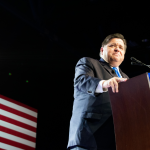
SPRINGFIELD, Ill. (AP) — Gov. J.B. Pritzker has activated nearly 60 Illinois National Guard soldiers and ordered additional steps by the state to prepare for projected flooding along the Illinois River and other streams.
The National Weather Service forecasts the Illinois River will reach major flood stage Saturday morning at Meredosia, about 50 miles (80 kilometers) west of Springfield, and continue to rise through the middle of next week.
Great Lakes Now
https://www.greatlakesnow.org/2020/05/ap-illinois-governor-national-guard-flood/
A Great Lakes engineer explains that the unusually high water levels combined with strong winds are likely to increase flooding in northwest Ohio. Read the full story by WTOL – TV – Toledo, OH.
Great Lakes Commission
https://www.glc.org/dailynews/20200521/flooding
The Federal Energy Regulatory Commission has ordered the owner of the Sanford Dam near Midland, Michigan to establish an independent investigation team to determine why floodwaters overflowed the structure. Read the full story by MLive.
Great Lakes Commission
https://www.glc.org/dailynews/20200521/sanford+dam
A small breach in an oil line in in Casco Township, Michigan caused crude oil to leak into several ditches, according to St. Clair County Emergency Management. Read the full story by the Port Huron Times Herald.
Great Lakes Commission
https://www.glc.org/dailynews/20200521/oil+spill
The devastation wreaked by the collapse of the Edenville Dam followed a 16-year battle between the dam’s owner and federal and Michigan state regulators that ultimately failed to bring the dam into compliance. Read the full story by WXYZ – TV – Detroit, MI.
Great Lakes Commission
https://www.glc.org/dailynews/20200521/Edenville+Dam
The Ozaukee Washington Land Trust is raising funds to purchase 131 acres of lakefront property in Port Washington, Michigan to create a natural recreation area, similar to Lion’s Den Gorge Nature Preserve. Read the full story by the Milwaukee Journal Sentinel.
Great Lakes Commission
https://www.glc.org/dailynews/20200521/recreation
The city of Milwaukee, Wisconsin has released final design standards for a planned extension of the Milwaukee RiverWalk. Read the full story by Urban Milwaukee.
Great Lakes Commission
https://www.glc.org/dailynews/20200521/milwaukee
A movement is developing among officials in Macomb County, Michigan to protest state environmental officials’ initial denial of a project to reduce sewer overflows into Lake St. Clair. Read the full story by Macomb Daily.
Great Lakes Commission
https://www.glc.org/dailynews/20200521/chapaton
The failure of two mid-Michigan dams called attention to the safety of many others around the state, many of which experts said were aging and needed expensive maintenance to avoid catastrophic failures. Read the full story by WWMT – TV – Kalamazoo, MI.
Great Lakes Commission
https://www.glc.org/dailynews/20200521/dam+failure
Lake Michigan water levels have continued at record highs this spring and with no sign of dropping anytime soon, lakeshore residents are taking expensive steps to protect their land. Read the full story by WLUK – TV – Green Bay, WI.
Great Lakes Commission
https://www.glc.org/dailynews/20200521/water+levels
U.S. Geological Survey field crews are measuring record flooding on the Tittabawassee River in Midland, Michigan, following a heavy rainfall event.
Region 3: Great Lakes
http://www.usgs.gov/news/state-news-release/usgs-crews-measure-major-flooding-lower-michigan

By Ari Kelo, theRising
This story originally appeared in theRising and is republished here as part of Covering Climate Now, a global journalism collaboration strengthening coverage of the climate story.
From lengthened hurricane seasons to deadly bushfires, the natural disasters symptomatic of climate change are becoming more and more pronounced each year.
Great Lakes Now
https://www.greatlakesnow.org/2020/05/america-prepared-natural-disasters-covid-19-coronavirus/
Memorial Day has long been seen as the kickoff of summer. In a time of COVD-19 safer-at-home practices, the promise of a season of outdoor pleasures is even more sweet this year. For many in Wisconsin, boating is one of those pleasures. Here are five things to know about boating in the Badger State, and about a Wisconsin Sea Grant-supported initiative, the Wisconsin Clean Marina Program.
When it comes to boating, Wisconsin’s got historical cred.
With the Mississippi, Wisconsin and St. Croix rivers, the Great Lakes and 15,000 inland lakes, it’s only natural people in this state find ways to float upon water bodies. Entrepreneurs have stepped in to fill the need.
A native of Mequon, Wisconsin, ,started manufacturing motorboat engines out of his machine shop in 1939. That was the birth of Mercury Marine, now the world’s largest manufacturer of boat engines. Builders have also set up shop here, including Manitowoc’s luxury yacht maker Burger Boat Co., which had its origins in crafting commercial fishing vessels beginning in the mid-1800s.
Mrs. Puff wouldn’t find work in Wisconsin.
Mrs. Puff is the beleaguered boat-driving instructor in the animated television program SpongeBob Squarepants. While SpongeBob is a hapless pupil and in Wisconsin Mrs. Puff would likely encounter more skilled boat operators, state law doesn’t require in-person instruction.
To operate a boat, those who are at least 16 years old and born on or after Jan. 1, 1989, must pass an online boater safety course and carry a boater safety certification card, which is like a driver’s license. The Department of Natural Resources provides the training, issues the card and handles registration for all watercraft longer than 12 feet. Sailboards and manually powered watercraft like a kayak or canoe don’t need to be registered.

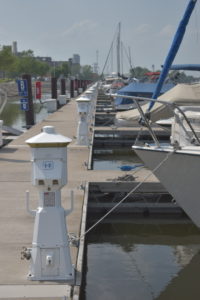
A Clean Marina in Wisconsin. Image by Marie Zhuikov, Wisconsin Sea Grant.
Boater Safety Certification Card in hand. Now, off to a marina.
The Wisconsin Marine Association notes that marinas and related industries and services contribute more than $2.7 billion to Wisconsin’s economy. The association counts more than 170 boating facilities in Wisconsin. Some of these businesses opt to become a certified Clean Marina.
A certified Clean Marina. What is that?
A Clean Marina voluntarily adopts practices to reduce water pollution from its facility and boaters. The efforts lead to clean lakes and rivers, which are good for business. There are currently 20 certified marinas in Wisconsin and another 20 establishments are working through the rigorous steps to become certified. Marinas see the benefits of becoming certified—creating a safer and healthier place to work and recreate, gaining an enhanced image among boaters and the community, and preventing pollution and the spread of aquatic invasive species.
It comes down to details.
Marinas perform a self-evaluation of their business using the Clean Marina Guidebook and certification checklist from the Wisconsin Clean Marina Program. The guidebook and checklist include things like preventing and cleaning up fuel spills, reducing stormwater pollution and educating boaters. Marinas also host visits from the program coordinator to ensure adherence to the practices.
The Clean Marina Program is administered by Wisconsin Sea Grant in partnership with the Wisconsin Marine Association, Wisconsin Coastal Management Program, Wisconsin Department of Natural Resources and Fund for Lake Michigan.
For more information, contact Theresa Qualls, Wisconsin Clean Marina coordinator, quallst@uwgb.edu.
Blog – Wisconsin Sea Grant
https://www.seagrant.wisc.edu/blog/take-5-summer-boating-and-the-wisconsin-clean-marina-program/
Great Lakes Echo
http://greatlakesecho.org/2020/05/21/research-delayed-elizabeth-lombardi/

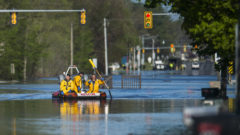
After two dams collapsed under a deluge of stormwater on Tuesday, many residents of Midland, Michigan, have evacuated or are being evacuated.
Michigan Gov. Gretchen Whitmer declared a state of emergency for Midland County on Tuesday after the Edenville and Sanford dams breached.
“If you have not evacuated the area, do so now and get somewhere safe,” Whitmer said.
Great Lakes Now
https://www.greatlakesnow.org/2020/05/midland-flooding-climate-change-infrastructure/
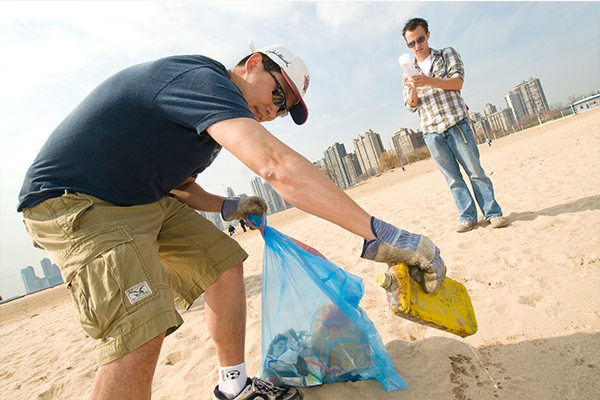
The Alliance’s Adopt-a-Beach program would not be possible without the involvement of hundreds of Team Leaders like you each year. We are grateful for your efforts to protect the Great Lakes and to keep our beaches safe and beautiful.
On this page you will find the following:
It’s been a challenging year and we’re excited to return to a more normal Adopt-a-Beach season this summer. However COVID-19 related rules and guidelines vary around the Great Lakes region. Adopt-a-Beach Team Leaders and volunteers must follow federal, state, and local coronavirus-related guidelines and should use their best judgement when planning and attending cleanup events.
Before planning an Adopt-a-Beach cleanup, Team Leaders should:
Illinois: https://coronavirus.illinois.gov/s/
Chicago: For up-to-date information, visit the Chicago Park District’s COVID-19 page.
Indiana: https://www.coronavirus.in.gov/
Michigan: https://www.michigan.gov/coronavirus/
Minnesota: https://www.health.state.mn.us/diseases/coronavirus/prevention.html
New York: https://coronavirus.health.ny.gov/home
Ohio: https://coronavirus.ohio.gov/wps/portal/gov/covid-19/home
Pennsylvania: https://www.health.pa.gov/topics/disease/coronavirus/Pages/Coronavirus.aspx
Wisconsin: https://www.dhs.wisconsin.gov/covid-19/index.htm
Alliance for the Great Lakes staff will update this guidance as appropriate and will communicate any new guidelines with Team Leaders and volunteers. If you have any questions, please do not hesitate to contact us at adoptabeach@greatlakes.org.
Many of the Great Lakes continue to experience high water levels.
Team Leaders should keep in mind the following safety and logistics concerns when scheduling and leading cleanup events:
We have plenty of resources to help Adopt-a-Beach Team Leaders plan a fun and safe cleanup event. Our Team Leader How-To Guide is a helpful step-by-step guide for organizing an event. And, you can also check out this quick refresher video.
Adopt-a-Beach Team Leaders should stress personal safety with all volunteers at your event including:
If you have any questions, please do not hesitate to contact us at adoptabeach@greatlakes.org.
The post Safety and Your Adopt-a-Beach Cleanup appeared first on Alliance for the Great Lakes.
News – Alliance for the Great Lakes
https://greatlakes.org/2021/06/safety-and-your-adopt-a-beach-cleanup/
The cool spring weather has slowed down the reproduction cycle of bait fish in Lake Erie, causing a shortage of minnows. Read the full story by WNWO – TV – Toledo, OH.
Great Lakes Commission
https://www.glc.org/dailynews/20200520-erie-minnows
Water levels on Lake Michigan and other Great Lakes set a record for April, but that was no surprise to residents up and down whose homes and property flooded last weekend. Read the full story by Green Bay Press-Gazette.
Great Lakes Commission
https://www.glc.org/dailynews/20200520-lake-levels
Funded by the H2Ohio initiative, a grant will turn an 18-acre property in Ohio into a recreational wetland, acting as a natural filter for nutrients from drained water of local farms before the water reaches Lake Erie. Read the full story by WTOL – TV – Toledo, OH.
Great Lakes Commission
https://www.glc.org/dailynews/20200520-wetland-h2o
The third straight wettest May on record is sending a message: Every town and suburb in the Chicago region needs to do a better job of teaming up to prevent flooding. Read the full story by Chicago Sun Times.
Great Lakes Commission
https://www.glc.org/dailynews/20200520-chicago-flooding
Rapidly rising water overtook dams and forced the evacuation of about 10,000 people in central Michigan, where the governor said one downtown could be under 9 feet of water by Wednesday morning after a catastrophic dam failure caused by aging infrastructure. Read the full story by The Washington Post.
Great Lakes Commission
https://www.glc.org/dailynews/20200520-dams-flooding
The U.S. Senate committee that oversees water infrastructure projects approved legislation authorizing $18 billion for projects and included a provision that the federal share of the U.S. Army Corps of Engineers project to stop Asian carp at Brandon Road Lock and Dam in the Chicago waterways system be increased from 65 percent to 75 percent. Read the full story by Great Lakes Now.
Great Lakes Commission
https://www.glc.org/dailynews/20200520-asian-carp-plan
A manufacturer of firefighting foam says the majority of more than 250 drinking water wells it’s tested in Marinette County, Wisconsin, turned up no trace of toxic chemicals known as PFAS; state regulators say it’s too early to tell the scope of PFAS contamination within drinking water in the area. Read the full story by Wisconsin Public Radio.
Great Lakes Commission
https://www.glc.org/dailynews/20200520-pfas-wisconsin
U.S. EPA’s temporary policy regarding enforcement of environmental legal obligations during the COVID-19 outbreak has received sharp criticism as a step-back from the EPA-established enforceable limit for daily loads of phosphates and runoff published a month ago. Read the full story by Cleveland Scene.
Great Lakes Commission
https://www.glc.org/dailynews/20200520-epa-algae-bloom
As Midland County, Michigan, grapples with flooding that collapsed one dam and overtopped another, plus evacuations of people and businesses, Dow Inc. officials have implemented the chemical company’s flood preparedness plan. Read the full story by MLive.
Great Lakes Commission
https://www.glc.org/dailynews/20200520-dam-failure
Michigan Attorney General Dana Nessel condemned the Navigable Waters Protection Rule as a replacement of the 2015 Waters of the United States rule, stating that the change would result in reduced protection under the Clean Water Act for many wetlands and smaller streams. Read the full story by WNEM – TV – Saginaw, MI.
Great Lakes Commission
https://www.glc.org/dailynews/20200520-clean-water-act-michigan
Once niche, podcasts have gone mainstream. According to figures cited in Forbes, 62 million Americans now listen to podcasts each week.

Sea Grant’s Yael Gen designed the cover art for the new podcast.
While Wisconsin Sea Grant and the University of Wisconsin Water Resources Institute have been involved in podcasting for years—from the current series Wisconsin Water News to older programs like Earthwatch Radio—there’s a new kid on the block: a podcast called “Introduced” that will be devoted to aquatic invasive species (AIS). Its tagline is “aquatic invaders and stories from our changing waters.”
“Introduced” is the brainchild of Sea Grant Video Producer Bonnie Willison and student employee Sydney Widell, a UW-Madison geography and geosciences major from Shorewood, Wis.
The series will span seven episodes, with one per week released beginning May 27. Listeners can find it on Apple Podcasts, Google Play, Spotify and on Sea Grant’s website.
While the simple name for the series conveys a bit of mystery, it also makes perfect sense. Said Willison, “As Sydney and I started learning more about invasive species, we noticed that there is a tendency for people to villainize these species. But we also noticed that humans are the ones introducing all these species to new environments. The title for our series puts the agency on people, which is something that we focus on in the podcast.”

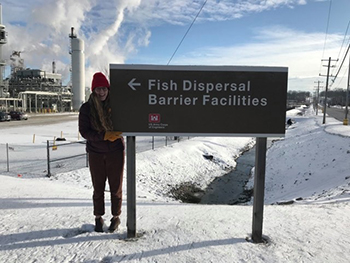
Sydney Widell, one of the creators of the new podcast, on a visit to an electric fish barrier in Illinois in February. The barrier helps keep Asian carp out of the Great Lakes. (Photo: Bonnie Willison)
Guests interviewed in the series include representatives from the Wisconsin Department of Natural Resources, U.S. Geological Survey, UW-Madison, the Fond du Lac Band of Lake Superior Chippewa, and a rescue organization focusing on exotic animals. Several Sea Grant staff also make appearances.
Topics are wide-ranging, from Asian carp to the trade in invasive species on the Internet. Because the AIS field is so rich, Willison anticipates doing a second season of the “Introduced” podcast. Stay tuned!
News Releases – Wisconsin Sea Grant
https://www.seagrant.wisc.edu/news/introducing-introduced-sea-grants-newest-podcast/

Produced fully during the COVID-19 pandemic, this episode of Great Lakes Now checks in with people, businesses and institutions from previous episodes to see how work has changed during the public health emergency and its economic fallout. But while social distancing keeps people inside, it lets the residents of some Great Lakes aquariums get out.
Great Lakes Now
https://www.greatlakesnow.org/2020/05/lakes-on-lockdown-episode-1014/
Great Lakes Echo
http://greatlakesecho.org/2020/05/20/research-delayed-ellie-weise/
Current Watches, Warnings and Advisories for Brown (WIC009) Wisconsin Issued by the National Weather Service
https://alerts.weather.gov/cap/wwacapget.php?x=WI125F4CC5C2F0.SpecialWeatherStatement.125F4CD1F020WI.GRBSPSGRB.6e531d1a6a7226481fdabd9f691e869c

By Patty Wetli, WTTW News
Chicago is drying out Monday after a record rainfall that flooded streets and yards over the weekend.
According to the National Weather Service, Sunday’s precipitation total at O’Hare Airport was 3.11 inches, the most ever recorded on May 17.
Great Lakes Now
https://www.greatlakesnow.org/2020/05/record-rainfall-chicago-river-lake-michigan-flooding/
Great Lakes Basin – In a historic agreement, Blue Accounting has partnered with the U.S. Fish and Wildlife Service to better track investments in restoring and protecting Great Lakes coastal wetlands. The Service has agreed to share its Habitat Information Tracking System (HabITS) database for publication in a public platform, substantially increasing the number of coastal wetland projects tracked on www.blueaccounting.org.
With this agreement, Blue Accounting will incorporate the two largest sources of coastal wetland project data in the Great Lakes Basin: the HaBITS database and Great Lakes Restoration Database, which tracks projects funded under the Great Lakes Restoration Initiative. Blue Accounting will soon be able to connect information on the vast majority of U.S. coastal wetland investments in the Great Lakes Basin initiated since 2010.
“The U.S. Fish and Wildlife Service is committed to collaborative approaches for fish and wildlife conservation across the Great Lakes Basin,” said Charlie Wooley, Regional Director for the U.S. Fish and Wildlife Service’s Great Lakes Region. “The principles of being collaborative, outcome-driven, data and science-informed, and adaptive are shared between the Service and the Blue Accounting Initiative. We are proud to have supported and participated with Blue Accounting since its inception as a means to join with other agencies to develop shared objectives and track progress toward goals. This agreement will allow for better tracking of the region’s progress toward restoring and protecting critical Great Lakes coastal wetlands.”
“Coastal wetlands protect our communities from floods, provide habitat for fish and wildlife, filter our water, and serve as economic drivers for the Great Lakes states and provinces,” said Sharon M. Jackson, chair of the Great Lakes Commission and deputy general counsel to Indiana Governor Eric Holcomb. “We are excited to partner with the U.S. Fish and Wildlife Service to expand the investments in wetlands that Blue Accounting is tracking, in order to make sure we are best protecting, restoring and utilizing this invaluable resource.”
The Blue Accounting coastal wetland team, led by The Nature Conservancy, works with a regional partnership of state, federal, tribal, nongovernmental and academic organizations to report on investments in Great Lakes Coastal Wetlands. This regional partnership, called the Great Lakes Coastal Assembly, is co-chaired by the U.S. Fish and Wildlife Service and Wisconsin Department of Natural Resources and has identified a collective vision and goals for coastal wetlands. This vision and goals act like a roadmap ensuring our collective actions create healthy coastal wetlands supporting fish, wildlife, plants, and people. The USFWS data provided through this agreement will help track investment and progress toward meeting these shared coastal wetland goals.
Through Blue Accounting, key experts and stakeholders track progress toward shared goals for the Great Lakes, helping decision-makers improve how they are protected and restored. The Great Lakes Commission leads Blue Accounting in partnership with dozens of federal, state, provincial, local and private sector organizations. Blue Accounting receives funding support from the Charles Stewart Mott Foundation, the Fred A. and Barbara M. Erb Family Foundation, the Joyce Foundation, and the Herbert H. and Grace A. Dow Foundation.
The Great Lakes Commission, led by chair Sharon M. Jackson, Deputy General Counsel for Governor Eric J. Holcomb of Indiana, is an interstate compact agency established under the Great Lakes Basin Compact of 1955. The Commission is authorized by state and U.S. federal law and dedicated to promoting a strong economy, healthy environment and high quality of life for the Great Lakes-St. Lawrence Basin and its residents. The Commission consists of governors’ appointees, state legislators, industry and nonprofit leaders and agency officials from eight states and two provinces. Associate membership for Ontario and Québec was established through the signing of a “Declaration of Partnership.” The Commission maintains a formal Observer program involving U.S. and Canadian federal agencies, tribal authorities, binational agencies and other regional interests. The Commission office is in Ann Arbor, Michigan. Learn more at www.glc.org.
Great Lakes Commission
https://www.glc.org/news/data-sharing-051920

By John Flesher, Associated Press Writer
TRAVERSE CITY, Mich. (AP) — Clare Nagrant earns her living from tourism, so she’s taken a beating during the coronavirus-imposed shutdown. A few months ago, she was juggling four jobs. Now she’s down to one part-time gig with a distillery that stayed open by adding hand sanitizer to its product line.
Great Lakes Now
https://www.greatlakesnow.org/2020/05/ap-coronavirus-covid-19-michigan-traverse-city-tourism/

With the federal government writing trillion-dollar checks to fight COVID-19, support collapsing businesses and feed cash into the economy via stimulus checks, Great Lakes legislators and advocacy groups are seizing on the opportunity to secure federal funding while the money still flows.
Recently the senate committee that oversees water infrastructure projects unanimously approved legislation authorizing $18 billion for projects nationally.
Great Lakes Now
https://www.greatlakesnow.org/2020/05/state-federal-budget-shortfalls-asian-carp-toxic-cleanups/
Great Lakes Echo
http://greatlakesecho.org/2020/05/19/research-delayed-emily-varga/
The marbled crayfish, which reproduces by cloning, has been added to Michigan’s prohibited species list. Read the full story by The Associated Press.
Great Lakes Commission
https://www.glc.org/dailynews/20200519-marbled-crayfish-prohibited
Due to intense rainfall and rising water levels, the Metropolitan Water Reclamation District of Greater Chicago reversed the flow of the Chicago River into Lake Michigan at both the Wilmette Pumping Station and downtown’s Controlling Works. Read the full story by WTTW-TV – Chicago, IL.
Great Lakes Commission
https://www.glc.org/dailynews/20200519-river-reversal
Aiming to return Minnesota’s river systems back to their original, untamed state, the Department of Natural Resources has for several years now been chipping away at older dams and other obstructions and replacing them with rock arch rapids. Read the full story by the Detroit Lakes Tribune.
Great Lakes Commission
https://www.glc.org/dailynews/20200519-dam-removal
A major utility’s plan to close five Indiana coal ash ponds at a power plant along Lake Michigan and move coal ash to a landfill has sparked concerns from environmental activists about how the dust kicked up by that project will be controlled. Read the full story by The Associated Press.
Great Lakes Commission
https://www.glc.org/dailynews/20200519-coal-ash-removal
A team of Michigan State University researchers hopes Detroit sewage will hold clues about the trajectory of COVID-19. The group has been sampling sewage as it arrives at a Great Lakes Water Authority water treatment plant. Read the full story by Michigan Radio.
Great Lakes Commission
https://www.glc.org/dailynews/20200519-detroit-wastewater
The Wisconsin Department of Natural Resources says there are more people out fishing this year compared to last year. The increase may be due to the ability to practice social distancing when fishing. Read the full story by the WLAX-TV – La Crosse, WI.
Great Lakes Commission
https://www.glc.org/dailynews/20200519-wisconsin-fishing
Routine quarterly testing of municipal water in Portage, Michigan, conducted by the state, turned up a low level of chemical contamination in one of the city’s wells. Read the full story by MLive.
Great Lakes Commission
https://www.glc.org/dailynews/20200519-portage-pfas
In Munising, Michigan, Pictured Rocks Cruises’ scenic shoreline tours will kick off on June 15, a little later than usual this summer on account of the COVID-19 pandemic. Read the full story by MLive.
Great Lakes Commission
https://www.glc.org/dailynews/20200519-pictured-rocks-cruise