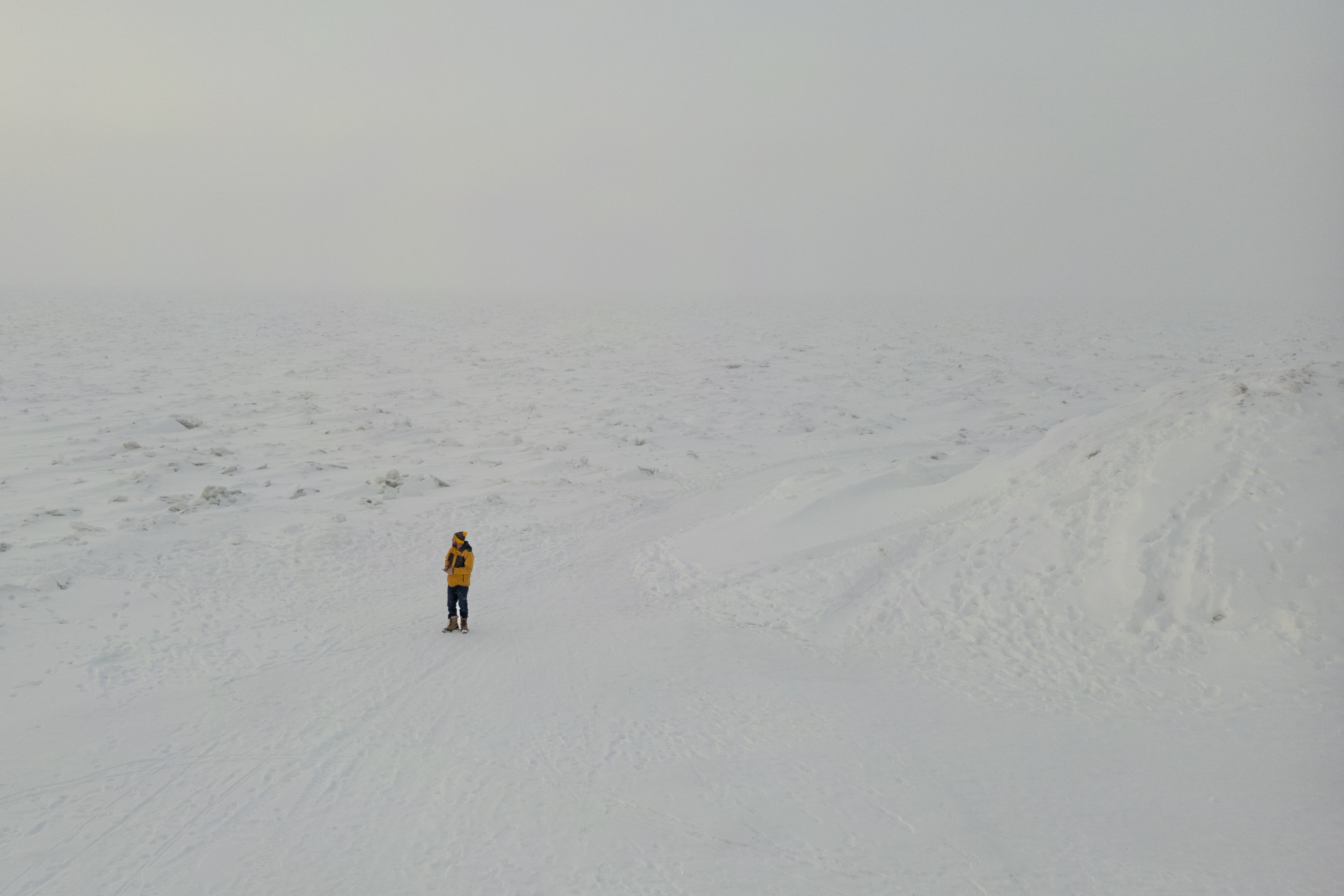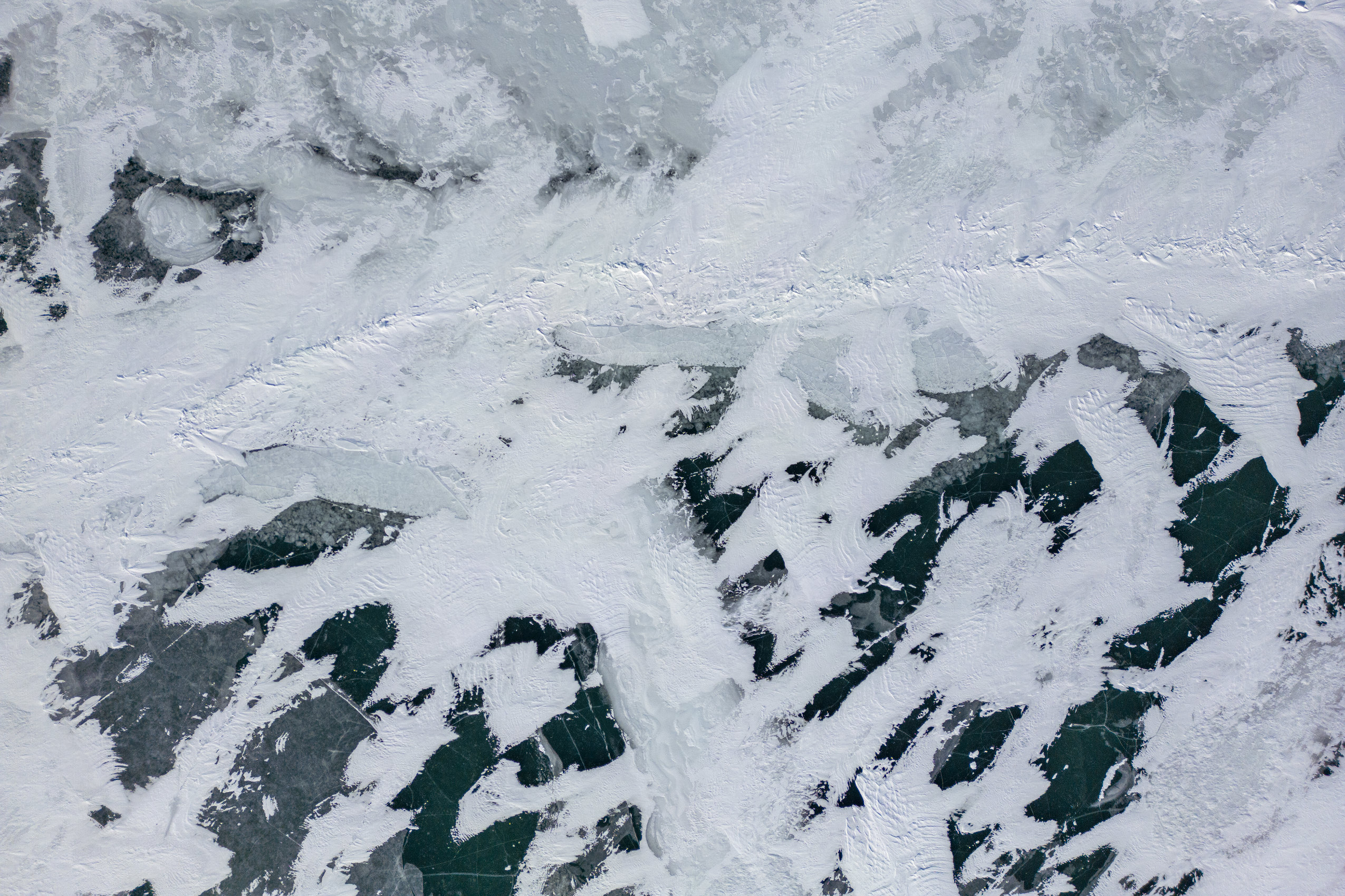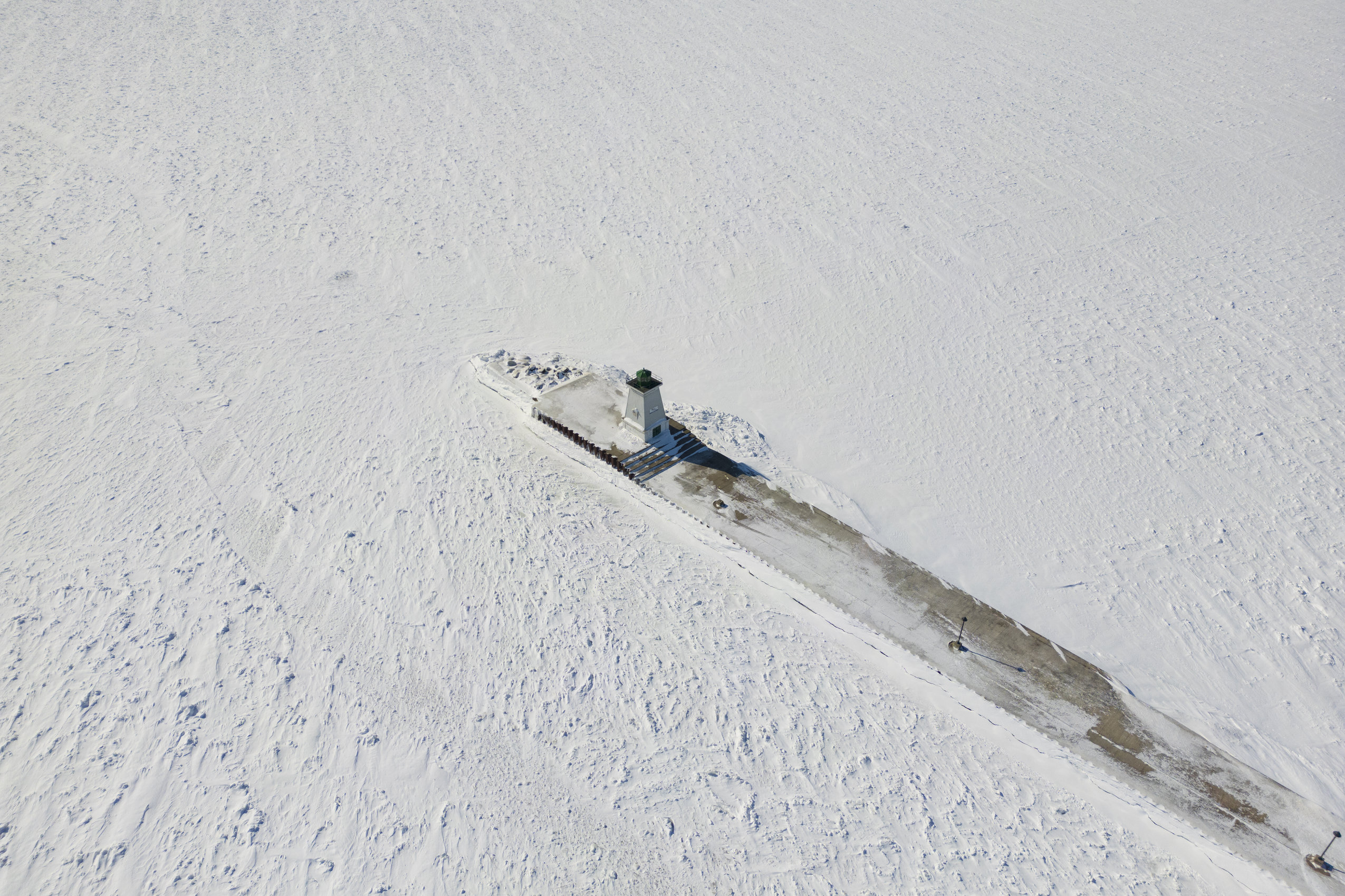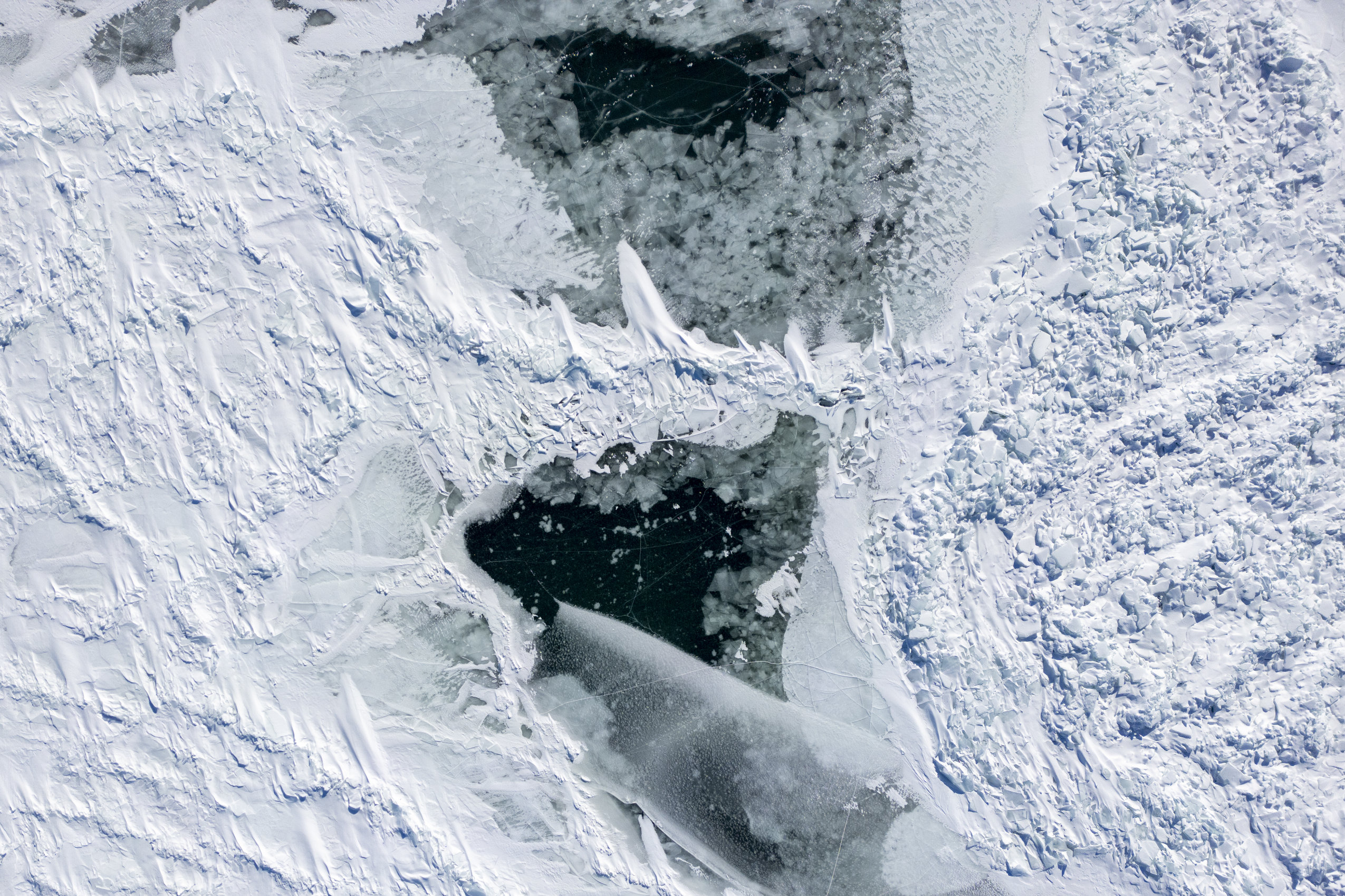
A coalition of Wisconsin environmental advocacy groups filed a lawsuit Monday challenging an administrative law judge’s decision to uphold the Department of Natural Resource’s permit approval to reroute the Enbridge Line 5 oil pipeline across northern Wisconsin. A similar lawsuit has also been filed by the Bad River Band of Lake Superior Chippewa. The tribe for years has fought against the pipeline, which currently runs across its land.  Read the full story by the Wisconsin Examiner.

Original Article

Great Lakes Commission

Great Lakes Commission

https://www.glc.org/dailynews/20260225-environmental-groups-challenge-dnr-line5-decision
Hannah Reynolds

An unusually snowy 2025–2026 season has helped draw tourists to northern Wisconsin’s outdoor winter attractions like the Apostle Islands ice caves, but many locals and industry groups say that reliably snowy winters are becoming less common and more unpredictable. Read the full story by Wisconsin Public Radio.

Original Article

Great Lakes Commission

Great Lakes Commission

https://www.glc.org/dailynews/20260225-snowy-season-wisconsin-boost-tourism

Hannah Reynolds

The Supreme Court on Tuesday heard arguments in a long-running dispute over the fate of an oil and gas pipeline in the Great Lakes. Michigan state officials had sued a Canadian company that operates a section of the pipeline, known as Line 5, which snakes under the Straits of Mackinac between Michigan’s Lower and Upper Peninsulas. Read the full story by The New York Times.

Original Article

Great Lakes Commission

Great Lakes Commission

https://www.glc.org/dailynews/20260225-supreme-court-fate-greatlakes-pipeline

Hannah Reynolds

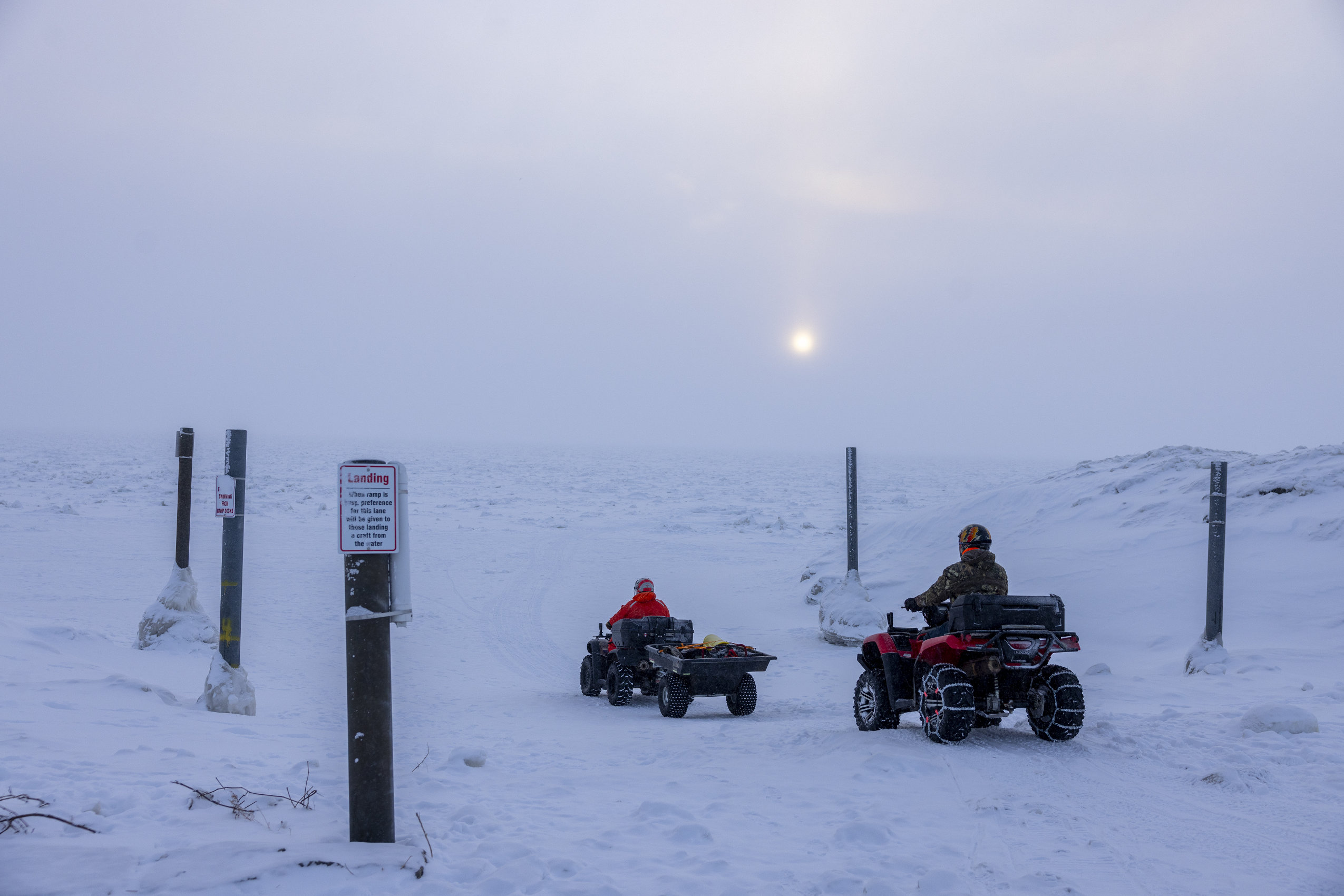
If you go ice fishing around Door County and have a shanty out on the bay of Green Bay or Lake Michigan, you’ve got a little more than two weeks left to get the shanty off the ice. Read the full story by Green Bay Press-Gazette.

Original Article

Great Lakes Commission

Great Lakes Commission

https://www.glc.org/dailynews/20260225-ice-fishing-door-county-dnr-reminders-ice-shanties

Hannah Reynolds

With frequent sub-freezing temperatures in Michigan this winter, it has been a great year for ice fishing. Stable ice conditions have allowed anglers the opportunity to get out on the ice and participate in a northern winter tradition. Read the full story by the Lasco Press.

Original Article

Great Lakes Commission

Great Lakes Commission

https://www.glc.org/dailynews/20260225-gennessee-county-fishing-opportunities

Hannah Reynolds

On Friday, February 20 the Wisconsin Assembly unanimously passed two bills to help residents with PFAS mitigation after 30 months of debate. Gov. Tony Evers approved $125 million for per- and polyfluoroalkyl substances (PFAS) cleanup in 2023, but Republican lawmakers disagreed with how the funds would be distributed, including the need to add protections for businesses and “innocent landowners” or people who bought contaminated property but weren’t responsible for the original spill. One bill allows for a series of grants to pay for testing and remediation, while the other bill exempts certain businesses and people from having to pay for cleanup, including any municipal services who use PFAS for emergencies by using firefighting foam.

In Minnesota, a study suggests about 99% of PFAS can be destroyed while turning solid waste into energy and ash at combustion facilities. Incineration is often seen as a controversial method for dealing with “forever chemicals” because it is still unclear if the substances only contribute to air pollution through manufacturing, or if incineration only works under very specific circumstances (at a certain temperature, and for a certain amount of time) without further contributing to the problem. 

The Illinois Commerce Commission (ICC) received a rate request from Illinois American Water for approximately $577 million to fund upgrades related to emerging contaminations like PFAS and continuing to replace lead service lines. According to CBS News, this proposed rate increase would mean an additional $14 a month for residential water customers and $28 a month for those with sanitary wastewater systems. 

This is the fourth rate hike in a decade. In an interview with CBS News, Chicago resident Susan Srail said that residents are already billed “…at the least, $180 a month. There are some people that are paying $300 a month.”

Recent reporting by Bridge Michigan suggests that PFAS levels are actually declining in Great Lakes fish. A study published in January 2026 used archived trout and walleye samples from 1975 to 2020 to track pollutants. Researchers found that average contamination levels reached their lowest by 2020. For example, PFAS in freeze-dried tissue samples from fish in Lake Erie “peaked at close to 450 nanograms per gram in 2005 but were closer to 50 nanograms per gram in 2020.”

Two bills related to “forever chemicals” passed through the New York State Senate, and now await final votes in the state Assembly. One bill will expand regulation of chemical discharge in the state’s groundwater, lakes and rivers. The other bill will restrain PFAS in consumer products like cookware, cleaning products and dental floss, according to WAMC

Meanwhile, a new permit is under consideration at the Ohio Environmental Protection Agency (EPA) to help expand the state’s data center boom. The new permit would allow data centers to discharge wastewater right into rivers and streams. According to Circle of Blue: “the Ohio permit would apply to water that circulates through data centers to absorb heat from servers, towers and boilers. Recent investigations have shown that chemicals such as PFAS and nitrates, which are harmful to human health, are a part of these effluents, or untreated discharges.”

Testing at Pittsburgh International Airport shows that PFAS levels of one particular compound are over 15,000 times the EPA’s safety levels. The airport sits on the Montour Run watershed, which leads to the Ohio River and is a source of drinking water for millions of Americans. 

More PFAS news in case you missed it:

  • In Canada, reporting from the CBC shows that Transport Canada was worried about PFAS in the 1980s according to files obtained through an access-to-information request.
  • The burden of advocacy falls on Indiana firefighters facing PFAS-related cancers
  • Three Olympic boardsport athletes were disqualified over their use of wax containing “forever chemicals.”
  • An op-ed penned by cardiologist Dr. Pierce Vatterott for The Hill makes the case for why medical care requires the use of some per- and polyfluoroalkyl substances. 
  • The U.S. Forest Service will stop issuing gasoline and water repellant pants for firefighters that contain PFAS. This move was inspired by original reporting by ProPublica.

The post Wisconsin finally unlocks $125 million funding for PFAS cleanup appeared first on Great Lakes Now.

Original Article

Great Lakes Now

Great Lakes Now

https://www.greatlakesnow.org/2026/02/25/wisconsin-finally-unlocks-125-million-funding-for-pfas-cleanup/

Lisa John Rogers, Great Lakes Now

By Elaine Anselmi, The Narwhal

Photography by Carlos Osorio

The Great Lakes News Collaborative includes Bridge MichiganCircle of BlueGreat Lakes NowMichigan Public and The Narwhal who work together to bring audiences news and information about the impact of climate change, pollution, and aging infrastructure on the Great Lakes and drinking water. This independent journalism is supported by the Charles Stewart Mott Foundation.


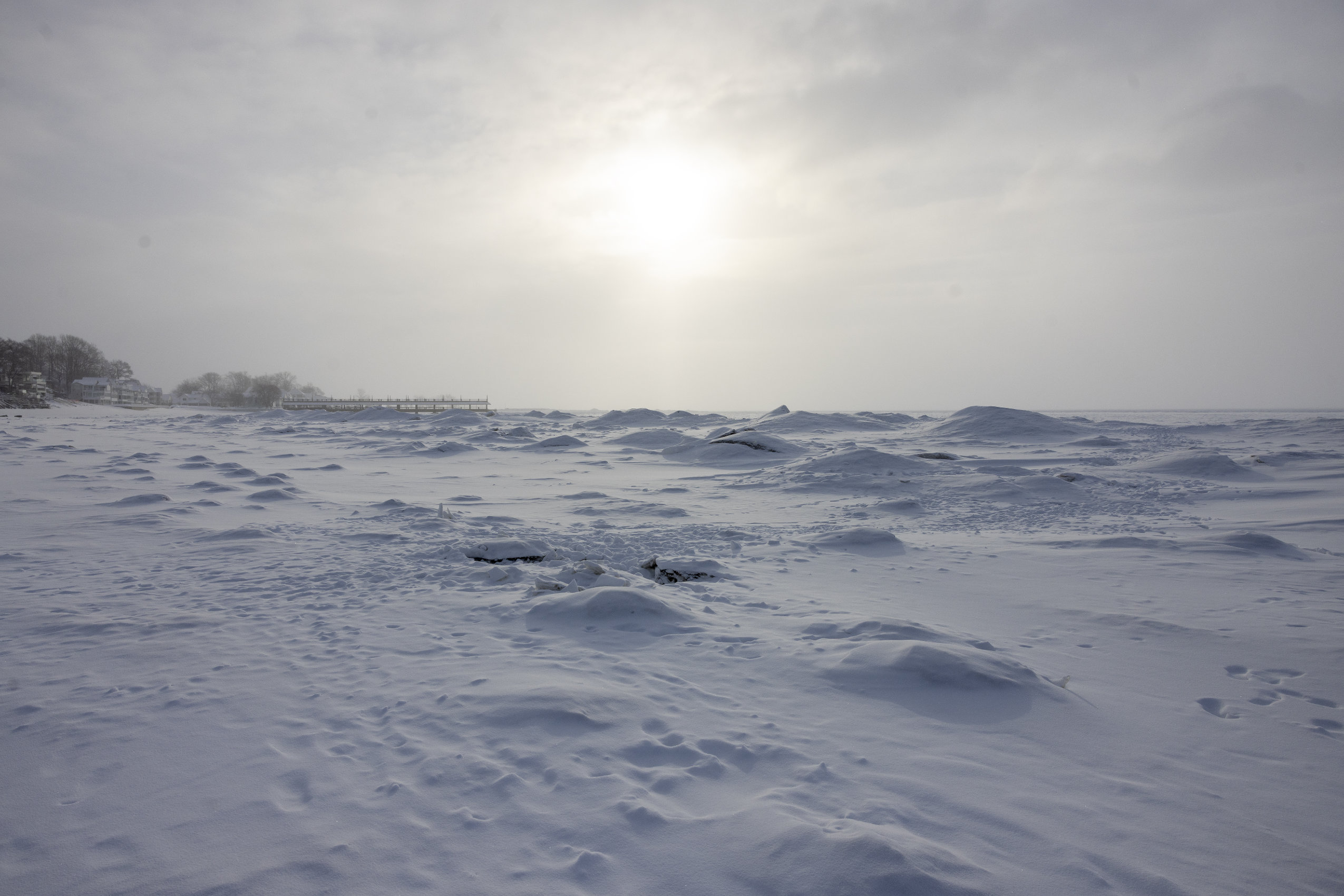
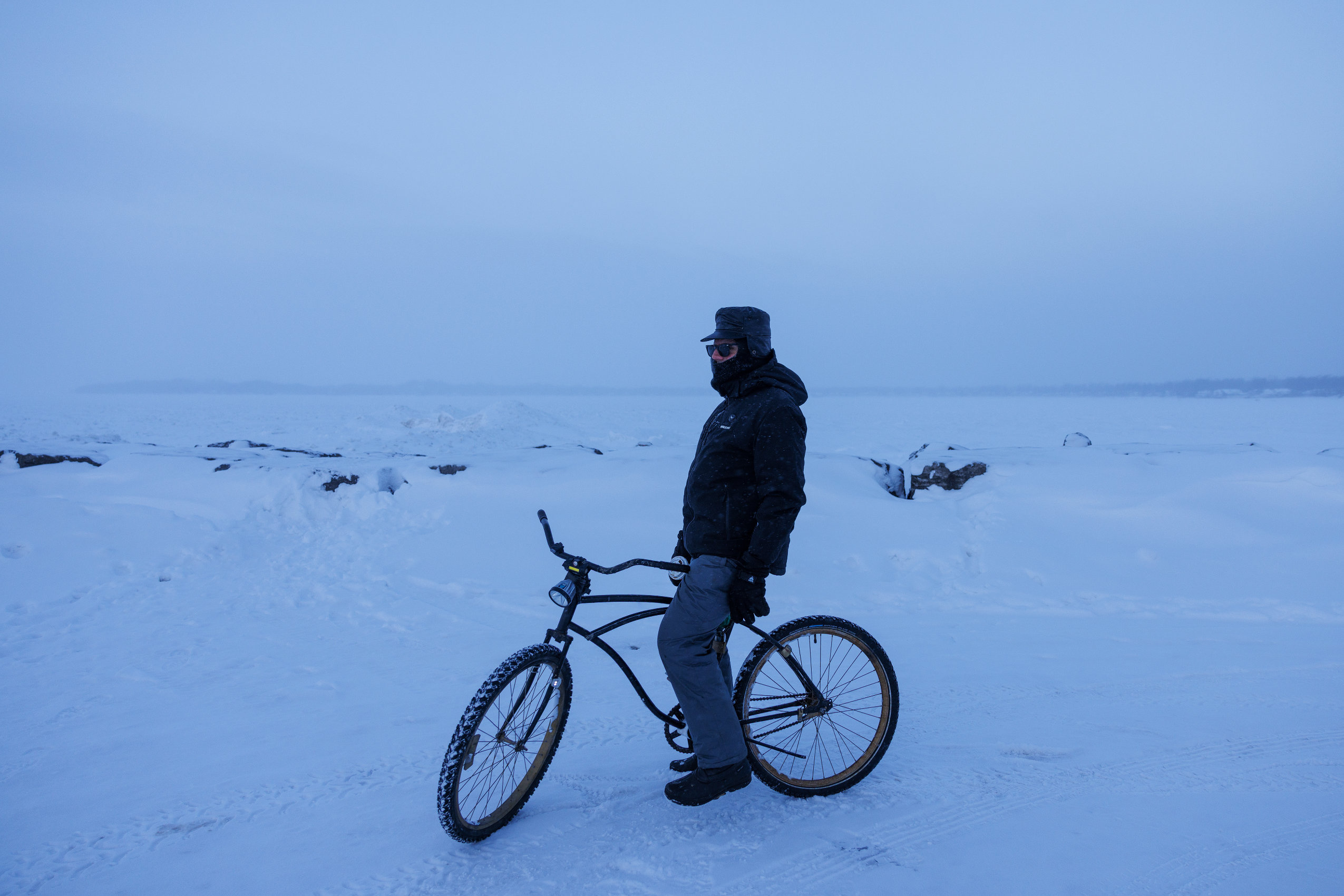
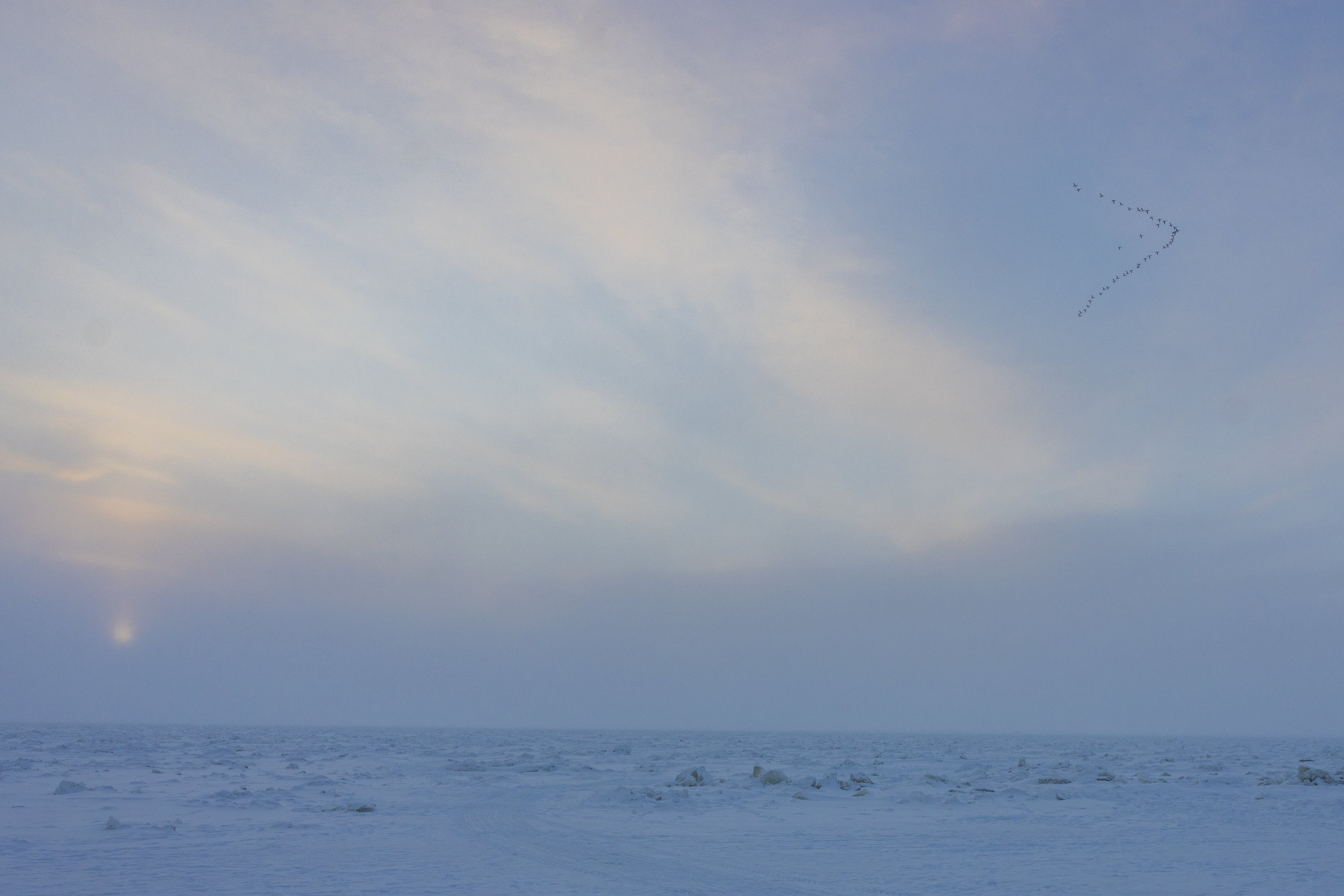
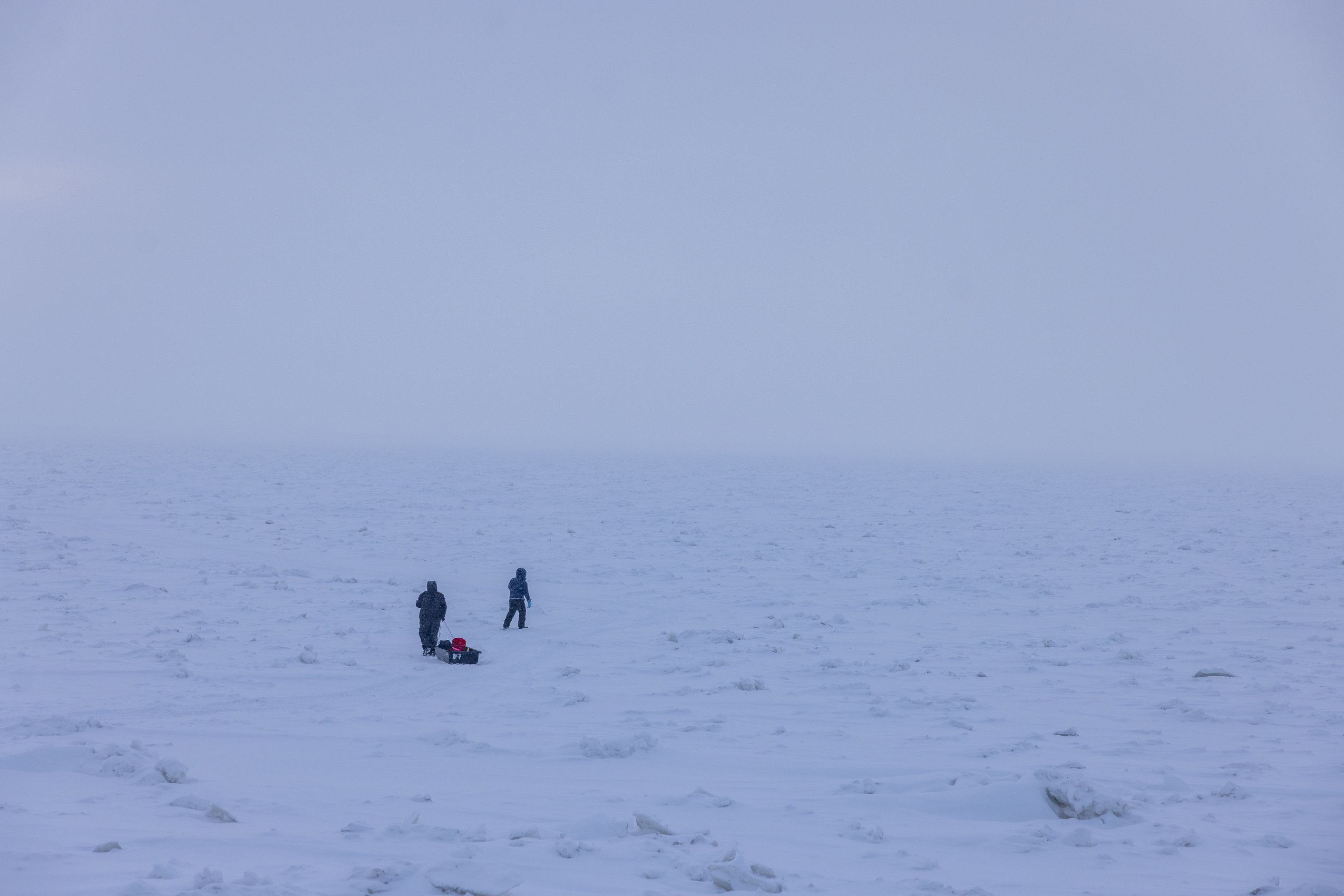
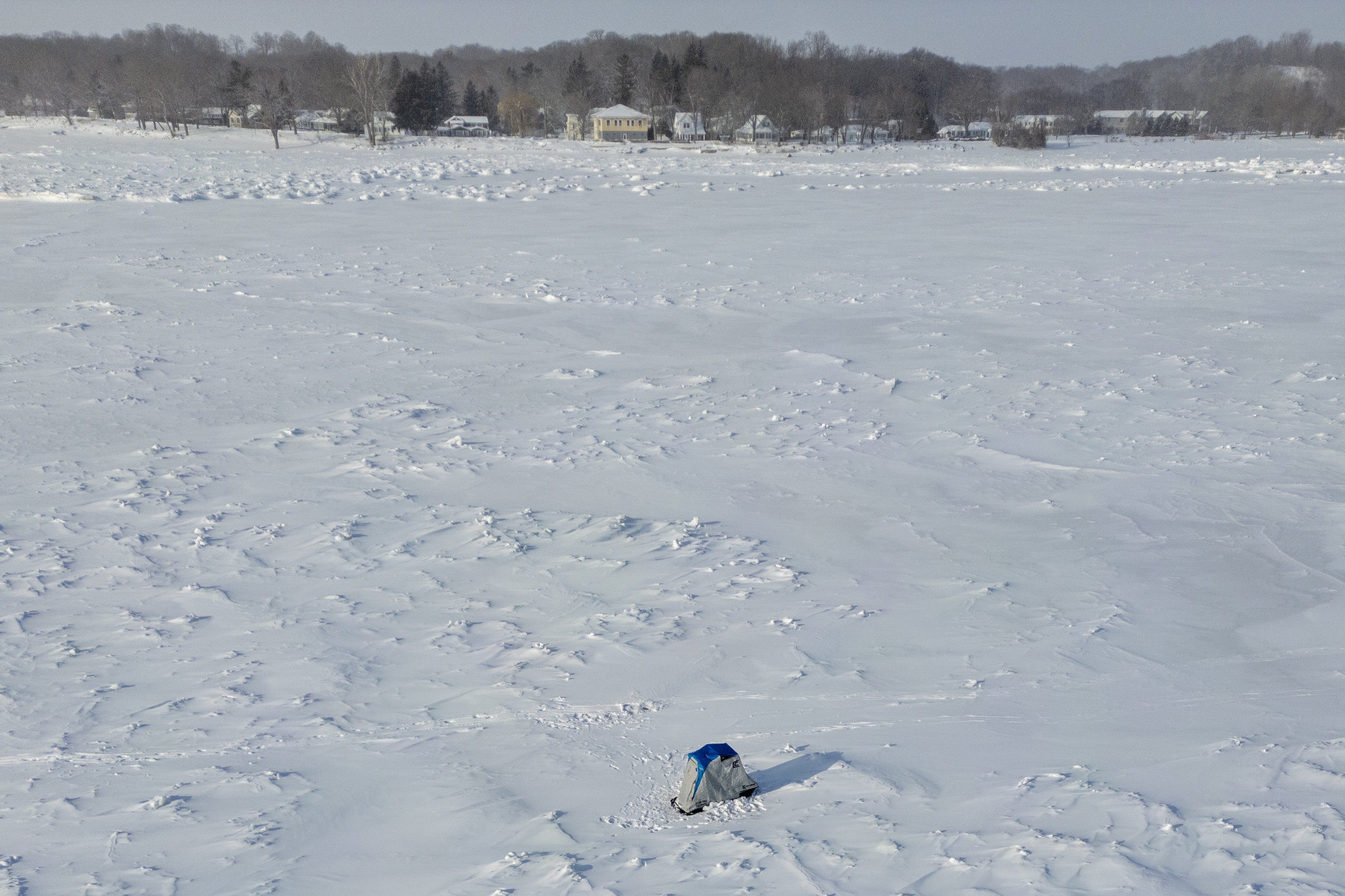
The cold snap held its grip on southern Ontario for weeks. On the shores of Lake Erie, some speculated this could be the year the ice makes it all the way across — something that hasn’t happened in three decades.

Erie, the shallowest of the Great Lakes, typically sees the most ice cover. Still, the most recent full freeze-up was in 1996, according to National Oceanic and Atmospheric Administration data.

On a Sunday in early February, as ice cover crept over 95 per cent, locals and visitors braved frigid temperatures to look out across the frozen surface. 

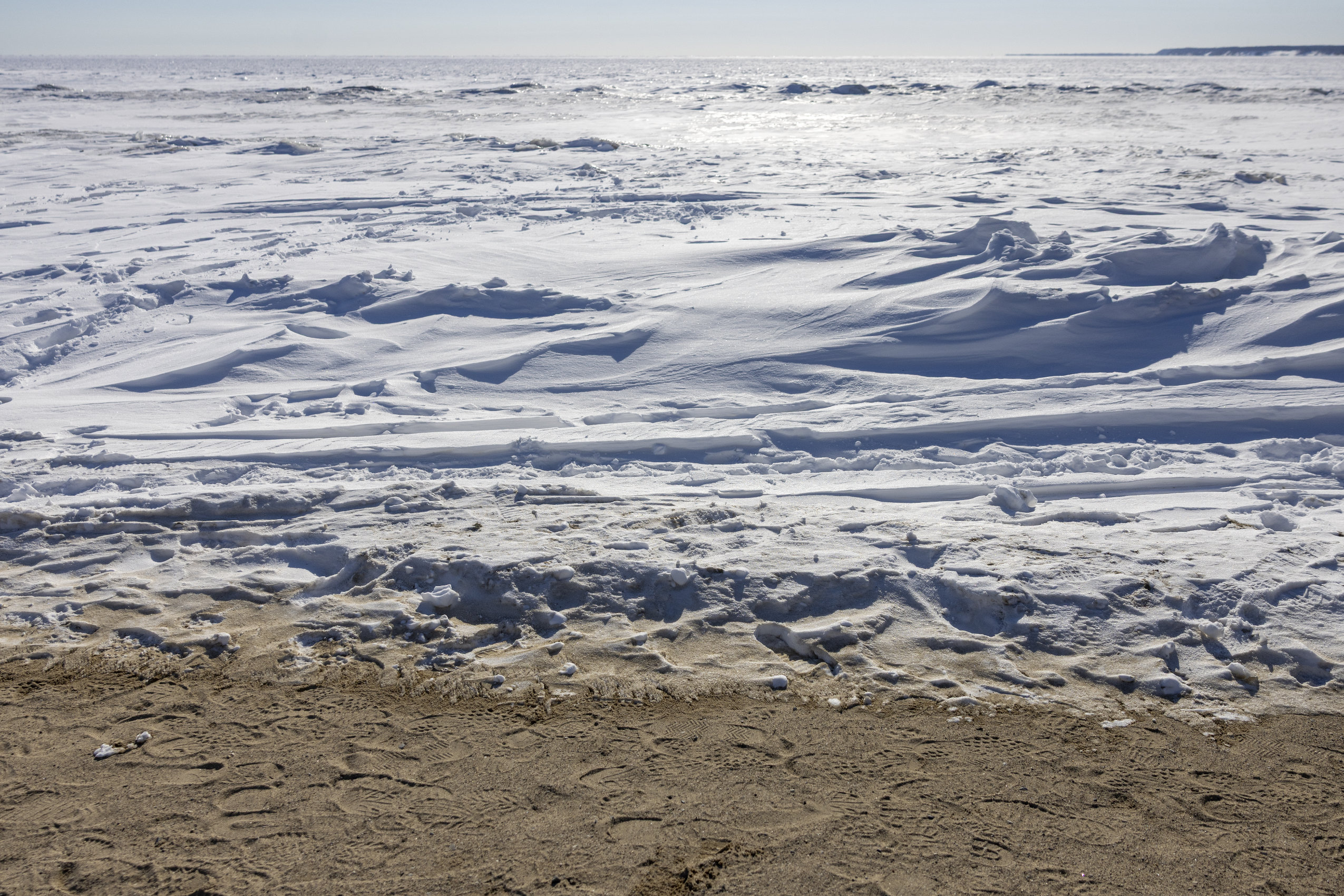
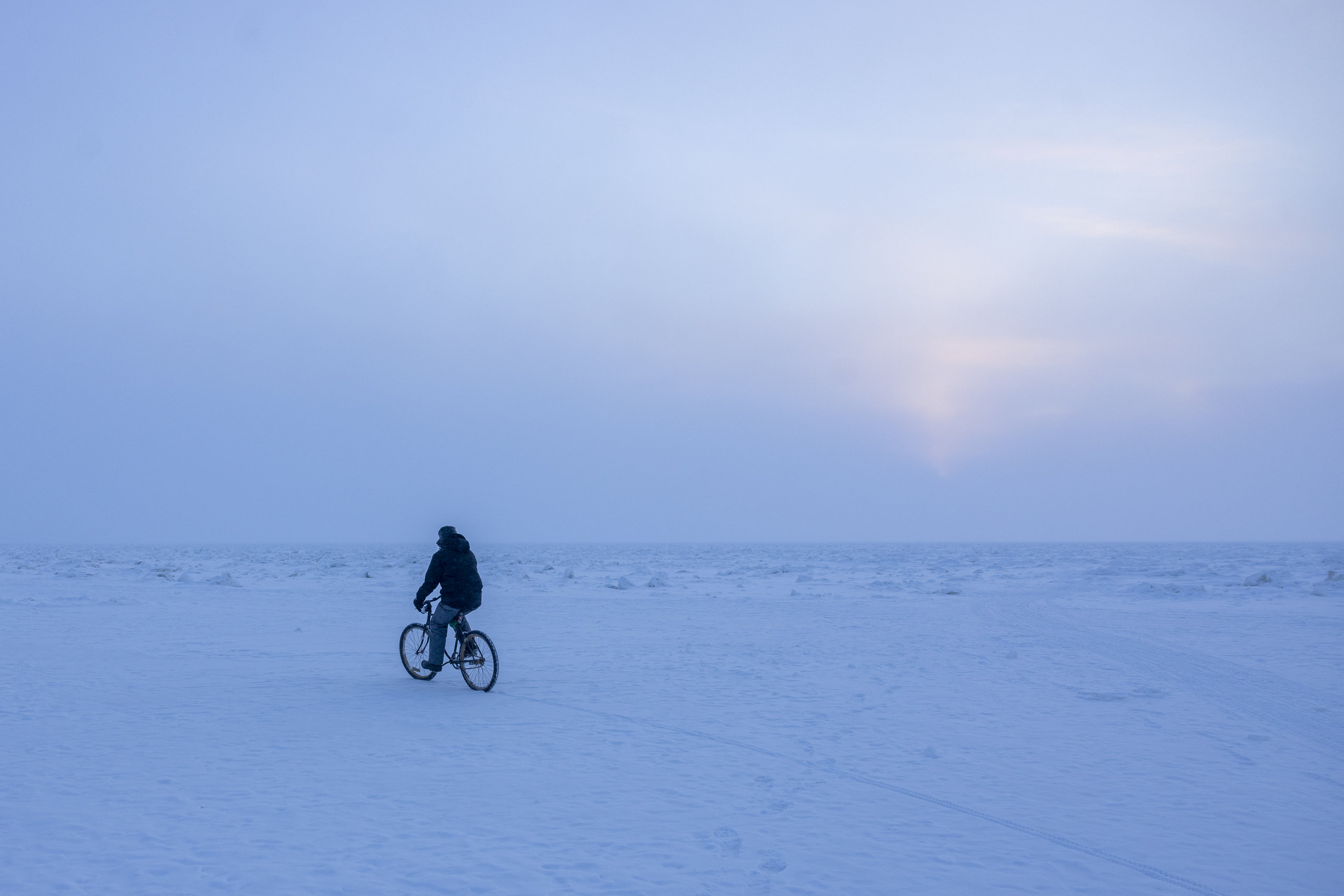
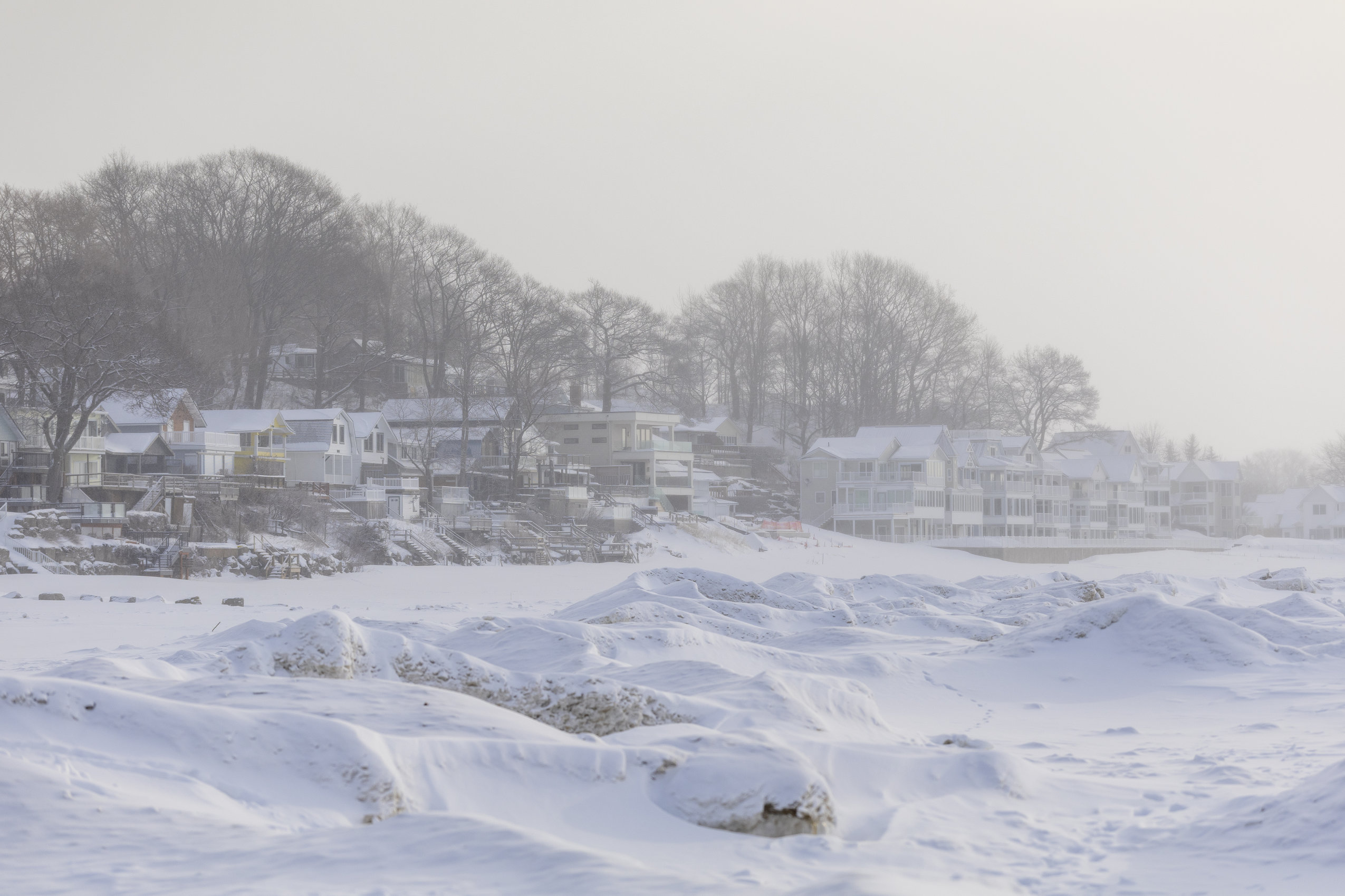
Among them was photographer Carlos Osorio, who captured the lake and the people who set out across it — on foot, studded-tire bicycle or all-terrain vehicle. Wind had sculpted blowing snow into rippling waves, as if the water, on a blustery summer day, suddenly stood still.

“When you think about water freezing, you think about smooth ice, and then you come here and the ice almost looks like frozen waves,” Frank said. “You can just imagine the water swelling up and down, but it’s not, it’s just frozen.”

Jay Augustine, a four-year resident of Crystal Beach, Ont., rode his bike with studded tires on the frozen lake.
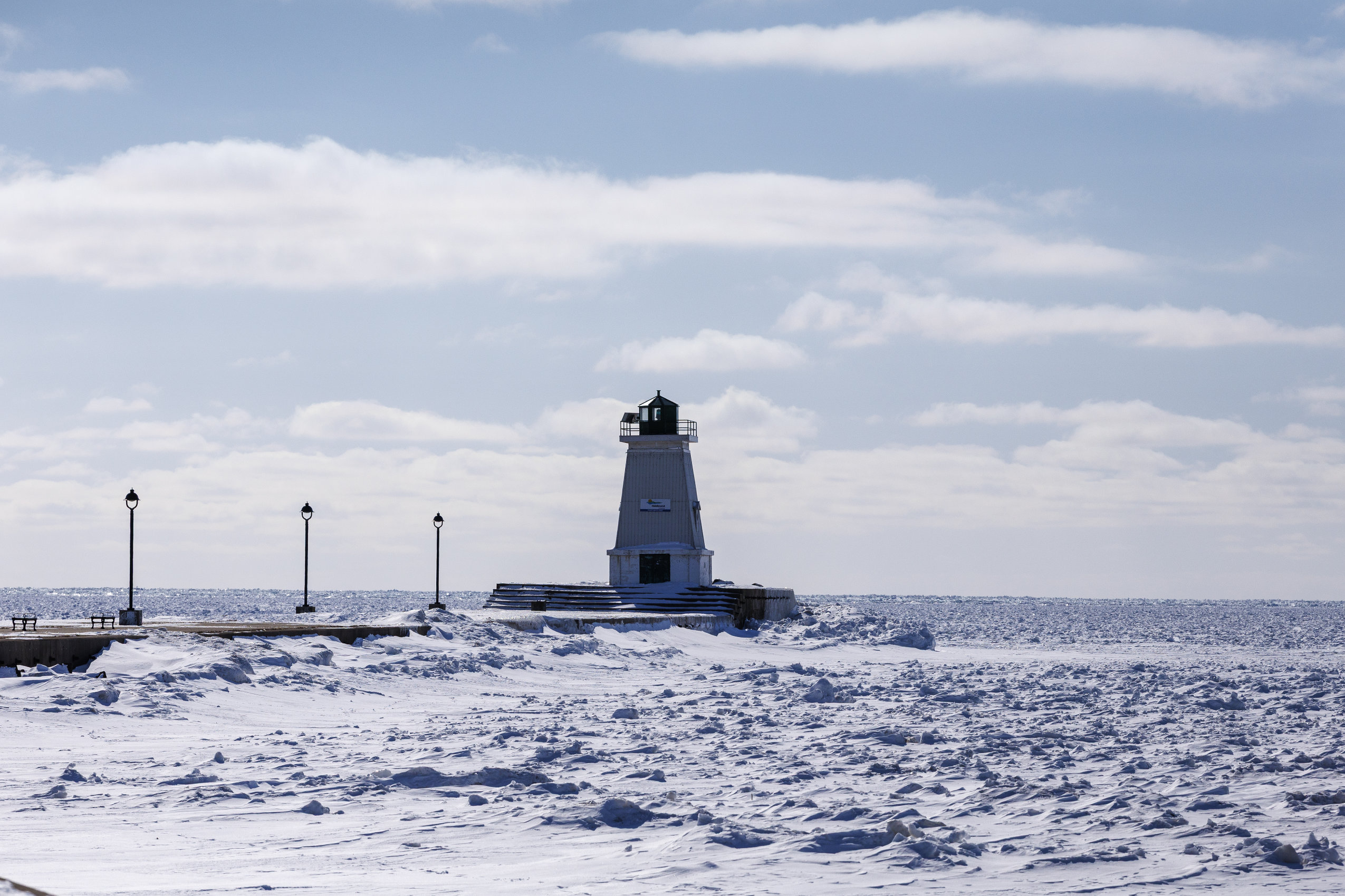
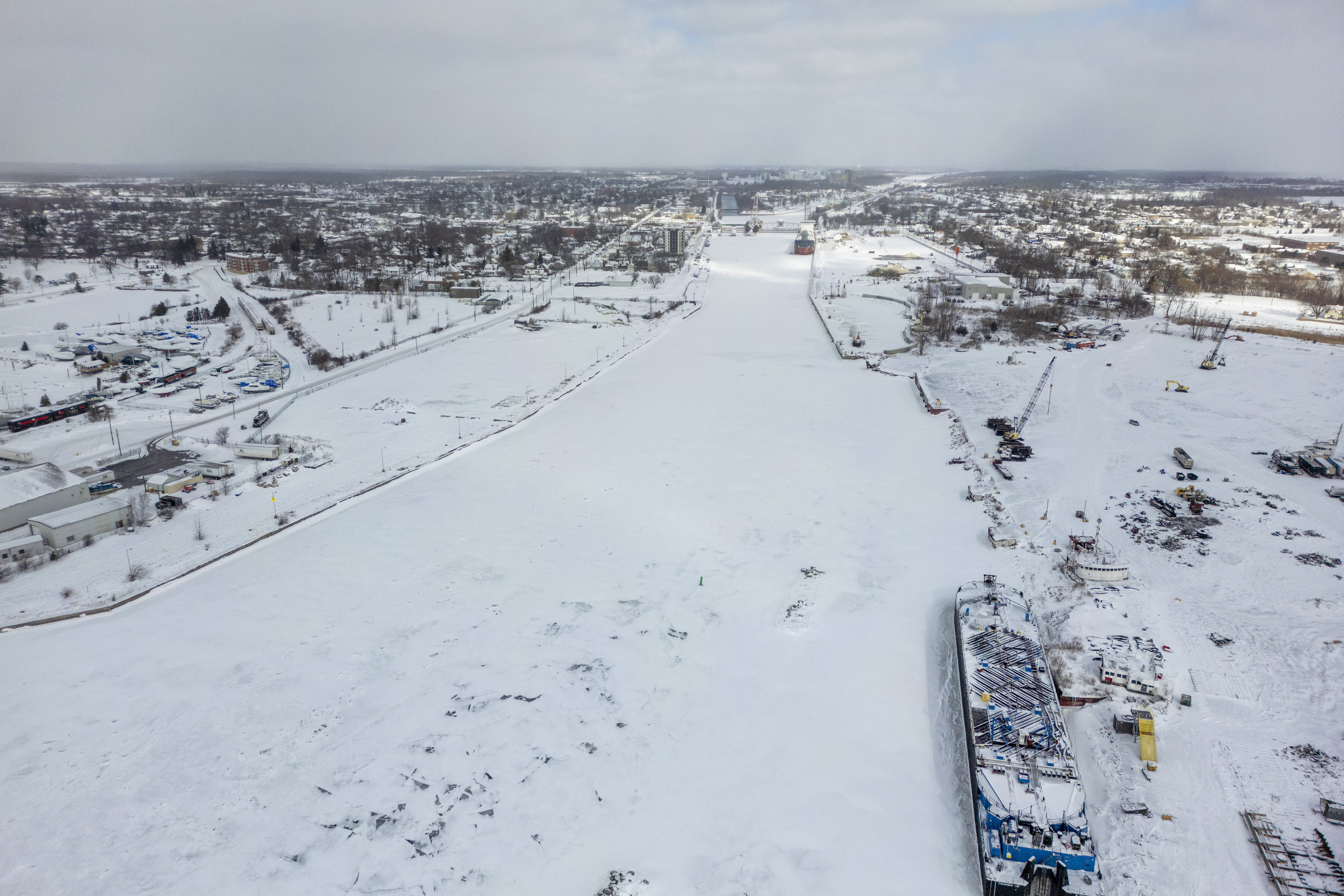
In Port Colborne, Ont., the Welland Canal that opens into Lake Erie froze over in the cold snap of early 2026.
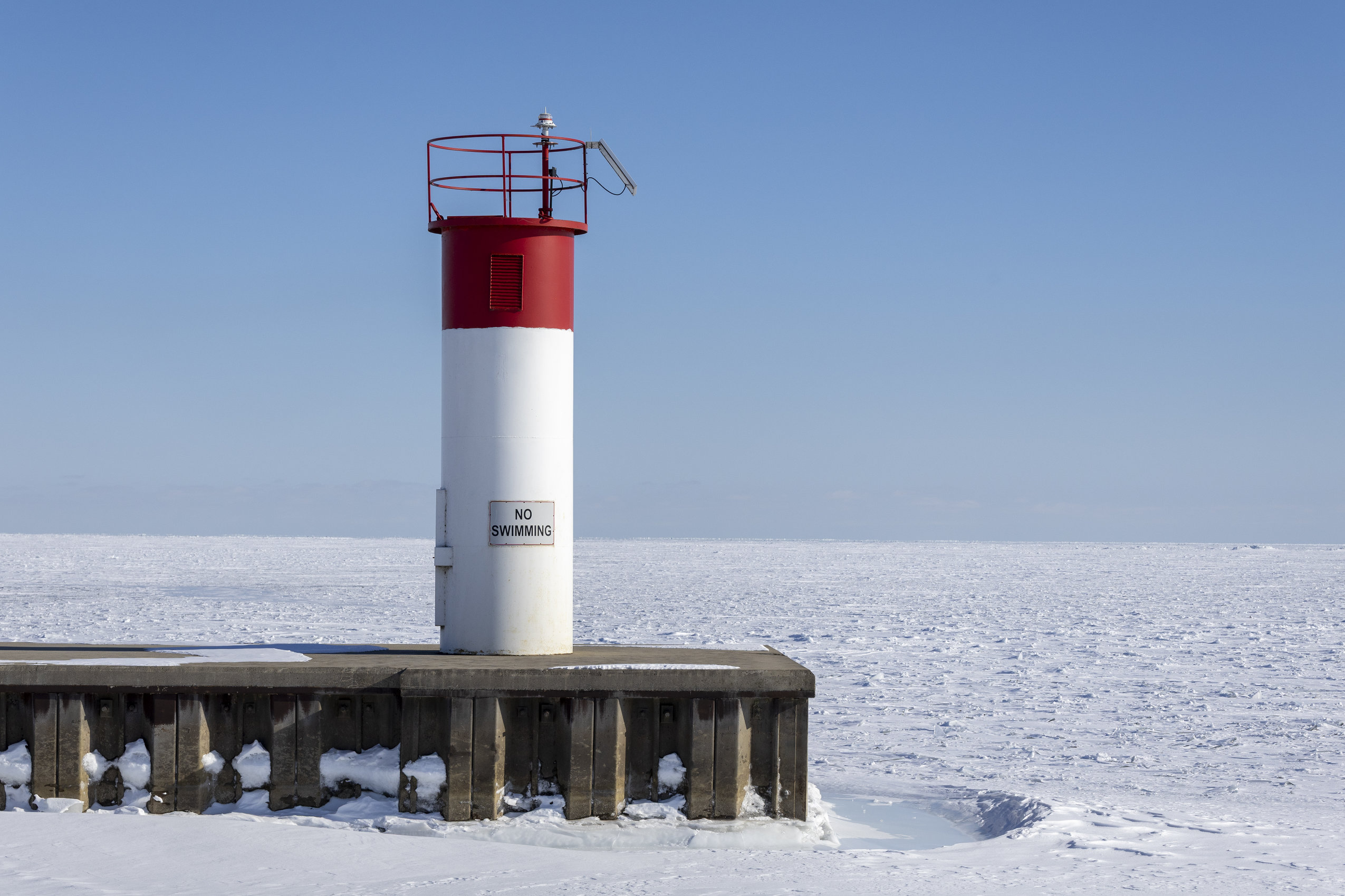
The town of Crystal Beach, Ont., crawls with tourists in the summer, but the snow-covered sand and piers sat quiet on a cold day in February.

“This is exceptional,” Gerald Meyering said, marveling at the amount of ice and snow on the lake, compared to recent mild winters.

— With files from Carlos Osorio

The post ‘So still, so quiet’: Lake Erie, frozen in a moment of time appeared first on Great Lakes Now.

Original Article

Great Lakes Now

Great Lakes Now

https://www.greatlakesnow.org/2026/02/24/so-still-so-quiet-lake-erie-frozen-in-a-moment-of-time/

The Narwhal

In September of 2025, dozens of people with indigenous roots from across the Great Lakes gathered on the banks of Michigan’s Au Sable River to harvest manoomin– or wild rice– the traditional way.

Manoomin is making a comeback in the Great Lakes. Once bountiful across the region, its existence has been threatened by dams and environmental pressures. Today, there is an effort among Anishinaabek peoples to restore and reconnect with this culturally important food.

Learn more on the Great Lakes Now YouTube channel.

This story was co-produced by Great Lakes Now, @OneDetroit, and BridgeDetroit.

#GreatLakes #Michigan #WildRice #Manoomin #Indigenous #History

===========================================
Website: https://greatlakesnow.org
Facebook: https://www.facebook.com/greatlakesnow
X: https://www.x.com/greatlakesnow
Instagram: https://www.instagram.com/greatlakesnoworg
Newsletter: https://www.greatlakesnow.org/great-lakes-now-newsletter/

To learn more about supporting Detroit PBS and Great Lakes Now, visit https://www.detroitpbs.org/

The post Harvesting Wild Rice the Traditional Way appeared first on Great Lakes Now.

Original Article

Great Lakes Now

Great Lakes Now

https://www.greatlakesnow.org/2026/02/24/harvesting-wild-rice-the-traditional-way/

Great Lakes Now

By Bauyrzhan Zhaxylykov

Bankruptcies of Michigan farmers are troubling despite a dip in their Chapter 12 filings last year. Major reasons are higher expenses for inputs such as fertilizer coupled with flat commodity prices.

The post Michigan farmers face bankruptcies, other financial challenges first appeared on Great Lakes Echo.

Original Article

Great Lakes Echo

Great Lakes Echo

https://greatlakesecho.org/2026/02/24/michigan-farmers-face-bankruptcies-other-financial-challenges/

Capital News Service

Target Conservation: Alternative Management for Increased Profits By Johnny Behrendt, Pheasants Forever | Written for the Winter 2025 Basin Buzz A common deterrent to the incorporation of conservation in farm business planning is the idea that it comes at a cost: fewer acres means less profits. While this may be [...]

The post Targeted Conservation: Alternative Management for Increased Profits appeared first on Fox-Wolf Watershed Alliance.

Original Article

Fox-Wolf Watershed Alliance

Fox-Wolf Watershed Alliance

https://fwwa.org/2026/02/23/targeted-conservation-alternative-management-for-increased-profits/?utm_source=rss&utm_medium=rss&utm_campaign=targeted-conservation-alternative-management-for-increased-profits

Tim Burns

In Traverse City, Michigan, crews are pouring a massive sorting channel that will form the core of the FishPass project, a globally unique structure in northern Michigan that’s designed to let native fish move upstream while blocking harmful invasive species like sea lamprey. Read the full story by MLive.

Original Article

Great Lakes Commission

Great Lakes Commission

https://www.glc.org/dailynews/20260223-fishpass-construction

Nichole Angell

The Bad River Band of Lake Superior Chippewa has filed a petition with Wisconsin’s Iron County Circuit Court to review a decision allowing Enbridge’s Line 5 reroute project to move forward as well as put a stop to construction until the Court considers their legal claims. Read the full story by the Wisconsin Public Radio.

Original Article

Great Lakes Commission

Great Lakes Commission

https://www.glc.org/dailynews/20260223-line5-opposition

Nichole Angell

The community-led Indigenous water research initiative, Ohneganos Ohnegahdę:gyo, has worked to address water insecurity through holistic capacity building grounded in Indigenous knowledge. These efforts will be expanded through a new Haudenosaunee Environmental Research Institute with Indigenous partnering hubs across the Great Lakes region. Read the full story by the Great Lakes Echo.

Original Article

Great Lakes Commission

Great Lakes Commission

https://www.glc.org/dailynews/20260223-water-insecurity

Nichole Angell

Part of Arcadia Dunes: The C.S. Mott Nature Preserve, Overlook Trail is a popular, universally accessible path that starts at Baldy Trailhead, just north of Arcadia off the M-22 scenic byway. All year round, this short walk through the woods ends with dazzling views of Lake Michigan from atop a high bluff. Read the full story by MLive.

Original Article

Great Lakes Commission

Great Lakes Commission

https://www.glc.org/dailynews/20260223-michigan-trail

Nichole Angell

Minnesota officials are calling on the city of Duluth to pay for a mistake believed to have led to a Tischer Creek fish kill that began in 2024. The city released about 1.7 million gallons from a drinking water reservoir into a designated trout stream causing damage along a 2-mile stretch of the waterway. Read the full story by Duluth News Tribune.

Original Article

Great Lakes Commission

Great Lakes Commission

https://www.glc.org/dailynews/20260223-duluth-fish-kill

Nichole Angell

The New York Department of State is developing an immersive extended reality experience and modular exhibit highlighting at least two “iconic” shipwrecks in what’s now the federally designated Lake Ontario National Marine Sanctuary. Read the full story by WXXI – Rochester, NY.

Original Article

Great Lakes Commission

Great Lakes Commission

https://www.glc.org/dailynews/20260223-shipwreck-exhibit

Nichole Angell

PFAS are posing a threat to the Great Lakes, one of America’s most vital water resources. Here’s what we’re learning about how PFAS are getting into the lakes, the risks they’re posing, and how to reduce those risks in the future. Read the full story by the Ohio Capital Journal.

Original Article

Great Lakes Commission

Great Lakes Commission

https://www.glc.org/dailynews/20260223-pfas

Nichole Angell

The Canadian Coast Guard Auxiliary has launched a recruitment campaign for volunteer search and rescue crew members. The unit provides marine search and rescue support across Lakes Erie and St. Clair and the Detroit River. Read the full story by The Windsor Star.

Original Article

Great Lakes Commission

Great Lakes Commission

https://www.glc.org/dailynews/20260223-coast-guard-volunteer

Nichole Angell

Almost a century ago, arctic grayling vanished from Michigan’s waters. Explore an effort to restore this long-lost fish. In Ontario, citizen scientists work to understand the damage that road salt is doing to local waterways. Author and forester Ethan Tapper discusses what it means to love a forest.

#GreatLakes #Fish #Ecology #Environment #Winter #Forest #Trees #Ontario #Michigan
===========================================
Website: https://greatlakesnow.org
Facebook: https://www.facebook.com/greatlakesnow
X: https://www.x.com/greatlakesnow
Instagram: https://www.instagram.com/greatlakesnoworg
Newsletter: https://www.greatlakesnow.org/great-lakes-now-newsletter/

To learn more about supporting Detroit PBS and Great Lakes Now, visit https://www.detroitpbs.org/

The post Restoring Grayling and Salting Roads | Great Lakes Now | Full Episode appeared first on Great Lakes Now.

Original Article

Great Lakes Now

Great Lakes Now

https://www.greatlakesnow.org/2026/02/23/restoring-grayling-and-salting-roads-great-lakes-now-full-episode/

Great Lakes Now

By Mia Litzenberg

The Six Nations of the Grand River face ongoing water insecurity from pollution, climate change and corporate extraction. Many years of Indigenous water advocacy have led to the development of a new Haudenosaunee Environmental Research Institute as the next step to overcome these challenges.

The post Water is Life, Six Nations lead international approach to long-standing water insecurity first appeared on Great Lakes Echo.

Original Article

Great Lakes Echo

Great Lakes Echo

https://greatlakesecho.org/2026/02/22/water-is-life-six-nations-lead-international-approach-to-long-standing-water-insecurity/

Mia Litzenberg

Flint, Michigan, is known for having significantly higher-than-average water rates, with residents paying some of the highest water bills in the nation, even after the Flint Water Crisis. Residents are facing a proposed 6.83% rise in water rates in 2026.  Read the full story by the Flint Courier News.

Original Article

Great Lakes Commission

Great Lakes Commission

https://www.glc.org/dailynews/20260220-flint-water-rates

Autumn McGowan

The New York State Department of Environmental Conservation announced the release of proposed changes to coolwater sportfish regulations that will help protect fish while spawning, increase the reproductive capacity of walleye in Lake Ontario’s eastern basin, and eliminate unnecessary special regulations. Read the full story by Lake Placid News.

Original Article

Great Lakes Commission

Great Lakes Commission

https://www.glc.org/dailynews/20260220-dec-regulations

Autumn McGowan

Saginaw Bay supports a productive fishery today, but much of its historic habitat was lost decades ago. Rock reefs are a critical habitat, and rebuilding reefs does not recreate the past — but it strengthens the ecological foundation needed to support resilient fish populations in the future. Read the full story by the Ludington Daily News.

Original Article

Great Lakes Commission

Great Lakes Commission

https://www.glc.org/dailynews/20260220-saginaw-bay-reefs

Autumn McGowan

Freighters cruise up and down the Detroit River, returning from or headed to the Great Lakes. But what happens when those freighters need something from the mainland? It turns out these boats utilize a unique mail service in Detroit that has been operating for more than 150 years. Read the full story by the Michigan Public.

Original Article

Great Lakes Commission

Great Lakes Commission

https://www.glc.org/dailynews/20260220-ship-mail

Autumn McGowan

By Ada Tussing

If you’ve noticed fewer birds in the sky recently, they haven’t all flown south for the winter. The North American bird population has dropped nearly 30% in the last 50 years. Mariette Nowak's book "Birdscaping for Wisconsin and the Great Lakes Region" offers a solution: birdscaping.

The post Fight climate change from your garden with ‘birdscaping’ first appeared on Great Lakes Echo.

Original Article

Great Lakes Echo

Great Lakes Echo

https://greatlakesecho.org/2026/02/20/fight-climate-change-from-your-garden-with-birdscaping/

Ada Tussing

Ben Hlaban and Nick Heise: Restoring the Little Wolf River after Manawa’s flood

After a major flood in 2024 destroyed a dam and mill pond in the Little Wolf River near Manawa, Wisconsin, fishing enthusiasts Ben Hlaban and Nick Heise wondered what it would be like if the river just stayed a river. 

River Alliance Communications Director Stacy Harbaugh spoke with Ben and Nick in an interview for the VMO Show on WVMO-FM about why they are personally invested in river restoration in their community. Hear the conversation on our YouTube channel.


Full interview text

The following interview has been edited for brevity and clarity.

Stacy: Welcome to the VMO show. I’m your host Stacy Harbaugh and with me in the studio today are Nick Heise and Ben Hlaban. They’re both residents or property owners of the greater Manawa area and they’re here to talk to us about what happened when the Little Wolf River flooded, a dam broke and made a big impact on their community. They’re also going to share their ideas for the future of the Little Wolf River and what river restoration may look like in their community. I think what happened in your community and to the Little Wolf River are things that more people in Wisconsin should know about. I’d love for you to tell us a little bit more about about what happened, when it happened, and how that impacted your lives.

Nick: Sure. It was early July. We got about eight inches of rain in a matter of a couple hours. And all the hillsides that surround Manawa, all that water came into town. It flooded the nursing home; they had to be evacuated. Several homes as well. That was actually before it hit the mill pond. But then all that water ended up in the pond and the dam wasn’t able to hold all that back. It started eroding a dirt embankment along the side of the dam. The cement structure stayed put, but the dirt embankment on the side started eroding and there was no stopping it at that point. All that water came down rushing through the river.

The annual rodeo is going on, the big event of of the area there. They had to evacuate all the cows, all the people. All the horses and everything like that had to be evacuated because that lies right along the river, down farther. That all happened successfully. There’s very minimal damage. Actually the river itself handled it pretty good. It obviously shook people up. I mean, the mill pond was important. It was part of the logging industry way back in the day. It was a grist mill as well. So the dam had its use at one point. When it went out, it was producing electricity. Not a lot, but it was doing some. So obviously this concerned everybody in Manawa. A lot of people lost their their frontage because the pond shrunk considerably down to just the river channel. For some people up river, it’s a little bit shallow river now. So it definitely affected plenty of people. And a lot of them have their concerns about it. Most people, I think, want their water frontage back. They don’t necessarily see both sides of it. I, myself, look at that and I saw opportunity. So yeah it’s been an interesting time for sure. Learned a lot about dams ever since then.

Ben: We were at our cottage when it happened. It was the rodeo weekend, Fourth of July weekend. The rodeo is Manawa’s big, annual event. It’s a big time fundraiser for them, and draws a lot of people into town. And we were up at our cottage, and my son had gone to the rodeo that night, on Thursday night, when the rain started. He got rained out at the bull riding event which is the last event of the evening and they ended up leaving early. But like Nick said, they just got a tremendous amount of rain in that short period of time. And another thing to note was like the ground was had already been pretty saturated. We had had a good amount of rain leading into that. It was ripe for a lot of runoff to happen. We tried to go in town because we have a business downtown that we’re renovating and we were curious if the flooding had affected it, but they had everything pretty much blocked off and they were really focused on getting people to safety out of the flood plane areas along the river where the rodeo ground was and all of the animals, too. So, thankfully there was no loss of life. But there was definitely a lot of sediment washed downstream from that. That dam was there, and that mill pond was there for over a hundred years, collecting silt and sediment that, unfortunately, washed downstream. So, that was that was very unfortunate. And I know a lot of the land owners downstream were impacted by that.

Nick: Pretty hectic for a while.

Stacy: Wow. Well, as our climate gets warmer and wetter and we start seeing more of these “100-year rain events,” this is a huge impact of our weather on communities like Manawa, communities that are built around these man-made structures like dams. And when the dams go, when that infrastructure fails, it makes a huge impact on people. It sounded like that was a lot of people’s worst day.

Nick: Yeah. Yeah, it was.

Ben: Yeah, for sure.

Nick: But potentially a silver lining in the end.

Stacy: You say that there’s a lot of opportunity to be to be had there.

Nick: I think so.

Stacy: So, tell me what does the area look like now around the the place where the dam failed, but also where that mill pond was. Can you paint a bit of a picture of what it looks like right now?

Nick: So, the dam structure is still there. Will have to be removed at some point on the side where it eroded. There’s a library near there. They were worried about that potentially getting washed in as well. Since then that’s been stabilized, rip-wrap along there and everything, pilings were put in. So that’s stable. Now the pond bed itself has grown up into various weeds, if you will, and there’s some definitely some native stuff growing in there as well. We noticed some native wild flowers when we were kayaking through there this summer. Personally, I think it’s beautiful. I think there’s a lot of animals around in there now. My wife’s aunt lives on the pond. She sends pictures of deer that are walking around in the pond bed and foxes are running around out there and everything. It’s different. I don’t think it’s worse. I don’t think it’s a bad thing by any means. I think it’s nature restoring itself.

Stacy: So Ben, I bet you’ve been going to a lot of city council meetings to talk about this issue because there’s a lot of decisions that need to be made around funding and figuring out what’s next for what’s left of the dam and what’s happening with the river. So tell me your experience in getting involved and talking to government.

Ben: Absolutely. The city council met and voted unanimously that they wanted to pursue rebuilding, restoring the mill pond. And I hadn’t really gotten involved for the first couple months. I kind of was just sitting back, taking it all in. And I’m a lifelong trout fisherman. I’ve been in trout streams and rivers my whole life. So, I have a personal reason to make it stay a river, but I wasn’t willing to speak out publicly. But then Manawa has a “What’s happening in Manawa” Facebook group, and I keep an eye on that. One day I saw this post that Nick put out there. And I didn’t know Nick at the time. I mean, I knew of him, but we hadn’t met. And he put something out to the effect of like, hey, would it be so bad if it just stayed a river? It’s pretty cool. The river’s recutting a channel, the (pond) weeds are, you know, all washed away and the water’s looking really good, and the fishing… I’m catching fish and would this be so bad, you know? And that was really what spurred me. I was like, “Oh, okay. There’s there’s other people out here that that feel the same way.” So, I reached out to Nick and we connected and since then it was like, “Well, what do we do?” Well, I think we need to go to the city council meeting and get informed on what’s going on and where their head is at and stay informed. So I started attending the city council meetings monthly and they had a few ad hoc meetings that were specific to the dam that they had scheduled that we attended.

The other thing that I did was I started to take my drone (to get) footage, because I was like, man, I wish I’d have done this right after the dam went out so that you would have seen the amount… because right after the dam went out, I mean, it was a kind of a mucky looking, ugly mess. You looked out there and it was just like a wasteland out there. That honestly within a couple months there was vegetation starting to come back in. But I wanted to fly the drone to see how the river would change and if it would cut channels. But it was pretty amazing. Like I I feel like that’s the original channel that the river is in right now. And we’ve floated it. You can’t see a lot of the effects from the drone footage, but if you get out there and you float down through it, you can see areas that are getting deeper, getting shallower, you know, where sediment’s accumulating, but the river is just doing what a river does. Which is kind of cool.

So, that was really what spurred me to get involved and attend these meetings. There’s been a lot of discussions … and this isn’t really like a damn removal, where it was a planned event, right? Mother nature really kicked this off for everybody and brought it to the forefront. It was interesting because the Town of Little Wolf had an agreement and I’m not exactly sure what the percentage that they were paying in maintenance, but they came to the city and they’re like, “We don’t want to have any part of this anymore.” This was before the dam went out, so they didn’t want to pay the money to to keep maintaining the dam because every 10 or 15 years they were having to do some stuff. So they rescinded their dam agreement. Well then now as we’ve gone through this process and attended these meetings you’re seeing that the Town of Little Wolf is now changing their position and they’re wanting to get back involved, which is good. I mean, these types of things really bring out people. They spur people into action. But I wanted to make sure that there were people speaking up in support of the river and mother nature and some of the benefits of having those free-flowing rivers because I think a lot of the people that we were hearing from were just the land owners, which I totally understand. You lose some land, some water frontage, it goes from a pond to a river. But I just wanted to speak out and be a voice for the river because it’s one of those things where, if it’s not me or Nick, like who else is going to stand up and do this? I’ve got a long history with Trout Unlimited, and we’ve done stream restoration work on a much smaller scale than the Little Wolf River, but I kind of have familiarity with how rivers work and and how they change over time and how resilient they can be and how important they are to clean water.

Stacy: What motivates you to get involved, Nick?

Nick: I’ve been standing in that river since over 30 years. I’m 47 now, and I think I was about 10 when I started fishing the river. Obviously that was below the dam at that time. I had a lot of good fishing down there then. My wife and I were kayaking it after the dam went out and I just looked at that and I was like look at this, Casey. The water’s getting clearer. This is nicer. I mean all these weeds are gone out of here now. What if this just stayed a river? How cool would that be? You I mean it’s going to clean itself up. Maybe we could turn (the banks) into a a field of of wild flowers. How cool would it be to have an area like that? And the the pollinators definitely need it. And I thought, well, that could also help clean up the river. This river flows into the Wolf River. That needs to be cleaner as well. Have how nice would be to have clean water flowing down through that. All I see is potential when I look at the dam being gone. I just see great fishing. I see good paddling, kayaking. I see great community events. You know, you can do all kinds of things that support a river versus the pond.

Stacy: And this is what you need to make any kind of change is to have that clearer vision of what something could be if everyone can get behind this beautiful future that you want to build. So, one last question. What’s the next steps for for you guys? How are you building a community around river restoration and what’s to come? I know it’s hard when it’s snowy and cold outside, to be thinking about paddling in the future, but you’re future-oriented. So, what’s next?

Nick: It’s trying to convince the community that this could be better. And it’s definitely not easy. You got vocal land owners that have a very good reason to to be upset and to want their dam back. I get that, but I don’t know that they see the big picture here. I think they’re thinking a little bit of themselves and not of the planet, of the future, of the whole picture. If we could get a few people to flip on that, I think that would be a big thing. There are some land owners upstream that are in support of it. We’ve got a little Facebook group called Friends of Little Wolf River. A couple of them joined up on that. We just try to educate where we can, you know, and it’s a big hurdle. There’s no doubt.

Stacy: Well, I know we’ve got a lot of listeners who are excited to come up and visit and paddle the Little Wolf in the future. So, thanks to your advocacy, hopefully we’ll be able to do that.

Ben: Yeah, absolutely. I mean, that’s one of the things that we’re trying to work on. We did a little bit of a river cleanup last year with our small group. Nick mentioned we had a Facebook group that we started to gain some support and identify people who were like-minded. And we did a cleanup and I think we’re talking about this coming summer having some sort of a paddle event. So, keep an eye out for that. And you don’t need an event to come up and paddle. You can come up anytime.

Nick: There’s plenty of access points. There’s great little shops downtown Manawa to stop into. There’s food and everything like that. So, it’s a nice area.

Stacy: Well, Ben, Nick, thank you so much for being here today. I know we’ve got lots of listeners who are excited about paddling. And the good news is is that no matter where you live in Wisconsin, there is probably a community organization that you could check out and learn more about the water that’s in your backyard and how you can protect it. So, thanks so much for listening to the VMO show. I’m your host Stacy Harbaugh. Thanks to Nick and Ben for being with us today and thanks for listening.


– Stacy Harbaugh, Communications Director


This message is made possible by generous donors who believe people have the power to protect and restore water. Subscribe to our Word on the Stream email newsletter to receive stories, action alerts and event invitations in your inbox.  Support our work with your contribution today.

The post Ben Hlaban and Nick Heise: Restoring the Little Wolf River after Manawa’s flood appeared first on River Alliance of WI.

Original Article

Blog - River Alliance of WI

Blog - River Alliance of WI

https://wisconsinrivers.org/manawa-flood-little-wolf-river-restoration/

Allison Werner

Data Center bills in the Wisconsin State Legislature

On February 17, 2026 the Wisconsin Senate Committee on Utilities, Technology, and Tourism held a hearing on data center development bills. River Alliance’s Agriculture and Policy Director Mike Tiboris attended the hearing and submitted the following testimony on why our state should pause new data center construction until our leaders fully understand the implications of how industries with extreme energy and water demands will have on our resources.

Chair Bradley and the members of the Committee on Utilities, Technology, and Tourism:

Thank you for holding this hearing for several bills on the emerging issues related to data center development in Wisconsin. River Alliance of Wisconsin has registered neutral on SB 729 and opposed on both SB 843 and AB 840 as written. River Alliance is a statewide nonprofit, nonpartisan advocacy organization that empowers people to protect and restore Wisconsin’s waters at a local level. The organization’s supporters include more than 5,000 individuals and businesses and nearly a hundred local watershed organizations. 

All of these bills recognize that we must thoughtfully confront the sudden construction pressure from a rapidly evolving technology. Our concern is that we do not allow Wisconsin’s water, among our most valuable public assets, to be mortgaged for unproven benefits and without adequate protection. A medium-sized data center consumes as much water as 1000 households per year for cooling (110 million gallons). Rapid and improperly regulated data center construction poses a potentially serious threat to our natural water resources. The benefits to Wisconsin of data center construction are unproven, but the hazards to our water are quite clear. Data centers directly use water to cool servers that generate heat either through evaporative cooling or through the addition of contaminants that can be discharged in wastewater and enter the environment. Further, these facilities may invite the construction of new hydropower facilities on already taxed river systems and cause aging, outdated, facilities to stay online. Often touted as “green”, hydropower operations can cause myriad negative environmental impacts, from preventing fish migrations to reducing water quality and water quantity at critical times of the year, affecting aquatic life and recreation.

Our preference in this moment of uncertainty would be to pause all new data center construction until we can develop appropriate legislative mechanisms for managing its downsides. Legislators’ recently proposed moratorium on data center construction should be used to give the Legislature time to create thoughtful controls that ensure new data centers actually benefit Wisconsinites and do not cause problems we could avoid if we took the time to prepare for them. Our abundant natural water and land resources are an obvious attraction for companies that want to build projects in Wisconsin, but we should be very careful to make sure the benefits are not simply handed to companies to export from the state for their own profit at the cost of damage to an irreplaceable public good and, at best, uncertain employment or tax benefits.


SB 729

River Alliance has registered neutral on SB 729. We are supportive of the bill’s emphasis on making sure that data centers pay for the energy that they use and that their usage does not drive up the cost of energy for Wisconsin homeowners. Similarly, it is common sense that such large water users should be required to report on their usage when it accounts for 25 percent or more of the total water usage of all customers for a water utility. Enforcing transparency about usage will help communities, utilities, and municipalities respond appropriately to water demand increases that could have very negative effects on local water sources, ecosystem health, and the costs of water provision.

We support the idea of encouraging data centers to rely on renewable wind and solar energy sources. SB 729 would require that at least 70 percent of the total annual electric energy used by the buildings be derived from renewable resources, as defined under s.16.75(12)(a)4. The definition of “renewable energy” referenced, however, includes hydropower, and we do not support the construction of new hydroelectric generation facilities to power data centers. 

Many people believe that hydropower, which uses dams and gravity to spin electricity generating turbines, is a clean, climate-smart, energy source. This is a misconception. While wind and solar power offer renewable low-carbon energy and are generally cheaper than fossil fuels, hydropower can cause environmental damage. Dams and reservoirs alter river flows, raise water temperature, degrade water quality, increase sedimentation in reservoirs, and prevent migrations of fish and native mussels harming aquatic ecosystems and Wisconsin communities. Reservoirs are a significant source of greenhouse gas emissions, predominantly methane, an especially potent greenhouse gas, that results from eutrophication and harmful algal blooms.

Again, River Alliance supports the approach that SB 729 takes to create water usage transparency and accountability, to ensure that the costs of new energy and water demand are borne by the data centers and not by other customers, and to encourage the use of renewable energy like wind and solar as power sources. We are concerned that, in its current form, the bill will encourage expansions of hydropower generation that will extensively damage aquatic ecosystems and may be more destructive to the climate than fossil fuel use in some cases.


SB 843 and AB 840

The above reasons also underwrite our opposition to both of these bills as written. The bills require that “any renewable energy facility that primarily serves the load of a data center must be located at the site of the data center.” (Section 2. 196.492(2), lines 16-17). Again, using the definition of renewable energy from s. 196.378 (1)(fg), we are concerned this will encourage the construction of new, environmentally damaging, hydropower facilities. Limiting the use of renewable energy to sources constructed on site is unnecessarily restrictive and would likely have the effect of discouraging renewable energy use entirely. Because the bills do not explicitly require that data center owners pay the full cost of their energy use, this will drive up the cost of energy for Wisconsin residents while increasing pollution.

However, the requirements to require reporting to the DNR about annual water usage and to ensure that the costs of reclamation and failure of the facility are borne by the data center owners are sensible. 

We are encouraged by the serious interest the Legislature is taking in managing the environmental consequences of data center construction. Given the likelihood that the industry will expand rapidly in the coming years, we hope this is the beginning of a sustained conversation about how to ensure that the benefits of data centers accrue to Wisconsinites and that these do not come with irreparable harm to our land and water resources.

– Mike Tiboris, Agriculture and Policy Director


This message is made possible by generous donors who believe people have the power to protect and restore water. Subscribe to our Word on the Stream email newsletter to receive stories, action alerts and event invitations in your inbox.  Support our work with your contribution today.

The post Data Center bills in the Wisconsin State Legislature appeared first on River Alliance of WI.

Original Article

Blog - River Alliance of WI

Blog - River Alliance of WI

https://wisconsinrivers.org/data-center-bills/

Allison Werner

This story is part of a Great Lakes News Collaborative series called Shockwave: Rising energy demand and the future of the Great Lakes. The Great Lakes region is in the midst of a seismic energy shakeup, from skyrocketing data center demand and a nuclear energy boom, to expanding renewables and electrification. In 2026, the Great Lakes News Collaborative will explore how shifting supply and demand affect the region and its waters.

The collaborative’s five newsrooms — Bridge Michigan, Circle of Blue, Great Lakes Now, Michigan Public and The Narwhal — are funded by the Charles Stewart Mott Foundation.


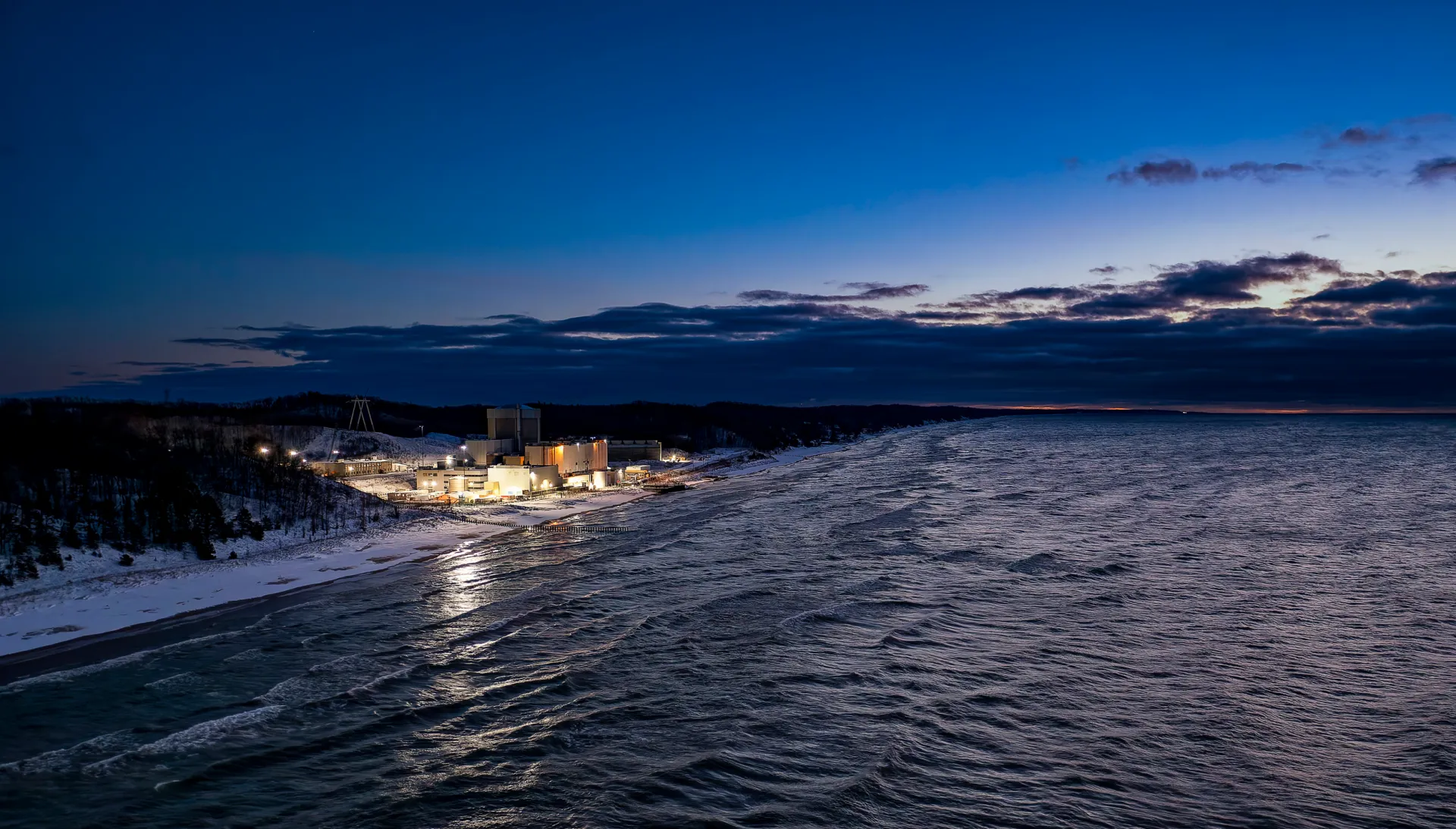
COVERT TOWNSHIP, Mich. – As a study in troubled operation, the Palisades Nuclear Plant once was ranked by the federal government as one of the four worst-performing nuclear power stations in the country. The 51-year-old facility closed in 2022, joining Big Rock Point near Charlevoix and 11 other nuclear plants decommissioned outside Michigan in what appeared to represent the sunset of the era of splitting atoms to produce electricity.

Not so fast. Sometime in the next few months a New Jersey-based company called Holtec International is expected to finish renovating Palisades, fire up the old reactor, and add 800 megawatts of generating capacity to Michigan’s electricity supply. It would be the first time a decommissioned nuclear plant has ever restarted in the United States. 

And that’s not the only game-changing nuclear development occurring at the Palisades site along the Lake Michigan shoreline in the state’s southwest corner. Holtec is busy seeking permission from the Nuclear Regulatory Commission, the federal licensing and safety agency, to start construction for a new 680-megawatt nuclear generating station next door to the old reactor. The company wants to power the new plant with not one but two 340-megawatt advanced small modular reactors. 

So-called “SMRs” are now viewed by the industry, government, utilities, and big energy consumers as one of the go-to electrical generating technologies of the 21st century. Holtec’s planned Pioneer I and II small reactors, and its Palisades reactor restart, signal the opening of a new era of electrical supply and demand in the Great Lakes basin. 

Holtec’s commitment to nuclear power, like other developers in the U.S. nuclear sector, is motivated by several converging and unconfirmed projections that are prompting billions of dollars in investment. By far the most important are that the cost of building nuclear plants will fall, and that demand for electricity will significantly increase. Nuclear developers and utility executives have embraced both optimistic scenarios, especially that electrical demand could increase as much as 50 percent by mid-century, driven by data center construction, new manufacturing plants, growing cities, and electrified transportation. Both of Holtec’s projects in Michigan, and several more developments by other companies in Wisconsin, Ohio, Illinois, and Ontario, are giving nuclear power new purchase in the region’s energy landscape.

One of the most influential supporters is Michigan Gov. Gretchen Whitmer, who is positioning Michigan at the lead of the nuclear revival era. She declared in a statement that opening Palisades and adding the SMR plant “will lower energy costs, reaffirm Michigan’s clean energy leadership, and show the world that we are the best place to do business.” 

Gov. Whitmer signed legislation in 2023 mandating that 100 percent of the state’s electricity come from “clean power” sources, among them nuclear energy. Michigan awarded Holtec $300 million to restart Palisades, a portion of the public funding package that included $1.52 billion in loan guarantees from the U.S. Department of Energy. The Energy Department also awarded Holtec $400 million more to develop the new SMR plant. 

A study of SMR development by the Department of Energy in 2023 found that construction costs for the first plants, like the one Holtec is planning, will be high because of limits on the supply chain providing parts, construction experience, and unknown interest rates for financing. At current estimates of SMR construction costs of $12 million to $15 million per megawatt, Holtec’s 680-megawatt plant could be put into operation at a cost of $7 billion to $10 billion.

Michigan’s bid to stimulate new markets for nuclear energy, moreover, are still dogged by old concerns about safety, waste management, and the cost of construction and operation. Three public interest groups filed a federal lawsuit in November asserting that opening the old Palisades reactor was illegal and unsafe. The case is pending in Federal District Court in Grand Rapids.

Safety, Cost, Waste Addressed

By any measure, managing high-level radioactive waste from commercial reactors has not changed much in the last half century and persists as an issue because no permanent waste repository has been established in the U.S. But other considerations of the risks, benefits, and cost of nuclear power are tilting in new directions, especially for SMR plants like the one Holtec is proposing in Michigan. 

SMR developers make a consistent case for proceeding with the new technology. 

Water consumption looks to be an environmental advantage, particularly in water-abundant regions like the Great Lakes. Holtec’s environmental statement filed with the NRC reports that the two reactors will draw 25,000 gallons a minute for operation, as much as 36 million gallons a day. At that rate the new plant, which is 15 percent smaller than the existing Palisades plant, will withdraw 75 percent less water. 

Because of its more compact 123-acre footprint, the new Holtec plant would easily fit onto the 438-acre site that already encompasses the existing reactor. It will transmit electricity with the existing powerlines and infrastructure. And like other commercial reactors, SMRs don’t discharge climate-warming gases, a big factor in why nuclear power has gained considerably more support in public polling in recent years.

When it comes to operational safety, Holtec and other SMR plant developers say their designs also answer that concern. The advanced modular reactors are smaller and contain less fuel, produce lower levels of radiation, and can operate at a lower temperature and pressure than big conventional reactors. Those properties enable engineers to design a reactor that can be cooled with water or air, and can be shut down with gravity-fed systems that don’t rely on mechanical pumps. 

“When it comes to safety the question is, ‘How do I keep this cool?’” said Brendan Kochunas, associate professor of nuclear engineering at the University of Michigan. “And that comes back to the amount of fuel that you have in the core. SMRs have smaller cores. There’s less heat being produced so you need to remove less heat.”

Industry executives assert that because the reactors are smaller than conventional 1,000-megawatt plants, they will require fewer construction materials, take fewer years to build, and be less expensive to operate. Industry executives say their goal is to standardize designs so that parts can be manufactured and new reactors can be assembled and shipped on trucks or by rail.  And because SMR plants have multiple reactors, one can be shut down for maintenance while the others continue operating. 

“In discussions we’ve had about small modular reactors, there may be lower upfront costs and potentially faster deployment because you don’t have quite as much concrete,” said Scott Burnell, the spokesman for the NRC in an interview. “And once you get into operation, the concept is you’ve got several small reactors running. If you bring one down for maintenance, you still have others running, generating profit.”

Race For Orders

Holtec is competing with 30 other SMR developers in the U.S. to be among the first to bring its reactor to market. Patrick O’Brien, the Holtec spokesman, explained that the company has spent 15 years designing the SMR-300, preparing architectural plans for the generating station, and keeping the NRC informed of its activities. Though the SMR-300 has not received an operating license, O’Brien said Holtec is confident it will be approved and the plant would be operating in 2032. “A lot of the work was done up front,” he said. “We’re anticipating two and a half more years’ worth of licensing work from the NRC. And two and a half years of construction.”

That’s an optimistic schedule for new nuclear plants. NuScale, an SMR designer based in Oregon, licensed its first 66-megawatt reactor with the NRC in 2023. It has yet to build a new plant. NuScale’s first project to install seven SMRs at a 462-megawatt plant in Idaho collapsed after construction cost estimates increased from under $4 billion to more than $9 billion. 

The NuScale experience reveals that uncontrolled costs are a primary impediment not just for big traditional reactors but also to SMR development. SMRs don’t exist in North America or Europe, and just three SMRs operate in the world – two 35-megawatt reactors operating on a ship in Russia and a third 125-megawatt SMR in China. “One always has to remember that these are experimental technologies,” said Joseph Romm, a physicist and senior research fellow at the University of Pennsylvania. “Both the Russian and Chinese reactors had huge cost overruns.”

According to an important study published last year by the University of Michigan, SMRs also may produce new environmental risks that could attract more review. Small reactors, for instance, have the potential to introduce new and unregulated byproducts and increased levels of radioactivity due to the demand for highly enriched uranium fuel, according to the report, “The Reactor Around The Corner.” 

Another likely environmental risk is deploying small reactors to power big industrial projects in the world’s wild and undeveloped places. SMRs pack a lot of energy into a small and portable power source, said the report’s authors, who projected that the small reactors will enable construction of big mines and industrial plants in terrain that has been too expensive to reach or entirely inaccessible. “SMRs will introduce and exacerbate direct and indirect environmental harms, especially on marginalized communities, that complicate the justification for using them to mitigate climate change,” they wrote.

Midwest Familiarity with Atomic Technology 


To date, elected leaders and residents in Michigan and the other Great Lakes states have responded to the opening of a new era of nuclear development with much more enthusiasm than alarm. That may be due principally to the region’s pioneering role in fostering atomic energy. The first nuclear chain reaction occurred at the University of Chicago in 1942. Argonne National Laboratory opened in Illinois in 1946 to serve as the center of atomic research and technology development. The Shippingport Atomic Power Station in Pennsylvania opened in 1957 as the first commercial nuclear generating station.

Not since the height of commercial nuclear energy construction in the 1960s and 1970s have Great Lakes states seen such a concentration of new nuclear projects either underway or planned. The Palisades restart would push the number of operating nuclear reactors in the eight states to 24, second only to the more than 30 big reactors operating in the six Southeast states. 

More big reactors could be on the way. DTE Energy notified the NRC last year that it is actively studying the development of a new reactor at its Fermi Nuclear Generating Station south of Detroit along Lake Erie. 

SMR plants, too, are attracting attention in the Great Lakes basin. Ontario Power Generation is constructing a 1,200-megawatt plant, composed of four 300-megawatt SMRs, at its Darlington Nuclear Generating Station along the shore of Lake Ontario. It could be the first operating commercial SMR plant in North America. 

Utah-based EnergySolutions is proposing to build “new nuclear generation” along the Lake Michigan shoreline in Wisconsin at the Kewaunee Power Station, which closed operation in 2013. Oklo Inc., a California company, is proposing a SMR reactor in Portsmouth, Ohio, where a closed federal plant once enriched uranium for nuclear weapons. The University of Illinois notified the NRC that it is developing a gas-cooled SMR research reactor at its campus in Champaign-Urbana. 

The surge of interest is the second time this century that utilities, government, and investors have tried to revive nuclear power in the U.S., and is driven by many of the same factors. One is federal policy to promote nuclear projects. The second is a tide of government financing that can be traced back to 2021 when President Biden signed the $1.2 trillion Infrastructure Investment and Jobs Act that directed $8 billion to nuclear energy. Three years later Biden signed the ADVANCE Act to make it easier and less expensive for nuclear plant developers to license their designs with the NRC.

President Trump also supports nuclear energy. He signed four executive orders in 2025 to accelerate the deployment and integration of advanced nuclear reactor technologies, and directed federal agencies to take aggressive action to build a nuclear production industry to mine and enrich uranium and construct manufacturing plants to fabricate fuel, reactors, and parts. Earlier this month, the Department of Energy exempted SMRs from National Environmental Policy Act review. 

Westinghouse late last year signed an agreement with the U.S. government to build ten 1,000-megawatt reactors in the U.S. That agreement is tied to the pact that President Trump reached with Japan last October to finance $332 billion “to support critical energy infrastructure in the United States” including the construction of ten Westinghouse AP1000 reactors and SMRs. The president also wants to develop the capacity to recycle nuclear fuel to reduce highly radioactive waste. 

Trump’s goal is to quadruple electrical generation capacity from nuclear power from 97 gigawatts today, powered by 94 operating reactors, to 400 gigawatts by 2050.

In the last five years Congress has enacted more than $20 billion in direct appropriations for nuclear energy programsalong with tax credits and federal loan authority that add billions more in federal support for existing and advanced reactors. 

U.S. technology giants like Amazon, Google, Meta, and Microsoft also are getting involved. 

Company executives are establishing formal agreements with nuclear developers to build and buy power for their data centers. Meta, for instance, has an agreement with Oklo Inc. to build a proposed 1,200-megawatt SMR plant in Ohio. The high-tech stalwarts also joined 14 major global banks and financial institutions, 140 nuclear industry companies, and 31 countries in signing a pledge last year in Texas to support tripling global nuclear capacity by 2050.

Just Marketing?

The big unknown is how much of this fervor is grounded in reality, and how much is hype and marketing. During the last attempt to revive nuclear energy in the U.S., from 2007 to 2010, the NRC counted over 20 nuclear plant proposals to review. But the heat of atomic hope quickly cooled as fracking started to produce ample supplies of natural gas, and much less expensive wind and solar power was gaining momentum. Just two new reactors that started construction during that period actually got built and began operating at Georgia Power’s Plant Vogtle. It took the utility 15 years to finish the project in 2024 at a cost of more than $30 billion. 

“Some vendors are overselling the vision,” said Kochunas of the University of Michigan. “I hope we do see some SMRs. They still have challenges in their economics. For it to succeed, one of these companies is going to need to establish a pretty substantial order book.” 

Could that be Holtec? 

“Yes,” Kochunas said. “I think they’ll get that built in Michigan. If they execute the project successfully, they will have opportunities to build more of them. Hopefully, you’ll see people lining up to get them. But if the execution of the project goes poorly and there’s significant delays and cost overruns and problems, it’s going to be hard to change that first impression.”

The post A nuclear shift buoyed by billions, and the waters of the Great Lakes appeared first on Great Lakes Now.

Original Article

Great Lakes Now

Great Lakes Now

https://www.greatlakesnow.org/2026/02/18/a-nuclear-shift-buoyed-by-billions-and-the-waters-of-the-great-lakes/

Keith Schneider, Circle of Blue

A new study examines the uniqueness of work that research centers conduct in the Great Lakes region, highlighting their importance amid dramatic changes in federal funding. Research centers in the region work together as a collaborative that complements each of them, underscoring the vitality of this network. Read the full story by Great Lakes Echo.

Original Article

Great Lakes Commission

Great Lakes Commission

https://www.glc.org/dailynews/20260218-research-centers

James Polidori

The New York State Department of Environmental Conservation last week announced the release of proposed changes to coolwater sportfish regulations to help protect spawning fish, increase the reproductive capacity of walleye in Lake Ontario’s eastern basin, and eliminate unnecessary special regulations. Read the full story by The Syracuse Post-Standard.

Original Article

Great Lakes Commission

Great Lakes Commission

https://www.glc.org/dailynews/20260218-sportfishing-regulations

James Polidori

Shipwreck hunters discovered a sunken Canadian freighter—the James Carruthers—on Lake Huron last year, the last shipwreck to be found that went down in the lake during a famous 1913 storm. The vessel was a large steel freighter equipped with state-of-the-art communication and safety equipment and was launched in Ontario in 1913, the same year it sank. Read the full story by The Detroit News.

Original Article

Great Lakes Commission

Great Lakes Commission

https://www.glc.org/dailynews/20260218-shipwreck-discovery

James Polidori

Ashland, Wisconsin’s new $11.5 million water intake pipe is operating successfully after crews repaired construction damage before bringing the system online in November. The new pipe, stretching out into Lake Superior, replaces the former intake constructed in 1891 that required multiple repairs over the years. Read the full story by the Ashland Daily Press.

Original Article

Great Lakes Commission

Great Lakes Commission

https://www.glc.org/dailynews/20260218-infrastructure-repairs

James Polidori

Sleeping Bear Dunes National Lakeshore was named the fourth best “one-of-a-kind” beach in the world by TripAdvisor in February 2026. The ranking is based on a high volume of positive reviews and opinions submitted to the TripAdvisor community over a 12-month period. Read the full story by WWTV – Cadillac, MI.

Original Article

Great Lakes Commission

Great Lakes Commission

https://www.glc.org/dailynews/20260218-dune-honors

James Polidori

More than 30 years ago, a group of scientists planted 4,200 seeds of the rare Pitcher’s thistle in the western Great Lakes sand dunes. Today, the restored populations are thriving and spreading, providing the foundation for a newly published study. Read the full story by The Iron Mountain Daily News.

Original Article

Great Lakes Commission

Great Lakes Commission

https://www.glc.org/dailynews/20260218-flower-restoration

James Polidori

The Wisconsin Department of Natural Resources reported that since the sturgeon spearing season began on Saturday, there have been 1,092 sturgeon speared on Lake Winnebago: 521 adult females, 423 males and 148 juvenile females. Another 279 fish were speared on upriver lakes Poygan, Winneconne and Butte des Morts. Read the full story by WLUK-TV – Green Bay, WI.

Original Article

Great Lakes Commission

Great Lakes Commission

https://www.glc.org/dailynews/20260218-sturgeon-spearfishing

James Polidori

More than 150 years after it sank in Lake Erie, the stone-hauling sailing vessel the Clough has been positively identified, the National Museum of the Great Lakes (NMGL) announced Wednesday. The Cleveland Underwater Explorers (CLUE) worked with the support of NMGL to identify the vessel, classified as a “bark” – a three-masted vessel rigged with square sails on the foremast, and schooner sails on the main and mizzen masts. Read the full story by WTOL-TV – Toledo, OH.

Original Article

Great Lakes Commission

Great Lakes Commission

https://www.glc.org/dailynews/20260218-shipwreck-identification

James Polidori

At the peak of the deep freeze, ice caves and ice volcanoes appeared along the shores of Lake Erie in Crystal Beach, Ontario. Lake Erie is nearly 95% covered in ice; if the cold weather continues across the Great Lakes Region, the possibility exists that Lake Erie could reach 100% ice cover for only the fourth times since records began. Read the full story by BurlingtonToday.com.

Original Article

Great Lakes Commission

Great Lakes Commission

https://www.glc.org/dailynews/20260218-erie-ice

James Polidori

The recent discovery of the Lac La Belle, which sank to the bottom of Lake Michigan in 1872, does more than scratch it from the list of long-sought shipwrecks. It takes one back – if only for a moment – to when traveling around the Great Lakes didn’t mean climbing in a car or boarding a train but buying a ticket on a steamer. Read the full story by The Plain Dealer.

Original Article

Great Lakes Commission

Great Lakes Commission

https://www.glc.org/dailynews/20260218-shipwreck-history

James Polidori

Millions of dollars are spent each year on programs that encourage recreational boaters to help stop the spread of aquatic invasive species like zebra mussels and hydrilla. But do these programs, like the national Stop Aquatic Hitchhikers! and Clean Drain Dry brands, actually work?

Recently published research from a University of Wisconsin–Madison team shows — for the first time — that yes, they do.

“Before now, we only assumed these messages work,” said Tim Campbell, Wisconsin Sea Grant’s aquatic invasive species outreach specialist and coauthor of the study. “This research shows, for sure, that Stop Aquatic Hitchhikers! and Clean Drain Dry outreach help keep our lakes and rivers free of invasive species.”

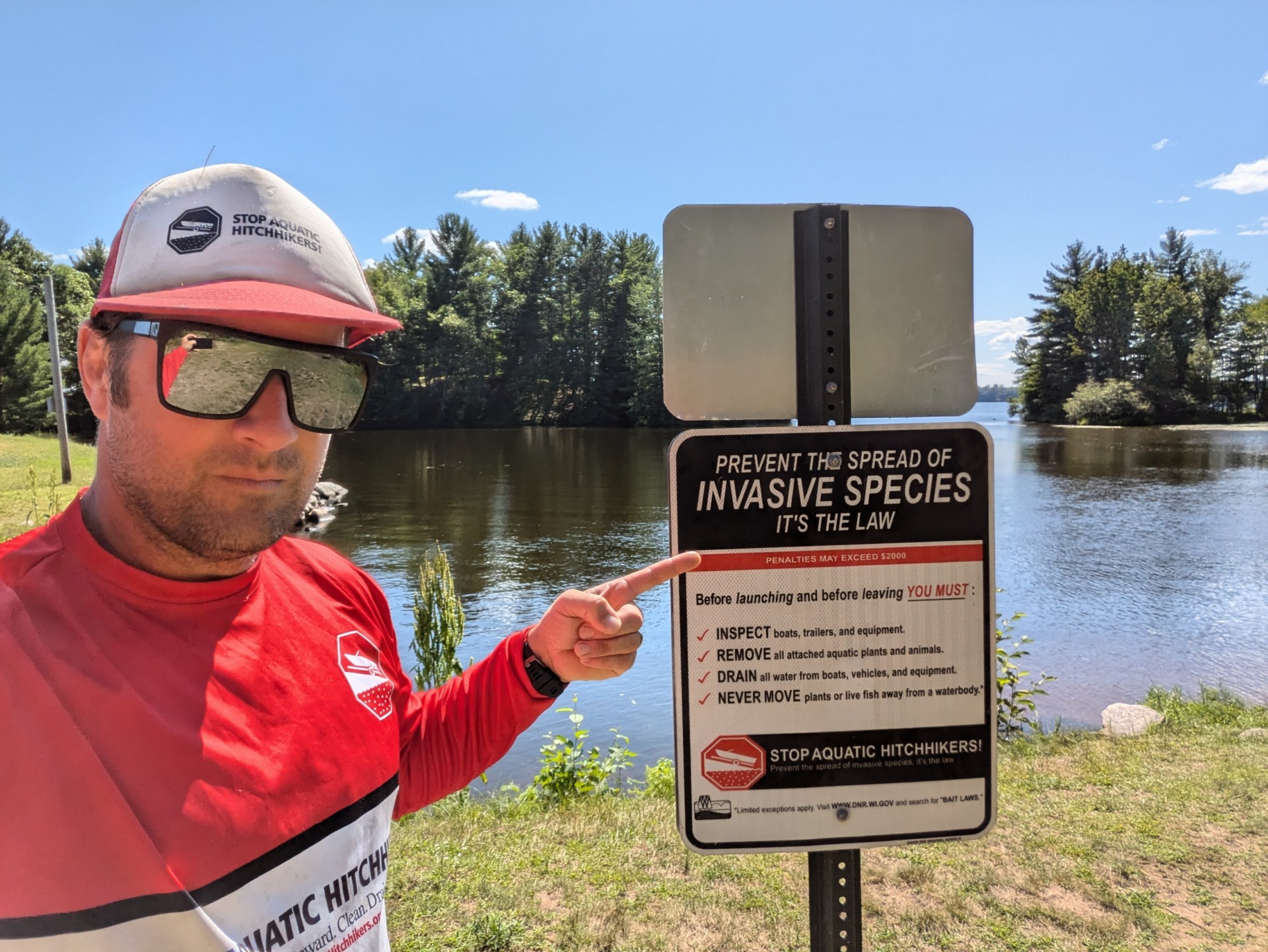
A man in reflective sunglasses wearing a Stop Aquatic Hitchikers shirt points to a sign telling boaters to remove invasive species from their boats

Tim Campbell points to a common sight at boat launches: a Stop Aquatic Hitchhikers! sign informing people about AIS. Photo by Tim Campbell / ASC

Campbell and coauthors Todd Newman and Bret Shaw of the UW–Madison Department of Life Sciences Communication worked with a national social science research firm to survey boaters about their actions related to invasive species prevention and their awareness of two invasive species prevention messages and brands, Stop Aquatic Hitchhikers! and Clean Drain Dry. The study found that boaters who were more aware of the brands reported that they removed plants from boats and drained water from live wells more often than people who were unaware of the programs.

Outreach materials from both brands are ready to use and available to anyone, often for free or at a nominal cost. 

“What I like about this research is that it supports that there are some easy and effective things anyone can do, like using Stop Aquatic Hitchhikers! and Clean Drain Dry,” said Campbell. He added that, while important, brand awareness is one of many factors that determine if and when boaters take action to prevent the spread of invasive species.  

“These brands and messages are the foundation of our outreach and prevention tools,” said Campbell. “People that are already using these approaches can then layer additional prevention approaches like inspectors and cleaning stations to further protect our lakes and rivers from invasive species.”

***

The University of Wisconsin Aquatic Sciences Center administers Wisconsin Sea Grant, the Wisconsin Water Resources Institute, and Water@UW–Madison. The center supports multidisciplinary research, education, and outreach for the protection and sustainable use of Wisconsin’s water resources. Wisconsin Sea Grant is one of 34 Sea Grant programs supported by the National Oceanic and Atmospheric Administration in coastal and Great Lakes states that encourage the wise stewardship of marine resources through research, education, outreach, and technology transfer.

The post Education works: Boaters who know the ‘Stop Aquatic Hitchhikers!’ rules are doing their part to stop AIS first appeared on Wisconsin Sea Grant.

Original Article

News Releases | Wisconsin Sea Grant

News Releases | Wisconsin Sea Grant

https://www.seagrant.wisc.edu/news/education-works-boaters-who-know-the-stop-aquatic-hitchhikers-rules-are-doing-their-part-to-stop-ais/

Wisconsin Sea Grant

The Energy News Roundup is your source for the latest energy stories from around the Great Lakes.

In Michigan, the state’s attorney general is taking on oil companies, accusing four of them of undermining climate research and driving up energy prices.

In Ohio, a bribery trial is underway against former energy executives accused of orchestrating the largest public corruption scheme in the state’s history.

Burning trash and wood for electricity now qualifies as carbon free in Minnesota. Meanwhile, a shuttered nuclear power plant in Wisconsin could be coming back online.

Find these stories, and more, in the latest Energy News Roundup at https://GreatLakesNow.org

#GreatLakes #Energy #News #Politics #Climate #Electricity

===========================================
Website: https://greatlakesnow.org
Facebook: https://www.facebook.com/greatlakesnow
X: https://www.x.com/greatlakesnow
Instagram: https://www.instagram.com/greatlakesnoworg
Newsletter: https://www.greatlakesnow.org/great-lakes-now-newsletter/

To learn more about supporting Detroit PBS and Great Lakes Now, visit https://www.detroitpbs.org/

The post The Latest Great Lakes Energy News appeared first on Great Lakes Now.

Original Article

Great Lakes Now

Great Lakes Now

https://www.greatlakesnow.org/2026/02/17/the-latest-great-lakes-energy-news/

Great Lakes Now

Take your passion for native plants to the next level with the Wild Ones Fox Valley Area 50-hour Native Plant Certification! This unique program offers a comprehensive education in Wisconsin’s native flora, perfect for home gardeners, students, teachers, conservation professionals, and nature enthusiasts. Click here to learn more! Certification Program Highlights: Earn [...]

The post Earn Your Native Plant Certification with Wild Ones appeared first on Fox-Wolf Watershed Alliance.

Original Article

Fox-Wolf Watershed Alliance

Fox-Wolf Watershed Alliance

https://fwwa.org/2026/02/17/wi-plant-cert-2026/?utm_source=rss&utm_medium=rss&utm_campaign=wi-plant-cert-2026

Katie Reed

Whitefish have declined because of invasive species and climate change-fueled loss of winter ice cover on the Great Lakes. Now scientists are testing whether rivers can serve as spawning refuges. Read the full story by MLive.

Original Article

Great Lakes Commission

Great Lakes Commission

https://www.glc.org/dailynews/20260216-whitefish-spawning-refugia

Nichole Angell