By Domonic Marroni In Ann Arbor, Michigan, Skyline High School's natural areas are home to several species of invasive plants causing widespread destruction of surrounding trees. These species pose potential fire hazards and are dangerous to public health.  Action is needed, say several environmental experts, to avert future disasters and to preserve the natural areas for future students.

Original Article

Great Lakes Echo

Great Lakes Echo

https://greatlakesecho.org/2026/07/09/invasives-oak-wilt-threaten-skyline-high-school-natural-areas-adjacent-neighborhoods/

Great Lakes Echo

By Theodore J. Kury, University of Florida

The Conversation is an independent and nonprofit source of news, analysis and commentary from academic experts.


Many major tech companies have pledged to pay their fair share of the costs associated with generating and transmitting more electricity to serve large data centers. But ratepayers across the United States are worried about the potential costs they might have to bear. That’s because it’s not immediately clear how the cost of data centers’ energy will be calculated. The effects of price increases are likely just beginning, and their full effects may not be felt for years.

For example, a recent report by the organization that monitors the PJM market, an area that encompasses all or part of 14 mid-Atlantic and Midwest states, concluded that expected power demand from data centers was a primary reason for US$23 billion in customer price increases that will last until at least the end of 2028.

I have studied the programs states have launched to address the needs of these large electricity customers. Prices are set by state utility commissions, who determine which customers’ rates will increase by how much to pay for new investments in electricity infrastructure. It’s not simple.

The complexity of setting prices

Setting a price for electricity is straightforward in principle but complicated in execution. Regulators identify the costs to provide service, allocate the costs to customers and design prices to recover those costs.

First, regulators identify the costs that a utility company incurs to provide service. Regulators look at the value of the assets the utility company invests in, such as power plants, transmission lines and substations, as well as its day-to-day operating expenses, such as salaries, fuel, replacement parts and electricity it purchases from other sources. Then these costs are allocated to categories of customers, such as residential, commercial and industrial.

Ideally, costs are allocated to the customers who cause them, but that can be complicated to determine. For example, imagine a data center is built in an area that lacks existing power lines and is located 50 yards from a nearby electric substation. It’s clear that the data center should pay to run a 50-yard power line from the substation to the data center.

But what if the power company needs to upgrade the substation to handle the increased needs of the data center? Or secure additional sources of electricity? In these cases, the investments are part of the electricity grid that everyone uses. These costs will likely be shared among all customers.

Cost analysts review each line of a utility company’s costs, often thousands of items, and determine how each cost will be allocated. Each decision incorporates one basic idea: What’s your share?

For instance, if a group of customers uses 20% of the electricity delivered by the utility, they would be allocated 20% of the costs associated with energy delivery. Other cost items may be allocated based on the number of customers or how much electricity customers use at particular points in time, but the idea is the same.

Finally, the analysts set prices that are designed to recover the costs allocated to each customer group. So, the costs that are allocated to you are directly reflected in the electricity prices that you pay.

Flexibility and a potential loophole

One common criterion for figuring out how much a customer should pay is based on what is called “coincident peak demand” – the amount a customer group uses at the moment when all customers are collectively using the largest amount of electricity. Costs associated with overall peak usage are typically split proportionally – but this opens an opportunity for data centers to exploit the system.

Data centers often are able to fine-tune their electricity consumption, using more one minute and less another, in ways that residential users can’t easily replicate. Computerized systems can automatically adjust the amount of work a data center is doing, while a homeowner would either have to race around shutting off appliances to meaningfully reduce the amount of power their home was using or invest in a device that does.

Their flexibility means data centers may be able to learn to predict when system loads will peak and consume little to no power in just the right period to avoid contributing to peak loads, as has happened with cryptocurrency-mining operations in Texas. So when regulators look at their usage to determine prices, data centers may be able to avoid paying any costs allocated through coincident peak demand, even if they use large amounts of electricity at other times.

Who speaks for you?

When utility regulators decide how costs should be allocated to each customer group, they solicit input from different groups. The utility company initially submits its own proposal for how it thinks costs should be allocated across its system.

Large industrial customer groups representing customers such as factories will also submit their own proposals for how to allocate costs and set rates. Retail customer groups representing large and small stores will submit theirs. And large data centers, with the resources to hire experts in cost allocation, will submit theirs as well. Some states have specific state-government agencies to do some of this work on behalf of particular commercial groups, such as Pennsylvania’s Office of Small Business Advocate.

Regulators don’t always get a good sense of residential customers’ voices, though. Every state except Georgia, Idaho and Louisiana has an office of the consumer advocate that represents customer interests in proceedings before the state utility regulator. But they are often charged with representing all customers in the state without bias, meaning they cannot advocate for outcomes that would impose costs on one group of customers in favor of another.

So while every state’s consumer advocate is concerned with keeping the utility’s costs as low as possible, they may be barred by law from adopting a position on how those costs should be allocated. This lack of representation in this aspect of rate-setting for average households may lead to situations where the data centers’ advocates argue for minimal costs to be allocated to them – but nobody advocates on behalf of residents to examine or refute that argument.

Citizens left holding the bag

There are other risks for residential customers, too. Utilities’ investments in electricity infrastructure last for many years. But not every proposed data center will get built, and some may use less energy than originally projected. Technology may even change, making some data centers obsolete after a year or two of operations.

If those events happen, then any costs the utility company incurred to provide enough electricity will be spread among all the other customers.

The allocation process may be even more complicated for municipal utilities regulated by city councils or independent boards, or cooperative utilities regulated by elected boards in rural communities. These groups may not have full-time staff who are utility or regulatory experts, yet they face the same decision-making challenges as trained professionals and might have to retain outside experts to aid in the process.

Consumers need to be aware of the importance of cost allocation and how it affects their electricity rates. I believe they should provide public comments to the regulators and speak during open hearings, as there may not be anyone else effectively advocating for their interests.

The post It may be almost impossible to make data centers pay their ‘fair share’ of electricity costs appeared first on Great Lakes Now.

Original Article

Great Lakes Now

Great Lakes Now

https://www.greatlakesnow.org/2026/07/08/it-may-be-almost-impossible-to-make-data-centers-pay-their-fair-share-of-electricity-costs/

The Conversation

By Ronia Cabansag and Adam Yahya Rayes, Michigan Public

The Great Lakes News Collaborative includes Bridge Michigan; Circle of Blue; Great Lakes Now at Detroit PBS; Michigan Public, Michigan’s NPR News Leader; and The Narwhal who work together to bring audiences news and information about the impact of climate change, pollution, and aging infrastructure on the Great Lakes and drinking water. This independent journalism is supported by the Charles Stewart Mott Foundation. Find all the work HERE.


It feels natural to say that there are five Great Lakes. It’s the kind of fact that feels as old and real as the lakes themselves.

But what if it isn’t true?

There may actually be four Great Lakes: “Lake” Huron and “Lake” Michigan could actually be considered “lobes” of one big lake — big enough to unseat Lake Superior as the world’s largest freshwater lake by surface area.

“They share a lake level. When the wind’s not blowing, they tend to be at the same level,” said Eric Anderson, director of hydrologic science and engineering at the Colorado School of Mines. “So if one goes up, the other one goes up. If one goes down, the other one does as well.”

The idea that Michigan’s mitten is hugged by one big U-shaped lake is not some new concept that you’ll only find buried in niche scientific studies.

It’s not very well known, but you don’t have to scroll far on WikipediaMichigan.gov or other very-public facing sources to find references to Lake Michigan-Huron.

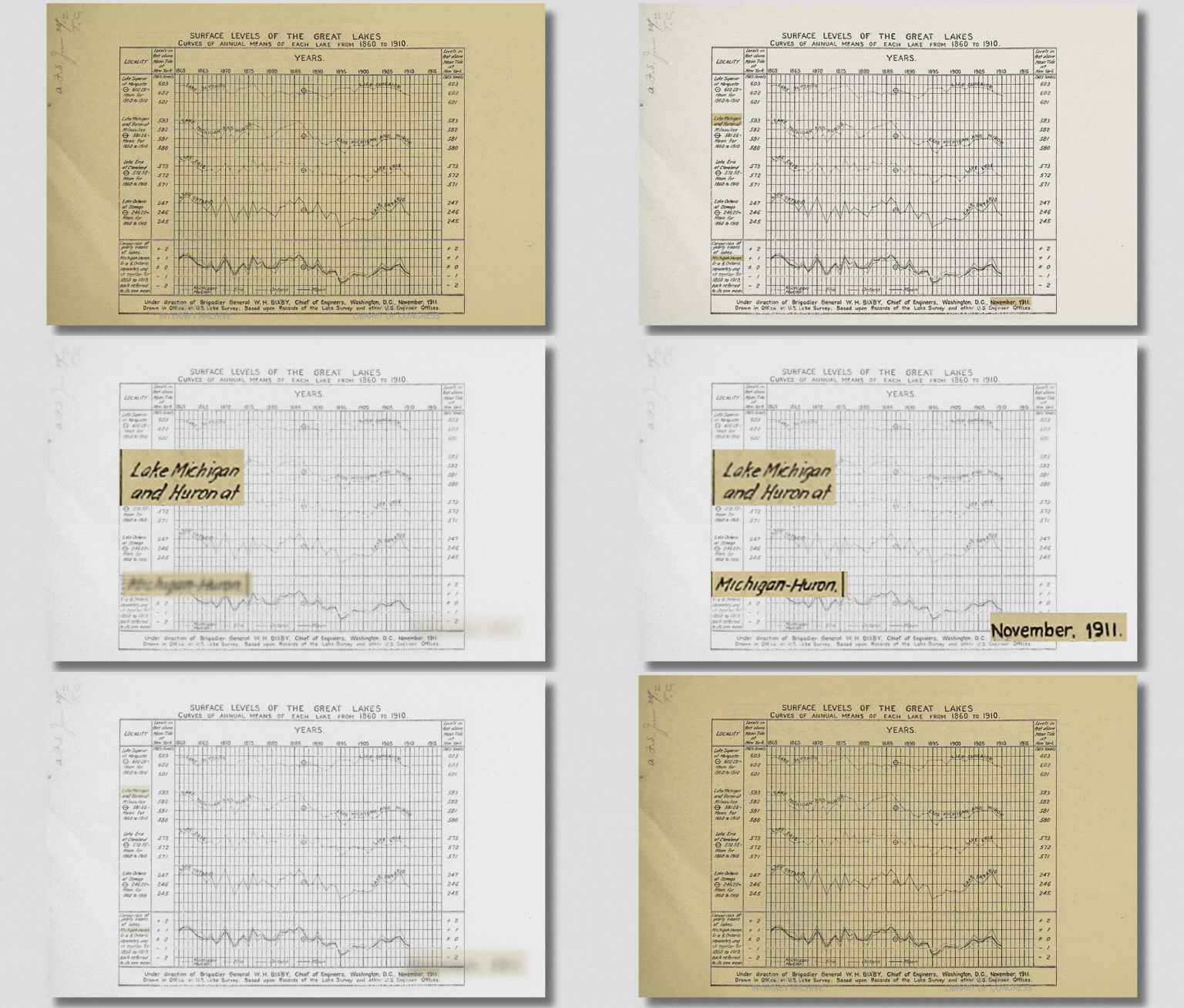
The oldest scientific record of it we found was from 1911.

This official U.S. Lake Survey document, dated 1911, references a combined “Lake Michigan and Huron” in measurements of the lake’s water levels. (Document: Library of Congress, accessed via HathiTrust. GIF: Adam Yahya Rayes | Michigan Public)

It’s not just the lake level that leads hydrologists to describe Huron and Michigan as one lake. The two bodies of water have another special connection: the straits of Mackinac.

At about five miles wide, the straits are a large body of water that flows in both directions between the Huron and Michigan lobes. This creates unique conditions for what Anderson called a “bi-lake seiche.” Seiches are standing waves that go back and forth across a body of water.

“Think about them as maybe like two water beds connected by some weird piece of material,” he said. “If you were to jump on the one water bed, right, you would create a giant wave that moves into the other one.”

That also means that any contaminants that spill into one body could easily end up in the other, Anderson said, especially if the spill happens near the straits.

But, Anderson said Michigan and Huron also have their own separate seiches. Plus, they each have their own circulation, water quality, and weather patterns. When he’s creating models to give people warnings about dangerous conditions, Anderson said it’s usually limited to one side or the other.

“In almost every other way, these lakes behave like two separate lakes,” he said. “Also just culturally and personally, because these lakes are so big, it’s really hard to think you’re experiencing the same thing in Chicago that you are in Georgian Bay.”

“Odawa Lake” and other names

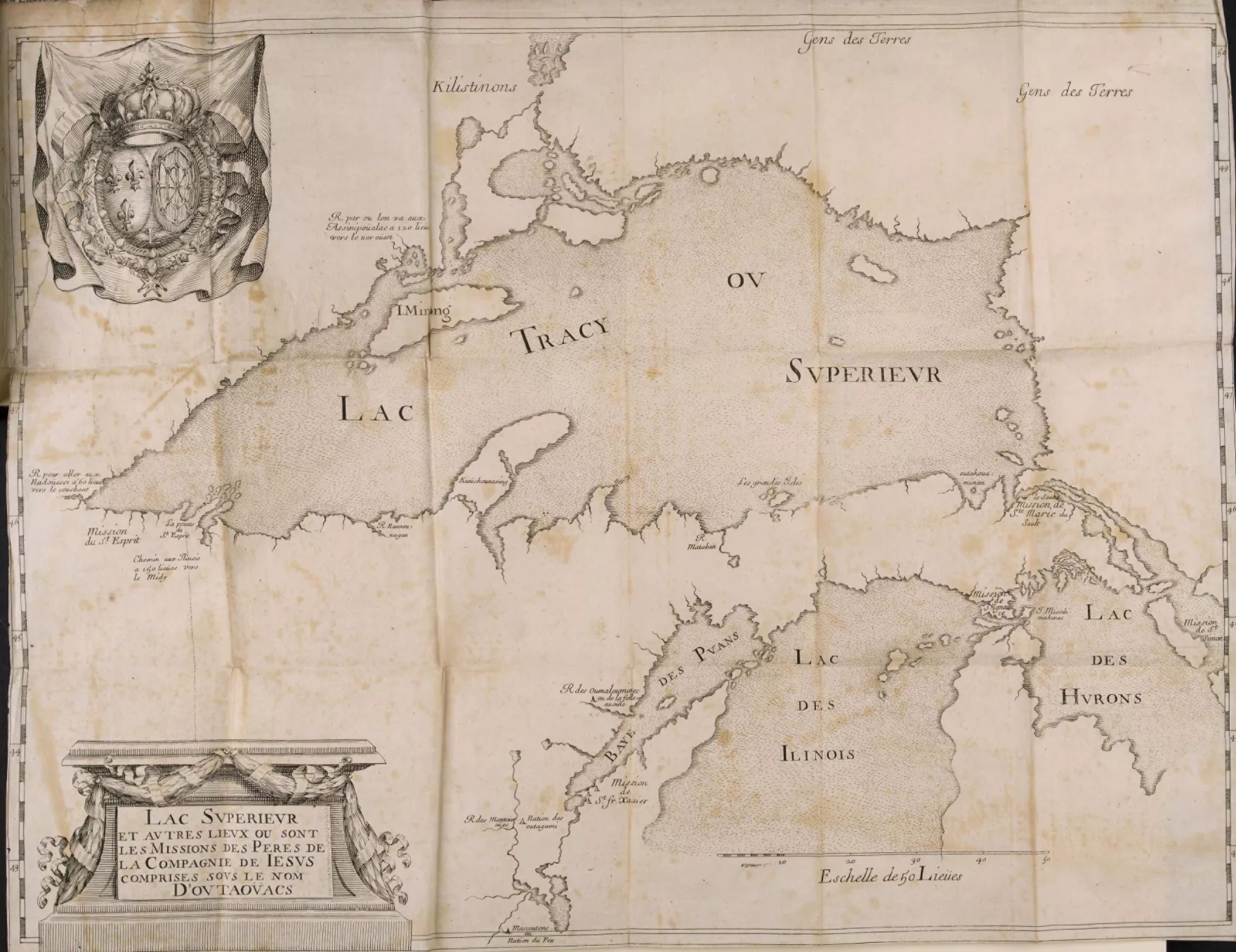
The earliest maps of the Great Lakes we know of are several hundred years old. Those maps, made by French explorers, refer to Michigan and Huron as separate lakes.

This map was created by French Jesuit missionaries in the 1600’s. It shows what are now known as Lake Huron and Lake Michigan (which they called “Lake of the Illinois” at the time) as separate lakes. The straits of Mackinac are not labeled. (Bibliothèque et Archives nationales du Québec)

“I think it’s important to note that there are different names for these lakes that predate European contact,” said Eric Hemenway, humanities program manager for the University of Michigan’s School for Environment and Sustainability. “And there’s a different view of the lakes that is still with us.”

Hemenway is Anishinaabe — the collective name for indigenous peoples who lived in the Great Lakes region — and Odawa (also called “Ottawa”). His Odawa name is Gaanaybik (Ge-na-bik).

“So in my mind, as the singular Odawa guy from living on Lake Michigan, to me [Huron and Michigan] are one body of water,” he said. “And all of our villages historically were right on both sides.”

Hemenway used to do archival work for the Little Traverse Bay Bands of Odawa Indians. Historically, he said, the tribe called Huron and Michigan “Odawa Lake.”

“There’s no wall, there’s no giant barrier,” he said. “The important part is who lived where … I can’t say it’s exclusively ours. You know, we named the lake after us, but there were other tribes that lived on the lake.”

Hemenway said Anishinaabe peoples had many different ways of naming and categorizing the lakes. Some did consider Huron and Michigan to be separate lakes or bodies.

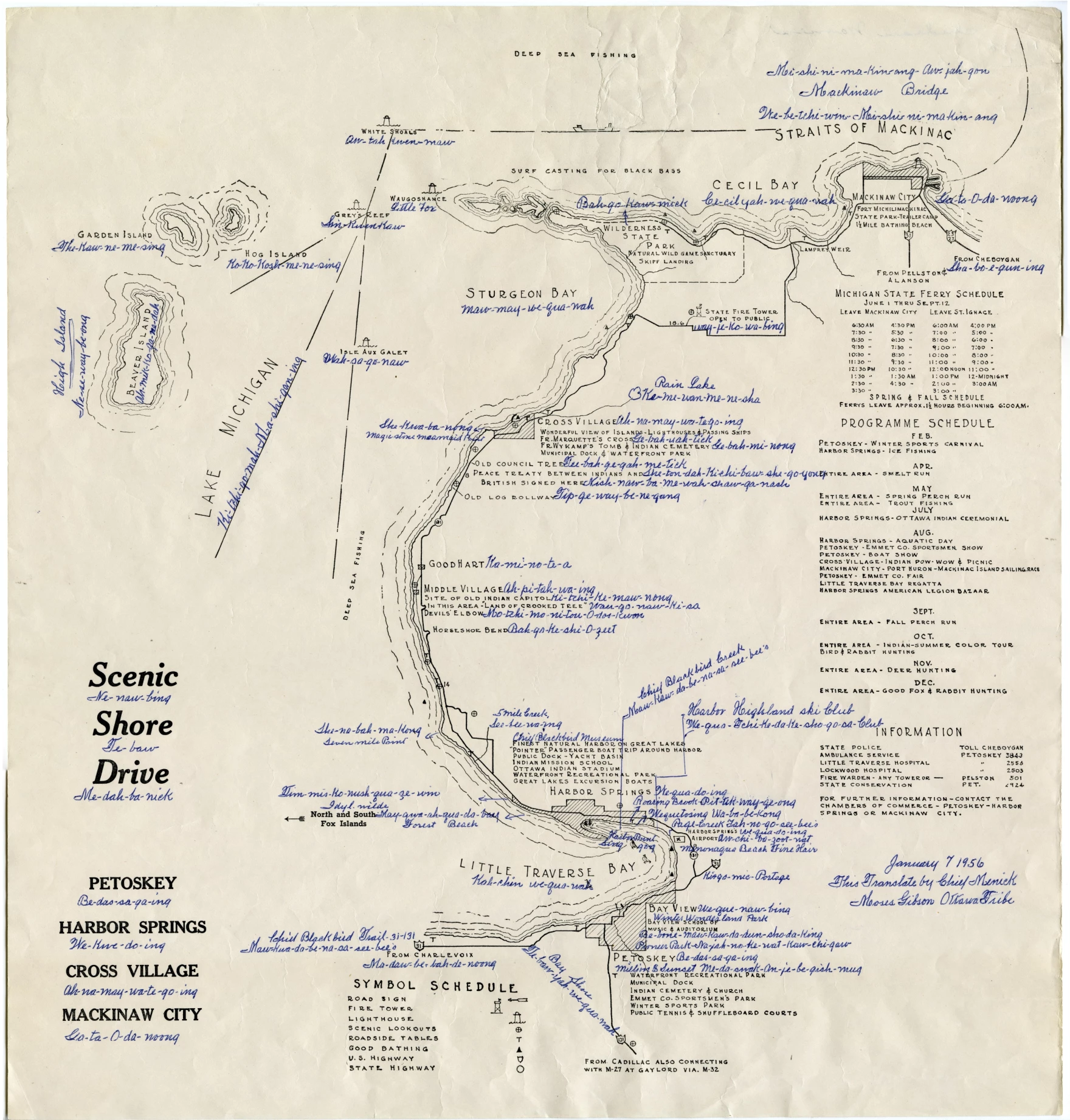
This map contains hand written notes from 1956 that are likely traditional Anishinaabe names and descriptions for areas around northern Lake Michigan, including a name for the lake itself. Hemenway said it’s not clear to him if that is a translation of the lake’s modern name or if it is “one of the old names for Lake Michigan.” (Bentley Historical Library)

“We live in these boundaries all the time. And so, trying to pull back and not look at the boundaries is really difficult,” he said. “But if you start seeing it as one, I think you start seeing the effort and responsibility shifts. We all have a part in this.”

Guests:

  • Eric Anderson, director of hydrologic science and engineering at the Colorado School of Mines.
  • Eric Hemenway, humanities program manager for the University of Michigan’s School for Environment and Sustainability.

The post Are Michigan and Huron actually one large Great Lake? appeared first on Great Lakes Now.

Original Article

Great Lakes Now

Great Lakes Now

https://www.greatlakesnow.org/2026/07/08/are-michigan-and-huron-actually-one-large-great-lake/

Michigan Public

Paddling a free Little Wolf for the first time in nearly 150 years

On June 28, 2026, we joined supporters of the Friends of the Little Wolf River for a paddle near Manawa, WI. 

On the July 4 weekend of 2024, Manawa received so much rain that the abutment of the dam on the Little Wolf gave away, effectively destroying a structure that had been in place for nearly 150 years. Since then, the greater Manawa community has debated the future of the dam, the mill pond the dam created, and the Little Wolf River itself.

Manawa dam in the Little Wolf River

Out of that community conversation formed a new friendship between Ben Hlaban and Nick Heise. They are calling for the Little Wolf to remain a free-flowing river. Both have deep family ties to the area and grew up fishing in the Little Wolf. They believe a free-flowing river is key to a more natural path to flood resilience in a changing climate where the next 100- or 500-year flood is no longer a matter of “if” but “when.”

The best way to learn about the beauty and benefits of a free-flowing river is to experience it first hand. So we loaded up our kayaks and helped a couple dozen fellow river enthusiasts join us on a guided trip. 

A changing river

In between waving to neighbors, pointing out bird species, and picking up trash, Ben and Nick explained how much the riverbed has changed since the 2024 flood. What used to be a mill pond is now a flowing river with clear water, native mussels, cold water tributaries, and migratory sturgeon. 

They pointed out good fishing spots, a train bridge that could be a future segment of the Tomorrow River trail, and how rain and the river have pushed sand and sediment into new places.

“The first thing I noticed was how quiet it was,” said River Alliance of Wisconsin Communications Director Stacy Harbaugh. “You just hear birds and the breeze. I also expected the gap between the former shoreline of the mill pond and the edge of the river to be more dramatic. What we saw was a river, a floodplain, and a lot of potential for restoration of this paddler’s delight.”

We stopped for lunch (catered by the friendly local diner, Sunrise Cafe) and a discussion at a local park where we heard from Ben and Nick about the options for the community. Undeterred by a little rain, we continued on to paddle past the former dam and into a more heavily wooded area that will be stunning in the fall. We wrapped up our trip with a visit to Linda Mae’s, a local ice cream parlor, for treats. 

The future of the Little Wolf

The community of Manawa, WI is still debating what to do about the dam. The City of Manawa’s consultants say that the dam cannot be fixed. Rebuilding the dam would cost $8 million. Removing the remnants of the structure and letting the river flow freely would cost around $700,000.

What isn’t included in that estimate is how a healthy river and floodplain can help protect the community from flood damage in the future. There are still a lot of misconceptions about the role of dams in flood control. 

The best place to learn about opportunities for public comments on the future of the Little Wolf River is by following the Friends of the Little Wolf on Facebook


Other resources

Hear an interview with leaders of the Friends of the Little Wolf with Communications Director Stacy Harbaugh on the VMO Show.

Read an opinion piece in Silent Sports magazine that is a deep-dive into the history of the Manawa mill pond, why dams are contentious, and why a free-flowing river has value by Timothy Bauer of Miles paddled.  

Timothy also documented the stretch of river we traveled back in October 2025 for Miles Paddled where you’ll find descriptions of where to put in and take out, the boulder gardens, and the little riffles that make the trip exciting. The included YouTube video gives you a good idea of what the river looked like in that snapshot of time.

The post Paddling a free Little Wolf for the first time in nearly 150 years appeared first on River Alliance of WI.

Original Article

Blog - River Alliance of WI

Blog - River Alliance of WI

https://wisconsinrivers.org/little-wolf-river-paddle-2026/

Allison Werner

Two sailors with Great Lakes roots are preparing to compete in the prestigious Admiral’s Cup, an elite international yacht racing competition returning in 2026 after a long hiatus. The pair, who learned to sail on the Detroit River and Lake St. Clair, will represent the United States as part of a team competing against some of the world’s top sailors off the coast of the United Kingdom. Read the full story by MLive.

Original Article

Great Lakes Commission

Great Lakes Commission

https://www.glc.org/dailynews/20260708-greatlakes-sailors-prestigious-yacht-races

Hannah Reynolds

Two former biologists from the EPA’s Great Lakes Toxicology and Ecology Division in Duluth, Minnesota, have joined five other fired EPA employees in federal lawsuits alleging they were unlawfully terminated for signing a public letter criticizing the Trump administration’s environmental policies.  Read the full story by the Minnesota Star Tribune.

Original Article

Great Lakes Commission

Great Lakes Commission

https://www.glc.org/dailynews/20260708-duluth-biologists-epa-filed-lawsuit

Hannah Reynolds