Paddling a free Little Wolf for the first time in nearly 150 years
Paddling a free Little Wolf for the first time in nearly 150 years
On June 28, 2026, we joined supporters of the Friends of the Little Wolf River for a paddle near Manawa, WI.
On the July 4 weekend of 2024, Manawa received so much rain that the abutment of the dam on the Little Wolf gave away, effectively destroying a structure that had been in place for nearly 150 years. Since then, the greater Manawa community has debated the future of the dam, the mill pond the dam created, and the Little Wolf River itself.

Out of that community conversation formed a new friendship between Ben Hlaban and Nick Heise. They are calling for the Little Wolf to remain a free-flowing river. Both have deep family ties to the area and grew up fishing in the Little Wolf. They believe a free-flowing river is key to a more natural path to flood resilience in a changing climate where the next 100- or 500-year flood is no longer a matter of “if” but “when.”
The best way to learn about the beauty and benefits of a free-flowing river is to experience it first hand. So we loaded up our kayaks and helped a couple dozen fellow river enthusiasts join us on a guided trip.
A changing river
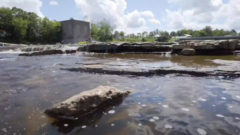
In between waving to neighbors, pointing out bird species, and picking up trash, Ben and Nick explained how much the riverbed has changed since the 2024 flood. What used to be a mill pond is now a flowing river with clear water, native mussels, cold water tributaries, and migratory sturgeon.
They pointed out good fishing spots, a train bridge that could be a future segment of the Tomorrow River trail, and how rain and the river have pushed sand and sediment into new places.
“The first thing I noticed was how quiet it was,” said River Alliance of Wisconsin Communications Director Stacy Harbaugh. “You just hear birds and the breeze. I also expected the gap between the former shoreline of the mill pond and the edge of the river to be more dramatic. What we saw was a river, a floodplain, and a lot of potential for restoration of this paddler’s delight.”

We stopped for lunch (catered by the friendly local diner, Sunrise Cafe) and a discussion at a local park where we heard from Ben and Nick about the options for the community. Undeterred by a little rain, we continued on to paddle past the former dam and into a more heavily wooded area that will be stunning in the fall. We wrapped up our trip with a visit to Linda Mae’s, a local ice cream parlor, for treats.
The future of the Little Wolf
The community of Manawa, WI is still debating what to do about the dam. The City of Manawa’s consultants say that the dam cannot be fixed. Rebuilding the dam would cost $8 million. Removing the remnants of the structure and letting the river flow freely would cost around $700,000.
What isn’t included in that estimate is how a healthy river and floodplain can help protect the community from flood damage in the future. There are still a lot of misconceptions about the role of dams in flood control.
The best place to learn about opportunities for public comments on the future of the Little Wolf River is by following the Friends of the Little Wolf on Facebook.
Other resources
Read an opinion piece in Silent Sports magazine that is a deep-dive into the history of the Manawa mill pond, why dams are contentious, and why a free-flowing river has value by Timothy Bauer of Miles paddled.
Timothy also documented the stretch of river we traveled back in October 2025 for Miles Paddled where you’ll find descriptions of where to put in and take out, the boulder gardens, and the little riffles that make the trip exciting. The included YouTube video gives you a good idea of what the river looked like in that snapshot of time.
The post Paddling a free Little Wolf for the first time in nearly 150 years appeared first on River Alliance of WI.
Blog - River Alliance of WI
https://wisconsinrivers.org/little-wolf-river-paddle-2026/
 Writers on Rivers: A Sharing of Some of the Best Essays from Rivers as Large as the Mississippi to as Small as Childhood Creeks
 Regulation Works ; 50 years of water quality progress in the Wisconsin River Watershed
 What Is a River?
 Protecting Paradise in the Driftless: How the Kickapoo Valley Reserve Came to Be
 Confluence luncheon
 Because native mussels are so important to Wisconsin, we organized a paddle trip to find them in one of Wisconsin’s other big rivers. Like the Wisconsin River, the Chippewa hosts many native species and is also highly regulated by hydro dam operations. For the trip, we brought along experts who know native mussels and this river very well. Experts included Lisie Kitchel (WDNR Bureau of Natural Heritage Conservation and aquatic ecologist), Jesse Weinzinger (WDNR aquatic zoologist), and Bre Klockzien (Citizen Science and Aquatics Coordinator with Beaver Creek Reserve).
 We set off in our kayaks and paddle boards and made several stops along the route. During one-on-one and group chats, we had the opportunity to discuss their ecology as well as the environmental threats they face, from water quality issues to hydropower impacts.. Some people found mussels right away. Others used tools like GoPros and bathyscopes to explore the underwater surface. Eventually, we all found some and got good skills for identifying mussels of all shapes and sizes.