...HEAT ADVISORY REMAINS IN EFFECT FROM 1 PM TO 8 PM CDT SATURDAY... * WHAT...Heat index values of 100 to 105 expected. * WHERE...Portions of central, east central and northeast Wisconsin. * WHEN...From 1 PM to 8 PM CDT Saturday.

Original Article

Current Watches, Warnings and Advisories for Brown (WIC009) Wisconsin Issued by the National Weather Service

Current Watches, Warnings and Advisories for Brown (WIC009) Wisconsin Issued by the National Weather Service

https://alerts.weather.gov/cap/wwacapget.php?x=WI125F589F5578.HeatAdvisory.125F58AE48D0WI.GRBNPWGRB.06a16a6a517146cadbc8456d072ac43b

w-nws.webmaster@noaa.gov

PFAS News Roundup: Research suggests link with COVID-19, disposal methods increase contamination

PFAS, short for per- and polyfluoroalkyl substances, are a group of widespread man-made chemicals that don’t break down in the environment or the human body and have been flagged as a major contaminant in sources of water across the country.

Keep up with PFAS-related developments in the Great Lakes area.

Read Now at Great Lakes Now.

Original Article

Great Lakes Now

Great Lakes Now

https://www.greatlakesnow.org/2020/07/pfas-michigan-wisconsin-legislation-foam-covid-19/

Samantha Cantie

...HEAT ADVISORY IN EFFECT FROM 1 PM TO 8 PM CDT SATURDAY... * WHAT...Heat index values of 100 to 105 expected. * WHERE...Portions of central, east central and northeast Wisconsin. * WHEN...From 1 PM to 8 PM CDT Saturday. * IMPACTS...Hot temperatures and high humidity may cause heat

Original Article

Current Watches, Warnings and Advisories for Brown (WIC009) Wisconsin Issued by the National Weather Service

Current Watches, Warnings and Advisories for Brown (WIC009) Wisconsin Issued by the National Weather Service

https://alerts.weather.gov/cap/wwacapget.php?x=WI125F58928F28.HeatAdvisory.125F58AE48D0WI.GRBNPWGRB.06a16a6a517146cadbc8456d072ac43b
w-nws.webmaster@noaa.gov

The Ohio Power Siting Board’s unanimous decision to place requirements for protecting birds on the proposed offshore wind sets the right precedent for wind projects on the Great Lakes. Read the full story by Cleveland Plain Dealer.

Original Article

Great Lakes Commission

Great Lakes Commission

https://www.glc.org/dailynews/20200717-protect-the-birds

Ned Willig

As high lake levels continue to erode shoreline along Lake Michigan, the state of Michigan is granting permits to homeowners to install armored shoreline features to protect their property. However, scientists warn that hard shoreline barriers interrupt the Great Lakes’ natural processes in ways that will worsen erosion over time. Read the full story by Bridge Magazine.

Original Article

Great Lakes Commission

Great Lakes Commission

https://www.glc.org/dailynews/20200717-seawalls

Ned Willig

A resolution passed by the Michigan House of Representatives opposing a nuclear waste disposal site in Ontario near Lake Huron has yet to be heard by the Michigan Senate. The bill is part of an ongoing effort by Michigan and U.S. elected officials to oppose the proposed site in Canada. Read the full story by the Iosco County News-Herald.

Original Article

Great Lakes Commission

Great Lakes Commission

https://www.glc.org/dailynews/20200717-michigan-bill-nuclear

Ned Willig

(Pictured – Shelly Sparks, Flint Development Center Director, presented with the 2020 US Water Prize commemorative glass sculpture)

For Immediate Release
July 17, 2020

Petoskey and Flint, Michigan – The McKenzie Patrice Croom Flint Community Water Lab, the first of its kind in the world, provides a trusted laboratory for Flint, Michigan residents for water testing of lead and other pollutants. Through generous financial support, the Flint Community Water Lab is a space open to the entire community that unifies residents around a common issue – the safety of water in residents’ homes. Freshwater Future has been honored to partner with the Flint Development Center where the lab is housed to turn this remarkable project into a reality. This innovative approach and collaborative community involvement hasn’t gone unnoticed. The Flint Water Lab has recently been recognized with the 2020 US Water Prize for Outstanding Cross-Sector Partnership.

The project’s focus is providing residents with knowledge about the safety of their water, and resources to help people trust that their water is safe, as thousands of pipes have been replaced in the City of Flint and the system continues to improve. The lab will provide free water testing and resources in Flint to help residents navigate the myriad of information they see and hear about water quality, to ensure their families’ health.

April 2014 marked the beginning of the Flint Water Crisis. The cameras may be gone from Flint, but the real truth is that for many still living there, the crisis isn’t over. While filters are being used to reduce the lead in water, many residents still don’t have enough information to begin to trust the water again. Jill Ryan, Executive Director of Freshwater Future, notes that “Community leaders helped us realize that the key to developing trust was through a multigenerational approach including training and education for youth who could then pass that information along to adults in the process of testing homes for current lead levels.”

The importance of having a way for residents to access trusted information about the water quality in Flint became so evident that the next step was to create a permanent community lab located in a trusted facility. Freshwater Future and the Flint Development Center are currently in the final phases of configuration for The Flint Community Lab with a scheduled opening date of summer to early Fall 2020 (tentative opening based on current COVID-19 restrictions). The coordinated vision for this community lab provides Flint residents a long-term trusted source for water tests, a place where residents can go to have their water tested for lead and other heavy metals at no cost.

Residents will receive a personalized report with the results from their tap water and have the option to meet with lab staff to review the findings. The reports will emphasize the importance and need of using filters and filter maintenance as well as helping uncover needed pipe or fixture changes within residents’ homes. Jill Ryan states that this project’s ultimate goal is “Having a lab that is based in Flint, operated by Flint residents, with the purpose of serving Flint residents, and embracing the resilience of Flint residents to keep working to solve their problems.”

Shelly Sparks, Director of the Flint Development Center, hopes that “The community lab will provide an opportunity for Flint to be a model as an innovative approach for the community to take the lead to gather data, analyze, and find solutions to our future water issues.” With the lab fully functional, teams of students and adults will continue to take and analyze water samples, survey homeowners, and provide filter, fixture and plumbing education. The Water Lab will provide opportunities to communicate with youth and help expand the learning in other cities who are also dealing with lead issues, such as Detroit and Benton Harbor.

The success of this project to date is due to the commitment and involvement of its community partners including Freshwater Future, the Flint Development Center, Genesee County Latino Hispanic Collaborative, Flint Neighborhoods United, the University of Michigan Biological Station and the City of Flint, as well as a committee of local residents who help guide the process. While there are too many individuals and organizations to mention that have stepped forward to financially support the lab, we do want to give special thanks to major supporters: Thermo Fisher Scientific, Inc., the C.S. Mott Foundation, the Joyce Foundation, the Hagerman Foundation, the Crown Family Philanthropies, and Nalgene Water Fund.

For more information, please visit Flint Development Center at http://www.flintdc.org/ and Freshwater Future at https://freshwaterfuture.org/.

For more information contact:
Jill M. Ryan, jill@freshwaterfuture.org
Shelly Sparks, ssparks@flintdc.org

Original Article

Blog – Freshwater Future

Blog – Freshwater Future

https://freshwaterfuture.org/uncategorized/mckenzie-patrice-croom-flint-community-lab-receives-2020-us-water-prize/

Leslie Burk

By Taylor Haelterman Capital News Service Insect populations fluctuate from year to year, depending on factors like weather and breeding, but the long-term downward trend in the monarch butterfly population is concerning conservationists. Listen to this story. The average monarch population from 2010 to 2020 is less than half of what it was the decade […]

Original Article

Great Lakes Echo

Great Lakes Echo

http://greatlakesecho.org/2020/07/17/monarch-butterfly-conservationists-concerned-by-long-term-population-decrease/

Guest Contributor

July 16, 2020

By Jennifer A. Smith

Pyrite, the mineral commonly known as fools’ gold for its luster and yellowish hue, can be found in the sandstone formations of Wisconsin, including in Trempealeau County.

Water Resources Institute-funded researchers are now examining what happens when that pyrite meets oxygen and microbes deep below the surface, particularly at circumneutral pH, a situation that has not been well understood up to this point. This intermingling could affect groundwater quality.

The research team’s two-year project (“Microbially mediated oxidation of trace element-bearing sulfide minerals in sandstones of Trempealeau County, Wisconsin”) began in summer 2019.

The team consists of University of Wisconsin-Madison professors Eric Roden and Matt Ginder-Vogel, along with geoscience graduate student Lisa Haas and Beloit College professor Jay Zambito.

Zambito was formerly with the Wisconsin Geological and Natural History Survey and, while there, worked on an earlier WRI-funded study with hydrogeologist Mike Parsen (also at the survey) that established some of the basis for the current study in terms of the presence of pyrite in two geologic units.

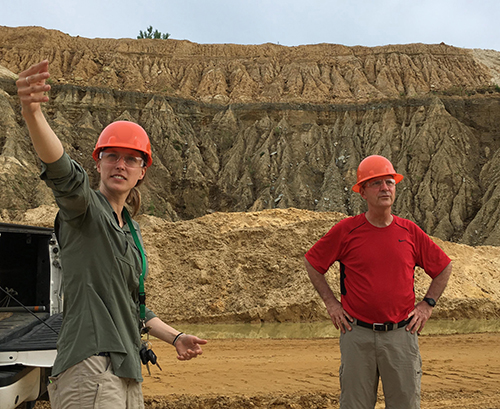
Haas and Roden visit a sand mine in Trempealeau County to collect freshly excavated Wonewoc sand and Tunnel City overburden for microcosm experiments. They are discussing the thin, intermittent clay sequences of the Wonewoc Formation. (Photo: Lisa Kamal)

The current study focuses on material found in the Tunnel City Group and Wonewoc Formation. While these rock units underlie much of the state, in Trempealeau County they are close to, or exposed at, the land surface and, depending on the amount of oxygen in the subsurface, have been observed to possess a notable amount of pyrite.

Roden described it: “In these sandstone formations, the pyrite is present in a state that you might call disseminated; it’s basically spread throughout the aquifer sand,” with the distributions varying in size and precise location.

What happens is that “when the pyrite in the sandstone is exposed to oxygen in groundwater, it reacts with the oxygen and that causes two things. One is that the mineral gets destroyed, if you will. It becomes oxidized,” he said. That results in a lowering of the groundwater’s pH. In turn, that increased acidity can lead to the release of toxic trace elements into the groundwater—things such as iron, arsenic, cadmium, zinc and lead—that have the potential to negatively affect groundwater quality.

The researchers believe this reaction is being sped up by the presence of microbes deep below the surface. “We’ve been working with the possibility that microbes, through their metabolism, can accelerate the reaction of oxygen with pyrite—and this is what’s crucial—at neutral pH,” said Roden.

Ginder-Vogel summarized, “It’s the microbes, water and minerals, and it’s this really interesting interface that is super dynamic and constantly changing. It’s really interesting from a broad groundwater perspective.”

The role of frac sand mining

The study bears a connection to industrial sand mining, also called frac sand mining, in this part of the state. When companies scrape off material known as “overburden”—in this instance, the Tunnel City Group rock—they set it aside in order to get to the sand (here, the Wonewoc Formation) they seek underneath. They later use the excavated overburden and low-quality sand for reclamation. However, the geologic material that was isolated in the subsurface is now disturbed and exposed to atmospheric levels of oxygen and rain at land surface. If pyrite was present in the rock, it will oxidize.

The team will examine whether this excavation and piling of materials help lead to the release of trace elements as a result of pyrite oxidation, which could have implications for the water quality of homeowners in the area. In experiments, they are working with collected samples of overburden and non-valuable geologic material and will be able to compare those with material collected from rock core of the geologic units of interest.

Haas, the graduate student, is running the lab experiments. A native of Mount Horeb, she completed her bachelor’s degree in the geoscience department in 2016 and then spent a few years with the Wisconsin Geological and Natural History Survey before beginning graduate school. As an undergraduate, she served as a research assistant to Zambito and Parsen on the earlier, related study.

For the current project, she is wrapping up the first set of experiments capturing pyrite oxidation and subsequent metal release from subsurface rock samples of the Tunnel City Group and Wonewoc Formation in unfiltered groundwater samples with the native aquifer microorganisms—the microorganisms thought to be accelerating the pyrite oxidation reaction.

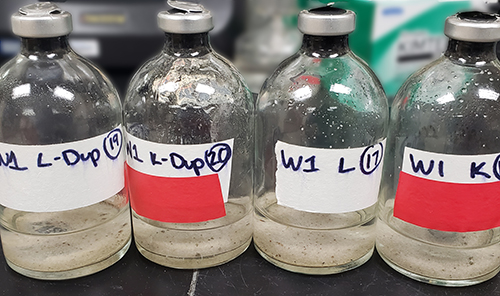
Four vials contain pulverized Wonewoc Formation rock, with a natural abundance of pyrite, in groundwater. The vials with red tape are the abiotic, or killed, controls. The live microcosms (without red tape) were sterilized and then inoculated with groundwater with live aquifer microorganisms. After 213 days following the start of the experiment, enough pyrite in the live microcosms oxidized to render the groundwater acidic (pH ~4). However, minimal pyrite was oxidized in the abiotic microcosms and the solution stayed circumneutral (pH ~8.5). (Photo: Lisa Haas)

As Haas described the process, “What we did is collect groundwater with some of those native microorganisms, and I put them in a vial and monitored chemical compounds that are produced as a result of this mineral dissolving and found that, with the native microbial communities, pyrite will dissolve faster than abiotically. So microorganisms are…significant drivers to this reaction.”

The next set of experiments will investigate pyrite oxidation in Tunnel City Group overburden and unprocessed sand from the Wonewoc Formation as described previously.

A kind of universality

While this experimental, analytical study is not designed to survey impacts to groundwater or surface water in Trempealeau County, it lays a foundation for possible future work.

“Our findings have a kind of universality,” said Roden. “Microbes are everywhere. And whatever we find, I can guarantee that that would apply in other environments where the lithology and also the hydrology were similar… All the details of what happens where on the landscape are determined by geology, but the microbes and the chemistry are always there.”

Ginder-Vogel echoed that thought: “These are reactions that are occurring everywhere. [Frac sand] mining may accelerate some of the reactions, and that’s where fundamental types of science—and what Eric and I do—comes in. We can understand these reactions and start to think about what types of processes might push them one way or push them another way, and then bring in some smart hydrologists to help us model what actually happens.”

The post Research on pyrite oxidation and native microorganisms has implications for groundwater quality in western Wisconsin first appeared on WRI.

Original Article

News Release – WRI

News Release – WRI

https://www.wri.wisc.edu/news/pyrite-oxidation-in-western-wi/

Jennifer Smith

The transportation and infrastructure committee of the U.S. House of Representatives on Wednesday passed legislation to build a system to prevent invasive carp from penetrating the Brandon Road Lock and Dam in Illinois and entering the Great Lakes. Read the full story by The Detroit News.

Original Article

Great Lakes Commission

Great Lakes Commission

https://www.glc.org/dailynews/20200716-carp-barrier

Ken Gibbons

In Fairport Harbor, Ohio, the Fairport Harbor Lighthouse has been hit hard by the pandemic since fewer tours are going through and volunteers aren’t able to staff the building. To help soften the blow, the Fairport Harbor Creamery has been asking patrons if they’d like to donate $1.00 when they make a purchase. Read the full story by WEWS-TV- Cleveland, OH.

Original Article

Great Lakes Commission

Great Lakes Commission

https://www.glc.org/dailynews/20200716-Fairport-Harbor

Ken Gibbons

Low dissolved oxygen levels in Port Colborne, Ontario has caused a fish kill and some fish have been seen gulping for air at the water’s surface. Water flow and temperature are two parameters that can affect the dissolved oxygen concentration. Read the full story by the Welland Tribune.

Original Article

Great Lakes Commission

Great Lakes Commission

https://www.glc.org/dailynews/20200716-gulping-fish

Ken Gibbons

Each summer since the 2014 Toledo water crisis that poisoned the metro system’s tap water for nearly three days, the city’s Collins Park Water Treatment plant has fortified its defenses against algal toxins in western Lake Erie that endanger public health this time of year. Read the full story by The Toledo Blade.

Original Article

Great Lakes Commission

Great Lakes Commission

https://www.glc.org/dailynews/20200716-water-plant

Ken Gibbons

Oswego, New York is considering an end to the Oswego Yacht Club’s occupation of the International Pier as part of a larger effort to improve the waterfront and create a publicly accessible and attractive jetty that complements the improvements at Wright’s Landing Marina and Breitbeck Park. Read the full story by Oswego County News Now.

Original Article

Great Lakes Commission

Great Lakes Commission

https://www.glc.org/dailynews/20200716-yacht-club

Ken Gibbons

Federal forecasters, hydrologists and university experts were expecting the Great Lakes 1986 high water level record to be replaced this summer, but Lake Huron and Lake Michigan don’t appear ready to break the big annual record this year thanks to recent drier-than-expected weather across the region. Read the full story by The Herald-Palladium.

Original Article

Great Lakes Commission

Great Lakes Commission

https://www.glc.org/dailynews/20200716-water-levels

Ken Gibbons

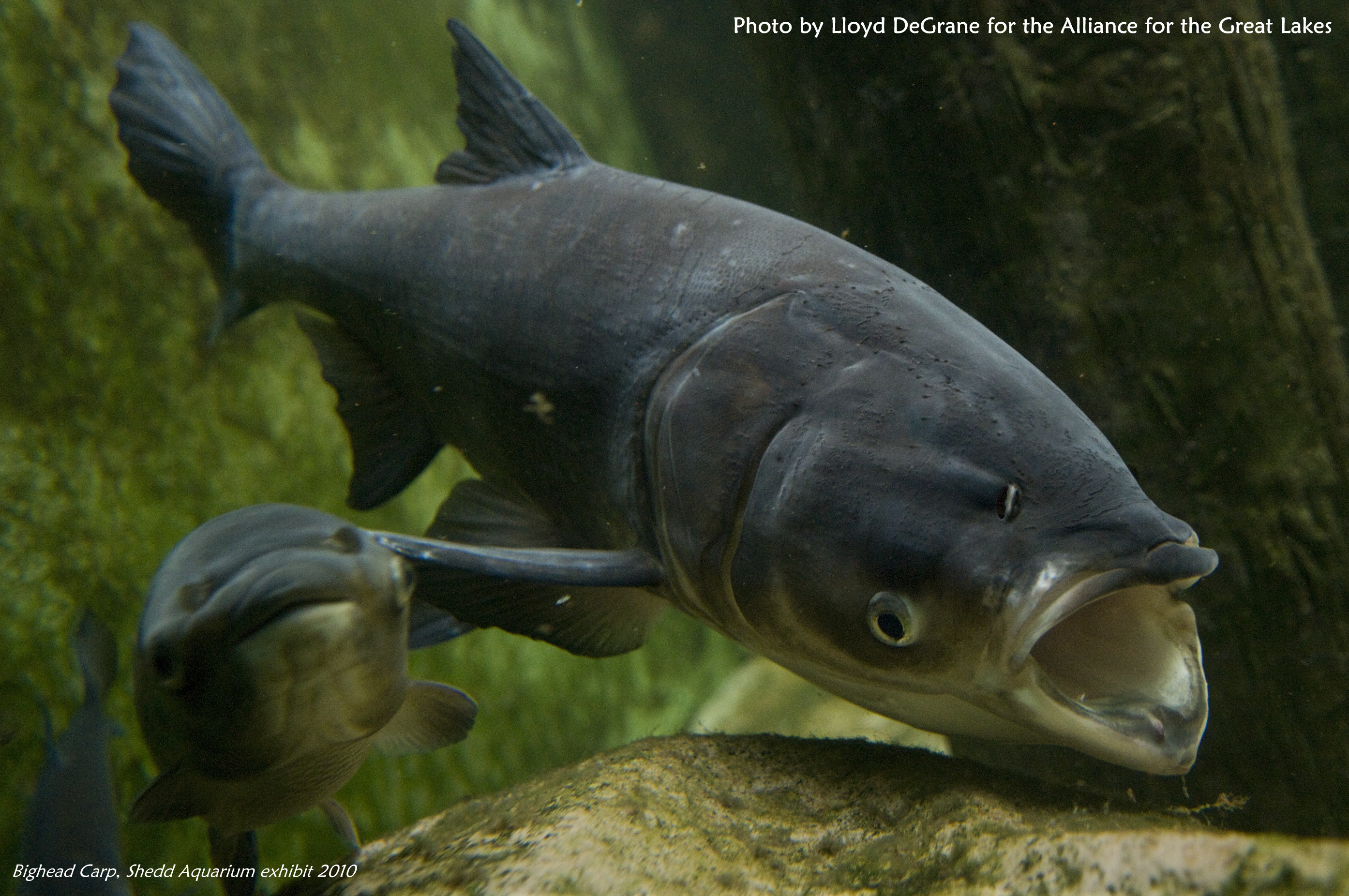
Chicago, IL (July 15, 2020) – Efforts to prevent invasive Asian carp from reaching the Great Lakes received support from two Congressional committees this week as two bills – Water Resources Development Act of 2020 and FY 2021 Energy and Water Development and Related Agencies appropriations bill – were advanced out of committee. They include project authorization and critical funding to stop invasive Asian carp from reaching the Great Lakes.

Invasive Asian carp would devastate the Great Lakes ecosystem and the region’s economy if they reach the lakes. Fortifying Brandon Road Lock and Dam in Joliet, a critical chokepoint for invasive Asian Carp about 50 miles downstream of Chicago, is the best chance to stop these aggressive fish from creeping closer to the Great Lakes.

Earlier today, the House Transportation and Infrastructure Committee passed the Water Resources Development Act of 2020. It includes authorization for construction of the Brandon Road Lock and Dam project to stop the movement of invasive Asian carp into the Great Lakes. It also adjusts the cost share for construction to 80% federal funding and 20% non-federal funding so that the federal government picks up more of the expense of building this critical project.

On Monday, the House Appropriations Committee passed the fiscal year 2021 Energy and Water Development and Related Agencies bill. The bill includes funding and language urging the U.S. Army Corp of Engineers to use the funds for the next phase of work at Brandon Road Lock and Dam—Preconstruction, Engineering and Design. Congresswoman Marcy Kaptur (D-OH) is Chairwoman of the House Appropriations Subcommittee on Energy and Water Development and Related Agencies.

Both bills now move to the full House of Representatives for consideration.

Alliance for the Great Lakes Vice President for Policy Molly Flanagan released this statement in response:

“Actions this week by the House Appropriations Committee and the House Transportation and Infrastructure Committee show that Congress is serious about preventing invasive Asian carp from reaching the Great Lakes. We applaud Great Lakes Members of Congress on both committees for their commitment to protecting the Great Lakes. We look forward to quick action by the full House of Representatives on both bills.”

###

For more media inquiries, contact Jennifer Caddick, jcaddick@greatlakes.org.

The post Congressional Committees Advance Efforts to Stop Invasive Asian Carp appeared first on Alliance for the Great Lakes.

Original Article

News – Alliance for the Great Lakes

News – Alliance for the Great Lakes

https://greatlakes.org/2020/07/congressional-committees-advance-efforts-to-stop-invasive-asian-carp/

Jennifer Caddick

Drinking Water News Roundup: Ohio Resumes Water Shutoffs, Lead Exposure More Likely from Private Wells

From lead pipes to PFAS, drinking water contamination is a major issue plaguing cities and towns all around the Great Lakes. Cleaning up contaminants and providing safe water to everyone is an ongoing public health struggle.

Keep up with drinking water-related developments in the Great Lakes area.

Click on the headline to read the full story:

Indiana:

  • Andrews Residents Told Drinking Water Is Safe, But Issues Remain – Indiana Public Media

When its water supply was running low in May, Andrews tapped into an unused well but was forced to shut it down again after the town found high levels of cancer-causing chemical vinyl chloride left over from a factory now owned by Raytheon Technologies.

Read Now at Great Lakes Now.

Original Article

Great Lakes Now

Great Lakes Now

https://www.greatlakesnow.org/2020/07/drinking-water-ohio-shutoffs-lead-exposure-private-wells/

Emily Simroth

Major restoration and rehabilitation of the historic Cleveland Dock Fishing Access Site in Cleveland is complete and the site is now open to the public after improvements were made for fishing access through restoration and stabilization. Read the full story by Oneida Daily Dispatch.

Original Article

Great Lakes Commission

Great Lakes Commission

https://www.glc.org/dailynews/20200715-cleveland-dock-restoration

Patrick Canniff

Michigan says a company that runs a dam near Comstock must try to contain sediment that’s pouring into the Kalamazoo River, in violation of environmental regulations. Silt has been streaming out of Morrow Lake since Eagle Creek Renewable Energy lowered the reservoir last year to make repairs on Morrow Dam. Read the full story by WMUK – Kalamazoo, MI.

Original Article

Great Lakes Commission

Great Lakes Commission

https://www.glc.org/dailynews/20200715-morrow-dam

Patrick Canniff

Pennsylvania and Indiana led the return to camping in mid-May, and other states and provinces soon followed suit; the cascade of reopenings through the month of June has been followed by a flood of campers excited to get back outdoors. Read the full story by Great Lakes Now.

Original Article

Great Lakes Commission

Great Lakes Commission

https://www.glc.org/dailynews/20200715-reopenings-outdoor

Patrick Canniff

Property owners in eastern Ontario are calling on their local and provincial governments for help handling an invasion of gypsy moth caterpillars; the red-and-blue-speckled caterpillars are an invasive species that can completely defoliate a tree, causing long-term damage. Read the full story by CBC News.

Original Article

Great Lakes Commission

Great Lakes Commission

https://www.glc.org/dailynews/20200715-gypsy-moth-invasive

Patrick Canniff

A ceremonial ribbon cutting was held Tuesday morning, marking the completion of a $6.2 million reconfiguration of Niagara Falls State Park’s welcome plaza improving mobility for pedestrians and access for vehicles making the park more mutually visible. Read the full story by NPR.

Original Article

Great Lakes Commission

Great Lakes Commission

https://www.glc.org/dailynews/20200715-niagara-falls-plaza

Patrick Canniff

Thirty-three years ago, water levels on Lake Michigan and Lake Huron reached their highest point at 582.35 feet above sea level. The two lakes don’t appear ready to break the big annual record this year thanks to recent drier-than-expected weather across the region. Read the full story by MLive.

Original Article

Great Lakes Commission

Great Lakes Commission

https://www.glc.org/dailynews/20200715-water-levels

Patrick Canniff

...SPECIAL WEATHER STATEMENT... At 320 AM CDT, Doppler radar was tracking thunderstorms along a line extending from Pine River to Central Lake Winnebago to Lomira. Movement was northeast at 45 mph. Winds in excess of 30 mph will be possible with these storms. Locations impacted include...

Original Article

Current Watches, Warnings and Advisories for Brown (WIC009) Wisconsin Issued by the National Weather Service

Current Watches, Warnings and Advisories for Brown (WIC009) Wisconsin Issued by the National Weather Service

https://alerts.weather.gov/cap/wwacapget.php?x=WI125F58725974.SpecialWeatherStatement.125F58727850WI.GRBSPSGRB.e905ba1fbd1c8c6a64f3dce0e16f350e

w-nws.webmaster@noaa.gov

By Weiting Du Summer is here and so are the annoying mosquitoes. But so, too, are creatures that limit their number. Water mites are close relatives to spiders and live in freshwater. Some of them can parasitize or prey on mosquitoes, according to a recent review study published in the Diversity journal. Understanding these water mites could be important […]

Original Article

Great Lakes Echo

Great Lakes Echo

http://greatlakesecho.org/2020/07/15/mighty-mites-might-manage-mosquitoes/

Guest Contributor

Outdoor Escape: Visitors flock to parks, beaches, lakes as states reopen

Great Lakes states and provinces have opened up their parks to overnight campers again now that COVID-19 closures have been lifted.

In March, national parks were closed in Canada, along with Ontario provincial parks. In the U.S., while parks remained open to visitors, facilities and many campgrounds were closed to the public.

Read Now at Great Lakes Now.

Original Article

Great Lakes Now

Great Lakes Now

https://www.greatlakesnow.org/2020/07/visitors-flock-parks-beaches-lakes-provinces-states-reopen/

Emily Simroth

A renewed focus on water quality emerged out of the 2014 drinking water crisis in Toledo, Ohio, leading to the creation of Smart Lake Erie. The project, led by the nonprofit Cleveland Water Alliance (CWA) and various partners, has echoes of the Jefferson Project at Lake George in New York. Read the full story by SmartCitiesDive.

Original Article

Great Lakes Commission

Great Lakes Commission

https://www.glc.org/dailynews/20200714-smart-lakes

Jill Estrada

Multiple environmental groups say a Canadian energy firm hasn’t provided enough information for state regulators to decide whether to grant waterway and wetlands permits for a proposed pipeline relocation project in northern Wisconsin. Read and listen to the full story by Wisconsin Public Radio.

Original Article

Great Lakes Commission

Great Lakes Commission

https://www.glc.org/dailynews/20200714-pipeline+relocation

Jill Estrada