Farmers turn to ‘predator-proof’ fences to deter wolves in northern Wisconsin

By Danielle Kaeding, Wisconsin Public Radio

This article was republished here with permission from Wisconsin Public Radio.

For at least the last decade, Dustin Soyring and his family have struggled with wolves on their farm in the northern Wisconsin town of Maple.

Read Now at Great Lakes Now.

Original Article

Great Lakes Now

Great Lakes Now

https://www.greatlakesnow.org/2024/09/farmers-turn-to-predator-proof-fences-to-deter-wolves-in-northern-wisconsin/

Wisconsin Public Radio

Editor: In the public interest and in accordance with Federal Aviation Administration regulations, the USGS is announcing this low-level airborne project. Your assistance in informing the local communities is appreciated.

Original Article

Midcontinent Region

Midcontinent Region

https://www.usgs.gov/news/state-news-release/media-alert-low-level-airplane-flights-image-geology-over-parts-nebraska?utm_source=comms&utm_medium=rss&utm_campaign=news

lrussell@usgs.gov

Cheryl Porter’s vision for the future of water

Great Lakes Now’s Anna Sysling spoke with Cheryl Porter, Chief Operating Officer of Water and Field Services at the Great Lakes Water Authority and the first African American president of the American Water Works Association (AWWA).

With 28 years of experience in the water sector, Porter shares her inspiring journey from junior chemist in Detroit to leading the AWWA.

Read Now at Great Lakes Now.

Original Article

Great Lakes Now

Great Lakes Now

https://www.greatlakesnow.org/2024/09/cheryl-porters-vision-for-the-future-of-water/

Great Lakes Now

Michigan advocates hail ‘groundbreaking’ settlement to civil rights complaint over hazardous waste facility

By Brian Allnutt, Planet Detroit

This article was republished with permission from Planet Detroit. Sign up for Planet Detroit’s weekly newsletter here.

Michigan environmental advocates are hailing a “groundbreaking” settlement to a civil rights complaint filed with state regulators over the expansion of a hazardous waste facility in Detroit.

Read Now at Great Lakes Now.

Original Article

Great Lakes Now

Great Lakes Now

https://www.greatlakesnow.org/2024/09/michigan-advocates-hail-groundbreaking-settlement-to-civil-rights-complaint-over-hazardous-waste-facility/

Planet Detroit

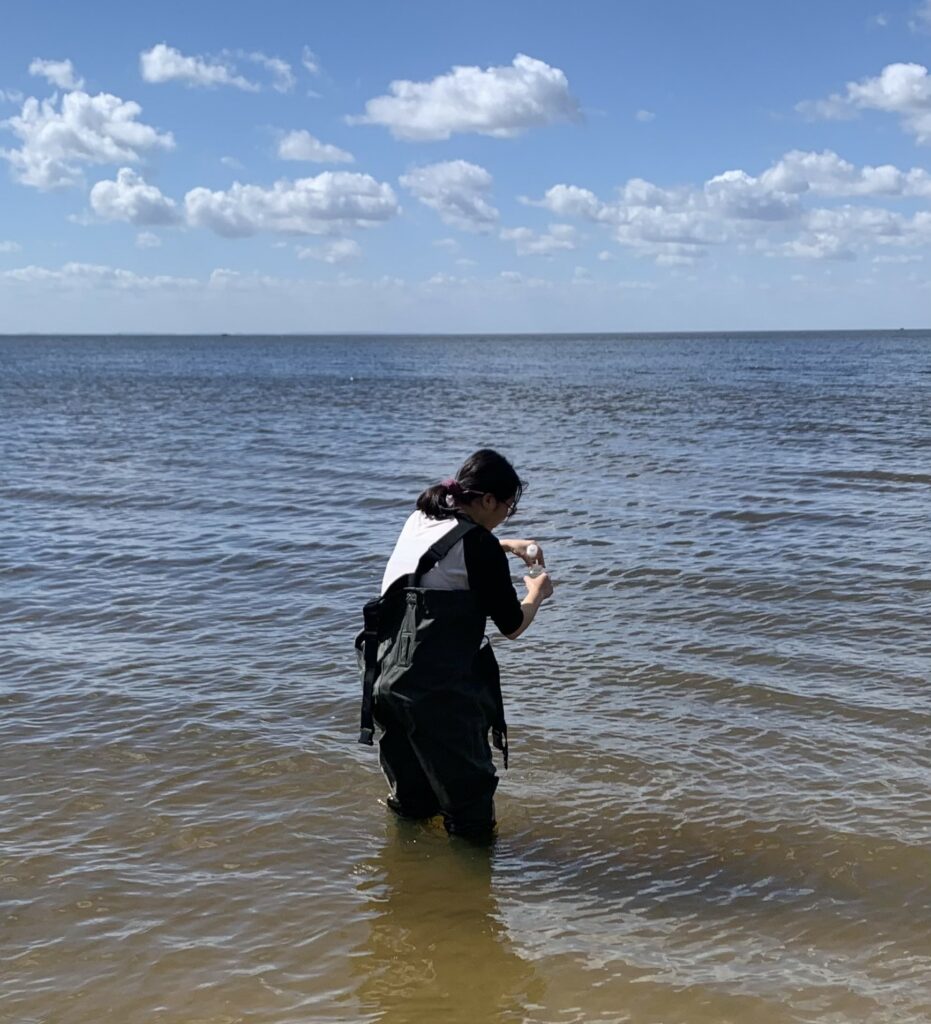
Jena Choi, Freshwater@UW student, collects water from beaches for E. coli analysis later at the UW-Oshkosh Environmental Research and Innovation Center. Image Credit: Megan Jensik

By ­­­Jena Choi, Freshwater Collaborative summer research student

This summer, 35 undergraduate students from across the country conducted research with Freshwater@UW, the University of Wisconsin’s cross-site, cross-discipline research opportunities program. Freshwater@UW is supported by the Freshwater Collaborative, Wisconsin Sea Grant, Water@UW–Madison, the Water Resources Institute and the University of Wisconsin–Madison Graduate School. In the final weeks of the program, students reflected on what they learned. We are sharing several of their stories over the coming months. Here’s Jena Choi, an undergraduate sophomore in freshwater science from UW–Milwaukee, who worked with Greg Kleinheinz at UWOshkosh.

I stumbled across Freshwater@UW a year ago, and I’m pleased that my persistence landed me in this program. As someone who finds comfort in familiarity, this program was the right step to coming out my comfort zone and exploring research in a new laboratory.

I had the privilege of working at ERIC (Environmental Research and Innovation Center) in the University of Wisconsin-Oshkosh, where I conducted my research in evaluating methods for analyzing microplastics from beach sand samples. Microplastics is a hot topic in the environmental field, and we’ve come a long way in developing several methods for analyzing them. The problem lies more in which methods to use and how effective they are at extracting tiny microplastics that you can’t even see with the naked eye. 

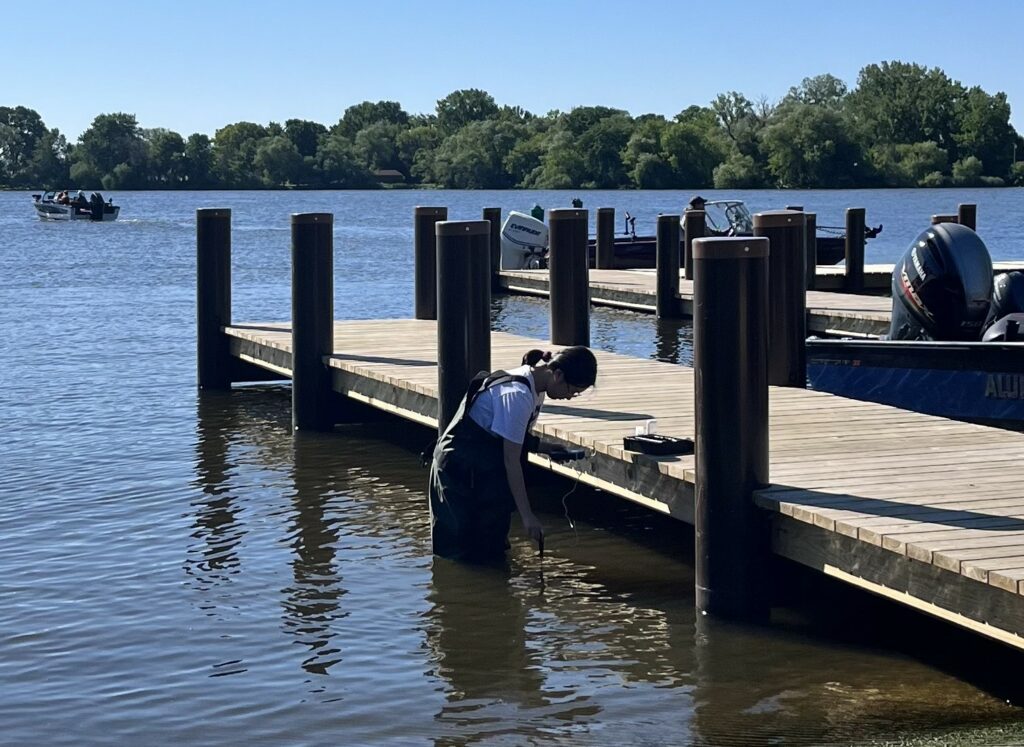
Choi reads water temperature for weekly beach data reports. Image Credit: Megan Jensik

One key lesson I’ve learned about research is that it involves a lot of reevaluating, revising and importantly, retrying. Rather than picking up another person’s project, I had to start from the beginning. I navigated through the seas of different methods from other scientific journals while remodifying them several times to fit both my limited time and resources. Once I settled with a method proposed by the National Oceanic and Atmospheric Administration, the true battle was finding and ordering everything before I could start my project. The process required a lot of patience and persistence, especially when the methods didn’t show promising results. However, all these moments gave me great insight on what graduate level research would look like, as well as a key lesson in being independent.

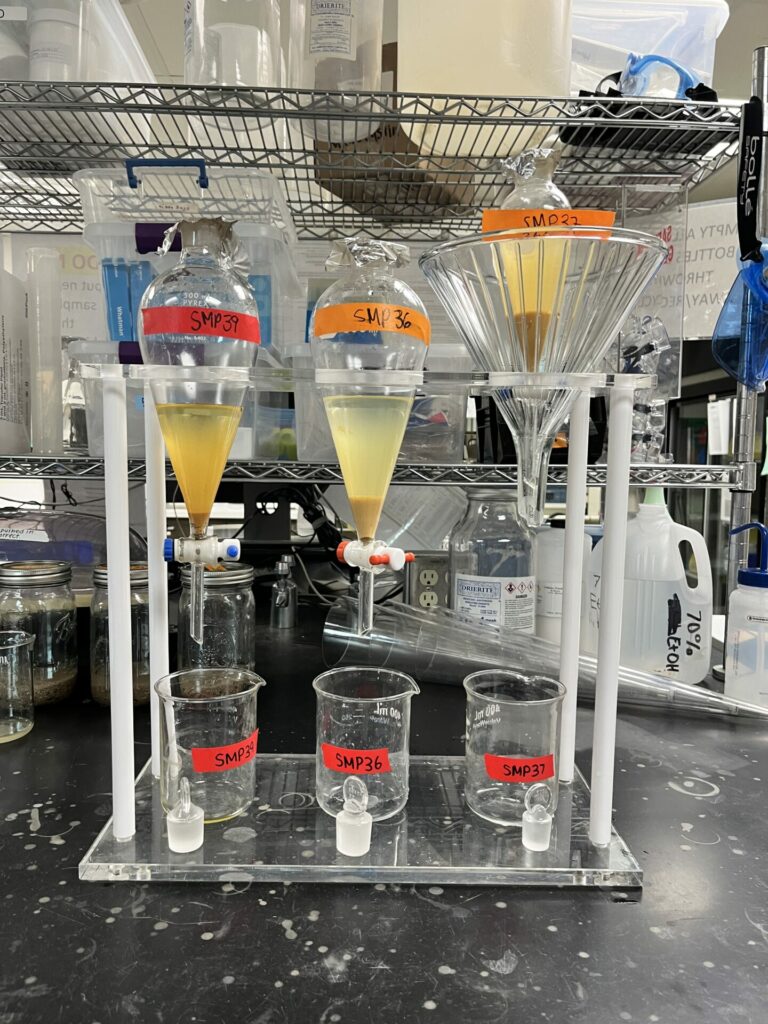
A density separation setup in the lab to separate settled solids from floating solids (microplastics). Image Credit: Jena Choi

I also learned that being part of the Freshwater@UW program is more than research. It also branches into helping communities and learning different career opportunities. Not only does ERIC host research projects, but they also test samples for campus members and external clients. I was able to help people know if their drinking water is safe and alert them of any possible dangers. Another welcome surprise were my weekly beach routes where I collected beach water around Winnebago County to test for E. coli. If the beaches reached a concerning level, it was our duty to warn the public by putting up signs and informing the Wisconsin Department of Natural Resources about the elevated levels of E. coli. Based on these experiences, I can see myself working in both a field and lab setting while working with the public through education and science communication. 

I’m grateful that Freshwater@UW has given me the opportunity to explore research in UW-Oshkosh. I’ve not only pursued my interest in microplastics, but I’ve learned the valuable skills of constructing my own project and independently solving any related conundrums or mistakes. With everything I’ve learned, I see my career heading to a professional track and hope to use the skills I’ve learned to improve Wisconsin’s water.

The post Summer research student learns independence and patience while studying microplastics first appeared on Wisconsin Sea Grant.

Original Article

Blog | Wisconsin Sea Grant

Blog | Wisconsin Sea Grant

https://www.seagrant.wisc.edu/blog/summer-research-student-learns-independence-and-patience-while-studying-microplastics/

Wisconsin Sea Grant

Foraged Fruit and Nuts: Wild Apples & Abundant Acorns

This story is a part of “A Year in the Wild Kitchen of the Great Lakes,” a series in partnership with expert forager Lisa M. Rose, with the mission of nurturing a deeper connection with the natural world through foraging. To get started with your foraging journey, begin here with our “Framework to Sustainable and Safe Practices.”

Autumn brings with it a bounty of fruits and nuts that often go unnoticed in our modern culinary landscape.

Read Now at Great Lakes Now.

Original Article

Great Lakes Now

Great Lakes Now

https://www.greatlakesnow.org/2024/09/foraged-fruit-and-nuts-wild-apples-abundant-acorns/

Lisa M. Rose

Drownings in Michigan this summer have once again put a spotlight on water safety in a state with the nation’s longest freshwater coastline and an abundance of inland lakes. As of Thursday, the Great Lakes Surf Rescue Project has tracked 77 Great Lakes drownings in 2024 compared to 85 Great Lakes drownings from last year. Read the full story by The Detroit Free Press.

Original Article

Great Lakes Commission

Great Lakes Commission

https://www.glc.org/dailynews/20240904-water-safety

Taaja Tucker-Silva

Residents and advocacy groups are asking the federal government for a hearing to try to stop the Palisades nuclear plant in Southwest Michigan on Lake Michigan, officially shut down in 2022, from reopening. No closed nuclear plant has ever reopened. Read the full story by Michigan Public.

Original Article

Great Lakes Commission

Great Lakes Commission

https://www.glc.org/dailynews/20240904-nuclear-petition

Taaja Tucker-Silva

The search and recovery team that found a crash victim and airplane lost 17 years ago in Lake Huron said it’s hoping to help even more people find their lost loved ones. Great Lakes Search and Recovery, a nonprofit that searches for people lost in the water, tries to bring closure to families. Read the full story by CBS News.

Original Article

Great Lakes Commission

Great Lakes Commission

https://www.glc.org/dailynews/20240904-search-and-recovery

Taaja Tucker-Silva

The Lake Michigan yellow perch population remains very low, and angler catches are far below historical averages. The drops are linked to the arrival of zebra and quagga mussels in the 1990s. Read the full story by the Milwaukee Journal Sentinel.

Original Article

Great Lakes Commission

Great Lakes Commission

https://www.glc.org/dailynews/20240904-perch-population

Taaja Tucker-Silva

Visitors to Lake Erie beaches have been puzzled by a flood of dead fish – particularly sheepshead, also known as freshwater drum – with thousands washing ashore in areas near Port Bruce and Port Stanley, Ontario. Experts suggest the die-offs were due to upwelling in hypoxic areas of the lake. Read the full story by the London Free Press.

Original Article

Great Lakes Commission

Great Lakes Commission

https://www.glc.org/dailynews/20240904-dead-fish

Taaja Tucker-Silva

Several journalists recently gathered at the Ohio Sea Grant/Ohio State University Stone Laboratory research facility for an annual overview of a multitude of issues affecting the world’s 11th largest freshwater lake. Read the full story by The Blade.

Original Article

Great Lakes Commission

Great Lakes Commission

https://www.glc.org/dailynews/20240904-erie-issues

Taaja Tucker-Silva

If you’ve walked along the Milwaukee lakefront in the past few weeks, you might have suddenly found yourself amid a swarm of dragonflies. The insects are making their yearly migration south, which includes a several-week stretch passing through Milwaukee. Read the full story by the Milwaukee Journal Sentinel.

Original Article

Great Lakes Commission

Great Lakes Commission

https://www.glc.org/dailynews/20240904-dragonfly-swarms

Taaja Tucker-Silva

Four piping Plover fledglings graduated out of captivity and made it onto a northern Michigan beach this summer, joining a record-breaking nesting season across the Great Lakes. A total of 124 wild chicks fledged, or grew wings large enough to fly. Read the full story by MLive.

Original Article

Great Lakes Commission

Great Lakes Commission

https://www.glc.org/dailynews/20240904-plovers-fledged

Taaja Tucker-Silva

The Great Lakes Way is an interconnected set of greenways and water trails stretching from Port Huron, Michigan to Toledo, Ohio on western Lake Erie. Its purpose is to help reconnect people with continentally significant natural resources, promote outdoor recreation with its many benefits, and foster a stewardship ethic. Read the full story by Great Lakes Now.

Original Article

Great Lakes Commission

Great Lakes Commission

https://www.glc.org/dailynews/20240904-great-lakes-way

Taaja Tucker-Silva

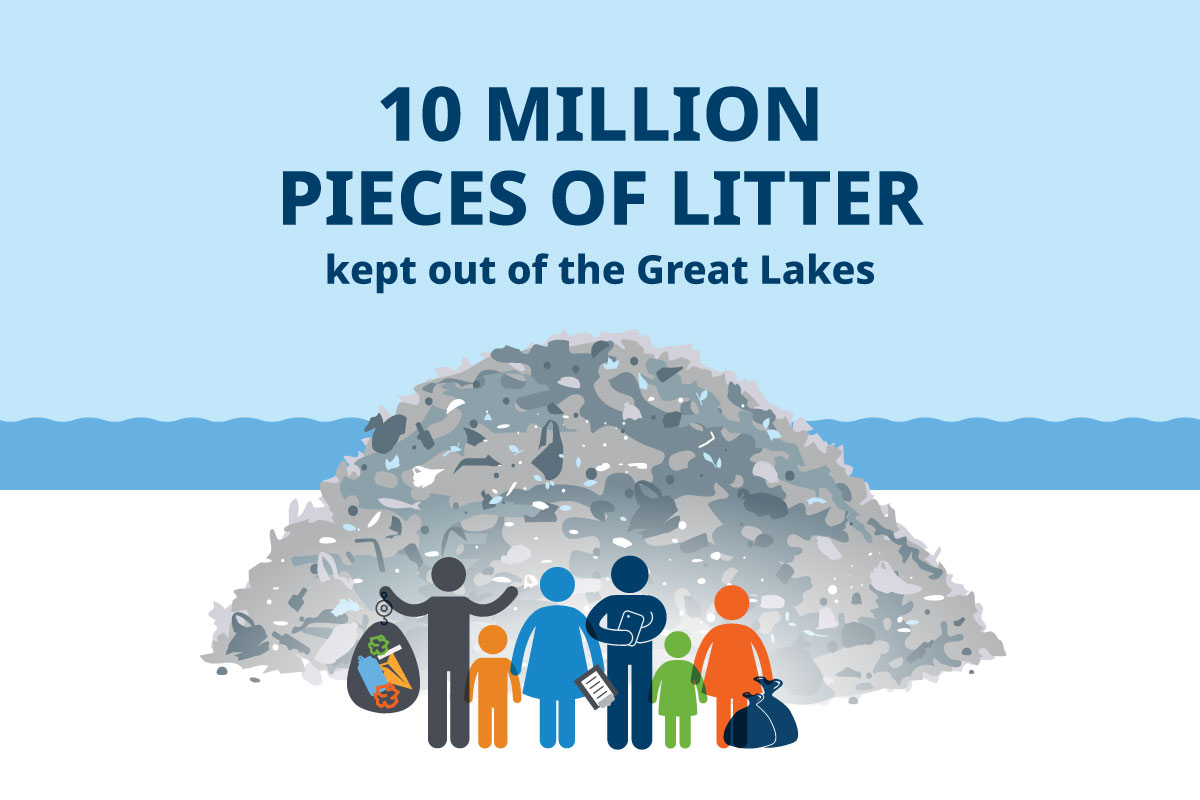
10 million pieces of litter kept out of the Great Lakes.

Chicago, IL (September 4, 2024) – Today, the Alliance for the Great Lakes announced an Adopt-a-Beach milestone. In the twenty-one years the Alliance has been tracking trash collected by the organization’s dedicated volunteers, more than 10 million pieces of litter have been removed from the five Great Lakes’ shorelines.  

“Our terrific volunteers do the incredibly hard work of not only cleaning the beaches but also take the time to catalog what they find. It may surprise people that instead of finding large items like bikes and tires, it’s mostly smaller bits of plastic trash. Their findings show litter patterns, raise awareness about plastic pollution, and help pass policies to reduce plastic pollution and litter,” said Olivia Reda, Alliance for the Great Lakes Volunteer Engagement Manager. 

In April, the Alliance released for the first time 20 years of data collected by Adopt-a-Beach volunteers that show 86% of the trash was either fully or partially made from plastic. Single-use plastic breaks down into much smaller pieces — microplastics — which have been found in our drinking water, fish, and even in human tissue. The building blocks of plastic are toxic and use large amounts of fossil fuels in their production.  

“I am consistently humbled and inspired by the hard work Alliance Adopt-a-Beach volunteers do, using their precious free time to clean up the region’s beaches. Plastic producers should give our volunteers a break by taking responsibility for the pollution they produce,” said Joel Brammeier, Alliance for the Great Lakes President and CEO.  

There is serious momentum across the country to steer the burden of plastic pollution away from consumers by holding producers accountable for the plastics that choke beaches and lakes, The Alliance for the Great Lakes has called for implementing extended producer responsibility policies — holding producers responsible across the life cycle of their products and packaging, from design and materials to end-of-life management. 

In August, Illinois Governor Pritzker signed a bill into law to eliminate the use of small, single-use plastic bottles containing personal care products in hotels. Minnesota became the fifth state in the U.S. to establish extended producer responsibility legislation for packaging, joining the Canadian provinces of Ontario and Quebec, which have been implementing policies holding producers accountable for years. In the United States, extended producer responsibility laws have passed in Maine, California, Oregon and Colorado. 

The Biden Administration announced in July that the federal government would phase out its purchases of single-use plastics since it is the biggest buyer of consumer goods in the world. At the Federal level, the Alliance is supporting the Plastic Pellet Free Waters Act, the Farewell to Foam Act, and the Break Free From Plastic Pollution Act.  

If you would like to volunteer to join an Alliance for the Great Lakes Adopt-a-Beach cleanup event, please follow this link: https://adopt.greatlakes.org/s/

###

If you are a member of the media and would like more information about covering an Adopt-a-Beach cleanup event, please contact Don Carr at dcarr@greatlakes.org.

The post 10 Million Pieces of Litter Collected from Great Lakes Shorelines appeared first on Alliance for the Great Lakes.

Original Article

News - Alliance for the Great Lakes

News - Alliance for the Great Lakes

https://greatlakes.org/2024/09/10-million-pieces-of-litter-collected-from-great-lakes-shorelines/

Judy Freed

Image credit: Wisconsin Sea Grant

Learn the art and craft of telling a Great Lakes story. Crafting experiences into powerful memories to share is an art. Join Jen Rubin, storytelling expert and producer of Love Wisconsin, a multimedia storytelling project, for an interactive workshop that will help storytellers share their love for the Great Lakes.

The first workshop will be held Oct. 4-5 at the Vaughn Public Library, Ashland, Wisconsin. Selected stories will be recorded. For more information and to register, visit: GreatLakesGreatRead.org/story.

Partners in this project include the Wisconsin Humanities Council, Wisconsin Library Association and the Wisconsin Water Library at the University of Wisconsin–Madison.

Great Lakes, Great Read is a basin-wide shared reading experience designed to inspire passion and connection to the Great Lakes Watershed through reading.

The post A Great Lakes, Great Read Storytelling Workshop first appeared on Wisconsin Sea Grant.

Original Article

News Releases | Wisconsin Sea Grant

News Releases | Wisconsin Sea Grant

https://www.seagrant.wisc.edu/news/a-great-lakes-great-read-storytelling-workshop/

Marie Zhuikov

Great Lakes Moment: Ten natural wonders of The Great Lakes Way

Great Lakes Moment is a monthly column written by Great Lakes Now Contributor John Hartig. Publishing the author’s views and assertions does not represent endorsement by Great Lakes Now or Detroit PBS.

The Great Lakes Way is an interconnected set of greenways and water trails stretching from Port Huron, Michigan (at the head of the St.

Read Now at Great Lakes Now.

Original Article

Great Lakes Now

Great Lakes Now

https://www.greatlakesnow.org/2024/09/great-lakes-moment-ten-natural-wonders-of-the-great-lakes-way/

John Hartig

Points North: A Natural Ending

By Ellie Katz, Interlochen Public Radio

Points North is a biweekly podcast about the land, water and inhabitants of the Great Lakes.

This episode was shared here with permission from Interlochen Public Radio. 

Peter Quakenbush’s big dream in life is a little different.

Read Now at Great Lakes Now.

Original Article

Great Lakes Now

Great Lakes Now

https://www.greatlakesnow.org/2024/09/points-north-a-natural-ending/

Interlochen Public Radio

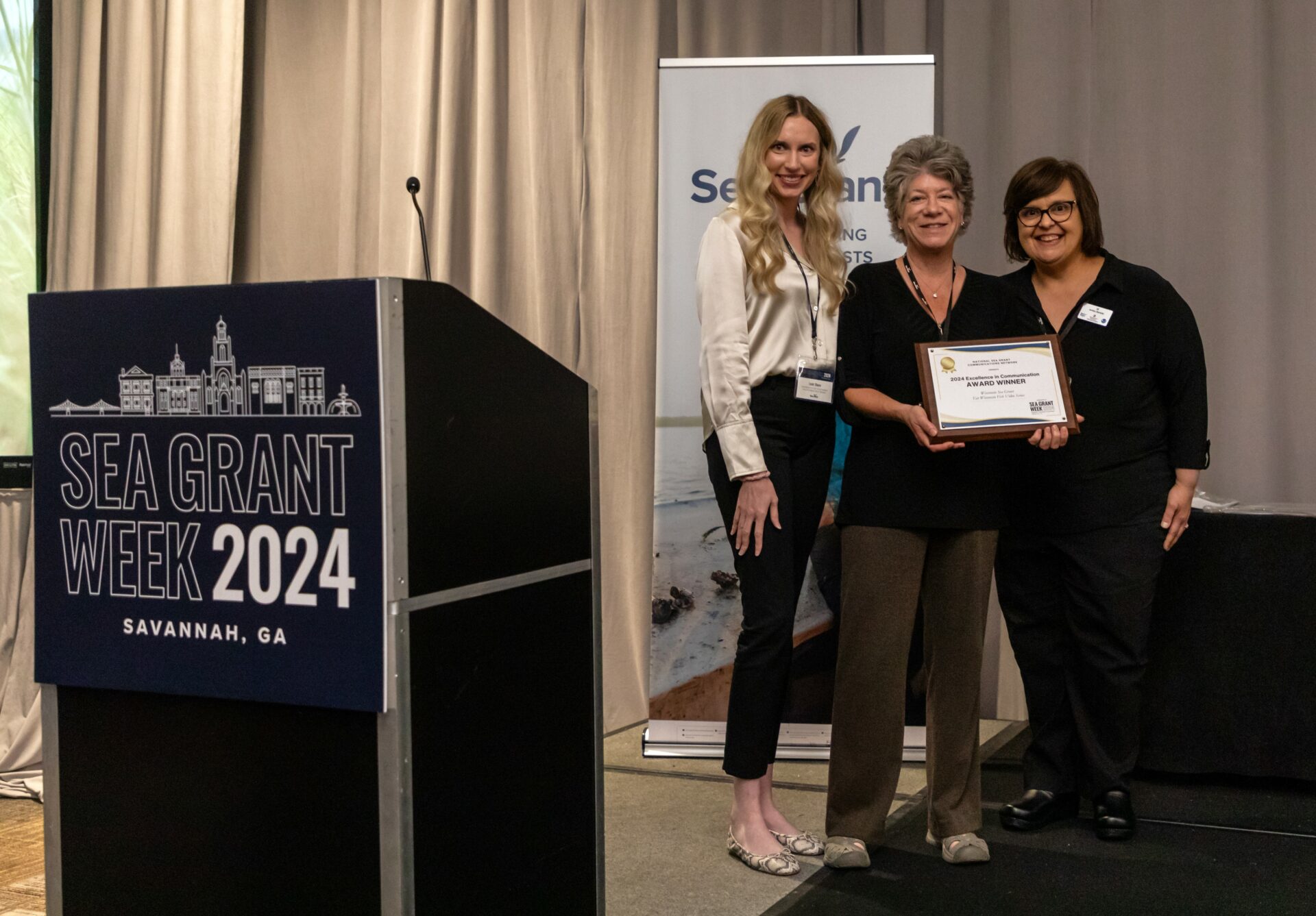
It’s no fish story: Wisconsin Sea Grant brought home top honors for its Eat Wisconsin Fish video series at Sea Grant Week in Savannah, Georgia.

The nine-part series, which showcases Wisconsin’s fish farmers and commercial fishers along the Great Lakes and Mississippi River, received the 2024 Excellence in Communication Award during the closing ceremony on Aug. 22. The award honors high-quality, innovative communication products or projects that reach audiences in new ways. Wisconsin Sea Grant’s 50th anniversary campaign was also honored as a runner-up.

Science communicator Marie Zhuikov poses with a communications award at Sea Grant Week alongside two other people

Marie Zhuikov (middle) accepts the communication award on behalf of Wisconsin Sea Grant, posing beside Leah Shore of USC Sea Grant (left) and Jill Jentes Banicki of Ohio Sea Grant (right). Photo: Georgia Sea Grant

Bonnie Willison, Wisconsin Sea Grant video and podcast producer who created the series, said the project exemplifies Sea Grant’s mission. “The profile videos educate the public about the sustainability of Wisconsin’s fish, our fishing heritage and career pathways in the industry. They promote Sea Grant’s brand, but also provide a service to the small-business owners: a professionally made video that they can use for their business,” said Willison.

Judges agreed, also praising the series as “multifaceted,” “captivating,” and “beautifully conceived.” One reviewer stated that the Eat Wisconsin Fish videos whet their appetite: “I wanted to meet all these people and buy their products after watching them!”

The project was a team effort. Willison made the videos under the direction of Sharon Moen, who runs the Eat Wisconsin Fish initiative. Marie Zhuikov, science communicator, created four “Fish Dish” podcast episodes out of the interview audio, and Moira Harrington, Emma Hauser and David Hart provided guidance and editorial support.

Said one reviewer, “An excellent team was assembled to create, implement and distribute the communications products.”

We couldn’t agree more.


The post Eat Wisconsin Fish videos win communication award at Sea Grant Week first appeared on Wisconsin Sea Grant.

Original Article

News Releases | Wisconsin Sea Grant

News Releases | Wisconsin Sea Grant

https://www.seagrant.wisc.edu/news/eat-wisconsin-fish-videos-win-communication-award-at-sea-grant-week/

Jenna Mertz

This week, blue-green algae blooms were spotted in the waters of Lake Superior in St. Louis Bay and Little Sand Bay in the Apostle Islands National Lakeshore. Those sightings followed a bloom spotted last week off Barker’s Island in Superior, Wisconsin. While common in inland rivers and ponds, the algae are fairly new to Lake Superior. Read the full story by Wisconsin Public Radio.

Original Article

Great Lakes Commission

Great Lakes Commission

https://www.glc.org/dailynews/20240830-lake-superior-habs

James Polidori

A Presque Isle County steel fabricator has won a $5.85 million contract to build the R/V Steelhead II, a new fisheries research boat, for the Michigan Department of Natural Resources. The 66-foot, steel-hulled vessel will replace the S/V Steelhead, a 56-year-old survey vessel used to gather Great Lakes fishery management data. Read the full story by MLive.

Original Article

Great Lakes Commission

Great Lakes Commission

https://www.glc.org/dailynews/20240830-research-vessel

James Polidori

More than 154,000 comments have been submitted on the U.S. Army Corps of Engineers’ environmental assessment of Enbridge’s proposed 41-mile reroute of its Line 5 around the Bad River Band of Lake Superior Chippewa’s land. Interested parties have until Aug. 30 to submit comments. Read the full story by the Milwaukee Journal Sentinel.

Original Article

Great Lakes Commission

Great Lakes Commission

https://www.glc.org/dailynews/20240830-line5-public-comments

James Polidori

In Ontario, toxic blue-green algae that closed public access to the water along Beach Boulevard this week is the first such discovery along Hamilton’s stretch of Lake Ontario in at least a decade, if not longer. Read the full story by The Hamilton Spectator.

Original Article

Great Lakes Commission

Great Lakes Commission

https://www.glc.org/dailynews/20240830-rare-algae

James Polidori

The volunteer lead Great Lakes piping plover monitor at Chicago’s Montrose Beach was recognized by the Illinois Department of Natural Resources as one of 11 outstanding volunteers of the year. Read the full story by WTTW – Chicago, IL.

Original Article

Great Lakes Commission

Great Lakes Commission

https://www.glc.org/dailynews/20240830-plover-volunteer

James Polidori

Approximately 72 hectares of land formerly occupied by a coal-fired power plant in Mississauga will soon be home to the longest Canadian pier in the Great Lakes. The pier will jut 600 meters into Lake Ontario and is part of the Lakeview Village, which is currently being built along its shores. Read the full story by CTV News.

Original Article

Great Lakes Commission

Great Lakes Commission

https://www.glc.org/dailynews/20240830-longest-pier

James Polidori

Many people are starting to lose hope that the gator of Lake Erie will ever be captured or seen again. Erie-Western Pennsylvania Port Authority officials said it has not confirmed any sightings of it, but expressed hope that it is safe if it is still out there. Read the full story by Erie Times-News.

Original Article

Great Lakes Commission

Great Lakes Commission

https://www.glc.org/dailynews/20240830-alligator-sightings

James Polidori

People love the expansive shorelines of the Great Lakes, and will often hit the beach on a warm summer afternoon to swim, play and cool off.  But scientists have recently discovered that meteotsunamis – waves caused by sudden atmospheric pressure … Continue reading

Original Article

NOAA Great Lakes Environmental Research Laboratory

NOAA Great Lakes Environmental Research Laboratory

https://noaaglerl.blog/2024/08/30/new-buoy-is-detecting-meteotsunamis-in-the-great-lakes/

Gabrielle Farina

‘These are not your lands to give away’: 6 First Nations take Ontario to court over mining law

By Emma McIntosh, The Narwhal

The Great Lakes News Collaborative includes Bridge Michigan; Circle of Blue; Great Lakes Now at Detroit Public Television; Michigan Public, Michigan’s NPR News Leader; and The Narwhal who work together to bring audiences news and information about the impact of climate change, pollution, and aging infrastructure on the Great Lakes and drinking water.

Read Now at Great Lakes Now.

Original Article

Great Lakes Now

Great Lakes Now

https://www.greatlakesnow.org/2024/08/these-are-not-your-lands-to-give-away-6-first-nations-take-ontario-to-court-over-mining-law/

The Narwhal

A rock covered with invasive zebra mussels taken from Lake Mendota. Photo: Adam Hinterthuer, University of Wisconsin-Madison

By Adam Hinterthuer and Madelyn Anderson, University of Wisconsin-Madison

A report on more than 40 years of research on Wisconsin lakes highlights lessons scientists have learned about aquatic invasive species. For example, far more ecosystems are playing host to non-native species than were previously thought. However, the authors write, those species aren’t necessarily detrimental to their new habitat and, in some cases, the negative “impacts of invasive species control [efforts] may be greater than the impacts of the invasive species” themselves.

That doesn’t mean we shouldn’t be concerned about different species moving into new ecosystems, said Jake Vander Zanden, director of the University of Wisconsin-Madison’s Center for Limnology and lead author on the report. “There are many examples where an invasive species has remarkable ecosystem impacts. They can result in fisheries decline, water quality decrease, and more which negatively impacts humans and the environment,” he said. But ecological destruction is far from a foregone conclusion in invasive species stories. 

In the article, published recently in the journal “BioScience,” Vander Zanden and his team, which includes Alison Mikulyuk, Sea Grant’s Water@UW Madison Research Program coordinator, highlight nine lessons learned through four decades of data collection, research and experiments conducted by the North Temperate Lakes Long-Term Ecological Research Program. Housed at the Center for Limnology, the NTL-LTER is one of 27 long-term research sites funded by the National Science Foundation.

Research grants are typically funded for three years, Vander Zanden explains, “But that would never allow you to detect these types of changes. It’s only through long-term research that we can get insights into these big questions like where invasive species are, how they are changing our ecosystems and how it all connects to things like climate change.” 

One such insight is that the presence of non-native aquatic species in Wisconsin lakes is more widespread than scientists and resource managers initially thought. The NTL-LTER has helped inform Wisconsin Department of Natural Resources maps and datasets on six target species – Eurasian watermilfoil, zebra mussels, spiny waterfleas, rusty crayfish, Chinese mystery snail and the banded mystery snail – since the 1990s. 

Combining long-term monitoring records on its 11 core study lakes with field-based research and community-based science on dozens of other water bodies, researchers revealed that existing estimates of about 8% of Wisconsin lakes containing one or more of the six species was way off. In fact, the number is closer to 39%.  

The post Study offers key takeaways from long-term research on aquatic invasive species first appeared on Wisconsin Sea Grant.

Original Article

Blog | Wisconsin Sea Grant

Blog | Wisconsin Sea Grant

https://www.seagrant.wisc.edu/blog/study-offers-key-takeaways-from-long-term-research-on-aquatic-invasive-species/

Wisconsin Sea Grant

Nibi Chronicles: A conversation about Ojibwe history in Fur Trade Nation

Editor’s Note: “Nibi Chronicles,” a monthly Great Lakes Now feature, is written by Staci Lola Drouillard. A direct descendant of the Grand Portage Band of Ojibwe, she lives and works in Grand Marais on Minnesota’s North Shore of Lake Superior. Her two books “Walking the Old Road: A People’s History of Chippewa City and the Grand Marais Anishinaabe” and “Seven Aunts” were published 2019 and 2022, and she is at work on a children’s story.

Read Now at Great Lakes Now.

Original Article

Great Lakes Now

Great Lakes Now

https://www.greatlakesnow.org/2024/08/nibi-chronicles-conversation-about-ojibwe-history-in-fur-trade-nation/

Staci Lola Drouillard

RESTON, Va. – The U.S. Geological Survey recently announced it will invest about $1.3 million in Bipartisan Infrastructure Law funding to collect high-resolution geophysical data focused on critical mineral resources across southeastern Nebraska and northeastern Kansas. 

Original Article

Midcontinent Region

Midcontinent Region

https://www.usgs.gov/news/state-news-release/critical-mineral-mapping-across-regions-nebraska-kansas-underway-thanks?utm_source=comms&utm_medium=rss&utm_campaign=news

lrussell@usgs.gov

Americans love nature but don’t feel empowered to protect it, new research shows

By Jessica Eise, Indiana University

 is an independent and nonprofit source of news, analysis and commentary from academic experts.

Climate change has been in the news for more than 40 years. It’s typically covered as a scientific or political issue. However, social scientists like me have found that feelings and values are what drive people toward broad, collective change – not charts, graphs or images.

Read Now at Great Lakes Now.

Original Article

Great Lakes Now

Great Lakes Now

https://www.greatlakesnow.org/2024/08/americans-love-nature-but-dont-feel-empowered-to-protect-it-new-research-shows/

The Conversation

fish farmer Peter Shep stands in front of an old milking parlor building discussing aquaculture

Peter Shep discusses fish farming in front of the milking parlor that houses his aquaculture operation. Photo: Wisconsin Sea Grant

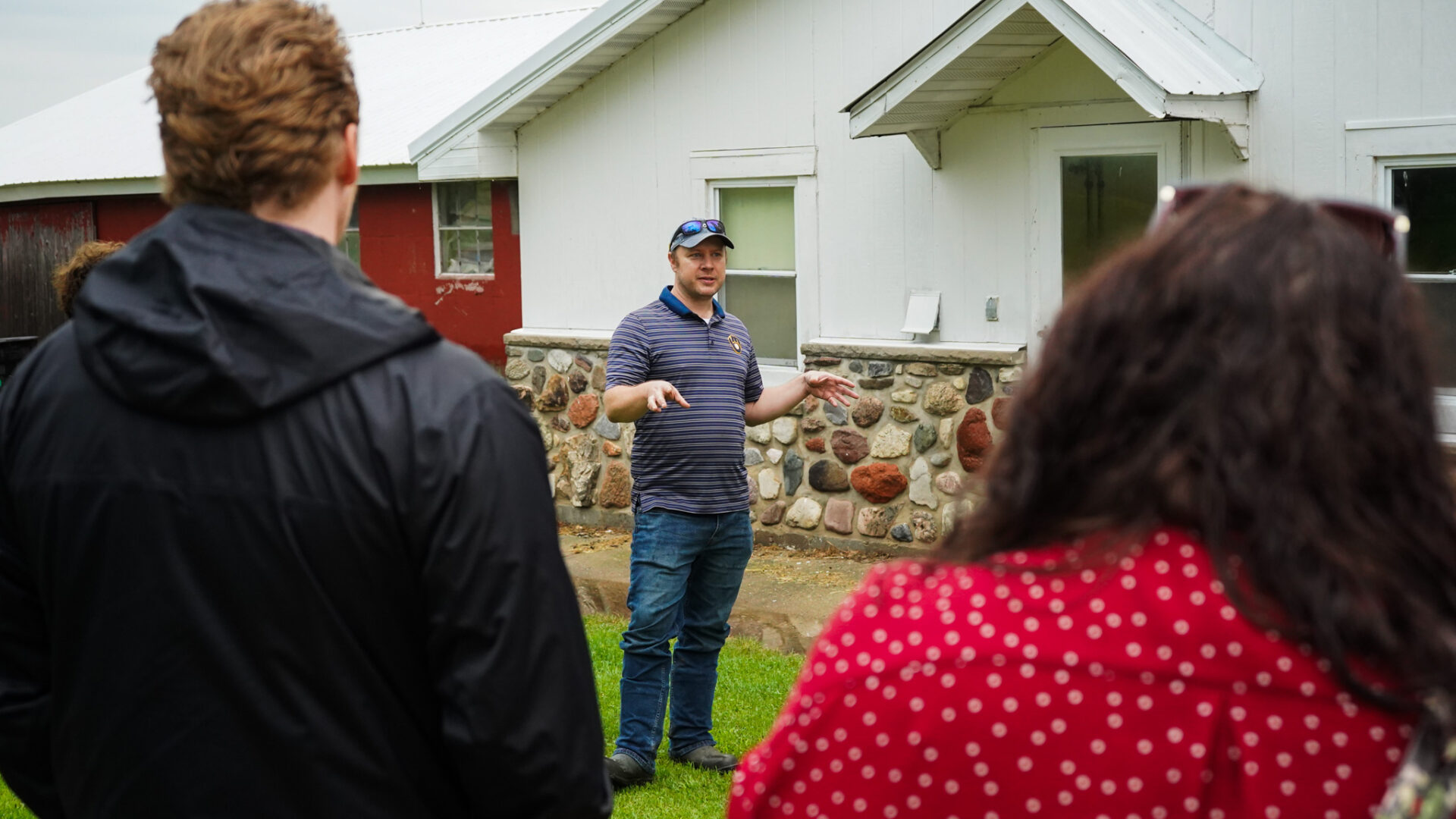
When a small group of Wisconsin lawmakers and their staff peered into a milking parlor in Stoughton, Wisconsin, in late July, they learned that that not all dairy barns have cows. Some have fish.  

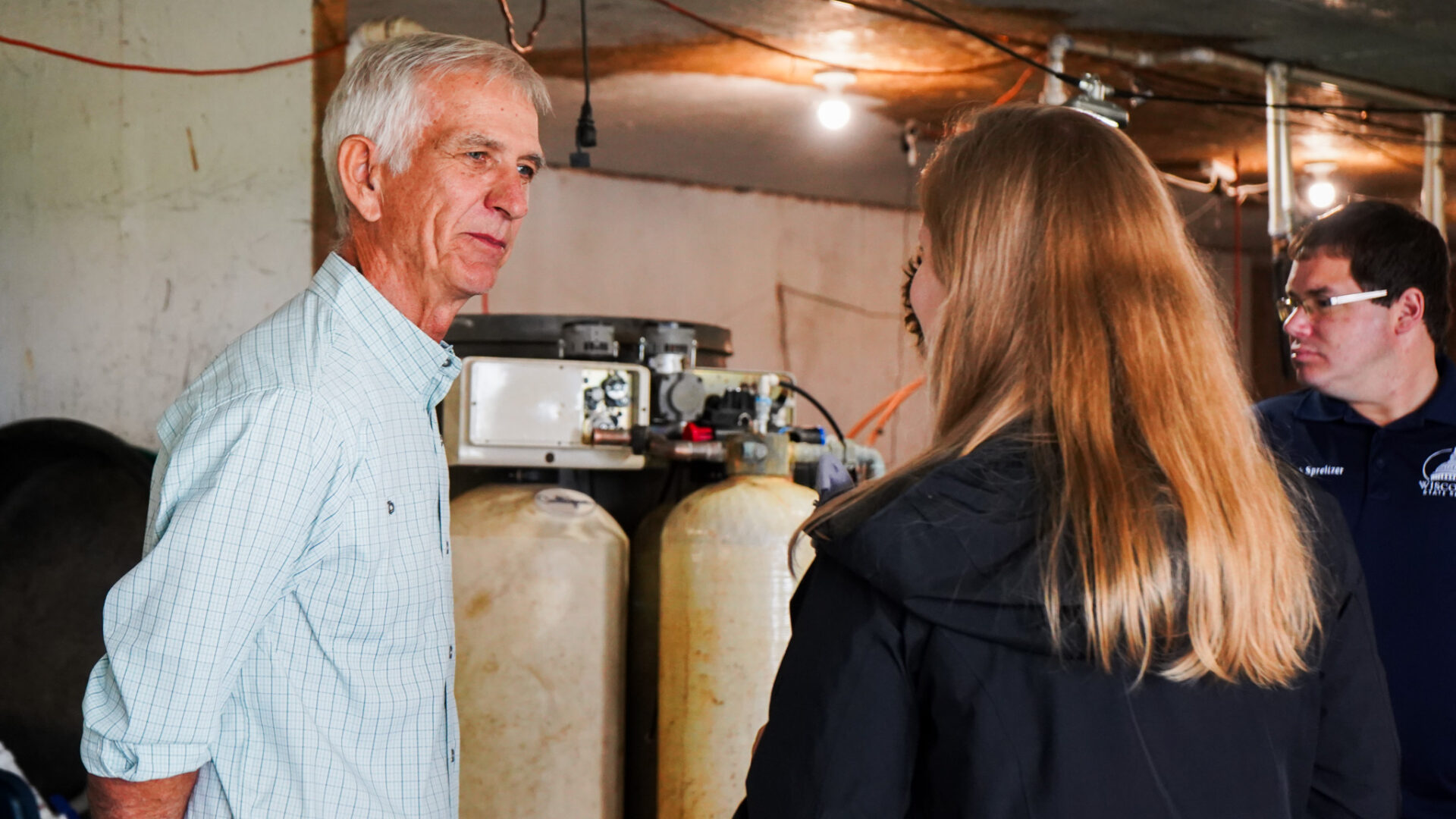
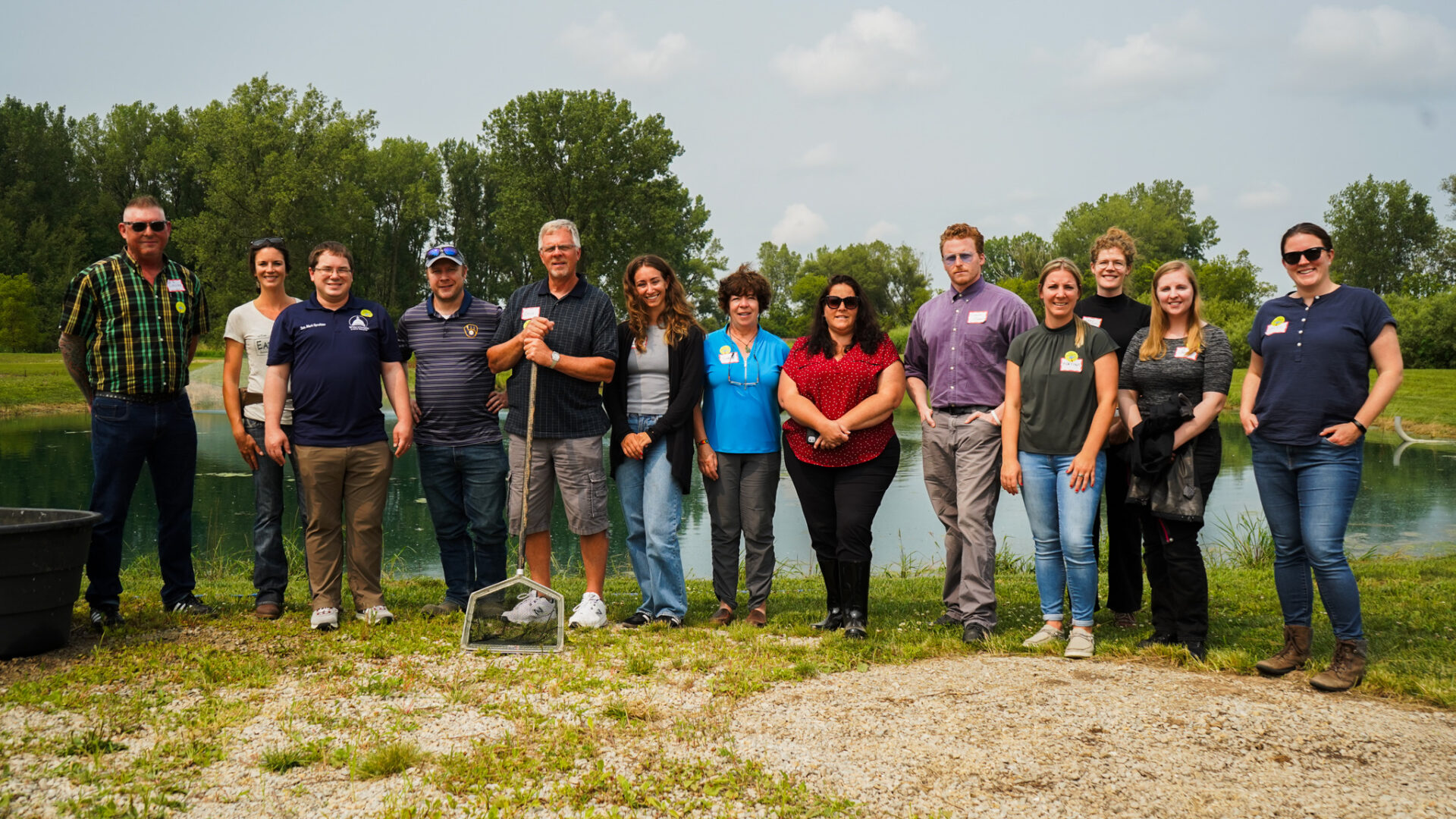
The visit to Mulberry Aquaponics and Hatchery was the first stop on a tour of four fish farms in southern Wisconsin that also included Northey Farms in Deerfield, Rushing Waters Fisheries in Palmyra and Crystal Clear Fish Farm in Beaver Dam. Hosted by Wisconsin Sea Grant and industry partners, the tour brought together decision-makers to learn more about aquaculture and the challenges fish farmers face. State Senator Mark Spreitzer and staff from the offices of state Reps. Rozar, Moses and Shankland were all in attendance as were Lauren Kisley, the new veterinary program manager from the Wisconsin Department of Agriculture, Trade and Consumer Protection, and Ben Gollon, president of the Wisconsin Aquaculture Association and president/CEO at Gollon Brothers Wholesale Live Bait Inc.

Sharon Moen, Wisconsin Sea Grant food-fish outreach coordinator, organized the tour with fish farmers and funding from the National Sea Grant office.

“This tour was a direct response to a needs assessment Wisconsin Sea Grant conducted with fish farmers,” said Moen. “The farmers prioritized developing better lines of communication with decision-makers so we designed an opportunity where that could happen. We loaded fish farmers, decision-makers and Sea Grant facilitators aboard two minivans and drove 150 miles with stops at four fish farms and one Kwik Trip, having meaningful conversations along the way.”

Stop one: Growing perch in a barn 

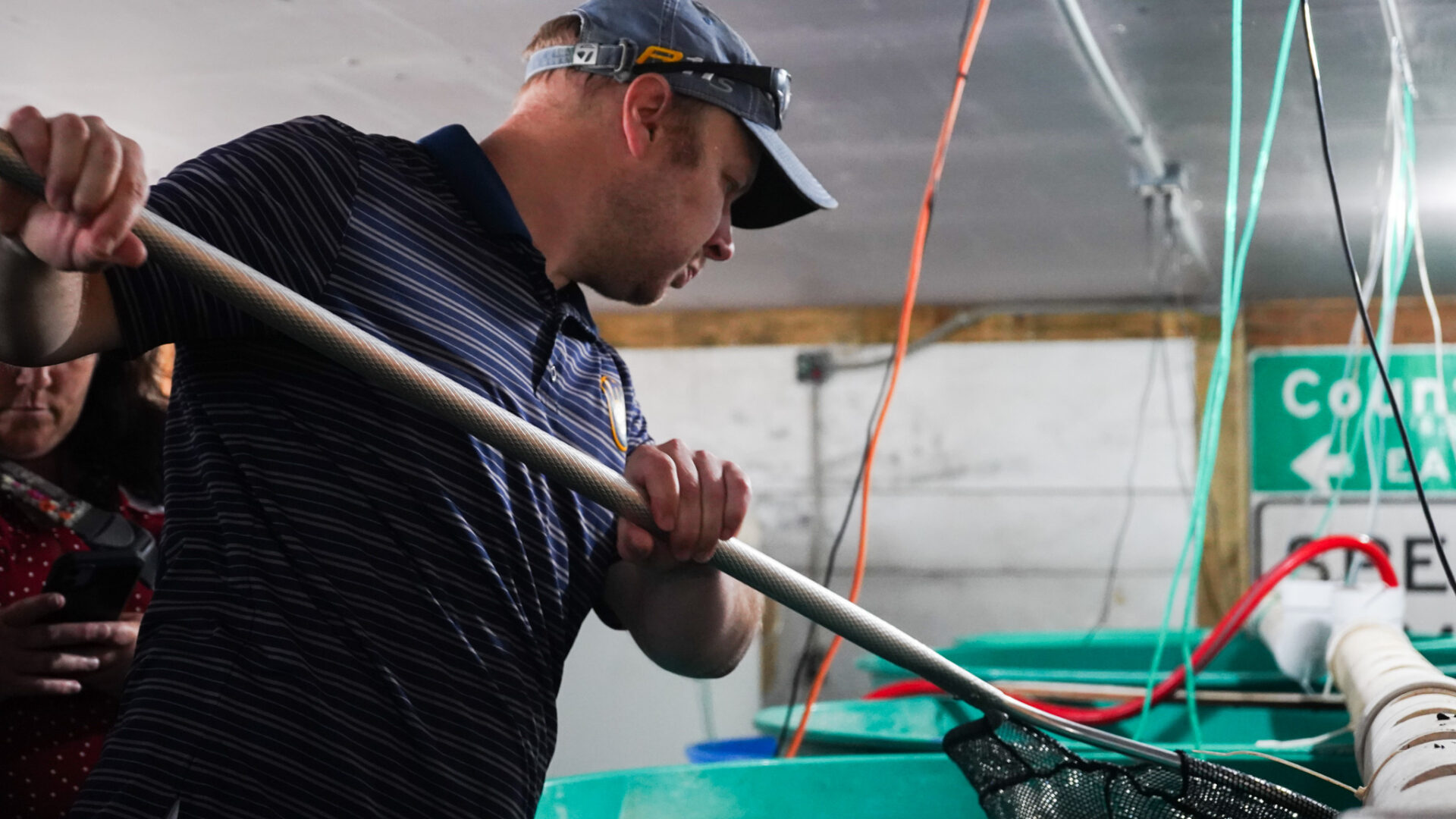
Inside the milking parlor at Mulberry Aquaponics and Hatchery, fish farmer Peter Shep explained how he raises yellow perch from egg to fingerling using a recirculating aquaculture system, which filters and recycles up to 90% of the water. This specialized equipment can be costly, but Shep used inexpensive materials like stock tanks, PVC pipes and solar-powered pumps to craft an affordable but effective system.  

Peter Shep dips a net into a blue tank that holds yellow perch.

Shep dips a net into one of the tanks where he raises yellow perch. Photo: Wisconsin Sea Grant

His graduate education helped. Shep started the business after graduating from the University of Wisconsin-Milwaukee School of Freshwater Sciences, where he worked with Professor Dong-Fang Deng, who specializes in yellow perch production.  

Raising fish in a gleaming, high-tech university lab, however, is not the same as raising fish in a renovated dairy barn. Despite using similar methods, Shep’s tanks produced fewer yellow perch per gallon than those at the university. The difference underlined the need for more research to be done on actual fish farms, where conditions are different than those in the lab. Wanting to solve some of the research-to-application challenges, he is returning to school in fall to pursue a doctorate degree in the Deng lab.

Shep also cited the technical challenges of raising perch, which are prone to dying within the first 30 days. In addition to being “finnicky,” perch are learning to eat and don’t always direct their hunger at the right thing. “They love to eat each other,” he said, showing photographic evidence to a rapt tour group. 

If the perch survive, fingerlings are sold to “grow-out” farms that raise fish to the desired size for stocking in lakes or ponds. And demand is high. One buyer was interested in purchasing up to 250,000 fingerlings, which is more than double Mulberry Aquaponics’ goal for 2024.  

Stop two: Where experience and innovation meet

Fish farmer Dave Northey talks with the group of decision-makers

Dave Northey discusses trying out recirculating aquaculture with the tour group. Photo: Wisconsin Sea Grant

The next stop was Northey Farms in Deerfield, where owner Dave Northey has raised yellow perch for nearly 30 years. Walking into an outbuilding, the tour group peeked into tanks that looked a lot like Shep’s.

Northey used to rear 300,000 to 900,000 fish exclusively in outdoor ponds, but several bad years and a serendipitous meeting with Shep encouraged him to try a recirculating aquaculture system. Compared to the pond system, Northey said RAS uses less water and offers the opportunity for multiple crops per year.

While production hasn’t bounced back to previous levels, Northey continues to work with Shep and Doug Sackett of Crystal Clear Fish Farm to optimize their systems and try new things. In this informal “co-op,” the trio share information as colleagues rather than competitors.  


Stop three: Raising rainbow trout for the dinner plate 

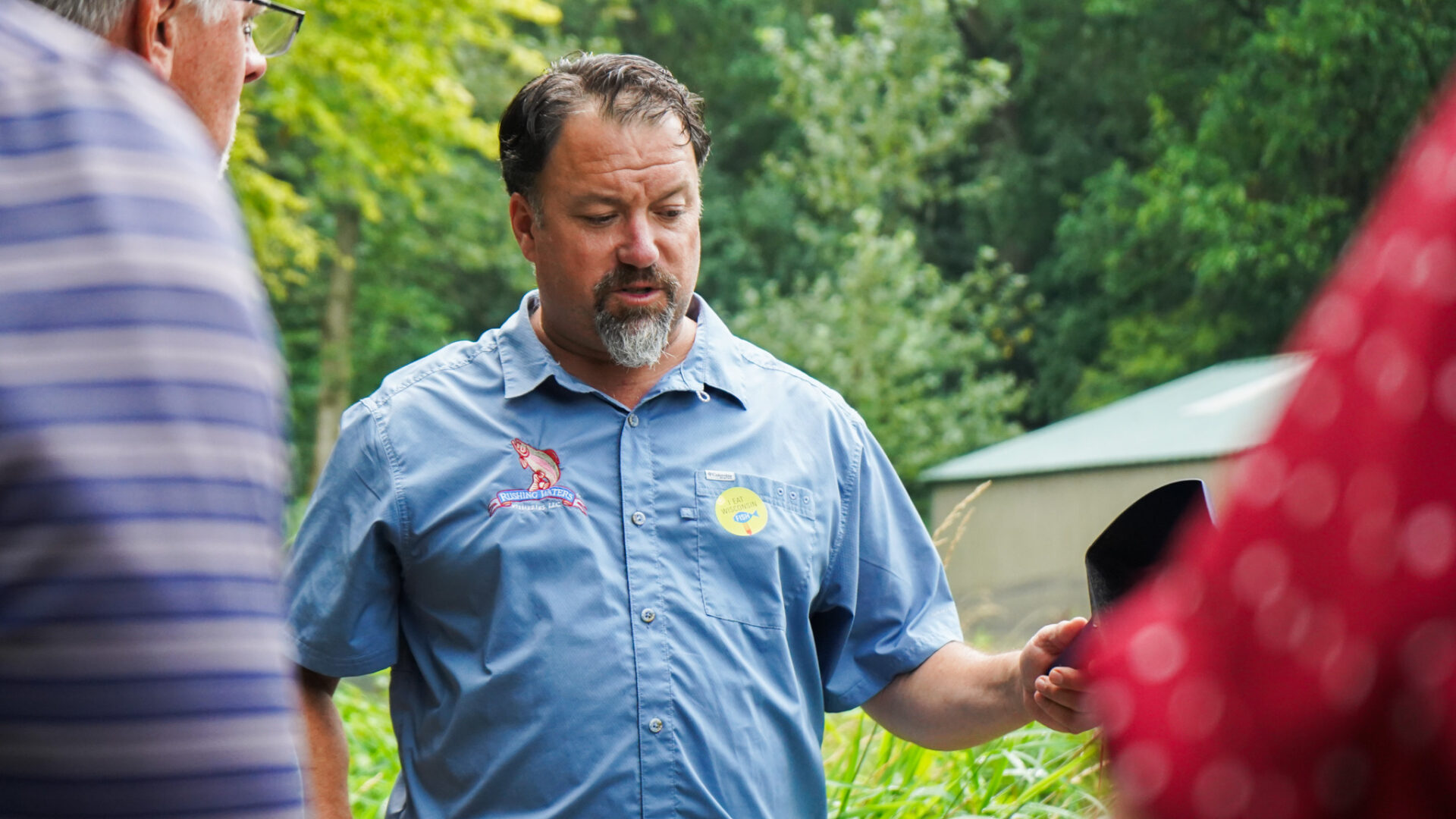
Trout farmer Peter Fritsch wears a blue shirt emblazoned with the logo of his business, Rushing Waters Fisheries, and discusses his business with tour group

Peter Fritsch of Rushing Waters took the group on a tour of the outdoor ponds where he raises rainbow trout. Photo: Wisconsin Sea Grant

Heading east, the tour’s lunchtime stop was at the state’s largest commercial rainbow trout farm, Rushing Waters Fisheries in Palmyra. The 80-acre farm produces around 225,000 pounds of fish per year in outdoor ponds and features a seafood processing facility that makes fish products sold on-site and in stores. Fish are raised from egg to harvest right on the farm.

Owner Peter Fritsch explained that the ponds where he raises rainbow trout are spring-fed and hover around 50 degrees year-round. The consistently cold temperature is what makes trout farming possible, as trout need cold water to survive. 

Being spring-fed, the waters were also clear and the fish easy to spot — not just for humans, but also birds. Fritsch said great blue herons and eagles like the easy pickings of ponds filled with fish and often hang around the farm. In the past, he used netting to deter predators and now uses laser technology to scare birds away. 

Over a lunch of salmon burgers (a product processed and sold by Rushing Waters), Fritsch discussed further challenges fish farmers face, such as securing permits and the differences between federal and state regulations of fish farms. Another one is the high cost of starting and sustaining a farm. 

“How do you make a little money in aquaculture? Start with a lot,” joked Fritsch. He encouraged the decision-makers to think about ways they can support fish farmers and those new to the industry. 

Stop four: Making fish big

Fish farmer doug Sackett nets several perch from him pond as the tour group watches

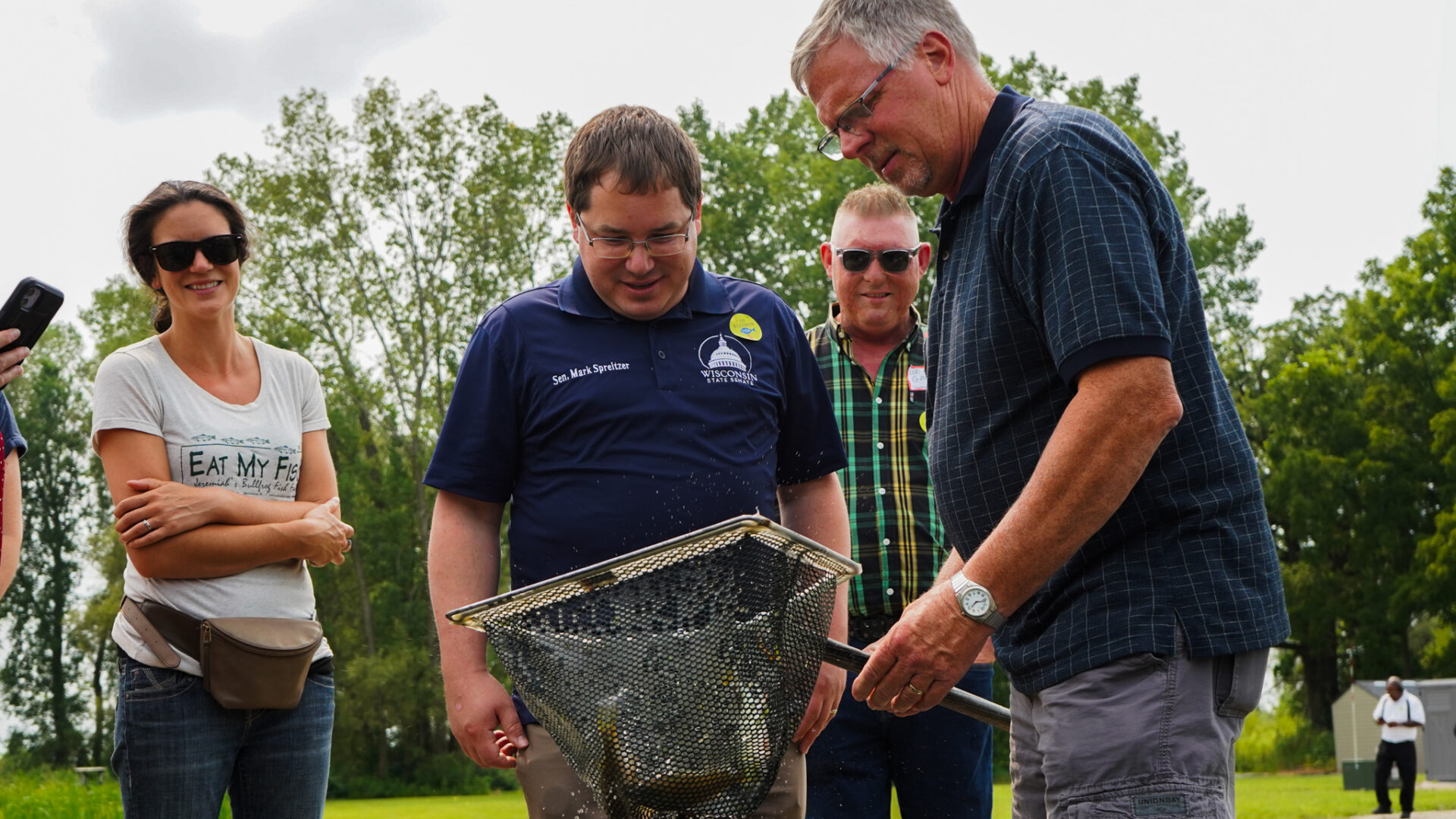
Doug Sackett of Crystal Clear Farms (right) nets yellow perch for a photo op with Sen. Spreitzer. Photo: Wisconsin Sea Grant

With fish on the mind and in the belly, the tour headed toward the fourth and final stop with Doug Sackett, owner of Crystal Clear Fish Farm in Beaver Dam.  

Sackett runs a “grow-out” farm, where — like the name suggests — he grows out fingerling yellow perch in eight outdoor ponds to be stocked in lakes across the state. He purchases his fingerlings from both Shep and Northey and is part of their informal co-op.  

Sackett’s goal is to keep the fish healthy and make them big, usually between 5 and 7 inches. He feeds fish twice a day, propelling pellets into the pond with a leaf blower, and works to maintain the appropriate temperature and dissolved oxygen levels. In fall, once the fish are big enough, he uses seine nets to corral and remove them from the ponds. The fish are then transported via truck to lakes and ponds. Most of Sackett’s clients are lake associations looking to boost numbers of yellow perch in their lake.

Sen. Spreitzer posed with one of Sackett’s perch but wasn’t spared the splash as the fish flopped back to the water.


Back on the bus, the wheels continue to turn on the future of Wisconsin aquaculture

As tour attendees boarded the vans to return to Madison, Sackett chatted with Ben Gollon, president of the Wisconsin Aquaculture Association, and Wisconsin Sea Grant aquaculture outreach specialist, Emma Hauser, about strategies for increasing oxygen in the ponds while keeping them cool during the hot summer months. The discussion was yet another example of how this excursion brought farmers, researchers and extension folks together in sharing knowledge and making connections.

The tour also invited lawmakers and legislative staff into the aquaculture conversation, many of whom asked questions of fish farmers on the car rides between stops. One asked whether fish, like other crops, could be insured; another asked about how to start an aquaponics system, which uses nutrients from fish waste to grow greens, at home. Others wanted to know more about how regulation works within the industry. 

Knowledge sharing, however, wasn’t a one-way street: Fish farmers also had a chance to ask questions of decision-makers. They asked how and when to best connect with and educate lawmakers about the industry and discussed how bills become laws. Some were curious about what it was like to manage a campaign or run for office. 

After the tour, Gollon asked, “This was such a great tour and discussion. Let’s do it again. Where are we going to go next?”

Moen said she was pleased by the depth of the questions and conversations during the tour and pointed toward more opportunities for connecting in the future. She said, “I think we can call this a resounding success as the fish farmers are talking about ‘next time’ and the legislative participants suggested that Wisconsin Sea Grant and fish farmers cooperate to hold a briefing at the state capitol. And — spoiler alert — we recently received word that our proposal to organize this type of opportunity in 2025 received funding.”

This project was made possible by a grant from the National Sea Grant Office (NOAA-OAR-SG-2023-2007550) to the Ohio (lead), Wisconsin and Minnesota Sea Grant programs.

The tour group stands in front of an outdoor pond

Fish farmers, decision-makers and Sea Grant staff pose for a photo in front of Crystal Clear Fish Farm’s yellow perch ponds. Photo: Wisconsin Sea Grant


The post A fish farm field trip for Wisconsin decision-makers highlights challenges and future of aquaculture first appeared on Wisconsin Sea Grant.

Original Article

News Releases | Wisconsin Sea Grant

News Releases | Wisconsin Sea Grant

https://www.seagrant.wisc.edu/news/a-fish-farm-field-trip-for-wisconsin-decision-makers-highlights-challenges-and-future-of-aquaculture/

Jenna Mertz

Southeast Michigan facility will soon house waste from the Manhattan Project

By Elinor Epperson, Michigan Public

The Great Lakes News Collaborative includes Bridge Michigan; Circle of Blue; Great Lakes Now at Detroit Public Television; Michigan Public, Michigan’s NPR News Leader; and The Narwhal who work together to bring audiences news and information about the impact of climate change, pollution, and aging infrastructure on the Great Lakes and drinking water.

Read Now at Great Lakes Now.

Original Article

Great Lakes Now

Great Lakes Now

https://www.greatlakesnow.org/2024/08/southeast-michigan-facility-will-soon-house-waste-from-the-manhattan-project/

Michigan Public

Geneva Lake in Walworth County, Wisconsin, has long been known for its clear, deep water and scenic location. And now it has an unwelcome distinction: it is the first Wisconsin inland lake documented with quagga mussels, according to state and local officials. Read the full story by the Milwaukee Journal Sentinel.

Original Article

Great Lakes Commission

Great Lakes Commission

https://www.glc.org/dailynews/20240828-quagga-mussels

Theresa Gruninger

The Sloughs — or Ogaakagonike in Ojibwe — are a series of Wisconsin tributaries chock full of wetlands that are home to the only wild rice bed in Lake Superior. As threats like climate change and extractive industries encroach on Lake Superior, the power of place has never been more important for the Ojibwe. Read the full story by the Milwaukee Journal Sentinel.

Original Article

Great Lakes Commission

Great Lakes Commission

https://www.glc.org/dailynews/20240828-the-sloughs

Theresa Gruninger

Wisconsin Gov. Tony Evers announced Monday that his administration is proposing to bring the state’s drinking water standards for PFAS in line with new federal regulations unveiled earlier this year. Read the full story by Wisconsin Public Radio.

Original Article

Great Lakes Commission

Great Lakes Commission

https://www.glc.org/dailynews/20240828-pfas-standards

Theresa Gruninger

This month, a team of scientists confirmed there are more than 40 sinkholes on Lake Michigan’s lakebed in the Wisconsin Shipwreck Coast National Marine Sanctuary. The sinkholes are valuable natural laboratories that can help scientists learn more about Earth’s early history before there was oxygen. Read the full story by the Milwaukee Journal Sentinel.

Original Article

Great Lakes Commission

Great Lakes Commission

https://www.glc.org/dailynews/20240828-sinkholes

Theresa Gruninger

Although this year’s cruise season is winding down in Cleveland, Ohio, there are plenty of reasons for optimism in 2025. The Port of Cleveland has announced that Victory Cruise Lines is coming back to the Great Lakes after a year-long hiatus, with 30 planned ports of call on the North Coast in 2025. Read the full story by WKYC-TV – Cleveland, OH.

Original Article

Great Lakes Commission

Great Lakes Commission

https://www.glc.org/dailynews/20240828-cleveland-cruises

Theresa Gruninger

Knox County, Ohio, farmers are among the more than 3,000 producers protecting Ohio’s water quality through the H2Ohio nutrient management program. Farmers will develop and implement a Voluntary Nutrient Management Plan that will reduce phosphorus runoff, a major contributor to algae blooms. Read the full story by the Knox Pages.

Original Article

Great Lakes Commission

Great Lakes Commission

https://www.glc.org/dailynews/20240828-h2ohio

Theresa Gruninger

A $1.45 million federal project will help communities across Wisconsin, Minnesota and Michigan prepare for floods by building up resilience along the Lake Superior coast and reestablishing the land’s ability to store water and release it slowly. Read the full story by the Milwaukee Journal Sentinel.

Original Article

Great Lakes Commission

Great Lakes Commission

https://www.glc.org/dailynews/20240828-flooding-grants

Theresa Gruninger

Minnesota’s iconic Split Rock Lighthouse on Lake Superior has transformed itself over the last few years. New to the popular lighthouse is a walking tour and a new exhibit on the history of the Native American people who were there long before the 114-year-old tower. Read the full story by Minnesota Public Radio.

Original Article

Great Lakes Commission

Great Lakes Commission

https://www.glc.org/dailynews/20240828-split-rock-lighthouse

Theresa Gruninger

The largest lake sturgeon in the history of Michigan’s annual state survey was captured last week. The monster fish was 75.2 inches long, or about 6-foot, 3 inches, which made it the largest sturgeon by length that the survey has ever recorded. Read the full story by MLive.

Original Article

Great Lakes Commission

Great Lakes Commission

https://www.glc.org/dailynews/20240828-sturgeon

Theresa Gruninger