Assessing the U.S. Climate in August 2024
2024-09-10
During August, the average contiguous U.S. temperature was 74.0°F, 1.9°F above the 20th-century average.
NCEI News Feed
https://www.ncei.noaa.gov/news/national-climate-202408
NCEI News Feed
https://www.ncei.noaa.gov/news/national-climate-202408
NCEI News Feed
https://www.ncei.noaa.gov/news/national-climate-202408
NCEI News Feed
https://www.ncei.noaa.gov/news/national-climate-202408
NCEI News Feed
https://www.ncei.noaa.gov/news/national-climate-202408
NCEI News Feed
https://www.ncei.noaa.gov/news/national-climate-202408
NCEI News Feed
https://www.ncei.noaa.gov/news/national-climate-202408
NCEI News Feed
https://www.ncei.noaa.gov/news/national-climate-202408
NCEI News Feed
https://www.ncei.noaa.gov/news/national-climate-202408
NCEI News Feed
https://www.ncei.noaa.gov/news/national-climate-202408
NCEI News Feed
https://www.ncei.noaa.gov/news/national-climate-202408
NCEI News Feed
https://www.ncei.noaa.gov/news/national-climate-202408
NCEI News Feed
https://www.ncei.noaa.gov/news/national-climate-202408
NCEI News Feed
https://www.ncei.noaa.gov/news/national-climate-202408
NCEI News Feed
https://www.ncei.noaa.gov/news/national-climate-202408
NCEI News Feed
https://www.ncei.noaa.gov/news/national-climate-202408
NCEI News Feed
https://www.ncei.noaa.gov/news/national-climate-202408
NOAA Great Lakes Environmental Research Laboratory
NOAA Great Lakes Environmental Research Laboratory
https://noaaglerl.blog/2024/09/10/video-50-years-of-science-service-and-stewardship-at-noaas-great-lakes-environmental-research-laboratory/
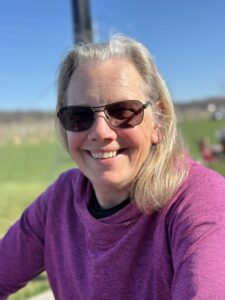
Jude Holland, local resident, volunteers for Fox-Wolf and other area groups.
Jude Holland doesn’t drink from the well in her backyard – there’s way too much arsenic in the water. But she figured she could still use the water to irrigate her flower beds.
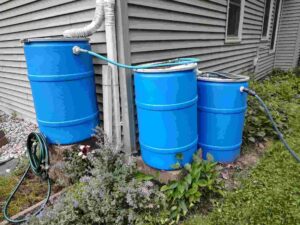
“When I bought my home, I figured out where I could build a garden,” she said. “I put in a raised bed because I wanted fresh, non-contaminated dirt. But I couldn’t use my terrible well water,” she realized. That’s when she decided to put up two rain barrels.
The first year, there wasn’t quite enough water in her barrels for the whole garden, so she added a third.
“I added a new garden later,” Jude said, “and then it was the same year we had a drought.” Which may explain why Jude is now up to five rain barrels.
Trying to grow a safe, healthy garden has certainly taught Jude the importance of knowing your water quality. She is also now a volunteer with Fox-Wolf Watershed Alliance. She and a friend both heard about the opportunity to sample water and decided to join together.
“Steph puts on waders and gets in the water,” Jude explained. “I label the bottles and write things down.”
When they started doing their water samples years ago, they stood on the dock of a nearby restaurant. The bartender came out to shoo them away, saying, “Are you the DNR? This is a private dock.”
Once Jude and Steph explained who they were, the man was intrigued by their work. Not only are they now welcome on the property, the owner jokes with them that if they fall in, “I’ll pull you out and give you a drink!”
Building relationships like these is one of the things that sets Fox-Wolf apart in the community. When working at the level of an entire watershed, it’s important to have partnerships that include residents, businesses, organizations, and government agencies. Volunteers like Jude are making a big difference for water quality, both at home with her rain barrels and in the field with her water sampling.
 Rain runs off your rooftop, onto your driveway, down the street and into the storm drain collecting dirt, debris, fertilizer and other harmful substances along the way. All of the polluted water ends up in our local waters unless we stop the water where it falls!
A rain barrel is a system that collects rainwater from your roof that would otherwise be lost to runoff. Rain barrels come in a wide variety of materials, designs and colors.
Rain water is best for plants. Catching rain water in a rain barrel allows you to water your garden and plants indoors and out during dry periods. Instead of paying for water from the tap, you can use the water you collect to keep your landscape healthy – saving you money!
Using a rain barrel benefits you and our local waters. Water stored in a rain barrel won’t rush off your property and carry pollutants to our streams and rivers. Not only that, water that is used for watering filters into the ground and replenishes the ground water supply. Two great benefits from one barrel!
Watershed Moments is a publication of Fox-Wolf Watershed Alliance, sharing the stories of how your donations have impacted lives in our community. Read our latest project updates, make a secure online donation, or become a member at www.fwwa.org
The post Watershed Moments: Terrible Well Water appeared first on Fox-Wolf Watershed Alliance.
Fox-Wolf Watershed Alliance
https://fwwa.org/2024/09/10/watershed-moments-terrible-well-water/?utm_source=rss&utm_medium=rss&utm_campaign=watershed-moments-terrible-well-water

By Lester Graham, Michigan Public
The Great Lakes News Collaborative includes Bridge Michigan; Circle of Blue; Great Lakes Now at Detroit Public Television; Michigan Public, Michigan’s NPR News Leader; and The Narwhal who work together to bring audiences news and information about the impact of climate change, pollution, and aging infrastructure on the Great Lakes and drinking water.
Great Lakes Now
https://www.greatlakesnow.org/2024/09/tribal-nations-in-michigan-get-grants-totaling-more-than-38-million-to-reduce-greenhouse-emissions/
By Enrique Saenz, Mirror Indy
Mirror Indy is a part of Free Press Indiana, a nonprofit news organization dedicated to ensuring all Hoosiers have access to the news and information they need.
The first thing Patti Daviau sees when she opens the front door of her home on South Harris Avenue every morning is a thick bunch of weeds reaching through a 500-foot stretch of chain link fence across the street.
Great Lakes Now
https://www.greatlakesnow.org/2024/09/25-years-after-major-toxic-lead-cleanup-westside-neighbors-still-dont-feel-safe/
Wisconsin Department of Natural Resources (DNR) officials released a final environmental impact statement on the Canadian energy firm Enbridge’s plans to reroute an oil and gas pipeline around the Bad River Band of Lake Superior Chippewa’s reservation. The 898-page document released Friday relied on 10,000 pages of materials that reflected hours of testimony and more than 32,000 comments submitted to the DNR. Read the full story by Wisconsin Public Radio.
Great Lakes Commission
https://www.glc.org/dailynews/20240909-pipeline-impact-statement
Researchers from the governments of Canada and Quebec released a report monitoring the state of the St. Lawrence River from 2018-2022. It found that the state of health of the river remains fragile and certain indicators, such as water temperature and oxygen saturation, show worrying signs of deterioration. Read the full story by CTV News.
Great Lakes Commission
https://www.glc.org/dailynews/20240909-stlawrence-water-quality
Researchers at Michigan Sea Grant, the National Oceanic and Atmospheric Administration, and Michigan state agencies recently published a study identifying the top 10 most invasive species in the Great Lakes. Read and listen to the full story by Interlochen Public Radio.
Great Lakes Commission
https://www.glc.org/dailynews/20240909-invasive-species-research
Canadian pipeline company Enbridge recently agreed it would not act on a 2021 permit from the Michigan Department of Environment, Great Lakes and Energy approving its Line 5 tunnel project. The Bay Mills Indian Community led a challenge to the permit, prompting a review by the U.S. Army Corps of Engineers that delayed the proposed tunnel construction timeline. Read the full story by Michigan Advance.
Great Lakes Commission
https://www.glc.org/dailynews/20240909-permit-redo
On Thursday, the Wisconsin Public Service Commission approved a $15 million plan to pipe water from the Green Bay Water Utility through Hobart to the village of Pulaski. The state says the move will improve water quality and bring Pulaski into compliance with state regulations. Read the full story by WGBA-TV – Green Bay, WI.
Great Lakes Commission
https://www.glc.org/dailynews/20240909-water-pipeline
Michigan Department of Natural Resources (DNR) fisheries biologists caught a 75-inch, 125-pound sturgeon – the biggest ever caught by the DNR – during a state survey in Lake St. Clair. None of the 17 sturgeon netted by the survey had been tagged before, providing another indication of the lake sturgeon’s population. Read the full story by the Macomb Daily.
Great Lakes Commission
https://www.glc.org/dailynews/20240909-sturgeon-survey
Leaders from the Wisconsin cities of Franklin and Oak Creek have agreed to a new contract through which the Oak Creek Water and Sewer Utility will provide Lake Michigan water to the Franklin Municipal Water Utility for the next forty years, replacing the previous thirty-year contract from 1994. Read the full story by WISN-TV – Milwaukee, WI.
Great Lakes Commission
https://www.glc.org/dailynews/20240909-water-deal
New York Governor Kathy Hochul on Friday celebrated the National Oceanic and Atmospheric Administration’s designation of the Lake Ontario National Marine Sanctuary – the first to be designated off New York State’s coast. The sanctuary will cover over 1,700 square miles of state waters in eastern Lake Ontario and protect approximately 43 known shipwrecks and one submerged aircraft, spanning centuries of history. Read the full story by the Finger Lakes Times.
Great Lakes Commission
https://www.glc.org/dailynews/20240909-marine-sanctuary
Hundreds gathered as the Gun Lake Tribe released roughly 160 hatchery-raised lake sturgeon into the Kalamazoo River on Friday. The fish eggs were collected in April 2024 from mats put in the Kalamazoo River by the Tribe’s Environmental Department. Read the full story by WZZM-TV – Grand Rapids, MI.
Great Lakes Commission
https://www.glc.org/dailynews/20240909-sturgeon-release
As a National Historic Landmark, the SS Milwaukee functions as a travel through time for visitors who climb abroad to hear her maritime history. For the first time since she returned to Muskegon in 1998, the ship is offering haunted tours taking place Fridays and Saturdays in October. Read the full story by MLive.
Great Lakes Commission
https://www.glc.org/dailynews/20240909-steamship-tours
Cleveland Metroparks in Ohio, along with partners, recently unveiled plans to open a state-of-the-art community sailing center, aimed at increasing lakefront access for residents and breaking down barriers to the sport. Read the full story by Spectrum News.
Great Lakes Commission
https://www.glc.org/dailynews/20240906-clevelandmetroparks-sailingcenter-2026
The Adopt-a-Beach program, an initiative to keep litter and waste out of the Great Lakes, has passed a milestone. Volunteers with Adopt-a-Beach have removed more than 10 million pieces of litter from Great Lakes beaches and shorelines since 2003. Read the full story by WSGW – Saginaw, MI.
Great Lakes Commission
https://www.glc.org/dailynews/20240906-litter-removed-greatlakes
After nearly a decade of waiting, Oswego County, New York, is celebrating the designation of the Lake Ontario National Marine Sanctuary and inviting the public to join in the festivities. Read the full story by Oswego County News Now.
Great Lakes Commission
https://www.glc.org/dailynews/20240906-noaa-lake-ontario-sanctuary-designation
Michigan environmental advocates are hailing a “groundbreaking” settlement to a civil rights complaint filed with state regulators over the expansion of a hazardous waste facility in Detroit. The settlement requires EGLE to deny a license to a hazardous waste facility, including the renewal of a license, if it will have an “unlawful impact on human health and the environment.” Read the full story by Great Lakes Now.
Great Lakes Commission
https://www.glc.org/dailynews/20240906-michigan-civilrights-settlement
Fertilizer made from city sewage has been spread on millions of acres of farmland for decades in states across the country, including Michigan. Scientists say this fertilizer can contain high levels of PFAS, and the national scale of farmland contamination by these chemicals is only now starting to become apparent. Read the full story by The New York Times.
Great Lakes Commission
https://www.glc.org/dailynews/20240906-foreverchemicals
An ultra swimmer nicknamed The Shark was back on shore Wednesday, having given up on yet another quest to cross Lake Michigan after 40 hours in the water. Read the full story by The Associated Press.
Great Lakes Commission
https://www.glc.org/dailynews/20240906-ulraswimmer-lakemichigan
The remains of the 131-year-old Minnehaha shipwreck are easy to spot as they peek out of the sand along the Lake Michigan shoreline in Manistee County, Michigan. The Minnehaha ran aground and was broken apart by waves in October 1893. Read the full story by MLive.
Great Lakes Commission
https://www.glc.org/dailynews/20240906-shipwrecks-lakemichigan-beach
Hydrilla, a rapidly growing invasive plant that’s prohibited in Ontario, has been discovered for the first time in Canada in the Hillman Marsh Conservation Area in Leamington, Ontario. Read the full story by CBC News.
Great Lakes Commission
https://www.glc.org/dailynews/20240906-invasiveplant-canada
Ludington State Park is known for its seven miles of sandy Lake Michigan beachfront, an iconic lighthouse, and a one-mile stretch of the Big Sable River, popular for fishing, paddling and tubing. It’s one of Michigan’s most popular state parks, and it’s now getting $3.2 million in upgrades. Read the full story by MLive.
Great Lakes Commission
https://www.glc.org/dailynews/20240906-ludingtonstatepark-upgrades
In Detroit, Michigan, Wayne County Commissioners issued a resolution calling for an end to shipping irradiated waste into the county. A statement from the chair calls for “a common-sense solution that protects residents and the nation’s largest fresh water supply.” Read the full story by the Detroit Free Press.
Great Lakes Commission
https://www.glc.org/dailynews/20240906-radioactivewaste-waynecounty
News | U.S. Climate Resilience Toolkit
News | U.S. Climate Resilience Toolkit
https://toolkit.climate.gov/news/new-training-course-climate-101-science-impacts-and-society

By Danielle Kaeding, Wisconsin Public Radio
This article was republished here with permission from Wisconsin Public Radio.
For at least the last decade, Dustin Soyring and his family have struggled with wolves on their farm in the northern Wisconsin town of Maple.
Great Lakes Now
https://www.greatlakesnow.org/2024/09/farmers-turn-to-predator-proof-fences-to-deter-wolves-in-northern-wisconsin/
Editor: In the public interest and in accordance with Federal Aviation Administration regulations, the USGS is announcing this low-level airborne project. Your assistance in informing the local communities is appreciated.
Midcontinent Region
https://www.usgs.gov/news/state-news-release/media-alert-low-level-airplane-flights-image-geology-over-parts-nebraska?utm_source=comms&utm_medium=rss&utm_campaign=news

Great Lakes Now’s Anna Sysling spoke with Cheryl Porter, Chief Operating Officer of Water and Field Services at the Great Lakes Water Authority and the first African American president of the American Water Works Association (AWWA).
With 28 years of experience in the water sector, Porter shares her inspiring journey from junior chemist in Detroit to leading the AWWA.
Great Lakes Now
https://www.greatlakesnow.org/2024/09/cheryl-porters-vision-for-the-future-of-water/

By Brian Allnutt, Planet Detroit
This article was republished with permission from Planet Detroit. Sign up for Planet Detroit’s weekly newsletter here.
Michigan environmental advocates are hailing a “groundbreaking” settlement to a civil rights complaint filed with state regulators over the expansion of a hazardous waste facility in Detroit.
Great Lakes Now
https://www.greatlakesnow.org/2024/09/michigan-advocates-hail-groundbreaking-settlement-to-civil-rights-complaint-over-hazardous-waste-facility/
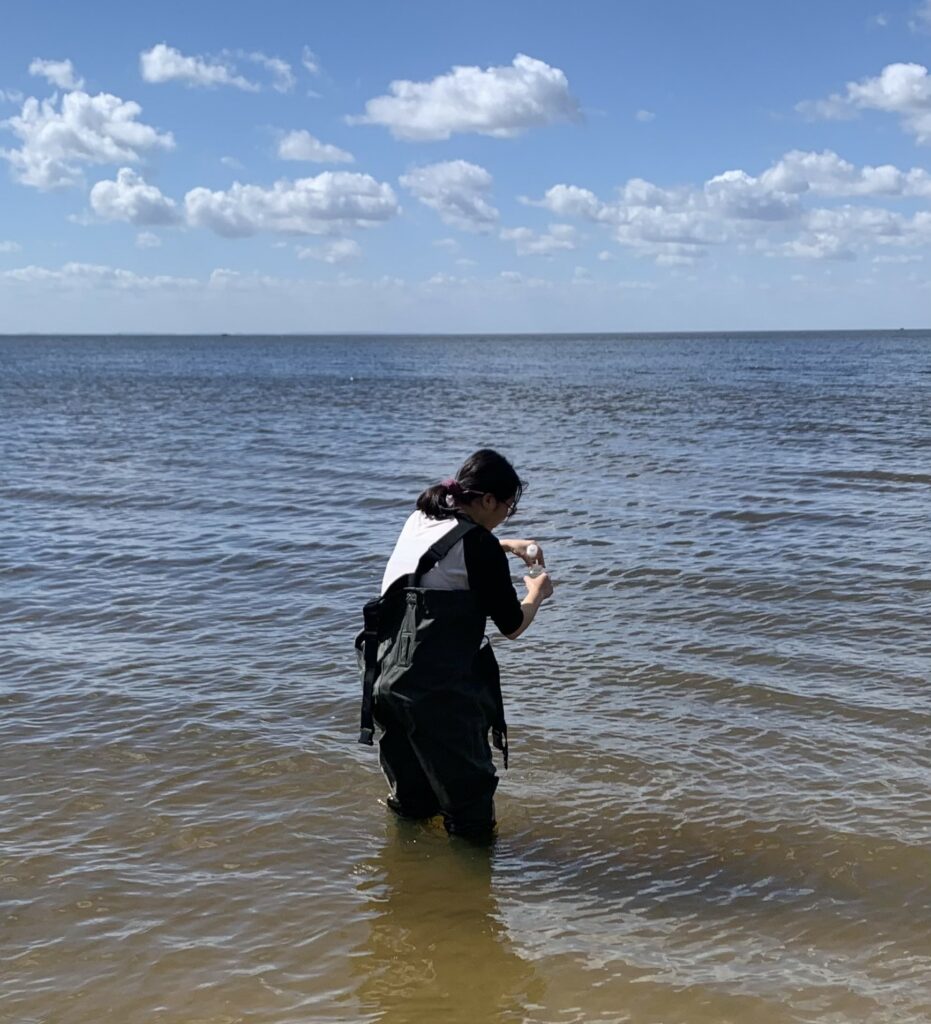
Jena Choi, Freshwater@UW student, collects water from beaches for E. coli analysis later at the UW-Oshkosh Environmental Research and Innovation Center. Image Credit: Megan Jensik
By Jena Choi, Freshwater Collaborative summer research student
This summer, 35 undergraduate students from across the country conducted research with Freshwater@UW, the University of Wisconsin’s cross-site, cross-discipline research opportunities program. Freshwater@UW is supported by the Freshwater Collaborative, Wisconsin Sea Grant, Water@UW–Madison, the Water Resources Institute and the University of Wisconsin–Madison Graduate School. In the final weeks of the program, students reflected on what they learned. We are sharing several of their stories over the coming months. Here’s Jena Choi, an undergraduate sophomore in freshwater science from UW–Milwaukee, who worked with Greg Kleinheinz at UW–Oshkosh.
I stumbled across Freshwater@UW a year ago, and I’m pleased that my persistence landed me in this program. As someone who finds comfort in familiarity, this program was the right step to coming out my comfort zone and exploring research in a new laboratory.
I had the privilege of working at ERIC (Environmental Research and Innovation Center) in the University of Wisconsin-Oshkosh, where I conducted my research in evaluating methods for analyzing microplastics from beach sand samples. Microplastics is a hot topic in the environmental field, and we’ve come a long way in developing several methods for analyzing them. The problem lies more in which methods to use and how effective they are at extracting tiny microplastics that you can’t even see with the naked eye.
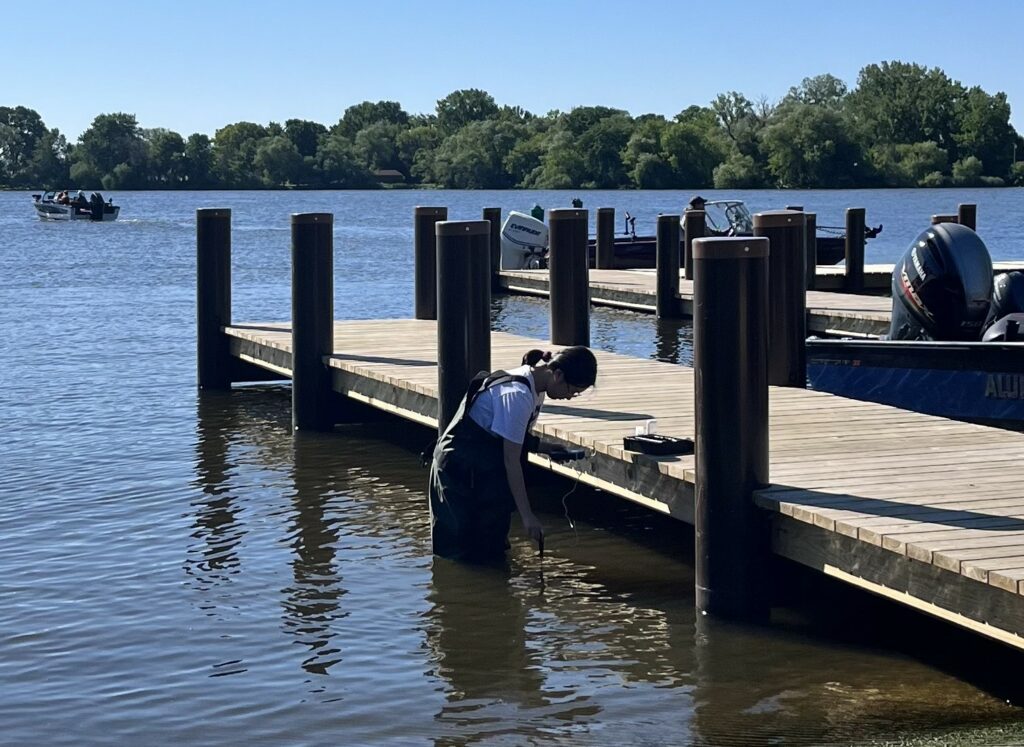
Choi reads water temperature for weekly beach data reports. Image Credit: Megan Jensik
One key lesson I’ve learned about research is that it involves a lot of reevaluating, revising and importantly, retrying. Rather than picking up another person’s project, I had to start from the beginning. I navigated through the seas of different methods from other scientific journals while remodifying them several times to fit both my limited time and resources. Once I settled with a method proposed by the National Oceanic and Atmospheric Administration, the true battle was finding and ordering everything before I could start my project. The process required a lot of patience and persistence, especially when the methods didn’t show promising results. However, all these moments gave me great insight on what graduate level research would look like, as well as a key lesson in being independent.
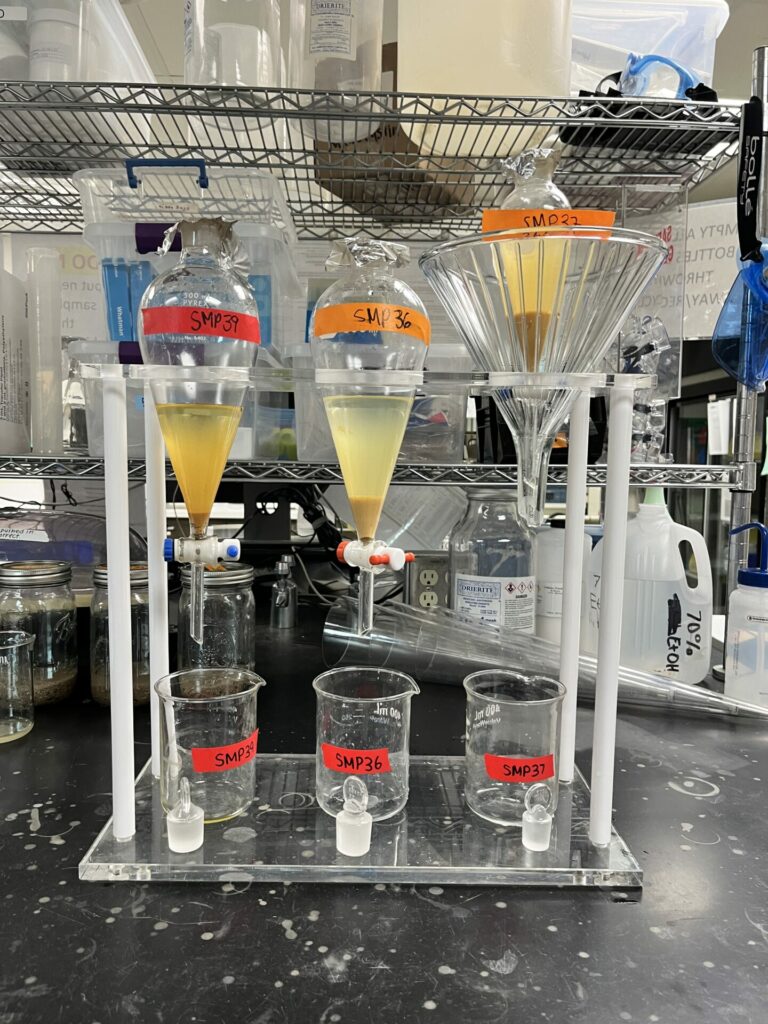
A density separation setup in the lab to separate settled solids from floating solids (microplastics). Image Credit: Jena Choi
I also learned that being part of the Freshwater@UW program is more than research. It also branches into helping communities and learning different career opportunities. Not only does ERIC host research projects, but they also test samples for campus members and external clients. I was able to help people know if their drinking water is safe and alert them of any possible dangers. Another welcome surprise were my weekly beach routes where I collected beach water around Winnebago County to test for E. coli. If the beaches reached a concerning level, it was our duty to warn the public by putting up signs and informing the Wisconsin Department of Natural Resources about the elevated levels of E. coli. Based on these experiences, I can see myself working in both a field and lab setting while working with the public through education and science communication.
I’m grateful that Freshwater@UW has given me the opportunity to explore research in UW-Oshkosh. I’ve not only pursued my interest in microplastics, but I’ve learned the valuable skills of constructing my own project and independently solving any related conundrums or mistakes. With everything I’ve learned, I see my career heading to a professional track and hope to use the skills I’ve learned to improve Wisconsin’s water.
The post Summer research student learns independence and patience while studying microplastics first appeared on Wisconsin Sea Grant.Blog | Wisconsin Sea Grant
https://www.seagrant.wisc.edu/blog/summer-research-student-learns-independence-and-patience-while-studying-microplastics/

This story is a part of “A Year in the Wild Kitchen of the Great Lakes,” a series in partnership with expert forager Lisa M. Rose, with the mission of nurturing a deeper connection with the natural world through foraging. To get started with your foraging journey, begin here with our “Framework to Sustainable and Safe Practices.”
Autumn brings with it a bounty of fruits and nuts that often go unnoticed in our modern culinary landscape.
Great Lakes Now
https://www.greatlakesnow.org/2024/09/foraged-fruit-and-nuts-wild-apples-abundant-acorns/
Drownings in Michigan this summer have once again put a spotlight on water safety in a state with the nation’s longest freshwater coastline and an abundance of inland lakes. As of Thursday, the Great Lakes Surf Rescue Project has tracked 77 Great Lakes drownings in 2024 compared to 85 Great Lakes drownings from last year. Read the full story by The Detroit Free Press.
Great Lakes Commission
https://www.glc.org/dailynews/20240904-water-safety
Residents and advocacy groups are asking the federal government for a hearing to try to stop the Palisades nuclear plant in Southwest Michigan on Lake Michigan, officially shut down in 2022, from reopening. No closed nuclear plant has ever reopened. Read the full story by Michigan Public.
Great Lakes Commission
https://www.glc.org/dailynews/20240904-nuclear-petition
The search and recovery team that found a crash victim and airplane lost 17 years ago in Lake Huron said it’s hoping to help even more people find their lost loved ones. Great Lakes Search and Recovery, a nonprofit that searches for people lost in the water, tries to bring closure to families. Read the full story by CBS News.
Great Lakes Commission
https://www.glc.org/dailynews/20240904-search-and-recovery