(Chicago, IL) Nov 8, 2020 – Engaging in the democratic process is one of the most powerful ways people throughout the Great Lakes region can have a voice. The Alliance for the Great Lakes congratulates President-elect Joe Biden and Vice President-elect Kamala Harris. Now that the votes have been counted, we must respect the vote and the work of election officials who have led a fair and transparent process.

President-elect Biden, in partnership with the Great Lakes region, has the opportunity to place safe and clean water at the center of our communities and make them healthier and more equitable than before.

We encourage President-elect Biden to work closely with Congress and Great Lakes leaders to invest in fixing our failing drinking water and wastewater infrastructure. These investments in clean water support getting people back to work, protect public health, and ready our communities for a changing climate – a win for everyone. He can also commit his administration to ensuring that basic federal clean water protections are vigorously supported and enforced, especially in communities that bear a disproportionate burden from pollution.

President-elect Biden has much work to do. A resurgence of COVID-19 and an economic crisis is affecting millions around the Great Lakes region and the nation. The pandemic is tragically highlighting the inequalities in our communities, and the intrinsic connection between clean water and health.

We look forward to working with President-elect Biden to create a Great Lakes region, and nation, with thriving, healthy ecosystems and communities.

###

For media inquiries, contact Jennifer Caddick at jcaddick@greatlakes.org
The post Statement: Alliance for the Great Lakes Congratulates President-Elect Biden and Vice President-Elect Harris, Urges Focus on Clean Water appeared first on Alliance for the Great Lakes.

Original Article

News – Alliance for the Great Lakes

News – Alliance for the Great Lakes

https://greatlakes.org/2020/11/statement-alliance-for-the-great-lakes-congratulates-president-elect-biden-and-vice-president-elect-harris-urges-focus-on-clean-water/

Jennifer Caddick

...INCREASING FIRE RISK DUE TO UNUSUALLY WARM AND DRY CONDITIONS TO CONTINUE THIS WEEKEND... Record or near record warmth will continue across much of the area through Monday. The combination of the unusually warm conditions along with low afternoon relative humidity readings will allow vegetation to continue to dry out, leading to an

Original Article

Current Watches, Warnings and Advisories for Brown (WIC009) Wisconsin Issued by the National Weather Service

Current Watches, Warnings and Advisories for Brown (WIC009) Wisconsin Issued by the National Weather Service

https://alerts.weather.gov/cap/wwacapget.php?x=WI125F6FD109D0.SpecialWeatherStatement.125F6FD1F7B4WI.GRBSPSGRB.c7af4845f2e9eb88e57e1747a63d15f5

w-nws.webmaster@noaa.gov

PFAS News Roundup: PFOS in fish, Wisconsin standards in dispute, lacking regulations in Canada

PFAS, short for per- and polyfluoroalkyl substances, are a group of widespread man-made chemicals that don’t break down in the environment or the human body and have been flagged as a major contaminant in sources of water across the country.

Keep up with PFAS-related developments in the Great Lakes area.

Read Now at Great Lakes Now.

Original Article

Great Lakes Now

Great Lakes Now

https://www.greatlakesnow.org/2020/11/pfas-news-fish-wisconsin-canada/

Natasha Blakely

As a region whose economy relies heavily on tourism, Ohio’s Lake Erie area has been hit particularly hard by the coronavirus pandemic. To stay viable, businesses in the area pivoted to offering more socially distanced outdoor activities for visitors. Read the full story by the Fremont News Messenger.

Original Article

Great Lakes Commission

Great Lakes Commission

https://www.glc.org/dailynews/20201106-erie-tourism

Ned Willig

The Minnesota Supreme Court must decide whether the company planning to build the state’s first copper mine engaged in “sham permitting” and intentionally misled state regulators about the intended size of the mine. Read the full story by the Star Tribune.

Original Article

Great Lakes Commission

Great Lakes Commission

https://www.glc.org/dailynews/20201106-polymet

Ned Willig

A new wetlands project in Sandusky County, Ohio that plans to turn 54 acres of frequently flooded farmland into a public nature preserve will begin next week. The property was purchased by the Black Swamp Conservancy and will provide habitat for a diversity of wildlife. Read the full story by the Fremont News Messenger.

Original Article

Great Lakes Commission

Great Lakes Commission

https://www.glc.org/dailynews/20201106-h2ohio

Ned Willig

A recent study found that the invasive round goby fish in the Great Lakes can eat juvenile invasive zebra and quagga mussels and prevent mussel colonization of bare rocks. The findings suggest possible pathways for preventing the spread of invasive mussels. Read the full story by the Manistee News Advocate.

Original Article

Great Lakes Commission

Great Lakes Commission

https://www.glc.org/dailynews/20201106-goby-eat-mussel

Ned Willig

The 1940 Armistice Day storm on Lake Michigan was among the deadliest storms to cross the lake, sinking multiple ships and claiming 164 lives. As the 80th anniversary of the event approaches, a new exhibit in Holland, Michigan, will commemorate the stories of the lives and boats that were lost. Read the full story by Second Wave Media.

Original Article

Great Lakes Commission

Great Lakes Commission

https://www.glc.org/dailynews/20201106-holland-diver

Ned Willig

A small group of people lined a patch of grass in the moorings for the U.S Coast Guard Cutter Hollyhock Thursday night in Port Huron, holding signs and flashlights and waving small American flags. They were waiting for the return of the Hollyhock, which left 74 days prior for the East Coast to help with post-hurricane reconstruction of ports and waterways. Read the full story by the Times Herald.

Original Article

Great Lakes Commission

Great Lakes Commission

https://www.glc.org/dailynews/20201106-uscgc

Ned Willig

...INCREASING FIRE RISK DUE TO UNUSUALLY WARM AND DRY CONDITIONS TO CONTINUE THROUGH THE WEEKEND... Record or near record warmth will continue across much of the area through Monday. The combination of the unusually warm conditions along with low afternoon relative humidity readings will allow vegetation to continue to dry out, leading to an

Original Article

Current Watches, Warnings and Advisories for Brown (WIC009) Wisconsin Issued by the National Weather Service

Current Watches, Warnings and Advisories for Brown (WIC009) Wisconsin Issued by the National Weather Service

https://alerts.weather.gov/cap/wwacapget.php?x=WI125F6FC1C600.SpecialWeatherStatement.125F6FC2DC84WI.GRBSPSGRB.c7af4845f2e9eb88e57e1747a63d15f5

w-nws.webmaster@noaa.gov

Drinking Water News Roundup: Illinois lead issues, Michigan citizen reporting, Canada First Nations water access

From lead pipes to PFAS, drinking water contamination is a major issue plaguing cities and towns all around the Great Lakes. Cleaning up contaminants and providing safe water to everyone is an ongoing public health struggle.

Keep up with drinking water-related developments in the Great Lakes area.

Click on the headline to read the full story:

Illinois:

  • Sycamore, Illinois, Residents Sue City for Toxic Tap Water That Sickens Residents – Businesswire

Residents of Sycamore, Illinois, have filed a class-action lawsuit against the city of Sycamore, alleging that it knowingly failed to maintain its water supply and ignored problems with its corrosion control treatment.

Read Now at Great Lakes Now.

Original Article

Great Lakes Now

Great Lakes Now

https://www.greatlakesnow.org/2020/11/drinking-water-news-lead-illinois-michigan-first-nations/

Grace Dempsey

Aquaculture, or fish farming, is a $21 million industry in Wisconsin. Wisconsin Sea Grant has a long history of nurturing the growth of aquaculture through research and public outreach. Coupled with Sea Grant efforts related to Great Lakes commercial fishing, these activities help Wisconsin producers offer consumers a sustainable, domestic alternative to imported fish and seafood.

A fresh chapter in this history is the Wisconsin Sea Grant Keillor Fellowship in Aquaculture, created in partnership with the University of Wisconsin-Stevens Point Northern Aquaculture Demonstration Facility (NADF), where the position is based. The Bayfield facility is a national leader in aquaculture research.

Dr. Patrick Blaufuss (submitted photo)

The inaugural fellow, Dr. Patrick Blaufuss, began his two-year position in September. He holds a doctorate in animal physiology from the University of Idaho, where his research focused on nutrition and physiology in rainbow trout. He’s also a graduate of North Dakota State University and Southern Illinois University, where he earned his bachelor’s and master’s degrees in zoology, respectively.

One of his greatest satisfactions, said Blaufuss, is seeing laboratory research provide useful results for fish farmers. “I’m excited to get experience with the aquaculture industry in the Great Lakes region… and to get more experience with commercial producers and the commercial setting, helping them refine what they do. Applying what we do in the lab out in the real world is very important,” said Blaufuss.

One of his top priorities will be analyzing data from past and current NADF projects and preparing manuscripts for publication in scientific journals.

Said Greg Fischer, NADF assistant director and research program manager, “Having Patrick on board as our new Sea Grant fellow will directly impact getting our completed research projects analyzed and published in a timely manner, which allows us to share results with the aquaculture industry and scientific community more rapidly, and to move aquaculture forward with confidence.”

Dr. Chris Hartleb, a UW-Stevens Point professor of fisheries biology and NADF co-director, echoed those thoughts. “Pat’s background and knowledge will assist us with completing past projects, restructuring current projects and expanding our ability to provide assistance to many aquaculturists with new projects.”

Blaufuss’ prior experience includes restoration aquaculture work with burbot in Idaho, where that species was almost extirpated from the Kootenai River watershed due to the operation of a dam that led to increased water temperatures (burbot need very cold water to spawn successfully). The recreational burbot fishery there had been closed since 1992. As part of the restoration work, Blaufuss served as a consultant to the Kootenai Tribe of Idaho, which runs a commercial-scale fish hatchery. Employing results from University of Idaho lab research, Blaufuss helped the tribe with its first season of burbot aquaculture. Subsequent years of restocking efforts by the Kootenai Tribe have succeeded in restoring burbot populations to a level that recreational fishing is once again possible for anglers.

Commented Blaufuss, “I came out there [to the tribal hatchery] regularly throughout their first season, since there are multiple steps in burbot culture, and you have to be aware of them.” Burbot are extremely carnivorous, so cannibalization can be an issue, and they also have a longer larval rearing period compared to some other species. “It was very fulfilling to help them through each stage of the culture, and to see how our smaller-scale research data could be applied to a full-size commercial setting.”

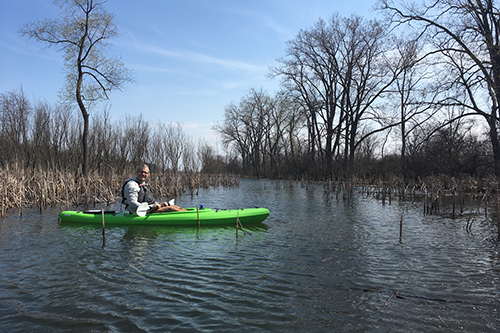
Blaufuss kayaking on Lake Erie near Gibraltar, Mich. (submitted photo)

Currently, Blaufuss is writing a manuscript about previous NADF work on commercial diets for larval walleye and saugeye (a walleye-sauger hybrid that also occurs in the wild). “It’s so important that producers know the best diet to feed these larval fish,” he said. (Wisconsin Sea Grant funded this research in its 2018-20 grant cycle; read more about it here.)

He’s also working on a nanobubble oxygenation project, a novel way of introducing oxygen into aquaculture systems. “We’re looking at how it affects fish health, growth and other parameters,” said Blaufuss. The National Sea Grant Office is supporting the nanobubble work; read more about it here.

While much of his work is remote at the moment due to the ongoing pandemic, Blaufuss said that the two-year commitment at NADF gives him a good chunk of time to work with fish species and aquaculture systems that are new to him, as well as boost the facility’s research output.

It’s all part of Sea Grant and NADF’s broader goals to train professionals—from undergraduate students to postdoctoral fellows like Blaufuss—and support sustainable aquaculture that is backed by cutting-edge science. When the public health crisis abates, said Hartleb, Blaufuss will be able to get out to conferences, workshops and farms to enhance connections and share NADF information.

Said Fischer, “Wisconsin Sea Grant has been a great partner in all that we do, and we look forward to the future and continued partnership and cooperation.”

The post Sea Grant aquaculture fellow begins two-year position in Bayfield to boost research capacity first appeared on Wisconsin Sea Grant.

Original Article

News Releases – Wisconsin Sea Grant

News Releases – Wisconsin Sea Grant

https://www.seagrant.wisc.edu/news/sea-grant-aquaculture-fellow/

Jennifer Smith

Leelanau County, Michigan
CCO Meeting
Wednesday, December 2, from 1-2:30pm ET
For information on attending this meeting please send your name and local address to Edgar.Patino@ogilvy.com and you will be provided with information on joining the meeting.

Open House:
To be scheduled.

Mackinac County, Michigan
CCO Meeting
Thursday, December 3, from 1-2:30pm
For information on attending this meeting please send your name and local address to Edgar.Patino@ogilvy.com and you will be provided with information on joining the meeting.

Open House:
To be scheduled.

Original Article

Great Lakes Coastal Flood Study

Great Lakes Coastal Flood Study

https://www.greatlakescoast.org/2020/11/05/lake-michigan-community-consultation-officers-meeting-and-open-house-for-leelanau-county-and-mackinac-county-michigan/

Great Lakes Coast

Alcona County, Michigan
CCO Meeting
November 9, from 1-2:30pm ET
For information on attending this meeting please send your name and local address to Edgar.Patino@ogilvy.com and you will be provided with information on joining the meeting.

Open House:
To be scheduled.

Alpena County, Michigan
CCO Meeting
November 10, from 1-2:30pm ET
For information on attending this meeting please send your name and local address to Edgar.Patino@ogilvy.com and you will be provided with information on joining the meeting.

Open House:
To be scheduled.

Cheboygan County, Michigan
CCO Meeting
November 10, from 3-4:30pm ET
For information on attending this meeting please send your name and local address to Edgar.Patino@ogilvy.com and you will be provided with information on joining the meeting.

Open House:
To be scheduled.

Original Article

Great Lakes Coastal Flood Study

Great Lakes Coastal Flood Study

https://www.greatlakescoast.org/2020/11/05/lake-huron-community-consultation-officers-meeting-and-open-house-for-alcona-county-alpena-county-and-cheboygan-county-michigan/

Great Lakes Coast

While large tributaries get lots of attention from researchers and regulatory agencies, a research team from the University of Wisconsin found that small streams were largely ignored despite playing a large role in feeding algal blooms and in nearshore water quality. Read the full story by Great Lakes Now.

Original Article

Great Lakes Commission

Great Lakes Commission

https://www.glc.org/dailynews/20201105-small-streams

Jill Estrada

The National Museum of the Great Lakes in Toledo, Ohio is offering special guided tours for “The Fitzgerald Experience” this weekend to celebrate the 45th anniversary of the Edmund Fitzgerald’s sinking. Read the full story by WTVG-TV – Toledo, Ohio.

Original Article

Great Lakes Commission

Great Lakes Commission

https://www.glc.org/dailynews/20201105-edmund-fitzgerald

Jill Estrada

We Energies of Milwaukee, Wisconsin will retire the oldest part of its coal-fired power plant complex in Oak Creek in 2023 and 2024. The We Energies Oak Creek generating site occupies 1,000 acres on the shore of Lake Michigan. Read the full story by the Milwaukee Business Journal.

Original Article

Great Lakes Commission

Great Lakes Commission

https://www.glc.org/dailynews/20201105-we-energies

Jill Estrada

The new season of River Talks began in October with two speakers who discussed the impacts of water level changes in the St. Louis River Estuary via Zoom. Brandon Krumwiede, Great Lakes geospatial coordinator with NOAA’s Office for Coastal Management, presented, “Water Level Change Impacts in the St. Louis River Estuary.” And Hannah Burgstaler, freshwater fellow at the Lake Superior National Estuarine Research Reserve, presented, “St. Louis River Estuary Water Level and Canada Geese Population Effect on Manoomin Survival Rate.”

Brandon Krumwiede. Submitted photo

Krumwiede described how water levels are changing in the Lake Superior Basin and then narrowed his scope to the estuary. “There’s been a huge step up in water levels in Lake Superior – a continual rise over the last several years, from 2007 to 2019. We’ve basically added three-and-a-half feet of water to the surface of Lake Superior,” Krumwiede said.

However, since August of 2020, levels in the basin have started to drop and are expected to continue to lower during the next six months. “Hopefully, this is that sigh of relief that everybody’s looking for with our recent exposure to high water levels,” Krumwiede said.

More locally, the estuary is sitting at or above record-high water levels. These can be exacerbated when wind from the northeast pushes water through the Wisconsin entry and the Duluth shipping canal. Krumwiede said urban stormwater runoff together with these northeast storm events can cause high water levels all the way to the Oliver Bridge (near Oliver, Wisconsin). He showed images of erosion on Allouez Bay, Wisconsin Point and Clough Island, along with inundated boat landings.

Low water levels can be problematic, too. “Often, in those new areas that are exposed, phragmites are some of the first species to take hold, so you have to deal with invasive species work,” he said. Access to the estuary for boaters can also be impeded.

For her research project, Burgstaler monitored four bays in the estuary (Allouez, Oliver-Little Pokegema, Duck Hunter South and Walleye Alley) using water pressure loggers and trail cameras, looking for the presence of geese and water levels that exceed a threshold for healthy wild rice growth. “Wild rice is at risk of completely disappearing in habitats where it once thrived. Factors contributing to its decline are fluctuating water levels, sulfide and mercury pollution, invasive species competition and waterfowl grazing,” Burgstaler said.

Hannah Burgstaler. Submitted photo

Wild rice tolerates a fluctuation range of up to six inches during the growing season and has a maximum water depth threshold of three feet. Continuous high water can “drown” the plants.

She visited the sites every one to two weeks by canoe, boat or paddleboard, to collect the camera SD cards and change batteries from June to September. She’s currently in the preliminary stages of data analysis. She’s going to compare her data with similar information collected by the Reserve and Fond du Lac Dam water release data to determine which sites are affected by seiches and water discharge from the dam. She will also compare geese counts in the different bays.

“Wild rice health is poor in the St. Louis River Estuary, but it’s still present so there’s still hope. From my preliminary data, geese may be negatively impacting wild rice survival with their browsing. Water levels in at least one bay exceeded 3 feet during the season and could impact wild rice survival. A combination of high water levels and geese may be contributing factors in the struggle of wild rice health in the St. Louis River Estuary,” Burgstaler said.

The Nov. 11 River Talk will feature Dustin Haines, research coordinator for the Reserve, who will present, “Should I Stay or Should I Go? The Clash of Wetlands With Lake Levels, Invasives and Humans.” His talk will also be via Zoom and held in cooperation with Café Scientifique Twin Ports. Join us at 7 pm:

https://uwmadison.zoom.us/j/97447413031?pwd=TkN2YjN5VGl0ODJtMWYzZGxCT2llUT09
Meeting ID: 974 4741 3031
Passcode: 424987

The post River Talk explores the impact of water levels on the St. Louis River Estuary first appeared on Wisconsin Sea Grant.

Original Article

Blog – Wisconsin Sea Grant

Blog – Wisconsin Sea Grant

https://www.seagrant.wisc.edu/blog/river-talk-explores-the-impact-of-water-levels-on-the-st-louis-river-estuary/

Marie Zhuikov

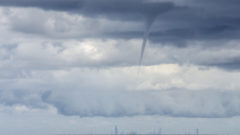
Great Lakes produce new record for waterspouts in one week

This article was republished here with permission from Great Lakes Echo.

By Audrey Porter, Great Lakes Echo

The Great Lakes produced a new high record in its number of 232 waterspouts from Sept. 28 through Oct. 4.

It tops the previous highest waterspout outbreak of 88 waterspouts in the month of  August.

Read Now at Great Lakes Now.

Original Article

Great Lakes Now

Great Lakes Now

https://www.greatlakesnow.org/2020/11/great-lakes-record-waterspouts/

Great Lakes Echo

News

Great Lakes Phragmites Collaborative releases shared approach to managing Phragmites

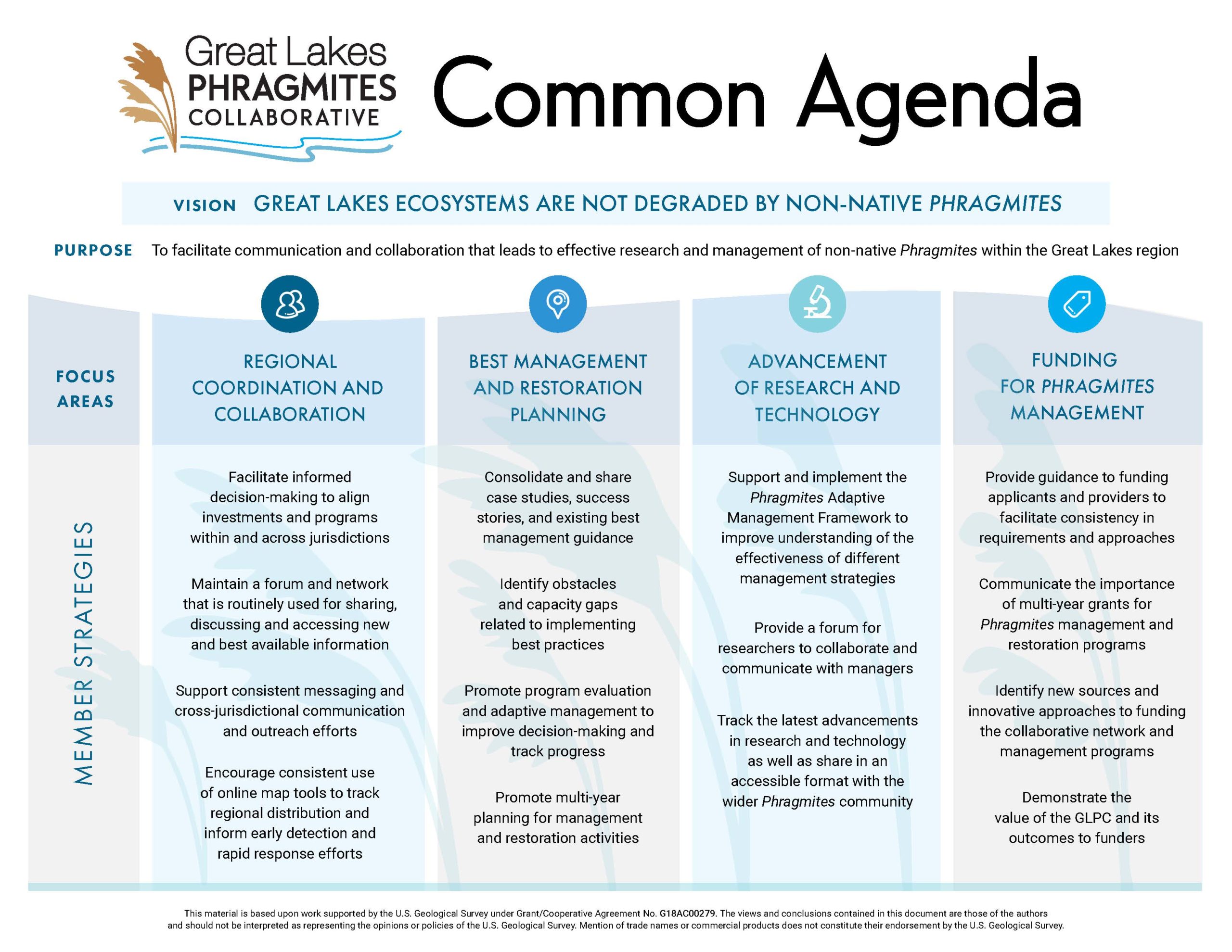
Ann Arbor, Mich. – The Great Lakes Phragmites Collaborative (GLPC) today released its “Common Agenda” – a shared understanding and an agreed-upon path for addressing invasive Phragmites in the Great Lakes basin. The agenda sets goals, defines gaps and problem areas in management of Phragmites, and outlines the strategies collaborative members will use to fight invasive Phragmites.

“Addressing a widespread regional issue like invasive Phragmites requires coordination across sectors and political boundaries,” said Erika Jensen, interim executive director of the Great Lakes Commission, which coordinates the GLPC with the U.S. Geological Survey. “The Great Lakes Phragmites Collaborative is excited to release their Common Agenda to guide regional efforts in the Great Lakes basin. Working together we can be more coordinated, efficient and strategic in tackling the issue of invasive Phragmites.”

Phragmites australis (also known as common reed) is a tall, aggressive invasive grass that can displace native plants, block scenic views, decrease property values, cut off road drainage, and become a fire hazard. Though nonnative Phragmites has been present in North America for some time, it has only become a true invader in the Great Lakes region over the last few decades. 

The GLPC also announced a strategic plan for the Phragmites Adaptative Management Framework (PAMF), which gathers data to determine which management approaches are the most likely to reduce a Phragmites infestation. PAMF is administered through a collaborative effort between the Great Lakes Commission, U.S. Geological Survey, and the University of Georgia. In its first three years, PAMF engaged more than 75 managers and enrolled nearly 700 acres from across the Great Lakes basin. The new PAMF strategic plan will guide program implementation over the next five years.

Phragmites continues to spread rapidly in the Great Lakes region and millions of dollars are spent on treatments each year, so it’s critical that we identify the most effective ways to manage it,” said Dr. Kurt Kowalski of the U.S. Geological Survey Great Lakes Science Center. “PAMF is helping us resolve the uncertainty around what approach is most effective given site conditions.”

Anyone treating Phragmites, from government agencies to private landowners, can enroll in PAMF and benefit by receiving annual management guidance. Participation in PAMF also contributes to advancing the mission of the GLPC under the Common Agenda.

The Great Lakes Phragmites Collaborative was established in 2012 and brings together agencies, organizations, and citizens who are engaged with Phragmites in some way, including management, research, and communication. The GLPC is guided by an Advisory Committee that represents a binational cross-section of Great Lakes Phragmites experts. The GLPC utilizes a “collective impact” framework intended to address complex problems through collaboration with multiple organizations working at multiple jurisdictional levels. Under this approach, a common agenda is one of five conditions necessary to effect change.


The Great Lakes Commission, led by chair Sharon M. Jackson, Deputy General Counsel for Governor Eric J. Holcomb of Indiana, is an interstate compact agency established under the Great Lakes Basin Compact of 1955. The Commission is authorized by state and U.S. federal law and dedicated to promoting a strong economy, healthy environment and high quality of life for the Great Lakes-St. Lawrence Basin and its residents. The Commission consists of governors’ appointees, state legislators, industry and nonprofit leaders and agency officials from eight states and two provinces. Associate membership for Ontario and Québec was established through the signing of a “Declaration of Partnership.” The Commission maintains a formal Observer program involving U.S. and Canadian federal agencies, tribal authorities, binational agencies and other regional interests. The Commission office is in Ann Arbor, Michigan. Learn more at www.glc.org.

Contact

For media inquiries, please contact Beth Wanamaker, beth@glc.org.

Recent GLC News

Upcoming GLC Events

View GLC Calendar >

Original Article

Great Lakes Commission

Great Lakes Commission

https://www.glc.org/news/phrag-110520

Beth Wanamaker

News

Great Lakes Phragmites Collaborative releases shared approach to managing Phragmites

Ann Arbor, Mich. – The Great Lakes Phragmites Collaborative (GLPC) today released its “Common Agenda” – a shared understanding and an agreed-upon path for addressing invasive Phragmites in the Great Lakes basin. The agenda sets goals, defines gaps and problem areas in management of Phragmites, and outlines the strategies collaborative members will use to fight invasive Phragmites.

“Addressing a widespread regional issue like invasive Phragmites requires coordination across sectors and political boundaries,” said Erika Jensen, interim executive director of the Great Lakes Commission, which coordinates the GLPC with the U.S. Geological Survey. “The Great Lakes Phragmites Collaborative is excited to release their Common Agenda to guide regional efforts in the Great Lakes basin. Working together we can be more coordinated, efficient and strategic in tackling the issue of invasive Phragmites.”

Phragmites australis (also known as common reed) is a tall, aggressive invasive grass that can displace native plants, block scenic views, decrease property values, cut off road drainage, and become a fire hazard. Though nonnative Phragmites has been present in North America for some time, it has only become a true invader in the Great Lakes region over the last few decades. 

The GLPC also announced a strategic plan for the Phragmites Adaptative Management Framework (PAMF), which gathers data to determine which management approaches are the most likely to reduce a Phragmites infestation. PAMF is administered through a collaborative effort between the Great Lakes Commission, U.S. Geological Survey, and the University of Georgia. In its first three years, PAMF engaged more than 75 managers and enrolled nearly 700 acres from across the Great Lakes basin. The new PAMF strategic plan will guide program implementation over the next five years.

Phragmites continues to spread rapidly in the Great Lakes region and millions of dollars are spent on treatments each year, so it’s critical that we identify the most effective ways to manage it,” said Dr. Kurt Kowalski of the U.S. Geological Survey Great Lakes Science Center. “PAMF is helping us resolve the uncertainty around what approach is most effective given site conditions.”

Anyone treating Phragmites, from government agencies to private landowners, can enroll in PAMF and benefit by receiving annual management guidance. Participation in PAMF also contributes to advancing the mission of the GLPC under the Common Agenda.

The Great Lakes Phragmites Collaborative was established in 2012 and brings together agencies, organizations, and citizens who are engaged with Phragmites in some way, including management, research, and communication. The GLPC is guided by an Advisory Committee that represents a binational cross-section of Great Lakes Phragmites experts. The GLPC utilizes a “collective impact” framework intended to address complex problems through collaboration with multiple organizations working at multiple jurisdictional levels. Under this approach, a common agenda is one of five conditions necessary to effect change.


The Great Lakes Commission, led by chair Sharon M. Jackson, Deputy General Counsel for Governor Eric J. Holcomb of Indiana, is an interstate compact agency established under the Great Lakes Basin Compact of 1955. The Commission is authorized by state and U.S. federal law and dedicated to promoting a strong economy, healthy environment and high quality of life for the Great Lakes-St. Lawrence Basin and its residents. The Commission consists of governors’ appointees, state legislators, industry and nonprofit leaders and agency officials from eight states and two provinces. Associate membership for Ontario and Québec was established through the signing of a “Declaration of Partnership.” The Commission maintains a formal Observer program involving U.S. and Canadian federal agencies, tribal authorities, binational agencies and other regional interests. The Commission office is in Ann Arbor, Michigan. Learn more at www.glc.org.

Contact

For media inquiries, please contact Beth Wanamaker, beth@glc.org.

Recent GLC News

Upcoming GLC Events

View GLC Calendar >

Original Article

Great Lakes Commission

Great Lakes Commission

https://www.glc.org/news/phrag-110520

Beth Wanamaker

Who in the U.S. Is in ‘Plumbing Poverty’? Mostly Urban Residents, Study Says

By Brett Walton, Circle of Blue

The Great Lakes News Collaborative includes Bridge Michigan; Circle of Blue; Great Lakes Now at Detroit Public Television; and Michigan Radio, Michigan’s NPR News Leader; who work together to bring audiences news and information about the impact of climate change, pollution, and aging infrastructure on the Great Lakes and drinking water.

Read Now at Great Lakes Now.

Original Article

Great Lakes Now

Great Lakes Now

https://www.greatlakesnow.org/2020/11/plumbing-poverty-urban-residents-study/

Circle of Blue

Chicago, IL (November 4, 2020) – Alliance for the Great Lakes President & CEO Joel Brammeier released the following statement in reaction to yesterday’s election:

“Great Lakes voices count. And this election is not over until each vote has been tallied. 

All eyes are on the Great Lakes region as Wisconsin, Michigan, and Pennsylvania complete their vote counts. Engaging in the democratic process is one of the most powerful ways people throughout the Great Lakes region can have a voice on issues they care about. 

A slow election does not mean an inaccurate one. Every vote must be counted and election officials must take the time to ensure that election rules are applied fairly.”

###

Media contact: Jennifer Caddick, jcaddick@greatlakes.org


The post “Great Lakes Voices Count”: Statement from Alliance for the Great Lakes on November 3 Election appeared first on Alliance for the Great Lakes.

Original Article

News – Alliance for the Great Lakes

News – Alliance for the Great Lakes

https://greatlakes.org/2020/11/great-lakes-voices-count-statement-from-alliance-for-the-great-lakes-on-november-3-election/

Jennifer Caddick

Per- and polyflourinated substances (PFAS) can be found just about everywhere these days. Some of the first products that used PFAS were non-stick cookware.  PFAS can now be found in such items as clothes and shoes, carpets, couches, food wrappers, fire fighting foam and so much more. It also is found in our air, soil, and water. There are nearly 5,000 PFAS chemicals, some more widely studied and understood than others. 

For decades corporations that invented and used the chemicals in products hid documents and results showing the dangers of PFAS to humans and its persistence in the environment- it is known as the forever chemical because it does not break down in the environment. PFAS is a highly toxic man-made chemical that binds to blood plasma proteins, circulating through each organ in the body. According to the CDC 99% of Americans already have PFOA in our blood. PFOA and PFOS are two highly toxic chemicals and two of the chemicals more widely studied and understood in the PFAS family. This toxic family of chemicals can cause birth defects, reproductive and immune system problems, liver and thyroid disease, and cancer. 

The Environmental Working Group estimates that nearly 110 million Americans’ drinking water is contaminated with PFAS. Unfortunately there are no federal water quality standards restricting how much PFAS can be in our sources of water and our tap water. The U.S. Environmental Protection Agency (EPA) has issued a 70 ppt lifetime limit health advisory, which is like 70 grains of sand in an Olympic-size pool. This health advisory does not take into the full body burden from being exposed to PFAS through items like food wrappers, scotchguard, other items, and drinking water. 

In 2019, the U.S. EPA rolled out its PFAS Action Plan. One of the action items in the plan included establishing a drinking water maximum contamination level (MCL) or drinking water standard for PFOA and PFOS. This has yet to occur and as a result of the lack of action by the federal government, some states are developing their own water quality standards. Majority of the Great Lakes States have set standards more stringent than the U.S. EPA’s public health advisory of 70 ppt. Minnesota and Michigan go even further in setting standards for multiple PFAS chemicals. Canada has set their own standards as well, but these standards are much higher than even the U.S. EPA’s public health advisory. At the end of the day though, each Great Lakes state has the ability to set their own standards and some have failed to set standards, opting for the U.S. EPA’s public health advisory.

PFAS, however, should be regulated as a single-class which could reduce health risks and contamination, and improve clean-up efforts. The current approach of managing PFAS chemicals one-by-one has failed to control the widespread exposures, has led to insufficient public health protection, and is not cost-effective. Managing and regulating PFAS as a single-class of chemicals will, among other things, prohibit manufacturers from substituting a well-known PFAS chemical with a lesser-known PFAS chemical but equally as hazardous to the environment and humans. 


Author: Kristy Meyer, Freshwater Future, Director of Policy

Original Article

Blog – Freshwater Future

Blog – Freshwater Future

https://freshwaterfuture.org/uncategorized/states-lead-the-way-in-regulating-certain-pfas-due-to-lack-of-action-at-the-federal-level/

Alexis Smith

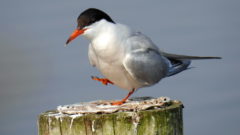
Long-lived chemicals that were banned years or even decades ago in the U.S. and Canada are still turning up in the bodies of fish and migrating terns in the Great Lakes, and they continue to affect the health of those threatened birds. Read the full story by Great Lakes Now.

Original Article

Great Lakes Commission

Great Lakes Commission

https://www.glc.org/dailynews/20201104-lingering-chems

Ned Willig

The Canadian federal government announced Tuesday that it is contributing $14.8 million toward flood prevention in LaSalle, Ontario. Rising water levels in Lake St. Clair and Lake Erie mean that LaSalle is increasingly vulnerable to floods. Read the full story by CBC News.

Original Article

Great Lakes Commission

Great Lakes Commission

https://www.glc.org/dailynews/20201104-ottawa

Ned Willig

While wildfires in the West are usually larger, the forests in Michigan and Wisconsin have frequently seen large uncontrolled burns, some as recent as 2013. Like forests out West, forests in the Great Lakes region are dependent on recurring fires for ecological health. Read the full story by The County Press.

Original Article

Great Lakes Commission

Great Lakes Commission

https://www.glc.org/dailynews/20201104-lake-levels

Ned Willig

Overlooked: Small streams can have a big impact on Great Lakes water quality

Even casual observers of Great Lakes issues are aware of the problems associated with algal blooms.

Perhaps they remember the headlines from August 2014 when Toledo went without drinking water for three days due to the threat of toxic blooms contaminating the city’s water supply. Or a day their favorite beach posted “No Swimming” signs because of toxic algal bloom threats.

Read Now at Great Lakes Now.

Original Article

Great Lakes Now

Great Lakes Now

https://www.greatlakesnow.org/2020/11/small-streams-impact-great-lakes-water-quality/

Gary Wilson

What Has the Trump Administration Meant for Water?

By Brett Walton, Circle of Blue

The Great Lakes News Collaborative includes Bridge Michigan; Circle of Blue; Great Lakes Now at Detroit Public Television; and Michigan Radio, Michigan’s NPR News Leader; who work together to bring audiences news and information about the impact of climate change, pollution, and aging infrastructure on the Great Lakes and drinking water.

Read Now at Great Lakes Now.

Original Article

Great Lakes Now

Great Lakes Now

https://www.greatlakesnow.org/2020/11/trump-administration-water-policy/

Circle of Blue

Lingering Chemicals: Legacy pollutants continue to haunt the Great Lakes

Long-lived chemicals that were banned years or even decades ago in the U.S. and Canada are still turning up in the bodies of fish and migrating terns in the Great Lakes, and they continue to affect the health of those threatened birds.

Scientists found all three chemicals they checked for in the brains and livers of more than two dozen common terns, at all life stages – chicks, juveniles and adults.

Read Now at Great Lakes Now.

Original Article

Great Lakes Now

Great Lakes Now

https://www.greatlakesnow.org/2020/11/legacy-pollutants-great-lakes-terns-emerald-shiners/

Brian Owens

The Marquette Regional History Center will livestream a presentation by local dive enthusiasts on Wednesday, Nov. 4 at 6 p.m. November is Shipwreck Month for the History Center, and Lake Superior harbors a large number of those. Read the full story by The North Wind.

Original Article

Great Lakes Commission

Great Lakes Commission

https://www.glc.org/dailynews/20201103-shipwreck-month

Ken Gibbons

Opposition to a proposed quarry in Severn Township, Ontario continues to grow. It isn’t common for the Couchiching Conservancy to publicly voice opposition to projects, but the proposed quarry is too close to the McDarker Wetland, one of the conservancy’s properties. Read the full story by Barrie Today.

Original Article

Great Lakes Commission

Great Lakes Commission

https://www.glc.org/dailynews/20201103-quarry

Ken Gibbons

High winds are in the forecast yet again this week, as a gale warning remains in place for western Lake Erie while a strong wind warning is in effect for Lake St. Clair. There is a risk that waves could damage shoreline protection works and cause erosion all along the Lake Erie shoreline in Ontario’s Chatham-Kent and Elgin County. Read the full story by The Gananoque Reporter.

Original Article

Great Lakes Commission

Great Lakes Commission

https://www.glc.org/dailynews/20201103-gale-erie

Ken Gibbons