The Catch: New freighter in town

Broadcasting in our monthly PBS television program, The Catch is a Great Lakes Now series that brings you more news about the lakes you love. Go beyond the headlines with reporters from around the region who cover the lakes and drinking water issues. Find all the work HERE.

This month, The Catch features a new bulk freighter that is making waves in Great Lakes shipping.

Read Now at Great Lakes Now.

Original Article

Great Lakes Now

Great Lakes Now

https://www.greatlakesnow.org/2022/10/the-catch-new-freighter-in-town/

GLN Editor

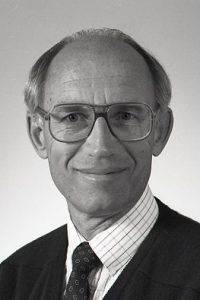
Close-up of man in a suit, tie and glasses

Pioneering researcher of Green Bay, Paul Sager, recently died. He built understanding of the bay and shaped whole-ecosystem policies. Photo courtesy of UW-Green Bay.

A Great Lakes champion and respected researcher, Paul Sager, passed away in late August. Sager had 20 of his research projects funded by Sea Grant. He was instrumental in the early days of the program’s history in Green Bay and establishing a foundational understanding of the bay and its influence on Lake Michigan.

He served as a member of the Sea Grant Advisory Council, as well as the Sea Grant Green Bay Subcommittee Steering Committee.

Sager took emeritus status at the University of Wisconsin-Green Bay in 2000. Prior to that, he taught 13 different courses and filled numerous administrative roles on the campus for 33 years.

Longtime Sea Grant Advisory Council Member Hallett J. “Bud” Harris said, “Professor Sager’s research has been instrumental in the identification and formation of policy initiatives that have led to improvements in the overall quality of the Green Bay ecosystem.”

Sager contributed the Fox River Remedial Action Plan and the Wisconsin Department of Natural Resources’s Total Maximum Daily Load plan.

He is survived by his wife, daughter, son, sister and five grandchildren.


The post A Great Lakes champion and prolific researcher of Green Bay dies first appeared on Wisconsin Sea Grant.

Original Article

News Releases | Wisconsin Sea Grant

News Releases | Wisconsin Sea Grant

https://www.seagrant.wisc.edu/news/a-great-lakes-champion-and-prolific-researcher-of-green-bay-dies/?utm_source=rss&utm_medium=rss&utm_campaign=a-great-lakes-champion-and-prolific-researcher-of-green-bay-dies

Moira Harrington

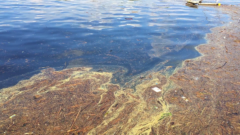
The Ohio Department of Natural Resources (DNR) and Environmental Protection Agency have demonstrated a new technology designed to reduce harmful algal blooms as part of a wide range of efforts on both sides of the Canada-U.S. border to address the threat of Eutrophication on the Great Lakes and other inland bodies of water.

The post New technology provides hope for the Great Lakes’ polluted waters first appeared on Great Lakes Echo.

Original Article

Great Lakes Echo

Great Lakes Echo

http://greatlakesecho.org/2022/10/12/new-technology-provides-hope-for-the-great-lakes-polluted-waters/

Guest Contributor

How to steer money for drinking water and sewer upgrades to the communities that need it most

By Andrian Lee, University of Wisconsin-Milwaukee and Melissa Scanlan, University of Wisconsin-Milwaukee, The Conversation

 is an independent and nonprofit source of news, analysis and commentary from academic experts.

When storms like Hurricane Ian strike, many people have to cope afterward with losing water service.

Read Now at Great Lakes Now.

Original Article

Great Lakes Now

Great Lakes Now

https://www.greatlakesnow.org/2022/10/money-drinking-water-sewer-upgrades-communities-need-most/

The Conversation

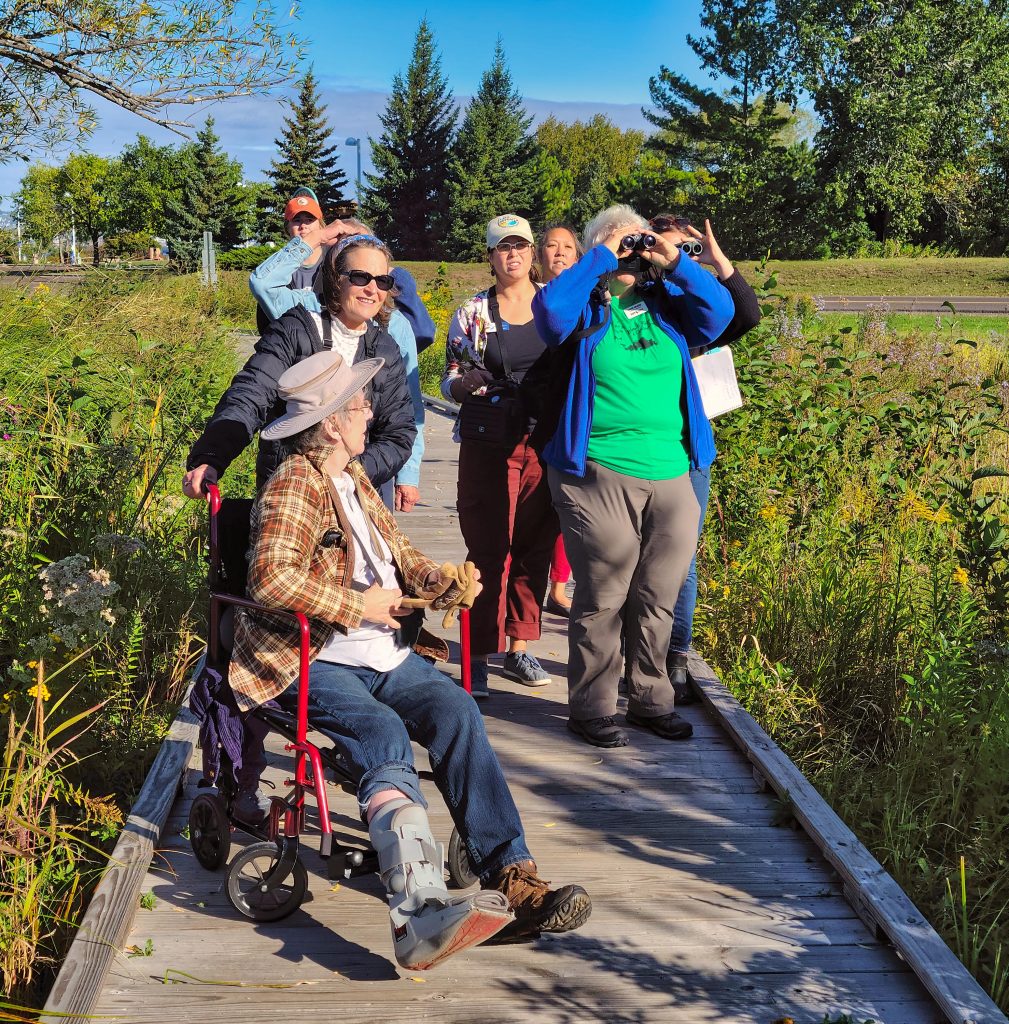
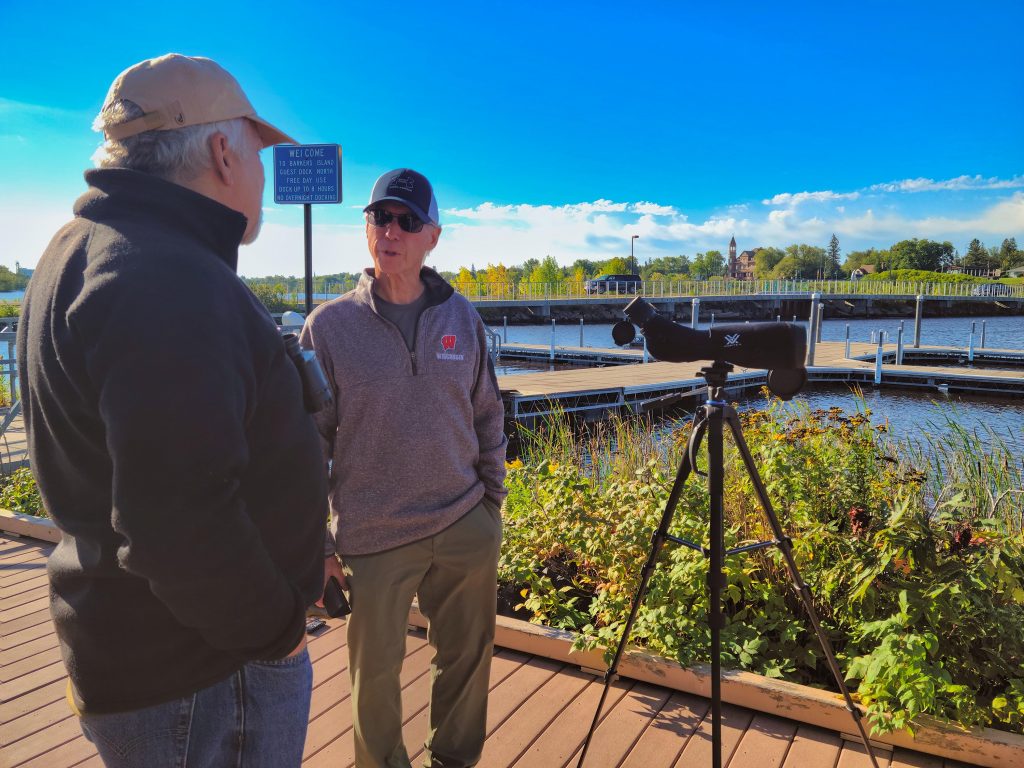
Participants of an accessible birding event spot birds on Barker’s Island in Superior, Wisconsin. Image credit: Marie Zhuikov, Wisconsin Sea Grant

Barker’s Island in the Duluth-Superior Harbor was the site of a free, bird-focused morning recently. People of all ages and ability levels attended an accessible birding outing led by experts from the Hawk Ridge Bird Observatory and the Friends of the Lake Superior Reserve.

The group met at the Lake Superior Estuarium on the island in Superior. They were welcomed by Luciana Ranelli, education coordinator for the Lake Superior National Estuarine Research Reserve. She explained the three options for learning about birds. First was inside the Estuarium, where staff from the University of Wisconsin-Extension Upham Woods Learning Center had arranged bird artifacts and learning stations. Second was a spotting scope behind the Estuarium staffed by Pat Collins, a volunteer birding expert with the Friends of the Lake Superior Reserve. This was designed for birders with mobility issues or anyone who preferred a more stationary option. The third was a guided tour along the Barker’s Island boardwalk with Margie Menzies, educator director for the Hawk Ridge Bird Observatory in Duluth.

Mick MacKenzie (right) talks birds with Pat Collins. Image credit: Marie Zhuikov, Wisconsin Sea Grant

Superior resident and former city council member Mick MacKenzie recently had hip surgery, so the second station appealed to him. He said he came to the event because he’s “enjoying life. It’s good to be out in nature.”

After discussing the population health of kingfishers in the estuary with Collins, MacKenzie said, “When I was a kid, there was nothing down here on Barker’s Island. We’d come here to explore and play, so all this new development is really something to see: the whaleback and the hotel . . .”

MacKenzie was interrupted by Collins. “There’s a hummingbird right here!” Collins said.

MacKenzie expressed surprise that the birds were still around in September.

“They migrate through starting this time of year,” Collins said. “As long as there are flowers in bloom, they’ll stick around.”

Meanwhile, Menzies’ group got oriented to their binoculars and began their walk on the boardwalk. Sightings of the ubiquitous herring gulls around the island prompted Menzies to discuss a rare bird that steals gulls’ food: the parasitic jaeger. An annual Jaeger Birding Festival is held on nearby Wisconsin Point annually this time of year because it’s a prime time for spotting jaegers during their migration south from the arctic.

Her discussion was interrupted when two pigeons landed on the Estuarium roof. “When you look at birds, particularly from a distance, what do you notice about that bird that helps you think about what it is. What kinds of diagnostic clues can you look at on that bird?” Menzies asked.

Someone mentioned the pigeons’ orange feet.

“Yes, those red-orangey feet are a dead giveaway for pigeons. And a nice chunky body,” Menzies added.

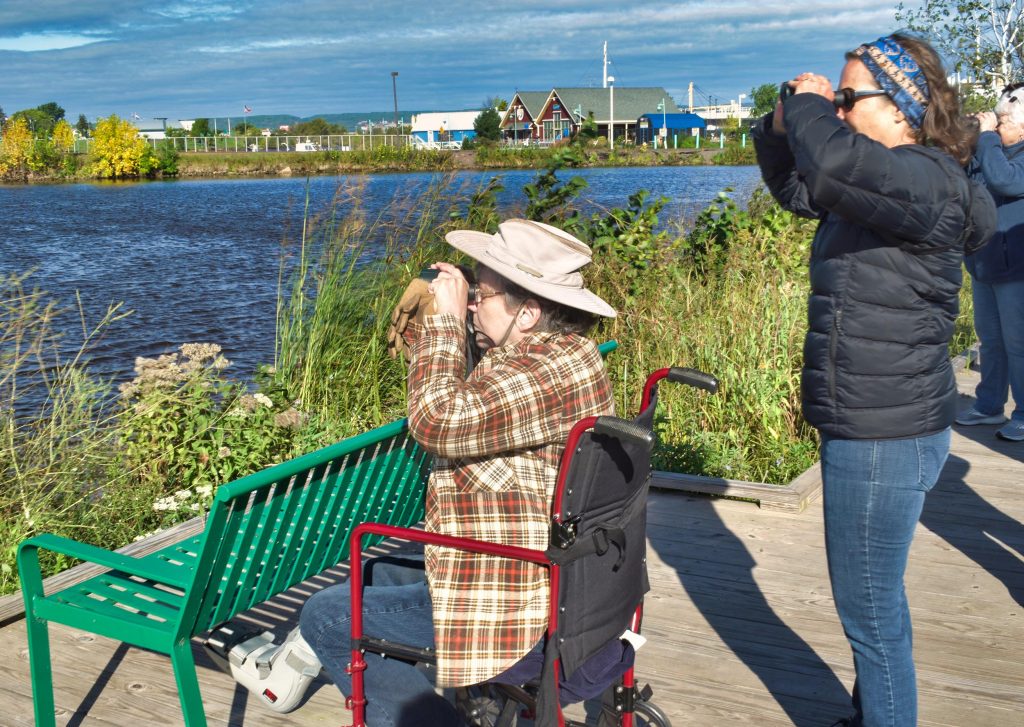
The group moved farther along the boardwalk, following the shoreline of the island to the public beach, which is surrounded by native plants. Along the way, they spotted a turkey vulture, common mergansers, mallards, cormorants and warblers.

Kate McCall (right) and another birder look at cormorants off Barker’s Island. Image credit: Marie Zhuikov, Wisconsin Sea Grant

Kate McCall, a member of the board of directors for the Friends of the Lake Superior Reserve group, said she attended the event because, “This is the stuff I love.” She is interested in making the outdoors more accessible for people of differing abilities and attended an accessibility training session offered by the Reserve previously.

Just one of the things she learned was that cormorants don’t shed water off their backs as easily as other birds after they’ve been diving. “That’s why they’re so clumsy when they fly afterwards,” McCall said. “I always wondered about that. It’s fun to learn more, not just about the habitat of birds, but their patterns of flight, as well. I just really enjoyed it.”

This free event was made possible through the University of Wisconsin–Madison Dean’s Innovation Grant to collaborators from Upham Woods Outdoor Learning Center, the Reserve, Wisconsin Sea Grant, University of Wisconsin-Extension, and Bayfield and Ashland counties.

The post Accessible birding event delivers first appeared on Wisconsin Sea Grant.

Original Article

News Releases | Wisconsin Sea Grant

News Releases | Wisconsin Sea Grant

https://www.seagrant.wisc.edu/news/accessible-birding-event-delivers/?utm_source=rss&utm_medium=rss&utm_campaign=accessible-birding-event-delivers

Marie Zhuikov

More from “Poisonous Ponds: Tackling Toxic Coal Ash”

In August, the “Poisonous Ponds: Tackling Toxic Coal Ash” student reporting initiative investigated the complicated policy and impacts of coal ash in the Great Lakes. The special collaboration included Great Lakes Now, The Energy News Network, and Northwestern University’s Medill School of Journalism, Media, Integrated Marketing Communications.

Keep up with more coal ash news published by The Energy News Network as part of this project:

How Puerto Rico’s banned coal ash winds up in rural Georgia

After Puerto Rico banned coal ash storage, the toxic waste from its coal plant is being quietly shipped through Florida to Georgia.

Read Now at Great Lakes Now.

Original Article

Great Lakes Now

Great Lakes Now

https://www.greatlakesnow.org/2022/10/more-from-poisonous-ponds-tackling-toxic-coal-ash/

Energy News Network

Fashion and the environment are linked in more ways than consumers may expect. Fashion designers are taking steps to reduce the clothing industry's impact on the environment.

The post A road to sustainable fashion: up-cycling t-shirts first appeared on Great Lakes Echo.

Original Article

Great Lakes Echo

Great Lakes Echo

http://greatlakesecho.org/2022/10/11/a-road-to-sustainable-fashion-up-cycling-t-shirts/

Guest Contributor

The Catch: Historic land transfer

Broadcasting in our monthly PBS television program, The Catch is a Great Lakes Now series that brings you more news about the lakes you love. Go beyond the headlines with reporters from around the region who cover the lakes and drinking water issues. Find all the work HERE.

This month, The Catch features a story on the return of 100 acres to the Onondaga Nation.

Read Now at Great Lakes Now.

Original Article

Great Lakes Now

Great Lakes Now

https://www.greatlakesnow.org/2022/10/the-catch-historic-land-transfer/

GLN Editor

Drinking Water News Roundup: New water infrastructure funding, projects, programs

From lead pipes to PFAS, drinking water contamination is a major issue plaguing cities and towns all around the Great Lakes. Cleaning up contaminants and providing safe water to everyone is an ongoing public health struggle.

Keep up with drinking water-related developments in the Great Lakes area.

Click on the headline to read the full story:


Indiana:

  • Water renovation project extends municipal water access to hundreds – The Indiana Gazette

Prior to the approximately $12 million project that connected Plumville and Crooked Creek water treatment plants, most residents in the area as well as the school district relied on well water.

Read Now at Great Lakes Now.

Original Article

Great Lakes Now

Great Lakes Now

https://www.greatlakesnow.org/2022/10/drinking-water-news-roundup-new-water-infrastructure-funding-projects-programs/

GLN Editor

Researchers at the University of Michigan are developing web-based tools in anticipation of a future influx in climate migration. The tools will be an important part in helping Great Lakes communities prepare and plan for the future, which may include many new residents. Read the full story by Michigan Radio.

Original Article

Great Lakes Commission

Great Lakes Commission

https://www.glc.org/dailynews/20221010-population-growth

Theresa Gruninger

A new report calling the conditions in Lake Erie poor may have some questioning whether it is safe to consume fish from the lake. The New York Department of Health provides guidelines for individual species and how frequently they can be consumed. Read the full story by WYRX – Buffalo, NY.

Original Article

Great Lakes Commission

Great Lakes Commission

https://www.glc.org/dailynews/20221010-fish-safty

Theresa Gruninger

Responding to the Ohio Lake Erie Commission’s and Ohio EPA’s recommendations from earlier this year, U.S. EPA has agreed to remove the “Restrictions on Fish and Wildlife Consumption” Beneficial Use Impairment from the Maumee Area of Concern. Read the full story by the Sentinel Tribune.

Original Article

Great Lakes Commission

Great Lakes Commission

https://www.glc.org/dailynews/20221010-maumee-river

Theresa Gruninger

Of all the rivers in the world, the St. Lawrence River is undeniably one of the most challenging for mariners, resulting in several thousand wrecks hidden below the river’s surface. New expeditions continue to explore the notable wrecks. Read the full story by The Conversation.

Original Article

Great Lakes Commission

Great Lakes Commission

https://www.glc.org/dailynews/20221010-shipwrecks

Theresa Gruninger

As of this week, 95 percent of Benton Harbor’s 4,500 water lines have either been replaced or verified as non-lead. The milestone comes exactly one year after state officials, with a big push from activists, began trucking cases of bottled water to the Michigan city that began struggling with elevated lead levels in 2018. Read the full story by MLive.


Original Article

Great Lakes Commission

Great Lakes Commission

https://www.glc.org/dailynews/20221010-benton-harbor

Theresa Gruninger

While Tribal Nations will receive $720 million for climate and energy funding via the Inflation Reduction Act, true partnership means respecting tribal treaty rights and defending tribal sovereignty against fossil fuel projects. In Michigan and other states, agencies must consult in a meaningful way with Tribal Nations. Read and listen to the full story by Newsweek.

Original Article

Great Lakes Commission

Great Lakes Commission

https://www.glc.org/dailynews/20221010-indigenous-peoples-day

Theresa Gruninger

Today marks Indigenous People’s Day, a time to reflect on the history and legacy of colonization in North America, and celebrate and support the Indigenous People across the Great Lakes and this continent. Indigenous People’s Day has it’s roots in the protests and counter-celebrations of 1992, the year that marked 500 years since Christopher Columbus […]

Original Article

Wisconsin Water Library

Wisconsin Water Library

https://waterlibrary.aqua.wisc.edu/7032-2/

Anne Moser

A new book details the decades-long cleanup of Detroit's River Rogue, which was once one of the most polluted watersheds in America. However, there is still more work to be done.

The post Book details how a watershed community rescued one of the nation’s most polluted rivers first appeared on Great Lakes Echo.

Original Article

Great Lakes Echo

Great Lakes Echo

http://greatlakesecho.org/2022/10/10/book-details-how-a-watershed-community-rescued-one-of-the-nations-most-polluted-rivers/

Guest Contributor

...FREEZE WARNING REMAINS IN EFFECT UNTIL 8 AM CDT THIS MORNING... * WHAT...Sub-freezing temperatures in the upper 20s to lower 30s expected. * WHERE...Calumet, Manitowoc, Winnebago, Brown, Door, Kewaunee and Outagamie Counties. * WHEN...Until 8 AM CDT this morning.

Original Article

Current Watches, Warnings and Advisories for Brown (WIC009) Wisconsin Issued by the National Weather Service

Current Watches, Warnings and Advisories for Brown (WIC009) Wisconsin Issued by the National Weather Service

https://alerts.weather.gov/cap/wwacapget.php?x=WI12641200F964.FreezeWarning.12641201AFD0WI.GRBNPWGRB.43c148fcb84ad2850842d9bc95e54946

w-nws.webmaster@noaa.gov

...FREEZE WARNING REMAINS IN EFFECT FROM 1 AM TO 8 AM CDT SATURDAY... * WHAT...Sub-freezing temperatures as low as 28 expected. * WHERE...Calumet, Manitowoc, Winnebago, Brown, Door, Kewaunee and Outagamie Counties. * WHEN...From 1 AM to 8 AM CDT Saturday. * IMPACTS...Frost and freeze conditions could kill crops, other

Original Article

Current Watches, Warnings and Advisories for Brown (WIC009) Wisconsin Issued by the National Weather Service

Current Watches, Warnings and Advisories for Brown (WIC009) Wisconsin Issued by the National Weather Service

https://alerts.weather.gov/cap/wwacapget.php?x=WI12641200115C.FreezeWarning.12641201AFD0WI.GRBNPWGRB.43c148fcb84ad2850842d9bc95e54946

w-nws.webmaster@noaa.gov

...FREEZE WARNING REMAINS IN EFFECT FROM 1 AM TO 8 AM CDT SATURDAY... * WHAT...Sub-freezing temperatures in the upper 20s to lower 30s expected. * WHERE...Calumet, Manitowoc, Winnebago, Brown, Door, Kewaunee and Outagamie Counties. * WHEN...From 1 AM to 8 AM CDT Saturday.

Original Article

Current Watches, Warnings and Advisories for Brown (WIC009) Wisconsin Issued by the National Weather Service

Current Watches, Warnings and Advisories for Brown (WIC009) Wisconsin Issued by the National Weather Service

https://alerts.weather.gov/cap/wwacapget.php?x=WI126411F36858.FreezeWarning.12641201AFD0WI.GRBNPWGRB.43c148fcb84ad2850842d9bc95e54946

w-nws.webmaster@noaa.gov

...FREEZE WARNING REMAINS IN EFFECT FROM 1 AM TO 8 AM CDT SATURDAY... * WHAT...Sub-freezing temperatures in the upper 20s to lower 30s expected. * WHERE...Calumet, Manitowoc, Winnebago, Brown, Door, Kewaunee and Outagamie Counties. * WHEN...From 1 AM to 8 AM CDT Saturday.

Original Article

Current Watches, Warnings and Advisories for Brown (WIC009) Wisconsin Issued by the National Weather Service

Current Watches, Warnings and Advisories for Brown (WIC009) Wisconsin Issued by the National Weather Service

https://alerts.weather.gov/cap/wwacapget.php?x=WI126411F2EB58.FreezeWarning.12641201AFD0WI.GRBNPWGRB.43c148fcb84ad2850842d9bc95e54946

w-nws.webmaster@noaa.gov

When a commercial fisherman pulled four grass carp out of the lower Sandusky River 10 years ago, biologists who monitor Lake Erie became suspicious. Today, a multi-million-dollar effort funded by Congress, partly through the Great Lakes Restoration Initiative, is underway to keep the invasive carp at bay. Read the full story by the Cleveland Plain Dealer.

Original Article

Great Lakes Commission

Great Lakes Commission

https://www.glc.org/dailynews/20221007-grass-carp

Connor Roessler

Public comment is being accepted on a multi-year action plan regarding New York’s Great Lakes. The plan would guide restoration and conservation, and foster sustainable, resilient, communities in New York’s Great Lakes region.  Read the full story by WRFA – Jamestown, NY.

Original Article

Great Lakes Commission

Great Lakes Commission

https://www.glc.org/dailynews/20221007-new-york-plan

Connor Roessler

The International Lake Ontario-St. Lawrence River Board (ILOSLR) will be reducing outflow through the Moses-Saunders dam this weekend to give boaters on Lake St. Lawrence an opportunity to remove their boats from the water. Read the full story by WROC-TV – Rochester, NY.

Original Article

Great Lakes Commission

Great Lakes Commission

https://www.glc.org/dailynews/20221007-ijc-action

Connor Roessler

Meteorology students at SUNY Oswego are taking part in a multi-million-dollar project funded by the National Science Foundation to study lake effect lightning events east of Lake Ontario. Read the full story by WROC-TV – Rochester, NY.

Original Article

Great Lakes Commission

Great Lakes Commission

https://www.glc.org/dailynews/20221007-oswego-study

Connor Roessler

The city of Flint, Michigan says it’s preparing for a return to using water from the Great Lakes Water Authority pipeline following a transmission main break that forced it to use its backup water source for more than seven weeks. Read the full story by MLive.

Original Article

Great Lakes Commission

Great Lakes Commission

https://www.glc.org/dailynews/20221007-flint-water

Connor Roessler

Great Lakes Moment: Rouge River Revived

Editor’s Note: Great Lakes Moment is a monthly column written by Great Lakes Now Contributor John Hartig. Publishing the author’s views and assertions does not represent endorsement by Great Lakes Now or Detroit Public Television. This month’s article is a combination of excerpts and a preview of his new book, “Rouge River Revived: How People are Bringing Their River Back to Life,” which chronicles how citizens are leading an effort to restore their river in metropolitan Detroit.

Read Now at Great Lakes Now.

Original Article

Great Lakes Now

Great Lakes Now

https://www.greatlakesnow.org/2022/10/great-lakes-moment-rouge-river-revived/

John Hartig

...FREEZE WARNING IN EFFECT FROM 1 AM TO 8 AM CDT SATURDAY... * WHAT...Sub-freezing temperatures in the upper 20s to lower 30s expected. * WHERE...Calumet, Manitowoc, Winnebago, Brown, Door, Kewaunee and Outagamie Counties. * WHEN...From 1 AM to 8 AM CDT Saturday.

Original Article

Current Watches, Warnings and Advisories for Brown (WIC009) Wisconsin Issued by the National Weather Service

Current Watches, Warnings and Advisories for Brown (WIC009) Wisconsin Issued by the National Weather Service

https://alerts.weather.gov/cap/wwacapget.php?x=WI126411F1B468.FreezeWarning.12641201AFD0WI.GRBNPWGRB.43c148fcb84ad2850842d9bc95e54946

w-nws.webmaster@noaa.gov

It’s October, and the stink bugs are moving into my house for the winter. So many things stink in a deliberate attempt to be repulsive. Other things stink to be attractive, but because they’re not trying to attract us, we may not like their aromas.

The post October: The smells of autumn first appeared on Great Lakes Echo.

Original Article

Great Lakes Echo

Great Lakes Echo

http://greatlakesecho.org/2022/10/07/october-the-smells-of-autumn/

Guest Contributor

Ann Arbor sends partially treated wastewater into river

ANN ARBOR, Mich. (AP) — The City of Ann Arbor says an estimated 1.38 million gallons (5.2 million liters) of partially treated wastewater flowed into the Huron River during maintenance Tuesday at its treatment plant.

The wastewater had received all treatment except disinfection, the city announced Wednesday in a news release.

Read Now at Great Lakes Now.

Original Article

Great Lakes Now

Great Lakes Now

https://www.greatlakesnow.org/2022/10/ap-ann-arbor-sends-partially-treated-wastewater-into-river/

The Associated Press

Sending out a huge thank you to everyone who went through the locks this season! The Fall Colors Weekend on October 1 & 2 was a big success and it was great to see all of you. Also, a big shout out to our lock tenders–they make sure you continue to have access to this historic navigation system. Please stay tuned to our website and our Facebook page for updates on the 2023 season and operational hours. See you when the ice melts!

Check out this short video from our Fall Colors Weekend!

Original Article

Blog – Fox Locks

Blog – Fox Locks

http://foxlocks.org/2022/10/06/thank-you-for-cruising-with-us/

Fox Locks

News

Great Lakes Commission awards more than $1.2 million to reduce runoff and improve water quality

Ann Arbor, Mich. – The Great Lakes Commission (GLC) announced today that it will award more than $1.2 million in grants to reduce the runoff of sediment, nutrients, and other pollutants into the Great Lakes and their tributaries through the Great Lakes Sediment and Nutrient Reduction Program.

“The Great Lakes Sediment and Nutrient Reduction Program continues to assist communities across the Great Lakes basin as they improve water quality and tackle pollution,” said Todd L. Ambs, chair of the Great Lakes Commission. “The Great Lakes Commission is proud to partner with these local project leads through this unique program. Throughout its three decade history, projects with the GLSNRP have prevented millions of pounds of phosphorus and tons of sediment from reaching the Great Lakes. We are looking forward to seeing this new cohort of 2022 grantees work toward a healthier Great Lakes.”

Each year, the Great Lakes Sediment and Nutrient Reduction Program provides competitive grants to local, state and tribal governments and nonprofit organizations to install erosion and nutrient control practices in the Great Lakes basin. These practices help to prevent harmful algal blooms and dead zones. The program supports projects not typically funded by other federal cost-share programs, including innovative and unique practices. The 2022 projects generally focus on three approaches: long-term sediment and nutrient management through engagement with the agricultural community, streambank restoration, and green infrastructure.

The following grants have been awarded:

Project Grantee Amount State
Spy Run Creek Streambank Restoration:  Phase II Fort Wayne Park Foundation $200,000 Indiana
Muskegon River Streambank Protection Initiative Muskegon River Watershed Assembly $87,909 Michigan
Babbitt’s Farm Streambank Restoration Genesee RiverWatch Inc. $198,455 New York
Skaneateles Lake Sub-Watershed Improvement Project for the Lake Ontario Great Lakes Basin Skaneateles Lake Association, Inc. $45,000 New York
Grassed Waterways and Wetlands in St. Mary’s River Mercer County Soil & Water Conservation District $176,000 Ohio
Keene Creek Resiliency Report – Irving Park Biofiltration Basin City of Duluth $121,000 Minnesota
McCormick Ravine Improvements The City of Lake Forest $200,000 Illinois
Forget Me Not Creek Stream Restoration Project Woodland Dunes Nature Center and Preserve $200,000 Wisconsin


Funding for the Great Lakes Sediment and Nutrient Reduction Program is provided by the U.S. Department of Agriculture – Natural Resources Conservation Service under the Great Lakes Restoration Initiative (GLRI). Since it was first funded in 2010, the GLRI has provided more than $4 billion to fund more than 6,000 projects across the Great Lakes region. The projects have cleaned up toxic hot spots, restored wetlands, helped to prevent the spread of aquatic invasive species and reduced harmful sediment and excess nutrients to the most significant surface, freshwater resource on the planet, our Great Lakes.

More information about the projects is available at www.nutrientreduction.org.


The Great Lakes Commission, led by chair Todd L. Ambs, deputy secretary of the Wisconsin Department of Natural Resources (retired), is a binational government agency established in 1955 to protect the Great Lakes and the economies and ecosystems they support. Its membership includes leaders from the eight U.S. states and two Canadian provinces in the Great Lakes basin. The GLC recommends policies and practices to balance the use, development, and conservation of the water resources of the Great Lakes and brings the region together to work on issues that no single community, state, province, or nation can tackle alone. Learn more at www.glc.org.

CONTACT

For media inquiries, please contact Hannah Reynolds, hreynolds@glc.org.

Recent GLC News

Upcoming GLC Events

View GLC Calendar

ARCHIVES

Original Article

Great Lakes Commission

Great Lakes Commission

https://www.glc.org/news/glsnrp-100622

Beth Wanamaker

A University of Windsor graduate student is creating erosion sensors, called transducers, for less than 5% of the commercial cost. The devices help researchers understand how boat wakes erode the shoreline.

The post UWindsor undergrad cuts research costs with DIY erosion sensors first appeared on Great Lakes Echo.

Original Article

Great Lakes Echo

Great Lakes Echo

http://greatlakesecho.org/2022/10/06/uwindsor-undergrad-cuts-research-costs-with-diy-erosion-sensors/

Guest Contributor

The State of the Great Lakes report, issued by the United States and Canada in July, assessed the overall condition of Lake Erie as poor and unchanging. Jill Jedlicka, Executive Director for the Buffalo Niagara Waterkeeper, believes that land use, development and individual decisions can change this trend for the better. Read the full story by WGRZ – Buffalo, NY.

Original Article

Great Lakes Commission

Great Lakes Commission

https://www.glc.org/dailynews/20221005-erie-condition

James Polidori

In Milwaukee, Wisconsin, the Metropolitan Sewerage District and Ducks Unlimited are leading a multi-year, multi-watershed effort to mitigate climate change in southeastern Wisconsin. The Reforestation & Wetland Restoration Program aims to plant six million trees and restore 4,000 acres worth of wetlands. Read the full story by WUWM – Milwaukee, WI.

Original Article

Great Lakes Commission

Great Lakes Commission

https://www.glc.org/dailynews/20221005-restoration-wetland-forest

James Polidori