...LOCALLY DENSE FOG AND SLIPPERY ROADS POSSIBLE THIS MORNING AND TONIGHT... Locally dense fog will be possible this morning, and again tonight. Visibility may drop below a mile at times. In addition, there is a small chance of freezing drizzle in northern Wisconsin this morning, and a light wintry mix may occur tonight. Motorists

Original Article

Current Watches, Warnings and Advisories for Brown (WIC009) Wisconsin Issued by the National Weather Service

Current Watches, Warnings and Advisories for Brown (WIC009) Wisconsin Issued by the National Weather Service

https://alerts.weather.gov/cap/wwacapget.php?x=WI12688586CD74.SpecialWeatherStatement.12688587AC80WI.GRBSPSGRB.3b77a733acfe35fc01f412b80021d336

w-nws.webmaster@noaa.gov

...AREAS OF DENSE FOG AND LOCALLY SLIPPERY ROADS TONIGHT... Mild, moist air flowing over the snow covered ground will keep areas of dense fog tonight. Visibility may drop below a mile at times, especially across north-central Wisconsin. In addition, light rain could transition over to snow or even freeze on untreated surfaces, creating slick spots late tonight. Use caution if you

Original Article

Current Watches, Warnings and Advisories for Brown (WIC009) Wisconsin Issued by the National Weather Service

Current Watches, Warnings and Advisories for Brown (WIC009) Wisconsin Issued by the National Weather Service

https://alerts.weather.gov/cap/wwacapget.php?x=WI12688585E56C.SpecialWeatherStatement.12688586D3B4WI.GRBSPSGRB.3b77a733acfe35fc01f412b80021d336
w-nws.webmaster@noaa.gov

...AREAS OF DENSE FOG AND LOCALLY SLIPPERY ROADS POSSIBLE TONIGHT... Mild, moist air flowing over the snow covered ground will create areas of dense fog tonight. In addition, light rain could freeze on some roads across northern Wisconsin late tonight. Use caution if you will be traveling. The dense fog could also result in airline delays tonight and Friday morning.

Original Article

Current Watches, Warnings and Advisories for Brown (WIC009) Wisconsin Issued by the National Weather Service

Current Watches, Warnings and Advisories for Brown (WIC009) Wisconsin Issued by the National Weather Service

https://alerts.weather.gov/cap/wwacapget.php?x=WI126885791170.SpecialWeatherStatement.12688585E378WI.GRBSPSGRB.3b77a733acfe35fc01f412b80021d336
w-nws.webmaster@noaa.gov

Defense Department to again target ‘forever chemicals’ contamination near Michigan military base

By Todd Richmond, Associated Press

The U.S. Department of Defense plans to install two more groundwater treatment systems at a former Michigan military base to control contamination from so-called forever chemicals, U.S. Rep. Elissa Slotkin’s office announced Friday.

Environmentalists say the systems will help prevent PFAS from spreading into the Clarks Marsh area and the Au Sable River near the former Wurtsmith Air Force Base in Oscoda on the shores of Lake Huron.

Read Now at Great Lakes Now.

Original Article

Great Lakes Now

Great Lakes Now

https://www.greatlakesnow.org/2024/01/ap-defense-department-to-again-target-forever-chemicals-contamination-near-michigan-military-base/

The Associated Press

Energy News Roundup: Ohio bipartisan energy efficiency bill stalled by Koch-linked group

Keep up with energy-related developments in the Great Lakes area with Great Lakes Now’s biweekly headline roundup. 

Click on the headline to read the full story:  


Illinois 

Illinois lands $14.9M federal grant to expand electric vehicle charging network — Chicago Sun-Times 

Illinois lands a $14.9 million federal grant to install electric vehicle charging stations at 273 new locations, including 36 fast-charging stations. 

Read Now at Great Lakes Now.

Original Article

Great Lakes Now

Great Lakes Now

https://www.greatlakesnow.org/2024/01/energy-news-roundup-ohio-bipartisan-energy-efficiency-bill-stalled-by-koch-linked-group/

Kathy Johnson

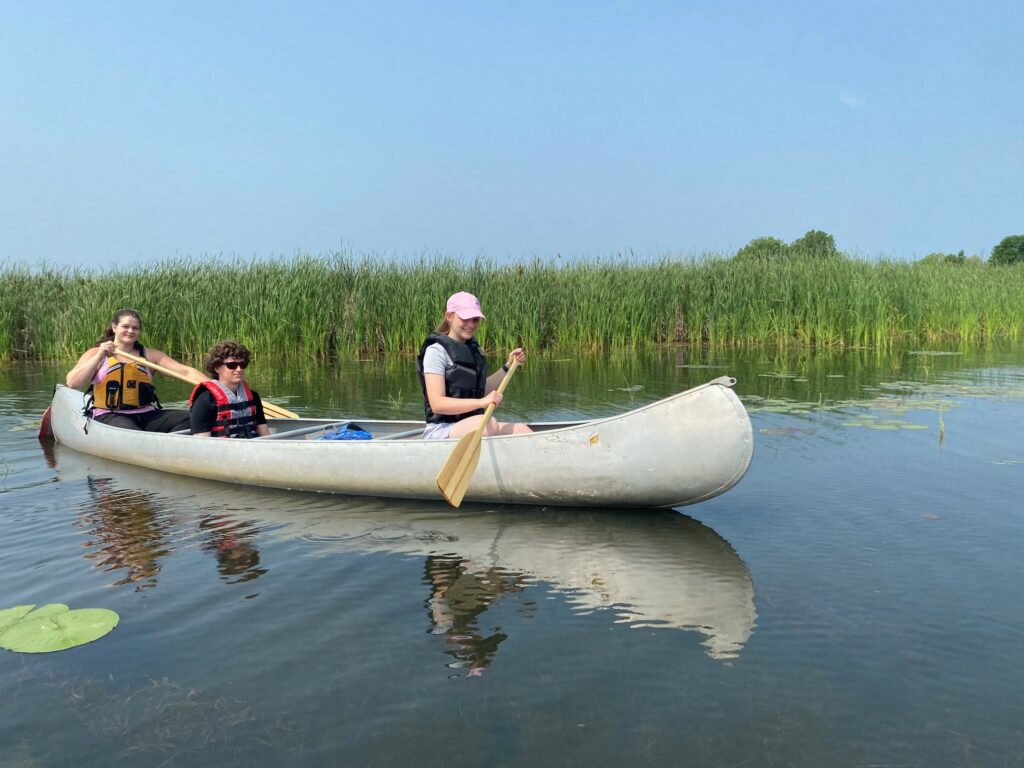
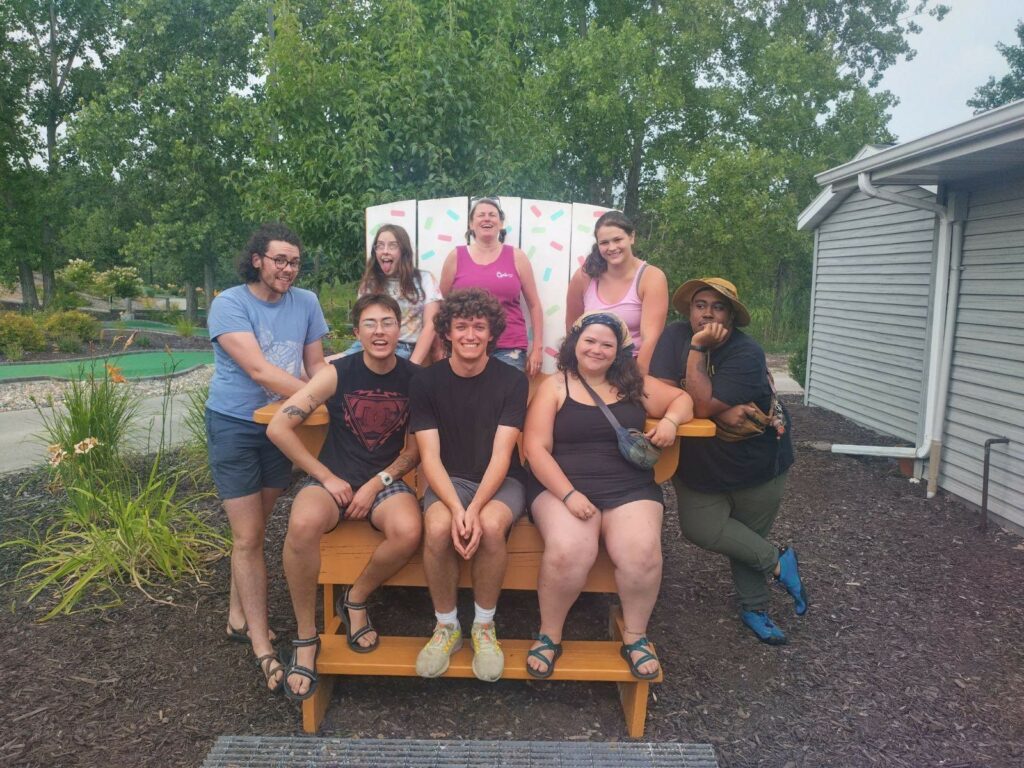
Summer Outreach Scholar students Sarah Zieglmeier, Adam Gips and Gweni Malokofsky canoe to learn about ecological monitoring and a Manoomin restoration/reseeding project. Image credit: Deidre Peroff, Wisconsin Sea Grant

The calendar has flipped to 2024. Our staff members are already tackling new projects. Before they move too deeply into the new year, however, some staff members took a moment to retain the glow of their favorite 2023 project. Deidre Peroff, social science outreach specialist, shared her thoughts.

My favorite project from 2023 was when I took seven “Generation Z” students who are studying Manoomin (wild rice) camping near Green Bay. I was mentoring two of the students as part of Wisconsin Sea Grant’s Summer Outreach Scholar Program and the other five came from the University of Minnesota. They were also studying Manoomin and participating in summer Manoomin-related field excursions.

The Summer Outreach Scholar group enjoys an ice cream stop after a day trip. Pictured, left to right, front row: Elliot Benjamin, Adam Gips, Pipper Gallivan. Back row: Sashi White, Lucia Richardson, Deidre Peroff, Sarah Zieglmeier, Kane Farmer. Image credit: Deidre Peroff, Wisconsin Sea Grant

During four jam-packed days, we learned from Indigenous knowledge-holders about the significance of Manoomin and visited sacred cultural sites on the Menominee Indian Reservation. We met with Amy Corrozino-Lyon (University of Wisconsin-Green Bay restoration scientist) and Titus Seilheimer (Sea Grant fisheries outreach specialist) one day to learn about ecological restoration efforts of Manoomin in Oconto and did journal and poetry writing to better connect with a new plant (inspired by Robin Wall Kimmerer’s work, “Braiding Sweetgrass”). We also met with Jesse Conaway (who is working with the Brothertown Nation on another Sea Grant-funded project) to participate in a traditional Manoomin appreciation ceremony, plus we saw how drones are used for monitoring Manoomin in the Lake Winnebego region.

While the students learned so much, what I think we all appreciated the most was spending time together and getting to know each other. During our three nights camping, we enjoyed cooking meals together, playing cards, telling stories by the campfire and swimming in Lake Michigan.

At night, we reflected on what we had learned that day and I enjoyed seeing the students’ newfound understanding and appreciation of Indigenous knowledge and finding a balance between Western and Indigenous science approaches to conservation, restoration and monitoring of a cultural, spiritual and ecological keystone species. When we weren’t reflecting on what we were learning during the day, we enjoyed sleeping under the stars (and storms) and finding time to decompress in nature.


The post Learning about Manoomin first appeared on Wisconsin Sea Grant.

Original Article

Blog | Wisconsin Sea Grant

Blog | Wisconsin Sea Grant

https://www.seagrant.wisc.edu/blog/learning-about-manoomin/

Deidre Peroff

 Do you want to know how peak streamflow is changing in the Upper Midwest, specifically Wisconsin? Read the scientific investigations report by Physical Scientist Sara Levin.

Original Article

Wisconsin

Wisconsin

https://www.usgs.gov/centers/upper-midwest-water-science-center/news/peak-streamflow-trends-wisconsin-and-their-relation?utm_source=comms&utm_medium=rss&utm_campaign=news

jvelkoverh@usgs.gov

...AREAS OF DENSE FOG AND LOCALLY SLIPPERY ROADS WILL IMPACT TRAVEL TODAY AND TONIGHT... Areas of fog, locally dense with visibilities of 1/4 mile or less, will continue across the region through tonight. Poor or rapidly changing visibilities will result in locally hazardous travel conditions. Air travel delays or cancellations may also

Original Article

Current Watches, Warnings and Advisories for Brown (WIC009) Wisconsin Issued by the National Weather Service

Current Watches, Warnings and Advisories for Brown (WIC009) Wisconsin Issued by the National Weather Service

https://alerts.weather.gov/cap/wwacapget.php?x=WI126885778878.SpecialWeatherStatement.126885784330WI.GRBSPSGRB.3b77a733acfe35fc01f412b80021d336
w-nws.webmaster@noaa.gov

...DENSE FOG ADVISORY REMAINS IN EFFECT UNTIL 9 AM CST THIS MORNING... * WHAT...Visibility one quarter mile or less in dense fog, with the worst conditions expected in the Fox Valley. * WHERE...Portage, Waushara, Wood, Calumet, Manitowoc, Winnebago, Brown, Kewaunee, Outagamie, and Waupaca Counties.

Original Article

Current Watches, Warnings and Advisories for Brown (WIC009) Wisconsin Issued by the National Weather Service

Current Watches, Warnings and Advisories for Brown (WIC009) Wisconsin Issued by the National Weather Service

https://alerts.weather.gov/cap/wwacapget.php?x=WI126885776424.DenseFogAdvisory.126885784330WI.GRBNPWGRB.9b8b0299c7b3d6443027ed9540ae96ad

w-nws.webmaster@noaa.gov

...DENSE FOG ADVISORY IN EFFECT UNTIL 9 AM CST THURSDAY... * WHAT...Visibility one quarter mile or less in dense fog. * WHERE...Portage, Waushara, Wood, Calumet, Manitowoc, Winnebago, Brown, Kewaunee, Outagamie, and Waupaca Counties. * WHEN...Until 9 AM CST Thursday. * IMPACTS...Low visibility could make driving conditions hazardous.

Original Article

Current Watches, Warnings and Advisories for Brown (WIC009) Wisconsin Issued by the National Weather Service

Current Watches, Warnings and Advisories for Brown (WIC009) Wisconsin Issued by the National Weather Service

https://alerts.weather.gov/cap/wwacapget.php?x=WI12688576A5E8.DenseFogAdvisory.126885784330WI.GRBNPWGRB.9b8b0299c7b3d6443027ed9540ae96ad

w-nws.webmaster@noaa.gov

...AREAS OF FOG AND LOCALLY SLIPPERY ROADS WILL IMPACT TRAVEL THROUGH THURSDAY MORNING... Areas of fog, locally dense with visibilities of 1/4 mile or less, will continue across the region through Thursday morning. Poor or rapidly changing visibilities will result in locally hazardous travel conditions tonight into Thursday morning. Air

Original Article

Current Watches, Warnings and Advisories for Brown (WIC009) Wisconsin Issued by the National Weather Service

Current Watches, Warnings and Advisories for Brown (WIC009) Wisconsin Issued by the National Weather Service

https://alerts.weather.gov/cap/wwacapget.php?x=WI126885765D40.SpecialWeatherStatement.1268857758D0WI.GRBSPSGRB.3b77a733acfe35fc01f412b80021d336
w-nws.webmaster@noaa.gov

Army Corps plans $1 billion barricade to deter invasive carp at Illinois and Des Plaines Rivers

By Juanpablo Ramirez-Franco, WBEZ

This coverage is made possible through a partnership between WBEZ and Grist, a nonprofit, independent media organization dedicated to telling stories of climate solutions and a just future. Sign up for WBEZ newsletters to get local news you can trust.

Read Now at Great Lakes Now.

Original Article

Great Lakes Now

Great Lakes Now

https://www.greatlakesnow.org/2024/01/army-corps-plans-1-billion-barricade-to-deter-invasive-carp-at-illinois-and-des-plaines-rivers/

WBEZ

A new nationwide study by USGS scientists provides additional scientific evidence that pesticides are likely negatively impacting aquatic invertebrate community health and therefore the health of our stream and river ecosystems.

Original Article

Midcontinent Region

Midcontinent Region

https://www.usgs.gov/news/national-news-release/pesticides-are-likely-impacting-invertebrate-life-essential-our-nations?utm_source=comms&utm_medium=rss&utm_campaign=news

lausman@usgs.gov

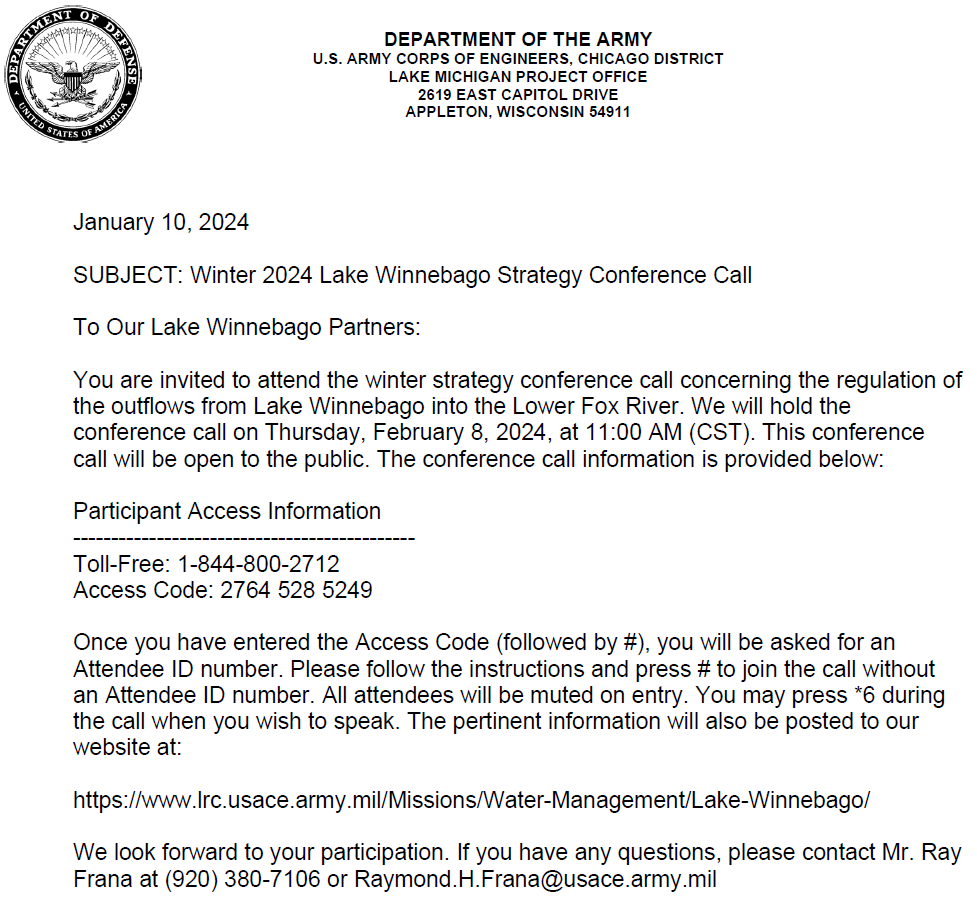
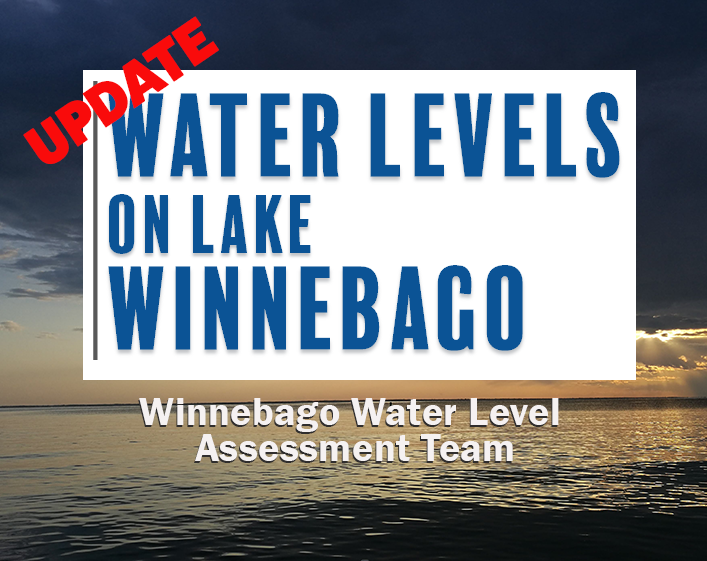
Interested in joining other stakeholders in ongoing discussions about water levels in the Winnebago System?

The Winnebago Water Level Assessment Team (WWLAT) provides a collaborative opportunity for stakeholder representatives and experts to develop realistic and achievable water level strategy recommendations and related goals that reasonably balance the top priorities of multiple system users and the health of the Winnebago System. This team is led separately from the Army Corps public input process by Fox-Wolf Watershed Alliance. Recommendations from the WWLAT are submitted to the Army Corps to help inform the Corps regulation of Lake Winnebago.

Visit the WWLAT website: CLICK HERE

The post Army Corps: Winter 2024 Call – Feb. 8, 2024 appeared first on Fox-Wolf Watershed Alliance.

Original Article

Fox-Wolf Watershed Alliance

Fox-Wolf Watershed Alliance

https://fwwa.org/2024/01/24/acoe-winter-2024-strategy-call-notice/?utm_source=rss&utm_medium=rss&utm_campaign=acoe-winter-2024-strategy-call-notice

Katie Reed

On Monday, the Conference of Great Lakes St. Lawrence Governors and Premiers organized a head-to-tail cook-off that challenged culinary students at Kendall College in Chicago to use the entire fish in their dishes. The event was the latest effort in a push toward utilizing 100% of the fish caught in the Great Lakes. Read the full story by WBBM – Chicago, IL.

Original Article

Great Lakes Commission

Great Lakes Commission

https://www.glc.org/dailynews/20240124-100-percent-fish

James Polidori

The Michigan Department of Natural Resources’ Fisheries Division will be hiring a full-time malacologist – a biologist who studies mollusks, including mussels and clams – which will kickstart a two-year project to centralize mussel data collected across the state. Read the full story by Michigan Public.

Original Article

Great Lakes Commission

Great Lakes Commission

https://www.glc.org/dailynews/20240124-mussel-research

James Polidori

Lake Erie is behind its typical freezing schedule, which depends on different weather patterns, according to National Oceanic and Atmospheric Administration officials. The recent cold snap has helped Lake Erie freeze at a faster pace, though if temperatures warm, it can thaw just as quickly. Read the full story by WKSU – Kent, OH.

Original Article

Great Lakes Commission

Great Lakes Commission

https://www.glc.org/dailynews/20240124-erie-ice-cover

James Polidori

Large freighters were on the move in Door County, Wisconsin, on Monday morning to find somewhere to go during the winter season. The Winter Fleet will remain in port typically until the Soo Locks on Lake Superior open again for the season; this year, that’s scheduled for April 24. Read the full story by WTAQ – Green Bay, WI.

Original Article

Great Lakes Commission

Great Lakes Commission

https://www.glc.org/dailynews/20240124-freighter-winter

James Polidori

Last Friday, northeast Illinois and northwest Indiana were hit with an extremely localized but intense band of lake-effect snow created by whirlwinds known as mesovortexes. They are formed by convergence, or a gathering of winds near the ground, and are akin to tiny low pressure systems. Read the full story by The Washington Post.

Original Article

Great Lakes Commission

Great Lakes Commission

https://www.glc.org/dailynews/20240124-mesovortex-snow

James Polidori

The city of Buchanan, Michigan, is a new member of the Great Lakes and St. Lawrence Cities Initiative, an international coalition of more than 240 municipal and regional U.S. and Canadian mayors and local officials working to advance the protection and restoration of the Great Lakes and St. Lawrence River basin. Read the full story by WSJM – Benton Harbor, MI.

Original Article

Great Lakes Commission

Great Lakes Commission

https://www.glc.org/dailynews/20240124-lake-protection-coalition

James Polidori

Amidst severe winter conditions last week, a Windsor-based photographer perched at Point Pelee on the northern shore of Lake Erie to photograph ice volcanoes, also known as ice shelves. The stunning formations appear when powerful winds hurl water against the shoreline, where it freezes on impact and builds up an ice shelf layer by layer. Read the full story by The Windsor Star.

Original Article

Great Lakes Commission

Great Lakes Commission

https://www.glc.org/dailynews/20240124-ice-volcano-photographer

James Polidori

The Michigan Department of Natural Resources (DNR) stocked Michigan waters with six different species totaling more than one million fish and 14.5 tons at 103 locations throughout the state at the end of 2023. That came after the DNR announced it had stocked waters with more than nine million fish as of September 2023. Read the full story by MLive.

Original Article

Great Lakes Commission

Great Lakes Commission

https://www.glc.org/dailynews/20240124-fish-stock

James Polidori

Donald Jodrey headshot.
Don Jodrey, Director of Federal Government Relations

This blog is part of a series of updates from Don Jodrey, the Alliance’s Director of Federal Government Relations, with his view on Great Lakes policy from Washington, DC.

At the beginning of 2023, we announced an ambitious Great Lakes federal policy agenda. We noted that it was the start of a new Congress and an era of divided government. We predicted that there were likely to be major policy disagreements between the Republican House, the Democratic Senate, and the Biden administration that might result in a stalemate or lack of progress on some issues, particularly where legislation is required.

We were correct in anticipating major policy disagreements, but we did not envision how dysfunctional the year would be in this Congress where a very small group of conservative House members have managed to delay action on some of Congress’ most basic tasks, including preventing the Congress from passing an annual budget for the federal government.

Major funding disagreements for water infrastructure

As we approach the year mark after we released our federal priorities last year, we note that Congress has enacted another short-term continuing resolution until early March for the fiscal year which started last October. And although the House and Senate leadership have agreed upon a top-line number for domestic spending, it is unclear when final spending levels will be resolved between the House and Senate among the 12 bills that fund the government. There are major disagreements between the House and Senate over the level of funding for water infrastructure with the House proposing more than $1.7 billion in cuts from levels supported by the Senate. This would reduce the funding available to communities to address drinking water and wastewater issues.

Farm Bill discussions continue

Another legislative casualty this year was the Farm Bill. The House and Senate were unable to advance a new five-year Farm Bill. Instead, they agreed to a one-year extension of the current program. We continue to encourage Great Lakes members to support increased funding for conservation programs, as well as provisions to ensure accountability for conservation programs that address harmful agricultural runoff pollution, particularly in Lake Erie. We are pleased that Representatives Marcy Kaptur from Ohio and Mike Gallagher from Wisconsin have introduced the Healthy Farms Healthy Watersheds Act to reduce nutrient runoff and thereby reduce harmful algal blooms. The legislation would help farmers reduce phosphorus pollution by better targeting farm bill conservation dollars where they would have the most impact.

Plastics legislation is introduced

Discussions continue in Congress on efforts to control plastic pollution. Several key pieces of legislation have been introduced in the House and Senate. First, Illinois Senator Dick Durbin reintroduced “The Plastic Pellet Free Waters Act” to address the problems posed by plastic pellets in our waters, including the Great Lakes. The bill would prohibit the discharge of plastic pellets and other pre-production plastics into the Great Lakes and waterways across the country. Plastic pellets, like other microplastics, pose a danger to human health, fish, wildlife, and ecosystems. In addition, Oregon Senator Jeff Merkley has reintroduced the “Break Free From Plastic Pollution Act” which provides a comprehensive approach to plastic pollution reduction by creating a national policy and requirements for extended producer responsibility which would require corporations to take responsibility for post-consumer management of plastic products and packaging. Other legislative efforts include bills that would impose an excise tax on the production of virgin plastic, as well as legislation that would ban the use of polystyrene foam. It is unlikely that any of these efforts will become law in this Congress, but we will continue to support them and educate members on the harmful environmental impacts caused by plastic pollution.

Great Lakes Restoration Initiative continues to receive strong bipartisan support

One program that continues to have robust bipartisan support is the Great Lakes Restoration Initiative. The House proposes to fund this program at the current funding level and the Senate proposes a $5 million increase. The Great Lakes Restoration Initiative’s goals are: fish that are safe to eat, water that is safe for recreation, a safe source of drinking water, clean up Areas of Concern, eliminate harmful algal blooms, prevent the introduction of new invasive species and control existing invasive species, and protect and restore habitat to sustain native species.

States step up to fund invasive carp protections

Following up on last year’s Congressional authorization to change the Brandon Road project’s construction cost share to 90 percent federal and 10 percent state, the Brandon Road project received funding boosts this year from the States of Illinois and Michigan. The combined $115 million will cover the entire state share of the estimated construction costs for the project. The next step is for the State of Illinois and the U.S Army Corps of Engineers to sign a project partnership agreement so that construction can begin in 2024. This project is critical to keeping invasive carp out of the Great Lakes.

Environmental Protection Agency takes action

This past year the Environmental Protection Agency (EPA) took several actions that affect the Great Lakes. First, the agency issued its 7th national Drinking Water Needs Assessment survey that assesses the health of the nation’s drinking water infrastructure. For the first time, the assessment included information on the number of lead service lines in each state. Unfortunately, Great Lakes states water infrastructure needs have increased since the last national drinking water needs assessment was completed. Collectively, EPA estimates that the Great Lakes region needs at least $225.3 billion over the next twenty years to fix failing water infrastructure.

EPA also proposed a supplemental rule to regulate ballast water in the Great Lakes. This is necessary to prevent the spread of harmful aquatic invasive species. Although EPA proposes to exempt existing Lakers (ships that do not leave the Great Lakes) from installing ballast water treatment systems, EPA does propose requiring that new Lakers, or those constructed after 2026, install ballast water treatment. We provided extensive comments to EPA recommending that all Lakers be required to install ballast water treatment systems. The agency’s final rule is expected later this year.

Lastly, EPA is updating the Great Lakes Restoration Initiative Strategy by developing its next action plan, which will cover the next five years of funding for this program. We have recommended that EPA address environmental justice and climate change along with its environmental restoration priorities. A draft plan will be released for public comment later this year.

Looking ahead, your voice matters

Although not all our priorities advanced this past year, your voice makes a difference. Contact federal decision-makers about the Great Lakes issues that you care about. Great Lakes members of Congress need to hear from you about prioritizing funding to ensure every community has safe drinking water. They need to hear what federal legislation or existing programs would help address environmental concerns in your community, like harmful algal blooms or reducing plastic pollution. Let your members of Congress and other federal decision-makers know how important clean and healthy Great Lakes are to you.

Protect the Great Lakes & Our Communities

Too many Great Lakers experience polluted water – whether it is lead-tainted water coming from taps in homes or algal blooms fouling beaches. Visit our Action Center and learn how you can take action.

Take Action

The post DC Update: Are Great Lakes Priorities Advancing After a Year of Divided Government? appeared first on Alliance for the Great Lakes.

Original Article

News - Alliance for the Great Lakes

News - Alliance for the Great Lakes

https://greatlakes.org/2024/01/dc-update-are-great-lakes-priorities-advancing-after-a-year-of-divided-government/

Judy Freed

After a mild start to winter in Wisconsin, most lakes across the state are now frozen after a week of bitterly cold temperatures. But in the future, Wisconsin’s state climatologist says residents can expect more winters where lakes take this long to freeze — or winters where lakes never freeze. Read the full story by Wisconsin Public Radio.

Original Article

Great Lakes Commission

Great Lakes Commission

https://www.glc.org/dailynews/20240124-wisconsin-ice-cover

James Polidori

...AREAS OF FOG AND LOCALLY SLIPPERY ROADS WILL IMPACT TRAVEL THROUGH THURSDAY MORNING... Areas of fog, locally dense with visibilities of 1/4 mile or less, will continue across the region through Thursday morning. Poor or rapidly changing visibilities will result in locally hazardous travel conditions through the afternoon and evening.

Original Article

Current Watches, Warnings and Advisories for Brown (WIC009) Wisconsin Issued by the National Weather Service

Current Watches, Warnings and Advisories for Brown (WIC009) Wisconsin Issued by the National Weather Service

https://alerts.weather.gov/cap/wwacapget.php?x=WI1268856916D0.SpecialWeatherStatement.12688575F940WI.GRBSPSGRB.3b77a733acfe35fc01f412b80021d336
w-nws.webmaster@noaa.gov

Environmental journalism is a difficult yet important field, says a freelance journalist who will be speaking at an upcoming environmental festival in Manistee, Michigan.

“Sometimes you’re asking people difficult questions,” said Genevieve Fox, a former Great Lakes Echo reporter who now writes for Planet Detroit, Metromode and The Keel.

The post Reporting on the environment is a tough job first appeared on Great Lakes Echo.

Original Article

Great Lakes Echo

Great Lakes Echo

http://greatlakesecho.org/2024/01/24/reporting-on-the-environment-is-a-tough-job/

Guest Contributor

...AREAS OF FOG AND LOCALLY SLIPPERY ROADS WILL IMPACT TRAVEL THROUGH THURSDAY MORNING... Areas of fog, locally dense with visibilities of 1/4 mile or less, will continue across the region through Thursday morning. The fog may freeze on cold roads early this morning, and again across northern and parts of central Wisconsin late tonight into

Original Article

Current Watches, Warnings and Advisories for Brown (WIC009) Wisconsin Issued by the National Weather Service

Current Watches, Warnings and Advisories for Brown (WIC009) Wisconsin Issued by the National Weather Service

https://alerts.weather.gov/cap/wwacapget.php?x=WI1268856892C8.SpecialWeatherStatement.126885692800WI.GRBSPSGRB.3b77a733acfe35fc01f412b80021d336
w-nws.webmaster@noaa.gov

...AREAS OF FOG AND LOCALLY SLIPPERY ROADS WILL IMPACT TRAVEL THROUGH THURSDAY MORNING... Areas of fog, locally dense with visibilities of 1/4 mile or less, will continue across the region through Thursday morning. The fog may freeze on cold roads early this morning, and again across northern and parts of central Wisconsin late tonight into

Original Article

Current Watches, Warnings and Advisories for Brown (WIC009) Wisconsin Issued by the National Weather Service

Current Watches, Warnings and Advisories for Brown (WIC009) Wisconsin Issued by the National Weather Service

https://alerts.weather.gov/cap/wwacapget.php?x=WI126885684AE8.SpecialWeatherStatement.126885692800WI.GRBSPSGRB.3b77a733acfe35fc01f412b80021d336
w-nws.webmaster@noaa.gov

...AREAS OF DENSE FOG IS EXPECTED ACROSS CENTRAL AND EAST- CENTRAL WISCONSIN OVERNIGHT... Areas of dense fog, with visibilities of 1 mile or less, will continue or expand across the area overnight. Visibilities could approach one quarter of a mile at times. The dense fog is expected to continue through Wednesday morning and could impact

Original Article

Current Watches, Warnings and Advisories for Brown (WIC009) Wisconsin Issued by the National Weather Service

Current Watches, Warnings and Advisories for Brown (WIC009) Wisconsin Issued by the National Weather Service

https://alerts.weather.gov/cap/wwacapget.php?x=WI1268856761B4.SpecialWeatherStatement.12688567EF80WI.GRBSPSGRB.494cf03b682e092eb57578d83349b4a7

w-nws.webmaster@noaa.gov

Today, the Department of Commerce (DOC) and NOAA announced an $85 million investment in the new Industry Proving Grounds (IPG) program to promote the development and use of actionable climate information.

Original Article

NCEI News Feed

NCEI News Feed

https://www.ncei.noaa.gov/news/industry-proving-grounds

lukas.noguchin

Members of the Lake Superior Climate Champions Program take a field trip to an eroded area in northern Wisconsin. Pictured left to right are Dave Sletten, Matt Hudson and Tony Janisch. Image credit: Karina Heim, Lake Superior Reserve

It’s official: 2023 was the hottest since we’ve been keeping records, according to the National Oceanic and Atmospheric Administration. This can trigger extreme weather events such as storms and flooding. Northern Wisconsin is not immune from the impacts of climate change and communities are taking action.

Leaders in several northern Wisconsin counties and cities were chosen to participate in a Lake Superior Climate Champions Program organized by Wisconsin Sea Grant and the Lake Superior National Estuarine Research Reserve in 2023. The program provided funding and guidance to two teams to work on goals of their choosing that addressed climate change.

Members of the Washburn/Ashland Climate Champions team attend a coastal resilience adaptation workshop organized by the Northern Institute of Applied Climate Science. Pictured left to right are Danielle Shannon, Sara Hudson, Tony Janisch, Bree Schabert, Matias Valero and Jessica Jacobson. Image credit: Karina Heim, Lake Superior Reserve

The first team from the cities of Washburn and Ashland included Tony Janisch, Washburn assistant city administrator, and Sara Hudson, Ashland park and recreation director and city forester. Their project involved creating the outline of a coastal adaptation plan for their cities that focused on flood resilience and climate adaptation. They also developed a project priorities list, connected with other communities at a climate-focused annual conference by the Great Lakes and St. Lawrence Cities Initiative in Chicago and brought a coastal resilience adaptation workshop to the region in collaboration with the Northern Institute of Applied Climate Science and the Lake Superior Collaborative.

During a webinar, Janisch described how the contacts he made during the Great Lakes and St. Lawrence Cities Initiative Conference helped him find funding for a long-standing problem in Washburn.

“We have some significant coastal erosion at one of our parks in the city. I had spent three years trying to find funding to start the work. I was connected with someone and then was able to get some FEMA funding. So, we have an engineer now doing design work for how to solve the problem,” Janisch said.

Another erosion project Janisch found possible funding sources for involves Thompson’s Creek, which runs underneath a local highway and along another road. “There was some erosion going on with one of the creek bends that’s eating away at one of our side roads. It’s very possible that it could start eroding the right-of-way on the highway itself,” Janisch said.

Hudson said the champions program, “…Opened up a couple projects that have been on the back burner in my mind. And then also just creating more of a living shoreline along our Baker City Creek Estuary and along the ore dock shoreline that is there. It’s been a really good process.”

The second team included emergency managers from Ashland, Bayfield, Douglas and Iron counties. These are Dorothy Tank (retired from Ashland County), Dave Sletten (Douglas County), Stacy Ofstad (Iron County) and Meagan Quaderer (Bayfield County) Their project focused on developing a digital form to record road maintenance activities for Great Lakes coastal counties in Wisconsin and beyond.

Quaderer said that development of the road maintenance form was timely. “This spring, the region had a lot of flooding and a lot of [road] damage. So, we actually had a real-world application of the document, especially in Bayfield County.”

The team presented the form at a Wisconsin Northwest Region Emergency Managers Meeting and it garnered their interest as well as that of representatives from Minnesota. The team was asked to present the form again to the Statewide Hazard Mitigation Committee. Those members saw the overwhelming value of the tool.

“I think it’s something that will be used here within our four counties but also hopefully, within both states,” Sletten said.

Tank said the form has already been used in Ashland County for a number of federally declared disasters. “It was not only approved at the state level, but by FEMA. It contained all the information they wanted,” she said.

The Climate Champions Program was facilitated by Karina Heim with the Reserve and Natalie Chin with Sea Grant. They recently released the call for applications for this year. Apply at this link: https://go.wisc.edu/0385yk. The deadline is March 15.

For more general information, visit: https://go.wisc.edu/am468e.

The post Northern Wisconsin communities benefit from climate change program first appeared on Wisconsin Sea Grant.

Original Article

News Releases | Wisconsin Sea Grant

News Releases | Wisconsin Sea Grant

https://www.seagrant.wisc.edu/news/northern-wisconsin-communities-benefit-from-climate-change-program/

Marie Zhuikov

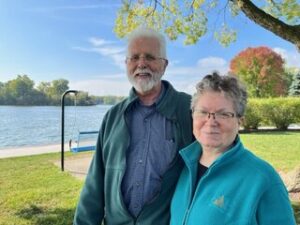
Ken and Megan Karth are citizen scientists, collecting data for use in assorted projects.

Ken Karth made a living making dirty water clean. “When I started working in the business, the Wisconsin River was a sewer,” he said. That was before the clean water act when industrial wastewater and raw sewage were commonly dumped into open rivers. In the last 50 years, that river has seen a 95% decrease in oxygen impairment in the water.

Eventually, Ken and Megan moved to the Fox Valley, and he noticed the same dedication to improving the water quality. He worked at Consolidated Paper, and there was political pressure to keep the mills running at high capacity. But there was also pressure to do the best job you could. The owner of the factory lived on an island in the Fox River, so he was known to tell his employees “I want the river as clean as we can possibly get it!”

As volunteers with Fox-Wolf, Ken and Megan care deeply about our water quality. They’ve lived through polluted water and the process of cleaning up. But they’re aware of the current threats to our water, and they don’t want to see things get worse.

Looking out at the Fox River from Jefferson Park in Menasha, Ken said, “Water means so much here. You wouldn’t have the Fox Valley if you didn’t have water.” From recreation, to drinking water, to business, “it touches every aspect of our lives!”

Ken recalls that in his early days on the Wisconsin River, you could smell which walleye were local. The sulfides from the polluted water seeped into the fish. At a fish fry, the smell of sulfur would escape, and local fish never won the taste test competitions. The waters of the Fox-Wolf Watershed are considered a premiere walleye fishery, and Ken hopes it stays that way.

When Ken and Megan visit their son in Kewaunee County, they have to buy drinking water. Many residents of the county rely on untreated well water. The combination of a high density of farms and shallow soil mean they are constantly monitoring for unsafe water conditions.

“I don’t want that to be true here,” said Megan. “We don’t have to think a lot about turning on the tap. There are places that is such a luxury.” Megan is thinking not only about water safety, but the availability of water. In such a water-rich area of the country, Megan has “the luxury of not having to think about every drop. I can water my vegetable garden.”

To keep tabs on the water, Ken and Megan volunteer with Fox-Wolf. They check for invasive plants about three times a year, and once a month they take water samples. “We go on a nice day and pack a picnic lunch,” Megan said. They also help with planting and maintaining plots of native shoreline plants.

They love having a way to help that fits into their calendar. “The annual cleanup is a one-day thing, and that may not work for us,” Megan said. Collecting water samples “has a window, and we can work it around our own schedule.”

“Water connects everything,” Ken said. “You’re doing things we believe in, and we really like the people that we’ve met. We’re grateful for Fox-Wolf, that you’re there.”

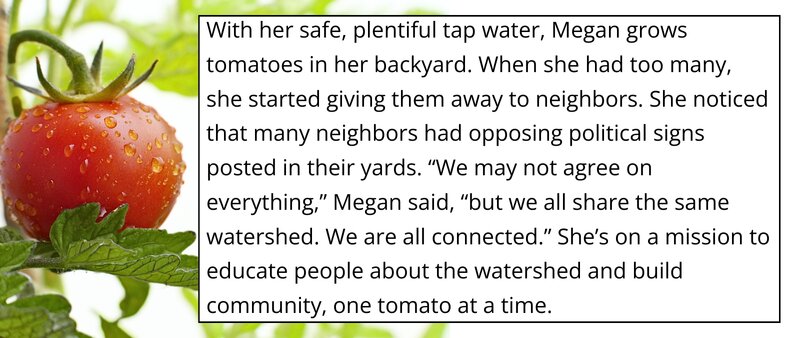
With her safe, plentiful tap water, megan grows tomatoes in her backyard. When she had too many, she started giving them away to neighbors. She noticed that many neighbors had opposing politcal signs posted in their yards. "We may not agree on everything," Megan said, "but we all share the same watershed. We are all connected." She's on a mission to educate people, one tomato at a time.

Watershed Moments is a publication of Fox-Wolf Watershed Alliance, sharing the stories of how your donations have impacted lives in our community. Read our latest project updates, make a secure online donation, or become a member at www.fwwa.org

The post Watershed Moments: You Wouldn’t Have the Fox Valley appeared first on Fox-Wolf Watershed Alliance.

Original Article

Fox-Wolf Watershed Alliance

Fox-Wolf Watershed Alliance

https://fwwa.org/2024/01/23/watershed-moments-wouldnt-have-fox-valley/?utm_source=rss&utm_medium=rss&utm_campaign=watershed-moments-wouldnt-have-fox-valley

Sharon Cook

Thank you to our board member!

We want to thank one of our board members for years of leadership and service to the Fox Locks. Jean Romback-Bartels, our representative from the Wisconsin Department of Natural Resources, will be retiring from her day job in January, and also retiring from the board of directors. Her investment of professional and personal time in the operation of the locks system has been invaluable.

Q: Why are the Fox Locks important to the DNR?

A: Anything that enhances the public’s ability to get out and enjoy the natural resources of this amazing state is important to the Department of Natural Resources. And to have this unique and historic feature traversing the popular and populous Fox River Valley–well, it goes without saying that we at the DNR are interested and invested in this state treasure.

Q: How does this unique attraction support the DNR’s mission? 

A: Our mission statement is all about preserving and protecting the natural resources for all people to enjoy. Having the lands held by the state, for the people of the state, and available for their use to walk on, fish from, or voyage through on a boat is what we want, what we need the people to do in order to stay connected to the resources. People who are connected care.

Q: Why was public service on the board important to you personally? 

A: As you know, the DNR has an obligation to be a member of the board of directors, but it goes beyond that. Public service is an honor. The public is, by default of my being hired into this position as Secretary’s Director in northeast Wisconsin, expecting me to serve in all of my duties with their best interest at heart and to the level of their expectations. I took that charge seriously when I was hired into my first job and will until I step away and retire from my position. I serve the people of the state, those who live, work, and/or play in the state. Whether you have ever visited northeast Wisconsin or not, my job was to ensure that if you did, it would be a good experience with resources to explore.

Q: What is your best hope for the future of the Fox Locks? 

A: My best hope for the lower Fox River locks is a long existence, where history and people come together and we slow down, take the time to really look at the cultural, historical, and natural resources at hand and appreciate all the river has to offer.

Original Article

Blog – Fox Locks

Blog – Fox Locks

https://foxlocks.org/blog/thank-you-to-our-departing-board-member/

Fox Locks

Lake Erie is 13% frozen, expect less freezing in the future

By Josh Boose, Ideastream Public Media

This story was originally published by Ideastream.

Lake Erie is behind its typical freezing schedule.

The schedule depends on different weather patterns, according to National Oceanic and Atmospheric Administration Director of Communications Jennifer Day.

Read Now at Great Lakes Now.

Original Article

Great Lakes Now

Great Lakes Now

https://www.greatlakesnow.org/2024/01/lake-erie-is-13-frozen-expect-less-freezing-in-the-future/

Ideastream Public Media

Project underway to improve portages

Thanks to a grant from the David L. and Rita E. Nelson Family Fund within the Community Foundation for the Fox Valley Region, construction will soon begin to improve portages on the Fox River locks system. The $150,000 grant will be used to help build improved portages along the system.

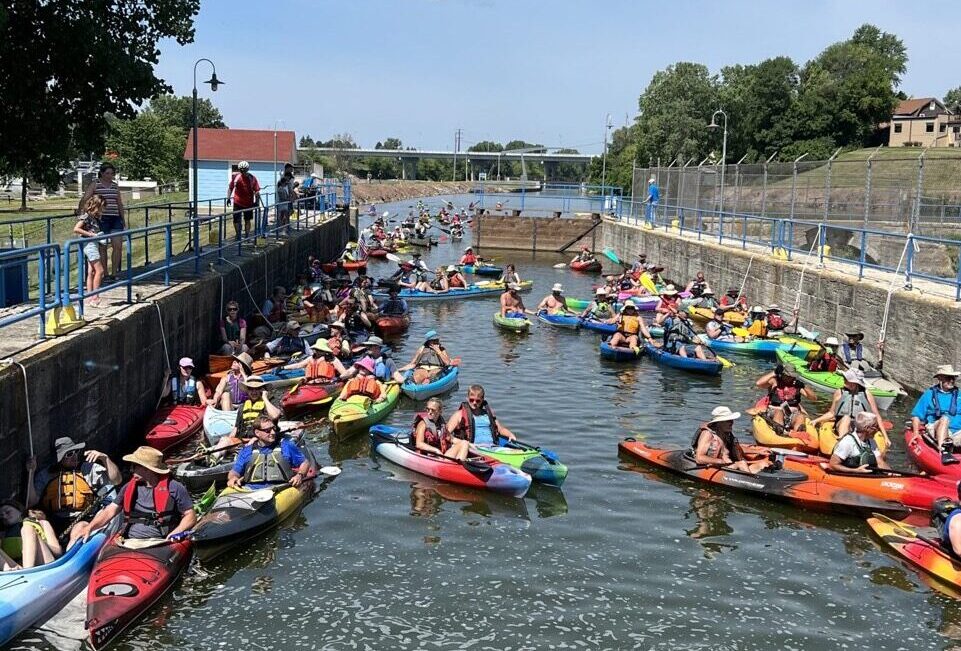
Since reopening the locks in 2015, non-motorized boaters have been portaging around the lock and dam system through temporary or makeshift portages often made by the boaters for one season. Existing portages are muddy, rugged paths or have not been maintained and are unsafe. And in recent years the Fox Locks have attracted a growing number of paddlers.

“We have seen steady growth in people exploring the Fox River through the locks on kayaks and canoes,” said Phil Ramlet, executive director of FRNSA. “Improving the portages is the best thing we can do to make the river accessible to a broad range of users and this grant will help us do that.”

Portages will be designed for safety and convenience of boaters at improved access points along the lock system. Another benefit of upgrading the portages is they will help to stabilize the shoreline along the locks.

“Most people are not aware of how the swift current of the Fox River erodes and destabilizes the shoreline along the lock system,” Ramlet said. “The grant will help us support our mission of repairing and maintaining the lock system for all boaters.”

Non-motorized boaters use the portages to carry their canoes or kayaks overland rather than going through the locks. Because the locks operate primarily on weekends from Memorial Day through Labor Day, paddlers often use the portages to navigate the elevation change on the Fox River when the locks are not operating.

We are still seeking additional donations to complete the portage construction which is estimated at $495,000 and the portages will be phased in over a period of three to five years. If you are interested in supporting this effort, please visit this link. 

Original Article

Blog – Fox Locks

Blog – Fox Locks

https://foxlocks.org/blog/project-underway-to-improve-portages/

Fox Locks

Points North: Can AI Caribou Lead Us To Our Prehistoric Past?

Points North is a biweekly podcast hosted by Daniel Wanschura and Morgan Springer about the land, water and inhabitants of the Great Lakes.

This episode was shared here with permission from Interlochen Public Radio. 

At the bottom of Lake Huron there’s a ridge that was once above water.

Read Now at Great Lakes Now.

Original Article

Great Lakes Now

Great Lakes Now

https://www.greatlakesnow.org/2024/01/points-north-can-ai-caribou-lead-us-to-our-prehistoric-past/

Interlochen Public Radio

Multiple small grants have been awarded to Buffalo, New York, area organizations through the New York Great Lakes Basin Small Grants Program. The projects aim to promote sustainable land use, improve water quality and manage natural resources using ecosystem-based approaches. Read the full story by Buffalo Rising.

Original Article

Great Lakes Commission

Great Lakes Commission

https://www.glc.org/dailynews/20240122-transformingwater-localgrants-sustainablefuture

Hannah Reynolds

The Superior Watershed Partnership recently received a Great Lakes grant to benefit water quality, coastal habitat and climate adaptation in the city of Marquette, Michigan. The $323,000 grant from the National Fish and Wildlife Foundation Sustain Our Great Lakes Program will be used to install green infrastructure that incorporates native plant species to improve stormwater runoff at numerous sites along the ten miles of Lake Superior coastline within the city of Marquette. Read the full story by Radio Results Network.

Original Article

Great Lakes Commission

Great Lakes Commission

https://www.glc.org/dailynews/20240122-grant-lakesuperior-shoreline-marquette

Hannah Reynolds

The Lake Michigan shoreline transformed this week into a whimsical land of ice after a recent winter storm hit the Great Lakes region. Drone footage of both the South Haven and St. Joseph, Michigan, lighthouses covered in ice was captured last week. Read the full story by MLive.

Original Article

Great Lakes Commission

Great Lakes Commission

https://www.glc.org/dailynews/20240122-dronevideo-lakemi-lighthouses-ice

Hannah Reynolds

After netting its largest-ever catch of invasive carp in the Mississippi River in November, the Minnesota Department of Natural Resources is moving ahead with a revised plan to keep the bottom-feeding fish from spreading across the Land of 10,000 Lakes. Read the full story by the Pioneer Press.  

Original Article

Great Lakes Commission

Great Lakes Commission

https://www.glc.org/dailynews/20240122-minnesotadnr-invasivecarpbattle

Hannah Reynolds

Farmers in Scott County, Minnesota, will have access to $8 million in grant money from the United States Department of Agriculture to implement conservation practices aimed at improving water quality and soil health, preventing erosion, and creating wildlife habitat. Read the full story by The Quad-City Times.

Original Article

Great Lakes Commission

Great Lakes Commission

https://www.glc.org/dailynews/20240122-grant-scottcounty-conservationpartnership-ducksunlimited

Hannah Reynolds

In Richland Township, Michigan, state and federal environmental regulators are investigating a “significant” oil leak in Saginaw County. Local residents say the oil has been leaking since before the holidays. Read the full story by WJRT-TV – Flint, MI.

Original Article

Great Lakes Commission

Great Lakes Commission

https://www.glc.org/dailynews/20240122-epa-egle-oilleak-saginawcounty

Hannah Reynolds

On Monday, commissioners of the Milwaukee Metropolitan Sewerage District accepted a bid from Michels Corporation to build the storage facility that will permanently house polluted sediment from the Milwaukee Estuary Area of Concern. Read the full story by the Milwaukee Journal Sentinel.

Original Article

Great Lakes Commission

Great Lakes Commission

https://www.glc.org/dailynews/20240122-michaelscorp-milwaukee-river

Hannah Reynolds

If you would like to attend the Jan. 31, 2024 meeting either in-person or virtually, please RSVP to Katie Reed at katherine@fwwa.org or 920-851-6472 by 1/29/24. Thank you!

The Winnebago Water Level Assessment Team provides a collaborative opportunity for stakeholder representatives and experts to develop realistic and achievable water level recommendations and related goals that reasonably balance the top priorities of multiple system users and the health of the lakes.

Meeting details:
Date: January 31, 2024
Time: 9:00 am – 11:00 am
Facilitator: Katie Reed, Winnebago Waterways Program Coordinator, Fox-Wolf Watershed Alliance, katherine@fwwa.org, (920)851-6472 & Jim Wickersham, Winnebago Waterways Program Director, jim@fwwa.org 
Where: Virtual and In person options – In Person at Fox-Wolf Watershed Alliance office in Appleton & Virtual Option (see agenda for details)

CLICK HERE for the meeting agenda

Check back here for the meeting notes and presentation slides after the meeting

To visit the WWLAT website for other meeting notes and updates, CLICK HERE.

Winnebago Waterways is a Fox-Wolf Watershed Alliance recovery initiative. Contact us at wwinfo@fwwa.org

The post WWLAT MEETING: Jan. 31, 2024 appeared first on Fox-Wolf Watershed Alliance.

Original Article

Fox-Wolf Watershed Alliance

Fox-Wolf Watershed Alliance

https://fwwa.org/2024/01/22/wwlat_2024_01_31/?utm_source=rss&utm_medium=rss&utm_campaign=wwlat_2024_01_31

Katie Reed