A U.S. Senate resolution would allow mining near Minnesota’s Boundary Waters Canoe Area Wilderness, prompting the Grand Portage Band of Lake Superior Chippewa to condemn the move as a threat to tribal rights and water quality. Read the full story by WTIP – Grand Marais, MN.

Original Article

Great Lakes Commission

Great Lakes Commission

https://www.glc.org/dailynews/20260420-mining-ban

Taaja Tucker-Silva

An emergency training facility in Duluth, Minnesota, used by local fire departments, Lake Superior College students, and agencies from out of state is facing an expensive environmental challenge: millions of dollars could be needed to clean up contamination from PFAS. Read the full story by Northern News Now.

Original Article

Great Lakes Commission

Great Lakes Commission

https://www.glc.org/dailynews/20260420-duluth-pfas

Taaja Tucker-Silva

Massive cargo ships move through the Great Lakes every day, carrying the goods that help keep Michigan’s economy running. When crews need vital supplies or packages from home, a small team on the Detroit River is often the one that answers the call. Read the full story by WSMH-TV – Flint, MI.

Original Article

Great Lakes Commission

Great Lakes Commission

https://www.glc.org/dailynews/20260420-floating-post

Taaja Tucker-Silva

The 665-foot Viking Polaris will launch the season, which will continue through October, when it docks on Monday, April 20 in Detroit. Polaris ties for the largest cruise ship on the Great Lakes with its twin, the Viking Octantis. Read the full story by MLive.

Original Article

Great Lakes Commission

Great Lakes Commission

https://www.glc.org/dailynews/20260420-cruise-ships

Taaja Tucker-Silva

What if your yard were part of a national park? That’s the idea behind the Homegrown National Park Movement, an effort to get property owners to see their land as part of a larger ecosystem. GLN’s Lisa John Rogers spoke with the movement’s co-founder Doug Tallamy to find out more.

#Wildlife #NationalParks #NativeTrees #Gardening

===========================================
Website: https://greatlakesnow.org
Facebook: https://www.facebook.com/greatlakesnow
X: https://www.x.com/greatlakesnow
Instagram: https://www.instagram.com/greatlakesnoworg
Newsletter: https://www.greatlakesnow.org/great-lakes-now-newsletter/

To learn more about supporting Detroit PBS and Great Lakes Now, visit https://www.detroitpbs.org/

The post Can your yard become a national park? | Freshwater People appeared first on Great Lakes Now.

Original Article

Great Lakes Now

Great Lakes Now

https://www.greatlakesnow.org/2026/04/20/can-your-yard-become-a-national-park-freshwater-people/

Great Lakes Now

By Samantha Plunkett For residents of Dearborn, Michigan, creating greenspaces in the community has been an important mission for schools and researchers. In a recent study, academics from the University of Michigan-Dearborn partnered with Salina schools to assess their outdoor play spaces.

Original Article

Great Lakes Echo

Great Lakes Echo

https://greatlakesecho.org/2026/04/18/investing-in-greenspaces-bring-benefits-to-schools-student-well-being/

Great Lakes Echo

Olivia Reda headshot.
Olivia Reda, Volunteer Engagement Coordinator

Thousands of people volunteer to protect the Great Lakes each year. Working with them truly inspires me.  

Every day, they remind me that we’re part of something bigger – an amazing community that’s working together to protect the waters that give us life. And together, we’re caring for something bigger than us all – the amazing Great Lakes, the largest source of surface freshwater on our beautiful planet. 

In honor of National Volunteer Week, I asked our volunteers to share a few words about why they volunteer. Take a minute to read what they said. I think they’ll inspire you! 

If you’d like to join them, consider becoming an Alliance Ambassador, an Adopt-a-Beach Team Leader, or an Adopt-a-Beach volunteer

If you’re already a volunteer, thank you for bringing your heart, your hands, and your time to protect the Great Lakes! 

I’m driven by a passion for health and innovation to support cleaner, safer environments where people can truly thrive for generations to come. It’s crucial that we give back to the water that so generously sustains our community. ~ Allison, Cleveland, Ohio

Volunteers sign in for a beach cleanup.

One of the things that makes volunteering with the Alliance for the Great Lakes and their Adopt-a-Beach program is showing people how easy it is to work within your community for the betterment of your neighbors. Spending a few hours of a sunny day wandering around one of Chicago’s beautiful beaches, chatting with friends, and doing something nice for your neighborhood? It’s a great way to spend a day, a fun time with friends, and a meaningful impact on the place that you live. Facilitating that realization, that giving back can be winsome and substantial, is a really great gift and an honor to participate in. Seeing the reactions of attendees as we weigh bags and compare notes is a delight, and I will try to continue to host these events for as long as the Alliance will let me. ~ Andrew, Chicago, Illinois

Our motivation to start doing Adopt-a-Beach was for my brother who had just passed away. He loved the beach and spent all of his spare time there. He was always getting on those who visited with him to pack out everything they brought with them. Our family and friends gather in his memory to care for our entire beach including his special spot to make a bigger difference. His absence leaves a huge hole in our hearts, but we all feel his presence when the sun shines on our faces and toes are in the hot sand along the shores of Lake Superior.  We love doing our beach clean-up and invite everyone to do their part. It’s a small effort in making a difference for our future. And as Bren would say, “Don’t forget to take our shoes off at the door!” ~ Ashley, Ontonagon, Michigan

When I volunteer with my students, they are able to see first-hand the consequences of all the disposables we use – especially plastic. Seeing all the waste on our beaches allows them to consider its impact on natural communities around us and on ourselves. They also learn that they can have a role in making things better, by reducing their own use, by taking part in cleanups, and even by advocating for environmentally-forward policies. They become more hopeful by learning that their actions make a difference! ~ Drea, Chicago, Illinois

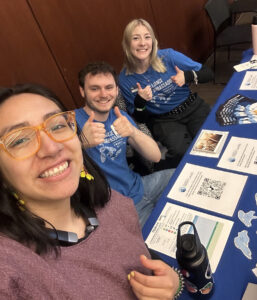
Three people behind a table full of Great Lakes materials smile at the camera.

My favorite quote/sentiment on volunteering, is from Denzel Washington: “The most selfish thing you can do is something for someone else”… At the end of the day, helping the lake and seeing the improvement you made so that everyone can enjoy it, makes you feel pretty good. ~ Eric, Pepperpike, Ohio

I volunteer for the Alliance for the Great Lakes Adopt-a-Beach cleanup because I believe in taking care of the natural spaces that give so much to our community. Living near Lake Michigan, it’s important to model environmental responsibility for my students and show them that small actions can make a big impact. I have participated with my school for the past 22 years, continuing a long-standing tradition at Pentwater Schools, andit’s something I am proud to be part of each year. ~ Erika, Hart, Michigan

Our beach cleanup days bring together multiple generations, united around a common interest in our lakeshore.  Everyone has a good time, regardless of the weather and we can measure our contributions in a healthy competition with other communities. ~ Eugene, Bridgman, Michigan

I volunteered with Adopt-a-Beach because I care about our environment and all of the generations to come. The Great Lakes were a huge part of my childhood growing up in northern Michigan, and I have so many memories of spending time with friends and family, and decompressing on my own at the lakes/beach. It’s important to keep the beaches clean and safe for everyone! ~ Halley, Chicago, Illinois

The world is greater than the mistakes people have made. ~ Jack, Chicago, Illinois

I volunteer because, as a young person living in southeast Michigan, I have come to realize how important the health of the Great Lakes is to our communities and our future! Right across the Huron river, where I go to school, I see closely that our everyday lives are connected to the clean and thriving waterways. I hope more students can learn about the Great Lakes and grow to love the beautiful environment around them. Through my volunteering, I want to help bring other young people feel a stronger connection to the Great Lakes and inspire them to protect it. ~ Jihyun, Ypsilanti, Michigan

It takes a lot of work and many people to keep Presque Isle State Park beautiful. We rely on our Adopt-a-Beach volunteers to help make this possible. When people visit here, we want them to take back great memories and helping keep this park as pristine as possible helps ensure a good experience for all. ~ John, Erie, Pennsylvania

I volunteer to be a team leader for the Alliance for the Great Lakes because it will protect the health, beauty, and future of our communities.  The Great Lakes are our essential natural resource and support system that supports our wildlife, provides recreation, and also connects our communities across the regions.  Volunteering is a very rewarding way to give back! ~ June, Independence, Ohio

I volunteer because I believe it is our responsibility and our privilege to not just protect the Great Lakes, but to leave the world a better place than we found so that future generations can build upon our efforts. I volunteer because I believe each and every one of us can make a difference, every day. No matter the size of the impact, our efforts and good deeds ripple outward to improve the environment, help wildlife, and positively impact other people’s lives. Being active in the community and volunteering is about being a force for good. Won’t you join us? ~ Justin, Ashtabula, Ohio

I volunteer because I believe Lake Michigan is part of my DNA 😊 ~  Kathleen, Saugatuck, Michigan
Friends of the Manitowoc River Watershed’s vision is to connect people to the river in order to increase awareness of the river, its history and ecosystem, and show we care and wish to enhance the watershed.  We do this to set an example for the citizens in our community.  When we all pitch in we can make a giant difference. Since 2012 our volunteers have collected 9,399.81 lbs. of debris from the shores of Manitowoc River and Lake Michigan.  We are very proud of our community and the efforts of the 3,034 volunteers over that timeframe. ~ Kim, Manitowoc, Wisconsin

Learning about our world and the troubles with pollution of our beaches, streams and lakes, as well as the lack of care that our fellow people in our world care about what’s happening to our world. It concerns me enough that I want to participate even in small ways! I’ve always picked up garbage that other people discard, and the wildlife creatures consuming these plastics and garbage bothers me!! So I help! ~ Lorrie, Rochester, New York

There is no more important resource than those offered by nature. I try to be a steward of these, and in particular the Great Lakes, to pass this along to future stewards. ~ Mike, Fredonia, New York

I’m grateful to be part of the volunteer team protecting the Great Lakes. I want to show my appreciation for the gift of nature. I love water sports, and joining the Adopt-a-Beach cleanups each year reminds me to reduce plastic use and keep pollution out of the lakes. I also enjoy the Great Lakes educational events, where I can give back to the community and meet other volunteers who share the same goals. To me, volunteering and gaining hands-on experience is truly invaluable. ~ Novem, Lancaster, New York

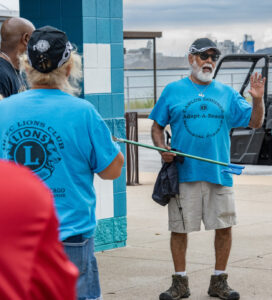
A volunteer wearing a shirt that says "Carlos Godinez Adopt-a-Beach Memorial Cleanup" speaks to volunteers near the shoreline.

The reason why I volunteer is because of Lion Carlos Godinez.  We encourage new Lions to bring new service projects and the Adopt-a-Beach program is what he bought to the table.Lion Carlos Godinez passed away, but we’re keeping his dream alive.~ Patrick, East Chicago, Indiana

My purpose is to clean the beaches for people to be safe, most importantly so the sea life is safe from toxic material and garbage that can harm them. ~ Peg, Richland, Michigan

I love the Great Lakes and I am very aware how much they protect their surrounding areas from catastrophic weather events. That is why I do what I can to protect them with beach cleanups, with writing to my legislators and donating monetarily. ~ Sarah, Lombard, Illinois

I grew up on the shores of Lake Michigan and have such a deep love for the Great Lakes. I volunteer to help protect our beautiful inland seas so that they can continue to be a source of joy and life for generations to come. ~ Sarah, Milwaukee, Wisconsin

A smiling volunteer stands next to a table full of Alliance for the Great Lakes stickers, brochures, and other items.

I volunteer because I wanted to meet kind people who care about our lakes like I do. I was very inspired after coming back from Alaska where the land was so respected. I needed to pay that forward here. I also want to teach my daughter to appreciate the earth instead of polluting it. This way we have something fun to look forward to together every summer. ~ Semaja, Chicago, Illinois

The Great Lakes are critical for so many reasons. The lakes provide food and a home to mammals, birds, and fish and they provide drinking water, a place to run, swim and sail, and a beautiful setting to connect with nature. Importantly the lakes act as a thermal buffer making the surrounding areas more livable. The Great Lakes are truly one-of-a-kind and should be respected and protected, which is why I volunteer with the Alliance for the Great Lakes. ~ Simone, Chicago, Illinois 

I volunteer because the Great Lakes are so important to so many people, animals and our ecosystems! Every piece of microplastic picked up makes a huge difference. ~ Steve, Cleveland, Ohio

Growing up in western lower Michigan in the 1960s, along with the other members of my Boy Scout troop, I shoveled up dead alewives off the beaches near Grand Haven. Even as a kid, at the time I thought, there has to be a better way. Now that I am retired, I have the opportunity, resources, and more experience to lend a hand as an Ambassador to promote AFGL’s strategies to prevent/remediate the effects of invasive species, pollution, and water basin depletion, and other threats to the Great Lakes. I’ve lived in the region my entire life and love it. ~ Steve, Grayslake, Illinois

The Great Lakes provide drinking water to millions of people, support diverse ecosystems, and sustain local economies through fishing, transportation, and recreation. Protecting them means protecting public health, wildlife, and future generations. Pollution, invasive species, and climate change threaten their health, and I believe it is our shared responsibility to make sure these waters are not contaminated. Participating to protecting the Great Lakes is not just environmental work but it is an investment in sustainability, community well-being, and long-term ecological balance. ~ Suhail, Shaker Heights, Ohio

Some of my best memories on my own, with friends, or with family have been at the lakefront. It is a beautiful place for family and friends to gather for a few minutes or an entire day. In Chicago, we’re fortunate to be able to access it bike (my favorite), on foot, or public transit. To this day, riding along the lakefront on my commute to/from work has always been a great way to enter a calmness and joy at the start and end of a day. Iwant for as many generations to come to have the same privilege I have and for that reason it is important to me that we all do our part to keep the Great Lakes clean and accessible to everyone. ~ Teresita, Chicago, Illinois

Our part of the country is truly blessed to share such a magnificent resource, and I’ve never taken it for granted. The health of our lake requires effort, and we can all play a role through cleanups, supporting legislation, and contributing to the work that AGL carries out year-round. I feel fortunate that Lake Michigan and its magic have always been woven into our family’s life. ~ Theresann, Coloma, Michigan

There is something powerful about coming together to care for the natural spaces we all share. Our most recent cleanup at Mentor Lagoons Beach represents more than the weight of the litter collected. It reflects commitment, teamwork, and respect for the beauty of our great lakes. Volunteerism connects us to nature in a hands-on way, reminding us that even small actions can protect wildlife, preserve clean water, and ensure that future generations can enjoy these shorelines just as we do today. ~ William, Northfield, Ohio

Become an Alliance Ambassador

Ambassadors educate their communities about how people can protect the Great Lakes. The Alliance provides training, supplies, and monthly online meetings with your fellow Ambassadors.

Learn More

The post Get Inspired by Great Lakes Volunteers appeared first on Alliance for the Great Lakes.

Original Article

News - Alliance for the Great Lakes

News - Alliance for the Great Lakes

https://greatlakes.org/2026/04/get-inspired-by-great-lakes-volunteers/

Judy Freed

Ohio officials have urged Congress to reauthorize the soon-to-expire Great Lakes Restoration Initiative, describing it as a crucial tool for protecting drinking water, fighting invasive species and supporting a regional economy worth trillions. Read the full story by the Plain Dealer.

Original Article

Great Lakes Commission

Great Lakes Commission

https://www.glc.org/dailynews/20260417-great-lakes-funding

Nichole Angell

The 33-pound, 30(ish)-year-old snapper who is now known as Doug the Tank was lethargic and nearly unresponsive when a rescuer pulled him from a Lake Michigan beach. He is now recovering from his misadventure at the Michigan Amphibian & Reptile Sanctuary in Kalamazoo. Read the full story by MLive.

Original Article

Great Lakes Commission

Great Lakes Commission

https://www.glc.org/dailynews/20260417-turtle-rescue

Nichole Angell

The National Museum of the Great Lakes is debuting a temporary exhibit focused on the environmental stories of the Great Lakes region, all in time for Earth Day. The exhibit, “Currents of Change: The Living History of the Great Lakes,” will be on display April-October of this year. Read the full story by the WTOL-TV – Toledo, OH.

Original Article

Great Lakes Commission

Great Lakes Commission

https://www.glc.org/dailynews/20260417-museum-exhibit

Nichole Angell

In Cheboygan, Michigan, federal officials ordered repairs to the dam last year that would have helped the 104-year-old Cheboygan Lock and Dam complex pass more water, but granted repeated extensions that have left the undersized structure with less capacity to endure what may be record-breaking floods this spring. Read the full story by Bridge Michigan.

Original Article

Great Lakes Commission

Great Lakes Commission

https://www.glc.org/dailynews/20260417-dam-repairs

Nichole Angell

A ship moving through the Welland Canal in Port Colborne, Ontario, made contact with the bridge this week. As a precaution, the bridge has been closed to both vehicle and pedestrian traffic making for a long, re-routed drive home for some. Read the full story by CKTB – St. Catherines, ON.

Original Article

Great Lakes Commission

Great Lakes Commission

https://www.glc.org/dailynews/20260417-welland-canal-closed

Nichole Angell

Pure Michigan advertising influenced 1.5 million vacations in Michigan from national, regional, and in-state markets targeted by the iconic campaign last year. In its 20th year, Pure Michigan is expanding the guest list to many more cities across the nation. Read the full story by MLive.

Original Article

Great Lakes Commission

Great Lakes Commission

https://www.glc.org/dailynews/20260417-michigan-advertising

Nichole Angell

The U.S. Army Corps of Engineers is beginning nearly $2 million in upgrades along Michigan’s Manistee River channel this month. The agency will harden structures with major stonework to lowers erosion risk and provide protection against unpredictable Great Lakes weather events. Read the full story by the Lansing State Journal.

Original Article

Great Lakes Commission

Great Lakes Commission

https://www.glc.org/dailynews/20260417-erosion-control

Nichole Angell

Lake Erie earned the lowest assessment of the five Great Lakes in a report looking at the Great Lakes’ progress and challenges. While progress has been made, legacy phosphorus, invasive mussels, climate-driven warming and shifting agricultural practices make improving water quality in Lake Erie a persistent challenge. Read the full story by the Evening Sun.

Original Article

Great Lakes Commission

Great Lakes Commission

https://www.glc.org/dailynews/20260417-erie-assessment

Nichole Angell

Suckers are among the most abundant and least appreciated species in the Great Lakes region. Sometimes described as the “wildebeests of the Great Lakes,” they make large spring migrations from the lakes into streams to spawn, creating one of the region’s more visible seasonal movements of fish. Read the full story by Door County Pulse.

Original Article

Great Lakes Commission

Great Lakes Commission

https://www.glc.org/dailynews/20260417-sucker-heros

Nichole Angell

By Paula Gardner, Kelly House and Ron French, Bridge Michigan

The Great Lakes News Collaborative includes Bridge Michigan; Circle of Blue; Great Lakes Now at Detroit PBS; Michigan Public, Michigan’s NPR News Leader; and The Narwhal who work together to bring audiences news and information about the impact of climate change, pollution, and aging infrastructure on the Great Lakes and drinking water. This independent journalism is supported by the Charles Stewart Mott Foundation. Find all the work HERE.


CHEBOYGAN — Local, state and federal officials were aware of the dangers posed by the Cheboygan Lock and Dam for years before floodwaters pushed it to the brink of collapse, records show.

Yet they failed to compel private owners to repair the nonfunctional hydro plant connected to the publicly-owned dam —  a critical piece of its ability to pass floodwaters downstream. 

The facility that houses the plant, once a Charmin toilet paper mill, changed hands repeatedly over decades as it fell into disrepair. 

Now taxpayers are helping bankroll a desperate effort to bring the plant back online before the dam fails and sends a wall of water toward downtown Cheboygan.

“I’m very concerned that this was not handled properly,” said Richard Sangster, a Cheboygan County commissioner and former Cheboygan mayor, about federal regulatory actions over several years.

The property is now owned by Hom Paper XI, LLC, a business controlled by former NFL linebacker Thomas Homco. He did not return voicemails left by Bridge Michigan. 

State and local officials did what they could, Cheboygan County Sheriff Todd Ross said Thursday.

“We didn’t wait ‘til the last minute,” Ross said. “It’s privately owned. There’s only so much we can do.”

A public tally of taxpayer costs associated with the round-the-clock repair wasn’t available Thursday, but estimates from a few years ago indicated the plant needed at least $1 million in repairs.

‘Safety concerns have been raised many times’

Records show the agency that primarily regulates hydropower dams, the Federal Energy Regulatory Commission, sent warning letters for years to a shifting cast of owners while granting multiple extensions.

Among the issues they cited: missing inspection records and malfunctioning equipment that was crucial to passing water in the event of a flood.  

As far back as 2019, regulars warned about cracked concrete and damaged retaining walls and gates that could help the dam manage flooding, records show.

In 2021, FERC told the plant’s then owners that “multiple items are overdue and completion dates are rapidly approaching.”

The plant was cited 16 times in 10 months for safety violations by Occupational Safety and Health Administration before a fire closed it altogether in September 2023, records indicate.

That prompted more orders for repairs and more extensions from FERC. Records indicate state officials said they were aware of the issues but had no role in enforcement.

“Safety concerns have been raised many times,” Sangster said, adding “you wouldn’t even be able to measure how detrimental” a dam failure would be. 

“In my eyes, it appears like total neglect on their behalf,” he added about FERC.

‘No simple answer’

FERC spokesperson Celeste Miller did not respond to detailed questions from Bridge about oversight of the hydro plant property and instead put out a statement noting the agency’s role in the ongoing emergency response in Cheboygan.

“Above all, our priority is to coordinate with all involved partners to safeguard both the community and the environment,” Miller wrote.

The crisis comes six years after the privately-owned Midland dams failed following a similar pattern of regulatory delay. Michigan legislators vowed to make dam safety a priority after Midland, but ultimately didn’t act on proposed reforms.

A solution “keeps getting kicked down the road …  now we’ve got a whole community in peril because it was mismanaged by (private owners),” state Sen. John Damoose, R-Harbor Springs, said after touring the dam with Gov. Gretchen Whitmer.

“This is a problem that could happen all over the state,” Damoose said. “‘It got our attention a few years ago in Midland, but now we’re seeing that it was not an isolated thing and we need to take some serious looks at how we allow this to go on.”

Whitmer said “there’s no simple answer” due to a “complicated web of privately owned and publicly owned (dams.)”

“We have made some long overdue investments in some of our infrastructure,” she said.

Complicated history

Like many dams in Michigan, the Cheboygan complex was once owned by utilities to generate power for the region. 

By 1967, when Consumers Energy sold it to the state of Michigan for $1, it was no longer generating power but the deeper Cheboygan River created by the dam had become a valued link between Lake Huron and the Inland Waterway, a 40-mile-long network of popular rivers and lakes.

In 1983, Procter & Gamble took over the hydroelectric side of the facility, securing a licensing exemption from FERC and striking a deal to give the state some continued say over water flows through the now-privatized portion of the complex. 

But soon after pouring millions into upgrading the hydro facility, the company shuttered its Cheboygan operation in 1990, eliminating 300 jobs and commencing the slow decline of the historic mill. 

Eventually, a company named Great Lakes Tissue bought the plant and was urged by FERC for years to make repairs.

It sold the business before a June 2022 deadline to ensure the gates that allowed water to flow through the hydro plant were functioning properly.

It’s not clear whether the work was ever completed. Nor is it clear whether federal regulators were aware of subsequent ownership changes.

Great Lakes Tissue Company was still the listed owner on FERC’s license exemption well into 2025.

Tug-of-war

While the hydro side of the dam complex sat idle following the fire, state Department of Natural Resources officials in charge of the rest of the dam publicly warned its closure would make it hard to manage water levels in the Cheboygan River.

The plant had accounted for about 30% of the river’s flow to Lake Huron, they said.

“Boaters and residents … may experience larger water level fluctuations,” stated a 2024 agency announcement.

Bridge Michigan was not able to discern what steps, if any, DNR officials took to try to compel action.

Agency spokesperson Ed Golder said he was not able to immediately answer related questions from Bridge Michigan while the agency deals with emergency response in Cheboygan.

Josef Greenberg, a spokesperson for the Michigan Department of Environment, Great Lakes and Energy, which regulates dams in the state that are not regulated by FERC, said state officials had communicated with federal counterparts about the issues at the dam, but did not play a regulatory role.

In the fire’s aftermath, federal officials continued issuing letters flagging unresolved safety issues at the hydro plant, some of them dating back years.

They pressed current and past owners for clarity about who was in charge, a process complicated by a flurry of legal disputes between parties with a stake in the floundering business.

Eventually, Hom Paper emerged as the rightful owner in FERC’s eyes, and the agency ordered the company to either restore the hydro plant to working condition or risk losing the license exemption that allows it to generate hydropower.

Company lawyer Tyler Tennent initially responded that doing so was no longer economically feasible: “Hom Paper XI, LLC no longer intends or desires to operate the hydroelectric machinery,” Tennent wrote in August 2025.

Then Hom Paper found a potential buyer, asking FERC for repeated extensions of time to repower the plant while it worked to finalize the deal.

The would-be buyer: HydroMine Cheboygan LLC, a Wyoming-based corporation spearheaded by Roy Davis, a self-proclaimed  “blue-collar mechanic that fixes things,” who has restarted power operations at other aging dams in Eaton Rapids and Hubbardston.

“Hom Paper and HydroMine are very near to having a signed agreement,” Hom’s lawyer, Tyler Tennent, wrote to FERC in January.

Tennent told regulators HydroMine was negotiating water management agreements with the DNR and working with Consumers Energy to repower the site.

“We appreciate FERC’s continued patience,” he wrote.

Three months later, the plant remained nonfunctional Thursday night, reducing the Cheboygan dam’s ability to pass floodwater that had climbed within five inches of its crest.

Residents in the floodzone have been urged to prepare for evacuation in case of dam failure.

Looking ahead

An estimated 75 Consumers Energy workers have been at the dam to get the privately owned hydroelectric power plant running, Michigan State Police said Thursday. 

By Thursday evening, signs pointed that restoration would be imminent, said Bruce Straub, Consumers’ incident commander.

Preserving dam integrity across northern Michigan will be important to the region once the crisis abates, said Sharen Lange, a Cheboygan business owner active in economic development, including on Cheboygan Commons.

Many in the area keep talking about who should own the hydro plant, Lange said. Others are saying that the city or county could take action. 

“We know that it being in private hands has produced a really bad result,” Lange said. 

The post Michigan feared Cheboygan Dam danger for years before rains pushed it to brink appeared first on Great Lakes Now.

Original Article

Great Lakes Now

Great Lakes Now

https://www.greatlakesnow.org/2026/04/17/michigan-feared-cheboygan-dam-danger-for-years-before-rains-pushed-it-to-brink/

Bridge Michigan

The Great Lakes are often described as a climate haven, somewhere spared from the worst impacts of climate change. This makes the region appealing to people seeking stability. But are climate migrants already arriving? And how protected are the Great Lakes, really? Great Lakes Now contributor Stephen Starr investigated climate migration in the region.

#ClimateChange #GreatLakes #Migration #Podcast #RuralLife #UrbanPlanning

===========================================
Website: https://greatlakesnow.org
Facebook: https://www.facebook.com/greatlakesnow
X: https://www.x.com/greatlakesnow
Instagram: https://www.instagram.com/greatlakesnoworg
Newsletter: https://www.greatlakesnow.org/great-lakes-now-newsletter/

To learn more about supporting Detroit PBS and Great Lakes Now, visit https://www.detroitpbs.org/
===========================================

“Are climate migrants coming to the Great Lakes?” was produced by Great Lakes Now/Detroit Public TV.

Produced by
Adam Fox-Long

Hosted by
Lisa John Rogers

Edited by
Bill Allesee

Camera
Adam Fox-Long

The post Are climate migrants coming to the Great Lakes? | Freshwater People appeared first on Great Lakes Now.

Original Article

Great Lakes Now

Great Lakes Now

https://www.greatlakesnow.org/2026/04/17/are-climate-migrants-coming-to-the-great-lakes-freshwater-people/

Great Lakes Now

Isle Royale is officially open for the 2026 season!

In 2023, Ian Solomon visited national park and met Rolf and Candy Peterson, who oversee a long running project on the island’s wolf and moose.

Watch his full adventure on the Great Lakes Now YouTube!

#IsleRoyale #Wolf #Moose #Wildlife #Science #Animals #NationalParks #Michigan #LakeSuperior
===========================================
Website: https://greatlakesnow.org
Facebook: https://www.facebook.com/greatlakesnow
X: https://www.x.com/greatlakesnow
Instagram: https://www.instagram.com/greatlakesnoworg
Newsletter: https://www.greatlakesnow.org/great-lakes-now-newsletter/

To learn more about supporting Detroit PBS and Great Lakes Now, visit https://www.detroitpbs.org/

The post Meet the Scientist Behind Isle Royale’s Wolf-Moose Project appeared first on Great Lakes Now.

Original Article

Great Lakes Now

Great Lakes Now

https://www.greatlakesnow.org/2026/04/16/meet-the-scientist-behind-isle-royales-wolf-moose-project/

Great Lakes Now

By Héctor Alejandro Arzate

This story was originally published by Grist. Sign up for Grist’s weekly newsletter here.


As a row crop farmer in St. Joseph, Missouri, Joe Lau said he’s noticing more extreme weather these days. 

Warmer seasons throughout the year. Quarter-inch predictions of rain stamped out by storms that bring 3 inches. Increased pressure from pests on his corn. He’s also noticed that spring is coming earlier. 

The USA National Phenology Network shows that this year spring arrived three to five weeks earlier than the average between 1991 to 2020 in much of the central U.S. and two to three weeks earlier in southern Midwest states. 

“I have allergies bad,” said Lau, who also grows soybeans. “And this year in particular, it’s hit me hard. It’s wild that we are talking about allergy issues in winter, but that’s technically the reality of it.”

Last month, Climate Central, a nonprofit specializing in communicating climate science, published an analysis that found that spring is trending to an earlier arrival from 1981 to 2025 in most of the United States.

On average, leaves now emerge six days earlier than they did in 1981 in 88 percent, or 212 out of 242, of major U.S. cities. For example, in Lau’s city of St. Joseph, Missouri, the spring leaves tend to arrive two days earlier. 

An earlier spring could have consequences for the agriculture industry, ecology, and more.

Where are spring leaves arriving earlier?

Climate Central used open-access data that was collected by the USA National Phenology Network, a group of volunteers and researchers who study seasonal events — like when migratory birds arrive, leaves emerge, and fruit ripens —  among plants and animals to determine ecosystem health. 

The analysis is based on the NPN’s first leaf index maps, which use models to predict the start of spring. To work, the models are fed data like temperature and the start date of the annual “leaf-out” — when leaves first emerge —  for the early spring plants of lilacs and honeysuckle, which are found throughout the U.S.

“That very leading edge of spring is drifting earlier and has drifted, in some cases, a whole lot earlier in just that last few decades,” said Theresa Crimmins, the NPN’s director, in a briefing last month.

Climate Central’s analysis found that many Mississippi River basin cities are seeing earlier spring, including Hazard, Kentucky, which is seeing leaves arrive 11 days earlier. Both Memphis, Tennessee, and St. Louis, Missouri, are leafing out seven days earlier. New Orleans, Louisiana, is two days earlier.

While most of the lower 48 states are experiencing an earlier spring, the report did find an exception in the Northern Rockies and Plains region. There, spring temperatures have either cooled or warmed “relatively slowly” since 1970, according to the report.

Kaitlyn Trudeau, a climatologist with Climate Central, said the differences in how much earlier spring is coming from place to place are likely due to what she calls “climate controls” — such as latitude, elevation, wind patterns, proximity to bodies of water, ocean currents, and topography. 

“All of those different factors really dictate what your local climate is like generally,” Trudeau said.

What does early spring mean for agriculture and more?

The early arrival of spring can have widespread impacts, said Trudeau. People with seasonal allergies, like Lau, will be exposed to more pollen because plants get more time to produce and release it.

Warmer temperatures can also cause birds to migrate too soon. One of the busiest migratory routes, or flyways, in North America moves along the Mississippi River. Each year, about half of all migratory bird species on the continent follow it to get from as far north as Canada to Central and South America, and then back.

When birds migrate too soon, said Trudeau, they miss out on the peak abundance of food. They can fall out of sync with insects or the flowers they pollinate, which can affect other species, too.

“That can cause this ecological mismatch,” Trudeau said.

Earlier springs can also put the agriculture industry at financial risk, she said. Whether it’s corn, soybeans, or specialty fruits, these crops can get hit with a hard freeze following an early leaf-out — also known as a false spring. It could lead to major economic damage in the agriculture industry, said Trudeau.

In 2017, a hard freeze in the southeastern U.S. destroyed fruit crops like peaches, pears, blueberries, strawberries, and even grass for livestock. It led to more than $1 billion dollars in losses for the agriculture industry, according to a report from NOAA.

“We are so dependent upon what happens in the natural environment,” Trudeau said. “And so when things start to shift and change, it’s also going to cause pretty widespread impacts for our lives.”

Growers of specialty crops — such as apricot trees or iris flowers — will be particularly vulnerable. Row crop farmers, like Lau, have more technology to aid them. He said seed treatments have allowed soybean farmers to plant earlier and grow longer, increasing their production. 

So the effects of an earlier spring have been “minimal” for him.

“From purely a row-crop production standpoint, the springs have been very favorable for us,” said Lau.

One thing that does have him worried is the bug activity out in his fields — they’ve been plentiful with the warmer weather. 

“I raise all non-GMO corn and so I don’t have the insect traits bred into the corn genetically modified, and so that does concern me that we’re kind of relying on what nature hands us,” Lau said. 

While farmers and communities are doing their part to innovate and adapt to continue producing, Trudeau said addressing the root of climate change is the most urgent need.

“There is no substitute for dramatically reducing our carbon pollution,” she said.

This story is a product of the Mississippi River Basin Ag & Water Desk, an independent reporting network based at the University of Missouri in partnership with Report for America, with major funding from the Walton Family Foundation.

The post Climate experts say spring is coming earlier. How will that affect agriculture and ecosystems? appeared first on Great Lakes Now.

Original Article

Great Lakes Now

Great Lakes Now

https://www.greatlakesnow.org/2026/04/16/climate-experts-say-spring-is-coming-earlier-how-will-that-affect-agriculture-ecosystems/

Grist

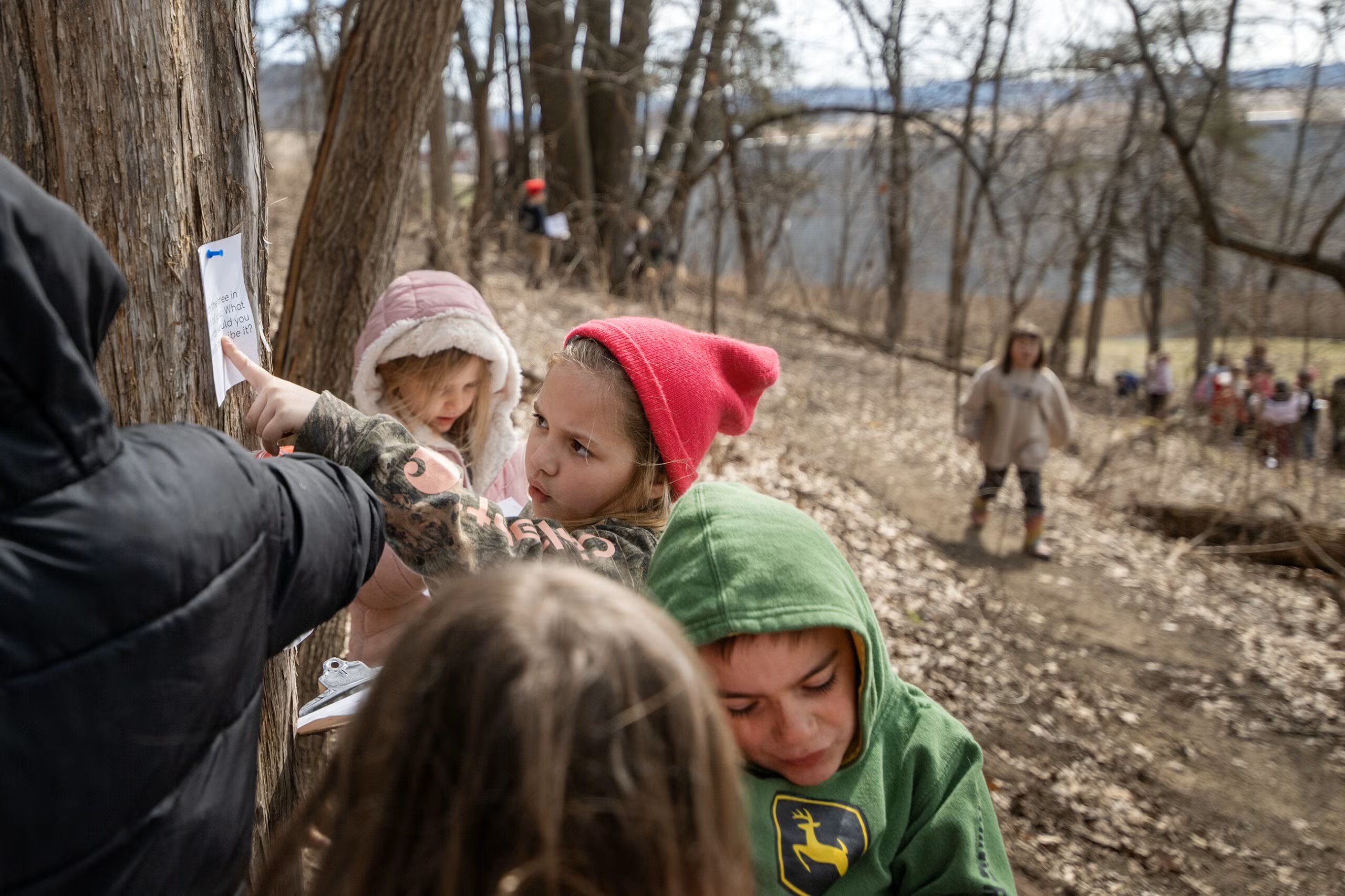
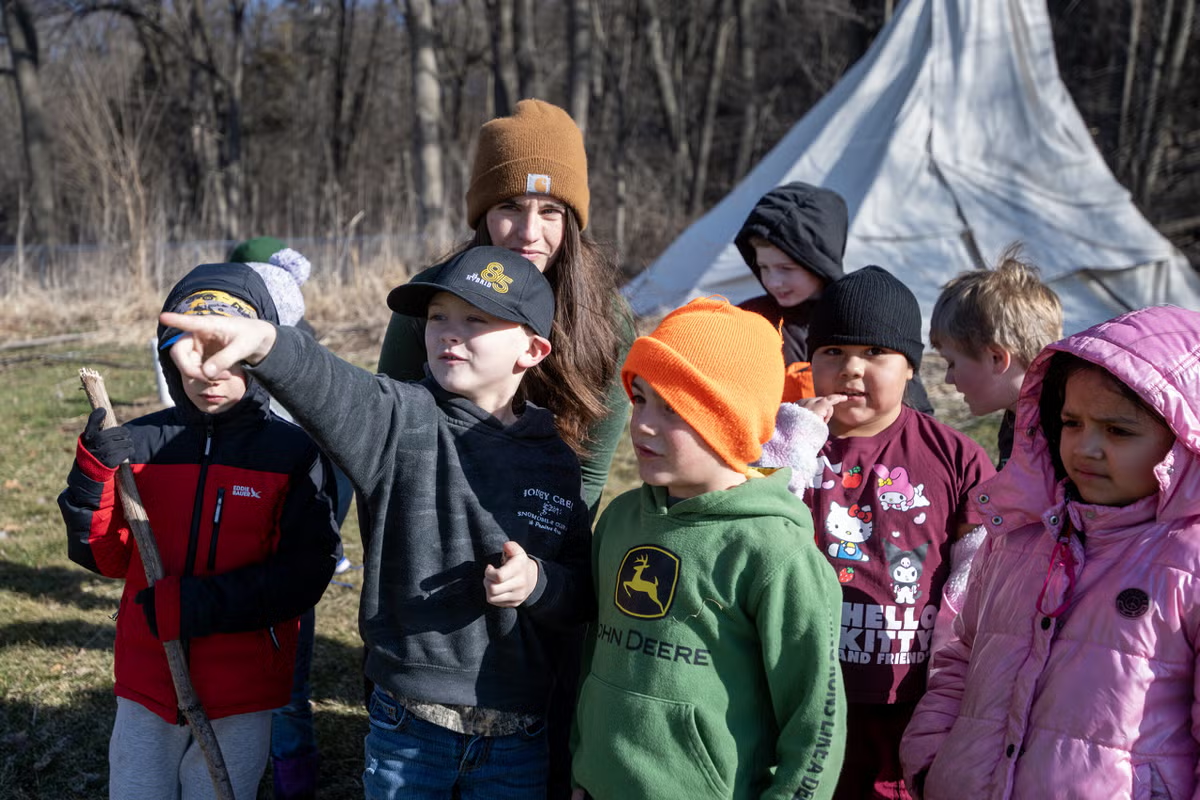
Once a week, first and second graders at Tower Rock Elementary School in Sauk County step into a classroom without walls. 

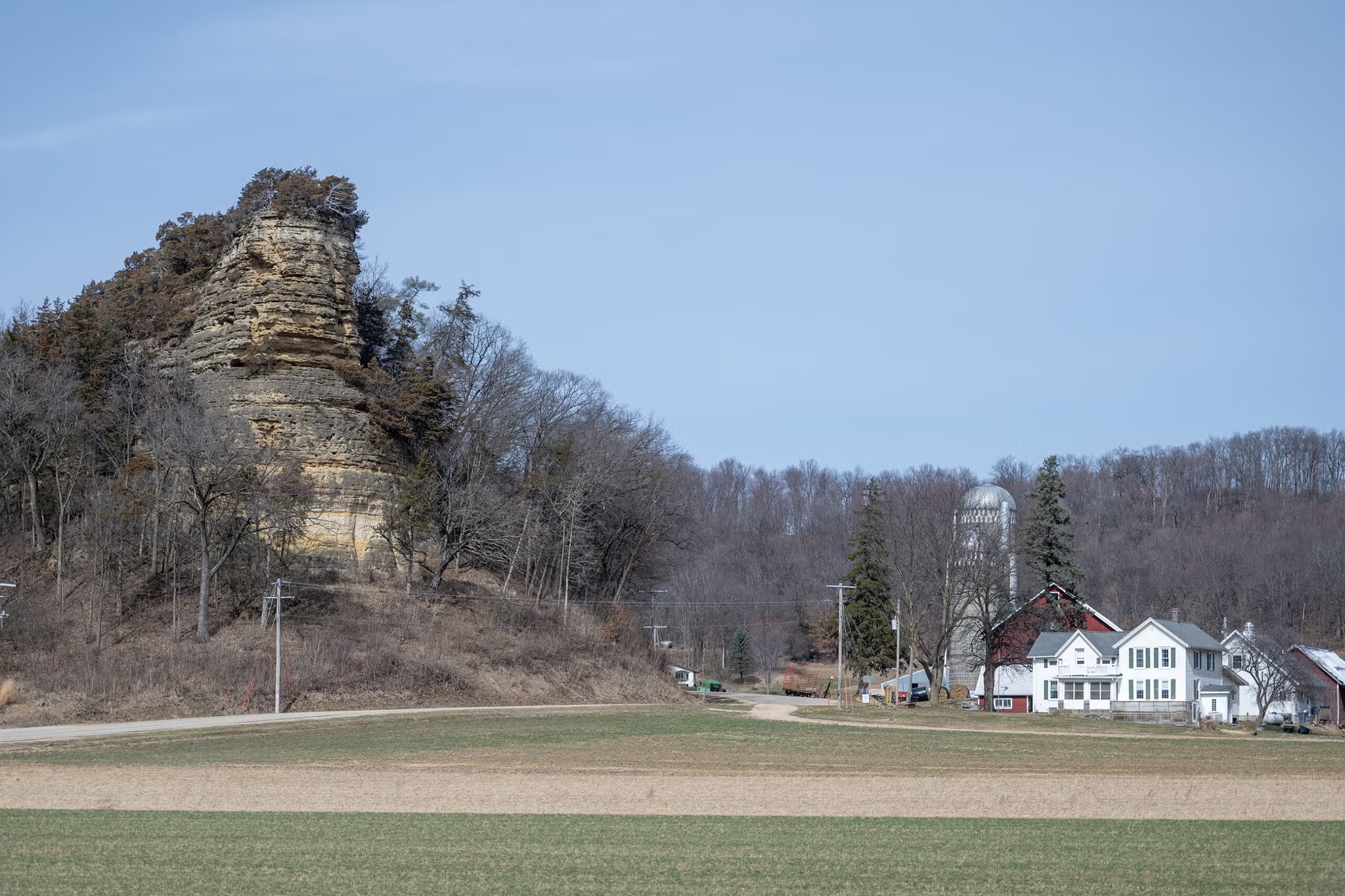
About 25 students, accompanied by three teachers, spend the day in their outdoor classroom tucked into nearby woods with a soaring sculpted bluff — called Tower Rock — in the school’s shadow.

Students follow a science and social studies-based curriculum on topics like insects and space, along with practical lessons like how to dress for the cold. 

In March, days before Blizzard Elsa blanketed the state with snow, first graders in the outdoor learning program prepared to blast off to Saturn. In small groups, students rode an imaginary rocket ship, learning about the planets while in their outdoor environment. 

Angus Mossman, left, leads an outdoor lesson on planets Thursday, March 12, 2026, at Tower Rock Elementary School in Prairie du Sac, Wis. Angela Major/WPR

Nature-based education and outdoor classrooms are expanding in Wisconsin and across the country. The concept of teaching outdoors got a boost during the pandemic. But now, according to Natural Start Alliance, there are more than 1,000 nature classroom programs in pre-schools nationwide. That’s up from a few dozen a decade ago. 

Teachers at Tower Rock want students to learn about the environment under their feet.

“It’s more than sitting in a classroom and saying, ‘We live in a beautiful area, you should protect it.’” JoAnnah Sorg, a teacher at Tower Rock, told WPR’s “Wisconsin Today.” “We go out there and we’re like, ‘Look at all of this. You want this to be here for your family someday. You want to continue to enjoy this, so we need to work to take care of it.’”

The landscape near Tower Rock Elementary School on Thursday, March 12, 2026, in Prairie du Sac, Wis. Angela Major/WPR

Keeping special places special

According to the state Department of Public Instruction, there are at least 17 schools that have a dedicated outdoor learning day in Wisconsin. Tower Rock, which launched its program in 2021, is one of a handful of public, non-charter schools in Wisconsin with this learning model. 

That means all first and second graders who attend Tower Rock participate. There is no waiting list, application or fees. Neurodivergent students and students with disabilities receive accommodations to participate. 

Principal Kelly Petrowski, right, helps a student with a science lesson Thursday, March 12, 2026, at Tower Rock Elementary School in Prairie du Sac, Wis. Angela Major/WPR

The school only cancels the outdoor program when the windchill factor plummets below zero. But this isn’t recess or free play. Every outdoor learning day is guided by a curriculum with a “place-based learning” model in mind, where educators use the local community and environment as a foundation for study. 

Sorg has been at Tower Rock for 15 years. She and two other educators, Dylan Edwards and Angus Mossman, run the program. Together, they build lessons and plan field trips to state parks and protected areas in Sauk County, an agricultural community on the banks of the Wisconsin River. 

Mossman went to Tower Rock and his mother still teaches there. He said many people leave Sauk County not realizing the beauty of it. The majority of the rural community is dedicated to farmland, but there are more than 22,000 acres of dedicated natural parks and open spaces, 63 lakes and nearly 160 miles of rivers and creeks, according to Explore Sauk County, the county’s tourism website.  

“There’s a lot of focus on getting urban students exposed to nature and I think there’s not a lot of focus on exposing kids in rural areas to nature,” Mossman said. 

“I want kids to realize that this is a special place and if people care about it, it will stay a special place. And if people don’t care about it, it might not stay a special place,” Mossman added. “I think (children) have it in their hearts to learn that.”

Students operate an imaginary spaceship with teacher JoAnnah Sorg as they learn about science outdoors Thursday, March 12, 2026, at Tower Rock Elementary School in Prairie du Sac, Wis. Angela Major/WPR
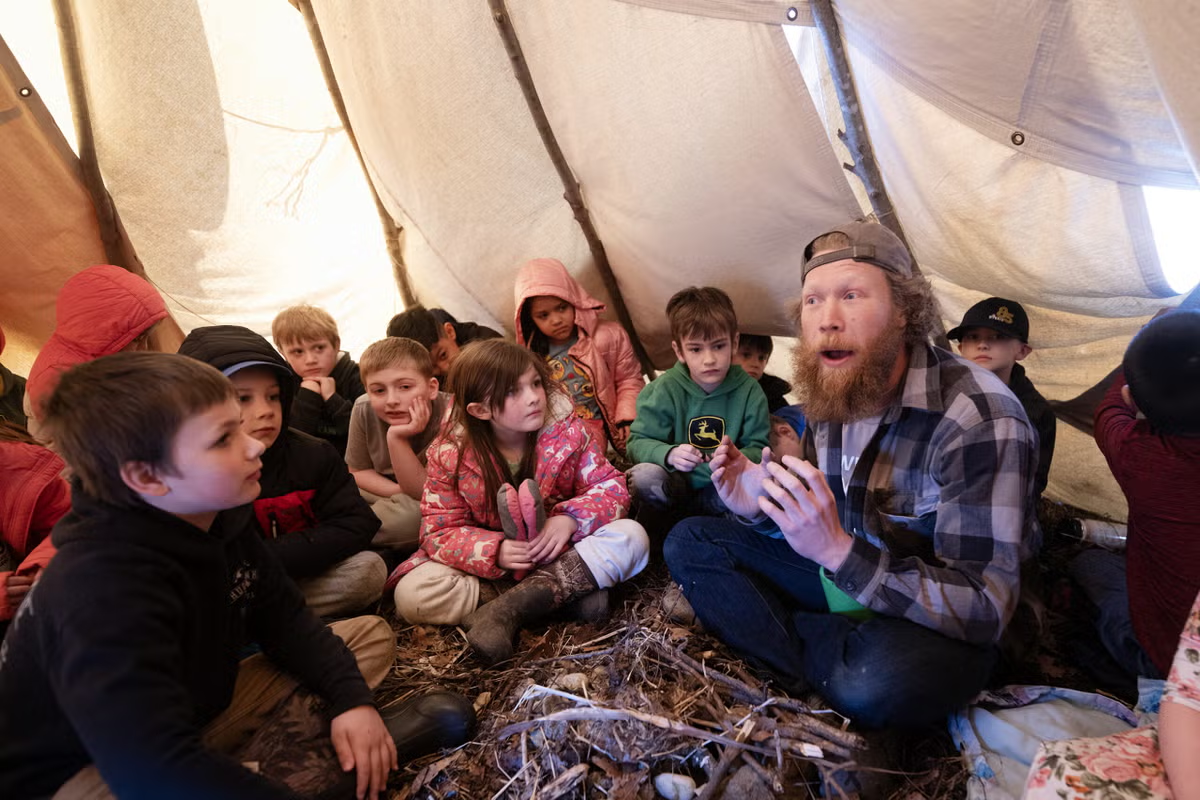
Angus Mossman tells a story as students gather to listen Thursday, March 12, 2026, at Tower Rock Elementary School in Prairie du Sac, Wis. Angela Major/WPR
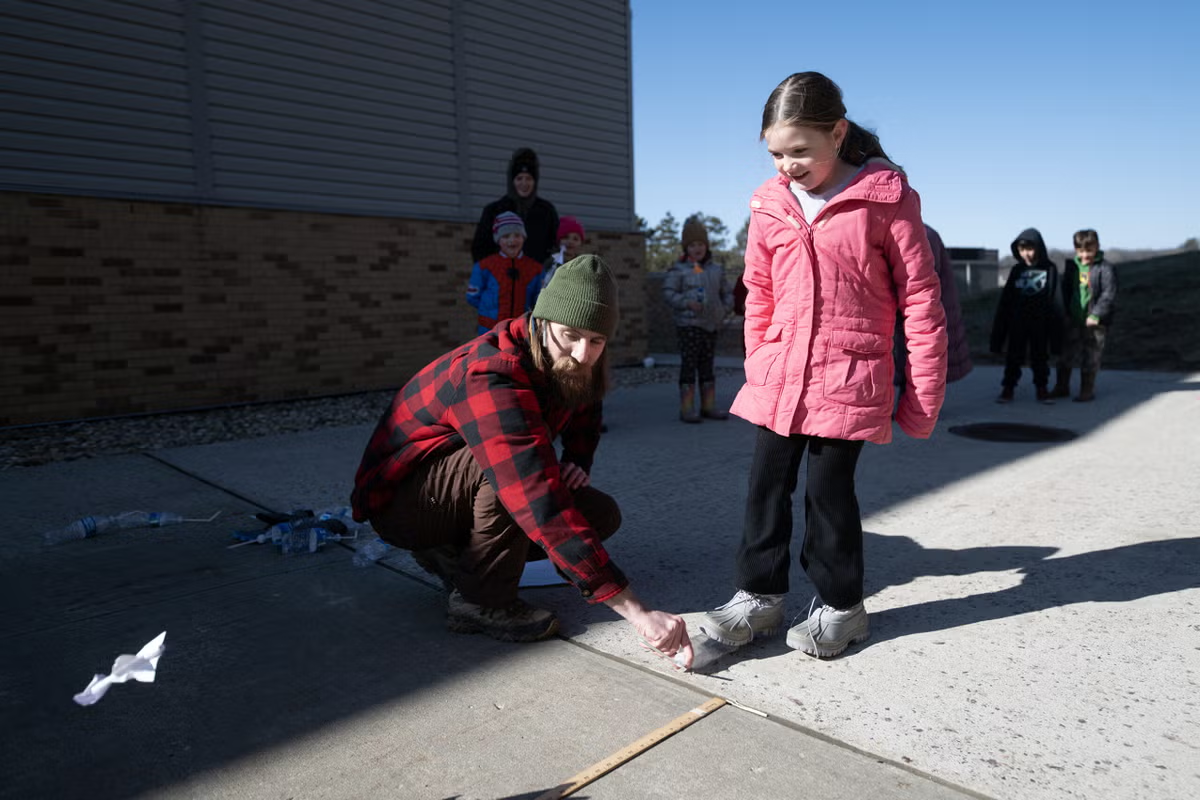
Teacher Dylan Edwards, left, helps students launch rockets using a water bottle Thursday, March 12, 2026, at Tower Rock Elementary School in Prairie du Sac, Wis. Angela Major/WPR

The wonder of bees and spiders

Since the program started, students have helped to restore a native prairie and learned about the federally endangered rusty patch bumble bee, which is rare, but can be found in Wisconsin. 

“In first and second grade, I was really, really scared of bees,” said Bentley Hughbanks, a fifth grader who went through the outdoor learning program. “I was insanely scared to the point where on a field trip, I didn’t want to go because of the bees. But now I’ve overgrown my fear of bees.”

“I realized that they don’t mess with you unless you mess around with them,” Bentley said. 

There are countless stories from students overcoming fears, educators said. Students who didn’t like spiders now prevent others from squishing them. One student asked his parents to stop using ant poison in the garage. And another wants to be an ornithologist.  

First-grade students participate in a lesson on space Thursday, March 12, 2026, at Tower Rock Elementary School in Prairie du Sac, Wis. Angela Major/WPR

“A powerful thing about outdoor learning and the experience we can give the kids here is that we’re teaching their hearts and not just teaching their minds,” Mossman said. 

Sorg recalled one student who struggled academically in the classroom but on an outdoor learning day found the perfect way to pack snow into a bucket for building a structure, and the other students followed his lead.

“The power that it gave him among his peers to be able to have that opportunity to shine and have that moment — he didn’t get a lot of those moments in the classroom during the day,” she said. 

Finding those moments is one benefit of outdoor learning. Research shows it can also promote concentration, perseverance and creativity, said Christy Merrick, director of the Natural Start Alliance

“(Nature) is a space that is always changing. Nature is not static,” Merrick said. “It’s keeping things interesting for students. It tends to promote very active, hands-on learning, which we know is a very effective way for children to learn when they’re young.”

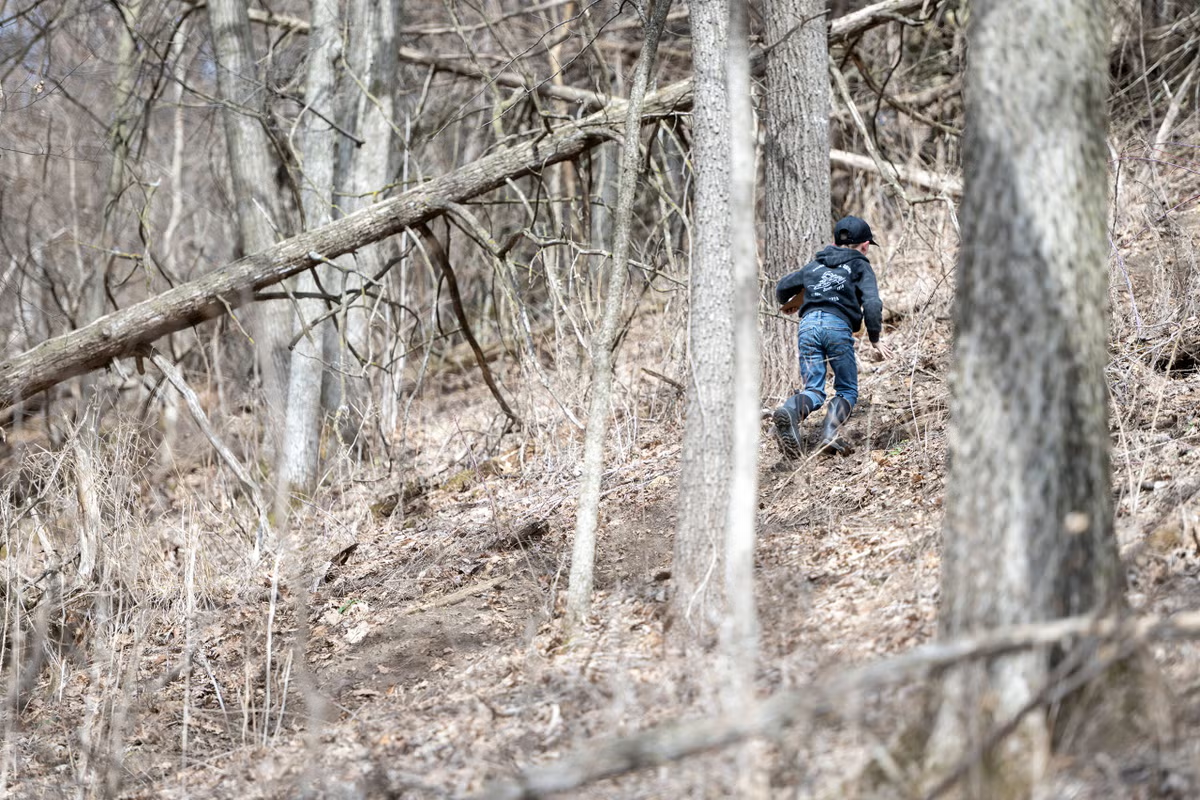
Students explore the woods during a lesson Thursday, March 12, 2026, at Tower Rock Elementary School in Prairie du Sac, Wis. Angela Major/WPR

An outdoor program like this is unique and requires a reliable funding stream. The teachers say it takes additional work to keep the program going. Each year, they apply for about $5,000 of local and state grants, Mossman said. The Community Foundation of South Central Wisconsin accepts donations on behalf of the school and other programs like it. The school also hopes to create an endowment. 

Outdoor learning is starting to become part of the fabric of attending Tower Rock. Now some fifth graders, like Brooks Mack, have younger siblings there, too.

“I can help (my brother) out. He asks me questions when he gets home, like, ‘We did this today but I didn’t quite understand it.’ So I get to answer those questions and other kids ask me questions, too,” Brooks said. “Sometimes I get to answer, which feels good.”

The post Nature is the classroom at this central Wisconsin elementary school appeared first on Great Lakes Now.

Original Article

Great Lakes Now

Great Lakes Now

https://www.greatlakesnow.org/2026/04/16/nature-is-the-classroom-at-this-central-wisconsin-elementary-school/

Wisconsin Public Radio

Michigan reduced funding for invasive species projects by $1.2 million. Conservation organizations like the regional Cooperative Invasive Species Management Areas (CISMAs) are rethinking their funding priorities for 2026 and beyond.

Original Article

Great Lakes Echo

Great Lakes Echo

https://greatlakesecho.org/2026/04/16/funding-cuts-hamper-conservation-groups-invasive-species-efforts/

Anna Ironside

Internal government emails show staff at the Canada Water Agency trying to make sense of Prime Minister Mark Carney’s budget cuts in response to questions from the media.

The Canada Water Agency launched in October 2024 to help protect Canada’s fresh water, including leading restoration work to clean up the Great Lakes, Lake Winnipeg and other important sources of drinking water. Canada is home to 20 per cent of the world’s fresh water, which is being threatened by climate-driven floods, droughts and algal blooms, as well as industrial contamination and other groundwater stressors.

Carney’s first federal budget proposed $3.8 million in lower spending by 2029-30 at the agency, and a further $1.2 million categorized as a separate “ongoing,” or permanent spending reduction, for a total of $5 million in cuts. They were part of Carney’s $60 billion in proposed cuts — split into $48 billion in spending reductions through 2029-30, and a further $12 billion in “ongoing” cuts with no given end date.

The Narwhal reported on the budget in November, summarizing the government’s proposal as cutting $5 million in total spending at the agency over a number of years. After that story was published, the agency emailed The Narwhal with a request for a “small correction,” asking that figure be changed to $3.8 million.

When The Narwhal asked the agency why it shouldn’t include the $1.2 million in ongoing spending cuts in the figure — which would make it $5 million — internal emails released under Access to Information law show staff reached out to Finance Canada, sharing a screenshot of the budget’s spending review page for the agency with the proposed “ongoing” cut circled in red. 

“Hello Finance Department colleagues, we are fact-checking an article in The Narwhal that mentions the [agency]’s budget cuts, and just want to make sure we are understanding the budget chart correctly,” the agency wrote. 

The water agency asked the Finance Department whether the $5-million figure, which it had already asked The Narwhal for a correction on, was in fact, correct.

After the Finance Department said it would look into the matter, the water agency asked for guidance on how to explain the permanent portion of the spending reductions to journalists.

“Do you have messaging you can share around communicating the ‘ongoing’ to the media?” the staff member asked.

The next day, an official at Finance Canada said the story did not need a correction after all.

Canada Water Agency to cut 13 jobs, but continue restoration and protection of fresh water

Last month, a Canada Water Agency planning document showed how it expected to absorb the first three fiscal years’ worth of cuts, amounting to $2.6 million by 2028-29. One result was the loss of roughly 13 jobs, or what’s known as full-time equivalent positions, from a workforce of 223.

It said it was also planning on “modernizing government operations” and “leveraging new technology” as well as making administrative and support functions more efficient.

At the same time, the agency plans to keep conducting water quality and ecosystem restoration, including in the Great Lakes, it said.

The federal budget says cuts are necessary to “rein in government spending” from pandemic highs. Carney has gone on to trumpet other multibillion-dollar investments in areas like the military, technology and infrastructure that could in turn pose new environmental challenges for water.

Last week, the Canada Water Agency took on a new task when the Carney government promised $3.8 billion to “protect nature” as part of a new environmental strategy. The agency will be working on the country’s first National Water Security Strategy meant to reflect Indigenous knowledge systems including water stewardship.

The Narwhal emailed the Canada Water Agency asking how its spending cuts will affect freshwater stewardship and restoration work.

A spokesperson said the government’s budget cuts would not impact the agency’s “planned activities, staffing and funding commitments for restoration and protection” of its eight freshwater ecosystem initiatives through Canada’s Freshwater Action Plan, a “signature” federal program.

The program includes the Great Lakes, lakes like Simcoe and Winnipeg and rivers like the St. Lawrence in Ontario and Quebec, and the Mackenzie in the Northwest Territories. Former prime minister Justin Trudeau’s 2023 federal budget allocated $650 million over 10 years to these freshwater initiatives.

Federal funding for freshwater protection has been important in Ontario in recent years, because the province has not invested as much in ecosystem restoration, according to an environmental scientist at the University of Windsor. Photo: Christopher Katsarov Luna / The Narwhal

“Like all federal organizations, the Canada Water Agency is contributing to the government’s plan to reduce spending, eliminate duplicative programs and focus resources on core priorities,” the spokesperson wrote.

“The agency remains fully committed to delivering on its mandate to improve freshwater management in Canada by providing leadership, effective collaboration federally and improved coordination and collaboration with provinces, territories and Indigenous Peoples to proactively address national and regional transboundary freshwater challenges and opportunities.”

The agency also told The Narwhal the reduction in jobs would be staggered, with four next fiscal year, followed by another four the year after and five more after that.

Asked how the agency was planning for the budget’s proposed $1.2 million in permanent cuts, the spokesperson reiterated the budget review was meant to ensure government spending was sustainable and funding cost-effective programs and activities.

Federal funds support water conservation in Ontario and the Great Lakes

The spending reductions come at a time when the Ontario government is amalgamating its watershed protection agencies, called conservation authorities, from 36 to nine, as well as moving to give itself the power to dictate more rules around drinking water

Federal funding has been important for conservation authorities because Ontario has not been investing as much in community science and ecosystem restoration, Catherine Febria, the Canada Research Chair in freshwater restoration ecology, said. 

An associate professor at the University of Windsor’s Great Lakes Institute for Environmental Research, Febria said that the federal “scale of investment is something that the province was never able to do.”

“That was really exciting, it was like a leapfrog in progress with this single initiative, and a number of large-scale projects were invested in [over] the first two years,” she said, naming the freshwater ecosystem initiatives in places like the Great Lakes as one example.

The federal government and Ontario have been working together “for over 50 years” through a series of agreements on protecting and conserving the Great Lakes, the spokesperson for the Canada Water Agency said. 

As one example, the Canada-Ontario Agreement on Great Lakes Water Quality and Ecosystem Health lays out how the two will coordinate protection efforts.

“This partnership has led to remarkable improvements, including dramatic reductions in harmful pollutants, and the return of pollution-sensitive species such as bald eagles,” the spokesperson wrote.

Ontario’s Ministry of the Environment, Conservation and Parks did not respond to questions from The Narwhal about how much provincial funding was going towards efforts to restore freshwater ecosystems, and to what extent the ministry was working with the federal water agency.

Febria said given the federal water agency is still relatively new, it’s still not clear what its full mandate will be, not to mention if or how the proposed cuts will impact its work or what exactly may be lost.

She said another Carney initiative, directing $1.7 billion toward a series of scientific initiatives, including research awards attracting high-level talent from abroad, holds promise. Some of the research awards will focus on water security, environment and climate resilience. 

Still, it’s a “tricky balance,” she added, between investing in research and also carrying out on-the-ground work to improve local areas.

“I think we need both,” she said. “When the pendulum swings towards a whole bunch of researchers, that’s great, but at the end of the day, we still need people and organizations and communities on the ground.”

The post Canada Water Agency wasn’t quite sure how to explain Carney’s budget cuts to the public, documents show appeared first on Great Lakes Now.

Original Article

Great Lakes Now

Great Lakes Now

https://www.greatlakesnow.org/2026/04/15/canada-water-agency-wasnt-quite-sure-how-to-explain-carneys-budget-cuts-to-the-public-documents-show/

The Narwhal

Internal government emails show staff at the Canada Water Agency trying to make sense of Prime Minister Mark Carney’s budget cuts in response to questions from the media.

The Canada Water Agency launched in October 2024 to help protect Canada’s fresh water, including leading restoration work to clean up the Great Lakes, Lake Winnipeg and other important sources of drinking water. Canada is home to 20 per cent of the world’s fresh water, which is being threatened by climate-driven floods, droughts and algal blooms, as well as industrial contamination and other groundwater stressors.

Carney’s first federal budget proposed $3.8 million in lower spending by 2029-30 at the agency, and a further $1.2 million categorized as a separate “ongoing,” or permanent spending reduction, for a total of $5 million in cuts. They were part of Carney’s $60 billion in proposed cuts — split into $48 billion in spending reductions through 2029-30, and a further $12 billion in “ongoing” cuts with no given end date.

The Narwhal reported on the budget in November, summarizing the government’s proposal as cutting $5 million in total spending at the agency over a number of years. After that story was published, the agency emailed The Narwhal with a request for a “small correction,” asking that figure be changed to $3.8 million.

When The Narwhal asked the agency why it shouldn’t include the $1.2 million in ongoing spending cuts in the figure — which would make it $5 million — internal emails released under Access to Information law show staff reached out to Finance Canada, sharing a screenshot of the budget’s spending review page for the agency with the proposed “ongoing” cut circled in red. 

“Hello Finance Department colleagues, we are fact-checking an article in The Narwhal that mentions the [agency]’s budget cuts, and just want to make sure we are understanding the budget chart correctly,” the agency wrote. 

The water agency asked the Finance Department whether the $5-million figure, which it had already asked The Narwhal for a correction on, was in fact, correct.

After the Finance Department said it would look into the matter, the water agency asked for guidance on how to explain the permanent portion of the spending reductions to journalists.

“Do you have messaging you can share around communicating the ‘ongoing’ to the media?” the staff member asked.

The next day, an official at Finance Canada said the story did not need a correction after all.

Canada Water Agency to cut 13 jobs, but continue restoration and protection of fresh water

Last month, a Canada Water Agency planning document showed how it expected to absorb the first three fiscal years’ worth of cuts, amounting to $2.6 million by 2028-29. One result was the loss of roughly 13 jobs, or what’s known as full-time equivalent positions, from a workforce of 223.

It said it was also planning on “modernizing government operations” and “leveraging new technology” as well as making administrative and support functions more efficient.

At the same time, the agency plans to keep conducting water quality and ecosystem restoration, including in the Great Lakes, it said.

The federal budget says cuts are necessary to “rein in government spending” from pandemic highs. Carney has gone on to trumpet other multibillion-dollar investments in areas like the military, technology and infrastructure that could in turn pose new environmental challenges for water.

Last week, the Canada Water Agency took on a new task when the Carney government promised $3.8 billion to “protect nature” as part of a new environmental strategy. The agency will be working on the country’s first National Water Security Strategy meant to reflect Indigenous knowledge systems including water stewardship.

The Narwhal emailed the Canada Water Agency asking how its spending cuts will affect freshwater stewardship and restoration work.

A spokesperson said the government’s budget cuts would not impact the agency’s “planned activities, staffing and funding commitments for restoration and protection” of its eight freshwater ecosystem initiatives through Canada’s Freshwater Action Plan, a “signature” federal program.

The program includes the Great Lakes, lakes like Simcoe and Winnipeg and rivers like the St. Lawrence in Ontario and Quebec, and the Mackenzie in the Northwest Territories. Former prime minister Justin Trudeau’s 2023 federal budget allocated $650 million over 10 years to these freshwater initiatives.

Federal funding for freshwater protection has been important in Ontario in recent years, because the province has not invested as much in ecosystem restoration, according to an environmental scientist at the University of Windsor. Photo: Christopher Katsarov Luna / The Narwhal

“Like all federal organizations, the Canada Water Agency is contributing to the government’s plan to reduce spending, eliminate duplicative programs and focus resources on core priorities,” the spokesperson wrote.

“The agency remains fully committed to delivering on its mandate to improve freshwater management in Canada by providing leadership, effective collaboration federally and improved coordination and collaboration with provinces, territories and Indigenous Peoples to proactively address national and regional transboundary freshwater challenges and opportunities.”

The agency also told The Narwhal the reduction in jobs would be staggered, with four next fiscal year, followed by another four the year after and five more after that.

Asked how the agency was planning for the budget’s proposed $1.2 million in permanent cuts, the spokesperson reiterated the budget review was meant to ensure government spending was sustainable and funding cost-effective programs and activities.

Federal funds support water conservation in Ontario and the Great Lakes

The spending reductions come at a time when the Ontario government is amalgamating its watershed protection agencies, called conservation authorities, from 36 to nine, as well as moving to give itself the power to dictate more rules around drinking water

Federal funding has been important for conservation authorities because Ontario has not been investing as much in community science and ecosystem restoration, Catherine Febria, the Canada Research Chair in freshwater restoration ecology, said. 

An associate professor at the University of Windsor’s Great Lakes Institute for Environmental Research, Febria said that the federal “scale of investment is something that the province was never able to do.”

“That was really exciting, it was like a leapfrog in progress with this single initiative, and a number of large-scale projects were invested in [over] the first two years,” she said, naming the freshwater ecosystem initiatives in places like the Great Lakes as one example.

The federal government and Ontario have been working together “for over 50 years” through a series of agreements on protecting and conserving the Great Lakes, the spokesperson for the Canada Water Agency said. 

As one example, the Canada-Ontario Agreement on Great Lakes Water Quality and Ecosystem Health lays out how the two will coordinate protection efforts.

“This partnership has led to remarkable improvements, including dramatic reductions in harmful pollutants, and the return of pollution-sensitive species such as bald eagles,” the spokesperson wrote.

Ontario’s Ministry of the Environment, Conservation and Parks did not respond to questions from The Narwhal about how much provincial funding was going towards efforts to restore freshwater ecosystems, and to what extent the ministry was working with the federal water agency.

Febria said given the federal water agency is still relatively new, it’s still not clear what its full mandate will be, not to mention if or how the proposed cuts will impact its work or what exactly may be lost.

She said another Carney initiative, directing $1.7 billion toward a series of scientific initiatives, including research awards attracting high-level talent from abroad, holds promise. Some of the research awards will focus on water security, environment and climate resilience. 

Still, it’s a “tricky balance,” she added, between investing in research and also carrying out on-the-ground work to improve local areas.

“I think we need both,” she said. “When the pendulum swings towards a whole bunch of researchers, that’s great, but at the end of the day, we still need people and organizations and communities on the ground.”

The post Canada Water Agency wasn’t quite sure how to explain Carney’s budget cuts to the public, documents show appeared first on Great Lakes Now.

Original Article

Great Lakes Now

Great Lakes Now

https://www.greatlakesnow.org/2026/04/15/canada-water-agency-wasnt-quite-sure-how-to-explain-carneys-budget-cuts-to-the-public-documents-show/

The Narwhal

According to the Michigan Department of Natural Resources (DNR), the Little Manistee River Weir in Stronach, Michigan—the sole source of winter-run steelhead eggs for fish hatcheries in Michigan, Indiana and Ohio—suffered storm damage Monday night resulting in a power failure that rendered the systems that sustained the fish inoperable and many fish died. The effect this loss will have on the steelhead egg collection for this season is still unknown, the DNR said. Read the full story by WZZM-TV – Grand Rapids, MI.

Original Article

Great Lakes Commission

Great Lakes Commission

https://www.glc.org/dailynews/20260415-hatchery-damage

James Polidori

According to the Wisconsin Department of Natural Resources (DNR), it won’t be long before lake sturgeon start to make their run up the Wolf River to spawn. While sturgeon have already been seen moving into their pre-spawning locations on the Wolf River, significant rainfall on the Wolf River drainage area Monday night could impact pre-spawning and spawning activity. Read the full story by WLUK-TV – Green Bay, WI.

Original Article

Great Lakes Commission

Great Lakes Commission

https://www.glc.org/dailynews/20260415-sturgeon-spawning

James Polidori

The Little Traverse Bay Bands of Odawa Indians recently received a federal grant to continue whitefish restoration work in the Bear River near Petoskey, Michigan. The goal is to catch newly-hatched whitefish as they drift down the river in order to estimate how many fish have survived. Read the full story by Michigan Public.

Original Article

Great Lakes Commission

Great Lakes Commission

https://www.glc.org/dailynews/20260415-whitefish-reintroduction

James Polidori

New York Sea Grant announced a two-part Coastal Community Development webinar series designed to help local officials—such as supervisors, mayors, code enforcement officers, and planners—better understand shoreline dynamics and implement effective land use strategies in waterfront communities. Read the full story by FingerLakes1.com.

Original Article

Great Lakes Commission

Great Lakes Commission

https://www.glc.org/dailynews/20260415-coastal-community-webinars

James Polidori

The Michigan Department of Natural Resources (DNR) has introduced new observation technology to track the movement of muskellunge—known as muskie—with acoustic telemetry in Lake Macatawa in Ottawa County, Michigan. As of November 2025, there were over 69,000 detections of the 20 tagged muskie by the acoustic receivers. Read the full story by the Manistee News Advocate.

Original Article

Great Lakes Commission

Great Lakes Commission

https://www.glc.org/dailynews/20260415-muskie-tracking

James Polidori

City officials in Duluth, Minnesota, delayed action Monday on a resolution that would have authorized the expenditure of up to $500,000 to better establish Duluth as a port of call for Great Lakes cruise ships in the face of dwindling traffic. Read the full story by the Duluth News Tribune.

Original Article

Great Lakes Commission

Great Lakes Commission

https://www.glc.org/dailynews/20260415-cruise-resolution

James Polidori

Lesser celandine, a small but destructive plant quietly spreading across Michigan’s forests and riverbanks, is a “watch list” species in Michigan, meaning its distribution in the state is still limited. However, according to the Michigan Department of Natural Resources (DNR), the plant is already widely established along the Grand River corridor and is actively spreading in lower Michigan and southeastern Wisconsin. Read the full story by WZZM-TV – Grand Rapids, MI.

Original Article

Great Lakes Commission

Great Lakes Commission

https://www.glc.org/dailynews/20260415-invasive-species-tracking

James Polidori

A $450,000 capital campaign is fully funded to restore the keeper’s dwelling at Big Sable Point Lighthouse on the Lake Michigan shoreline at Ludington State Park near Ludington, Michigan. Work is scheduled for 2027, the lighthouse’s 160th anniversary. Read the full story by MLive.

Original Article

Great Lakes Commission

Great Lakes Commission

https://www.glc.org/dailynews/20260415-lighthouse-restoration

James Polidori

The Greater Cleveland Aquarium is recruiting volunteers for a series of community beach cleanups this summer aimed at keeping debris out of Lake Erie and local waterways. Each cleanup begins at the Aquarium where groups walk about 2.5 miles roundtrip to collect litter along the shoreline. Read the full story by The Plain Dealer.

Original Article

Great Lakes Commission

Great Lakes Commission

https://www.glc.org/dailynews/20260415-beach-cleanup

James Polidori

By Naveena Sadasivam

This story was originally published by Grist. Sign up for Grist’s weekly newsletter here.


Last month, President Trump sat alongside executives of the largest tech companies in the country as they pledged to pay a fair share of the energy costs of their data center buildout. “Data centers … they need some PR help,” Trump said at the gathering. “People think that if the data center goes in, their electricity is going to go up.”

It’s not an entirely unfounded assumption.

As the tech industry has funneled billions of dollars into the AI boom over the last several years, it has simultaneously been expanding its fleet of computing powerhouses, which require vast amounts of energy to run. These facilities have been cropping up all over the country, from rural communities in eastern Pennsylvania to the cities of northern Utah. 

This boom coincides with a dramatic rise in U.S. electricity prices, driven by inflation and the rising cost of adapting to wildfires, hurricanes, and other extreme weather. But these massive facilities have also strained the grid — and in some cases — contributed to rising prices. For instance, last year, an independent monitor for PJM, the grid operator that serves 13 northeastern states and Washington, D.C., projected that powering data centers would result in higher electricity generation costs, which would ultimately be passed on to consumers. And in cases where the buildout hasn’t yet led to price hikes, utilities and grid operators expect that it’s just a matter of time if tech companies follow through on their plans. Indeed, the Federal Reserve Bank of Dallas estimates that with data center electricity demand expected to double in the next five years, wholesale power prices could rise by as much as 50 percent.

At a time when the cost of living has become untenable for many Americans, and consumers are setting aside ever greater shares of their income to pay energy bills, the possibility of further rate hikes to line the pockets of tech companies has prompted a massive backlash across the country. The White House gathering of tech executives appeared to be a response to the backlash. On March 4 at the event, they signed onto the “Ratepayer Protection Pledge.”

The pledge itself has few specifics or teeth. It’s a voluntary agreement by several prominent tech companies — including Microsoft, Meta, OpenAI, and Amazon — to secure their own power for data centers, pay for any powerlines or other infrastructure that utilities may need to build to move that power, and hire locally from the communities they build in. While in theory the agreement could help prevent Americans from having to bear the cost of the data center expansion, the White House hasn’t set up oversight mechanisms to ensure that they do. Several consumer and environmental advocates called the agreement “meaningless,” “unenforceable,” and ultimately, “nonsense.”

The United States has become ground zero for the global data center boom. The rapid buildout has left developers, tech companies, and the utility industry scrambling to secure more power. As a result, the wait for a data center to connect to the grid can be years in many parts of the country. Hyperscalers — companies that operate large data centers and provide vast computing power — have been trying to get around these wait times by signing long-term power purchase agreements with solar developers, building their own natural gas plants, and even retrofitting jet engines to generate electricity

“Every single data center in the future will be power limited,” said NVIDIA CEO Jensen Huang last year. “We are now a power‑limited industry.”

Outside of the White House, utilities, local regulators, and lawmakers have also been proposing various solutions to address the community backlash and allow for the continued building of more data centers. Some have implemented measures requiring data centers to pay the costs of generating and moving the electricity they use. Others have suggested that data center developers install solar and battery systems on-site, or that rates should be frozen for residents while utilities figure out how to handle the additional costs. And at least 11 states are considering legislation to temporarily ban new data centers while their impact on electricity prices and other concerns are addressed.

“You’re seeing states try to move quickly,” said Meghan Pazik, a senior policy associate in Public Citizen’s climate program. But “every state’s going to have a different approach to how far they want to go on data centers.”  

Many states are utilizing additional tariffs for data centers and other customers that pull large amounts of power from the grid. These facilities — referred to as “large load customers” — are required to pay more to make up for the added infrastructure costs that come with supplying them, as well as the risk if they end up walking away from the project, which would leave consumers on the hook for the investments. More than 30 states have proposed or implemented measures of this sort. 

Some hyperscalers are changing their approaches, too. In Minnesota, Google inked a deal with Xcel Energy, the state’s largest investor-owned utility, to bring 1,900 megawatts of clean energy onto the grid. The company is fully funding wind turbines, solar panels, and battery storage, as well as the costs of grid infrastructure upgrades to serve its data centers. And in Louisiana, Meta signed a deal with Entergy to help fund the construction of seven natural gas plants, more than 200 miles of transmission lines, and battery systems, among other infrastructure upgrades.

A recent report from the Searchlight Institute, a policy think tank, argues that this piecemeal approach to regulating the tech industry misses an opportunity to fund a large-scale upgrade of the grid. Although the surge in demand has largely been framed as a looming crisis, the report contends that the boom also creates a rare policy window: a chance to modernize the country’s electrical system and make long-delayed investments needed for the clean energy transition.

Utilities make roughly $35 billion in investments in transmission infrastructure every year — far short of what’s actually needed. Electricity demand is projected to double or triple in the next 25 years. The Searchlight Institute report proposes creating a dedicated grid infrastructure fund to accelerate the expansion. Under the plan, hyperscalers would pay into the fund in exchange for speedy connections. Money from the fund would be directed to utilities and other companies to build out the system, prioritizing clean energy along the way. And consumer and environmental advocates, along with other policymakers, would oversee the process to ensure funds are being distributed equitably and serve the needs of the public. 

Such a mechanism would ensure increased investments in clean energy, rather than the natural gas projects many tech companies are currently backing, while protecting consumers from increases in electricity prices.

“The hyperscalers need power,” said Jane Flegal, a senior fellow at the Searchlight Institute and author of the report. “They have a ton of capital. And rather than letting them continue to cut these one-off deals with utilities, we’ve got to find a better way to take advantage of the potential upside here and avoid the downside of them basically building a secondary grid behind the existing grid that benefits only them.”


The post Data centers are straining the grid. Can they be forced to pay for it? appeared first on Great Lakes Now.

Original Article

Great Lakes Now

Great Lakes Now

https://www.greatlakesnow.org/2026/04/14/data-centers-are-straining-the-grid-can-they-be-forced-to-pay-for-it/

Grist

Hands casting ballots.

Lake Erie needs your vote! Voting has already started for the Ohio primary election. Races up and down the ballot will have an impact on Lake Erie, our drinking water, our health, and our wildlife.

Make sure your voice is heard in the Ohio primary. Vote by May 5!

Get information on voting by mail or voting early, and find your polling location by visiting the Ohio Secretary of State’s election website at https://www.ohiosos.gov/elections.

Share this information with friends, family, and other members of your community so they can make their voices heard, too!

Want to learn where your candidates stand on Great Lakes issues? Use these resources from our Great Lakes Voter Toolkit:

  • How to research the candidates on your ballot. Shows how you can learn which offices are up for election, who the candidates are, where to connect with candidates, and how you can find out where candidates stand on the issues.
  • Questions to ask the candidates. Gives you questions you can ask candidates, for example at town halls, about important issues affecting Lake Erie and our communities that depend on safe, healthy water.

Thank you for voting!


The Alliance for the Great Lakes and the Election Season: Our Role
As a 501(c)(3) nonprofit organization, the Alliance for the Great Lakes cannot support or oppose candidates or political parties. However, we can, and do, educate candidates and voters on Great Lakes issues.

Protect the Great Lakes this Election Season

Your voice and your vote matter! Vote, encourage others to vote, and encourage candidates to stand up for the Great Lakes.

Get Our Nonpartisan Voter Toolkit

The post Ohio primary election voting has started appeared first on Alliance for the Great Lakes.

Original Article

News - Alliance for the Great Lakes

News - Alliance for the Great Lakes

https://greatlakes.org/2026/04/ohio-primary-election-voting-has-started/

Judy Freed

Hands casting ballots.

Lake Michigan needs your vote! Voting has already started for the Indiana primary election. Races up and down the ballot will have an impact on Lake Michigan, our drinking water, our health, and our wildlife.

Make sure your voice is heard in the Indiana primary. Vote by May 5!

Get information on voting by mail or voting early, and find your polling location by visiting Indiana’s voter portal at https://indianavoters.in.gov/.

Share this information with friends, family, and other members of your community so they can make their voices heard, too!

Want to learn where your candidates stand on Great Lakes issues? Use these resources from our Great Lakes Voter Toolkit:

  • How to research the candidates on your ballot. Shows how you can learn which offices are up for election, who the candidates are, where to connect with candidates, and how you can find out where candidates stand on the issues.
  • Questions to ask the candidates. Gives you questions you can ask candidates, for example at town halls, about important issues affecting Lake Michigan and our communities that depend on safe, healthy water.

Thank you for voting!


The Alliance for the Great Lakes and the Election Season: Our Role
As a 501(c)(3) nonprofit organization, the Alliance for the Great Lakes cannot support or oppose candidates or political parties. However, we can, and do, educate candidates and voters on Great Lakes issues.

Protect the Great Lakes this Election Season

Your voice and your vote matter! Vote, encourage others to vote, and encourage candidates to stand up for the Great Lakes.

Get Our Nonpartisan Voter Toolkit

The post Indiana primary election voting has started appeared first on Alliance for the Great Lakes.

Original Article

News - Alliance for the Great Lakes

News - Alliance for the Great Lakes

https://greatlakes.org/2026/04/indiana-primary-election-voting-has-started/

Judy Freed

By Joshua Kim A new book, “Wrecked: The Edmund Fitzgerald and the Sinking of the American Economy” (Michigan State University Press, $29.95), uncovers more of the political and legal aspects of the legendary Edmund Fitzgerald shipwreck.

Original Article

Great Lakes Echo

Great Lakes Echo

https://greatlakesecho.org/2026/04/13/new-book-sails-into-the-unknown-political-legal-stories-of-the-edmund-fitzgerald/

Joshua Kim

By Sarah Cwiek, Michigan Public

The Great Lakes News Collaborative includes Bridge Michigan; Circle of Blue; Great Lakes Now at Detroit PBS; Michigan Public, Michigan’s NPR News Leader; and The Narwhal who work together to bring audiences news and information about the impact of climate change, pollution, and aging infrastructure on the Great Lakes and drinking water. This independent journalism is supported by the Charles Stewart Mott Foundation. Find all the work HERE.


Compounds from the family of chemicals known as PFAS can suppress the body’s ability to mount a defense against new pathogens — and the effects can last well into adulthood.

That’s one conclusion from a new Michigan State University study that looked at how people in two West Michigan communities that had PFAS-contaminated water responded to the virus that causes COVID-19.

Courtney Carignan, an environmental epidemiologist and the lead researcher for the MSU team, had already been conducting PFAS impact studies in Parchment and Cooper Township near Kalamazoo. Both communities were home to paper mills, and in 2018, state testing found that public water supplies had been historically contaminated.

Carignan said it’s well-established that PFAS chemicals are immunotoxic in children, but it’s been harder to study that impact on adults. That’s because adult immune systems have already been exposed to a number of pathogens that trained their immune systems to respond by producing antibodies, the frontline “soldiers” of immune response.

So when the COVID pandemic struck, Carignan and her team took the opportunity to look at the immune responses in adults participating in the existing research. And what they found was striking: a strong link between blood levels of a certain PFAS compound — perfluorohexanesulfonic acid, or PFHxS — and fewer defensive antibodies being produced in response to COVID exposure through vaccination.

“And so we infer then that people who have higher exposures, if they’re producing less antibodies, then their bodies are less able to fight an infection,” Carignan said.

“It reinforces what we know about these contaminants — that they have been phased out of use because they’re known to be harmful, that they are immunotoxic, and that these effects persist into adulthood.”

Carignan added that while some classes of PFAS have been phased out, including PFHxS, thousands more remain in use.

They’re known as “forever chemicals” because of how long they take to break down in the environment and in human bodies. In addition to immunotoxic properties, they’re also known endocrine disruptors and linked to multiple types of cancer.

PFAS are so prevalent in the environment that nearly everyone has some level of them present in their body. However, Carignan said there doesn’t appear to be a link to suppressed immune response correlated with those lower levels.

“Most of us, unfortunately, do have these chemicals in our body,” she said. “[But] at those levels, we don’t really see not producing enough antibodies to be protected.”

The study comes at a time when the U.S. is still debating PFAS standards for drinking water. The U.S. Environmental Protection Agency finalized its first enforceable drinking water standards for certain PFAS chemicals in 2024, but implementation timelines and enforcement for some compounds have since been pushed back, according to Carignan. Michigan, however, has its own standards.

“I think Michiganders can know that our state is doing more than other states, and we have more protections,” Carignan said. “That’s a good thing.”

The post MSU study: PFAS can affect immune response appeared first on Great Lakes Now.

Original Article

Great Lakes Now

Great Lakes Now

https://www.greatlakesnow.org/2026/04/13/msu-study-pfas-can-affect-immune-response/

Michigan Public