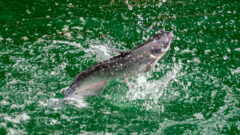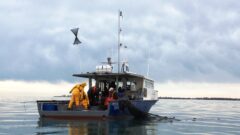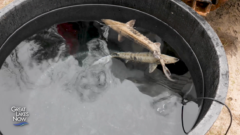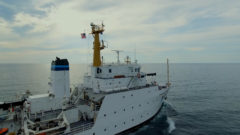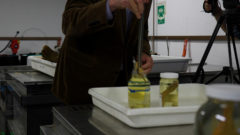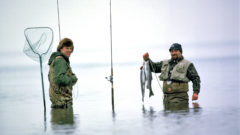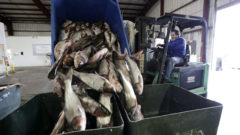
About 20 UW–Madison students got a unique – and very squishy – hands-on lesson in sustainability this spring when they learned to make leather from fish skin in a class called “Building a Sustainable Creative Practice.” Follow them throughout the process in Bringing Fish Leather to UW-Madison,” a new video produced by Wisconsin Sea Grant’s Bonnie Willison.

After fish are caught or harvested, the skins are often discarded. But in class, students explored how the material can be repurposed into fashion and design pieces while reducing waste and avoiding plastic-based materials. Using skins donated by northern Wisconsin commercial fishers, students learned the surprisingly simple process of making fish leather. Along the way, Wisconsin Sea Grant outreach specialists Sharon Moen and Titus Seilheimer also introduced students to Wisconsin’s commercial fishing industry and topics related to Great Lakes sustainability.

Moen and Seilheimer first learned fish leather tanning at a 2025 workshop and have since been teaching others across Wisconsin. Ginny Carlton, Sea Grant’s education outreach specialist, helped forge a partnership with UW-Madison’s Design Studies department to bring fish leather tanning to UW-Madison. Students were encouraged by instructors Mary Hark and Anika Kozlowski to experiment creatively with the material, with project ideas ranging from fitted tops, to book covers, to bracelets. “I’m excited about the future, seeing the enthusiasm these students had,” said Moen.

This project was made possible by the Brittingham Wisconsin Trust.

The post New video: From fish waste to fashion first appeared on Wisconsin Sea Grant.

Original Article

News Releases | Wisconsin Sea Grant

News Releases | Wisconsin Sea Grant

https://www.seagrant.wisc.edu/news/fishleather/
Bonnie Willison

Monitoring for Invasive Round Goby Best Done By Just Fishing We're in the midst of another Wisconsin spring where recreational activities on our waterways are plentiful! The sun is shining and we're dusting off our fishing gear and planning for warm days ahead. But if you're in need of another reason to go fishing, [...]

The post We Need You To Go Fishing (It’s For Science, We Promise) appeared first on Fox-Wolf Watershed Alliance.

Original Article

Fox-Wolf Watershed Alliance

Fox-Wolf Watershed Alliance

https://fwwa.org/2026/05/12/we-need-you-to-go-fishing-its-for-science-we-promise/?utm_source=rss&utm_medium=rss&utm_campaign=we-need-you-to-go-fishing-its-for-science-we-promise

Chris Acy

Research Project Study Looking For Input on Pet Welfare, Invasive Species Messaging Original Story: Wisconsin Sea Grant Wisconsin Sea Grant is doing a research project about messaging related to pet welfare and invasive species. As a college student in Wisconsin we are interested in your opinions about messaging on this topic since you may [...]

The post College Student? Help Pet Welfare By Taking This Survey appeared first on Fox-Wolf Watershed Alliance.

Original Article

Fox-Wolf Watershed Alliance

Fox-Wolf Watershed Alliance

https://fwwa.org/2026/05/06/college-student-help-pet-welfare-by-taking-this-survey/?utm_source=rss&utm_medium=rss&utm_campaign=college-student-help-pet-welfare-by-taking-this-survey

Chris Acy

This article was republished here with permission from Great Lakes Echo.

By Samantha Ku, Great Lakes Echo


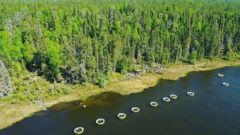
A newly restored reef at Channel Island in Saginaw Bay is intended to support native fish spawning and increase their numbers, ensuring the sustainability of local fisheries.

Construction to restore the nearshore fish spawning reef ended last October. 

Recreational fishing is an economic boon to the Lake Huron region, according to Jeffrey Jolley, a fisheries unit supervisor with the Michigan Department of Natural Resources.

“The excellent fishery attracts anglers from all over the state, and they spend money on fuel, tackle, restaurants and shops, and hotels and rentals,” Jolley said.

Therefore, protecting fish habitats is crucial to the local economy, he said.

The construction is an additional reef restoration following the restoration of the Coreyon Reef site and is intended to support a network of spawning reefs and nursery habitat, according to Michigan Sea Grant.

The Coreyon Reef site is a 2-acre offshore rocky habitat about 10 miles north of the Quanicassee River, northwest of the Channel Island site.

By studying the Coreyon Reef, researchers gather valuable data on the spawning habitats of native species. 

According to Michigan Sea Grant, researchers from the state DNR and Purdue University documented lake whitefish and walleye spawning on the reef between 2020 and 2022.

Initial results from the study indicate that fish species don’t show a particular preference for any specific type of cobble that makes up the reef structure.

Following the completion of the project at the Channel Island Reef, fish activity will be monitored by partners in the restoration, said Meaghan Gass, an MSU Extension educator with Michigan Sea Grant.

“With the two completed sites, researchers are able to compare nearshore and offshore locations,” Gass said.

Channel Island is also called Shelter Island, Spoils Island and the U.S. Army Corps Confined Disposal Facility.

Its newly built reef is about 570 feet long and 190 feet wide. It rises about 3 to 4 feet above the lake bottom and sits at least 5.5 feet below the water’s surface, even when water levels are low.

The artificial reefs are built from a mound of rocks that are distinctly different from coral reefs found in the ocean, Gass said. 

Nearly 20,000 tons of natural limestone, delivered by barge, forms the Channel Island Reef, she said. 

“Historically, inner Saginaw Bay had rocky underwater reefs formed by glacial deposits,” Gass said.

Gass said the rocky underwater reefs provided safe spaces for native fish to lay eggs because crevices among the rocks protect eggs and young fish from predators and strong currents.

The importance of native fish protection for the Lake Huron fishery lies in preserving the ecological balance that has developed over thousands of years, according to Jolley.

“Our native fish species evolved here through the forces of natural selection over millennia, adapting to local conditions, prey, predators and seasonal changes,” Jolley said.

In contrast, invasive species are often introduced abruptly, without natural checks and balances, allowing them to outcompete or prey on native fish, disrupt habitats and destabilize food webs, Jolley said.

Jolley said although some invasive species can temporarily provide new fishing opportunities, they often reduce long-term stability of ecosystems.

In contrast, native species support more resilient, diverse and sustainable fisheries, delivering lasting ecological and economic benefits.

However, artificial reefs designed to support native fish spawning habitats may also benefit invasive species.

“Round goby, an invasive species that prefers rocky habitats, will likely colonize the reef,” Jolley said.

While gobies can prey on fish eggs, native predators such as smallmouth bass feed heavily on them and are also attracted to the area. 

The reef structure and placement support native species like smallmouth bass and walleye, which depend on clean, stable substrate for spawning and feeding, Jolley said.

“This interaction is expected to balance out naturally as predator-prey relationships stabilize,” Jolley said.

According to Jolley, community engagement is crucial for further restoration projects.

Jolley said public opinion often centers on safety, navigation features and aesthetics, as people seek to balance these considerations with the ecological benefits of habitat restoration.

“We have consistently engaged local communities on past, current and future projects,” Jolley said.


The post Lake Huron artificial reef restores fish spawning habitat appeared first on Great Lakes Now.

Original Article

Great Lakes Now

Great Lakes Now

https://www.greatlakesnow.org/2026/04/30/lake-huron-artificial-reef-restores-fish-spawning-habitat/

Great Lakes Echo

Free Meeting: See Where The Fish Are Moving Original Story: Wisconsin DNR Date: 01/14/2026 Time: 6:00 p.m. - 8:00 p.m. Location: In-Person & Virtual Options; See Below for Address and Virtual Link Contact: Angelo Cozzola, Angelo.Cozzola@wisconsin.gov or 920-410-9170 Details The Winnebago System is home to one of the state's premier walleye fisheries. The walleye [...]

The post 1/14/26 Meeting: Winnebago System Walleye and Lake Sturgeon Movement appeared first on Fox-Wolf Watershed Alliance.

Original Article

Fox-Wolf Watershed Alliance

Fox-Wolf Watershed Alliance

https://fwwa.org/2026/01/07/1-14-26-meeting-winnebago-system-walleye-and-lake-sturgeon-movement/?utm_source=rss&utm_medium=rss&utm_campaign=1-14-26-meeting-winnebago-system-walleye-and-lake-sturgeon-movement

Chris Acy

Another Impact of Zebra Mussels Zebra mussel cluster. Photo taken by D. Jude, Univ. of Michigan. Zebra mussels are an invasive species that can reshape entire lake ecosystems. Researchers have discovered that zebra mussels may be increasing mercury levels in popular game fish like walleye and yellow perch. Mercury is a potent [...]

The post How Zebra Mussels Are Changing Fish Contaminants appeared first on Fox-Wolf Watershed Alliance.

Original Article

Fox-Wolf Watershed Alliance

Fox-Wolf Watershed Alliance

https://fwwa.org/2025/08/14/how-zebra-mussels-are-changing-fish-contaminants/?utm_source=rss&utm_medium=rss&utm_campaign=how-zebra-mussels-are-changing-fish-contaminants

Chris Acy

How Michigan’s Inland Fish Farmers Cultivate a Sustainable Future for the Great Lakes

Despite being surrounded by the largest group of freshwater lakes on Earth, Michigan imports the vast majority of its seafood, between 65% and 90%, according to Michigan Sea Grant.

As global aquaculture has grown to meet increasing demand for protein, a small but determined group of inland fish farmers in the Great Lakes region are working to build a more sustainable, local supply.

Read Now at Great Lakes Now.

Original Article

Great Lakes Now

Great Lakes Now

https://www.greatlakesnow.org/2025/08/how-michigans-inland-fish-farmers-cultivate-a-sustainable-future-for-the-great-lakes/

Donte Smith

Bassmaster Elite arrives as Lake St. Clair’s smallmouth break records

As anglers compete in the 2025 Yokohama Tire Bassmaster Elite competition on Lake St. Clair from Aug. 7-10, they’ll likely bring some pretty prize catches to weigh-ins. That’s because the catch-and-release method has allowed smallmouth bass on Lake St. Clair to grow to much greater sizes, according to new research from the Michigan Department of Natural Resources (DNR).

Read Now at Great Lakes Now.

Original Article

Great Lakes Now

Great Lakes Now

https://www.greatlakesnow.org/2025/08/bassmaster-elite-arrives-as-lake-st-clairs-smallmouth-break-records/

Jack Armstrong

I Speak for the Fish: Think you’re not to blame for overfishing? Think again.

I Speak for the Fish is a monthly column written by Great Lakes Now Contributor Kathy Johnson, coming out the third Monday of each month. Publishing the author’s views and assertions does not represent endorsement by Great Lakes Now or Detroit Public Television. 

Read Now at Great Lakes Now.

Original Article

Great Lakes Now

Great Lakes Now

https://www.greatlakesnow.org/2025/07/i-speak-for-the-fish-think-youre-not-to-blame-for-overfishing-think-again/

Kathy Johnson, Great Lakes Now

I Speak for the Fish: The hardest lake sturgeon dive in the Great Lakes

For two weeks each year, the St. Clair River hosts thousands of spawning lake sturgeon.

Hundreds of six-foot females plump with eggs and thousands of 4 to 5-foot-long males gather at the base of Lake Huron. In the span of a few weeks, they will arrive, group up, deposit millions of fertilized eggs on the river bottom and depart.  

Read Now at Great Lakes Now.

Original Article

Great Lakes Now

Great Lakes Now

https://www.greatlakesnow.org/2025/06/i-speak-for-the-fish-the-hardest-lake-sturgeon-dive-in-the-great-lakes/

Kathy Johnson, Great Lakes Now

Hundreds of fish killed by manure runoff in Monroe County

By Danielle Kaeding, Wisconsin Public Radio

This article was republished here with permission from Wisconsin Public Radio.

Manure runoff from a dairy farm in Monroe County killed hundreds of fish in nearby waterways, according to the Wisconsin Department of Natural Resources.

The agency first received notice of the spill Saturday from a call to its violation hotline.

Read Now at Great Lakes Now.

Original Article

Great Lakes Now

Great Lakes Now

https://www.greatlakesnow.org/2025/05/hundreds-of-fish-killed-by-manure-runoff-in-monroe-county/

Wisconsin Public Radio

I Speak for the Fish: Sturgeon vs salmon prioritizing native Great Lakes species

I Speak for the Fish is a monthly column written by Great Lakes Now Contributor Kathy Johnson, coming out the third Monday of each month. Publishing the author’s views and assertions does not represent endorsement by Great Lakes Now or Detroit Public Television. 

Read Now at Great Lakes Now.

Original Article

Great Lakes Now

Great Lakes Now

https://www.greatlakesnow.org/2025/05/i-speak-for-the-fish-sturgeon-vs-salmon-prioritizing-native-great-lakes-species/

Kathy Johnson, Great Lakes Now

I Speak for the Fish – Giddy up sucker

I Speak for the Fish is a monthly column written by Great Lakes Now Contributor Kathy Johnson, coming out the third Monday of each month. Publishing the author’s views and assertions does not represent endorsement by Great Lakes Now or Detroit Public Television. 

Read Now at Great Lakes Now.

Original Article

Great Lakes Now

Great Lakes Now

https://www.greatlakesnow.org/2023/08/i-speak-for-the-fish-giddy-up-sucker/

Kathy Johnson

Mapping the Great Lakes: Summertime fishing

Love staring at a map and discovering something interesting? Then “Mapping the Great Lakes” is for you. It’s a monthly Great Lakes Now feature created by Alex B. Hill, a self-described “data nerd and anthropologist” who combines cartography, data, and analytics with storytelling and human experience.

Read Now at Great Lakes Now.

Original Article

Great Lakes Now

Great Lakes Now

https://www.greatlakesnow.org/2023/07/mapping-the-great-lakes-summertime-fishing/

Alex Hill

I Speak for the Fish — Searching for the elusive sculpin.

I Speak for the Fish is a monthly column written by Great Lakes Now Contributor Kathy Johnson, coming out the third Monday of each month. Publishing the author’s views and assertions does not represent endorsement by Great Lakes Now or Detroit Public Television. 

Read Now at Great Lakes Now.

Original Article

Great Lakes Now

Great Lakes Now

https://www.greatlakesnow.org/2023/06/i-speak-for-the-fish-searching-elusive-sculpin/

Kathy Johnson

I Speak for the Fish – What’s the most popular freshwater fish?

I Speak for the Fish is a monthly column written by Great Lakes Now Contributor Kathy Johnson, coming out the third Monday of each month. Publishing the author’s views and assertions does not represent endorsement by Great Lakes Now or Detroit Public Television. 

Read Now at Great Lakes Now.

Original Article

Great Lakes Now

Great Lakes Now

https://www.greatlakesnow.org/2023/05/i-speak-for-the-fish-whats-the-most-popular-freshwater-fish/

Kathy Johnson

Walleye and pike surveys start in early spring, followed by muskie surveys. In May, the DNR starts surveying general fish communities like panfish and bass, and from July to September it surveys streams.

The post Shocking news for Michigan fish first appeared on Great Lakes Echo.

Original Article

Great Lakes Echo

Great Lakes Echo

http://greatlakesecho.org/2023/04/27/shocking-news-for-michigan-fish/

Guest Contributor

I Speak for the Fish: Eyeballing Walleye

I Speak for the Fish is a monthly column written by Great Lakes Now Contributor Kathy Johnson, coming out the third Monday of each month. Publishing the author’s views and assertions does not represent endorsement by Great Lakes Now or Detroit Public Television. 

Read Now at Great Lakes Now.

Original Article

Great Lakes Now

Great Lakes Now

https://www.greatlakesnow.org/2023/04/i-speak-for-fish-eyeballing-walleye/

Kathy Johnson

I Speak for the Fish: Eyeballing Walleye

I Speak for the Fish is a monthly column written by Great Lakes Now Contributor Kathy Johnson, coming out the third Monday of each month. Publishing the author’s views and assertions does not represent endorsement by Great Lakes Now or Detroit Public Television. 

Read Now at Great Lakes Now.

Original Article

Great Lakes Now

Great Lakes Now

https://www.greatlakesnow.org/2023/04/i-speak-for-fish-eyeballing-walleye/

Kathy Johnson

Habitat restoration can cost hundreds of thousands of dollars, years of time and the collaborative effort of engineers, scientists and designers. It may be better to just start from scratch. 

The post Creating habitat to help fish reproduce is costlier, but more effective than restoring it first appeared on Great Lakes Echo.

Original Article

Great Lakes Echo

Great Lakes Echo

http://greatlakesecho.org/2023/04/04/creating-habitat-to-help-fish-reproduce-is-costlier-but-more-effective-than-restoring-it/

Vladislava Sukhanovskaya

Artificial reefs bring wild lake trout to Lake Huron

This article was republished here with permission from Great Lakes Echo.

By Daniel Schoenherr, Great Lakes Echo

The ecological success of artificial reefs in Lake Huron’s Thunder Bay could teach people how to restore fish populations across the world.

Ellen Marsden, a fisheries and wildlife expert from the University of Vermont, spearheaded the construction of 29 reefs built with small stones – cobble aggregate – in Thunder Bay in 2010.

Read Now at Great Lakes Now.

Original Article

Great Lakes Now

Great Lakes Now

https://www.greatlakesnow.org/2023/03/artificial-reefs-bring-wild-lake-trout-to-lake-huron/

Great Lakes Echo

I Speak for the Fish: Playing follow-the-leader with diving ducks

I Speak for the Fish is a monthly column written by Great Lakes Now Contributor Kathy Johnson, coming out the third Monday of each month. Publishing the author’s views and assertions does not represent endorsement by Great Lakes Now or Detroit Public Television. 

Read Now at Great Lakes Now.

Original Article

Great Lakes Now

Great Lakes Now

https://www.greatlakesnow.org/2023/03/i-speak-for-the-fish-playing-follow-the-leader-with-diving-ducks/

Kathy Johnson

I Speak for the Fish: Courting Sunfish

I Speak for the Fish is a monthly column written by Great Lakes Now Contributor Kathy Johnson, coming out the third Monday of each month. Publishing the author’s views and assertions does not represent endorsement by Great Lakes Now or Detroit Public Television. 

Read Now at Great Lakes Now.

Original Article

Great Lakes Now

Great Lakes Now

https://www.greatlakesnow.org/2023/02/i-speak-for-the-fish-courting-sunfish/

Kathy Johnson

Lake sturgeon added to endangered list, but things are looking up

Lake sturgeon, one of the largest and oldest species of fish in the Great Lakes, are in more trouble than we thought.

In December, the International Union for the Conservation of Nature downgraded its status from Least Concern to Endangered based on shrinking populations over the past three generations, which is between 250 and 300 years for this long-lived fish.

Read Now at Great Lakes Now.

Original Article

Great Lakes Now

Great Lakes Now

https://www.greatlakesnow.org/2023/02/lake-sturgeon-added-to-endangered-list-but-things-are-looking-up/

Brian Owens

By Anastasia Pirrami The nonprofit group Perch America has been stocking thousands of walleye into Wolf Lake for 24 of the last 25 years, creating a rich fishery for the small community of Hammond, Indiana. Anglers concerned about commercial fisheries over harvesting fish in the southern part of Lake Michigan, including Wolf Lake, formed the […]

The post Indiana group stocks walleye for 24 years first appeared on Great Lakes Echo.

Original Article

Great Lakes Echo

Great Lakes Echo

http://greatlakesecho.org/2023/01/17/indiana-group-stocks-walleye-for-24-years/

Guest Contributor

As a long-time angler and ichthyology student, I thought I knew a lot about the bowfin. But recent developments have shown that much of what I knew about this fish was wrong.

The post Commentary: New insights about an old fish first appeared on Great Lakes Echo.

Original Article

Great Lakes Echo

Great Lakes Echo

http://greatlakesecho.org/2022/12/27/commentary-new-insights-about-an-old-fish/

Guest Contributor

I Speak for the Fish: Favorite fish books

I Speak for the Fish is a monthly column written by Great Lakes Now Contributor Kathy Johnson, coming out the third Monday of each month. Publishing the author’s views and assertions does not represent endorsement by Great Lakes Now or Detroit Public Television. 

Read Now at Great Lakes Now.

Original Article

Great Lakes Now

Great Lakes Now

https://www.greatlakesnow.org/2022/12/i-speak-for-the-fish-favorite-fish-books/

Kathy Johnson

In the course of 11 days, a device dating back to 234 B.C. successfully transported 704 fish across the Cheboygan Dam in the northern part of Michigan’s Lower Peninsula with no injuries observed.

The post Device from 234 B.C. lifts fish over barriers while blocking invaders, study finds first appeared on Great Lakes Echo.

Original Article

Great Lakes Echo

Great Lakes Echo

http://greatlakesecho.org/2022/11/23/device-from-234-b-c-lifts-fish-over-barriers-while-blocking-invaders-study-finds/

Guest Contributor

I Speak for the Fish: These catfish have something to say

I Speak for the Fish is a new monthly column written by Great Lakes Now Contributor Kathy Johnson, coming out the third Monday of each month. Publishing the author’s views and assertions does not represent endorsement by Great Lakes Now or Detroit Public Television. 

Read Now at Great Lakes Now.

Original Article

Great Lakes Now

Great Lakes Now

https://www.greatlakesnow.org/2022/11/i-speak-for-the-fish-these-catfish-have-something-to-say/

Kathy Johnson

The research collaboration among the Medical College of Wisconsin, the Inter-Tribal Council of Michigan and the Chippewa Ottawa Resource Authority in Sault Ste. Marie, Michigan has demonstrated how an advisory program designed for the Anishinaabe is a useful tool for tracking fish consumption in Great Lakes tribes. 

The post Study shows value of culturally appropriate environmental health resources first appeared on Great Lakes Echo.

Original Article

Great Lakes Echo

Great Lakes Echo

http://greatlakesecho.org/2022/11/17/study-shows-value-of-culturally-appropriate-environmental-health-resources/

Jonus Cottrell

An aquaculture group recently received $425,000 in federal support to strengthen the aquaculture community in the Great Lakes region. The goal for the grant is to build up the local economy of aquaculture producers.

The post Great Lakes Aquaculture Collaborative receives support from federal government first appeared on Great Lakes Echo.

Original Article

Great Lakes Echo

Great Lakes Echo

http://greatlakesecho.org/2022/11/09/great-lakes-aquaculture-collaborative-receives-support-from-federal-government/

Guest Contributor

A new campaign is pushing for commercial fisheries to use whitefish for more than just filets. The fish could be used for makeup, wallets and supplements. 

The post Whitefish campaign seeks to lift fisheries while fish stocks drop first appeared on Great Lakes Echo.

Original Article

Great Lakes Echo

Great Lakes Echo

http://greatlakesecho.org/2022/11/03/whitefish-campaign-seeks-to-lift-fisheries-while-fish-stocks-drop/

Guest Contributor

A University of Windsor doctoral student studying conservation has a knack for science communication - and is using it to bring attention and support to at-risk species.

The post Minnow researcher uses You Tube, children’s literature to connect people with at-risk species first appeared on Great Lakes Echo.

Original Article

Great Lakes Echo

Great Lakes Echo

http://greatlakesecho.org/2022/10/21/minnow-researcher-uses-you-tube-childrens-literature-to-connect-people-with-at-risk-species/

Guest Contributor

Shipping vessels make Lake Superior one of the loudest freshwater lakes in the world, but ice makes it one of the quietest during winter. The winter silence plays a key role in conserving the lake’s marine animals.

The post Study: Why are Lake Superior’s quiet winters so important? first appeared on Great Lakes Echo.

Original Article

Great Lakes Echo

Great Lakes Echo

http://greatlakesecho.org/2022/10/04/study-why-are-lake-superiors-quiet-winters-so-important/

Guest Contributor

Authorities probing report of scandal at fishing tournament

By Mark Gillispie, Associated Press

CLEVELAND (AP) — The county prosecutor’s office in Cleveland has opened an investigation into an apparent cheating scandal during a lucrative walleye fishing tournament on Lake Erie last week.

A video posted to Twitter shows Jason Fischer, tournament director for the Lake Erie Walleye Trail, cutting open the winning catch of five walleye on Friday and finding lead weights and prepared fish filets inside them.

Read Now at Great Lakes Now.

Original Article

Great Lakes Now

Great Lakes Now

https://www.greatlakesnow.org/2022/10/ap-authorities-report-scandal-fishing-tournament/

The Associated Press

Finders, Keepers: The Great Lakes Now Episode Quiz

Great Lakes Now tries to make every episode interesting and educational.

In “Finders, Keepers,” join researchers as they uncover details about the bottom of the Great Lakes, head to Toronto’s Royal Ontario Museum to learn how scientists are using a natural history collection to understand changes to global biodiversity, and tune into The Catch for more news about the lakes you love.

Read Now at Great Lakes Now.

Original Article

Great Lakes Now

Great Lakes Now

https://www.greatlakesnow.org/2022/09/finders-keepers-the-great-lakes-now-episode-quiz/

Anna Sysling

Fish scientists: From childhood aspirations to Amazonian expeditions

Most professions offer a range of subspecialties to choose from.

Want to be a doctor? What kind? Surgeon, pediatrician, neurologist…?

Want to work construction? What kind? Plumer, electrician, carpenter…?

The study of fishes is different only in that the subspecialties are far less familiar to people outside the field.

Read Now at Great Lakes Now.

Original Article

Great Lakes Now

Great Lakes Now

https://www.greatlakesnow.org/2022/09/fish-scientists/

Kathy Johnson

I Speak for the Fish: A Fish’s Shelf Life

I Speak for the Fish is a new monthly column written by Great Lakes Now Contributor Kathy Johnson, coming out the third Monday of each month. Publishing the author’s views and assertions does not represent endorsement by Great Lakes Now or Detroit Public Television. 

Read Now at Great Lakes Now.

Original Article

Great Lakes Now

Great Lakes Now

https://www.greatlakesnow.org/2022/09/i-speak-for-the-fish-a-fishs-shelf-life/

Kathy Johnson

Great Lakes feature Midwest curiosity: Fish-cleaning houses

If you catch fish in a Great Lakes state on a river, pond, stream or reservoir and keep any to eat, most likely you’ll have to clean them yourself. But if you get close to one of the big lakes, especially Lake Erie, you could have a fish cleaner do it.

Read Now at Great Lakes Now.

Original Article

Great Lakes Now

Great Lakes Now

https://www.greatlakesnow.org/2022/09/fish-cleaning-houses/

James Proffitt

Setting Lake Erie limits

The total allowable catch (TAC) for yellow perch and walleye went up this year in Lake Erie. The raise is indicative of booming walleye population in recent years as well as a healthy perch population in most areas of the lake.

The walleye TAC rose 18% from 12.28 million fish in 2021 to 14.53 million this year, with yellow perch rising 15% from 6.23 million pounds last year to 7.18 million pounds this year.

Read Now at Great Lakes Now.

Original Article

Great Lakes Now

Great Lakes Now

https://www.greatlakesnow.org/2022/08/setting-lake-erie-limits/

James Proffitt

Only half of Great Lakes residents are aware of advisories for safely eating fish

This article was republished here with permission from Great Lakes Echo.

By Cameryn Cass, Great Lakes Echo

The Great Lakes Basin draws millions of anglers each year to fish in its lakes, rivers and streams.

In addition, millions more of the region’s residents consume those fish.

Read Now at Great Lakes Now.

Original Article

Great Lakes Now

Great Lakes Now

https://www.greatlakesnow.org/2022/07/great-lakes-residents-advisories-eating-fish/

Great Lakes Echo

DNR monitoring crappie kill at Loon Lake in NE Indiana

COLUMBIA CITY, Ind. (AP) — State Department of Natural Resources fisheries biologists have collected fish and water samples at a northeastern Indiana lake as the result of a fish kill involving thousands of crappies, the agency said June 23.

The fish kill began last week at Loon Lake in Whitley and Noble counties.

Read Now at Great Lakes Now.

Original Article

Great Lakes Now

Great Lakes Now

https://www.greatlakesnow.org/2022/07/ap-crappie-kill-loon-lake/

The Associated Press

The study in the journal “Science of the Total Environment” found that five million people exceeded the recommended fish intake of two meals or 12 ounces per week, as suggested by the Environmental Protection Agency. Notably, women, nonwhites, younger residents and those with lower education levels were less aware of fish advisories, and thus more prone to eat more than the recommended amount.

The post Only half of Great Lakes residents are aware of advisories for safely eating fish first appeared on Great Lakes Echo.

Original Article

Great Lakes Echo

Great Lakes Echo

http://greatlakesecho.org/2022/06/30/only-half-of-great-lakes-residents-are-aware-of-advisories-for-safely-eating-fish/

Guest Contributor

From ‘carp’ to ‘copi’: unpopular fish getting a makeover

By John Flesher, Associated Press

TRAVERSE CITY, Mich. (AP) — You’re in the mood for fish and your server suggests a dish of invasive carp. Ugh, you might say. But how about broiled copi, fresh from the Mississippi River?

Here’s the catch: They’re the same thing.

Read Now at Great Lakes Now.

Original Article

Great Lakes Now

Great Lakes Now

https://www.greatlakesnow.org/2022/06/ap-unpopular-fish-getting-makeover/

The Associated Press

Since the early 2000s fewer young whitefish have been making it to adulthood. Understanding the decline of lake whitefish recruitment is important for fishery managers and regulators as they approach the deadline to update a 2000 consent decree that regulates recreational and commercial fishing in Lake Huron and Lake Michigan. 

The post Water test: One fish, two fish – where are all the whitefish? first appeared on Great Lakes Echo.

Original Article

Great Lakes Echo

Great Lakes Echo

http://greatlakesecho.org/2022/06/23/water-test-one-fish-two-fish-wheres-all-the-whitefish/

Guest Contributor

How will tire chemicals affect Great Lakes fish? Some scientists hope to find out

Just a couple years ago, nobody had heard of 6PPD-quinone, a chemical by-product of car tires. Until it was discovered that it can kill fish, including species in the Great Lakes.

Researchers with the University of Washington discovered in late 2020 that 6PPD-quinone was washing off roadways and into Seattle’s urban creeks during rainstorms – a death sentence for coho salmon.

Read Now at Great Lakes Now.

Original Article

Great Lakes Now

Great Lakes Now

https://www.greatlakesnow.org/2022/06/tire-chemicals-great-lakes-fish/

Sharon Oosthoek