Michigan researchers have gone back in time to get a picture of how ice cover on the Great Lakes has evolved since the late 19th century. Using historical temperature records from weather stations around the region, researchers improved their understanding of where ice might have formed and for how long it lasted. Read the full story by WXPR – Rhinelander, Wisconsin.

Original Article

Great Lakes Commission

Great Lakes Commission

https://www.glc.org/dailynews/20260216-ice-data

Nichole Angell

For the first time in more than two decades, Lake Erie is nearly completely frozen. As a result, surrounding communities could see a number of impactful side effects. Read the full story by The Cool Down.

Original Article

Great Lakes Commission

Great Lakes Commission

https://www.glc.org/dailynews/20260216-frozen-erie

Nichole Angell

A new study examines the uniqueness of work that research centers conduct in the Great Lakes region, highlighting their importance amid dramatic changes in federal funding.

The post Research centers in the Great Lakes region change the scope of global freshwater ecology first appeared on Great Lakes Echo.

Original Article

Great Lakes Echo

Great Lakes Echo

https://greatlakesecho.org/2026/02/16/research-centers-in-the-great-lakes-region-change-the-scope-of-global-freshwater-ecology/

Akia Thrower

Across the Great Lakes, a network of buoys provides real-time data about waves, wind, and ice. In 2025, one buoy broke free, drifting nearly to the center of Lake Michigan before washing ashore. The data it collected is helping researchers better understand how winter weather impacts the lakes.

#GreatLakes #Science #Weather #Technology #Freshwater #LakeMichigan
===========================================
Website: https://greatlakesnow.org
Facebook: https://www.facebook.com/greatlakesnow
X: https://www.x.com/greatlakesnow
Instagram: https://www.instagram.com/greatlakesnoworg
Newsletter: https://www.greatlakesnow.org/great-lakes-now-newsletter/

To learn more about supporting Detroit PBS and Great Lakes Now, visit https://www.detroitpbs.org/
===========================================

“This Breakaway Buoy Explored Lake Michigan’s Icy Waves” was produced by Great Lakes Now/@detroitpbs

Produced, Written, and Narrated by
Adam Fox-Long

Edited by
Jordan Wingrove
Adam Fox-Long

Additional Material:
Great Lakes Outreach Media
Great Lakes Observing System
Sofar Ocean
NOAA
Great Lakes Environmental Research Laboratory
Cooperative Institute for Great Lakes Research
Russ Miller

The post This Breakaway Buoy Explored Lake Michigan’s Icy Waves | Great Lakes Now appeared first on Great Lakes Now.

Original Article

Great Lakes Now

Great Lakes Now

https://www.greatlakesnow.org/2026/02/16/this-breakaway-buoy-explored-lake-michigans-icy-waves-great-lakes-now/

Great Lakes Now

By Bauyrzhan Zhaxylykov

New U-M survey finds only about 5% of rural Michigan residents say they would choose an electric vehicle as their next car. Researchers attribute much of that reluctance to misinformation about the availability of public chargers and the cost of EVs and replacement batteries. The Whitmer administration is pushing to expand electric vehicle use to meet climate and clean energy goals.

The post Why Michigan’s rural residents are reluctant to drive electric vehicles first appeared on Great Lakes Echo.

Original Article

Great Lakes Echo

Great Lakes Echo

https://greatlakesecho.org/2026/02/14/why-michigans-rural-residents-are-reluctant-to-drive-electric-vehicles/

Capital News Service

Researchers say the world has entered an era of global ‘water bankruptcy’—a point where many rivers, lakes, aquifers, and glaciers have been pushed past their capacity to recover. This finding has implications on the Great Lakes system as each year, only about one percent of Great Lakes water is replenished through rain, snow, and groundwater. Read the full story by the Welland Tribune.

Original Article

Great Lakes Commission

Great Lakes Commission

https://www.glc.org/dailynews/20260213-water-bankruptcy

James Polidori

A six-decade history in the Great Lakes region of ecosystem and water protection is being put to the test as a dynamic era of energy investment, rising electricity demand, aging assets and political intervention dawns across the basin. Read the full story by Bridge Michigan.

Original Article

Great Lakes Commission

Great Lakes Commission

https://www.glc.org/dailynews/20260213-energy-water-nexus

James Polidori

The City of Duluth’s Engineering division will launch a new Private Stormwater Best Management Practice (BMP) Inspection and Maintenance Program for certain properties starting this spring. These BMPs help control stormwater runoff, reduce flooding risk and protect water quality in local resources including Lake Superior, the Saint Louis River Bay Estuary, wetlands and 60 streams. Read the full story by WDIO-TV – Duluth, MN.

Original Article

Great Lakes Commission

Great Lakes Commission

https://www.glc.org/dailynews/20260213-stormwater-management

James Polidori

A coalition of environmental advocates introduced state legislation in Illinois Wednesday to guard against data centers causing water shortages, groundwater conflicts, increased water prices and pollution without proper planning and management. Read the full story by the Daily Herald.

Original Article

Great Lakes Commission

Great Lakes Commission

https://www.glc.org/dailynews/20260213-data-center-legislation

James Polidori

Construction on a new reservoir designed to maintain a secure water supply in London, Ontario is nearly complete. The new addition, fed from Lake Erie and Lake Huron where the water is treated before being pumped to the reservoirs, will be nearly double the capacity of the previous reservoir. Read the full story by CTV News.

Original Article

Great Lakes Commission

Great Lakes Commission

https://www.glc.org/dailynews/20260213-water-storage

James Polidori

The Michigan Department of Natural Resources is reminding ice fishermen that there are only a few times and locations where it’s legal to catch lake sturgeon — and they should take care to quickly release any fish they catch by mistake this winter. Read the full story by the Lansing State Journal.

Original Article

Great Lakes Commission

Great Lakes Commission

https://www.glc.org/dailynews/20260213-sturgeon-protections

James Polidori

Lake Superior State University is expanding its Great Lakes research capacity through a $3 million donation to support the university’s Center for Freshwater Research and Education in Sault Ste. Marie, Michigan. The funding will be used to create an Excellence Fund for student research, acquire advanced equipment, and purchase a larger research vessel for applied fieldwork. Read the full story by WWTV-TV – Cadillac, MI.

Original Article

Great Lakes Commission

Great Lakes Commission

https://www.glc.org/dailynews/20260213-research-donation

James Polidori

Battle on Bago, Sturgeon Spearing Time on Winnebago Perfect Time to Check That Catch Thousands of folks are arriving on Lake Winnebago this week with big dreams. People are dreaming of spearing a mammoth sturgeon or maybe catching that perfect fish for Battle on Bago resulting in a new truck. Dreaming of creating those [...]

The post Winter Goby Watch During Battle on Bago, Sturgeon Spearing appeared first on Fox-Wolf Watershed Alliance.

Original Article

Fox-Wolf Watershed Alliance

Fox-Wolf Watershed Alliance

https://fwwa.org/2026/02/13/winter-goby-watch-during-battle-on-bago-sturgeon-spearing/?utm_source=rss&utm_medium=rss&utm_campaign=winter-goby-watch-during-battle-on-bago-sturgeon-spearing

Chris Acy

This story is part of a Great Lakes News Collaborative series called Shockwave: Rising energy demand and the future of the Great Lakes. The Great Lakes region is in the midst of a seismic energy shakeup, from skyrocketing data center demand and a nuclear energy boom, to expanding renewables and electrification. In 2026, the Great Lakes News Collaborative will explore how shifting supply and demand affect the region and its waters.

The collaborative’s five newsrooms — Bridge Michigan, Circle of Blue, Great Lakes Now, Michigan Public and The Narwhal — are funded by the Charles Stewart Mott Foundation.


A six-decade history in the Great Lakes region of ecosystem and water protection is being put to the test as a dynamic era of energy investment, rising electricity demand, aging assets, and political intervention dawns across the basin.

The energy story emerging today is one of tumultuous change in energy supply and demand coupled with conflicting state and federal objectives that are colliding with a buzzy economic narrative centered around AI and data centers. Electricity consumption in the basin’s eight states and two provinces is climbing for the first time in at least a decade. 

Forecasts show electricity demand in the region growing 2 to 3 percent annually over the next 10 years. The Trump administration, meanwhile, is injecting carbon-promoting policies into energy markets, requiring coal power plants in Michigan and Indiana to continue operating beyond their announced closure dates while also slowing the solar and wind projects, two energy sources that emit no climate-altering carbon and use little to no water. 

Along with coal, another water-intensive energy source is being revived or reimagined to satisfy projected electricity demands. With nearly $3 billion in federal and state financing, the 55-year-old Palisades Nuclear Generating Station is preparing to restart after a four-year shutdown. When it does, the old reactor will draw 98,000 gallons a minute, 141 million gallons a day from Lake Michigan.  

In addition to these legacy energy sources, new gas-fired power plants, battery storage, transmission lines, and a planned new nuclear plant north of Benton Harbor, Michigan, are being added to keep pace with demand. Agriculture, the region’s biggest water consumer and water polluter, is playing a larger role in energy production – by converting corn into biofuel and producing methane from manure in industrial-scale biodigesters

Liquid fuels also remain in the spotlight due to the lingering question of Line 5, an oil pipeline that crosses the Straits of Mackinac. The future of the 73-year-old pipeline is the subject of several lawsuits, with key legal and permitting decisions expected in 2026.

This is the first article in our “Shockwave” project, a series of reports that will investigate the rapid evolution of the energy landscape in the Great Lakes region and the consequences the new era will have for one of the world’s largest reserves of fresh water. Produced by the five partners of the Great Lakes News Collaborative — Bridge Michigan, Circle of Blue, Great Lakes Now, Michigan Public, and The Narwhal — Shockwave will document the depth and breadth of the region’s energy transformation and its influence on water use and pollution.

“As electricity demand is soaring, in part due to data centers, we’re seeing changes in water use, we’re seeing changes in electricity consumption,” said Mike Shriberg, director of the University of Michigan Water Center. “And how our region responds to that over the long term will have a massive impact for the Great Lakes and for our energy future.”

Altogether, these changes amount to an inflection point in the region’s energy policy, one with as many questions as answers. Will data center demand and the White House’s lifeline to fossil fuel units jeopardize state clean energy targets? Will the numerous binational, regional, and state-level consultative bodies enable collaboration that reduces harm to waterways? Can local officials, researchers, and lawmakers assemble the data to inform their responses? Will a decade-long decline in the energy sector’s water use continue or stall? Will the projected data center demand for electricity materialize or will the energy buildout result in stranded assets?

What is certain is that the energy playing field today is set up for a different game than just a few years ago. These are still early days, but the region, its $9.3 trillion economy, its border-crossing energy infrastructure, and its world-class environmental riches stand at the threshold of a profound shift in some of its basic economic inputs and assumptions.

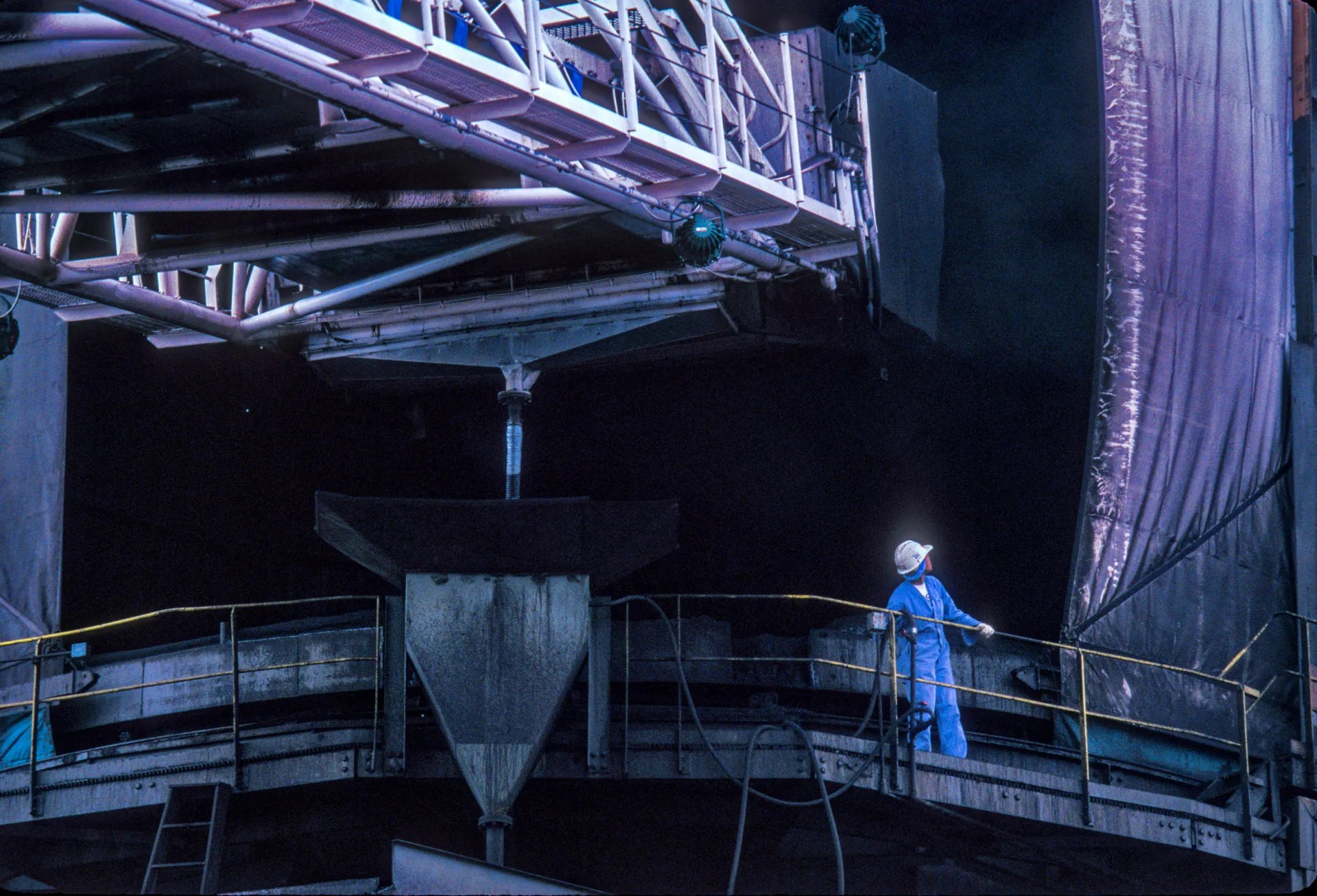
A Detroit Edison worker guides the unloading boom of the freighter Walter J. McCarthy, Jr. to a coal chute at the Monroe power plant in Monroe, Michigan, in this image from 1997. Photo © J. Carl Ganter/Circle of Blue

Top-Down Orders

The changes begin at the top. 

For political, ideological, and grid reliability reasons the Trump administration is adamant on propping up fossil fuels and shepherding a nuclear power revival. It is doing so through executive orders and agency action. 

The Department of Energy issued a series of emergency orders to prevent the coal-fired J.H. Campbell Power Plant, in West Olive, Michigan, on the shore of Lake Michigan, from shutting down last year. It issued a separate order in December to prevent the closures of the R.M. Schahfer Generating Station and F.B. Culley Generating Station in Indiana. 

In addition, the administration extended the deadline for closing coal waste dumps in Illinois, Indiana, and Ohio, though none is directly within the basin. Though the administration asserts it is “clean,” coal is the dirtiest and among the thirstiest sources of electricity. 

The Department of Energy excluded small modular reactors, or SMRs, and other “advanced” nuclear generation technologies from National Environmental Policy Act review. SMR developers promote the new reactors as more mobile and less risky than the older generation of big reactors. SMRs are under development or have been proposed in Ontario, Illinois, Ohio, Michigan, and Wisconsin. 

Canada, too, has announced national energy strategies that appear certain to affect Great Lakes waters. Rebuffed and taunted by tariffs imposed by President Trump, Prime Minister Mark Carney told an audience at the World Economic Forum in Davos last month, “We are an energy superpower.” Carney outlined his plan for $1 trillion in fast-tracked Canadian investments in energy, AI, and critical minerals. He also promoted a national infrastructure campaign for oil pipelines, electricity transmission lines, and mines.

Big political announcements are reinforced by facts on the ground. The numbers tell a story of rapid growth in electricity demand that has analysts reaching back decades for a historical equivalent. Some compare it to the push for rural electrification in the United States after the Second World War. Already rising, electricity demand in the Great Lakes region could soar ever higher if high-tech corporate interest in data centers manifests as real-world construction. This comes as NERC, a North American regulatory agency, warns that the Great Lakes region faces high risk of electricity shortfalls in the next five years due to rising demand and power plant retirements.

This represents a head-spinning, era-defining reversal in electrical demand. In Wisconsin, electricity sales had been on a downward slope since the Great Recession began in 2007. By one estimate, data center electricity demand in the state will increase seven-fold by 2030, amounting to more than 4 percent of its electricity consumption. Data center load in northern Illinois has climbed 27 percent annually between 2022 and 2025, according to ComEd, the region’s electric utility. 

DTE Energy, the largest Michigan electric utility, announced a deal last fall to provide power to the 1,383-megawatt Green Chile Ventures data center in Washtenaw County. The Michigan Public Service Commission conditionally approved the state’s first “hyperscale” development in December. 

Consumers, the second largest electric provider in Michigan, has 9,000 megawatts of projects in its development pipeline, mostly for data centers and manufacturing.

Meta, the parent company of Facebook, announced a 20-year deal with Vistra last month to buy 2,100 megawatts from three nuclear plants while also expanding the generating capacity at those facilities. The agreement covers Perry and Davis-Besse, both located along Lake Erie in Ohio, as well as Beaver Valley, in Pennsylvania along the Ohio River. Meta also signed an agreement with California-based Oklo Inc. to build a 1,200-megawatt SMR plant in Ohio.

The rise in electricity demand could pose a challenge to state renewable energy goals. Illinois has a target of 100 percent clean energy by 2050. For Michigan’s electric utilities, the deadline is sooner: 100 percent clean energy by 2040.

That shift to renewables and the closure of water-intensive coal plants has been a net benefit for Great Lakes water so far. Water is drawn from lakes and rivers to cool the equipment at thermoelectric power stations, a category that includes fossil fuels and nuclear. Water withdrawals in the basin for thermoelectric power are down 24 percent compared to a decade ago, according to a University of Michigan report prepared for the Conference of Great Lakes St. Lawrence Governors and Premiers. That decline is true for power plants that use once-through cooling as well as for those that have recirculating systems that reduce withdrawals but increase consumption.

There are “substantial water savings as the region transitions away from traditional fossil fuels,” the report found. Besides water demand, the shift away from thermoelectric plants means fewer fish sucked into cooling-water pipes or trapped against their screens. It means less thermal pollution of nearshore waters and rivers. It means less mercury deposited into waterways from coal plant air emissions. 

The downward trend could shift upwards this year when the Palisades nuclear plant is scheduled to open, and may tilt higher as another shuttered nuclear plant in Wisconsin could reopen and new SMR plants come online. For data centers, the largest piece of their water use is not in direct operations. It is through the electricity they consume.

Years ago, the Great Lakes Commission, which represents the eight basin states and two Canadian provinces, was thinking about the same questions of water supply. In 2011, the commission published the findings from a multi-year project to identify water quality and quantity vulnerabilities in the U.S. portion of the Great Lakes basin due to thermoelectric power generation. 

The analysis, led by Sandia National Laboratories, considered multiple power generation projections and assessed three energy-related risk factors for the region’s water resources: water quality, thermal pollution of waterways, and low stream flows. It was the first model to consider water resources in future electricity scenarios for the region. A fifth of the basin’s 102 sub-watersheds scored a high risk in at least two categories.

The commission published the analysis, but largely moved on. No follow-up review was completed to determine the project’s effectiveness in shaping policy, said Erika Jensen, the commission’s executive director.

Today with data centers commanding so much attention, the water-energy connection resurfaced. That focus is partly due to growing public pushback against data center growth. Lawmakers in Indiana, Michigan, and Minnesota have introduced legislation to mandate more transparency from data center operators on their water and energy use.

At its meeting last October, the Great Lakes Commission signaled its reengagement when the commissioners – largely high-ranking state officials and lawmakers – signed two new resolutions related to energy and water. One resolution encourages water reuse for industry, where appropriate. The other, on the water-energy nexus, asserts the “importance of coordinating and integrating water, energy, and sustainable resource management” in the face of data center development and related industries that are poised to increase energy demand and water use.

The resolutions reaffirmed that energy and water are back on the table at the highest levels, Jensen said. “We’re just getting restarted right now.”

Digital Crossroad, a data center facility in Hammond, Indiana, sits on the shore of Lake Michigan. Photo © J. Carl Ganter/Circle of Blue

Looking Back, Looking Forward

Electricity is only part of the region’s evolving energy story. Aging legacy assets are also a part of the mix. 

The most noteworthy of these older assets is Line 5, the 645-mile oil pipeline that runs from Superior, Wisconsin, to Sarnia, Ontario. Enbridge, the Canadian company that owns the pipeline, wants to drill a tunnel to house the structure so that it does not sit exposed on the lakebed. Michigan officials are seeking to shut down the line. Lawsuits are proceeding in both state and federal courts, with a U.S. Supreme Court hearing later this month to determine the appropriate venue. 

The outcome will be a bellwether for energy policy, Shriberg said. “It’s really symbolic and may be determinant of which direction this region and this country is headed on energy and water issues.”

Reliable water and cheap energy are foundational economic pieces. Historically, these resource inputs were the great engines of the Great Lakes economy. Water-intensive industries – tanneries, breweries, pulp mills, manufacturers and the like – were drawn to a region where they could extract water and pump out profits. Nuclear and coal-fired power plants were installed on the shores of Michigan, Ontario, Huron, Superior, and Erie, the source of water to cool their electricity-generating equipment.

Today a different set of businesses has entered the market. The entire sweep of large water users catalyzed by the new energy economy – semiconductors, battery manufacturers – need to be part of the water-use equation, said Alaina Harkness, CEO of Current, a Chicago-based organization focused on water innovation.

“If we had better policy and planning frameworks, this could be a great place to do that relative to some of the water-scarce regions in the rest of the country,” Harkness said. “But again, we’ve got to shift our frameworks, got to look much more at water reuse and these water-energy connections.”

There is indeed opportunity in the new energy landscape, said Liesl Clark, director of climate action engagement at the University of Michigan and the former head of the state environment agency. Not just for a foothold in the 21st century economy, but also for continuing on a low-carbon path and strengthening the policies that ensure the region’s water is not abused in the process.

“How do we make sure we’re doing it in the most protective way possible in the state?” Clark asked.

As the new energy era takes shape, that is a prevailing question not just for Michigan but for the region as a whole.

The post The energy boom is coming for Great Lakes water appeared first on Great Lakes Now.

Original Article

Great Lakes Now

Great Lakes Now

https://www.greatlakesnow.org/2026/02/12/the-energy-boom-is-coming-for-great-lakes-water/

Brett Walton, Circle of Blue

News

Request for Proposals: Great Lakes Sediment Nutrient Reduction Program

Ann Arbor, Michigan — The Great Lakes Commission (GLC) today issued a request for proposals (RFP) for projects that will help improve Great Lakes water quality by reducing nutrient loads from agricultural watersheds and eroding shorelines and streams. Indigenous Nations, nonfederal units of government, and incorporated nonprofit organizations are invited to apply for grants for up to $300,000 through the 2026 Great Lakes Sediment and Nutrient Reduction Program (GLSNRP) grant program.

For 35 years, grants provided by GLSNRP have helped local partners keep nutrients and sediment from entering the Great Lakes. Since 2017, practices implemented with GLSNRP funding have prevented nearly 100,000 pounds of phosphorus from entering the Great Lakes. 2026 applicants are invited to submit proposals for activities associated with one of the following project types: agricultural nonpoint or stream/shoreline. Grants awarded through GLSNRP may support work over a period of up to four years.
 
webinar for potential applicants will be held on March 11 at 2 p.m. Eastern. Applications are due by 5 p.m. Eastern on April 27 and will be reviewed by a task force of representatives from the eight Great Lakes states, as well as partners at the U.S. Department of Agriculture’s Natural Resource Conservation Service (NRCS) and U.S. Environmental Protection Agency (U.S. EPA). Final decisions on funded projects are anticipated in summer, with work to begin no later than October 1.
 
This year, the program will support a complementary request for proposals for projects which utilize the Agricultural Conservation Planning Framework (ACPF) to create targeted outreach plans for agricultural conservation practice siting. Eligible Indigenous Nations, nonfederal units of government, and incorporated nonprofit organizations are invited to apply for small grants of up to $10,000. Selected projects will begin work no later than October 1, for a duration of up to one year.
 
A webinar for applicants interested in the ACPF small grant opportunity will be held on March 18 at 2 p.m. Eastern. These proposals are also due by 5 p.m. Eastern on April 27 and will also be considered by the GLSNRP Task Force.
 
The GLC has managed GLSNRP with funding support through the Great Lakes Restoration Initiative since 2010. Funded projects support progress toward the achievement of GLRI Action Plan IV objectives and goals. This program reflects a longstanding partnership between NRCS, U.S. EPA, and the Great Lakes states. GLSNRP funding is subject to the continued availability of U.S. federal government grants.
 
Please visit www.nutrientreduction.org for more information or contact Connor Roessler at croessler@glc.org.

Contact

For media inquiries, please contact Beth Wanamaker, beth@glc.org.

Recent GLC News

Upcoming GLC Events

View GLC Calendar

Archives

Original Article

Great Lakes Commission

Great Lakes Commission

https://www.glc.org/news/glsnrp-rfp-021226

Beth Wanamaker

By Julia Belden

An Alanson-raised author whose book on Ernest Hemingway’s ties to Northern Michigan explains the region’s influence on the novelist’s work. The book “Picturing Hemingway’s Michigan,” has just been released in paperback.

The post Book explores Hemingway’s experiences ‘up north’ first appeared on Great Lakes Echo.

Original Article

Great Lakes Echo

Great Lakes Echo

https://greatlakesecho.org/2026/02/12/book-explores-hemingways-experiences-up-north/

Julia Belden

Valentine’s Day is all about the people we care about. Significant others, our kids, our friends, and the neighbors who shovel their sidewalk early and often so the salt can stay in the bag. It's also not a bad day to appreciate the places we care about, too. The lake where you watch the [...]

The post Watershed Valentines: Little Love Notes for Local Water appeared first on Fox-Wolf Watershed Alliance.

Original Article

Fox-Wolf Watershed Alliance

Fox-Wolf Watershed Alliance

https://fwwa.org/2026/02/11/watershed-valentines-little-love-notes-for-local-water/?utm_source=rss&utm_medium=rss&utm_campaign=watershed-valentines-little-love-notes-for-local-water

Fox-Wolf Watershed Alliance

Hands casting ballots.

Lake Michigan needs your vote! Voting has already started for the Illinois primary election. Races up and down the ballot will have an impact on Lake Michigan, our drinking water, our health, and our wildlife.  

Make sure your voice is heard in the Illinois primary. Vote by March 17! 

You can register to vote, get information on voting by mail or voting early, and find your polling location by visiting your state or local election board: 

Share this information with friends, family, and other members of your community so they can make their voices heard, too! 

Thank you for voting. 

The post Illinois primary election voting has started appeared first on Alliance for the Great Lakes.

Original Article

News - Alliance for the Great Lakes

News - Alliance for the Great Lakes

https://greatlakes.org/2026/02/illinois-primary-election-voting-has-started/

Judy Freed

The White House says President Donald Trump has the right to amend a permit for a new bridge between Canada and Michigan, prolonging the latest dispute between the U.S. and its northern neighbor hours after its prime minister signaled there could be a detente. Read the full story by the Associated Press.

Original Article

Great Lakes Commission

Great Lakes Commission

https://www.glc.org/dailynews/20260211-brigde-brouhaha

Taaja Tucker-Silva

A new Michigan Senate bill would address the regulation, inspection, and re-evaluation of septic systems. If passed, Michigan would become the last state with a comprehensive septic code intended to prevent contamination of drinking water. Read the full story by Great Lakes Echo.

Original Article

Great Lakes Commission

Great Lakes Commission

https://www.glc.org/dailynews/20260211-septic-code

Taaja Tucker-Silva

The state of Michigan wants more detail from Enbridge about the impact its proposed oil pipeline tunnel may have on archeological sites and coastal wetlands as federal regulators clear a path to permit the long-delayed project under the Straits of Mackinac. Read the full story by MLive.

Original Article

Great Lakes Commission

Great Lakes Commission

https://www.glc.org/dailynews/20260211-line5-decision

Taaja Tucker-Silva

Didymosphenia geminata — “didymo” for short — also has another, much less scientific, nickname: rock snot. Researchers say it’s native to North America and may have been in Michigan longer than previously thought, but now it is spreading in the state’s waterways. Read the full story by Michigan Public.

Original Article

Great Lakes Commission

Great Lakes Commission

https://www.glc.org/dailynews/20260211-rock-snot

Taaja Tucker-Silva

Despite a colder-than-average winter in the Great Lakes and across the country, climate change may reduce ice cover on the Great Lakes over the long term. Declines in ice cover could impact fish populations. Read the full story by WPBN-TV – Traverse City, MI.

Original Article

Great Lakes Commission

Great Lakes Commission

https://www.glc.org/dailynews/20260211-climate-fish-impacts

Taaja Tucker-Silva

The Ohio Lake Erie Commission announced the second round of funding is open for a grant program to help communities restore habitats, combat invasive species, and clean or divert storm water with infrastructure techniques. Read the full story by Spectrum News 1.

Original Article

Great Lakes Commission

Great Lakes Commission

https://www.glc.org/dailynews/20260211-erie-funding

Taaja Tucker-Silva

Five more solar-powered signs will help alert beachgoers to rip currents and dangerous conditions at Muskegon, Michigan beaches starting summer 2026. The warning system uses red, yellow, and green lights similar to a traffic signal to indicate swimming conditions. Read the full story by MLive.

Original Article

Great Lakes Commission

Great Lakes Commission

https://www.glc.org/dailynews/20260211-beach-warnings

Taaja Tucker-Silva

An 80-mile-long ice crack runs along Lake Erie from Cleveland to the north shore of Lake Erie near Port Bruce in Canada. In addition to photos from satellites, there are now drone images from right on top of the crack. Read the full story by MLive.

Original Article

Great Lakes Commission

Great Lakes Commission

https://www.glc.org/dailynews/20260211-erie-crack

Taaja Tucker-Silva