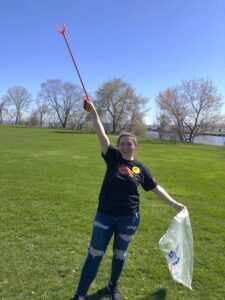
Ashley Muench, college student and volunteer.

Ashley grew up fishing with her dad on Lake Winnebago, but it was taking two environmental science classes at UW-Oshkosh that gave her a more concrete idea of how important the environment is. For the first time, she started to understand the human impact on the environment, and in particular, the effect her actions were having on the ecosystem.

“Why didn’t I hear about this until I went to college?” asked Ashley.

Ashley was starting to think about getting involved and making a difference, but wasn’t sure how. Then at a food truck festival in Fond du Lac, she saw the Fox-Wolf staff handing out brochures. She asked if there were volunteer opportunities, and then Ashley jumped in with both feet.

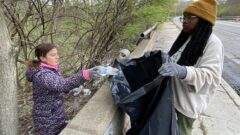
In just two years, she has been a volunteer with a restoration project, water quality monitoring, Winter Salt Watch, and AIS Snapshot Day. She has been a Site Leader at the Watershed Cleanup for two years in row. She does it all because she believes “it isn’t until you see things with your own eyes that you realize how important it is, and how big of an impact you can have.”

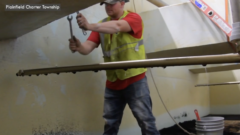
At last year’s Watershed Cleanup, the volunteers at her site cleaned up over 200 pounds of trash. “When you see what 230 pounds of trash looks like, it’s different than just hearing that number,” Ashley said. The biggest surprise to her was when a volunteer struggled to pull a huge tarp out from the water. “You wouldn’t have seen it if you were just walking by. I had no idea how much garbage is really in our waterways,” she said. “I literally felt like I wanted to cry seeing that first hand. Is this what we’re really doing to the environment?”

Instead of letting that realization overwhelm her, Ashley is using it to launch a plan for her adult life. She is working to complete a degree in environmental science. She has an internship this summer with the Glacial Lakes Conservancy, creating interpretive signage for waterways. She has applied for a research assistantship doing stream sampling looking at the effects of pollution.

For Ashley, Fox-Wolf Watershed Alliance has made all the difference.

“Before I started volunteering with Fox-Wolf, I would have thought I shouldn’t even apply,” Ashley said. “But two years of volunteering with Fox-Wolf means I have a lot to talk about.” She has received a scholarship, is applying for more, and is now considering job opportunities that once seemed out of reach.

Like most students, Ashley is busy, but she is hooked on water conservation. “It’s easy to see something and assume someone else is going to do something,” Ashley said. “But you can’t assume that other people are going to do it for you. I’m part of the problem; what can I do to fix it?”

“Volunteering has developed me as a person. It’s nice to get out there and know you’re making a difference,” she said. She would encourage everyone else to just get out there and do it too. “It’s personally rewarding. It provides a sense of community. And it helps you sleep at night!”

Watershed Moments is a new publication of Fox-Wolf Watershed Alliance, sharing the stories of how your donations have impacted lives in our community. Read our latest project updates, make a secure online donation, or become a member at www.fwwa.org

The post Watershed Moments: Ashley Muench appeared first on Fox-Wolf Watershed Alliance.

Original Article

Fox-Wolf Watershed Alliance

Fox-Wolf Watershed Alliance

https://fwwa.org/2023/05/16/watershed-moments-ashley-muench/?utm_source=rss&utm_medium=rss&utm_campaign=watershed-moments-ashley-muench

Sharon Cook

Lake Erie charter industry rebounding from slump

Veteran fishers on Lake Erie fondly recall the late 1980s as a heyday for walleye – a time when Ohio anglers were allowed to catch 10 fish a day and the big-eyed apex predators seemed an endless resource.

At its height in 1988, the Ohio charter fishing industry supported 1,221 licensed captains and nearly 5 million walleye were taken.

Read Now at Great Lakes Now.

Original Article

Great Lakes Now

Great Lakes Now

https://www.greatlakesnow.org/2023/05/lake-erie-charter-industry-rebounding-from-slump/

James Proffitt

Summary

Title: Senior Agriculture Policy Manager 

Status: Full-time, Exempt  

Location: Ohio preferred  

Role: The Senior Agriculture Policy Manager (Manager) plans and executes policy analysis, advocacy, and project implementation under the Agriculture & Water Restoration sections of the Alliance’s strategy. 

Structure: The Manager reports to the Agriculture & Restoration Policy Director and works with other program, fundraising, and communications staff.  

Compensation and Benefits: Salary range starts at $75,000. Medical, dental, short- and long-term disability, life insurance, FSA, 11 paid holidays plus the business days between 12/26 and 12/30, 3 weeks vacation to start + PTO; Fidelity 401(k) with employer match of up to 6% of salary.  

Work Environment: Remote; occasional travel required. 

Overview

The Senior Agriculture Policy Manager (Manager) plans and executes policy analysis, advocacy, and project implementation under the Agriculture & Water Restoration sections of the Alliance’s strategy. The Manager implements work across the Basin – with a particular emphasis in Ohio, Michigan, and Wisconsin – to achieve the Alliance’s agriculture and water goals. They are the lead liaison to state and local decision-makers, project partners, and stakeholders in Ohio and will grow and nurture similar relationships in other Alliance focus states. The Manager maintains a working knowledge of Ohio agriculture and source water programs and policies as they affect the Great Lakes and uses that knowledge to recommend new opportunities within the Alliance’s programs. The Manager ensures timely and high-quality execution of relevant Alliance strategic plan deliverables and partners with a variety of other staff members to support internal work planning, external communications, and grant proposals and reports. 

A typical day at the Alliance is often self-directed and is based on balancing immediate tasks – tracking the status of a relevant bill in the Ohio Legislature– and longer-term projects within the Agriculture and Restoration Program, like quantifying the costs to meet water quality targets in the Western Basin of Lake Erie. These short-term and longer-ranging projects and tasks are developed in close coordination with the Director based on the goals under the Alliance’s strategic plan, but the Manager is afforded the flexibility and autonomy to develop their own approach to advance these goals on a day-to-day basis. Our policy work is highly collaborative, and the Manager should feel comfortable engaging – independently – with legislative offices and agency staff as well as facilitating meetings with stakeholders and partners on a regular basis. 

Responsibilities

Planning & Policy 

  • Work in collaboration with the Agriculture and Restoration Policy Director (Director), to assist with the implementation of policy, governance, and funding mechanisms to support the reduction of agricultural pollution across the Great Lakes region.   
  • Manage relationships with the state of Ohio Administration, lawmakers, and regulatory agencies. Including tracking relevant legislation and administrative programs. 
  • Track the implementation of the Maumee River (OH) Total Maximum Daily Load (TMDL) and the overall changes in water quality in the Western Lake Erie Basin. 
  • Identify emerging issues and programmatic reform opportunities to improve surface and groundwater quality in Ohio and Michigan 
  • In coordination with the Director, assist in advancing policy and advocacy efforts in Ohio and Michigan with an emphasis on the Western Lake Erie Basin.  
  • Identify trends in mission areas, create fundable concepts and leverage work and ideas for increased organizational impact related to agricultural pollution reduction. 

Outreach 

  • Build issue-focused networks of key stakeholders with a focus in Ohio. 
  • Be a leadership voice for the Alliance and for the Great Lakes in Ohio and across the region. 
  • Create and conduct external outreach opportunities, such as public speaking, conferences, and presentations. 
  • Serve as an Alliance liaison to the Ohio environmental community, identifying advocacy and partnership opportunities and engaging other Alliance staff as appropriate. 
  • Work with Communications and Engagement team to determine and take advantage of opportunities to communicate to the media and Alliance supporters about the Alliance’s work in the Basin. 

Administrative 

  • Create and keep current Alliance case statement supporting engagement in Ohio. 
  • Assist in the development of short- and long-term work plans for Ohio and Michigan  
  • Create opportunities to add strategic capacity to Alliance work through affiliate programs, fellowships, and staff recruitment when possible. 
  • Contribute content to grant proposals and reports 

Knowledge/Skills

  • Bachelor’s degree, graduate degree preferred, with at least seven years of increasingly responsible professional experience in managing natural resource stewardship, environmental organizing and coalition building, community-based planning or similar field. 
  • Specific knowledge on state and federal agricultural and water quality policies and programs. 
  • Familiarity with the process of policy development and advocacy, as well as addressing the barriers and opportunities for policy implementation to be successful.    
  • Established network and relationship portfolio including stakeholders, experts, influencers, and decision-makers in Ohio and around the Great Lakes region 
  • Excellent diplomacy skills – the ability to read and respond productively to the needs of different stakeholders at any time is essential. 
  • Unwavering commitment to diversity, justice, equity and inclusion. Adhere to and exemplify these principles in addition to our values of community, relationships, courage, integrity, and optimism.  
  • Ability to communicate a working knowledge of Great Lakes issues with confidence to diverse audiences. 
  • Excellent listening, writing, and speaking skills. Must be able to speak publicly in a clear, compelling, and engaging manner. 
  • Able to identify and engage target constituencies that are most likely to have an affinity for the Great Lakes and motivate them to act on that affinity.  
  • Desire and ability to both lead and work as part of a staff team located in different offices with varying types of expertise and priorities. 
  • Ability to pivot strategies and tactics to an ever-changing policy landscape 

Job Parameters

  • This position is full-time and consistent with Alliance employment policy.  Salary range starts at $75,000 annually. 
  • Benefits include medical, dental, short- and long-term disability, life insurance, FSA, 11 paid holidays plus the business days between 12/26 and 12/30 (staff who must work on any holidays may take those holidays at another time subject to the employee handbook). Employees start with 3 weeks vacation annually + PTO; Fidelity 401(k) with a match of up to 6% of salary after one month of employment. 
  • The Manager position can be based in any of the Great Lakes states, but a preference is given to those candidates based within the state of Ohio. 

Application Process

Please e-mail a cover letter, resume and references to: 

hr@greatlakes.org. Include job title in the subject line. 

Applications will be accepted until (Date) or until the position is filled, whichever is earlier. Materials should be compatible with Microsoft Word or Adobe Acrobat. Applicants will receive confirmation of receipt of their materials and further guidance and updates about the hiring process by e-mail, with interviews provided for finalists. No phone inquiries, please. 

About the Alliance for the Great Lakes

The Alliance for the Great Lakes is an Equal Opportunity Employer. The search process will reinforce the Alliance’s belief that achieving diversity requires an enduring commitment to inclusion that must find full expression in our organizational culture, values, norms, and behaviors. 

Our vision is a thriving Great Lakes and healthy water that all life can rely on today and far into the future. We aspire to be a voice for the lakes, and to support the voices of the communities that depend on the lakes and their waters. 


The mission of the Alliance for the Great Lakes is to protect, conserve and restore the Great Lakes ensuring healthy water in the lakes and in our communities for all generations of people and wildlife. We advance our mission as advocates for policies that support the lakes and communities by building the research, analysis, and partnerships that motivate action and by educating and uniting people as a voice for the Great Lakes.   

To achieve our vision and mission, everyone in our organization will live our values of Community, Relationships, Courage, Integrity, and Optimism and weave the principles of Justice, Equity, Diversity and Inclusion into all our work. Each value and principle is backed by measurable goals and expectations for our Board of Directors and staff.  

 For more information about the Alliance’s programs and work, please visit us online at www.greatlakes.org

The post Senior Agriculture Policy Manager  appeared first on Alliance for the Great Lakes.

Original Article

News - Alliance for the Great Lakes

News - Alliance for the Great Lakes

https://greatlakes.org/2023/05/senior-agriculture-policy-manager/

Michelle Farley

I Speak for the Fish – What’s the most popular freshwater fish?

I Speak for the Fish is a monthly column written by Great Lakes Now Contributor Kathy Johnson, coming out the third Monday of each month. Publishing the author’s views and assertions does not represent endorsement by Great Lakes Now or Detroit Public Television. 

Read Now at Great Lakes Now.

Original Article

Great Lakes Now

Great Lakes Now

https://www.greatlakesnow.org/2023/05/i-speak-for-the-fish-whats-the-most-popular-freshwater-fish/

Kathy Johnson

The city of Chicago trumpeted a deal with the Illinois city of Joliet to divert treated drinking water from Lake Michigan, starting in 2030. But how and why Illinois can divert that much water inland underscores risky concessions the other seven Great Lakes states had to make when they negotiated the 2008 Great Lakes Compact. Read the full story by The Plain Dealer.

.

Original Article

Great Lakes Commission

Great Lakes Commission

https://www.glc.org/dailynews/20230515-joliet-diversion

Connor Roessler

Partners working to clean up a polluted hotspot on Lake Superior are now looking to monitor emerging threats from harmful algal blooms. A team of scientists is now deploying sensors to collect more than 300 water samples from the St. Louis River Estuary to track emerging water quality issues. Read the full story by Wisconsin Public Radio.

.

Original Article

Great Lakes Commission

Great Lakes Commission

https://www.glc.org/dailynews/20230515-estuary-monitoring

Connor Roessler

New York state water officials are keeping an eye on the Lake Ontario shoreline as the water is higher but still below flooding levels. The lake is seeing more water flow in from seasonal snowmelt up north, and less water flow out a dam on the New York-Canadian water border. Read the full story by WAER – Syracuse, NY.

Original Article

Great Lakes Commission

Great Lakes Commission

https://www.glc.org/dailynews/20230515-lake-ontario-levels

Connor Roessler

In a move to tackle an acute mariner shortage accentuated by the rapid retirement of boomers, Canada has signed an unprecedented agreement with the Philippines, allowing Filipino merchant mariners to serve on Canadian-flagged vessels. This marks a significant shift in international labor arrangements, opening new doors for the robust Filipino seafarer population, but causing worry among Canadian Merchant Mariners that wages could fall. Read the full story by gCaptain.

Original Article

Great Lakes Commission

Great Lakes Commission

https://www.glc.org/dailynews/20230515-filipino-mariners

Connor Roessler

Michigan remains the only state without a septic code, with recent efforts failing to gain traction within the Legislature. As the state contends with flooding and sewer backups, addressing individual septic systems is yet another element in addressing aging infrastructure and water quality issues for both inland waters and the Great Lakes. Read the full story by The Michigan Advance.

Original Article

Great Lakes Commission

Great Lakes Commission

https://www.glc.org/dailynews/20230515-septic-code

Connor Roessler

Local officials have been pursuing a public marina off the Belle River, citing a lack of docking space for boaters around the mid-point along the St. Clair River waterfront between Algonac, Michigan and the city of St. Clair. Read the full story by the Port Huron Times Herald.

Original Article

Great Lakes Commission

Great Lakes Commission

https://www.glc.org/dailynews/20230515-marine-city-marina

Connor Roessler

On a windy, Saturday morning, the UAL Fortitude arrived under the Aerial Lift Bridge in Duluth, Minnesota. The Fortitude’s arrival is significant because she’s the first of a regular liner service from overseas. Read the full story by WDIO-TV – Duluth, MN.

Original Article

Great Lakes Commission

Great Lakes Commission

https://www.glc.org/dailynews/20230515-fortitude-duluth

Connor Roessler

In Michigan’s Port Huron Township, fifth graders released 65 chinook salmon into the Black River as part of an education program with the Michigan Department of Natural Resources. An aquatic education coordinator for the DNR said the program teaches students the importance of Great Lakes ecology. Read the full story by the Port Huron Times Herald.

Original Article

Great Lakes Commission

Great Lakes Commission

https://www.glc.org/dailynews/20230515-student-salmon

Connor Roessler

In Michigan, the Great Lakes Maritime Heritage Center recently partnered with Alpena Public Schools to host the first-ever “3rd grade Get Into Your Sanctuary Program”, a multi-visit field trip that culminated with the students taking a boat ride to explore the Thunder Bay National Marine Sanctuary. Read the full story by The Alpena News.

Original Article

Great Lakes Commission

Great Lakes Commission

https://www.glc.org/dailynews/20230515-sanctuary-program

Connor Roessler

The village of Geneva-on-the-Lake in Ohio has joined the Lake County Communities Shoreline Special Improvement District, which will provide an additional funding option for the village to deal with erosion issues harming Lake Erie. Read the full story by the Star Beacon.

Original Article

Great Lakes Commission

Great Lakes Commission

https://www.glc.org/dailynews/20230515-shoreline-improvement

Connor Roessler

New Great Lakes book challenges readers with mystery, facts and whimsy

What is President Abraham Lincoln’s connection to a current vexing Great Lakes threat? Traveling south to Canada, right? And why would France go to court over a Great Lakes issue?

Those are some of the questions Traverse City author Dave Dempsey asks in his latest book, The Great Lakes: Fact or Fake.

Read Now at Great Lakes Now.

Original Article

Great Lakes Now

Great Lakes Now

https://www.greatlakesnow.org/2023/05/great-lakes-book-challenges-readers-mystery-facts-whimsy/

Gary Wilson

An eco-friendly beach robot known as BeBot made its debut Thursday as it cleaned microplastics from Pere Marquette Beach in Muskegon, MI. The remote-controlled technology can clear debris that is as small as 3 cm. Microplastics are often overlooked during beach cleanups, but they contribute to the pollution of the country’s waterways. Read the full story by WOOD-TV – Grand Rapids, MI.

Original Article

Great Lakes Commission

Great Lakes Commission

https://www.glc.org/dailynews/20230512-beachcleanup-robot-microplastics

Hannah Reynolds

The Michigan DNR is asking Michiganders for help in reporting marked splake when fishing on Lake Superior. Splake are a hybrid cross between lake trout and brook trout. Splake have been stocked in Lake Superior most years since 1971. The data collected from anglers assists the DNR in making decisions on how to best manage Michigan’s fisheries. Read the full story by WW-J-TV – Detroit, MI.

Original Article

Great Lakes Commission

Great Lakes Commission

https://www.glc.org/dailynews/20230512-dnr-report-splake-lakesuperior

Hannah Reynolds

Sturgeon are native to Lake Michigan and historically made spawning migrations up the Milwaukee River and other tributaries. However, dams, pollution and overfishing combined to wipe out the local sturgeon population by the late 1800s.  Since 2003, sturgeon have been stocked in the Milwaukee River or harbor as part of “Return the Sturgeon,” a joint effort of the DNR, U.S. Fish and Wildlife Service and Riveredge Nature Center in Newburg, WI. Read the full story by the Milwaukee Journal Sentinel.  

Original Article

Great Lakes Commission

Great Lakes Commission

https://www.glc.org/dailynews/20230512-upperpeninsula-cruiseport

Hannah Reynolds

The City of Houghton, Michigan has a new $5 million pier that’s equipped to dock cruise ships, which are becoming increasingly popular on the Great Lakes. Opened in the fall of 2022, the new pier serves as the city’s town square and event space but with its size, deep water and a few extra elements, it has the added function of being a cruise ship dock. Read the full story by MLive.com.

Original Article

Great Lakes Commission

Great Lakes Commission

https://www.glc.org/dailynews/20230512-upperpeninsula-cruiseport

Hannah Reynolds

The Township of Archipelago, ON is a municipality of 979 people located 200 kilometres north of Toronto on the eastern shoreline of Georgian Bay, part of the Lake Huron watershed. Its residents are concerned about the impacts of Ontario Premier Doug Ford’s Bill 23 on the Great Lakes ecosystem. Read the full story The Narwhal.

Original Article

Great Lakes Commission

Great Lakes Commission

https://www.glc.org/dailynews/20230512-ontario-seeksprotection-greatlakesbill

Hannah Reynolds

The City of Cleveland held its final Community Visioning Workshop Thursday to get feedback on its proposed North Coast Connector project to connect Lake Erie to Downtown Cleveland. Read and listen to the full story by WVIZ-TV – Cleveland, OH.

Original Article

Great Lakes Commission

Great Lakes Commission

https://www.glc.org/dailynews/20230512-cleveland-connectingdowntowntolakefront

Hannah Reynolds

A number of Canadian cities have exceeded acceptable chloride levels in watersheds in recent years, raising concerns about the impact on freshwater wildlife and other species. The problem largely stems from road salt and saline solutions, which have a chemical compound of chloride to keep roadways safe during winter weather. Chloride has both long- and short-term impacts on wildlife, and some experts believe it is adversely affecting fish, frogs and aquatic ecosystems across Canada. Read the full story by CTV News-TV – Toronto, Canada.

Original Article

Great Lakes Commission

Great Lakes Commission

https://www.glc.org/dailynews/20230512-wintermaintenance-effects-freshwater

Hannah Reynolds

The Great Lakes cruising season is now well underway and Ports Toronto said this year is once again setting another record. Fifty-four ships are scheduled to visit the city of Toronto between May and October, bringing more than 22,000 passengers to the city. Read the full story by CityNews Toronto.

Original Article

Great Lakes Commission

Great Lakes Commission

https://www.glc.org/dailynews/20230512-cruiseships-toronto-recordyear

Hannah Reynolds

As the two-year anniversary approaches since Canadian oil company Enbridge began defying a state shutdown order, environmental groups this week are renewing their call for the Biden administration to take immediate action to protect the Great Lakes from a controversial 70-year-old crude oil pipeline. Read the full story by Energy News Network.

Original Article

Great Lakes Commission

Great Lakes Commission

https://www.glc.org/dailynews/20230512-enbridge-line5-shutdown-bidenadministration

Hannah Reynolds

Snowmelt and recent rain have brought Great Lakes water levels up. This spring rise is normal – and water levels are projected to increase even more this month. Water levels for the Great Lakes are still lower than their record high from a couple of years ago. However, all the lakes are up from their long-term average, by between six and 13 inches, as of May 5. Read the full story by WKAR – East Lansing, MI.

Original Article

Great Lakes Commission

Great Lakes Commission

https://www.glc.org/dailynews/20230512-greatlakeswaterlevels-up-historicalaverage

Hannah Reynolds

EPA wants Native American tribes to implement water quality standards equivalent to the Clean Water Act’s requirements

By Lester Graham, Michigan Radio

The Great Lakes News Collaborative includes Bridge Michigan; Circle of Blue; Great Lakes Now at Detroit Public Television; and Michigan Radio, Michigan’s NPR News Leader; who work together to bring audiences news and information about the impact of climate change, pollution, and aging infrastructure on the Great Lakes and drinking water.

Read Now at Great Lakes Now.

Original Article

Great Lakes Now

Great Lakes Now

https://www.greatlakesnow.org/2023/05/epa-native-american-tribes-implement-water-quality-standards-clean-water-acts-requirements/

Michigan Radio

Ensuring Your Water Garden Doesn’t Harbor Invasive Plants

As you’re choosing your plants for your water gardens and backyards this spring, be sure you aren’t accidentally growing an invasive plant that could do harm to our lakes and rivers! But don’t take our word for it! Here’s some tips from Melinda Myers, nationally known gardening educator, horticulturist, arborist, author, speaker, and TV/radio host with more than 30 years of horticulture experience!

Questions? Comments? Contact Chris Acy, the AIS Coordinator covering Brown, Outagamie, Fond du Lac, Calumet, and Winnebago Counties at (920) 460-3674 or chris@fwwa.org!

Follow the Fox Wolf Watershed Alliance’s Winnebago Waterways Program on our Winnebago Waterways Facebook page or @WinnWaterways on Twitter! You can also sign-up for email updates at WinnebagoWaterways.org.

Winnebago Waterways is a Fox-Wolf Watershed Alliance program. The Fox-Wolf Watershed Alliance is an independent nonprofit organization that identifies and advocates effective policies and actions that protect, restore, and sustain water resources in the Fox-Wolf River Basin.

Check out the Keepers of the Fox Program at https://fwwa.org/watershed-recovery/lower-fox-recovery/

Reporting invasive species is a first step in containing their spread. Maintaining and restoring our waters and landscapes can reduce the impacts even when we don’t have other management options to an invasive species.

The post What’s That Plant? Know What’s In Your Water Garden appeared first on Fox-Wolf Watershed Alliance.

Original Article

Fox-Wolf Watershed Alliance

Fox-Wolf Watershed Alliance

https://fwwa.org/2023/05/11/whats-that-plant-know-whats-in-your-water-garden/?utm_source=rss&utm_medium=rss&utm_campaign=whats-that-plant-know-whats-in-your-water-garden

Chris Acy

The Catch: National PFAS limits

Broadcasting in our monthly PBS television program, The Catch is a Great Lakes Now series that brings you more news about the lakes you love. Go beyond the headlines with reporters from around the region who cover the lakes and drinking water issues. Find all the work HERE.

This month, The Catch features a story about national regulations on PFAS.

Read Now at Great Lakes Now.

Original Article

Great Lakes Now

Great Lakes Now

https://www.greatlakesnow.org/2023/05/the-catch-national-pfas-limits/

GLN Editor

U.S. representatives Marcy Kaptur, D-Toledo, and Bob Latta, R-Bowling Green, are leading a bipartisan group of 15 House members from Ohio and Michigan urging U.S. Department of Energy Secretary Jennifer Granholm to support a proposal for the Great Lakes Clean Hydrogen Hub. Read the full story by the Sentinel Tribune.

Original Article

Great Lakes Commission

Great Lakes Commission

https://www.glc.org/dailynews/20230510-hyrdogen-hub

Jill Estrada

Back-to-back court dates scheduled for this month could determine whether a proposed consent decree between the state, feds, and five sovereign tribes will cause drastic impacts to parts of our Great Lakes fishery. Read the full story by the Ludington Daily News.

Original Article

Great Lakes Commission

Great Lakes Commission

https://www.glc.org/dailynews/20230510-tribal-fishing

Jill Estrada

In Wisconsin, Milwaukee’s rivers that converge downtown and feed into Lake Michigan were once dumping grounds for industrial pollution. A remediation project is helping to restore the Milwaukee Estuary. Read the full story by WUWM – Milwaukee, WI.

Original Article

Great Lakes Commission

Great Lakes Commission

https://www.glc.org/dailynews/20230510-remediation

Jill Estrada

Heavy spring flooding has made Line 5 an “imminent threat” to Lake Superior and a key Indigenous watershed in Wisconsin, lawyers argued Tuesday in an emergency motion to shut down the controversial cross-border pipeline. Read the full story by The Canadian Press.

Original Article

Great Lakes Commission

Great Lakes Commission

https://www.glc.org/dailynews/20230510-line5

Jill Estrada

Wisconsin’s Lower Fox River that flows into the bay of Green Bay was one of the many places throughout the Great Lakes polluted with polychlorinated biphenyls. A new book examines the battles behind one of the largest, most divisive PCB river cleanups in history. Read the full story by Milwaukee Journal Sentinel.

Original Article

Great Lakes Commission

Great Lakes Commission

https://www.glc.org/dailynews/20230510-pcbs

Jill Estrada

Once beset by industrial pollution, Rouge River on a slow path to recovery

By Kelly House, Bridge Michigan

The Great Lakes News Collaborative includes Bridge Michigan; Circle of Blue; Great Lakes Now at Detroit Public Television; and Michigan Radio, Michigan’s NPR News Leader; who work together to bring audiences news and information about the impact of climate change, pollution, and aging infrastructure on the Great Lakes and drinking water.

Read Now at Great Lakes Now.

Original Article

Great Lakes Now

Great Lakes Now

https://www.greatlakesnow.org/2023/05/once-beset-industrial-pollution-rouge-river-slow-path-recovery/

Bridge Michigan

For our Diving Deep for Solutions series, we commissioned author and journalist Kari Lydersen to examine big issues facing the lakes today and how our expert team at the Alliance for the Great Lakes is growing to meet the moment.

In late April, teachers and students from Tremont Montessori descended on Edgewater Beach on Chicago’s lakefront armed with colorful plastic rakes, sieves and shovels to pick up trash. It was one of many Alliance for the Great Lakes beach cleanups happening across the lakes that weekend.

Students beamed as they loaded plastic stir sticks, shredded balloons and other debris into orange buckets. One student paused to carve his name, Albert, into the sand.

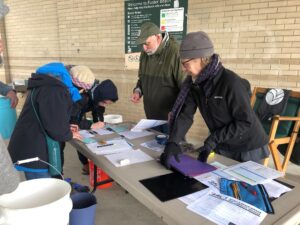
Volunteers sign in for an Adopt-a-Beach cleanup.

At nearby Foster Beach in Chicago, Eileen Ryan was leading a beach cleanup with the group she helps lead, Organizing for Plastic Alternatives. The multi-generational crowd hauled in pounds of plastics – water bottles, cups and plates – mostly single-use products, confirming Ryan’s longstanding position that plastic consumption and pollution is “out of control.”

Ryan’s feelings mirror the Alliance’s position: we must switch quickly away from reliance on plastics, so that youth like the Tremont students aren’t burdened with increasing loads of toxic plastic pollution for decades to come.

Ryan – an artist – takes meditative walks along the Lake Michigan beaches, chronicling the experience in serene photos posted to social media. Now, she spends those walks picking up plastic and photographing this waste to make a point. At an advocacy-oriented “Trashion Revolution” runway show in May, she is exhibiting a dress made entirely from plastic lids collected on her walks.

“People need to see what a travesty plastic is,” Ryan said. “Our unending consumption and waste from single-use plastic will be in our bodies, our water and our food for generations!”

Plastic pollution’s harmful impacts

In all, more than half a million pounds of litter, most of it plastic, has been collected through Alliance cleanups over the past 20 years.  

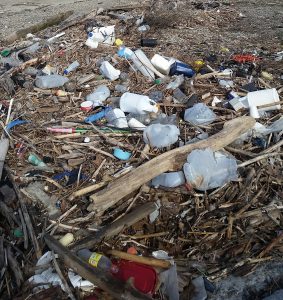
Plastic pollution on a beach.

Not only are components of plastic toxic in their own right, the fragments also absorb and harbor potentially dangerous microbes and chemicals. In all, about 22 million pounds of plastic get into the Great Lakes each year, and the lakes provide drinking water for more than 40 million people.

The Alliance has long worked to remove plastic waste from the Great Lakes through beach cleanups, as well as pushing for laws and policies like the 2015 federal ban on plastic microbeads formerly used in facial scrubs and other toiletries.

Now, along with continuing this work, the Alliance is prioritizing fighting plastic pollution at the root – slashing the amount of plastic that is produced and used – the same model Ryan advocates.

Plastic poses a serious threat to the environment and public health when it enters the Great Lakes and other waterways, but an even greater environmental injustice is the impact of the petrochemical facilities that produce plastic on surrounding communities.

“The burden of drinking water with some microplastic is real, but the burden you’re living with [near a petrochemical plant] is orders of magnitude different,” said Andrea Densham, a sustainability expert working with the Alliance on plastics.

From Louisiana and Texas to Illinois and Michigan, petrochemical and plastics plants are predominantly located in low-income communities and communities of color. As the country slowly shifts away from fossil fuels for energy and transportation, plastic production is often described as a “lifeline” for the oil and gas industry. Plastics, along with fertilizers and various other industrial and household products, are made from petroleum-based feedstock. Plastics also typically contain toxic “forever chemicals” like PFAs, synthetic compounds found in many household goods and linked to harms including increased risk of cancer, developmental problems, and interference with hormonal processes. Scientists are especially concerned about PFAs since they are very slow to break down in the environment, and their full impacts on human health are not yet understood.

Factories manufacturing plastics emit highly toxic, cancer-causing emissions and pose serious safety risks. And nearby residents, who typically already bear disproportionate pollution burdens from other sources, often have trouble obtaining transparency and protection from the major industry players and government regulators.

Changing to sustainable alternatives

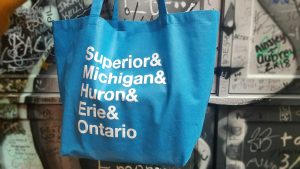
Blue bag with white text listing the names of the Great Lakes

A huge portion of the plastic products and packaging we use everyday could be replaced by other materials or simply eliminated, experts note. Bans on single-use plastics like plastic grocery bags, foam container, and straws are one solution that multiple municipalities have implemented in various forms.

Illinois legislators are considering bills that would phase out single-use polystyrene foam containers beginning in January 2024. The state House has passed the bill, and Illinois already enacted a law banning single-use plastic food products in state parks and at the state fair. Canada has banned the manufacturing and import of multiple single-use plastic products including straws, cutlery, and ring carriers; and the government has set an ambitious goal of recycling 90% of beverage containers.

Plant-based materials can be used for many of the products currently made from plastic. And extensive reuse and recycling can reduce demand for new plastic. The emphasis should be on “organic items we can compost or reuse, and glass or things that we can truly recycle, for a more circular economy,” said Densham.

It can be a win-win situation, as Great Lakes-region farmers and manufacturers can benefit by more demand for plant-based materials and reusable containers made out of glass or stainless steel.

“Just like we’ve made a commitment to move toward clean energy, we need to move toward cleaner manufacturing that uses more natural organic items like hemp and switchgrass,” said Densham. “If we incentivize manufacturers to use less and less and less PFAs and other toxic chemicals, we don’t have to clean it up on the other end,” after it has polluted the Great Lakes.

Making manufacturers responsible for waste

The Alliance is working with the Ocean Conservancy to push policies based around Extended Producer Responsibility, the idea that manufacturers of products that become waste are responsible for it – rather than shifting the burden to municipal or county waste management agencies. The concept of Extended Producer Responsibility has been incorporated into policy in states including California, Colorado, Maine, and Oregon, and it is gaining traction nationwide.

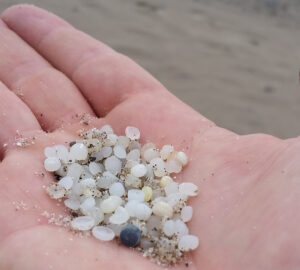
A hand holding tiny plastic nurdles

Demanding accountability from producers includes regulation of the dumping and release of “nurdles,” the pellets that are used to make plastic. Loyola University biologist Timothy Hoellein recently encountered a trove of such nurdles around the North Branch of the Chicago River, down the watershed from several plastics manufacturers. Now he’s seeking funding to study the distribution and source of nurdles in the region.

“They’re like discs with little dimples, very uniform. When you see a bunch of them together,  same shape and color, it’s a little shocking,” said Hoellein, who has partnered with the Alliance to analyze data from trash collected during the beach cleanups. “Plastic is not regulated as a pollutant in the same way other industrial discharges or wastes are, but it is a point source of pollution, and it seems like it should be controllable.”

Focusing on the manufacturing of plastics rather than littering doesn’t mean individual citizens are off the hook. Hoellein, Densham, and others emphasize that regular people have the power and responsibility to demand and make change around plastic pollution – starting at the root.

“We might not be the person throwing the plastic bag on the sidewalk, but we’re all part of this consumer system that has a demand for plastic bags,” said Hoellein. “We’re all collectively accountable for the production because we’re all purchasing the materials. There can be grassroots advocacy and collective demand for alternative products, a combination of policies that are put in place and creating a genuine market.”

Take Action to Stop Plastic Pollution

Your voice, when combined with thousands of advocates around the lakes, can make a difference! Our action center makes it easy for you to contact decision makers.

Take Action

The post Putting an end to plastic pollution appeared first on Alliance for the Great Lakes.

Original Article

News - Alliance for the Great Lakes

News - Alliance for the Great Lakes

https://greatlakes.org/2023/05/putting-an-end-to-plastic-pollution/

Judy Freed

PFAS News Roundup: The Nation’s first “PFAS Annihilator” is now being used in Michigan

PFAS, short for per- and polyfluoroalkyl substances, are a group of widespread man-made chemicals that don’t break down in the environment or the human body and have been flagged as a major contaminant in sources of water across the country.

Keep up with PFAS-related developments in the Great Lakes area.

Read Now at Great Lakes Now.

Original Article

Great Lakes Now

Great Lakes Now

https://www.greatlakesnow.org/2023/05/pfas-news-roundup-nations-first-pfas-annihilator-being-used-michigan/

Kathy Johnson

...DENSE FOG ADVISORY IN EFFECT UNTIL 9 AM CDT THIS MORNING... * WHAT...Visibility one quarter mile or less in dense fog. * WHERE...Manitowoc, Lincoln, Oneida, Brown, and Shawano Counties. * WHEN...Until 9 AM CDT this morning. * IMPACTS...Rapid reductions in visibility could make driving conditions hazardous. Use caution on your morning commute.

Original Article

Current Watches, Warnings and Advisories for Brown (WIC009) Wisconsin Issued by the National Weather Service

Current Watches, Warnings and Advisories for Brown (WIC009) Wisconsin Issued by the National Weather Service

https://alerts.weather.gov/cap/wwacapget.php?x=WI1266484EB1A8.DenseFogAdvisory.1266484F9820WI.GRBNPWGRB.5040c85a69f8ebaeb0afc6c5828448f5

w-nws.webmaster@noaa.gov

...PATCHY DENSE FOG EXPECTED OVERNIGHT INTO EARLY TUESDAY... Patchy dense fog, with visibilities of 1/4 mile or less, may develop in Shawano, Green Bay and Manitowoc overnight. The patchy dense fog is expected to continue through 8 am or 9 am Tuesday before lifting. Motorists traveling across the region overnight can expect

Original Article

Current Watches, Warnings and Advisories for Brown (WIC009) Wisconsin Issued by the National Weather Service

Current Watches, Warnings and Advisories for Brown (WIC009) Wisconsin Issued by the National Weather Service

https://alerts.weather.gov/cap/wwacapget.php?x=WI1266484DEB9C.SpecialWeatherStatement.1266484EFBE0WI.GRBSPSGRB.10c9efba54bd1dfff29a2dd0729ab3c8

w-nws.webmaster@noaa.gov

Commercial fishers are catching fewer whitefish in parts of the Great Lakes – and the Anishinaabe people are trying to figure out why. The Little Traverse Bay Bands of Odawa Indians is looking into low reproduction rates for the fish. Read the full story by Bridge Michigan.

Original Article

Great Lakes Commission

Great Lakes Commission

https://www.glc.org/dailynews/20230508-anishinaabetribes-savemiwhitefish

Hannah Reynolds

Water levels tend to fluctuate during the year, but seasonally speaking, lake levels typically rise during the spring and early summer. Highest water usually occurs in July. The water level of Lake Michigan and Huron, (hydrologically, a single lake) has fallen a net 4 inches from one year ago. However, this level still stands 6 inches above the May average, which has been tracked since 1918. Read the full story by WXMI-TV – Grand Rapids, MI.

Original Article

Great Lakes Commission

Great Lakes Commission

https://www.glc.org/dailynews/20230508-lakemi-lakehuron-waterlevels-aboveaverage

Hannah Reynolds

An aging sewer main that crosses the Muskegon River poses a “high environmental risk” and needs to be replaced at an estimated cost of $43 million. The county public works board agreed to apply for a state loan to pay for replacement of the approximately 6 miles of metal pipe that is at risk of breaking and does not meet capacity needs. Read the full story by MLive.

Original Article

Great Lakes Commission

Great Lakes Commission

https://www.glc.org/dailynews/20230508-muskegonlake-sewermain

Hannah Reynolds