Oshkosh Aviation Weather
2023-07-18

With nearly 125 million buildings across the United States, all these spaces account for about 30 percent of the country’s emissions. In 2014, Donnel Baird created BlocPower to get these spaces off fossil fuels by changing out old water systems, gas ovens, gas and oil furnaces and air conditioning units with electric equipment, like air source heat pumps, which are compatible with renewable energy options.
Great Lakes Now
https://www.greatlakesnow.org/2023/07/ted-countdown-blocpower-ceo-donnel-baird-greening-americas-buildings-improving-communities/
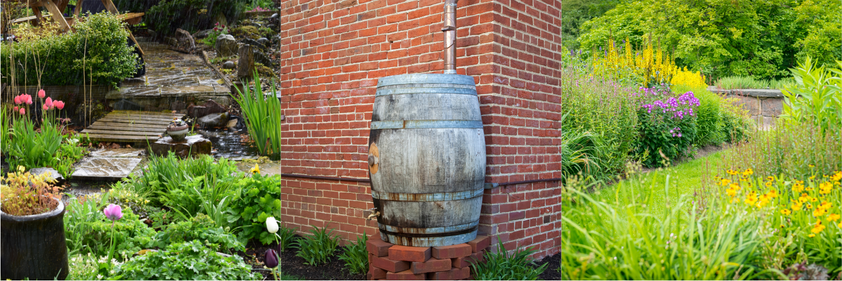
A gorgeous home landscape does not need to come at the price of clean lakes, rivers, and streams. We can have both. To make it happen, we all need to think a little differently.
Less hard surfaces
The more concrete or blacktop your property has, the more water will run off the property and into storm drains and ditches. 75% more rain water sinks into the ground in a natural versus developed area. Stormwater that flows from developed areas also carries oil, grease, fertilizer, bacteria, exhaust particles, and more.
Planning for minimal hard surface on your property makes good sense. Consider the amount of runoff that will be generated by roofs, pavements, and sidewalks. Focus on natural plantings to slow water and allow it to filter into the ground rather than becoming runoff. Where needed, install pavers or bricks that allow water to sink in the ground.
Minimizing runoff reduces damage to your property and others down stream. It may also save you money if you live in a city that has a stormwater utility, since stormwater utility fees are based on the amount of runoff your property sends to the storm sewer system.
Rain gardens are slight depressions in a yard that acts as receiving areas for rain water that runs off your roof and downspouts. Rain gardens capture rainwater before it picks up oil, grease, fertilizer, pet waste, or other contaminants. Rain gardens replenish groundwater by infiltrating runoff, rather than passing it into the stormwater sewer. Often they are planted with native plants that thrive on moisture, but can withstand a dry period too.
A rain barrel captures water that flows from a roof through downspouts. Commonly, the rain barrel is a 55-gallon drum designed specifically to hold water without creating a mosquito breeding habitat. A tight fitting lid, seal for the downspout, and filtered overflow valve all overflow water to move away from the rain barrel.
Northeast Wisconsin Stormwater Consortium (NEWSC) P.O. Box 1861 Appleton, WI 54912 l 920.851.4336
RenewOurWaters.org
Stormwater is rain or snowmelt and water from things people do, like washing the car or watering the lawn. As water makes its way to the storm drain it picks up pollutants like oil from car leaks and bacteria from pet waste. When we choose products carefully and dispose of products properly, we can greatly reduce the amount of pollution that enters our local waters through runoff.
Untreated runoff is the biggest threat to our nation’s water quality, according to the U.S. Environmental Protection Agency. Let’s make the small, important changes that will reduce that threat and improve water quality and our lives!
—

—
The post The Perfect Landscape appeared first on Fox-Wolf Watershed Alliance.
Fox-Wolf Watershed Alliance
https://fwwa.org/2023/07/18/the-perfect-landscape/?utm_source=rss&utm_medium=rss&utm_campaign=the-perfect-landscape

Your dog brings a lot of joy to your life. Enjoying your four legged friend doesn’t need to come at the price of clean water. We can have both, but to make that happen, we all need to think a little differently
Pet waste is not only an unpleasant find on a yard or sidewalk, it also carries bacteria that causes beach closings in the summer.
Before dumping your dirty water into the sanitary sewer, filter the water to make sure that any fiber or debris does not go down the drain. Debris in the wash water can clog the pipes. Dispose of the filtered material in the garbage, provided that the carpet was not contaminated with hazardous materials.
Campylobacteriosis and Salmonellosis are often the cause of the “24-hour bug”. They are transferred through fecal material from an infected person or animal
Toxoplasmosis is carried by a single-celled parasite that lives in infected animal feces (typically cats). In pregnant women, it can pass through the umbilical cord to the unborn fetus, causing serious abnormalities.
Prevent bacteria in our streams by carrying small plastic bags when walking your dog. Collect droppings, tie a knot in the bag, and dispose of it properly. Do not throw pet waste down a sewer.
At home, pick up pet waste often. Even waste in your backyard can pollute local waterways. You can flush the waste down the toilet or put it in your trash can (be sure to check your local ordinances first!).
Northeast Wisconsin Stormwater Consortium (NEWSC) P.O. Box 1861 Appleton, WI 54912 l 920.851.4336
RenewOurWaters.org
Stormwater is rain or snowmelt and water from things people do, like washing the car or watering the lawn. As water makes its way to the storm drain it picks up pollutants like oil from car leaks and bacteria from pet waste. When we choose products carefully and dispose of products properly, we can greatly reduce the amount of pollution that enters our local waters through runoff.
Untreated runoff is the biggest threat to our nation’s water quality, according to the U.S. Environmental Protection Agency. Let’s make the small, important changes that will reduce that threat and improve water quality and our lives!
—
—
The post Good Dog, Good Owner appeared first on Fox-Wolf Watershed Alliance.
Fox-Wolf Watershed Alliance
https://fwwa.org/2023/07/18/good-dog-good-owner/?utm_source=rss&utm_medium=rss&utm_campaign=good-dog-good-owner
NCEI News Feed
https://www.ncei.noaa.gov/news/humans-ncei-christina-maurin

This article was republished here with permission from Planet Detroit.
By Nina Ignaczak, Planet Detroit
As Michigan deals with periodic wildfire smoke drifting across its borders, the Michigan Department of Environment, Great Lakes and Energy has a new advisory protocol to inform the public about resulting poor air quality.
Great Lakes Now
https://www.greatlakesnow.org/2023/07/record-air-pollution-canadian-wildfires-prompts-state-change-how-issues-air-quality-alerts/
The project is meant to help prevent catastrophic damage to the Great Lakes fishery.
The post Des Plaines River is a site of new impediments to voracious species first appeared on Great Lakes Echo.Great Lakes Echo
http://greatlakesecho.org/2023/07/17/des-plaines-river-is-a-site-of-new-impediments-to-voracious-species/
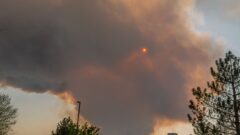
By Janelle D. James, Bridge Michigan
The Great Lakes News Collaborative includes Bridge Michigan; Circle of Blue; Great Lakes Now at Detroit Public Television; and Michigan Radio, Michigan’s NPR News Leader; who work together to bring audiences news and information about the impact of climate change, pollution, and aging infrastructure on the Great Lakes and drinking water.
Great Lakes Now
https://www.greatlakesnow.org/2023/07/michigan-air-quality-unhealthy-again-monday-canadian-wildfires/
Three years ago, Viking, the luxury cruise line, struck a deal with the National Oceanic and Atmospheric Administration to launch passenger cruises on the Great Lakes with a scientific bent, allowing passengers to assist with laboratory experiments. Read the full story by Bridge Magazine.
Great Lakes Commission
https://www.glc.org/dailynews/20230717-science-cruises
Some environmental advocates are unhappy with some of Ohio’s new Lake Erie plans, as it is not a regulatory document. Read the full story by WTVG-TV – Toledo, OH.
Great Lakes Commission
https://www.glc.org/dailynews/20230717-erie-guidelines
The director of the Central Michigan University Institute for Great Lakes Research joined two submersible owners under Lake Michigan at Beaver Island this week to assist the station’s water quality and fisheries research. Read the full story by MLive.
Great Lakes Commission
https://www.glc.org/dailynews/20230717-private-submersibles
Several wetland restoration and enhancement projects have been announced for Lake Huron and Lake Erie, as part of a multi-million dollar investment from the Ontario government. Read the full story by CKXS – Wallaceburg, Ontario.
Great Lakes Commission
https://www.glc.org/dailynews/20230717-wetland-restoration
A no-contact order remains in place for a section of the St. Joseph River in Southwest Michigan a week after sewage spilled into the river. A lag between the time of the spill and the warning means some people went into the Lake Michigan tributary without realizing they could be in danger. Read the full story by the MLive.
Great Lakes Commission
https://www.glc.org/dailynews/20230717-kayakers-sewage
In Michigan, a project to shore up South Haven’s South Beach and protect it from erosion that occurred in 2019 due to record-high water levels on Lake Michigan is nearing completion. This past week, the United States Army Corps of Engineers began the finishing work on the project that will add approximately 57,000 cubic yards of dredged material from the Black River Channel to expand the sand on the beach that was washed away during the high-water levels. Read the full story by the South Haven Tribune.
Great Lakes Commission
https://www.glc.org/dailynews/20230717-south-beach
Michigan residents are being warned to be prepared for another season of harmful algal blooms in the Great Lakes. The Michigan Department of Environment, Great Lakes, and Energy is advising people on what to do if they encounter the algae. Read the full story by WXPR – Rhinelander, WI.
Great Lakes Commission
https://www.glc.org/dailynews/20230717-algae-michigan
A new state of the art wastewater treatment plant is up and running in the City of Cheboygan, Michigan. The new facility will enhance public health safeguards, better protect Lake Huron, and reduce costs through state assisted funding. Read the full story by WPBN-TV – Traverse City, MI.
Great Lakes Commission
https://www.glc.org/dailynews/20230717-cheboygan-wastewater
Potash shipments at the port of Thunder Bay, ON have made a strong comeback in June reaching 31 per cent higher than June 2022. Chris Heikkinen, director of business development with the port, says the reason for the uptick is “it’s timing more than anything.” Read the full story by the Chronicle Journal.
Great Lakes Commission
https://www.glc.org/dailynews/20230717-potash
In New York, Chautauqua Institution provided an opportunity last month for the public to learn more about the array of research and management efforts taking place on and around Chautauqua Lake. Read the full story by the Post-Journal.
Great Lakes Commission
https://www.glc.org/dailynews/20230717-institution-event
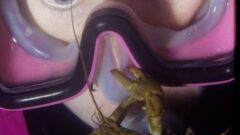
I Speak for the Fish is a monthly column written by Great Lakes Now Contributor Kathy Johnson, coming out the third Monday of each month. Publishing the author’s views and assertions does not represent endorsement by Great Lakes Now or Detroit Public Television.
Great Lakes Now
https://www.greatlakesnow.org/2023/07/i-speak-for-the-fish-facing-wrath-crayfish/
Ah, a summer day at the beach: cool water, warm sand and a beverage at hand. Wisconsin’s 180 public beaches are one of the state’s most-valued assets. They provide recreational opportunities, economic benefits for coastal communities and enhance the quality of life for residents.
Keeping those beaches safe for people to use is a continuing process. Beach managers use levels of Escherichia coli (E. coli), a bacterium from fecal pollution in water to know when to keep beaches open or closed. It’s far from a perfect indicator, however. E. coli can come from many sources, not all of it harmful to humans, and it can persist in the environment sometimes for weeks after it was introduced. In fact, sand can contain more E. coli than water. This can make a beach manager’s job complicated.
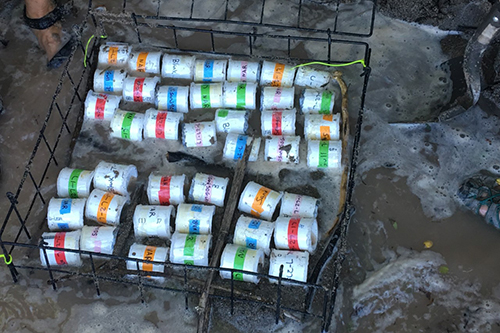
Microcosms containing E. coli samples were buried in sand for six weeks at several beaches in a related project by McLellan. Image credit: Natalie Rumball
Sea Grant-funded researchers Sandra McLellan and Gyaneshwar Prasad, both with the University of Wisconsin-Milwaukee, are building on previous research to find ways to decomplicate beach managers’ lives by determining what factors could limit long-term survival of E. coli on beaches.
McLellan, a professor in the School of Freshwater Sciences, explained the pros and cons of E. coli as an indicator.
“It’s a great indicator because it’s so easy for people to culture in the lab. It’s easy to count. Where it’s not a good indicator is it really doesn’t tell you anything about the source of what’s there. You don’t know where to direct your management strategies. Should I be chasing away the birds or should I be looking for a leaking sewage pipe nearby? And then to top it off, the other downside is the E. coli survives outside of a host. There’s prolonged survival in the sand and maybe even growth if enough nutrients are available,” McLellan said.
Once outside a human or animal gut, E. coli usually only live a couple of days. But under certain circumstances, it can live for week or even indefinitely in sand.
With graduate student Sophia Ward’s help, McLellan and Prasad are studying sand and water at six Lake Michigan beaches: two in Kenosha County, two in Manitowoc County and two in Milwaukee County. McLellan thinks this array of beaches will provide good representation of what goes on around the Lake Michigan shoreline.
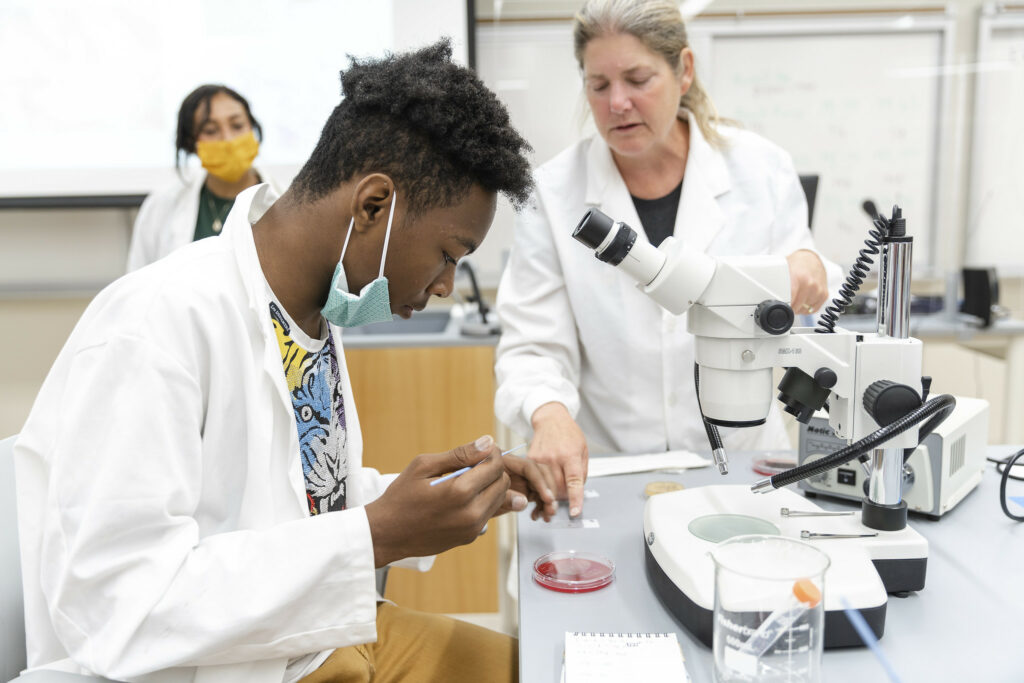
Sandra McLellan interacts with high school students who are studying E. coli in a program she ran in partnership with the Sixteenth Street Clinic in Milwaukee in 2021. Image credit: Wisconsin Sea Grant
They are also testing for levels of nutrients such as carbon, nitrogen, phosphorus and iron. In addition, they are conducting laboratory experiments to “starve” long-lived E. coli of these nutrients to see what drives their survival.
For the lab experiments, E. coli is mixed with sand and packed into small microcosms (miniature environments). McLellan describes them as four-inch diameter PVC pipes cut into four-inch sections. “We bury them in a bed of sand and keep them nice and moist. This helps us mimic what happens at the beach. The water can pass through, but the E. coli can’t escape from those little microcosms.”
The E. coli contain an extra piece of DNA that has a green fluorescent protein engineered in such a way that when the cell is starved, it lights up. The researchers then feed them with water containing varying amounts carbon, nitrogen, phosphorus and iron. They remove the microcosms periodically and count the E. coli to see how many have survived and see if any display the fluorescent-green markers of starvation.
From preliminary experiments, McLellan suspects carbon might be the most important factor that allows E. coli to persist. In beach environments, carbon is often provided by decaying plant life, especially leaves and the nuisance algae, Cladophora.
Once this limiting factor is confirmed, McLellan and her team will develop a scorecard for the potential of long-term E. coli reservoirs for each beach. “By scoring how easily or how much E. coli is growing in the sand at these beaches, it can help beach managers direct their attention to what might be some probable sources at their beaches,” McLellan said. They are also taking nutrient levels into account.
“The scorecard is developing. I think once we understand the dynamic range of what these beaches look like, then we’ll have a better idea of what the scorecard will actually look like,” she added. The information will also be useful to the Wisconsin Department of Natural Resources, which heads the Wisconsin beach monitoring program.
The post Persistent Pollution: Researchers investigate the key to E. coli bacteria survival in Lake Michigan beach sand and water first appeared on Wisconsin Sea Grant.News Releases | Wisconsin Sea Grant
News Releases | Wisconsin Sea Grant
https://www.seagrant.wisc.edu/news/persistent-pollution-researchers-investigate-the-key-to-e-coli-bacteria-survival-in-lake-michigan-beach-sand-and-water/
NCEI News Feed
https://www.ncei.noaa.gov/news/enso-detection-and-monitoring-depends-data
Current Watches, Warnings and Advisories for Brown (WIC009) Wisconsin Issued by the National Weather Service
https://alerts.weather.gov/cap/wwacapget.php?x=WI126654A5F13C.AirQualityAlert.126654B40C90WI.GRBAQAGRB.da5a7ed5beb109af88bb4b1c4265f55a
Current Watches, Warnings and Advisories for Brown (WIC009) Wisconsin Issued by the National Weather Service
https://alerts.weather.gov/cap/wwacapget.php?x=WI126654A45778.SpecialWeatherStatement.126654A47C30WI.GRBSPSGRB.47a4c4767dbd26d7484e0fb0d41919b2
Current Watches, Warnings and Advisories for Brown (WIC009) Wisconsin Issued by the National Weather Service
https://alerts.weather.gov/cap/wwacapget.php?x=WI12665497BA90.AirQualityAlert.126654A69F10WI.GRBAQAGRB.95772b461ecdeafcc9c0642321d118ec
Current Watches, Warnings and Advisories for Brown (WIC009) Wisconsin Issued by the National Weather Service
https://alerts.weather.gov/cap/wwacapget.php?x=WI12665497BA90.AirQualityAlert.126654A69F10WI.GRBAQAGRB.95772b461ecdeafcc9c0642321d118ec
Current Watches, Warnings and Advisories for Brown (WIC009) Wisconsin Issued by the National Weather Service
https://alerts.weather.gov/cap/wwacapget.php?x=WI126654954D78.SpecialWeatherStatement.126654957294WI.GRBSPSGRB.940d7b3678472919033e33d5c588d613
Current Watches, Warnings and Advisories for Brown (WIC009) Wisconsin Issued by the National Weather Service
https://alerts.weather.gov/cap/wwacapget.php?x=WI126654887918.AirQualityAlert.126654A69F10WI.GRBAQAGRB.95772b461ecdeafcc9c0642321d118ec
The U.S. Environmental Protection Agency and partners are seeking input on their latest plan to guide restoration and protection of the Great Lakes under an updated action plan for the Great Lakes Restoration Initiative from 2025 to 2029. Read the full story by Wisconsin Public Radio.
Great Lakes Commission
https://www.glc.org/dailynews/20230714-epa-input
The Great Lakes Shipwreck Historical Society announced Wednesday the discovery of a tug boat that sank into the waters of Lake Superior 144 years ago. The historical society said the Satellite sank on June 21, 1879, either as a result of a mechanical problem or because the boat struck a floating log. Read the full story by WPBN-TV – Traverse City, MI.
Great Lakes Commission
https://www.glc.org/dailynews/20230714-shipwreck

We are at a choice point when it comes to our relationship with water, says noted water expert Peter Gleick.
We can continue on our current path, which has evolved over centuries and includes unsustainable water use and ecological destruction. Both further worsened as we grapple with the effects of climate change.
Great Lakes Now
https://www.greatlakesnow.org/2023/07/book-review-water-scientist-offers-positive-vision-avoid-dystopian-future/
The Chicago Park District released three endangered piping plover chicks Wednesday at Montrose Beach along Lake Michigan, hoping to help the species which is nearly extinct in the Great Lakes region. Read the full story by WMAQ-TV – Chicago, IL.
Great Lakes Commission
https://www.glc.org/dailynews/20230714-piping-plovers
Several types of technology are deployed along beaches in the Great Lakes region to remove trash and other marine debris, both large and small. Read the full story by WLUK-TV – Green Bay, WI.
Great Lakes Commission
https://www.glc.org/dailynews/20230714-marine-debris
The U.S. Army Corps of Engineers, Detroit District will begin planned maintenance work in the navigation channel in Charlevoix, Michigan to replace deteriorating timber fenders along the channel revetments. Read the full story by MLive.
Great Lakes Commission
https://www.glc.org/dailynews/20230714-channel-repair
Several beaches along Lake Erie’s Presque Isle are restricted for swimming due to E. coli. Officials are searching for the reason. Read the full story by the Erie Times-News.
Great Lakes Commission
https://www.glc.org/dailynews/20230714-presque-isle
On July 13, 1938, five people were killed after a type of tsunami hit Holland, Michigan. Eighty-five years later, researchers say meteotsunamis in the Great Lakes occur more than some may think. Read the full story by WOOD-TV – Grand Rapids, MI.
Great Lakes Commission
https://www.glc.org/dailynews/20230714-tsunamis
On rare occasions of heavy rainfall, the Chicago Metropolitan Water Reclamation District officials will reverse the flow of river water into Lake Michigan to reduce river flooding. Read the full story by WBBM-TV – Chicago, IL.
Great Lakes Commission
https://www.glc.org/dailynews/20230714-chicago-river
As the summer continues to heat up, Lake Superior researchers are urging the public to look out for and report algae blooms. Read the full story by KBJR-TV – Superior, WI.
Great Lakes Commission
https://www.glc.org/dailynews/20230714-superior-algae
A Holland man will attempt to swim across Lake Michigan this summer to raise money for the Holland Aquatic Center. Read the full story by WZZM-TV – Grand Rapids, MI.
Great Lakes Commission
https://www.glc.org/dailynews/20230714-holland-man

Keep up with energy-related developments in the Great Lakes area with Great Lakes Now’s biweekly headline roundup.
Click on the headline to read the full story:
Illinois
Byron nuclear station, 12 taxing bodies reach settlement on EAV — Ogle County News
The owner of an Illinois nuclear plant reaches an agreement with surrounding taxing entities on how much it owes in property taxes, settling years of ongoing appeals.
Great Lakes Now
https://www.greatlakesnow.org/2023/07/energy-news-roundup-sulfur-smell-indiana-minnesota-power-solar-project/
By A.J. Evans, Michigan Radio
The Great Lakes News Collaborative includes Bridge Michigan; Circle of Blue; Great Lakes Now at Detroit Public Television; and Michigan Radio, Michigan’s NPR News Leader; who work together to bring audiences news and information about the impact of climate change, pollution, and aging infrastructure on the Great Lakes and drinking water.
Great Lakes Now
https://www.greatlakesnow.org/2023/07/no-contact-advisory-in-place-for-part-of-st-joseph-river/
Current Watches, Warnings and Advisories for Brown (WIC009) Wisconsin Issued by the National Weather Service
https://alerts.weather.gov/cap/wwacapget.php?x=WI12665487A628.AirQualityAlert.126654969980WI.GRBAQAGRB.95772b461ecdeafcc9c0642321d118ec

Eat Your Heartland Out is a Taste Awards nominated program about the intersection of food and culture in the American Midwest. The show is produced by the Heritage Radio Network, a leader in culinary audio storytelling and distributed on the Public Radio Exchange (PRX), which provides content to public radio affiliates across the United States.
Great Lakes Now
https://www.greatlakesnow.org/2023/07/eat-your-heartland-out-great-wine-great-lakes/
The University of Wisconsin Water Resources Institute recently provided funds for three new projects that will conclude at the end of June 2025:
Risk From Pathogens and Exposure to Antibiotic Resistance Genes in Private Wells in Southwest Wisconsin, led by Maureen Muldoon at the University of Wisconsin-Madison
Here’s things that are true about the southwestern Wisconsin counties of Lafayette, Grant and Iowa: they are predominantly rural, people living there mostly get their drinking water from private wells and the water sources lie under fractured rock, which means septic systems and agricultural practices can more easily contaminate the water supply. This research team has recent findings of viral, bacterial and protozoan pathogens in 66 of the 138 private wells in the area, but the health risk associated with this contamination is unknown. That’s in keeping with the broader lack of knowledge about the health risk associated with private well water. This project has three objectives 1) quantify the health risk associated with 10 pathogens detected in wells 2) evaluate well construction and geologic factors for pathogen contamination and 3) assess antibiotic resistance genes co-occurrence with human and livestock fecal contamination.
An Experimental Investigation on the Leaching of Per- and Polyfluoroalkyl Substances (PFAS) From Contaminated Soil, led by Shangping Xu at the University of Wisconsin-Milwaukee
The majority of people in Wisconsin get their drinking water from groundwater. This project will attempt to build an understanding of how what are known as “forever chemicals,” per- and polyfluoroalkyl substances (PFAS), might move through soil and into groundwater drinking water sources. The research team will collect soil core samples from several Wisconsin location, including samples based on factors like soil type, properties and PFAS contamination history. They will apply collected rainwater to the soil cores at rates simulating natural conditions. The rainwater flow patterns will be monitored, and leachate will be collected to measure its volume and its PFAS concentrations. If different transport behavior of PFAS within soil cores collected from different sites is observed, the comparison of the soil physicochemical properties and hydrological patterns will provide clues to the key factors that control PFAS mobility within the vadose zone (where the land and the aquifer meet). This work may also yield knowledge of “high risk” and currently overlooked PFAS areas.
Long-Term Threat of Geogenic Contaminants to Water Quality and Quantity in the Midwestern Cambrian Ordovician Aquifer System, led by Matt Ginder-Vogel at the University of Wisconsin-Madison
The Cambrian Ordovician Aquifer System underlies most of Wisconsin. It’s a system with naturally occurring contaminants—uranium, radium, arsenic and manganese. This project seeks to understand the sources and temporal trends of these contaminants because their variations complicate municipal water system management. The research team will identify six study sites, obtain well cuttings and/or core materials from the sites, quantify the presence and prevalence of potential contaminants and then construct models of how the contaminants move in the system. This will help water managers build and manage wells in a way that prevents water users from being exposed to contaminants.
Two University of Wisconsin-Madison-based projects kicked off last July and are ongoing with completion targeted for next year:
Aligning the Wisconsin Idea on Water: Interpreting Public Perspectives and Values, led by Michael Cardiff
This project is documenting rural perspectives (attitudes, perception and values) related to groundwater issues, and the variability of these perspectives within the state through “Wisconsin’s Waters Survey”—a community-sourced public survey to be delivered to a range of rural communities. Rural land covers most of the state, overlies the majority of groundwater and the range of issues that may be important to the rural public is vast, from quality concerns such as nitrate and microbial contamination, to quantity concerns that include agricultural irrigation needs and impacts of groundwater to springs and streamflows.
Biomanipulation of Groundwater Flooding, led by Steve Loheide
This project is examining the causes of groundwater flooding, which leads to the loss of farmland and permanent inundation of homes. Such flooding can happen when extremely flat, internally or poorly drained landscapes get hit with a quantity of rain that doesn’t otherwise drain away, infiltrate the soil without flooding or dissipate through the atmosphere. The research team is examining Dane and Columbia counties’ flood records from the 1930s to the present to identify flood causes and how such factors may have changed through time.
The post Water Research Projects Announced first appeared on WRI.
News Release | WRI
https://www.wri.wisc.edu/news/water-research-projects-announced/
This article was republished here with permission from Planet Detroit.
By Nina Ignaczak, Planet Detroit
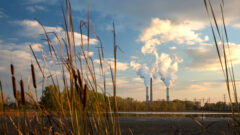
DTE Electric has agreed to shut down its Monroe coal-fired power plant three years ahead of schedule under a settlement agreement with environmental, business and labor groups filed Wednesday with the Michigan Public Service Commission.
Great Lakes Now
https://www.greatlakesnow.org/2023/07/dte-agrees-shut-down-coal-fired-monroe-plant-three-years-ahead-schedule/
Points North is a biweekly podcast hosted by Daniel Wanschura and Morgan Springer about the land, water and inhabitants of the Upper Great Lakes.
This episode was shared here with permission from Interlochen Public Radio.
The idea that wilderness is untouched by man is written into law, but it’s not so accurate.
Great Lakes Now
https://www.greatlakesnow.org/2023/07/points-north-rekindling-wilderness/
NCEI News Feed
https://www.ncei.noaa.gov/news/global-climate-202306
The Fox Locks pre-date the Civil War, so there is a large body of historical information on the system. We are lucky to have an amateur historian on staff, and these are excerpts from Scott Thompson’s greater research into the system.
Don’t drink the water?
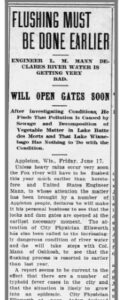 Many communities along the Fox River used the river for drinking water and even in the early 1900s pollution was a concern. This article from Appleton Post dated June 23, 1910, outlines the conditions on the river and Little Lake Butte des Morts. At the time, wastewater treatment was still 20-30 years into the future and communities dumped sewage directly into the river. Residents and city leaders were always watching for cases of Scarlet Fever and other water-borne infections.
Specifically, the article mentions that the lock master at the “first lock” in Appleton was called on to open the lock gates twice in a day to flush contaminants through the locks and navigation canal.
Original dam construction at De Pere
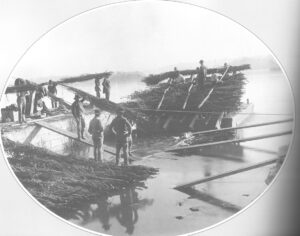
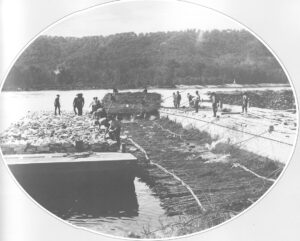
In 1835, Wisconsin was part of the Michigan Territory and statehood was still 13 years away. That didn’t stop a group of De Pere businessmen from “improving” the Fox River and they received permission from the Michigan legislature to build the original dam across the Fox River. That innovative design called for a construction style using rocks, mud, and brush. Steamboat captains referred to it as a “hazard to navigation.”
However, in a book by Henry Bosse who was with the Army Corps of Engineers, the rock and brush construction worked best on muddy river bottoms (like the Mississippi). If you’re interested, the book is Views on the Mississippi River between Minneapolis, Minn and St. Louis, Mo. 1883–1891. The silty mud moving downstream packs into the brush keeping it all in place. However, the rocky Fox River bottom at De Pere was much different and didn’t hold up.
The original dam at De Pere was replaced by a more robust version using quarried limestone with upgrades to follow using concrete with steel gates. Often, builders of these Fox River dams quarried the limestone right from the riverbed near the dam.
The photos below from the Bosse book show the rock and brush construction underway on a dam on the Mississippi in 1889. Look closely to see the bundled branches and small trees laid down first, followed by a layer of rocks.
Blog – Fox Locks
https://foxlocks.org/blog/history-shorts/
The Fox Locks pre-date the Civil War, so there is a large body of historical information on the system. We are lucky to have an amateur historian on staff, and these are excerpts from Scott Thompson’s greater research into the system.
Don’t drink the water?
Many communities along the Fox River used the river for drinking water and even in the early 1900s pollution was a concern. This article from Appleton Post dated June 23, 1910, outlines the conditions on the river and Little Lake Butte des Morts. At the time, wastewater treatment was still 20-30 years into the future and communities dumped sewage directly into the river. Residents and city leaders were always watching for cases of Scarlet Fever and other water-borne infections.
Specifically, the article mentions that the lock master at the “first lock” in Appleton was called on to open the lock gates twice in a day to flush contaminants through the locks and navigation canal.
Original dam construction at De Pere
In 1835, Wisconsin was part of the Michigan Territory and statehood was still 13 years away. That didn’t stop a group of De Pere businessmen from “improving” the Fox River and they received permission from the Michigan legislature to build the original dam across the Fox River. That innovative design called for a construction style using rocks, mud, and brush. Steamboat captains referred to it as a “hazard to navigation.”
However, in a book by Henry Bosse who was with the Army Corps of Engineers, the rock and brush construction worked best on muddy river bottoms (like the Mississippi). If you’re interested, the book is Views on the Mississippi River between Minneapolis, Minn and St. Louis, Mo. 1883–1891. The silty mud moving downstream packs into the brush keeping it all in place. However, the rocky Fox River bottom at De Pere was much different and didn’t hold up.
The original dam at De Pere was replaced by a more robust version using quarried limestone with upgrades to follow using concrete with steel gates. Often, builders of these Fox River dams quarried the limestone right from the riverbed near the dam.
The photos below from the Bosse book show the rock and brush construction underway on a dam on the Mississippi in 1889. Look closely to see the bundled branches and small trees laid down first, followed by a layer of rocks.
Blog – Fox Locks
https://foxlocks.org/blog/history-shorts/
Application deadline: August 11, 2023 | Download PDF
The Great Lakes Commission (GLC) has an immediate opening for a highly motivated team player with experience in the field of climate resiliency to join our staff as a project manager. This position will work under the direction of the GLC leadership team to develop, coordinate, and manage GLC’s climate resiliency work and related efforts. Resiliency is a priority for the GLC and a key goal of its strategic plan. Since 2019, the GLC has worked with partners to develop an Action Plan for a Resilient Great Lakes Basin to build and establish regional coordination around climate resilience. This position is designed to advance GLC work on resiliency under the strategic plan, facilitate implementation of the resiliency action plan and its recommendations, and assist the GLC in coordinating and tracking regional resiliency efforts.
The project manager will serve as the GLC’s primary point of contact for climate resiliency and will be responsible for developing and managing projects in support of the GLC’s climate resiliency goal within its strategic plan and related work. In general, project managers are responsible for overseeing the planning, implementation, and tracking of specific projects and ensuring exceptional quality of project deliverables.
Specific responsibilities include:
Ideal candidates will have a master’s degree and five or more years of full-time professional experience, or a comparable combination of experience and education, and the following qualifications:
Position Classification
The position is classified as full-time, limited term as defined by the GLC’s personnel policies. The appointment term will be a minimum of two years with the potential to extend based on mutual interest and continued funding availability. The desired starting time for this position is October 2023.
Compensation and Benefits
The starting salary range for this position is $76,000-80,000 per year depending on education, skills and experience. The GLC offers a competitive salary and comprehensive benefits, including generous leave time, flexible schedules, medical, dental and vision insurance, and a retirement match program.
Work Environment
The GLC is located in Ann Arbor, Michigan. It is expected that the majority of work is performed in the GLC’s office; periodic telework may be considered. This position requires occasional travel.
Applicants must submit a cover letter and resume stating their interest in and qualifications for the position in a single PDF emailed to vacancy@glc.org. Please use the subject line “Project Manager: Resiliency.” All required items must be provided for an application to receive consideration. No phone calls, please.
The Great Lakes Commission is a binational government agency established in 1955 to protect the Great Lakes and the economies and ecosystems they support. Its membership includes leaders from the eight U.S. states and two Canadian provinces in the Great Lakes basin. The GLC recommends policies and practices to balance the use, development, and conservation of the water resources of the Great Lakes and brings the region together to work on issues that no single community, state, province, or nation can tackle alone. Learn more at www.glc.org.
The Great Lakes Commission strives to create an inclusive, diverse, and non-discriminatory workplace. The Great Lakes Commission is an equal opportunity employer; the Great Lakes Commission complies with applicable federal, state and local laws prohibiting discrimination. It is Great Lakes Commission policy that no person shall be discriminated against, as an employee or applicant for employment, because of race, color, religion, age, sex, national origin, disability status, genetics, protected veteran status, marital status, political affiliation, sexual orientation, gender identity or expression, or any other characteristic protected by federal, state, or local laws.
Great Lakes Commission
https://www.glc.org/news/position-available-project-mgr-resiliency-2023
Application deadline: August 11, 2023 | Download PDF
The Great Lakes Commission (GLC) has an immediate opening for a highly motivated team player with experience in the field of maritime transportation to join our staff as project manager. This position will work under the direction of the GLC leadership team to develop, coordinate and manage GLC’s maritime transportation work and related efforts. Supporting safe and reliable waterways for recreational and commercial navigation is a longstanding priority for the GLC and a key goal of its strategic plan. This position is designed to develop and advance GLC work on maritime transportation under the strategic plan, aligned with the needs and interests of the Great Lakes states and provinces and regional maritime community.
The project manager will serve as the GLC’s primary point of contact for maritime transportation and will be responsible for developing and managing projects in support of the GLC’s navigation and maritime transportation related work. In general, project managers are responsible for overseeing the planning, implementation, and tracking of specific projects and ensuring exceptional quality of project deliverables.
Specific responsibilities include:
Ideal candidates will have a master’s degree and five or more years of full-time professional experience, or a comparable combination of experience and education, and the following qualifications:
Position Classification
The position is classified as full-time, limited term as defined by the GLC’s personnel policies. The appointment term will be a minimum of two years with the potential to extend based on mutual interest and continued funding availability. The desired starting time for this position is October 2023.
Compensation and Benefits
The starting salary range for this position is $76,000-80,000 per year depending on education, skills and experience. The GLC offers a competitive salary and comprehensive benefits, including generous leave time, flexible schedules, medical, dental and vision insurance, and a retirement match program.
Work Environment
The GLC is located in Ann Arbor, Michigan. It is expected that the majority of work is performed in the GLC’s office; periodic telework may be considered. This position requires occasional travel.
Applicants must submit a cover letter and resume stating their interest in and qualifications for the position in a single PDF emailed to vacancy@glc.org. Please use the subject line “Project Manager: Maritime.” All required items must be provided for an application to receive consideration. No phone calls, please.
The Great Lakes Commission is a binational government agency established in 1955 to protect the Great Lakes and the economies and ecosystems they support. Its membership includes leaders from the eight U.S. states and two Canadian provinces in the Great Lakes basin. The GLC recommends policies and practices to balance the use, development, and conservation of the water resources of the Great Lakes and brings the region together to work on issues that no single community, state, province, or nation can tackle alone. Learn more at www.glc.org.
The Great Lakes Commission strives to create an inclusive, diverse, and non-discriminatory workplace. The Great Lakes Commission is an equal opportunity employer; the Great Lakes Commission complies with applicable federal, state and local laws prohibiting discrimination. It is Great Lakes Commission policy that no person shall be discriminated against, as an employee or applicant for employment, because of race, color, religion, age, sex, national origin, disability status, genetics, protected veteran status, marital status, political affiliation, sexual orientation, gender identity or expression, or any other characteristic protected by federal, state, or local laws.
Great Lakes Commission
https://www.glc.org/news/position-available-project-mgr-maritime-2023