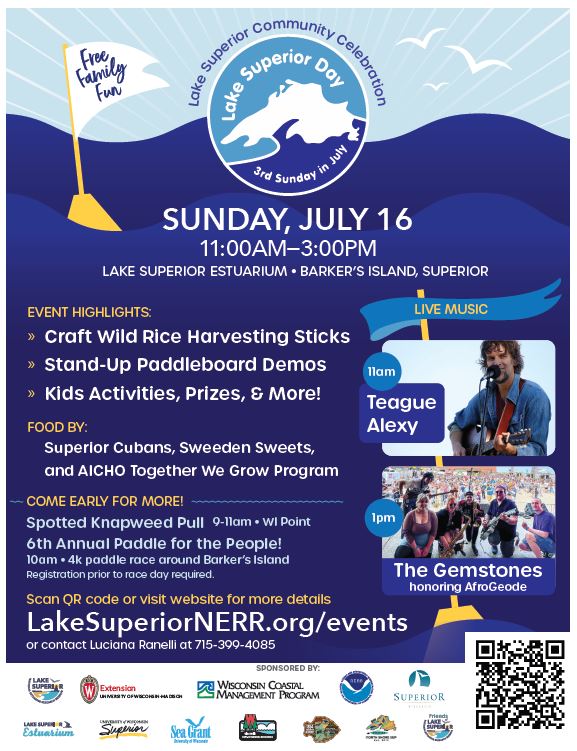
Lake Superior Day 2023
2023-06-29
Blog | Wisconsin Sea Grant
https://www.seagrant.wisc.edu/blog/lake-superior-day-2023/
Blog | Wisconsin Sea Grant
https://www.seagrant.wisc.edu/blog/lake-superior-day-2023/

TED wants to bring Detroit to the world and the world to Detroit. As the city at the heart of the automotive industry grappling with building a sustainable future, Detroit was a deliberate choice for this year’s Countdown Summit.
This invite-only gathering will take place from July 11-14 in Michigan Central, the Fillmore Detroit and other locations around the city.
Great Lakes Now
https://www.greatlakesnow.org/2023/06/ted-countdown-summit-is-coming-to-detroit/
Current Watches, Warnings and Advisories for Brown (WIC009) Wisconsin Issued by the National Weather Service
https://alerts.weather.gov/cap/wwacapget.php?x=WI12664F75CA34.AirQualityAlert.12664F771B50WI.GRBAQAGRB.95772b461ecdeafcc9c0642321d118ec
This article was republished here with permission from Great Lakes Echo.
By Eric Freedman, Great Lakes Echo
Picture decrepit plantations enveloped in aggressively spreading kudzu. Picture the remnants of abandoned outbuildings invisible under kudzu’s woody vines. Picture forests smothered and trees killed by blankets of kudzu.
Great Lakes Now
https://www.greatlakesnow.org/2023/06/watch-out-creepy-kudzu-coming/
A recent U.S. Supreme Court decision removed federal protections for many wetlands, leaving states to decide whether and how to protect them. In a watershed like the Great Lakes basin, wetland protections are only as good as the state with the weakest laws. Read the full story by Michigan Radio.
Great Lakes Commission
https://www.glc.org/dailynews/20230628-wetland-protections
The U.S. EPA has been utilizing two research vessels to collect data on Lake Ontario in order to properly address issues of nutrient pollution, chemical contaminants, habitats and invasive species. Read the full story by WIVB-TV – Buffalo, NY.
Great Lakes Commission
https://www.glc.org/dailynews/20230628-lake-ontario-research
Volunteers in Ellisburg, New York, are trying to make South Sandy Creek more resilient by increasing biodiversity. In just a few days, the team introduced 6,000 plants, including 25 different native species to the region. Read the full story by WWNY-TV – Carthage, NY.
Great Lakes Commission
https://www.glc.org/dailynews/20230628-invasive-resilience
One of Metro Detroit’s most well-known historic estates is getting a $7 million federal grant to restore Ford Cove on Lake St. Clair, improve habitats for local species and make it more accessible. Read the full story by The Detroit News.
Great Lakes Commission
https://www.glc.org/dailynews/20230628-restoration-grant
A survey of lake sturgeon, a species that dates back to the time of dinosaurs, will count juveniles in Northern Michigan’s Black Lake for the first time since 2013. Read the full story by MLive.
Great Lakes Commission
https://www.glc.org/dailynews/20230628-sturgeon-survey
In New York, SUNY Cortland and SUNY Oswego are collaborating with the federal Tunison Lake Ontario Biological Station and several other groups to determine the best ways to transport, raise and reintroduce the coregonine subfamily of freshwater fish. Read the full story by WXHC – Homer, NY.
Great Lakes Commission
https://www.glc.org/dailynews/20230628-fish-restoration
Swimming is currently restricted on Beach 8 at Presque Isle State Park in Erie, Pennsylvania, because of high E. coli levels. Read the full story by WJET-TV – Erie, PA.
Great Lakes Commission
https://www.glc.org/dailynews/20230628-beach-restriction
The H. Lee White Maritime Museum in Oswego, New York, is hosting a new exhibit featuring twenty-five 3D printed and hand painted scale models of shipwrecks located beneath the waters of Lake Ontario and Central New York. Read the full story by Oswego County Today.
Great Lakes Commission
https://www.glc.org/dailynews/20230628-shipwreck-exhibit
The U.S. Environmental Protection Agency is seeking comment on the next phase of an Obama-era Great Lakes program that has become one of the region’s largest for environmental cleanups and wildlife restoration over the past 13 years. Read the full story by The Toledo Blade.
Great Lakes Commission
https://www.glc.org/dailynews/20230628-restoration-input
Captain Paul Berger Jr., of the Interlake Steamship Company, said he is “at home” this shipping season aboard the M/V Mesabi Miner—an iron ore freighter dedicated to the Men and Women of Minnesota’s Mesabi Iron Range. Read the full story by the Mesabi Tribune.
Great Lakes Commission
https://www.glc.org/dailynews/20230628-shipping-home
Wisconsin Sea Grant is organizing a webinar and has produced a report regarding the status of nature-based jobs in Wisconsin’s northern tier, which includes Douglas, Ashland, Bayfield and Iron counties.
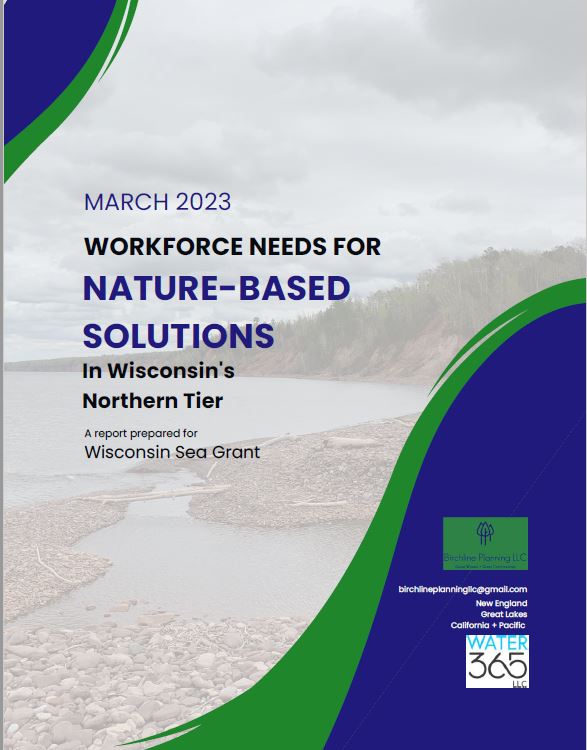 The webinar, “What Does Housing Have to do with Green Infrastructure? Workforce Needs in Northern Wisconsin,” is scheduled for noon-1 p.m., Tuesday July 18 on Zoom. Preregister for it here.
The report it is based on, titled, “Workforce Needs for Nature-Based Solutions in Wisconsin’s Northern Tier,” is available for free download from Wisconsin Sea Grant. It was prepared by Birchline Planning LLC and Water 365 LLC.
Natalie Chin, Wisconsin Sea Grant’s climate and tourism outreach specialist, said the report and webinar deal with projects that implement green infrastructure practices in communities. “It’s using the benefits of nature to help communities mitigate or reduce the impacts of climate change that we’re seeing because of lake levels, warming and more rain,” Chin said.
Examples of nature-based solutions include stabilizing shorelines through planting greenery instead of hardening the shoreline with concrete and installing pervious pavers in parking lots that allow water to infiltrate into the soil instead of running off into storm sewers or waterways.
The report found not only strong capacity, interest and strengths in the region that support use of nature-based solutions, but also several unexpected limitations relating to a region-wide housing shortage and limits on municipal fiscal capacity.

Natalie Chin, climate and tourism outreach specialist, Wisconsin Sea Grant. Image credit: Wisconsin Sea Grant
“Overall, the region’s public, private, educational and nonprofit leaders have an exceptional understanding of nature-based solutions and green infrastructure practices,” said Chin. “However, the region is held back by the sheer lack of people available to carry out this work. Housing availability was cited as the single most difficult limitation on recruitment. Also, communities need more capacity when it comes to project management. Writing grants and executing them is a full-time job just by itself for these types of projects.”
As next steps, this report recommends that Wisconsin Sea Grant and its regional partners consider options to build grant and project management capacity, address the regional housing shortage, work toward legislative reform and facilitate training that will support specific needs in the northern tier around nature-based solutions. Case studies of efforts in other rural regions are provided to illustrate successful strategies from other areas.
During the July 18 webinar, report authors Juli Beth (JB) Hinds and Linda Reid will share their key findings. This will be followed by a panel discussion where people who were interviewed for the report will share their perspectives. These include Alex Faber, executive director, Superior Rivers Watershed Association; Sara Hudson, director, City of Ashland Parks and Recreation; and Philomena Kebec, economic development coordinator, Bad River Band of Lake Superior Chippewa.
The post Webinar and report available about nature-based jobs in northern Wisconsin first appeared on Wisconsin Sea Grant.News Releases | Wisconsin Sea Grant
News Releases | Wisconsin Sea Grant
https://www.seagrant.wisc.edu/news/webinar-and-report-available-about-nature-based-jobs-in-northern-wisconsin/
This month’s species spotlight highlights Wisconsin’s largest and only aquatic salamander: the mudpuppy (Necturus maculosus)! This brown or grayish salamander typically has dark spots and deep red, feathery gills. These salamanders have a finned tail too. Mudpuppies can grow up to 16 inches (1.33 feet) long!
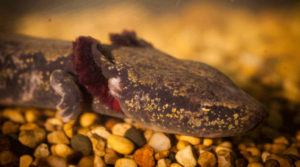
The skin of mudpuppies is very slimy, though the rumors that mudpuppies are poisonous are not true. It is still best to avoid touching them and leave them be if you find one because they have sensitive, permeable skin.
Mudpuppies live their whole lives in the water of lakes and rivers. They prefer areas with large flat docks and will live in underwater holes. Mudpuppies eat aquatic invertebrates (animals in the water without a backbone) such as worms and insect larvae. They will also eat small fish and other amphibians.
Mudpuppies breed in late fall and spawn in June. Eggs hatch in July or August. It is estimated mudpuppies can live up to 20 years old.
Mudpuppies are typically nocturnal, meaning they are most active at night. They may be more active during the day if the live in murky/muddy water but are tricky to spot and study. Currently, Wisconsin’s mudpuppy populations have not been extensively studied, so it is unknown how the species’ population is faring in Wisconsin. Their status is listed as common, but have recently been listed as a species of special concern in Minnesota, and are threatened in Iowa and Illinois. It is known that mudpuppies in Wisconsin are the only host of the Salamander Mussel, a state threatened species. In the winter, mudpuppies may be a common bycatch during the ice-fishing season, and in 2022 the Wisconsin DNR asked for help documenting mudpuppy observations. Mudpuppies are active year round, even under winter ice!
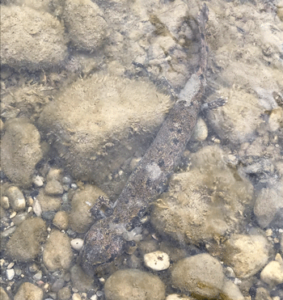
Article written by Katie Reed, Winnebago Waterways Coordinator: katherine@fwwa.org
Featured Image Credit: Wisconsin DNR
Additional Image Credit 1: US Fish and Wildlife Service – National Digital Library
Additional Image Credit 2: thismia CC BY-SA 4.0
Sources:
DNR Asks Public to Report Mudpuppy Observations – WDNR
Mudpuppy: NECTURUS MACULOSUS – WDNR
Mudpuppy – Endangered Resources – WDNR
Mudpuppy – Environmental Education For Kids
Winnebago Waterways is a Fox-Wolf Watershed Alliance recovery initiative. Contact us at wwinfo@fwwa.org

The post Species Spotlight: Mudpuppy appeared first on Fox-Wolf Watershed Alliance.
Fox-Wolf Watershed Alliance
https://fwwa.org/2023/06/28/species-spotlight-mudpuppy/?utm_source=rss&utm_medium=rss&utm_campaign=species-spotlight-mudpuppy

By Irena Li, Bridge Michigan
The Great Lakes News Collaborative includes Bridge Michigan; Circle of Blue; Great Lakes Now at Detroit Public Television; and Michigan Radio, Michigan’s NPR News Leader; who work together to bring audiences news and information about the impact of climate change, pollution, and aging infrastructure on the Great Lakes and drinking water.
Great Lakes Now
https://www.greatlakesnow.org/2023/06/michigan-under-statewide-advisory-as-canada-wildfire-smoke-hits-midwest/
By Kelly House Bridge Michigan
The Great Lakes News Collaborative includes Bridge Michigan; Circle of Blue; Great Lakes Now at Detroit Public Television; and Michigan Radio, Michigan’s NPR News Leader; who work together to bring audiences news and information about the impact of climate change, pollution, and aging infrastructure on the Great Lakes and drinking water.
Great Lakes Now
https://www.greatlakesnow.org/2023/06/nessel-10b-pfas-settlement-with-3m-doesnt-resolve-michigans-claims/

June 27, 2023
Fresh is a biweekly newsletter from Circle of Blue that unpacks the biggest international, state, and local policy news stories facing the Great Lakes region today. Sign up for Fresh: A Great Lakes Policy Briefing, straight to your inbox, every other Tuesday.
Great Lakes Now
https://www.greatlakesnow.org/2023/06/fresh-federal-judge-orders-line-5-shutdown-on-tribal-land-in-wisconsin/
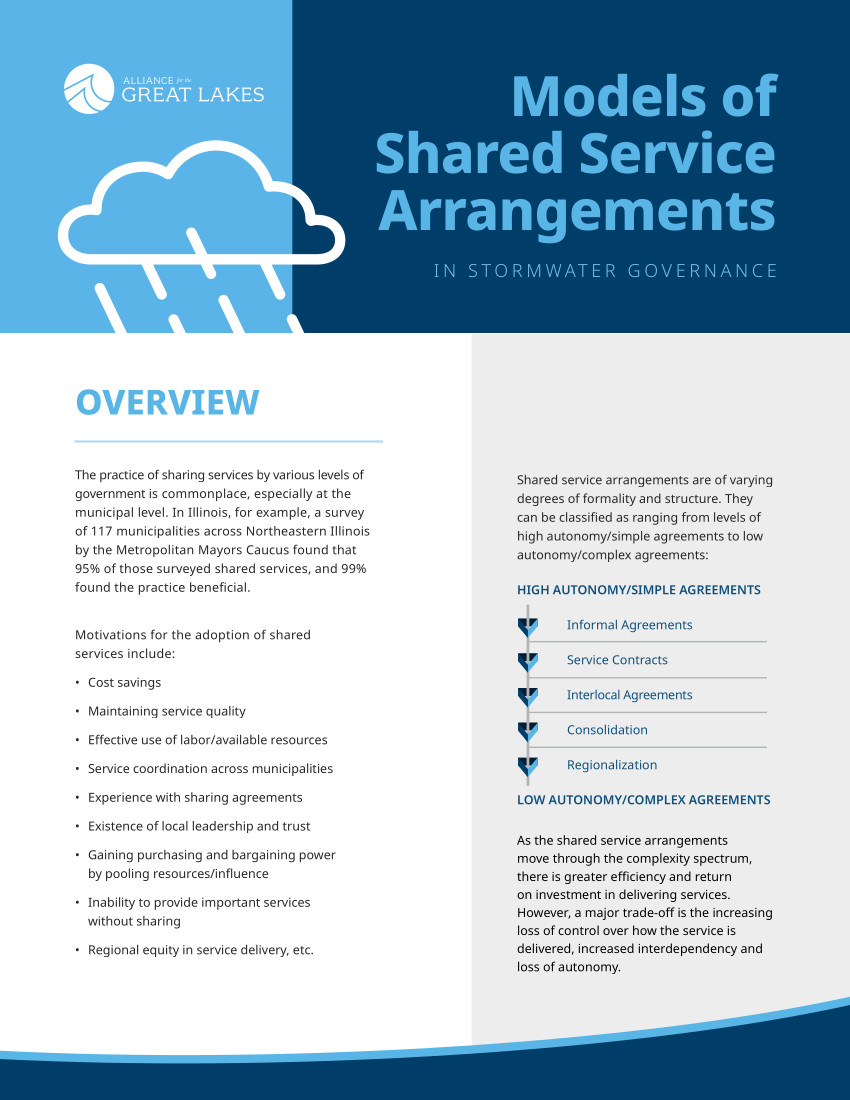
Cities across the country are investing in their stormwater infrastructure with hopes of achieving triple bottom line benefits – for people, the environment, and economic return. In the face of a changing climate that brings more extreme wet weather, a combination of gray infrastructure (pipes and tunnels) and green stormwater infrastructure (plants and soil) is a recipe for resilience that many cities are trying to perfect.
But responsibility for green stormwater infrastructure is rarely the primary mandate of any one department or agency. Instead, multiple agencies manage green infrastructure – from transportation to parks, stormwater to planning. And when agencies don’t collaborate, inefficiencies, inequities, and working at cross purposes often result.
Shared service arrangements can help. These legal agreements help agencies save money, pool resources, and collaborate to solve systemic water problems while still achieving their individual mandates.
Models of Shared Service Arrangements in Stormwater Governance takes a high-level look at 7 types of agreements, from simple informal agreements to Joint Benefits Authority. Each type of agreement is described with an easy-to-read overview of how it operates, when it’s suitable, advantages & disadvantages, and an example.
Read more to learn what type of agreement could be the best fit for your agency and its partners.
The post Models of Shared Service Arrangements in Stormwater Governance appeared first on Alliance for the Great Lakes.
News - Alliance for the Great Lakes
News - Alliance for the Great Lakes
https://greatlakes.org/2023/06/models-of-shared-service-arrangements-in-stormwater-governance/
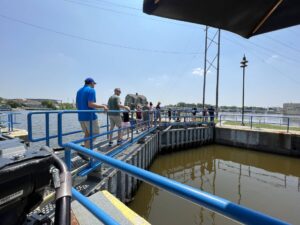
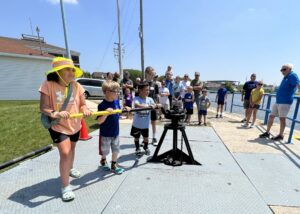
Every year the DOT regional office schedules a “take your kid to work” event that combines fun activities and learning. This year, the office combined an outing to the DePere lock with a demonstration on boat safety from a DNR warden. About 46 kids and 24 adults attended to learn the history and operation of the DePere lock—the busiest lock of all 17 locks on the Fox River. Lock tenders talked about how the locks were used for shipping, cargo, and vital to navigate the sharp drop in elevation of the Fox River. From Menasha to Green Bay, the river drops 168 feet in elevation—equal to the vertical height of Niagara Falls.
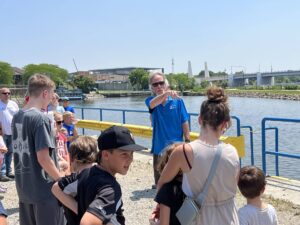
Lock tender Scott Thompson explained the size of boats that can fit into the lock chambers and told the kids that in the late 1800s and early 1900s the river was used to ship goods on giant barges and ships. The kids all got the chance to flood the lock chamber by opening the valves and taking a spin on the turnstile to open the giant lock doors. The word from the kids: “This is COOL!”
Blog – Fox Locks
https://foxlocks.org/blog/take-your-kids-to-work-day/
Current Watches, Warnings and Advisories for Brown (WIC009) Wisconsin Issued by the National Weather Service
https://alerts.weather.gov/cap/wwacapget.php?x=WI12664F56ACF8.AirQualityAlert.12664F771B50WI.GRBAQAGRB.95772b461ecdeafcc9c0642321d118ec
Adopt-a-Beach volunteers launched the 2023 Adopt-a-Beach season with hundreds of cleanups on Great Lakes beaches, harbors, bluffs, and trails. By June 26, volunteers had removed more than 191,000 pieces of litter from shorelines around the region.
“It’s so much fun to see the sense of community our volunteers create,” said Olivia Reda, the Alliance’s Volunteer Engagement Manager. “Everyone is working together to clean up their shoreline. Scouting groups, businesses, families, yacht clubs – it’s exciting to see so many different types of people get involved.”
And Adopt-a-Beach volunteers are working with a community that’s larger than their local cleanup, said Reda. “They’re working with volunteers all over the Great Lakes to collect important data about plastic pollution.”
This year marks 20 years of data collection by Adopt-a- Beach volunteers. While scientists have been studying plastic pollution in the ocean for decades, there is much less research about plastic pollution in the Great Lakes. Adopt-a-Beach data collection is one way our Great Lakes community is beginning to fill that gap.
Volunteers use a datasheet at every cleanup to tally each item they pick up. The event’s team leader tallies up all the data collected at the event and enters it into our online system.
“It might feel a little silly to count up every cigarette butt, bottle cap, or piece of tiny trash when you’re on the beach,” Reda said. “But the data from each cleanup tells a story. And when you put everyone’s data together in one place, the power of all that information is amazing!”
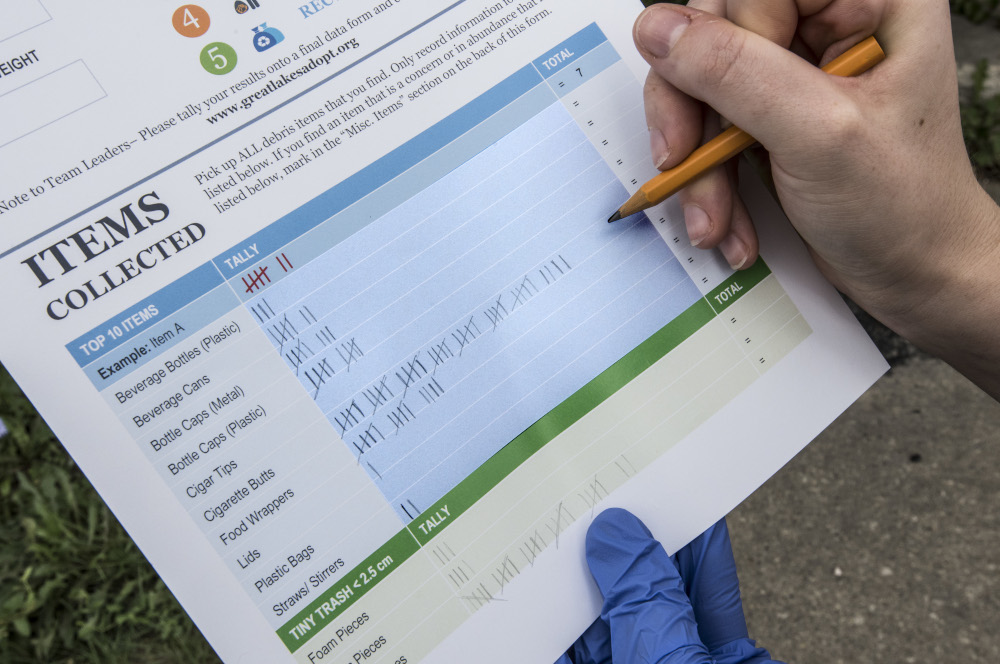
One of this spring’s data stories comes from Green Bay, Wisconsin. A group of Adopt-a-Beach volunteers led by Green Bay Sail & Paddle removed 677 pounds of trash from the South Bay Marina in just a few hours.
“It’s a bit unusual to collect so many pounds of trash at one cleanup,” said Reda, “but spring is a time when the heavy stuff shows up in the data, the stuff that washed ashore over the winter.” The litter this team collected included plastic, broken glass, rusted metal, and wooden planks. “This group really made their shoreline safer!”
Another spring data story comes from Cleveland, Ohio, where Adopt-a-Beach volunteers led by Drink Local, Drink Tap set an ambitious goal: remove 1 million pieces of trash from Lake Erie shorelines. The organization has already collected more than 500,000 pieces of litter from cleanups dating back to 2010. The vast majority of those items are plastic.
“Drink Local, Drink Tap is an amazing organization,” said Reda. “Their dedication to their community and Edgewater Beach is so inspiring! And the fact that they see so much plastic reflects the trend we see around the region. Roughly 85% of the litter found at Adopt-a-Beach cleanups is entirely or partially made of plastic.”
Because so much of the litter they collect is made from plastic, some Adopt-a-Beach volunteers are taking their cleanup efforts back to the source. In Chicago, Illinois, Organizing for Plastic Alternatives is working to reduce plastic use as the best way to keep plastic out the Great Lakes.
“Researchers say that more than 22 million pounds of plastic pollution end up in the Great Lakes each year. And the best way to keep plastic out of the lakes is to reduce how much plastic we use in the first place,” Reda said. “It’s so great that Adopt-a-Beach Team Leader and Alliance Ambassador Eileen Ryan – and the Organizing for Plastic Alternatives team – are raising awareness about problems associated with single-use plastic in their community!”
Every Adopt-a-Beach volunteer has a story to tell. And each of their stories adds up to an even bigger story told by 20 years of litter data.
“I really appreciate the volunteers who’ve returned for many years, and people who just joined this year. I’m so grateful for everything you’ve done for the Great Lakes!” said Reda. “I hope to see you on the beach again this year.”
A special thanks to Bell’s Brewery and Unilever, this year’s top Adopt-a-Beach sponsors. Both companies are organizing shoreline cleanups throughout the region as well as providing financial support.
The post Adopt-a-Beach Launches 20th Year of Data Collection appeared first on Alliance for the Great Lakes.
News - Alliance for the Great Lakes
News - Alliance for the Great Lakes
https://greatlakes.org/2023/06/adopt-a-beach-launches-20th-year-of-data-collection/
Adopt-a-Beach volunteers launched the 2023 Adopt-a-Beach season with hundreds of cleanups on Great Lakes beaches, harbors, bluffs, and trails. By June 26, volunteers had removed more than 191,000 pieces of litter from shorelines around the region.
“It’s so much fun to see the sense of community our volunteers create,” said Olivia Reda, the Alliance’s Volunteer Engagement Manager. “Everyone is working together to clean up their shoreline. Scouting groups, businesses, families, yacht clubs – it’s exciting to see so many different types of people get involved.”
And Adopt-a-Beach volunteers are working with a community that’s larger than their local cleanup, said Reda. “They’re working with volunteers all over the Great Lakes to collect important data about plastic pollution.”
This year marks 20 years of data collection by Adopt-a- Beach volunteers. While scientists have been studying plastic pollution in the ocean for decades, there is much less research about plastic pollution in the Great Lakes. Adopt-a-Beach data collection is one way our Great Lakes community is beginning to fill that gap.
Volunteers use a datasheet at every cleanup to tally each item they pick up. The event’s team leader tallies up all the data collected at the event and enters it into our online system.
“It might feel a little silly to count up every cigarette butt, bottle cap, or piece of tiny trash when you’re on the beach,” Reda said. “But the data from each cleanup tells a story. And when you put everyone’s data together in one place, the power of all that information is amazing!”
One of this spring’s data stories comes from Green Bay, Wisconsin. A group of Adopt-a-Beach volunteers led by Green Bay Sail & Paddle removed 677 pounds of trash from the South Bay Marina in just a few hours.
“It’s a bit unusual to collect so many pounds of trash at one cleanup,” said Reda, “but spring is a time when the heavy stuff shows up in the data, the stuff that washed ashore over the winter.” The litter this team collected included plastic, broken glass, rusted metal, and wooden planks. “This group really made their shoreline safer!”
Another spring data story comes from Cleveland, Ohio, where Adopt-a-Beach volunteers led by Drink Local, Drink Tap set an ambitious goal: remove 1 million pieces of trash from Lake Erie shorelines. The organization has already collected more than 500,000 pieces of litter from cleanups dating back to 2010. The vast majority of those items are plastic.
“Drink Local, Drink Tap is an amazing organization,” said Reda. “Their dedication to their community and Edgewater Beach is so inspiring! And the fact that they see so much plastic reflects the trend we see around the region. Roughly 85% of the litter found at Adopt-a-Beach cleanups is entirely or partially made of plastic.”
Because so much of the litter they collect is made from plastic, some Adopt-a-Beach volunteers are taking their cleanup efforts back to the source. In Chicago, Illinois, Organizing for Plastic Alternatives is working to reduce plastic use as the best way to keep plastic out the Great Lakes.
“Researchers say that more than 22 million pounds of plastic pollution end up in the Great Lakes each year. And the best way to keep plastic out of the lakes is to reduce how much plastic we use in the first place,” Reda said. “It’s so great that Adopt-a-Beach Team Leader and Alliance Ambassador Eileen Ryan – and the Organizing for Plastic Alternatives team – are raising awareness about problems associated with single-use plastic in their community!”
Every Adopt-a-Beach volunteer has a story to tell. And each of their stories adds up to an even bigger story told by 20 years of litter data.
“I really appreciate the volunteers who’ve returned for many years, and people who just joined this year. I’m so grateful for everything you’ve done for the Great Lakes!” said Reda. “I hope to see you on the beach again this year.”
A special thanks to Bell’s Brewery and Unilever, this year’s top Adopt-a-Beach sponsors. Both companies are organizing shoreline cleanups throughout the region as well as providing financial support.
The post Adopt-a-Beach Launches 20th Year of Data Collection appeared first on Alliance for the Great Lakes.
News - Alliance for the Great Lakes
News - Alliance for the Great Lakes
https://greatlakes.org/2023/06/adopt-a-beach-launches-20th-year-of-data-collection/
Wisconsin Water Library
https://waterlibrary.aqua.wisc.edu/reel-in-the-summer-fishing-and-conservation-book-display/
GIS Analyst – Full-Time
In support of Fox-Wolf Watershed Alliance (Fox-Wolf)’s mission, the GIS Analyst is responsible for providing technical support to further the awareness of Fox-Wolf’s work to advance water quality. Duties include but are not limited to a wide range of work including: needs assessments, database design, application design, data development, software development and installation, cartographic mapping, user training, acceptance testing, rollout support, and technical support. The successful candidate will utilize project management principles to manage projects within time, scope and budget, work effectively with partners, and coordinate tasks with multi-faceted project teams. We are looking for a self-motivated, independent and detail-oriented individual who is passionate about the mission of Fox-Wolf.
This position reports to the Winnebago Waterways Director and will work on the following tasks:
● Design, monitor, and maintain the structure and integrity of the Fox-Wolf GIS database
● Own GIS data creation (compilation, editing, conversion of non-spatial data, digitization) and data management
(organization and structure, quality control) tasks
● Work closely with program directors to create systems to collect, analyze, and visualize a variety of data metrics to
show progress in implementation of water quality efforts
● Facilitate partner Land and Water Conservation Department staff in tracking and reporting adoption and
environmental and financial outcomes resulting from the adoption of climate smart agricultural practices
● Maintain and build relationships with conservation partners by providing training and support for conservation staff
● Support the Lower Fox Director in managing the Climate Smart Commodities grant project including standardized data collection, management, and reporting
To apply, email resume and cover letter to jessica@fwwa.org
The post GIS Analyst appeared first on Fox-Wolf Watershed Alliance.
Fox-Wolf Watershed Alliance
https://fwwa.org/2023/06/26/gis-analyst/?utm_source=rss&utm_medium=rss&utm_campaign=gis-analyst

Because the holiday falls on a Tuesday this year, we made some scheduling changes. The only locks that will be open on Tuesday, July 4 are the De Pere and Little Kaukauna locks. Locks in the Fox Valley and Kaukauna will be closed on that day but will be open the Saturday and Sunday before and after the 4th of July. We know mid-week holidays may throw off your planning but just remember: for the record July 4, 1776 was a Thursday!
Blog – Fox Locks
https://foxlocks.org/blog/4th-of-july-schedule-changes/
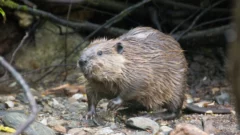
Points North is a biweekly podcast hosted by Daniel Wanschura and Morgan Springer about the land, water and inhabitants of the Upper Great Lakes.
This episode was shared here with permission from Interlochen Public Radio.
In 2007, helicopters were circling over a few rivers and streams in Minnesota near Lake Superior.
Great Lakes Now
https://www.greatlakesnow.org/2023/06/points-north-leave-it-to-beavers/
American Queen Voyages has announced that it will no longer offer Great Lakes cruises after this year. AQV President Cindy D’Aoust said the Midwest’s winters don’t make fiscal sense for the company and it plans to plans to sell the two vessels it operates on the Lakes, Ocean Navigator and Ocean Voyager. Read the full story by WOOD-TV Grand Rapids, Michigan.
Great Lakes Commission
https://www.glc.org/dailynews/20230626-cruise
Monarch Point Conservation Reserve will protect 1,600 hectares along south shore of Prince Edward County. Read the full story by CBC News.
Great Lakes Commission
https://www.glc.org/dailynews/20230626-ontario-reserve
Wisconsin state regulators say they’re making progress on an environmental review of Enbridge’s plans to relocate Line 5 as a federal judge has ordered a partial shutdown of the oil and gas pipeline on the Bad River reservation. Read the full story by Wisconsin Public Radio.
Great Lakes Commission
https://www.glc.org/dailynews/20230626-line-5
Chemical manufacturer 3M Co. will pay at least $10.3 billion to settle lawsuits over contamination of many U.S. public drinking water systems with potentially harmful compounds used in firefighting foam and a host of consumer products, the company said Thursday. Read the full story by the Detroit Free Press.
Great Lakes Commission
https://www.glc.org/dailynews/20230626-3m-settlement
The U.S. Department of Commerce recently announced a first-ever $575 million competitive funding opportunity to help coastal and Great Lake communities increase their resilience to extreme weather and rising sea levels. Read the full story by American City & County.
Great Lakes Commission
https://www.glc.org/dailynews/20230626-climate-funding
A photo posted by the Interlake Steamship Company shows mayflies swarming a freighter in Toledo. Read the full story by WXYZ – TV – Detroit, MI.
Great Lakes Commission
https://www.glc.org/dailynews/20230626-mayflies
Criminal charges are being brought by the Michigan attorney general against the owner of an industrial barge authorities said remains abandoned in Lake Michigan. Read the full story by the Huron Daily Tribune.
Great Lakes Commission
https://www.glc.org/dailynews/20230626-abandoned-barge
The television show Expedition Unknown discovered an uncatalogued tugboat in their most recent episode. Read and listen to the full story by WRKR – Kalamazoo, MI.
Great Lakes Commission
https://www.glc.org/dailynews/20230626-tugboat-shipwreck
A new study proposes reducing the reliance on trucking in transporting goods between the U.S. and Canada by increasing short-sea shipping on the Great Lakes. Read the full story by The Maritime Executive.
Great Lakes Commission
https://www.glc.org/dailynews/20230626-shipping
NOAA is now in the process of seeking public comment about the proposed Lake Erie Quadrangle National Marine Sanctuary. Read the full story by the Erie Times-News.
Great Lakes Commission
https://www.glc.org/dailynews/20230626-marine-sanctuary
Plastic pollution is a serious problem for the Great Lakes and the people and wildlife who live here.
Researchers from the Rochester Institute of Technology estimate that over 22 million pounds of plastic enter the Great Lakes annually. And University of Toronto researchers calculate that the amount of microplastics in the surface water of the Great Lakes is higher than plastic concentrations in the widely publicized Great Pacific Garbage Patch.
Stopping the flow of all that plastic can feel overwhelming. But you can make a difference by helping your community reduce its plastic use. Now is the time to move away from single-use plastic and encourage reuse, refill, and reduction.
Your town, your park district, and your school board all have policies that affect plastic pollution. Start by learning what’s happening in your community.
Find out:
Once you’ve learned what’s going on in your community, pick one thing you want to change – and find out who can make that change happen. For instance, if you want to see water refill stations at all your public parks and beaches, your park district board members might be the people who can make the decision and allocate money to pay for it.
After you know what you want to change and who can make it happen, it’s time to build support and contact the decision makers. Here are some tools to help:
Build support:
Communicate with decision makers:
Stopping plastic pollution is a huge task. But when you change a policy locally, you’re doing more than helping your community reduce one type of plastic. You’re creating momentum for the next change and the next – in your community, in your state, and nationally – bringing all of us closer to systemic reductions in single-use plastic production and pollution.
Let us know how it’s going! Contact us at alliance@greatlakes.org.
The post Take Action Locally to Reduce Plastic Pollution appeared first on Alliance for the Great Lakes.
News - Alliance for the Great Lakes
News - Alliance for the Great Lakes
https://greatlakes.org/2023/06/take-action-locally-to-reduce-plastic-pollution/
Current Watches, Warnings and Advisories for Brown (WIC009) Wisconsin Issued by the National Weather Service
https://alerts.weather.gov/cap/wwacapget.php?x=WI12664F48813C.AirQualityAlert.12664F771B50WI.GRBAQAGRB.95772b461ecdeafcc9c0642321d118ec
Current Watches, Warnings and Advisories for Brown (WIC009) Wisconsin Issued by the National Weather Service
https://alerts.weather.gov/cap/wwacapget.php?x=WI12664F39A3C4.SpecialWeatherStatement.12664F39C430WI.GRBSPSGRB.670272ffdeab82d92d5ab990673d0435
Current Watches, Warnings and Advisories for Brown (WIC009) Wisconsin Issued by the National Weather Service
https://alerts.weather.gov/cap/wwacapget.php?x=WI12664F37DA58.AirQualityAlert.12664F381680WI.GRBAQAGRB.95772b461ecdeafcc9c0642321d118ec
Current Watches, Warnings and Advisories for Brown (WIC009) Wisconsin Issued by the National Weather Service
https://alerts.weather.gov/cap/wwacapget.php?x=WI12664F28FCE0.AirQualityAlert.12664F37EF70WI.GRBAQAGRB.95772b461ecdeafcc9c0642321d118ec

By Drew Anderson and Fatima Syed, The Narwhal
This story originally appeared in The Narwhal and is republished here as part of Covering Climate Now, a global journalism collaboration strengthening coverage of the climate story.
Space lasers. That’s the reason some people gave for the catastrophic burning of Lytton, B.C., in 2021 after a historic heat wave set a new temperature record in Canada, exacerbating a wildfire that essentially destroyed the town.
Great Lakes Now
https://www.greatlakesnow.org/2023/06/it-isnt-arson-untangling-climate-misinformation-around-canadas-raging-wildfires/
Though forecasts are projecting a mild bloom, scientists are learning more about how the toxin found in western Lake Erie algal blooms has the ability to become airborne and travel long distances, potentially miles. Read the full story by the Toledo Blade.
Great Lakes Commission
https://www.glc.org/dailynews/20230623-algal-forecast
Potentially record numbers of lake herring born last spring seem to have survived their first year of life, according to state and federal biologists. The boom will help sustain both the ecosystem and Minnesota’s commercial fishing industry for years to come. Read the full story by the Star Tribune.
Great Lakes Commission
https://www.glc.org/dailynews/20230623-herring
Newly proposed federal regulations would affect coal ash ponds situated around the Great Lakes shoreline, many in communities of color. Read the full story by Grist Magazine.
Great Lakes Commission
https://www.glc.org/dailynews/20230623-coal-ash
Researchers from SUNY Oswego and SUNY Cortland in New York will work with the U.S. Geological Survey and other entities on a conservation and restoration project focused on native fish species in the Great Lakes, funded by the U.S. Environmental Protection Agency’s Great Lakes Restoration Initiative. Read the full story by The Citizen.
Great Lakes Commission
https://www.glc.org/dailynews/20230623-suny-students
In New York, a high school teacher is about to embark on a Great Lakes journey as she was selected nationally among 15 other teachers from Great Lakes states to participate in the Federal EPA’s research vessel on Lake Ontario for a workshop on board the Lake Guardian ship. Read the full story by WKBW-TV – Buffalo, NY.
Great Lakes Commission
https://www.glc.org/dailynews/20230623-biology-teacher
Steel production ticked up by 4,000 tons in the Great Lakes region last week, according to the American Iron and Steel Institute. Read the full story by the Times of Northwest Indiana.
Great Lakes Commission
https://www.glc.org/dailynews/20230623-steel-production