By Bauyrzhan Zhaxylykov

Across Michigan, religious institutions, local governments, schools and nonprofits are turning to a federal program called Elective Pay to help pay for solar panels and other clean-energy projects.

The post Federal program can help nonprofits cover costs of clean-energy projects first appeared on Great Lakes Echo.

Original Article

Great Lakes Echo

Great Lakes Echo

https://greatlakesecho.org/2026/03/11/federal-program-can-help-nonprofits-cover-costs-of-clean-energy-projects/

Capital News Service

By Brian Allnutt, Planet Detroit

This article was republished with permission from Planet Detroit. Sign up for Planet Detroit’s weekly newsletter here.


Water levels on the Great Lakes and Lake St. Clair continued to decline below long-term averages over the winter, just a few years after lakes hit record highs in 2019 and 2020.

Lake levels are expected to begin their seasonal rise and stay close to long-term averages, according to the U.S. Army Corps of Engineers’ six-month forecast issued March 4.  

The recent decline in Great Lakes water levels hasn’t been especially steep, but the overall trajectory of lake levels is one of increasing variability, according to Yi Hong, a research scientist at the Cooperative Institute for Great Lakes Research.

Lake Michigan and Lake Huron, which are technically two lobes of a single lake, saw record highs in 2020 less than a decade after being hit by record lows in 2012 and 2013, Corps records show.

Climate change-driven extreme storms and heatwaves are influencing lake level variability, but there isn’t enough data to show if levels will trend lower or higher over the long-term, Hong said.

Over the next six months, the Corps predicts water levels will stay below long-term averages on all the lakes, except possibly Lake Ontario.

Lake Michigan and Lake Huron will be the farthest below average. From March to August, levels will be 4 to 7 inches below last year’s levels and 11 to 12 inches below the long-term average. Closer to Detroit, Lake St. Clair will see water levels 6 to 10 inches below last year and 5 to 7 inches below the long-term average.

Megan Royal, a Corps hydraulic engineer, said the agency doesn’t anticipate any water level issues in the shipping channels and harbors used by Great Lakes freighters. Sediment can occasionally move into navigation channels and harbors, requiring emergency dredging, she said.

In an interview with Maritime Reporter TV, Eric Peace, vice president of the Lake Carriers Association, said Great Lakes shipping is negatively impacted by several factors, including severe weather over the fall and early ice cover. Dredging will continue to be a challenge for the industry, he said. 

Dry falls, hot summers contribute to lake level declines

A pattern of dry fall seasons from 2023-2025 contributed to the Great Lakes’ falling water levels, Royal told Planet Detroit.

Last summer’s heat also led to near record-high lake temperatures, producing significant evaporation when the winter’s extremely cold air passed over relatively warm water, she said.

“Evaporation is very difficult to measure because of just how large the lakes are,” Royal said, adding that modeling showed evaporation from all the lakes except Lake Erie was above average from October to January.

The rate of decline in lake levels is beginning to stabilize as a drought eases in parts of the Great Lakes Basin and snowmelt drives runoff into the lakes, she said.  

The National Weather Service’s Climate Prediction Center forecasts above normal precipitation across nearly all the U.S. portion of the Great Lakes Basin over the next three months. Temperatures in these areas mostly have equal chances of being above or below normal over the same time period.

The post Great Lakes water levels decline from record highs: What the forecast says appeared first on Great Lakes Now.

Original Article

Great Lakes Now

Great Lakes Now

https://www.greatlakesnow.org/2026/03/10/great-lakes-water-levels-decline-from-record-highs-what-the-forecast-says/

Planet Detroit

By Richelle Wilson, Wisconsin Public Radio

This article was republished here with permission from Wisconsin Public Radio.


Paul Ehorn started scuba diving as a teenager in the early 1960s. On his first dive, he was wearing a self-assembly wetsuit he purchased from a Montgomery Ward catalog for $28.

“The water’s cold, probably the low 40s, and I came up just shivering uncontrollably,” Ehorn told WPR’s “Wisconsin Today.” “All I could say was, ‘How long before we can go back in?’”

“I was hooked. That was it,” he added. “It just became a passion and obsession.”

After that, it wasn’t long before Ehorn picked up some sonar gear and started what would become a lifelong career as a shipwreck hunter. Now 80 years old, he has discovered 15 shipwrecks in the Great Lakes. 

His latest find, which he announced to the public in February, is Lac La Belle, a luxury steamer that sank in Lake Michigan more than 150 years ago. The ship has been on Ehorn’s radar from the beginning due to his interest in wooden steamers and because it’s “close to home,” he said in the press release. 

After nearly 60 years of searching, Ehorn got the clue he needed and finally located the sunken wreckage about 20 miles offshore between Racine and Kenosha.

“It was just a wonderful day,” Ehorn said. “Beautiful wreck, it turned out.”

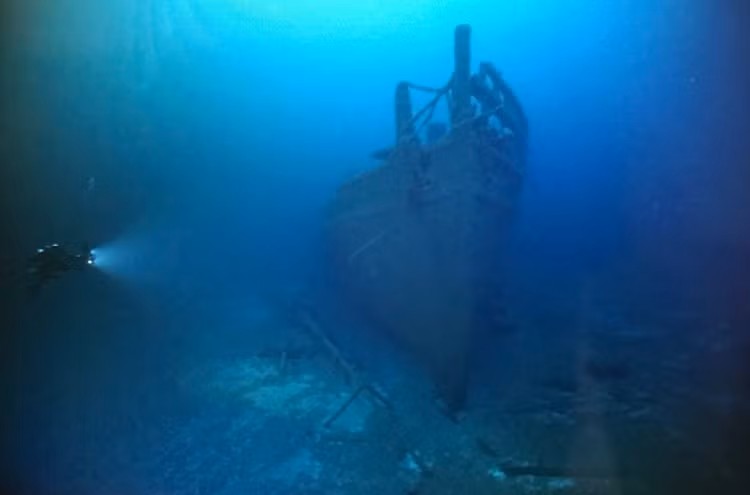
A scuba diver approaches the bow of the Lac La Belle. Photo courtesy of Paul Ehorn

Ehorn and his crew first found the wreckage of Lac La Belle in 2022, but he waited to publicly share his discovery until conditions were right to go down for a dive to film the ship and create a 3D model. Documenting the shipwreck is an important part of the process to educate the public and give historians a unique view into the past.

“All of our wrecks on the Great Lakes have a shelf life — they’re not going to look like this in 100 years,” said Brendon Baillod, president of the Wisconsin Underwater Archaeology Association. “I have to commend Paul for really wanting to do that photogrammetry model, because that’s a good standard for recording exactly how that wreck was at the time he found it.”

As a maritime historian, Baillod has researched a number of Great Lakes shipwrecks. His book “Fathoms Deep But Not Forgotten: Wisconsin’s Lost Ships” includes an entry for Lac La Belle that details its history carrying passengers and cargo — first between Cleveland and Lake Superior starting in 1864, and later on a trade route between Milwaukee and Grand Haven, Michigan. 

On Oct. 13, 1872, the ship sank a couple hours after departing Milwaukee due to a leak that sprung during a storm. The ship was carrying cargo and 53 passengers. Eight people died after one of the lifeboats capsized.

“The Lac La Belle is a time capsule. It’s an underwater museum from 1872,” Baillod told “Wisconsin Today.” “It played such a pivotal role not just in the industrialization of America, but in Milwaukee’s history.”

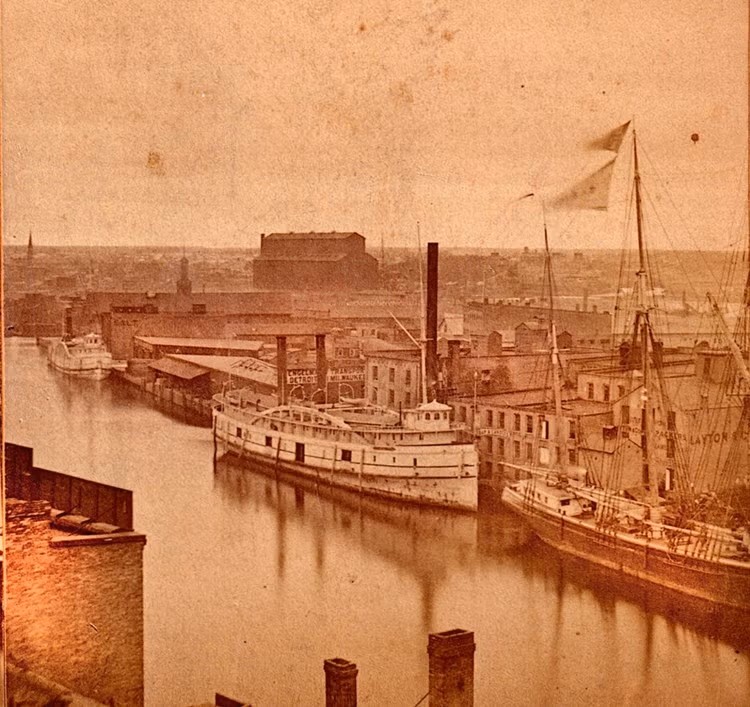
The steamer Lac La Belle docked in Milwaukee in 1872. This image is from an original stereoview by W. H. Sherman. Image courtesy of Brendon Baillod

A ‘golden age’ of shipwreck discovery

The Great Lakes are home to an estimated 6,000 to 10,000 shipwrecks, most of which remain undiscovered, according to the Wisconsin Water Library

But more of these sunken ships are being found, Baillod said, due to advancements in affordable technology and with the help of citizen scientists who are becoming more aware of shipwreck history.

“It’s kind of the golden age, I guess you might say, of shipwreck discovery on the Great Lakes,” he said, “and a tremendous opportunity for us to tell the stories of these ships that played such a huge role in the cultural history of the Midwest, and Wisconsin in particular.”

And the race is on to find more of these wrecks, as invasive quagga mussels congregate around shipwrecks and damage what remains.

For shipwreck hunters, the mussels are a double-edged sword: Despite the damage they cause, the mussels also are clarifying the water, making shipwrecks easier to spot. Whereas Lake Michigan used to have only about 5 or 10 feet of visibility underwater, now divers have a much clearer view.

“We called it ‘Braille diving.’ You’d go down and you’d have to get within a couple of feet of the shipwreck,” Baillod said. “Now, you go down there and you can see sometimes 50, 80, 100 feet — you can see the whole ship.”

While that has created opportunities for “beautiful underwater photos of these shipwrecks” and raised public awareness, Baillod said, the quagga mussels are ultimately decimating the food web and changing Lake Michigan’s biome, leading to the collapse of native species like whitefish.

Baillod is one of the founders of the Ghost Ships Festival, an annual community event to promote research, education and public awareness of Wisconsin’s shipwreck history. This year, the event is being held in Manitowoc on Friday, March 6 and Saturday, March 7 and includes a presentation from Ehorn about his discovery of the Lac La Belle.

“We’re trying to educate the public about the Great Lakes maritime history and about the role these ships played in building America back in the 1800s,” Baillod said. “And we’re having a lot of success — people are learning about it.”

The post Shipwreck hunter discovers sunken 150-year-old luxury liner off the coast of Wisconsin appeared first on Great Lakes Now.

Original Article

Great Lakes Now

Great Lakes Now

https://www.greatlakesnow.org/2026/03/10/shipwreck-hunter-discovers-sunken-150-year-old-luxury-liner-off-the-coast-of-wisconsin/

Wisconsin Public Radio

CHICAGO, IL (March 10, 2026) – Today the Alliance for the Great Lakes released a Regional Playbook for Managing Data Center Impacts in the Great Lakes. The guide is designed for residents, concerned citizens, grassroots organizations, and local leaders across the Great Lakes region seeking clear, accessible information on the rapid growth of data centers and their impacts on water, energy, land use, community health, and local economies.

The Playbook brings together a compilation of ideas, data, and practical tools, drawing from existing toolkits, guidance documents, and best practices developed by state advocates, organizations, and communities across the Great Lakes region.  

“Communities across the Great Lakes are increasingly confronted by proposals for large-scale developments with significant water demands – from manufacturing plants, food and beverage facilities, and energy projects to data centers – that are not required to measure or publicly report how much water they use when they receive water from local municipal systems. These proposals often move quickly and can come with community and environmental impacts that are not always clearly explained to residents or local leaders,” said Maria Iturbide-Chang, Director of Water Resources.

 “The playbook is designed to inform Great Lakes residents about the processes and the potential consequences, identify the right questions to ask at the right moment, and navigate local and regional decision-making processes to ensure that we protect our Great Lakes, its water resources and the communities that depend on them.”

###

Contact: Don Carr, Media Director, Alliance for the Great Lakes dcarr@greatlakes.org 

More about data centers & water use

Read more about data centers in the Great Lakes region, how they use water, and their impact on our water resources.

Read More

The post New Great Lakes Data Center Playbook Gives Residents Tools to Ask the Right Questions to Reduce Impacts and Protect Water appeared first on Alliance for the Great Lakes.

Original Article

News - Alliance for the Great Lakes

News - Alliance for the Great Lakes

https://greatlakes.org/2026/03/new-great-lakes-data-center-playbook-gives-residents-tools-to-ask-the-right-questions-to-reduce-impacts-and-protect-water/

Judy Freed

Water-intensive data center development is rapidly growing across the Great Lakes region. To help make sense of the impacts, we released this guide for residents, concerned citizens, grassroots organizations, and local leaders seeking clear, accessible information. It describes how water is used in data centers and provides checklists to help communities understand potential impacts and ask the right questions at the right time.

This playbook does not take a position on whether any specific proposed data center is “good” or “bad” for a community. The goal is to ensure that, if data centers move forward, they operate in ways that maximize public benefits while minimizing harm to water resources, community well-being, and ecosystems.

A report cover that says "A Regional Playbook for Managing Data Center Impacts in the Great Lakes."

Download the playbook

Download checklists from the playbook

Data center impacts

Increased water and energy use from data centers could lead to strain on local water systems and increased prices for ratepayers, and ultimately, water shortages, groundwater conflicts, and aquifer contamination. Data centers can discharge wastewater that’s contaminated with pollutants, potentially damaging our lakes and rivers. Residents may already be seeing their energy bills rising because of unprecedented demand that large data centers put on local power systems. There is concern about similar increases in future drinking water and wastewater treatment costs.

Lack of transparency

While we know data centers require large amounts of water and energy, there are barriers to understanding their full impact on communities and the Great Lakes. Many data center developers rely on non-disclosure agreements (NDAs) to keep estimates of water use and consumption, cooling needs, and electricity demand secret, even when communities are being asked to approve zoning changes, tax abatements, or public infrastructure investments.

The transparency challenge is not unique to data centers. Many large water-using industries, such as pharmaceuticals, food and beverages, and manufacturing, are not required to measure or publicly report how much water they use when they connect to and receive water from local municipal systems. When they rely on city or town water supplies, their water use often remains largely invisible to the public and decision-makers.

Data centers also increase electricity demand, which in turn increases water use at power plants that also use water for cooling. Without transparent reporting on both energy consumption and associated water use, it is nearly impossible to understand how growth in the data center sector is increasing water use across the Great Lakes region.

These are just some of the impacts described in the playbook, along with the questions necessary to bring transparency to local data center development.

Local and regional action

As Maria Iturbide-Chang, Director of Water Resources, shared when the playbook was released, “The playbook is designed to inform Great Lakes residents about the processes and the potential consequences, identify the right questions to ask at the right moment, and navigate local and regional decision-making processes to ensure that we protect our Great Lakes, its water resources, and the communities that depend on them.”

This guide is grounded in the belief that informed communities are better equipped to shape outcomes that align with both local needs and regional responsibilities. Ultimately, state and regional action is needed to protect a water system shared across eight states. The playbook also looks to the future and outlines state policies necessary for the responsible, transparent, and sustainable development the Great Lakes need and deserve.

Join Us March 24

Join our experts to learn more about the Data Center Playbook. Ask your questions during this live event.

Register for the Webinar

The post Data Center Playbook appeared first on Alliance for the Great Lakes.

Original Article

News - Alliance for the Great Lakes

News - Alliance for the Great Lakes

https://greatlakes.org/2026/03/data-center-playbook/

Judy Freed

Two next-generation turbines powered by river currents are set to be lowered into the St. Lawrence Seaway off Montreal this autumn, marking the first installation of the pioneering renewable energy technology in Canada. Read the full story by Canada’s National Observer.

Original Article

Great Lakes Commission

Great Lakes Commission

https://www.glc.org/dailynews/20260309-stlawrence-turbines

Autumn McGowan

Ontario Premier Doug Ford thinks a man-made island in Lake Ontario could be the spot for Toronto’s new convention centre, but the idea is already creating confusion and concern among city officials. Read the full story by Canada’s National Observer.

Original Article

Great Lakes Commission

Great Lakes Commission

https://www.glc.org/dailynews/20260309-ford-lake-ontario

Autumn McGowan

Two Tree River, a small river on St. Joesph Island in Ontario, has been identified as a Key Biodiversity Area because it is the home of Canada’s northernmost population of Redside Dace, an acrobatic minnow famous for being the only fish in Canada that leaps out of the water to catch flying insects. Read the full story by SooToday.

Original Article

Great Lakes Commission

Great Lakes Commission

https://www.glc.org/dailynews/20260309-two-tree-river

Autumn McGowan

“This story was originally published by Grist. Sign up for Grist’s weekly newsletter here.”

The Canadian oil pipeline giant Enbridge will pay Wisconsin law enforcement for riot suits, training, and hours spent policing protests, according to an agreement approved by two counties last week. The secretive arrangement offers an uncapped funding source to local sheriffs as the company prepares for disruptive, Indigenous-led resistance to the controversial Line 5 reroute.

Last Tuesday, Enbridge began construction on a 41-mile segment of Line 5, which carries around 540,000 barrels of oil and natural gas liquids daily from a transfer point in Superior, Wisconsin, to Sarnia, Ontario. The pipeline is designed to send fossil fuels from Canada’s tar sands region and the Bakken fracking fields to U.S. refineries before shipping much of the refined products back into Canada. 

The proposed reroute comes after the Bad River Band of Lake Superior Chippewa fought for years to force Enbridge to shut down an existing 12-mile segment of the pipeline that passes through the tribe’s reservation. After several of the pipeline’s easements expired in 2013, the Bad River Band declined to renew them over concerns about a potential oil spill. Enbridge continued operating, and in 2023, a federal judge ruled that the company was illegally trespassing and ordered it to shut down the reservation segment by June 2026. 

Enbridge appealed, and last Friday, the same judge that issued the trespass decision lifted the June deadline until the appeal is resolved. Bad River’s leaders want the pipeline stopped altogether, arguing that the reroute would surround the reservation and threaten the tribe’s treaty-protected watershed and wild rice beds. Tribal nations have also joined the state of Michigan in demanding that a separate section of corroding Line 5 pipeline be shut down under the Straits of Mackinac, which connects Lake Huron and Lake Michigan. However, under President Donald Trump, the federal government has repeatedly weighed in in favor of keeping Line 5 oil flowing. Shortly after taking office, Trump declared a national energy emergency to speed up the development of fossil fuel projects. Under this directive, the Army Corps of Engineers expedited a permit last spring to build a tunnel for Line 5 under the straits. The move prompted several tribal nations in the region to withdraw from pipeline talks in protest.

Anticipating significant public pushback against the reroute construction, Enbridge and the Wisconsin Counties Association negotiated the Public Safety Expense Reimbursement Agreement. The agreement is designed specifically to address the cost of potential protests, allowing police and public safety agencies along Line 5 to submit invoices for an array of expenses. Eligible costs include daily patrols of the construction area, crowd control, police coordination with Enbridge, education programs, and Enbridge trainings on “human trafficking and cultural awareness” — an attempt to thwart transient construction workers who use trafficked women for sex. Firearms, tasers, K-9 units, and recording devices will not be reimbursed. 

An account manager appointed by the Wisconsin Counties Association will review the reimbursement requests before Enbridge pays the police via an escrow account. 

At Ashland County’s Board of Supervisors meeting last week, about a dozen people spoke out against the account. Riley Clave, a community member, told the board the agreement “would be turning our public service into private security.” Another commenter, Soren Bvennehe, called the agreement “a blatant conflict of interest,” arguing that paying the sheriff’s office incentivizes preferential treatment for the company.

Wenipashtaabe Gokee, a citizen of the Red Cliff Band of Lake Superior Chippewa, raised concerns about the disproportionate policing of Indigenous people in the area. She noted that the Ashland County Sheriff’s Office, which would be tasked with policing Indigenous-led protests against Line 5, already has a presence on the Bad River Reservation — in 2017, her 14-year-old nephew, Jason Pero, was killed by an Ashland County sheriff’s deputy in front of his home. “We’re already targeted,” Gokee said during the hearing. She also pointed to a 2019 state law making it a felony to trespass on the property of oil pipeline companies, part of a wave of anti-protest legislation passed nationwide following the 2016 Dakota Access pipeline protests. 

Those in favor of the agreement repeatedly expressed their desire to avoid raising taxes or using sparse county resources to police the pipeline. County officials asserted that they would rather have local law enforcement respond to protests than private security. Andy Phillips, a lawyer for the Wisconsin Counties Association, estimated the counties will face “millions” in pipeline-related public safety expenses. The agreement includes no cap on reimbursements and does not specify that the money has to come from Enbridge. “We didn’t care where it came from,” Phillips said, so long as the burden did not fall on taxpayers.

Bayfield County Sheriff Tony Williams noted his chief deputy is already making a list of equipment, including helmets and shields. “I think that cost was up to $60,000,” Williams said, adding, “I don’t know if it’s fair to put the cost back on the community and the taxpayers if we can get a billion-dollar company to pay us back.” 

Ashland and Iron counties ultimately approved the agreement, while Bayfield County rejected it.

The approved agreement includes a clause stating that all communications regarding the reimbursements are highly confidential, citing unspecified risks to public health and safety. “The clause in the agreement is wildly over broad,” said Bill Lueders, president of the Wisconsin Freedom of Information Council, arguing that it looks like an attempt to “tip the balance” of the state’s public records laws. 

Enbridge spokesperson Juli Kellner said, “Enbridge does not believe local communities and taxpayers should be saddled with these extra costs associated with Line 5 construction and offered a constructive solution.” 

Funding arrangements like this emerged after the 2016 Standing Rock protests against the Dakota Access pipeline, which cost North Dakota $38 million in policing and other protest-related bills. The state spent years in court attempting to get the federal government to pay the costs, even after Energy Transfer donated $15 million to offset the bill. In 2019, South Dakota, under then-governor Kristi Noem, drafted legislation to establish a protest-policing fund for the Keystone XL pipeline, before the project was canceled by the Biden administration.

The model was successfully tested in Minnesota during construction of Enbridge’s Line 3 pipeline expansion. There, the state Public Utilities Commission established an Enbridge-funded escrow account that ultimately reimbursed $8.6 million to 97 public agencies for everything from energy drinks to zip ties and porta potties. 

In the aftermath of Line 3, several people arrested during the protests pursued legal motions arguing that the escrow account created an unconstitutional police bias that violated their rights to due process.

While Minnesota’s escrow manager was state-appointed, Wisconsin’s manager will be appointed by the Wisconsin Counties Association — an organization that a judge ruled in 2014 is not subject to public records requests. The Wisconsin Counties Association did not reply to requests for comment.

Dawn Goodwin, a White Earth Nation member who worked with the nonprofit Indigenous Environmental Network to fight Line 3 in Minnesota, attended the recent Ashland County meeting. She said she watched trust in law enforcement deteriorate in counties that accepted Enbridge’s reimbursements. In her own county, however, the sheriff decided not to submit any invoices to the company.

“Our sheriff told me he took an oath to uphold the First Amendment,” Goodwin recalled. ”He held to that.”

This article originally appeared in Grist at https://grist.org/indigenous/enbridge-paid-police-to-protect-one-pipeline-now-it-wants-to-do-it-again-in-wisconsin/.

Grist is a nonprofit, independent media organization dedicated to telling stories of climate solutions and a just future. Learn more at Grist.org

The post Enbridge paid police to protect one pipeline. Now it wants to do it again in Wisconsin. appeared first on Great Lakes Now.

Original Article

Great Lakes Now

Great Lakes Now

https://www.greatlakesnow.org/2026/03/09/enbridge-paid-police-to-protect-one-pipeline-now-it-wants-to-do-it-again-in-wisconsin/

Grist