Ohio Plastic Waste Plant to Expand Nationally
By James Bruggers, Inside Climate News
This article originally appeared on Inside Climate News, a nonprofit, non-partisan news organization that covers climate, energy and the environment. Sign up for their newsletter here.
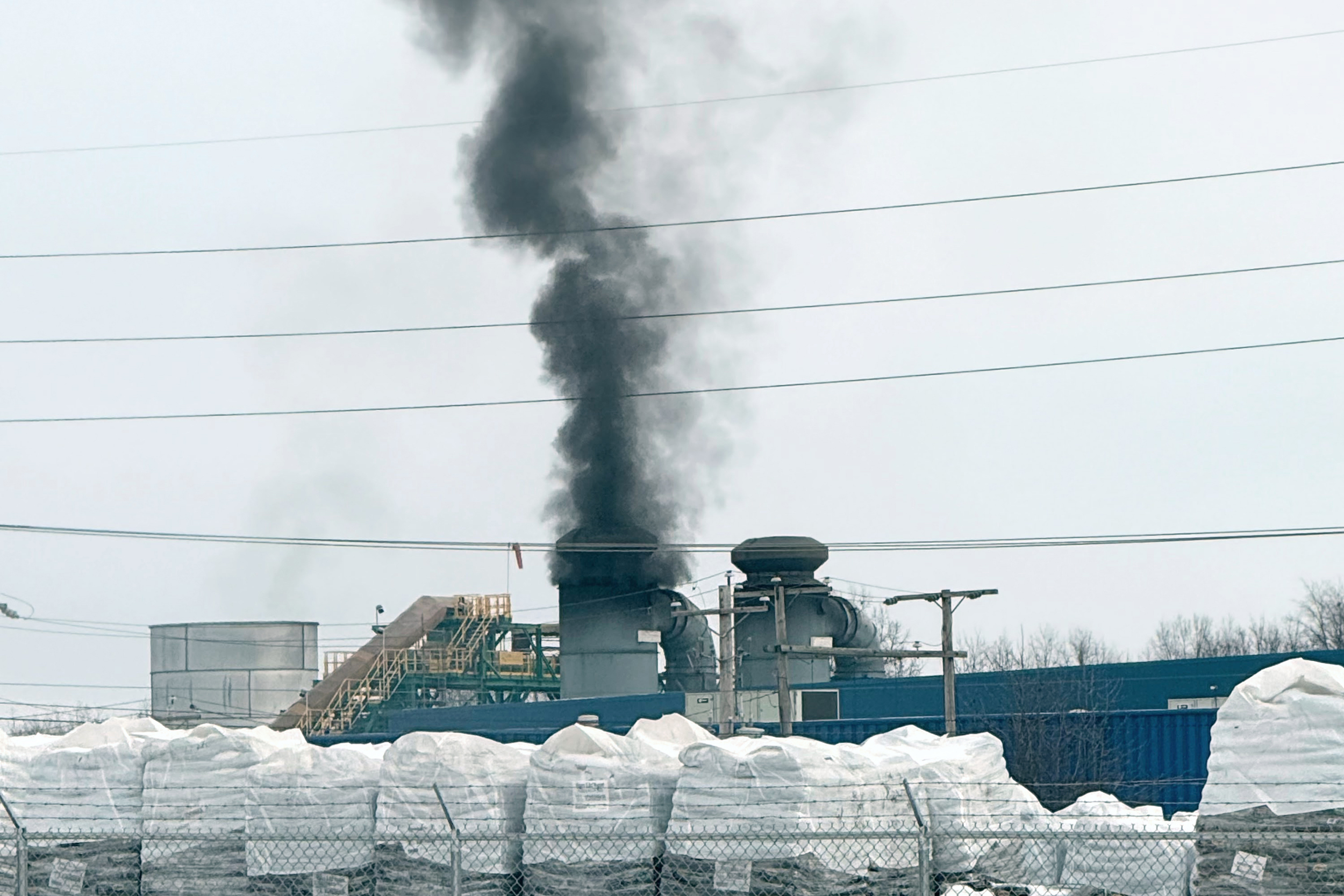
Belching smoke from a new plastic waste processing plant in central Ohio has stirred opposition to an even larger “chemical recycling” factory planned for Arizona by the same company.
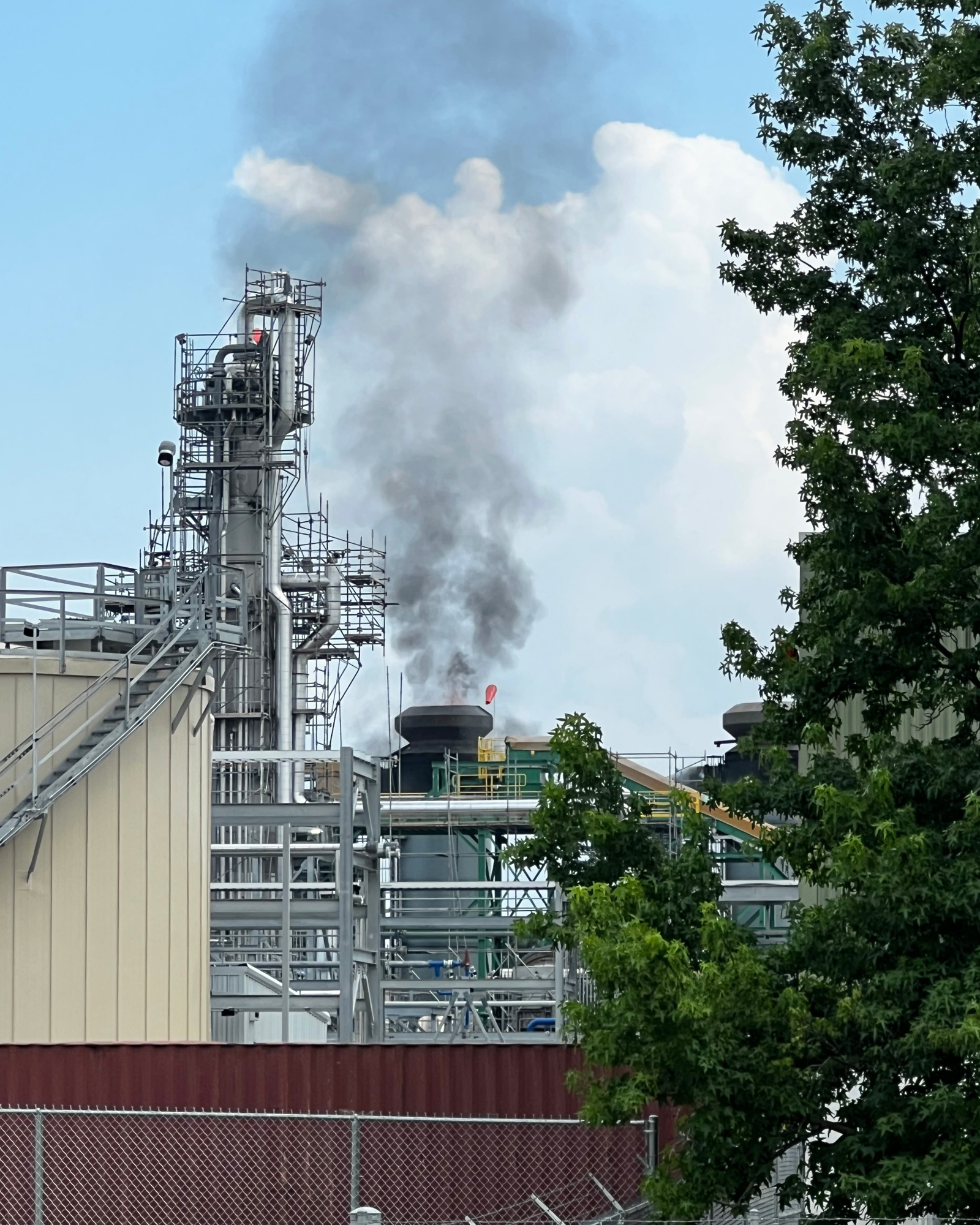
The Freepoint Eco-Systems plant near Hebron, Ohio, fired up its processing kilns for the first time in 2024. Since then, it’s faced multiple citizen complaints about sooty emissions, from black clouds of smoke to flames. Dozens of times, plant operators have bypassed normal pollution controls to vent gases through a flare after upsets in their manufacturing processes, including emergency shutdowns, according to the Ohio Environmental Protection Agency.
The state regulator has issued four notices of violation to the company, according to an agency database, and launched an enforcement case after the latest one in December.
The Ohio plant’s troubled track record should be a red flag to officials who oversee permitting for the company’s plans for Eloy, Arizona, about 60 miles south of Phoenix on Interstate 10, said Kevin Greene, a pollution-prevention expert who lives in nearby Tucson and retired from the Illinois Environmental Protection Agency.
Another warning should be the industry’s “troubling” underperformance when attempting to use chemical processes to turn mixed plastic waste into fuels or new plastic feedstocks, said Greene.
“How about a six-month pause on this project while they investigate what’s going on in Hebron and take another look at the industry in general?” Greene suggested in an interview with Inside Climate News.
At least one Eloy city councilmember, Josephine “JoAnne” Galindo, said she’s concerned enough to want to be part of a potential Eloy delegation to visit Ohio, tour the Freepoint plant there and meet with local government and company officials.
“I would want to know more,” Galindo said. “I’m always concerned about the safety of my community.”
Freepoint officials declined a request for an interview on either their Ohio plant’s environmental performance or their proposed Arizona facility.
In a written statement, the company said it has “invited officials from Arizona to tour our Ohio facility to see the sophistication of our operations and the scale of the plastic waste we are working to process. We’re currently scheduling this visit.”
In Ohio, the company is working with environmental and occupational safety and health officials and the local fire department “to ensure compliance with health, safety and environmental requirements,” the statement said. Freepoint officials, the statement added, “have implemented a number of operational improvements.”
In February, at public meetings in Arizona, a Freepoint representative put a positive spin on the situation.
“You get the benefit of being the second mover,” Geof Storey, the company’s chief development officer, told the Pinal County Board of Supervisors. “We are only going to build this one if the first one works. You are going to get all [the] learnings and all the benefits of that [Ohio] project.”
To the Eloy City Council the same week, he added, “We are still working out some of the kinks.”
The Ohio plant, located about 30 miles east of Columbus near Interstate 70, is designed to process up to 175 million pounds of plastic waste annually. The waste is sourced from plastic packaging companies and community recycling programs throughout the region, including as far away as Louisville, Kentucky.
Freepoint Eco-Systems, a subsidiary of global trading and finance firm Freepoint Commodities, envisions at least a half-dozen facilities in the United States, Storey told Arizona officials. The Eloy facility would collect waste plastic from as far away as California and Colorado, as well as from Phoenix and Tucson, he added. A company PowerPoint presentation said its capacity would be more than twice the Ohio plant’s.
That would make the Eloy plant one of the largest in the world, said Rita O’Connell, a national organizer with the environmental group Beyond Plastics. But O’Connell also noted that the company’s PowerPoint contains a disclaimer that “there can be no assurances that information relied upon in preparing this presentation will prove accurate or any of the projections will be realized.”
Deregulatory Agenda Boosts Chemical Recycling
Industry officials have advocated for chemical recycling of plastics for years—often under the umbrella term of “advanced recycling”—as a solution to the global plastic waste crisis.
Typically, that’s done with a technology called pyrolysis, the process of decomposing materials at very high temperatures in an oxygen-free environment. Traditional uses range from making tar from timber for wooden ships to transforming coal into coke for steelmaking.
More recently, major oil companies and small startups alike have sought to develop the technology as an alternative for recycling a wide variety of plastic waste. So far, they’ve been met with limited success and serious pushback from environmental groups viewing it as akin to incineration.
But one of the biggest criticisms is the paucity of plastic waste that pyrolysis actually turns into new plastic.
For example, a 2024 lawsuit by California Attorney General Rob Bonta—against ExxonMobil’s pyrolysis-based chemical recycling operation at its Baytown complex near Houston—claimed decades of recycling deception contributed to a plastics crisis in California and around the world. In the lawsuit, which is still pending, Bonta asserted that no more than 8 percent of the incoming plastic waste to ExxonMobil’s plant is converted to feedstocks for new plastic.
The lawsuit claimed the remaining waste becomes fuel, which is subsequently burned.
After the lawsuit was filed, ExxonMobil responded that “advanced recycling works. To date, we’ve processed more than 60 million pounds of plastic waste into usable raw materials, keeping it out of landfills.”
The United Nations estimates that the world produces roughly 882 billion pounds of plastic waste each year.
Freepoint, which also uses pyrolysis, declined to say how much of the waste plastic it takes in becomes new plastic.
Storey told Arizona officials its plants divert waste from landfills and offset in-the-ground oil demand.
Company officials said 70 percent of incoming plastic waste is converted into something called pyrolysis oil, or pyoil, which is used as a feedstock to create new products. About 25 percent is converted into gas used to heat the kilns. The rest becomes something called char, what Storey described as “black carbon.”
Storey said the pyoil gets sent to petrochemical customers on the Gulf Coast. There, company officials said, it serves as a “substitute for crude oil to create new plastics and other products.”
“What products our customers manufacture and where they distribute them,” the company said, “is up to our customers.”
The chemical industry has already worked to ease regulations on advanced recycling in dozens of states, including Arizona and Ohio. And in March, after groups of chemical and plastics industry lobbyists visited the U.S. Environmental Protection Agency’s headquarters, the EPA took an initial step to exempt pyrolysis from federal Clean Air Act regulations.
Beyond Plastics’ O’Connell, who is based in New Mexico, said the chemical industry seems to have accelerated its push for chemical recycling as the Trump administration rolls back a wide range of environmental rules. At least three recycling and chemical regulation bills pending in Congress aim to boost chemical recycling of plastic waste, she said.
Fewer than 10 chemical recycling plants are operating in the United States, often in a limited capacity, said O’Connell, whose group follows the industry’s performance.
But Oil and Gas Watch, a petrochemical tracker created by the Environmental Integrity Project, identifies about 40 potential new chemical recycling facilities in the works. Some are proposed, some are in the permitting process and some are approved for construction.
“Given the national atmosphere, it’s possible we’re about to see the lights go on on a bunch of these proposals that haven’t moved in a while, because there seems to be a lot of energy in this direction,” O’Connell said. “It all points to a huge industry push to leverage this Congress and EPA to get chemical recycling rolling nationally.”

Ohio EPA Opens an Enforcement Case
It was a little more than a year ago when Amanda Rowoldt, an Ohio organizer with the environmental group Moms Clean Air Force, was driving by the Freepoint facility near Hebron and saw black smoke billowing out of the stacks. She took a video and filed a complaint with the Ohio EPA.
“Long story short, they were found in violation of exceeding their particulate limits,” Rowoldt.
Numerous pollution incidents followed. A local nonprofit newsroom covering Licking County, The Reporting Project, affiliated with Denison University’s journalism program, took notice.
Denison is a small private liberal arts college located about 10 miles away in Granville. Doug Swift, who teaches at Denison and is an advisor of The Reporting Project, said a plastics recycling theme in an investigative reporting track resulted in a series of articles.
One of the stories, published Feb. 26, revealed the citizen complaints, the state’s violation notices and a 911 call last May from a resident a quarter-mile away reporting “a factory on fire.”
“It was a great series to push out into the community, and it did alert some of our most engaged and knowledgeable citizens to the plant and to a technology most didn’t know anything about,” Swift said. He described the Hebron area as something of a local news desert, often ignored by commercial news outlets in the region.
Hebron Mayor Valerie Mockus said her municipality has no jurisdiction over the plant because it’s located just outside city limits, in an industrial park in Union Township. Still, she said she’s been concerned about environmental incidents there, though she is working to keep an open mind.
“I am very interested in finding ways to address problems with novel solutions,” Mockus said. “We have a problem with too much plastic. Is this a way to address that? But I was disappointed to hear about the negative side effects.”
She described her community as working class, its residents familiar with plumes of evaporated vapor coming from industrial stacks. “When it comes out black,” she added, “everybody pauses.”
According to the company’s air-quality permit from the Ohio EPA, the plant is allowed to emit certain levels of toxic fine particles, volatile organic compounds, nitrogen oxides, hydrochloric acid, and dioxins—pollutants that collectively can damage lungs, cause cancer and create havoc with other bodily systems.
Ohio EPA’s most recent notice in mid-December alleges air-permit violations including excess emissions of particulates, a toxic mix that can include soot, smoke and a variety of chemicals. Since then, the agency has opened an enforcement case against the company, said Max Moore, a spokesman for the Ohio EPA.
The state agency required the company to conduct emissions testing to get a clearer picture of what’s being released into the air, Moore said. Visible particulate emissions exceeded an opacity limit 18 times from Feb. 1 through March 31, he said. Nitrogen oxides from a test in February also exceeded a permit limit, he added.
On April 3, an Ohio EPA official chastised Freepoint for repeatedly failing to quickly notify the agency of plant malfunctions, according to an email that Inside Climate News obtained through a public-records request.
“This issue has been beaten to death at this point, but we still are not receiving immediate notifications of malfunctions,” the state official wrote, citing an example of a late afternoon March 30 notice to regulators of an early morning March 27 malfunction.
“If it helps, think of it like calling the fire department when there’s a fire,” the official told the company representatives. “That’s immediate. You wouldn’t wait eight hours or until the next day.”
A company representative said that afterward, “we promptly changed our reporting process to ensure it’s in line with their requirements.”
The Ohio EPA’s Moore said the goal “is to get the facility back into compliance.”
Pollution and Fire Videos
Cat Adams, a Columbus-based organizer with the Buckeye Environmental Network, said several workers have sought her out to describe unsafe working conditions, including dust, chemical spills and fire hazards. She hears from area residents about the plant, too.
“There’s a group of people in the community who are worried about it, and they want something done,” Adams said.
Shawn Jones is one of them. He was an eyewitness to the May 27 fire and took a video of it. In subsequent months, he’s kept a close eye, documenting other incidents of billowing smoke. “I’ve probably seen that 15 times,” Jones said, adding that he’s concerned about the health and safety of both people in the community and workers inside the plant.
He said he’s not sure what, if anything, Ohio EPA officials will do to force the company to comply with environmental regulations.
“I’d like them to shut the whole place down,” Jones said. “It’s such a new process. They clearly don’t have it figured out yet.”
He said it feels like Freepoint is “doing sandbox experiments in the backyards of thousands of people. They can, because of the lack of zoning here.”
In Arizona, Greene, the former Illinois environmental official, said he and an Eloy resident, Ralph Atchue, are asking Pinal County air quality officials to strengthen a permit they issued the company three years ago. The reason they’re citing: the company’s pollution record in Ohio.
Greene also suggests that the city of Eloy should ask for fenceline air-quality monitoring to give the community real-time data on any leaks and equipment failures.
Noting that the company has essentially described its Ohio plant as a test case, Greene added: “I’d like to know what’s going to be redesigned [for Eloy], or what’s going to be improved. But I also want to make sure there will be the appropriate safeguards in place to ensure that it doesn’t happen in Eloy—and that it doesn’t recur in Hebron.”
The post Ohio Plastic Waste Plant to Expand Nationally appeared first on Great Lakes Now.
Great Lakes Now
https://www.greatlakesnow.org/2026/04/24/ohio-plastic-waste-plant-to-expand-nationally/