At Farrand Hall in Southwest Michigan, chefs don’t just source their ingredients. They forage for them. What began as a vacation home for owners James Gray and Jacob Hagan has grown into a one-of-a-kind dining experience that gives guests a true taste of the surrounding landscape.

GLN News Editor Lisa John Rogers visited Farrand Hall to learn how the team’s unique approach connects food, place, and community.

#GreatLakes #Food #Dining #FineDining #Foraging #Restaurant
===========================================
Website: https://greatlakesnow.org
Facebook: https://www.facebook.com/greatlakesnow
X: https://www.x.com/greatlakesnow
Instagram: https://www.instagram.com/greatlakesnoworg
Newsletter: https://www.greatlakesnow.org/great-lakes-now-newsletter/

To learn more about supporting Detroit PBS and Great Lakes Now, visit https://www.detroitpbs.org/
===========================================

Produced by
Lisa John Rogers
Adam Fox-Long

Written by
Adam Fox-Long

Narrated by
Lisa John Rogers

Edited by
Bill Allesee

Camera
Adam Fox-Long

Additional Material
Farrand Hall

The post At This Michigan Restaurant, Chefs Forage For Your Food | Great Lakes Now appeared first on Great Lakes Now.

Original Article

Great Lakes Now

Great Lakes Now

https://www.greatlakesnow.org/2025/12/08/at-this-michigan-restaurant-chefs-forage-for-your-food-great-lakes-now/

Great Lakes Now

What is a Watershed? and why you should care about yours. Watershed 101 Watersheds can be tricky things to wrap your head around. They're not super easy to see with the naked eye, and they often lack distinct visible boundaries when you not looking at [...]

The post What is a Watershed? Watershed 101 appeared first on Fox-Wolf Watershed Alliance.

Original Article

Fox-Wolf Watershed Alliance

Fox-Wolf Watershed Alliance

https://fwwa.org/2025/12/08/what-is-a-watershed-watershed-101/?utm_source=rss&utm_medium=rss&utm_campaign=what-is-a-watershed-watershed-101

Tim Burns

By Clara Lincolnhol

Michigan is pouring $77 million into clean-up of contaminated abandoned real estate such as former factories. The director of the Department of Environment, Great Lakes and Energy says the goal is to make the cleaned-up sites safe for housing, commercial developments and other uses.

The post Michigan allocates $77 million to clean thousands of contaminated sites first appeared on Great Lakes Echo.

Original Article

Great Lakes Echo

Great Lakes Echo

https://greatlakesecho.org/2025/12/07/michigan-allocates-77-million-to-clean-thousands-of-contaminated-sites/

Clara Lincolnhol

for immediate release Groundbreaking Set for Brothertown Creek Restoration Project EPA-supported project to protect local farmland, water quality, and Lake Winnebago kicks off December 9 BROTHERTOWN, WI — December 8, 2025 — Tomorrow marks the start of a major conservation project in northeast Wisconsin, as partners break ground on the Brothertown [...]

The post MEDIA RELEASE: Groundbreaking Set for Brothertown Creek Restoration Project appeared first on Fox-Wolf Watershed Alliance.

Original Article

Fox-Wolf Watershed Alliance

Fox-Wolf Watershed Alliance

https://fwwa.org/2025/12/06/media-release-groundbreaking-set-for-brothertown-creek-restoration-project/?utm_source=rss&utm_medium=rss&utm_campaign=media-release-groundbreaking-set-for-brothertown-creek-restoration-project

Fox-Wolf Watershed Alliance

Invasive quagga mussels have taken over the lakes, severely threatening native species like whitefish. So what can we do?

Researchers like Harvey Bootsma are exploring different ways to control mussel populations. But will any of them work?

This video was produced in partnership with @bridge.michigan

Learn more on the Great Lakes Now YouTube channel.

#Whitefish #Fish #Fishing #Ecology #GreatLakes #Mussels #InvasiveSpecies
===========================================
Website: https://greatlakesnow.org
Facebook: https://www.facebook.com/greatlakesnow
X: https://www.x.com/greatlakesnow
Instagram: https://www.instagram.com/greatlakesnoworg
Newsletter: https://www.greatlakesnow.org/great-lakes-now-newsletter/

To learn more about supporting Detroit PBS and Great Lakes Now, visit https://www.detroitpbs.org/

The post What will it take to stop invasive mussels? appeared first on Great Lakes Now.

Original Article

Great Lakes Now

Great Lakes Now

https://www.greatlakesnow.org/2025/12/05/what-will-it-take-to-stop-invasive-mussels/

Great Lakes Now

By Ellie Katz, Interlochen Public Radio

This article was republished with permission from Interlochen Public Radio.


The U.S. Army Corps of Engineers recently revived an alternative to the Line 5 tunnel. The new option was proposed in a supplemental environmental impact statement published by the federal agency last month.

The Army Corps is now proposing to use a technique called horizontal directional drilling, or HDD, which was tabled as an option for replacing the pipeline in 2018. HDD would create a narrow borehole to house the pipeline in the Straits of Mackinac, as opposed to the tunnel that’s been at the center of criticism and lawsuits for several years.

Public comment on the Army Corps’ new proposal is due by the end of the week. An online public comment session on Wednesday went for nearly three hours. The majority of those speaking were against the project, raising fears about a potential oil spill in the Straits of Mackinac and voicing frustration with the new drilling option.

“This proposal before you is a bait and switch,” said Lauren Sargent of Ann Arbor. “We were talking about a tunnel. Now what we’re talking about is essentially fracking technology below the Straits.”

Horizontal drilling is not the same as fracking, but is sometimes used to drill wells for fracking.

Joseph Torres, a business agent for Pipeliners Local Union 798, spoke in favor of the continued operation of Line 5 regardless of the method used to replace it.

“Building this pipeline, whether going through a tunnel or by HDD, is a safer option compared to transporting resources by railcar or truck,” Torres said. “I do believe that maintaining the integrity of Line 5 is crucial and shutting it down will impact citizens and our economy.”

In email to Interlochen Public Radio, an Enbridge spokesperson Ryan Duffy said there is confusion surrounding the new horizontal directional drilling alternative.

“This is not something we proposed,” Duffy wrote. “Nothing has changed on our end, we are still planning to build the tunnel.”

According to an online timeline, U.S. Army Corps expects to issue a decision on the Line 5 project in spring 2026.


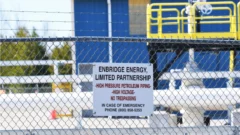
Featured image: A view of part of the Enbridge Energy Line 5 pumping station near Mackinaw City, Michigan on the south side of the Straits of Mackinac. (Photo: Lester Graham/Michigan Radio)

The post Tensions flare as Line 5 public comment deadline nears appeared first on Great Lakes Now.

Original Article

Great Lakes Now

Great Lakes Now

https://www.greatlakesnow.org/2025/12/05/tensions-flare-as-line-5-public-comment-deadline-nears/

Interlochen Public Radio

Tensions flare as Line 5 public comment deadline nears

By Ellie Katz, Interlochen Public Radio

This article was republished with permission from Interlochen Public Radio.

The U.S. Army Corps of Engineers recently revived an alternative to the Line 5 tunnel. The new option was proposed in a supplemental environmental impact statement published by the federal agency last month.

Read Now at Great Lakes Now.

Original Article

Great Lakes Now

Great Lakes Now

https://www.greatlakesnow.org/2025/12/tensions-flare-as-line-5-public-comment-deadline-nears/

Interlochen Public Radio

The federal government has committed up to $400 million to develop two small nuclear reactors at the Palisades Nuclear Generating Station, an existing nuclear power plant in southwest Michigan on Lake Michigan.  Read the full story by Michigan Public.

Original Article

Great Lakes Commission

Great Lakes Commission

https://www.glc.org/dailynews/20251205-mi-nuclear-power

Autumn McGowan

The New York State Department of Environmental Conservation has announced the completion of an experimental aquatic habitat reclamation project on Brocton Shoal in Lake Erie. The project utilizes high-velocity jetting to restore historical lake trout spawning grounds after being degraded by zebra and quagga mussels. Read the full story by WRFA – Jamestown, NY.

Original Article

Great Lakes Commission

Great Lakes Commission

https://www.glc.org/dailynews/20251205-nysdec-habitat-restoration

Autumn McGowan

The Center for Great Lakes Literacy launched a new, self-paced and online module designed for elementary, middle and high school teachers to learn and teach their students about the science of harmful algal blooms in the Great Lakes. Read the full story by MLive.

Original Article

Great Lakes Commission

Great Lakes Commission

https://www.glc.org/dailynews/20251205-habs-free-course

Autumn McGowan

News

Grants awarded to improve regional management of invasive Phragmites across the Great Lakes basin

Ann Arbor, Michigan – Nearly $315,000 will be awarded to support local organizations in controlling nonnative Phragmites australis, one of the most aggressive plant species invading the Great Lakes basin and North America. Grantees will implement certain combinations of management actions for Phragmites, and the Phragmites Adaptive Management Framework (PAMF) will use the data gathered to improve guidance on management practices that are most likely to be effective.

Phragmites is currently managed using a suite of approaches, including herbicide, cutting/crushing, flooding, and burning. These actions are resource intensive and differ in effectiveness due to site-specific conditions and variations in implementation. PAMF is a predictive model, developed by the Great Lakes Phragmites Collaborative, that uses participant data to continually ‘learn’ more about which management techniques are working against Phragmites in certain conditions and which are not. In turn, the PAMF model predicts optimal guidance for each site. Data provided to PAMF by grantees will reduce the uncertainty surrounding management outcomes, increase the model’s predictive power, and improve best management practices.

2025 is the second year that PAMF Active Adaptive Management Program grants are available for Phragmites management in Great Lakes states. In the first year of the program, AAMP recipients from 17 organizations contributed 70 management units totaling over 130 acres. The grant program contributed data to six combinations lacking data in the PAMF model, three of which had no prior data.

Twenty-one grants have been awarded in 2025:

Grantee

Award

Jurisdiction

Chicago Park District

$24,717

Illinois

Chikaming Open Lands

$4,641

Michigan

Conservation of Waterford Lands (COWL)

$15,654

Michigan

County of St. Clair Parks and Recreation Commission

$9,174

Michigan

Crescent Beach Landowners Association (CBLA)

$4,008

Michigan

Huron Clinton Metropolitan Authority (HCMA)

$44,000

Michigan

Ionia Conservation District

$9,018

Michigan

Lake St. Clair CISMA

$19,800

Michigan

Macomb County Department of Public Works

$36,233

Michigan

Six Rivers Land Conservancy

$6,911

Michigan

Washtenaw County Parks & Recreation Commission (WCPARC)

$2,900

Michigan

City of Pepper Pike

$8,000

Ohio

City of Toledo, Division of Environmental Services

$26,000

Ohio

Conneaut Port Authority

$10,940

Ohio

Old Woman Creek National Estuarine Research Reserve

$30,000

Ohio

Regional Science Consortium at Presque Isle Center

$31,330

Pennsylvania

Door County Soil & Water Conservation Department (SWCD)

$9,424

Wisconsin

Great Lakes Community Conservation Corps (Great Lakes CCC)

$5,000

Wisconsin

Pheasants Forever

$8,255

Wisconsin

Weed Out! Racine

$1,720.

Wisconsin

Wisconsin Department of Natural Resources- Bureau of Wildlife Management

$7,000

Wisconsin

TOTAL

$314,729.19

The Great Lakes Phragmites Collaborative (GLPC) is a regional partnership led jointly by the Great Lakes Commission and U.S. Geological Survey to foster more coordinated, efficient and strategic approaches to Phragmites management and ecosystem restoration. Funding for the PAMF Active Adaptive Management Program is provided by the Great Lakes Restoration Initiative (GLRI).


The Great Lakes Commission, led by chair Timothy Bruno, Great Lakes Program Coordinator at the Pennsylvania Department of Environmental Protection, is a binational government agency established in 1955 to protect the Great Lakes and the economies and ecosystems they support. Its membership includes leaders from the eight U.S. states and two Canadian provinces in the Great Lakes basin. The GLC recommends policies and practices to balance the use, development, and conservation of the water resources of the Great Lakes and brings the region together to work on issues that no single community, state, province, or nation can tackle alone. Learn more at www.glc.org.

Contact

For media inquiries, please contact Beth Wanamaker, beth@glc.org.

Recent GLC News

Upcoming GLC Events

View GLC Calendar

Archives

Original Article

Great Lakes Commission

Great Lakes Commission

https://www.glc.org/news/aamp-120425

Beth Wanamaker