Participating in the 2024 ESIP January Meeting
NCEI News Feed
https://www.ncei.noaa.gov/news/participating-2024-esip-january-meeting
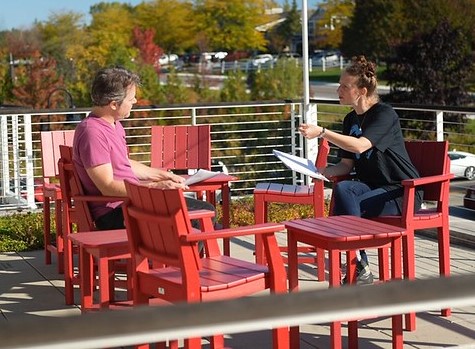
NCEI scientists and partners explore Earth science data for all people at the 2024 January Meeting of Earth Science Information Partners (ESIP).
NCEI News Feed
https://www.ncei.noaa.gov/news/participating-2024-esip-january-meeting
Current Watches, Warnings and Advisories for Brown (WIC009) Wisconsin Issued by the National Weather Service
https://alerts.weather.gov/cap/wwacapget.php?x=WI12688473F54C.WinterStormWarning.12688492EC40WI.GRBWSWGRB.63171d3eabf7d88a2b3d8886b91dde32
Current Watches, Warnings and Advisories for Brown (WIC009) Wisconsin Issued by the National Weather Service
https://alerts.weather.gov/cap/wwacapget.php?x=WI126884730C18.WinterStormWatch.126884927710WI.GRBWSWGRB.877ae34f9819ef19bcf6c2446daa1d04
Current Watches, Warnings and Advisories for Brown (WIC009) Wisconsin Issued by the National Weather Service
https://alerts.weather.gov/cap/wwacapget.php?x=WI126884666828.WinterStormWatch.126884927710WI.GRBWSWGRB.877ae34f9819ef19bcf6c2446daa1d04
Current Watches, Warnings and Advisories for Brown (WIC009) Wisconsin Issued by the National Weather Service
https://alerts.weather.gov/cap/wwacapget.php?x=WI126884653458.SpecialWeatherStatement.12688465C1C0WI.GRBSPSGRB.3b77a733acfe35fc01f412b80021d336
Current Watches, Warnings and Advisories for Brown (WIC009) Wisconsin Issued by the National Weather Service
https://alerts.weather.gov/cap/wwacapget.php?x=WI12688463EF58.SpecialWeatherStatement.12688464E318WI.GRBSPSGRB.fc8c6076cccd3f028608ae46eaa49482
Current Watches, Warnings and Advisories for Brown (WIC009) Wisconsin Issued by the National Weather Service
https://alerts.weather.gov/cap/wwacapget.php?x=WI12688463A0D4.SpecialWeatherStatement.12688464E318WI.GRBSPSGRB.fc8c6076cccd3f028608ae46eaa49482
Current Watches, Warnings and Advisories for Brown (WIC009) Wisconsin Issued by the National Weather Service
https://alerts.weather.gov/cap/wwacapget.php?x=WI126884563AC0.SpecialWeatherStatement.12688456CDA0WI.GRBSPSGRB.e1ae724017be2a10443f5b652ce3656c
Current Watches, Warnings and Advisories for Brown (WIC009) Wisconsin Issued by the National Weather Service
https://alerts.weather.gov/cap/wwacapget.php?x=WI12688455A524.SpecialWeatherStatement.126884565870WI.GRBSPSGRB.3b77a733acfe35fc01f412b80021d336
A 20th company recently signed a pledge to use 100% of commercially caught Great Lakes fish. This pledge details how a fish can be turned into products, increasing profits and eliminating waste. Read the full story by the Great Lakes Echo.
Great Lakes Commission
https://www.glc.org/dailynews/20240105-fish-pledge
An exhibit in Milwaukee, Wisconsin, transports visitors to a surreal underwater future with interactive sculptural elements and hidden passageways where invasive species have overrun the Great Lakes ecosystem. Read the full story by the Milwaukee Journal Sentinel.
Great Lakes Commission
https://www.glc.org/dailynews/20240105-immersive-exhibit
A phenomenon called pancake ice was caught on video in Chequamegon Bay of Lake Superior by a lakeshore homeowner. This is an indication that the Great Lakes will, hopefully, freeze soon. Read the full story by WJBK-TV – Detroit, MI.
Great Lakes Commission
https://www.glc.org/dailynews/20240105-pancake-ice
The Michigan Department of Environment, Great Lakes, and Energy is planning a webinar series on invasive species and what Michiganders can do to help protect their environment. Read the full story by WSJM-FM – Benton Harbor, MI.
Great Lakes Commission
https://www.glc.org/dailynews/20240105-invasive-species-webinars
With little ice coverage so far this winter, the time is right to spot winter waterfowl that return to this region each year for a winter getaway. Audubon Great Lakes is declaring this the “season of the duck” in Michigan. Read the full story by the Manistee News Advocate.
Great Lakes Commission
https://www.glc.org/dailynews/20240105-winter-waterfowl
In the heart of Niagara Falls, New York, two ambitious development projects – including a living museum showcasing the wildlife of the Niagara River and the larger Great Lakes ecosystem – will bring transformation to an area that has languished for years. Read the full story by Advance Media New York.
Great Lakes Commission
https://www.glc.org/dailynews/20240105-niagara-falls-projects
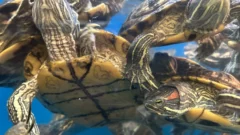
Red-eared sliders are one of the most common pet turtle species in the world. But they can grow to the size of dinner plates and can live around 40 years. Because of that, people often release their pet turtles into the wild. That causes a big problem. Listen the full story by the Interlochen Public Radio.
Great Lakes Commission
https://www.glc.org/dailynews/20240105-turtle-takeover
With winter in the Great Lakes still on standby, so too are icebreakers needed to keep the marine freighters moving for as long as possible through the cold season. The Canadian Coast Guard has strategically docked an icebreaker in downtown Windsor, Ontario, ready for the potential of freezing waterways. Read the full story by the Windsor Star.
Great Lakes Commission
https://www.glc.org/dailynews/20240105-windsor-icebreakers
Researchers say wolf range in the Great Lakes region is unlikely to be negatively affected by projected human land use and climate change. Read the full story by The Wildlife Society.
Great Lakes Commission
https://www.glc.org/dailynews/20240105-resilient-wolves
The two-year plan aims to create tangible and achievable goals moving forward into 2024 and each initiative reflects a priority concern within the maritime domain. Read the full story by The Sault News.
Great Lakes Commission
https://www.glc.org/dailynews/20240105-coast-guard-plan
NCEI News Feed
https://www.ncei.noaa.gov/news/December-2023-regional-climate-impacts-and-outlooks

By Kelly House, Bridge Michigan
The Great Lakes News Collaborative includes Bridge Michigan; Circle of Blue; Great Lakes Now at Detroit Public Television; and Michigan Radio, Michigan’s NPR News Leader; who work together to bring audiences news and information about the impact of climate change, pollution, and aging infrastructure on the Great Lakes and drinking water.
Great Lakes Now
https://www.greatlakesnow.org/2024/01/group-launches-campaign-to-overturn-michigan-solar-siting-law/

Points North is a biweekly podcast hosted by Daniel Wanschura and Morgan Springer about the land, water and inhabitants of the Upper Great Lakes.
This episode was shared here with permission from Interlochen Public Radio.
When I was 13 years old and on vacation in Florida, I bought a baby red-eared slider at a flea market.
Great Lakes Now
https://www.greatlakesnow.org/2024/01/points-north-the-turtle-takeover/
In the roughly six months she has been the 2023 Water Science Policy Fellow, Sarah Gravlee’s throughline has been science, in many forms. It’s been her head-down task to complete a literature review of the hurdles facing public water systems. Gravlee’s been checking for lead water-service lines to a location where someone has applied for day care certification. She’s been fielding phone calls from people across Wisconsin with questions about contaminants in their private wells. There was also the meth house.

“I joined one of our toxicologists in the field a few months ago,” Gravlee said. “We went to a home where someone used to smoke meth. We tested it to ensure it was safe for children to resume living there. It passed with flying colors. Well, not flying colors. There was a negligible amount of residue detected. We used a test similar to a PCR test (a DNA polymerase chain reaction test). We wiped windowsills down and mixed these samples with a chemical solution. The solution was dropped on a tester that uses color indication to quantify the meth levels.”
Gravlee’s two-year fellowship is supported by the Wisconsin Department of Health Services (DHS) and the University of Wisconsin Water Resources Institute (WRI). Her indisputably wide range of tasks in such a short amount of time is precisely the intention of the sponsoring organizations.
Jennifer Hauxwell, WRI associate director and a co-mentor for Gravlee, noted the initial call for applicants stated that the fellow would capitalize on many opportunities to help communities facing hazardous conditions.
The mentor team is rounded out by Drs. Roy Irving and Sarah Yang at DHS and Environmental Health Capacity Evaluator Jacquie Cronin, also at DHS. This fellowship/co-mentoring model, Hauxwell said, serves the interests of all three participants, the university, agency and fellow.
The university, through WRI, contributes to workforce development—training the next generation of scientists to do community-engaged science. Then, “Agencies make progress on a water challenge for the people of Wisconsin and attract talent for a project, and potentially longer-term positions.” Hauxwell continued, “Fellows apply technical skills to real-world problems, learn how to engage partners and communities and are invited to step outside of a comfort zone.”
For Gravlee’s part, she’s ticking the boxes Hauxwell described. “I like working at the intersection between water and public health. I’ve enjoyed fielding questions from the public about water contaminants, sitting in on meetings about newly identified water contamination, and assisting in projects focused on reducing Wisconsin’s environmental health hazards. I’ve learned a lot about how DHS functions and collaborates with its partners, including the DNR, DATCP (Department of Agriculture, Trade and Consumer Protection), UW-Extension and local health departments.”
She also offered: “I know the DHS fellowship is a little different than other fellowships that are focused on a singular project. I love that I have a variety of tasks, so every day is different. DHS has been great about providing professional development opportunities and involving me in work that is in line with my interests.”
As for longer-term positions that could result from a fellowship, Gravlee isn’t yet sure of her future direction. “I never pictured myself working in public health before this fellowship, but I think it’s been a good fit. I could see myself continuing environmental health work or transitioning to work focused specifically on contaminated water resources.”
In the meantime, she’s soaking up the experience and providing solid contributions to, for example, implementing a wide-ranging Centers for Disease Control and Prevention grant on building environmental health capacity. According to the DHS, 83% of community water systems in the state serve small populations, 3,330 or fewer people. Through a mini-grant program on which Gravlee works, local public health departments and tribal health agencies are getting assistance to address health hazards such as high nitrate levels, flooding and contaminants.
Based on that grant, Gravlee has been preparing for a conference presentation in March. It will focus on her and Cronin’s environmental health capacity support for local health departments investigating and resolving water-related issues. The pair is refining a presentation they previously delivered at a statewide conference in the fall.
The post Variable fellowship brings learning and results for all involved first appeared on WRI.News Release | WRI
https://www.wri.wisc.edu/news/4058-2/
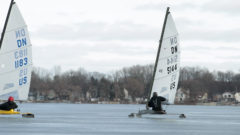
Fish-leather purses and wallets may make their way into Great Lakes fashion with an initiative to use 100% of commercially caught fish by 2025.
One of the latest projects of a binational Great Lakes organization is to fully use the region’s whitefish, lake trout, yellow perch, walleye and white sucker.
The post Twenty companies pledge to use all parts of Great Lakes fish by 2025 first appeared on Great Lakes Echo.Great Lakes Echo
http://greatlakesecho.org/2024/01/04/twenty-companies-pledge-to-use-all-parts-of-great-lakes-fish-by-2025/

This article was republished here with permission from Planet Detroit.
By Brian Allnutt, Planet Detroit
U.S. Reps. Debbie Dingell (D-Dearborn) and Rashida Tlaib (D-Detroit) showed up to a meeting last week in Dearborn to sign a water affordability pledge and discuss the challenges faced by Michiganders struggling to pay for water service.
Great Lakes Now
https://www.greatlakesnow.org/2024/01/michigan-group-looks-to-grow-a-statewide-coalition-for-water-affordability/
The Great Lakes had the smallest amount of ice cover this New Year’s Day in at least the past 50 years. The Lakes are on track to see less ice cover than the seasonal average this winter, according to the National Oceanic and Atmospheric Administration’s Great Lakes Environmental Research Laboratory. Read the full story by The Washington Post.
Great Lakes Commission
https://www.glc.org/dailynews/20240103-ice-cover
Four Michigan tribes are appealing the Michigan Public Service Commission’s decision to allow Canadian oil company Enbridge to move forward with building a tunnel around Line 5 beneath the Straits of Mackinac. Read the full story by WLUC-TV – Marquette, MI.
Great Lakes Commission
https://www.glc.org/dailynews/20240103-permit-appeal
By this time of year, Sainte-Anne-de-la-Pérade, Québec, is usually teeming with thousands of visitors eager to angle for tomcod that swim upstream from the St. Lawrence River estuary every winter. The start of the season can attract as many as 15,000 visitors and at least $1 million in revenue. But this year’s ice fishing season is lacking a key element: ice. Read the full story by CBC News.
Great Lakes Commission
https://www.glc.org/dailynews/20240103-ice-fishing
This winter’s mild temperatures and lack of ice are making the end of the shipping season much smoother for the Port of Duluth-Superior. The ships will be able to travel through the Soo Locks at a much faster speed and the Port will have its latest closure date in history. Read the full story by KBJR-TV – Superior, WI.
Great Lakes Commission
https://www.glc.org/dailynews/20240103-shipping-season
A recently discovered chemical compound that makes it difficult for invasive sea lamprey to find their breeding grounds may be a new tool for controlling this parasite that threatens Great Lakes fish. Read the full story by Midland Daily News.
Great Lakes Commission
https://www.glc.org/dailynews/20240103-sea-lamprey-control
Proposed legislation that would create a statewide water affordability program in Michigan is drawing backlash from several Macomb County communities who worry it will raise rates for all users and say a Great Lakes Water Authority (GLWA) program already exists to help those in need. Sponsors of the legislation said the proposed water affordability program would actually subsidize the program already in place through the GLWA. Read the full story by The Detroit News.
Great Lakes Commission
https://www.glc.org/dailynews/20240103-water-affordability-program
Each fall and winter, the Milwaukee River receives runs of brown trout from Lake Michigan. The fish, among the largest of the species available to river anglers anywhere on the planet, travel upriver on spawning migrations and provide world-class fishing opportunities. Read the full story by the Milwaukee Journal Sentinel.
Great Lakes Commission
https://www.glc.org/dailynews/20240103-fishing-opportunities
The water level of most of the Great Lakes has been falling. Lake Superior’s water level is down 4 inches in the last month and down a very significant 8 inches in the last year, leading it to be 2 inches below its December average level. Read the full story by WOOD-TV – Grand Rapids, MI.
Great Lakes Commission
https://www.glc.org/dailynews/20240103-water-levels
Upcoming changes to the fishing regulations in part of northeastern Ontario are drawing mixed reactions from anglers. A particular point of contention in the changes, which took effect on January 1, 2024, is a reduction in the keeping size of walleye in Fisheries Management Zone 10. Read the full story by CBC News.
Great Lakes Commission
https://www.glc.org/dailynews/20240103-fishing-regulations
The mysterious disappearance of a commercial fishing boat in Lake Michigan, and the 18-month-long search that followed, is the topic of the next program in the Maritime Speaker Series offered by the Door County Maritime Museum in Wisconsin. The public can attend the program on January 4 in person at the museum or see it online via Zoom. Read the full story by the Green Bay Press Gazette.
Great Lakes Commission
https://www.glc.org/dailynews/20240103-shipwreck-program
Current Watches, Warnings and Advisories for Brown (WIC009) Wisconsin Issued by the National Weather Service
https://alerts.weather.gov/cap/wwacapget.php?x=WI126884281E10.SpecialWeatherStatement.12688428978CWI.GRBSPSGRB.3b77a733acfe35fc01f412b80021d336

By Izzy Ross, Interlochen Public Radio
This coverage is made possible through a partnership between IPR and Grist, a nonprofit independent media organization dedicated to telling stories of climate solutions and a just future.
On an early Thursday evening, people are seated around the dining room of Trattoria Stella, an Italian restaurant on the ground floor of the Grand Traverse Commons, just outside the city’s downtown area.
Great Lakes Now
https://www.greatlakesnow.org/2024/01/a-valuable-resource-traverse-city-restaurants-aim-to-reduce-food-waste-greenhouse-gases/

Keep up with PFAS-related developments in the Great Lakes area with Great Lakes Now’s biweekly headline roundup.
Michigan
PFAS experts gather to address growing chemical crisis — Great Lakes Now
The ongoing “forever chemicals” crisis took center stage during EGLE’s fourth annual Great Lakes PFAS Summit.
Great Lakes Now
https://www.greatlakesnow.org/2024/01/pfas-news-roundup-forever-chemicals-awareness-lacking-among-u-s-adults/

Author Sue Leaf’s latest work starts in 1977 when she and her then boyfriend embarked on a 185-mile bike trek from Michigan across Lake Superior’s southern shore to Duluth.
It ends many decades later as she, and the boyfriend who became her husband, settle into a new Lake Superior cabin designed by her architect daughter.
Great Lakes Now
https://www.greatlakesnow.org/2024/01/book-review-author-sue-leafs-latest-takes-a-philosophical-look-at-life-on-lake-superiors-south-shore/

Actors Neil Brookshire and Cassandra Bissell practice their lines for “Me and Debry,” a play about marine debris held at the Door County Public Library in 2022. Image credit: Bonnie Willison, Wisconsin Sea Grant
What is marine debris, what are its impacts and what can we do about it? These are the central messages of a play written on behalf of Wisconsin Sea Grant by David Daniel with American Players Theatre of Wisconsin.
“Me and Debry,” (pronounced “debris”), is a half-hour, whimsical, audience-participation play about litter (marine debris) in the Great Lakes. It had its “world premiere” in Wisconsin’s Door County in October 2022 and was performed three times at the Gilmore Fine Arts School in Racine, Wisconsin, for fifth- and sixth-grade students in May 2023.
The play’s script has been fine-tuned through these performances and is now available for others to use for free, complete with props.
Ginny Carlton, Wisconsin Sea Grant’s education outreach specialist, recently discussed the play and why schools or other educational institutions might be interested in performing it.
Ginny, what is marine debris and what message does the play offer about it?
So, a lot of times people think about gasoline or oil on the water because we often see that on the news. Technically, from NOAA’s perspective (National Oceanic and Atmospheric Administration), that isn’t marine debris. It’s obviously pollution, but the definition requires marine debris to be a solid. It can be anything from something really small, like a microplastic, to something quite large, like a derelict fishing vessel.
Often, environmental messaging can be sort of depressing and doom and gloom. We wanted to provide students with an uplifting message. One of the lines in the play is, “If it’s to be, it’s up to me.” This particular line is repeated a couple times during the play, so that hopefully, the students come to understand that they can have a positive role in at least considering what to do and making a change that would have a positive impact.

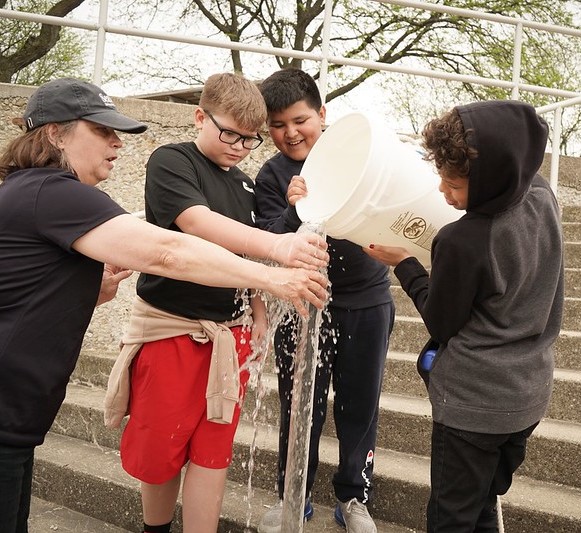
Ginny Carlson (left) instructs Racine elementary students in an environmental stewardship day project at Quarry Lake County Park as part of the marine debris project that the “me and Debry” play came from. Image credit: Bonnie Willison, Wisconsin Sea Grant
What is special about the play compared to other marine debris educational materials?
Two reasons: one, it presents the material in a slightly different messaging format. Rather than reading a textbook or watching a video, it has an opportunity for interaction. There’s a lot of audience participation built into the play script. There are four central roles that are performed by members of the audience. One is a crane, another is a kayaker, a fish and a kid. Then beyond those four central roles, there’s also audience participation opportunities when the play starts to talk about what we call the eight R’s. Many teachers and students are already familiar with three of the R’s. Reduce, Reuse, Recycle. The play introduces five others for the students and the educators to think about. (Rethink, Refuse, Repurpose, Refurbish and Repair)
I think another reason is that it has the potential of getting people up moving and actually doing, and inspiring action beyond the actual performance. So, providing an opportunity for the students to consider their own behavior and their own impact on this issue and potentially making some minor adjustments in what they’re doing. Obviously other educational curriculum and formats also attempt to do that, but for some reason, I think just having the audio and visual together and having live interactions with people brings it one step further along than just listening to a teacher talk about it or with a PowerPoint or watching a video, perhaps.
Also, the script design itself is a rhyming format, and that tends to grab people’s attention, and it somehow helps people to remember the content better than just having it in regular prose.
Do actors in the play need to memorize lines?
Even with the actors that were at Door County and in The Gilmore Fine Arts School, we told them that there was no need for them to memorize lines. They could do what they called a reading performance, which means that you can have the script in hand. The desire is to have you pre-read it, so you’re not standing and reading like a storybook-style program, but that you have some familiarity with the script ahead, but have it there to provide a refresher as you move along.
What do students get out of the play in addition to marine debris education?
Students get an opportunity to do some public speaking. I think oftentimes students don’t have the opportunity to publicly speak in front of their peers and or other individuals. So that can be a real confidence-booster to have the opportunity to do that.
They also have an opportunity to consider different worldviews and different perspectives. So, by including the characters of the crane and the fish our intention and hope was that perhaps the students or youth that are watching the performances and interacting with the performances would understand how humans can and do impact other organisms and our responsibility to them — a stewardship message that is part of the play as well.

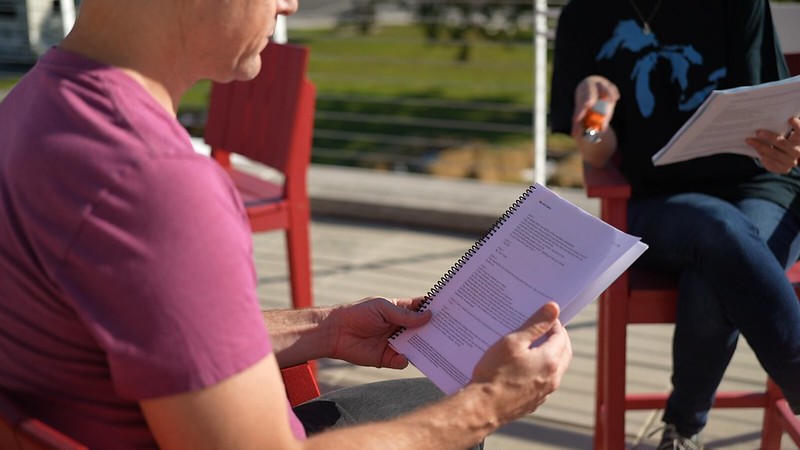
The “Me and Debry” script is now available to use for free. Image credit: Bonnie Willison, Wisconsin Sea Grant
How do people get the script if they want it?
The easiest way to obtain it is to simply download it from our Wisconsin Sea Grant Education website. We have it available in English, and then the four main character parts for the audience members are in English, Spanish, and Hmong translations as well. The eight R materials for audience participation, they’re available in English, Spanish, and Hmong directly from our website. We also include all that material in a costume kit and an educational kit that you can make a request to have sent to you within Wisconsin. That link is also on the education website. So, you simply make a request for the materials to be interlibrary loaned to you.
The kit has costumes for the two primary actors. Basically, a T-shirt and a pair of oversized sunglasses, so it’s not elaborate costuming. And similarly, it has costumes for the four main characters. And then supporting props for the various eight R topics.
Does it cost anything?
No. Just like our other educational kits at this time, there’s no charge. We will ship it on our cost, and we also pay for the return shipping.
Me and Debry, is part of a two-year project funded by Wisconsin Sea Grant with grants from the National Sea Grant College Program, National Oceanic and Atmospheric Administration Marine Debris Program, U.S. Department of Commerce, and the state of Wisconsin.
The post Marine debris play script available for free first appeared on Wisconsin Sea Grant.News Releases | Wisconsin Sea Grant
News Releases | Wisconsin Sea Grant
https://www.seagrant.wisc.edu/news/marine-debris-play-script-available-for-free/
While driving down a snowy rural road, admiring Minnesota’s winter landscape, you catch a glimpse of something in the distance. Its person standing on a frozen river wearing bright lime green clothing. "Uffda!", you’d say! What could that person be doing!?
Upper Midwest Water Science Center
https://www.usgs.gov/centers/upper-midwest-water-science-center/news/adventures-winter-fieldwork?utm_source=comms&utm_medium=rss&utm_campaign=news
Current Watches, Warnings and Advisories for Brown (WIC009) Wisconsin Issued by the National Weather Service
https://alerts.weather.gov/cap/wwacapget.php?x=WI1266735887AC.WinterWeatherAdvisory.126673590CE0WI.GRBWSWGRB.40dfb0e0eb0d606854c3710b950f75f5
Current Watches, Warnings and Advisories for Brown (WIC009) Wisconsin Issued by the National Weather Service
https://alerts.weather.gov/cap/wwacapget.php?x=WI126673580F5C.WinterWeatherAdvisory.126673590CE0WI.GRBWSWGRB.40dfb0e0eb0d606854c3710b950f75f5
Current Watches, Warnings and Advisories for Brown (WIC009) Wisconsin Issued by the National Weather Service
https://alerts.weather.gov/cap/wwacapget.php?x=WI12667357B264.SpecialWeatherStatement.12667358014CWI.GRBSPSGRB.678500c005046086d6b3e5f3170d0588
Current Watches, Warnings and Advisories for Brown (WIC009) Wisconsin Issued by the National Weather Service
https://alerts.weather.gov/cap/wwacapget.php?x=WI126673574CD4.SpecialWeatherStatement.12667357AD50WI.GRBSPSGRB.678500c005046086d6b3e5f3170d0588
Current Watches, Warnings and Advisories for Brown (WIC009) Wisconsin Issued by the National Weather Service
https://alerts.weather.gov/cap/wwacapget.php?x=WI12667356F554.WinterWeatherAdvisory.126673590CE0WI.GRBWSWGRB.40dfb0e0eb0d606854c3710b950f75f5
Current Watches, Warnings and Advisories for Brown (WIC009) Wisconsin Issued by the National Weather Service
https://alerts.weather.gov/cap/wwacapget.php?x=WI1266734AA240.WinterWeatherAdvisory.126673573820WI.GRBWSWGRB.ad00fdd7d9b0f28282ec71b1ab05f9a4

By Matthew Brown, Associated Press
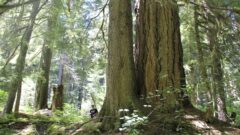
BILLINGS, Mont. (AP) — The Biden administration moved on Tuesday to conserve groves of old-growth trees on national forests across the U.S. and limit logging as climate change amplifies the threats they face from wildfires, insects and disease.
Agriculture Secretary Tom Vilsack said the agency was adopting an “ecologically-driven” approach to older forests — an arena where timber industry interests have historically predominated.
Great Lakes Now
https://www.greatlakesnow.org/2023/12/ap-biden-administration-moves-to-protect-old-growth-forests-as-climate-change-brings-fires-pests/

Science Says What? is a monthly column written by Great Lakes now contributor Sharon Oosthoek exploring what science can tell us about what’s happening beneath and above the waves of our beloved Great Lakes and their watershed.
In the summer of 2017, Teskey Baldwin, a student at Ontario’s University of Guelph, was studying whether pitcher plants near water capture more insects than those farther away.
Great Lakes Now
https://www.greatlakesnow.org/2023/12/science-says-what-pitcher-plants-feast-on-salamanders-unveiling-a-brutal-side-of-botanical-carnivory/