The winner of a Great Lakes water quality competition is tackling microplastics pollution one washing machine at a time. Ten finalists from the United States and Canada presented their work to a four-judge panel at the AquaHacking Challenge at Northwestern Michigan College in Traverse City, Michigan. Projects dealt with PFAS, lead contamination, microplastics, and nutrients. Read the full story by Interlochen Public Radio.

Original Article

Great Lakes Commission

Great Lakes Commission

https://www.glc.org/dailynews/20240515-water-innovation-challenge

Nichole Angell

Purvis Fisheries located on Ontario’s Manitoulin Island in Lake Huron is one of 24 fisheries operating on the Great Lakes that have joined the 100% Great Lakes Fish Pledge. Through the project, signatories have committed to using 100 percent of their fish by 2025. The Manitoulin Island fishery’s commitment to make better use of its catch will create more value for the company while also improving its impact on the environment. Read the full story by BayToday.

Original Article

Great Lakes Commission

Great Lakes Commission

https://www.glc.org/dailynews/20240515-fishery-sustainable-pledge

Nichole Angell

An upcoming celebration of Great Lakes sturgeon is no big fish story, as the Friends of the St. Clair River will host its annual Sturgeon Fest on June 1 in Port Huron, Michigan. Those who attend the festival can experience the Great Lakes’ largest fish via a live sturgeon touch tank and hands-on activities. Read the full story by The Voice.

Original Article

Great Lakes Commission

Great Lakes Commission

https://www.glc.org/dailynews/20240515-sturgeon-festival

Nichole Angell

FishPass is a project aiming to reconnect the Ottaway or Boardman River in Traverse City, Michigan, to Lake Michigan. With recent money granted the project is slated to start in June, marking the start of a long process to make dams smarter and capable of sorting beneficial fish species from invasive species. Read the full story by WMNN-TV – Cadillac, MI.

Original Article

Great Lakes Commission

Great Lakes Commission

https://www.glc.org/dailynews/20240515-new-fishpass-project

Nichole Angell

The Huron River Watershed Council recently estimated the 148-year-old Peninsular Dam in Ypsilanti, Michigan, could come down in 2025 or 2026. The plan includes investing $10 million to revitalize a nearby public park that will grow as the river narrows. Read the full story by Great Lakes Echo.

Original Article

Great Lakes Commission

Great Lakes Commission

https://www.glc.org/dailynews/20240515-dam-removal

Nichole Angell

There are a few active large fires in southern Canada. Due to upper air flow the smoke from those fires will be blown into the Midwest. Satellite images show the milky white haze of smoke moving from the Dakotas into the western portion of the Great Lakes basin. Read the full story by MLive.

Original Article

Great Lakes Commission

Great Lakes Commission

https://www.glc.org/dailynews/20240515-early-wildfires

Nichole Angell

Harmful algal blooms have become the talk of the summer for nearly a decade in Lake Erie, especially as the heat cranks up. The record-breaking rainfall experienced this April is the main driver for the above-average algal bloom forecast this coming summer. Read the full story by WTOL11 – Toledo, OH.

Original Article

Great Lakes Commission

Great Lakes Commission

https://www.glc.org/dailynews/20240515-early-algal-bloom

Nichole Angell

Chicago groups spotlight the city’s water “abundance,” focus on innovation, collaboration as key to its future

For Chicago’s Alaina Harkness, the availability and well-being of Chicago and the Great Lakes region’s water is clear. It’s about innovation, and that requires collaboration. Bringing together the right mix of policy, science, tech, advocacy groups, and others to work on common priorities for the future of water.

This mix happened recently at Chicago Water Week, organized by the not-for-profit, Current, a Chicago-based water innovation hub.

Read Now at Great Lakes Now.

Original Article

Great Lakes Now

Great Lakes Now

https://www.greatlakesnow.org/2024/05/chicago-groups-spotlight-the-citys-water-abundance-focus-on-innovation-collaboration-as-key-to-its-future/

Gary Wilson, Great Lakes Now

Nonprofit organizations in Northern Michigan will receive nearly $70,000 in funding from the Great Lakes Energy People Fund. With 21 grants awarded, the funds will support a variety of local initiatives including maritime preservation. Read the full story by Cheboygan Daily Tribune.

Original Article

Great Lakes Commission

Great Lakes Commission

https://www.glc.org/dailynews/20240515-nonprofit-funding

Nichole Angell

Central Michigan University’s Institute for Great Lakes Research recently acquired a two-person submersible that will help researchers get a better handle on what’s happening beneath the surface of the Great Lakes. Read the full story by Central Michigan University.

Original Article

Great Lakes Commission

Great Lakes Commission

https://www.glc.org/dailynews/20240515-submersible-vessel

Nichole Angell

Lake trout fish cheeks as prepared in the recipe below. Image credit: Marie Zhuikov, Wisconsin Sea Grant

Did you know that fish have cheeks? And did you know you can eat them?

Well they do and you can. Several species of fish, both saltwater and freshwater have cheeks that are large enough to harvest. These include halibut, grouper, cod, walleye, whitefish and lake trout. About the size of a scallop, fish cheeks are prized for their firm texture and tenderness.

They’re usually not available in supermarkets, but if you’re near a commercial fisherman, you might be in luck. During a recent trip to the Bayfield Peninsula in Wisconsin I stopped by Halvorson’s Fisheries in Cornucopia where they had frozen lake trout fish cheeks for sale. I’d never had them before, so was intrigued. I bought a half pound and took them home in my cooler.

About a week later, after taking time to peruse different recipes available online, I thawed the cheeks and prepared them based on a halibut cheeks recipe courtesy of The Culinary Chase. Because I only had half the amount of cheeks, I halved the recipe, plus made my own tweaks.

The result was highly edible. Next time, I’ll delete the flour. It made them a bit mealy and I don’t think they need it. In case you want to try, here’s what I did. By the way, the Eat Wisconsin Fish website run by Wisconsin Sea Grant offers many great fish recipes that you may also want to check out.

MARIE’S FISH CHEEKS RECIPE (wheat- and corn-free)

½ lb fish cheeks
½ cup white rice flour
Sea salt and black pepper
1 Tablespoon butter
½ Tablespoon olive oil
3 green onions, green parts, diced
1-1/2 teaspoons capers, rinsed
splash of cooking wine or sherry
1 lemon wedge
1 teaspoon dried parsley

Rinse the fish cheeks and pat them dry with a paper towel. Put the flour in a pie tin or a plate and add salt and pepper to taste. Add the fish cheeks and gently tap off any excess flour.

In a sauté pan over medium-high heat, melt the butter and add the olive oil. Swirl until the butter and oil are mixed and bubbly. Add the scallions and cook briefly until tender. Place the cheeks into the butter and brown until cooked, just a minute or two each side. Time will vary depending on the size of the cheeks, but no longer than 5 minutes total should be needed.

When you flip the fish over, add capers, wine, and squeeze the lemon wedge over the cheeks. Add an additional ½ Tablespoon of butter and allow to melt. Shake the pan and remove from heat. Sprinkle the fish cheeks with parsley and serve right away.

The post Marie’s (Fish) Cheeks first appeared on Wisconsin Sea Grant.

Original Article

Blog | Wisconsin Sea Grant

Blog | Wisconsin Sea Grant

https://www.seagrant.wisc.edu/blog/maries-fish-cheeks/

Marie Zhuikov

The most exciting part about removing a dam in a small Michigan city isn’t the demolition, but what comes after. 

The Huron River Watershed Council recently estimated the 148-year-old dam In Ypsilanti could come down in 2025 or 2026.

The post Michigan dam removal could improve environment, recreation and storm protection first appeared on Great Lakes Echo.

Original Article

Great Lakes Echo

Great Lakes Echo

http://greatlakesecho.org/2024/05/15/michigan-dam-removal-could-improve-environment-recreation-and-storm-protection/

Elinor Epperson

Look fast or you may miss an elusive 170-year-old sunken schooner off the coast of Baileys Harbor, Wisconsin.

The mostly intact shipwreck, which was added to the National Register of Historic Places in early April, isn’t always visible, even though it’s in very shallow waters, said Tamara Thomsen, a Wisconsin Historical Society maritime archaeologist.

The post Old Lake Michigan shipwreck visible again after burial under sand first appeared on Great Lakes Echo.

Original Article

Great Lakes Echo

Great Lakes Echo

http://greatlakesecho.org/2024/05/14/old-lake-michigan-shipwreck-visible-again-after-burial-under-sand/

Clara Lincolnhol

Canadian wildfire smoke chokes upper Midwest for second straight year

By Todd Richmond, Associated Press

MADISON, Wis. (AP) — Smoke from Canadian wildfires has prompted health warnings across the upper Midwest for the second straight year.

Fires raging in British Columbia and Alberta sent the haze over parts of Montana, the Dakotas, Minnesota and Wisconsin on Sunday, lingering into Monday morning.

Read Now at Great Lakes Now.

Original Article

Great Lakes Now

Great Lakes Now

https://www.greatlakesnow.org/2024/05/canadian-wildfire-smoke-chokes-upper-midwest-for-second-straight-year/

The Associated Press


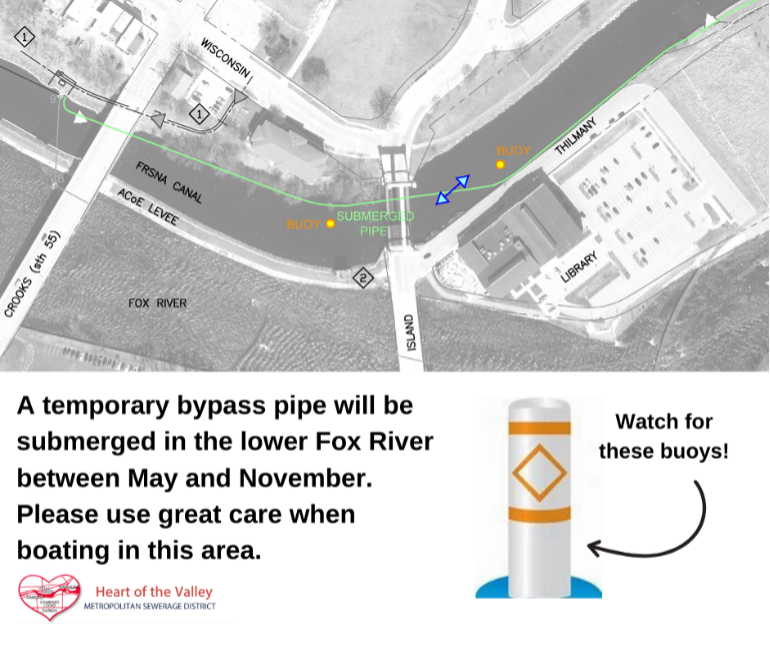
Please be careful when boating through the Kaukauna locks this season.

A temporary sewer bypass pipe will be placed in the Lower Fox River as part of Heart of the Valley Metropolitan Sewerage District’s Interceptor Rehabilitation Project. The bypass pipe will be in use between approximately May and November.  The bypass pipe for this project area will be installed in the guard lock from the Kaukauna Power dam (at State Highway 55/Crooks Avenue bridge) east to Kaukauna Lock 1.

For boating safety, the pipe will be submerged to provide approximately four (4) feet of clearance and will be marked with two navigational hazard buoys. Boaters should not navigate close to the buoys and may safely cross the submerged pipe in the center of the canal (generally east of Island/Catherine Street). Boaters should still practice caution when crossing the pipe and may wish to trim their motor and raise any trailing devices above water.

Project updates may be found at this link https://hvmsd.org/interceptor-rehabilitation-project/.


Original Article

Blog – Fox Locks

Blog – Fox Locks

https://foxlocks.org/blog/attention-kaukauna-boaters/

Fox Locks

Job Opportunities

Great Lakes Commission Position Available: Geospatial Data Internship

Application deadline: May 24, 2024  |  Download PDF

Description

The Great Lakes Commission (GLC) is seeking one to two individuals for an internship focused on geospatial data management and delivery. The selected individuals will contribute to spatial data projects in support of GLC’s work to advance the environment and economy of the eight-state, two-province Great Lakes region. This position will work under the direction of the GIS Project Manager.

The intern(s) will support GLC’s work with the U.S. Environmental Protection Agency and other partners to gather, update and curate data to support planning and response activities under the Oil Pollution Act. A smaller proportion of time will be dedicated to supporting projects related to other priority areas included in the GLC’s strategic plan, such as aquatic invasive species and water quality. The position is ideal for students and other early-career applicants interested in gaining professional experience in GIS mapping and analysis tasks in a regional agency setting.

Responsibilities

The intern(s) will support the work of the GIS/data team to provide mapping, data management, analysis, and visualization support across the GLC’s program areas as needed.

Specific responsibilities include:

  • Creation of geospatial datasets from tables, heads-up digitizing and standard GIS reference data
  • Contacting agencies and facilities via phone and email to confirm that datasets used in emergency response planning are up to date
  • Preparation of thematic maps, charts and tables for use in print and web publications in collaboration with in-house project staff and partner organizations
  • Maintenance of reference data published by the Great Lakes Commission and updates to associated maps and tables
  • Creation and maintenance of metadata for new or modified datasets according to established standards

Qualifications

Current undergraduate and graduate students or recent graduates (within the last 24 months) are preferred. Successful candidates will most likely have a background in geography, environmental studies, data science, or another related field. Applicant must have demonstrated competence using ArcGIS, with preference given to those who have practical work or volunteer experience or equivalent academic achievement. This position requires great attention to detail, excellent communication, time management and critical thinking skills, and the ability to work well both in a team setting and independently.

Knowledge of web GIS, experience working with large datasets and data QA/QC processes, and/or knowledge of Great Lakes issues and programs, regional government, water quality, land use and/or resource management are advantageous but not required.

Appointment

Position Classification and Compensation
The position is full time and classified as limited term as defined by the GLC’s personnel policies. The intended duration is 10 weeks starting as early as June 3, 2024; specific start and end dates are flexible. The term may be extended beyond the initial 10 weeks depending on funding and mutual interest. The salary for this position is $17/hour.

Work Environment
The location for this position is the GLC’s office in Ann Arbor, Michigan. A partial telework schedule may be considered under the GLC’s flexible schedule and telework policy.

Application Process

Applicants must submit a cover letter and resume stating their interest in and qualifications for the position in a single email to vacancy@glc.org. All required items must be provided for an application to receive consideration. Applications will be reviewed as they are received. No phone calls, please.

About the Great Lakes Commission

The Great Lakes Commission is a binational government agency established in 1955 to protect the Great Lakes and the economies and ecosystems they support. Its membership includes leaders from the eight U.S. states and two Canadian provinces in the Great Lakes basin. The GLC recommends policies and practices to balance the use, development, and conservation of the water resources of the Great Lakes and brings the region together to work on issues that no single community, state, province, or nation can tackle alone. Learn more at www.glc.org.

Equal Opportunity Employer
The Great Lakes Commission strives to create an inclusive, diverse and non-discriminatory workplace. The Great Lakes Commission is an equal opportunity employer; the Great Lakes Commission complies with applicable federal, state and local laws prohibiting discrimination. It is Great Lakes Commission policy that no person shall be discriminated against, as an employee or applicant for employment, because of race, color, religion, age, sex, national origin, disability status, genetics, protected veteran status, marital status, political affiliation, sexual orientation, gender identity or expression, or any other characteristic protected by federal, state or local laws.


Contact

For media inquiries, please contact Beth Wanamaker, beth@glc.org.

Recent GLC News

Upcoming GLC Events

View GLC Calendar

Archives

Original Article

Great Lakes Commission

Great Lakes Commission

https://www.glc.org/news/position-available-gis-intern-2024

Laura Andrews

Despite losing a few ships this year, experts say you can expect to see a lot of cruise ships once again on the Great Lakes this summer. A few popular cruise ports will include Little Current, Killarney, and Sault Ste. Marie. Read the full story by CTV News Northern Ontario.

Original Article

Great Lakes Commission

Great Lakes Commission

https://www.glc.org/dailynews/20240513-cruiseships-greatlakes-summer

Hannah Reynolds

The cause of a large number of dead and dying fish reported at Lake Macatawa, located near Holland in Ottawa County, Michigan, has been found. Testing of collected fish revealed positive cases of viral hemorrhagic septicemia. Read the full story by the Detroit Free Press.

Original Article

Great Lakes Commission

Great Lakes Commission

https://www.glc.org/dailynews/20240513-fish-dying-lakemacatawa

Hannah Reynolds

SUNY Oswego recently launched the Great Lakes Institute to foster a greater awareness and understanding of the Great Lakes through continuing research efforts, academic programming and coursework for students at all levels, and public outreach. Read the full story by Oswego County News Now.

Original Article

Great Lakes Commission

Great Lakes Commission

https://www.glc.org/dailynews/20240513-greatlakesinstitude-challenges-solutions

Hannah Reynolds

Readers across the Great Lakes states and Canada this year will participate in a basin-wide book club hosted by the Library of the Great Lakes. From now until September 2025, participants will read Michigan author Sally Cole-Misch’s The Best Part of Us and Ontario author Joanne Robertson’s children’s book, The Water Walker. Read the full story by Great Lakes Echo.

Original Article

Great Lakes Commission

Great Lakes Commission

https://www.glc.org/dailynews/20240513-summerread-book-club

Hannah Reynolds

The Great Lakes Shipwreck Historical Society announced a remarkable discovery on May 1st, 2024, unearthing the long-lost Adella Shores vessel beneath 650 feet of water, roughly 40 miles northwest of Whitefish Point in Michigan. Read the full story by WITL – Lansing, MI.

Original Article

Great Lakes Commission

Great Lakes Commission

https://www.glc.org/dailynews/20240513-adellashores-shipwreck-lakesuperior

Hannah Reynolds

Despite hitting some rocky waters recently, it’s full steam ahead for the SS Badger this year, with the popular Lake Michigan car ferry setting sail for its 71st season May 17. Read the full story by the Milwaukee Journal Sentinel.

Original Article

Great Lakes Commission

Great Lakes Commission

https://www.glc.org/dailynews/20240513-ss-badger

Hannah Reynolds

The Wisconsin Department of Natural Resources has issued an Air Quality Advisory for PM2.5 which will remain in effect until 10:00 AM CDT today. This advisory affects people living in the following counties: Brown, Calumet, Door, Florence, Forest, Kewaunee, Langlade, Lincoln, Manitowoc, Marathon, Marinette, Menominee, Oconto, Oneida, Outagamie, Portage, Shawano, Vilas, Waupaca, Waushara, Winnebago and Wood. The first round of Canadian wildfire smoke of 2024 is currently impacting the region. Air quality will be in the Unhealthy for Sensitive Groups (USG) to Unhealthy PM2.5 AQI categories. Smoke will continue moving from northwest to southeast behind a cold front, and is expected to eventually impact the entire state later today. Moderate to Unhealthy for Sensitive Groups (USG) AQI PM2.5 concentrations are anticipated today before transitioning back toward Moderate to Good AQI later today into Tuesday. The current Air Quality Advisory will be updated this morning after the situation is reassessed. Since the air quality index could reach the UNHEALTHY level, people with heart or lung disease, older adults, and children should avoid prolonged or heavy exertion. Everyone else should reduce prolonged or heavy exertion. For more information on current air quality, please see: https://airquality.wi.gov

Original Article

Current watches, warnings, and advisories for Brown County (WIC009) WI

Current watches, warnings, and advisories for Brown County (WIC009) WI

https://api.weather.gov/alerts/urn:oid:2.49.0.1.840.0.c97a973e05d1724d696e2c05beb0b825721f8dfb.001.1.cap

NWS

Readers across the Great Lakes states and Canada this year will participate in a basin-wide book club hosted by the Library of the Great Lakes. 

From now until September 2025 participants will read Michigan author Sally Cole-Misch’s The Best Part of Us and Ontario author Joanne Robertson’s children’s book, The Water Walker.

The post Need a summer read? Join this basin-wide book club first appeared on Great Lakes Echo.

Original Article

Great Lakes Echo

Great Lakes Echo

http://greatlakesecho.org/2024/05/13/need-a-summer-read-join-this-basin-wide-book-club/

Kayla Nelsen

The Wisconsin Department of Natural Resources has issued an Air Quality Advisory for PM2.5 which will remain in effect until 10:00 AM CDT Monday morning. This advisory affects people living in the following counties: Brown, Calumet, Door, Florence, Forest, Kewaunee, Langlade, Lincoln, Manitowoc, Marathon, Marinette, Menominee, Oconto, Oneida, Outagamie, Portage, Shawano, Vilas, Waupaca, Waushara, Winnebago and Wood. The first round of Canadian wildfire smoke of 2024 is currently being observed in Minnesota and far northwest Wisconsin. Unhealthy for Sensitive Groups (USG) to Unhealthy PM2.5 AQI will be possible as the smoke plume moves into the state behind a cold front. PM2.5 concentrations are likely to remain elevated through Sunday afternoon and evening across northwest Wisconsin. Smoke will then continue moving from northwest-to-southeast behind the cold front Sunday night into Monday morning and is expected to eventually impact the entire state come Monday. Currently, Moderate to Unhealthy for Sensitive Groups (USG) AQI PM2.5 concentrations are anticipated Monday before transitioning back towards Moderate to Good AQI later Monday into Tuesday. The current Air Quality Advisory will be updated Monday morning after we reassess the situation. Since the air quality index could reach the UNHEALTHY level. People with heart or lung disease, older adults, and children should avoid prolonged or heavy exertion; everyone else should reduce prolonged or heavy exertion. For more information on current air quality, please see: https://airquality.wi.gov

Original Article

Current watches, warnings, and advisories for Brown County (WIC009) WI

Current watches, warnings, and advisories for Brown County (WIC009) WI

https://api.weather.gov/alerts/urn:oid:2.49.0.1.840.0.15ee385df85b64e9137bfb9b6191eb21bf316430.001.1.cap

NWS

At 816 PM CDT, Doppler radar was tracking gusty showers along a line extending from 10 miles south of Cedar River Michigan to 8 miles northeast of Kaukauna to 7 miles south of Princeton. Movement was southeast at 30 mph. HAZARD...Wind gusts 30 to 40 mph with isolated higher gusts. SOURCE...Radar indicated. IMPACT...Gusty winds could knock down tree limbs and blow around unsecured objects. Locations impacted include... Green Bay, Oshkosh, Manitowoc, Sturgeon Bay, Kewaunee, Chilton, Algoma, Brillion, Luxemburg, and Denmark.

Original Article

Current watches, warnings, and advisories for Brown County (WIC009) WI

Current watches, warnings, and advisories for Brown County (WIC009) WI

https://api.weather.gov/alerts/urn:oid:2.49.0.1.840.0.81052c68c752e1c4de233394df96b1fbab1dab1d.001.1.cap

NWS

At 711 PM CDT, Doppler radar was tracking a band of showers and isolated thunderstorms along a line extending from near Hermansville Michigan to near Legend Lake to 10 miles southwest of Plainfield. Movement was southeast at 30 mph. These showers and isolated thunderstorms produced wind gusts of 39 mph near Antigo at 615 PM and wind gusts of 41 mph at Wisconsin Rapids at 635 PM. HAZARD...Wind gusts 35 to 40 mph with isolated higher gusts possible. SOURCE...Radar indicated. IMPACT...Gusty winds could knock down tree limbs and blow around unsecured objects. Locations impacted include... Green Bay, Appleton, Oshkosh, Marinette, Shawano, Waupaca, Wautoma, Bay Shore Park, Menasha, and Kaukauna.

Original Article

Current watches, warnings, and advisories for Brown County (WIC009) WI

Current watches, warnings, and advisories for Brown County (WIC009) WI

https://api.weather.gov/alerts/urn:oid:2.49.0.1.840.0.44bb14a89cc18e398ccbbee0bf7337d085176fc6.001.1.cap

NWS

The Great Lakes Indian Fish and Wildlife Commission (GLIFWC) is looking for support on a proposed Buffalo Reef stamp sand removal plan. Mining stamp sands are encroaching on the 22,000-foot reef and its status as spawning grounds for whitefish and trout. The sands would be moved to an upland location, stabilized, and monitored for any outflow. Read the full story by WLUC-TV – Marquette, MI.

Original Article

Great Lakes Commission

Great Lakes Commission

https://www.glc.org/dailynews/20240510-stamp-sand-removal

James Polidori

A White House official visited the Lake Elmo, Minnesota high school known as “ground zero” for PFAS contamination. Last year, state lawmakers passed Amara’s Law, named for a Tartan High School graduate who spent the last few months of her life lobbying Minnesota state lawmakers to crack down on the “forever chemicals” which contributed to her liver cancer diagnosis. Read the full story by Great Lakes Now.

Original Article

Great Lakes Commission

Great Lakes Commission

https://www.glc.org/dailynews/20240510-pfas-visit

James Polidori

More than 15 years after the Great Lakes Compact was signed, For Love of Water (FLOW), a Great Lakes advocacy organization, has reevaluated the compact and its goal of protecting lake water from being diverted by canals, aqueducts, pipelines, vessels, tunnels or tanker trucks. Read the full story by Michigan Advance.

Original Article

Great Lakes Commission

Great Lakes Commission

https://www.glc.org/dailynews/20240510-compact-review

James Polidori

The S.S. Badger is fully recovered and ready for another season on Lake Michigan’s open waters. The opening voyage for the 410-foot boat will be manned by 100 employees, ready to take the trip across the lake. The trip shortens a 7-8.5 hour, over 400-mile journey to a 60-mile jaunt taking 4 hours. Read the full story by WXMI-TV – Grand Rapids, MI.

Original Article

Great Lakes Commission

Great Lakes Commission

https://www.glc.org/dailynews/20240510-carferry-voyage

James Polidori

U.S. Fish and Wildlife Service personnel will apply lampricides to the Cedar River in Michigan to kill sea lamprey larvae burrowed in the stream bottom. Applications will be conducted between May 21-30 in accordance with State of Michigan permits. Read the full story by the EagleHerald.

Original Article

Great Lakes Commission

Great Lakes Commission

https://www.glc.org/dailynews/20240510-lamprey-control

James Polidori

A renewable energy company announced it will use the shores of Lake Erie in Harborcreek Township, Pennsylvania, as the spot to test how wave energy converters hold up to different marine conditions while also focusing on sustainability, energy efficiency and potential impacts on local ecosystems. Read the full story by WKBN-TV – Youngstown, OH.

Original Article

Great Lakes Commission

Great Lakes Commission

https://www.glc.org/dailynews/20240510-renewable-testing

James Polidori

U.S. Senators Debbie Stabenow, co-chair of the U.S. Senate Great Lakes Task Force, and Gary Peters applauded the Senate Committee on Environment and Public Works passage of its bipartisan Great Lakes Restoration Initiative Act of 2024. The legislation would extend the program for another five years through 2031 and increase annual funding authorization from $475 million $500 million. Read the full story by the Oscoda Press.

Original Article

Great Lakes Commission

Great Lakes Commission

https://www.glc.org/dailynews/20240510-restoration-program

James Polidori

The Wisconsin Department of Natural Resources (DNR) has announced that over six million fish had been restocked throughout the state’s inland waters and the Great Lakes in 2023. Over 1.3 million Chinook Salmon and 450,000 Brown Trout were stocked in Wisconsin’s Great Lakes. Read the full story by WFRV-TV – Green Bay, WI.

Original Article

Great Lakes Commission

Great Lakes Commission

https://www.glc.org/dailynews/20240510-fish-stocking

James Polidori

A former lightkeeper reminisced on her family’s stay at Trowbridge Light Station, off the northern shore of Lake Superior, from March to December while the lake was free of ice. Duties included everything from manual labour, to working with generators and radio equipment. Important work, as those activities helped to keep the waters safe for the booming shipping industry on the great lake. Read the full story by CBC News.

Original Article

Great Lakes Commission

Great Lakes Commission

https://www.glc.org/dailynews/20240510-lighthouse-keeper

James Polidori

Beginning in the 1940s, businesses started using the Rouge River in southeast Michigan as a dumping ground for industrial pollution. Local activists formed the Friends of the Rouge in 1986. A coordinator of its flagship program, Rouge Rescue, recounted his involvement at the annual event where they organize volunteers across the watershed to remove trash from the river. Read the full story by Planet Detroit.

Original Article

Great Lakes Commission

Great Lakes Commission

https://www.glc.org/dailynews/20240510-cleanup-activist

James Polidori

Like clockwork, Michigan’s Ford Lake and its downstream neighbor, Belleville Lake, turn bright green every summer due to harmful algal blooms.

The lakes, located near Ypsilanti in the southeast part of the state, have struggled for decades with phosphorus pollution that spurs algae growth.

The post Dams may power a stop harmful algal blooms in urban lakes, expert says first appeared on Great Lakes Echo.

Original Article

Great Lakes Echo

Great Lakes Echo

http://greatlakesecho.org/2024/05/10/dams-may-power-a-stop-harmful-algal-blooms-in-urban-lakes-expert-says/

Elinor Epperson

PFAS News Roundup: White House official visits Minnesota high school in town known as “ground zero” for PFAS

White House official and chair of the White House Council on Environmental Quality, Brenda Mallory, visited Minnesota’s Tartan High School on May 6 to tour the area known as “ground zero” for PFAS contamination. The Lake Elmo school is located in a “plume” created by Minnesota multinational chemical giant, 3M.

Read Now at Great Lakes Now.

Original Article

Great Lakes Now

Great Lakes Now

https://www.greatlakesnow.org/2024/05/pfas-news-roundup-white-house-official-visits-minnesota-high-school-in-town-known-as-ground-zero-for-pfas/

Lisa John Rogers, Great Lakes Now

In 2010, Congress established the Great Lakes Restoration Initiative (GLRI) to allow the U.S. Environmental Protection Agency (EPA), working in collaboration with other federal agencies, states, and tribes, to fund projects to restore and protect the Great Lakes. To date, the GLRI has funded more than 7,563 individual projects totaling $3.7 billion and has greatly improved the quality of life in the region. GLRI projects restore habitat, reduce non-point source pollution, prevent the establishment or spread of invasive species, and clean up toxic legacy pollution. In recognition of the importance of this program, the Infrastructure Investment and Jobs Act of 2021 invested an additional $1 billion to accelerate the cleanup of toxic legacy pollution at “Areas of Concern” throughout the region.

Will Congress extend the GLRI for 5 more years?

This year is another important year for the GLRI. Congress is considering bipartisan legislation to reauthorize and extend the program for an additional five years at $500 million per year from 2027-2031. A bipartisan group of lawmakers, including Senators Debbie Stabenow (D-MI) and J.D. Vance (R-OH) in the Senate, and Representatives David Joyce (R-OH), Debbie Dingell (D-MI), Bill Huizenga (R-MI) and Marcy Kaptur (D-OH) in the House, have introduced legislation to reauthorize the GLRI.

On May 1, 2024, the Senate Environment and Public Works Committee unanimously approved the legislation thereby clearing the way for full Senate passage later this year. On the House side, the bill has 31 Republican and Democratic cosponsors, and we continue to advocate that the House Transportation and Infrastructure Committee approve the bill and send it to the full House for approval.

How will projects be prioritized?

In addition to GLRI’s reauthorization, the Alliance for the Great Lakes worked in partnership with the Healing Our Waters–Great Lakes Coalition to suggest ways the EPA could improve its next GLRI Action Plan. The Action Plan is important because it identifies five-year priorities for GLRI funding. We encouraged EPA to address climate change resilience and to focus on the needs of underserved communities. We also made specific suggestions for each part of the Action Plan.

EPA adopted many of our recommendations in its recently released draft “Action Plan IV.” When complete, it will guide GLRI funding to projects from 2025 to 2029.  Climate change is now better incorporated into the draft action plan with projected climate change impacts being emphasized during the design and implementation of GLRI projects. There is increased focus on meaningfully involving underserved communities in decisions about addressing issues in their communities and accruing benefits from GLRI projects. We would still like to see additional emphasis in both areas consistent with our earlier comments.

How you can help

EPA would like your feedback on the draft Action Plan IV. You can read the action plan and provide comments to EPA until May 24, and we hope you will.

Give Your Feedback by May 24

EPA would like your feedback on the draft GLRI Action Plan IV. You can read the plan and provide comments to EPA until May 24, 2024.

Read the Plan & Give Your Feedback

The post 2024: An Important Year for Great Lakes Restoration appeared first on Alliance for the Great Lakes.

Original Article

News - Alliance for the Great Lakes

News - Alliance for the Great Lakes

https://greatlakes.org/2024/05/2024-an-important-year-for-great-lakes-restoration/

Judy Freed

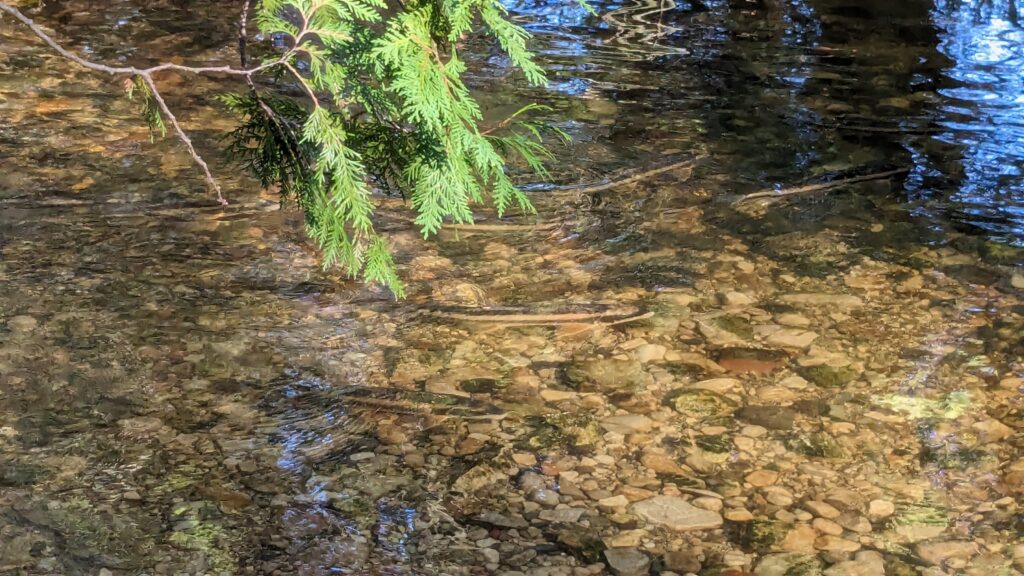
White suckers in Silver Creek. Image credit: Titus Seilheimer, Wisconsin Sea Grant

Spring is when that I head to the streambank most days and look for fish. And not just fish, I also follow the seasonal progression of spring and log those observations as part of the Great Lakes BioBlitz. I really look forward to slowing down and taking time to look at the daily changes. Although I’ve spent more than 20 years studying fish and wetlands, that work tends to be busier and more hectic with lots of travel between different sites. Both the Great Lakes Bioblitz and the sucker monitoring I do for the Shedd Aquarium take me to Silver Creek Park in Manitowoc first thing in the morning five days a week to look for fish and other animals.

It is also a time of sounds, from the seasonally evolving chorus of birds to the splash of fish in the stream. There are two distinct fish splash sounds right now: the vigorous splashing of a couple spawning suckers and the “ploink” splash of a surface-feeding steelhead trout. Suckers spawn in shallow water with a single female and several males. There is a lot of thrashing with fins and tails often breaking the surface. This year I’ve been alerted to the presence of suckers more than once by their splashing spawning activities. Thanks friends, I might have missed you otherwise.

The other sound is from the trout in Silver Creek—that cheerful little “ploink” splash of a feeding steelhead smolt. The creek is one of the stocking locations where the Wisconsin Department of Natural Resources plants two types of rainbow trout (also called “steelhead” because they run to the ocean/lake like salmon and get very silvery). The two types (strains) of steelhead are Ganaraska and Chambers Creek, both from Pacific drainages in the western United States. They are stocked as yearlings, and typically thousands of each type are released.

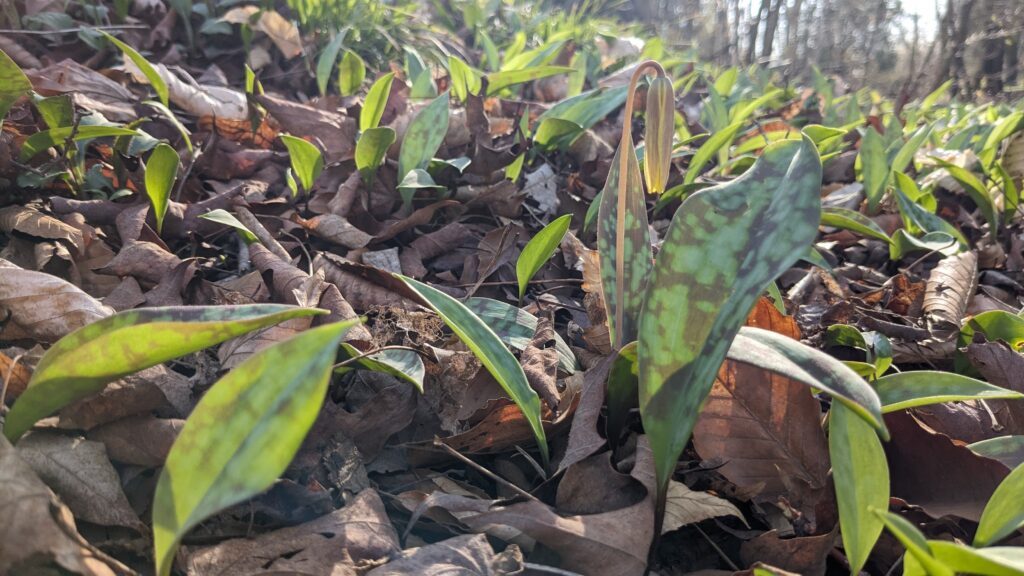
Trout lilies. Image credit: Titus Seilheimer, Wisconsin Sea Grant

You know when steelhead show up because they vigorously feed on the surface. They tend to sit in the deeper pools, facing upstream, swimming just enough to stay in place until they shoot to the surface to gulp down some unsuspecting bug. These stocked trout will head to Lake Michigan and grow big until they return to Silver Creek as adults to spawn. (You can see a pair of spawning steelhead in this video.) Steelhead are popular with anglers on the lake, but people can also catch them in the stream when they return to spawn—no boat required.

As a monitor for the Shedd Aquariums sucker monitoring program, I visit Silver Creek every day. Volunteers go to the same part of the stream and stand for 10 minutes looking for and then counting white suckers. Our monitoring station will contribute to a larger project that looks at suckers in Lake Michigan from Illinois to Door County and also on Lake Superior in Marquette, Michigan.

Water temperature is an important cue for suckers to know that it is time to move upstream from Lake Michigan to their spawning areas. This project will teach us more about how these cues might differ along a south to north gradient and be an important dataset in documenting the changes that climate disruption is causing to the natural world.

Coming out of winter, I value the time I spend watching the stream and looking for fish. I also get to watch the yellow trout lilies emerge and bloom, followed by the wild onions, mayapples and trillium. Sometimes there’s a muskrat or mink saying hello. Spring is a beautiful time to get outside and slowly watch the season!

The post Slowing down for science first appeared on Wisconsin Sea Grant.

Original Article

Blog | Wisconsin Sea Grant

Blog | Wisconsin Sea Grant

https://www.seagrant.wisc.edu/blog/slowing-down-for-science/

Titus Seilheimer

Human engineering solves age-old problems each day. 

But the natural environment has been engineering solutions to solve problems for thousands of years. People are catching on. 

The post Nature has clues to solve environmental problems first appeared on Great Lakes Echo.

Original Article

Great Lakes Echo

Great Lakes Echo

http://greatlakesecho.org/2024/05/09/nature-has-clues-to-solve-environmental-problems/

Anna Barnes

Meet the man who has been cleaning the Rouge River for 35 years

By Zach Lassen

This article was republished here with permission from Planet Detroit.

This story is from Planet Detroit’s Neighborhood Reporting Lab, where community reporters write about health and climate issues in their neighborhood. Neighborhood Reporting Lab is supported by the Americana and Kresge Foundations.

Read Now at Great Lakes Now.

Original Article

Great Lakes Now

Great Lakes Now

https://www.greatlakesnow.org/2024/05/meet-the-man-who-has-been-cleaning-the-rouge-river-for-35-years/

Planet Detroit

In its first early season forecast, the National Oceanic and Atmospheric Administration (NOAA) said that April’s record rainfall will probably lead to a moderate or large algal bloom in western Lake Erie. Though still highly variable, NOAA currently predicts this summer’s bloom will be at least a 4.5 and as high as a 7.5 on its 10-point severity scale. Read the full story by The Toledo Blade.

Original Article

Great Lakes Commission

Great Lakes Commission

https://www.glc.org/dailynews/20240508-erie-bloom

Taaja Tucker-Silva

Scientists have found evidence the flathead catfish—a species from the southern U.S. known for its huge size and monstrous appetite for fish—has established itself in the Thames River in southwestern Ontario. Read the full story by the CBC.

Original Article

Great Lakes Commission

Great Lakes Commission

https://www.glc.org/dailynews/20240508-catfish-canada

Taaja Tucker-Silva