Reading, cleaning replaces social media and phone use
2020-05-11
East Lansing woman hopes to keep it up after quarantine.
Great Lakes Echo
http://greatlakesecho.org/2020/05/11/reading-cleaning-replaces-social-media-and-phone-use/
Great Lakes Echo
http://greatlakesecho.org/2020/05/11/reading-cleaning-replaces-social-media-and-phone-use/
Current Watches, Warnings and Advisories for Brown (WIC009) Wisconsin Issued by the National Weather Service
https://alerts.weather.gov/cap/wwacapget.php?x=WI125F4C3C0538.FreezeWarning.125F4C4A4990WI.GRBNPWGRB.4e107059946e8dc8fdfba709d16f67b0
Current Watches, Warnings and Advisories for Brown (WIC009) Wisconsin Issued by the National Weather Service
https://alerts.weather.gov/cap/wwacapget.php?x=WI125F4C2BD6A4.SpecialWeatherStatement.125F4C390B80WI.GRBSPSGRB.90324354550314ecc9f1f61bf785a0b7
Current Watches, Warnings and Advisories for Brown (WIC009) Wisconsin Issued by the National Weather Service
https://alerts.weather.gov/cap/wwacapget.php?x=WI125F4C2BD6A4.SpecialWeatherStatement.125F4C390B80WI.GRBSPSGRB.c7af4845f2e9eb88e57e1747a63d15f5
Current Watches, Warnings and Advisories for Brown (WIC009) Wisconsin Issued by the National Weather Service
https://alerts.weather.gov/cap/wwacapget.php?x=WI125F4C2A5068.FreezeWarning.125F4C2BC510WI.GRBNPWGRB.c06ba20bf13691d5770cef02a6e7355a

PFAS, short for per- and polyfluoroalkyl substances, are a group of widespread man-made chemicals that don’t break down in the environment or the human body and have been flagged as a major contaminant in sources of water across the country.
Keep up with PFAS-related developments in the Great Lakes area.
Great Lakes Now
https://www.greatlakesnow.org/2020/05/pfas-new-york-incinerator-oscoda-senate-bills-settlements/
Calling postdoctoral and post-master’s candidates for a new fellowship opportunity tackling science and policy related to hydrology and stream flow. The University of Wisconsin Water Resources Institute in partnership with the Wisconsin Department of Natural Resources (DNR) will fund the position for two years.
The arrangement brings the fellow’s technical skills to the DNR. In turn, the fellow receives valuable real-world science-policy experience from resource professionals serving as mentors. This mutually beneficial partnership will result in advancing science to support policy decisions as well as valuable training opportunities for new professionals entering the work force.
Further details for the opportunity, which closes on June 5, are available here.
News Release – WRI
https://www.wri.wisc.edu/news/seeking-applicants-for-new-fellowship-opportunity/
Great Lakes Echo
http://greatlakesecho.org/2020/05/08/loss-of-social-connection-challenges-recovering-addicts/
The Healing Our Waters-Great Lakes Coalition is supporting a bill introduced today in the U.S. House of Representatives that reverses the Trump Administration’s roll-back of clean water protections. The “Clean Water for All Act” stops the Trump Administration’s removal of protections for streams and wetlands—waters that feed public drinking water supplies for more than 117 million people across the country, including nearly 30 million people in the Great Lakes states of Illinois, Indiana, Michigan, Minnesota, New York, Ohio, Pennsylvania, and Wisconsin.
Laura Rubin, director of the Healing Our Waters-Great Lakes Coalition, said:
“We wholeheartedly support this bill. Clean water is a basic need. With many of our cities and towns living with unsafe drinking water, we need more – not less – protection for clean water. We cannot allow pollution into small waterways without it affecting the rest of the water we all depend on. We all know wetlands and streams flow into small rivers, which flow into bigger rivers, and into lakes, including our Great Lakes, and ultimately the ocean. We look forward to working with elected officials to support this bill and protect our drinking water, our Great Lakes, and our public health.”
Within two years of the bill’s passage, a new clean water rule is to be crafted by the administrator of the EPA and secretary of the Army. According to the bill, the rule must prevent any: degradation of surface water quality; increased contaminant levels in drinking water sources; increased risks to human life or property; and disproportionate adverse impacts on minority or low-income populations.
The post Coalition Supports Bill Reversing Trump Attacks on Clean Water appeared first on Healing Our Waters Coalition.
Healing Our Waters Coalition
https://healthylakes.org/coalition-supports-bill-reversing-trump-attacks-on-clean-water/
Current Watches, Warnings and Advisories for Brown (WIC009) Wisconsin Issued by the National Weather Service
https://alerts.weather.gov/cap/wwacapget.php?x=WI125F4C1D0228.FreezeWarning.125F4C2BC510WI.GRBNPWGRB.c06ba20bf13691d5770cef02a6e7355a
Hundreds of thousands of anglers will hit Minnesota’s lakes and rivers Saturday for the general fishing opener, but they will be doing it without professional guides or charter captains leading the way. Read the full story by the Duluth News Tribune.
Great Lakes Commission
https://www.glc.org/dailynews/20200508-charter
Michigan Department of Environment, Great Lakes, and Energy requested revisions to Enbridge Energy’s permit application to build a tunnel for the Line 5 oil pipeline under the Straits of Mackinac, specifically noting it was too long for the public to review. Read the full story by Interlochen Public Radio.
Great Lakes Commission
https://www.glc.org/dailynews/20200508-permit
Dozens of homeowners in northern Ottawa County who went decades without flooding problems are now seeing water infiltrate their basements. Heavy rains were not as damaging when the water table was lower. Read the full story by MLive.
Great Lakes Commission
https://www.glc.org/dailynews/20200508-flooding
A seasonal ferry that sails Lake Huron between South Baymouth on Manitoulin Island and Tobermory on the Bruce Peninsula, the Chi-Cheemaun usually launches in early May and runs until mid-October. This year, it will open in June but only for essential travel. Read the full story by Northern Ontario Business.
Great Lakes Commission
https://www.glc.org/dailynews/20200508-ferry
The Port Hope Project and Port Granby projects, a $1.3-billion combined Canadian federal investment for a multi-year cleanup of low-level radioactive waste in the Lake Ontario communities, were set to enter their largest construction phase as the coronavirus pandemic began and effectively halted work. Read the full story by Global News.
Great Lakes Commission
https://www.glc.org/dailynews/20200508-cleanup
The Ontario Commercial Fisheries Association is still looking to the federal government for financial and marketing support of the industry as it is feeling the pinch with the COVID-19 pandemic, as none of the $62.5 million in federal funding for fisheries went to Ontario. Read the full story by the Manitoulin Expositor.
Great Lakes Commission
https://www.glc.org/dailynews/20200508-fisheries
Lakefront tourism officials were initially worried about the bad reputation beaches are getting due to major erosion issues, but then the coronavirus came along and made an uphill battle even harder. Read the full story by WSBT-TV – Mishawaka, IN.
Great Lakes Commission
https://www.glc.org/dailynews/20200508-tourism
Sleeping Bear Dunes in Michigan provides habitat for anywhere from one-third to half of all nesting Great Lakes piping plovers in a given year — and as such, is home to an active plover monitoring and protection program. Read the full story by MLive.
Great Lakes Commission
https://www.glc.org/dailynews/20200508-plover
The Red Cliff Band of Lake Superior Chippewa has broken ground on a 3,500-square-foot commercial fish processing facility for Red Cliff Fish Co. that will process commercial fish and provide packaged products to distributors and local markets. Read the full story by the Ashland Daily Press.
Great Lakes Commission
https://www.glc.org/dailynews/20200508-fish
The National Oceanic and Atmospheric Administration on Tuesday will host a virtual field trip to learn about how scientists explore the bottom of Lake Huron and discover what lies below the surface. Read the full story by The Alpena News.
Great Lakes Commission
https://www.glc.org/dailynews/20200508-sanctuary
The University of Minnesota Duluth recently received a grant for half a million dollars to look more into how climate-driven disturbances are impacting the Great Lakes. Read the full story by KQDS-TV – Duluth, MN.
Great Lakes Commission
https://www.glc.org/dailynews/20200508-climate
Ohio residents voiced concerns about potential water pollution, air pollution and air quality Thursday night during an Ohio Environmental Protection Agency webinar addressing the issuance of a draft air pollution permit for a proposed pig iron plant in Ashtabula Harbor. Read the full story by the Star Beacon.
Great Lakes Commission
https://www.glc.org/dailynews/20200508-iron
Current Watches, Warnings and Advisories for Brown (WIC009) Wisconsin Issued by the National Weather Service
https://alerts.weather.gov/cap/wwacapget.php?x=WI125F4C1CAB70.SpecialWeatherStatement.125F4C1E0970WI.GRBSPSGRB.c7af4845f2e9eb88e57e1747a63d15f5
Current Watches, Warnings and Advisories for Brown (WIC009) Wisconsin Issued by the National Weather Service
https://alerts.weather.gov/cap/wwacapget.php?x=WI125F4C1C9914.FreezeWarning.125F4C2BC510WI.GRBNPWGRB.c06ba20bf13691d5770cef02a6e7355a
NCEI News Feed
http://www.ncei.noaa.gov/news//news/hurricanes-take-heavy-toll-mental-health-survivors
NCEI News Feed
http://www.ncei.noaa.gov/news/hurricanes-take-heavy-toll-mental-health-survivors
Current Watches, Warnings and Advisories for Brown (WIC009) Wisconsin Issued by the National Weather Service
https://alerts.weather.gov/cap/wwacapget.php?x=WI125F4C1BCB9C.FreezeWarning.125F4C1CA9E0WI.GRBNPWGRB.1a313a7ac614bd9f89a8de20f3c4b50b
Current Watches, Warnings and Advisories for Brown (WIC009) Wisconsin Issued by the National Weather Service
https://alerts.weather.gov/cap/wwacapget.php?x=WI125F4C1BCB9C.FreezeWarning.125F4C2BC510WI.GRBNPWGRB.c06ba20bf13691d5770cef02a6e7355a
Great Lakes Echo
http://greatlakesecho.org/2020/05/08/quarantine-renews-teacher-appreciation/
Current Watches, Warnings and Advisories for Brown (WIC009) Wisconsin Issued by the National Weather Service
https://alerts.weather.gov/cap/wwacapget.php?x=WI125F4C1ABAF4.FreezeWarning.125F4C1CA9E0WI.GRBNPWGRB.1a313a7ac614bd9f89a8de20f3c4b50b
Current Watches, Warnings and Advisories for Brown (WIC009) Wisconsin Issued by the National Weather Service
https://alerts.weather.gov/cap/wwacapget.php?x=WI125F4C1ABAF4.FreezeWatch.125F4C2BEC20WI.GRBNPWGRB.1dfc9449c9d178e51c99f4797ed1a1ba

MINNEAPOLIS (AP) — Minnesotans should fish close to home to help curb the coronavirus pandemic when the walleye season opens this weekend, avoiding overnight stays and driving no further than they can go on one tank of gas, Department of Natural Resources officials said Wednesday.
Great Lakes Now
https://www.greatlakesnow.org/2020/05/ap-minnesota-fish-business-covid-19-coronavirus/
Two major bills that boost water infrastructure investment were unanimously reported out of the Senate Environment and Public Works Committee yesterday, a major step forward in ensuring that all communities have access to clean and safe drinking water, as well as healthy ecosystems, the Healing Our Waters – Great Lakes Coalition said. The bipartisan America’s Wastewater Infrastructure Act of 2020 and Drinking Water Infrastructure Act of 2020 provide more than $4 billion in new funding for water infrastructure and almost $1 billion targeted at helping low-income, rural and tribal communities.
“This is a great start toward addressing some of the issues that have unfortunately prevented many in the Great Lakes region from accessing the basic need of clean drinking water,” said Laura Rubin, Director of the Healing Our Waters – Great Lakes Coalition. “The nation is facing a water infrastructure crisis. Communities are facing unsafe water from toxic pollutants like lead and PFAS, while seeing their water rates skyrocket. These federal investments are urgently needed to help provide clean and affordable drinking water to everyone – especially those people in communities which have historically borne the brunt of pollution and injustice. We urge the Senate to pass these bills now, because the longer we wait, the more costly and difficult these projects become.”
The Healing Our Waters-Great Lakes Coalition delivered a letter to Congress, which over 65 organizations signed, supporting key provisions in the bills such as:
The bills now head to the full Senate for consideration.
The Healing Our Waters-Great Lakes Coalition has urged the U.S. Congress to boost water infrastructure for the last several years, as water affordability and poor quality continues to plague communities across the region. Great Lakes cities such as Chicago, Cleveland and Detroit have seen water rates increase dramatically over the last ten years, in large part due to inadequate federal investment.
The U.S. EPA estimates that the Great Lakes states of Illinois, Indiana, Michigan, Minnesota, Ohio, New York, Pennsylvania, and Wisconsin need more than $179 billion over the next 20 years to fix, update, and maintain their wastewater and drinking water infrastructure.
According to a Michigan State University report, if water rates continue to rise as they have, more than 35 percent of people in the United states will struggle to afford their water bills by 2022.
The post Bills to Inject $4 Billion in New Water Infrastructure Funding, Start Confronting Environmental Injustices appeared first on Healing Our Waters Coalition.
Healing Our Waters Coalition
https://healthylakes.org/bills-to-inject-4-billion-in-new-water-infrastructure-funding-start-confronting-environmental-injustices-2/
Current Watches, Warnings and Advisories for Brown (WIC009) Wisconsin Issued by the National Weather Service
https://alerts.weather.gov/cap/wwacapget.php?x=WI125F4C0E3B58.FreezeWarning.125F4C1CA9E0WI.GRBNPWGRB.1a313a7ac614bd9f89a8de20f3c4b50b
Current Watches, Warnings and Advisories for Brown (WIC009) Wisconsin Issued by the National Weather Service
https://alerts.weather.gov/cap/wwacapget.php?x=WI125F4C0E3B58.FreezeWatch.125F4C2BEC20WI.GRBNPWGRB.1dfc9449c9d178e51c99f4797ed1a1ba
Two major bills that boost water infrastructure investment were unanimously reported out of the Senate Environment and Public Works Committee yesterday, a major step forward in ensuring that all communities have access to clean and safe drinking water, as well as healthy ecosystems, the Healing Our Waters – Great Lakes Coalition said. The bipartisan America’s Wastewater Infrastructure Act of 2020 and Drinking Water Infrastructure Act of 2020 provide more than $4 billion in new funding for water infrastructure and almost $1 billion targeted at helping low-income, rural and tribal communities.
“This is a great start toward addressing some of the issues that have unfortunately prevented many in the Great Lakes region from accessing the basic need of clean drinking water,” said Laura Rubin, Director of the Healing Our Waters – Great Lakes Coalition. “The nation is facing a water infrastructure crisis. Communities are facing unsafe water from toxic pollutants like lead and PFAS, while seeing their water rates skyrocket. These federal investments are urgently needed to help provide clean and affordable drinking water to everyone – especially those people in communities which have historically borne the brunt of pollution and injustice. We urge the Senate to pass these bills now, because the longer we wait, the more costly and difficult these projects become.”
The Healing Our Waters-Great Lakes Coalition delivered a letter to Congress, which over 65 organizations signed, supporting key provisions in the bills such as:
The bills now head to the full Senate for consideration.
The Healing Our Waters-Great Lakes Coalition has urged the U.S. Congress to boost water infrastructure for the last several years, as water affordability and poor quality continues to plague communities across the region. Great Lakes cities such as Chicago, Cleveland and Detroit have seen water rates increase dramatically over the last ten years, in large part due to inadequate federal investment.
The U.S. EPA estimates that the Great Lakes states of Illinois, Indiana, Michigan, Minnesota, Ohio, New York, Pennsylvania, and Wisconsin need more than $179 billion over the next 20 years to fix, update, and maintain their wastewater and drinking water infrastructure.
According to a Michigan State University report, if water rates continue to rise as they have, more than 35 percent of people in the United states will struggle to afford their water bills by 2022
The post Bills to Inject $4 Billion in New Water Infrastructure Funding, Start Confronting Environmental Injustices appeared first on Healing Our Waters Coalition.
Healing Our Waters Coalition
https://healthylakes.org/bills-to-inject-4-billion-in-new-water-infrastructure-funding-start-confronting-environmental-injustices/

Plans are underway to open the locks for the 2020 navigation season, but Governor Evers safer at home order will delay the official opening until Saturday, May 30. Originally several of the busier locks were scheduled to be open by mid-May, but the official opening to full navigation is tentatively scheduled for 5.30.20.
“As a state authority, we need to adhere to the Governor’s orders,” said CEO Jeremy Cords. “We also need the appropriate amount of time to interview and hire lock tenders for the season.” Cords added that as conditions changes due to coronavirus, the opening date may change.
The locks typically operate with 1-5 lock tenders stationed at the nine locks that will be open this summer. Those locks are; the four Appleton locks, Cedars, Little Chute, Combined Locks, Little Kaukauna, and De Pere. The five locks in Kaukauna are scheduled to open in 2021 pending repairs to the Memorial lift bridge in Kaukauna.
Blog – Fox Locks
http://foxlocks.org/2020/05/07/2020-locks-schedule/
Current Watches, Warnings and Advisories for Brown (WIC009) Wisconsin Issued by the National Weather Service
https://alerts.weather.gov/cap/wwacapget.php?x=WI125F4C0DCBA0.SpecialWeatherStatement.125F4C1AAE10WI.GRBSPSGRB.3b77a733acfe35fc01f412b80021d336
Enbridge’s application for an oil pipeline tunnel beneath a Great Lakes channel can’t be processed without more information, including an analysis of alternatives to the project, Michigan state regulators say. Read the full story by The Associated Press.
Great Lakes Commission
https://www.glc.org/dailynews/20200507-Enbridge
Heavy wave action and shifting sands have again brought a piece of the Jennie and Annie wreckage to float at the shoreline along Sleeping Bear Dunes National Lakeshore near Traverse City, Michigan. Read the full story by MLive.
Great Lakes Commission
https://www.glc.org/dailynews/20200507-shipwreck
The U.S. Saint Lawrence Seaway Development Corporation announced that five U.S. ports in the Great Lakes St. Lawrence Seaway System received the agency’s Robert J. Lewis Pacesetter Award for registering increases in international cargo tonnage shipped through their ports during the 2019 navigation season. Read the full story by WDIO -TV – Duluth, MN.
Great Lakes Commission
https://www.glc.org/dailynews/20200507-cargo-award
Work to reroute a storm sewer line through RACER Trust’s Buick City property in Flint, Michigan, which was postponed due to COVID-19 nonessential business restrictions, will resume shortly after May 7. Read the full story by MLive.
Great Lakes Commission
https://www.glc.org/dailynews/20200507-Flint-river
The city of Port Clinton, Ohio, is still looking to find potential funding sources to address the issues with high water and flooding that have been plaguing the downtown area. Read the full story by the Port Clinton News Herald.
Great Lakes Commission
https://www.glc.org/dailynews/20200507-port-clinton
In New York, Rochester Institute of Technology scientists recently developed a 3D mass estimate to show where microplastic pollution is collecting in Lake Erie. Read the full story by the Monroe County Post.
Great Lakes Commission
https://www.glc.org/dailynews/20200507-erie-plastics
In Ontario, officials with the Lower Thames Valley Conservation Authority are welcoming the Chatham-Kent Lake Erie Shoreline Study which will help protect residents and businesses in the future. Read the full story by Chatham This Week.
Great Lakes Commission
https://www.glc.org/dailynews/20200507-erie-shoreline
Even under the wettest models, Lake Ontario water levels are expected to remain below the flood stages experienced in recent years, according federal regulators, but are likely to stay well above the 100-year average. Read the full story by Oswego County News Now.
Great Lakes Commission
https://www.glc.org/dailynews/20200507-ontario
Joe Naughton is broadening his horizons even while working from his Washington, D.C., apartment during the COVID-19 pandemic.
Originally from Brookfield, Wisconsin, Naughton is one of 68 fellows in the 2020 class of the John A. Knauss Marine Policy Fellowship Program. The prestigious program places early-career professionals in one-year fellowships working in federal government offices. The program is run by the National Oceanic and Atmospheric Administration (NOAA) and the National Sea Grant Office.
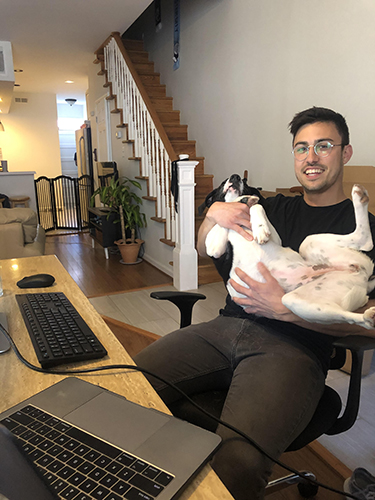
Joe Naughton at home in Washington with his work-at-home buddy, Suki, his roommate’s dog. (Submitted photo)
After being chosen through a competitive state and national process last July and then receiving his placement in the fall, Naughton began his post in early February 2020. Like many, he shifted from days spent in the office to telework in mid-March.
Naughton serves as the Interagency Ocean Policy Coordinator within NOAA’s Office of Oceanic and Atmospheric Research (OAR). His role is a mix of science and communication, and his primary responsibility is as Executive Secretary of the Subcommittee on Ocean Science and Technology (SOST).
Explained Naughton, “The SOST is a federal coordinating body that sits under the NSTC (National Science and Technology Council), so it’s under White House purview. It coordinates all federal work related to ocean science and technology. I do a lot of work across these different agencies, coordinating communication, working on various reports, and then I communicate all of this correspondence up to the co-chairs of this Subcommittee. The co-chairs are from NOAA, the National Science Foundation and the Office of Science and Technology Policy, and I serve as the SOST liaison to these agencies. But also, within the SOST, there are these technical working groups, which I really enjoy, since it’s a little more science-focused.”
With a background in water resources engineering from his studies at the University of Wisconsin-Madison and Marquette University—where he earned his bachelor’s and master’s degrees, respectively—Naughton is finding that the fellowship is pushing him in some new directions. While he previously focused on hydrology and urban water issues, now he’s learning more about ocean concerns. “That’s a whole new world for me,” he said.
He’s also found unexpected benefits on the communication side: “One really great thing is I’ve worked a lot on my writing, which I didn’t foresee initially. I’ve been getting my hands on a lot of reports, and that’s a huge change.”
Like many professionals these days, Naughton spends a good chunk of his days interacting with his colleagues on a screen. “I have a lot of video calls, whether it’s hopping on these technical working groups or having quick tag-ups with NOAA, NSF or whatever other agency it may be. A lot of it is expressing concerns; these agencies have their missions, and they want that vocalized in whatever federal, coordinated ocean science work is being done.”
Naughton is also gaining exposure to some NOAA-specific efforts, such as the Ambassadors Initiative, in which someone like a fellow or an administrator goes to present in a school or other setting. Naughton helps assemble collections of materials for the ambassador’s visit.
While the COVID-19 pandemic has put a damper on some of the travel, conference and professional development aspects of the Knauss Fellowship experience, Naughton is hopeful that some of those things will be possible towards the latter part of his one-year commitment.
In the meantime, he said, he’s found a supportive climate in his contacts with Wisconsin Sea Grant, the National Sea Grant Office and the other members of his Knauss class, who have been connecting virtually, whether to discuss each other’s research or simply have coffee.
Naughton is also enjoying the company of his roommate’s new puppy, a rescued Lab/beagle mix named Suki. While the pet adoption was in motion before the pandemic hit, it’s been a silver lining to be home with the new pup and help her get acclimated, or simply take a walk at lunchtime and get some fresh air.
Despite this highly unusual Knauss Fellowship year, Naughton and others in his cohort are making the most of it. Said Naughton, “The amount I’m able to touch in this fellowship is really great, and something I didn’t expect.” And despite the adjustments necessitated by the pandemic, said Naughton, “I’m definitely still fortunate to have this experience.”
News Releases – Wisconsin Sea Grant
News Releases – Wisconsin Sea Grant
https://www.seagrant.wisc.edu/news/wisconsins-knauss-fellow-broadens-horizons/
Current Watches, Warnings and Advisories for Brown (WIC009) Wisconsin Issued by the National Weather Service
https://alerts.weather.gov/cap/wwacapget.php?x=WI125F4C0D75B0.FreezeWarning.125F4C1CA9E0WI.GRBNPWGRB.1a313a7ac614bd9f89a8de20f3c4b50b
Current Watches, Warnings and Advisories for Brown (WIC009) Wisconsin Issued by the National Weather Service
https://alerts.weather.gov/cap/wwacapget.php?x=WI125F4C0D75B0.FreezeWatch.125F4C2BEC20WI.GRBNPWGRB.1dfc9449c9d178e51c99f4797ed1a1ba
Current Watches, Warnings and Advisories for Brown (WIC009) Wisconsin Issued by the National Weather Service
https://alerts.weather.gov/cap/wwacapget.php?x=WI125F4C0D27F4.SpecialWeatherStatement.125F4C0DDCD0WI.GRBSPSGRB.3b77a733acfe35fc01f412b80021d336