Angelica Vazquez-Ortega, a Bowling Green State University geochemist, obtained more than $1 million in grants to study the effects of using dredged lake sediment from Lake Erie as a farm soil amendment to mitigate nutrient overflow into the lake. Read the full story by The Toledo Blade.

Original Article

Great Lakes Commission

Great Lakes Commission

https://www.glc.org/dailynews/20221123-sediment-fertilizer
James Polidori

A new report led by St. Paul, Minnesota-based Freshwater Society reveals how groundwater is governed and serves as a reference for water policy and resource professionals to build future policy work. The authors conclude that the current structures, cobbled together over decades in response to different kinds of stressors and crises, does not adequately provide for a sustainable and equitable groundwater management for the Upper Midwest and Great Lakes regions. Read the full story by The Waynedale News.

Original Article

Great Lakes Commission

Great Lakes Commission

https://www.glc.org/dailynews/20221123-groundwater-governance

James Polidori

The Great Lakes Piping Plover Recovery Effort, a watchdog group, has tracked a particular bird that has foregone its migration to Michigan to forage in Florida over the past several breeding seasons. Even though this bird has apparently taken herself out of the nesting business, 150 piping plover chicks were fledged in the wild at dozens of nesting sites along the Great Lakes shoreline – a huge step in the numbers game for this small bird. Read the full story by MLive.

Original Article

Great Lakes Commission

Great Lakes Commission

https://www.glc.org/dailynews/20221123-piping-plover-migration

James Polidori

On November 26, the U.S. Coast Guard Cutter Mackinaw will travel from Cheboygan, Michigan, to Chicago with its annual shipment of 1,200 Christmas trees to deliver holiday cheer to families in need. This is the 23rd year of carrying on the tradition of the schooner Rouse Simmons, which sank in Lake Michigan in 1912 with a cargo full of Christmas trees. Read the full story by WWMT-TV – Kalamazoo, MI.

Original Article

Great Lakes Commission

Great Lakes Commission

https://www.glc.org/dailynews/20221123-christmas-ship

James Polidori

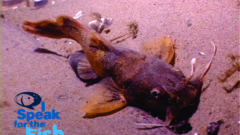
COMMENTARY: In the St. Clair River, northern madtoms are one of the species that helps researchers gauge the overall health of the river and its inhabitants as they eat some of the tiniest organisms in the system, which are also some of the most sensitive and vulnerable to pollutants. Read the full story by Great Lakes Now.

Original Article

Great Lakes Commission

Great Lakes Commission

https://www.glc.org/dailynews/20221123-catfish-indicator

James Polidori

In the course of 11 days, a device dating back to 234 B.C. successfully transported 704 fish across the Cheboygan Dam in the northern part of Michigan’s Lower Peninsula with no injuries observed.

The post Device from 234 B.C. lifts fish over barriers while blocking invaders, study finds first appeared on Great Lakes Echo.

Original Article

Great Lakes Echo

Great Lakes Echo

http://greatlakesecho.org/2022/11/23/device-from-234-b-c-lifts-fish-over-barriers-while-blocking-invaders-study-finds/

Guest Contributor

While virtual reality grows in the entertainment world, a team of Cornell researchers is using it to prepare farmworkers for hard work. Cornell hopes to collaborate with farms to create a variety of virtual reality spaces for people to visit and learn how to farm. The idea is to document and record the various practices used on a successful farm.

The post Cornell researchers farm pixels first appeared on Great Lakes Echo.

Original Article

Great Lakes Echo

Great Lakes Echo

http://greatlakesecho.org/2022/11/22/cornell-researchers-farm-pixels/

Guest Contributor

The discovery of evidence in a Lake Michigan shipwreck comes on the 175th anniversary of its sinking. The Wisconsin Maritime Museum recently confirmed the steamer Phoenix was found off the coast of Sheboygan. Read the full story by WLUK – Green Bay, WI.

Original Article

Great Lakes Commission

Great Lakes Commission

https://www.glc.org/dailynews/20221121-superior-beach

Jill Estrada

A storm packing snow, strong winds and cold temperatures swept through West Michigan this week, and it left behind a visually compelling scene at Lake Michigan beaches. Sand formations, also known as “sand hoodoos,” popped up along the beach at Grand Haven State Park. Read the full story by the Muskegon Chronicle.

Original Article

Great Lakes Commission

Great Lakes Commission

https://www.glc.org/dailynews/20221121-sand-formations

Jill Estrada

A dangerous lake-effect snowstorm paralyzed parts of western and northern New York on Friday, with more than 3 feet of snow already on the ground in some places by early afternoon. The storm was blamed for the deaths of two people stricken while clearing snow. Read the full story by The Associated Press.

Original Article

Great Lakes Commission

Great Lakes Commission

https://www.glc.org/dailynews/20221121-new-york-snow

Jill Estrada

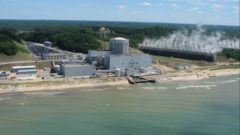
No federal aid to restart Michigan nuclear power plant

COVERT, Mich. (AP) — The federal government has turned down a request for financial aid to restart a nuclear power plant in southwestern Michigan, the owner said.

Holtec International said it was notified Friday by the U.S. Energy Department.

The Palisades plant along Lake Michigan, formerly owned by Entergy, was shut down last spring after generating electricity for more than 50 years.

Read Now at Great Lakes Now.

Original Article

Great Lakes Now

Great Lakes Now

https://www.greatlakesnow.org/2022/11/no-federal-aid-to-restart-michigan-nuclear-power-plant/

The Associated Press

Doing the math gives you numbers:

2022 – 2016 = 6
2012 – 1972 = 40

What is the story behind those numbers?

The first simple equation represents how long Deidre Peroff has been the Wisconsin Sea Grant social scientist: six years.

As Sea Grant celebrates a 50-year anniversary in 2022, the second computation indicates the program functioned for 40 years prior to bringing on board a social scientist. (Peroff succeeded Jane Harrison who had been hired in 2012.)

Deidre Peroff, social science outreach specialist. Image credit: Wisconsin Sea Grant

The numbers of six and 40, then, demonstrate the evolution of how those in the Sea Grant program deepened an understanding of and recognized the value of bringing a human dimension to freshwater and coastal science. Social science complements the natural sciences that Sea Grant has long been known for, disciplines like biology, physics and chemistry as they relate to things like the Lake Michigan fishery, Lake Superior coastal processes or Great Lakes water quality.

Now, we’ll throw in an additional number, the number one. Peroff is one person who touches all of the focus areas in which Sea Grant currently operates. Those areas are healthy coastal ecosystems, sustainable fisheries and aquaculture, resilient communities and economies and environmental literacy and workforce development. Her fellow Sea Grant outreach specialists mostly concentrate on one of those focus areas.

Some examples of her projects include manoomin and raising awareness about this wild rice, communicating to low-income communities about severe weather and water safety.

Just as Sea Grant evolved to incorporate social science in its portfolio, Peroff herself has evolved during her time in this role. She has increasingly devoted energy to social and environmental justice. “Some of the topics are really straightforward, focused on environmental justice and, with others, I just make sure we are incorporating equity and diversity and very much thinking about the DEI (diversity, equity and inclusion) principles.”

Peroff noted environmental justice is itself a newer concept. “That’s something that’s really changed in the last 50 years. That wasn’t even a term in the ‘80s. In the 1990s, President Clinton issued an executive order regarding environmental justice, for federal agencies to consider environmental justice and how projects may disproportionately affect more vulnerable communities than others.”

She expanded on this. “You think about the environmental movement, and you need to go back, go way back even in the last 100 or 200 years, how environmental solutions aren’t being equally advantageous to different communities.” She continued, “The national park system was developed but a lot of Indigenous people were displaced because of the national parks. Twenty years ago, I would have thought this is great and national parks are great. They protect wildlife and they’re good to have green spaces but it’s really important in terms of environmental justice to think about the whole picture.”

Into the next 50 years, Peroff said, social science has to be a part of understanding and working toward environmental justice. It’s a thrust she’d like to expand. “We are headed in the right direction on social justice,” Peroff said, “People are thinking about it a lot…corporations are learning more about racial and social justice issues.” She tempered it a bit by saying she and others have much more to learn.

On the nature of society’s environmental complexities, Peroff is passionate about being multidisciplinary. “While we need to use both natural and physical sciences to further understand environmental problems, it is important to place equal value on social science to understand how society contributed to the problem. Better integration between the sciences is needed to fully understand a problem to come up with a solution.”

Finally, in Peroff’s ideal future 50 years, we would use social science to broaden people’s horizons and crack the code to bring about behavior change. “Right now,” using climate change as an example, “behavior change is hard. It’s not happening with data alone.” She added, “in order to have impact, it’s important to relate to people.”

Perhaps we could summon all these numbers into the corner to help—10 years of having a social scientist contributing to the Sea Grant mission, one current dynamo with a firm commitment to results and another 50 years of Sea Grant dedication to affecting change.


The post Deidre Peroff, social science and Sea Grant by numbers first appeared on Wisconsin Sea Grant.

Original Article

Blog | Wisconsin Sea Grant

Blog | Wisconsin Sea Grant

https://www.seagrant.wisc.edu/blog/deidre-peroff-social-science-and-sea-grant-by-numbers/?utm_source=rss&utm_medium=rss&utm_campaign=deidre-peroff-social-science-and-sea-grant-by-numbers

Moira Harrington

I Speak for the Fish: These catfish have something to say

I Speak for the Fish is a new monthly column written by Great Lakes Now Contributor Kathy Johnson, coming out the third Monday of each month. Publishing the author’s views and assertions does not represent endorsement by Great Lakes Now or Detroit Public Television. 

Read Now at Great Lakes Now.

Original Article

Great Lakes Now

Great Lakes Now

https://www.greatlakesnow.org/2022/11/i-speak-for-the-fish-these-catfish-have-something-to-say/

Kathy Johnson

Rock climbing might be a new tool for conserving the public land that bolsters Michigan’s annual $20 billion tourism industry. The sport is gaining traction as outdoor enthusiasts look to experience nature differently, especially after indoor climbing gyms closed during the pandemic. 

The post A growing fad in the “flat” Midwest: Rock climbing. first appeared on Great Lakes Echo.

Original Article

Great Lakes Echo

Great Lakes Echo

http://greatlakesecho.org/2022/11/21/a-growing-fad-in-the-flat-midwest-rock-climbing/

Guest Contributor

...BRIEF INTENSE SNOW SHOWERS THIS AFTERNOON... Scattered snow showers will continue to move across northeast Wisconsin this afternoon. Some of these snow showers may briefly fall at an intense rate, reducing visibility to one-quarter mile. Although widespread travel problems are not expected, motorists should be prepared for potential rapid changes in visibility and

Original Article

Current Watches, Warnings and Advisories for Brown (WIC009) Wisconsin Issued by the National Weather Service

Current Watches, Warnings and Advisories for Brown (WIC009) Wisconsin Issued by the National Weather Service

https://alerts.weather.gov/cap/wwacapget.php?x=WI126418A07CF4.SpecialWeatherStatement.126418A0F60CWI.GRBSPSGRB.3b84abab2a0e5f76f50745403b6c3daf

w-nws.webmaster@noaa.gov

...BRIEF MODERATE SNOW SHOWERS THIS AFTERNOON... Scattered snow showers are expected to move across central and east-central Wisconsin this afternoon. Some of these snow showers may fall at a moderate rate, briefly reducing visibility to under one mile. Although widespread travel problems are not expected, motorists should be prepared for potential rapid changes in

Original Article

Current Watches, Warnings and Advisories for Brown (WIC009) Wisconsin Issued by the National Weather Service

Current Watches, Warnings and Advisories for Brown (WIC009) Wisconsin Issued by the National Weather Service

https://alerts.weather.gov/cap/wwacapget.php?x=WI1264189121B4.SpecialWeatherStatement.126418919874WI.GRBSPSGRB.cdc1ff113f80474f83c6e7685b61e187

w-nws.webmaster@noaa.gov

Democrats in control: Advocates want action on justice, climate and “stronger leadership” from Gov. Whitmer

Elections have consequences, the saying goes, and for the Michigan Democratic party, the election last week resulted in a sweep of the race for governor and the legislature.

Now comes their opportunity to deliver on long-stalled environmental initiatives.

Gov. Gretchen Whitmer was re-elected and for the first time in almost 40 years, Democrats will be the majority in the legislature.

Read Now at Great Lakes Now.

Original Article

Great Lakes Now

Great Lakes Now

https://www.greatlakesnow.org/2022/11/advocates-want-action-on-justice-climate-stronger-leadership-gov-whitmer/

Gary Wilson

Under an initiative announced at a United Nations climate gathering last week, preliminary plans are in the works for a “Great Lakes-St. Lawrence Seaway System Green Shipping Corridor Network” as means of spurring the early adoption of zero-emission fuels and technologies within the shipping sector. Read the full story by the Watertown Daily Times.

Original Article

Great Lakes Commission

Great Lakes Commission

https://www.glc.org/dailynews/20221118-green-corridor

Theresa Gruninger

The International Joint Commission reported that Lake Michigan is in fair condition, meaning the health of the lake has not worsened but does not show signs of improvement either. Read the full story by WUWM – Milwaukee, WI.

Original Article

Great Lakes Commission

Great Lakes Commission

https://www.glc.org/dailynews/20221118-lake-michigan-health

Theresa Gruninger

Less than 45 miles northwest of Northport and 16 miles southwest of Lake Michigan’s Gull Island lie the remains of the Great Lakes freighter the Carl D. Bradley. The freighter broke apart in 40-foot waves 64 years ago today. Read the full story by The Alpena News.

Original Article

Great Lakes Commission

Great Lakes Commission

https://www.glc.org/dailynews/20221118-carl-d-bradley

Theresa Gruninger

EPA orders Ohio power plant to stop dumping toxic coal ash

By Matthew Daly, Associated Press

WASHINGTON (AP) — In a major action to address toxic wastewater from coal-fired power plants, the Environmental Protection Agency on Friday ordered an Ohio utility to stop dumping dangerous coal ash into unlined storage ponds and speed cleanup of the site.

The order to the Gen.

Read Now at Great Lakes Now.

Original Article

Great Lakes Now

Great Lakes Now

https://www.greatlakesnow.org/2022/11/ap-epa-orders-ohio-power-plant-stop-dumping-coal-ash/

The Associated Press

It’s back to the drawing board for scientists trying to come up with an accurate forecasting model for the annual harmful algal bloom in western Lake Erie. For the second year in a row, the severity of the bloom has been underestimated. Read the full story by the Sandusky Register.

Original Article

Great Lakes Commission

Great Lakes Commission

https://www.glc.org/dailynews/20221118-algal-bloom

Theresa Gruninger

The U.S. and Ohio Environmental Protection Agencies, along with the U.S. Department of Justice, entered into consent decrees with two Northeast Ohio communities, mandating cities make modernizing repairs to their sewer systems to address sewer overflows into Lake Erie and Rocky River in Lakewood, and the Black River in Elyria, and bring both cities sewer systems into compliance with the Clean Water Act. Read and listen to the full story by WKSU – Kent, OH.

Original Article

Great Lakes Commission

Great Lakes Commission

https://www.glc.org/dailynews/20221118-sewer-updates

Theresa Gruninger

...SNOW COVERED AND SLIPPERY ROADS THIS MORNING... Up to an inch of light snow this morning has created snow covered and slippery roads. Additional accumulations will be on the light side, under a half inch. Although widespread travel problems are not anticipated, use caution when traveling, especially on untreated roads, elevated roadways, bridges, and overpasses. Allow

Original Article

Current Watches, Warnings and Advisories for Brown (WIC009) Wisconsin Issued by the National Weather Service

Current Watches, Warnings and Advisories for Brown (WIC009) Wisconsin Issued by the National Weather Service

https://alerts.weather.gov/cap/wwacapget.php?x=WI126418902F20.SpecialWeatherStatement.126418909C80WI.GRBSPSGRB.3b84abab2a0e5f76f50745403b6c3daf

w-nws.webmaster@noaa.gov

New York voters passed a $4.2 billion proposal on Election Day for water drinking protection, pollution mitigation, land conservation, waste management and other environmental projects.

The post New Yorkers approved $4.2 billion bond to prepare for climate change first appeared on Great Lakes Echo.

Original Article

Great Lakes Echo

Great Lakes Echo

http://greatlakesecho.org/2022/11/18/new-yorkers-approved-4-2-billion-bond-to-prepare-for-climate-change/

Guest Contributor

The Keweenaw Mountain Lodge in Michigan’s Upper Peninsula has been accepted into the International Dark-Sky Association, the third dark sky park in the state. Such areas are becoming more popular in the United States as people become more interested in ecotourism experiences.

The post Northern Michigan resort promotes dark skies first appeared on Great Lakes Echo.

Original Article

Great Lakes Echo

Great Lakes Echo

http://greatlakesecho.org/2022/11/18/northern-michigan-resort-promotes-dark-skies/

Guest Contributor

Uncertainty for Michigan rivers, residents as Consumers reconsiders its 13 dams

By Kelly House, Bridge Michigan

The Great Lakes News Collaborative includes Bridge Michigan; Circle of Blue; Great Lakes Now at Detroit Public Television; and Michigan Radio, Michigan’s NPR News Leader; who work together to bring audiences news and information about the impact of climate change, pollution, and aging infrastructure on the Great Lakes and drinking water.

Read Now at Great Lakes Now.

Original Article

Great Lakes Now

Great Lakes Now

https://www.greatlakesnow.org/2022/11/uncertainty-michigan-rivers-residents-consumers-reconsiders-13-dams/

Bridge Michigan

...BRIEF MODERATE TO HEAVY SNOW SHOWERS THIS AFTERNOON... Brief moderate to heavy snow showers will continue to move east to southeast across central and east central Wisconsin this afternoon. These snow showers may leave a light accumulation on grassy and elevated surfaces. Although widespread travel problems are not anticipated, use caution when traveling as heavier snow

Original Article

Current Watches, Warnings and Advisories for Brown (WIC009) Wisconsin Issued by the National Weather Service

Current Watches, Warnings and Advisories for Brown (WIC009) Wisconsin Issued by the National Weather Service

https://alerts.weather.gov/cap/wwacapget.php?x=WI12641881D1C8.SpecialWeatherStatement.126418826BB0WI.GRBSPSGRB.cdc1ff113f80474f83c6e7685b61e187

w-nws.webmaster@noaa.gov

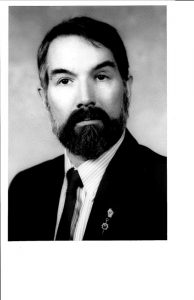
Ask Jim Lubner about his 33-year career as a boating safety and education outreach specialist at Wisconsin Sea Grant (and what lead to those years), and he’ll tell you about Lake Michigan.

“Living in the Bay View area of Milwaukee, I’m never very far from Lake Michigan. I see it on a regular basis and spend many hours each year on its waters as well. I consider it very special and am always reminded of the significant part it has played in my life and that of my family. I’m thankful for all of those people, experiences and opportunities,” he said.

He grew up on a farm in Sheboygan County, which borders Lake Michigan, spending his high school and college years in Catholic school and the seminary. He enjoyed fishing in Lake Michigan and in the fairly large lake across the neighbor’s field using a small aluminum boat you could throw in the back of the pickup truck.

While fishing continued to hold its appeal, Lubner realized the seminary wasn’t the right direction for him and he secured a position at a Catholic middle school, teaching science and math for three years. It may not have been his ideal job.

“I won’t say that I was necessarily good at it, but it was an early opportunity to get involved in education. In the back of my mind I really knew that if I was going to shift away from the seminary that I was going to pursue education, likely in the sciences,” he said.

And pursue education he did. Lubner received a master’s degree in zoology and a Ph.D. in biological sciences from the University of Wisconsin-Milwaukee. He became a teaching assistant during his master’s program, as most graduate students do, until another student suggested he find a program with the resources to support him in other ways. The Center for Great Lakes Studies was the only program that came to mind, and Lubner secured a position there.

Historical photo of LubnerDuring a graduate student seminar at the Center for Great Lakes Studies, Lubner was approached by a Ph.D. student with ship time who was studying pelagic zooplankton. He proposed that Lubner take on studying the benthos, allowing them to share the work of collecting samples and the ship time. Sea Grant was funding that project and Lubner joined right in.
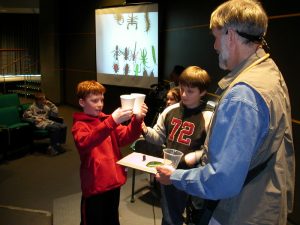

Sea Grant was funding some projects that supported his master’s degree, and he was encouraged to submit a proposal for his Ph.D. project, which was funded for several years.

Lubner assumed he was headed for the classic tenure-track academic position, but nothing seemed to fit. When a position became available at Sea Grant, he decided to give it a try.

“Opportunities present themselves and sometimes you take a leap,” he said. “I have no idea what the heck I’m doing, but sometimes, it turns into something that maybe soon or maybe way far down the road and you say, ‘Geez, I’m glad I did that.’”

That opportunity turned into a 33-year career at Sea Grant, specializing in boating safety and, most of the time, education, even including an adjunct faculty position.

An early emphasis of the job was boating safety. Kim Bro (the Sea Grant field agent in the Lake Superior office) suggested partnering with an established organization with a solid track record, so Lubner joined the U.S. Coast Guard Auxiliary in 1979. He taught courses in boating safety to several thousand adults and young people and continues his membership in the Coast Guard Auxiliary to this day.

Over the course of working with the Coast Guard, Lubner started a pilot program for charter boat operators to help them with licensing and other requirements and wrote up a guidebook published by Sea Grant. Today there is a national-level program for charter boat captains (not as a direct result of the earlier program) that Lubner remains involved with.

Another long-lasting relationship resulted from an invitation to join the local emergency planning committee, which oversees the planning for spills of hazardous materials within a county. He’s been on that committee in Milwaukee county for 32 years.

For the education side of the position, there was a project already underway in Milwaukee when Lubner first accepted the job in 1977. The project focused on kids in Milwaukee and was funded by Sea Grant and led by a professor from the UW-Milwaukee Department of Curriculum and Instruction along with a UW Extension staff member with close ties to the inner city community in Milwaukee. The program ran its course, but it gave Lubner an inroad that turned into an adjunct position in the School of Education, Department of Curriculum and Instruction.

Then the Reagan era arrived, and many entities shifted their focus away from education. The same was true for Sea Grant’s national priorities. At one point Lubner received a letter from Bob Ragotzkie, the Sea Grant director at that time, stating very clearly that education was no longer in his job description.

Lubner said, “It is to his everlasting credit that Al Miller [the Sea Grant assistant director of outreach at the time] found creative ways to involve me in education, knowing full well that it was officially not my job description.”

As the interest in education projects started to rise again with a different administration, Lubner discovered that what the program needed was not better education proposals to biennial Sea Grant competitions but a better review process. Education projects can’t be evaluated fairly using the same criteria as research project.

Lubner with students at an education event in 2006.

Lubner said, “When you ticked off the boxes that a reviewer would tick off (related to an education proposal), there weren’t enough science boxes. So even if it was a good proposal, it didn’t rate as high as the science proposals.” He set to work creating a review process for education projects that resulted in the funding of many successful education projects.

In addition to his boating safety work and his role as education coordinator, Lubner served as an adjunct professor, largely teaching middle and high school teachers about Great Lakes, ocean and climate topics. He described two-week teacher trainings as “the most exhausting and exhilarating experience I ever had.”

In addition to his work as a Sea Grant educator, Lubner also taught a course called “Environmental Education for Teachers” at UW-Milwaukee that was a requirement for teacher certification in Wisconsin. The teachers who enrolled primarily taught middle school, but then UW-Milwaukee’s approach to teacher certification changed, resulting in more early-childhood majors appearing in his classes.

He was rather dismayed with this development, saying that they “scared the heck out of me because I didn’t really know anything about early-childhood educational principles and practices.”

He soon realized that he loved the enthusiasm and dedication of these teachers and the way their energy and knowledge influenced the interests of the kids. “Early childhood is really just about awareness,” he said. “It’s helping them make the connection they can make at that level so that five years from now, 10 years from now, the teacher in the classroom can help them make a higher-level connection.”

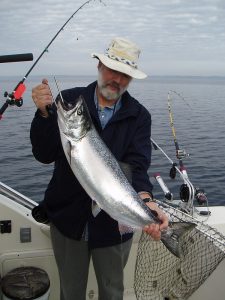
Lubner holding a large fish

Lubner in 2011

Starting environmental education early can make all the difference. Lubner said, “I remember one young teacher who said, ‘I teach kindergarten. What can I do?’ And one of the other teachers looked at her and said, ‘I’m a middle-school teacher, and what you do for those young kids, that sets the tone for what they are by the time they get to me.’”

As Lubner looks back at what changed over the span of his career, he noted a couple of changes that have benefited education—an increased emphasis on accountability and an increase in enthusiasm for outreach. As government budgets became tighter, officials wanted to be sure their dollars were having the most impact. How can you ensure that the research you’re funding has a real-world impact? Outreach and education became important aspects of that accountability.

Lubner said, “When I was working, except for the last number of years, scientists did their work and assumed that somebody would recognize the value for policy decisions down the road. Then finally somebody figured out if we don’t get policy experts in there who can tell the political decision makers what the benefits are for their constituents and make these social connections, they won’t care about the science, no matter how good it is.”

He went on to explain that Sea Grant has always tried to serve as a bridge between scientists and the general public, and in the early days it was one of a very few organizations serving that purpose. He’s found that younger scientists seem to have more of a desire to reach out and get their message across to a wider audience, and he thinks the work that Sea Grant has done helped lay the foundation.

“To some extent we can take credit for showing the importance of [outreach]. It adds to the number of people who are actually doing it, which is a good thing,” he said.

In addition to his enduring roles at the U.S. Coast Guard Auxiliary and the local emergency planning committee, Lubner is well known for his work with the Lake Sturgeon Bowl. He brought the competition to Milwaukee—somewhat by accident. A group from the National Ocean Sciences Bowl requested a meeting with J. Val Klump, formerly associate dean of the School of Freshwater Sciences. Klump was unable to attend and asked Lubner to attend instead. Lubner, Klump and UW-Milwaukee formed a strong partnership with the national organization and created the Lake Sturgeon Bowl. The program allowed Lubner to work closely with the Bowl’s regional coordinators. He finished his Sea Grant career working with Liz Sutton of the School of Freshwater Sciences, regional coordinator for the Bowl, and he continues volunteer work with outreach and education activities in his retirement.

“I still have an office at the School of Freshwater Sciences, so when I do a tour, I tell people I’ve had an office in that building since 1977. They haven’t thrown me out yet,” he said.

The post A Lifetime of Education—Retired Outreach Specialist James Lubner first appeared on Wisconsin Sea Grant.

Original Article

News Releases | Wisconsin Sea Grant

News Releases | Wisconsin Sea Grant

https://www.seagrant.wisc.edu/news/a-lifetime-of-education-retired-outreach-specialist-james-lubner/?utm_source=rss&utm_medium=rss&utm_campaign=a-lifetime-of-education-retired-outreach-specialist-james-lubner

Elizabeth White

Image courtesy of Zazzle.com

Gov. Tony Evers announced “Wisconsin Waters” as the theme for the 2022 state capitol holiday tree and invited students to contribute handmade ornaments celebrating what Wisconsin’s waterways mean to them. 

“From the first Indigenous people who hunted and gathered in our freshwater sources before Wisconsin became a state, to our farmers who have been the backbone of our economy for generations, to our proud maritime and shipbuilding history, to our outdoor recreators and anglers hoping to hook one of our mammoth lake sturgeon and muskies, water has always been essential for our way of life here in Wisconsin,” wrote Gov. Evers in a letter sent to students and educators. “So, when it comes to our waterways, we’ve got a lot to celebrate—and that means we have a lot to protect, too!” 

The capitol holiday tree is displayed in the rotunda of the Wisconsin State Capitol throughout the holiday season and serves as a centerpiece of festivity for those visiting and working at the Capitol Building. Each year, the tree is decorated with handmade ornaments from kids, students, and families from every corner of the state. This year, students are encouraged to explore Wisconsin’s waterways for inspiration, including the wildlife that call the state’s waterways home, Wisconsin’s rich maritime history, and the recreational and outdoor activities enjoyed by Wisconsinites across the state, like fishing and boating.

All students and families are welcome to submit ornaments celebrating “Wisconsin Waters” and should mail ornaments by Tues., Nov. 22, 2022, to:

Emily Gorman 
Wisconsin Department of Administration 
Division of Facilities and Transportation Services
17 West Main Street, Suite 119 
Madison, WI 53703

Students are asked to make ornaments from non-breakable material. They must be strong enough to hold up during shipping and to be handled while the tree is being decorated. It is recommended students do not use fragile items or paper cutouts that may tear easily and that ornaments are 4-6 inches in size and are made from a color that contrasts with the color of the tree so they can easily be seen and enjoyed by all visitors. Please attach a ten-inch loop of ribbon or string from which each ornament will hang. 

If you have any questions about an ornament, please contact the Facilities Management Information Center at (608) 266-1485. Please note that ornaments will not be returned.

The post Gov. Evers Announces invites students and families to create ornaments celebrating “Wisconsin Waters” for state capital holiday tree first appeared on Wisconsin Sea Grant.

Original Article

Blog | Wisconsin Sea Grant

Blog | Wisconsin Sea Grant

https://www.seagrant.wisc.edu/blog/gov-evers-announces-invites-students-and-families-to-create-ornaments-celebrating-wisconsin-waters-for-state-capital-holiday-tree/?utm_source=rss&utm_medium=rss&utm_campaign=gov-evers-announces-invites-students-and-families-to-create-ornaments-celebrating-wisconsin-waters-for-state-capital-holiday-tree

Marie Zhuikov

Election day was a little more than a week ago. Seven of the eight Great Lakes states had gubernatorial elections. Six had U.S. Senate races on the ballot. All seats in the U.S. House of Representatives were up for election. And numerous state and local offices were on ballots.

Joel Brammeier, the Alliance’s President & CEO, and Don Jodrey, our Director of Director of Federal Relations, explain what the midterm election results mean for the Great Lakes. To hear more, listen to our Lakes Chat post-election podcast.

U.S. Senate & House Races

Q: How did things change for the Great Lakes?

A: There are 28 new members of Congress representing Great Lakes residents. Two of them are senators – Republican J.D. Vance in Ohio, and Democrat John Fetterman in Pennsylvania. The other 26 are representatives – 11 Democrats and 15 Republicans. Most Great Lakes incumbents who ran were re-elected. 

Q: What Great Lakes issues will the new Congress need to tackle next year?

A: Annual spending bills. We’ll be looking for Congress to address additional investments in water infrastructure, the Great Lakes Restoration Initiative, and all the other federal programs that the Alliance for the Great Lakes supports. 

The Farm Bill. This is important for the Great Lakes because it deals with federal support for programs that can reduce agricultural runoff in Lake Erie and other Great Lakes waters. The Farm Bill comes up for renewal only once every five years. 

Q: On a national level, it was a very close race. Democrats kept control of the Senate, with one more seat to be decided by a December runoff in Georgia. Republicans have taken control of the House. How will the new makeup of Congress affect the Great Lakes? 

A: “Having the majority in the House or the Senate really does matter. It allows you to set the legislative agenda. It allows you to decide which bills are debated and come up for a vote. It allows you to determine the makeup of the committees, and the committees write the legislation for the Congress to consider. The bills that tend to go forward are bills that have originated in the committee structure.”

~ Don Jodrey, the Alliance’s Director of Federal Relations

Gubernatorial Races

Q: How did things change for the Great Lakes?

A: Josh Shapiro, a Democrat, was elected to fill the open seat for governor in Pennsylvania. Incumbents won re-election in Illinois (J.B. Pritzker), Michigan (Gretchen Whitmer), Minnesota (Tim Walz), New York (Kathy Hochul), Ohio (Mike DeWine), and Wisconsin (Tony Evers).

Q: What Great Lakes issues will individual states tackle next year?

A: Governor DeWine in Ohio has been focused on agriculture issues in a big way. The biggest source of Lake Erie’s agricultural pollution is in Ohio. I think you’ll see a renewed push for follow-through on the pollution diet that’s being written for Lake Erie in Ohio.

Governor Whitmer in Michigan has an emphasis on dealing with that state’s water infrastructure challenges. Governor Evers in Wisconsin has focused on issues around water infrastructure and agriculture.

In all the Great Lakes states, we’re seeing a major investment in water infrastructure that’s been unseen since the seventies. But there’s a lot of work to do over the next four years to make sure that those funds go to where they’re needed most. All the states need to be really smart and strategic about how to get the best clean water outcomes for the largest number of people, and make sure that communities that have been disinvested in for decades, get the support that they need.”

 ~ Joel Brammeier, the Alliance’s President & CEO

Q: Great Lakes states have a long history of bipartisan cooperation across the region. What issues will the states need to work on together?

A: Stopping invasive carp. The U.S. Army Corps of Engineers has begun designing a critical project in Illinois to stop invasive carp from reaching Lake Michigan. The first year of construction will be covered by federal funds, but there will need to be some agreements on how to pay for the local share of later construction across state lines. Governors Whitmer and Pritzker will need to continue working together to ensure that this project, which is a priority for both states, actually gets the funding it needs.

Maintaining the Great Lakes Compact. The Compact is the state-level law that governs how Great Lakes water can be used. It makes very limited exceptions for water to be diverted and returned to the Great Lakes. All Great Lakes governors need to work together to maintain the integrity of the Compact.

Local Ballot Measures Signal Strong Support for Environmental Issues

In New York State, voters approved a $4.2 billion environmental bond act. In Cook County, Illinois, where Chicago is located, voters approved an increased tax levy to support the local forest preserves. Each measure passed by a wide margin – about two out of three voters were in support.

Q; In an era where everything seems so divided, when environmental issues stand alone on a ballot, they seem to be pretty successful. Why do you think that’s the case?

A: “Voters understand that a good environment leads to healthy people, healthy families, healthy neighbors and a good quality of life. They’re willing to invest in something that’s going to help their community, improve their own health, and protect clean water and clean air for generations to come.”  ~ Joel Brammeier, the Alliance’s President & CEO

“Environmental investments are also investments in a robust economy and a growing economy. I think people realize that, and that’s why they’re willing to make them. You can have a healthy environment and a healthy economy. Actually investing in the environment is a good economic base, and pays good economic dividends,” ~ Don Jodrey, the Alliance’s Director of Federal Relations

Note: The Alliance for the Great Lakes is a 501(c)3 nonprofit organization, which means that we cannot and do not endorse candidates for office. However, we can – and do – educate candidates about Great Lakes issues.

The post What the 2022 Midterms Mean for the Great Lakes appeared first on Alliance for the Great Lakes.

Original Article

News - Alliance for the Great Lakes

News - Alliance for the Great Lakes

https://greatlakes.org/2022/11/what-the-2022-midterms-mean-for-the-great-lakes/

Judy Freed

The Alliance for the Great Lakes has been awarded two top charitable ratings in recognition of the organization’s financial health, accountability, and transparency.

Charity Navigator four-star badge.

Charity Navigator, America’s largest independent charity evaluator, awarded the Alliance for the Great Lakes a top Four-Star Rating. Charity Navigator analyzes nonprofit performance based on four key indicators, referred to as beacons. Currently, nonprofits can earn scores for the Impact & Results, Accountability & Finance, Culture & Community, and Leadership & Adaptability beacons. This rating designates the Alliance as an official “Give with Confidence” charity, indicating that our organization is using its donations effectively based on Charity Navigator’s criteria.

Candid Platinum Transparency 2022 badge.

Guidestar, the worlds’ largest source of nonprofit information, awarded the Alliance for the Great Lakes the Platinum Seal of Transparency, the highest level of recognition. The award recognizes organizations with a high level of fiscal and programmatic accountability and transparency.

These ratings demonstrate the Alliance’s commitment to responsible and careful stewardship of financial donations to ensure the biggest impact for the Great Lakes. We are truly grateful for every supporter who entrusts us with their donation to protect the Great Lakes, our region’s most precious resource.

The post Alliance Earns Two Top Charity Ratings; Charity Navigator Four-Star Rating and Guidestar’s Platinum Seal of Transparency appeared first on Alliance for the Great Lakes.

Original Article

News - Alliance for the Great Lakes

News - Alliance for the Great Lakes

https://greatlakes.org/2022/11/alliance-earns-two-top-charity-ratings-charity-navigator-four-star-rating-and-guidestars-platinum-seal-of-transparency/

Judy Freed

The research collaboration among the Medical College of Wisconsin, the Inter-Tribal Council of Michigan and the Chippewa Ottawa Resource Authority in Sault Ste. Marie, Michigan has demonstrated how an advisory program designed for the Anishinaabe is a useful tool for tracking fish consumption in Great Lakes tribes. 

The post Study shows value of culturally appropriate environmental health resources first appeared on Great Lakes Echo.

Original Article

Great Lakes Echo

Great Lakes Echo

http://greatlakesecho.org/2022/11/17/study-shows-value-of-culturally-appropriate-environmental-health-resources/

Jonus Cottrell

Attorney general candidates backed by environmental groups claimed the majority of seats in Great Lakes state elections. Attorney generals play an important role in litigation over environmental policy and regulations, climate and enforcement of state environmental laws.

The post A win for environmental groups in state attorney general races first appeared on Great Lakes Echo.

Original Article

Great Lakes Echo

Great Lakes Echo

http://greatlakesecho.org/2022/11/17/a-win-for-environmental-groups-in-state-attorney-general-races/

Guest Contributor

In the week before Thanksgiving, Wisconsin Sea Grant is considering gratitude. Why are we thankful? 2022 marked a yearlong 50th anniversary commemoration. We have been grateful for the opportunity to provide decades of service to Wisconsin’s coastal communities, promote freshwater learning and contribute research findings to benefit the whole Great Lakes Basin.

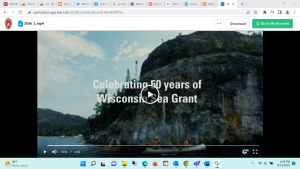
A brand-new 50 years video celebrates this past and looks to Great Lakes science for our future through reflections from staff members collected throughout the past 12 months.

Grainy image of bluffs and water. People canoeing.

A new video celebrates Wisconsin Sea Grant’s 50-year legacy.

“Wisconsin was the first state in the Great Lakes region to develop a Sea Grant program,” said Moira Harrington, Sea Grant’s assistant director for communications. “In a state with a long history of environmental stewardship and the home of such environmental giants as John Muir, Aldo Leopold and the founder of Earth Day, Gaylord Nelson, we are particularly proud to have also embraced the Sea Grant model to use research, education and outreach to better understand, use and protect our globally significant freshwater assets. We’re also proud to share this video that recounts the history.”

The new six-minute video uses archival video to revisit touchpoints such as the 1963 proposal from scientist Athelstan Spilhaus to establish a national Sea Grant College Program, Congress’s adoption of the program in 1966 and ratification of the binational Great Lakes Water Quality Agreement during the Nixon administration.

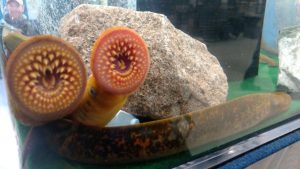
In vintage footage, the video also depicts unfortunate chapters of the lakes—the arrival of the nonnative sea lamprey and its negative effects on the fishery, pollution shutting down beaches due to open pipes gushing contaminants and nutrient runoff tainting waters.

Two fish with round jaws up along the wall of a glass tank.

Nonnative sea lamprey have had an effect on the Great Lakes food web. The video has footage of the fish. Photo by Titus Seilheimer.

The somewhat grainy footage then shifts, giving way to contemporary shots of Sea Grant-funded research and education and extension initiatives. A concluding quote best summarizes what probably all of us could get behind, “I really believe that we need to talk about hope. We have to give people a strong vision of where we want things to do because as soon as we do that we start moving toward it rather than focusing on the negative things that have happened in the past,” Julia Noordyk, water quality and coastal communities specialist said.


The post Wisconsin Sea Grant gratitude for 50 years shines in a new 50th anniversary video first appeared on Wisconsin Sea Grant.

Original Article

News Releases | Wisconsin Sea Grant

News Releases | Wisconsin Sea Grant

https://www.seagrant.wisc.edu/news/wisconsin-sea-grant-gratitude-for-50-years-shines-in-a-new-50th-anniversary-video/?utm_source=rss&utm_medium=rss&utm_campaign=wisconsin-sea-grant-gratitude-for-50-years-shines-in-a-new-50th-anniversary-video

Moira Harrington

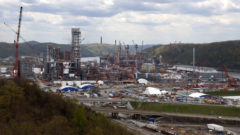
After years of construction, Shell ethane cracker starts up

MONACA, Pa. (AP) — Years in the works, a massive petrochemical refinery in western Pennsylvania fed by the vast natural gas reservoir underneath Appalachia became fully operational Tuesday, oil and gas giant Shell plc said.

The refinery, built on the site of a former zinc smelter along the Ohio River some 30 miles (48 kilometers) northwest of Pittsburgh, will produce 3.5 billion pounds (1.6 billion kilograms) of polyethylene annually when it ramps up to full production by the second half of 2023, Shell said.

Read Now at Great Lakes Now.

Original Article

Great Lakes Now

Great Lakes Now

https://www.greatlakesnow.org/2022/11/ap-shell-ethane-cracker-starts-up/

The Associated Press

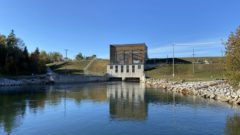
Consumers Energy is considering whether to keep its 13 hydropower dams on Michigan rivers. The dams are environmentally and financially costly, and deliver little energy, but their reservoirs are beloved for recreation. The outcome could dramatically alter Michigan’s rivers and surrounding communities. Read the full story by Bridge Michigan.

Original Article

Great Lakes Commission

Great Lakes Commission

https://www.glc.org/dailynews/20221116-hydropower

Laura Andrews