Tours of one of Muskegon’s two Lake Michigan lighthouses will be offered this summer as the city works toward ownership of the historic structures. The South Pierhead Lighthouse, located near the U.S. Coast Guard station at Pere Marquette Park, is open for tours from 1-5 p.m. Fridays through Mondays. Read the full story by MLive.

Original Article

Great Lakes Commission

Great Lakes Commission

https://www.glc.org/dailynews/20230612-lighthousetours-muskegon
Hannah Reynolds

At the Brandon Road Lock and Dam, south of Joliet, Illinois, below where the Chicago Sanitary and Ship Canal and Des Plaines River meet, there is a choke point, a 110-foot wide channel and lock through which the Copi, otherwise called invasive carp, must pass to get to the Great Lakes. There, the Army Corps of Engineers is mustering about $1.2 billion taxpayer dollars to build a barrier that will, hypothetically, stop the carp from getting to the lakes. Read the full story by Undark Magazine.

Original Article

Great Lakes Commission

Great Lakes Commission

https://www.glc.org/dailynews/20230612-race-to-build-fish-barricade

Hannah Reynolds

This is “Three Free” Weekend in Michigan. Residents and visitors can fish without a license, ride state-designated trails without an ORV license or trail permit, or get access to state parks and boat landings without a Recreation Passport. Read the full story by The Iron Mountain Daily News.

Original Article

Great Lakes Commission

Great Lakes Commission

https://www.glc.org/dailynews/20230612-michigan-freefishingweekend-fathersday

Hannah Reynolds

On Saturday and Sunday of Father’s Day weekend Ohio residents may fish without a license, keeping in mind that size and creel limits never take a holiday. Before and after the weekend, residents age 16 and older who want to fish are required to purchase a license and be prepared to show it when requested. Read the full story by the Columbus Dispatch.

Original Article

Great Lakes Commission

Great Lakes Commission

https://www.glc.org/dailynews/20230612-ohio-freefishingweekend-fathersday

Hannah Reynolds

A local couple wants to share the joy of boating with their new private cruise business. Ahh! Venture Cruise is offering private cruises from Lake Macatawa to Lake Michigan in the Holland area. Cal and Terrie Morrow, both licensed captains through the U.S. States Coast Guard, started the business as a way to enjoy the lake in retirement. Read the full story by the Holland Sentinel.

Original Article

Great Lakes Commission

Great Lakes Commission

https://www.glc.org/dailynews/20230612-couplelaunchescruise-lakemacatawa-lakemichigan

Hannah Reynolds

Richmond Heights, OH has been named an inaugural recipient of the Richard M. Daley Water Equity Community Award from the Great Lakes and St. Lawrence Cities Initiative. The award is intended to provide support to disadvantaged communities who are working to remove lead lines and modernize their water infrastructure. Read the full story by The Plain Dealer.

Original Article

Great Lakes Commission

Great Lakes Commission

https://www.glc.org/dailynews/2023-0612-richmondheights-waterinfrastructure

Hannah Reynolds

Climate change needs to be solved at the local level. That was the key message of this year’s Great Lakes and St. Lawrence Cities Initiative annual meeting. The binational coalition, composed of over 200 municipal and regional U.S. and Canadian mayors and local officials, gathered in Chicago June 6-9 to talk climate action, with Illinois cities like Waukegan, Evanston and Zion joining in. Read the full story by The Daily Herald.  

Original Article

Great Lakes Commission

Great Lakes Commission

https://www.glc.org/dailynews/20230612-greatlakes-waukegan-zion-climatechange

Hannah Reynolds

Travis Coenen grew up on the river in Wrightstown, fishing, canoeing, and launching from the boat ramp. As an adult, he works for the community as the Village Administrator of Wrightstown.

He was aware of the pollution in the river, even when he was young. He didn’t know what was causing it, but when the algae would bloom in late summer, “all of a sudden the river would turn bright green – like in Chicago for St. Patrick’s Day when they dye the river. It didn’t seem right.”

His family enjoyed fishing, but his parents would encourage him to bring home a perch from the bay or up north. “We would go north to Clintonville or Tomahawk,” Travis said, “and the lake waters were so much clearer than the Fox River.”

By the time he was taking biology and chemistry classes in high school and college, Travis had his aha moment. He understood that the problem was what we were putting into the water. At that time, it was the PCBs in particular, coming from the manufacturing along the Fox River.

But that wasn’t the only thing. Travis also noticed that as generations changed and property was handed down, people were adding septic systems to old cabins. And he realized the dirty water from those buildings used to go straight to the lake. “I was just swimming there!” Travis said. “How can that be? We need to do something better.”

While the DNR sets regulations for stormwater treatment according to the size of the community, Wrightstown is working to exceed those expectations. Travis knows that “water quality is part of our community,” so the Village has partnered with area municipalities to meet higher standards.

The Village is also partnering with Fox-Wolf to restore Plum Creek. There’s so much erosion and sediment in the creek that Travis says it looks like “a chocolate milk stream coming into town.” This project will start at the mouth of the creek and provide almost a mile of shoreline restoration.

A project of that magnitude is often beyond what a small community can fund. “This is a million-dollar project, but we’ve only had to pay 20%,” said Travis. The grant money brought in by Fox-Wolf Watershed Alliance has dramatically increased the impact the community can afford.

The Plum Creek project isn’t done, but the Village is already seeing the benefits of doing more than is required for water quality. Travis says you can see it in the fish.

There’s a small, family fishing tournament in Wrightstown every year, trying to see what is the biggest fish of each species they can catch. At first, they only caught carp, catfish, and bullhead. But recently, they’re also catching perch, walleye, muskie, crappie, and bass. Not only are there more species, “the coloration of the fish is so much better. The clarity of the river is so much better.”

And that’s how Travis knows the work is making a difference. “I feel blessed that I got acquainted with Fox-Wolf. The collaborative efforts they’ve initiated, created, or facilitated have been amazing,” he said. “They’re stewards out there trying to actually fix things. Their feet-on-the-ground initiatives are actually happening.”

Plum Creek flows into the lower Fox River carrying so much sediment it looks like chocolate milk.

Watershed Moments is a new publication of Fox-Wolf Watershed Alliance, sharing the stories of how your donations have impacted lives in our community. Read our latest project updates, make a secure online donation, or become a member at www.fwwa.org

The post Watershed Moments: Travis Coenen appeared first on Fox-Wolf Watershed Alliance.

Original Article

Fox-Wolf Watershed Alliance

Fox-Wolf Watershed Alliance

https://fwwa.org/2023/06/11/watershed-moments-travis-coenen/?utm_source=rss&utm_medium=rss&utm_campaign=watershed-moments-travis-coenen

Sharon Cook

...Thunderstorms will impact portions of Wood, Brown, western Kewaunee, southern Marathon, northern Winnebago, northern Waushara, Outagamie, Shawano, Portage, southeastern Menominee, Waupaca, southern Oconto and north central Manitowoc Counties through 500 PM CDT... At 418 PM CDT, Doppler radar was tracking thunderstorms along a line

Original Article

Current Watches, Warnings and Advisories for Brown (WIC009) Wisconsin Issued by the National Weather Service

Current Watches, Warnings and Advisories for Brown (WIC009) Wisconsin Issued by the National Weather Service

https://alerts.weather.gov/cap/wwacapget.php?x=WI12664E55D43C.SpecialWeatherStatement.12664E55F3E0WI.GRBSPSGRB.f4aa549a77ee91bfaf6eda8225515f8d

w-nws.webmaster@noaa.gov

...A strong thunderstorm will impact portions of northwestern Brown and northeastern Outagamie Counties through 400 PM CDT... At 315 PM CDT, Doppler radar was tracking a strong thunderstorm near Pulaski, or 13 miles northwest of Green Bay, moving southeast at 15 mph. HAZARD...Winds in excess of 30 mph and half inch hail.

Original Article

Current Watches, Warnings and Advisories for Brown (WIC009) Wisconsin Issued by the National Weather Service

Current Watches, Warnings and Advisories for Brown (WIC009) Wisconsin Issued by the National Weather Service

https://alerts.weather.gov/cap/wwacapget.php?x=WI12664E55AC00.SpecialWeatherStatement.12664E55CCD0WI.GRBSPSGRB.f0c86258ac7920942c65ca09d35217ad

w-nws.webmaster@noaa.gov

...THUNDERSTORMS FORMING OVER CENTRAL AND EAST CENTRAL WISCONSIN... A broken line of thunderstorms stretched from Abbotsford to Mosinee to Shawano at 145pm. The activity was along a cold front moving slowly south across the area. Pea size hail and wind gusts to 30 mph are possible. Lightning is the biggest hazard from the storms, so find shelter if outdoors

Original Article

Current Watches, Warnings and Advisories for Brown (WIC009) Wisconsin Issued by the National Weather Service

Current Watches, Warnings and Advisories for Brown (WIC009) Wisconsin Issued by the National Weather Service

https://alerts.weather.gov/cap/wwacapget.php?x=WI12664E556998.SpecialWeatherStatement.12664E55A5C0WI.GRBSPSGRB.d310ec03e2692621d6bda53ebf3036c5

w-nws.webmaster@noaa.gov

In New York, following public concern over whether the poor air quality from the Canadian wildfires will impact drinking water, the Monroe County Water Authority says the wildfire smoke will have no impact on the quality of water coming from the tap. Chris Lamanna, director of production and transmission, explained that there has been no detectable increase in particulate matter in the raw water quality coming in from Lake Ontario or treated water going out to customers. Read the full story by WHEC-TV – Rochester, NY.

Original Article

Great Lakes Commission

Great Lakes Commission

https://www.glc.org/dailynews/20230609-air-quality-impacts

James Polidori

Invasive, parasitic sea lampreys continue to hunt and kill Lake Superior fish above the levels biologists would like to see, especially after the COVID-19 pandemic caused parts of two summer seasons to be lost in the never-ending battle against the eel-like creatures. Lake Superior now has an estimated 108,000 lampreys, a three-year rolling average, far above the goal of 48,000 lampreys set by the Great Lakes Fishery Commission. Read the full story by Duluth News Tribune.

Original Article

Great Lakes Commission

Great Lakes Commission

https://www.glc.org/dailynews/20230609-lamprey-increases

James Polidori

Buffalo Niagara Waterkeeper has launched the trash-trapping, in-water cleanup technology Seabin for a second season at Buffalo Harbor State Park, New York. This is the second season for the installation of this innovative trashing/trapping device at the water’s edge of Buffalo Harbor State Park – a new tool for Buffalo Niagara Waterkeeper’s efforts to prevent garbage from polluting our region’s waterways. Read the full story by Niagara Frontier Publications.

Original Article

Great Lakes Commission

Great Lakes Commission

https://www.glc.org/dailynews/20230609-cleanup-technology

James Polidori

The city of Highland Park, Michigan, and the Great Lakes Water Authority have agreed to put a long-running court case on pause, giving the two sides more time to work out how the city will pay a $24 million court judgment after not paying disputed water and sewer bills for years. The city says it can’t afford to pay, and has requested a state financial review and expedited bankruptcy proceeding. Read the full story by Michigan Radio.

Original Article

Great Lakes Commission

Great Lakes Commission

https://www.glc.org/dailynews/20230609-water-bill-payment

James Polidori

Crews continue work restoring a floodplain that will also serve as a living laboratory for students along the Blanchard River in Findlay, OH. Local middle school students even helped contribute to the design of the seven-acre project site through the Great Lakes Sediment and Nutrient Reduction Program (GLSNRP), which is headed by the Great Lakes Commission. Read the full story by WTVG-TV – Toledo, OH.

Original Article

Great Lakes Commission

Great Lakes Commission

https://www.glc.org/dailynews/20230609-floodplain-restoration

James Polidori

The Superior Watershed Partnership and Land Conservancy (SWP) staff deployed three climate monitoring and maritime safety buoys near the shorelines of Marquette, Munising and Grand Marais, Michigan, on Saturday, June 3. Each of the three monitoring buoys collect important navigation and climate planning data including wave height, wind speed, water temperature and more. Read the full story by WLUC-TV – Marquette, MI.

Original Article

Great Lakes Commission

Great Lakes Commission

https://www.glc.org/dailynews/20230609-buoys-deployed

James Polidori

Representatives from the Ohio Department of Natural Resources, the Medina County Park District and Litchfield Township cut a ribbon to celebrate Litchfield Wetlands Nature Preserve officially being open on Tuesday. It is 150 acres in total, and 80 of the acres are wetlands that are designed to treat surface runoff and reduce the amount of sediment and nutrients that flows into Lake Erie. Read the full story by The Medina County Gazette.

Original Article

Great Lakes Commission

Great Lakes Commission

https://www.glc.org/dailynews/20230609-nature-preserve-opening

James Polidori

Research collecting data on lake trout movement using acoustic telemetry tags in underway in Lake Ontario. The research team is using specialized tags that communicate with acoustic receivers stationed on the lake bottom and will provide information about the migration patterns and habitats used by adult lake trout. More than 350 lake trout will be tagged in 2023; the tags’ battery life allows the fish to be tracked over the next 10 years. Read the full story by Niagara Frontier Publications.

Original Article

Great Lakes Commission

Great Lakes Commission

https://www.glc.org/dailynews/20230609-trout-research

James Polidori

The 30th Door County Spring Lighthouse Festival is being held this weekend in Door County, Wisconsin. This fundraising weekend includes air, land, boat and adventure tours that provide access to all 11 of the treasured lighthouses of Door County and three to the south. Many of the tour excursions are part of the Lighthouse Festival weekends only, providing visitors with exclusive access to structures that are not typically open to the public. Read the full story by Door County Pulse.

Original Article

Great Lakes Commission

Great Lakes Commission

https://www.glc.org/dailynews/20230609-lighthouse-festival

James Polidori

For the fourth straight year, the Erie-Western Pennsylvania Port Authority will not offer its water taxi service that shuttles people across Presque Isle Bay because it was unable to find an operator for the service. The water taxi service started in 2000 as a way for tourists and residents to travel between the city and Presque Isle State Park. Read the full story by Erie Times-News.

Original Article

Great Lakes Commission

Great Lakes Commission

https://www.glc.org/dailynews/20230609-erie-water-taxi

James Polidori

Wildfire smoke can harm human health, even when the fire is hundreds of miles away – a toxicologist explains why

By Christopher T. Migliaccio, University of Montana

 is an independent and nonprofit source of news, analysis and commentary from academic experts.

Smoke from more than 100 wildfires burning across Canada has been rolling into North American cities far from the flames. New York City and Detroit were both listed among the five most polluted cities in the world because of the fires on June 7, 2023.

Read Now at Great Lakes Now.

Original Article

Great Lakes Now

Great Lakes Now

https://www.greatlakesnow.org/2023/06/wildfire-smoke-harm-human-health-even-when-hundreds-miles-away/

The Conversation

...ELEVATED FIRE WEATHER CONDITIONS TODAY... Very dry conditions, with relative humidity falling into the 15 to 25 percent range, will result in elevated fire potential this afternoon. The areas of greatest concern are the sandy soil regions of northern and central Wisconsin. Persistent dry weather has caused an increase in fire activity in recent days.

Original Article

Current Watches, Warnings and Advisories for Brown (WIC009) Wisconsin Issued by the National Weather Service

Current Watches, Warnings and Advisories for Brown (WIC009) Wisconsin Issued by the National Weather Service

https://alerts.weather.gov/cap/wwacapget.php?x=WI12664E44BDA0.SpecialWeatherStatement.12664E52BF90WI.GRBSPSGRB.3b77a733acfe35fc01f412b80021d336

w-nws.webmaster@noaa.gov

Library

Strengthening Our Water-Based Economy: Project Archive

This project has ended. Archived project materials are available below.

The GLC is supporting research, disseminating information, and collaborating with regional leaders to quantify the economic value of Great Lakes water resources, the return on investments in environmental restoration and water-related infrastructure, and the ecosystem benefits and services generated by the Great Lakes. These and related efforts are aimed at advancing the “Blue Economy” and ensuring that businesses, communities and agriculture are able to leverage our region’s abundant water resources to support strong economies and a high quality of life for residents.

The GLC will support the work of the Conference of Great Lakes and St. Lawrence Governors and Premiers’ regional economic task force, and collaborate with other partners such as the Council of Great Lakes Industries and the Great Lakes Metro Chambers Coalition, to advance policies, programs and funding to strengthen water-related infrastructure, industries and commerce and facilitate a cooperative approach to improve regional economic performance and competitiveness.

Learn More about Strengthening Our Water-Based Economy

The Great Lakes and the abundant freshwater resources they provide fueled our region’s early development and economic growth. Waterfront areas historically served as centers of economic activity and the Great Lakes and St. Lawrence River provided a maritime transportation system that facilitated the efficient movement of goods and commodities, supporting industries such as manufacturing, steel production, agribusiness and power generation. Recreational boating and other water-based activities drive a vibrant tourism and outdoor recreation sector centered on the Great Lakes and their tributaries.

Currently, many Great Lakes coastal communities are working to restore and reclaim degraded or under-utilized waterfronts and leverage them to support economic development, recreation and other purposes. The Great Lakes Restoration Initiative (GLRI) is accelerating this process, particularly in the Areas of Concern.

Regional leaders have recognized the potential of fresh water and the “Blue Economy” to promote economic growth, attract and retain talent, support water-dependent industries, and sustain a high quality of life in the Great Lakes region. Numerous reports in recent years have showcased challenges and opportunities for the binational U.S.-Canadian Great Lakes regional economy, the potential to leverage the region’s unique freshwater resources, and the need to build on clusters of economic activity. The Great Lakes governors and premiers have created a regional economic task force to tackle long-term challenges, including promoting cross-border trade, supporting key economic sectors and boosting regional productivity.

The Great Lakes Commission is collaborating with regional leaders to strengthen the economy and promote the Great Lakes region as a global center for research and development of technologies to utilize and manage freshwater resources. Some specific areas for collaborative research include quantifying the economic value of Great Lakes water resources, the return on investments in environmental restoration and water-related infrastructure, and the ecosystem benefits and services generated by the Great Lakes. Other Commission activities are supporting efforts to strengthen the Great Lakes maritime transportation system, clean up degraded or underutilized waterfront areas, and revitalize coastal communities.

For More Information

Eric Brown
Senior Advisor for External Relations, Great Lakes Commission
734-971-9135
ebrown@glc.org

Original Article

Great Lakes Commission

Great Lakes Commission

https://www.glc.org/work/waterfront

Laura Andrews

Library

Revitalizing Waterfront Communities: Project Archive

This project has ended. Archived project materials are available below.

Many Great Lakes coastal communities are working to restore and reclaim degraded or under-utilized waterfronts and leverage them to support economic development, recreation and other purposes. The Great Lakes Restoration Initiative is accelerating this process, particularly in the Areas of Concern. As these and other areas are cleaned up, communities are starting to consider how to build on successful remediation and restoration to advance economic and social revitalization in waterfront areas. This is part of a broader recognition among regional leaders of the potential of fresh water and the “Blue Economy” to promote economic growth, attract and retain talent, support water-dependent industries, and sustain a high quality of life in the Great Lakes region.

Learn More about Revitalizing Waterfront Communities

The Great Lakes Commission is well suited to develop tools and support strategies to revitalize waterfront communities and strengthen the “Blue Economy” through research, policy development, information exchange and technology transfer, and stakeholder collaboration. The GLC supports programs, such as the Coastal Zone Management Program as implemented by the states, that facilitate healthy and sustainable coastal development, and advocates for policies and legislation that strengthen state leadership; promote the exchange of best practices; emphasize sustainability and resiliency to impacts from climate change; and balance multiple benefits such as recreation, fish and wildlife, commercial navigation, and water-dependent industries.

Waterfront areas in the Great Lakes historically have been centers of economic activity for coastal communities, supporting industries with fresh water, energy, and access to waterborne networks for shipping raw materials and finished goods. The industrial era left a legacy of contamination and habitat degradation in many shoreline areas and the decline in heavy industry in the Great Lakes region has left many waterfronts vacant or underutilized.

Many coastal communities are working to clean up and reclaim waterfront areas and align them with new plans for economic development, public access, recreation, habitat restoration and other uses, along with continued support for commercial navigation. Progress in cleaning up and restoring degraded shorelines has accelerated significantly in recent years with support from the Great Lakes Legacy Act, the Great Lakes Restoration Initiative (GLRI) and other state, provincial and federal programs, particularly in Areas of Concern designated under the Great Lakes Water Quality Agreement.

Multiple state, provincial and federal programs support healthy and sustainable coastal development, including the GLRI, Coastal Zone Management Act, National Sea Grant College Program, and brownfields redevelopment programs. Some recent proposals have focused on promoting economic clusters, particularly those that depend on fresh water, and assisting communities in developing waterfront areas, balancing multiple uses, and strengthening resiliency to impacts from climate change.

The Great Lakes Commission’s work supports waterfront community revitalization by improving water quality, restoring degraded shorelines, enhancing valuable fish and wildlife resources, repairing water infrastructure, promoting commercial navigation, and facilitating collaboration and information exchange among policymakers and local leaders. The GLC will continue to identify and support opportunities to strengthen federal and state policies, programs and funding; facilitate state leadership; promote the exchange of best practices; emphasize sustainability and resiliency to impacts from climate change; and balance multiple benefits such as recreation, fish and wildlife, commercial navigation, and water-dependent industries.

For More Information

Eric Brown
Senior Advisor for External Relations, Great Lakes Commission
734-971-9135
ebrown@glc.org

Original Article

Great Lakes Commission

Great Lakes Commission

https://www.glc.org/work/waterfront

Laura Andrews

Episode 2305 Lesson Plans: Recycling freighters

This lesson will explore the phenomenon of shipbreaking, including how the technique of breaking down freighters allows us to recycle the materials and parts of the ship for other uses. Students will model shipbreaking in order to better understand the process.

  • Know how shipbreaking takes place
  • Understand the recycling numbers on plastic containers
  • Be able to harvest bricks and parts from one LEGO build to create another altogether different build

View the entire lesson plan including teacher background information, worksheets and more below or download for free here.

Read Now at Great Lakes Now.

Original Article

Great Lakes Now

Great Lakes Now

https://www.greatlakesnow.org/2023/06/episode-2305-freighter-lesson-plan/

Gary Abud Jr.

I’m a born and bred Minnesotan. I’ve lived there almost my whole life. Sometimes, that can make working for Wisconsin institutions like Sea Grant and the University of Wisconsin-Madison challenging. While I am technically a UW-Madison employee, I live in Duluth, Minnesota, and my office is just across the border in Superior, Wisconsin. Although I’ve worked for Wisconsin Sea Grant 10 years, I’m not as steeped in my workplace’s culture and geography as I am in my home state’s.

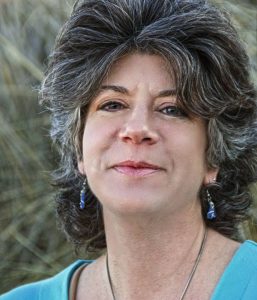
Marie Zhuikov. Image credit: John Steffl.

This can lead to some interesting mistakes. One happened a few months ago when a co-worker said they grew up on Wisconsin’s Fox River. I only knew the part of the Fox that connects to Green Bay so, in the story I was writing at the time, I put that person’s birthplace near Green Bay. I was chagrined to learn she actually grew up near Oshkosh on a branch of the river 50 miles away from where I originally placed her.

I hate making mistakes in my stories. Even if it’s just during a draft. So, when I saw an announcement for the Wisconsin Idea Seminar in the UW employee newsletter, I jumped at the chance to apply.

The seminar is an annual five-day immersive study tour of Wisconsin culture and geography for UW-Madison faculty and staff. It’s designed so that participants:

  • Gain a deeper knowledge of the cultural, educational, industrial, social and political realities of Wisconsin
  • Learn firsthand about the social and cultural contexts that shape the lives of many UW students
  • See and experience the university’s connections to the state
  • Understand the public service mission of the university
  • Nurture an increased mutual understanding between the university and the people of Wisconsin

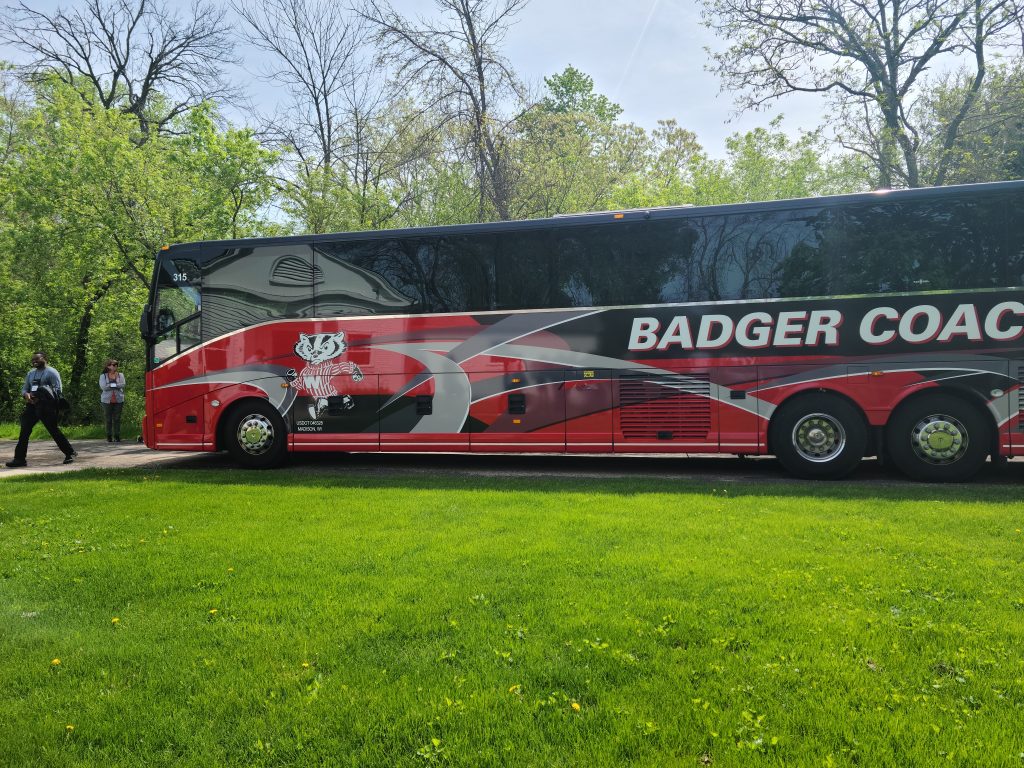
What this looks like in real life is about 40 people on a big red Bucky Badger bus riding around the state, talking to seminar participants and non-participants, diving into activities and drinking in the landscape. The theme this year was Forest + River, which was right up my alley as a water research storyteller who is also a Wisconsin geographically challenged person.

This post focuses on just one of our experiences during the seminar’s first day. I plan to write another post later about the rest of the trip and a visit to the Green Bay Packaging Plant, which makes recycled paper used in boxes.

The Wisconsin Idea tour bus. Image credit: Marie Zhuikov, Wisconsin Sea Grant

*

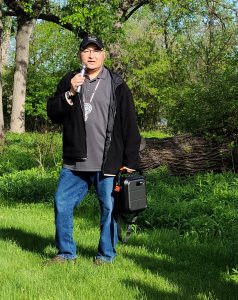
Our experience began on the Madison campus with a walking tour of Ho-Chunk sites. Amid a cacophony of spring birdsong, Bill Quackenbush, tribal historic preservation officer for the Ho-Chunk Nation, took us to several effigy mounds. These are ancient burial mounds formed in the shape of animals — birds, in the case of the two that we viewed.

Bill Quackenbush. Image credit: Marie Zhuikov, Wisconsin Sea Grant

The Madison campus is home to more of these ancient earthen monuments than any other university or college campus anywhere in North America, and probably the world. There are 38 burial mounds. At least 14 others have been lost to development. They are several thousand years old, perhaps as ancient as Egypt’s pyramids.

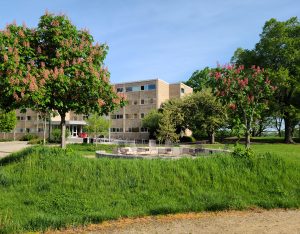
I learned something new right off the bat, mainly that there is a goose-shaped effigy mound right outside the Sea Grant office in Goodnight Hall. Granted, I don’t work on campus, but you’d think I would have heard something about that during my career here! Quackenbush said a Ho-Chunk village used to be where the office building is now located on the shores of Lake Mendota.

He explained how the Ho-Chunk are working to reclaim their culture. “These earth works are one small example of a portion of our life. We are no different today then we were back then. We humans like to take care of not only our babies and our children, but also our ancestors,” Quackenbush said.

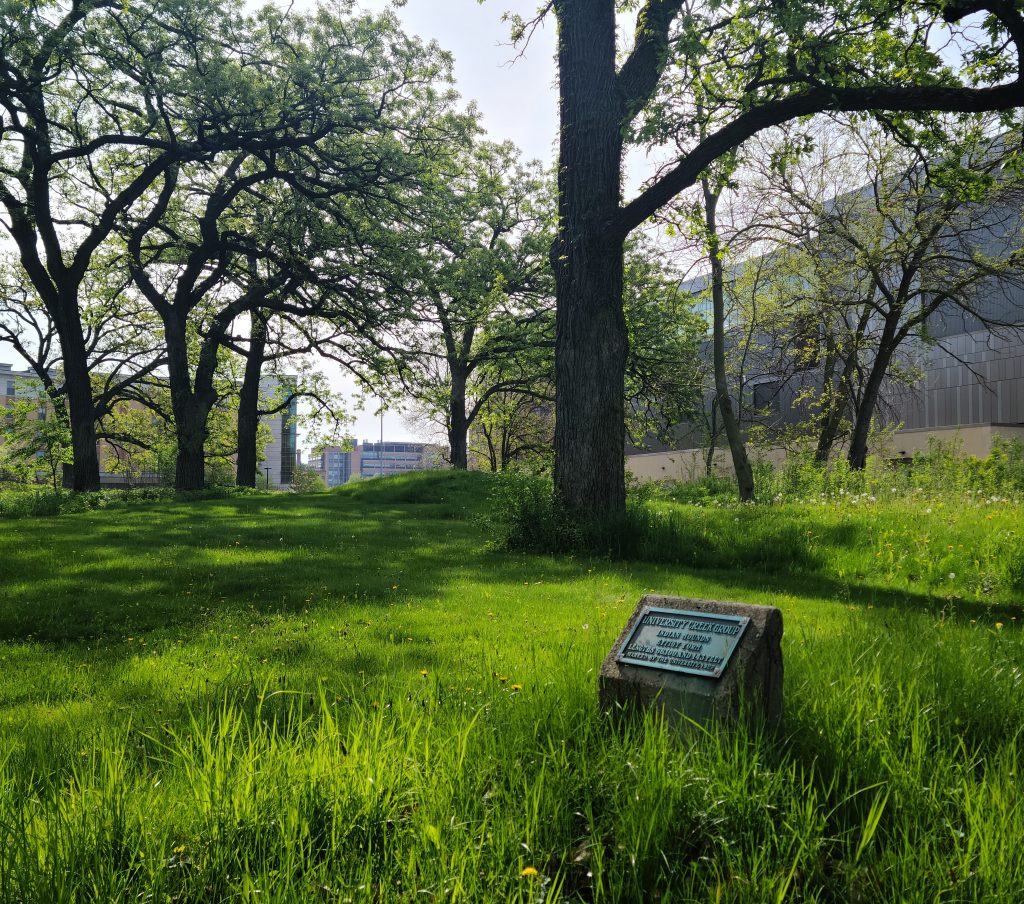
He criticized a stone marker on the mound not only for disturbing the site but for the text on it, which gives the impression that the mound is a thing of the past. “It isn’t a thing of the past at all,” Quackenbush said. “This is ever-present. It’s living and it’s here. Our ancestors are buried in this ground. They’re living, breathing things to us like that tree over there. Their bones have probably returned to the earth by now, but it’s the ground that is sacred to us.

Goodnight Hall, the home of Wisconsin Sea Grant on the UW-Madison campus. Image credit: Marie Zhuikov, Wisconsin Sea Grant

“However, I don’t want to be all doom and gloom. There’s a lot of good things that have come from protecting these mounds,” Quackenbush added.

The mound site was designated on the National Register of Historic Places a few years ago. The University is working to restore an oak savannah that used to exist there.

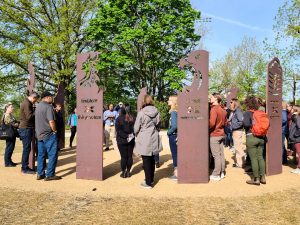
A short walk took us to the Ho-Chunk Clan Circle, a series of 12 metal sculptures that was dedicated earlier this year. Each depicts a clan symbol. Quackenbush said the circle represents the Ho-Chunk people as a whole.

Fittingly to my Sea Grant employment, I found myself standing near the Water Spirit sculpture. Quackenbush said the tribe was involved in the process of creating the circle and that the sculpture offers opportunities for him to meet and speak with more groups such as the Wisconsin Idea Seminar participants. He explained the various clan roles and how they fit into the tribe’s governmental system.

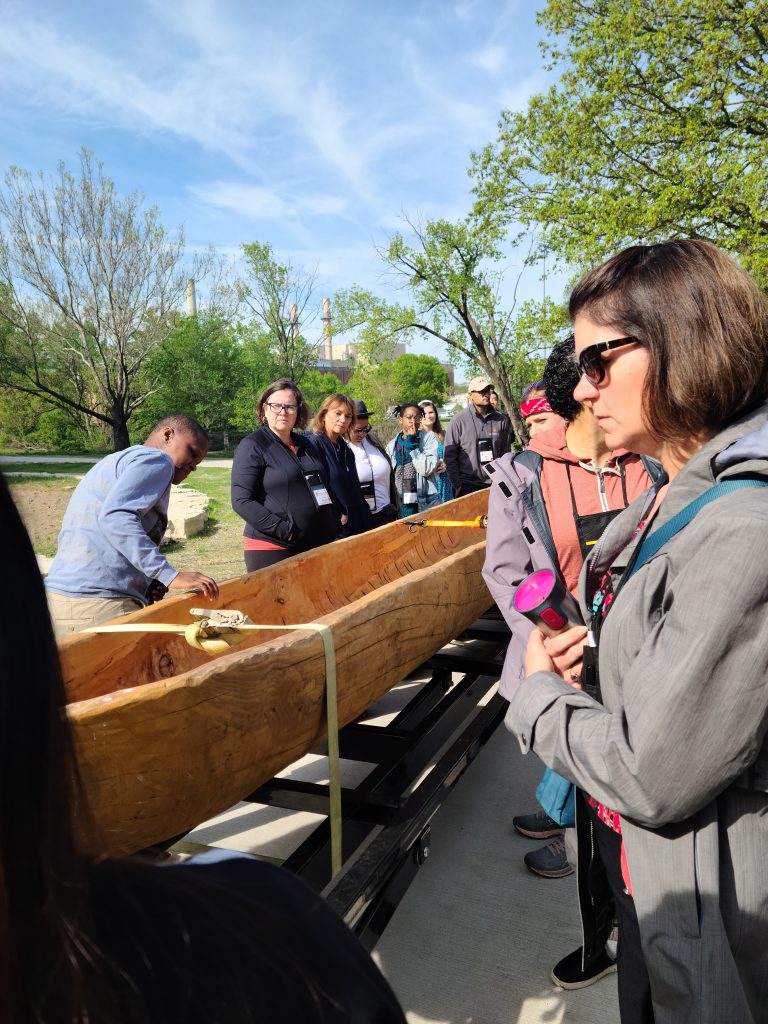
Next, the group was able to view a dugout canoe that Quackenbush built with the help of Ho-Chunk youth. They built it in much the same style as the ancient canoes that were recently discovered in Lake Mendota.

The Ho-Chunk goose effigy burial mound near the Sea Grant office. Image credit: Marie Zhuikov, Wisconsin Sea Grant

“This canoe doesn’t look very exciting, but the journey it’s been on is,” Quackenbush said. “When I saw that the historical society discovered the dugout canoes in the lake behind you as I was drinking my cup of coffee, it shot out of my nostrils! It was amazing to me because we had aspirations of putting one of them together.”

Wisconsin Idea Seminar participants tour the Ho-Chunk Clan Circle. Image credit: Marie Zhuikov, Wisconsin Sea Grant

He worked with Dane County to find a suitable cottonwood tree that was going to be removed for a trail project. The county delivered the tree to a youth education center, which is where Quackenbush and the students worked on it. Everything came together and, like the clan circle, the canoe is a great educational discussion piece.

Amy Rosebrough, interim Wisconsin state archeologist, joined us and described how the historic dugout canoes were found. She also detailed the significance of the new canoe. “These lakes remember. With the canoes, they’re telling the story of the Ho-Chunk presence here.”

Her office’s goal has been to work with Quackenbush and other partners to keep that story alive, “…To let people know that when they’re out there fishing, this isn’t something new. This is something that’s been going on for thousands of thousands of years. It’s not just the mounds, it’s this whole landscape. And to have Bill and his team come through with this new dugout, that was a wonderful thing – to sort of bring that back,” Rosebrough said.

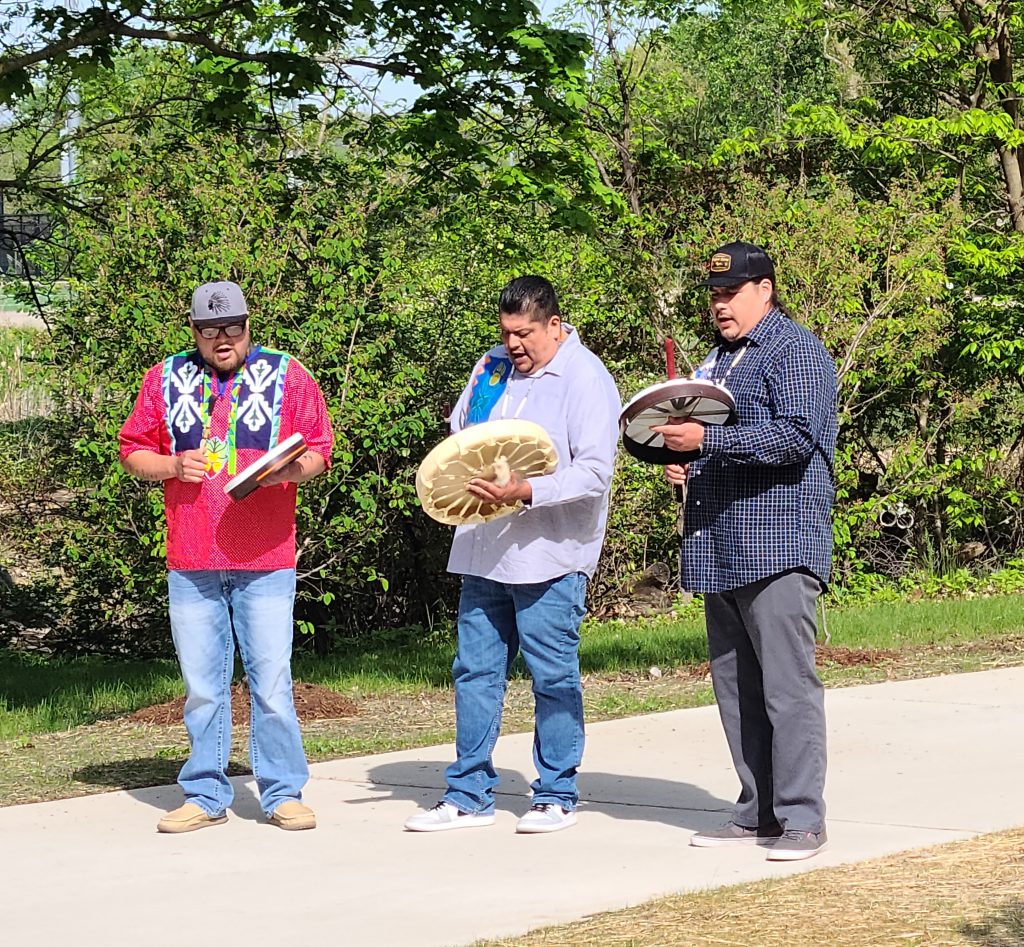
Our visit ended with a Ho-Chunk drum ceremony by the Iron Mound Singers. Listening to them was like hearing the heartbeat of the Earth. That is definitely not something I get to do every day in my job as a science writer. As we walked back to the bus to head to Portage and Appleton, I felt privileged to learn more about Ho-Chunk culture and the history of the land where the university stands.

Wisconsin Idea Seminar participants view a dugout canoe recently made by Quackenbush and Ho-Chunk youth. Image credit: Marie Zhuikov, Wisconsin Sea Grant

The Iron Mound Singers drum for Wisconsin Idea Seminar participants. Image credit: Marie Zhuikov, Wisconsin Sea Grant

The post A Wisconsin Idea Adventure: Part 1 first appeared on Wisconsin Sea Grant.

Original Article

Blog | Wisconsin Sea Grant

Blog | Wisconsin Sea Grant

https://www.seagrant.wisc.edu/blog/a-wisconsin-idea-adventure-part-1/?utm_source=rss&utm_medium=rss&utm_campaign=a-wisconsin-idea-adventure-part-1

Marie Zhuikov

...ELEVATED FIRE WEATHER CONDITIONS EXPECTED THROUGH FRIDAY... Very dry conditions, with relative humidity falling into the 15 to 25 percent range, will result in elevated fire potential this afternoon and again on Friday afternoon. The areas of greatest concern are the sandy soil regions of northern and central Wisconsin. Persistent dry weather has caused an increase

Original Article

Current Watches, Warnings and Advisories for Brown (WIC009) Wisconsin Issued by the National Weather Service

Current Watches, Warnings and Advisories for Brown (WIC009) Wisconsin Issued by the National Weather Service

https://alerts.weather.gov/cap/wwacapget.php?x=WI12664E354ED8.SpecialWeatherStatement.12664E437D50WI.GRBSPSGRB.3b77a733acfe35fc01f412b80021d336

w-nws.webmaster@noaa.gov

Inside the Michigan lab where scientists raise killer bugs to save trees

By Ashley Zhou Bridge Michigan

The Great Lakes News Collaborative includes Bridge Michigan; Circle of Blue; Great Lakes Now at Detroit Public Television; and Michigan Radio, Michigan’s NPR News Leader; who work together to bring audiences news and information about the impact of climate change, pollution, and aging infrastructure on the Great Lakes and drinking water.

Read Now at Great Lakes Now.

Original Article

Great Lakes Now

Great Lakes Now

https://www.greatlakesnow.org/2023/06/inside-michigan-lab-scientists-raise-killer-bugs-save-trees/

Bridge Michigan

There are plenty of lakes and rivers to explore across Pennsylvania as bass season begins this week. Smallmouth and largemouth bass are plentiful across the 86,000 miles of rivers and lakes in Pennsylvania, and anglers know these predator fish are fun to catch. Read the full story by the Erie Times-News.

Original Article

Great Lakes Commission

Great Lakes Commission

https://www.glc.org/dailynews/20230607-bass-pennslyvania

Hannah Reynolds

The official start of summer is just two short weeks away. As more Michiganders travel across the state and take to the water, it’s important to remember the basics of water safety — especially when it comes to the Great Lakes. Read the full story by the Livingston Daily.

Original Article

Great Lakes Commission

Great Lakes Commission

https://www.glc.org/dailynews/20230607-summer-staysafe-greatlakes

Hannah Reynolds

Some of the most panoramic views in all of Northern Michigan can be found at the peaks of its ski hills. Or, in Boyne City, Michigan, at a former downhill ski area that has now become a recreation gem for its community. Read the full story by MLive.

Original Article

Great Lakes Commission

Great Lakes Commission

https://www.glc.org/dailynews/20230607-northernmi-climb

Hannah Reynolds

The state of Michigan is warning residents about summer kills as the weather has been more extreme than usual this time of year. Fish kills can happen naturally, and with scorching weather, a summer kill is likely to occur sooner. Read the full story by WDIV-TV – Detroit, MI.

Original Article

Great Lakes Commission

Great Lakes Commission

https://www.glc.org/dailynews/20230607-egle-warning-fishkills

Hannah Reynolds

High levels of E. Coli have shut down beach access at Belle Isle in Detroit, Michigan, the second day in a row the bacteria has limited recreation at the popular location. Access to Belle Isle remains, but any visitors will be asked to avoid going in the water to avoid risking any contamination. Read the full story by WJBK-TV – Detroit, MI.

Original Article

Great Lakes Commission

Great Lakes Commission

https://www.glc.org/dailynews/20230607-belleisle-beachaccess-closed-ecoli

Hannah Reynolds

Ohio’s Lake Erie fishermen and an invasion of walleye anglers from all over the region have seen a big surge in the walleye fishing this week, thanks to the warm weather. The walleye are biting in many areas right now, making it an excellent time to enjoy the Walleye Capital of the World. Read the full story by The Beacon.

Original Article

Great Lakes Commission

Great Lakes Commission

https://www.glc.org/dailynews/20230607-warmtemps-walleye-lakeerie

Hannah Reynolds

...ELEVATED FIRE WEATHER CONDITIONS EXPECTED THROUGH THURSDAY... Very dry conditions, with relative humidity falling into the 15 to 25 percent range, will result in elevated fire potential this afternoon and again on Thursday afternoon. The areas of greatest concern are the sandy soil regions of northern and central Wisconsin. Persistent dry weather has caused an increase

Original Article

Current Watches, Warnings and Advisories for Brown (WIC009) Wisconsin Issued by the National Weather Service

Current Watches, Warnings and Advisories for Brown (WIC009) Wisconsin Issued by the National Weather Service

https://alerts.weather.gov/cap/wwacapget.php?x=WI12664E25F3FC.SpecialWeatherStatement.12664E343B10WI.GRBSPSGRB.3b77a733acfe35fc01f412b80021d336

w-nws.webmaster@noaa.gov

PFAS News Roundup: 3M being investigated for contamination, New safety bills introduced in Michigan

PFAS, short for per- and polyfluoroalkyl substances, are a group of widespread man-made chemicals that don’t break down in the environment or the human body and have been flagged as a major contaminant in sources of water across the country.

Keep up with PFAS-related developments in the Great Lakes area.

Read Now at Great Lakes Now.

Original Article

Great Lakes Now

Great Lakes Now

https://www.greatlakesnow.org/2023/06/pfas-news-roundup-3m-investigated-contamination-safety-bills-michigan/

Kathy Johnson

When summer stretches before many college undergraduates, they make plans: Spend time outdoors. Connect with friends. Catch up on screen time.

For the 31 undergraduates participating in the 2023 Freshwater@UW Summer Research Scholars Program, those plans are the same, with slight alterations. The time outdoors is likely to be spent collecting field samples from a body of water. The friends are new ones—made from the pool of program participants who hail from California to Alabama from Virginia to Wisconsin, and points in between. The screen time isn’t about beating The Legend of Zelda: Tears of the Kingdom, but instead entering findings into a larger dataset to further aquatic science projects.

“I looked at many summer REU (research experiences for undergraduates) opportunities,” Sofia Mota Chichy, chemistry major from the University of Michigan, said. “This one at Madison had the most in water chemistry and that’s what I am interested in. I’ve never worked in a chemistry lab before and it’s even better that it is an aquatic one.” Mota Chichy will be a part of University of Wisconsin-Madison’s Christine Remucal’s lab studying magnesium oxide.

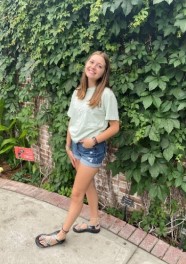
Jessica Alcorn is an undergraduate who will join a water research lab at UW-Madison this summer. Contributed photo.

A second young woman also expressed her attraction to this opportunity because of its emphasis on water. Plus, said Jessica Alcorn a student at Northwest Missouri State, “I want to go to graduate school here in Madison.” She’ll work under UW-Madison’s Matt Ginder-Vogel, who does both surface and groundwater research.

These springboards from research to a new path in life were celebrated by an enthusiastic Marissa Jablonski at a recent orientation session for the students. “Life will form you without you trying. You’re on your way. You’ve shown up. You’re leaning in.”

Jablonski is the executive director of the Freshwater Collaborative of Wisconsin, one of the funding entities for the summer program, about which, the University of Wisconsin Water Resources Institute Director Jim Hurley said, “It’s been really positive to be able to expand our program because of support from the Freshwater Collaborative. Last year, we were a fledgling program of nine students.” Hurley secured a nearly $358,300 grant from the collaborative, resulting in this year’s larger cohort.

No matter the size of the group, though, Hurley said the goal remains unchanged, “The overall goal is to provide immersive student research experiences to enhance workforce development skills and allow undergraduates to consider the option of graduate studies in Wisconsin. Research experience as an undergraduate is an important component of a successful application for graduate school. In the job market, it also sets apart recent undergraduates who have addressed the changing needs of water-related fields.”

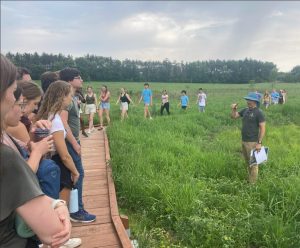
Group of people standing in a grassy area.
Summer research scholars had many orientation activities before heading to their assignments across the state. Photo by Alison Mikulyuk

Expanding the number of participating students is one thing, another is the broadened involvement from professors, graduate students and others at organizations that are acting as mentors for the students. There are 48 in all, including people on University of Wisconsin System campuses in Eau Claire, Green Bay, La Crosse, Madison, Milwaukee and Oshkosh. Also providing formative experiences will be mentors from the U.S. Geological Survey, the Lake Superior National Estuarine Research Reserve, Wisconsin Shipwreck Coast National Marine Sanctuary and Wisconsin Maritime Museum.

In application materials, students this summer expressed interest in pursuing research into topics such as pollution, climate change, molecular structures of water, public health and more. The projects will deliver on that skill-building, spawning a new generation of water leaders. While the students will disperse across the state for these labs and field sites, they have a standing invitation to gather each Thursday virtually—and in-person if they are in Madison—for weekly professional development sessions on topics like science communication, navigating graduate school and proposal writing.

They will add these skills to their already prodigious ones in other areas that demonstrate well-rounded natures. At the orientation session, Alison Mikulyuk, summer research opportunity program coordinator, called out fun facts when she said among the group there was a proficient loon caller, a mushroom finder, dancers, an aspiring author, someone who graduated from high school as a 14-year-old, a boxer, world-medalist baton twirler, two twins, competitive swimmers, a multi-instrumentalist, many who play instruments and several who speak more than one language.

Mikulyuk urged the undergraduates to enjoy those skills of others, and also capitalize on the people who possess them, “Learn from each other. Care for each other…Take advantage of personal and professional connections.” She continued, “I hope you will have a life-changing experience that propels you forward in your next decades.”

The program will run until Aug. 5, culminating in a poster session where students will present their summer’s worth of findings.

In addition to the Freshwater Collaborative of Wisconsin and the Water Resources Institute, the summer program has support from Wisconsin Sea Grant, Water@UW Madison and the UW-Madison Graduate School.

The post Summer loving and the research is fine first appeared on WRI.

Original Article

News Release | WRI

News Release | WRI

https://www.wri.wisc.edu/news/summer-loving-and-the-research-is-fine/?utm_source=rss&utm_medium=rss&utm_campaign=summer-loving-and-the-research-is-fine

Moira Harrington

When summer stretches before many college undergraduates, they make plans: Spend time outdoors. Connect with friends. Catch up on screen time.

For the 31 undergraduates participating in the 2023 Freshwater@UW Summer Research Scholars Program, those plans are the same, with slight alterations. The time outdoors is likely to be spent collecting field samples from a body of water. The friends are new ones—made from the pool of program participants who hail from California to Alabama from Virginia to Wisconsin, and points in between. The screen time isn’t about beating The Legend of Zelda: Tears of the Kingdom, but instead entering findings into a larger dataset to further aquatic science projects.

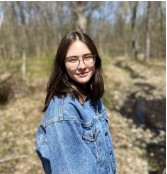
Smiling person standing in a grassy, wooded area.

Sofia Mota Chichy will research magnesium oxide. Contributed photo.

“I looked at many summer REU (research experiences for undergraduates) opportunities,” Sofia Mota Chichy, chemistry major from the University of Michigan, said. “This one at Madison had the most in water chemistry and that’s what I am interested in. I’ve never worked in a chemistry lab before and it’s even better that it is an aquatic one.” Mota Chichy will be a part of University of Wisconsin-Madison’s Christine Remucal’s lab studying magnesium oxide.

A second young woman also expressed her attraction to this opportunity because of its emphasis on water. Plus, said Jessica Alcorn a student at Northwest Missouri State, “I want to go to graduate school here in Madison.” She’ll work under UW-Madison’s Matt Ginder-Vogel, who does both surface and groundwater research.

These springboards from research to a new path in life were celebrated by an enthusiastic Marissa Jablonski at a recent orientation session for the students. “Life will form you without you trying. You’re on your way. You’ve shown up. You’re leaning in.”

Jablonski is the executive director of the Freshwater Collaborative of Wisconsin, one of the funding entities for the summer program, about which, Sea Grant Director Jim Hurley said, “It’s been really positive to be able to expand our program because of support from the Freshwater Collaborative. Last year, we were a fledgling program of nine students.” Hurley secured a nearly $358,300 grant from the collaborative, resulting in this year’s larger cohort.

No matter the size of the group, though, Hurley said the goal remains unchanged, “The overall goal is to provide immersive student research experiences to enhance workforce development skills and allow undergraduates to consider the option of graduate studies in Wisconsin. Research experience as an undergraduate is an important component of a successful application for graduate school. In the job market, it also sets apart recent undergraduates who have addressed the changing needs of water-related fields.”

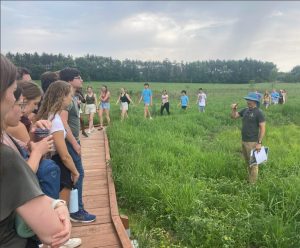
Large group of people in a grassy area.

The 2023 cohort of summer research scholars undertook various orientation activities, including a tour of the UW-Madison Arboretum. Photo: Alison Mikulyuk

Expanding the number of participating students is one thing, another is the broadened involvement from professors, graduate students and others at organizations that are acting as mentors for the students. There are 48 in all, including people on University of Wisconsin System campuses in Eau Claire, Green Bay, La Crosse, Madison, Milwaukee and Oshkosh. Also providing formative experiences will be mentors from the U.S. Geological Survey, the Lake Superior National Estuarine Research Reserve, Wisconsin Shipwreck Coast National Marine Sanctuary and Wisconsin Maritime Museum.

In application materials, students this summer expressed interest in pursuing research into topics such as pollution, climate change, molecular structures of water, public health and more. The projects will deliver on that skill-building, spawning a new generation of water leaders. While the students will disperse across the state for these labs and field sites, they have a standing invitation to gather each Thursday virtually—and in-person if they are in Madison—for weekly professional development sessions on topics like science communication, navigating graduate school and proposal writing.

They will add these skills to their already prodigious ones in other areas that demonstrate well-rounded natures. At the orientation session, Alison Mikulyuk, summer research opportunity program coordinator, called out fun facts when she said among the group there was a proficient loon caller, a mushroom finder, dancers, an aspiring author, someone who graduated from high school as a 14-year-old, a boxer, world-medalist baton twirler, two twins, competitive swimmers, a multi-instrumentalist, many who play instruments and several who speak more than one language.

Mikulyuk urged the undergraduates to enjoy those skills of others, and also capitalize on the people who possess them, “Learn from each other. Care for each other…Take advantage of personal and professional connections.” She continued, “I hope you will have a life-changing experience that propels you forward in your next decades.”

The program will run until Aug. 5, culminating in a poster session where students will present their summer’s worth of findings.

In addition to the Freshwater Collaborative of Wisconsin and Sea Grant, the summer program has support from the University of Wisconsin Water Resources Institute, Water@UW Madison and the UW-Madison Graduate School.


The post Summer loving and the research is fine first appeared on Wisconsin Sea Grant.

Original Article

News Releases | Wisconsin Sea Grant

News Releases | Wisconsin Sea Grant

https://www.seagrant.wisc.edu/news/summer-loving-and-the-research-is-fine/?utm_source=rss&utm_medium=rss&utm_campaign=summer-loving-and-the-research-is-fine

Moira Harrington

Chicago, IL (June 5, 2023) – With eyes on Paris for the recently completed crucial second round of global plastics treaty negotiations, groups in Illinois and across the Great Lakes are excited to celebrate the work that has been done closer to home to reduce the production of single-use plastic. This year, the Alliance for the Great Lakes, Ocean Conservancy and Illinois Environmental Council secured significant wins at the statehouse in Springfield that will advance the effort to reduce plastics while increasing access to water and promoting reuse.

The Illinois General Assembly wrapped up the 2023 session in late May by passing several bills addressing plastic production and reduction; improving reuse systems; and providing better data to assist future policymaking:

  • SB 58 bans the state from purchasing polystyrene foam foodware. Styrene, a building block of polystyrene, is likely a human carcinogen, creating health risks in production, use and disposal. Additionally, polystyrene is not recyclable, increasing the challenges of an overburdened waste system by plastic pollution. The bill also requires all state agencies to develop plans to reduce purchasing of single-use plastic.
  • SB 1715 will increase the number of bottle-filling water fountains across the state, providing no-cost water for many more people and decreasing reliance on single-use water bottles that contribute to plastic pollution. 
  • HB 2086 will allow customers to refill their own containers with ready-made food at restaurants and retailers. Increasing reusable systems is the most effective and efficient way to reduce plastics and associated greenhouse gas emissions and transition to a safe, circular economy.
  • SB 1563, requires the Illinois Environmental Protection Agency to report on the potential impacts of microplastics in drinking water in Illinois.
  • SB 1555 requires the Illinois EPA to create a statewide needs assessment for packaging and paper products. This is a critical step towards establishing comprehensive extended producer responsibility in Illinois focused on holding producers accountable and achieving source reduction.

Advocates were also able to prevent HB 1616 from advancing. This bill would have allowed for a dangerous and toxic pyrolysis plant to side-step the Illinois Environmental Protection Agency’s standard permitting process to be built in an already overburdened minority community near Joliet, IL. 

Dr. Anja Brandon, associate director of U.S. plastics policy at Ocean Conservancy and an environmental engineer, notes, “Now is the time to pursue a single-use plastics source reduction target in the Great Lakes that’s in line with the global goal of a minimum 50% reduction by 2050. These recently passed bills will reduce literal tons of plastic pollution while also decreasing greenhouse gas emissions. We applaud the Illinois legislature for these steps forward and hope to see more headway next session to meet the urgency of this moment.”

“We are proud to link arms with our partners from across the Great Lakes and the country in order to build smart and sustainable solutions that will reduce plastic production, support regenerative solutions, advance environmental justice by reducing toxic pollution and improve our community’s health. This session in Illinois represents just the start of the work needed to be done to reduce plastic pollution in the Great Lakes. We are all ready to keep the work moving forward together,” said Andrea Densham, senior strategic adviser for the Alliance for the Great Lakes.

“This year’s plastic reduction victories represent some of the most significant environmental legislative progress we made during this session, and it’s a sign that our years of education and mobilization have built momentum for change,” said Jen Walling, executive director of the Illinois Environmental Council. “Make no mistake; we have plenty of work to do to realize the scale of policy progress we truly need, but it’s important to stop and celebrate significant wins, like halting HB1616, for example– an objectively good thing for the already disproportionately polluted communities in the Joliet area who would have borne the brunt of new toxic pollution emitted by the proposed chemical recycling plant.”

Global and regional efforts to reduce plastic are critical as the connections between climate and plastic production become clearer. Already, plastics are responsible for 3-4% of global greenhouse gas emissions; if they continue to grow, this will triple by 2050. In addition, the health impacts of these emissions from extraction to disposal of plastics are disproportionately borne by historically marginalized communities, making this an environmental justice issue. 

###

Contact:

Jack Walker, teamgreatlakes@mrss.com, 847-721-0597  

Madeline Black, mblack@oceanconservancy.org, 202-280-6232

Tucker Barry, tucker@ilenviro.org, 337-280-1269

ABOUT THE ALLIANCE FOR THE GREAT LAKES: The Alliance for the Great Lakes is a nonpartisan nonprofit working across the region to protect our most precious resource: the fresh, clean, and natural waters of the Great Lakes. For more information, visit www.greatlakes.org.

ABOUT OCEAN CONSERVANCY: Ocean Conservancy is working to protect the ocean from today’s greatest global challenges. Together with our partners, we create evidence-based solutions for a healthy ocean and the wildlife and communities that depend on it. For more information, visit www.oceanconservancy.org, or follow us on Facebook, Twitter or Instagram

ABOUT THE ILLINOIS ENVIRONMENTAL COUNCIL: Since 1975, the Illinois Environmental Council (IEC) has worked to safeguard Illinois—its people, its plants and animals, and the natural systems on which all life depends by building power for people and the environment. Representing over 100 environmental organizations in the state, IEC carries out its mission to advance public policies that create healthy environments across Illinois through education, advocacy and movement building.

The post Environmental Advocates Applaud Illinois General Assembly’s Efforts to Reduce Plastic Pollution appeared first on Alliance for the Great Lakes.

Original Article

News - Alliance for the Great Lakes

News - Alliance for the Great Lakes

https://greatlakes.org/2023/06/environmental-advocates-applaud-illinois-general-assemblys-efforts-to-reduce-plastic-pollution/

Judy Freed

Great Lakes Moment: New trail connects people with secluded Detroit River wetlands

Great Lakes Moment is a monthly column written by Great Lakes Now Contributor John Hartig. Publishing the author’s views and assertions does not represent endorsement by Great Lakes Now or Detroit Public Television.

What do a former naval air station, a Nike missile site, and a wildlife refuge have in common?

Read Now at Great Lakes Now.

Original Article

Great Lakes Now

Great Lakes Now

https://www.greatlakesnow.org/2023/06/great-lakes-moment-trail-connects-people-secluded-detroit-river-wetlands/

John Hartig

With the environment warming because of climate change, researchers are noticing some drastic fluctuations. This year, Lake Erie had little to no ice coverage which has effects on other lake processes like water levels, fish hatches, and algal blooms. Read the full story by Spectrum News 1.

Original Article

Great Lakes Commission

Great Lakes Commission

https://www.glc.org/dailynews/20230605-erie-ice

Connor Roessler

NOAA has been working to update the Environmental Response Management Application digital data map for Lake Erie. It’s a tool that helps emergency responders and environmental resource managers in dealing with incidents that may adversely impact the environment.  Read the full story by WJET-TV – Erie, PA.

Original Article

Great Lakes Commission

Great Lakes Commission

https://www.glc.org/dailynews/20230605-erie-map

Connor Roessler

The Army Corps of Engineers is now on the cusp of construction on modification of the Brandon Road Lock in Illinois. The project is now projected to cost $1.1 billion, but the main sticking point is that it requires Illinois to sign an agreement as the non-federal sponsor that the state has so far refused to sign Read the full story by Great Lakes Now.

Original Article

Great Lakes Commission

Great Lakes Commission

https://www.glc.org/dailynews/20230605-carp-agreement

Connor Roessler