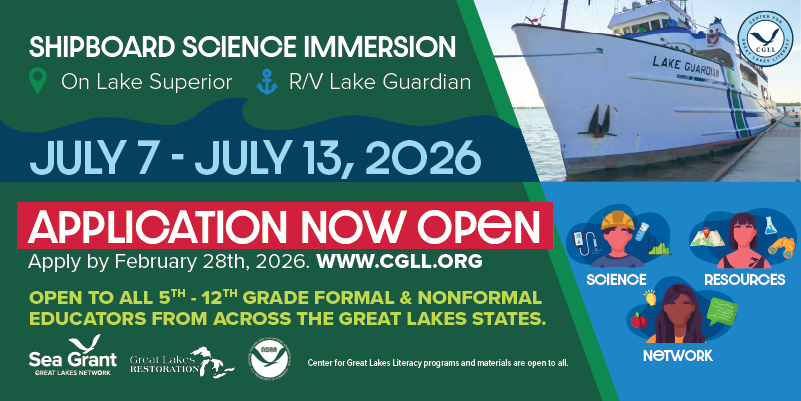
Banner announcing the 2026 shipboard science immersion workshop

Formal and non-formal 5-12th grade educators from throughout Great Lakes states are invited to apply for an exciting opportunity to spend a week aboard a U.S. Environmental Protection Agency research vessel alongside scientists and to bring Great Lakes science back to their classrooms. The program, organized by the Center for Great Lakes Literacy (CGLL), is July 7-13, 2026. Deadline for applications is February 28, 2026.

Through a partnership with the EPA Great Lakes National Program Office and NOAA, with funding from the Great Lakes Restoration Initiative, educators will engage in scientific investigations aboard the ship. Hosts for the Lake Superior program are CGLL partners Minnesota Sea Grant, Wisconsin Sea Grant, and Illinois-Indiana Sea Grant.

The annual Shipboard Science Immersion promotes Great Lakes science while forging lasting relationships between Great Lakes scientists and educators. CGLL is a collaborative effort led by Sea Grant educators throughout the Great Lakes watershed in the U.S. CGLL fosters informed and responsible decisions that advance basin-wide stewardship by providing hands-on experiences, educational resources, and networking opportunities promoting Great Lakes literacy among an engaged community of educators, scientists, and youth.

For more information on the 2026 Shipboard Science Immersion and application materials, visit the Center for Great Lakes Literacy website.

The post Apply for the 2026 Shipboard Science Immersion on Lake Superior first appeared on Wisconsin Sea Grant.
Original Article

News Releases | Wisconsin Sea Grant

News Releases | Wisconsin Sea Grant

https://www.seagrant.wisc.edu/news/apply-for-the-2026-shipboard-science-immersion-on-lake-superior/

Wisconsin Sea Grant

Manoomin— or wild rice—is Michigan’s official native grain and an important cultural food source for Anishinaabe peoples throughout the Great Lakes. Once abundant throughout the region, its existence has been threatened by dams and environmental pressures. Today, there’s an effort to restore it.

This story was produced in collaboration with @OneDetroit and BridgeDetroit.

#WildRice #GreatLakes #Indigenous #NativeAmerican #Michigan #Food #Cooking
===========================================
Website: https://greatlakesnow.org
Facebook: https://www.facebook.com/greatlakesnow
X: https://www.x.com/greatlakesnow
Instagram: https://www.instagram.com/greatlakesnoworg
Newsletter: https://www.greatlakesnow.org/great-lakes-now-newsletter/

To learn more about supporting Detroit PBS and Great Lakes Now, visit https://www.detroitpbs.org/
===========================================
“How Wild Rice Goes From Water to Table” was produced by Great Lakes Now/Detroit PBS in collaboration with @OneDetroit and BridgeDetroit.

Produced by
Bill Kubota
Jena Brooker

Written by
Bill Kubota

Narrated by
Jena Brooker

Edited by
Bill Kubota

Additional Editing
Jordan Wingrove

Camera & Audio
Bill Kubota
Brendan Battle
Darin Donahue
Randy Strobl
Dean Underwood

Additional Material
U.S. Department of Interior
University of Michigan
Superior National Forest
U.S. National Archives and Records Administration
Milwaukee County Historical Society
iStock
Avidly Ravenous

The post How Wild Rice Goes From Water to Table | Great Lakes Now appeared first on Great Lakes Now.

Original Article

Great Lakes Now

Great Lakes Now

https://www.greatlakesnow.org/2026/02/09/how-wild-rice-goes-from-water-to-table-great-lakes-now/

Great Lakes Now

Summary

The Water Resources Analyst (Analyst) is an integral part of the Alliance’s Water Resources team, supplying research and analysis to advance policy campaigns related to source water protection. With a particular focus on plastic pollution, PFAS, and other high-priority contaminants, the Analyst is committed to bringing scientific rigor to the Alliance’s work on behalf of people and ecosystems in the Great Lakes basin.

The Analyst works collaboratively with the Water Resources team to track, analyze and synthesize scientific research, policy developments, and regulatory trends in key geographies across the Great Lakes region. The Analyst brings a strong foundation in water quality science, paired with the ability to critically evaluate, interpret, and translate complex research into clear, actionable insights that advance issue-based campaigns. Leveraging rigorous research methodologies, innovative data visualization and applied policy analysis tools, the Analyst elevates technical information to support strategic decision-making and summarizes findings for diverse audiences, including policymakers, partners, and the public.

This position reports to the Director of Water Resources and works closely with Alliance staff across policy, government affairs, community partnerships, and communications to ensure research products are timely, credible, and strategically aligned, and that recommendations are effectively integrated into advocacy, outreach, and campaign efforts.

A typical week:

In a typical week, the Analyst might:

  • Check in with the Director of Water Resources and Water Resources team to discuss progress on projects and coordinate tasks.
  • Finalize a report with talking points and graphics to characterize the sources of water pollution entering the Great Lakes and impacts on the ecosystem and drinking water quality.
  • Develop talking points and graphics to assist the government affairs team as they prepare for an upcoming meeting with a state lawmaker who has expressed interest in supporting legislation to require contaminant monitoring and assessment.
  • Review a regulation proposed by a state agency and advise the Director of Water Resources on issues to address in our comment letter.
  • Reach out to a partner to discuss the implications of new research related to water pollution and other water quality and quantity issues.
  • Update the team’s policy tracking document with the latest information about a relevant agency action.

Responsibilities

Research

  • Maintain awareness of the latest research related to priority issues for the Water Resources team, including but not limited to microplastics, PFAS, and emerging pollutants
  • Synthesize and analyze research to glean insights relevant to policy campaigns
  • Prepare compelling reports and data visualizations to make information accessible to a variety of audiences

Policy Analysis

  • Track relevant policy developments across the Great Lakes states
  • Review proposed rules, regulations, and bills to offer technical feedback on source water impacts and opportunities to strengthen protections
  • Identify and describe opportunities to shift existing approaches to water quality monitoring, risk assessment, restoration efforts, and regulatory practices to protect source water, with a focus on state and federal policy

Relationship Building & Thought Leadership

  • Foster collaboration with researchers and academic partners doing work relevant to the Great Lakes and source water protection
  • Build and maintain strong working relationships with internal staff and external partners who have diverse backgrounds and skill sets to develop and tailor communication materials and advance campaign priorities
  • Actively contribute to public dialogues in the fields of source water protection through conferences, roundtables, and workshops, including those that reach beyond the environmental NGO community

Program Development

  • Contribute to annual and multi-year work and campaign plans
  • Track and report on grant deliverables, project budgets, and expenses, as needed
  • Contribute to the creation of proposals for philanthropic funding to support the work, including doing so in collaboration with complementary partners where possible

Knowledge/Skills

  • Bachelor’s degree required and 5+ years of relevant experience in research for environmental science, biology, toxicology, chemistry, environmental engineering, natural/water resources management, or related field. An advanced degree or demonstrated additional experience preferred
  • Strong research, data analysis and visualization skills, ability to convert analysis to different types of communication materials (e.g. talking points, blog posts, data visualization and graphics) that can be used as effective policy communication and storytelling tools that engage the media, Alliance supporters, and public officials
  • Ability to convey recommendations in concise, precise, and compelling written and data visualization work products
  • Willingness to listen and respond to the needs and demands of diverse groups of individuals and partner organizations
  • Excellent listening, written, and verbal communication skills
  • Motivated to work primarily internally and behind the scenes with Alliance staff
  • Adept with Microsoft Office Suite and project management software
  • Adhere to and exemplify the Alliance for the Great Lakes’ values of community, relationships, courage, integrity, optimism, and the principles of justice, equity, diversity, and inclusion in all our work

    Additional Skills/Pluses
  • Fundamental commitment to socioeconomic and racial equity and demonstrated skills in identifying policy options that advance environmental equity
  • Collaborative, collegial, with a good sense of humor and ability to adapt to diverse work styles; adept at working in teams and independently in both virtual and in-person settings
  • Keen understanding of the dynamics of project and policy implementation within public agencies, ability to navigate complex political and fiscal landscapes, and adapt accordingly
  • Commitment to and passion for mission-driven public interest work related to clean water, climate adaptation, the Great Lakes, and the role of water in community resilience and revitalization

Job Parameters

This position is full-time and consistent with Alliance employment policy. The Alliance has defined salary ranges that are evaluated annually, and it is customary for candidates to join the lower half of the range to leave room for learning and development in the role. It is uncommon for starting salaries to fall above the mid-point. The salary range for this position begins at $70,000, and we negotiate salaries with final candidates based on their experience in similar roles and expertise related to the qualifications.

  • Excellent benefits, including medical, dental, short- and long-term disability, life insurance, FSA, 11 paid holidays plus the business days between 12/26 and 12/30 (staff who must work on any paid holidays may take those holidays at another time subject to the employee handbook), 3 weeks’ annual vacation to start + PTO, and Fidelity 401(k) with employer match of up to 6% of salary, eligible after 30 days.

Application Process

Please e-mail a cover letter, resume, references, and writing or work sample that demonstrates relevant qualifications to hr@greatlakes.org. Include the job title in the subject line.

Applications will be accepted and reviewed on a rolling basis starting on February 9th, 2026, and until the position is filled. Materials should be compatible with Microsoft Word or Adobe Acrobat. Applicants will receive confirmation of receipt of their materials, further guidance, and updates about the hiring process by e-mail, with interviews provided for finalists. No phone inquiries, please.

About the Alliance for the Great Lakes

Our vision is a thriving Great Lakes and healthy water that all life can rely on, today and far into the future.

The mission of the Alliance for the Great Lakes is to protect, conserve, and restore the Great Lakes, ensuring healthy water in the lakes and in our communities for all generations of people and wildlife.

To achieve our vision and mission, everyone in our organization will live ourvalues of Community, Relationships, Courage, Integrity, and Optimism, and weave the principles of Justice, Equity, Diversity, and Inclusion into all our work.

 For more information about the Alliance’s programs and work, please visit us online at www.greatlakes.org.

The post Water Resources Analyst appeared first on Alliance for the Great Lakes.

Original Article

News - Alliance for the Great Lakes

News - Alliance for the Great Lakes

https://greatlakes.org/2026/02/water-resources-analyst/

Michelle Farley

By Karlee VanAntwerp

Critics of the proliferation of data centers are calling for a one-year moratorium on the approval of new projects.

The post Data center concerns lead to push for a one-year moratorium on projects first appeared on Great Lakes Echo.

Original Article

Great Lakes Echo

Great Lakes Echo

https://greatlakesecho.org/2026/02/08/data-center-concerns-lead-to-push-for-a-one-year-moratorium-on-projects/

Capital News Service

Using historical temperature records from weather stations around the region, researchers improved their understanding of where ice might have formed and for how long it lasted spanning the last 120 years. Researchers said this new data record could help with efforts like research on fish in the winter, regional climate and improving safety on the ice. Read the full story by Interlochen Public Radio.

Original Article

Great Lakes Commission

Great Lakes Commission

https://www.glc.org/dailynews/20260206-ice-data-insights

James Polidori

Ottawa County, Michigan, relies on two aquifers for groundwater: a shallow upper glacial aquifer and a much deeper one known as the Marshall Sandstone. When snow melts in the spring, it does help recharge the upper aquifer, but the deeper Marshall aquifer, the one many residents’ wells rely on, doesn’t get that same benefit. Read the full story by WZZM-TV – Grand Rapids, MI.

Original Article

Great Lakes Commission

Great Lakes Commission

https://www.glc.org/dailynews/20260206-groundwater-impacts

James Polidori

Data from the National Oceanic and Atmospheric Administration’s Great Lakes Environmental Research Laboratory show Lake Erie’s ice coverage surged from under 2% on January 14 to nearly 85% by January 21; coverage has increased since then, hovering near or above 95% since late January. Read the full story by The Plain Dealer.

Original Article

Great Lakes Commission

Great Lakes Commission

https://www.glc.org/dailynews/20260206-lake-erie-ice

James Polidori

The Soo Locks have closed to marine traffic for their annual maintenance period, but the critical Great Lakes shipping gateway remains a hub of activity as engineers and technicians work to prepare the massive structures for another shipping season. Read the full story by WBUP – Marquette, MI.

Original Article

Great Lakes Commission

Great Lakes Commission

https://www.glc.org/dailynews/20260206-lock-maintenance

James Polidori

The S.S. Badger car and passenger ferry’s 2026 season will run from May 15 to October 11, making four-hour trips to and from Manitowoc, Wisconsin, and Ludington, Michigan. The ferry will also host some special events, including an ’80s-themed murder mystery. Read the full story by the Manitowoc Herald Times Reporter.

Original Article

Great Lakes Commission

Great Lakes Commission

https://www.glc.org/dailynews/20260206-ferry-season

James Polidori

 By Bauyrzhan Zhaxylykov

Given dramatic changes in federal energy policy and spending, as well as possible reduction in state financial support for alternative energy projects, is Michigan still on target to reach its clean energy goals?

The post Michigan pushes toward 100% clean energy by 2040 despite funding cuts first appeared on Great Lakes Echo.

Original Article

Great Lakes Echo

Great Lakes Echo

https://greatlakesecho.org/2026/02/06/michigan-pushes-toward-100-clean-energy-by-2040-despite-funding-cuts/

Capital News Service

Of all the fish in the Great Lakes, muskellunge— or muskies— are one of the largest and most sought after by anglers. To keep up with the demand, the Michigan DNR aims to raise and release 40,000 muskies every year.

But raising muskies is easier said than done, especially when they’re known for being highly cannibalistic. On the Great Lakes Now YouTube channel, learn more about how the Wolf Lake State Hatchery in Mattawan, Michigan raises tens of thousands of these apex predators.

#GreatLakes #fishing #freshwaterfish #muskie

===========================================
Website: https://greatlakesnow.org
Facebook: https://www.facebook.com/greatlakesnow
X: https://www.x.com/greatlakesnow
Instagram: https://www.instagram.com/greatlakesnoworg
Newsletter: https://www.greatlakesnow.org/great-lakes-now-newsletter/

To learn more about supporting Detroit PBS and Great Lakes Now, visit https://www.detroitpbs.org/

The post Cannibalism Makes Rearing Muskies a Challenge appeared first on Great Lakes Now.

Original Article

Great Lakes Now

Great Lakes Now

https://www.greatlakesnow.org/2026/02/04/cannibalism-makes-rearing-muskies-a-challenge/

Great Lakes Now

Statewide water conference spotlights river protection victories

This year’s Lakes and Rivers Convention in Stevens Point April 15-17 includes a stream of River Talks we think will inspire and inform river and clean water advocates.

The Lakes and Rivers Convention is ideal for folks who do conservation work, who are vocal advocates for waterways, who are involved in restoration efforts and local groups. The conference is a time to learn about the big picture of conservation, to connect with government/industry leaders and boots-on-the-ground conservation efforts, and who are leaders of lake districts.

River Alliance is involved because all waters are connected. Understanding the interconnections of the work of lake districts, river groups, the DNR, and clean water researchers is fundamental to making progress in conservation, balancing water use needs, fighting invasive species and pollution, and forming solid relationships with each other.

River Talks on Thursday

The conference has a very deep bench of fantastic experts sharing their knowledge. Explore the full agenda on the Water Week website. One track of topics will be River Talks that focus on the art, science and history of protecting rivers. These highlights will also be a part of the convention’s virtual program. 

Photo of John BatesWriters on Rivers: A Sharing of Some of the Best Essays from Rivers as Large as the Mississippi to as Small as Childhood Creeks

Speaker: John Bates, author

From Mark Twain and Henry David Thoreau to Aldo Leopold to Ann Zwinger, Terry Tempest Williams, and Barry Lopez, writers have waxed eloquent about their love of rivers. Come sit back and let your imagination flow along the waters our finest writers have so brilliantly written about.

Bob Martini photoRegulation Works ; 50 years of water quality progress in the Wisconsin River Watershed

Speaker: Bob Martini, retired Wisconsin Department of Natural Resources

Beginning in 1976, we identified and addressed the main water quality problems in the Wis River Basin, including pollution from paper mills and cities, acid rain impacts on lakes, groundwater pollution in the Central Sands, and the impacts of dams on the “Hardest Working River in America”. We learned that properly designed regulation restores the environment, protects the public interest, AND can actually enhance local economies while avoiding the myth of economic disaster caused by environmental regulation.

Integrating Multi-Benefit Floodplain Restoration and Nutrient Management: A Decision-Support Framework for River Systems

Floodplain restoration offers a nature-based solution to address biodiversity loss, flood risk, and water quality degradation in Wisconsin’s river systems. This work presents an integrated framework using EcoFIP and NutriSink tools to identify and prioritize multi-benefit rehabilitation projects. Case studies from the Wabash River demonstrate that optimal restoration sites are not always downstream, emphasizing the need for spatially nuanced planning. Together, these tools provide a scalable approach for watershed managers in Wisconsin to target interventions that maximize ecological and water quality benefits, supporting efforts to mitigate nutrient pollution and restore riverine function.

Timothy Bauer photoWhat Is a River?

Speaker: Timothy Bauer of Miles Paddled
Most of us know what rivers do — they flow from one place to another, transporting sediment and reshaping landscapes along the way. They provide fresh drinking water and power dams to generate electricity. Historically, rivers allowed for navigational travel, commercial trade, and borders to boundaries. But what is a river? Are rivers natural resources to serve our convenience and contrivances, or do rivers have sovereignty? Like lakes, rivers are living systems, but are they alive like butterflies and grizzly bears — are they alive like you and me? Come join author and paddler, Timothy Bauer, on a playful but provocative exploration of the metaphysics and mischief of what a river is, and maybe offer your own observation, favorite song, or metaphor along the way!

Marcy WestProtecting Paradise in the Driftless: How the Kickapoo Valley Reserve Came to Be

Speaker: Marcy West, author and Director of the Kickapoo Valley Reserve

In the heart of Wisconsin’s beautiful Driftless Area lies an 8,600-acre National Natural Landmark—The Kickapoo Valley Reserve. Its steep ravines, rich forests, and crooked river are enjoyed by thousands of outdoor enthusiasts each year. “Protecting Paradise in the Driftless: How the Kickapoo Valley Reserve Came to Be”, published in 2024, chronicles why the Kickapoo River still runs free through the Driftless. Author Marcy West will highlight key components from the story, including the innovative preservation and ecological journey from grassroots activism to a unique Memorandum of Understanding between the State of Wisconsin and the Ho-Chunk Nation. West will offer your audience an insider’s perspective on the Reserve’s founding, entertain with anecdotes as an unconventional bureaucrat, and provide real world examples of how to earn community support for whichever lake or river conference attendees consider their piece of Paradise.


Other river-centered highlights

Wednesday

Getting to Know Your Dam: The Who, What, When and How about Dams and Their Waterway Interests

Speakers: Uriah Monday, WDNR; Ellen Voss, River Alliance of Wisconsin; Peter Jensen, Eagle Spring Lake Management District; Keifer Sroka, Adams County Land & Water Department

This workshop is designed for dam owners/operators and those with riparian interests/stakeholders on waterways controlled or impounded by a dam. Key topics discussed will include the responsibilities and liabilities of owning or operating a dam; understanding the basic laws and regulations involving water control structures; and a review of reference tools and training relating to dams.

Thursday

Introduction to Lake River and Watershed Associations

Speakers: Sara Windjue, Extension Lakes, UW-Stevens Point; Laura MacFarland, WI Department of Natural Resources; Johnson Bridgwater, River Alliance of Wisconsin; and Dave Quady, Sand Lake Association

Are you a new board member of a lake, river or watershed association? Do you have questions about what it means to be a qualified lake association? Join us for an introduction to non-profit associations and learn about board structure, voting, membership, Articles of Incorporation, bylaws, and advocacy.

Friday

Luke Zahm photoConfluence luncheon

Speaker: Luke Zahm

Luke Zahm, host of the PBS Emmy® Award-winning TV series, Wisconsin Foodie, and co-owner and chef at Viroqua’s Driftless Cafe will lead this full-group session and help us think about how our food and water resources are connected. Just like a home-cooked meal, this session is a time to slow down, share experiences, and find commonality. ***virtual access available


The 2026 Lakes & Rivers Convention is made possible by the statewide Wisconsin Lakes and Rivers Partnership which joins science, education, and citizens to empower people to work together to care for our waters. Since its genesis in the early 1970s, this partnership has been recognized as a national model of collaboration. Explore the Water Week website


This message is made possible by generous donors who believe people have the power to protect and restore water. Subscribe to our Word on the Stream email newsletter to receive stories, action alerts and event invitations in your inbox.  Support our work with your contribution today.

The post Statewide water conference spotlights river protection victories appeared first on River Alliance of WI.

Original Article

Blog - River Alliance of WI

Blog - River Alliance of WI

https://wisconsinrivers.org/lakes-and-rivers-convention-2026/

Allison Werner

Scientists in the Midwest are asking for help from the public this winter to measure ice thickness on the Great Lakes and other inland lakes in the region, which they plan to use to improve ice-forecasting models. Read the full story by WXPR – Rhinelander, WI.

Original Article

Great Lakes Commission

Great Lakes Commission

https://www.glc.org/dailynews/20260204-ice-thickness

Autumn McGowan

As dams come down around the world, native fish are returning to their home waters. But invasive species are taking advantage of that same access. In Traverse City, Michigan, a fish obstacle course is keeping unwanted species out of a river. Read the full story by Great Lakes Now.

Original Article

Great Lakes Commission

Great Lakes Commission

https://www.glc.org/dailynews/20260204-unwanted-river-fish

Autumn McGowan

Ohio’s Port of Cleveland announced Monday that work has been completed on the stabilization of the Irishtown Bend hillside along the Cuyahoga River, a major infrastructure project officials say was necessary to prevent a potential collapse that could have blocked river traffic and disrupted regional commerce. Read the full story by WKYC-TV – Cleveland, OH.

Original Article

Great Lakes Commission

Great Lakes Commission

https://www.glc.org/dailynews/20260204-cleveland-irishtown-bend

Autumn McGowan

The Thousand Islands Land Trust and the Ontario Bays Initiative Land Trust are teaming up to ensure Cherry Island, in Lake Ontario’s Chaumont Bay, will remain undeveloped. They’ll also work together to protect Cherry Island’s wildlife habitat and water quality. Read the full story by WWNY-TV – Carthage, NY.

Original Article

Great Lakes Commission

Great Lakes Commission

https://www.glc.org/dailynews/20260204-cherry-island

Autumn McGowan

By Vivian La, Interlochen Public Radio

This coverage is made possible through a partnership between IPR and Grist, a nonprofit environmental media organization.

Michigan researchers have gone back in time to get a picture of ice cover on the Great Lakes since the late 19th century.

Using historical temperature records from weather stations around the region, researchers improved their understanding of where ice might have formed and for how long it lasted — spanning the last 120 years.

Their findings were published in the journal Scientific Data last month. Researchers said this new data record could help with efforts like research on fish in the winter, regional climate and improving safety on the ice.

“Lake ice is really part of the system, part of our life. It matters [for] our culture, regional weather, safety, everything,” said Ayumi Fujisaki-Manome, study co-author and associate director for the Cooperative Institute for Great Lakes Research at the University of Michigan.

There’s a “pretty good satellite record” of Great Lakes ice cover from the last 45 years, she said. But research into the region’s historical climate requires a longer timescale and there isn’t good data specific to ice.

According to researchers, there’s a general gap in scientific knowledge about winter on the Great Lakes — buoys get pulled out because of harsh conditions.

There are good weather observations, though. And air temperature is a good proxy for ice cover on the lakes because ice typically forms when there’s several cold days in a row.

To peer into the past, researchers looked at temperature records from weather stations all around the Great Lakes, limiting their study to stations with the most consistent data since 1897.

They calculated ice cover using this information, and the end result was a dataset that can be compared to present day conditions. Researchers said it can inform future research on how animals behave during the winter, for example.

“A lot of the biological conditions under ice are really poorly understood,” said Katelyn King, fisheries research biologist for the Michigan Department of Natural Resources and the study’s lead author. King is using the data set to study the historic decline of whitefish in the Great Lakes.

King said this dataset is a helpful baseline as the region continues to shift under climate change. Research shows that average temperatures in the region have increased in the last two decades, frost seasons are shortening, and heavy snow or rainstorms are becoming more frequent.

Still, year-to-year variability is the new normal. Ice cover on the Great Lakes was relatively close to average last winter, but followed historic lows the season prior.

And so far this winter, cold temperatures in recent weeks have contributed to some of the highest ice cover on the Great Lakes in years, according to data tracked by the U.S.’s National Oceanic and Atmospheric Administration.

“These really extreme years where we have really cold weather or really warm weather is just a sign that long-term climate is changing,” King said. “It really affects all of us in our day-to-day.”

The post New ice cover data offers insight into whitefish declines, climate change appeared first on Great Lakes Now.

Original Article

Great Lakes Now

Great Lakes Now

https://www.greatlakesnow.org/2026/02/04/new-ice-cover-data-offers-insight-into-whitefish-declines-climate-change/

Interlochen Public Radio

TheTheT The Army Corps of Engineers has announced details of their upcoming Winnebago 2026 Lake Winnebago Winter Coordination Video Conference which is open to the public: Feb. 18, 2026 - Lake Winnebago Winter Coordination Video Conference Army Corps website: https://www.lrd.usace.army.mil/Missions/Projects/Article/3623884/lake-winnebago/ DEPARTMENT OF THE ARMY U.S. ARMY CORPS OF ENGINEERS, CHICAGO [...]

The post Army Corps: Winter 2026 Call – Feb. 18, 2026 appeared first on Fox-Wolf Watershed Alliance.

Original Article

Fox-Wolf Watershed Alliance

Fox-Wolf Watershed Alliance

https://fwwa.org/2026/02/03/acoe-winter-2024-strategy-call-notice-2/?utm_source=rss&utm_medium=rss&utm_campaign=acoe-winter-2024-strategy-call-notice-2

Katie Reed

Janet McCabe, Indiana University

When I worked for the Environmental Protection Agency in the 2010s as an Obama administration appointee, I helped write and review dozens of regulations under the Clean Air Act. They included some groundbreaking rules, such as setting national air quality standards for ozone and fine particulate matter.

For each rule, we considered the costs to industry if the rule went into effect – and also the benefits to people’s health.

Study after study had demonstrated that being exposed to increased air pollution leads to more asthma attacks, more cardiovascular disease and people dying sooner than they would have otherwise. The flip side is obvious: Lower air pollution means fewer asthma attacks, fewer heart problems and longer lives.

To use this information in making decisions, we needed to have a way to compare the costs of additional pollution controls to industry, and ultimately, to consumers, against the benefits to public health. A balanced approach meant putting a dollar value on health benefits and weighing them against the seemingly more easily, though not always accurately, predicted costs of complying with the regulations.

We were able to make these decisions because environmental economists since the 1980s have developed and continually improved robust methodologies to quantify the costs to society of air pollution’s effect on human health, such as workdays lost and hospital visits.

Now, however, the Trump administration is dropping one whole side of that cost-benefit equation. The EPA wrote in January 2026 that it will stop quantifying the health benefits when assessing the monetary impact of new pollution regulations and regulation changes involving pollutants that contribute to ozone, or smog, and fine particulate matter, known as PM2.5.

The result leaves government decision-makers without a way to clearly compare regulatory costs to health benefits. It will almost certainly lead to an increase in harmful pollution that America has made so much progress reducing over the decades.

Cost-benefit rules go back to Ronald Reagan

The requirement that agencies conduct a thorough cost-benefit analysis dates back to President Ronald Reagan’s efforts to cut regulatory costs in the 1980s.

In 1981, Reagan issued an executive order requiring cost-benefit analysis for every economically significant regulation. He wrote that, to the extent permitted by law, “Regulatory action shall not be undertaken unless the potential benefits to society for the regulation outweigh the potential costs to society.”

Chart shows economy growing 321% while emissions of common pollutants fell.
Comparison of growth areas and declining emissions, 1970-2023.
EPA

In 1993, President Bill Clinton issued another executive order, EO 12866, which to this day governs federal agency rulemaking. It states: “In deciding whether and how to regulate, agencies should assess all costs and benefits of available regulatory alternatives. … Costs and benefits shall be understood to include both quantifiable measures (to the fullest extent that these can be usefully estimated) and qualitative measures of costs and benefits that are difficult to quantify, but nevertheless essential to consider.”

Quantifying human health benefits

In response to these directives, environmental economists have generated rigorous, peer-reviewed and data-driven methods and studies to inform both sides of the cost-benefit equation over the past four decades.

Estimating costs seems like it would be relatively straightforward, even if not always precisely on the money. Industry provides the EPA with predictions of costs for control technology and construction. Public review processes allow other experts to opine on those estimates and offer additional information.

For a system as complex as the power grid, however, it’s a lot more complicated. Starting in the 1990s, the EPA developed the Integrated Planning Model, a complex, systemwide model used to evaluate the cost and emissions impacts of proposed policies affecting power plants. That model has been improved and updated, and has repeatedly undergone peer review in the years since.

On the health benefits side, in 2003, EPA economists developed the Environmental Benefits Mapping and Analysis Program, which uses a wide range of air quality data to assess changes in health effects and estimates the monetized value of avoiding those health effects.

For example, when the EPA was developing carbon pollution standards for power plants in 2024, it estimated that the rule would cost industry US$0.98 billion a year while delivering $6.3 billion in annual health benefits. The benefit calculation includes the value of avoiding approximately 1,200 premature deaths; 870 hospital and emergency room visits; 1,900 cases of asthma onset; 360,000 cases of asthma symptoms; 48,000 school absence days; and 57,000 lost work days.

The EPA has used these toolsets and others for many regulatory decisions, such as determining how protective air quality standards should be or how much mercury coal-fired power plants should be permitted to emit. Its reports have documented continual refinement of modeling tools and use of more comprehensive data for calculating both costs and benefits.

Not every health benefit can be monetized, as the EPA often acknowledges in its regulatory impacts assessments. But we know from years of studies that lower levels of ozone and fine particles in the air we breathe mean fewer heart attacks, asthma cases and greater longevity.

The Trump EPA’s deregulation sledgehammer

The U.S. EPA upended the practice of monetizing health costs in January 2026. In a few paragraphs of a final rulemaking about emissions from combustion turbines, the EPA stated that it would no longer quantify the health benefits associated with reduced exposure to ozone and PM2.5.

The agency said that it does not deny that exposure to air pollution adversely affects human health, including shortening people’s lives. But, it says, it now believes the analytical methods used to quantify health benefits from reduced air pollution are not sufficiently supported by the underlying science and have provided a false sense of precision.

As a result, the EPA decided it will no longer include any quantification of benefits, though it will consider qualitative effects.

Understanding the qualitative effects is useful. But for the purposes of an actual rule, what matters is what gets quantified.

The new decision hands a sledgehammer to deregulators because in the world of cost-benefit analysis, if an impact isn’t monetized, it doesn’t exist.

What does this mean?

Under this new approach, the EPA will be able to justify more air pollution and less public health protection when it issues Clean Air Act rules.

Analysis of new or revised rules under the Clean Air Act will explain how much it would cost industry to comply with control requirements, and how much that might increase the cost of electricity, for example. But they will not balance those costs against the very real benefits to people associated with fewer hospital or doctor visits, less medication, fewer missed school or workdays, and longer life.

Costs will easily outweigh benefits in this new format, and it will be easy for officials to justify ending regulations that help improve public health across America.

I know the idea of putting a dollar value on extra years of human life can be uncomfortable. But without it, the cost for industry to comply with the regulation – for reducing power plant emissions that can make people sick, for example – is the only number that will count.The Conversation

Janet McCabe, Visiting Professor, Indiana University McKinney School of Law and O’Neill School of Public and Environmental Affairs, Indiana University

This article is republished from The Conversation under a Creative Commons license. Read the original article.

The post EPA’s new way of evaluating pollution rules hands deregulators a sledgehammer and license to ignore public health appeared first on Great Lakes Now.

Original Article

Great Lakes Now

Great Lakes Now

https://www.greatlakesnow.org/2026/02/03/epas-new-way-of-evaluating-pollution-rules-hands-deregulators-a-sledgehammer-and-license-to-ignore-public-health/

The Conversation

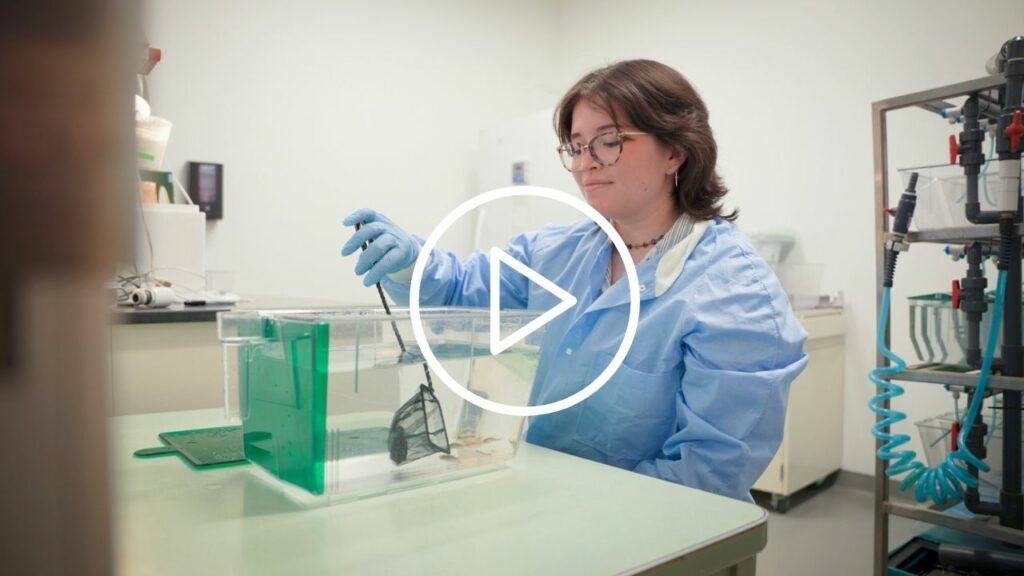
Video thumbnail showing a student working with zebra fish in a lab

Watch “How do PFAS affect Wisconsin’s fish?” (Video by Bonnie Willison / ASC)

In order to become big fish, baby fish face seemingly impossible odds. They evade predators, find food, and fend off disease — all while being smaller than the size of a fingernail. But what if contaminants in the water affect their ability to respond to those challenges and survive?

With funding from Wisconsin Sea Grant, University of Wisconsin–La Crosse Professor Tisha King-Heiden is studying how per- and polyfluoroalkyl substances, or PFAS, impact the nervous and immune systems of young fish. PFAS are a family of chemicals found in non-stick and waterproof household products, from food packaging to dental floss. They’re widespread in lakes and rivers across Wisconsin. 

“What I’m interested in is how exposure to environmental contaminants during early stages of embryonic development can lead to adverse health effects later on in life,” said King-Heiden. 

Her work on the project is personal. King-Heiden lives on French Island in Campbell, Wisconsin, where the groundwater is contaminated with PFAS. 

“It hit home pretty hard. I’ve been on bottled water now for going on five years,” she said. “So I just wanted to try to contribute a little bit more to understanding what the risks are and what they aren’t, because there’s still quite a few unknowns.”

New PFAS, new fish

With over 7,000 types of PFAS, King-Heiden is zeroing in on three newer chemicals: PFHxS, PFUNdA, and PFNA. Not much is known about how they affect fish, as past studies have primarily focused on older, “legacy” PFAS that are no longer used but remain in the environment. 

 ”The vast majority of information we have is on PFOA and PFOS. So those are […] the original PFAS chemicals,” she said.

PFHxS, PFUNdA, and PFNA have slightly different chemical structures than the legacy PFAS, which may affect how they accumulate in and affect fish. 

Another novel aspect of King-Heiden’s project is the type of fish she’s studying: fathead minnow, walleye, and sturgeon. Many PFAS studies use zebrafish, a popular lab species from southern Asia.

“I wanted to try something different and start working with some other prevalent species that are more ecologically and culturally relevant to people living in Wisconsin,” she said.

Measuring tail flicks and body bends

To evaluate the effects of PFAS on fish, King-Heiden and her team are collecting data on hatching success, growth, and immune system responses. They’ve also developed a series of behavioral tests to gauge how the nervous system develops.

The first test? Watching fish embryos for tail flicks.

“It’s the same thing that humans feel when they can start to feel the fetus moving,” said King-Heiden. “If they are flicking their tails too much, or if they’re not flicking them enough, it can give us an idea of how PFAS is impacting that nervous system development.”

After the fish hatch, the team then measures how well they can respond to stimuli. King-Heiden explained that during this time, fish develop neurons along their body that help them sense movement in the water. And when they do detect movement — a lurking predator, perhaps — the fish bends into the shape of “C” and swims away. It’s called a C-start response.

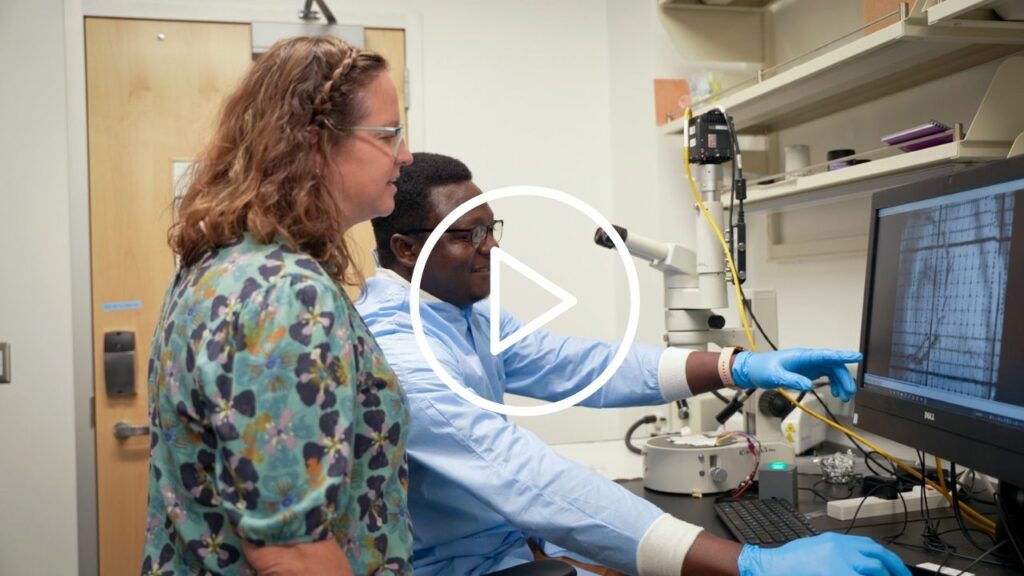
Video thumbnail showing Tisha King-Heiden and a student looking at a computer

Watch “The C-start: Sea Grant funded research.” (Video by Bonnie Willison / ASC)

“It’s an autonomic reflex, like the knee-jerk reflex,” she said. 

Using a high-speed camera, the team measures how long it takes for a fish to respond to a vibration sent through the water. The longer the response time, the more likely the neurons are damaged. 

The final behavioral test raises the stakes. Instead of contending with vibrations, a baby fish is placed in a container with a hungry adult fish.

“We give them a certain amount of time and see if the fish can actually escape that predator,” King-Heiden said. Cumulatively, the tests can indicate how the nervous system is developing and how baby fish might survive in the wild.

Protecting wild fish and people

While PFAS concentrations in lakes and rivers may not be high enough to kill baby fish, they could make them more susceptible to predation and disease. King-Heiden said that could spell trouble for wild fish populations, especially if they’re dealing with other issues, like invasive species. 

“If you add other environmental contaminants and stressors like disease to that mix, you can exacerbate the problem,” she said. 

Human health is also a concern, as people catch and eat fish from contaminated water. Understanding if and how the new PFAS accumulate in tissues of fish can help set consumption advisories that keep people safe. King-Heiden is also developing a communication campaign to engage local communities around PFAS, fish, and human health.

“We can try to help explain why it’s important for us to spend the money to clean up PFAS, to spend the money to support the research that’s going to find the most cost-effective way of cleaning up our drinking water for both human health as well as our wildlife,” she said. 

The post Measuring the impact of PFAS on Wisconsin’s fish first appeared on Wisconsin Sea Grant.

Original Article

News Releases | Wisconsin Sea Grant

News Releases | Wisconsin Sea Grant

https://www.seagrant.wisc.edu/news/measuring-the-impact-of-pfas-on-wisconsins-fish/

Jenna Mertz

The long-term cold spell that has settled over Michigan has quickly expanded the ice cover on the Great Lakes and other waterways, forcing vessels to adapt, creating fears of ice jams and providing leisure activities for those wanting to take advantage of the thick ice. Read the full story by The Detroit News.

Original Article

Great Lakes Commission

Great Lakes Commission

https://www.glc.org/dailynews/20260202-cold-spell-ice

Nichole Angell

State officials are currently working to fully document the beauty, vastness, and variety of Michigan’s dunes with an enormous scientific project that could carry legal implications for coastal areas and the ability to build near them. Read the full story by MLive.

Original Article

Great Lakes Commission

Great Lakes Commission

https://www.glc.org/dailynews/20260202-michigan-dunes

Nichole Angell

Lake Erie is completely frozen over, with surveys showing an average ice thickness of about one foot, according to the U.S. Coast Guard website. The formation poses both opportunities and risks as winter settles in for the season. Read the full story by the Star Beacon.

Original Article

Great Lakes Commission

Great Lakes Commission

https://www.glc.org/dailynews/20260202-frozen-erie

Nichole Angell

An incidental catch of a lake sturgeon is rare. But it’s less of an angler’s tall tale than it once was, thanks to a collaborative effort to bring this legendary species back to the waters where it once swam abundantly in the eastern and central United States and Canada. Read the full story by The Toledo Blade.

Original Article

Great Lakes Commission

Great Lakes Commission

https://www.glc.org/dailynews/20260202-sturgeon-reintroduction

Nichole Angell

Benton Harbor residents and business owners can push forward on their lawsuit alleging the state of Michigan knowingly subjected people in the southwestern Michigan town to lead-tainted water for years, according to a new ruling from the state Court of Appeals. Read the full story by the Detroit Free Press.

Original Article

Great Lakes Commission

Great Lakes Commission

https://www.glc.org/dailynews/20260202-lead-lawsuit

Nichole Angell

In Traverse City, Michigan, a fish obstacle course is keeping unwanted species out of a river. As dams come down around the world, native fish are returning to their home waters. But invasive species are taking advantage of that same access. So how do we separate native fish from undesirable fish?

In Traverse City, researchers are testing an innovative solution called FishPass. This system sorts native fish from invasive species using a combination of obstacles, bubble curtains, adjustable currents, and cameras that hone in on identifying features. The goal is to open the door to native fish like sturgeon, while turning away invasive species like sea lamprey.

#GreatLakes #Fish #Fishing #Ecology #Sturgeon #SeaLamprey #Dam #Michigan #TraverseCity
===========================================
Website: https://greatlakesnow.org
Facebook: https://www.facebook.com/greatlakesnow
X: https://www.x.com/greatlakesnow
Instagram: https://www.instagram.com/greatlakesnoworg
Newsletter: https://www.greatlakesnow.org/great-lakes-now-newsletter/

To learn more about supporting Detroit PBS and Great Lakes Now, visit https://www.detroitpbs.org/
===========================================

“How This River Keeps Unwanted Fish Away” was produced by Great Lakes Now/Detroit PBS.

Produced and Written by
Kathy Johnson

Narrated by
Rob Green

Edited by
Bill Allesee

Camera
Greg Lashbrook

Additional Material
Team Elmer’s
Great Lakes Fishery Commission
Jon Lemerond
PolkaDot Perch
Bubbletubing.com
Shedd Aquarium
Into the Outdoors Education Network
Conservation Resource Alliance
AECOM
John H. Bolf Jr.
Andrea Miehls, Great Lakes Fishery Commission

The post How This River Keeps Unwanted Fish Away | Great Lakes Now appeared first on Great Lakes Now.

Original Article

Great Lakes Now

Great Lakes Now

https://www.greatlakesnow.org/2026/02/02/how-this-river-keeps-unwanted-fish-away-great-lakes-now/

Great Lakes Now

By Joshua Kim

Following the passing of new legislation by the Illinois General Assembly, the Regional Transport Authority, soon to be the Northern Illinois Transit Agency, will receive an additional $1.2 billion for its annual budget this year. The additional funding will be used to improve “frequency, reliability, and safety”

The post More funding approved to improve the Greater Chicago Area’s public transit first appeared on Great Lakes Echo.

Original Article

Great Lakes Echo

Great Lakes Echo

https://greatlakesecho.org/2026/02/01/more-funding-approved-to-improve-the-greater-chicago-areas-public-transit/

Joshua Kim

for immediate release Fox-Wolf Watershed Alliance mobilizing volunteers May 2 across Northeast Wisconsin APPLETON, Wis—Registration is now open for the 2026 Fox-Wolf Watershed Cleanup, a region-wide volunteer event that brings together people of all ages to remove trash from parks, trails, riverbanks, lakeshores, and more. The Cleanup will take place on Saturday, [...]

The post MEDIA RELEASE: Registration Opens for One of Wisconsin’s Largest Watershed Cleanups appeared first on Fox-Wolf Watershed Alliance.

Original Article

Fox-Wolf Watershed Alliance

Fox-Wolf Watershed Alliance

https://fwwa.org/2026/02/01/media-release-registration-opens-for-one-of-wisconsins-largest-watershed-cleanups/?utm_source=rss&utm_medium=rss&utm_campaign=media-release-registration-opens-for-one-of-wisconsins-largest-watershed-cleanups

Dan Beckwith

By Joshua Kim

“Chicago Transit Hikes," a new book by Lindsay Welbers, aims to help Chicago residents and visitors reach outdoor recreation sites car-free.

The post Book helps residents, visitors, use Chicago’s public transit to access recreational sites first appeared on Great Lakes Echo.

Original Article

Great Lakes Echo

Great Lakes Echo

https://greatlakesecho.org/2026/01/30/book-helps-residents-visitors-use-chicagos-public-transit-to-access-recreational-sites/

Joshua Kim

A Shorewood Municipal Court judge has ruled in favor of allowing less public beach access along Lake Michigan in Wisconsin – but the issue may not be settled yet. The case garnered attention as Wisconsin’s chance to finally settle the issue of where public access to Lake Michigan ends and where private landowners’ rights begin.  Read the full story by the Milwaukee Journal Sentinel.

Original Article

Great Lakes Commission

Great Lakes Commission

https://www.glc.org/dailynews/20260130-beach-access

Taaja Tucker-Silva

PFAS are posing a threat to the Great Lakes, one of America’s most vital water resources. There are many ways that PFAS enters the Great Lakes, including through rivers, groundwater, and even rain and snowfall. Read the full story by The Conversation.

Original Article

Great Lakes Commission

Great Lakes Commission

https://www.glc.org/dailynews/20260130-pfas-origins

Taaja Tucker-Silva

A new construction project will restore 16 acres of wetlands and 2,000 feet of shoreline within Lake Erie’s Sandusky Bay near Sandusky, Ohio. It’s a fraction of the 11,000 linear feet of shoreline the Nature Conservancy is working to restore altogether. Read the full story by The Ohio Newsroom.

Original Article

Great Lakes Commission

Great Lakes Commission

https://www.glc.org/dailynews/20260130-sandusky-bay

Taaja Tucker-Silva