By Danielle Kaeding, Wisconsin Public Radio

This article was republished here with permission from Wisconsin Public Radio.


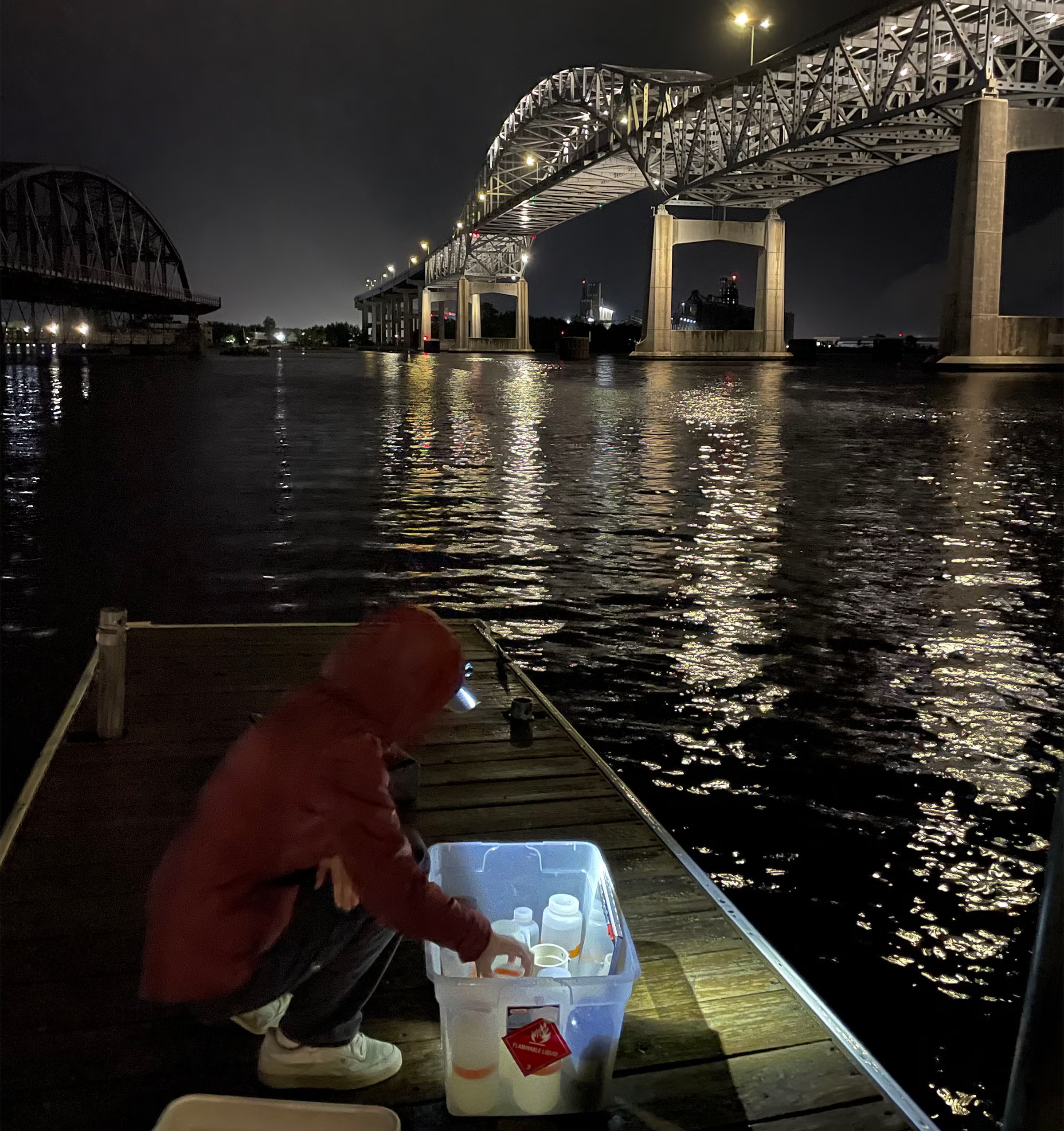
After the sun goes down, Donn Branstrator and his team get to work.

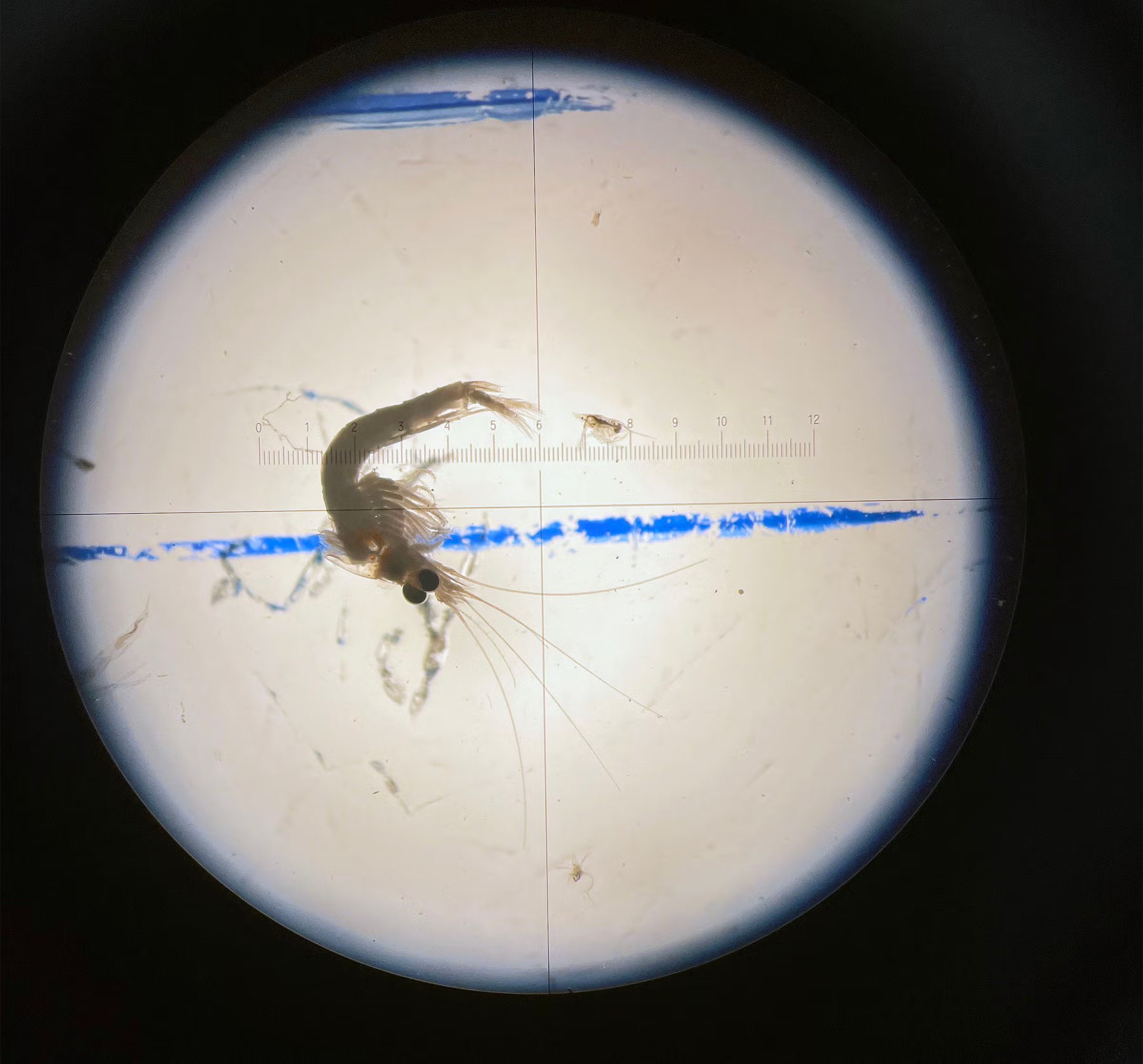
For the past couple years, they’ve been using nets and setting light traps at several locations in a Lake Superior harbor on a quest to find an invader: the bloody red shrimp. The freshwater shrimp is known for its red pigment and translucent or ivory-yellow appearance.

Branstrator, a biology professor at the University of Minnesota-Duluth, said the organism that grows up to a half-inch in length tends to come out at night because they’re vulnerable to fish.

“They hide on the bottom within the cracks and crevices of the break wall and bouldered environments during the day,” Branstrator said. “You can go out there during the day and sample all you want, and you’re going to be hard-pressed to find them.”

Bloody red shrimp are a type of zooplankton native to the Black Sea and Caspian Sea between Europe and Asia. The invader likely hitched a ride aboard the ballast water of oceangoing vessels. They were first detected 20 years ago in the Great Lakes. But evidence was lacking that they had become established in Lake Superior.

Until now.

Last year, Branstrator and others collected 81 bloody red shrimp in light traps and nets at Wisconsin Point and Montreal Pier in Superior. He said they found enough individuals at various life stages, including pregnant adult females, for them to be confident that a self-sustaining population is living in the lake. Findings from their study were recently published in the Journal of Great Lakes Research.

“It is there, in perpetuity one would think, if they can continue to grow and reproduce,” Branstrator said.

A researcher is processing a sample from a net used to collect bloody red shrimp in the Duluth-Superior Harbor. (Photo credit: Donn Branstrator/University of Minnesota-Duluth)

The findings make Lake Superior the final of the five Great Lakes to see an established population of the invasive species. The U.S. Fish and Wildlife Service first detected a single specimen from the Duluth-Superior harbor in 2017.

Researchers found more the following year at Wisconsin Point, and they published a study showing that Great Lakes ships were moving bloody red shrimp and other invaders from the lower lakes to Lake Superior.

Matt TenEyck is director of the Lake Superior Research Institute and co-authored the study with Branstrator. Now that bloody red shrimp are here to stay, he said their effects remain unclear.

“It’s just too soon to tell if and when they will cause problems with our local communities, if they’ll disrupt the food web,” TenEcyk said. “We just won’t know yet.”

As juveniles, Branstrator said bloody red shrimp feed more on algae. As they grow, they eat more zooplankton and could become a potential competitor to small fish. But they could also become a potential new food source for fish.

Research has found that the introduction of bloody red shrimp can cause the collapse of zooplankton abundances in European reservoirs. Even so, Branstrator said there have been no reports of adverse or positive effects since their introduction to the Great Lakes. But swarms of thousands of bloody red shrimp have been found in waters connected to Lake Michigan in Muskegon, Michigan.

“We haven’t seen a single swarm yet in our work,” Branstrator said.

However, both he and TenEyck are concerned about what their establishment could mean for inland lakes.

“What happens if someone picks that up in their bait bucket or their live well and goes to an inland lake?” TenEyck said. “This is the classic example of likely how (other invasive species like) zebra mussels and spiny water fleas have made this slow migration inland. This could be the next concern.”

So far, they haven’t been found in any inland lakes in Wisconsin or Minnesota.

While progress has been made, TenEyck stressed that the spread of invasive species has not stopped and work must continue. He and others have been working on the Great Waters Research Collaborative at the University of Wisconsin-Superior. The project aims to prevent the spread of invasive species through ballast water by testing ballast water treatment systems for ships. 

Meanwhile, Branstrator said his team has expanded sampling for bloody red shrimp to other areas of the Duluth-Superior harbor and Two Harbors to find out more about how they’re spreading in Lake Superior.


The post In Lake Superior, researchers find invasive bloody red shrimp are here to stay appeared first on Great Lakes Now.
Original Article

Great Lakes Now

Great Lakes Now

https://www.greatlakesnow.org/2026/07/01/in-lake-superior-researchers-find-invasive-bloody-red-shrimp-are-here-to-stay/
Wisconsin Public Radio

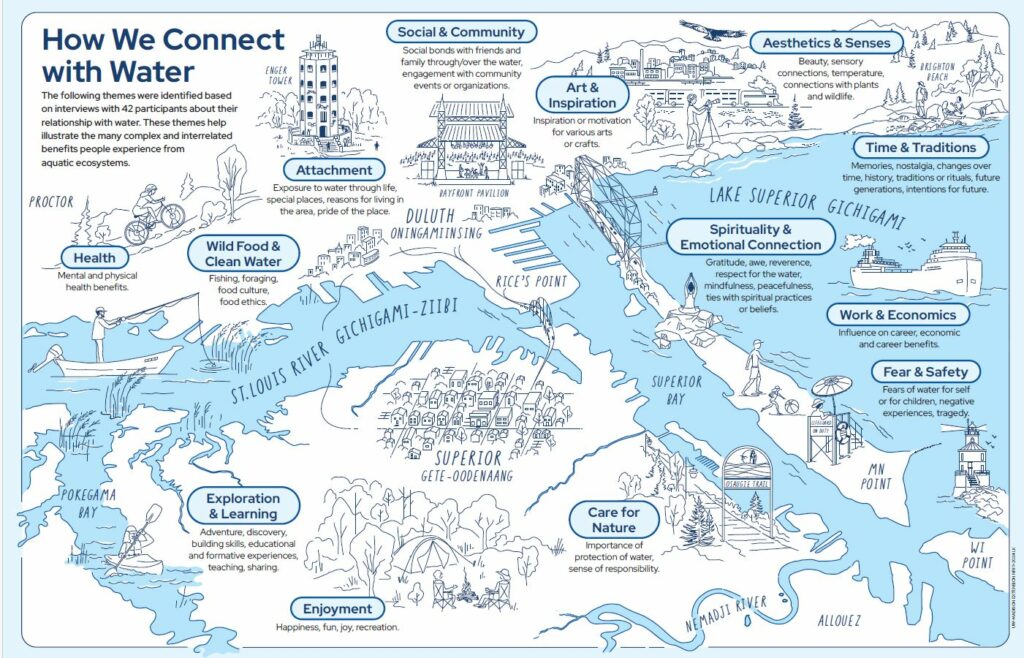
The U.S. Environmental Protection Agency has published the results and recommendations that came from a 2021-22  Waterway Benefits Study of the St. Louis River Estuary. The study was conducted to explore the estuary community’s deep connections to the St. Louis River, Lake Superior, and local streams to help increase access and guide decision-making.

During the study, 532 residents were surveyed about their experiences with Lake Superior, the Estuary, and local streams in the previous year. Follow-up interviews were conducted later with 42 survey participants about their relationships with water. This fact sheet offers an overview of the study’s findings. 

Other project partners include the Lake Superior National Estuarine Research Reserve and the University of Minnesota Duluth.

The post How people connect to the St. Louis River Estuary first appeared on Wisconsin Sea Grant.

Original Article

Blog | Wisconsin Sea Grant

Blog | Wisconsin Sea Grant

https://www.seagrant.wisc.edu/blog/how-people-connect-to-the-st-louis-river-estuary/

Marie Zhuikov

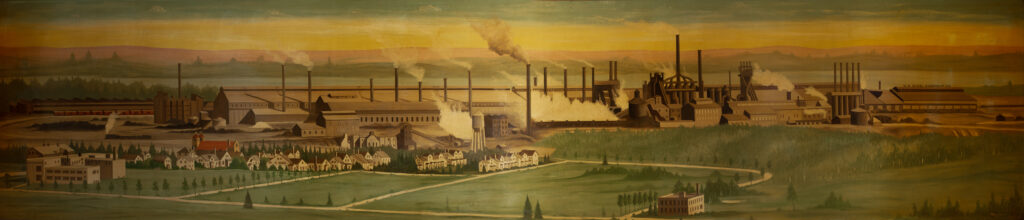
One of the 21 images painted by Art Fleming that line the walls of the Kom-on-Inn in Duluth. This one depicts the U.S. Steel Plant, which has been torn down and is now a Superfund site that is being cleaned up. Note the St. Louis River in the background. The presence of the river emphasizes the role that water has played and continues to play in shaping the city of Duluth. Image credit: Jennifer Webb, University of Minnesota Duluth.

The smell of stale cigarette smoke is the first thing to strike as I walk into the Kom-on-Inn Bar not far from the St. Louis River. Even though indoor smoking in public places was banned 17 years ago in Duluth, Minnesota, the scent lingers here.

It’s 10:30 a.m.; several patrons sit under dim lights at the bar with their beers, chatting. But I’m not here to drink. I’m on a field trip that’s part of the St. Louis River Summit, an annual conference to share information about the largest U.S. tributary that enters Lake Superior on Wisconsin’s northwestern border, and site of the second-largest Area of Concern in the country.

Bars aren’t typical locations for conference field trips. However, this one in West Duluth was chosen for several good reasons. The old paintings that line its walls are one of them. The other reasons involve the bar’s importance to the community.

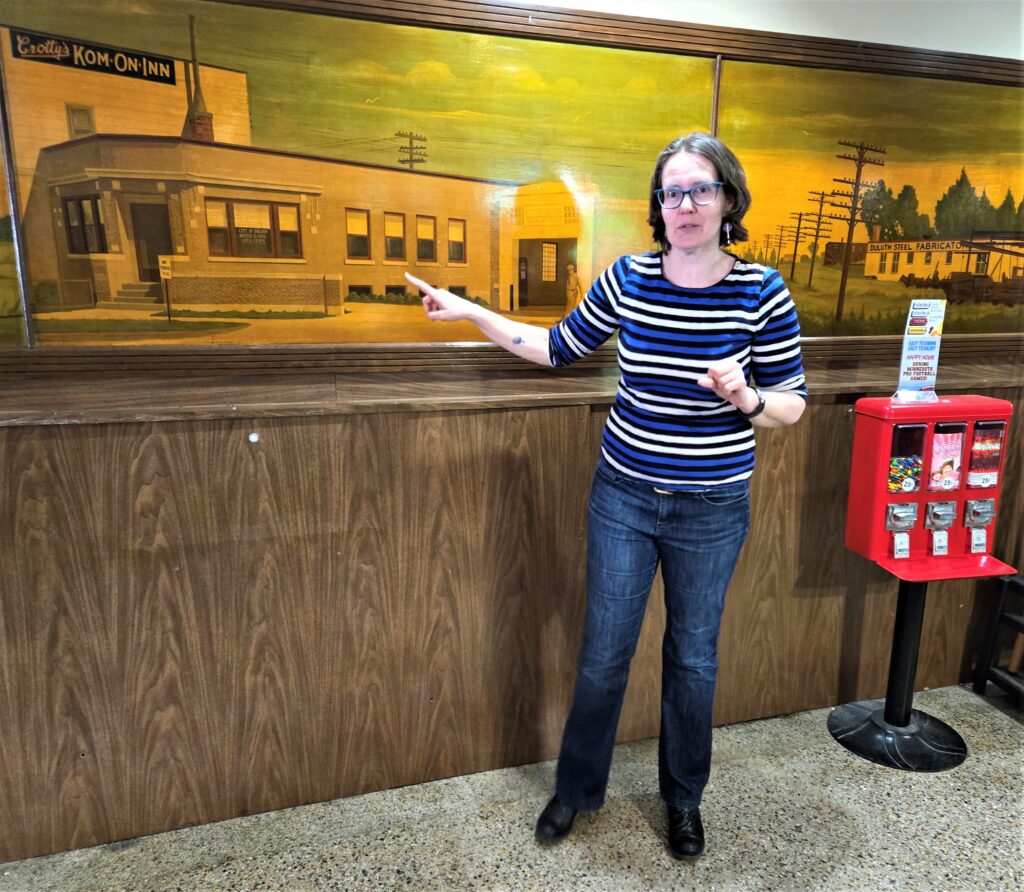
Art Historian Jennifer Webb describes the community significance of architectural portraits that hang in the Kom-on-Inn Bar in West Duluth, Minnesota. Image credit: Marie Zhuikov, Wisconsin Sea Grant

According to field trip host Jennifer Webb, an art historian and head of the Department of Art and Design at the University of Minnesota Duluth (UMD), 21 paintings are displayed on the bar’s walls, with another 20 stored in the basement.

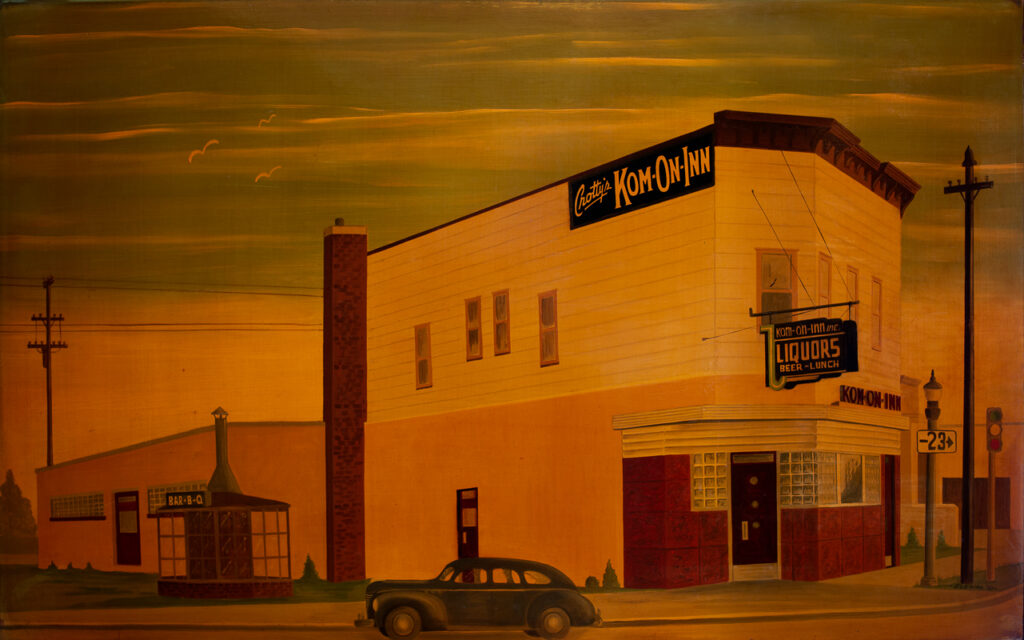
A resident of this area of Duluth, Webb has studied the artworks for several years and has written a scientific journal article about their significance. Created between 1950-51 by Western Duluth resident and sign painter Art Fleming, these architectural portraits depict local businesses where many of the bar patrons worked. There’s the U.S. Steel mill that made barbed wire and pig iron, the Coolerator Co. that made refrigerators and a coal-fired power plant. A blue strand of the St. Louis River flows through almost every image. The paintings’ varnish coating has yellowed with age and sealed in the cigarette smoke scent.

To Webb, the bar and the portraits epitomize the area. “As an outsider who didn’t grow up in a community like this, the first thing that I was struck by is how every neighborhood has a place, an anchor and an identity.” Bars like the Kom-on-Inn provided a place for workers to gather at the end of their shifts to “decompress from a very difficult and hard industrial life,” she said.

Many of the industries in the paintings closed only two decades after their depiction, leaving unemployment and pollution in their wakes. In Webb’s journal article she says the portraits are a “testament to the pride in place and the importance of the river and industries in the making and then breaking of the neighborhoods and the larger ecosystems of which they are a part.”

Webb suspects that Fleming painted the portraits from photographs since many similar scenes can be found in the photo archives at UMD. The artworks were commissioned by the original bar owners, the Crotty Family, and their preservation is a requirement each time the bar changes hands.

Webb divides us into small groups so that we can take a closer look. In front of one portrait of the river neighborhood of Morgan Park, comprised mainly of homes built by U.S. Steel Co. for their workers, Webb describes the experience she had interviewing people about this painting and their nostalgia for the way of life it depicts.

The Kom-on-Inn panel painted by Art Fleming, located inside the bar. Image credit: Jennifer Webb, University of Minnesota Duluth.

“People who grew up there, when they talk to me about it, they remember their childhood fondly. They had a perfect community. They never really needed to leave. The doctor was there, the dentist. They had a fire department and a hospital,” Webb said. Many of those services are no longer offered directly in Morgan Park.

Plans for remediating Areas of Concern stress the importance of placemaking, which is the process of using public input to create quality places where people will want to live, and broadening the definition of stakeholders. In her paper, Webb argues that such stakeholder groups should include local historians, archivists and art or architectural historians who can offer insights into the built and visual landscape. She also contends that the most successful community revitalization and placemaking work need not create new places but instead should focus on remaking places already formed and to which community members are attached.

“Duluth is so well situated to build walkable communities. We’ve got these anchors like the Kom-on-Inn that were already built as our communities strung themselves out along the waterways. I can’t wait to see where we’re going,” Webb said of restoration efforts.

I left with a new appreciation for this neighborhood where I went to high school, and a broader understanding of the connections between the St. Louis River, its recovery and some paintings in a neighborhood bar.

If you’d like to see the paintings and can’t travel to Duluth, watch this recent television news story about them.

The post A conference field trip to a bar links river and art to community first appeared on Wisconsin Sea Grant.

Original Article

Blog | Wisconsin Sea Grant

Blog | Wisconsin Sea Grant

https://www.seagrant.wisc.edu/blog/a-conference-field-trip-to-a-bar-links-river-and-art-to-community/

Marie Zhuikov

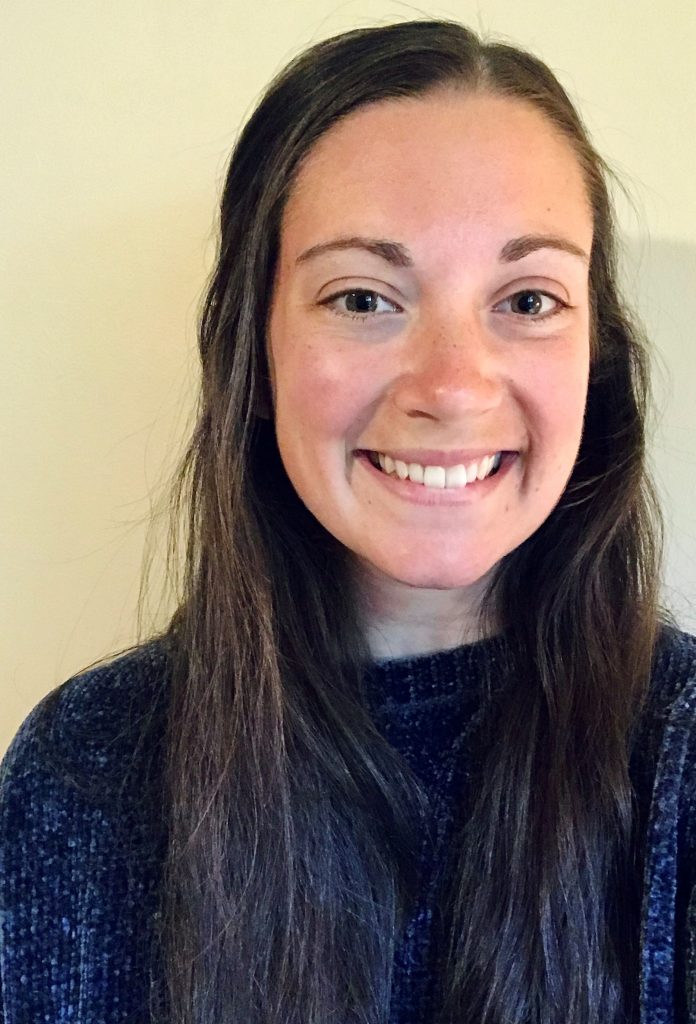
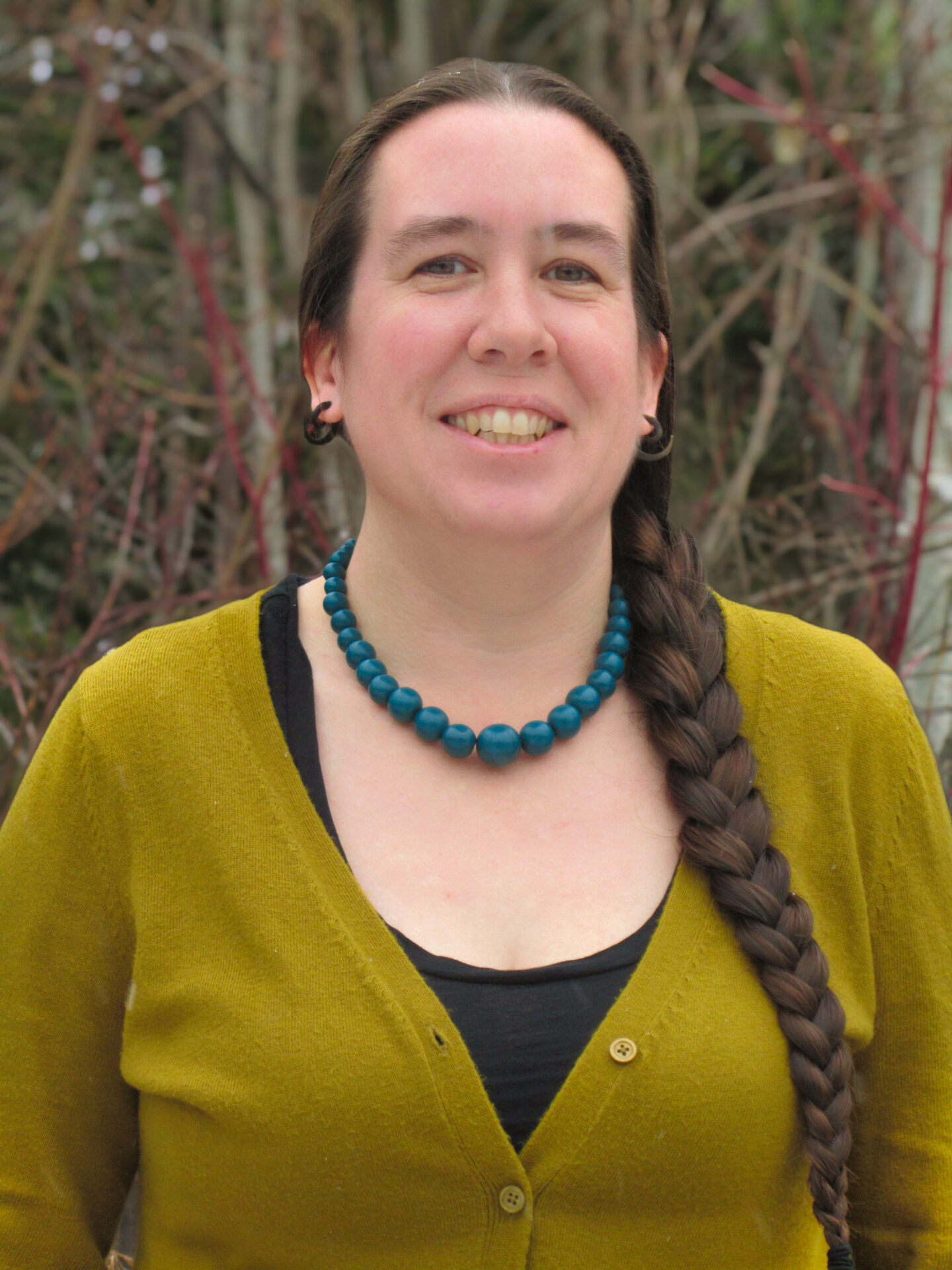
Allie Pesano. Submitted photo.

Allie Pesano first got turned onto birds as an undergraduate at Unity College in Maine. She was studying wildlife biology and, for one class, students were required to learn about various common North American wildlife species. The variety of birds sparked her curiosity, ultimately leading to her current six-month fellowship in avian toxicology with the Environmental Protection Agency’s Great Lakes Toxicology and Ecology Division in Duluth, Minnesota.

“I realized that every bird I saw wasn’t the same thing,” Pesano said. “They’re all very nuanced and unique. That led to my interest in learning more about birds in general. Even in my spare time, I would flip through the bird guide and just kind of go on a treasure hunt in my own back yard to see what kinds of birds were around.”

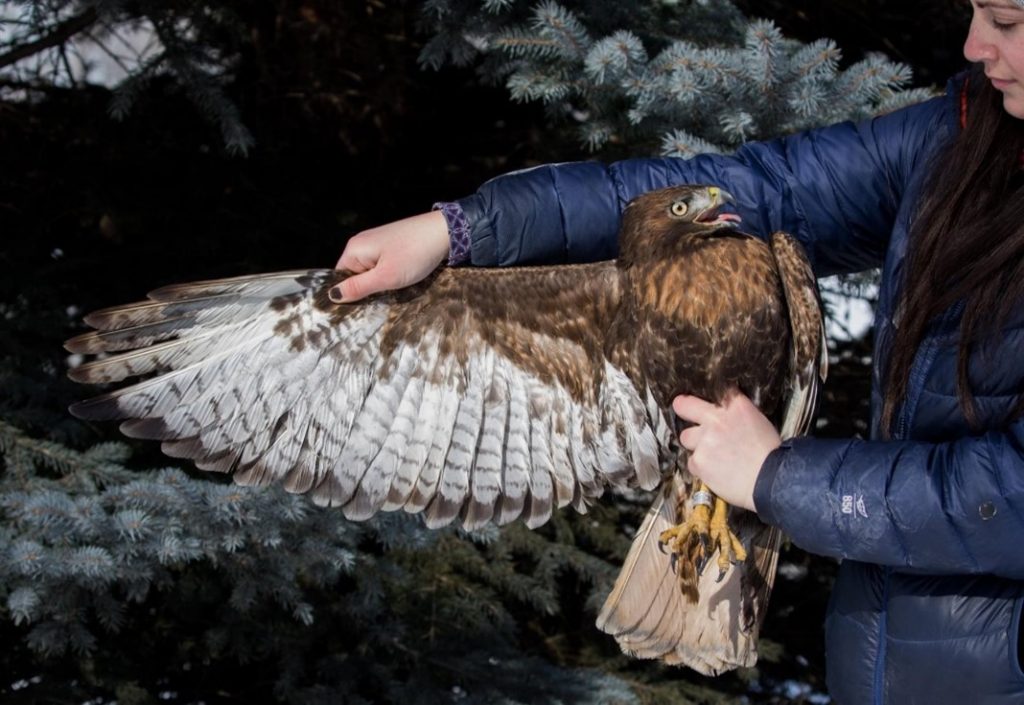
Her back yard was in Syracuse, New York. After obtaining her undergraduate degree, she flitted about the country like a bird, researching migrating hawks in Nevada, nesting endangered sparrows in Florida and resilient saltmarshes in Massachusetts, which, of course, provide homes for wetland birds. Most recently, she graduated with a master’s degree in integrated biosciences from the University of Minnesota Duluth. There, in collaboration with the Hawk Ridge Bird Observatory, she used satellite transmitters to determine where some unique, dark-plumaged red-tailed hawks were migrating from on their way through Duluth. These hawks are usually only found in the western part of North America and are rare in the East. This bird treasure hunt led her to northeastern Canada.

One of the dark-plummaged red-tailed hawks that Pesano studied for her master’s research. This bird was captured in the Twin Cities (Minnesota) in February 2021, and was named “Manley.” He was the first dark red-tailed hawk fitted with a satellite transmitter. Manley spent the last two summers in northern Manitoba and has returned to the same winter territory in the Twin Cities since researchers have been studying his movements. Submitted photo.

“We discovered they had been spending summers and the breeding season in northern Manitoba and Ontario. Birds that look really dark like that would not, to our historical knowledge, be nesting and breeding in those provinces usually. They would more likely nest in Alaska or British Columbia,” Pesano said.

Pesano’s latest quest involves researching the impacts of per- and polyfluorinated alkyl substances (PFAS) on the reproductive success of birds in the Duluth area. Under the mentorships of Matt Etterson and John Haselman at the EPA, Pesano is studying tree swallows, black-capped chickadees and house wrens with another EPA Fellow, Emily Pavlovic. Funded by the University of Wisconsin-Madison but working in Duluth, Pesano is looking into things like the quality and quantity of food to see if there’s any correlation between what the birds are eating and their reproductive success.

The goal of this research is to create a toxicology model that scientists can use to predict, based on contamination concentrations in the environment, what the exposure risk would be to birds in that area.

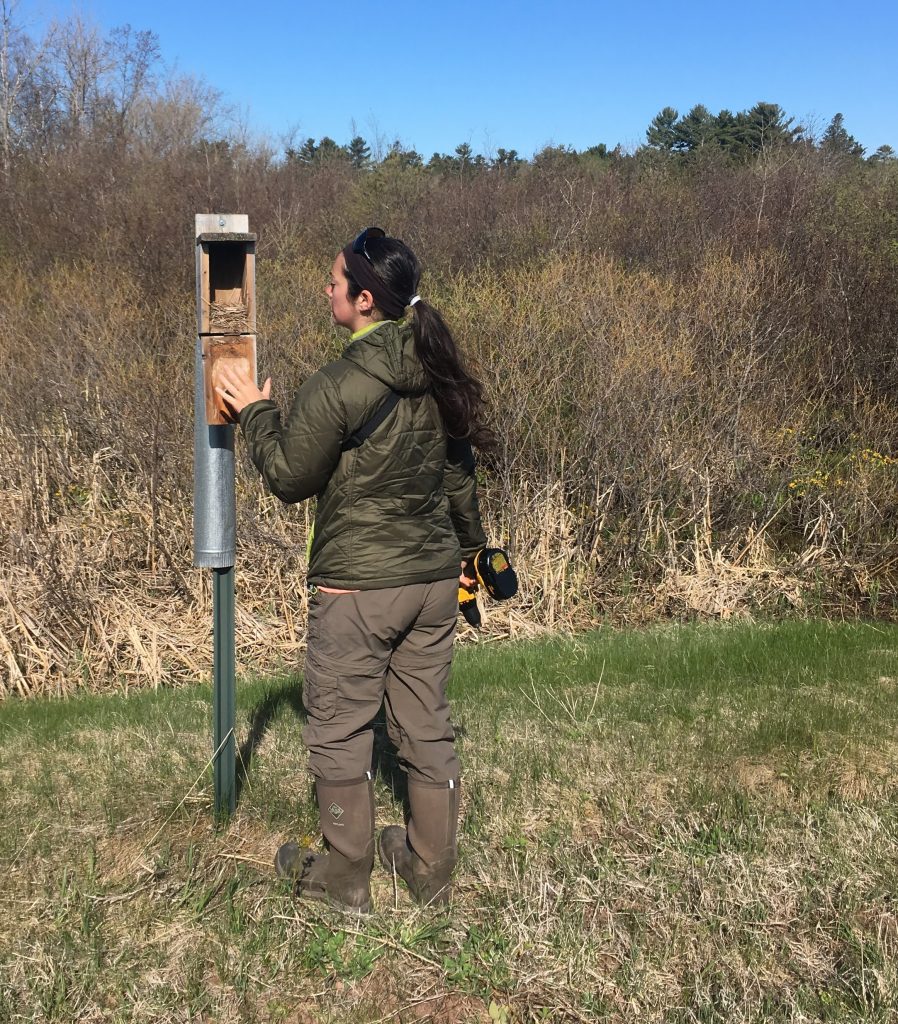
Pesano checks a tree swallow nest as part of her EPA avian PFAS study. Submitted photo.

The three-year U.S. Environmental Protection Agency Human Health and the Environment Research Fellows program is a partnership between the EPA, the University of Wisconsin-Madison and its Aquatic Sciences Center. The goal is to train the next generation of scientists in environmental and ecosystem health.

The post Allie Pesano: On a treasure hunt for birds first appeared on Wisconsin Sea Grant.

Original Article

News Releases | Wisconsin Sea Grant

News Releases | Wisconsin Sea Grant

https://www.seagrant.wisc.edu/news/allie-pesano-on-a-treasure-hunt-for-birds/?utm_source=rss&utm_medium=rss&utm_campaign=allie-pesano-on-a-treasure-hunt-for-birds

Marie Zhuikov

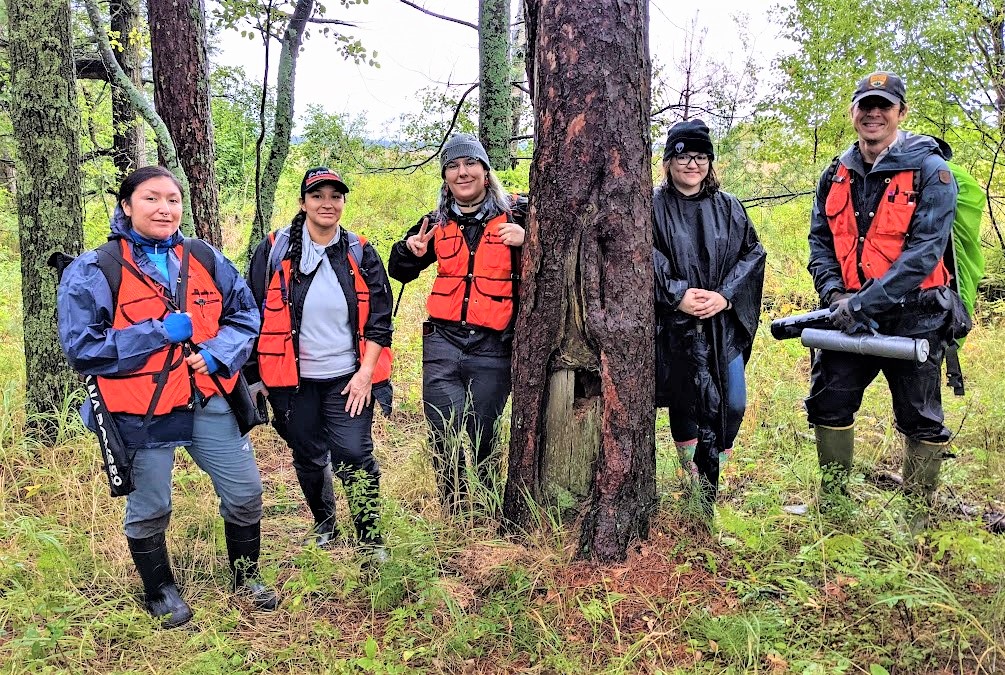
The research team at work on Wisconsin Point. From left to right: Evan Larson, Ashla Ojibway, Mocha Reynolds, Valerie Zhaawendaagozikwe and Emily Lockling. Image credit: Marie Zhuikov, Wisconsin Sea Grant

On a cool, sunny spring morning among the pines on Wisconsin Point along Lake Superior, a mix of Native and non-native people gathered in a circle with the scent of wood smoke and sage in the air. The small group was performing an opening ceremony for “Nimaawanji’idimin Giiwitaashkodeng.” This is the Anishinaabe name for a Wisconsin Sea Grant-funded research and outreach project designed to explore how the Anishinaabe people connected to and homesteaded the lands of “Zhaagawaamikong Neyaashi” (Wisconsin and Minnesota points) and how they used fire to manage the landscape. The project name translates into “We are all gathering around the fire.”

Melonee Montano. Submitted photo

The ceremony was held to “…let the animals and plants and the spirits there know what our intentions are as far as the research,” said Melonee Montano, a Red Cliff tribal member and a University of Minnesota graduate student who is one of the investigators leading the project. “We were asking for their permission and also for any guidance that they could give us moving forward so that we do things in the right way.”

As the ceremony continued, a deer emerged and stood at the tree line, looking at the group for at least 20 minutes. “She just hung out for a long time, checking us out, wondering what we were doing. For me, that was a real good sign that what we’re doing is OK,” Montano said.

Later, in June on the first day of summer, a larger ceremony was led by Ricky DeFoe, Fond du Lac Elder and spiritual leader. The ceremony brought over 30 members of stakeholder groups together to publicly open the project. It included representatives from the cities of Superior and Duluth, the Great Lakes Indian Fish and Wildlife Commission, University of Wisconsin-Madison Extension, the Douglas County Board, Sea Grant and the Fond du Lac Band of Lake Superior Chippewa. As the group stood around a sacred fire, DeFoe talked about the need to reconcile history and come together to heal people and the land.

Wisconsin and Minnesota points were home to the Anishinaabe people for hundreds of years before the forces of settler-colonialism began threatening their relationship to the area. Treaties and federal legislation drew explicit lines around reservations and industrial interests began to covet Zhaagawaamikong Neyaashi.  

As the Anishinaabe presence diminished, their influence on the land weakened as well, including a decline in their use of “Ishkode” (fire). Settlers suppressed Ishkode and the landscape changed, losing biodiversity and resilience.

Research project reaches into the past

Managed by Evan Larson, professor of geography and a dendrochronologist with the University of Wisconsin-Platteville, the Nimaawanji’idimin Giiwitaashkodeng Project seeks to combine tree-ring data with Indigenous Experiential Knowledge: the deep understanding that Indigenous people have developed through millennia of close observation of and engagement with the ecological webs of the Great Lakes Region. This understanding, sometimes also referred to as Traditional Ecological Knowledge, puts data derived from tree rings into context in terms of Ishkode as an ecological and cultural process. The ultimate goal is to restore the cultural use of Ishkode to increase the resilience of the ecosystem and to maintain “miinan” (blueberries), a key traditional food source among the Anishinaabe.

Miinan are one of the important first foods for the Anishinaabe, along with strawberries, wild rice, maple syrup, deer, rabbits and others, Montano said. “We’ve moved away from blueberries and the other first foods these days for multiple reasons like government commodities and smaller land bases, but we’ve also lost some of the connections or knowledge on how to gather them.”

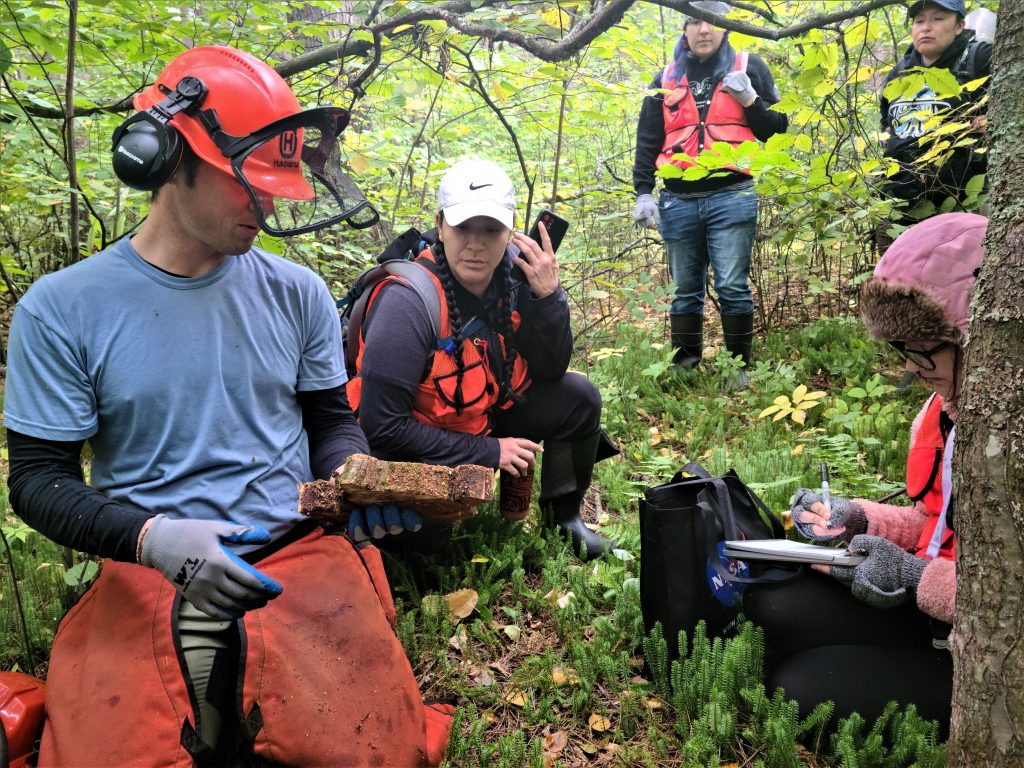
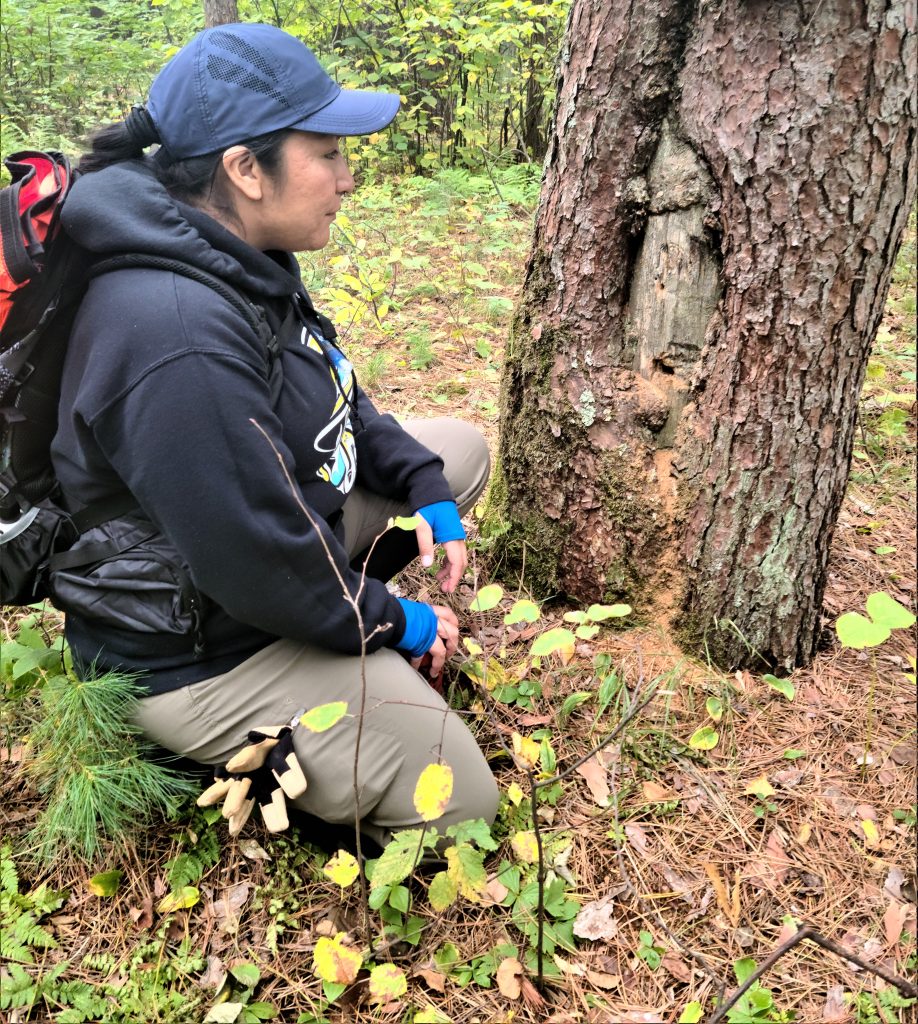
The project research team on Wisconsin Point. From left to right: Valerie Zhaawendaagozikwe, Ashla Ojibway, Mocha Reynolds, Emily Lockling and Evan Larson. They are standing next to a pine that shows signs of fire or past use by Native peoples. Submitted photo

In October, Larson and a team of four undergraduate students from Fond du Lac Tribal and Community College and the University of Minnesota Duluth visited Wisconsin Point to search for downed and dead trees to sample for the project. They were seeking signs of past Ishkode or tool marks etched into the rings of trees that could be used to learn more about the history of the place.

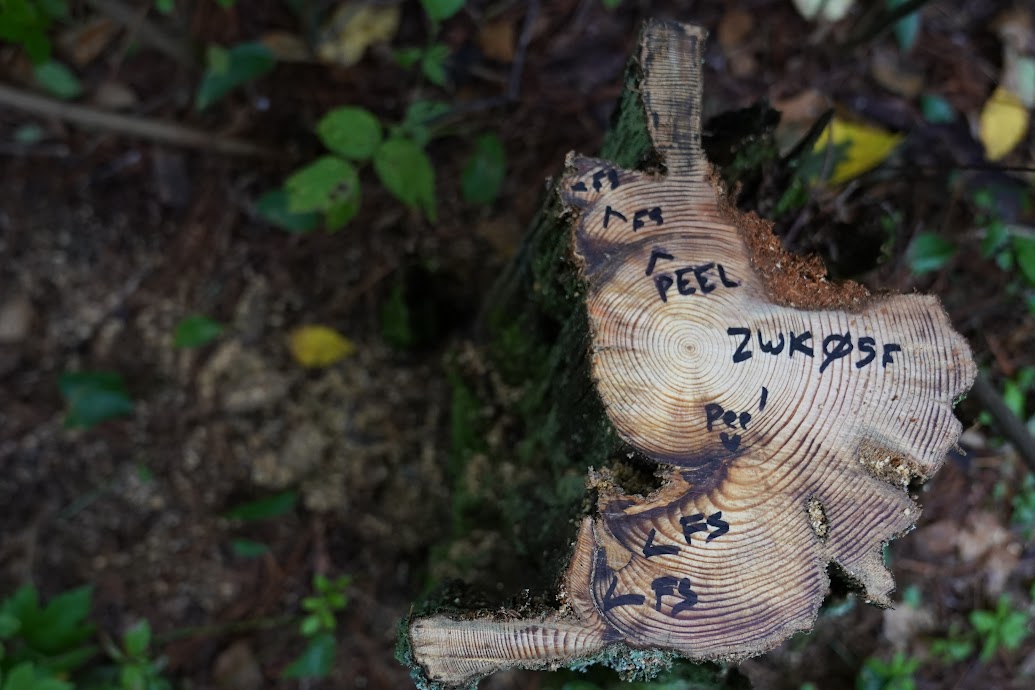
They gathered at the Lake Superior Estuarium in Superior, which housed slices of wood they had collected on two previous outings. Mocha Reynolds, an environmental science major, pointed to places on the samples where the tree rings had been interrupted.

A slice from a tree with marks showing where it’s been peeled or exposed to fire. Image credit: Evan Larson.

“This one, you can see where people have peeled the bark away,” Reynolds said. “The tree healed then and grew around it. From these blackened spots, you can also see that a couple of fires have touched this tree in its life. We feel like there’s a pretty good chance that they were prescribed burns by the Anishinaabe.”

The samples will soon be sanded and polished to make it easier to see individual growth rings and any interrupting patterns that tell of past fires or peel scars.

Of food, medicine and resin

Larson explained that people might have peeled the bark off the tree for a variety of reasons. Sustenance is one. During starvation periods, the starchy inner bark of trees can be used for food. Different parts of the inner bark might also be incorporated into medicines.

Larson said that the provisions provided by trees on the points were likely linked to the daily lives of the Anishinaabe, particularly how they traveled to the area in birchbark canoes. “The Latin name of red pine trees is Pinus resinosa, and the reference to resin is apt. A tree that has had its bark peeled from part of the trunk will respond by infusing the wound with resin, often referred to as ‘sap.’ If you’ve ever climbed a pine tree and found your hands covered in the sticky stuff, you know what I’m talking about,” Larson said.

The resin protects the injured tree from decay, much like blood forms a clot when a person’s skin is pierced. The resin pools along the edges of the peel and can then be collected and combined with other materials to make the gum used to build and repair birchbark canoes.

Each sample that Larson and the students collected was labelled in Anishinaabemowin: Zhaagawaamikong-neyaashi for those collected on Wisconsin Point and “Onigamiinsing” for those on Minnesota Point. They were also mapped. Using the techniques of dendrochronology (tree-ring science), the team will be able to determine exact calendar years of each Ishkode and peel scar from the samples.

“That information then can be used to understand where the fires were. Did it burn the whole point, or did you have a small fire over here one year, and a small fire over there another year?” Larson said. “That will give us a sense of the spatial aspects of how fire and people interacted with the landscape.”

Larson compared the process the research team uses to find collectable trees to instructions he saw once on a chocolate truffle package. “It said to truly experience the truffle, first you look at it, then you smell it. In a way, these are the same because of that resin that Mocha was talking about. It’s just infused throughout the wood. So, these stumps, they’re from trees that have been dead for 100 years or more in some cases. Their appearance gives you the first hint of what’s inside. And on that first draw of the saw, the wood chips fly and all of a sudden you just like, (sniff), you can just smell the resin. And that’s … yeah,” Larson said.

“It’s a really good smell,” Reynolds echoed.

Red pine and white pine reproduction

The team then drove to the end of Wisconsin Point, where a lighthouse and shipping canal are located. After making a tobacco offering to Lake Superior, Larson and crew traipsed inland into a red pine forest. During the hike, Larson offered his perspective on the current landscape.

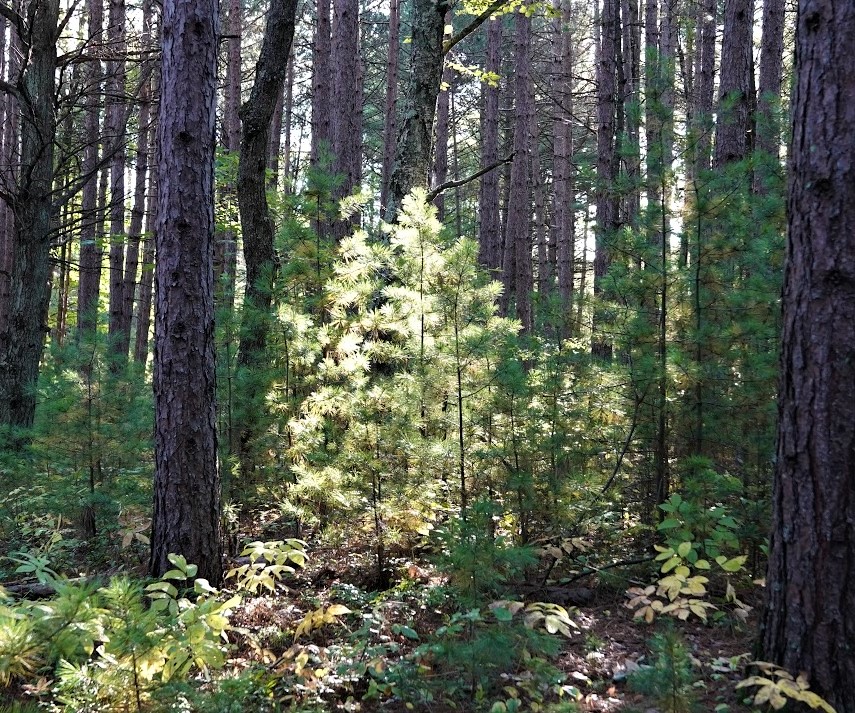
White pines regenerating in a stand of red pines on Wisconsin Point. Image credit: Evan Larson.

“In some places, you can still see the legacy of fire here, like blueberries and red pine. But if you look at the lower layer now, there’s no red pine and a lot of hazel. All of the new pines coming up are white pine, which is more shade-tolerant than red pine. White pine seeds can get through a little bit of duff. Red pine seeds, when they fall on all this duff, just land on the needles and litter. They can’t get to the mineral soil to germinate. So, all these red pines will cast seeds for the rest of their lives, but they will very likely never result in a baby pine tree until there’s a fire.”

The students had already mapped some stumps and downed trees to investigate. When they rediscovered one, Reynolds did something surprising. He kicked it. He explained this is done to make sure the stump or snag is solid. That indicates the tree had scarring during its life and has produced resin to heal. The resin makes the tree sturdier. So far, so good.

Larson pointed out a triangular wound that began on the trunk and extended wider to the base at ground level. “That generally is the healing mode of a tree that’s been damaged by fire,” Larson said.

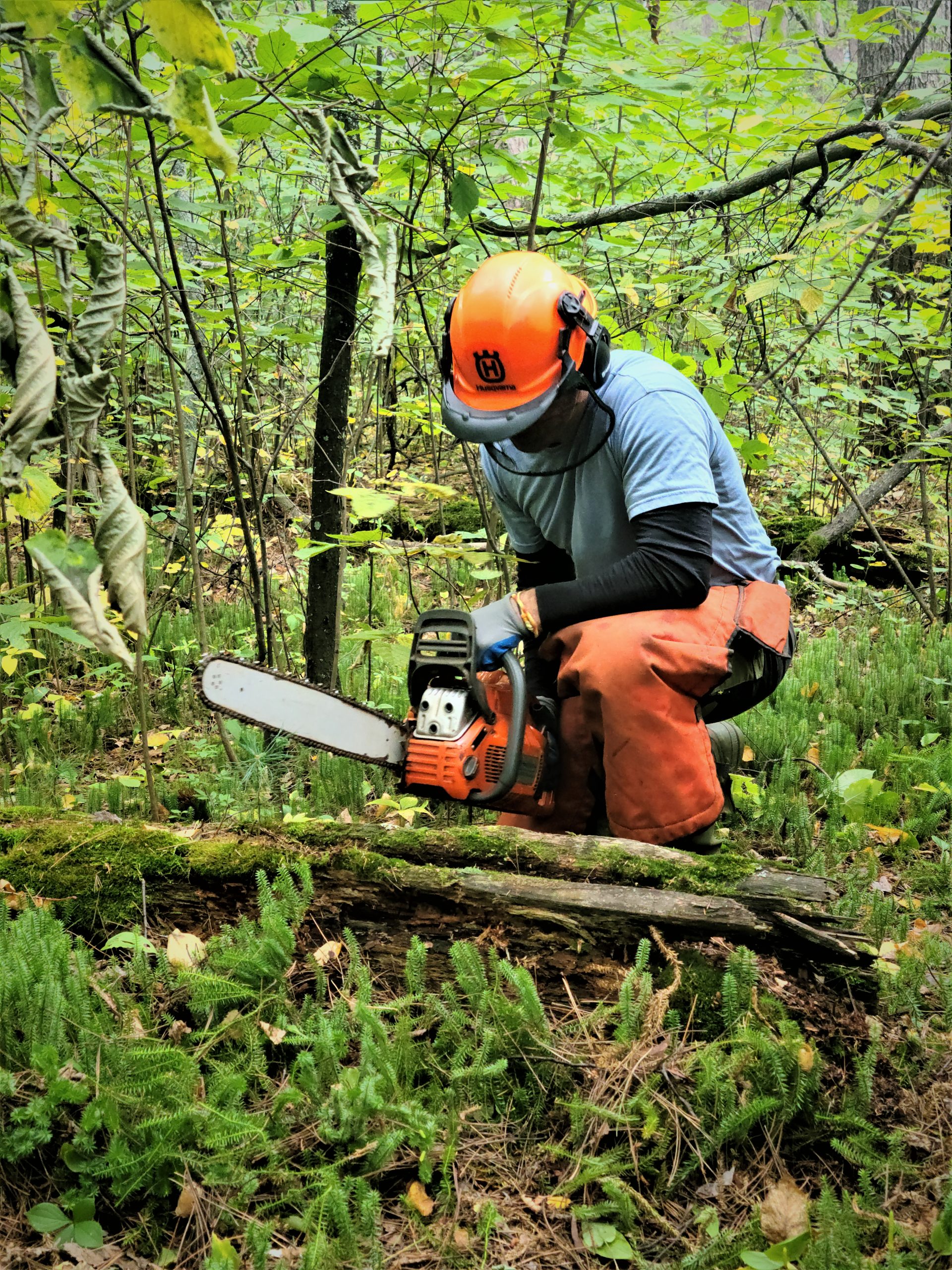
Evan Larson saws through a dead and downed tree on Wisconsin Point. Image credit: Marie Zhuikov, Wisconsin Sea Grant

He chainsawed though the tree and extracted an inch-thick sample. Valerie Zhaawendaagozikwe, an environmental science major, noted an Ishkode scar. Larson pointed out three more, possibly from a peel and other fires.

Anishinaabe Chief Osaugie was one person connected to Wisconsin Point in the past. He was a renowned canoe-builder and must have gathered resin to make the gum for the canoes. “To see a peel scar on this stump – to suddenly realize that, I mean, we don’t know who made that peel, but it could’ve been him. We are holding history in our hands, covered in moss. That’s pretty cool stuff,” Larson said.

Emily Lockling, a geographical information science student, carefully mapped the sample’s location.

As they searched for another sample, Zhaawendaagozikwe explained what drew her to participate in the project.

“I grew up on the West Coast, so I grew up seeing culturally modified trees, like the cedar trees. People still peel them for hats, baskets, clothing and things. I got to so I could tell when a tree had been peeled by a Native. When I came here, I got an email about this project. I thought I would enjoy this work because I already had an idea of what it is. I also enjoy being outside,” she said.

The team crossed a road on the point, moving closer to the lake. As Ashla Ojibway, another environmental science major, demonstrated how they use a hand saw to get samples from stumps, a bald eagle called above her. Remember the deer from the beginning of the story? The eagle, it seemed, approved of the project as well.

The importance of capturing stories

Just as the landscape chronicles the past, stories held by people are also important for understanding this place more completely. As snow begins to cover the land, Montano will be working with Elders and community members to gather memories and stories of Zhaagawaamikong Neyaashi, Ishkode and miinan.

Valerie Zhaawendaagozikwe inspects a red pine that shows signs of cultural modification or fire. Image credit: Marie Zhuikov, Wisconsin Sea Grant

“Together, the memories of people and trees will help us understand the deep connections that weave the community of life found on the points now and in the past. They’ll help guide us moving forward,” Larson said.

To ensure that information from the project reaches a broad audience and engages in societal change, Montano and Larson are creating an illustrated children’s book with the help of Robin Wall-Kimmerer, noted author of “Braiding Sweetgrass,” and distinguished professor and director of the Center for Native Peoples and the Environment at the State University of New York. The book will be published by Black Bears and Blueberries Publishing, a Native-owned company, and will be distributed to teachers and students through another Sea Grant-supported project, Rivers2Lake.

Montano is applying her interviews with Elders to the children’s book but also to her graduate research about the relationships between Ishkode and people. She described the topic of her interviews as, “Basically looking at who fire is as a being rather than what fire is.” The Anishinaabe believe that Ishkode has a spirit, similar to their beliefs about animals and other aspects of nature.

To reach scientific audiences, Larson and his students will present their results at the American Association of Geographers Annual Meeting in spring 2023. Montano, Larson and students will also be giving a public-friendly presentation for the River Talk series on Jan. 11, 2023.

Back on the field trip, the team wasn’t as lucky with the last sample they collected. Although the stump passed the “kick test,” the inside heartwood was completely decayed and there weren’t enough intact rings.

Larson said, “From a tree-ring perspective, we don’t have enough material to work with this sample. We know it was a peel. We know it holds that information. But for this study, that’s as far as we can go, which also shows the urgency of doing this work now because these injuries and these scars on these trees are from a time hundreds of years ago. They’re an expression of people and their connection to place.

“Through a huge range of reasons — legislation, boarding schools, treaties, the systemic racism that has engendered a systematic approach to what boiled down to genocide in a lot of ways, has taken this relationship and put it on pause. So, these trees have been living on this land, carrying this story and these relationships in their rings for all this time, but trees die, too. These trees are now old. That story is long enough ago that these trees are the last vestiges of that tangible legacy. That’s why we’re doing the work now so that we can capture that story now before it turns into dust.”

Other partners in the project include representatives from the Minnesota Department of Natural Resources, the Lake Superior National Estuarine Research Reserve, the Lake States Fire Science Consortium, the University of Minnesota Cloquet Forestry Center, and St. Anthony Falls Communications Manager Clare Boerigter, retired Wisconsin State Archaeologist John Broihahn and Duluth-based visual artist Moira Villiard.

The post The stories trees tell first appeared on Wisconsin Sea Grant.

Original Article

News Releases | Wisconsin Sea Grant

News Releases | Wisconsin Sea Grant

https://www.seagrant.wisc.edu/news/the-stories-trees-tell/?utm_source=rss&utm_medium=rss&utm_campaign=the-stories-trees-tell

Marie Zhuikov

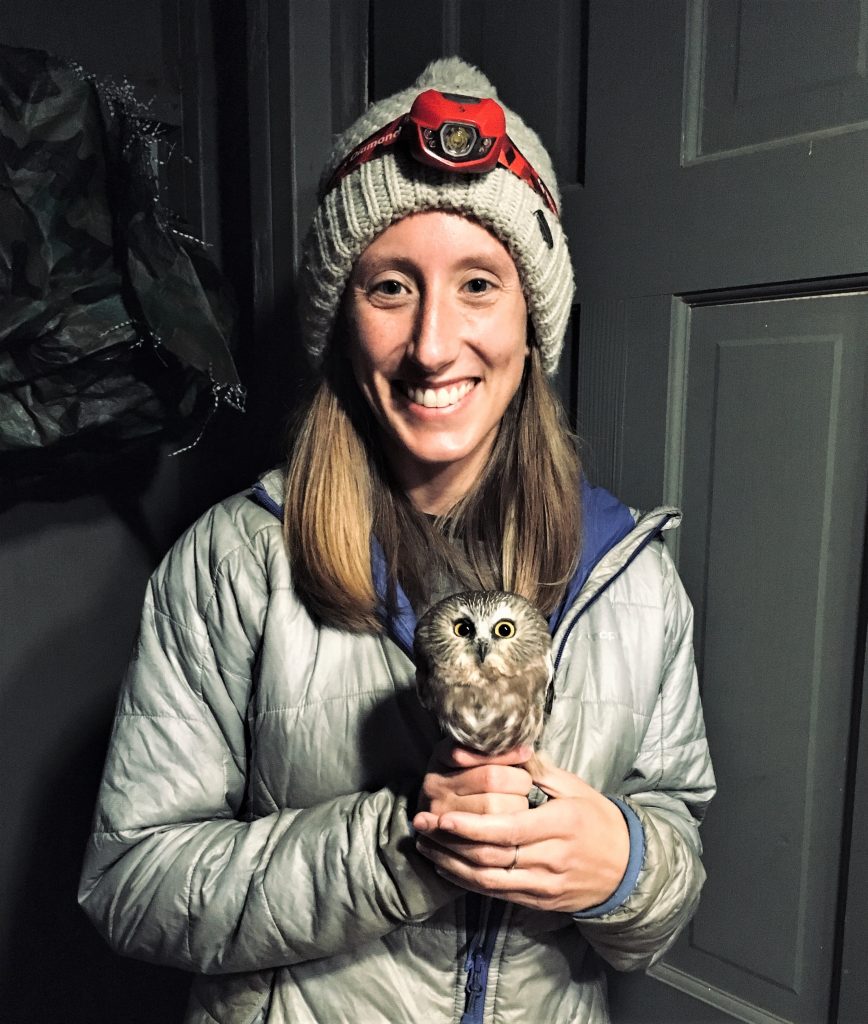
Emily Pavlovic, EPA Fellow in avian toxicology, holds a northern saw-whet owl. Submitted photo

Emily Pavlovic’s love of birds didn’t come to the fore until after college when she worked at an Audubon Center. She turned that love into her vocation and is now a fellow at the Environmental Protection Agency’s Great Lakes Toxicology and Ecology Division in Duluth, Minnesota. Under mentorship from Matt Etterson, Pavlovic is looking at the impacts of per- and polyfluorinated alkyl substances (PFAS) on the reproductive success of birds in the Duluth area.

After Pavlovic earned her bachelor’s degree in biochemistry from Earlham College, she spent five years working as an environmental educator at various nature centers around the U.S. before earning her master’s degree.

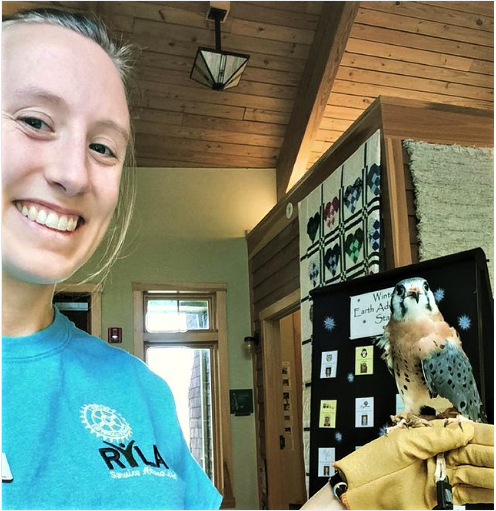
Emily Pavlovic holds an American kestrel. Submitted photo

“I was able to work up-close and personal with the birds and really see the power they have on engaging the public,” Pavlovic said. “The birds capture people’s attention so that you can teach about other really important things like contaminants in the environment, or basic ecology.”

At the Aullwood Audubon Center and Farm in Dayton, Ohio, Pavlovic had the chance to work with an American kestrel. This small, fierce raptor became an educational bird after an accident broke its wing.

“This kestrel was spunky and loud. It didn’t always do the things I wanted it to do. It taught me a lot,” Pavlovic said. “Seeing peoples’ reactions when they saw this beautiful bird up-close was pretty incredible.”

Pavlovic’s passion for birds led her to the Hawk Ridge Bird Observatory in Duluth, a nature reserve along the Lake Superior coast that’s one of the premier bird-watching sites in fall as birds migrate south. For her master’s degree in integrated biosciences at the University of Minnesota Duluth, Pavlovic collected feathers from three different species of juvenile raptors that were caught in mist nets (red-tailed hawks, sharp-shinned hawks and northern saw-whet owls). Analyzing the feathers for hydrogen-stable isotopes allowed her to identify where geographically the birds had been born, providing more information for the ridge’s long-term dataset.

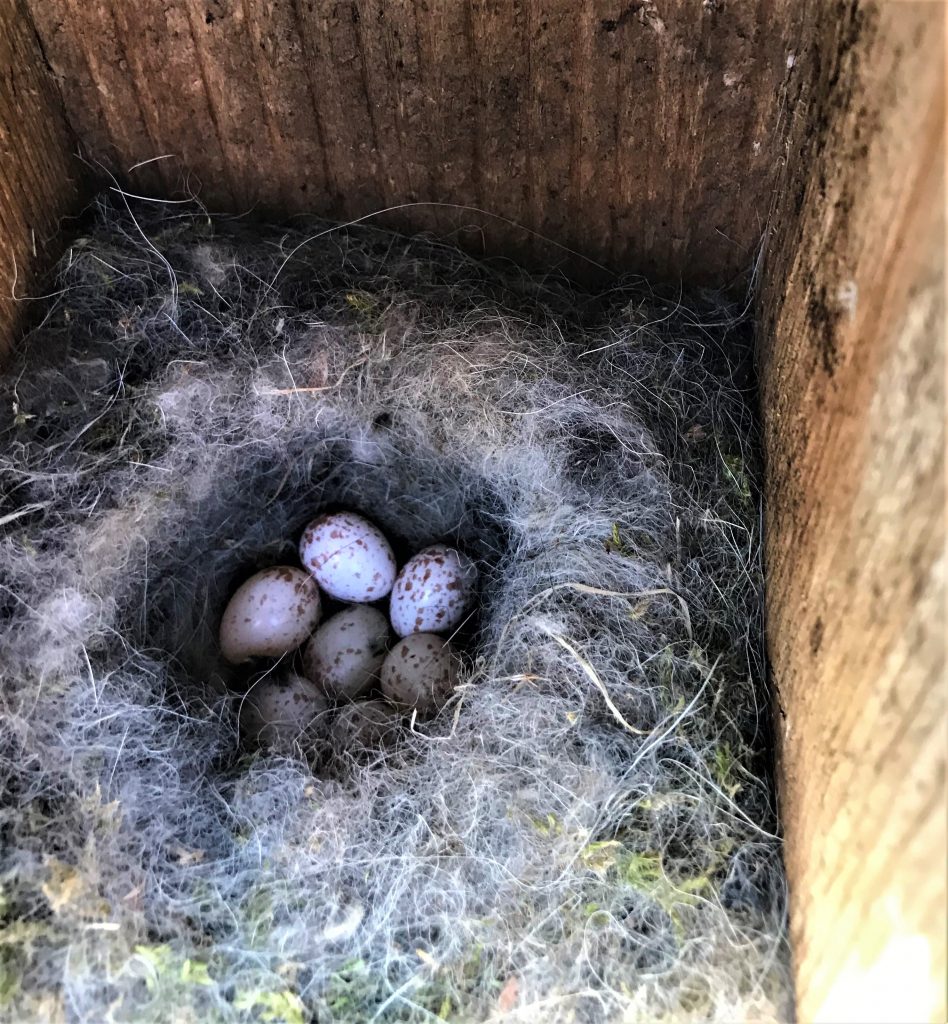
A nest box holds a black-capped chickadee nest and eggs. Submitted photo

For her six-month EPA avian toxicology fellowship, Pavlovic is studying tree swallows, black-capped chickadees and house wrens. “We’ve got a bunch of nest box locations around Duluth that we’re assessing for reproductive success and various metrics of how the birds are doing. Then we’re relating that to the amount of PFAS in the environment in those areas,” Pavlovic said.

The goal of this research is to create a toxicology model that scientists can use to predict, based on contamination concentrations in the environment, what the exposure risk would be to birds in that area.

The three-year U.S. Environmental Protection Agency Human Health and the Environment Research Fellows program fellowship program is a partnership between the EPA, the University of Wisconsin-Madison and its Aquatic Sciences Center. The goal is to train the next generation of scientists in environmental and ecosystem health.

The post EPA Fellow Emily Pavlovic: Up-close and personal with birds first appeared on Wisconsin Sea Grant.

Original Article

News Releases | Wisconsin Sea Grant

News Releases | Wisconsin Sea Grant

https://www.seagrant.wisc.edu/news/epa-fellow-emily-pavlovic-up-close-and-personal-with-birds/?utm_source=rss&utm_medium=rss&utm_campaign=epa-fellow-emily-pavlovic-up-close-and-personal-with-birds

Marie Zhuikov

Back in 2004, when I worked for Minnesota Sea Grant, I was part of an effort to eradicate “feral” goldfish that had been flourishing in a pond on the University of Minnesota Duluth campus. The two-acre Rock Pond drained into a trout stream, which led to Lake Superior. Although it’s unlikely the goldfish would have survived in Lake Superior, they are illegal to release into waterways, and it’s not a good idea to have them swimming around in trout streams or a Great Lake.

After considering all options, a plan was put into place to drain the pond and compost the goldfish. At that same time, we were in the middle of developing “Habitattitude,” a national educational campaign that sought to prevent the release of aquarium and water garden fish and plants. Developed by Sea Grant, the U.S. Fish and Wildlife Service and the Pet Industry Joint Advisory Council and involving large aquarium fish retailers such as PetCo, Wal-Mart and others, the campaign is still active today.

We decided Rock Pond would make a perfect pilot test of the new campaign logo and messages. After all, we didn’t want to clean up the pond only to have goldfish find their mysterious way back into it. For several years, we targeted the college students a few weeks before they left for the summer with emails, fliers in residence halls, and signs near the pond offering information about alternatives to releasing their unwanted pets.

It seemed to work well. As far as I know, the pond has not been infested with goldfish since. But I suppose you’re wondering why I referenced “murder” in the title of this story. Well, let me tell you a story behind the story.

After Rock Pond was drained, my supervisor at the time, Minnesota Sea Grant Assistant Director Jeff Gunderson, was back in his office looking over photos he took. He noticed something strange. He called me and our invasive species coordinator, Doug Jensen, into his office. He enlarged a section of a photo that seemed to show something white in the bottom of the pond.

“What does this look like to you?” Gunderson asked.

Jensen and I looked at the image and then looked at each other in disbelief. “That looks like a human skull!” I said.

We examined the image some more and came to consensus that yes, it very well could be a skull, half-buried in the mud.

Adrenaline coursed through my Sea Grant science communicator’s heart. We could have a murder mystery on our hands. Murder, combined with aquatic invasive species, what a wonderous and newsworthy combination!

What happened after that is a bit blurry in my memory, but I think we alerted the campus police and Gunderson sent them the photo. They investigated quickly. The result? Yes, it was a skull . . .

BUT, it was a plastic skull – like one a person would use for Halloween or some sort of occult ritual. (It had symbols carved into it.)

We were a bit deflated by the news, but also happy that no one had met their demise in the pond with the goldfishes.

It just goes to show that even with projects as routine as combatting invasive species, exciting things can happen.

The post Murder and Aquatic Invasive Species? first appeared on Wisconsin Sea Grant.

Original Article

Blog | Wisconsin Sea Grant

Blog | Wisconsin Sea Grant

https://www.seagrant.wisc.edu/blog/murder-and-aquatic-invasive-species/?utm_source=rss&utm_medium=rss&utm_campaign=murder-and-aquatic-invasive-species

Marie Zhuikov