Gardener Extraordinaire Melinda Myers Gives Insight into Japanese Knotweed

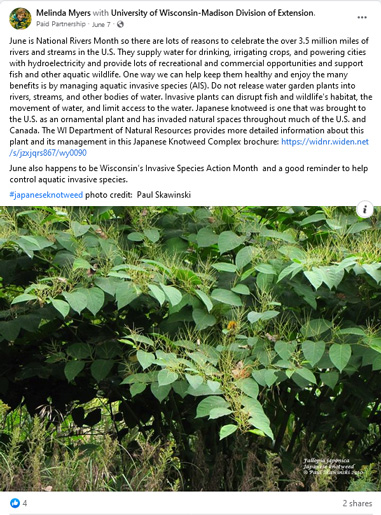
During last month’s National Rivers Month, Melinda Myers took a moment to highlight the over 3.5 million miles of rivers and streams in the United States. In addition to outlining the amazing things our waters do for us (including supplying water for drinking and for irrigating crops), Melinda brought attention to a riverside invasive species; Japanese knotweed. This plant was original brought to America as an ornamental but quickly spread through much of the United States. With bamboo-like stems, this invasive plant is known to choke waterways and hasten erosion. If you are one of the folks who has Japanese knotweed growing along your shorelines, there are great control options available.

To learn more, including control methods, check out this Japanese Knotweed brochure: https://widnr.widen.net/s/jzxjqrs867/wy0090?fbclid=IwAR2q36KUKGAJ4NJfAZ7N8S6MOeOgx-NPEV1T-LD3lzp6nMdXFvRWum-ssKQ

Photo Credit: Paul Skawinski, Melinda Myers

Questions? Comments? Contact Chris Acy, the AIS Coordinator covering Brown, Outagamie, Fond du Lac, Calumet, and Winnebago Counties at (920) 460-3674 or chris@fwwa.org!

Follow the Fox Wolf Watershed Alliance’s Winnebago Waterways Program on our Winnebago Waterways Facebook page or @WinnWaterways on Twitter! You can also sign-up for email updates at WinnebagoWaterways.org.

Winnebago Waterways is a Fox-Wolf Watershed Alliance program. The Fox-Wolf Watershed Alliance is an independent nonprofit organization that identifies and advocates effective policies and actions that protect, restore, and sustain water resources in the Fox-Wolf River Basin.

Check out the Keepers of the Fox Program at https://fwwa.org/watershed-recovery/lower-fox-recovery/

Reporting invasive species is a first step in containing their spread. Maintaining and restoring our waters and landscapes can reduce the impacts even when we don’t have other management options to an invasive species.

The post Japanese Knotweed and our Rivers appeared first on Fox-Wolf Watershed Alliance.

Original Article

Fox-Wolf Watershed Alliance

Fox-Wolf Watershed Alliance

https://fwwa.org/2023/07/10/japanese-knotweed-and-our-rivers/?utm_source=rss&utm_medium=rss&utm_campaign=japanese-knotweed-and-our-rivers

Chris Acy

Education Team Welcomes You to the Boat Launches

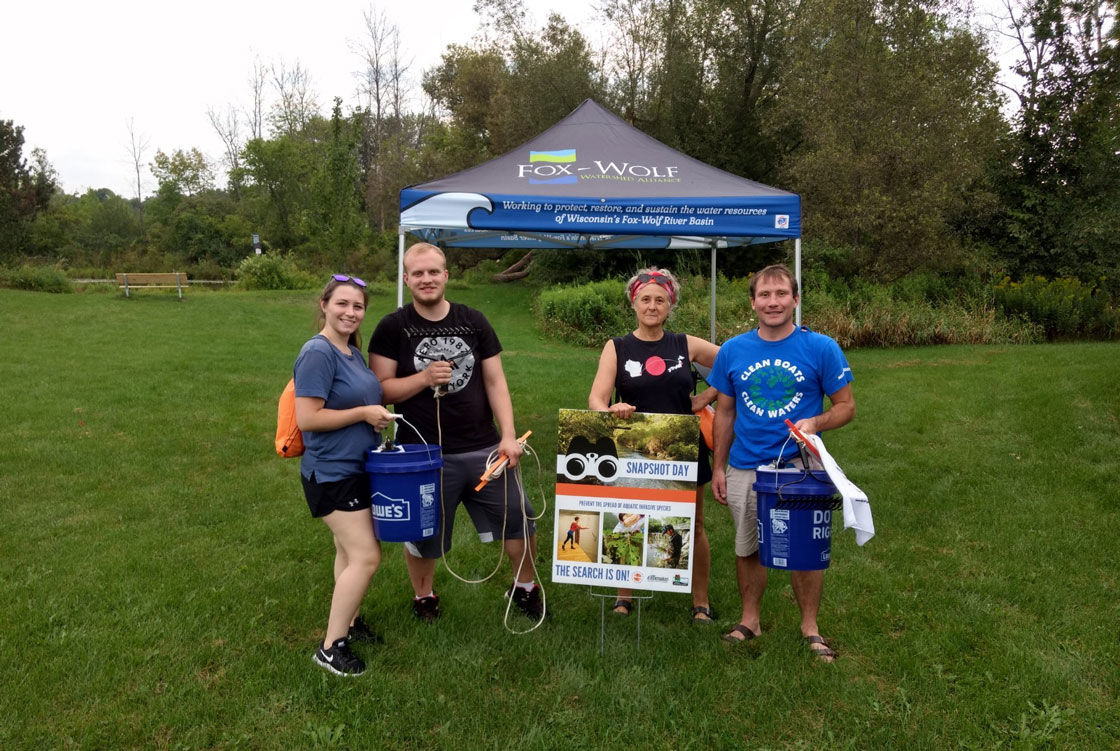
Every summer, the Fox-Wolf Watershed Alliance and partner organizations across the state welcome new hires to help prevent the spread of aquatic invasive species.  These new staff members help with the Clean Boats, Clean Waters Program and talk with water users at local boat launches. Thanks to a contract from the Wisconsin Department of Natural Resources, the Fox-Wolf Watershed Alliance was able to grow our aquatic invasive species program in the Winnebago Waterways by hiring five educators for Summer 2023! Take a minute to learn more about the seasonal team that is working directly to protect your local waters!

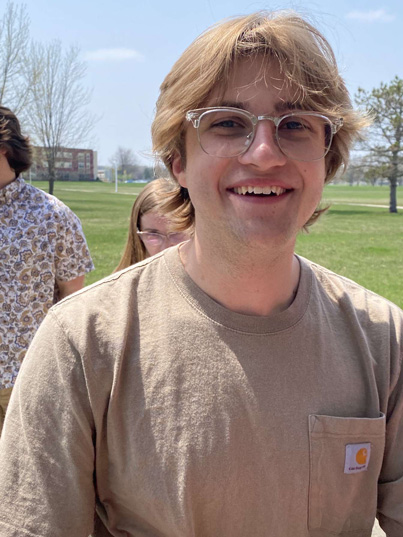
Tim – CBCW Coordinator

Tim joins the Fox-Wolf Watershed Alliance doing the Clean Boats, Clean Waters project as the project Coordinator. He is a junior at UW-Oshkosh majoring in Environmental Studies, with a minor in Geography. He loves to be in his garden and outside; plants are kind of his thing! In addition to being at the boat launches this summer, Tim will be coordinating the CBCW Program including making schedules, checking in on with the Educators, and getting our data uploaded correctly!

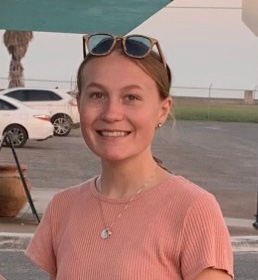
Leah – AIS Educator

Leah is joining the CBCW crew as an AIS educator for her first year. She is a senior at the University of Wisconsin and is studying to finish a degree in Environmental Studies with a Geology minor. She has always loved being outside in nature. Growing up, she went camping and hiking a lot with her my mom and she would always pick up garbage. She is now dedicating her life to advocating for the needs of the Earth and for all other beings. She is thrilled to start her position with the Clean Boats, Clean Waters Program to help conserve our local waters.

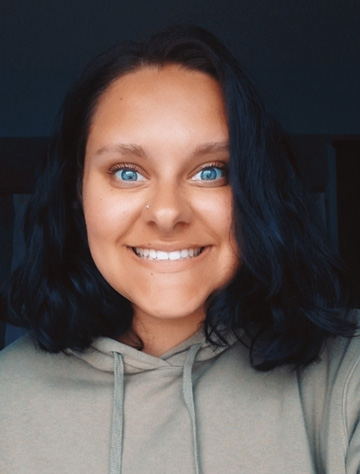
Mikayla – AIS Educator

Mikayla returns for her second year with the Fox-Wolf Watershed Alliance as an Aquatic Invasive Species Educator. She graduated from the University of Wisconsin-Oshkosh with a Biology Degree. She is excited to be back this summer and meet some new boaters! Mikayla also works at a local YMCA as the Building Supervisor!

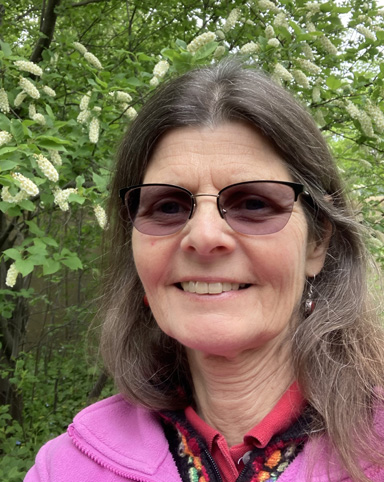
Lisa – AIS Educator

Lisa joins the Fox-Wolf Watershed Alliance and the Clean Boats Clean Waters Program team as a first year Educator! Originally from New York City, Lisa has called Wisconsin home for over 30 years! For the past two years, she’s been located on a canal on Lake Winnebago in Oshkosh. Lisa ran her own Chiropractic office for 27 years. She is looking forward to working to protect her favorite place; the great outdoors!

Steve – AIS Educator

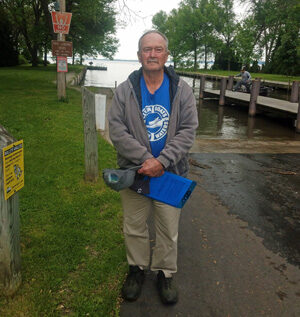
Steve Berholtz is working on his fifth year (!!) as a summer AIS employee with the main job of informing and educating boaters at various boat landings. Steve graduated in 1974 from UW-Oshkosh with a BS in Mathematics and a minor in Economics. He worked for 40 years for Canteen Vending and also put in 34 years in the Army Reserves. He loves to hunt pheasants in South Dakota and Wisconsin with his hunting dog, Skye. Steve wants to help improve and protect the Winnebago System for future generations!

If you’re a boater or angler, make sure to say hello if you see our team at your favorite boat launch!

Photo Credit: Tim Burns, Leah Fleury, Mikayla Wing, Steve Berholtz, Lisa Roth, Alyssa Reinke (Fox-Wolf), Chris Acy (Fox-Wolf)

Questions? Comments? Contact Chris Acy, the AIS Coordinator covering Brown, Outagamie, Fond du Lac, Calumet, and Winnebago Counties at (920) 460-3674 or chris@fwwa.org!

Follow the Fox Wolf Watershed Alliance’s Winnebago Waterways Program on our Winnebago Waterways Facebook page or @WinnWaterways on Twitter! You can also sign-up for email updates at WinnebagoWaterways.org.

Winnebago Waterways is a Fox-Wolf Watershed Alliance program. The Fox-Wolf Watershed Alliance is an independent nonprofit organization that identifies and advocates effective policies and actions that protect, restore, and sustain water resources in the Fox-Wolf River Basin.

Check out the Keepers of the Fox Program at https://fwwa.org/watershed-recovery/lower-fox-recovery/

Reporting invasive species is a first step in containing their spread. Maintaining and restoring our waters and landscapes can reduce the impacts even when we don’t have other management options to an invasive species.

The post Meet Your 2023 Aquatic Invasive Species Education Team! appeared first on Fox-Wolf Watershed Alliance.

Original Article

Fox-Wolf Watershed Alliance

Fox-Wolf Watershed Alliance

https://fwwa.org/2023/05/24/meet-your-2023-aquatic-invasive-species-education-team-2/?utm_source=rss&utm_medium=rss&utm_campaign=meet-your-2023-aquatic-invasive-species-education-team-2

Chris Acy

The 2021 publication advanced understanding of VHSV, an invasive pathogen affecting fish, in Wisconsin waters

A journal article that grew out of Wisconsin Sea Grant-funded research has been honored with a Publications Award from the American Fisheries Society (AFS), presented today at the society’s annual meeting in Spokane, Washington.

The society honors one outstanding paper from each of its journals annually with this award. “Widespread Seropositivity to Viral Hemorrhagic Septicemia Virus in Four Species of Inland Sport Fishes in Wisconsin” was published last year in the Journal of Aquatic Animal Health. Its authors are Whitney A. Thiel, Kathy L. Toohey-Kurth, David Giehtbrock, Bridget B. Baker, Megan Finley and Tony L. Goldberg.

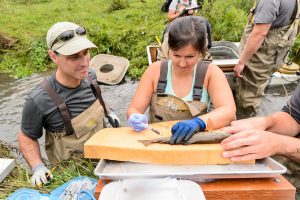
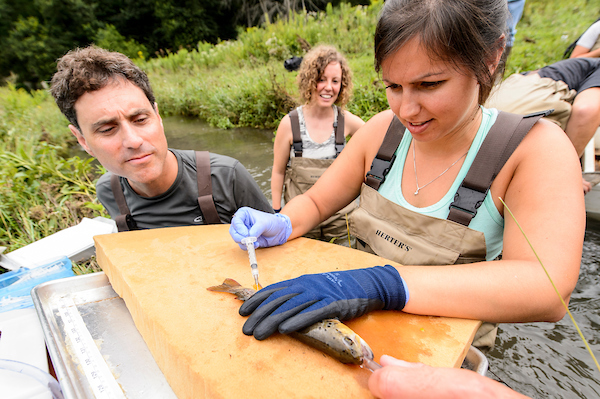
In this July 2016 photo taken near Wauzeka, Wis., Whitney Thiel draws blood from a brown trout while Tony Goldberg observes. (Photo: Bryce Richter, UW-Madison)

The team’s work revealed a more accurate and complex picture of Viral Hemorrhagic Septicemia Virus (VHSV) than previously understood. They found evidence of VHSV farther inland than anticipated, as well as “hot spots” and “not spots”—affected and unaffected bodies of water—that were surprisingly close together.

Said Thiel, who completed her master’s degree at UW-Madison in 2019, “I was surprised and flattered when I heard about the award. What a great feeling to know our research, something we all worked so hard on for so many years, is appreciated by the scientific community.”

In addition to serving as the paper’s first author, Thiel presented the group’s work at the Great Lakes Fish Health Committee meeting last year, where it was well received. “I think others are grateful for the insights into inland VHS prevalence that this wide-scale surveillance effort has provided,” she said.

Goldberg, who holds the John D. MacArthur Chair in the Department of Pathobiological Sciences at the UW-Madison School of Veterinary Medicine, also noted that the publication sparked discussion with others in the field. “I suspect it was an eye opener because it changed our vision of what VHSV is, from a lethal and geographically restricted pathogen to a sometimes not-so-lethal pathogen with a far wider distribution than originally suspected.”

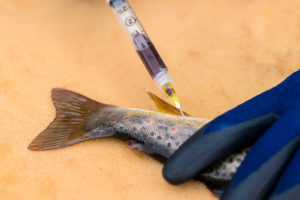
For the study, blood samples were drawn from fish in a non-lethal way. (Photo: Bryce Richter, UW-Madison).

The work has implications for mitigating the virus’ spread. Said Goldberg, “VHSV is not ‘everywhere.’ Rather, there are antibody-negative water bodies very close to antibody-positive water bodies, so the risk of spread is still there. In other words, our paper should not be interpreted as an excuse to throw up our hands. There’s still a lot of prevention that can be done.”

Looking ahead, he anticipates that researchers working in other regions will find similar patterns in VHSV occurrence. In the meantime, Goldberg is pleased by the AFS honor and credits former graduate student Thiel’s role in the effort. “I’m very proud of what Whitney did during this project. There’s no doubt in my mind that we would not have been able to do a study like this without a stellar–and Sea Grant-funded–student like Whitney.”

Find previous Sea Grant coverage of this work here, and the team’s journal article here.

The post American Fisheries Society honors journal article based on Sea Grant-funded research first appeared on Wisconsin Sea Grant.

Original Article

News Releases | Wisconsin Sea Grant

News Releases | Wisconsin Sea Grant

https://www.seagrant.wisc.edu/news/afs-honors-journal-article/?utm_source=rss&utm_medium=rss&utm_campaign=afs-honors-journal-article

Jennifer Smith

NOAA Sea Grant, in collaboration with U.S. Department of Defense, U.S. Department of Energy, U.S. Environmental Protection Agency, U.S. Fish and Wildlife Service, and U.S. Geological Survey, announces six new partnership positions. The Sea Grant Federal Partnership Liaisons will integrate Sea Grant extension expertise with science, products and services from NOAA labs and other publicly supported scientific research programs. These jointly-funded positions expand on a key component of Sea Grant’s work, extending science to end users and doing so through collaborative partnerships.

“The Sea Grant Liaisons provide strong connection points between emerging research and interested parties to tackle some of coastal and Great Lakes communities’ most pressing issues,” stated Dr. Jonathan Pennock, director of NOAA’s National Sea Grant College Program. “By engaging user communities around the country, Sea Grant’s Federal Partnership Liaisons program harnesses the Sea Grant network’s strengths to inform the work of federal science and service agencies.”

Focus areas for the new liaisons include aquatic invasive species, climate resilience, offshore wind energy, aquaculture opportunity areas, harmful algal blooms and community science for underserved communities. They join three existing Sea Grant partnership liaisons who work in ocean acidification, tsunami and coastal resilience, and Great Lakes research with NOAA’s Pacific Marine Environmental Laboratory and NOAA’s Great Lakes Environmental Research Laboratory.

The positions announced today are the result of a competitive funding opportunity announced in 2020. These Federal Partnership Liaisons are as follows:

  • Aquatic Invasive Species Liaison, with Wisconsin Sea Grant and U.S. Fish and Wildlife Service;
  • Coastal Resilience Liaison, with Georgia Sea Grant and U.S. Department of Defense;
  • Community Science Liaison, with Louisiana Sea Grant, Lake Champlain Sea Grant, U.S. Environmental Protection Agency, U.S. Geological Survey, NOAA Office of Education and NOAA Fisheries;
  • Harmful Algal Bloom Liaison, with Florida Sea Grant, NOAA’s National Centers for Coastal Ocean Science and NOAA’s National Environmental Satellite, Data, and Information Service;
  • Offshore Wind Energy Liaison, with Rhode Island Sea Grant and U.S. Department of Energy; and
  • Shellfish Aquaculture Liaison, with Connecticut Sea Grant and NOAA Fisheries Office of Aquaculture and Milford Laboratory.

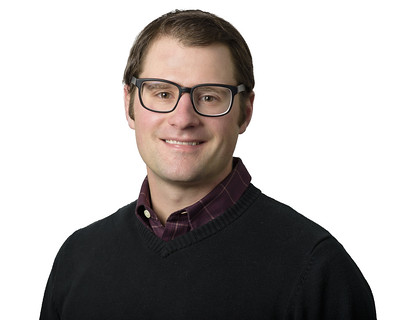
Wisconsin Sea Grant’s Tim Campbell will serve as one of the new liaisons. (Photo: Wisconsin Sea Grant)

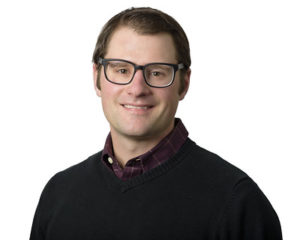
Wisconsin Sea Grant’s Aquatic Invasive Species Outreach Specialist Tim Campbell will be the AIS Liaison. He will serve in this capacity part-time while continuing his current role with Wisconsin Sea Grant. As a liaison, he will work broadly on AIS outreach coordination for the Aquatic Nuisance Species Task Force, co-chaired by USFWS and NOAA. He will also work to strengthen Sea Grant connections with the regional aquatic nuisance species panels and assist with AIS work in the National Sea Grant Office.

In addition to closely aligning with Sea Grant strategic goals and Sea Grant Network Vision Plans, the Liaisons support shared priorities in sustaining coastal and Great Lakes communities. These positions will build on agencies’ efforts to address three of the Biden Administration’s Executive Orders, “Executive Order on Protecting Public Health and the Environment and Restoring Science to Tackle the Climate Crisis”, “Executive Order on Tackling the Climate Crisis at Home and Abroad” and “Executive Order On Advancing Racial Equity and Support for Underserved Communities Through the Federal Government.”

“EPA is excited to work with our federal partners to address critical water research needs in coastal communities,” said Dr. Wayne E. Cascio, Acting Principal Deputy Assistant Administrator for Science in EPA’s Office of Research and Development. “By working directly with communities, we can increase scientific knowledge and promote more inclusive public engagement in priority environmental concerns, including environmental justice and climate change.”

The Sea Grant Liaisons will serve as a resource to the public, helping to engage and educate communities. Learn more about Sea Grant’s Federal Partnership Liaisons here.

The post NOAA Sea Grant Liaisons address critical research areas across federal agencies first appeared on Wisconsin Sea Grant.

Original Article

News Releases | Wisconsin Sea Grant

News Releases | Wisconsin Sea Grant

https://www.seagrant.wisc.edu/news/noaa-sea-grant-liaisons-address-critical-research-areas-across-federal-agencies/?utm_source=rss&utm_medium=rss&utm_campaign=noaa-sea-grant-liaisons-address-critical-research-areas-across-federal-agencies

Jennifer Smith

You could say that preventing the spread of aquatic invasive species (AIS) is a team sport. While it takes the professional efforts of natural resource managers, AIS specialists and others in the environmental field, it also takes the cooperation of the public.

Professionals encourage and rely on boaters, anglers and other outdoor enthusiasts to take preventative actions such as cleaning, draining and drying their boats and other watercraft and not moving water or live bait from one lake to another. Successful management of AIS and the help of a vigilant public go hand in hand.

Yet for community members to take necessary actions, they must first be aware of the negative impacts AIS can have and how to stop their spread. Communicating with them about AIS in an effective way is vital.

New research from Wisconsin Sea Grant Aquatic Invasive Species Outreach Specialist Tim Campbell, University of Wisconsin-Madison Associate Professor Bret Shaw and consultant Barry T. Radler sheds new light on such communication. The researchers analyzed which communication strategies are most effective and which may pose unintended problems. Shaw is a faculty member in the Department of Life Sciences Communication and is also an environmental communication specialist in the university’s Division of Extension.

The team’s findings were published online Aug. 14 in the journal Environmental Management (“Testing Emphasis Message Frames and Metaphors on Social Media to Engage Boaters to Learn about Preventing the Spread of Zebra Mussels”).

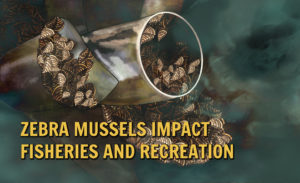
This advertisement is an example of the “science” message framing–a straightforward, factual approach. (Artwork by Brooke Alexander)

The trio used Facebook as a platform to test five types of messages—each invoking a different metaphor or message frame—to educate people about zebra mussels, a significant problem in the Great Lakes and elsewhere. These communication strategies can shape how people understand and form opinions about complex issues.

Paid advertising on Facebook and the social media site’s message-testing feature enabled the researchers to present these different messages to 270,000 people in Wisconsin with an interest in lakes, boating or fishing.

Although the ads presented messages similar to those commonly used in invasive species communication, up until this point little testing had actually been done about their effectiveness. The commonly used message frames were dubbed hitchhiker, militaristic, nativist, science and protective. The messages were paired with artwork by Brooke Alexander.

Many communication goals, the team found, can be achieved by using fact-based or more positive message frames. In general, the science frame—a direct, factual approach—will always perform at least as well as nativist and militaristic frames.

Said Campbell, “This work provides real-world results that can help those working with invasive species achieve their desired communication results, while avoiding possible unintended consequences from their messaging.” For example, nativist message framing (e.g., “alien,” “exotic”) can have unwanted xenophobic connotations while also not performing better than other frames on any tested metric.

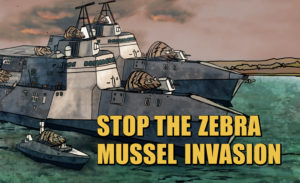
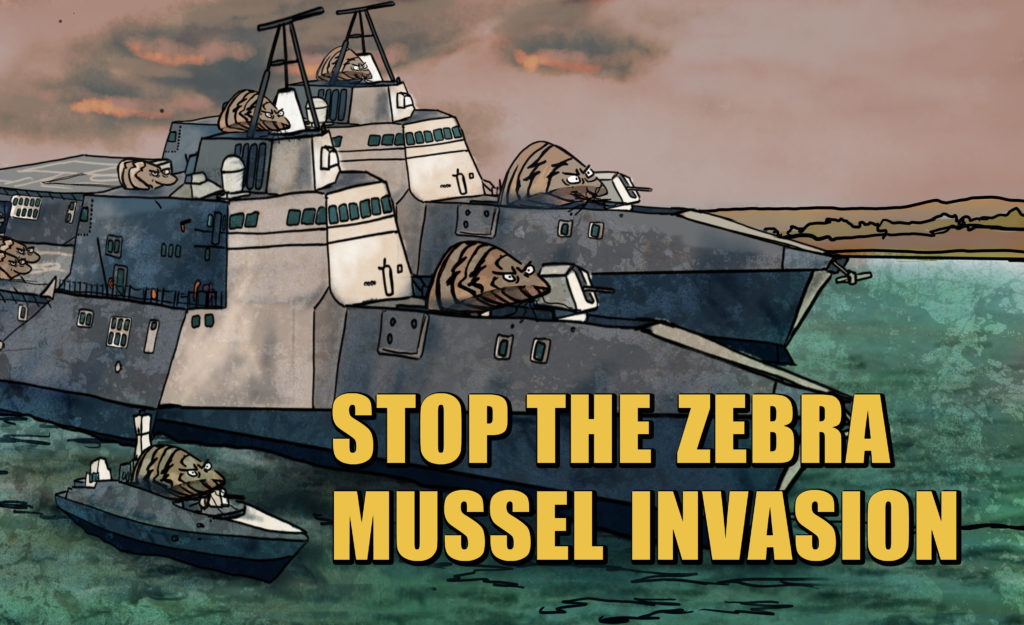
Militaristic message framing can be fraught with unintended connotations. (Artwork by Brooke Alexander)

Similarly, militaristic framing (such as stating we are “at war” with invasive species) can create potentially unhealthy relationships with nature and misguided views on how to manage invasive species.

Shaw noted that the metrics tested for the Facebook ads included cost-per-click, shares and comments. As he explained, “Many scholars and AIS professionals have debated the use of nativist or militaristic language in prevention campaigns, since many of them find that language to be fraught with unwanted implications. Based on our research, we recommend that outreach professionals skip those nativist and militaristic frames and focus instead on clearly communicated science.”

The team’s journal article may be read online. The research was supported by Wisconsin Sea Grant and the University of Wisconsin-Madison Division of Extension.

For further information, contact Campbell at tim.campbell@wisc.edu.

The post New research provides guidance for effective public messaging about invasive species prevention first appeared on Wisconsin Sea Grant.

Original Article

News Releases | Wisconsin Sea Grant

News Releases | Wisconsin Sea Grant

https://www.seagrant.wisc.edu/news/new-research-provides-guidance-for-effective-public-messaging-about-invasive-species-prevention/?utm_source=rss&utm_medium=rss&utm_campaign=new-research-provides-guidance-for-effective-public-messaging-about-invasive-species-prevention

Jennifer Smith

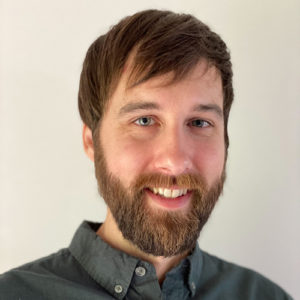
Wisconsin Sea Grant has a new team member in the effort to protect our waters from aquatic invasive species. Scott McComb began May 3 as the southeast Wisconsin aquatic invasive species (AIS) outreach specialist.

Scott McComb has joined the staff of Wisconsin Sea Grant. (Submitted photo)

McComb’s position focuses on Kenosha, Racine and Milwaukee counties, where he will coordinate education, monitoring and outreach programs for communities, stakeholders and volunteers to prevent the spread of AIS. His office is located at the Kenosha County Center in Bristol, though he anticipates spending a significant amount of time in the field in the three counties.

The three main programs McComb will focus on are the “Clean Boats, Clean Waters” campaign, a purple loosestrife biocontrol program and a citizen lake monitoring program. When possible, he’ll also have a presence at local and regional events (like Racine’s Salmon-A-Rama in July) to help spread the word about AIS prevention and answer the public’s questions.

McComb is eager to engage with a wide range of people. “Honestly, I feel like everyone under the sun is my stakeholder!” he laughed. He will partner with lake or homeowners’ associations that monitor bodies of water, government entities like parks departments, volunteer groups, conservation corps and individuals with an interest in maintaining healthy ecosystems for future generations.

He’s also keen to work with people of different ages. “I’d really like to engage youth and the diversity of cultures and backgrounds in this region. There are so many great groups and people to connect to,” said McComb.

As the summer recreation season gets underway and people head out for boating, fishing and other outdoor pastimes, McComb stressed the basics of protecting our waters, such as the “Inspect—remove—drain—never move—dispose” motto. People should inspect their boats, kayaks or other watercraft for aquatic plants and animals; remove any that are found; drain water from live wells and other areas; never move water, plants or animals between waterbodies; and dispose of unused bait in the trash.

Additionally, he said, “Just be curious and keep your eyes open with what’s going on in the different lakes that you use. You don’t need to be an expert on aquatic vegetation to see a species start to take over, and there’s a whole bunch of people—including myself and DNR folks—who are here to help you identify something if you think it’s an invasive.”

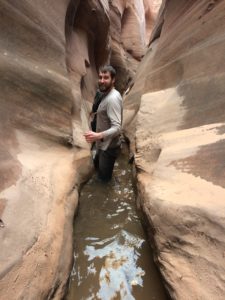
McComb during a hike in Zebra Canyon, Grand Staircase-Escalante National Monument, Utah. (Submitted photo)

McComb grew up in the Madison area and earned a bachelor’s degree in geography from the University of Wisconsin-Milwaukee. He then spent several years in Utah, where he completed a master’s degree in bioregional planning and worked in planning and conservation.

Said Tim Campbell, Wisconsin Sea Grant’s aquatic invasive species outreach specialist, “Scott has a lot of experience helping communities plan and implement projects that help them improve their communities. I look forward to seeing how that experience helps him build upon existing local partnerships in southeast Wisconsin to improve aquatic invasive species prevention and management.”

A desire to be closer to family brought McComb and his wife back to Wisconsin. In their free time, they enjoy canoeing, kayaking and simply being out in nature.

As McComb settles into his new role, he encourages people seeking AIS information to get in touch. He can be reached at 608-890-0977 or McComb@aqua.wisc.edu.

The post Scott McComb ready to take on aquatic invasive species role in southeast Wisconsin first appeared on Wisconsin Sea Grant.

Original Article

News Releases – Wisconsin Sea Grant

News Releases – Wisconsin Sea Grant

https://www.seagrant.wisc.edu/news/scott-mccomb-ready-to-take-on-aquatic-invasive-species-role-in-southeast-wisconsin/

Jennifer Smith

Wisconsin Sea Grant-funded research is revealing a more detailed picture of the range of viral hemorrhagic septicemia virus (VHSV) in Wisconsin waters. This invasive pathogen can cause affected fish to die. Since the early 2000’s, it has caused deaths in more than 30 fish species in the Great Lakes region.

The researchers’ findings have been published in the Journal of Aquatic Animal Health, a publication of the American Fisheries Society. The findings show that VHSV in Wisconsin can be found further inland and in more bodies of water than previously known.

Authors of the research paper (“Widespread Seropositivity to Viral Hemmorhagic Septicemia Virus in Four Species of Inland Sport Fishes in Wisconsin“) are Whitney A. Thiel, Kathy L. Toohey-Kurth, David Giehtbrock, Bridget B. Baker, Megan Finley and Tony L. Goldberg.

They key to discovering this new information was testing fish for the presence of antibodies to VHSV through a process known as enzyme-linked immunosorbent assay (ELISA). While the general method of ELISA is not new, the particular ELISA for VHSV is, and it was developed with Sea Grant support. “It’s a valuable tool in fish health testing,” said Goldberg, an epidemiology professor at the University of Wisconsin-Madison School of Veterinary Medicine.

In this July 2016 photo taken near Wauzeka, Wis., Whitney Thiel draws blood from a brown trout while Tony Goldberg observes. (Photo: Bryce Richter, UW-Madison)

While other, more common testing methods look for presence of the live virus, the new method detects past exposure to VHSV, which, said Goldberg, is “really useful for screening populations and looking back in time.” Blood samples are collected from fish in a non-lethal way.

The research team focused on four sport fish that are economically important in Wisconsin: bluegill, brown trout, northern pike and walleye. Fish with VHSV antibodies were found in 37 of 46 inland water bodies tested, including water bodies far from known outbreak events. Sampling occurred in 2016 and 2017.

Researchers found the results surprising. Said Thiel, first author of the journal article, “I suspected we’d see it spread out in some of the inland water bodies connected to the Winnebago watershed or the Green Bay area—where we already knew VHS was—but I didn’t expect we would see it so far inland.” Thiel completed a master’s degree in freshwater and marine sciences at UW-Madison in 2019 and is now a research scientist at the University of Idaho.

Another intriguing finding was what members of the team characterized as “hot spots” and “not spots,” which were often close together. Prior to the research, they expected that any additional instances of VHSV detected would be near bodies of water known to have problems. However, in a number of cases, a body of water with no evidence of VHSV could be found neighboring one with evidence of the virus.

Giehtbrock, fish culture section chief at the Wisconsin Department of Natural Resources, said that this new information was all the more reason for those using Wisconsin’s waters—like recreational boaters and anglers—to keep taking preventative steps against the spread of aquatic invasive species in general.

“We need to continue all those practices that have been in place for a long time, to mitigate any transfer of VHSV between bodies of water, which is what we were already asking people to do everywhere. From invasives like Eurasian watermilfoil to carp to VHSV, we’re already asking people to clean their boats, drain their live wells and not transfer water between bodies of water,” said Giehtbrock.

“What people should take away from this is, we want to keep it out of where it’s not,” echoed Goldberg.

Giehtbrock, who supervises DNR fish hatcheries around the state, does not foresee a change in fish stocking practices at this point. Citing both Department of Agriculture regulations and the DNR’s own policies, he said that managing the health of fish for stocking is already strictly controlled.

Blood samples were drawn from fish in a non-lethal way. In this 2016 photo, a sample is taken from a brown trout. (Photo: Bryce Richter, UW-Madison)

“VHSV is one big component of that,” explained Giehtbrock. “We do virus testing on all of the stocks prior to their departure from the hatchery for stocking. So in terms of actual stocking practice, I don’t see a change because we’re already doing all the testing and monitoring that is feasible to make sure that everything we put out there is healthy and not spreading disease.”

Where Giehtbrock does see a possible change, however, is on the demand side, if more fish are needed to maintain or supplement fisheries being affected by VHSV fish kills. However, such a situation has not occurred yet.

This new information paints a more accurate and complex picture of VHSV in Wisconsin than previously understood. The research team recommended vigilance against potentially spreading the virus or other invasives. The best offense is a good defense, such as adhering to current advice promoted by the “Clean Boats, Clean Waters” campaign and similar initiatives.

The post Research reveals a more accurate picture of the occurrence of VHSV in Wisconsin waters first appeared on Wisconsin Sea Grant.

Original Article

News Releases – Wisconsin Sea Grant

News Releases – Wisconsin Sea Grant

https://www.seagrant.wisc.edu/news/research-reveals-a-more-accurate-picture-of-the-occurrence-of-vhsv-in-wisconsin-waters/

Jennifer Smith

A series of informal, interactive science presentations on Great Lakes issues will return in spring 2021 with new topics and speakers.

Wisconsin Sea Grant’s “Lake Talks” series highlights topics related to Lake Michigan or, more widely, the Great Lakes basin. Spring talks will be offered through Zoom in light of the ongoing pandemic.

The spring series kicks off on Thursday, March 18 at 7 p.m. with “What cartoon zebra mussels taught me about invasive species communication.” (Register now for this Zoom webinar.)

Aquatic Invasive Species Outreach Specialist Tim Campbell. (Photo: Wisconsin Sea Grant)

The speaker is Tim Campbell, Wisconsin Sea Grant aquatic invasive species outreach specialist. Campbell will discuss how metaphors—such as aquatic invasive species as “hitchhikers” or “invaders”—affect how people perceive the issues, and how certain metaphors pose ethical issues or may not lead to productive engagement.

As Campbell explained, “People use many different message frames and metaphors when talking about invasive species, and we know that metaphor use can affect how people understand complex issues. We wanted to better understand how these communication strategies impact actions people might take in regards to invasive species.”

Because preventing the spread of aquatic invasive species (AIS) depends significantly on public cooperation, communicating with the public in an effective way is highly important. Learn what Campbell and his fellow researchers discovered through work that was funded by Wisconsin Sea Grant. The research focused on communication about zebra mussels.

The Lake Talks series will continue with talks in April, May and June. Those future talks will address PFAS (contaminants in our waters often referred to as “forever chemicals”), tourism in the Great Lakes and rip current safety.

The image and tagline here are an example of “militaristic” message framing about invasive species. (Artwork: Brooke Alexander)

All sessions will last one hour on Zoom and include time for audience Q&A. For connection information for future talks, visit the Lake Talks page of the Wisconsin Sea Grant website, or follow Wisconsin Sea Grant on Facebook or Twitter as event dates draw closer. You can register for Tim Campbell’s talk now.

For questions about this series, contact Wisconsin Sea Grant science communicator Jennifer Smith.

The post “Lake Talks” series returns for spring 2021 with presentation on invasive species communication first appeared on Wisconsin Sea Grant.

Original Article

News Releases – Wisconsin Sea Grant

News Releases – Wisconsin Sea Grant

https://www.seagrant.wisc.edu/news/lake-talks-series-returns-for-spring-2021-with-presentation-on-invasive-species-communication/

Jennifer Smith

Topics include aquatic invasive species, eating local fish and Green Bay’s ecosystem
Wisconsin Sea Grant’s “Lake Talks” series of free, public events will return this fall—in cyberspace. Four virtual events in the series will take place on Thursdays at 7 p.m. between Sept. 10 and Nov. 12.

The series was launched earlier in 2020 with an in-person event in Green Bay in early March. However, remaining spring events were canceled due to public health concerns surrounding the coronavirus. Now, because of ongoing health concerns and university policy, the series will move to a virtual format this fall. Wisconsin Sea Grant is headquartered at the University of Wisconsin-Madison.

The Lake Talks cover topics of special interest to residents in communities along or near the Lake Michigan shoreline—though anyone is welcome to attend.

Fall speakers and topics are:

Sept. 10: Molly Bodde of Kenosha, Wisconsin Sea Grant aquatic invasive species outreach specialist for southeast Wisconsin, will present “But It’s So Pretty: Combating Purple Loosestrife with Look-a-likes.”

Sept. 24: Chris Litzau of Racine, Great Lakes Community Conservation Corps director.

Oct. 22: University of Wisconsin-Green Bay graduate students Cadie Olson and Brandon Falish will speak about “Green Bay: A Saga of Life, Destruction and Restoration.”

Nov. 12: Titus Seilheimer of Manitowoc, Wisconsin Sea Grant fisheries specialist, will offer “How to Eat Wisconsin Fish.” Seilheimer will talk about his favorite fish, the benefits of eating Wisconsin fish—both wild-caught and farmed—and how you can incorporate local fish into upcoming holiday celebrations.

Zoom will be used as the online event platform. Each event will last one hour and include time for Q&A after the presentation.

While web links and other technical details for the sessions are still being finalized, those interested can get more information when it is announced by following Wisconsin Sea Grant on social media (at the handle @UWiscSeaGrant on both Facebook and Twitter), or by going to the Wisconsin Sea Grant website at seagrant.wisc.edu (search for “Lake Talks”).

Questions about the series may be directed to Wisconsin Sea Grant science communicator Jennifer Smith at smith@aqua.wisc.edu.

Original Article

News Releases – Wisconsin Sea Grant

News Releases – Wisconsin Sea Grant

https://www.seagrant.wisc.edu/news/wisconsin-sea-grant-to-host-virtual-lake-talks-this-fall/

Jennifer Smith

A series of online videos for fisheries managers who need to sample for invasive carp species like bighead and silver carp is now available. This unique resource—a collection of 17 videos that can be watched on YouTube—grew out of a workshop that took place in spring 2019 at Lake Barkley State Resort Park in Kentucky.

The partners behind the workshop and the resulting video series are the Mississippi River Basin Panel on Aquatic Nuisance Species (MRBP), Wisconsin Sea Grant, the U.S. Fish and Wildlife Service, the U.S. Geological Survey, and the Kentucky Department of Fish and Wildlife Resources. The videos can be found on Wisconsin Sea Grant’s YouTube channel.

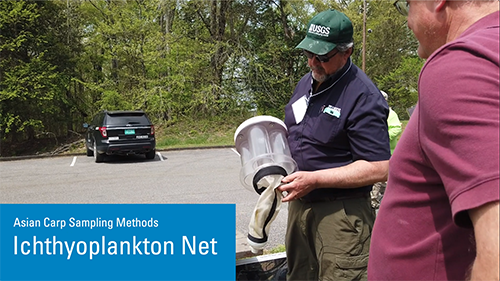
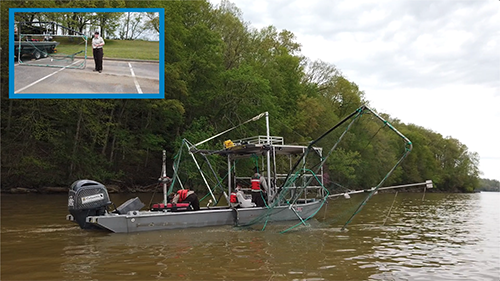
Duane Chapman of the U.S. Geological Survey discusses an ichthyoplankton net and its use for silver, bighead, grass and black carp sampling. (Photo: Bonnie Willison)

The April 17-18, 2019 workshop on invasive carp species featured experts from around the country, who presented to about 65 attendees.

The MRBP funded the event, and Wisconsin Sea Grant Video Producer Bonnie Willison filmed on location in Kentucky to create the training videos, working in cooperation with Sea Grant Aquatic Invasive Species Outreach Specialist Tim Campbell. Campbell also serves as the Wisconsin representative on the MRBP.

Said Campbell, “This workshop was a one-of-a-kind interagency effort to train people in the methods needed to sample for bighead and silver carp.” Those methods can be different from standard ones familiar to most U.S. fisheries professionals. For example, different gear may be needed, and the video series covers different types of gear and how to use it, among other topics.

“I’m so glad that workshop organizers had the forethought to capture this event so this knowledge could be preserved and shared with more people,” added Campbell.

The effort as a whole is aimed at more effective management of these invasive species in the waters of the Mississippi River basin, a vast watershed covering about 40% of the continental U.S. The methods demonstrated at the workshop can be used for a combination of monitoring (to know where the fish are) and control (to remove the unwanted species).

Emily Pherigo of the U.S. Fish and Wildlife Service discusses the paupier boat and gives an overview of the equipment. (Photo: Bonnie Willison)

Bighead and silver carp are problematic because they eat a lot, grow rapidly and become quite large, with silver carp exceeding 60 lbs. and bighead carp exceeding 100 lbs. If left unchecked, they become abundant and make recreational uses of lakes and rivers difficult due to their sheer numbers. They also pose a significant threat to the Great Lakes, where they are not yet established.

The training videos may be viewed on YouTube.

Questions may be directed to Campbell at 608-263-3259 or tim.campbell@wisc.edu.

Original Article

News Releases – Wisconsin Sea Grant

News Releases – Wisconsin Sea Grant

https://www.seagrant.wisc.edu/news/training-videos-for-fisheries-managers-cover-techniques-for-sampling-invasive-carp-species/

Jennifer Smith

While New Zealand white rabbits do not normally spring to mind when you mention the fauna of Lake Michigan, a recently published paper in Limnology and Oceanography: Methods, a journal of the Association for the Science of Limnology and Oceanography, shows how this cotton-tailed creature plays a role in a newly validated method for assessing the lake’s food web, along with yielding surprising finds about the feeding habits of invasive spiny waterfleas.

Sea Grant-funded scientist John Berges, a University of Wisconsin-Milwaukee professor of biological sciences, and UW-M biology colleague Craig Sandren (now deceased), set about investigating the impact of invasive zooplankton on the big lake’s system. As they weighed and rejected three different research tools, Berges suggested an approach that he termed, “almost naively simple.”

Sea Grant-funded researcher John Berges on Lake Michigan for a study of the effects of invasive zooplankton on the food web. (contributed photo)

He harkened back to the 1970s for a process first used terrestrially to calculate what’s eating insects and what kind of insects are being eaten. Berges said the technique had seen limited use in the marine environment but that “this is really the first time it’s been used systematically in fresh waters.”

Berges noted, “What we like about it as opposed to some of the DNA techniques is that it’s pretty quick. It’s cheap. You don’t need big deep DNA sequencing. Most labs will be able to use this.” Additionally, he said, scientists—such as the University of Windsor’s Aaron Fisk—who are using stable isotopes to map food webs can use this process to corroborate findings.

So far, there’s been references to fish and bugs. Just where do the rabbits come into the picture? Berges provided a detailed rundown of this “simple” process: “You take the likely prey (of a spiny waterflea) and…you grind it up. You basically homogenize it, make a soup of it. You take that soup and you inject it into an animal. We’re going to use a bunny rabbit here. That bunny rabbit’s immune system goes nuts, making a whole bunch of antibodies against the proteins that are in the putative prey organism. You have a huge array, a suite, of antibodies which now recognize the proteins that are in that item that potential prey item, that you injected into it.”

There is then a rabbit blood draw—after six to 12 weeks, during which time the immune response has built up. In the lab, Berges’ team then took the antibody (also known as immunoglobulin IgG) fraction of the blood, “which is real easy to do, and you have basically stuff, the immunoglobulins, which are going to stick very, very precisely to the proteins that were in that particular (prey) organism. So, you have a nice little marker.”

The next step, he said, is to determine if any of the markers from the rabbit blood overlap with the predator, which is the spiny waterflea. “You grind up the predator (the spiny waterflea) and you let the immunoglobulin bind to all the predator’s proteins. You remove them (the predator’s antibody) …What we’ve got left over now is things that are going to react only to the prey and not to the predator.”

Berges continued, “We found a whole bunch of the predators and checked them out for 12 different prey and some of them we didn’t find. None of the predators had them and we can be pretty clear that the predators aren’t eating them. And other prey, almost everybody had some of the prey in them. Now, we have a fairly clear picture of what the spiny waterflea is eating and a couple surprises came out.”

A University of Wisconsin-Milwaukee research team collects samples that will later be used as part of a “almost naively simple” method to assess an ecosystem’s populations. The represents the first time the antibody-based method has been used systematically in fresh waters. (contributed photo)

There were two surprises. First was evidence that the spiny waterflea was consuming the larvae of invasive Dreissenid mussels, commonly known as zebra mussels or quagga mussels. “That’s a neat story. We have one invasive species eating another invasive species. Well, that’s kinda cool. But we think about it a little more and it doesn’t make an awful lot of sense because we have this great big predator why is it grazing on these tiny little larvae,” Berges said.

The researchers continued with their reasoning and are now confident that it’s a case of what is known as hyperpredation—the spiny water flea ate something that itself first ate the larval Dressenid mussel.

The second surprise was a 180-degree turn in the category of size—not a tiny food source like the Dreissenid mussel larvae, but a large organism. Evidence of a type of zooplankton called Limnocalanus macrurus, or one of the “big dogs in the lake” as Berges put it, was found to have been consumed by the spiny waterflea. In this instance, Berges said they reasoned the spiny waterflea was eating the juvenile and larval forms of the large copepod.

In the end and with the help of a few New Zealand white rabbits as interim hosts for ground-up zooplankton prey, Berges said, “We have reasonable explanations for those two strange things that we found, and a technique that now we’ve proven out.”

Original Article

News Releases – Wisconsin Sea Grant

News Releases – Wisconsin Sea Grant

https://www.seagrant.wisc.edu/news/uw-milwaukee-researchers-enlist-antibodies-to-understand-spiny-waterflea-diet/

Moira Harrington

A research project recently completed by Wisconsin Sea Grant found that there was no statistical difference between an experienced watercraft inspector removing aquatic plants and small-bodied invertebrates from a watercraft using hand removal or using a CD3 waterless watercraft cleaning system. There was also no difference related to cleaning treatment duration. Study results are available in a recently finalized Wisconsin Sea Grant report authored by Tim Campbell, Molly Bodde and Titus Seilheimer.

A CD3 waterless watercraft cleaning system is used to clean a small boat during an experimental trial. (Photo: Molly Bodde)

Experimental trials consisted of a researcher placing a known amount of Eurasian watermilfoil or a mixture of spiny water fleas and wetland plant seeds on a watercraft. Then the inspector used each cleaning treatment for 90 or 180 seconds. The researcher then collected the removed specimens and recovered the remaining specimens to determine the percentage of specimens removed for each trial.

The same inspector completed every trial—a trained Wisconsin Clean Boats, Clean Waters inspector with two summers of inspection experience. The inspector did not have any previous experience with the CD3 cleaning system.

A key finding from the study was that a trained, experienced inspector can be very effective removing plants and small-bodied organisms from watercraft, with the inspector removing between 93 to 99 percent of aquatic plants and 80 to 92 percent of small-bodied invertebrates with the treatments, with no statistical difference between the methods.

Compared to a previous, similar study that also used a trained inspector (but not a CD3 system for comparison), these new results show a slightly higher removal effectiveness. Future research should investigate the roles that training and experience have in the ability of inspectors and boaters to remove aquatic plants and small-bodied invertebrates from watercraft.

For more information, contact Aquatic Invasive Species Outreach Specialist Tim Campbell or Southeast Wisconsin Aquatic Invasive Species Outreach Specialist Molly Bodde.

Original Article

News Releases – Wisconsin Sea Grant

News Releases – Wisconsin Sea Grant

https://www.seagrant.wisc.edu/news/report-compares-ais-prevention-actions/

Jennifer Smith

A research project recently completed by Wisconsin Sea Grant found that there was no statistical difference between an experienced watercraft inspector removing aquatic plants and small-bodied invertebrates from a watercraft using hand removal or using a CD3 waterless watercraft cleaning system. There was also no difference related to cleaning treatment duration. Study results are available in a recently finalized Wisconsin Sea Grant report authored by Tim Campbell, Molly Bodde and Titus Seilheimer.

A CD3 waterless watercraft cleaning system is used to clean a small boat during an experimental trial. (Photo: Molly Bodde)

Experimental trials consisted of a researcher placing a known amount of Eurasian watermilfoil or a mixture of spiny water fleas and wetland plant seeds on a watercraft. Then the inspector used each cleaning treatment for 90 or 180 seconds. The researcher then collected the removed specimens and recovered the remaining specimens to determine the percentage of specimens removed for each trial.

The same inspector completed every trial—a trained Wisconsin Clean Boats, Clean Waters inspector with two summers of inspection experience. The inspector did not have any previous experience with the CD3 cleaning system.

A key finding from the study was that a trained, experienced inspector can be very effective removing plants and small-bodied organisms from watercraft, with the inspector removing between 93 to 99 percent of aquatic plants and 80 to 92 percent of small-bodied invertebrates with the treatments, with no statistical difference between the methods.

Compared to a previous, similar study that also used a trained inspector (but not a CD3 system for comparison), these new results show a slightly higher removal effectiveness. Future research should investigate the roles that training and experience have in the ability of inspectors and boaters to remove aquatic plants and small-bodied invertebrates from watercraft.

For more information, contact Aquatic Invasive Species Outreach Specialist Tim Campbell or Southeast Wisconsin Aquatic Invasive Species Outreach Specialist Molly Bodde.

Original Article

News Releases – Wisconsin Sea Grant

News Releases – Wisconsin Sea Grant

https://www.seagrant.wisc.edu/news/report-compares-ais-prevention-actions/

Jennifer Smith

Once niche, podcasts have gone mainstream. According to figures cited in Forbes, 62 million Americans now listen to podcasts each week.

Sea Grant’s Yael Gen designed the cover art for the new podcast.

While Wisconsin Sea Grant and the University of Wisconsin Water Resources Institute have been involved in podcasting for years—from the current series Wisconsin Water News to older programs like Earthwatch Radio—there’s a new kid on the block: a podcast called “Introduced” that will be devoted to aquatic invasive species (AIS). Its tagline is “aquatic invaders and stories from our changing waters.”

“Introduced” is the brainchild of Sea Grant Video Producer Bonnie Willison and student employee Sydney Widell, a UW-Madison geography and geosciences major from Shorewood, Wis.

The series will span seven episodes, with one per week released beginning May 27. Listeners can find it on Apple Podcasts, Google Play, Spotify and on Sea Grant’s website.

While the simple name for the series conveys a bit of mystery, it also makes perfect sense. Said Willison, “As Sydney and I started learning more about invasive species, we noticed that there is a tendency for people to villainize these species. But we also noticed that humans are the ones introducing all these species to new environments. The title for our series puts the agency on people, which is something that we focus on in the podcast.”

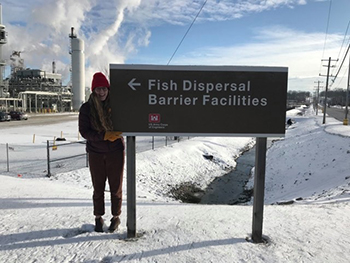
Sydney Widell, one of the creators of the new podcast, on a visit to an electric fish barrier in Illinois in February. The barrier helps keep Asian carp out of the Great Lakes. (Photo: Bonnie Willison)

Guests interviewed in the series include representatives from the Wisconsin Department of Natural Resources, U.S. Geological Survey, UW-Madison, the Fond du Lac Band of Lake Superior Chippewa, and a rescue organization focusing on exotic animals. Several Sea Grant staff also make appearances.

Topics are wide-ranging, from Asian carp to the trade in invasive species on the Internet. Because the AIS field is so rich, Willison anticipates doing a second season of the “Introduced” podcast. Stay tuned!

Original Article

News Releases – Wisconsin Sea Grant

News Releases – Wisconsin Sea Grant

https://www.seagrant.wisc.edu/news/introducing-introduced-sea-grants-newest-podcast/

Jennifer Smith