I Speak for the Fish: April showers bring vernal pools and baby salamanders

I Speak for the Fish is a new monthly column written by Great Lakes Now Contributor Kathy Johnson, coming out the third Monday of each month. Publishing the author’s views and assertions does not represent endorsement by Great Lakes Now or Detroit Public Television.

Read Now at Great Lakes Now.

Original Article

Great Lakes Now

Great Lakes Now

https://www.greatlakesnow.org/2021/06/fish-vernal-pools-baby-salamanders/
Kathy Johnson

News

Great Lakes aquatic invasive species are the focus of the third annual “Landing Blitz”

Ann Arbor, Mich. – Hundreds of organizations across the Great Lakes region will be coming together to educate boaters and the public about the risks of spreading aquatic invasive species (AIS) during the third annual Great Lakes AIS Landing Blitz, to be held June 26 to July 4. The event is coordinated annually among state and provincial agencies with the support of the Great Lakes Commission and partner organizations.

 As part of the Landing Blitz, volunteers will join paid inspectors at boat launches to educate boaters on how to prevent the spread of AIS, ways to identify AIS, and how to report an AIS discovery. Properly inspecting and cleaning boats, trailers and other equipment helps prevent the spread of AIS, which are recognized as one of the most significant threats to the ecological and economic health of the Great Lakes.

“More than 185 nonnative species are already established in the Great Lakes, many of which are invasive and cause harm,” said Sharon M. Jackson, chair of the Great Lakes Commission and deputy general counsel for Indiana Governor Eric Holcomb. “Progress is being made, but we must continue to work together through successful partnerships like the AIS Landing Blitz to prevent new invasions and reduce the damage from species already here.”

Last year’s Great Lakes AIS Landing Blitz reached 128,000 people at over 1,000 public and private boat landings across the region, and an additional 830,000 people engaged with online virtual content and social media about the event. This year, agencies leading the effort will host a hybrid event, continuing to reinstate in-person inspections and outreach in accordance with relevant COVID-19 public health procedures while maintaining an online presence.

“As recreation and tourism continues to open back up across the Great Lakes basin, we are excited to communicate directly with boaters at landing sites, while continuing to exercise appropriate safety procedures,” said James M. Tierney, Great Lakes Commissioner and Deputy Commissioner for Water Resources at the New York State Department of Environmental Conservation.

For more information on the Great Lakes AIS Landing Blitz, including educational materials, location, and volunteer opportunities, visit www.glc.org/blitz.


The Great Lakes Commission, led by chair Sharon M. Jackson, Deputy General Counsel for Governor Eric J. Holcomb of Indiana, is a binational government agency established in 1955 to protect the Great Lakes and the economies and ecosystems they support. Its membership includes leaders from the eight U.S. states and two Canadian provinces in the Great Lakes basin. The GLC recommends policies and practices to balance the use, development, and conservation of the water resources of the Great Lakes and brings the region together to work on issues that no single community, state, province, or nation can tackle alone. Learn more at www.glc.org.

Contact

For media inquiries, please contact Beth Wanamaker, beth@glc.org.

Recent GLC News

Upcoming GLC Events

View GLC Calendar

ARCHIVES

Original Article

Great Lakes Commission

Great Lakes Commission

https://www.glc.org/news/blitz-062321

Beth Wanamaker

Chicago, IL (June 23, 2021) – Earlier today, the Canadian government released new rules on the regulation of ship ballast water. In response, Alliance for the Great Lakes Chief Operating Officer and Vice President for Policy Molly Flanagan issued the following statement:

“The Alliance for the Great Lakes is pleased to see Canada put in place new rules on ballast water tanks that will help keep aquatic invasive species out of the Great Lakes. The rules are an important step toward preventing irreversible damage to the lakes.

Reporting has found that “lakers” — ships that transit solely within Great Lakes waterways — contribute to the spread of destructive aquatic invasive species among the lakes. Aquatic invasive species can irreparably harm our ecosystem and cost the region billions. Under these new rules, which will require all vessels stopping at Candian ports to have ballast water treatment systems by 2030, it is estimated the spread of invasive species at Canadian Great Lakes ports will be reduced by 82 percent. Additionally, an estimated $980 million in benefits will result from the implementation of these rules. Given that costs to comply are about $280 million, that amounts to an impressive 3.5 to 1 benefit/cost ratio.

While we applaud Canada for taking action, these new rules serve as a reminder that the United States must also hold up its end of the bargain by implementing similarly strong ballast water standards on board all ships operating on the Great Lakes.The Alliance for the Great Lakes calls on the United States Environmental Protection Agency to regulate all vessels on the Great Lakes, including lakers. Ultimately, unwavering commitments from both countries are necessary to keep aquatic invasive species at bay and protect the health and vitality of the Great Lakes for future generations.”

###

Media contact: Jennifer Caddick, jcaddick@greatlakes.org

The post Alliance Applauds New Canadian Ballast Water Regulations appeared first on Alliance for the Great Lakes.

Original Article

News – Alliance for the Great Lakes

News – Alliance for the Great Lakes

https://greatlakes.org/2021/06/alliance-applauds-new-canadian-ballast-water-regulations/

Jennifer Caddick

Chicago, IL (June 23, 2021) – Earlier today, the Canadian government released new rules on the regulation of ship ballast water. In response, Alliance for the Great Lakes Chief Operating Officer and Vice President for Policy Molly Flanagan issued the following statement:

“The Alliance for the Great Lakes is pleased to see Canada put in place new rules on ballast water tanks that will help keep aquatic invasive species out of the Great Lakes. The rules are an important step toward preventing irreversible damage to the lakes.

Reporting has found that “lakers” — ships that transit solely within Great Lakes waterways — contribute to the spread of destructive aquatic invasive species among the lakes. Aquatic invasive species can irreparably harm our ecosystem and cost the region billions. Under these new rules, which will require all vessels stopping at Candian ports to have ballast water treatment systems by 2030, it is estimated the spread of invasive species at Canadian Great Lakes ports will be reduced by 82 percent. Additionally, an estimated $980 million in benefits will result from the implementation of these rules. Given that costs to comply are about $280 million, that amounts to an impressive 3.5 to 1 benefit/cost ratio.

While we applaud Canada for taking action, these new rules serve as a reminder that the United States must also hold up its end of the bargain by implementing similarly strong ballast water standards on board all ships operating on the Great Lakes.The Alliance for the Great Lakes calls on the United States Environmental Protection Agency to regulate all vessels on the Great Lakes, including lakers. Ultimately, unwavering commitments from both countries are necessary to keep aquatic invasive species at bay and protect the health and vitality of the Great Lakes for future generations.”

###

Media contact: Jennifer Caddick, jcaddick@greatlakes.org

The post Alliance Applauds New Canadian Ballast Water Regulations appeared first on Alliance for the Great Lakes.

Original Article

News – Alliance for the Great Lakes

News – Alliance for the Great Lakes

https://greatlakes.org/2021/06/alliance-applauds-new-canadian-ballast-water-regulations/

Jennifer Caddick

New York state Health Department released updated guidelines this week increasing the number of fish caught in bodies of water across the state. Entire families can safely eat an increased number of wild fish from Lake Ontario, the Niagara River and most of the St. Lawrence River for the first time in decades after new data showed lower levels of chemicals in various sportfish. Read the full story by Livingston County News.

Original Article

Great Lakes Commission

Great Lakes Commission

https://www.glc.org/dailynews/20210623-ontario-fish

Patrick Canniff

The Ministry of the Environment, Conservation and Parks has confirmed the presence of blue-green algae in a water sample collected at Swimming Area of Hazelwood Lake, north of Thunder Bay, ON on June 14. The Ministry is conducting toxin analysis on the water sample. However, it is important to remember that water should be avoided whenever a blue-green algae bloom is present, and for about 2 weeks after it has dissipated, regardless of the toxin analysis results because blue-green algae can turn toxin production on and off in response to environmental conditions. Read the full story by GreatLakesNow.

Original Article

Great Lakes Commission

Great Lakes Commission

https://www.glc.org/dailynews/20210623-algae-ontario

Patrick Canniff

An Ottawa-based renewable energy organization is looking to raise a fresh round of financing in a bid to acquire two new wind turbines along the shore of Lake Huron. The Ottawa Renewable Energy Co-operative says it’s launching a new offering to raise up to $1.3 million to purchase the two turbines in partnership with an independent power producer that belongs to a “well-established, municipally owned group of energy infrastructure companies.” Read the full story by Ontario Business Journal.

Original Article

Great Lakes Commission

Great Lakes Commission

https://www.glc.org/dailynews/20210623-wind-energy

Patrick Canniff

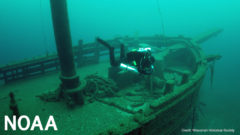
Federal officials have designated 962 square miles off of Wisconsin’s Lake Michigan coastline as a National Marine Sanctuary to protect historic shipwrecks in the area from Kewaunee County south to Ozaukee County. The designation will protect 36 shipwrecks, 21 of which are on the National Register of Historic Places and may include as many as 60 additional shipwrecks. Read the full story by Madison.com.

Original Article

Great Lakes Commission

Great Lakes Commission

https://www.glc.org/dailynews/20210623-shipwreck-sanctuary

Patrick Canniff

A postdoctoral fellow at McMaster University in Hamilton who studies bird behavior and communication spent two weeks gathering trash along a 7 km stretch of shoreline and found 380 balloons. The plastic balloons found mark some of the biggest milestones in our lives: births, deaths, graduations, homecomings, engagements, and gender reveal parties end up in the Great Lakes by the hundreds of thousands. Read the full story by CBC News.

Original Article

Great Lakes Commission

Great Lakes Commission

https://www.glc.org/dailynews/20210623-pollution

Patrick Canniff

The Ohio Department of Agriculture has been awarded a $2 million Great Lakes Restoration Initiative  program grant from the United State Environmental Protection Agency to help administer the H2Ohio initiative across the Maumee River Watershed. The grant project will run through October 2024 to support H2Ohio’s long-term work to improve water quality across the Maumee Watershed. View images by Ohio’s Country Journal.

Original Article

Great Lakes Commission

Great Lakes Commission

https://www.glc.org/dailynews/20210623-ohio-water-quality

Patrick Canniff

With the passing of colors and brief remarks from each, command of the Corps’ Great Lakes and Ohio Division passed from Maj. Gen. Robert F. “Bob” Whittle Jr. to Col. Kimberly “Kim” A. Peeples in a June 11 change of command ceremony. Read the full story by The Waterways Journal.

Original Article

Great Lakes Commission

Great Lakes Commission

https://www.glc.org/dailynews/20210623-army-corps-great-lakes

Patrick Canniff

Lake Michigan has weathered seasons of smelly and slimy shores in decades past. The 1960s and ’70s were especially dire and demanded human intervention in order for clean water to be restored. Salmon stocking and introduction are credited for assisting in the clean up and slashing the invasive alewife population by 90% of its peak. Read the full story by WOOD – TV – Grand Rapids, MI.

Original Article

Great Lakes Commission

Great Lakes Commission

https://www.glc.org/dailynews/20210623-fish

Patrick Canniff

A four-year research project funded by the Canadian government, looking into the impact of microplastics on freshwater ecosystems and on agricultural soils will have important implications for the Great Lakes. It will measure microplastic levels in wastewater from treatment plants draining into Ontario rivers and streams that feed into the Great Lakes. Researchers hope to better understand which treatments are best able to deal with microplastics. Read the full story by GreatLakesNow.

Original Article

Great Lakes Commission

Great Lakes Commission

https://www.glc.org/dailynews/20210623-plastic-pollution

Patrick Canniff

NOAA to designate Wisconsin coastline as national sanctuary

MADISON, Wis. (AP) — Federal officials have designated a huge swath of Wisconsin’s Lake Michigan coastline as a National Marine Sanctuary to protect historic shipwrecks in the area, Gov. Tony Evers’ office announced Tuesday.

The National Oceanic and Atmospheric Administration will publish regulations designating 962 square miles from Kewaunee County south to Ozaukee County as a sanctuary, Evers’ office said.

Read Now at Great Lakes Now.

Original Article

Great Lakes Now

Great Lakes Now

https://www.greatlakesnow.org/2021/06/ap-noaa-wisconsin-coastline-national-marine-sanctuary-designated/

The Associated Press

Dangerous currents can be caused by winds and waves on beaches and often form around islands or piers, as well. They are a hidden but lethal hazard. Across the Great Lakes, an average of 11 drownings and 23 rescues happen related to dangerous currents every year.

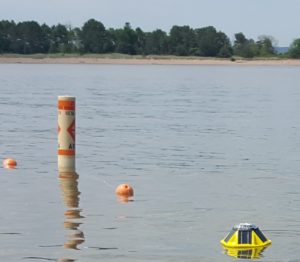
This is the spotter sensor (right) that was deployed off Park Point recently for the Dangerous Currents Project. Image credit: Jerry Henneck, Natural Resources Research Institute

Local water researchers studying dangerous currents want the public to know they’ll be active on the Lake Superior beaches of Park Point this summer. One of their activities in July will turn the lake water a fluorescent yellow green with a nontoxic dye to trace water currents as part of a safety project to predict dangerous currents. Research equipment will also be deployed into swimming waters off the shore. A spotter sensor (a buoy that measures waves and temperature) was deployed last week off Park Point, and a GPS drifter tracker will go in the water in July.

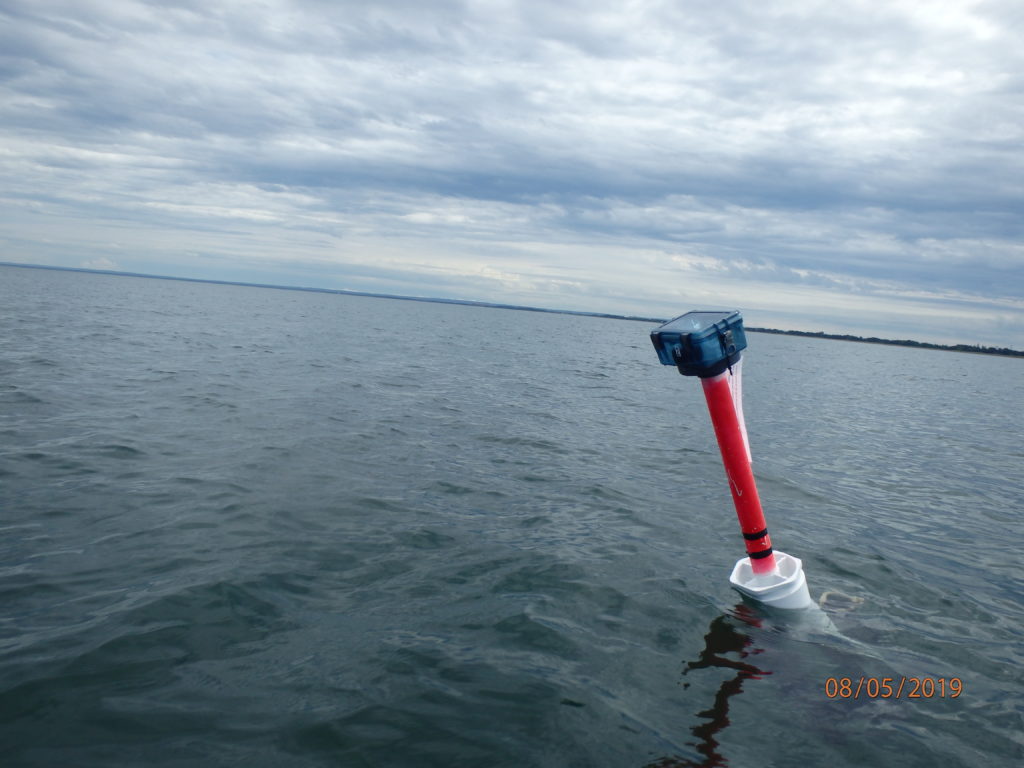
Chin Wu, one of the lead researchers with the project and a professor of civil and environmental engineering at the University of Wisconsin-Madison, explains what the research activities will entail. “The spotter sensor is a basketball-sized, solar-powered yellow buoy that will be anchored. The GPS drifter tracker looks rather like a red post floating upright in the water. It will be drifting with the current. We’d appreciate it if the public would allow the equipment to operate. We plan to release the dye after a storm. It’s the same type used by the military to spot downed pilots in the ocean or track leaks in sewer pipes. It’s nontoxic and disperses within 45 minutes.”

The project involves a team of personnel in Wisconsin and Minnesota who are working to better understand and characterize dangerous currents along Lake Superior’s South Shore, improve the ability to predict when and where they will form, and develop a framework for public safety warnings and education programs. The project is focusing on six locations: three on Park Point, and one each in Port Wing, the Apostle Islands and Chequamegon Bay.

While on the beach this summer, Park Point beachgoers might also notice signs requesting them to take a survey. Results of this survey will be used to guide water safety efforts in the future.

Funding for the project is provided by the Wisconsin and Minnesota Sea Grant programs. Other partners include the National Oceanic and Atmospheric Administration’s National Weather Service, the Wisconsin Coastal Management Program, the Great Lakes Environmental Research Laboratory; the University of Minnesota and the University of Minnesota Duluth, the Natural Resources Research Institute and the University of Wisconsin-Madison.

A GPS drifter tracker in Lake Superior. Image credit: Jerry Henneck, Natural Resources Research Institute

The post If you see bright yellow-green water off Park Point this summer, it’s OK first appeared on Wisconsin Sea Grant.

Original Article

News Releases | Wisconsin Sea Grant

News Releases | Wisconsin Sea Grant

https://www.seagrant.wisc.edu/news/if-you-see-bright-yellow-green-water-off-park-point-this-summer-its-ok/?utm_source=rss&utm_medium=rss&utm_campaign=if-you-see-bright-yellow-green-water-off-park-point-this-summer-its-ok

Marie Zhuikov

Piping Plovers: Despite new challenges, the birds make their comeback

When biologist Jillian Farkas stepped into the position of piping plover coordinator for the U.S. Fish and Wildlife Service in January 2020, there was no way she could have predicted just how unprecedented the coming season would be.

Her role involves coordinating dozens of scientists and volunteers across six states, two tribes and multiple government agencies—all to help preserve the endangered Great Lakes population of piping plovers.

Read Now at Great Lakes Now.

Original Article

Great Lakes Now

Great Lakes Now

https://www.greatlakesnow.org/2021/06/piping-plovers-recovery-population/

Lorraine Boissoneault

Although Great Lakes water levels are down, the risk of coastal erosion remains high, Michigan State University researchers say. Now, the researchers are enlisting “citizen scientists” to assist in helping better understand coastal change.

The post Researchers seek volunteers to document coastal erosion in Michigan first appeared on Great Lakes Echo.

Original Article

Great Lakes Echo

Great Lakes Echo

http://greatlakesecho.org/2021/06/23/researchers-seek-volunteers-to-document-coastal-erosion-in-michigan/

Guest Contributor

ANN ARBOR, MICH. (June 22, 2021) – The Healing Our Waters-Great Lakes Coalition sent a letter to Congress advocating for full funding for the Great Lakes Restoration Initiative at $375 million for the 2022 fiscal year. The letter was signed by 93 Coalition members and can be read in full below.


HOW FY2022 GLRI Appropriations Final (6.22.21)

The post Coalition Members Call for Full Funding of GLRI at $375 Million appeared first on Healing Our Waters Coalition.

Original Article

Healing Our Waters Coalition

Healing Our Waters Coalition

https://healthylakes.org/coalition-members-call-for-full-funding-of-glri/

Lindsey Bacigal

The NOAA Great Lakes Environmental Research Laboratory (GLERL) and partners recently deployed a buoy in Lake Champlain that will measure the lake’s wave heights to assess the accuracy of a new experimental model for the lake. This is part of … Continue reading

Original Article

NOAA Great Lakes Environmental Research Laboratory

NOAA Great Lakes Environmental Research Laboratory

https://noaaglerl.blog/2021/06/22/new-wave-buoy-will-provide-data-to-support-wave-and-flood-forecasting-on-lake-champlain/

Gabrielle Farina

The University of Wisconsin Water Resources Institute (WRI) won a communications award in an international competition sponsored by the Council for Advancement and Support of Education, an association that shares strategies and tactics to engage alumni, donors, prospective students, parents, government officials, community leaders and those in the private sector to support education.

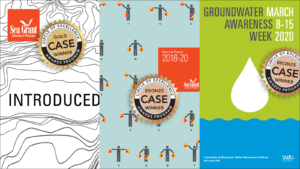
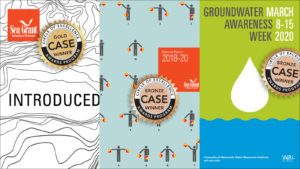
An invitation designed by Yael Gen for an event commemorating Groundwater Awareness Week won a bronze award. Judges said the creative team “clearly thought about their various audiences when they were producing this highly effective piece. This is a modern, striking design that is simplistic, but not simple.”

WRI’ sister organization, Sea Grant, also won two awards. The podcast series Introduced, produced by Bonnie Willison and student Sydney Widell about aquatic invasive species, won a gold award and the 2018-20 Sea Grant biennial report won a bronze award. The report was designed by Yael Gen, edited by Elizabeth White and written by Moira Harrington.

The post WRI wins communications award first appeared on WRI.

Original Article

News Release – WRI

News Release – WRI

https://www.wri.wisc.edu/news/wri-wins-communications-award/

Moira Harrington

Sea Grant won two communications awards in an international competition sponsored by the Council for Advancement and Support of Education, an association that shares strategies and tactics to engage alumni, donors, prospective students, parents, government officials, community leaders and those in the private sector to support education.

The podcast series Introduced, produced by Bonnie Willison and student Sydney Widell about aquatic invasive species, won a gold award. Judges said, “We loved that the hosts reported their stories by finding interesting leads and then going into the field to investigate and interview the people involved…The back-and-forth between the hosts is comfortable and welcoming, and there’s good use of music throughout.”

The 2018-20 Sea Grant biennial report won a bronze award. The report was designed by Yael Gen, edited by Elizabeth White and written by Moira Harrington. Judges said, “Such a fun and creative design! The signal flag theme and visual identity are smart and unusual, and we agree with the nominators that the design captures the zeitgeist of this time period. Rough waters indeed! The graphic elements added inside flowing type are hard to pull off, but pull them off they did, creating something that’s not just visually interesting but rewards the viewer upon their closer inspection. For not being able to commission photography, they have done a wonderful job of creating visual excitement on each layout; it’s like a master class in how to get around COVID photography restrictions.”

An invitation designed by Yael Gen for an event commemorating Groundwater Awareness Week also won a bronze award that went to Sea Grant’s sister organization, the University of Wisconsin Water Resources Institute.

The competition drew 2,957 entries from around the world, including from prestigious Ivy League schools and respected international institutions.

The post Sea Grant wins communications awards first appeared on Wisconsin Sea Grant.

Original Article

News Releases | Wisconsin Sea Grant

News Releases | Wisconsin Sea Grant

https://www.seagrant.wisc.edu/news/sea-grant-wins-communications-awards/?utm_source=rss&utm_medium=rss&utm_campaign=sea-grant-wins-communications-awards

Moira Harrington

Plastic Impact: Canada launches multi-year study of microplastics in water and soil

A four-year research project looking into the impact of microplastics on freshwater ecosystems and on agricultural soils will have important implications for the Great Lakes, said its principal researcher.

Funded by the Canadian government, the $1-million project was announced in May. It will measure microplastic levels in wastewater from treatment plants draining into Ontario rivers and streams that feed into the Great Lakes.

Read Now at Great Lakes Now.

Original Article

Great Lakes Now

Great Lakes Now

https://www.greatlakesnow.org/2021/06/canada-microplastics-study-wastewater-impact/

Sharon Oosthoek

The GLRI, launched in 2010 by the Obama administration and funded with bipartisan support by the U.S. Congress, began with an initial budget of $475 million in its first year, and roughly $300 million in each subsequent year through 2020, when it jumped to $320 million. Read the full story by The Voice News.

Original Article

Great Lakes Commission

Great Lakes Commission

https://www.glc.org/dailynews/20210621-glri

Jill Estrada

PFAS, short for per- and polyfluoroalkyl substances, are a group of widespread man-made chemicals that don’t break down in the environment or the human body and have been flagged as a major contaminant in sources of water across the country. Read the full story by Great Lakes Now.  

Original Article

Great Lakes Commission

Great Lakes Commission

https://www.glc.org/dailynews/20210621-pfas

Jill Estrada

The announcement Friday amounted to a swap of assets — with the Alder heading for a year of maintenance and then permanent residency in San Francisco, while USCG Cutter Spar will be bound for Duluth, Minnesota in spring 2022. Read the full story by the Duluth News Tribune.

Original Article

Great Lakes Commission

Great Lakes Commission

https://www.glc.org/dailynews/20210621-alder-cutter

Jill Estrada

The Biden administration is rewriting how it protects endangered species — making significant shifts in regulations that could affect how habitat is kept safe for these and other imperiled birds, fish, insects, mammals and plants across the United States. Read the full story by Maryland Matters.

Original Article

Great Lakes Commission

Great Lakes Commission

https://www.glc.org/dailynews/20210621-endangered-species

Jill Estrada

The story of Monty and Rose, a breeding pair of piping plovers, is being retold in a children’s book, with proceeds from its sale benefiting a study to boost the population of the endangered Great Lakes piping plover. Read the full story by the Block Club Chicago. 

Original Article

Great Lakes Commission

Great Lakes Commission

https://www.glc.org/dailynews/20210621-piping-plover

Jill Estrada

Eighteen beaches in Benzie, Grand Traverse, and Leelanau counties showed satisfactory water quality after test results were released for harmful levels of E. coli bacteria Thursday morning. This was the first of weekly testing that will occur every Wednesday until Sept. 8. Read the full story by the Traverse City Record-Eagle.

Original Article

Great Lakes Commission

Great Lakes Commission

https://www.glc.org/dailynews/20210621-beach-monitoring

Jill Estrada

A decree allowing native tribal members fishing rights, but regulating the types of gear and fishing areas used, is currently under negotiation after it was set to expire on Summer 2020. The deadline has been extended to June 30, 2021. Read the full story by the Traverse City Record-Eagle.

Original Article

Great Lakes Commission

Great Lakes Commission

https://www.glc.org/dailynews/20210621-native-fishing

Jill Estrada

Federal authorities have charged the owner and manager of more than 100 buildings in Buffalo with conspiracy for violating laws intended to protect tenants from lead paint poisoning.

The post Feds file conspiracy charges against owner, manager, of Buffalo properties with long-running lead paint violations first appeared on Great Lakes Echo.

Original Article

Great Lakes Echo

Great Lakes Echo

http://greatlakesecho.org/2021/06/21/feds-file-conspiracy-charges-against-owner-manager-of-buffalo-properties-with-long-running-lead-paint-violations/

Eric Freedman

...SPECIAL WEATHER STATEMENT... At 708 AM CDT, Doppler radar was tracking a cluster of strong thunderstorms over east-central Wisconsin from Green Bay to Appleton eastward to Lake Michigan. Movement was east at 50 mph. Half inch hail will be possible with these storms. Locations impacted include...

Original Article

Current Watches, Warnings and Advisories for Brown (WIC009) Wisconsin Issued by the National Weather Service

Current Watches, Warnings and Advisories for Brown (WIC009) Wisconsin Issued by the National Weather Service

https://alerts.weather.gov/cap/wwacapget.php?x=WI1261A6C5FD68.SpecialWeatherStatement.1261A6C62090WI.GRBSPSGRB.d65efe55088dd94d9c460efb2df919a6

w-nws.webmaster@noaa.gov

...STRONG THUNDERSTORM MOVING INTO EAST-CENTRAL WISCONSIN... At 556 AM CDT, Doppler radar was tracking a strong thunderstorm over Clintonville, or 13 miles southwest of Shawano, moving east at 55 mph. Penny size hail and winds in excess of 30 mph will be possible with this storm.

Original Article

Current Watches, Warnings and Advisories for Brown (WIC009) Wisconsin Issued by the National Weather Service

Current Watches, Warnings and Advisories for Brown (WIC009) Wisconsin Issued by the National Weather Service

https://alerts.weather.gov/cap/wwacapget.php?x=WI1261A6C5C1A4.SpecialWeatherStatement.1261A6C5E404WI.GRBSPSGRB.7520cb428c3c67ad07be789df893eb3c

w-nws.webmaster@noaa.gov

...SIGNIFICANT WEATHER ADVISORY FOR SOUTHWESTERN BROWN...NORTHWESTERN CALUMET...NORTHERN WINNEBAGO...SOUTHEASTERN WAUPACA AND SOUTHERN OUTAGAMIE COUNTIES UNTIL 515 AM CDT... At 430 AM CDT, Doppler radar was tracking a strong thunderstorm near Fremont, or 11 miles east of Waupaca, moving east at 40 mph. Pea size hail and winds to 45 mph will be possible with this storm.

Original Article

Current Watches, Warnings and Advisories for Brown (WIC009) Wisconsin Issued by the National Weather Service

Current Watches, Warnings and Advisories for Brown (WIC009) Wisconsin Issued by the National Weather Service

https://alerts.weather.gov/cap/wwacapget.php?x=WI1261A6C5906C.SpecialWeatherStatement.1261A6C5B13CWI.GRBSPSGRB.670272ffdeab82d92d5ab990673d0435

w-nws.webmaster@noaa.gov

THIS WEEKJuneteenth — How Freedom Has Evolved + Chemical Companies Hid Health Dangers of Forever Chemicals + Sturgeon For Tomorrow Black Lake Chapter Receives Grant for Sturgeon Restoration in Saginaw Bay + Community Summer Events


Juneteenth — How Freedom Has Evolved 

     By Brandon Tyus

As an African American team member of Freshwater Future, I’d like to comment on recent progress to address inequities and justice. We’ve gone from being brought to American soils on someone else’s accord, to increasing our number of people now sitting at the table to make decisions to better our community, to the adoption this week of Juneteenth as a federal holiday. We fight so hard every day to rectify the disparity in equity, so let us use Juneteenth to recognize how far we’ve come. To relish in our wins in water and freedom.


Chemical Companies Hid Health Dangers of Forever Chemicals

Industry research indicates that severe health risks from newer PFAS used in food packaging was hidden by chemical companies from the U.S. Food and Drug Administration (FDA).  The reporting revealed that these newer chemicals, sometimes called “short-chain” PFAS, accumulate and are toxic, similar to the longer chain chemicals. As a result, our pizza boxes, take out containers, and other food packaging are exposing us to these damaging chemicals.  


Sturgeon For Tomorrow Black Lake Chapter Receives Grant for Sturgeon Restoration in Saginaw Bay

The Black Lake Chapter was awarded $8,000 to help increase the lake sturgeon population in Saginaw Bay through the Conservation Fund and the Bay Area Community Foundation. The Black Lake Chapter will use these funds to stock 1,500 fall fingerling lake sturgeon over three years in the Saginaw Bay watershed, helping to restore these long-lived fish. 


Summer Community Events

Water Celebration – Menominee River

Water Celebration on July 16th, 2021 is a gathering in Stephenson Island, Wisconsin to support protection from mining contamination of the Menominee River. Great speeches and fun activities are featured at this outdoor event. Learn more here.

Water is Life Festival September 4, 2021

The Water is Life Festival is an annual event that celebrates our connection to the water and builds power through community so we can work towards living in a holistic way with water and protect it from those who seek to exploit or endanger it. The festival is held Saturday, September 4th before Labor Day in Mackinaw City, Michigan. 


Original Article

Blog – Freshwater Future

Blog – Freshwater Future

https://freshwaterfuture.org/freshwater-weekly/freshwater-future-weekly-june-18-2021/

Freshwater Future

For the second consecutive year, experts are anticipating Lake Erie’s seasonal harmful algal bloom will be smaller than the year before, according to the most recent early projection made by the National Oceanic and Atmospheric Administration. Read the full story by the Port Clinton News Herald.

Original Article

Great Lakes Commission

Great Lakes Commission

https://www.glc.org/dailynews/20210618-hab

Ken Gibbons

The Lake Superior Magazine is recognizing a Marquette County partnership for its dedication to Lake Superior. The Superior Watershed Partnership was named the recipient of the 2020 Achievement Award for its significant contribution to Lake Superior and surrounding communities. Read the full story by WLUC-TV- Marquette, MI.

Original Article

Great Lakes Commission

Great Lakes Commission

https://www.glc.org/dailynews/20210618-award

Ken Gibbons

Along the beaches and coastal areas of Saugeen Shores, Ontario don’t be surprised to see youth participants in the Coastal Conservation Youth Corps this summer. The program gives high school aged students a summer opportunity to take action on conservation and restoration projects. Read the full story by the Shoreline Beacon.

Original Article

Great Lakes Commission

Great Lakes Commission

https://www.glc.org/dailynews/20210618-youth-program

Ken Gibbons

University of Wisconsin-Green Bay is receiving a boost in its effort to designate the Bay of Green Bay as a national research site. On Thursday afternoon, the state provided nearly $49,788 to help in the process. Read and view the full story by WLUK-TV- Green Bay, WI.

Original Article

Great Lakes Commission

Great Lakes Commission

https://www.glc.org/dailynews/20210618-greenbay

Ken Gibbons