Scientists agree on the source of Great Lakes microplastics pollution: people. What remains far less clear is how microplastics move through the system, where they collect, and why some waters appear far more contaminated than others. Read the full story by The Plain Dealer.

Original Article

Great Lakes Commission

Great Lakes Commission

https://www.glc.org/dailynews/20251215-microplastics

Autumn McGowan

In the face of growing interest in Ohio as a data center hub, some people are worried about Ohio’s ability to keep up with the energy needs associated with these projects. A new report argues that an efficient energy permitting process is a key to making sure enough energy is available to continue to have these sorts of centers in the state without subjecting the state to soaring energy costs. Read the full story by Ohio Capital Journal.

Original Article

Great Lakes Commission

Great Lakes Commission

https://www.glc.org/dailynews/20251215-ohio-energy

Autumn McGowan

A long-planned revival of Elberta, Michigan’s, historic Lake Michigan waterfront is moving into its next phase after the state approved a parkland acquisition grant and the village selected a developer to lead public design work for a mixed-use site. Read the full story by MLive.

Original Article

Great Lakes Commission

Great Lakes Commission

https://www.glc.org/dailynews/20251215-elberta-development

Autumn McGowan

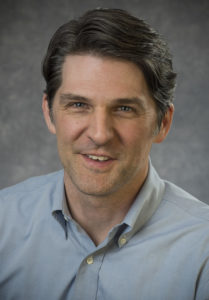
Joel Brammeier headshot.
Joel Brammeier, ​President & CEO

I have always believed that progress on the Great Lakes happens when patience meets persistence. The challenges facing our waters rarely appear overnight. They build slowly, shaped by years of pressure, changing landscapes, and decisions that ripple far beyond one moment. And then there comes a year when the needle moves. A year when the long work begins to pay off. 

Thanks to your support, 2025 was that kind of year. 

Stopping Invasive Species Before They Spread More 
After years of advocacy, the U.S. Army Corps of Engineers broke ground on the critical invasive carp barrier at Brandon Road Lock and Dam in Illinois. Construction is now underway, and we are working closely with partners to ensure every phase continues as planned. This milestone brings us closer to keeping invasive carp out of the Great Lakes for good. 

Restoring and Protecting the Lakes We Share 
This year, we helped shape the next chapter of the federal Great Lakes Restoration Initiative. The updated program will better address environmental justice and climate impacts, making sure federal investments reach communities that need them most. Our lakes deserve solutions that reflect the realities of today and the future we are preparing for. 

Defending Clean Water Infrastructure 
Federal funding cuts threatened the ability of overburdened communities to replace lead service lines, fix outdated sewers, and protect families from contaminated water. Our policy experts broke down the consequences, giving members of Congress and partners clear, actionable analysis to push back. Their response showed how much this work matters and how deeply people care about protecting safe drinking water 

Reducing Plastic Pollution, One Policy at a Time 
Our efforts to curb microplastic pollution gained traction at the state level. The Illinois Senate and a House committee advanced a phaseout of single-use foam food containers. While the bill did not pass this session, this progress signals growing momentum. With continued advocacy, our region is poised to become a national leader in reducing plastic waste. 

People Power: Volunteers and Advocates Making Change 
In 2025, more than 10,000 Adopt-a-Beach volunteers cleaned shorelines across all five lakes. Their work fuels the largest litter database of its kind, guiding researchers and policymakers who rely on the truth their data reveals. Supporters also sent over 13,000 messages to decision-makers, reminding leaders that people are paying attention and that clean water is not optional. 

Securing Safe, Affordable Water for Every Community 
Our State Revolving Fund Advocates Forum grew to more than 230 members nationwide. This network helps communities learn how to access federal infrastructure funding and strengthen local drinking water and wastewater systems. Clean water should not depend on your ZIP code. This work helps make sure it doesn’t. 

Addressing Flooding and Sewage Overflows 
We launched the Flooding and Sewage Coalition in Southern Lake Michigan to support communities facing basement backups, chronic flooding, and failing wastewater systems. We are also developing a Flooding and Sewage Vulnerability Tool that will help agencies identify risks and build better protections. Families deserve homes that stay dry and water systems that work. 

Guarding Against Unsustainable Water Use 
This year, our report on water use revealed that the Great Lakes region is not prepared for growing demands from data centers, agriculture, mining, and other major water users. We identified the lack of transparency in water withdrawal decisions and called for policies that protect both economic development and the long-term health of our water. The report sparked local and national attention, signaling a turning point in how we plan for the future. 

Fighting Harmful Algal Blooms with Better Data 
In Michigan’s Western Lake Erie Basin, our coalition implemented a high-density network of monitors at fifty locations. These sensors started collecting continuous data this spring, giving state leaders, farmers, and conservation groups better tools to reduce phosphorus pollution and harmful algal blooms. 

Exposing Nitrate Pollution in Drinking Water 
Our report on nitrate contamination in Wisconsin revealed how thousands of families are paying higher water costs and facing serious health risks due to fertilizer and manure pollution. The recommendations offer a blueprint that other states can follow to protect public health and reduce agricultural pollution. We all depend on clean water, and this research helps chart a path forward. 

Looking Ahead 
Every win this year was fueled by people like you. Whether you volunteered, advocated, donated, or shared our work with someone who needed to hear it, your actions made a difference. 
The Great Lakes hold the stories of millions of people who rely on them every day. When we protect these waters, we protect our collective future. And while there is much more to do, 2025 proved that steady, determined progress is not only possible but powerful. 

Thank you for believing in clean, safe, and abundant water for all. 
  

Keep the Progress Going

Donate today to protect fresh, clean, and safe water, and support our work to preserve our  Great Lakes. 

Give a Gift Today

The post 2025 Accomplishments appeared first on Alliance for the Great Lakes.

Original Article

News - Alliance for the Great Lakes

News - Alliance for the Great Lakes

https://greatlakes.org/2025/12/2025-accomplishments/

Michelle Farley

The village of Elberta, Michigan, has been awarded a $5.3 million grant from the Michigan Department of Natural Resources for the development of a waterfront park. The park project will be on 16 acres of property near the mouth of Betsie Bay, including Lake Michigan shoreline, which will eventually be transferred to the village from the Grand Traverse Regional Land Conservancy. Read the full story by Benzie County Record Patriot.

Original Article

Great Lakes Commission

Great Lakes Commission

https://www.glc.org/dailynews/20251212-waterfront-park-elberta

Hannah Reynolds

John U. Bacon spent nearly four years researching and writing his new book about the Edmund Fitzgerald. The public has caught on to the new release titled The Gales of November: The Untold Story of the Edmund Fitzgerald. Read the full story by the Detroit Free Press.

Original Article

Great Lakes Commission

Great Lakes Commission

https://www.glc.org/dailynews/20251212-john-u-bacon-edmund-fitzgerald-book

Hannah Reynolds

If the predictions turn out to be accurate, it will be a second year in row of normal ice cover on the Great Lakes – a reprieve, given that winter is changing the most. The season has shortened by several weeks and is becoming increasingly warmer and wetter. Read the full story by Milwaukee Journal Sentinel.

Original Article

Great Lakes Commission

Great Lakes Commission

https://www.glc.org/dailynews/20251212-winter-ice-cover-impacts-greatlakes

Hannah Reynolds

Two municipalities in northeast Wisconsin are getting federal funding to replace lead service lines. More than $159 million has been allocated to 29 municipalities across the state, including Manitowoc and Oshkosh, to ensure Wisconsinites have access to clean, safe drinking water that is free of lead. Read the full story by WTAQ – Green Bay, WI.

Original Article

Great Lakes Commission

Great Lakes Commission

https://www.glc.org/dailynews/20251212-manitowoc-oshkosh-replace-lead-water-lines

Hannah Reynolds

Michigan House Republicans have unilaterally blocked about $8.3 million in spending aimed at helping residents of Flint deal with the long-term fallout of the drinking water crisis, as the GOP leader, Speaker Matt Hall, said the emergency in the city is over. Read the full story by The Detroit News.

Original Article

Great Lakes Commission

Great Lakes Commission

https://www.glc.org/dailynews/20251212-house-speaker-flint-watercrisis

Hannah Reynolds

Research shows that the United States would need to invest nearly $3.4 trillion over the next 20 years to sufficiently fix and update its drinking water, wastewater and stormwater infrastructure. Much of the country’s water infrastructure was built 40 to 50 years ago and is showing its age. Michigan’s is no exception. Read the full story by Great Lakes Echo.

Original Article

Great Lakes Commission

Great Lakes Commission

https://www.glc.org/dailynews/20251212-michigan-water-infrastructure-work

Hannah Reynolds

The U.S. Coast Guard Sector Northern Great Lakes began ice-breaking operations in the Great Lakes on Wednesday for the winter shipping season. Currently, the U.S. Coast Guard cutter Spar will manage the ice-breaking needs of Western Lake Superior, specifically Duluth, Minnesota, and Superior, Wisconsin. Read the full story by WXYZ-TV – Detroit, MI.

Original Article

Great Lakes Commission

Great Lakes Commission

https://www.glc.org/dailynews/20251212-coastguard-ice-breaking-greatlakes

Hannah Reynolds

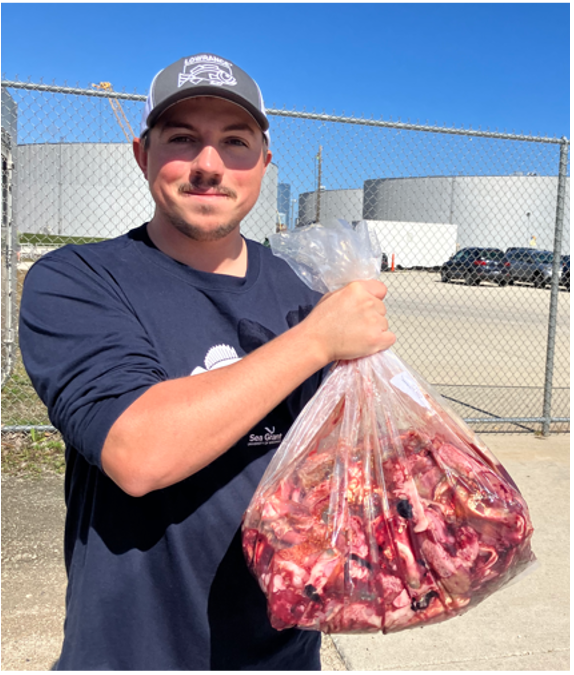
A man in a blue shirt and white hat holds up a big bag of red fish guts

UW–Milwaukee graduate student Kyle Freimuth holding a bag of fish byproducts. Photo: Sharon Moen

When Wisconsin Sea Grant’s Eat Wisconsin Fish team posted the question, “What would you do with a pile of fish guts?,” social media users from across the state creatively responded with ideas that included:

  • Make fly traps
  • Donate them to the raptor center in Spooner
  • Feed them to mink at a mink farm
  • And  – less helpfully – place them under my brother’s car seat on a sweltering July day

“Fertilizer” was the most popular answer to this post, which was one of several that boosted the 100% Wisconsin Fish Contest. The contest ran from September 16-October 24, 2025. It was part of a broader effort to highlight Wisconsin’s sustainable fisheries and the 100% Great Lakes Fish Initiative, which promotes full use of commercially harvested fish – including byproducts.

Grace Elonen of Omro, Wisconsin, submitted the winning entry. She wrote:

“Fish scales are often the first part discarded when harvesting. Fish scales and skin are comprised of collagen… Knowing the collagen source was sustainably harvested is a good selling point. Knowing the collagen came from our own Great Lakes would be even better. Tagline: Take a little bit of the Great Lakes with you everywhere.”

John Schmidt, program manager for the Conference of the Great Lakes St. Lawrence Seaway Governors and Premiers (GSGP) 100% Great Lakes Fish Initiative, praised the idea. “Collagen from Great Lakes fish scales and skins squarely advances 100% fish goals, has multiple markets, and we’ve already flagged collagen as one of the best-case strategies for the region,” he said.

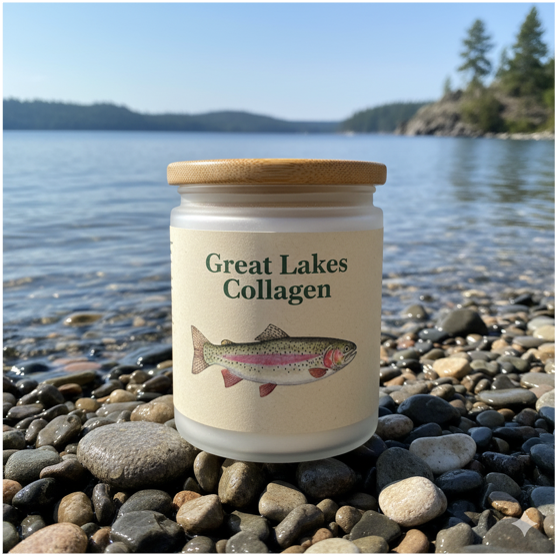
An AI-generated image of a glass jar of fish collagen sitting on a rocky beach

The winning idea for using more parts of a fish involved scales and skin. Photo credit: Gemini AI-generated image submitted by Grace Elonen.

Judges – including Schmidt, two commercial fishers, and a University of Wisconsin-Madison undergraduate – commended Elonen’s regional branding concept, noting that taglines like the one Elonen offered underscore both local pride and market potential.

Charlie Henriksen, co-owner of Henriksen Fisheries and a contest judge, applauded the thoughtfulness behind many submissions. “All the ideas had some value, and I appreciate the people who provided serious replies,” he said.

He gave special mention to making dog treats from dehydrated fish skins and using fish parts for stock. When it comes to fish stock, he said, “The issue to overcome is producing a stock with consistent flavor and texture. Many chowders now use clam juice, so a genuine whitefish stock would be valuable.”

Led by GSGP, the 100% Great Lakes Fish Initiative brings together dozens of partners – including Wisconsin Sea Grant and Wisconsin commercial fishers, fish farmers, and processors – to demonstrate how every part of Great Lakes fish can be used for food, products, and other innovative purposes. Wisconsin Sea Grant’s online contest may serve as a model for similar efforts in other Great Lakes states according to Schmidt.

The contest was made possible through support from GSGP, along with interns Kyle Freimuth and Wyatt Slack, and Wisconsin Sea Grant’s communications team. Special thanks to judges Charlie Henriksen (Henriksen Fisheries), Jessica Resac (Halvorson Fisheries), John Schmidt (GSGP), and UW–Madison undergraduate Wyatt Slack.

The post Guts and glory: Thinking beyond the fillet first appeared on Wisconsin Sea Grant.

Original Article

News Releases | Wisconsin Sea Grant

News Releases | Wisconsin Sea Grant

https://www.seagrant.wisc.edu/news/guts-and-glory-thinking-beyond-the-fillet/

Andrew Savagian

News

New Great Lakes water use report demonstrates shared stewardship of the world’s largest freshwater system

Ann Arbor, Michigan/Chicago, Illinois — A report released today on Great Lakes water use demonstrates the region’s ongoing commitment to coordinated, science-based management of the world’s largest freshwater system. The 2024 Annual Report of the Great Lakes Regional Water Use Database shows that water withdrawals in the basin remained stable, with the vast majority of withdrawn water returned to the Great Lakes St. Lawrence River Basin.

Overall, the basin gained a total of 345 million gallons of water per day in 2024; by comparison, the basin lost 550 million gallons per day in 2023. This change is primarily due to an increase in the amount of water diverted from the Hudson Bay watershed into the Lake Superior basin through the Long Lac and Ogoki diversions in northern Ontario.

The report found that 35.7 billion gallons of water per day were withdrawn from the Great Lakes basin in 2024, representing a less than 1% increase from 2023. Just under 5% of the total reported water withdrawn was consumed or otherwise lost from the basin. Thermoelectric power production (once-through cooling), public water supply, and industrial use were the primary water use sectors.

The report’s findings were shared at the December meeting of the Great Lakes St. Lawrence River Basin Water Resources Council and the Great Lakes St. Lawrence River Water Resources Regional Body. Since 1988, the eight U.S. states and two Canadian provinces have reported water use data to the Great Lakes Commission, which compiles and summarizes these datasets into an annual report. This report meets requirements of the Great Lakes Compact and Agreement, and strengthens shared stewardship of the basin’s waters by improving access to consistent information on how water is withdrawn, used, and conserved across the region.

“This report gives the Great Lakes states and provinces the information needed to better manage water use in the largest surface freshwater system in the world, but also serves as an example of how interstate compact agencies can leverage each other’s strengths and share expertise to the benefit of everyone in the basin,” said Great Lakes Commission Chair Timothy Bruno, Great Lakes Program Coordinator at the Pennsylvania Department of Environmental Protection.

“The value of shared regional water use reporting is more evident than ever,” said Loren Wobig, chair of the Regional Body and Compact Council. “This reporting is an important tool in supporting the regional water resources management that is so vital to future development in the Great Lakes region.”

“For more than 15 years, the Compact and Agreement have provided a model for regional cooperation and responsible water management,” said Peter Johnson, deputy director of the Conference of Great Lakes St. Lawrence Governors & Premiers (GSGP). “This annual reporting initiative is central to advancing sound decision-making, sustainable economic development, and long-term protection of our region’s waters.”

The 2024 Annual Report of the Great Lakes Regional Water Use Database is available at waterusedata.glc.org.

# # #                             

The Great Lakes Commission, led by Chair Timothy Bruno, is a binational government agency established in 1955 to protect the Great Lakes and the economies and ecosystems they support. Its membership includes leaders from the eight U.S. states and two Canadian provinces in the Great Lakes basin. The GLC recommends policies and practices to balance the use, development, and conservation of Great Lakes water resources and brings the region together to address issues no single entity can tackle alone. Learn more at www.glc.org.

The Great Lakes St. Lawrence River Basin Water Resources Compact Council is comprised of the Governors of the eight Great Lakes States and is responsible for implementing the Great Lakes–St. Lawrence River Basin Water Resources Compact in the United States. The Compact, which is both State and U.S. Federal law, protects the largest freshwater body on earth.

The Great Lakes St. Lawrence River Water Resources Regional Body consists of the Governors of the eight Great Lakes States and the Premiers of Ontario and Québec. Formed under the Great Lakes–St. Lawrence River Basin Sustainable Water Resources Agreement, the Regional Body promotes coordinated review, information sharing, and cooperative action in managing Great Lakes water resources across the international border.

Contact

For media inquiries, please contact Beth Wanamaker, beth@glc.org.

Recent GLC News

Upcoming GLC Events

View GLC Calendar

Archives

Original Article

Great Lakes Commission

Great Lakes Commission

https://www.glc.org/news/wudb-121125

Beth Wanamaker

Library

Annual Reports of the Great Lakes Regional Water Use Database

Visit website to download PDFs |  Published Annually

The Annual Reports of the Great Lakes-St. Lawrence River Regional Water Use Database are available at the Great Lakes Regional Water Use website. The data are provided by the Great Lakes-St. Lawrence River states and provinces to the Great Lakes Commission, which serves as the database repository, under the Great Lakes-St. Lawrence River Basin Water Resources Compact and the Great Lakes St. Lawrence River Basin Sustainable Water Resources Agreement.

To download the latest report and historical reports, please visit: https://waterusedata.glc.org/

Original Article

Great Lakes Commission

Great Lakes Commission

https://www.glc.org/library/great-lakes-water-use-database-report

Laura Andrews