By Eric Freedman

Flashing light on warning signs near curves can slow drivers and reduce the odds of a crash during winter weather conditions, says a new study by Michigan State University engineers.

The post Winter makes curved roads dangerous; researchers seek solutions first appeared on Great Lakes Echo.

Original Article

Great Lakes Echo

Great Lakes Echo

https://greatlakesecho.org/2025/12/04/winter-makes-curved-roads-dangerous-researchers-seek-solutions/
Eric Freedman

The U.S. EPA is proposing to weaken the Clean Water Act by eliminating protections for many streams and wetlands that feed into the Great Lakes. This would put our drinking water, communities, and wildlife at risk.  

The EPA needs to hear from thousands of people who care about clean water. Your voice matters! The deadline to comment on the proposed rule is January 5, 2026. 

What’s happening?  

The EPA has proposed a revised definition of the “waters of the United States” that would drastically narrow which waters are protected under the Clean Water Act. The rule could remove safeguards for seasonal streams, small tributaries, and large areas of wetlands—including many waters that eventually flow into the Great Lakes.  

Weakening these protections would:  

  • Allow more pollution to enter rivers, lakes, and drinking water sources
  • Increase flooding by destroying wetlands that store stormwater
  • Raise costs for communities that must treat more contaminated water
  • Harm fish, wildlife, and recreation opportunities

More than 40 million people rely on the Great Lakes for drinking water. We cannot afford to roll back protections now.  

What you can do!  

Contact the U.S. EPA today and urge them to withdraw the proposed rule and uphold strong protections for all U.S. waters.  

  1. Draft your note to U.S. EPA.  
    • Start by explaining why clean water matters to you, whether you fish, boat, rely on a well, work in a water-related industry, or simply care about protecting the Great Lakes.  
    • Then ask EPA to withdraw the proposed rule and uphold strong protections for all U.S. waters. If it’s helpful, use some of the language below and make it your own.  
      I urge the U.S. EPA to withdraw the proposed revision to the definition of “waters of the United States.” Weakening this definition will remove protections from wetlands and streams that feed into our lakes and drinking water sources—including the Great Lakes.
      These waters filter pollution, reduce flooding, support fish and wildlife, and provide clean drinking water for millions of people, and yet the proposed rule gives little to no attention to the impacts on public health, water quality, and flood prevention that will result from removing these protections. Allowing more wetlands to be filled and more streams to be polluted shifts the burden onto communities, taxpayers, and water customers who must pay for increased treatment costs.  
      The Clean Water Act has protected the water in our nation’s lakes, rivers, and streams for more than 50 years, and 94% of Americans support strong safeguards. The EPA should strengthen—not weaken—protections for wetlands and streams. I urge you to withdraw the proposed rule and ensure that all waters that affect downstream water quality remain protected. 
  1. Submit your comment to the U.S. EPA. Go to https://www.regulations.gov/commenton/EPA-HQ-OW-2025-0322-0001 and follow the instructions.  

Take action by January 5th! And, if you have a minute, email alliance@greatlakes.org to let us know you contacted the EPA.

Thank you for speaking out to protect the Great Lakes! 

Tell U.S. EPA: Protect Our Streams & Wetlands

The U.S. EPA is proposing to weaken the Clean Water Act by eliminating protections for many streams and wetlands that feed into the Great Lakes. This would put our drinking water, communities, and wildlife at risk.

Submit Your Comment

The post Tell the U.S. EPA to Protect Our Streams and Wetlands appeared first on Alliance for the Great Lakes.

Original Article

News - Alliance for the Great Lakes

News - Alliance for the Great Lakes

https://greatlakes.org/2025/12/tell-the-u-s-epa-to-protect-our-streams-and-wetlands/

Judy Freed

Great Lakes whitefish are disappearing, largely due to an explosion of invasive mussels. These filter feeders consume much of the food that baby whitefish need to make it to adulthood.

But there may be some hope. Lake Superior, which has far fewer mussels than the other lakes, is the last refuge for whitefish. And another invasive species, the round goby, may be an unlikely ally in the fight against mussels.

This video was produced in partnership with @bridge.michigan

Learn more on the Great Lakes Now YouTube channel.

#GreatLakes #Whitefish #Fishing #Mussels #InvasiveSpecies
===========================================
Website: https://greatlakesnow.org
Facebook: https://www.facebook.com/greatlakesnow
X: https://www.x.com/greatlakesnow
Instagram: https://www.instagram.com/greatlakesnoworg
Newsletter: https://www.greatlakesnow.org/great-lakes-now-newsletter/

To learn more about supporting Detroit PBS and Great Lakes Now, visit https://www.detroitpbs.org/

The post Is there any hope for whitefish? appeared first on Great Lakes Now.

Original Article

Great Lakes Now

Great Lakes Now

https://www.greatlakesnow.org/2025/12/03/is-there-any-hope-for-whitefish/

Great Lakes Now

The Ontario Ministry of Natural Resources and Forestry (MNRF) has confirmed that quagga mussels have been found in the north end of Black Bay on Lake Superior, marking the latest appearance of the invasive species on the lake’s north shore. The mussels were first flagged earlier this month through a post on the iNaturalist app. Read the full story by CBC.

Original Article

Great Lakes Commission

Great Lakes Commission

https://www.glc.org/dailynews/20251203-quagga-mussels-spreading-lake-superior

Hannah Reynolds

The outcome of a municipal court trial in Shorewood, Wisconsin, could become a decisive flashpoint over public access to Lake Michigan’s shoreline. Similar legal battles have been settled in other Great Lakes states, but the topic hasn’t been litigated in Wisconsin. Read the full story by Milwaukee Journal Sentinel.

Original Article

Great Lakes Commission

Great Lakes Commission

https://www.glc.org/dailynews/20251203-public-walk-lake-michigan

Hannah Reynolds

The Wisconsin Department of Natural Resources is recommending a 39% reduction in the lake whitefish quota for commercial fishers in the Wisconsin waters of Lake Michigan but no change in Green Bay. Read the full story by the Milwaukee Journal Sentinel.

Original Article

Great Lakes Commission

Great Lakes Commission

https://www.glc.org/dailynews/20251203-dnr-whitefish-harvest-lakemichigan

Hannah Reynolds

Despite recent news of data center development in Michigan, the development boom is much more dramatic in Illinois and Ohio, two states that account for half of all operational facilities in the Great Lakes. Read the full story by The Detroit News.

Original Article

Great Lakes Commission

Great Lakes Commission

https://www.glc.org/dailynews/20251203-michigan-data-center-greatlakes

Hannah Reynolds

An environmental crisis is unfolding in Lake Erie, where plastic pollution has increased dramatically over the past decade despite widespread conservation efforts. The findings are dramatic in Cleveland, Ohio, but more so near the eastern end of Lake Erie, where researchers found up to 700,000 particles per kilometer – up from just 19,000 a decade ago. That’s surface-area plastic and does not account for whatever has sunk to the bottom. Read the full story by The Plain Dealer.

Original Article

Great Lakes Commission

Great Lakes Commission

https://www.glc.org/dailynews/20251203-lake-erie-plastic-crisis

Hannah Reynolds

Canadian builder, owner, and pilot of the houseboat, The Neverlanding, wanted to sail her through the Straits of Mackinac, down Lake Michigan to be in Chicago by Christmas. Wintry weather on the Great Lakes gave him second thoughts. Read the full story by the Detroit Free Press.

Original Article

Great Lakes Commission

Great Lakes Commission

https://www.glc.org/dailynews/20251203-huron-homemade-houseboat-captain-thumb

Hannah Reynolds

Earlier this summer, students from Alverno College in Milwaukee, Wisconsin, had the opportunity to build their skills in fish farming. The students, who raise yellow perch and a variety of plants in an aquaponics system on campus, teamed up with the University of Wisconsin–Stevens Point Northern Aquaculture Demonstration Facility (UWSP NADF) to boost their knowledge and tour other aquaculture operations in northern Wisconsin.

Aquaculture is the growing of fish, shellfish, algae, and other aquatic organisms in all types of water environments. It’s also the fastest-growing segment of agriculture worldwide.

“Although aquaculture is one of the last agricultural businesses that come to mind for our region, there are actually over 2,000 registered fish farms in Wisconsin that raise fish for food, bait, stocking, or ornamentals,” said Emma Hauser, aquaculture outreach specialist with Wisconsin Sea Grant and UWSP NADF.

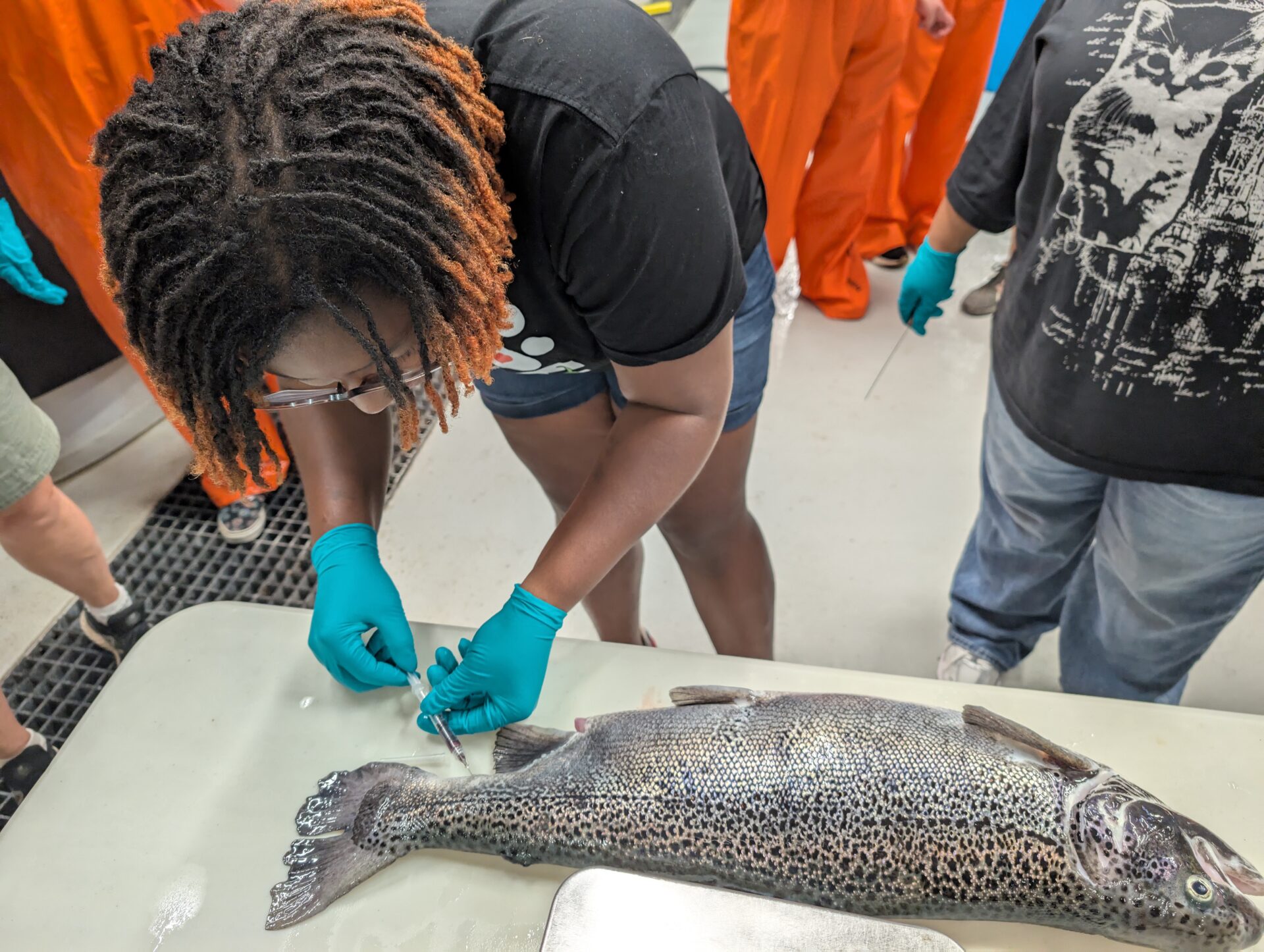
An Alverno student takes blood from an Atlantic salmon

An Alverno student takes a blood sample from an Atlantic salmon. Photo: Emma Hauser

Funding from the Great Lakes Aquaculture Collaborative (GLAC) made the field trip possible, allowing the students to travel nearly seven hours north to UWSP NADF, located in Bayfield, Wisconsin. Amy Schrank, Minnesota Sea Grant extension program leader and project lead of GLAC, said that aquaculture is a good STEM education and workforce development tool. 

“Students learn how to monitor water quality, care for fish, and get an idea of what it really takes to basically run a small business,” she said. 

The field trip began with an interactive tour of UWSP NADF, where students gained experience in the daily operation and maintenance of the facility’s aquaculture systems, which includes ponds and flow-through and recirculating systems. They also participated in research, trying their hands (and arms) at securing nearly 30-pound Atlantic salmon for data collection that included height, weight, fat meter readings, and blood and mucus samples. 

“Giving students a literal hands-on education in aquaculture is so important, especially since many students have never handled or even touched a fish before,” said Hauser. “This interaction isn’t only about learning but also about sparking interest in future careers.”

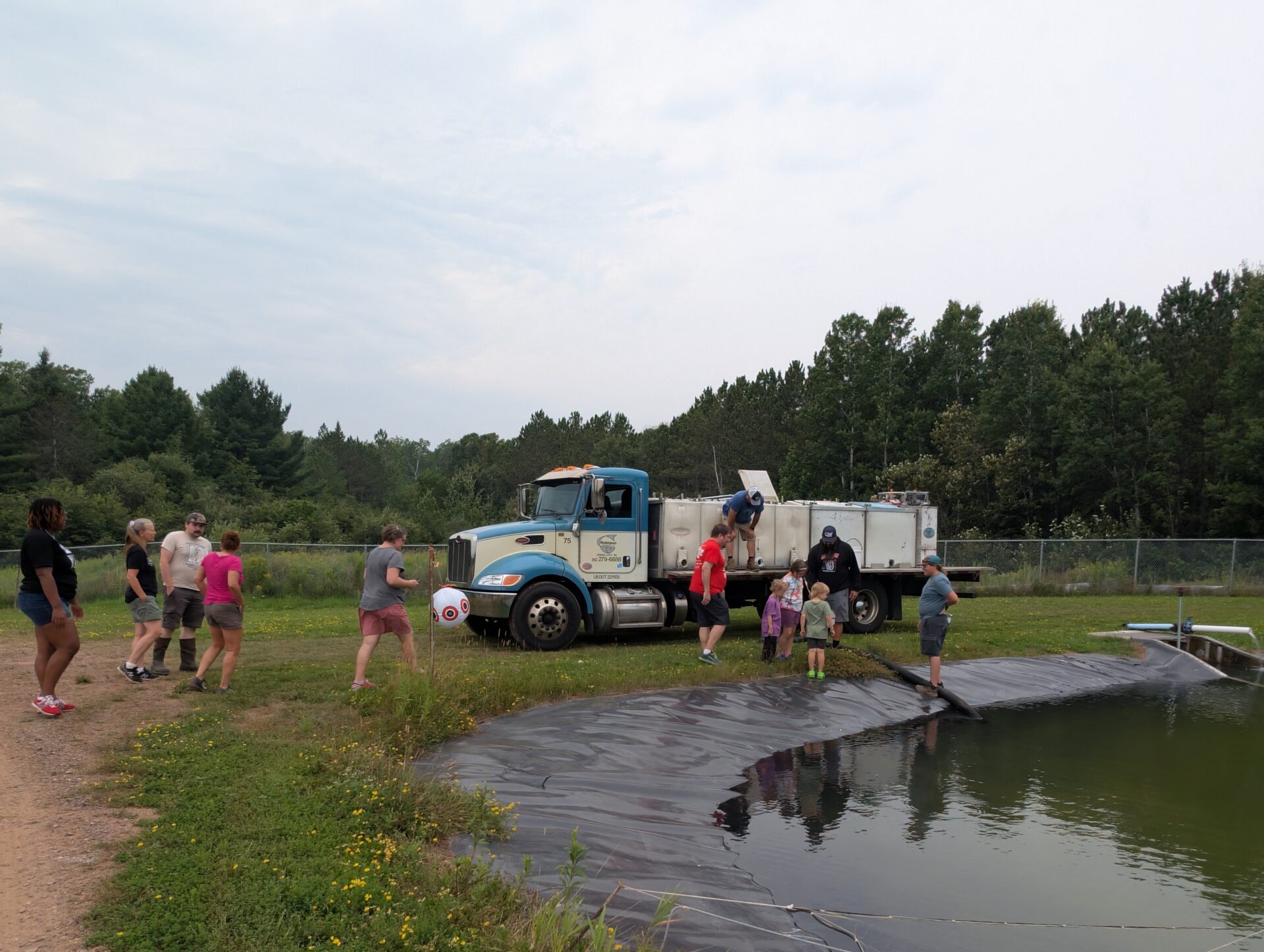
Alverno students tour an outdoor pond at Red Cliff hatchery

Alverno students tour an outdoor pond at the Red Cliff Tribal Fish Hatchery. Photo: Emma Hauser

Following the workshop, the group visited two other aquaculture facilities in the area. At the Red Cliff Band of Lake Superior Chippewa Tribal Fish Hatchery, they observed the stocking of forage fish to feed walleye in outdoor ponds, and they learned about raising and stocking cold-water fish at the historical Les Voight Bayfield State Fish Hatchery in Bayfield. The tour then culminated with a visit to one of the largest trout hatcheries in the Midwest, the Iron River National Fish Hatchery, which produces approximately 1.5 million lake trout and 65,000 coaster brook trout for stocking in the Great Lakes each year.

Rebekah Klingler, a professor of biology at Alverno, said the experience leveled up her students’ learning. She’s worked with UWSP NADF in the past, having taken virtual tours and interactive classroom lessons in fish health and anatomy with her students.

“Although Alverno is only a few miles from Lake Michigan, most of our students have never been fishing or handled fish before, let alone consider fish farming and/or research as potential career options,” said Klingler. “Our trip to NADF was absolutely eye-opening.  I was thrilled to see how the students jumped right into the experience.”

***

The University of Wisconsin Aquatic Sciences Center administers Wisconsin Sea Grant, the Wisconsin Water Resources Institute, and Water@UW. The center supports multidisciplinary research, education, and outreach for the protection and sustainable use of Wisconsin’s water resources. Wisconsin Sea Grant is one of 34 Sea Grant programs supported by the National Oceanic and Atmospheric Administration in coastal and Great Lakes states that encourage the wise stewardship of marine resources through research, education, outreach, and technology transfer.

The post Alverno College students explore Great Lakes aquaculture first appeared on Wisconsin Sea Grant.

Original Article

News Releases | Wisconsin Sea Grant

News Releases | Wisconsin Sea Grant

https://www.seagrant.wisc.edu/news/alverno-college-students-explore-great-lakes-aquaculture/

Wisconsin Sea Grant

In world of AI, Michigan State University Extension bets on human expertise

By Kelly House, Bridge Michigan

The Great Lakes News Collaborative includes Bridge Michigan; Circle of Blue; Great Lakes Now at Detroit PBS; Michigan Public, Michigan’s NPR News Leader; and The Narwhal who work together to bring audiences news and information about the impact of climate change, pollution, and aging infrastructure on the Great Lakes and drinking water.

Read Now at Great Lakes Now.

Original Article

Great Lakes Now

Great Lakes Now

https://www.greatlakesnow.org/2025/12/in-world-of-ai-michigan-state-university-extension-bets-on-human-expertise/

Bridge Michigan

Fall 2025 newsletter

Enjoy River Alliance of Wisconsin’s Fall 2025 WaterWays newsletter. To get a copy of WaterWays, become a River Alliance member or pick up a print copy at local events with our partners across Wisconsin. Download a PDF copy of the full newsletter.


Fall 2025 | Volume 31, Issue 3

Right to Know legislation

by Allison Werner, Executive Director

Allison Werner's headshot

Looking for a bright spot of bipartisan cooperation? There is a new piece of legislation circulating at the state Capitol. The Right to Know bill would close the communication gap between the state Department of Natural Resources and county and Tribal health departments when incidents of water pollution could impact the drinking water of those who use private wells.

We are backing this proposal that is being championed by Wisconsin Conservation Voters because it is practical, necessary to protect public health, and is a rare chance for legislators to agree.

Folks who drink city water get a notice in the mail when municipal water utilities test their water. Those on private wells, however, have to test their own water, but are out of the information loop when there are spills in their area. After environmental groups—including River Alliance of Wisconsin as a participating amicus partner—successfully defended the state’s Spills Law at the Wisconsin Supreme Court, the next step to protecting the health of Wisconsinites is to affirm their right to know when pollution threatens their private drinking wells.

We encouraged our supporters and watershed group leaders to contact their state legislators to ask them to sign on as co-sponsors to the bill. As of the publication of this newsletter, we are hopeful that the bill will get a hearing before the legislative session is over. Watch for updates and action alerts in your inbox. If you aren’t on our email list yet, sign up on our homepage.


Upon his retirement, Bill Davis’ impact on Wisconsin’s water will continue

by Allison Werner, Executive Director

Bil Davis headshot

In October, Senior Legal Analyst Bill Davis retired. His impact on Wisconsin’s environmental policies and the advocates who work to protect our water goes deep.

Bill’s background

Bill has worked to advance clean water policies throughout his career. He led groups including the Sierra Club–Wisconsin, Wisconsin’s Environmental Decade (now known as Clean Wisconsin), Citizens for a Better Environment, and the State Environmental Leadership Program.

He spent decades pushing for policy and litigation solutions to toxins, PCBs, dioxins, and solid waste.

Impact on River Alliance of Wisconsin and our partners

Six years ago, Bill and I discussed the challenges we were seeing in achieving strong water policy in Wisconsin and the need to set new long-term strategies to reimagine how we protect Wisconsin’s water. We quickly added Bill to the River Alliance team to develop big-picture strategies for change. He launched the Wisconsin Water Agenda and inspired our Clean Water Now referendum campaign.

Bill stands with fellow Community Shares award winners.His knowledge of water law and lobbying has made him a sounding board on state policy priorities and legal advice, not just for River Alliance, but for many of our partner organizations. Bill has been a leading legal consultant for Wisconsin’s PFAS coalition alongside local grassroots organizations like Save Our H2O and statewide groups like Wisconsin Conservation Voters. He was a key legal advisor in Midwest Environmental Advocates’ friend-of-the-court intervention in defending the state’s Spills Law from a challenge by Wisconsin Manufacturers and Commerce that went to the state Supreme Court.

In his role at River Alliance, Bill also guided dozens of local groups across the state, helping them develop decision-making tools like bylaws and best practices, strengthening their organizations to carry out their water-protection missions.

Central Wisconsin Basin Plan: Applying the Wisconsin Water Agenda

Because our rivers and groundwater don’t recognize the boundaries of counties and cities, Bill saw a clear need for a comprehensive water management strategy.

His vision for a Central Wisconsin Basin Plan is coming to life through the dedicated work of many partners including the Department of Natural Resources, the North Central Wisconsin Planning Commission, UW-Stevens Point, municipalities and county governments, drinking water utilities, and nonprofits like Wisconsin’s GreenFire and Wisconsin Trout Unlimited. The project is focused on systemic changes, coordinated governmental cooperation, and how to increase clean water ethics and literacy. Bill will continue to serve as an advisor to this effort.

Our organization is stronger thanks to Bill, and luckily, everyone on our team has been able to learn from him. We are ready to carry on his legacy.

“I hope and trust that Bill will be available, on occasion, to provide his sage counsel to various nonprofits when they face difficult governance or financial choices. Bill’s expertise and insights in this arena are some of the best that I have ever seen, and I know that many groups across Wisconsin – and, in fact, around the country – run better and with greater financial accountability, thanks to Bill’s tremendous work.” – Todd Ambs, retired Director of Healing Our Waters-Great Lakes Coalition, Wisconsin Department of Natural Resources Water Division, Deputy DNR Secretary

“I just want to thank you for all the years of service to Wisconsin and the Great Lakes and also for all the years we’ve worked together. You’ve been more than a colleague to me though; you’ve been a mentor, a reality backstop when I’ve needed advice, and most importantly a good friend.” – Dave Blouin, Sierra Club

“In my four years working in environmental politics, Bill has easily been one of the most encouraging coalition partners. His institutional knowledge, his legal expertise and ability to scout out the tripwires, his stories about where coalitions have worked well, his cautionary tales about where trust and progress have broken down, and his encouragement to stick with the work – it’s all been more important to me than he knows.” – Peter Burress, Wisconsin Conservation Voters


Becoming a steward of manoomin starts at rice camp

By Johnson Bridgwater, Water Advocates Organizer

Johnson Bridgwater headshot

Over Labor Day weekend, I participated in GLIFWC’s Intertribal Rice Camp. I went to get hands-on experience and learning from the masters of traditional wild rice harvesting. River Alliance’s development director, Evan Arnold, also joined us at the manoomin camp.

Every fall for hundreds of years, families and Tribes have gathered for wild rice season on the lakes and streams of what is now known as northern Wisconsin. For the Anishinaabeg—including Ojibwe and other related tribes—this annual gathering remains a vital cultural and social tradition, encompassing far more than food gathering.

Johnson And Roger With Push PolesThis year, following in the rice camp tradition, the Great Lakes Indian Fish and Wildlife Commission and UW–Trout Lake Station hosted an intergenerational, intertribal Manoomin/Manōmaeh Camp over Labor Day weekend at the North Lakeland Discovery Center in Manitowish Waters. Esiban Parent (GLIFWC), Sagen Quale (UW graduate student), and Dr. Gretchen Gerrish (UW–Trout Lake Station) did an outstanding job organizing the welcoming event, and more than twenty Tribes and bands were represented.

There are no spectators at rice camp. Your moments are spent either learning, teaching, or building the tools essential for traditional wild rice gathering (or “ricing”). All the while, participants are storing and sharing knowledge that will keep this tradition alive. Because manoomin is regarded as a sacred being, the camp also includes ceremony and other cultural practices that can only be learned firsthand or by invitation.

How to harvest manoomin at rice camp

The basic process of preparing manoomin begins with the harvest. Gathering wild rice is done from a canoe using a push pole, a pair of rice knockers, and two people working together. After harvesting, the rice is spread out in the sun to dry, giving rice worms and spiders a chance to leave before processing begins.

Evan Arnold sands a wooden knocker used to harvest wild rice“Whether I was carving rice knockers, building push poles, crafting birchbark baskets, enjoying delicious manoomin meals, or paddling through rice beds, my experiences at Rice Camp helped cement my connection to the unique and valuable waters we have right here in Wisconsin, and strengthened my resolve to continue to protect them.”

– Evan Arnold, River Alliance Development Director


The traditional process of preparing wild rice involves three main steps: parching, threshing (also known as “dancing the rice” or “jigging”), and winnowing. Parching—or roasting—dries the grain to preserve it and makes the hull brittle. Threshing removes the dried husks from the kernels, traditionally done by “dancing” or “jigging” on the rice. Winnowing uses wind to separate the loose, light chaff from the heavier, processed rice grains. At that point, you have ready-to-cook rice.

All of these activities took place at this year’s camp, along with workshops where participants hand-crafted their own traditional ricing tools.

Is it OK for me to work with wild rice as a non-Native person?

Manoomin is not simply a “food that grows on water.” At the heart of Tribal beliefs, it is recognized as a Sacred Living Being and, unfortunately, it is very much under threat. Research estimates that this translates to an annual loss of about 6 percent of the total regional wild rice produced.

In response, GLIFWC and the Tribes working to protect wild rice have made it clear: addressing the growing threats to manoomin will require partnerships, alliances, and coalitions between Tribal and non-Tribal partners.

With deep respect and under the guidance of many Tribal partners, individuals, and GLIFWC, River Alliance of Wisconsin is honored to begin work in this space because we know that healthy wild rice means healthy water and strong community. This work is made possible by a grant from the Fund for Lake Michigan.

Become a Manoomin Steward

Plans are already underway to repeat this welcoming rice camp. For anybody wanting a deeper connection to our world or seeking new ways to grow your stewardship, a single weekend at rice camp can easily unlock a lifetime pursuit and passion.

Subscribe to our ManoomiNews email newsletter to get more photos and stories of this year’s ricing season. You’ll be the first to be invited to become a Manoomin Steward and join us next year.

Governor Evers’ executive order promoting Tribal Treaty rights and manoomin stewardship

“Wild rice is a culturally significant crop and an important food source to the Native Nations of Wisconsin. However, changing ecological conditions are putting Tribes’ ability to grow, cultivate, and harvest the crop on ceded Tribal lands and waters at risk. So, we’re creating a new Wild Rice Stewardship Council in my administration to help promote the protection of wild rice in Wisconsin and ensure its presence for future generations. And starting next year, this order designates the first week of September as “Wild Rice Week,” helping to raise awareness for and appreciation of the value of wild rice in our state.” – Governor Tony Evers’ statement upon signing an executive order on manoomin protection on October 13, 2025


Scouting for native mussels connects paddlers to rivers impacted by hydropower

By Ellen Voss, Climate Resilience Director

Ellen Voss headshot

One of the highlights of my summer was paddling the Chippewa River just outside Chippewa Falls along with some of Wisconsin’s leading experts on native mussels. It was more than just a beautiful day for a river trip; we had an important mission.

The inspiration for this trip was sparked in September 2023 when drought and hydropower dams reduced the Wisconsin River to a trickle below the last dam, creating a worst-case scenario for the river’s most vulnerable species: native freshwater mussels. Volunteers organized rescue efforts, finding stranded mussels along riverbanks and moving them to deeper water. Their actions may have saved thousands of mussels, invaluable river dwellers that filter water and support our rivers’ interconnected ecosystems and food chains.

Because native mussels are so important to Wisconsin, we organized a paddle trip to find them in the Chippewa River. Like the Wisconsin River, the Chippewa hosts many native species and is impacted by several hydropower dams. We brought along experts Lisie Kitchel (aquatic ecologist with the DNR’s Bureau of Natural Heritage Conservation), Jesse Weinzinger (DNR aquatic zoologist), and Bre Klockzien (Citizen Science and Aquatics Coordinator with Beaver Creek Reserve).

We started onshore, learning how to identify mussels and inspect them without causing harm. Our experts, who had surveyed this river previously, knew the best spots to search.

Group photo of paddlers on the Chippewa RiverWe launched our kayaks and paddleboards, making several stops along the route. Some participants found mussels right away, while others used GoPros and bathyscopes to explore under the waters’ surface. Everyone eventually found specimens and applied new identification skills.

At a riverside chat, participants were eager to learn how they could protect these delicate species and volunteer for future mussel rescue efforts during droughts or water shortages caused by hydroelectric dams.

The need for more people to learn about mussels and help advocate for their survival will continue. This fall, a mandated draw-down of the impounded Wolf River behind Balsam Row Dam in Shawano County resulted in a multifaceted, multiagency effort to protect the public, vulnerable natural resources like herps and mussel populations, and cultural relics. The drawdown prompted questions among local residents about dam safety and shed light on the myriad impacts that ensue when power production outweighs cultural priorities, environmental impacts, and recreation considerations.

To learn more about the impacts of hydropower and how you can get involved with aquatic organism rescue in the future, please contact Ellen at evoss@wisconsinrivers.org.


Leave no community behind when it comes to PFAS pollution

By Mike Tiboris, Agriculture and Policy Director

Michael Tiboris headshotOn October 7, I testified at a Senate Natural Resources, Veteran and Military Affairs Committee hearing regarding twin bills related to PFAS pollution. 

The bad news is that SB 127 and 128 are nearly identical to the PFAS bills introduced in the last legislative session and vetoed by Governor Evers. 

The good news is that state legislators heard strong and clear opposition to punching holes in our state’s nearly 50-year-old Spills Law. In fact, the hearing was a lively public discussion about what the DNR can and can’t do, how farmers and residential homeowners can be victims of legacy pollution, and where good-faith compromises and amendments can be made.

What we want is very clear: 

  • The state Joint Finance Committee should not wait for SB 127 or 128 to distribute the $125 million in the already-approved “PFAS Trust Fund” that the DNR could quickly use to help communities immediately.
  • Don’t gut the Spills Law. Liability for PFAS pollution can’t exempt entities like paper mills’ sludge spreading. 
  • We can’t leave any community – large or small – without options for clean drinking water. If these laws create too many exemptions, some communities will be without responsible parties and fewer legal options for relief. 

Public pressure is being heard by legislators loud and clear. Thanks to all of you who responded to our action alert to tell committee members what our non-negotiables are. 

If you missed the action alert in your inbox, please subscribe to our Word on the Stream email newsletter to get action alerts in the future. As of the printing of this newsletter, negotiations around this legislation are still in progress.


Menominee River fish passage tour lets visitors connect with sturgeon

On SeptMembers of the public tour a sturgeon passage facility in the Menominee Riverember 25, we co-hosted two tours of the hydroelectric dam and fish passage at the Hattie Street Dam in Menominee, Michigan. Visitors—including inquisitive kids—got a behind-the-scenes look at how the dam operates and collaborates with state scientists studying the movement and lifecycles of sturgeon that can live up to 150 years. The annual tour is made possible by the Michigan Department of Natural Resources and North East Wisconsin Hydro.


Save the date: Giving Tuesday is December 2!

By Evan Arnold, Development Director

As a supporter of River Alliance of Wisconsin, your generosity fuels our mission to protect and restore water. On December 2, your support – or your effort to encourage your friends to join us – will make an even bigger impact!

On Giving Tuesday, your donation will be doubled dollar for dollar up to $20,000, thanks to a match provided by a group of fellow River Alliance supporters, helping us reach our $40,000 Giving Tuesday goal.

Mark your calendar and watch your inbox for ways to have your gift – and impact for Wisconsin’s waters – doubled on Giving Tuesday!


River Alliance of Wisconsin donors receive our triennial member newsletter by mail. To become a member, donate online.

This message is made possible by generous donors who believe people have the power to protect and restore water. Receive more updates in your inbox. Sign up for our e-newsletter to receive biweekly news and special alerts.

The post Fall 2025 newsletter appeared first on River Alliance of WI.

Original Article

Blog - River Alliance of WI

Blog - River Alliance of WI

https://wisconsinrivers.org/fall-2025-newsletter/

Allison Werner

By Eric Freedman  

Looking for a holiday gift for a reader who loves the Great Lakes? Here are five prospects to consider – and what our reporters learned from interviewing their authors this year.

The post Great Lakes books for your holiday gift list  first appeared on Great Lakes Echo.

Original Article

Great Lakes Echo

Great Lakes Echo

https://greatlakesecho.org/2025/12/02/great-lakes-books-for-your-holiday-gift-list/

Eric Freedman

Sue Swanson: Where Wisconsin’s water comes from

Sue Swanson is Wisconsin’s new leader of the Wisconsin Geological and Natural History Survey. She’s the first woman to serve as the state’s geologist and she knows a lot about the land and water of Wisconsin.
 
The interview was featured on the VMO Show on Friday, November 28 on 98.7 WVMO-FM in Monona, WI. This episode of the VMO Show was hosted by River Alliance of Wisconsin’s Communications Director, Stacy Harbaugh.


Full interview text

Stacy: You’re listening to the VMO show. I’m your guest host, Stacy Harbaugh. You may recognize my voice from Polka time with DJ Shotski on Sunday and Saturday nights at 7 p.m. on WVMO. But for my day job, I work for River Alliance of Wisconsin, where we advocate for the protection of Wisconsin’s clean water resources. I get to meet the coolest water experts in my work, just like today’s VMO Show guest who has deep experience with studying geosciences and hydrogeology. I’m joined today by Susan Swanson, who leads the Wisconsin Geological and Natural History Survey. Sue has an incredible background in applied research that she’s bringing to this branch of UW Extension that has served our state for over 125 years. Welcome Sue.

Sue:  Thank you for the invitation. I’m really happy to be here.

Stacy: Well, I’m excited to have a conversation about where our water comes from in Wisconsin. So, tell me more about yourself and tell us about the mission and work of the survey.

Sue: Well, I’m the director of the Wisconsin Geological and Natural History Survey. I’m also the State Geologist of Wisconsin. The State Geological Survey is part of UW Madison Division of Extension, and our mission is really to provide education, outreach, and applied research activities around the geology, mineral and water resources of the state.

Stacy: So you’re like rock and water nerds.

Sue: We are.

Stacy: In all the best ways. Well, in order to appreciate our water, we need to know where it comes from. And you know, Wisconsin it’s such a water-rich state. You know, we know that we love being amongst the Great Lakes and the Mississippi River and you know, but those are the big surface waters. You really look at what’s underneath the surface of our land uh to figure out how this how this land and water interact with each other.

Sue: That’s right. So, in Wisconsin, surface waters and groundwater are interconnected. But the state geological survey does focus more on groundwater and as you said, Wisconsin is water rich and we have some of the most prolific aquifers around and so we’re very lucky for that reason. But that doesn’t mean that we don’t need to effectively manage our water use and our land use practices so that we maintain high water quality.

Stacy: Yeah, really the first step is just knowing what’s out there and getting that information. So we know that the work of the survey is so, so valuable. But also something I’d like to bring attention to that’s, I think, notable is that you are the first woman to hold that position as the State Geologist. Tell us more about how that’s come out in your work. Have you, you know, met any young women who are in STEM, or what does it feel like to be the first woman in that job?

Sue: Yeah, thanks for recognizing that. I will point out that the State Geological Survey did have a woman director for a couple of months as an interim director. So, there’s that, but yes, I’m the first State Geologist, and it’s been great. I’ve had a number of young women in STEM reach out to me with questions. You know, if I can serve as a role model for women in STEM I’m happy to do that. As I went through college and the earlier part of my career, I had a lot of colleagues who were women. But I can remember the first time I met a woman geologist in college and then, even though I worked professionally before going to graduate school, it was about five years before I met another woman geologist. Things have changed a lot, right? So there’s lots of wonderful role models out there, but if I can promote women in science, I’m happy to do so.

Stacy: Thanks for listening to the VMO Show. I’m your guest host, Stacy Harbaugh, and I’m speaking with the new director of the Wisconsin Geological and Natural History Survey, Sue Swanson. So Sue, in Wisconsin, I’m assuming that our drinking water really, pretty much all comes from underground in one way or another. I mean, even if you’re on municipal water, they draw water from wells, right? So here in Monona, the city is located on the Yahara chain of lakes, which sits amidst urban life, farmland, lots of parks, and obviously our beautiful lakes. So I think that our drinking water is reasonably safe, but, you know, our lakes still have algae. We’re really facing some complex water issues in our area, just like all across the state of Wisconsin. So I’d like for you to explain to us a little bit more about how all of this water is connected, and what that has to do with where we get our drinking water from.

Sue: Yeah, great question. So I think one thing that’s important to remember is that all groundwater in Wisconsin originally comes from precipitation, and I think it can be helpful to think about where groundwater originates before you start thinking about its relationship to something like the Yahara lakes. So, precipitation falls on the landscape, some of it might run off, some of it might infiltrate through the soil profile, some of it might evaporate or get used by plants, but the rest of the water that actually makes it down to the water table is what we call groundwater recharge. So, that’s how aquifers get replenished, right? And then once that groundwater is in an aquifer, it doesn’t just sit there, it flows, but it flows pretty slowly, much slower than surface waters, but eventually it flows through an aquifer system, and unless it gets intercepted by something like a pumping well, then it might flow to a lake, a river or a wetland and and we call that groundwater discharge. So that’s sort of the cycle, right? And it’s really helpful to understand that before you start thinking about what can influence the quality of the water.

Stacy: Yeah, and so not all of that land across Wisconsin is all equal. I mean, we have a lot of diverse landscapes, both on the top and below. And so I think that some of our soils are going to handle water in different ways in different parts of the state. Some places are a little more sensitive to that rain that comes through and what goes on on the land. Do you have some examples of how things are different around the state?

Sue: Yeah, in and around the Madison and Monona area, most of the landscape, not all of it, has been glaciated. So there’s a lot of loose material at the surface, sand and gravel, silt and clay, and water infiltrates down through the pore spaces in that material before it gets to the water table, like I explained. But in other areas of the state, like Eastern and Northeastern Wisconsin, the glacial cover is very thin, and the bedrock, made up of dolomite and limestone, is very close to the surface, and it’s heavily fractured, so that recharge process still happens, like I explained, but the rate at which it happens can be much faster than what it might be in an area like southern Wisconsin that has a thicker glacial cover.

Stacy: Yeah. So that land’s a lot more sensitive, I think.

Sue: That’s right.

Stacy: More vulnerable.

Sue: Yeah. More vulnerable there.

So, you know, clearly how we protect our water and how we manage our water is going to be we’re going to have different strategies all over the state. But it’s important to understand how this water moves through the ground first. Understanding that is really the first step.

Sue: That’s right. Yeah. I think it has to do with an understanding of the geology and the land use practices. They go hand-in-hand to better understand the quality of the water in our aquifers.

Stacy: Thanks for tuning in to the VMO show. I’m Stacy Harbaugh here with a leader in Wisconsin’s research in hydrogeology, Sue Swanson. So Sue, I think that protecting our water can be pretty complex, but we can all do our part. Like here in the City of Monona, we have an adopt-a-drain program, where residents can pledge to keep leaves and other debris out of the street drains, which, you know, ultimately flow into Lake Monona. So while that’s a good program for an individual household, I’m wondering if in your work, have you thought of some other ways that we can individually or collectively take care of our water, and, you know, understand how this all works. So, what do you think?

Sue: Yeah, the programs that you mentioned, those are really important. And I’ll point out that, you know, oftentimes our focus tends to be on these surface water features, lakes, wetlands, that are so important to us, right? So those types of programs really have an important impact on the surface water features. But it might be that an area is pretty far away from the lakes or the wetlands that because of the geology, the land use practices in those areas are also really important. So we can’t lose sight of the entire watershed when we are trying to protect resources like the Yahara lakes.

Stacy: And I think that something else that’s very interesting is that when it comes to some of our collective decisions, like government decisions, we have these kinds of seemingly arbitrary lines of counties and cities, but water doesn’t respect any of those lines. But it might be a little different here in Dane County.

Sue: That’s right. You know, this area is pretty unique in that, as you said, watershed boundaries and political boundaries don’t necessarily coincide, but the Yahara watershed actually coincides pretty well with Dane County. So not all of the watershed is within Dane County, but the majority of it is, and that provides really pretty unique opportunities for local government, county government, to really think critically about the water resources and then the land use planning or zoning that gets done can have a really tangible impact on the resources that are so important to people in this area.

Stacy: That’s so cool. And you know, at River Alliance of Wisconsin, we talk a lot about how we should be managing water and planning for water based on the whole watershed, this whole basin, where water moves together, rather than in some of these arbitrary, county lines. Or we can get the counties talking to each other for sure, but all of these collective decisions add up to the quality of the water that we have here in Wisconsin. So, tell us more about how people can learn more about how water and land works and what kind of resources you have at the survey.

Sue: Yeah, because that’s really what the survey is there for. We’re there to provide information about the geology, mineral and water resources of the state for informed decision making. And so if you go to our website, you’ll find that there are videos, blogs, and a lot of maps with explanations on the geology of the region. And I think really one of the most important things that people can do is to educate themselves on our natural resources, so that they are informed when they go to make comments on new policy or zoning that might be coming up.

Stacy: Well, if you love maps, please check out the website of the Wisconsin Geological and Natural History Survey. You don’t even have to be as deep into the research as you are Sue to enjoy all of the maps that come out from the survey that just show how beautiful and interconnected Wisconsin really is.

Sue: That’s right, yeah. You know, one of the maps that we produce pretty regularly at the Geological Survey is a groundwater contamination susceptibility map. Lots of big words there, but these maps take into account things like the geology, right? So either the loose glacial materials or the bedrock in a region, how deep the water table is, how deep the bedrock is, and how quickly groundwater recharges. And those maps can be used generally then to better understand the vulnerability of an aquifer to a variety of different land use practices. So I would point listeners specifically to those types of resources if they are interested in educating themselves on how to protect our water resources.

Stacy: I love it. I love the maps! I love the information. You’re doing an invaluable service over there. So we’re so glad that you could join us today on the VMO show. Sue any final words?

Sue: Just thank you again, and hopefully people will find the information they need at the survey. But if not, please reach out to us. We’re happy to answer questions too.

Stacy: That’s awesome. Thank you so much.

Sue: Thank you so much.

Stacy: Thank you for your leadership and for your research. Thank you.

– Stacy Harbaugh, Communications Director


This message is made possible by generous donors who believe people have the power to protect and restore water. Subscribe to our Word on the Stream email newsletter to receive stories, action alerts and event invitations in your inbox.  Support our work with your contribution today.

The post Sue Swanson: Where Wisconsin’s water comes from appeared first on River Alliance of WI.

Original Article

Blog - River Alliance of WI

Blog - River Alliance of WI

https://wisconsinrivers.org/sue-swanson-water/

Allison Werner

While ice does play some role, the results of a new study show the humidity of the air over the lakes has a much more dominant effect on how much water is sucked out of the lakes into the atmosphere. Read the full story by Wisconsin Public Radio.

Original Article

Great Lakes Commission

Great Lakes Commission

https://www.glc.org/dailynews/20251201-lake-evaporation

Taaja Tucker-Silva

Under a new rule to protect Wisconsin’s cleanest waterways finalized last week, the Wisconsin Department of Natural Resources is required to conduct a review before regulated entities are allowed to discharge new or increased levels of contaminants into waterbodies classified as “high quality waters.” Read the full story by the Wisconsin Examiner.

Original Article

Great Lakes Commission

Great Lakes Commission

https://www.glc.org/dailynews/20251201-wisconsin-water-rule

Taaja Tucker-Silva

Herring gull blood and egg samples collected in the St. Lawrence River in Quebec were tested to see how exposed seabirds are to plastic additives called ultraviolet absorbents. Every herring gull sampled was exposed to plastic additives. Read the full story by Great Lakes Echo.

Original Article

Great Lakes Commission

Great Lakes Commission

https://www.glc.org/dailynews/20251201-gull-plastics

Taaja Tucker-Silva

The Lakehead Region Conservation Authority says Ontario’s plan to merge the province’s 36 conservation authorities into seven larger regional bodies would disconnect Thunder Bay’s watershed from the region it actually serves. Read the full story by the CBC.

Original Article

Great Lakes Commission

Great Lakes Commission

https://www.glc.org/dailynews/20251201-conservation-authorities

Taaja Tucker-Silva

Samples collected by researchers aboard the U.S. EPA’s Lake Guardian research vessel in 2014 and 2024 showed an increase in the volume of plastic per square kilometer, suggesting that the volume of plastic in the lake has gone up. Read the full story by The Plain Dealer.

Original Article

Great Lakes Commission

Great Lakes Commission

https://www.glc.org/dailynews/20251201-erie-plastics

Taaja Tucker-Silva

A shipwreck from 145 years ago still litters the bottom of Lake Michigan near Frankfort, Michigan, that sparked a haunting mystery that continues to be part of Great Lakes lore: a woman who died lashed to the sinking ship’s mast. Read the full story by MLive.

Original Article

Great Lakes Commission

Great Lakes Commission

https://www.glc.org/dailynews/20251201-shipwreck-mystery

Taaja Tucker-Silva

The big cold front moving into the Great Lakes region, leading to heavy snow in some areas and high winds and gale warnings on the Great Lakes, is also expected to cause a storm surge on Lake Erie − a phenomenon that can leave shoreline locations looking like the lake drained away. Read the full story by the Detroit Free Press.

Original Article

Great Lakes Commission

Great Lakes Commission

https://www.glc.org/dailynews/20251201-erie-seiches

Taaja Tucker-Silva

By Joshua Kim

Following the completion of segments 1 and 2 of the Portage Canal, local residents and visitors can use the historic site and its amenities following years of disrepair.

The post Restoration of historical site improves quality of life for Portage, Wisconsin residents first appeared on Great Lakes Echo.

Original Article

Great Lakes Echo

Great Lakes Echo

https://greatlakesecho.org/2025/11/30/restoration-of-historical-site-improves-quality-of-life-for-portage-wisconsin-residents/

Great Lakes Echo

* WHAT...Blowing and drifting snow is expected. Winds gusting as high as 35 mph. * WHERE...Calumet, Manitowoc, Winnebago, Brown, Door, Kewaunee, Outagamie, Southern Marinette County, and Southern Oconto County Counties. * WHEN...Until 3 PM CST this afternoon. * IMPACTS...Plan on slippery or snow covered road conditions. Blowing snow will make clearing roadways difficult at times and may result in road conditions and visibilities varying over short distances. * ADDITIONAL DETAILS...Holiday travelers and hunters should be prepared for snow covered roads and reduced visibilities.

Original Article

Current watches, warnings, and advisories for Brown County (WIC009) WI

Current watches, warnings, and advisories for Brown County (WIC009) WI

https://api.weather.gov/alerts/urn:oid:2.49.0.1.840.0.bc853d20f029911d46c61c36135ce05d30177e4a.001.2.cap

NWS

* WHAT...For the Winter Storm Warning, snow. Additional snow accumulations of 1 to 2 inches. For the Winter Weather Advisory, blowing and drifting snow is expected. Winds gusting as high as 35 mph. * WHERE...Calumet, Manitowoc, Winnebago, Brown, Door, Kewaunee, Outagamie, Southern Marinette County, and Southern Oconto County Counties. * WHEN...For the Winter Storm Warning, until 6 AM CST this morning. For the Winter Weather Advisory, from 6 AM this morning to 3 PM CST this afternoon. * IMPACTS...Plan on slippery or snow covered road conditions. Blowing snow will make clearing roadways difficult at times and may result in road conditions and visibilities varying over short distances. * ADDITIONAL DETAILS...Holiday travelers and hunters should be prepared for snow covered roads and reduced visibilities.

Original Article

Current watches, warnings, and advisories for Brown County (WIC009) WI

Current watches, warnings, and advisories for Brown County (WIC009) WI

https://api.weather.gov/alerts/urn:oid:2.49.0.1.840.0.287f64dfc7789427a5efe32b5373c004a63e10e3.001.2.cap

NWS

* WHAT...For the Winter Storm Warning, snow. Additional snow accumulations of 1 to 2 inches. For the Winter Weather Advisory, blowing and drifting snow is expected. Winds gusting as high as 35 mph. * WHERE...Calumet, Manitowoc, Winnebago, Brown, Door, Kewaunee, Outagamie, Southern Marinette County, and Southern Oconto County Counties. * WHEN...For the Winter Storm Warning, until 6 AM CST this morning. For the Winter Weather Advisory, from 6 AM this morning to 3 PM CST this afternoon. * IMPACTS...Plan on slippery or snow covered road conditions. Blowing snow will make clearing roadways difficult at times and may result in road conditions and visibilities varying over short distances. * ADDITIONAL DETAILS...Holiday travelers and hunters should be prepared for snow covered roads and reduced visibilities.

Original Article

Current watches, warnings, and advisories for Brown County (WIC009) WI

Current watches, warnings, and advisories for Brown County (WIC009) WI

https://api.weather.gov/alerts/urn:oid:2.49.0.1.840.0.287f64dfc7789427a5efe32b5373c004a63e10e3.001.1.cap

NWS

* WHAT...Snow, moderate at times. Additional snow accumulations between 2 and 4 inches. Total accumulations of 5 to 9 inches. * WHERE...Portions of central, east central, and northeast Wisconsin. * WHEN...Until 6 AM CST Sunday. * IMPACTS...Travel will be very difficult at times due to poor visibility and snow covered roads. Pockets of moderate snow will continue in parts of the Fox Valley and lakeshore areas into the early morning hours. * ADDITIONAL DETAILS...Holiday travelers and hunters should be prepared for snow covered roads and low visibilities.

Original Article

Current watches, warnings, and advisories for Brown County (WIC009) WI

Current watches, warnings, and advisories for Brown County (WIC009) WI

https://api.weather.gov/alerts/urn:oid:2.49.0.1.840.0.70506aa311d2d784c95454c4e6dae4df10da9255.001.1.cap

NWS

* WHAT...Snow, heavy at times, especially this evening. Additional snow accumulations between 3 and 5 inches, with locally higher amounts near Lake Michigan. Total accumulations of 5 to 9 inches. * WHERE...Portions of central, east central, and northeast Wisconsin. * WHEN...Until 6 AM CST Sunday. * IMPACTS...Travel will be very difficult at times due to poor visibility and snow covered roads. The heaviest snow is expected this evening, though pockets of heavy snow could continue along the Lake Michigan shoreline into the early morning hours. * ADDITIONAL DETAILS...Holiday travelers and hunters should be prepared for snow covered roads and low visibilities.

Original Article

Current watches, warnings, and advisories for Brown County (WIC009) WI

Current watches, warnings, and advisories for Brown County (WIC009) WI

https://api.weather.gov/alerts/urn:oid:2.49.0.1.840.0.48cce2fae4034ff8a4e14f748599841a2521760b.001.1.cap

NWS

Snow will continue through the evening, then gradually taper off late tonight. The snow may become heavy at times through this evening, with visibilities down to a half mile or less. Total storm snow accumulations of 6 to 12 inches are expected in the Winter Storm Warning area, with the highest totals across east- central Wisconsin near Lake Michigan. Snowfall totals near Lake Michigan may vary due to the location and persistence of the heavier snow bands. Although the significant accumulating snow will come to an end late tonight, snow showers or flurries will linger Sunday morning with minor additional accumulations possible. Hazardous travel conditions will still be possible on Sunday as northerly winds gusting to 25 to 35 mph produce some blowing and drifting of the new snow. If you have holiday travel plans through Sunday morning, slow down and allow extra time to reach your destination. Use your low beam headlights if you encounter heavier bands of snow.

Original Article

Current watches, warnings, and advisories for Brown County (WIC009) WI

Current watches, warnings, and advisories for Brown County (WIC009) WI

https://api.weather.gov/alerts/urn:oid:2.49.0.1.840.0.db9979fbf30c720d93caabafb9956f87bc9926bb.002.1.cap

NWS

Snow will continue through the evening, then gradually taper off late tonight. The snow may become heavy at times this evening, especially near Lake Michigan with visibilities down to a half mile less. Total storm snow accumulations of 6 to 12 inches are expected in the Winter Storm Warning area, with the highest totals across east-central Wisconsin near Lake Michigan. Snowfall totals near Lake Michigan may vary due to where and how persistent bands of heavier snow set up. Although the significant accumulating snow will come to an end late tonight, snow showers or flurries will linger Sunday morning with only a minor accumulation possible. Hazardous travel candidness will still be possible on Sunday as northerly winds gusting up to 35 mph may produce some blowing and drifting of the new snow. If you have holiday travel plans through Sunday morning, slow down and allow extra time to reach your destination. Use your low beam headlights if you encounter heavier bands of snow.

Original Article

Current watches, warnings, and advisories for Brown County (WIC009) WI

Current watches, warnings, and advisories for Brown County (WIC009) WI

https://api.weather.gov/alerts/urn:oid:2.49.0.1.840.0.19199c625e72d07a7613194f841b21f4e1435c56.002.1.cap

NWS

* WHAT...Heavy snow expected. Total snow accumulations between 6 and 11 inches. Locally higher amounts over 12 inches will be possible near the Lake Michigan shoreline, particularly over Kewaunee and Manitowoc counties. Snowfall totals near Lake Michigan will vary depending where and on how long persistent snow bands set up. * WHERE...Portions of central, east central, and northeast Wisconsin. * WHEN...Until 6 AM CST Sunday. * IMPACTS...Travel could be very difficult at times. The heaviest snow is anticipated to fall this afternoon and evening. * ADDITIONAL DETAILS...Holiday travelers and hunters should be prepared for snow covered roads and low visibilities.

Original Article

Current watches, warnings, and advisories for Brown County (WIC009) WI

Current watches, warnings, and advisories for Brown County (WIC009) WI

https://api.weather.gov/alerts/urn:oid:2.49.0.1.840.0.97ac39aa80b1bfaf717fbf40351143a058c28735.001.1.cap

NWS

Snow will continue through this evening, then gradually taper off late tonight. The snow may become heavy at times this afternoon and evening, especially near Lake Michigan. Radar continues to show a band of heavier lake effect snow showers embedded in the large area of snow across eastern Manitowoc County northward into northern Door County, that will impact travel along Highway 42, and in Door County Highway 57. Total storm accumulations of 6 to 12 inches are expected in the Winter Storm Warning area, with the highest totals across east- central Wisconsin near Lake Michigan. Although the significant accumulating snow will come to an end late tonight, hazardous travel is still possible on Sunday due to some blowing and drifting of the new snow. If you have holiday travel plans through Sunday, slow down and allow extra time to reach your destination. Use your low beam headlights if you encounter heavier bands of snow.

Original Article

Current watches, warnings, and advisories for Brown County (WIC009) WI

Current watches, warnings, and advisories for Brown County (WIC009) WI

https://api.weather.gov/alerts/urn:oid:2.49.0.1.840.0.5bd3dd151e1c0821acea70b40d405477dcbd94fe.002.1.cap

NWS

Light snow continues to expand northward across central into northeast Wisconsin. Snow continues this evening, before gradually tapering off later tonight. The snow may become heavy at times this afternoon and evening, with visibility's at times down to a quarter to half mile at times. If you live along Lake Michigan, there could be a period of heavy snow late this morning as heavier bands of snow move onshore. Total storm accumulations of 6 to 12 inches are expected in the Winter Storm Warning area, with the highest totals across east- central Wisconsin near Lake Michigan. If you have holiday travel plans through tonight, slow down and allow extra time to reach your destination. Use your low beam headlights if you encounter heavier bands of snow.

Original Article

Current watches, warnings, and advisories for Brown County (WIC009) WI

Current watches, warnings, and advisories for Brown County (WIC009) WI

https://api.weather.gov/alerts/urn:oid:2.49.0.1.840.0.8f202c075b3e8f87d6b85ae0a48bb8d7317ac770.002.1.cap

NWS

* WHAT...Heavy snow expected. Total snow accumulations between 6 and 12 inches. Locally higher amounts will be possible near the Lake Michigan shoreline, particularly over Kewaunee and Manitowoc counties. * WHERE...Portions of central, east central, and northeast Wisconsin. * WHEN...Until 6 AM CST Sunday. * IMPACTS...Travel could be very difficult at times. The heaviest snow is anticipated to fall this afternoon and evening. * ADDITIONAL DETAILS...Holiday travelers and hunters should be prepared for snow covered roads and low visibilities.

Original Article

Current watches, warnings, and advisories for Brown County (WIC009) WI

Current watches, warnings, and advisories for Brown County (WIC009) WI

https://api.weather.gov/alerts/urn:oid:2.49.0.1.840.0.e6fa75c720352e626f7e4fbae87954bc78c4a9fa.001.1.cap

NWS

...WINTER STORM TO IMPACT POST HOLIDAY TRAVEL TODAY AND TONIGHT... * WHAT...Heavy snow expected. Total snow accumulations between 6 and 11 inches. Locally higher amounts exceeding 12 inches will be possible near the Lake Michigan shoreline, particularly over Kewaunee and Manitowoc counties. * WHERE...Portions of central, east central, and northeast Wisconsin. * WHEN...From 10 AM this morning to 6 AM CST Sunday. * IMPACTS...Travel could be very difficult at times. The heaviest snow is anticipated to fall this afternoon and evening. * ADDITIONAL DETAILS...Holiday travelers and hunters should be prepared for snow covered roads and low visibilities.

Original Article

Current watches, warnings, and advisories for Brown County (WIC009) WI

Current watches, warnings, and advisories for Brown County (WIC009) WI

https://api.weather.gov/alerts/urn:oid:2.49.0.1.840.0.eccec80f8f48d8bb31d2e9fd50d4e4364558620c.001.1.cap

NWS

* WHAT...Heavy snow expected. Total snow accumulations between 6 and 10 inches. Locally higher amounts approaching 12 inches will be possible near the Lake Michigan shoreline, particularly over Door, Kewaunee, and Manitowoc counties. * WHERE...Portions of central, east central, and northeast Wisconsin. * WHEN...From 8 AM Saturday to 6 AM CST Sunday. * IMPACTS...Travel could be very difficult at times. The heaviest snow is anticipated to fall Saturday afternoon and Saturday evening. * ADDITIONAL DETAILS...Holiday travelers and hunters should be prepared for snow covered roads and low visibilities.

Original Article

Current watches, warnings, and advisories for Brown County (WIC009) WI

Current watches, warnings, and advisories for Brown County (WIC009) WI

https://api.weather.gov/alerts/urn:oid:2.49.0.1.840.0.ef819c6e841135a2aa93ff238f5a66aa107bcd1a.001.1.cap

NWS

By Victoria Witke

Christina Petalas, a doctoral student McGill University, studies herring gulls to learn about plastic pollution near the St. Lawrence River. Across two studies, she found plastic additives in every bird sampled, which could have human health consequences.

The post What herring gulls tell us about plastic pollution first appeared on Great Lakes Echo.

Original Article

Great Lakes Echo

Great Lakes Echo

https://greatlakesecho.org/2025/11/28/what-herring-gulls-tell-us-about-plastic-pollution/

Victoria Witke

* WHAT...Heavy snow expected. Total snow accumulations between 7 and 12 inches. Locally higher amounts near the Lake Michigan shoreline are possible, particularly over Door, Kewaunee and Manitowoc counties. * WHERE...Portage, Waushara, Wood, Calumet, Manitowoc, Winnebago, Brown, Door, Kewaunee, Outagamie, and Waupaca Counties. * WHEN...From 8 AM Saturday to 6 AM CST Sunday. * IMPACTS...Travel could be very difficult at times. The heaviest snow is anticipated to fall Saturday afternoon and Saturday evening.

Original Article

Current watches, warnings, and advisories for Brown County (WIC009) WI

Current watches, warnings, and advisories for Brown County (WIC009) WI

https://api.weather.gov/alerts/urn:oid:2.49.0.1.840.0.f96570d01e0016cc1f40d7638d332f15743b7767.002.1.cap

NWS

* WHAT...Heavy snow expected. Total snow accumulations between 7 and 11 inches. Locally higher amounts near the Lake Michigan shoreline in excess of 12 inches are possible, particularly over Door, Kewaunee and Manitowoc counties. * WHERE...Portage, Waushara, Wood, Calumet, Manitowoc, Winnebago, Brown, Door, Kewaunee, Outagamie, and Waupaca Counties. * WHEN...From 8 AM Saturday to 6 AM CST Sunday. * IMPACTS...Travel could be very difficult at times. The heaviest snow is anticipated to fall Saturday afternoon and Saturday evening. * ADDITIONAL DETAILS...Holiday travelers and hunters should be prepared for snow covered roads and low visibilities.

Original Article

Current watches, warnings, and advisories for Brown County (WIC009) WI

Current watches, warnings, and advisories for Brown County (WIC009) WI

https://api.weather.gov/alerts/urn:oid:2.49.0.1.840.0.d1f17baae456163293b44ae144ab0eb4010fc0fb.002.1.cap

NWS

* WHAT...Heavy snow expected. Total snow accumulations between 6 and 9 inches. Locally higher amounts near the Lake Michigan shoreline in excess of 10 inches are possible, particularly over Door, Kewaunee and Manitowoc counties. * WHERE...Portage, Waushara, Wood, Calumet, Manitowoc, Winnebago, Brown, Door, Kewaunee, Outagamie, and Waupaca Counties. * WHEN...From 9 AM Saturday to 6 AM CST Sunday. * IMPACTS...Travel could be very difficult at times. The heaviest snow is anticipated to fall Saturday afternoon and Saturday evening. * ADDITIONAL DETAILS...Holiday travelers and hunters should be prepared for snow covered roads and low visibilities.

Original Article

Current watches, warnings, and advisories for Brown County (WIC009) WI

Current watches, warnings, and advisories for Brown County (WIC009) WI

https://api.weather.gov/alerts/urn:oid:2.49.0.1.840.0.ae3e2ca2d24868cfd6642a62c72f74579ba543a0.001.1.cap

NWS

...WINTER STORM TO IMPACT POST HOLIDAY TRAVEL ON SATURDAY AND SATURDAY NIGHT... * WHAT...Heavy snow expected. Total snow accumulations between 6 and 9 inches. Locally higher amounts near the Lake Michigan shoreline in excess of 10 inches are possible, particularly over Kewaunee and Manitowoc counties. * WHERE...Waushara, Calumet, Manitowoc, Winnebago, Brown, Door, Kewaunee, Outagamie, and Waupaca Counties. * WHEN...From 9 AM Saturday to 6 AM CST Sunday. * IMPACTS...Travel could be very difficult at times. The heaviest snow is anticipated to fall late Saturday afternoon and Saturday evening. * ADDITIONAL DETAILS...Holiday travelers and hunters should be prepared for snow covered roads and low visibilities.

Original Article

Current watches, warnings, and advisories for Brown County (WIC009) WI

Current watches, warnings, and advisories for Brown County (WIC009) WI

https://api.weather.gov/alerts/urn:oid:2.49.0.1.840.0.6c3addfdb9cd5ff8c7c10a96efd81f8a22ec8929.001.2.cap

NWS

* WHAT...Heavy snow possible. Total snow accumulations between 5 and 9 inches possible. * WHERE...Waushara, Calumet, Manitowoc, Winnebago, Brown, Door, Kewaunee, Outagamie, Southern Marinette County, Southern Oconto County, and Waupaca Counties. * WHEN...From Saturday morning through late Saturday night. * IMPACTS...Travel could be very difficult. * ADDITIONAL DETAILS...Holiday travelers and hunters should be prepared for snow covered roads and low visibilities.

Original Article

Current watches, warnings, and advisories for Brown County (WIC009) WI

Current watches, warnings, and advisories for Brown County (WIC009) WI

https://api.weather.gov/alerts/urn:oid:2.49.0.1.840.0.0eea0418b80d36a5eaf8f2ca24152273de74fce5.002.1.cap

NWS

Light to moderate snow showers were drifting southeast across the area late this afternoon. As these snow showers move through, they may briefly reduce visibilities to below a mile at times and produce minor snow accumulations up to a half inch. Gusty northwest winds of 20 to 30 mph may produce blowing and drifting of snow at times. Motorists traveling into early this evening should exercise caution, as roads may quickly become snow covered and slippery.

Original Article

Current watches, warnings, and advisories for Brown County (WIC009) WI

Current watches, warnings, and advisories for Brown County (WIC009) WI

https://api.weather.gov/alerts/urn:oid:2.49.0.1.840.0.71eb2328926b9339590b1da6b8643c3b18e066bd.001.1.cap

NWS

* WHAT...Heavy snow possible. Total snow accumulations between 5 and 9 inches possible. * WHERE...Waushara, Calumet, Manitowoc, Winnebago, Brown, Door, Kewaunee, Outagamie, Southern Marinette County, Southern Oconto County, and Waupaca Counties. * WHEN...From Saturday morning through late Saturday night. * IMPACTS...Travel could be very difficult. * ADDITIONAL DETAILS...Holiday travelers and hunters should be prepared for snow covered roads and low visibilities.

Original Article

Current watches, warnings, and advisories for Brown County (WIC009) WI

Current watches, warnings, and advisories for Brown County (WIC009) WI

https://api.weather.gov/alerts/urn:oid:2.49.0.1.840.0.ea41003d1f159b8fd38c4c202555b215286ebefa.002.1.cap

NWS