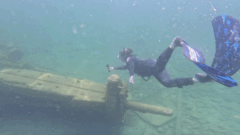
From dining on authentic cuisine served on the ill-fated freighter to a solemn laying of wreaths on the water, the Detroit Historical Society is hosting a weekend of events to honor the 29 mariners who died in the sinking of the Edmund Fitzgerald nearly 50 years ago. Read the full story by The Detroit Free Press.

Original Article

Great Lakes Commission

Great Lakes Commission

https://www.glc.org/dailynews/20250929-edmund-fitzgerald-anniversary
Taaja Tucker-Silva

As part of a court case filed by environmental advocacy groups, The Campbell’s Company recently admitted to violating the Clean Water Act more than 5,000 times from 2018 to 2024 at their Napoleon, Ohio, facility which discharges water into the Maumee River. Read the full story by Spectrum News 1.

Original Article

Great Lakes Commission

Great Lakes Commission

https://www.glc.org/dailynews/20250929-campbells-violations

Taaja Tucker-Silva

A cruise line focused on U.S. destinations will join the growing Great Lakes cruising industry in 2026. The new ship will sail lakes Erie, Huron, Michigan, and Ontario from May to August 2026 with 9- and 14-day itineraries. Read the full story by MLive.

Original Article

Great Lakes Commission

Great Lakes Commission

https://www.glc.org/dailynews/20250929-great-lakes-cruises

Taaja Tucker-Silva

After recent sightings, the Wisconsin Department of Natural Resources (DNR) is increasing monitoring in Lake Winnebago for invasive round gobies. The DNR is working with local fishing groups and partners to help catch the fish. Read the full story by Wisconsin Public Radio.

Original Article

Great Lakes Commission

Great Lakes Commission

https://www.glc.org/dailynews/20250929-winnebago-gobies

Taaja Tucker-Silva

Local historians are looking for one of the last radios to be in contact with the Edmund Fitzgerald. The radio was among discarded items when the Auxiliary Coast Guard building in Grand Marais, Michigan, was emptied. Read the full story by The Detroit Free Press.

Original Article

Great Lakes Commission

Great Lakes Commission

https://www.glc.org/dailynews/20250929-missing-radio

Taaja Tucker-Silva

A lake sturgeon reintroduction program in Ohio’s Maumee River has released 3,000 fingerlings annually since 2018. Early survival rates are promising, and researchers aim to establish a self-sustaining population of 1,500 sturgeon by 2038. Read the full story by WFFT-TV – Fort Wayne, IN.

Original Article

Great Lakes Commission

Great Lakes Commission

https://www.glc.org/dailynews/20250929-maumee-sturgeon

Taaja Tucker-Silva

A new business provides lessons along the Detroit River on a relatively new type of watercraft. e-Foils, motorized surfboard-like watercraft derived from kiteboarding, allow users to travel over the water at up to 30 mph for about an hour at a time. Read the full story by MLive.

Original Article

Great Lakes Commission

Great Lakes Commission

https://www.glc.org/dailynews/20250929-efoil-lessons

Taaja Tucker-Silva

A $5.5 million expansion at the National Museum of the Great Lakes in Toledo, Ohio, made room for a pilot house, a new permanent gallery, space for rotating exhibits, offices, a conference room and places for seminars and workshops. Read the full story by the Toledo City Paper.

Original Article

Great Lakes Commission

Great Lakes Commission

https://www.glc.org/dailynews/20250929-museum-expansion

Taaja Tucker-Silva

By Samantha Ku
New federal policy is aimed at addressing the nation’s wildfire crisis by boosting timber production, but some experts say it’s not expected to have a major impact in Michigan. 

The post Federal wildfire policy sparks debate: timber or trees?  first appeared on Great Lakes Echo.

Original Article

Great Lakes Echo

Great Lakes Echo

https://greatlakesecho.org/2025/09/29/federal-wildfire-policy-sparks-debate-timber-or-trees/

Great Lakes Echo

By Eric Freedman
Motorcycles and deer don’t mix. And motorcyclists are especially vulnerable to injury or death when they do, according to a recent study of a decade’s worth of crashes in Michigan.

The post Study finds high risk of injury or death in motorcycle-deer collisions  first appeared on Great Lakes Echo.

Original Article

Great Lakes Echo

Great Lakes Echo

https://greatlakesecho.org/2025/09/27/study-finds-high-risk-of-injury-or-death-in-motorcycle-deer-collisions/

Eric Freedman

Patchy dense fog is expected at times across the region this morning. The fog will reduce visibilities below 1 mile, with visibilities as low as one quarter of a mile at times. Motorists should anticipate rapidly changing and poor visibilities. If you are traveling, slow down and give yourself extra time to reach your destination as even if no fog is occurring where you are, there could be thick fog along your route. Allow extra room between you and the car in front of you and use your low beam headlights.

Original Article

Current watches, warnings, and advisories for Brown County (WIC009) WI

Current watches, warnings, and advisories for Brown County (WIC009) WI

https://api.weather.gov/alerts/urn:oid:2.49.0.1.840.0.0f20828568deef567187ebc16eb2449f7c7d45fa.001.1.cap

NWS

Federal cuts to Great Lakes science would harm the quality of life, the multibillion-dollar economies built around the lakes, and emergency preparedness, a group of environmental advocacy officials, academics and local government representatives said Wednesday. Read the full story by the Detroit Free Press.

Original Article

Great Lakes Commission

Great Lakes Commission

https://www.glc.org/dailynews/20250926-greatlakes-science-cuts

Autumn McGowan

Mayors from major cities in the Great Lakes and St. Lawrence River region launched a 10-year economic transformation plan positioning the region as a “Fresh Coast” corridor to capitalize on growing global water scarcity. Read the full story by the Cleveland Plain Dealer.

Original Article

Great Lakes Commission

Great Lakes Commission

https://www.glc.org/dailynews/20250926-fresh-coast-initiative

Autumn McGowan

The Chicago River made news recently for hosting an open water swim, the first organized swim event in the river in nearly 100 years. The Cuyahoga River in Cleveland, Ohio, may not be ready for such an event. Read the full story by the Cleveland Plain Dealer.

Original Article

Great Lakes Commission

Great Lakes Commission

https://www.glc.org/dailynews/20250926-cuyahga-river-swim

Autumn McGowan

Expanding underwater spearfishing in Michigan would open more of the Great Lakes to the sport and broaden the kinds of fish anglers could harvest, but wildlife regulators must first approve the change. Read the full story by WJBK – Detroit, MI.

Original Article

Great Lakes Commission

Great Lakes Commission

https://www.glc.org/dailynews/20250926-michigan-spearfishing

Autumn McGowan

Fish Caught Off of Bowen St. Fishing Pier in Oshkosh In June, an angler caught a round goby in Lake Winnebago at the Bowen Street Fishing Pier in Oshkosh, the first known detection there. The invasive fish is about 3 to 6 inches long with bulging frog-like eyes and a fused fin on their [...]

The post Round Goby Discovery in Winnebago Update; Assessment Ramps Up appeared first on Fox-Wolf Watershed Alliance.

Original Article

Fox-Wolf Watershed Alliance

Fox-Wolf Watershed Alliance

https://fwwa.org/2025/09/26/round-goby-discovery-in-winnebago-update-assessment-ramps-up/?utm_source=rss&utm_medium=rss&utm_campaign=round-goby-discovery-in-winnebago-update-assessment-ramps-up

Chris Acy

By Maya Moore 

Blight Hernandez is a master of turning everyday trash into something of value. A Southwest Detroit native, Hernandez has called himself an artist since he was 6. Now a full-time working artist for five years, his sustainable business is called Be The Light. It’s born out of intention and focused on higher consciousness, keeping things out of the landfill, and making things that people love, Hernandez said.

The post The sustainable art of Blight Hernandez: ‘No waste’   first appeared on Great Lakes Echo.

Original Article

Great Lakes Echo

Great Lakes Echo

https://greatlakesecho.org/2025/09/25/the-sustainable-art-of-blight-hernandez-no-waste/

Great Lakes Echo

Patchy dense fog is expected across portions of northeast Wisconsin this morning, with visibilities around a quarter of a mile or less at times. Motorists should anticipate rapidly changing and poor visibilities through the morning commute. If you have travel plans, slow down and allow extra time to reach your destination. Allow extra room between you and the car in front of you and use your low beam headlights.

Original Article

Current watches, warnings, and advisories for Brown County (WIC009) WI

Current watches, warnings, and advisories for Brown County (WIC009) WI

https://api.weather.gov/alerts/urn:oid:2.49.0.1.840.0.df298d6fe82072807e76d041e1ed15cf6108a8ab.001.1.cap

NWS

Patchy dense fog is expected across portions of northeast Wisconsin this morning, with visibilities around a quarter of a mile or less at times. Motorists should anticipate rapidly changing and poor visibilities through the morning commute. If you have travel plans, slow down and allow extra time to reach your destination. Allow extra room between you and the car in front of you and use your low beam headlights.

Original Article

Current watches, warnings, and advisories for Brown County (WIC009) WI

Current watches, warnings, and advisories for Brown County (WIC009) WI

https://api.weather.gov/alerts/urn:oid:2.49.0.1.840.0.10a09893863d4ff48b9f1b5cf636ddc45005e752.001.1.cap

NWS

After the U.S. Coast Guard closed its Grand Marais, Minnesota, station in 2022, the Grand Portage Band of Lake Superior Chippewa launched what’s believed to be the first Indigenous-led coast guard, now rescuing vessels and serving Minnesota’s North Shore. Read the full story by WTIP – Grand Marais, MN.

Original Article

Great Lakes Commission

Great Lakes Commission

https://www.glc.org/dailynews/20250924-indigenous-coast-guard

Taaja Tucker-Silva

The U.S. Coast Guard Sector of the Eastern Great Lakes plans to introduce a tool called Aqua Alerts, which will be sent straight to the public’s phones to notify them and local mariners about search and rescue efforts on Lakes Erie and Ontario. Read the full story by Spectrum News 1.

Original Article

Great Lakes Commission

Great Lakes Commission

https://www.glc.org/dailynews/20250924-aqua-alerts

Taaja Tucker-Silva

New research shows a fivefold expansion of seawalls, riprap, groins and other hard armoring of Lake Michigan beaches in recent years. Coastal armoring temporarily protects properties from erosion but makes the problem worse in the long run. Read the full story by Bridge Michigan.

Original Article

Great Lakes Commission

Great Lakes Commission

https://www.glc.org/dailynews/20250924-armored-shoreline

Taaja Tucker-Silva

The Northeast Ohio Regional Sewer District’s $3 billion ‘Project Clean Lake’ has passed the halfway point, with billions of gallons of sewage already kept out of Lake Erie. When completed, massive storage tunnels will help capture and treat 99% of the district’s combined stormwater and sanitary sewage. Read the full story by The Plain Dealer.

Original Article

Great Lakes Commission

Great Lakes Commission

https://www.glc.org/dailynews/20250924-project-clean-lake

Taaja Tucker-Silva

The Riveredge Nature Center in Saukville, Wisconsin, has raised hundreds of lake sturgeon that will soon be released in Lake Michigan. In partnership with the Wisconsin Department of Natural Resources, this rehabilitation effort has released over 22,000 sturgeon in the past two decades. Read the full story by Spectrum News 1.

Original Article

Great Lakes Commission

Great Lakes Commission

https://www.glc.org/dailynews/20250924-sturgeon-release

Taaja Tucker-Silva

The Lake Michigan car ferry, S.S. Badger, crashed into a docked ship last week when its engines didn’t respond. The engines are in working order despite this anomaly, but the ship’s damaged seagate was removed and will be replaced at the end of the season. Read the full story by MLive.

Original Article

Great Lakes Commission

Great Lakes Commission

https://www.glc.org/dailynews/20250924-badger-collision

Taaja Tucker-Silva

In terms of popular fascination, few shipwrecks compare to the foundering of the Edmund Fitzgerald in a 1975 Lake Superior storm, with the loss of its entire 29-person crew. The shipwreck’s ‘human element’ keeps its story alive. Read the full story by the Duluth News Tribune.

Original Article

Great Lakes Commission

Great Lakes Commission

https://www.glc.org/dailynews/20250924-edmund-fitzgerald

Taaja Tucker-Silva

The Alliance for the Great Lakes recently issued a report that the Great Lakes region isn’t prepared for the dramatic water and energy use demands of data centers. The region is at a critical moment, one that requires caution, statewide oversight, strong regional planning, and transparency. Read the full story by The Capital Times.

Original Article

Great Lakes Commission

Great Lakes Commission

https://www.glc.org/dailynews/20250924-data-centers

Taaja Tucker-Silva

Stroll along Cleveland’s Edgewater Pier on a summer evening, and you’ll hear Arabic, Spanish, and other languages wafting through the lake air. For decades, international immigrants have found a home in the city of Lake Erie.

But now, there’s an increasing chance that future waves of migrants — from Florida, Arizona, California, and beyond — could move here as extreme weather events caused by climate change in those regions prompt people to rethink where they want to live.

Read Now at Great Lakes Now.

Original Article

Great Lakes Now

Great Lakes Now

https://www.greatlakesnow.org/2025/09/how-great-lakes-cities-are-preparing-for-climate-migration/

Stephen Starr, Great Lakes Now

Some people revel in the dog days of summer, but for a dozen aquaculture interns, the season was all about fish.

In partnership with Wisconsin Sea Grant and funded through a grant from the Freshwater Collaborative of Wisconsin, the interns were stationed at aquaculture facilities across the state, working alongside mentors to get hands-on experience raising and caring for fish. According to Wisconsin Sea Grant food-fish coordinator Sharon Moen, who led the project alongside aquaculture specialists Emma Hauser and Dong-Fang Deng, the purpose of the internships was to build awareness of fish farming and offer training opportunities for young people.

“We couldn’t be happier with the way this first-time program unfolded,” said Moen. “The students and mentors gained so much during a short 10 weeks.”

Raising fish was not the only new skill the interns acquired. They learned how to manage projects, work on a team, and — importantly — embrace the many utilitarian wonders of PVC pipes and power tools.

Here’s a snapshot of some of their projects.

Yellow perch, aquaponics, and renewable energy at Northey Farms

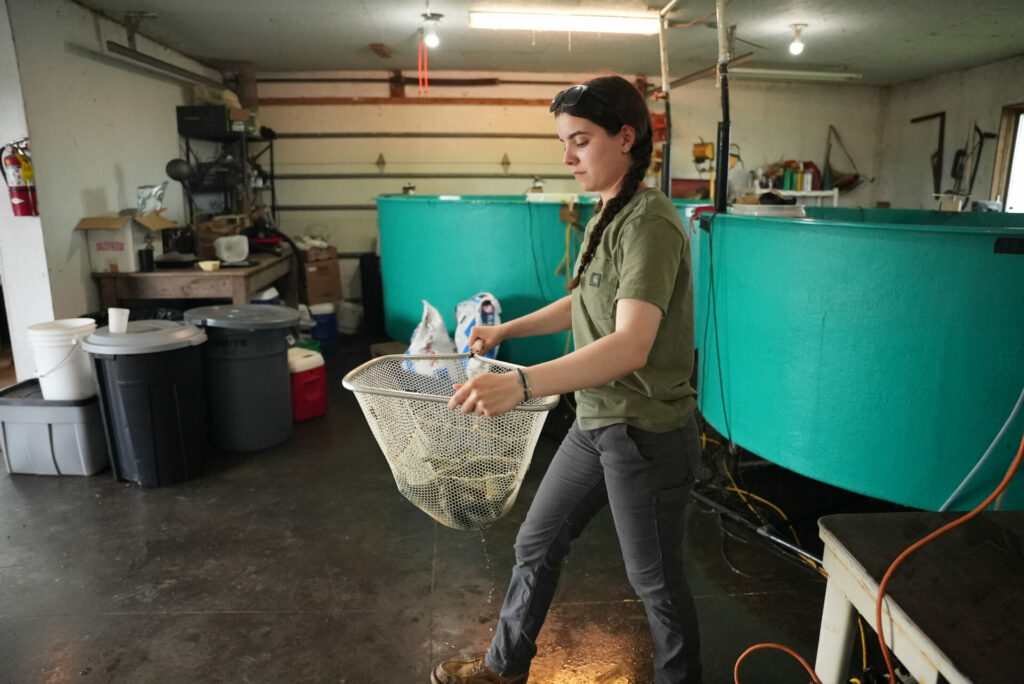
Aquaculture intern walks with a net of yellow perch

Rachel Virnig transports yellow perch at Northey Farms. Credit: Wisconsin Sea Grant


University of Wisconsin–Madison undergraduates Jack Patterson, Erin Ross, and Rachel Virnig interned at Northey Farms in Deerfield, Wisconsin, a fish farm that uses both outdoor ponds and a recirculating aquaculture system to raise yellow perch. Under the supervision of Kyle Freimuth, a University of Wisconsin–Milwaukee School of Freshwater Sciences graduate student, the team of interns learned how to monitor water quality, clean tanks, and care for more than 27,000 yellow perch.

Freimuth got a crash course in farm management. He developed a system for interns to track daily water quality, allocate tasks, and communicate with the farm owner. “I feel good about the work,” said Freimuth. “I was able to see all the little things that we were able to do to better care for the fish.”

For Patterson, Ross, and Virnig, the biggest project of the summer was building an aquaponic system in an outdoor hoop house. When it wasn’t being burglarized by racoons, the plant-and-fish production system supported bluegill and yellow perch alongside tomatoes, eggplants, peppers, basil, and tomatillos. The interns also constructed — from scratch and with no directions! — a mini wind turbine to power the whole system. The project was a point of pride for the team, who enjoyed creating a functioning, self-sufficient food system and learning new, practical life skills.

“I didn’t know how to use power tools before this internship, and that became a daily skill,” said Ross. “That was huge for me as a young adult.”

Research, education, and outreach at Northern Aquaculture Demonstration Facility

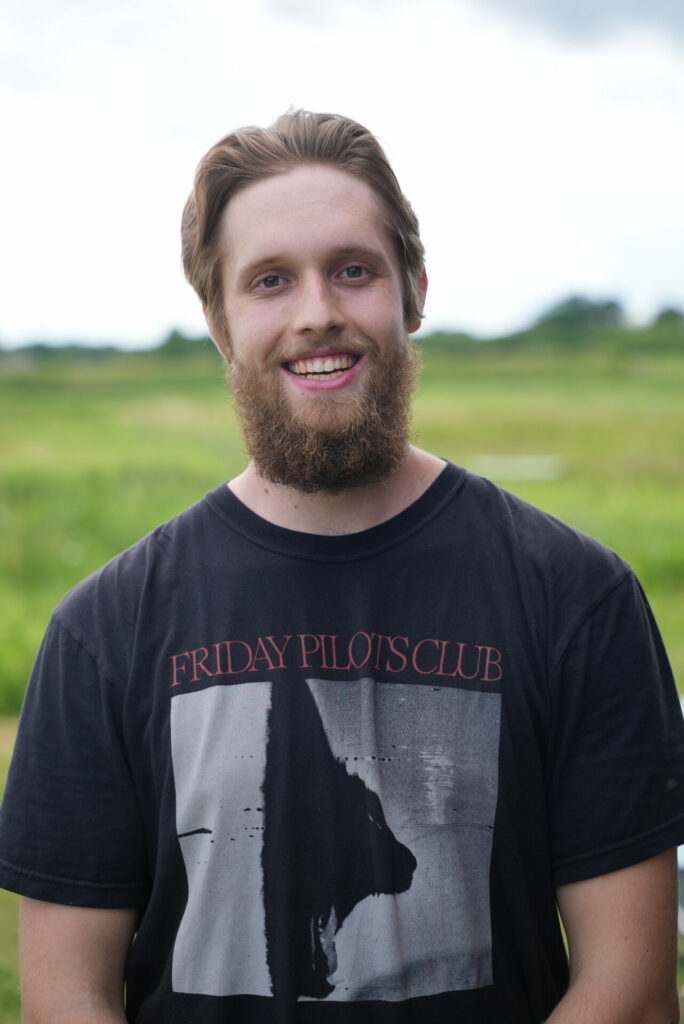
aquaculture intern, Wyatt Slack, stands in a black t-shirt in front of a green field

Wyatt Slack. Credit: Wisconsin Sea Grant


Like most of the interns, Wyatt Slack was largely unfamiliar with aquaculture prior to this summer. Fast forward two months, and he was teaching others about what he learned.

Slack, an undergraduate at the University of Wisconsin–Madison, worked at the University of Wisconsin–Stevens Point Northern Aquaculture Demonstration Facility in Red Cliff, Wisconsin. The facility supports aquaculture research and showcases the latest techniques and technologies while also educating others about the industry. As an intern, Slack got to do a little bit of everything.

“Some days we spawned salmon. Others, we took blood samples from lake trout or set up another experiment,” said Slack. “No day looks exactly the same.”

One task remained constant, however, and that was cleaning. Slack used a windshield wiper attached to a PVC pipe to clean the circular walls of the fish tanks. It was a funny but utterly functional tool that was, in a lot of ways, emblematic of the ingenuity of fish farmers.

“PVC pipes are the lifeblood of these systems,” he laughed.

Slack also practiced communicating the science of aquaculture to different audiences, from kids to adults. He gave tours to visiting groups, showed kindergartners big fish, and made art at Kid’s Fishing Day. His last assignment was serving walleye he helped raise to about 150 people at an event in Houghton, Michigan. During the event he talked to participants and a reporter about aquaculture in the Upper Midwest.

“Outreach was definitely one of the most fulfilling parts of this internship,” he said.

Raising zebrafish at the Morgridge Institute for Research

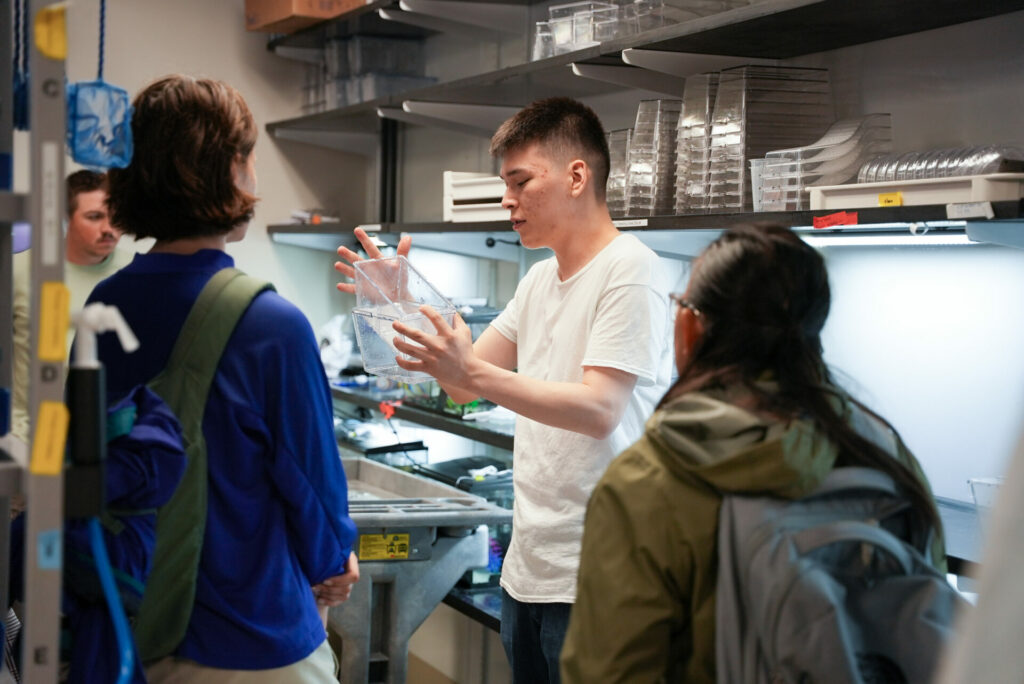
aquaculture intern Raatbek Baizakov holds a plastic tanks used for breeding zebrafish

Raatbek Baizakov explains zebra fish breeding tanks at the Morgridge Institute. Credit: Wisconsin Sea Grant


While aquaculture often produces fish for food, fish farms also raise fish for bait, stocking and, as University of Wisconsin–Madison student Raatbek Baizakov learned, research.

Baizakov spent his summer interning at the Morgridge Institute for Research, a biomedical research facility in Madison, Wisconsin. Originally from Kyrgyzstan, Baizakov grew up helping his dad raise trout.

“I had experience with game fish. I didn’t really have experience with research fishes,” he said. “It’s not really similar at all.”

Instead of trout, Baizakov worked with zebrafish, a small striped fish with the unique ability to regrow damaged body parts like fins, heart tissue, and spinal cords. Researchers at Morgridge study the fish for this reason, hoping to find ways to heal similar injuries in people.

Working with a small team, Baizakov provided daily care for 2,250 tanks of zebrafish, which involved feeding and flushing tanks. He also enjoyed learning about the system that pumps and recirculates water through the tanks, which he described as “genius.”

“As a mechanical engineer, I appreciated this so much,” he said.

Lab research at the University of Wisconsin–Milwaukee School of Freshwater Sciences

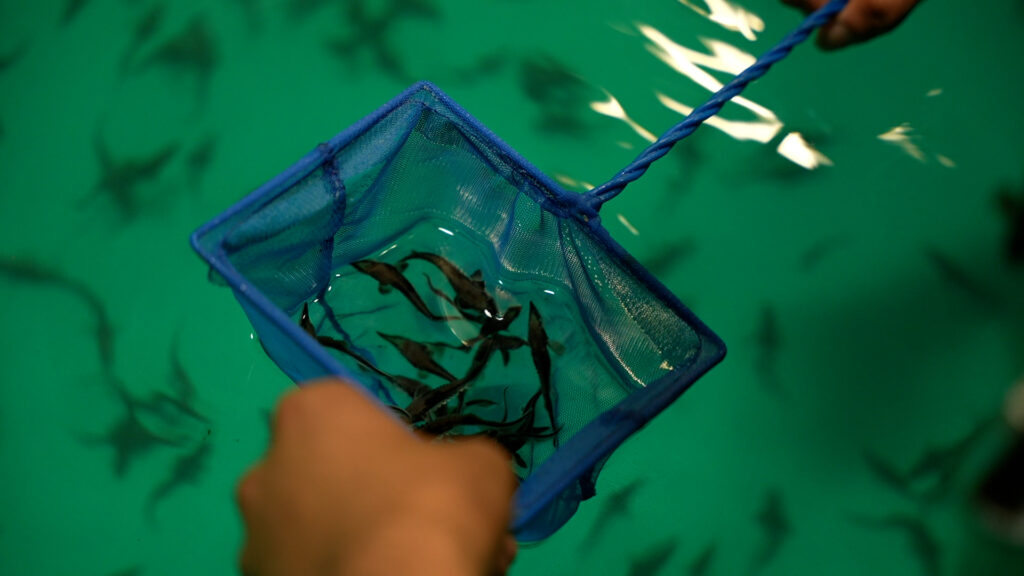
a hand holds a small net filled with tiny sturgeon

Baby sturgeon at the UW–Milwaukee School for Freshwater Sciences. Credit: Wisconsin Sea Grant


Another set of interns kept busy learning about fish care and nutrition in the lab of Wisconsin Sea Grant aquaculture outreach and extension specialist Dong-Fang Deng.

Though not all were funded by the Freshwater Collaborative of Wisconsin, Louis Benard, Kayden Knudsen, Alex Gregory, Cory Vines, and Tyler Gregorski worked side-by-side cleaning tanks, sorting fish, and pursuing individual projects, which ranged from the effects of microplastics on fish growth to incorporating novel ingredients like black soldier fly oil and soy cake into fish food.

“It’s a lot of fun,” said high school senior Knudsen, who investigated the impacts of microplastics on yellow perch. “Working at UWM has been a really good experience for developing ideas about my future.”

Mapping Wisconsin fish farms

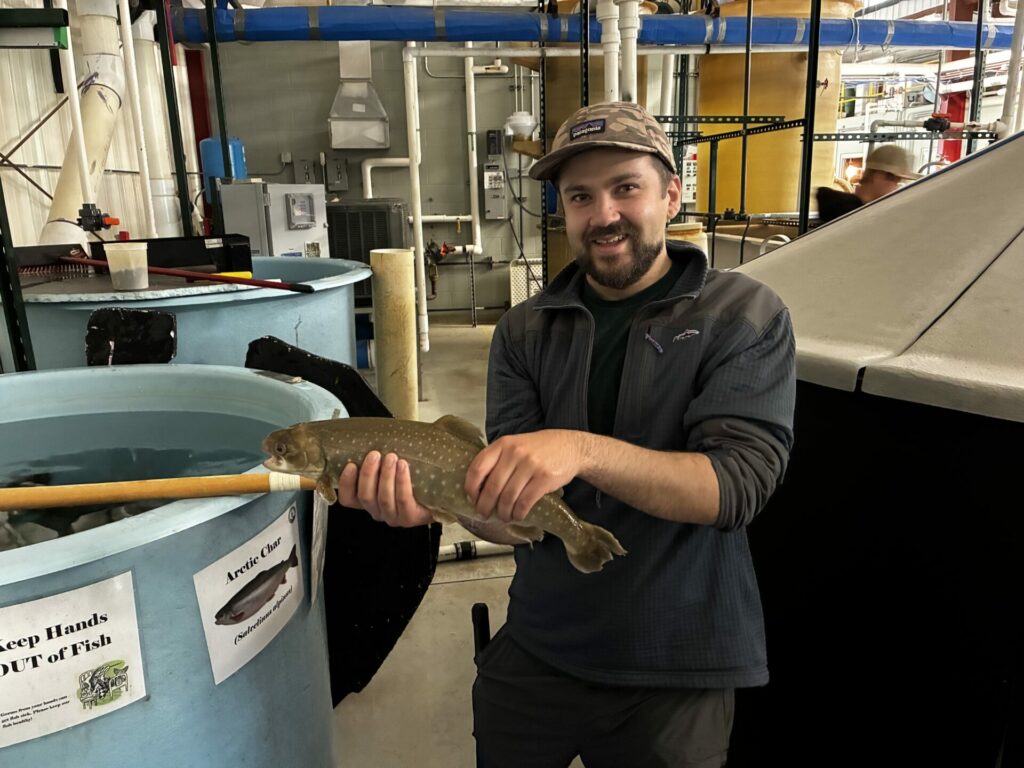
Aquaculture intern Ryan Figueroa holds up a fish at the Northern Aquaculture Demonstration Facility

Ryan Figueroa visited the University of Wisconsin-Stevens Point Northern Aquaculture Demonstration Facility as part of his internship. Submitted photo.

Unlike the other interns, Ryan Figueroa didn’t work at a fish farm, but he did get a bird’s-eye view of the aquaculture industry across the state. Figueroa, an undergraduate at the University of Wisconsin–Superior with an interest in GIS, worked with Moen to revamp the Eat Wisconsin Fish food fish maps to show the location and features of aquaculture and commercial fishing operations in Wisconsin. The goal was to make aquaculture visible and accessible to those wanting to buy locally raised fish.

“Maps help connect people to local food systems,” said Figueroa. That certainly was the case for him. He visited several fish operations to collect geospatial data and enjoyed eating some of their wares. He also appreciated having Moen as his mentor for the summer.

“She’s the best,” said Figueroa. “I really want to emulate what she does. I loved seeing how she works and how she communicates with people. She’s been a huge help for me.”

To learn more about the interns’ experiences, check out this video made by aquaculture outreach specialist Emma Hauser.

***

The University of Wisconsin Aquatic Sciences Center administers Wisconsin Sea Grant, the Wisconsin Water Resources Institute, and Water@UW. The center supports multidisciplinary research, education, and outreach for the protection and sustainable use of Wisconsin’s water resources. Wisconsin Sea Grant is one of 34 Sea Grant programs supported by the National Oceanic and Atmospheric Administration in coastal and Great Lakes states that encourage the wise stewardship of marine resources through research, education, outreach, and technology transfer.

The post Summer students learn the ropes of fish farming first appeared on Wisconsin Sea Grant.

Original Article

News Releases | Wisconsin Sea Grant

News Releases | Wisconsin Sea Grant

https://www.seagrant.wisc.edu/news/summer-students-learn-the-ropes-of-fish-farming/

Jenna Mertz

A Great Lakes oil pipeline faces 3 controversies with no speedy resolutions

By Mike Shriberg, University of Michigan

 is an independent and nonprofit source of news, analysis and commentary from academic experts.

For more than a decade, controversy over an oil pipeline that passes directly through a Native American reservation and then across a sensitive waterway that is also a key shipping lane has brewed in Wisconsin and Michigan.

Read Now at Great Lakes Now.

Original Article

Great Lakes Now

Great Lakes Now

https://www.greatlakesnow.org/2025/09/a-great-lakes-oil-pipeline-faces-3-controversies-with-no-speedy-resolutions/

The Conversation

By Eric Freedman 

The iconic Blue Water Bridge has received a clean bill of operational health from the Michigan Auditor General’s Office. Based on its preliminary survey of procurement, fleet vehicles, employee training and toll transactions, the office said it saw no need to do a full performance audit of the bridge’s effectiveness and efficiency.

The post Busy Blue Water Bridge gets positive auditor general report  first appeared on Great Lakes Echo.

Original Article

Great Lakes Echo

Great Lakes Echo

https://greatlakesecho.org/2025/09/23/busy-blue-water-bridge-gets-positive-auditor-general-report/

Eric Freedman

* WHAT...Visibility one quarter mile or less in dense fog. * WHERE...Brown, Door, Kewaunee, Outagamie, Shawano, Southern Marinette County, Southern Oconto County, and Waupaca Counties. * WHEN...Until 7 AM CDT this morning. * IMPACTS...Low visibility could make driving conditions hazardous.

Original Article

Current watches, warnings, and advisories for Brown County (WIC009) WI

Current watches, warnings, and advisories for Brown County (WIC009) WI

https://api.weather.gov/alerts/urn:oid:2.49.0.1.840.0.0449d39eeb93b2696f6c1b971bfb2a748d865ce4.002.1.cap

NWS

* WHAT...Visibility one quarter mile or less in dense fog. * WHERE...Brown, Kewaunee, Outagamie, Shawano, and Waupaca Counties. * WHEN...Until 7 AM CDT this morning. * IMPACTS...Low visibility could make driving conditions hazardous.

Original Article

Current watches, warnings, and advisories for Brown County (WIC009) WI

Current watches, warnings, and advisories for Brown County (WIC009) WI

https://api.weather.gov/alerts/urn:oid:2.49.0.1.840.0.e576aa3bd0015157c8c39e0f048431908f2d4072.001.1.cap

NWS

Widespread dense fog, with visibilities around a quarter of a mile or less, was reported across Door County and southern sections of Oconto and Marinette counties, where a Dense Fog Advisory remains in effect until 7 am Tuesday morning. Over the remainder of the region, patchy dense fog was noted across north-central and portions of northeast Wisconsin. Visibilities in the patchy fog was down to around one quarter of a mile. Latest surface observations, satellite, and model data suggest the fog will continue to expand southward overnight into central and east-central Wisconsin. Motorists should anticipate rapidly changing and poor visibilities through the night as the fog spreads southward. If you have travel plans, slow down and allow extra time to reach your destination. Allow extra room between you and the car in front of you and use your low beam headlights.

Original Article

Current watches, warnings, and advisories for Brown County (WIC009) WI

Current watches, warnings, and advisories for Brown County (WIC009) WI

https://api.weather.gov/alerts/urn:oid:2.49.0.1.840.0.3caa2cd65d067768d438f36a2bb1c0e62819a4f2.001.1.cap

NWS

Amid rise of RFK Jr., officials waver on drinking water fluoridation — even in the state where it started

By Anna Clark, ProPublica

This story was originally published by ProPublica.

Just 15 months after receiving an award from the Centers for Disease Control and Prevention for excellence in community water fluoridation, the city of Grayling, Michigan, changed course.

With little notice or fanfare, council members voted unanimously in May to end Grayling’s decades long treatment program.

Read Now at Great Lakes Now.

Original Article

Great Lakes Now

Great Lakes Now

https://www.greatlakesnow.org/2025/09/fluoride-drinking-water-rfk-jr-michigan-cdc-hhs/

ProPublica

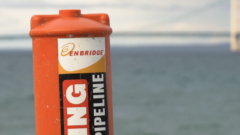
The Michigan Supreme Court said it will hear a challenge brought by Indigenous Nations and environmental advocates who argue that the Michigan Public Service Commission broke state laws in approving Enbridge’s proposal to construct a massive oil tunnel beneath the Straits of Mackinac. Read the full story by WLUC-TV – Marquette, MI.

Original Article

Great Lakes Commission

Great Lakes Commission

https://www.glc.org/dailynews/20250922-pipeline-legal-challenge

James Polidori

The Michigan Supreme Court said it will hear a challenge brought by Indigenous Nations and environmental advocates who argue that the Michigan Public Service Commission broke state laws in approving Enbridge’s proposal to construct a massive oil tunnel beneath the Straits of Mackinac. Read the full story by WLUC-TV – Marquette, MI.

Original Article

Great Lakes Commission

Great Lakes Commission

https://www.glc.org/dailynews/20250922-pipeline-legal-challenge

James Polidori

According to a new report by the Alliance for the Great Lakes and Clean Wisconsin, nitrate contamination could cost communities millions of dollars in remediation and lead to higher health care bills for thousands of residents in largely rural areas where people rely on private drinking water wells. Read the full story by the Milwaukee Journal Sentinel.

Original Article

Great Lakes Commission

Great Lakes Commission

https://www.glc.org/dailynews/20250922-nitrate-impacts-report

James Polidori

According to a new report by the Alliance for the Great Lakes and Clean Wisconsin, nitrate contamination could cost communities millions of dollars in remediation and lead to higher health care bills for thousands of residents in largely rural areas where people rely on private drinking water wells. Read the full story by the Milwaukee Journal Sentinel.

Original Article

Great Lakes Commission

Great Lakes Commission

https://www.glc.org/dailynews/20250922-nitrate-impacts-report

James Polidori

One billion dollars will be spent in efforts to “significantly” improve water quality in the Niagara River, according to an agreement announced Friday between the Buffalo Sewer Authority, the New York State Department of Environmental Conservation and the Attorney General’s Office. Read the full story by WIVB-TV – Buffalo, NY.

Original Article

Great Lakes Commission

Great Lakes Commission

https://www.glc.org/dailynews/20250922-water-quality-funding

James Polidori

One billion dollars will be spent in efforts to “significantly” improve water quality in the Niagara River, according to an agreement announced Friday between the Buffalo Sewer Authority, the New York State Department of Environmental Conservation and the Attorney General’s Office. Read the full story by WIVB-TV – Buffalo, NY.

Original Article

Great Lakes Commission

Great Lakes Commission

https://www.glc.org/dailynews/20250922-water-quality-funding

James Polidori