Typical Global Climate Conditions
2024-08-20
In cooperation with the World Meteorological Organization (WMO),
NCEI News Feed
https://www.ncei.noaa.gov/news/typical-global-climate-conditions
NCEI News Feed
https://www.ncei.noaa.gov/news/typical-global-climate-conditions
NCEI News Feed
https://www.ncei.noaa.gov/news/typical-global-climate-conditions
NCEI News Feed
https://www.ncei.noaa.gov/news/typical-global-climate-conditions
NCEI News Feed
https://www.ncei.noaa.gov/news/typical-global-climate-conditions
NCEI News Feed
https://www.ncei.noaa.gov/news/typical-global-climate-conditions
NCEI News Feed
https://www.ncei.noaa.gov/news/typical-global-climate-conditions
NCEI News Feed
https://www.ncei.noaa.gov/news/typical-global-climate-conditions
NCEI News Feed
https://www.ncei.noaa.gov/news/typical-global-climate-conditions
NCEI News Feed
https://www.ncei.noaa.gov/news/typical-global-climate-conditions
NCEI News Feed
https://www.ncei.noaa.gov/news/typical-global-climate-conditions

Members of the Wisconsin Sea Grant communications team look into an aquaculture tank at the Northern Aquaculture Demonstration Facility while Emma Hauser looks on. Image credit: Marie Zhuikov, Wisconsin Sea Grant
Each summer, our communications team goes out in the field to see Sea Grant projects firsthand and to spend time with each other. This year’s learning trip took us to the Bayfield Peninsula and northern Wisconsin.

Emma Hauser shows off one of NADF’s aquacultured salmon. Image credit: Wisconsin Sea Grant
Highlights on the first day included a visit to the Northern Aquaculture Demonstration Facility in Red Cliff, where Sea Grant’s Emma Hauser helped us get up close and personal with some salmon. For dinner, we got even closer to fish as we ate Lake Superior whitefish caught by Hoop’s Fisheries in Bayfield.

Lake Superior whitefish (and chips) caught and cooked by Hoop’s Fisheries. Image credit: Marie Zhuikov, Wisconsin Sea Grant
On Day Two, we learned about the Wave Watch Buoy Project in the Apostle Islands National Lakeshore from Jeff Rennicke, director of the Friends of the Apostle Islands. These University of Wisconsin–Madison data buoys allow boaters to access wind and wave information online, making for more safe boating.

Jeff Rennicke (right) with the Friends of the Apostle Islands talks about the group’s projects while Sea Grant’s Natalie Chin (left) and Moira Harrington (center) listen on the Bayfield City Dock. Image credit: Marie Zhuikov, Wisconsin Sea Grant
Next, we toured Bodin’s Fisheries where Bill Bodin showed us how Lake Superior fish are processed after they’re caught. Afterward at a shore lunch hosted by Eat Wisconsin Fish’s Sharon Moen, we dined on Bodin’s whitefish, cooked over a charcoal grill.

Bill Bodin in his fish store. Image credit: Marie Zhuikov, Wisconsin Sea Grant

Lake Superior fish caught by Bodin’s Fisheries. Image credit: Marie Zhuikov, Wisconsin Sea Grant
Sated, we caught the ferry to Madeline Island where we walked through a drizzle on the Big Bay Town Park boardwalk and learned more about the park’s unique lagoon, which is surrounded by a floating fen mat and, on the other side, a beautiful Lake Superior beach.
We caught the ferry back to the mainland only to board another boat for a grand cruise on the Apostle Islands. During the hourlong ride, we learned about the rich history of human interaction with these islands in Lake Superior. We saw lighthouses and sea caves cut into the island sandstone by the lake. We also waved to one of the Wave Watch buoys as we motored past.

Devil’s Island, Apostle Islands National Lakeshore. Image credit: Marie Zhuikov, Wisconsin Sea Grant
On the final day of our field trip, we drove to Superior, Wisconsin, where we met with Melonee Montano, one of the leads for a project that is investigating how Anishinaabe people connected to and homesteaded the lands of “Zhaagawaamikong Neyaashi” (Minnesota and Wisconsin points) and how they used fire to manage the landscape. She took us to both points and discussed the differences in habitats and uses.

Communications summer student Abigail Brown takes a photo of Melonee Montano on Minnesota Point for a video about her project. Image credit: Marie Zhuikov, Wisconsin Sea Grant
When the trip was over, I, for one, felt like my head was heavier from all the knowledge imparted by our speakers and experiences. These “crash courses” help greatly with our work to interpret Sea Grant research and outreach projects by providing us with vital background information. Plus, it’s not every day I get to watch a colleague hug a 20-pound salmon!

Editor Elizabeth White gets personal with a salmon at NADF while Emma Hauser looks on. Image credit: Wisconsin Sea Grant
The post Sea Grant communications team gets crash course in aquaculture, Lake Superior fish, buoys, bogs, islands and fire first appeared on Wisconsin Sea Grant.
Blog | Wisconsin Sea Grant
https://www.seagrant.wisc.edu/blog/sea-grant-communications-team-gets-crash-course-in-aquaculture-lake-superior-fish-buoys-bogs-islands-and-fire/
By Amalia Medina Water tanks line a room in Philadelphia’s Water Works on the bank of the Schuylkill River. Inside are small fish that are hosts to tiny organisms that researchers say can help solve polluted waterways. Tucked under the fish gills are microscopic mussels that will mature and become capable of filtering 10 to […]
The post Harnessing mussels to filter fresh water: A biological cure for contaminants is being studied first appeared on Great Lakes Echo.Great Lakes Echo
http://greatlakesecho.org/2024/08/19/harnessing-mussels-to-filter-fresh-water-a-biological-cure-for-contaminants-is-being-studied/
In September, federal contractors will begin a pilot cleanup project in Torch Lake near Houghton, Michigan, where 400 deteriorating metal drums of mining waste have littered the Upper Peninsula lakebed for decades. The U.S. Environmental Protection Agency wants to figure out the best method for removing the drums, as well as other debris and contaminated sediment which are helping drive fish consumption advisories for species like bass, pike, and walleye. Read the full story by MLive.
Great Lakes Commission
https://www.glc.org/dailynews/20240819-cleanup-study
The Sixth Circuit Court of Appeals denied Enbridge Energy’s request to rehear its June decision to remand the Nessel v. Enbridge case, which denied Enbridge’s Line 5 project to continue, back to a Michigan state court. Read the full story by WLUC-TV – Marquette, MI.
Great Lakes Commission
https://www.glc.org/dailynews/20240819-pipeline-litigation
Nagamo, the only piping plover chick that survived from a full clutch of eggs spawned at Montrose Beach in Illinois, was seen flying away from the area on Wednesday, according to volunteers with the Chicago Piping Plovers organization. But the chick returned Saturday, along with another young plover — a cousin from Waukegan. Read the full story by the Chicago Sun-Times.
Great Lakes Commission
https://www.glc.org/dailynews/20240819-plover-return
The National Oceanic and Atmospheric Administration said the main harmful algal bloom in western Lake Erie has expanded from the Toledo area to reach Huron, Ohio. The cyanobacteria bloom has an approximate area of 560 square miles, which is an increase in area since the last update on August 12. Read the full story by the Sandusky Register.
Great Lakes Commission
https://www.glc.org/dailynews/20240819-habs-expansion
The MI Healthy Climate Plan calls for Michigan to become carbon neutral by 2050. The Wolverine Power Collective’s plan to meet that goal involves the “Lake Michigan Connector” — a “superhighway” of electric cable across the lake that would allow power generated in the upper Midwest to be used in Michigan. Read the full story by WOOD-TV – Grand Rapids, MI.
Great Lakes Commission
https://www.glc.org/dailynews/20240819-power-production
The Port of Monroe recently received $1.5 million from the Michigan Maritime Grant Program for a new roll on/roll off extension that will facilitate the cross-border movement of large oversized transports from Canada. The port, Michigan’s only port on Lake Erie, is one of five facilities that received funding from the grant program. Read the full story by The Monroe News.
Great Lakes Commission
https://www.glc.org/dailynews/20240819-port-funding
The U.S. Army Corps of Engineers Buffalo District has secured $760,000 for designing new erosion defenses at Old Fort Niagara in New York State. Considerable erosion along the Lake Ontario shoreline has jeopardized the wall surrounding Old Fort Niagara, threatening landmarks like the French Castle and North Redoubt at the state historic site. Read the full story by the Niagara Gazette.
Great Lakes Commission
https://www.glc.org/dailynews/20240819-erosion-prevention
The City of Oshawa, Ontario, announced it has teamed up with the Central Lake Ontario Conservation Authority to repurpose old holiday trees as material to stabilize stream banks, control erosion, collect sediment, and improve overall stream habitat and water quality at the Enniskillen Conservation Area. Read the full story by the Durham Post.
Great Lakes Commission
https://www.glc.org/dailynews/20240819-stream-restoration
This summer has been one of almost instant gratification for salmon anglers booking charter trips on the eastern basin of Lake Ontario. In the coming weeks the salmon action will increase as they move close to shore and begin staging for their spawning runs up the tributaries. Read the full story by the Republican Herald.
Great Lakes Commission
https://www.glc.org/dailynews/20240819-salmon-fishing
By Jada Vasser Reusing materials in creative ways is a lifelong obsession for Ang Adamiak – one that led her to launch a nonprofit. Even though these days she says she’s mostly “in an office writing grants” while her staff is out doing “interesting work,” building partnerships around the sustainable reuse of materials still fuels […]
The post Arts & Scraps: Reusing materials to combat climate change first appeared on Great Lakes Echo.Great Lakes Echo
http://greatlakesecho.org/2024/08/18/arts-scraps-reusing-materials-to-combat-climate-change/
Current watches, warnings, and advisories for Brown County (WIC009) WI
Current watches, warnings, and advisories for Brown County (WIC009) WI
https://api.weather.gov/alerts/urn:oid:2.49.0.1.840.0.86ab2f32b583f688e176124f605ba70073d03d58.001.1.cap
Current watches, warnings, and advisories for Brown County (WIC009) WI
Current watches, warnings, and advisories for Brown County (WIC009) WI
https://api.weather.gov/alerts/urn:oid:2.49.0.1.840.0.86ab2f32b583f688e176124f605ba70073d03d58.001.1.cap
By Elinor Epperson Of all the things I could step in while wandering the Shiawassee National Wildlife Refuge in Northeast Michigan, vulture vomit was not on my list. My hosts, a team of scientists looking for native plant seeds, warned me to avoid it. Elizabeth Haber is a lead botanist with Seeds of Success, a […]
The post Commentary: Michigan joins federal program that collects native flora and champions restoration first appeared on Great Lakes Echo.Great Lakes Echo
http://greatlakesecho.org/2024/08/17/commentary-michigan-joins-federal-program-that-collects-native-flora-and-champions-restoration/
On August 5th, the New York Times opinion section published a piece by Arizona State University professor Dr. Jay Famiglietti where he asked Will We Have to Pump the Great Lakes to California to Feed the Nation?
At the Alliance for the Great Lakes, we are compelled to remind those eyeing Great Lakes water that Famiglietti poses a question already answered. No, we can’t pump water from the Great Lakes to California because it would violate federal and state law, specifically the Great Lakes-St. Lawrence River Basin Water Resources Compact that prohibits such acts.
Even if the impossible was possible – far better common-sense strategies than building expensive, thousand-mile-long water pipelines exist, like engaging in proven conservation, water reuse, and land-use planning initiatives. Only 1% of the water in the Great Lakes is renewed each year, underscoring the hard choices and complex planning that goes into keeping sustainable amounts of water available.
Short-sighted Western water law, rampant unchecked growth, and poor agricultural policy is much to blame for Western water shortages. The idea of building a massive, large-scale public works project to move water from one area of the country to another – which the author acknowledges would be wasteful and environmentally harmful – may be easier for some to envision than having difficult conversations about sustainable water and land use management.
Western water users would be better served working together to manage and plan for sustainable water use, like the eight Great Lakes states did, than embracing pipeline-in-the-sky fantasies made impossible by a settled agreement between the U.S. federal government, the Canadian provinces of Quebec and Ontario, and eight states.
The post Great Lakes Water is Staying in the Great Lakes appeared first on Alliance for the Great Lakes.
News - Alliance for the Great Lakes
News - Alliance for the Great Lakes
https://greatlakes.org/2024/08/great-lakes-water-is-staying-in-the-great-lakes/
Current watches, warnings, and advisories for Brown County (WIC009) WI
Current watches, warnings, and advisories for Brown County (WIC009) WI
https://api.weather.gov/alerts/urn:oid:2.49.0.1.840.0.ebc1cd86ea2cd48bbdd29c8046478bc70354ea5d.001.1.cap
By Jada Vasser Six years ago, the Association for the Advancement of Deaf/Hard-of-Hearing was founded by four mothers who wanted to create change and educational programming for their deaf children and community. “We are dedicated to improving the educational and occupational outcomes of deaf/hard of hearing youth and young adults by creating more accessible educational […]
The post Deaf and hard of hearing kids have a role in climate resilience first appeared on Great Lakes Echo.Great Lakes Echo
http://greatlakesecho.org/2024/08/16/deaf-and-hard-of-hearing-kids-have-a-role-in-climate-resilience/
A tribal leader and conservationists urged Wisconsin state officials to reject plans to relocate part of the aging Enbridge Line 5 pipeline in northern Wisconsin, warning that the threat of a catastrophic spill would still exist along the new route. Read the full story by The Associated Press.
Great Lakes Commission
https://www.glc.org/dailynews/20240816-pipeline-route
The presence of an invasive plant known as water soldier was confirmed in Ontario’s Lake Simcoe for the first time. If left unchecked, water soldier has the potential to invade lakes and rivers throughout Ontario and the Great Lakes basin. Read the full story by Barrie Advance.
Great Lakes Commission
https://www.glc.org/dailynews/20240816-water-soldier-found
The County Commissioners Association of Ohio’s Joint Water Quality Task Force agreed that cleaning up the western Lake Erie watershed is falling short, but two questions have been left unanswered: How to tackle the problem and who is going to foot the bill. Read the full story by The Blade.
Great Lakes Commission
https://www.glc.org/dailynews/20240816-erie-commissioners
The Mackinac Island Ferry Co. will stop making trips from Mackinaw City and St. Ignace, Michigan, to the island effective Monday, leaving Shepler’s Ferry as the only operating ferry service for the rest of the season. Read the full story by Bridge Michigan.
Great Lakes Commission
https://www.glc.org/dailynews/20240816-mackinac-ferry-repairs
Lake Erie’s harmful algal blooms have started sooner and had longer peak periods over the past decade compared to earlier years, newly released data shows. Warming temperatures linked to climate change are a cause, with interactions among species likely playing a role as well. Read the full story by Cleveland Scene.
Great Lakes Commission
https://www.glc.org/dailynews/20240816-erie-bloom-shift
After tens of millions of dollars in public funding and decades of work by many, the U.S. Environmental Protection Agency is moving to remove from its list of Areas of Concern Lake Ontario’s Rochester embayment, which lies between Towns of Webster and Parma, New York. Read the full story by The Democrat and Chronicle.
Great Lakes Commission
https://www.glc.org/dailynews/20240816-rochester-aoc
Multicolored, foul-smelling algae in the Lake Ontario waterfront of Hamilton, Ontario, has spurred complaints from boaters and residents, with the city testing for toxic blue-green algae and installing warning signs. Rather than clean it up, city staff are focused on tracking toxic algae locations and alerting the public. Read the full story by The Hamilton Spectator.
Great Lakes Commission
https://www.glc.org/dailynews/20240816-hamilton-algae
Alpena, Michigan, gateway to the Thunder Bay National Marine Sanctuary, offers a fascinating window into the maritime history of the Great Lakes. But beyond its well-known status as a shipwreck haven, Thunder Bay holds many lesser-known stories and facts that deepen its allure. Read the full story by The Sun Times News.
Great Lakes Commission
https://www.glc.org/dailynews/20240816-thunder-bay
Inland Seas Education Association operates two tall ships, with the bulk of its cruises involving school groups, hosting as many as 200 classrooms a year. The Association has been designated as a Certified Autism Center, providing accessible and inclusive educational experiences for all visitors. Read the full story by WPBN-TV – Traverse City, MI.
Great Lakes Commission
https://www.glc.org/dailynews/20240816-inland-seas
The City Council in Yorkville, Illinois, approved applying for an Environmental Protection Agency loan to fund the Lake Michigan water project, joining the DuPage Water Commission, which sources water from Chicago. City officials say Lake Michigan water could be flowing to Yorkville by April of 2028. Read the full story by WSPY – Plano, IL.
Great Lakes Commission
https://www.glc.org/dailynews/20240816-yorkville-water
Dave Poulson, the founder and editor of the Knight Center’s award-winning environmental news service, has retired after more than 21 years on the MSU Journalism School faculty. We at the Knight Center miss him already. Poulson, a professor of practice, spearheaded the center’s initiatives to boost diversity among environmental journalism students and practitioners, securing grant […]
The post Great Lakes Echo founder retires first appeared on Great Lakes Echo.Great Lakes Echo
http://greatlakesecho.org/2024/08/16/great-lakes-echo-founder-retires/
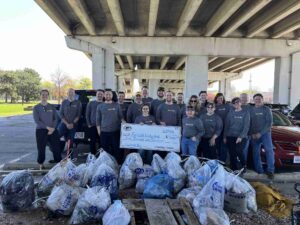
For their spring Packers Give Back day, staff from the Green Bay Packers participated in the annual Fox-Wolf Watershed Cleanup.
What is the best gift a Packers fan can give to the next generation?
Some might argue it’s to add their infant relatives to the infamously long waiting list for season tickets. Or to include the next generation in their will, handing off their own season tickets.
But there are more people on the waiting list than there are residents of Green Bay, and it can take over 50 years for your number to be called.
So what else can football fans leave for the next generation? The over 550 people who work for the Packers organization have lots of ideas.
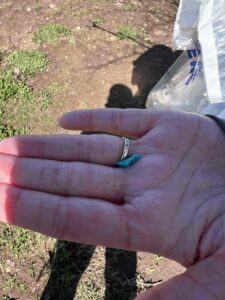
The winning entry for ‘smallest piece of garbage picked up.’
Twice a year, those ideas become reality through Packers Give Back volunteer days. This spring, they selected the annual Fox-Wolf Watershed Cleanup as one of their staff volunteer day options.
“Fox-Wolf popped up on my radar for the last three years through the Volunteer Center of Brown County,” said Amanda Wery, Community Outreach Manager. When she realized that the Packers have also been sponsoring the cleanup since its beginning, it seemed like a natural fit.
“For us, being community owned, it’s a major way to give back,” Amanda said. “It’s part of our backbone and who we are as a team.”
A group of staff from across departments joined at a trail in Brown County to pick up trash and debris from the edge of the Fox River. “It was a great event, and the staff really enjoyed it,” said Amanda. “Whoever comes out for Give Back Days tends to be competitive. We split into two groups to see who could fill the most bags of trash, find the tiniest trash, the largest piece, and so on.”
Their efforts paid off, and their team of picked up 228 pounds of trash in just three hours.
The Packers organization is mindful of how much they are impacted by water. “It’s part of a little bit of everything,” Amanda said, “even watering the field the players play on. It’s the water we drink. It washes the hands of our fans. It’s the snow that falls and we have to shovel the bleachers.”
Water matters to the team, and it matters to our community. “Fans are community-based too,” Amanda said, “and they notice things on our website. Hopefully someone sees the Packers did something, and they decide to do it too. Because it’s not just for us. It’s for the generations to come. It’s about leaving it for the next fan.”
When you support Fox-Wolf Watershed Alliance, you’re investing in a better future. Clean water for you, for your business and your family, and for the next generation of fans (who may still be waiting for their season tickets).
Watershed Moments is a publication of Fox-Wolf Watershed Alliance, sharing the stories of how your donations have impacted lives in our community. Read our latest project updates, make a secure online donation, or become a member at www.fwwa.org
The post Watershed Moments: The Next Fan appeared first on Fox-Wolf Watershed Alliance.
Fox-Wolf Watershed Alliance
https://fwwa.org/2024/08/16/watershed-moments-next-fan/?utm_source=rss&utm_medium=rss&utm_campaign=watershed-moments-next-fan
By Jada Vasser Detroit resident Timothy Paule Jackson’s fascination with bees began in 2016 when he discovered the benefits of using honey to combat the common cold. He began researching the components in honey that provide medicinal benefits for the immune system. Soon, he and his partner, Nicole Lindsay, enrolled in beekeeping classes. They launched […]
The post Detroit is the place to bee! How Detroit Hives is helping Detroit fight climate change through pollination first appeared on Great Lakes Echo.Great Lakes Echo
http://greatlakesecho.org/2024/08/15/detroit-is-the-place-to-bee-how-detroit-hives-is-helping-detroit-fight-climate-change-through-pollination/

Homeowners and property owners, listen up: sweeping new home energy rebate programs have launched in a couple of states and are in the works in most of the rest. A pair of multibillion dollar federal initiatives, funded by the Inflation Reduction Act of 2022, offers thousands of dollars in savings for whole-house efficiency improvements and appliance upgrades.
Great Lakes Now
https://www.greatlakesnow.org/2024/08/energy-news-roundup-new-household-rebates-are-on-their-way-and-some-are-already-here/
Editor: In the public interest and in accordance with Federal Aviation Administration regulations, the USGS is announcing this low-level airborne project. Your assistance in informing the local communities is appreciated.
Midcontinent Region
https://www.usgs.gov/news/state-news-release/media-alert-low-level-fixed-wing-helicopter-flights-image-geology-over?utm_source=comms&utm_medium=rss&utm_campaign=news
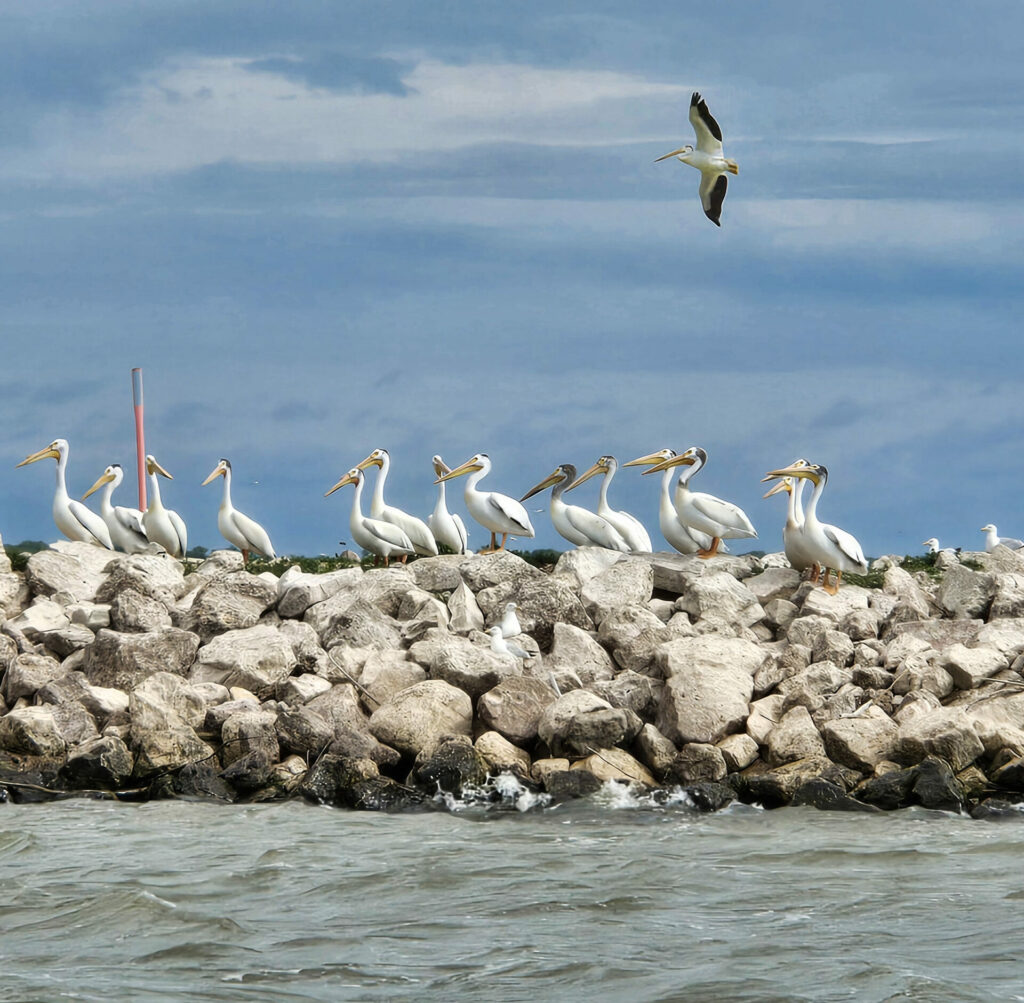
American white pelicans at their nesting colony on Cat Island in Green Bay. Image credit: Marie Zhuikov, Wisconsin Sea Grant
On a sunny morning in mid-June, the University of Wisconsin-Green Bay’s research vessel, Phoenix, headed out onto the bay. Aboard were Sea Grant researchers Emily Tyner and Bill Sallak and a small mound of recording equipment. The boat was piloted by Chris Houghton, assistant professor and fish ecologist, who was assisted by first mate, undergraduate student Jacob Hoffman.
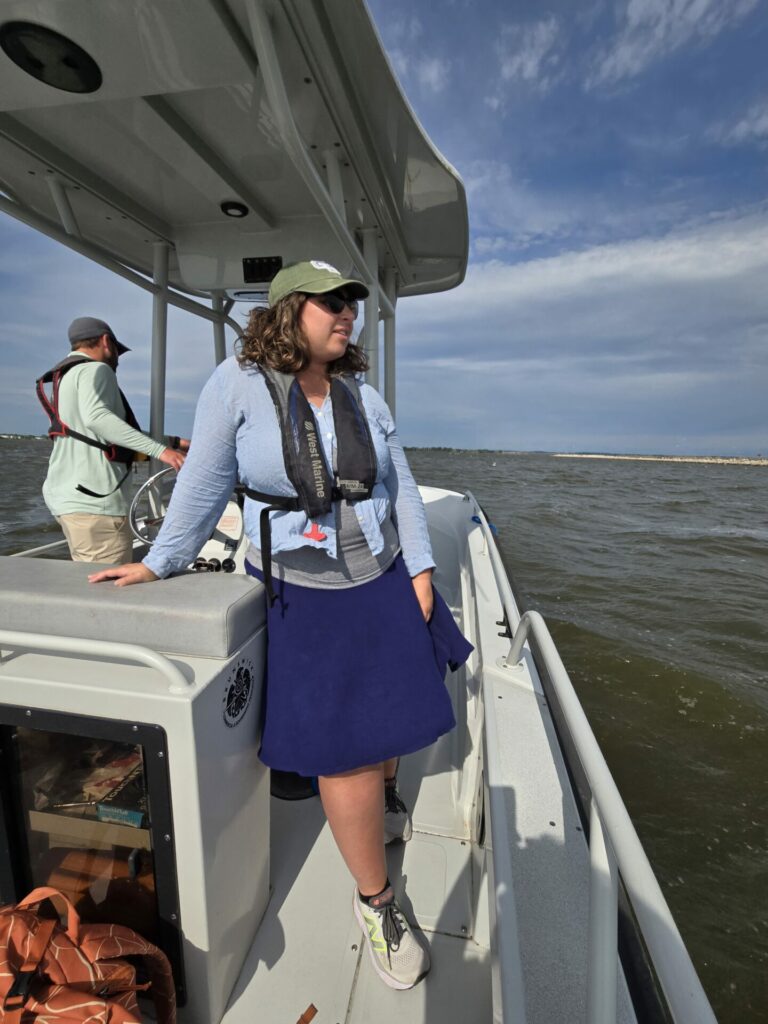
Emily Tyner aboard the Phoenix, UW-Green Bay’s research boat. Image credit: Marie Zhuikov, Wisconsin Sea Grant
The bay outing’s purpose was to collect the natural noises of the estuary, particularly bird sounds. It was only supposed to last for three hours but like in the theme song for the “Gilligan’s Island” television show, a mishap was involved.
Tyner and Sallak’s project is associated with the development of a national estuarine research reserve on the bay. The National Estuarine Research Reserve System is a network of 30 coastal sites that protect and study estuaries. In the Great Lakes, estuaries are areas where rivers empty into the lakes. The mission of the reserves is to practice and promote estuary stewardship via innovative research and education projects through a system of protected areas. It’s a partnership program between the National Oceanic and Atmospheric Administration and coastal states.
Tyner, director of freshwater strategy at UW-Green Bay, is the state lead on the designation of a new National Estuarine Research Reserve for the Bay of Green Bay. It will be the third reserve on the Great Lakes after Old Woman Creek in Ohio on Lake Erie and the Lake Superior Reserve in Superior, Wisconsin. Sallak is an associate professor of music and was sound recorder for the trip.
Their target was the Cat Island Chain, restored barrier islands in the bay that have created new habitat for migrating and nesting shorebirds. Then, if time allowed, they would visit several other sites.
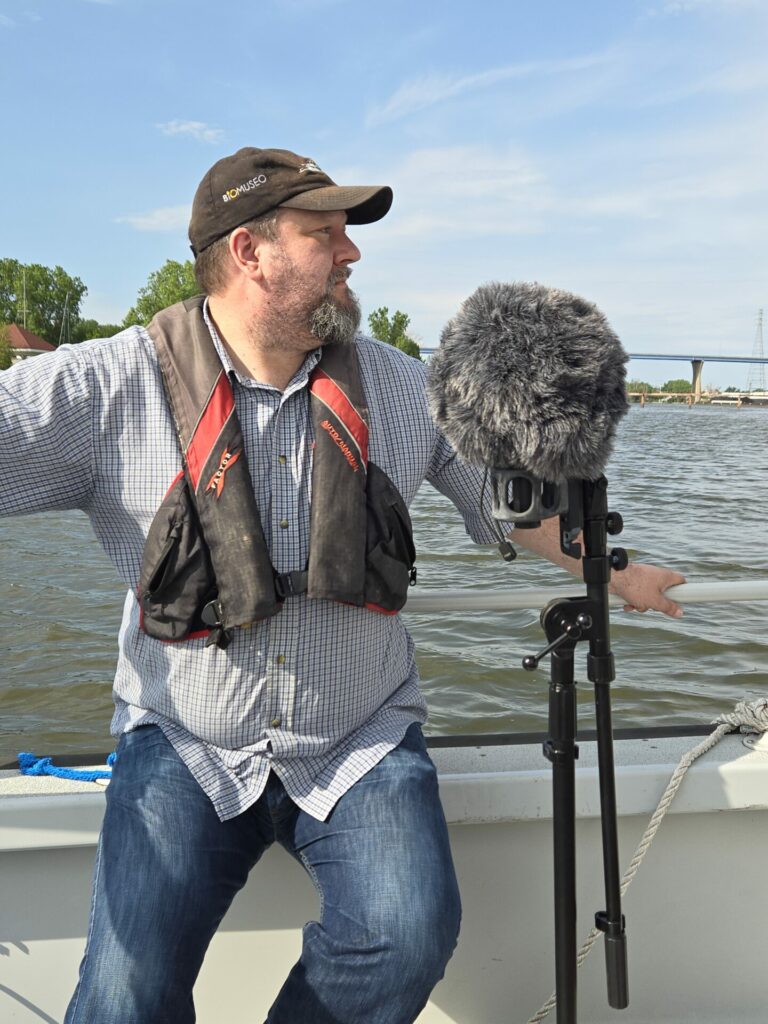
Bill Sallak with sound recording equipment. Image credit: Marie Zhuikov, Wisconsin Sea Grant
Sallak described how the idea for this project evolved. “Part of our original conception was more of a hard science, bioacoustics angle. But then, we went out on a boat trip and we went, ‘That sounds cool, that sounds cool. All these things sound really fantastic.’ And so, we decided to lean more towards a more humanistic angle, which is also going to work better if we get to the point where there’s a visitor’s center, because we can take these recordings and put them into a room with a surround sound speaker set up, and you can hear the bay in different locations, different seasons.”
In their proposal, Tyner and Sallak stressed the importance of bringing the sounds of the Green Bay estuary to the community. Tyner elaborated, “Right there is a restaurant that’s one of the only places on the lower bay where you can go and have a beer and have a burger and be sitting out on the water. And there’s almost no other places to kind of enjoy the bay. There’s the amusement park, but then there’s no pier or boardwalk for access. There’s no swimmable beaches. Some of that’s for water quality reasons. To get onto the bay, you need to have a boat, an expensive boat, probably. Maybe you can do a bit of kayaking from shore, but a trail system, we don’t really have that.
“For a long time, communities had closed themselves off from around the bay because of smells and harmful algal blooms and industrial uses. But now Green Bay and other communities are reopening and turning their front doors back. Especially with the Fox River cleanup, which was a $1.5 billion effort. And so, with that kind of trying to encourage the city and communities to turn their front doors this way, we also want to reconnect people. This is one step in getting us there,” Tyner said.
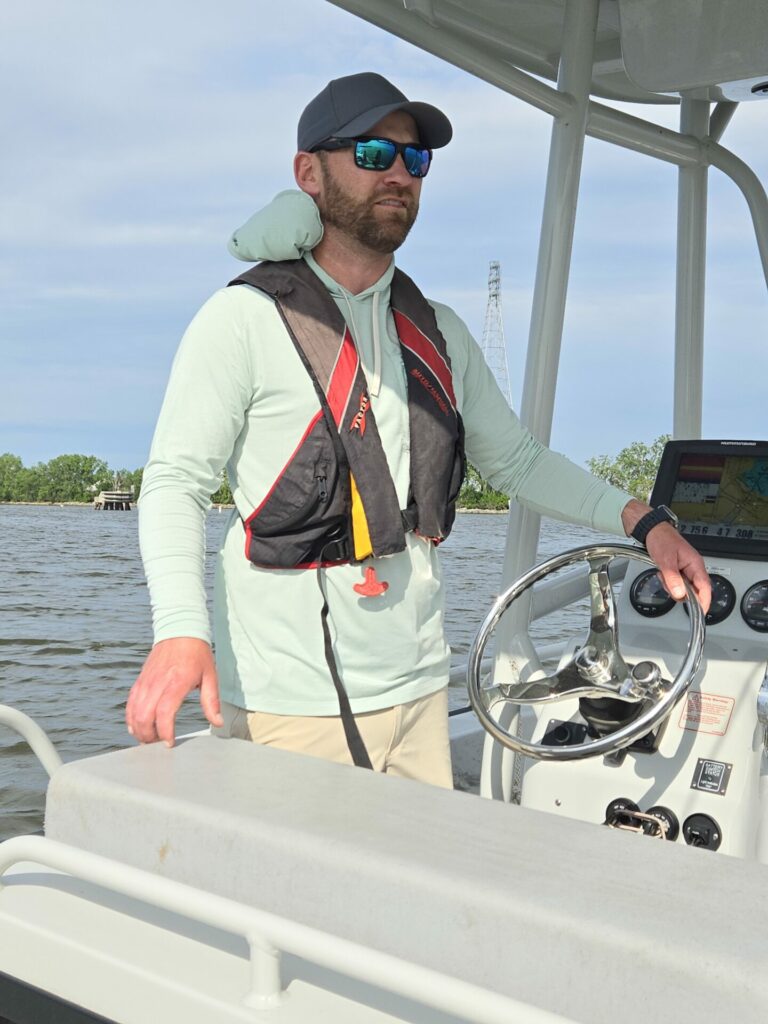
Chris Houghton. Image credit: Marie Zhukov, Wisconsin Sea Grant
In sort of a happy accident, UW-Green Bay recently received funding for a new sound auditorium. Plans are for it to be completed this fall, and this Green Bay audio project will be the first to be featured.
Sallak explained. “Now the audio production program at the Resch Institute for Music is going to have probably the best facilities in higher education in the state. We were able to find about 1,600 square feet in the studio arts building and some underused space in the Wiedner Center. We’re putting in four new recording studios, one of which is an Atmos room. So, it’s equipped with a 14-speaker surround sound setup.”
He said it will be the same surround sound audio system that’s used in movie theaters. They’ll have the capacity to make surround sound recordings and present them in an acoustically refined space. When the Atmos room is finished, the Green Bay sounds project will be the first presentation featured in it. The sound files will also be available on a webpage.
The first of five stops on the boat tour was off the gull colony at Cat Island. Amid raucous gull calls, Sallak set up the recording equipment on the boat. He tagged the sound file with the date, time and location. After capturing several minutes of sound, he turned off the equipment as the Phoenix made its way to the pelican colony at the other end of Cat Island. The pelicans were very quiet, so there wasn’t much to record, but dozens of the prehistoric birds flying overhead made for some inspiring photos.
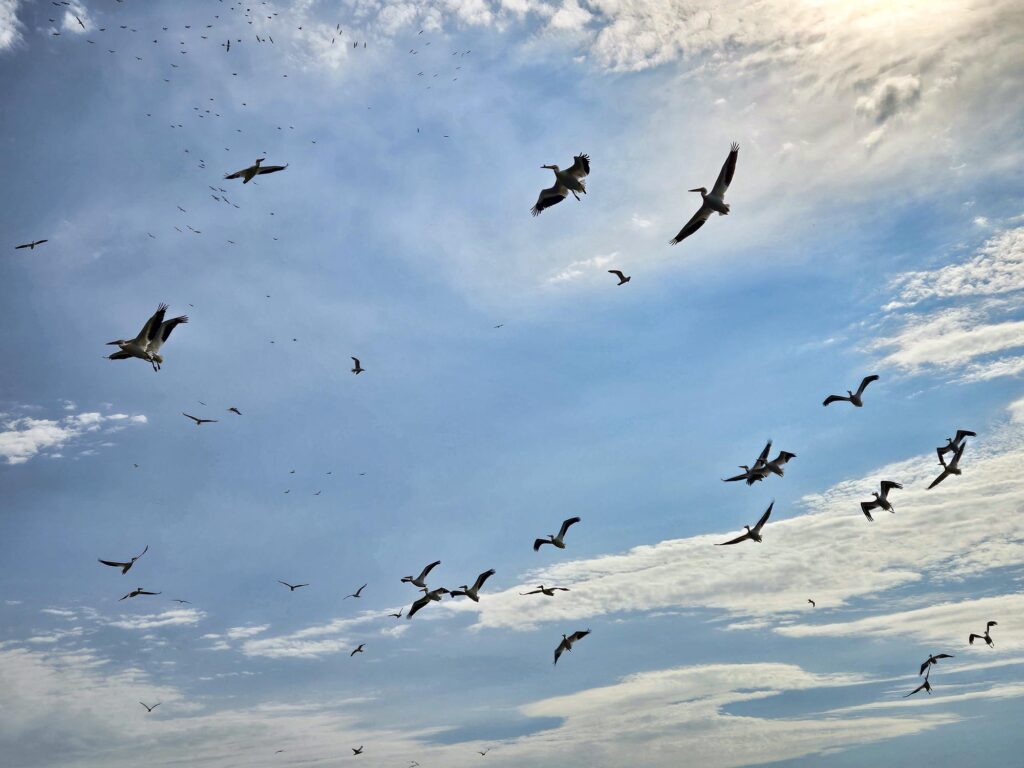
Pelicans wheel in the sky over Cat Island. Image credit: Marie Zhukov, Wisconsin Sea Grant
Their third stop was Longtail Point Lighthouse, a crumbling structure on a long sandy point. After Sallak recorded the sounds for several minutes, the unexpected happened.
“We’re beached,” Houghton said as the bottom of the boat came to rest on the sandy bottom.
“Uh oh,” Tyner said.
“Shouldn’t be a problem.” Houghton laughed, “Famous last words.”
Sallak chimed in, “We’re not going to run out of granola bars? Figure out who we have to eat first?”
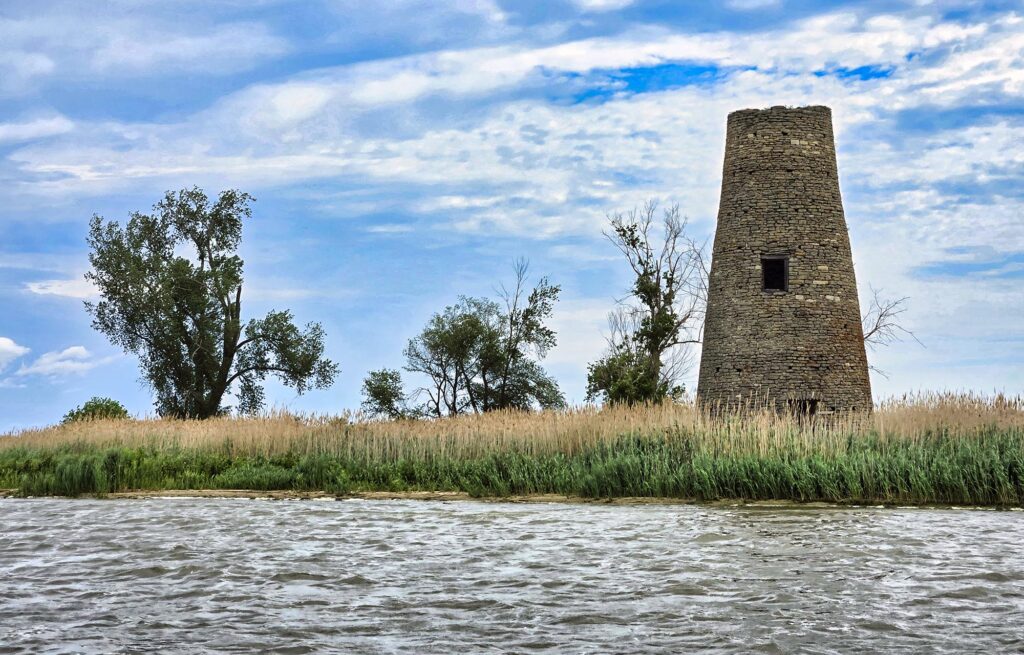
Long Tail Point Lighthouse. Image credit: Marie Zhukov, Wisconsin Sea Grant
Houghton and Hoffman jumped over the side of the boat and tried to free it from the bottom. After some finagling, they were able to push it into deeper water.
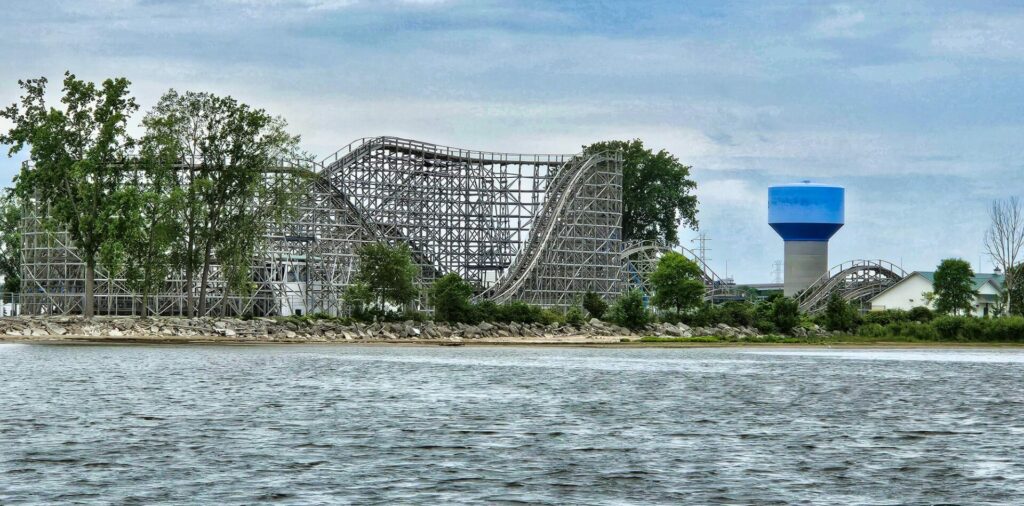
The Zippin Pippin rollercoaster, Bay Beach Amusement Park. Image credit: Marie Zhukov, Wisconsin Sea Grant
Audio captured, the team moved onto the next stop, which had the ominous name of Dead Horse Bay. As they recorded, a bald eagle sat in a tree, watching as songbirds chirped and twittered. A plane flew overhead, and someone fired up a chain saw on shore. Sallak said he would keep those human sounds in the show. “We’re not apart from everything that’s going on. I’m more interested in collecting what’s literally here than trying to erase.”
Their fifth and final stop was full of human sounds offshore of Bay Beach Amusement Park. One of the most noticeable features there is the Zippin Pippin — a rollercoaster. The team watched as the coaster cars made their slow way up to the top of the ride and then plummeted, eliciting screams from the riders. Sallak said he has plans to go into the courtyard in the middle of the ride and get a recording for this project later.
With audio captured, the team motored back to the marina. They agreed there’s nothing like spending a morning on the water, even if it involved getting beached.
To hear a podcast episode of this story, complete with sounds, visit this Wisconsin Water News page.
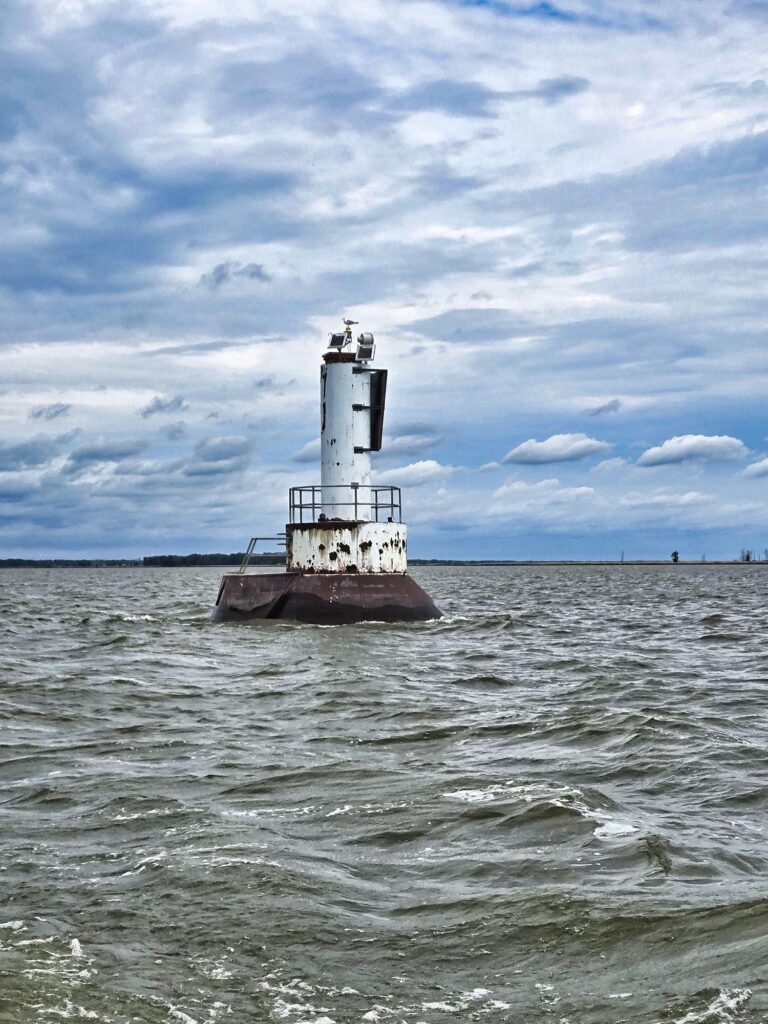
A navigation beacon in Green Bay. Image credit: Marie Zhuikov, Wisconsin Sea Grant
The post Using Sound to Connect People to Green Bay first appeared on Wisconsin Sea Grant.
News Releases | Wisconsin Sea Grant
News Releases | Wisconsin Sea Grant
https://www.seagrant.wisc.edu/news/using-sound-to-connect-people-to-green-bay/
The Great Lakes Microbial Water Quality Assessment, sponsored by the International Joint Commission, found that decades-old testing methods that measure microbial and chemical threats in Great Lakes waters are inadequate and advances in newer methods are critically needed. Read the full story by Circle of Blue.
Great Lakes Commission
https://www.glc.org/dailynews/20240814-pollutant-testing-study
Multiple officials in Macomb County, Michigan, are calling on the Michigan Department of Environment, Great Lakes, and Energy to hold off on renewing Oakland County’s groundwater discharge permit until the county commits to addressing sewage discharges into the Red Run Drain, which flows for 130 miles through both counties. Read the full story by the Michigan Advance.
Great Lakes Commission
https://www.glc.org/dailynews/20240814-permit-dispute
A sizable fish kill of freshwater drum, also known as sheepshead, has happened on portions of Lake Erie near Erie, Pennsylvania. It appeared that some of the distressed fish were doing a side stroke and were unable to right themselves due to issues with their swim bladders which can be caused by changes in water pressure associated with recent weather pattern. Read the full story by Erie Times-News.
Great Lakes Commission
https://www.glc.org/dailynews/20240814-fish-kill
New York Governor Kathy Hochul signed an agreement allowing the Thousand Islands Land Trust to acquire nearly 1,000 acres in Jefferson County through a mix of conservation easements and land purchases to filter potential pollutants from entering the St. Lawrence River and Lake Ontario. Read the full story by WWNY-TV – Carthage, NY.
Great Lakes Commission
https://www.glc.org/dailynews/20240814-land-acquisition
The National Park Service is moving forward with a $32 million project to relocate the docks at both North and South Manitou Islands in Lake Michigan. The agency is seeking permits to relocate the structures after years of access problems caused by sediment shoaling, which has fueled conflict between the park and a ferry operator based in Leland, Michigan, which has canceled service to North Manitou this year. Read the full story by MLive.
Great Lakes Commission
https://www.glc.org/dailynews/20240814-dock-relocation
The Michigan Department of Natural Resources (DNR) reports good fall fishing due to successful spring and summer fish stocking. The DNR stocked a total of 9,118,112 fish that weighed nearly 321 tons and consisted of 10 different species and one hybrid. Read the full story by the News Advocate.
Great Lakes Commission
https://www.glc.org/dailynews/20240814-fish-stocking