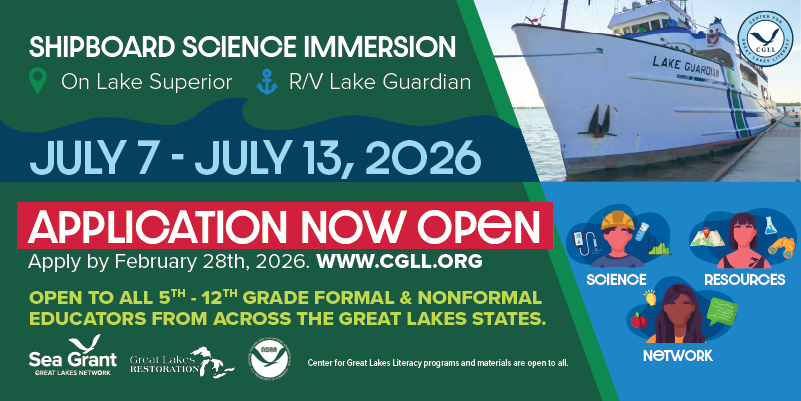
Banner announcing the 2026 shipboard science immersion workshop

Formal and non-formal 5-12th grade educators from throughout Great Lakes states are invited to apply for an exciting opportunity to spend a week aboard a U.S. Environmental Protection Agency research vessel alongside scientists and to bring Great Lakes science back to their classrooms. The program, organized by the Center for Great Lakes Literacy (CGLL), is July 7-13, 2026. Deadline for applications is February 28, 2026.

Through a partnership with the EPA Great Lakes National Program Office and NOAA, with funding from the Great Lakes Restoration Initiative, educators will engage in scientific investigations aboard the ship. Hosts for the Lake Superior program are CGLL partners Minnesota Sea Grant, Wisconsin Sea Grant, and Illinois-Indiana Sea Grant.

The annual Shipboard Science Immersion promotes Great Lakes science while forging lasting relationships between Great Lakes scientists and educators. CGLL is a collaborative effort led by Sea Grant educators throughout the Great Lakes watershed in the U.S. CGLL fosters informed and responsible decisions that advance basin-wide stewardship by providing hands-on experiences, educational resources, and networking opportunities promoting Great Lakes literacy among an engaged community of educators, scientists, and youth.

For more information on the 2026 Shipboard Science Immersion and application materials, visit the Center for Great Lakes Literacy website.

The post Apply for the 2026 Shipboard Science Immersion on Lake Superior first appeared on Wisconsin Sea Grant.

Original Article

News Releases | Wisconsin Sea Grant

News Releases | Wisconsin Sea Grant

https://www.seagrant.wisc.edu/news/apply-for-the-2026-shipboard-science-immersion-on-lake-superior/

Wisconsin Sea Grant

Manoomin— or wild rice—is Michigan’s official native grain and an important cultural food source for Anishinaabe peoples throughout the Great Lakes. Once abundant throughout the region, its existence has been threatened by dams and environmental pressures. Today, there’s an effort to restore it.

This story was produced in collaboration with @OneDetroit and BridgeDetroit.

#WildRice #GreatLakes #Indigenous #NativeAmerican #Michigan #Food #Cooking
===========================================
Website: https://greatlakesnow.org
Facebook: https://www.facebook.com/greatlakesnow
X: https://www.x.com/greatlakesnow
Instagram: https://www.instagram.com/greatlakesnoworg
Newsletter: https://www.greatlakesnow.org/great-lakes-now-newsletter/

To learn more about supporting Detroit PBS and Great Lakes Now, visit https://www.detroitpbs.org/
===========================================
“How Wild Rice Goes From Water to Table” was produced by Great Lakes Now/Detroit PBS in collaboration with @OneDetroit and BridgeDetroit.

Produced by
Bill Kubota
Jena Brooker

Written by
Bill Kubota

Narrated by
Jena Brooker

Edited by
Bill Kubota

Additional Editing
Jordan Wingrove

Camera & Audio
Bill Kubota
Brendan Battle
Darin Donahue
Randy Strobl
Dean Underwood

Additional Material
U.S. Department of Interior
University of Michigan
Superior National Forest
U.S. National Archives and Records Administration
Milwaukee County Historical Society
iStock
Avidly Ravenous

The post How Wild Rice Goes From Water to Table | Great Lakes Now appeared first on Great Lakes Now.

Original Article

Great Lakes Now

Great Lakes Now

https://www.greatlakesnow.org/2026/02/09/how-wild-rice-goes-from-water-to-table-great-lakes-now/

Great Lakes Now

Summary

The Water Resources Analyst (Analyst) is an integral part of the Alliance’s Water Resources team, supplying research and analysis to advance policy campaigns related to source water protection. With a particular focus on plastic pollution, PFAS, and other high-priority contaminants, the Analyst is committed to bringing scientific rigor to the Alliance’s work on behalf of people and ecosystems in the Great Lakes basin.

The Analyst works collaboratively with the Water Resources team to track, analyze and synthesize scientific research, policy developments, and regulatory trends in key geographies across the Great Lakes region. The Analyst brings a strong foundation in water quality science, paired with the ability to critically evaluate, interpret, and translate complex research into clear, actionable insights that advance issue-based campaigns. Leveraging rigorous research methodologies, innovative data visualization and applied policy analysis tools, the Analyst elevates technical information to support strategic decision-making and summarizes findings for diverse audiences, including policymakers, partners, and the public.

This position reports to the Director of Water Resources and works closely with Alliance staff across policy, government affairs, community partnerships, and communications to ensure research products are timely, credible, and strategically aligned, and that recommendations are effectively integrated into advocacy, outreach, and campaign efforts.

A typical week:

In a typical week, the Analyst might:

  • Check in with the Director of Water Resources and Water Resources team to discuss progress on projects and coordinate tasks.
  • Finalize a report with talking points and graphics to characterize the sources of water pollution entering the Great Lakes and impacts on the ecosystem and drinking water quality.
  • Develop talking points and graphics to assist the government affairs team as they prepare for an upcoming meeting with a state lawmaker who has expressed interest in supporting legislation to require contaminant monitoring and assessment.
  • Review a regulation proposed by a state agency and advise the Director of Water Resources on issues to address in our comment letter.
  • Reach out to a partner to discuss the implications of new research related to water pollution and other water quality and quantity issues.
  • Update the team’s policy tracking document with the latest information about a relevant agency action.

Responsibilities

Research

  • Maintain awareness of the latest research related to priority issues for the Water Resources team, including but not limited to microplastics, PFAS, and emerging pollutants
  • Synthesize and analyze research to glean insights relevant to policy campaigns
  • Prepare compelling reports and data visualizations to make information accessible to a variety of audiences

Policy Analysis

  • Track relevant policy developments across the Great Lakes states
  • Review proposed rules, regulations, and bills to offer technical feedback on source water impacts and opportunities to strengthen protections
  • Identify and describe opportunities to shift existing approaches to water quality monitoring, risk assessment, restoration efforts, and regulatory practices to protect source water, with a focus on state and federal policy

Relationship Building & Thought Leadership

  • Foster collaboration with researchers and academic partners doing work relevant to the Great Lakes and source water protection
  • Build and maintain strong working relationships with internal staff and external partners who have diverse backgrounds and skill sets to develop and tailor communication materials and advance campaign priorities
  • Actively contribute to public dialogues in the fields of source water protection through conferences, roundtables, and workshops, including those that reach beyond the environmental NGO community

Program Development

  • Contribute to annual and multi-year work and campaign plans
  • Track and report on grant deliverables, project budgets, and expenses, as needed
  • Contribute to the creation of proposals for philanthropic funding to support the work, including doing so in collaboration with complementary partners where possible

Knowledge/Skills

  • Bachelor’s degree required and 5+ years of relevant experience in research for environmental science, biology, toxicology, chemistry, environmental engineering, natural/water resources management, or related field. An advanced degree or demonstrated additional experience preferred
  • Strong research, data analysis and visualization skills, ability to convert analysis to different types of communication materials (e.g. talking points, blog posts, data visualization and graphics) that can be used as effective policy communication and storytelling tools that engage the media, Alliance supporters, and public officials
  • Ability to convey recommendations in concise, precise, and compelling written and data visualization work products
  • Willingness to listen and respond to the needs and demands of diverse groups of individuals and partner organizations
  • Excellent listening, written, and verbal communication skills
  • Motivated to work primarily internally and behind the scenes with Alliance staff
  • Adept with Microsoft Office Suite and project management software
  • Adhere to and exemplify the Alliance for the Great Lakes’ values of community, relationships, courage, integrity, optimism, and the principles of justice, equity, diversity, and inclusion in all our work

    Additional Skills/Pluses
  • Fundamental commitment to socioeconomic and racial equity and demonstrated skills in identifying policy options that advance environmental equity
  • Collaborative, collegial, with a good sense of humor and ability to adapt to diverse work styles; adept at working in teams and independently in both virtual and in-person settings
  • Keen understanding of the dynamics of project and policy implementation within public agencies, ability to navigate complex political and fiscal landscapes, and adapt accordingly
  • Commitment to and passion for mission-driven public interest work related to clean water, climate adaptation, the Great Lakes, and the role of water in community resilience and revitalization

Job Parameters

This position is full-time and consistent with Alliance employment policy. The Alliance has defined salary ranges that are evaluated annually, and it is customary for candidates to join the lower half of the range to leave room for learning and development in the role. It is uncommon for starting salaries to fall above the mid-point. The salary range for this position begins at $70,000, and we negotiate salaries with final candidates based on their experience in similar roles and expertise related to the qualifications.

  • Excellent benefits, including medical, dental, short- and long-term disability, life insurance, FSA, 11 paid holidays plus the business days between 12/26 and 12/30 (staff who must work on any paid holidays may take those holidays at another time subject to the employee handbook), 3 weeks’ annual vacation to start + PTO, and Fidelity 401(k) with employer match of up to 6% of salary, eligible after 30 days.

Application Process

Please e-mail a cover letter, resume, references, and writing or work sample that demonstrates relevant qualifications to hr@greatlakes.org. Include the job title in the subject line.

Applications will be accepted and reviewed on a rolling basis starting on February 9th, 2026, and until the position is filled. Materials should be compatible with Microsoft Word or Adobe Acrobat. Applicants will receive confirmation of receipt of their materials, further guidance, and updates about the hiring process by e-mail, with interviews provided for finalists. No phone inquiries, please.

About the Alliance for the Great Lakes

Our vision is a thriving Great Lakes and healthy water that all life can rely on, today and far into the future.

The mission of the Alliance for the Great Lakes is to protect, conserve, and restore the Great Lakes, ensuring healthy water in the lakes and in our communities for all generations of people and wildlife.

To achieve our vision and mission, everyone in our organization will live ourvalues of Community, Relationships, Courage, Integrity, and Optimism, and weave the principles of Justice, Equity, Diversity, and Inclusion into all our work.

 For more information about the Alliance’s programs and work, please visit us online at www.greatlakes.org.

The post Water Resources Analyst appeared first on Alliance for the Great Lakes.

Original Article

News - Alliance for the Great Lakes

News - Alliance for the Great Lakes

https://greatlakes.org/2026/02/water-resources-analyst/

Michelle Farley

By Karlee VanAntwerp

Critics of the proliferation of data centers are calling for a one-year moratorium on the approval of new projects.

The post Data center concerns lead to push for a one-year moratorium on projects first appeared on Great Lakes Echo.

Original Article

Great Lakes Echo

Great Lakes Echo

https://greatlakesecho.org/2026/02/08/data-center-concerns-lead-to-push-for-a-one-year-moratorium-on-projects/

Capital News Service

Using historical temperature records from weather stations around the region, researchers improved their understanding of where ice might have formed and for how long it lasted spanning the last 120 years. Researchers said this new data record could help with efforts like research on fish in the winter, regional climate and improving safety on the ice. Read the full story by Interlochen Public Radio.

Original Article

Great Lakes Commission

Great Lakes Commission

https://www.glc.org/dailynews/20260206-ice-data-insights

James Polidori

Ottawa County, Michigan, relies on two aquifers for groundwater: a shallow upper glacial aquifer and a much deeper one known as the Marshall Sandstone. When snow melts in the spring, it does help recharge the upper aquifer, but the deeper Marshall aquifer, the one many residents’ wells rely on, doesn’t get that same benefit. Read the full story by WZZM-TV – Grand Rapids, MI.

Original Article

Great Lakes Commission

Great Lakes Commission

https://www.glc.org/dailynews/20260206-groundwater-impacts

James Polidori

Data from the National Oceanic and Atmospheric Administration’s Great Lakes Environmental Research Laboratory show Lake Erie’s ice coverage surged from under 2% on January 14 to nearly 85% by January 21; coverage has increased since then, hovering near or above 95% since late January. Read the full story by The Plain Dealer.

Original Article

Great Lakes Commission

Great Lakes Commission

https://www.glc.org/dailynews/20260206-lake-erie-ice

James Polidori

The Soo Locks have closed to marine traffic for their annual maintenance period, but the critical Great Lakes shipping gateway remains a hub of activity as engineers and technicians work to prepare the massive structures for another shipping season. Read the full story by WBUP – Marquette, MI.

Original Article

Great Lakes Commission

Great Lakes Commission

https://www.glc.org/dailynews/20260206-lock-maintenance

James Polidori