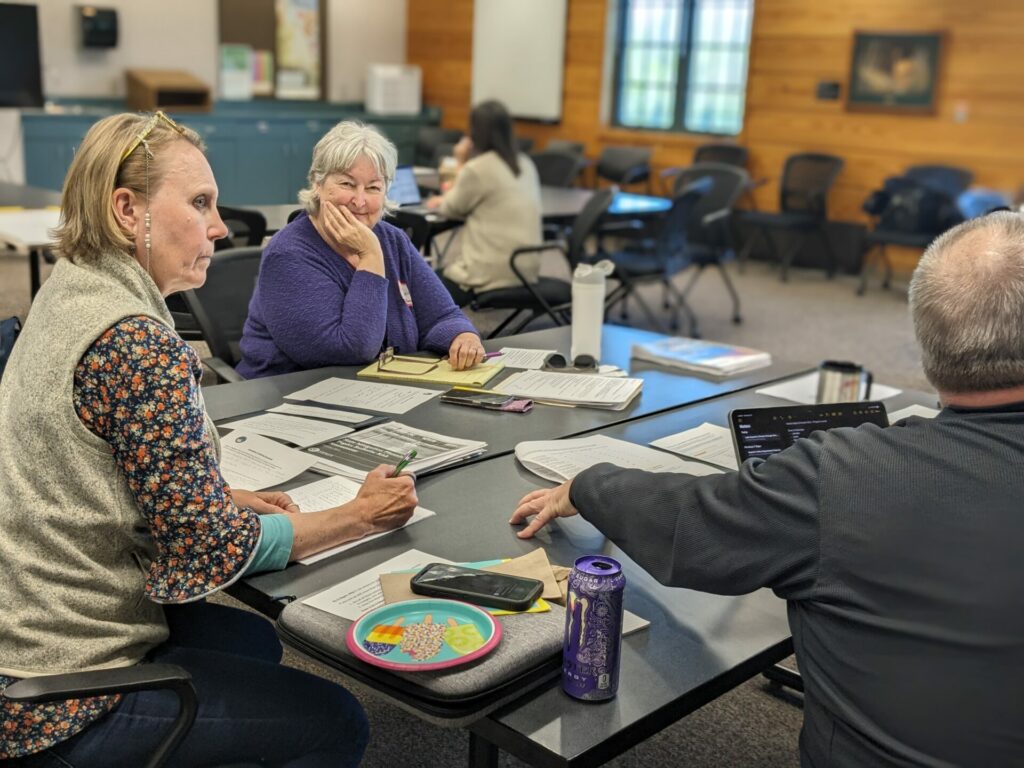
Three people discuss around a table at the workshop.

A community team talks through program goals at an Enduring Lake Superior Communities Program workshop. (Photo by Natalie Chin / ASC)

Recent weather impacts in northern Wisconsin have increased the challenges coastal communities face like erosion, flooding, and shoreline damage. A program from Wisconsin Sea Grant and the Lake Superior National Estuarine Research Reserve offers local officials a chance to tackle those challenges together. 

The Enduring Lake Superior Communities Program provides a yearlong opportunity for municipal teams to work on a goal of their choosing to address community resilience. Now accepting applications for its third year, the program is open to teams of two to four people from the four Lake Superior coastal counties — Douglas, Bayfield, Ashland, or Iron — and may include representatives from multiple jurisdictions. 

The program offers up to $2,000 in funding support, tailored guidance from natural resource professionals, and connections with other Lake Superior communities facing similar challenges.

In 2025, participating teams included staff from the Bayfield County Health Department and community members from the town of Marengo. The health department team examined potential extreme weather impacts on local public water and sewer systems through a survey of utilities operators and a detailed analysis of water infrastructure needs. The Town of Marengo team hosted their first annual town picnic, conducted a survey of their residents’ extreme weather preparedness needs, and developed a comprehensive emergency preparedness and action plan.

Feedback from a 2025 participant shows the value of the program: “Community preparedness has proven to be essential in northern rural regions. From floods to fires to public water failures, not being prepared has led to devastation in poor, aging rural communities in the past and present day.” 

2026 Program Applications due April 10

Teams who want to participate in this year’s Enduring Lake Superior Communities Program can now apply at https://go.wisc.edu/3apv86. The deadline to submit applications is April 10, 2026. Teams will be selected and notified in May, with the program starting in June.

Applicants are encouraged to seek support for a new coastal resilience effort or an ongoing effort. This could include developing a new resource or tool, conducting an assessment, bringing people together in dialogue, or developing a specific community resilience plan. Program facilitators are happy to meet with prospective applicants to answer any questions and talk through project ideas.

For more information, visit Enduring Lake Superior Communities

###

The University of Wisconsin Aquatic Sciences Center administers Wisconsin Sea Grant, the Wisconsin Water Resources Institute, and Water@UW. The center supports multidisciplinary research, education, and outreach for the protection and sustainable use of Wisconsin’s water resources. Wisconsin Sea Grant is one of 34 Sea Grant programs supported by the National Oceanic and Atmospheric Administration in coastal and Great Lakes states that encourage the wise stewardship of marine resources through research, education, outreach, and technology transfer.

The post Lake Superior community leaders work together on coastal resilience projects; funding for 2026 projects available first appeared on Wisconsin Sea Grant.
Original Article

News Releases | Wisconsin Sea Grant

News Releases | Wisconsin Sea Grant

https://www.seagrant.wisc.edu/news/lake-superior-community-leaders-work-together-on-coastal-resilience-projects-funding-for-2026-projects-available/
Andrew Savagian

Lydia Salus grew up about 20 miles from Lake Michigan, in a Wisconsin village graced with Mammoth Spring, where water seeps through cracks on top of the shallow aquifer that underlies much of Waukesha County.

Since her formative years, water has been a part of Salus’s life. As an undergraduate, Salus worked on a project to facilitate fish passage through urban culverts. She got a master’s degree in water resources management with a focus on hydrology from the University of Wisconsin-Madison with the intention of becoming a hydrologist devoted to ecological restoration.

Although that career in restoration shifted in 2018 when she signed on as an assistant to the Southeastern Wisconsin Coastal Resilience Project, Salus remains tied to water. Right now, her connection is through a brand-new initiative to increase coastal resilience on Wisconsin’s Lake Michigan shoreline.

The new project builds on the previous one, which assisted people in Kenosha, Racine, Milwaukee and Ozaukee counties in responding to rising lake levels—offering information on how to stabilize bluffs, address erosion and protect infrastructure.

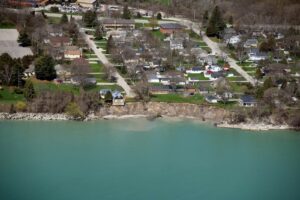
Aerial photo of water and buildings near the water. One house is balanced on the edge of a tall bluff over the water.

A southeastern Wisconsin house teeters on the edge of a bluff after coastal storms and waves eroded the shoreline 40 feet in four years. This house was later demolished

It was also notable for encouraging conversation and cooperation among the whole mix of lakefront property owners—between private property holders and municipalities, counties, state agencies and federal partners.

Termed Collaborative Action for Lake Michigan (CALM) Coastal Resilience, the project places Salus at Sea Grant. The Wisconsin Coastal Management Program and State Cartographer’s Office are the other members of this three-way partnership that, according to Salus, increases capacity to reach and serve communities. 

“The Southeastern Wisconsin Resiliency project was a really good start for taking a regional approach to addressing hazards. Hazards don’t just go away,” she said. “That earlier project was good at building momentum in those communities, so then we just wanted to expand that up the coast to other communities and share that momentum with them.”

CALM is funded by what Salus termed “an exciting grant; a competitive grant for something called a project of special merit” from the National Oceanic and Atmospheric Administration and which was awarded to the Wisconsin Coastal Management Program. It will strive for three outcomes:

  • Increasing collaboration across all stakeholders.
  • Developing, revising or adopting local ordinances, plans or policies that are going to help build resilience in coastal communities.
  • Fostering regional prioritization of hazards that need to be addressed so that when opportunities for collaborative action are available, community leaders are ready to capitalize.

CALM is a nearly $250,000 18-month undertaking that kicked off in October 2021 and will conclude in March 2023, making it, as Salus said, “A quick turnaround, but we already have a good framework to build off of. I think it’s a little bit easier to implement because we have something that we know worked (with the Southeastern Wisconsin Coastal Resiliency Project).”

When fully in the swing of the initiative, Salus will organize field trips, pandemic willing, to highlight coastal challenges and solutions. Additionally, she will host meetings to share case studies and tools, and support communities talking with each other and determining regional priorities. Those communities include 11 counties, 18 cities, 16 villages and 36 towns stretching from the state’s border with Illinois up the Lake Michigan coastline to the state of Michigan.

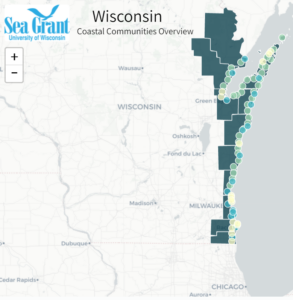
map of Wisconsin with communities along Lake Michigan highlighted in greens and blues to show areas involved in new resilience program.

Wisconsin’s Lake Michigan communities will participate in a new program to build resilience in the face of flooding, erosion and infrastructure damage.

The types of folks involved are those housed in state and federal agencies, local and state elected officials, coastal engineers and landscape professionals, municipal technical staff members, people from academic institutions, sewerage districts and regional planning commissions.

Salus said she is feeling energized by the chance to bring together so many people through a process that embraces “stakeholder-driven prioritization. I really like that term because we have built into the project the process of getting feedback from the communities. We are starting off with a survey of their needs, so we are then presenting tools and resources and bringing in speakers that are going to be helpful to them.”

Salus is also feeling personally energized as this new initiative gets underway, saying she appreciates the “unique challenge that balances the human-environment interaction. There are naturally occurring processes on the lake that wouldn’t necessarily cause issues if we didn’t have a built environment along the lake, if we didn’t have people living there.” She said she looks forward to the applied science that can address these coastal hazards that are certainly not going to disappear.


The post CALM aims to bring calm to communities facing coastal hazards first appeared on Wisconsin Sea Grant.

Original Article

News Releases | Wisconsin Sea Grant

News Releases | Wisconsin Sea Grant

https://www.seagrant.wisc.edu/news/calm-aims-to-bring-calm-to-communities-facing-coastal-hazards/?utm_source=rss&utm_medium=rss&utm_campaign=calm-aims-to-bring-calm-to-communities-facing-coastal-hazards

Moira Harrington