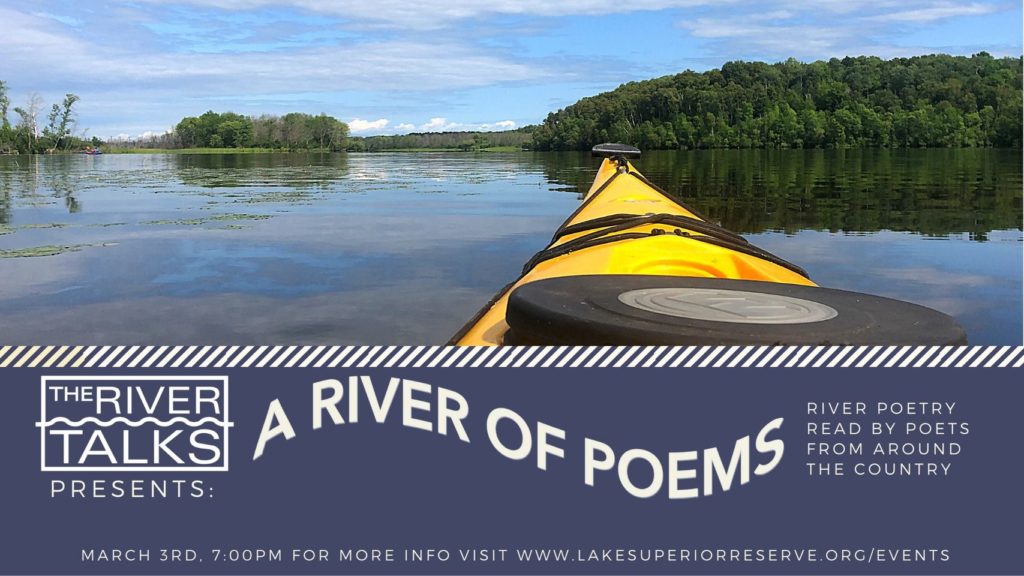
The next River Talk will take place via Zoom at 7 p.m. (Central Time) Wednesday, March 3. During “A River of Poems,” a dozen poets from around the world and across the country will read their powerful, provocative and beautiful poems about rivers – the St. Louis River or others. This event is free and open to the public. Come experience a different perspective on waterways!

Here is the Zoom link and info:
https://uwmadison.zoom.us/j/93264788373?pwd=amRqSWgvT1ZxNW03WFBnU2ZYclZUQT09
Meeting ID: 932 6478 8373
Passcode: 776905

The selected poets are:
Tyler Dettloff (Michigan) “My Stars”
Heather Dobbins (Arkansas) “I Held us on for 36 Hours after the Levee Broke to Hell”
Ben Green (New Mexico) “Immersion: A Prayer of Intent”
Lorraine Lamey (Michigan) “Catching Your Drift”
Joan Macintosh (Newfoundland) “The Current Feels”
Kate Meyer-Currey (England) “Timberscombe”
Rebecca Nelson (California) “Of the St. Louis River”
Stephanie Niu (New York) “To the Beaver’s Eyes”
Diana Randolph (Wisconsin) “Knowing the Way”
Ron Riekki (Florida) “It Took a Long Time to Discover”
Derold Sligh (South Korea) “Rogue River”
Lucy Tyrell (Wisconsin) “Talking Water”

Held in conjunction with the St. Louis River Summit, the reading will last an hour and will include time for comments and questions. The talk will be recorded and posted afterward on the Reserve’s Facebook page and YouTube. A summary will also be posted on Wisconsin Sea Grant’s blog.

Remaining River Talks will be held on April 14 and May 12. For more information, visit the River Talks page: go.wisc.edu/4uz720.

River Talks are sponsored by The Lake Superior National Estuarine Research Reserve and the Wisconsin Sea Grant Program.

The post A River of Poems first appeared on Wisconsin Sea Grant.

Original Article

News Releases – Wisconsin Sea Grant

News Releases – Wisconsin Sea Grant

https://www.seagrant.wisc.edu/news/a-river-of-poems/
Marie Zhuikov

The January 2021 River Talk featured Kelly Beaster and Reed Schwarting with the Lake Superior Research Institute at the University of Wisconsin-Superior tag-teamed and presented, “Coastal wetlands: Dynamic ecosystems of Lake Superior.”

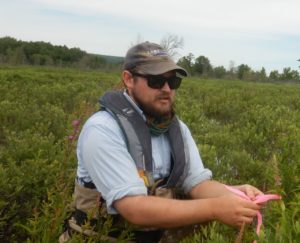
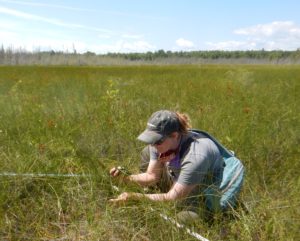
Kelly Beaster in the field. Image credit: Lake Superior Research Institute

Beaster and Schwarting have spent the past five years monitoring the health of local wetlands along Lake Superior, including those in the St. Louis River Estuary. They described the formation and function of coastal wetlands and how they change over time. They focused on vegetation, covering the more common plant communities and some of their unique species as well as how wetlands have adapted to the short-term and long-term flux of water levels in the Great Lakes.

Schwarting said sediment is key to wetlands formation. “Sediment can come from tributaries along Lake Superior, but it can come from shoreline erosion, as well. Plants eventually start to grow. This stabilizes the sediment and encourages more sediment deposition and plant growth.”

Beaster described the three classifications of coastal wetlands. All three are low in nutrients (oligotrophic) due to the northern climate and cold water in Lake Superior when compared to the other Great Lakes. The first type, lacustrine wetlands, tend to form near large open lakes, such as Lake Superior. The second, riverine, form at and along river mouths. Barrier wetlands are separated from the lake by some type of barrier like a sandbar or a railroad bed.

Schwarting said wetlands function as carbon storage locations, which is helpful with climate change. The cold water, especially in lacustrine wetlands, limits decomposition. Wild cranberry, pitcher plants and bog buckbean are common species they find in their surveys. Although they are not rare, Beaster said these species are among some of the first to disappear from wetlands when nutrient loading occurs or the water level changes. “Some type of disturbance happens and the diversity starts to drop down.”

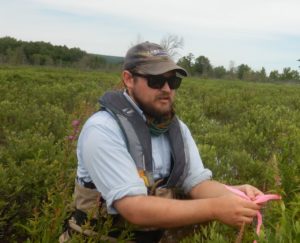
Reed Schwarting in the field. Image credit: Lake Superior Research Institute

They have found a notable plant in the St. Louis River estuary. “It’s incredible to think we have aquatic ferns floating around. They are no bigger than your fingertip. They’re really common in the estuary,” Beaster said.

Cattails are often the first thing people think about when visualizing an emergent marsh, but Beaster said cattails are often a sign of problems. “Often, they signify nutrient-loading. Cattails also out-compete native plants. There can be toxic chemicals present or heavy metals.” Allouez Bay in the estuary is an example of one such area.

Schwarting said control measures for invasive species like cattails include chemical, mechanical and biological measures. But care must be taken. “It’s not enough to control these species. As soon as you control something, you’re basically creating a disturbance,” he said. “Normally, a lot of invasive species come in through disturbances, so you’re opening them back up to having another species either come in or even the same species being reintroduced from your disturbance. So, we want to do some restoration work on top of any control.” Some plants used in this way are wild rice and seedlings of other native species already at the location.

Schwarting said that wetlands along Lake Superior are doing well. “While there are some negatively impacted sites on Lake Superior, we probably have some of the more diverse and higher-quality wetlands in the Great Lakes region. Especially compared to the more industrial sites,” he said.

Beaster said one of the top five coastal wetlands they’ve been to is on Madeline Island. Bog Lake is a barrier wetland and fen on northern part of island. “Once we’ve boated out there, we have about three hours to do our surveys, but we’d rather spend three days because it’s so cool. This wetland is iconic of what an oligotrophic plant community should be on Lake Superior. We don’t see any invasive species here. It’s pretty stable – easy walking on the ground. Year after year we don’t really see any changes.”

She said Bog Lake isn’t the only high-quality, undisturbed wetland in the area. “This fortunately is here, intact, and it’s very encouraging especially when what we see in the St. Louis Estuary doesn’t always seem like it’s very high quality any longer. However, the estuary contains about 25 different oligotrophic species. Some of them are very common: wire sedge, bog birch and bog buckbean. When we’re out in these habitats and we know we have these remnants of oligotrophic species, it always brings to mind what the estuary used to look like, which is incredibly different from what we see now. But it is encouraging that we still have those oligotrophic species there, and we have done a lot over the years to stop our nutrient loading and to clean up some of the areas of concern. We’ve been controlling invasive species and I believe we’ll continue to control them even further once these areas are cleaned up. Eventually, we will have some semblance of these oligotrophic plant communities back, and they’ll be fairly functional, I hope.”

A video of their talk is available on YouTube here. The next River Talk will be held March 3 in conjunction with the St. Louis River Summit. The topic is “A River of Poems.” Poets from across the country will share their works about rivers.

The post River Talk explores life on the soggy side: coastal wetlands first appeared on Wisconsin Sea Grant.

Original Article

Blog – Wisconsin Sea Grant

Blog – Wisconsin Sea Grant

https://www.seagrant.wisc.edu/blog/river-talk-explores-life-on-the-soggy-side-coastal-wetlands/

Marie Zhuikov

The next River Talk will take place via Zoom at 7 p.m. Wednesday, Feb. 10. Alexis Berke with the Great Lakes Aquarium will present, “A virtual visit: Explore the St. Louis River exhibits and animals at the Great Lakes Aquarium.”

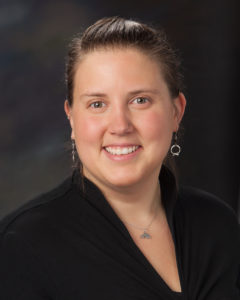
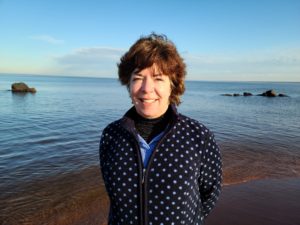
Alexis Berke. Submitted photo.

Berke, director of learning and engagement, will offer a mini-guided tour of the St. Louis River exhibits at the aquarium that all ages will enjoy. Along the way, she will spotlight some of the estuary residents and highlight ways the aquarium works to make visits to their facility an inclusive experience.

Here is the Zoom link and info:
https://uwmadison.zoom.us/j/97039831999?pwd=NUIreTAvV0d2b2ZVbTJnNnV4aFRMZz09 Meeting ID: 970 3983 1999
Passcode: 683032

The talk will last an hour and will include time for Q&A. The talks will be recorded and posted afterward on the Reserve’s Facebook page. A summary will also be posted on Wisconsin Sea Grant’s blog.

Other River Talks will be held on March 3, April 14 and May 12. The March talk will feature poets from around the country reading their river poems, held in conjunction with the St. Louis River Summit. For more information, visit the River Talks page: go.wisc.edu/4uz720.

River Talks are sponsored by The Lake Superior National Estuarine Research Reserve and the Wisconsin Sea Grant Program.

The post Explore the St. Louis River exhibits and animals at the Great Lakes Aquarium first appeared on Wisconsin Sea Grant.

Original Article

News Releases – Wisconsin Sea Grant

News Releases – Wisconsin Sea Grant

https://www.seagrant.wisc.edu/news/explore-the-st-louis-river-exhibits-and-animals-at-the-great-lakes-aquarium/

Marie Zhuikov

The Lake Superior National Estuarine Research Reserve (Lake Superior Reserve) is holding its 11th annual St. Louis River Summit March 1-3 via the virtual platform Zoom.

The theme for the summit is, “Resilient Ecosystems, Resilient Communities,” which highlights the ways the St. Louis River Estuary contributes to community well-being in the Twin Ports and beyond. The goal of the summit is to bring together key audiences working in the region to share information about the St. Louis River and encourage coordination of activities and funding proposals.

“We are adapting the event to fit a virtual format but will provide the opportunities for engagement that are a central feature of the summit. Yes, there will still be a poster session, a River Talk, and chances to connect with colleagues and community,” said Deanna Erickson, Lake Superior Reserve director. “We hope people will join us to learn about and celebrate the healing power of the estuary as we share our successes and look toward the future.”

Keynote speakers include photographer and author Dudley Edmondson and longtime Great Lakes champion Cameron Davis. Edmondson will present, “The Disconnect Between African Americans and the Outdoors.” Davis will present, “A Field Guide to Hugging the St. Louis River.”

On March 1, a special meeting will take place where participants can learn about a collaborative effort to sustain the health of the estuary once it’s no longer a U.S. EPA-designated Area of Concern. That session is called “St. Louis River Landscape Conservation Design Project System Analysis Update.”

A virtual poster session will take place 4 p.m. on Tuesday, March 2. Also, the Friends of the Lake Superior Reserve (FOLSR) will hold a legislative listening session, time TBD.

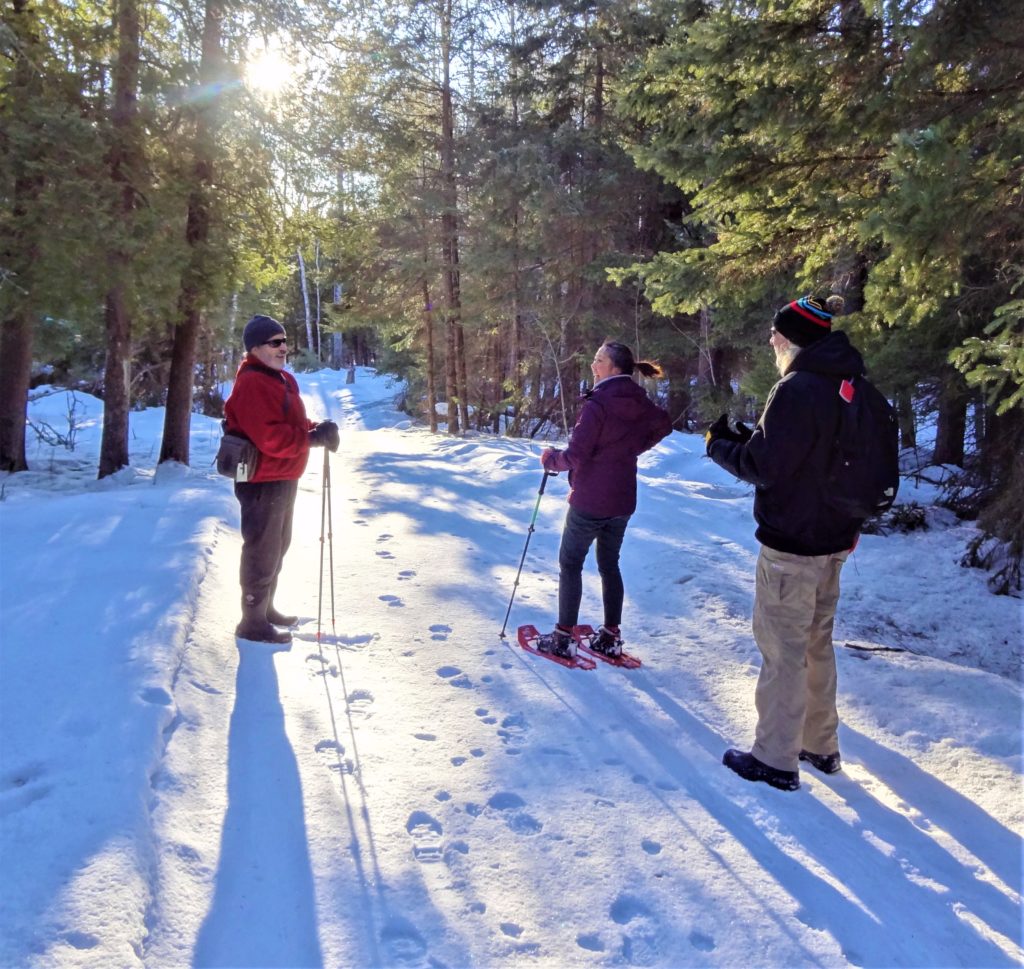
During the morning of March 3, small-group, socially distanced field trips will be held. Options include birding with the FOLSR, Kingsbury Bay and the Waabizheshinkana Trail, snowshoeing near Pokegema Bay, and revitalization efforts on and around Barker’s Island.

At 7 p.m. on March 3, a virtual presentation will feature poets from across the country reading their poems about rivers. This “River of Poems” is being held as part of the popular monthly River Talk series, which is free and open to all.

Students from local schools and institutions are invited to attend the summit to learn more about the research community and river projects. Students are free but need to register.      

The cost to attend the summit is $30. To register and view the agenda, visit lakesuperiorreserve.org/summit/.

Initial sponsors include Duluth Pottery, the Duluth Seaway Port Authority, the Friends of the Lake Superior Reserve, the Great Lakes Maritime Research Institute, the Lake Superior Research Institute, the Large Lakes Observatory, LimnoTech, Inc., the Minnesota Land Trust, Roen Salvage Company, the University of Minnesota Duluth Natural Resources Research Institute, the Western Lake Superior Sanitary District, the Wisconsin Coastal Management Program, the Wisconsin Department of Natural Resources, Wisconsin Sea Grant, and the United States Environmental Protection Agency.

The post St. Louis River Summit goes virtual first appeared on Wisconsin Sea Grant.

Original Article

Blog – Wisconsin Sea Grant

Blog – Wisconsin Sea Grant

https://www.seagrant.wisc.edu/blog/st-louis-river-summit-goes-virtual/

Marie Zhuikov

Owners of steel structures on inland lakes and a river in northern Minnesota are reporting the same kind of corrosion as seen in the Duluth-Superior Harbor and other harbors along Lake Superior. A structural engineering firm reported it has designed and overseen replacement of gates on dams along the St. Louis River, far removed from Lake Superior water, because of the corrosion.

Along with partners, Gene Clark, retired Wisconsin Sea Grant coastal engineer, devoted considerable energy into ferreting out the causes of and ways to mitigate this corrosion, which can lead to costly harbor infrastructure replacement.

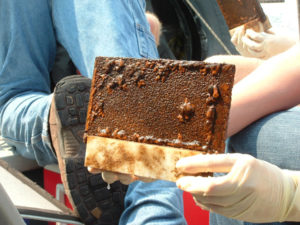
The accelerated corrosion of steel pilings in the Duluth-Superior Harbor was first noticed in 1998. Researchers funded in part by the Wisconsin and Minnesota Sea Grant programs eventually identified microbes as the culprit combined with a complicated interaction between water and the steel. Bacteria form small lumps, or tubercles, on the steel. The lumps limit oxygen and allow small amounts of copper in the water to interact with and dissolve the steel, which results in pockmarks and holes that compromise steel structures.

A steel research “coupon” removed from the Duluth Superior Harbor in 2007 shows freshwater biocorrosion tubercles. Image credit: Wisconsin Sea Grant

Experts brought together to investigate the issue blamed water chemistry specific to Lake Superior. However, those still tracking the issue have discovered this microbially influenced corrosion problem is more widespread.

Chad Scott, principal at AMI Consulting Engineers, initially alerted harbor industries about the corrosion issue in 1998 when he was a diver inspecting structures in the Duluth-Superior Harbor. Scott said during the past few years his company has worked with the U.S. Army Corps of Engineers to place steel samples (or coupons) in the St. Louis River at the Thompson Dam, Scanlon, Cloquet and near Cotton.

“At every single location along the river, the steel had the same tubercles on them,” Scott said. “So, what that tells me is, what’s coming to the harbor is coming down naturally from inland in Minnesota.”

Scott said his firm designed and oversaw replacement of gates on the Fond du Lac Dam and the Sappi Dam in Cloquet.

“They were all heavily pitted. It looked just like harbor corrosion,” Scott said. He’s also had friends report biocorrosion on their docks on Fish Lake, Island Lake and Grand Lake. He’s seen firsthand the dock posts covered by corrosive tubercles on those lakes.

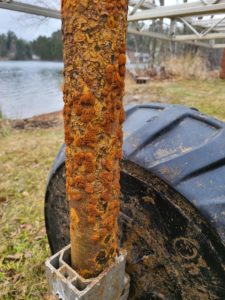
A steel dock post on Wilson Lake near Cotton, shows the same biocorrosion tubercles as those found in the Duluth Superior Harbor. Image credit: Marie Zhuikov, Wisconsin Sea Grant

Randall Hicks, professor emeritus at the University of Minnesota Duluth, has worked for years to understand the microbiology behind the corrosion. He said he has seen the tubercles on his own dock on Barrs Lake near Two Harbors. He has also identified them in photos from a dock on Wilson Lake near Cotton.

“I don’t think it’s just a regional problem,” Hicks said. “I think it’s been happening all along for a long time in places where conditions are right.” Those conditions include the presence of sulfate-reducing bacteria and iron-oxidizing bacteria, a source of dissolved sulfate and iron, and low-oxygen conditions such as those sometimes found in spring water.

Hicks described how the process begins when a clean sheet of steel is placed in water. “Different bacteria will attach to the surface and form a biofilm first.” Dental plaque is a common example of a biofilm. Microorganisms multiply and create a thin but tight layer on teeth. In this case, the biofilm layer is on steel.

“As that biofilm grows, we see a lot of iron-oxidizing bacteria – they’re aerobic microorganisms,” Hicks said. He explained that as the iron-oxidizing bacteria next to the steel surface use up oxygen, sulfate-reducing bacteria, bacteria that can live without oxygen, become common. “It’s really their activities in combination with activities of the iron-oxidizers in the biofilm that accelerate the loss of steel from the surface of the metal.”

Jim Sharrow, retired director of planning and resiliency with the Duluth Seaway Port Authority, said the corrosion bacteria are not an invasive species. “They’re indigenous to this area. They’re all over.”

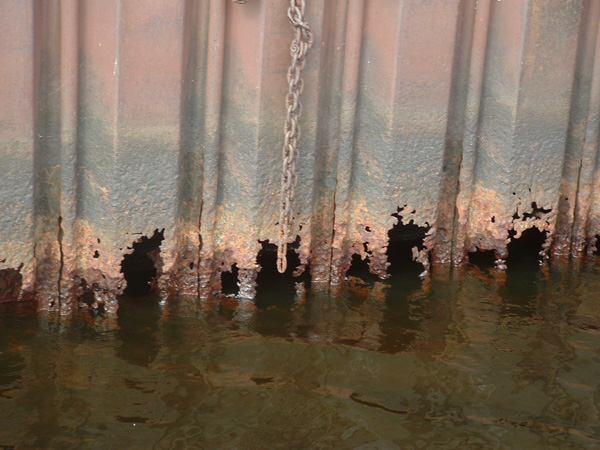
The Canadian Northern dock in the Duluth Superior Harbor shows damage caused by freshwater microbial corrosion in 2007. Image credit: Wisconsin Sea Grant

Previous research identified coatings that can be used to protect steel. Hicks is now working on ways to fool the bacteria in the first place. Hicks and Mikael Elias, associate professor from the University of Minnesota Twin Cities, have found that adding a lactonase enzyme into a steel coating can reduce the biofilm produced, change the biofilm community and reduce the amount of corrosion. The lactonase enzyme works by destroying signaling molecules that the bacteria on steel produce to sense each other – in essence, fooling the bacteria into thinking they are alone, so “they don’t turn on genes to produce a biofilm,” Hicks said.

The nontoxic coating enzymes only last a month or two before degrading or diffusing out of the coating but Hicks said that, compared to untreated steel, the enzymes have reduced corrosion by 50% for at least two years, which was the length of their study.

“Hopefully, these enzymes can have an impact even farther out. If you’re in the shipping business and you expect a steel structure to last 100 years, then all of a sudden you have to replace it every 50 years because of the corrosion, that’s a big economic impact – and that’s just with doubling the corrosion rate. If we can reduce the rate, we don’t need to have a big impact to really extend the lifetime of structures quite a ways down the road,” Hicks said.

The University of Minnesota has applied for a patent for the lactonase enzyme coating. Hicks and Elias have also conducted tests in Lake Minnetonka and the Mississippi River to see if the same mechanism in the enzymes that inhibits biofilms from forming on steel inhibits larger invasive and nuisance organisms like zebra mussels and barnacles from attaching to underwater structures.

Elias said their experiments, funded by the Minnesota Environment and Natural Resources Trust Fund*, were successful. More recently, they added sites in sea water. Their pilot experiments in Florida show promise.

Until the lactonase enzyme coating becomes commercially available, what should cabin dock owners do to protect their steel from biocorrosion? Sharrow said, “Basically, what we found is, all you need to do is keep paint on your dock. You need to keep the water from touching the steel. You can use epoxy, but if you take your dock out every fall, you could probably use Rustoleum or something like that.”

Beyond docks, enzyme technology might also work on farm crops and in people. Elias said he is testing whether a lactonase enzyme spray can protect corn from a common bacterial infection (Gross’s wilt). Cystic fibrosis patients are prone to bacterial pneumonia, which forms in a biofilm.

Elias said, “One of our goals is to potentially use this enzyme as an aerosol to prevent biofilms in the lungs. . . It appears from our experiments that everywhere microbes are creating some sort of nuisance, this enzyme, because it changes the behavior of bacteria, can be helpful. We have a lot of different investigations to do and we are trying our best to pursue some of them as hard as we can.”

“This all grew out of those initial corrosion studies funded by Sea Grant and the work we did with Gene Clark and the other people in the corrosion study group,” Hicks said. Other organizations involved include the U.S. Army Corps of Engineers and the Great Lakes Maritime Research Institute.

*Funding for this project was provided by the Minnesota Environment and Natural Resources Trust Fund as recommended by the Minnesota Aquatic Invasive Species Research Center and the Legislative-Citizen Commission on Minnesota Resources.

The post Freshwater steel corrosion occurring beyond Lake Superior harbors first appeared on Wisconsin Sea Grant.

Original Article

News Releases – Wisconsin Sea Grant

News Releases – Wisconsin Sea Grant

https://www.seagrant.wisc.edu/news/freshwater-steel-corrosion-occurring-beyond-lake-superior-harbors/

Marie Zhuikov

Owners of steel structures on inland lakes and a river in northern Minnesota are reporting the same kind of corrosion as seen in the Duluth-Superior Harbor and other harbors along Lake Superior. A structural engineering firm reported it has designed and overseen replacement of gates on dams along the St. Louis River, far removed from Lake Superior water, because of the corrosion.

Along with partners, Gene Clark, retired Wisconsin Sea Grant coastal engineer, devoted considerable energy into ferreting out the causes of and ways to mitigate this corrosion, which can lead to costly harbor infrastructure replacement.

The accelerated corrosion of steel pilings in the Duluth-Superior Harbor was first noticed in 1998. Researchers funded in part by the Wisconsin and Minnesota Sea Grant programs eventually identified microbes as the culprit combined with a complicated interaction between water and the steel. Bacteria form small lumps, or tubercles, on the steel. The lumps limit oxygen and allow small amounts of copper in the water to interact with and dissolve the steel, which results in pockmarks and holes that compromise steel structures.

A steel research “coupon” removed from the Duluth Superior Harbor in 2007 shows freshwater biocorrosion tubercles. Image credit: Wisconsin Sea Grant

Experts brought together to investigate the issue blamed water chemistry specific to Lake Superior. However, those still tracking the issue have discovered this microbially influenced corrosion problem is more widespread.

Chad Scott, principal at AMI Consulting Engineers, initially alerted harbor industries about the corrosion issue in 1998 when he was a diver inspecting structures in the Duluth-Superior Harbor. Scott said during the past few years his company has worked with the U.S. Army Corps of Engineers to place steel samples (or coupons) in the St. Louis River at the Thompson Dam, Scanlon, Cloquet and near Cotton.

“At every single location along the river, the steel had the same tubercles on them,” Scott said. “So, what that tells me is, what’s coming to the harbor is coming down naturally from inland in Minnesota.”

Scott said his firm designed and oversaw replacement of gates on the Fond du Lac Dam and the Sappi Dam in Cloquet.

“They were all heavily pitted. It looked just like harbor corrosion,” Scott said. He’s also had friends report biocorrosion on their docks on Fish Lake, Island Lake and Grand Lake. He’s seen firsthand the dock posts covered by corrosive tubercles on those lakes.

A steel dock post on Wilson Lake near Cotton, shows the same biocorrosion tubercles as those found in the Duluth Superior Harbor. Image credit: Marie Zhuikov, Wisconsin Sea Grant

Randall Hicks, professor emeritus at the University of Minnesota Duluth, has worked for years to understand the microbiology behind the corrosion. He said he has seen the tubercles on his own dock on Barrs Lake near Two Harbors. He has also identified them in photos from a dock on Wilson Lake near Cotton.

“I don’t think it’s just a regional problem,” Hicks said. “I think it’s been happening all along for a long time in places where conditions are right.” Those conditions include the presence of sulfate-reducing bacteria and iron-oxidizing bacteria, a source of dissolved sulfate and iron, and low-oxygen conditions such as those sometimes found in spring water.

Hicks described how the process begins when a clean sheet of steel is placed in water. “Different bacteria will attach to the surface and form a biofilm first.” Dental plaque is a common example of a biofilm. Microorganisms multiply and create a thin but tight layer on teeth. In this case, the biofilm layer is on steel.

“As that biofilm grows, we see a lot of iron-oxidizing bacteria – they’re aerobic microorganisms,” Hicks said. He explained that as the iron-oxidizing bacteria next to the steel surface use up oxygen, sulfate-reducing bacteria, bacteria that can live without oxygen, become common. “It’s really their activities in combination with activities of the iron-oxidizers in the biofilm that accelerate the loss of steel from the surface of the metal.”

Jim Sharrow, retired director of planning and resiliency with the Duluth Seaway Port Authority, said the corrosion bacteria are not an invasive species. “They’re indigenous to this area. They’re all over.”

The Canadian Northern dock in the Duluth Superior Harbor shows damage caused by freshwater microbial corrosion in 2007. Image credit: Wisconsin Sea Grant

Previous research identified coatings that can be used to protect steel. Hicks is now working on ways to fool the bacteria in the first place. Hicks and Mikael Elias, associate professor from the University of Minnesota Twin Cities, have found that adding a lactonase enzyme into a steel coating can reduce the biofilm produced, change the biofilm community and reduce the amount of corrosion. The lactonase enzyme works by destroying signaling molecules that the bacteria on steel produce to sense each other – in essence, fooling the bacteria into thinking they are alone, so “they don’t turn on genes to produce a biofilm,” Hicks said.

The nontoxic coating enzymes only last a month or two before degrading or diffusing out of the coating but Hicks said that, compared to untreated steel, the enzymes have reduced corrosion by 50% for at least two years, which was the length of their study.

“Hopefully, these enzymes can have an impact even farther out. If you’re in the shipping business and you expect a steel structure to last 100 years, then all of a sudden you have to replace it every 50 years because of the corrosion, that’s a big economic impact – and that’s just with doubling the corrosion rate. If we can reduce the rate, we don’t need to have a big impact to really extend the lifetime of structures quite a ways down the road,” Hicks said.

The University of Minnesota has applied for a patent for the lactonase enzyme coating. Hicks and Elias have also conducted tests in Lake Minnetonka and the Mississippi River to see if the same mechanism in the enzymes that inhibits biofilms from forming on steel inhibits larger invasive and nuisance organisms like zebra mussels and barnacles from attaching to underwater structures.

Elias said their experiments, funded by the Minnesota Environment and Natural Resources Trust Fund*, were successful. More recently, they added sites in sea water. Their pilot experiments in Florida show promise.

Until the lactonase enzyme coating becomes commercially available, what should cabin dock owners do to protect their steel from biocorrosion? Sharrow said, “Basically, what we found is, all you need to do is keep paint on your dock. You need to keep the water from touching the steel. You can use epoxy, but if you take your dock out every fall, you could probably use Rustoleum or something like that.”

Beyond docks, enzyme technology might also work on farm crops and in people. Elias said he is testing whether a lactonase enzyme spray can protect corn from a common bacterial infection (Gross’s wilt). Cystic fibrosis patients are prone to bacterial pneumonia, which forms in a biofilm.

Elias said, “One of our goals is to potentially use this enzyme as an aerosol to prevent biofilms in the lungs. . . It appears from our experiments that everywhere microbes are creating some sort of nuisance, this enzyme, because it changes the behavior of bacteria, can be helpful. We have a lot of different investigations to do and we are trying our best to pursue some of them as hard as we can.”

“This all grew out of those initial corrosion studies funded by Sea Grant and the work we did with Gene Clark and the other people in the corrosion study group,” Hicks said. Other organizations involved include the U.S. Army Corps of Engineers and the Great Lakes Maritime Research Institute.

*Funding for this project was provided by the Minnesota Environment and Natural Resources Trust Fund as recommended by the Minnesota Aquatic Invasive Species Research Center and the Legislative-Citizen Commission on Minnesota Resources.

The post Freshwater steel corrosion occurring beyond Lake Superior harbors first appeared on Wisconsin Sea Grant.

Original Article

News Releases – Wisconsin Sea Grant

News Releases – Wisconsin Sea Grant

https://www.seagrant.wisc.edu/news/freshwater-steel-corrosion-occurring-beyond-lake-superior-harbors/

Marie Zhuikov

As 2020 winds down, we asked staff members at Wisconsin Sea Grant what their favorite project was this year. Although work was a bit more challenging than usual due to our altered work circumstances, everyone managed to stay productive, and even find fulfillment.

In our last post in this series, Social Science Outreach Specialist Deidre Peroff describes her favorite project of 2020, which is the Wild Rice (Manoomin) Education and Outreach Toolkit for Lake Superior Audiences project. Funded by the National Oceanic and Atmospheric Administration, the project is in its final stages.

“The goal is to raise awareness about Manoomin, its cultural and regional significance, its ecological function and importance, and to share information about the current threats to wild rice that may impact its resilience and future,” said Peroff. “Along with two Ph.D. students from the University of Wisconsin-Madison (Jimmy Camacho and Sarah Dance), we also worked closely with indigenous and nonindigenous partners in the region to develop educational resources to share with broad audiences to raise awareness of Manoomin and to support parallel efforts to protect and restore it for future generations.”

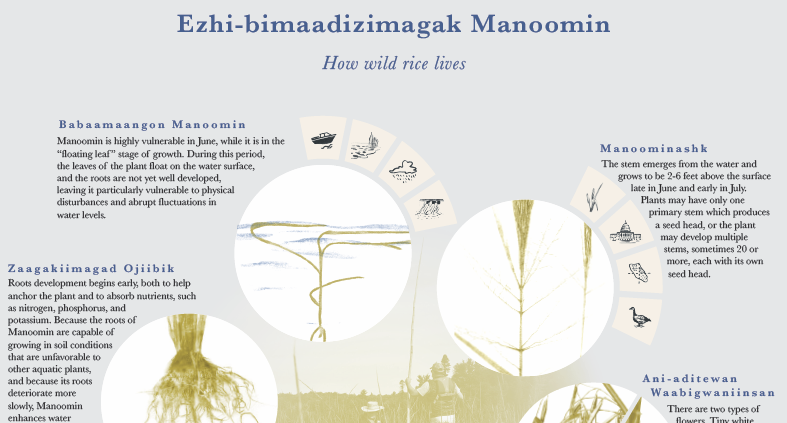
Part of one of the graphics developed for the project is below. We can’t wait to see the finalized versions!

Thank you for reading this series. We wish you the best in 2021.


The post Sea Grant staff project faves, Deidre Peroff first appeared on Wisconsin Sea Grant.

Original Article

Blog – Wisconsin Sea Grant

Blog – Wisconsin Sea Grant

https://www.seagrant.wisc.edu/blog/sea-grant-staff-project-faves-deidre-peroff/

Marie Zhuikov

As 2020 winds down, we asked staff members at Wisconsin Sea Grant what their favorite project was this year. Although work was a bit more challenging than usual due to our altered work circumstances, everyone managed to stay productive, and even find fulfillment.

Tim Campbell. Image credit: Wisconsin Sea Grant

In our second-to-last post in this series, Tim Campbell, our aquatic invasive species outreach specialist, chose a project that hugged the timeline border between 2019 and 2020. His two-minute Eat Wisconsin Fish video was produced in 2019 but posted in 2020. Helping Campbell put it together were Titus Seilheimer with Wisconsin Sea Grant and Bret Shaw with University of Wisconsin-Madison Extension and the Life Sciences Communication Department.

Campbell said, “It was fun to get to pretend I was some sort of cooking personality for the day, and it was nice to step outside of my aquatic invasive species world. If I weren’t helping people clean off their boats or finding new homes for their pets, helping them eat more Wisconsin fish would definitely be an enjoyable way to spend my time!”

Campbell also chose a runner-up favorite project. This one hugs the timeline border, too – although it’s the 2020-2021 border. He finished a year-long process of getting a paper on the potential invasion pathway of Buddhist life release accepted in the Management of Biological Invasions.

“We submitted the paper in February, revised and resubmitted in August, and found out at the beginning of December that it was accepted. I’m looking forward to being able to share that in 2021,” Campbell said.

The post Sea Grant staff project faves, Tim Campbell first appeared on Wisconsin Sea Grant.

Original Article

Blog – Wisconsin Sea Grant

Blog – Wisconsin Sea Grant

https://www.seagrant.wisc.edu/blog/sea-grant-staff-project-faves-tim-campbell/

Marie Zhuikov

The next River Talk will take place via Zoom at 7 p.m. Wednesday, Jan. 13. Kelly Beaster and Reed Schwarting with the Lake Superior Research Institute at the University of Wisconsin-Superior will present, “Coastal wetlands: Dynamic ecosystems of Lake Superior.”

Kelly Beaster in the field. Image credit: Lake Superior Research Institute

Reed Schwarting. Image credit: Lake Superior Research Institute

Beaster and Schwarting have spent the past five years monitoring the health of local wetlands along Lake Superior, including those in the St. Louis River Estuary. Their talk will describe the function of coastal wetlands and how they change over time. They will focus on vegetation, covering the more common plant communities and some of their unique species as well as how wetlands have adapted to the short-term and long-term flux of water levels in the Great Lakes.

Here is the Zoom link and info:
https://uwmadison.zoom.us/j/91446157971?pwd=czhnVGxuMTJNWlZveTllanFCVkRsUT09

Meeting ID: 914 4615 7971

Passcode: 163792

The talk will last an hour and will include time for Q&A. The talks will be recorded and posted afterward on the Reserve’s Facebook page. A summary will also be posted on Wisconsin Sea Grant’s blog.

Other River Talks will be held on Feb. 10, March 3, April 14 and May 12. The March talk will be held in conjunction with the St. Louis River Summit. For more information, visit the River Talks page: go.wisc.edu/4uz720.

River Talks are sponsored by The Lake Superior National Estuarine Research Reserve and the Wisconsin Sea Grant Program.

The post Coastal wetlands: Dynamic ecosystems of Lake Superior first appeared on Wisconsin Sea Grant.

Original Article

News Releases – Wisconsin Sea Grant

News Releases – Wisconsin Sea Grant

https://www.seagrant.wisc.edu/news/coastal-wetlands-dynamic-ecosystems-of-lake-superior/

Marie Zhuikov

Sharon Moen. Image credit: Marie Zhuikov, Wisconsin Sea Grant

As 2020 winds down, we asked staff members at Wisconsin Sea Grant what their favorite project was this year. Although work was a bit more challenging than usual due to our altered work circumstances, everyone managed to stay productive, and even find fulfillment. Although Sharon Moen, our Eat Wisconsin Fish outreach specialist, hasn’t been working here that long, she wanted to contribute to this blog series.

Sharon said, “I dissected the Eat Wisconsin Fish initiative soon after I was hired to manage it in November. Laying the innards out on the metaphorical table and studying their functions informed strategies for working with commercial fishers, fish farmers and the public in 2021. Eat Wisconsin Fish activities support food security, economic and environmental health, and the overall well-being of the people of Wisconsin.”

To learn more about the initiative and Sharon’s work, visit https://eatwisconsinfish.org/.


The post Sea Grant staff project faves, Sharon Moen first appeared on Wisconsin Sea Grant.

Original Article

Blog – Wisconsin Sea Grant

Blog – Wisconsin Sea Grant

https://www.seagrant.wisc.edu/blog/sea-grant-staff-project-faves-sharon-moen/

Marie Zhuikov

As 2020 winds down, we asked staff members at Wisconsin Sea Grant what their favorite project was this year. Although work was a bit more challenging than usual due to our altered work circumstances, everyone managed to stay productive, and even find fulfillment.

David Hart. Image credit: Wisconsin Sea Grant

David Hart, assistant director for extension, said that updating the Wisconsin Coastal Guide was his favorite activity this year. The guide is an interactive story map that lets users explore the coastal and natural heritage of Wisconsin’s Great Lakes. The project, funded by the Wisconsin Coastal Management Program, let Hart combine two of his favorite things — making interactive maps and exploring the Great Lakes.

“The guide has so many exciting attractions to discover,” Hart said. “They are organized by tabs at the top of the website. The photo tab leads to scenic photos of all 15 coastal counties taken by nature photographer Bob Hundt. The learn tab features place-based learning activities like clue-driven Great Lakes Quests and maritime history geocaches. The maritime heritage tab lets you explore lighthouses, shipwrecks, fish markets and harbor towns. In the stories tab, you can listen to Voices of the Coast and catch up on Wisconsin Water News podcasts. The recreation tab guides you to 196 beaches and 228 coastal parks, ranging from busy state parks to rustic township parks. The nature tab features state natural areas, wildlife areas and the 37 nature centers near our coasts. The history tab lets you uncover historic sites in the Around the Shores of Lake Superior and Around the Shores of Lake Michigan books by Margaret Beattie Bogue. It also lets you read the 122 historic markers and find 100 museums near our coast. The boating tab locates the 33 certified and pledged clean marinas that are working protect water quality. It also features 112 public boat access sites. With the public access and routes tabs, you can navigate Circle Tour routes, Rustic Roads and Scenic Byways and find the 400+ public access sites along our coasts,” he said.

Be sure to block some time for a deep dive into the guide to get ideas of what to visit on your next trip to the Great Lakes.

The post Sea Grant staff project faves, David Hart first appeared on Wisconsin Sea Grant.

Original Article

Blog – Wisconsin Sea Grant

Blog – Wisconsin Sea Grant

https://www.seagrant.wisc.edu/blog/sea-grant-staff-project-faves-david-hart/

Marie Zhuikov

Anne Moser. Image credit: Wisconsin Sea Grant

As 2020 winds down, we asked staff members at Wisconsin Sea Grant what their favorite project was this year. Although work was a bit more challenging than usual due to our altered work circumstances, everyone managed to stay productive, and even find fulfillment.

Anne Moser, senior special librarian and education coordinator, said the “Explore Lake Sturgeon” project was her favorite for 2020.

“Having the opportunity to experience a fish dissection was an experience I’ll never forget. Over my years working at Wisconsin Sea Grant, I have participated in several projects that help tell the conservation story of this iconic fish species and this was the best! It gave me deeper understanding of the power of ‘hands-on’ learning and will hopefully be a useful tool for our cohort of talented Great Lakes educators during these months of distance learning,” Moser said.

If you’re not squeamish, you’ve got to check out the video of Anne helping to dissect a young sturgeon.

The post Sea Grant staff project faves, Anne Moser first appeared on Wisconsin Sea Grant.

Original Article

Blog – Wisconsin Sea Grant

Blog – Wisconsin Sea Grant

https://www.seagrant.wisc.edu/blog/sea-grant-staff-project-faves-anne-moser/

Marie Zhuikov

Julia Noordyk on the East River. Submitted photo.

As 2020 winds down, we asked staff members at Wisconsin Sea Grant what their favorite project was this year. Although work was a bit more challenging than usual due to our altered work circumstances, everyone managed to stay productive, and even find fulfillment.

Julia Noordyk, our water quality and coastal communities outreach specialist, said the East River Resiliency Collaborative was her favorite 2020 project. “The need to holistically address flooding and water quality in this Green Bay watershed has been talked about by stakeholders and communities for over a decade. I am thrilled that the Wisconsin Coastal Management Program and Fund for Lake Michigan saw the value in this project and helped us make it a reality!” she said.

The project formed a new partnership among Wisconsin Sea Grant, the University of Wisconsin-Madison department of civil and environmental engineering, The Nature Conservancy and NEW Water (the brand of the Green Bay Metropolitan Sewerage District).

Read more about this notable fave here.

The post Sea Grant staff project faves, Julia Noordyk first appeared on Wisconsin Sea Grant.

Original Article

Blog – Wisconsin Sea Grant

Blog – Wisconsin Sea Grant

https://www.seagrant.wisc.edu/blog/sea-grant-staff-project-faves-julia-noordyk/

Marie Zhuikov

As 2020 winds down, we asked staff members at Wisconsin Sea Grant what their favorite project was this year. Although work was a bit more challenging than usual due to our altered work circumstances, everyone managed to stay productive, and even find fulfillment.

Titus Seilheimer. Image credit: Wisconsin Sea Grant

Our fisheries specialist, Titus Seilheimer’s favorite project is Great Lakes Aquaculture Day. This annual event for the Great Lakes Aquaculture Collaborative was held on October 10. Seilheimer said, “We had to move the event online and had a full day of interactive sessions for new farmers, current farmers and consumers. There was a lot of planning to make it happen, but the most fun part of the day was when Elliot Nelson and I were emcees for a virtual Iron Chef-style cooking contest. Although that sounds strange, it actually worked really well.”

The recordings for Great Lakes Aquaculture Day are available online. Learn more about this Great Lakes Sea Grant Network effort on its website.

Seilheimer said the event was a team effort from Elliot Nelson and Lauren Jescovitch (Michigan Sea Grant), Emma Wiermaa (Wisconsin Sea Grant and Univ. of Wisconsin Stevens Point-Northern Aquaculture Demonstration Facility), Amy Schrank (Minnesota Sea Grant), and himself, with essential help from Cindy Hudson and Geneva Langeland from the Michigan Sea Grant communications team.

The post Sea Grant staff project faves, Titus Seilheimer first appeared on Wisconsin Sea Grant.

Original Article

Blog – Wisconsin Sea Grant

Blog – Wisconsin Sea Grant

https://www.seagrant.wisc.edu/blog/sea-grant-staff-project-faves-titus-seilheimer/

Marie Zhuikov

Today, the Wisconsin PFAS Action Council (WisPAC) released a final report of statewide initiatives regarding per- and polyfluoroalkyl substances (PFAS) with Gov. Evers to the public. Representing the entire University of Wisconsin System, Christina Remucal, associate professor of civil and environmental engineering at the University of Wisconsin-Madison, is one member of the council composed of representatives from 17 state agencies. The council has been working on the PFAS Action Plan for over a year to identify priority actions in response to growing concerns about PFAS and the hazards this class of chemicals pose to human health. The council was put together in 2019 by the governor to ensure Wisconsinites have access to clean, safe drinking water.

Christina Remucal. Image credit: University of Wisconsin-Madison

Remucal brought her research experience with PFAS to the table, including her most recently funded Wisconsin Sea Grant project, where she is investigating the fate of PFAS in Green Bay and Lake Michigan sediments and water for two years.

“We often think of PFAS as a groundwater contaminant, but here we have an interesting scientific opportunity to learn about how these chemicals move in surface waters,” Remucal said. Her research team is looking in and around the city of Marinette, which has a known PFAS contamination site and also the bay of Green Bay. They plan to collect samples out on Lake Michigan next year.

Unlike other traditional environmental contaminants like PCBs, which tend to be found more in sediment, Remucal said PFAS dissolve easily in water and move about more freely. There are thousands of different kinds of PFAS. Their chemical structure determines where they’re more likely to travel in the environment. “The ones that are longer-chain compounds – the ones that are a little bigger – are more likely to be found in the sediment,” Remucal said.

One mystery her team is focusing on is why the amounts of PFAS measured in sediment in the field are different than what’s been observed in the laboratory. “In the lab we always try to mimic the environment, but I think these compounds, because of their chemical properties, don’t behave very well. That’s why it’s important to make those measurements in the field as well,” Remucal said.

Remucal recently met with Wisconsin Department of Natural Resources staff members to share what her team has found so far, which is that PFAS concentrations in sediment vary widely. “The Tyco facility drainage ditch sites have a lot of PFAS in them, which we knew. The amounts that are ending up in the sediment vary a lot. We’re finding more of the longer-chain compounds in the sediment than the shorter-chain compounds – more of the sulfinates and the carboxylates. It really depends on the chemistry,” Remucal said.

The researchers are analyzing the sediments themselves to see if their composition might explain why the PFAS amounts vary.

Remucal finds all the public interest in PFAS and her research refreshing and in keeping with Sea Grant expectations to engage stakeholders in research. “It’s challenging working with these chemicals and communicating about them because the chemistry is so complex, but it’s been rewarding to have people so interested in what we are doing.”

Christina Remucal works with PFAS samples in her lab. Image credit: Bonnie Willison, Wisconsin Sea Grant

The post Investigating the fate of PFAS in Green Bay and Lake Michigan first appeared on Wisconsin Sea Grant.

Original Article

News Releases – Wisconsin Sea Grant

News Releases – Wisconsin Sea Grant

https://www.seagrant.wisc.edu/news/investigating-the-fate-of-pfas-in-green-bay-and-lake-michigan/

Marie Zhuikov

As 2020 winds down, we asked staff members at Wisconsin Sea Grant what their favorite project was this year. Although work was a bit more challenging than usual due to our altered work circumstances, everyone managed to stay productive, and even find fulfillment.

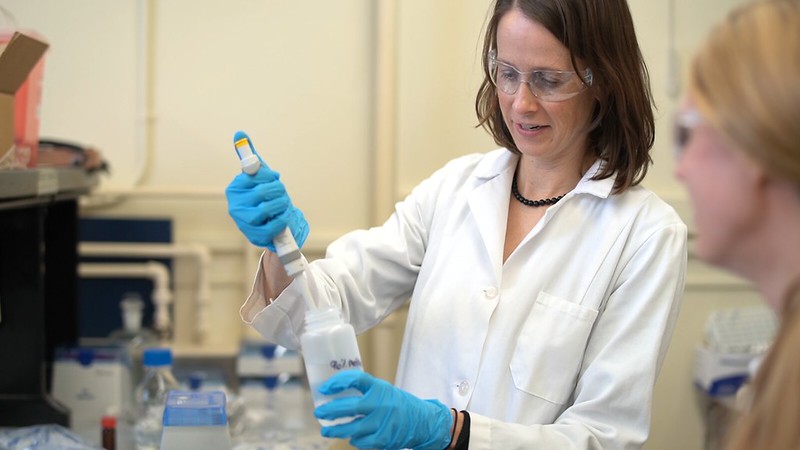
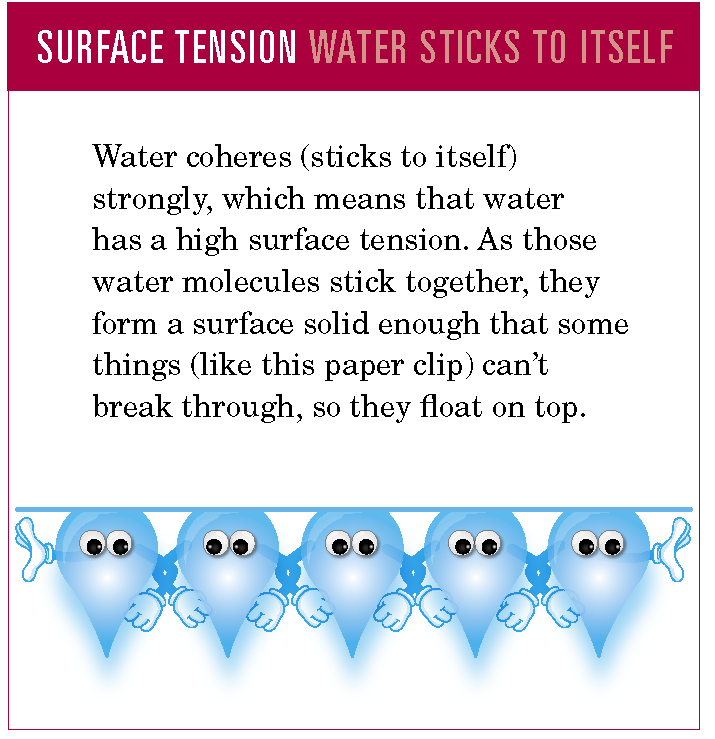
Our editor, Elizabeth White’s favorite project is her work on a story hour lesson plan for Anne Moser and the Wisconsin Water Library titled, “Can Water Be Sticky?”

Elizabeth said, “It was quite a challenge explaining properties of water such as cohesion, adhesion and surface tension to a young audience. Freelance designer Kristen Rost’s illustrations did a lot of the work. I hope it’s not a bad thing that I learned a lot from curriculum for ages 3-9!”

One of Rost’s designs is below. The Wisconsin Water Library has many other lesson plans and activities available for teachers, parents and librarians at this link.

The post Sea Grant staff project faves, Elizabeth White first appeared on Wisconsin Sea Grant.

Original Article

Blog – Wisconsin Sea Grant

Blog – Wisconsin Sea Grant

https://www.seagrant.wisc.edu/blog/sea-grant-staff-project-faves-elizabeth-white/

Marie Zhuikov

As 2020 winds down, we asked staff members at Wisconsin Sea Grant what their favorite project was this year. Although work was a bit more challenging than usual due to our altered work circumstances, everyone managed to stay productive, and even find fulfillment.

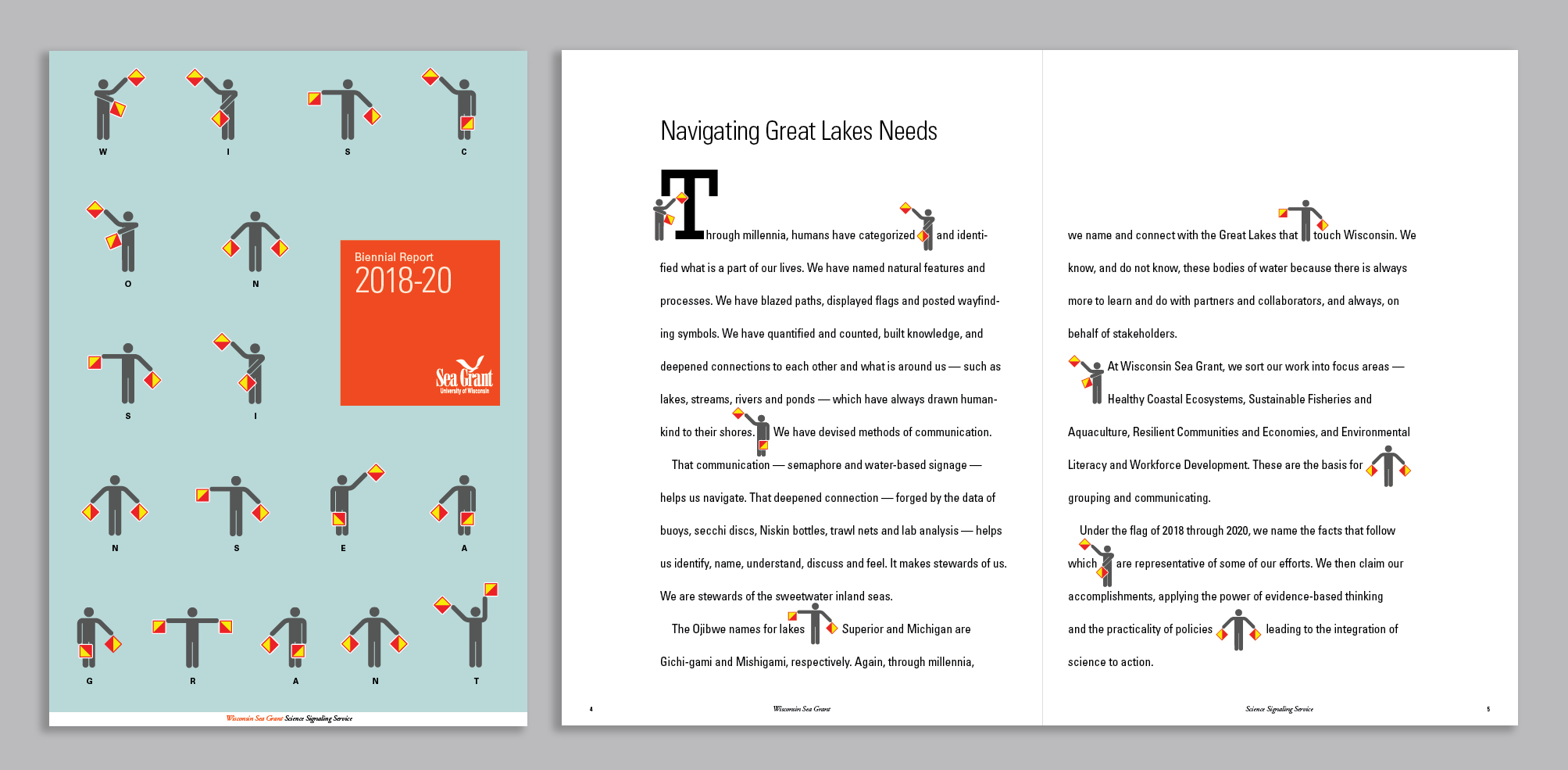
Our designer, Yael Gen’s favorite project is her work on our 2018-2020 Biennial Report.

She said, “In the past, we commissioned a photographer to create the images based on a theme. But because of the pandemic, that couldn’t happen. Communications Coordinator Moira Harrington came up with the idea of using signal flags, and after a few minutes of researching the flags, I could visualize the entire report in my head. All I had to do was get it down on ‘paper.’ After such a disorienting year, it was gratifying to see how much our program accomplished.”

The report is at the printers and is not posted online yet, but here’s a sneak preview of the cover and inside spread.

The post Sea Grant staff project faves, Yael Gen first appeared on Wisconsin Sea Grant.

Original Article

Blog – Wisconsin Sea Grant

Blog – Wisconsin Sea Grant

https://www.seagrant.wisc.edu/blog/sea-grant-staff-project-faves-yael-gen/

Marie Zhuikov

The November River Talk featured Dustin Haines, research coordinator for the Lake Superior National Estuarine Research Reserve. His Zoom talk held in cooperation with Café Scientifique Twin Ports, was titled, ““Should I Stay or Should I Go? The Clash of Wetlands With Lake Levels, Invasives and Humans.”

Dustin Haines

Haines described research conducted on a special site on the St. Louis River Estuary. This sentinel site on the Pokegama River, which flows into the estuary, serves as a long-term location to help researchers understand the impacts of water level fluctuations on coastal communities. “It is a sentinel of present, past and future change,” Haines said. Vegetation, weather and water quality data are collected on these sites on the Reserve and in other estuarine research reserves across the country.

From historical aerial images and Lake Superior water level data from 1938 to 2018, Reserve researchers found that, “When water levels are low, we have high amounts of emergent vegetation. And when the water level goes up, those emergent plant communities decline . . . It’s fairly clear that these emergent plant communities are correlated with these changing water levels. Biologists who study wetlands already know this, but it’s interesting to see it in this much-longer-term data set,” Haines said. Emergent plants are those with roots in the water and their tips out of the water. They form wetlands, which provide vital wildlife habitat and are a hallmark of a healthy estuary.

Then Haines turned to more recent data. During 2014-2017 and in 2020, Haines and other Reserve researchers established plots to record the types of plants found in them (emergent, submerged and floating). They also recorded water depths at the plots.

“We saw some interesting shifts in the emergent and submergent plant communities, which seem to be tied to rising water levels,” Haines said. The sites with high water depths had few emergent plants. Despite that, Haines said the submerged plant communities are doing well in those areas.

What does that mean for the health of the overall plant community in terms of diversity? The communities are changed by water level changes, but the number of species is fairly stable. The types of them just change.

“The number of species is not changing with respect to long-term changes in depth,” Haines said. “That indicates that while these communities are changing with emergent/submergent plant types, the species diversity is not drastically reduced.”

Invasive plants can outcompete native plants and can harm wetland health. Nonnative cattails and purple loosestrife are the most common alien plants found at the sentinel site. Haines did not find a correlation between the cover of invasive plants and the native plant cover on the site. “But it’s still something to pay attention to,” Haines said. “Cattails can really take over an area. They grow in monoculture, largely to the exclusion of native plants. That can be a problem.”

“This huge loss of wetland habitat from 200 years ago to now from human activities, indicates we do really need to focus on restoration efforts in the estuary to regain these neat habitats that we’ve lost over time. There’s a lot being done now, but we need to do more. Additionally, water levels are driving the system. Whatever’s happening to Lake Superior is happening to the estuary. That changes quickly, but the plant response is really quick to change, too. Restoration efforts need to take these dynamics into account,” Haines said.

If people would like to help efforts of the Reserve in the estuary, they can get involved in the Friends of the Lake Superior Reserve. There are sometimes opportunities to participate in field work with the researchers.

A video of Haines’s talk is available on YouTube here. The next River Talk will be held in January (we skip December due to the holidays). Coastal wetlands will be the topic on January 13.

The post River Talk explores wetland clashes on the St. Louis River Estuary first appeared on Wisconsin Sea Grant.

Original Article

Blog – Wisconsin Sea Grant

Blog – Wisconsin Sea Grant

https://www.seagrant.wisc.edu/blog/river-talk-explores-wetland-clashes-on-the-st-louis-river-estuary/

Marie Zhuikov

As 2020 winds down, we asked staff members at Wisconsin Sea Grant what their favorite project was this year. Although work was a bit more challenging than usual due to our altered work circumstances, everyone managed to stay productive, and even find fulfillment.

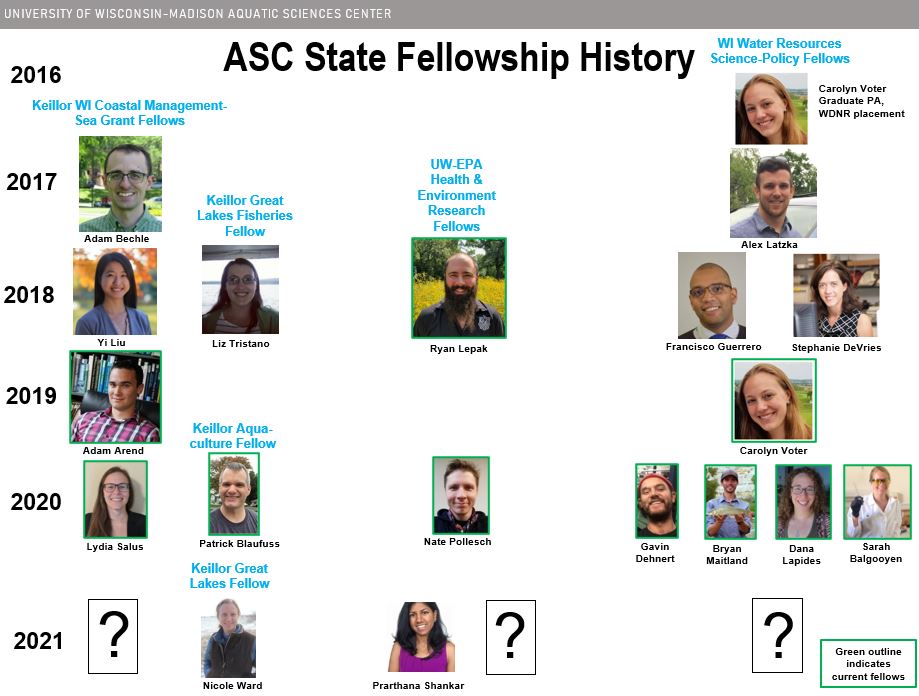
Associate Director Jennifer Hauxwell is our first to be featured. Her favorite project is her work with state and federal agencies to find outstanding research fellows to tackle Wisconsin’s water challenges.

Hauxwell says, “I love seeing:

  • professional development in technical training, science communications, and stakeholder-engaged science = actionable science!
  • the talent and passion that the fellows bring
  • the talent and passion of the mentors at the agencies
  • progress on state water challenges and
  • the Wisconsin Idea in action.”

The image below shows how the fellowship program has evolved under Hauxwell’s care. The number and variety we are able to offer has increased every year. The question marks denote openings we are in the process of filing. We can’t wait to see who will fill those spots.

The post Sea Grant staff project faves first appeared on Wisconsin Sea Grant.

Original Article

Blog – Wisconsin Sea Grant

Blog – Wisconsin Sea Grant

https://www.seagrant.wisc.edu/blog/sea-grant-staff-project-faves/

Marie Zhuikov

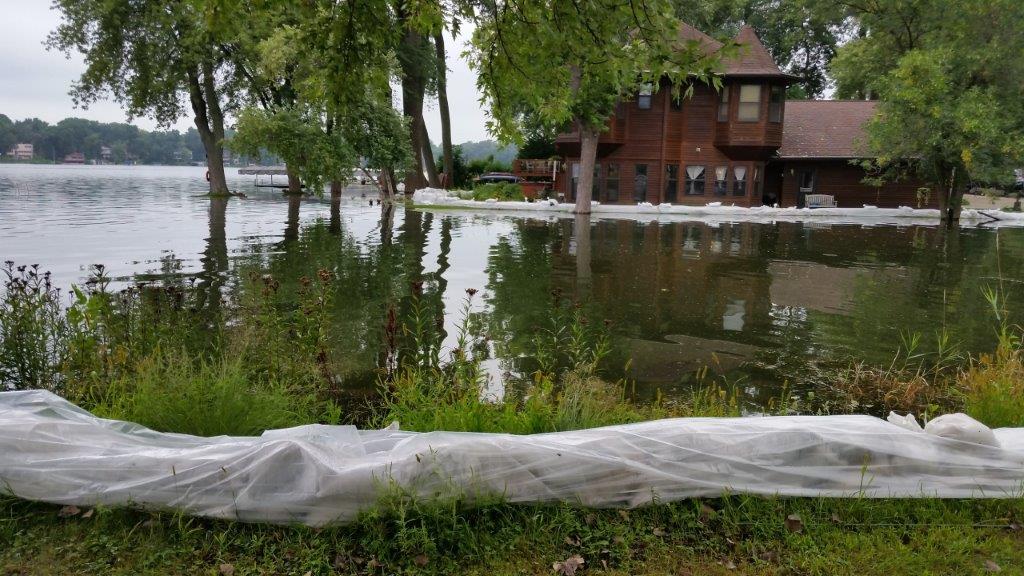
Flooding in Wisconsin. Image credit: Wisconsin Emergency Management

The annual amount of rain and snowfall is rising in Wisconsin. Over the past 70 years, the intensity of storms has increased, bringing more rain in a shorter amount of time, which can lead to flooding. To help communities cope and prepare, Wisconsin Sea Grant and the Wisconsin Department of Health Services (DHS) has developed a Flood Resilience Scorecard.

Emma Holtan. Submitted photo

Emma Holtan, flood resilience intern with the DHS Climate and Health Program, described the new proactive tool. “Basically, it’s a comprehensive questionnaire that a local official can move through with a team of assembled staff, experts and community members. Together, they move through three different parts of the scorecard that address different aspects of their community and the way they relate to flood resilience.”

The three modules address environmental features of flood vulnerability, sustainable community policies and plans, and building social resilience. Although the scorecard questionnaire is in-depth, the answers are multiple choice and resources are provided in the document for reference.

Holtan was hired this past May with the goal of working with the community of Washburn, Wisconsin, to test-run the scorecard by completing it with Washburn staff. The necessity of social distancing changed those plans.

Margaret Thelen, DHS climate and health program manager, said, “We had Emma complete it on her own with very little familiarity with the municipality. She completed it in about eight hours. That’s with looking up municipal code, reading through social media, reading through websites. If you’ve ever looked through municipal code – ooof! So, bless her for doing that. If a local planner or emergency manager or a local public health official were to complete it, they could do it in less time if they knew where to look and who to ask for the scorecard questions.”

Margaret Thelen. Submitted photo.

Thelen said the idea for the scorecard came from Sea Grant’s Coastal Resilience Self-Assessment. This project is designed for communities in southeastern Wisconsin that are heavily impacted by coastal storms, fluctuating Lake Michigan water levels and erosion.

“Sea Grant got brought in because we were working on very similar products,” Thelen said. “We could share best practices and share what works. They’ve been an invaluable partner on this project.”

Even if a community’s score is low after going through the process, Holtan said that’s all right. “If your score is lower or doesn’t meet a certain favorable threshold, then there’s a list of recommendations that you or your community may choose to implement if you have the necessary funding and resources. So, it’s really a tool that helps prioritize actions that will make your community more flood resilient and does so in a more holistic and comprehensive way, which I think is really cool.”

Holtan and Thelen said plans are in the works to make the scoring process more interactive. They also plan to develop a listing of funding sources for communities to make changes, a facilitation guide and a database of scorecard outcomes.

Holtan said the effort to complete the scorecard is worth it. “I feel like in Wisconsin we’re relatively safe from a lot of climate disasters that we’re seeing, but flooding is creeping up on us pretty fast and could be extremely detrimental. The opportunity to use this tool in the planning process of preparing for the climate changing is amazing. You get an in-depth look at your community in a way that most other tools don’t ask you to do. It’s to a community’s benefit to use this tool and to work together to prepare for a future that is safer for everybody.”

The scorecard was recently presented by Holtan and Natalie Chin, Wisconsin Sea Grant climate and tourism outreach specialist, at a Coastal Hazards of (Lake) Superior meeting. A PDF of the scorecard and individual models can be downloaded from the website.

If your community is interested in partnering with Sea Grant to go through the scorecard or has already completed it, let Chin know by emailing: nchin5@aqua.wisc.edu.

The post Flood Resilience Scorecard can help communities plan for high water first appeared on Wisconsin Sea Grant.

Original Article

News Releases – Wisconsin Sea Grant

News Releases – Wisconsin Sea Grant

https://www.seagrant.wisc.edu/news/flood-resilience-scorecard-can-help-communities-plan-for-high-water/

Marie Zhuikov

The new season of River Talks began in October with two speakers who discussed the impacts of water level changes in the St. Louis River Estuary via Zoom. Brandon Krumwiede, Great Lakes geospatial coordinator with NOAA’s Office for Coastal Management, presented, “Water Level Change Impacts in the St. Louis River Estuary.” And Hannah Burgstaler, freshwater fellow at the Lake Superior National Estuarine Research Reserve, presented, “St. Louis River Estuary Water Level and Canada Geese Population Effect on Manoomin Survival Rate.”

Brandon Krumwiede. Submitted photo

Krumwiede described how water levels are changing in the Lake Superior Basin and then narrowed his scope to the estuary. “There’s been a huge step up in water levels in Lake Superior – a continual rise over the last several years, from 2007 to 2019. We’ve basically added three-and-a-half feet of water to the surface of Lake Superior,” Krumwiede said.

However, since August of 2020, levels in the basin have started to drop and are expected to continue to lower during the next six months. “Hopefully, this is that sigh of relief that everybody’s looking for with our recent exposure to high water levels,” Krumwiede said.

More locally, the estuary is sitting at or above record-high water levels. These can be exacerbated when wind from the northeast pushes water through the Wisconsin entry and the Duluth shipping canal. Krumwiede said urban stormwater runoff together with these northeast storm events can cause high water levels all the way to the Oliver Bridge (near Oliver, Wisconsin). He showed images of erosion on Allouez Bay, Wisconsin Point and Clough Island, along with inundated boat landings.

Low water levels can be problematic, too. “Often, in those new areas that are exposed, phragmites are some of the first species to take hold, so you have to deal with invasive species work,” he said. Access to the estuary for boaters can also be impeded.

For her research project, Burgstaler monitored four bays in the estuary (Allouez, Oliver-Little Pokegema, Duck Hunter South and Walleye Alley) using water pressure loggers and trail cameras, looking for the presence of geese and water levels that exceed a threshold for healthy wild rice growth. “Wild rice is at risk of completely disappearing in habitats where it once thrived. Factors contributing to its decline are fluctuating water levels, sulfide and mercury pollution, invasive species competition and waterfowl grazing,” Burgstaler said.

Hannah Burgstaler. Submitted photo

Wild rice tolerates a fluctuation range of up to six inches during the growing season and has a maximum water depth threshold of three feet. Continuous high water can “drown” the plants.

She visited the sites every one to two weeks by canoe, boat or paddleboard, to collect the camera SD cards and change batteries from June to September. She’s currently in the preliminary stages of data analysis. She’s going to compare her data with similar information collected by the Reserve and Fond du Lac Dam water release data to determine which sites are affected by seiches and water discharge from the dam. She will also compare geese counts in the different bays.

“Wild rice health is poor in the St. Louis River Estuary, but it’s still present so there’s still hope. From my preliminary data, geese may be negatively impacting wild rice survival with their browsing. Water levels in at least one bay exceeded 3 feet during the season and could impact wild rice survival. A combination of high water levels and geese may be contributing factors in the struggle of wild rice health in the St. Louis River Estuary,” Burgstaler said.

The Nov. 11 River Talk will feature Dustin Haines, research coordinator for the Reserve, who will present, “Should I Stay or Should I Go? The Clash of Wetlands With Lake Levels, Invasives and Humans.” His talk will also be via Zoom and held in cooperation with Café Scientifique Twin Ports. Join us at 7 pm:

https://uwmadison.zoom.us/j/97447413031?pwd=TkN2YjN5VGl0ODJtMWYzZGxCT2llUT09
Meeting ID: 974 4741 3031
Passcode: 424987

The post River Talk explores the impact of water levels on the St. Louis River Estuary first appeared on Wisconsin Sea Grant.

Original Article

Blog – Wisconsin Sea Grant

Blog – Wisconsin Sea Grant

https://www.seagrant.wisc.edu/blog/river-talk-explores-the-impact-of-water-levels-on-the-st-louis-river-estuary/

Marie Zhuikov

The River Talk series is partnering with Café Scientifique Twin Ports with a virtual talk at 7 p.m. Wednesday, Nov. 11, via Zoom. Dustin Haines, research coordinator with the Lake Superior National Estuarine Research Reserve will present, “Should I Stay or Should I Go? The Clash of Wetlands With lake Levels, Invasives and Humans.”
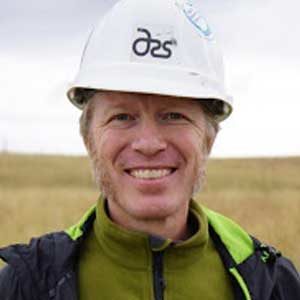
Dustin Haines

Wetlands are an essential key to having healthy rivers and estuaries, but they are sensitive to natural and human-caused changes in the environment. This presentation will provide an overview of changes in wetland plant communities of the St. Louis River Estuary due to Lake Superior water levels, invasive non-native plants and human action, including more recent changes seen at the Reserve’s Sentinel Site.

Here is the Zoom link and info:
https://uwmadison.zoom.us/j/97447413031?pwd=TkN2YjN5VGl0ODJtMWYzZGxCT2llUT09 Meeting ID: 974 4741 3031
Passcode: 424987

The talk will last an hour and will include time for Q&A. The talks will be recorded and posted afterward on the Reserve’s Facebook page. A summary will also be posted on Wisconsin Sea Grant’s blog.

Other River Talks will be held in 20201 on Jan. 13, Feb. 10, March 3, April 14 and May 12. The March talk will be held in conjunction with the St. Louis River Summit. For more information, visit the River Talks page: go.wisc.edu/4uz720.

River Talks are sponsored by The Lake Superior National Estuarine Research Reserve and the Wisconsin Sea Grant Program.


The post Should I Stay or Should I Go? The Clash of Wetlands With Lake Levels, Invasives and Humans appeared first on Wisconsin Sea Grant.

Original Article

News Releases – Wisconsin Sea Grant

News Releases – Wisconsin Sea Grant

https://www.seagrant.wisc.edu/news/should-i-stay-or-should-i-go-the-clash-of-wetlands-with-lake-levels-invasives-and-humans/

Marie Zhuikov

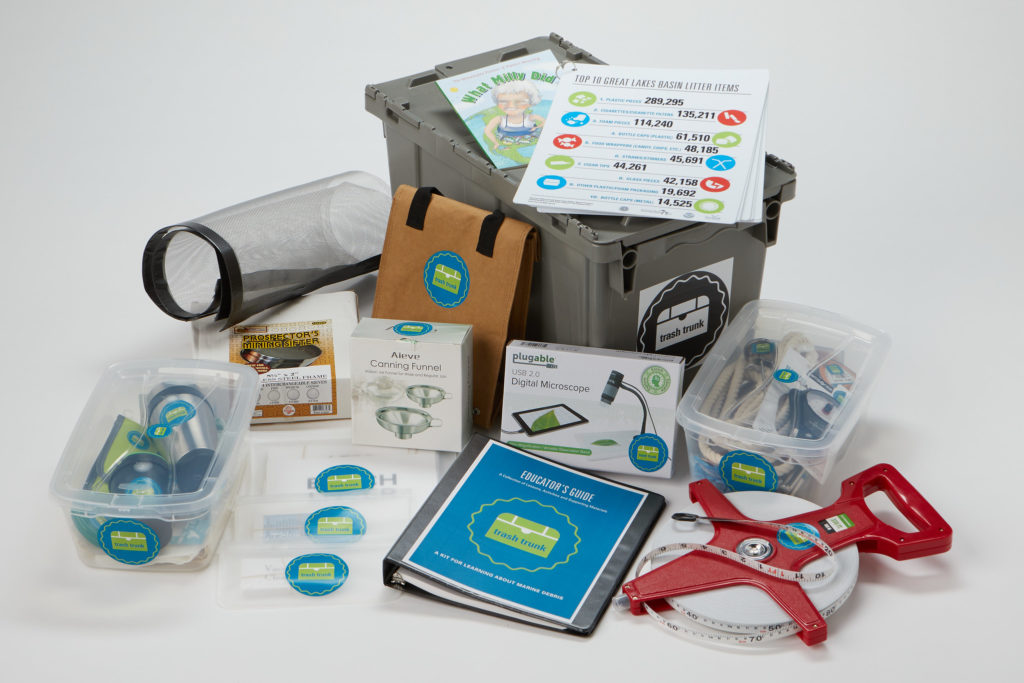
If you’re among the many who are looking for online learning materials for use at home, you might want to check out the Trash Trunk. This new learning kit focuses on trash found in our waterways, otherwise known as marine debris. Its free lessons are applicable for learners at levels kindergarten through adult in both formal and informal educational settings.
Wisconsin Sea Grant Education Outreach Specialist Ginny Carlton explained how the idea originated. “The topic for the trash trunks came from things we were seeing happening across the Great Lakes Basin. Marine debris is an emerging issue. There was consensus among the partners that this would be a worthwhile topic.”

Sea Grant programs in Ohio and Michigan, and the National Oceanic and Atmospheric (NOAA) Marine Debris Program joined Wisconsin Sea Grant staff in creating the trunks as part of their work for the Center for Great Lakes Literacy.

True to form, the team recycled lessons previously created by other educators, picking the best of the best materials about the impact of trash in both fresh and salt waters. “We used materials from groups like NOAA, the Ocean Conservancy, the Alliance for the Great Lakes and other institutions,” Carlton said.

The kit contains an educator’s guide with 14 lessons, sturdy informational display cards and supporting materials needed to perform the activities. Those activities are organized into three sections, which address the origins of marine debris, its impacts and what can be done. Educators can select a single lesson or develop a unit using Trash Trunk content, supplemental materials and common classroom supplies.

Wisconsin Sea Grant’s Senior Special Librarian and Education Coordinator Anne Moser has been doing marine debris activities with children for a while now. “They absolutely LOVE this topic!” she said. “It’s very action-oriented. They can embrace the topic and make changes, especially with their waste and plastic consumption at home, which I think kids find inspiring.”

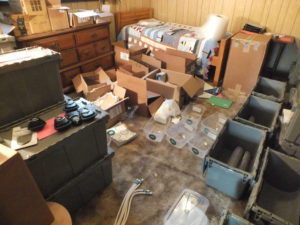
Trash trunk assembly in process in Carlton’s home. Image credit: Ginny Carlton, Wisconsin Sea Grant.

Carlton organized materials for the 35 trunks at home in her living room, since she is working from home due to COVID-19. “They did take up a little bit of space for a while. It was worth it. I think these resources will be well-used by the teachers and students across the Great Lakes Basin,” she said.

Besides finding space to assemble the trunks, figuring out what would fit inside the trunks was another challenge. “There’s a limit as to what you can fit in the tote box,” Carlton said. “I ordered supplies in waves just to make sure that what we wanted to include would actually fit.” These include tools that teachers might have difficulty in obtaining, such as a digital microscope, thermometers, a 100-foot measuring tape, and a manual luggage scale to weigh collected marine debris. Examples of reusable items are also included, like a mug, lunch totes and beeswax wrap, which is a substitute for plastic wrap.

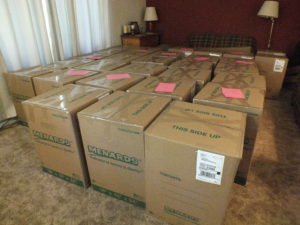
Much to the UPS driver’s dismay, Carlton distributed all the trunks at the same time from her home to Sea Grant programs in the other states that border the Great Lakes: Minnesota, Illinois-Indiana, Ohio, Pennsylvania, New York and Michigan. (Five trunks will be available in Wisconsin through the interlibrary loan system.) After some masterful rearranging, the driver was able to fit the trunks into his truck.

The trash trunks ready for shipping throughout the Great Lakes states. Image credit: Ginny Carlton, Wisconsin Sea Grant

Moser explained that due to COVID-19 quarantining requirements, the trunks are not available in Wisconsin right now but that the curriculum is available online. “If you have a student working at home, there are lessons they can use,” Moser said.

For more information about the Trash Trunk and other educational materials, please visit this resources page.

Funding for the trunks came from the Great Lakes Restoration Initiative through the Center for Great Lakes Literacy.

Original Article

News Releases – Wisconsin Sea Grant

News Releases – Wisconsin Sea Grant

https://www.seagrant.wisc.edu/news/trash-trunk-filled-with-learning-treasures/

Marie Zhuikov

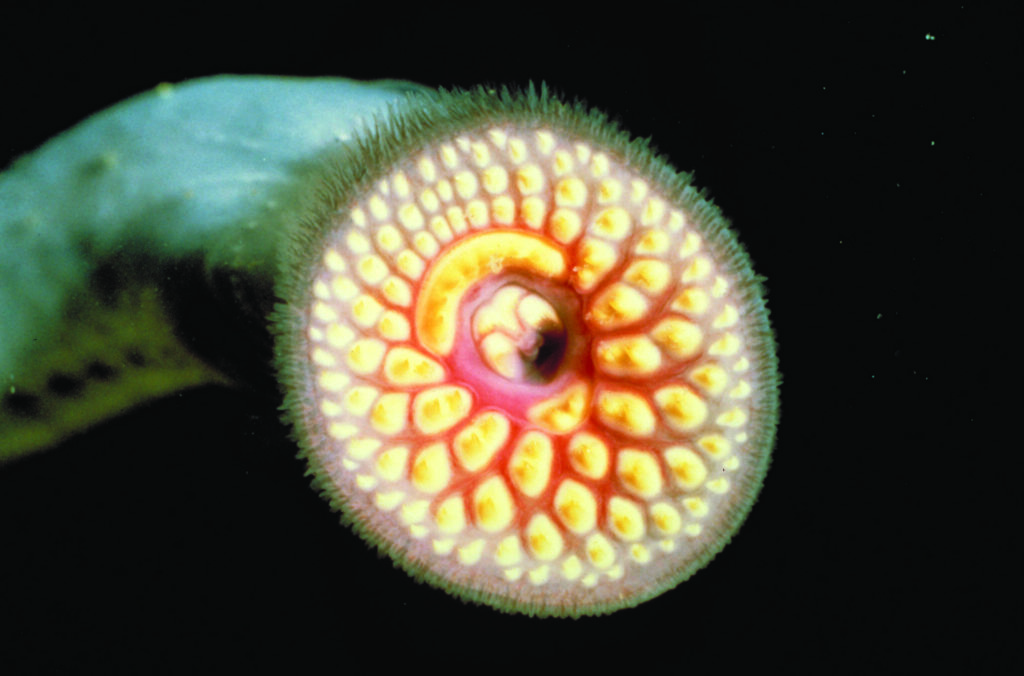
The business end of a sea lamprey. Image credit: U.S. Environmental Protection Agency

The New York Times recently published an article about eating invasive species as a means of control. It reminded me of a demonstration project we undertook when I worked at Minnesota Sea Grant in 1996. We received money from The Great Lakes Protection Fund for two years to study the overseas market potential for Great Lakes sea lamprey.

I’m sure you all know that lamprey, with their penchant for sucking blood, are a parasitic exotic species that entered the Great Lakes and almost wiped out the Great Lakes fishery by the 1940s. This led to a control program coordinated by the Great Lakes Fishery Commission that is ongoing even today. Every year, the commission’s various lamprey control programs cost millions of dollars. Sea lamprey are clearly still an enduring threat.

In the mid-1990s, the commission’s lamprey control program routinely landfilled thousands of female lamprey they trapped. At that same time, lamprey populations in their native countries like Portugal and Spain were becoming decimated due to overfishing and habitat loss. This was an issue because lamprey were/are considered a culinary delicacy in Portugal and Spain. Like the lobster aquariums found in American restaurants, Portuguese restaurants offered tanks of sea lamprey where people could pick their dinners. Exclusive and expensive clubs even formed around lamprey consumption.

Jeff Gunderson, the fisheries and aquaculture specialist with Minnesota Sea Grant at the time, took an idea from a University of Minnesota food professor and the extension leader at Minnesota Sea Grant and turned it into a project to find a use for the excess, unwanted Great Lakes lamprey by seeing if chefs in Portugal and Spain would find them as palatable as their native lamprey. He set up a team that included a professor in Portugal who would conduct market testing, University of Minnesota experts, a NOAA international marketing expert, and a fisheries biologist.

My job was to garner visibility for the project and its results. When Jeff first described the project to me, one of my first questions was whether the lamprey had been tested for mercury. “I don’t want to promote something that’s going to contaminate people,” I recall saying. He assured me the lamprey had been tested and were within U.S. standards. But what I didn’t know at the time was that only a small sample of lamprey were tested. (More to come on this later.)

To figure out my publicity strategy, I consulted a couple of my news reporter friends. I think it was Mike Simonson, the well-known and now dearly departed Superior bureau chief for Wisconsin Public Radio who said, “You gotta have a taste test!”

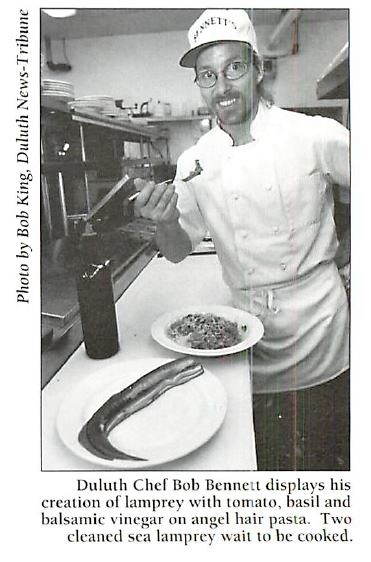
That sounded like a capital idea, so my first step was to find a local chef willing to cooperate. I approached my favorite restaurant, Bennett’s Bar and Grill, run by Bob Bennett. This “forefather of contemporary cuisine in Duluth” was game.

The Portuguese professor had given me several traditional sea lamprey recipes, at least one of which involved using lamprey blood. Ewww. Anyway, I showed these to Chef Bennett, and we came up with a taste-test plan. He would prepare two traditional recipes and create two of his own. Gunderson talked the original Lou of Lou’s Fish House in Two Harbors into smoking some lamprey for the taste test, as well.
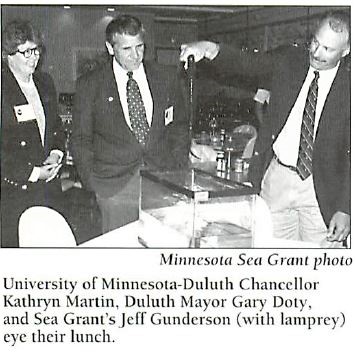
Next, we had to find some brave lamprey consumers. Somehow, I managed to convince the Duluth mayor (Gary Doty) to participate along with the University of Minnesota Duluth chancellor (Kathleen Martin). Several members of our Sea Grant Advisory Committee also agreed as did a freelance graphic designer who worked for us, a congressional office manager and the Minnesota Sea Grant director (Michael McDonald),

We held the lamprey taste test at Bennett’s restaurant, which was on Superior Street in downtown Duluth. Eight intrepid tasters were seated at a long table facing into the room so that reporters could easily see them and ask about their reactions to the food. We gave them a rating form. We also provided an aquarium with several lamprey in it, just to add to the room’s ambiance, and the smoked lamprey and some crackers for snacks.

Simonson was right about the lure of the taste test. We were mobbed by local reporters, both print and broadcast. Reporters from the Twin Cities even made the trip up north for it. The resulting stories went everywhere, even internationally. The Associated Press picked up the print story, and Gunderson said he talked to someone who saw it on a television station in Seattle. The story eventually made it into Newsweek and The New York Times.

Back in my office after the test, I received a phone call from the daughter of a Portuguese immigrant in Boston who saw the news stories and wanted to know how to obtain lamprey. She told me lamprey was a traditional Sunday dinner in Portugal, just like American pot roast. Her father was so excited when he saw the news, he implored her to find out more. I had to give her the disappointing information that lamprey were a regulated invasive species without a commercial source yet.

The highest rated dish was Bennett’s own lamprey stew with garlic mashed potatoes, rated 4.5 out of a possible 5. The smoked lamprey came in second, earning 3.7 out of 5. The taste of the lamprey came out more strongly in the traditional dishes, which did not suit these American taste-testers.
I ate both the lamprey stew and the smoked lamprey. I enjoyed the stew, although the chef forgot to take out the lamprey’s cartilaginous backbone (called a notochord), which made it a bit crunchy for my taste. I bet if he had removed the backbone, the dish’s ratings would have been higher. The smoked lamprey tasted rather like any kind of smoked fish – very good!

The taster’s comments included: “Surprisingly good. Try selling it without telling people what they are eating. It would be better.” And, “I would not order this out, but Bennett’s dishes were by far the best.”

More extensive taste tests were run in Porto, Portugal. Eight restaurants with lamprey-cooking experience, two homemakers and 16 individual taste testers participated in two studies. The restaurant chefs were asked to rate how the lamprey looked while alive, how they cooked compared to Portuguese lamprey, how they smelled/tasted/looked after cooking, how the lamprey tasted to them, and how their clients or family members liked them.

Overall, the Portuguese taste testers enjoyed the strong flavor and firm texture of the lamprey, noting the lamprey had a pleasant “turf” taste and was less soft and fatty than Portuguese lamprey. (A turf taste refers to an earthy flavor, somewhat like mushrooms or liver.) They rated the flavor 4.5 out of 5 – a definite win.

During the second year of the project, more lamprey were shipped to Spain for taste tests. The results weren’t as glowing, perhaps because only frozen and canned Great Lakes lamprey were shipped instead of live wriggly ones. The Spanish testers liked the texture and that some contained eggs. Yes, lamprey are a delicacy in Spain, but lamprey caviar takes it to a whole other level.

The death knell for this innovative program came from subsequent contaminant tests on the lamprey. The Great Lakes lamprey contained mercury levels that were too high to meet European Union standards. They tested at 1.3 ppm for mercury. The EU standard at that time was 0.3 ppm. This information came too late for our taste testers, but hopefully, one meal of lamprey was not detrimental. I certainly didn’t feel any ill effects.

Gunderson summed it up like this: “At least we have an answer to the question that has been debated for nearly 40 years. Yes, Great Lakes lamprey are marketable in Europe. Because of current control programs and experimental programs, a commercial harvest of lamprey would not have been a priority even if mercury levels were acceptable. But given time, a commercial harvest could fit into lamprey control and management. Lamprey are here forever and who knows if the funding for lamprey control will last that long. If funding ever does wane, let’s hope it’s not before mercury levels decline to acceptable levels so that lamprey harvest can be evaluated as part of a low-cost management program.”

That was almost 25 years ago. A Lamprey and Rice Festival is apparently held in Portugal each year, so it still must be popular, but I fear that the people who used to love eating them for Sunday dinner are aging out of this world.

Unfortunately, mercury levels in Great Lakes lamprey are still high. According to a 2018 study by the Great Lakes Indian Fish and Wildlife Commission and the University of Wisconsin, levels in adult lamprey were still beyond that deemed safe for human consumption.

In any event, this project was one of the highlights of my career. It seemed like a win-win idea: The U.S. could rid itself of an expensive invasive species, and European diners could eat a traditional and much longed-for dish. Yes, I promoted something that could have contaminated people. But I did a darn good job of it.

Original Article

Blog – Wisconsin Sea Grant

Blog – Wisconsin Sea Grant

https://www.seagrant.wisc.edu/blog/that-time-i-organized-a-sea-lamprey-taste-test/

Marie Zhuikov

Stephanie King of Oneida, Wisconsin, is breaking new ground. Not only is she first to fill a position with Wisconsin Sea Grant designed to strengthen relationships with First Nation tribes in the Green Bay area, she is in the first cohort of the University of Wisconsin-Green Bay’s First Nations Education Doctoral Program.

Stephanie King. Image by Stephanie King.

Although her position, which also involves the UW-Green Bay’s Cofrin Center for Biodiversity, is just beginning, King said her role will be to incorporate Indigenous knowledge and traditional ecological knowledge as part of a team that’s restoring wetlands north of the Green Bay campus on Wequiock Creek.

“That area is ancestral lands for the Ho-Chunk Nation, Menominee Nation and I believe the Potawatomi, as well,” King said.

The assistantship opened at just at the right time. King, who is enrolled in the Oneida Nation but was raised on the Menominee Reservation, was laid off from her cultural wellness work for the Oneida Nation due to COVID-19 factors.

“I was excited when I saw the position. When I was reading through the announcement, the requirements brought my higher educational experience and passions full circle. I thought it would be a unique opportunity to share my experiences and knowledge with others and the team. I decided to throw my name in the hat and see what happened,” King said.

One of the reasons King’s name was plucked from that proverbial hat was her academic background. King has an associate degree in sustainable development from the College of Menominee Nation, a bachelor’s degree in family, consumer and community education from UW-Madison and a master’s degree in educational leadership with a focus on adult education from UW-Oshkosh.

Julia Noordyk, Wisconsin Sea Grant water quality and coastal communities outreach specialist, is King’s mentor. “Stephanie’s knowledge and experience working with people of all ages and backgrounds is a good fit for Wisconsin Sea Grant,” Noordyk said. “I am always focused on how we can most successfully engage with our audiences, so her expertise in education and outreach lends perfectly to this.”

King had the chance to visit the Wequiock Creek sites and “got an idea of some of the potential goals that all the different people involved have. There are still conversations to be had about what the First Nations communities would like to see as well, so that will come next,” King said.

King also said this position fits well with her life goals. “My foundation for my education, my work and my research has been with a passion to give back to my community and to my people. In any opportunity I take, I always look at how is this going to benefit others and benefit the community as well as my family in a good way, in a positive way.”

While on paper Noordyk is King’s supervisor and mentor, Noordyk acknowledges there is already more to their relationship. “Stephanie comes to this assistantship with a deep understanding of education, outreach and communication with First Nations people. It would be foolish of me not to learn as much as possible from her, too.”

Original Article

News Releases – Wisconsin Sea Grant

News Releases – Wisconsin Sea Grant

https://www.seagrant.wisc.edu/news/first-to-fill-a-first-nations-graduate-assistant-position/

Marie Zhuikov

Quick, what do these things have in common: water level fluctuations, Canada goose populations and wild rice growth on the St. Louis River? Answer: they are all connected. Discover how they are linked during the first presentations of the season for the River Talks series.

Two speakers will offer virtual talks at 7 p.m. Wednesday, Oct. 14, via Zoom. Brandon Krumwiede, Great Lakes geospatial coordinator with NOAA’s Office for Coastal Management, will present, “Water Level Change Impacts in the St. Louis River Estuary.” Over the past several years, water level changes from near-record lows to near-record highs have altered the shorelines along Lake Superior and the estuary. Krumwiede’s presentation will provide an overview of the interplay between water levels and physical changes seen along the shorelines.
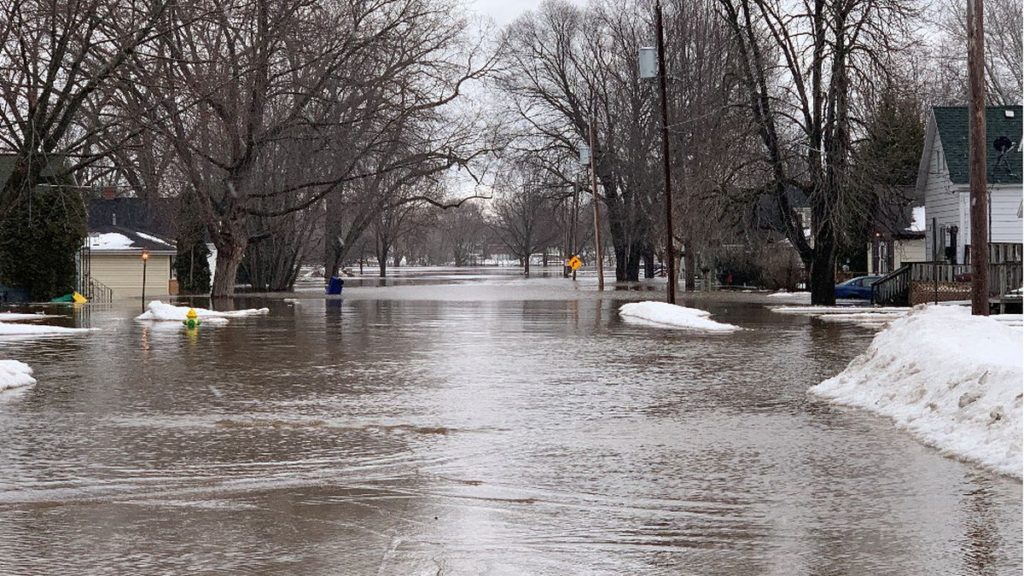
Hannah Burgstaler, freshwater fellow at the Lake Superior National Estuarine Research Reserve, will present, “St. Louis River Estuary Water Level and Canada Geese Population Effect on Manoomin Survival Rate.” Burgstaler monitored four bays using trail cameras, looking for the presence of geese and water levels that exceed a threshold for healthy wild rice growth.

Here is the Zoom link and info:
https://uwmadison.zoom.us/j/94136537051?pwd=OVk4QWpBODdIWUJaWkduQnYzREw0QT09
Meeting ID: 941 3653 7051
Passcode: 638298

Each talk will last one hour and include time for Q&A. The talks will be recorded and posted afterward on the Reserve’s Facebook page. A summary will also be posted on Wisconsin Sea Grant’s blog.

Other River Talks will be held Nov. 11, 2020, and Jan. 13, Feb. 10, March 3, April 14 and May 12, 2021. The March talk will be held in conjunction with the St. Louis River Summit and the date may change. For more information, visit the River Talks page: go.wisc.edu/4uz720.

River Talks are sponsored by The Lake Superior National Estuarine Research Reserve and the Wisconsin Sea Grant Program.

Original Article

News Releases – Wisconsin Sea Grant

News Releases – Wisconsin Sea Grant

https://www.seagrant.wisc.edu/news/water-levels-erosion-wild-rice-and-geese/

Marie Zhuikov

A passion for mathematics, natural resources and community outreach led Nathan Pollesch to the U.S. Environmental Protection Agency (EPA) in Duluth, Minnesota. That’s where he is working to develop an analytical model that can predict the effects of pesticides on wildlife populations.

Nathan Pollesch. Image credit: Nathan Pollesch

Pollesch is the latest fellow in a partnership project between the EPA’s Great Lakes Toxicology and Ecology Division, the University of Wisconsin-Madison and its Aquatic Sciences Center. The goal of the three-year U.S. Environmental Protection Agency Human Health and the Environment Research Fellows program is to train the next generation of scientists in environmental and ecosystem health.

Pollesch’s EPA mentor is Ecologist Matt Etterson. The duo has been working together already with a group of EPA ecological modelers who are spread across the country. Pollesch said the toxicity translator model he is working on is specific to fish.

“Dr. Etterson got the ball rolling by developing the first model, which is for birds and looks at nesting success related to pesticide exposure,” Pollesch said. “Two others are under development that focus on invertebrates and amphibians.”

These models will be tools that risk assessors at the EPA and elsewhere can use to help inform their assessments of new chemicals and chemicals that are up for reregistration. For instance, for agricultural chemicals, “We can run scenarios. Using some other models developed by the EPA and elsewhere will give us a time series of a concentration of the chemical that we can expect in the environment. We can see how that concentration will fluctuate over the course of a year and then we can pair that with the integral projection model I’m developing. We’ll be able to say, ‘Given this exposure profile, we would expect this potential effect on the populations of whatever species we’re looking at’,” Pollesch said.

Pollesch became interested in mathematics in college, thanks to some excellent professors. “A lot of people see math as this dry, robotic thing. It’s a shame you don’t learn until much later that it’s really not. At a certain point, it’s so far past memorization. That’s when it gets really interesting,” Pollesch said.

He was also interested in natural resource problems and decided to apply his math passion along that pathway. Pollesch earned his bachelor’s degree from the University of Wisconsin-Steven’s Point in mathematics. He continued to the University of Minnesota Duluth where he earned his master’s in applied and computational mathematics. For his master’s project, Pollesch developed a model to look at impacts of the Deepwater Horizon oil spill on the Gulf of Mexico. For his Ph.D., Pollesch studied mathematical ecology at the University of Tennessee. Then Etterson had an opening for a postdoc, and Pollesch jumped at the chance to use his mathematical training to help solve environmental problems. His EPA fellowship is offering the chance for him to continue his work with Etterson and other EPA researchers.

Soon after his arrival in 2016 at the EPA, Pollesch started a community outreach program centered on science. He is the lead organizer of a series of monthly science cafes that are ongoing. He said that experience also helped him gain the EPA fellowship.

“Outreach and the application of science had a strong emphasis in the fellowship application. That was especially exciting, given the work I’ve done with Café Scientifique. For those experiences as well as in my own research, I always try to communicate science and what I’m doing at a level that’s appropriate for the people I’m talking to. Also, I have a strong interest in working on applied problems,” Pollesch said.

“I think the reason I do research in the environmental field is because I feel strongly that environmental protection is one of the things that benefits the community the most. Protecting these shared resources is really important for everybody. The community-minded aspect probably influences why I spend time doing community outreach for science. I think there’s a connection,” Pollesch said.

Eventually, more trainees will be placed at the Duluth EPA Laboratory, ranging from undergraduate students, graduate students and postdoctoral fellows such as Pollesch. They will focus on four EPA priorities: systems toxicology, watersheds and water resources, ecosystem services and translational toxicology.

Original Article

News Releases – Wisconsin Sea Grant

News Releases – Wisconsin Sea Grant

https://www.seagrant.wisc.edu/news/new-epa-fellow-uses-math-to-predict-toxicity-for-fish-and-other-wildlife/

Marie Zhuikov

Flooding along the east side of Green Bay in March 2019. Image credit: WBAY-TV.

In March 2019, a massive snowmelt combined with heavy rain over frozen ground disrupted lives and flooded homes along the East River near and in Green Bay. A total of 50 homes were condemned.

A new partnership that includes Wisconsin Sea Grant seeks to address conditions that caused the flooding and work with communities within the East River Watershed to increase their resiliency to such events. Other project partners include NEW Water (the brand of the Green Bay Metropolitan Sewerage District) and The Nature Conservancy. The communities include Brown County, Calumet County, Manitowoc County, the cities of Green Bay and De Pere, the villages of Allouez and Bellevue, and the towns of Ledgeview, Rockland, Wrightstown and Holland.

Julia Noordyk, Wisconsin Sea Grant’s water quality and coastal communities outreach specialist, explained that although this formalized partnership is new, the project partners often work individually with these communities.

“One thing that’s unique is that we want to work within the watershed and not just within municipality boundaries or county borders,” Noordyk said. “Working beyond their borders is very challenging for local governments. So the partnership between NEW Water, The Nature Conservancy and Sea Grant is really to help provide that coordinating capacity and bring together those communities that are being affected by flooding and water quality issues to help them learn how to move forward.”

The year-and-a-half-long project, which was recently funded for $50,000 by the Wisconsin Coastal Management Program and $123,000 by the Fund for Lake Michigan is comprised of four parts. The first is an East River Flood Study. Noordyk explained that this will involve development of a hydrologic computer model to understand current and future flood risk for the watershed. Sea Grant’s Coastal Engineer Adam Bechle will take the lead on that. He will work with Chin Wu, professor in the department of civil and environmental engineering at the University of Wisconsin-Madison, to develop the hydrologic model.

Noordyk said the East River is a major tributary to the Fox River, which flows into the bay of Green Bay. Besides the flooding risk, the East River provides the highest load of sediment and unwanted nutrients to the bay, which contributes to poor water quality and clarity, and toxic blue-green algae blooms.

Flooding in Fond du Lac in March 2019. Image credit: Fond du Lac Police Department.

“The upper parts of the watershed are dominated by agriculture. In the lower parts, it’s more urban and developed suburban areas,” Noordyk said. The clay soils and compacted land in the upper watershed contribute a lot of agricultural pollution and excess water runoff. Once this water reaches the paved surfaces in the urban areas that were developed over floodplains and have outdated and aging stormwater infrastructure, it can cause flooding issues. Warmer winters are compounding the problem, with more frequent and intense rainstorms resulting from a changing climate in the region.

The project’s second part involves formation of an East River Watershed Resilience Community of Practice. This will be facilitated by an East River Resiliency Fellow who has been hired by The Nature Conservancy with Noordyk’s guidance. Through regular meetings, the coordinator will help build knowledge and relationships among local officials and staff, practitioners, scientists, NGOs and outreach specialists in the watershed.

The third part is development of a community-based watershed resilience framework. Noordyk and the resilience coordinator will work with the communities to draft the vision, goals and near-term actions for building community capacity and flooding resilience.

David Hart, Wisconsin Sea Grant’s assistant director for extension, will lead the final part of the project, which involves working with the UW-Madison Cartography Lab to create interactive maps to communicate the flood study’s findings and recommendations to the communities and partners involved.

Original Article

News Releases – Wisconsin Sea Grant

News Releases – Wisconsin Sea Grant

https://www.seagrant.wisc.edu/news/east-river-watershed-study-to-address-flooding-and-pollution/

Marie Zhuikov

Educators who participated in a recent six-week online workshop series about the Great Lakes and inland waters, “Trimming our Sails” were especially wowed by one presentation. “Plastic Debris Identification” was offered by Daniela Leon, an undergraduate student at the University of Wisconsin-Superior who is majoring in biology and minoring in chemistry.

Daniela Leon, submitted image.

Leon described a method to identify the common types of plastic, many of which make their way into lakes and break down into smaller pieces to form microplastic pollution. The method can be used in classrooms or at home and is especially geared toward high school students.

According to Ginny Carlton, Wisconsin Sea Grant’s education outreach specialist, one reason it’s important to know about the various types of plastics is because some float and others sink. “The differences in buoyancy means that a particular type of plastic will be found within a different vertical location of the water column. Where it is found influences the impacts it can have. For example, if it floats, then organisms that are surface feeders may be impacted,” Carlton said.

Identification of plastic types is also useful because it gives clues to the sources of the pollution – whether the plastic came from a fast-food container or from plumbing materials, for instance.

“Another reason . . . is that different chemical compounds can attach to different types of plastic,” said Carlton. These other chemicals basically attach to the plastic and ‘catch a ride’ through the water column or float across the water surface. The plastic acts like a magnet to gather up and concentrate various chemical compounds. Previous research has shown some of these chemicals are hazardous to human health.”

Leon’s activity uses simple materials like isopropyl alcohol, acetone, corn oil and plastic pellets. First come the tests to see how buoyant the plastic is. Students drop the plastic into water, then isopropyl alcohol, then the oil. Six types of plastic are commonly used in the plastic industry and each have different densities and abilities to float.

The next test is solubility or how long it takes the plastic to dissolve. That’s what the acetone is for. Students place the plastic into the acetone and record the length of time until it dissolves. As with the float test, the different types of plastic have varying solubility.

At the end of Leon’s presentation, the workshop teachers met in small groups. The high school teachers were enthused, saying they thought this exercise could be done by students even in virtual environments with supplies they have on hand at home.

Leon is mentored by professor Lorena Rios Mendoza at UWS. Mendoza was the main presenter for this part of the workshop and was also joined by another mentee, professor Tania Pelamotti. The workshop was organized by the Center for Great Lakes Literary (CGLL) and hosted by the Wisconsin and Minnesota Sea Grant programs.

The first four videos of the workshop series are now available on the CGLL YouTube page, including Leon’s session, which is contained in Workshop 4.

For more information about the toxicological effects of plastic, visit this webpage by the U.S. Environmental Protection Agency.

Original Article

Blog – Wisconsin Sea Grant

Blog – Wisconsin Sea Grant

https://www.seagrant.wisc.edu/blog/plastic-identification-activity-wows-educators/

Marie Zhuikov

Friends of Lincoln Park board members and neighbors gather at a Milwaukee County Board budget hearing to protest the planned closure of an aquatic center in their neighborhood. Cheryl Bledsoe is on the second from left. Image credit: Friends of Lincoln Park

In 2018, a group of children and their parents gathered in a hallway in the Milwaukee County Courthouse, holding signs and chanting. The signs said, “Closing our pool is mean” and “Don’t drown us in bureaucracy!”

They were protesting the proposed closure of the Schulz Aquatic Center, a relatively new facility in their Lincoln Park neighborhood that had been targeted due to county budget shortages. Many of the protesters were African American, which reflected the makeup of their neighborhood on Milwaukee’s north side.

Cheryl Bledsoe, an assistant principal at the time at Cross Trainers Academy and a board member of the Friends of Lincoln Park, announced to the news video cameras at the protest, “. . . The pool should remain open so our current African American youths have the opportunity to receive swimming lessons at that pool . . . I don’t think it’s fair that since 1995, five public pools on the north side have been closed . . . Lincoln Park pool will not close under my watch.”

The Schulz Aquatic Center in Milwaukee was built in 2009. Image credit: Quorum Architects Inc.

The data behind Bledsoe’s statement about the number of pool closures came from a mapping project undertaken by Deidre Peroff, Wisconsin Sea Grant’s social science outreach specialist in Milwaukee. The interactive Google Earth map she developed with Reflo, a local nonprofit, provided pivotal information, which, when brought to light by the friends group, ultimately helped convince the Milwaukee County Board to keep the pool open and make their budget cuts elsewhere.

“Basically, we looked at where swimming pools are and where they have been historically, all the way back to the 1930s,” Peroff said. “What the map indicated pretty clearly is they’re mostly closing in the north side of the city, which is a predominantly Black community.”

Peroff said she started the mapping project as part of her duties as co-chair of an education and recreation committee of Milwaukee Water Commons, a group that’s working to make Milwaukee a model water city.

“The two main goals of that initiative were that every child and adult in Milwaukee would have meaningful water experiences and to launch a comprehensive effort to change culture around swimming and improve access to swimming facilities,” Peroff said.

The committee gathered various Milwaukee organizations together to discuss how to accomplish these goals and received an earful about past efforts that had failed due to socio-cultural, financial, historical, political and even transportation barriers.

This map shows the “swimming pool desert” in north Milwaukee. If the Schulz Aquatic Center pool had been closed, only splash pads would have been available in this predominantly Black neighborhood. Children can’t learn how to swim on splash pads. Image credit: Deidre Peroff

Peroff said that myths about Black people and swimming, combined with a long history of segregation around swimming are hard to overcome.

Pool access for Black communities is a vital issue because, according to the USA Swimming Foundation (2017), 64% of African American children have no or low swimming ability. According to the Centers for Disease Control and Prevention, this may be why Black children, without regard to age or income, are up to 5.5 times more likely to drown than white children.

David Thomas, board secretary for the Friends of Lincoln Park, said the timing was fortunate for their information needs in fighting the pool closure. “When all this hit the fan and they announced the pool closing, Deidre had already started this research. It was a very fortunate chain of events that the research was already going on.”

Thomas sent out an email to the Friends group with a call to action to save the pool, which included a link to the pool closure map.

Bledsoe, who is African American, said she learned how to swim at a previous pool in Lincoln Park. She said the Schulz Aquatic Center closure issue was an opportunity for her students to learn how to peacefully advocate for their community. It showed them that public officials “aren’t untouchable. You can talk to them, you can call them. Their information is available.”

She said their successful protest was about more than just saving the pool. It helped build the youths’ confidence and self-esteem. “There were lives changed as a result of that, and people fighting for something very meaningful.”

Bledsoe’s own parents were so proud of their daughter’s role in keeping the aquatic center open, they framed a copy of the “Milwaukee Journal Sentinel” newspaper story, displaying it in their living room.

David Thomas, Friends of Lincoln Park board member. Image credit: Friends of Lincoln Park

Peroff credits the Friends group’s strong community relationships for their success. They were able to call on people who were already invested in the park and cared about the aquatic center. “That was one reason they were able to move so quickly, and then also use the map and some other data to tell the story they needed.”

A spin-off project, undertaken in 2019, had Peroff looking at the impact of swimming programs on underserved communities in Milwaukee. She hired Emily Tolliver, a professional master’s student, to interview seven swimming organizations about how they address the issue of diversity and access to swimming resources in their programming.

She is still analyzing the data but said one thing is coming out clearly. “We found that the programs that were more successful in being diverse said the best thing was having African American or Black role models – teachers or lifeguards or staff – who are part of the swimming program.” She said these programs worked extra hard to recruit people of color to be part of their organizations.

Peroff said addressing these wickedly difficult issues is satisfying, but they are complex. “It’s not like one approach is going to fix any problem. We have to understand the barriers at a much deeper level.”

Original Article

News Releases – Wisconsin Sea Grant

News Releases – Wisconsin Sea Grant

https://www.seagrant.wisc.edu/news/a-fight-to-keep-milwaukee-pool-open-uses-sea-grant-data-and-strong-partnerships/

Marie Zhuikov

Image credit: Marie Zhuikov, Wisconsin Sea Grant

Beach management in 2020 has been anything but usual. A webinar on Aug. 12 offers the opportunity for beach managers and outdoor recreation professionals to share how COVID-19 has impacted their jobs on state and local levels, followed by a question-and-answer session.

The event is organized by the Wisconsin Coastal Beaches Working Group, which was organized in 2015 for professionals, researchers and funders involved in managing and improving Wisconsin’s Great Lakes beaches.

Webinar presenters include Ryan Wozniak, Wisconsin Department of Health Services; Holly Glainyk, Waukesha County Parks; and Sara Hudson, City of Ashland Parks and Recreation. To sign up for the webinar, please visit the Eventbrite page.

Interested in joining the working group? Membership is open to anyone involved in issues related to the management, safety or quality of coastal beaches in Wisconsin. Subscribe to the listserv by sending an email to join-wicoastalbeaches@lists.wisc.edu.

Original Article

News Releases – Wisconsin Sea Grant

News Releases – Wisconsin Sea Grant

https://www.seagrant.wisc.edu/news/managing-beaches-during-a-pandemic-a-webinar-opportunity/

Marie Zhuikov

Megan Hoff recently completed her graduate research assistantship in Green Bay, working for Sea Grant Staffer Julia Noordyk. This was the first time such an opportunity has been offered at one of our field offices. Hoff’s work for Noordyk and for her master’s degree in environmental science and policy at the University of Wisconsin-Green Bay involved working with the community to develop a watershed management plan for Mahon and Wequiock creeks, which flow through the campus.

Megan Hoff on the Oregon Coast. Image by Austin Yantes

I caught up with Hoff recently, just after she finished a drive across the country to Oregon, where she is starting a new job in Newport as a shellfish assessment biologist. Yes, she’ll be working with clams.

You may wonder how that relates to all the community work she did for her assistantship post. Never fear, Hoff will not abandon her people skills entirely for the company of mollusks.

True, she will be working to document where different species of clams are found along the bays of the Oregon coast, but she will also be on the beach surrounded by beachgoers and people who like to clam recreationally.

Hoff described it like this: “My graduate research assistantship enabled me to not only graduate with my master’s degree debt-free, but I also graduated armed with a suite of new and improved technical and personal skills. Julia and the rest of the Sea Grant folks inspired me and prepared me to address coastal and watershed-based community management and planning challenges. Although the shellfish management challenges are not exactly the same, they still require similar ways to think about how to tackle them.”

Hoff credits her community science communication work with Sea Grant for giving her a leg up on her competition for this full-time permanent job.

“The folks here in Oregon thought my interdisciplinary skills were something unique that I could contribute to their program. My skills in interacting with community members will be really useful and valuable in transitioning to my new life in Oregon,” Hoff said.

Although she is thrilled by this new opportunity, leaving Wisconsin was hard for Hoff.

“I was sad to leave, especially since I didn’t get to say any proper in-person goodbyes to any of the folks I worked with because of social distancing and COVID-19. But I felt so supported and appreciated. Julia and the UW-GB Cofrin Center for Biodiversity staff gave me so much of their time, effort, energy, words of praise and encouragement over the last two years. Without that, I wouldn’t have been as successful.”

Given Hoff’s strong skill set from her academic and Sea Grant experiences, I somehow suspect her success will continue.

Original Article

Blog – Wisconsin Sea Grant

Blog – Wisconsin Sea Grant

https://www.seagrant.wisc.edu/blog/field-office-graduate-research-assistant-jumps-from-watershed-planning-to-clams/

Marie Zhuikov

Recordings collected for the Wisconsin Sea Grant book, “People of the Sturgeon: Wisconsin’s Love Affair with an Ancient Fish,” were recently added to a national archive by the National Oceanic and Atmospheric Administration (NOAA). NOAA Fisheries’ “Voices Oral History Archives” seeks to document the human experience as it relates to the changing environment, climate, oceans and coasts through firsthand oral history accounts.

A sturgeon in the Shedd Aquarium in Chicago. Image credit: Brenna Hernandez, Shedd Aquarium.

Wisconsin Sea Grant’s Senior Special Librarian Anne Moser, who curated the 73 sturgeon interviews, is excited by this recognition of the collection’s significance. “It is great to see our materials being featured on the national level. Having the collection included in NOAA Fisheries’ archive is acknowledgement of its scientific and cultural value for scholars, students and the public.”

Follow this link to access the NOAA Voices oral histories.

“People of the Sturgeon” was written by Wisconsin Sea Grant staff members, Kathleen Kline and Fred Binkowski with help from Ronald Bruch. It was published in 2009 by the Wisconsin Historical Society Press and has captured a dozen state, regional, and national prizes. The oral histories are courtesy of the Oshkosh Public Museum.

For the book, which is about the culture surrounding sturgeon spearing on Lake Winnebago, the authors interviewed 69 community activists, sturgeon spearing enthusiasts, spear and decoy craftsmen and scientific researchers.

The recordings are also housed in a permanent collection at the University of Wisconsin-Madison Libraries’ Digital Collections and they are available for free download. Excerpts are featured on this Wisconsin Water News podcast.

Original Article

Blog – Wisconsin Sea Grant

Blog – Wisconsin Sea Grant

https://www.seagrant.wisc.edu/blog/people-of-the-sturgeon-oral-histories-added-to-noaa-collection/

Marie Zhuikov

Olivia Dachel, a Merrill High School teacher who attended Sea Grant’s R/V Denis Sullivan educators’ cruise in 2019, has used knowledge she gained through Sea Grant to help her students go on to greater things. Her team of students took home the grand prize in the 2020 Aquaculture Challenge competition cosponsored by Lake Superior State University in Sault St. Marie, Michigan, and Michigan Sea Grant.

The students actually won two awards, one for Best Overall Integrated Design and another for Technical Savvy. Teams were challenged to research and create an automated system for fish and plant growth that could be marketed and sold to homes or businesses. Students submitted a business plan and video pitch, engineered a fully functional aquaponics system, and created and programmed automated monitoring systems to maintain system health and productivity using a circuit board, temperature, light and ammonia sensors.

Merrill High School aquaculture team captain Drew Polak stands next to the team’s winning project. Image credit: Drew Polak.

Team Captain Drew Polak said, “Our goal as a team was simple: to provide a functional and stylish aquaponics system to encourage a happy and healthy lifestyle.” 

The Merrill team competed against 23 others from Michigan and Wisconsin, totaling over 300 students in grades 9-12. The contest is designed to engage high school students in an interdisciplinary learning competition of science, business and computer science. The competition centers on the concept of providing sustainable, local food to meet the demand for fresh produce and seafood in local markets.  Aquaponics is now deemed critical to help the food supply chain in the current crippled global trade and economy caused by the Covid-19 pandemic. 

Aquaponics is a combination of aquaculture, which is growing fish and other aquatic animals, and hydroponics, which is growing plants without soil. To be successful, an aquaponics unit must carefully balance nutrients, fish, bacteria and plants. Anything out of balance will cause the system to collapse.

Judges applauded the students for their creativity, intelligence and grit as they overcame immense challenges presented by the pandemic to complete the project.

Polak said, “This project really put our skills to the test. It was an amazing experience for me and my teammates. It was challenging to coordinate pickups for components the other team members were working on as well as having to undergo the turn-in process virtually. It was a difficult road, but we endured, and it paid off.” 

Dachel said, “It was a dream project to integrate disciplines of science, computer science and business to solve a read-world problem. I am so proud of the resilience, creativity, intelligence and problem-solving abilities of my students to not only complete, but win this competition during such a difficult time. I am truly inspired by my students and feel fortunate to work with them.”

Original Article

Blog – Wisconsin Sea Grant

Blog – Wisconsin Sea Grant

https://www.seagrant.wisc.edu/blog/merrill-high-school-team-overcomes-barriers-to-claim-aquaculture-championship-during-pandemic/

Marie Zhuikov

Photo credit: Great Lakes algal blooms, August 2010, NASA Earth Observatory.

“Trimming our Sails: Land-Based Workshops about the Great Lakes and Inland Waters,” is a virtual, 6-week workshop series that explores how people influence the Great Lakes and vice versa.

Designed for any fourth- through twelfth-grade formal, non-formal or informal educator in Minnesota or Wisconsin, the series is offered by the Center for Great Lakes Literacy (CGLL). Participants will learn from educators who have participated in shipboard science workshops, researchers, and CGLL staff about Great Lakes science along with classroom and field applications. 

Registration is required so a Zoom link can be sent.  Registration deadline is June 16. For more information, visit the workshop web page.

Original Article

News Releases – Wisconsin Sea Grant

News Releases – Wisconsin Sea Grant

https://www.seagrant.wisc.edu/news/minnesota-and-wisconsin-educators-invited-to-land-based-water-workshop/

Marie Zhuikov

Information provided by Melanie Perello, Minnesota Department of Natural Resources
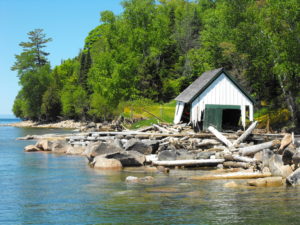
CHAOS has come to Lake Superior. However, it’s organized chaos, so that’s a good thing.

CHAOS stands for the Coastal Hazards of Superior. The group, organized by the Coastal programs and Sea Grant programs in Minnesota and Wisconsin, the National Oceanic and Atmospheric Administration Office for Coastal Management and the Lake Superior National Estuarine Research Reserve, is a community of practice for sharing knowledge and resources about natural hazards that affect Lake Superior coastal communities in Minnesota and Wisconsin.

It provides an opportunity for local community leaders, managers, researchers and communicators to engage over concerns about coastal hazards across western Lake Superior. Recent storms, flooding and shoreline erosion have strained local communities, making CHAOS’ goal of building collaborations among groups impacted by these hazards even more important.

Membership is free and open to all. To join or for more information, contact Melanie Perello at Minnesota’s Lake Superior Coastal Program: melanie.perello@state.mn.us.

Storm damage to a boathouse on Devil’s Island in the Apostle Islands National Lakeshore. Image by Gene Clark, Wisconsin Sea Grant.

The group hosted its first event on April 29, a webinar attended by more than 70 participants, featuring presentations on Lake Superior water levels and lakeshore flood modeling and forecasting. Deanna Apps, a physical scientist at the U.S. Army Corps of Engineers Detroit District, explained historical and recent lake levels, the drivers of water level fluctuations and how the Army Corps forecasts future conditions.

Joseph Moore, warning coordination meteorologist at the National Weather Service-Duluth Office, highlighted efforts to model and forecast lakeshore flooding events and explained the need for reports of lakeshore flooding storm damages.

Following the presentations, webinar participants had the opportunity to network in small breakout groups to discuss actions they will take in response to the information shared.

A recording of the presentations is being edited and will soon be shared on the Wisconsin Sea Grant’s YouTube Channel.

U.S. Army Corps of Engineers – High water level resources

Apps highlighted several resources available from the U.S. Army Corps of Engineers:

Water Level Forecasts: https://www.lre.usace.army.mil/Missions/Great-Lakes-Information/Great-Lakes-Water-Levels/Water-Level-Forecast/

Water Level Observations: https://www.lre.usace.army.mil/Missions/Great-Lakes-Information/Great-Lakes-Information-2/Water-Level-Data/

Basin Conditions & Great Lakes Information: https://www.lre.usace.army.mil/Missions/Great-Lakes-Information/Great-Lakes-Information-2/Basin-Conditions/

Living on the Coast: https://publications.aqua.wisc.edu/product/living-on-the-coast-protecting-investments-in-shore-property-on-the-great-lakes/

Report storm damages to the National Weather Service (NWS)

Moore highlighted the importance of observational data for lakeshore flood modeling and projections. The NWS seeks reports of damages attributed to recent and past storm events — cost estimates and photos or videos are extremely valuable. These reports are useful not only for current modeling but will become part of the official storm record and help improve future modeling.

To learn more about efforts to model lakeshore flooding: https://www.weather.gov/dlh/lakeshoreflooding

Want to help? Anyone can make a report using this online form: https://docs.google.com/forms/d/e/1FAIpQLSd87gub2R_vCVCZkZ5GaPC88LIFfVhd0d7paSXjRbiD5GCZ7A/viewform

Resource highlights

With projections of higher water levels on Lake Superior this summer, these additional resources may be helpful.

Original Article

Blog – Wisconsin Sea Grant

Blog – Wisconsin Sea Grant

https://www.seagrant.wisc.edu/blog/new-community-of-practice-focuses-on-western-lake-superior-hazards/

Marie Zhuikov

The River Talk series is changing format for the final talk for this academic year. At 7 p.m. on Wednesday, May 13, via Zoom, Sam Hansen, former undergraduate research fellow with the Lake Superior National Estuarine Research Reserve, will present, “Deterring Geese on the St. Louis River to Protect Wild Rice.”
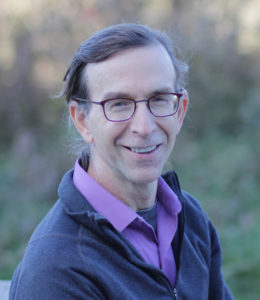
Northern wild rice, native to the St. Louis River, was once abundant. Today, it is threatened by high water levels and increased feeding pressure by Canada geese. Hansen will describe his project to determine if low-impact kayaking in wild rice bays could reduce the abundance of geese.

Registration is required to attend:

https://uwextension.zoom.us/meeting/register/tJ0od-ihqDIvEtQfz-vWF3bPtsPAIdk-ULYW

Registration will help keep the event safe and prevent unauthorized access. After registration, attendees will receive an e-mail with the link and a unique password to join the meeting. To attend a Zoom meeting, participants can access the meeting on the web and do not need to download the program to a personal device.

Hansen’s talk will be recorded and posted afterward on the Reserve’s Facebook page. A summary will also be posted on Wisconsin Sea Grant’s blog.

River Talks are sponsored by The Lake Superior National Estuarine Research Reserve and the Minnesota and Wisconsin Sea Grant programs.

For more information, visit go.wisc.edu/4uz720.

Original Article

News Releases – Wisconsin Sea Grant

News Releases – Wisconsin Sea Grant

https://www.seagrant.wisc.edu/news/deterring-geese-on-the-st-louis-river-to-protect-wild-rice/

Marie Zhuikov

Image credit: madlily58

A Wisconsin Sea Grant-funded project has helped improve the state’s capability to test for PFAS (per- and polyfluoroalkyl substances) and led to the discovery of their widespread presence in rainwater across the country.

The project is led by Martin Shafer, senior scientist with the University of Wisconsin-Madison School of Medicine and Public Health and the and Wisconsin State Laboratory of Hygiene (WSLH). Shafer is also a principal researcher with the National Atmospheric Deposition Program (NADP), the nation’s longest-running program for monitoring the chemistry of precipitation, which is housed at the WSLH.

Shafer said the presence of PFAS in everything from the food supply, personal care products, lakes and the atmosphere is a “growing crisis.” PFAS exposure is linked to human health concerns, including compromised immunity, low birth weight, endocrine disruption and cancer.

Martin Shafer. Image credit: Wisconsin State Lab of Hygiene

“Everyone in the world, including those in northern Canada and remote regions, all have substantial levels of PFAS in their bloodstreams,” Shafer said. “Some people believe PFAS are a significant threat to human health.”

These chemicals get into the environment from point sources like firefighting foam and industrial processes. Shafer said an estimated 4,500 to 5,000 PFAS compounds exist, but federal regulations currently only target two: PFOS and PFOA.

With help from the Sea Grant funding, the WSLH can now measure levels of 36 PFAS compounds, which is the highest available in the state. “Two other labs in Wisconsin can test for PFAS, but they can’t offer the breadth of compounds nor the breadth of matrices that the state lab can,” Shafer said.

Rainwater is another source of PFAS that, until recently, has received limited study. In his researcher role with the federal NADP, Shafer is in an ideal situation to study the cycling of PFAS in the atmosphere and rainwater deposition.

Precipitation samples from 263 sites of the NADP National Trends Network across the country “appear” on his lab doorstep every weekday. Studying samples from 31 of those sites, Shafer found measurable levels of PFAS in almost all, some up to four or five nanograms per liter.

“Considering that Wisconsin just promulgated an action level of two nanograms per liter and a regulatory level of 20 for PFAS, that’s not insignificant,” he said. “We showed that deposition from rainfall events integrated over a year could represent and supply a large fraction of PFAS loading to large lakes, and similarly, to terrestrial environments that are not receiving any other point-source loadings of PFAS.”

Shafer presented his rainfall study results at the American Geophysical Union meeting last fall in San Francisco, which resulted in media interest from outlets like “The Guardian,” and The Weather Channel. The U.S. Environmental Protection Agency also took note and will be using these data in their deposition models.

Shafer is now gearing up to study the role of wastewater treatment facilities in disseminating PFAS. Sea Grant is funding a graduate student to work on this project and the Wisconsin Department of Natural Resources (DNR) is providing funding for analysis at the WSLH. Samples of wastewater influents, effluents, biosolids and air emissions will be collected and analyzed.

Because the wastewater treatment facilities collect and concentrate wastes from many different sources, Shafer is concerned that they could unwittingly be a point-source for PFAS pollution. Spreading biosolids produced at the treatment plant on agricultural fields could result in further dissemination with potential for contamination of water resources and crops.

With funding and collaboration with the DNR, Shafer will also be studying how PFAS are distributed and transformed in the atmosphere. He will be collecting PFAS precipitation samples from seven NADP sites in Wisconsin for a three-and-a-half-month period, every week.

“That will be one of the more intensive studies of PFAS done anywhere,” Shafer said. He’s also working with several northeastern states to establish a similar project.

“We need to understand what is driving the distribution pattern of PFAS in the atmosphere — what compounds are contributing to the load, how can we fingerprint sources – a whole list of things where further work would need to be done,” Shafer said.

Original Article

News Releases – Wisconsin Sea Grant

News Releases – Wisconsin Sea Grant

https://www.seagrant.wisc.edu/news/sea-grant-research-addresses-the-growing-crisis-of-pfas-exposure-finds-pfas-in-rainwater/

Marie Zhuikov

A leatherback sea turtle. Image credit: Alastair Rae

By Elise Ertl, University of Wisconsin-Superior

Our student blogger intern, Elise, shares a story about her experience a few years ago helping leatherback sea turtles in Costa Rica. An estimated 34,000 to 36,000 nesting females are now left worldwide, compared to 115,000 in 1980.  Elise traveled with her mother, who is a biology teacher in north-central Wisconsin. We hope you enjoy this virtual trip to the tropics!

The air is hot and humid. The summer breeze smells of sea salt and wet sand, something the trees experience all the time. How luxurious for the trees — moisture-laden air, golden, sunny rays and fertilized ground. Their trunks are weathered, yet untouched and strong. The soil materializes to a dark, moist brown that I could imagine seeping through my toes as my feet begin to sink.

I envy the Costa Ricans their way of life. They seem happy, carefree and to enjoy living a simple life. One of their sayings, “Pura Vida,” means pure life, better translated to, “don’t take life so seriously,” or, “take it easy.” I wish life could always be thought of in this way. I want to relax and take life slowly, one step at a time. That’s not the kind of life that I am used to, but is something for which I deeply long.

Something else I deeply cherish is Costa Ricans’ regard for nature. In Costa Rica, harming or killing any animal is illegal, including the minute mosquito or spider.  I think of it as a recognition of the delicate balance of the ecosystem that can be found in the rainforests of their country. As one Costa Rican explained, “We are just one small part of nature. Nature is our home. We must respect every living creature as we respect ourselves.” Every hour I spend learning and exploring the grounds of Costa Rica, the more I fall in love with the people and their values.

Elise Ertl and friend. Submitted image.

I am on my way to Pacaure Reserve, a small research center for leatherback sea turtles, the largest species of sea turtle. I am sitting in the back of a van whipping down a long winding road. I pull out my water bottle and take a sip of my warm water to try and ease the nausea of motion sickness. Don’t throw up. Don’t throw up.

I wish my spinning head would still. I am aware that alongside the road waterfalls flow over bright green vines, clay and rock, but my head blends it all together.

We finally veer off the never-ending bending road, and I never thought I would be so happy to feel the bumpiness of a gravel surface. Any road is better than the previous one! The spinning slowly subsides the more I focus on the view outside my window. This area is not like what I had seen so far but rather dry and could probably use a good day of rain. The van pulls up alongside a river where two men wait for us with their two boats. Normally, I would not hop in a boat with a strange man, but these men smile, laugh, and obviously care about my safety as they hand me a life jacket.

The boats are nothing fancy, made of tin and painted dark green with metal seats. Knowing the boats are a bit tipsy, the man reaches for my hand and I reluctantly take his offer. I tumble into the rocky boat, catching myself and scorching my hand on a hot metal seat. My skin turns bright red and feels like it is on fire. I am an inch away from sticking my hand in the water to find relief when I feel my wrist snatched.

A Costa Rican crocodile. Image by Craig Hemsath.

“No, no, no,” the man says, looking at me with wide eyes and gaping mouth. “Keep your hands inside the boat at all times. There are crocodiles everywhere.”

An alarm goes off in my head. “There’s crocodiles everywhere!?” I say as my expression begins to match the man’s. I look around and sure enough, every 10 feet along the river edge, crocodiles lurk. Dark brown, yellow-eyed crocodiles and their babies await their next meal. “Thank you,” I say as he lets go of my wrist, and we both sigh in relief.

The boat ride is stunning, and I even grow to like the crocodiles soaking up the sun on the sand pits of the water’s edge. Birds whose songs I do not recognize are singing louder and louder in a call and response to one another. I see one peculiar black, skinny beak sticking up from the water, moving from one area to the next. The man driving my boat is a native, and I ask him what that animal with the long sharp beak is called.

An anhinga. Image by Craig Hemsath.

He responds, “That is an Anhinga. They eat crocodiles.” Alarmed at first, I find comfort in the thought that this small but mighty bird is my protector against the crocodiles.

The boats stop by a short sand pathway that leads to our final destination, the Pacuare Reserve. As we walk up the shore with our gear on our backs, the first thing we notice is a small brown building with a concrete patio out front. People are gathered at the picnic tables, eating a meal of rice, black beans and fried plantains. What we don’t know is that meal would become the same one we would eat for the next two weeks. Everyone gathered introduces themselves as the researchers of the project and the ones who will be helping us with our sea turtle research. They all look fresh out of college and happy to be spending their time on this reserve.

Soon after meeting the researchers, the owner of the reserve shows us where we will be staying. Long, tan and skinny yurts reminiscent of a Girl Scout camp stand before me, except this time, the spiders will be enjoying their stay with us, since we cannot kill them here. To avoid ants and other animals coming into the yurts, we are told to make sure there is absolutely no food in our bags, and to come back to the concrete patio as soon as we are ready. We are starting our training right away.

Down at the patio, the researchers split us into groups and take us down to the beach. On our way, I notice signs written in Spanish lining the rocky trail, showing pictures of the different types of Tortugas (turtles) that come to nest on this beach. We are here to document the number of leatherback sea turtles that come to nest, measure their length and width, collect their eggs and relocate them to safe place on the beach where poachers and predators cannot find them.

Our training begins with a group activity to build the best, and most accurately sized, leatherback sand sea turtle. We start sculpting turtles out of the moist sand, having no idea how big these turtles really are. Our sand modeling done, the researchers teach us how to properly measure a turtle, but note that our turtles are only three feet long, when the average leather back turtle is six- to seven-and-a-half-feet long.  My group can’t imagine a turtle longer than an arm’s length.

The instructors teach us everything we need to know to assist the researchers. As we learn, I realize how ingenious these creatures are. Leatherbacks implement a defense against predators by laying different-sized eggs. The first 100 or so eggs are fertilized and about the size of a billiard ball, while the next 30 to 50 eggs are unfertilized and ping-pong-ball-sized. By placing fake eggs on top, the mother leatherback increases her young’s chance of survival.

The researchers tell us we are now ready to begin our first night shift out of 14, but none of us realizes how unprepared we are for what we are about to witness.

Night after night, we scour the beaches, hoping our group will be the next to help the half-ton, egg-bearing mother leatherback sea turtle deliver her young to safety. As the days go on, the outlook becomes more and more grim as we have not seen any turtles, but both of the other groups had seen and helped one, if not two, already.

It’s my group’s final night shift at the reserve. After walking down the beach, I gaze over the darkened water, only seeing as far as the moonlight allows. The sound of the ocean waves swaying so gracefully makes me feel as if I could close my eyes and lie down to drift away. Taking in a deep breath of fresh, warm air, I almost don’t care if I see a turtle or not. As magnificent as it would be, I have so much magnificence already in front of me — a vast ocean joined by never-ending rainforest — and I am standing on the centerpiece. Bioluminescent algae make the water glow in the dark and the sands sparkle in every direction. In the night, I hear waves, and I feel wind. I even smell the alarming and musky scent of a jaguar.

Life doesn’t stop at night. When the Earth falls silent and the lights turn off, the creatures of the night awake. Not monsters and ghosts, but hidden gems that gleam in daylight’s absence. A new world is brought alive without the sun’s perpetual shadow.

Our group leader, Laura, interrupts my wandering thoughts with a hushed voice telling us to crouch down. When my eyes settle, I see a massive creature emerging from the many-thousand-mile trip she endured across the ocean. The group falls silent in awe and disbelief. Two front flippers rise from the ground in tremendous effort to pull herself through the sand and up toward the trees lining the beach edge. Ten seconds between each pull forward and nine seconds of heavy, laborious breathing. I can hear the air being inhaled through her nostrils and exhaled with every task, leading to her utter exhaustion.

She reaches the top of the beach and turns her body to face the ocean. Using her two back flippers, she forms a scoop and begins to dig and dig until her flippers can reach no farther, and falls into a trance to begin the laying process.

We slowly move closer to the mother sea turtle. The nearer I get, the more I realize she’s been here longer than any of us have been alive and her ancestors longer than humans have been on Earth. Sea turtles truly are dinosaurs of the sea.

We use a red light to not awaken or disturb her. If she were to see white light, she would think it is daytime and descend back to the water to lay her eggs another time.

We take the measurements of her five-ridged shell. Her length measures six feet, seven inches. Her width from front flipper to front flipper measures six feet, ten inches. We place a large, sturdy bag into the dug-out hole behind the mother turtle just before she begins to lay, and we count. One, two, three, four, one after another, billiard-ball-sized eggs stack slowly filling up toward the top.

We count 83 eggs and then she lays 30 unfertilized, golf-ball-sized eggs over her children as a blanket of disguise against potential predators. The temperature of the upcoming days will determine the sex of the baby turtles. If temperatures are warm, females will be born, and if temperatures are cooler, the turtles will be male.

After around 45 minutes, we close the bag and allow her to fill the hole back up with sand. She soon departs back down toward the water. I hear her take one last breath, this time sounding of relief, and watch her fade away to spend her life in the mysterious sea.

I realize I have just experienced a small slice of her life, and I am forever grateful to have been a part of something so special.

We remove the eggs from the original hole dug by the mother and relocate them to one of our own making with the exact same measurements of 28 inches deep, which we dug in a safer spot. We place the eggs bottom to top, largest to smallest.

I can’t help but think of the long, dangerous journey these baby turtles will embark on once they hatch, and hope they live to experience a life like their mother. I hope these turtles return to this same beach at the Pacuare Reserve to lay their eggs. I hope another young person like myself will get share the chillingly beautiful experience of hearing a mother sea turtle’s breath, and I hope they will cherish being a part of such a pivotal moment in her life. Maybe one day, my child and one of this mother sea turtle’s children will meet on this very same beach, and share the same experience we had today.

As we head back to the reserve, I’m overwhelmed to have witnessed something so grand and so beautiful. I want to stay here forever and feel this again and again like it was the first time, but tonight is my last night and tomorrow, we leave.

The people here are immersed in these surroundings every day. They live in nature, nature doesn’t live around them. They take moments to slow down and remember what is truly important in life and what is worth valuing, such as the endangered leatherback sea turtles. That is now something I strive for day after day, and I hope one day, I too will find myself saying “Pura Vida” on the sunny, tan beaches of Costa Rica.


Original Article

Blog – Wisconsin Sea Grant

Blog – Wisconsin Sea Grant

https://www.seagrant.wisc.edu/blog/dinosaurs-of-the-sea/

Marie Zhuikov

In honor of the 50th anniversary of Earth Day, we are highlighting five popular posts from our blog — one representing each Earth Day decade, although all the stories were published recently. We hope this Earth Day gives you a chance to reflect on the topics they describe – from aquatic invasive species, to the importance of drinkable water, to fishing.

Here they are:

  1. Spring thaw throwdown! March 14, 2019

This was a tournament we offered last year where 16 species competed for the title of “Least Wanted Aquatic Invasive Species in Wisconsin.” The game was widely publicized and was hosted by our AIS staffers. The winner(s)? Zebra and quagga mussels. Read more about the results here.
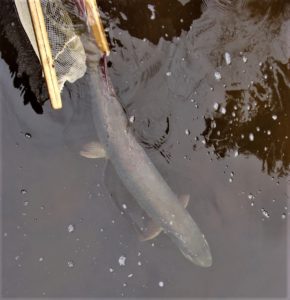
  1. Muskie fishing a restored river March 13, 2019

Muskie anglers are a passionate bunch. This story, written by our River Talks student blogging intern, outlined a presentation by Keith Okeson, past-president of the Lake Superior Chapter of Muskies Inc. Okeson described efforts to restock and assess muskie populations in the St. Louis River in northeastern Wisconsin.

  1. Water connects us: Getting to know your urban streams January 17, 2019

This was another story written by our River Talks student blogger. This talk in the monthly series featured a panel of local urban stream experts: Tiffany Sprague with the University of Minnesota Duluth Natural Resources Research Institute, Andrea Crouse with the city of Superior and Todd Carlson with the city of Duluth. They highlighted the many environmental and lifestyle impacts we have on our urban streams.
  1. Tips for good outdoors and nature writing December 17, 2018

One of our science communicators attended a writing seminar by noted book author and Duluth News Tribune outdoors writer Sam Cook. This post highlights a few of his tips and tricks of the trade.

  1. Welcome to the water bar. Water is all we have April 22, 2019

One of our science communicators learned a new skill and encouraged discussions about water, all at the same time. With the intent of celebrating the importance of clean water, the event offered the public a chance to taste regional water at a Water Bar and local craft beer brewed with Lake Superior water.

Original Article

Blog – Wisconsin Sea Grant

Blog – Wisconsin Sea Grant

https://www.seagrant.wisc.edu/blog/wisconsin-sea-grant-blog-celebrates-popular-posts-for-earth-day/

Marie Zhuikov

As the state of Wisconsin’s population grows and water issues gain in complexity and number, demand for skilled water workers is expected to increase. According to the Wisconsin Department of Workforce Development’s 2016-2026 occupation projections, demand for hydrologists and environmental scientists with bachelor’s degrees will rise 6.5% and 12.6%, respectively.

A new Wisconsin Sea Grant-funded education project addresses this need by engaging undergraduate students at the University of Wisconsin Green Bay at Manitowoc in research and connecting the students to their communities. A professional master’s student from UW-Milwaukee School of Freshwater Sciences will also complete development of a water resource hub used by regional water organizations to provide cohesive stormwater messaging along Lake Michigan’s Wisconsin coastline. Even high school students are included in the project.

Deidre Peroff

“One of the objectives is to retain students in water-related STEM pathways and careers,” said Deidre Peroff, Wisconsin Sea Grant social science outreach specialist. “We are focusing on watershed education and helping students strengthen their skills to make them more marketable – ideally, to have a career in water, whatever that may look like.”

Peroff is part of a project team that involves representatives from the Southeastern Wisconsin Watersheds Trust, Inc., (nicknamed Sweetwater, for short), UW-Green Bay at Manitowoc, and the Lakeshore Natural Resource Partnership. Although initially inspired separately, the team members recognized similarities in their goals and developed the project together.

Many moving parts make up the project. Two of them are an annual Lakeshore Water Summit and a stormwater messaging resource hub.

The Lakeshore Water Summit is held during fall each year at UW-Green Bay at Manitowoc. It offers college students the chance to practice research presentations. For this project, freshman and sophomore interns will collect weekly measurements on Lake Michigan tributary streams during the summers of 2020-2022. Data includes pH, temperature, flow, turbidity, dissolved oxygen and E. coli, among others. The interns operate with guidance from UWGB biology professors Rebecca Abler and Rick Hein.

Funding from this project will allow the inclusion of high school students in the Summit, as well. Mentored by the undergraduate interns and their teachers, the high school students will also learn how to present scientific information from their water quality studies. They’ll have the opportunity to create scientific posters for the Summit or give informal presentations.

Rebecca Abler. Image credit: University of Wisconsin-Green Bay

“This project is going to really enhance the real-world aspect of science for our students,” said Abler. “They won’t just be collecting data. They’ll be learning how to communicate to various audiences. They’re not just doing this for faculty members – they’re doing this for the community – which is our goal at the university. So it’s just really exciting.”

The graduate intern who will be mentoring the undergraduate students will also work on the stormwater messaging resource hub with advisement from Jacob Fincher, acting executive director of Sweetwater, and Peroff.

The hub is a web-based clearinghouse of information related to stormwater pollution prevention. Sweetwater has created a framework for the hub already, and plans to have the master’s intern work with the Lake Michigan Stakeholders Communication Committee to pick the most applicable stormwater education materials. Once those are all loaded into the website, Fincher said the intern will remind stormwater groups along the coast when certain messages should be publicized and how to do that.

Jacob Fincher. Image credit: Sweetwater

Fincher offered a fictional example of a billboard as an explanation of the concept. “If I were to drive from Kenosha and see a billboard about stormwater pollution prevention . . . and see the logo of a certain organization in the corner, then drive up past Milwaukee and see that same message but with a different logo, all the way up to Port Washington to Door County to Green Bay and Marinette, and continue to see that same message provided by different organizations – that takes coordination and facilitation. That’s where the intern will help us,” Fincher said.

The master’s intern will also work with Peroff to develop a science data communication toolkit, which will be used to mentor the undergraduate interns at UW-Green Bay at Manitowoc. The toolkit will help the students present their findings at the Summit in an understandable way.

Peroff summed up the complex project with this: “The faculty are going to be mentoring the undergraduates. The undergrads are going to mentor the high school students. The graduate students are mentoring the undergraduates. We’re (project staff) mentoring the graduate students. So, it’s this broad connection of mentorship, and then the key is having students share what they learned so communities can gain knowledge as well.”

Original Article

News Releases – Wisconsin Sea Grant

News Releases – Wisconsin Sea Grant

https://www.seagrant.wisc.edu/news/new-watershed-education-program-uses-mentoring-and-collaboration-to-share-information-with-communities-along-lake-michigan/

Marie Zhuikov

The River Talk series is postponed until further notice due to concerns to our speakers and guests related to the COVID-19 virus. This series of informal talks about the St. Louis River Estuary relies heavily on audience participation. The states of Wisconsin and Minnesota are advising people to remain home. Postponing the talks better suits the series’ interactive community-based mission.

The priority of the organizers from the Lake Superior National Estuarine Research Reserve and the Minnesota and Wisconsin Sea Grant programs is the safety and well-being of our communities.

If you missed a past talk, visit the River Talk web page. Click on the talk title for a blog post summary.

The staff at the Reserve and Sea Grant programs are telecommuting and can be reached by email and phone. Stay safe, stay well, stay connected, everyone!


Original Article

News Releases – Wisconsin Sea Grant

News Releases – Wisconsin Sea Grant

https://www.seagrant.wisc.edu/news/river-talk-series-postponed/

Marie Zhuikov

Image by Marie Zhuikov, Wisconsin Sea Grant.

Quick – where is the world’s largest research ocean located?

If you answered that it’s in the middle of the desert in the American Southwest, you are right!

Image by Marie Zhuikov, Wisconsin Sea Grant.

I was able to visit this artificial ocean in February before travel restrictions were imposed due to COVID-19. I found it inside Biosphere 2, a self-enclosed science station run by the University of Arizona near Tucson.

Designed to simulate a Caribbean reef, the 750,000-gallon marine mesocosm is enclosed in a large tank with a maximum depth of seven meters. It slopes to a shallow lagoon, partially separated by a reef. There’s even an artificial wave generator that mimics the movement found in real reef environments.

Unfortunately, the ocean has not fared well over the years. A research project into ocean acidification by Columbia University, which used to own Biosphere 2, killed off the coral. After a period of neglect when the facility changed hands, algae took over the system and most of the fish perished.

The research ocean at Biosphere 2. Remnants of the coral reef are vertical across the middle. Image by Marie Zhuikov, Wisconsin Sea Grant.

Hmm, this sounds eerily similar to the fate of many of my home aquariums! During my visit, I was able to view the ocean from above. If I had arrived at the facility earlier in the day before tickets were sold out, I could have purchased an ocean tour, which allows people to climb down to the “beach” area on the ocean shore. (Note that the facility is currently closed to public tours and activities.)

However, now the University of Arizona is in the process of revitalizing the ocean to create a coral reef tank solely dedicated for research purposes. They are cleaning out the algae and making the ocean more hospitable for fish and other fauna – with the goal of building a reef that’s resilient to changes in climate.

With the crisis our real oceans are facing with acidification and coral bleaching, this research is especially needed. For more information, visit the ocean page on the Biosphere 2 site.

Biosphere 2. Image by Marie Zhuikov, Wisconsin Sea Grant.

Original Article

Blog – Wisconsin Sea Grant

Blog – Wisconsin Sea Grant

https://www.seagrant.wisc.edu/blog/ocean-research-in-an-unlikely-place/

Marie Zhuikov

Michael Anderson, Natalie Chin and Friends of the Lake Superior Reserve member Ruben enjoy a hike through the Superior Municipal Forest. Image by Marie Zhuikov, Wisconsin Sea Grant.

As we walked across the frozen bay, a dark shape appeared. Nearing, we could see a large chunk of deer hide lying wrinkled in the snow like a rich lady’s carelessly discarded fur coat.

Were we deep in the wilderness? No. We were just a 15-minute drive outside of Superior.

My Sea Grant coworker, Natalie Chin, and I were treated to a tour of the Superior Municipal Forest last week, courtesy of the Friends of the Lake Superior Reserve group and naturalist Mike Anderson.

This green gem offers 4,400 acres of the best remaining example of a boreal forest in Wisconsin and it’s the third largest municipal forest in the country.

Although I’d driven through the forest several times, I’d never had time to actually walk out into it. So, I jumped at the opportunity for this outing, and invited Chin, who is new to the area.

Two trees killed by shoreline erosion on Kimball’s Bay. Image by Marie Zhuikov, Wisconsin Sea Grant.

We met in a parking lot for a motorized winter trail. With snowshoes and highwater boots on, we hiked with several other Friends members down the trail to a frozen bay, which Anderson told us was Kimball’s Bay. All was quiet except for the crunching of snow under our boot. We found several old red pines on the shore that had fallen recently, their trunks snapped due to high water levels in the St. Louis River, which caused the shore to erode. The trees leaned and leaned until they could lean no further, and snapped from the extreme physical forces.

Along the way, Anderson described the history of the area. Although the ends of many of the peninsulas that poke into the bay are developed with homes, the municipal forest is preserved from development. Anderson was active in efforts to protect the area. Only cross-county ski trails, hiking trails and a campsite point to human use of the forest.

We trekked across to the other shoreline, passing an ice angler and coyote tracks. Two deer bounded across the ice ahead of us. We clambered up and over another point onto Cedar Bay, which is a narrower inlet. A short walk led us to the dark shape of the slain deer in the snow.

Deer hide in the snow. Image by Marie Zhuikov, Wisconsin Sea Grant.

Soon, it was time to return to our cars and the demands of urban life. Reluctantly, we headed back, savoring views of a slanting setting sun and a rising waxing moon.

The Friends of the Lake Superior Reserve hopes to organize more tours come spring. The group acts as ambassadors and supporters for the Lake Superior National Estuarine Research Reserve – the same folks in the building where our Sea Grant Lake Superior Field Office is located. They are a nonprofit group of volunteers who love the St. Louis River Estuary and work to highlight its importance to the community.  They even help with the reserve’s science projects sometimes. Find out more about what they do here. If all this sounds interesting to you, consider joining their group. It might give you a whole new perspective.

Besides being a great guide, Anderson is an accomplished nature and event photographer. You can view some of his municipal forest and St. Louis River images here:

Deep fall paddle

St. Louis River

Original Article

Blog – Wisconsin Sea Grant

Blog – Wisconsin Sea Grant

https://www.seagrant.wisc.edu/blog/a-touch-of-wilderness-near-the-city-the-superior-municipal-forest/

Marie Zhuikov

Barker’s Island in Superior looks different than it did a year ago. Construction on the island’s public beach rearranged and added structures to help improve water quality and provide a better experience for swimmers.

More changes are in store for the next two summers, all designed to reduce stormwater runoff and protect water quality in the Superior Bay and ultimately, Lake Superior.

Conceptual designs were recently completed for work at the Barker’s Island Marina and will be completed in 2020 for areas around Barker’s Island Inn, thanks to several grants and cooperation among the two businesses and Sea Grant programs in Wisconsin, Michigan, and Ohio, as well as the City of Superior, the Wisconsin Coastal Management Program, The Ohio State University, and the Wisconsin Marine Association.

Three projects at the marina will begin work this summer. Four others at the inn will begin in 2021. Here’s the rundown.

Barker’s Island Marina will be updated in 2020 with a stormwater wetland. The project will treat runoff from the service area and parking lot. Image by Marie Zhuikov, Wisconsin Sea Grant.

Barker’s Island Marina

A stormwater wetland will be created at Barker’s Island Marina in 2020 in an unused area along the coast to treat runoff from the service area and parking lot. Currently, runoff from these areas flows into a ditch and the harbor. As part of this, the marina will be graded and repaved to direct water toward the stormwater wetland. They will also install a boat wash station.

Julia Noordyk, water quality and coastal communities outreach specialist with Wisconsin Sea Grant, explains the importance of boat wash stations. “Copper anti-fouling paints are used on the bottoms of boats. At the end of the season when they’re power-washed, it just all sloughs off. You have some heavy metals potentially going into the water body. Boat wash stations are a really great thing. They capture the water rather than having it just drain directly into the lake.”

The second area is the parking lot at the marina where boats are stored for winter. The lot currently features a stormwater pond that doesn’t function properly. It sometimes floods, putting people and boats at risk. The design team plans to install an underground pipe so the pond can drain properly, plus a forebay to capture sediment coming off the parking lot, which will improve water quality.

If enough funds are left after the first two fixes, the third will be to install a large cistern to catch water off the roof of the marina maintenance building, delaying its flow into the bay. The water could be used for rinsing tanks and other water supply needs by the marina.

These activities are supported by a grant designed to advance stormwater management at Great Lakes marinas through the Great Lakes Protection Fund. As part of this project, a tool is being developed that will help marina owners and operators choose the best green infrastructure projects for their operations. Barker’s Island Marina is one of three marinas in the states of Wisconsin, Michigan, and Ohio chosen to test the tool and install the green infrastructure practices. Researchers from The Ohio State University and the Lake Superior National Estuarine Research Reserve will monitor the site before and after installation to record changes in water quality.

After completing the projects and adopting other best-management practices, Barker’s Island Marina will become a certified Clean Marina in the state of Wisconsin. The Clean Marina Program is designed to reduce pollution from marinas to protect Wisconsin’s waterways. Program staff conduct site visits to verify marina practices and provide training and technical support to marina and boatyard managers.

“I’m impressed by Barker’s Island Marina’s willingness to participate in this project and go through the certification process,” Noordyk said. “They understand that healthy water quality and a clean Lake Superior is crucial to their business plan.”

“It’s a unique opportunity to advance green infrastructure and help improve water quality at the marina, as well as improve its resiliency to coastal storms, and flooding,” said Todd Breiby, program coordinator with the Wisconsin Coastal Management Program, which is partnering with Sea Grant on the Great Lakes Protection Fund grant. “We’re hoping what we learn on Barker’s Island can be transferred to other locations and marinas around the state.”

The marina sits on city land, so the city of Superior is also involved.

“There’s a lot of really good energy on Barker’s Island right now,” said Andrea Crouse, water resources program coordinator with the city. “We know that a lot of boaters spend time on the water because they love being around water, and they value programs like the Clean Marina Program. We expect this will be a draw for people who are out on sailboats or motorboats on the lake – knowing that they could dock at a place where there’s a clean marina certification and good practices is something that people feel good about.”

Barker’s Island Inn

The parking lot at Barker’s Island Inn will get a “green” makeover in 2021. Image by Marie Zhuikov, Wisconsin Sea Grant.

Crouse said the city was recently awarded a grant for just under $500,000 from the National Fish and Wildlife Foundation’s Sustain Our Great Lakes Program to improve stormwater storage and reduce runoff impacts on Barker’s Island, including a “green” parking lot around Barker’s Island Inn. Conceptual plans call for installing infiltration medians and pervious surfaces around the lot edges in 2021 to discourage water runoff, and planting native trees and shrubs.

“We’re also exploring dark-sky lighting options for the parking lot,” Crouse said. “We’re thinking not only about water quality, but about how we can keep this a safe and well-lit area for people using it, while minimizing the ambient light that’s shining up into the sky or being directed to places that are problematic for wildlife.”

Across the road from the lot is a sandy area used as a catamaran launch, however, it was never an official site. Crouse said the area is eroding, sending sediment into the harbor. Plans involve creating an official launch and installing grass paving, which is a grid of plastic that can withstand the weight of vehicles and heavy foot traffic. This will stabilize the shoreline and prevent soil compaction and erosion.

And that walking trail that currently dead-ends across from the inn? Crouse said it’s going to be expanded. “Most people like walking in a loop, so we’re going to lengthen the trail to go around the hotel property and allow walkers to extend their hike,” she said. The trail will be constructed with low-impact practices, possibly a porous asphalt.

The final of the areas slated for work in 2021 are the tennis courts behind the inn. “They are in rough shape right now,” said Crouse. “We’ll be talking with the inn to discuss whether they want to keep one of those courts or none of them . . . But we’ll be removing several of them, at least, and putting in a green playground area so there will be more room for children and families that are using the space, as well as folks that are using the marina.”

Crouse said the timing of the projects is fortunate. “…Knowing that these projects might be happening at a similar time will allow us to be really efficient with city effort and funds so we can design these as much as possible in tandem. It’s a huge benefit to the public for us to be able to coordinate these projects together.”

Original Article

News Releases – Wisconsin Sea Grant

News Releases – Wisconsin Sea Grant

https://www.seagrant.wisc.edu/news/environmental-improvements-coming-to-barkers-island/

Marie Zhuikov

The River Talk series continues this month, but will be held in a different location and day of the week. At 6:30 p.m. on Tuesday, March 3, in the French River Room 1 at the Duluth Entertainment Convention Center (350 Harbor Drive, Duluth, Minnesota), Vern Northrup, member of the Fond du Lac Tribe of Lake Superior Chippewa, will present “Akinomaage: Teaching From the Earth.” Northrup will discuss how he uses photography as a tool to educate both himself and viewers about the rhythms of nature, the preservation of tradition, and the relationship between resilience and sustainability.
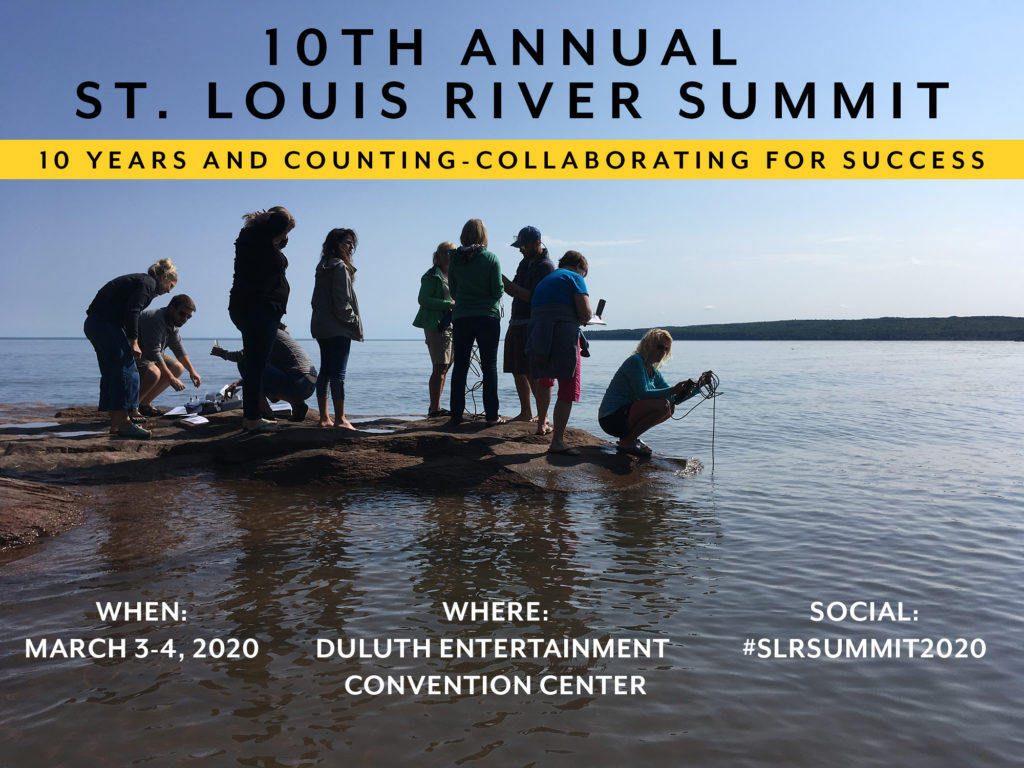
Northrup’s talk is being held in conjunction with the St. Louis River Summit. River Talks are free and open to all, however, participants will need to pay a DECC parking charge. Refreshments are provided.

The Lake Superior National Estuarine Research Reserve and the Minnesota and Wisconsin Sea Grant programs offer this series of informal evening talks about the St. Louis River Estuary.

Other River Talks will be held on April 8 and May 13. For more information, visit go.wisc.edu/4uz720. If you miss a talk, visit Wisconsin Sea Grant’s blog for a summary.


Original Article

News Releases – Wisconsin Sea Grant

News Releases – Wisconsin Sea Grant

https://www.seagrant.wisc.edu/news/akinomaage-teaching-from-the-earth/

Marie Zhuikov

Wisconsin Sea Grant is among the sponsors of the 10th annual St. Louis River Summit, March 3-4 at the Duluth Entertainment Convention Center, 350 Harbor Drive, in Duluth, Minnesota.

The Lake Superior National Estuarine Research Reserve (Lake Superior Reserve) is organizing the event with the theme, “Ten Years and Counting: Collaborating for Success,” which highlights the power collaboration has had in protecting and restoring the St Louis River Estuary. The goal of the summit is to bring together key audiences working in the region to share information about the St. Louis River and encourage coordination of activities and funding proposals.

“The strides we have made toward a delisting of the U.S. EPA-designated Area of Concern (AOC) have benefited immensely from the many partnerships that have been cultivated over the last decade,” said Erika Washburn, Lake Superior Reserve manager. “We hope you will join us to celebrate our progress over the last 10 years and look toward the future.”

A keynote panel on March 3 will feature facilitation by Pat Collins, natural resources program consultant with the Minnesota Department of Natural Resources. Collins has been involved in the setup of the St. Louis River AOC since the beginning decades ago, and will share his insights into progress made, with participation from other professionals involved in the process.

A March 4 panel will feature members of the local news media who will explain how they choose stories to cover and how their coverage of the St. Louis River has changed over the years.

During lunch on March 3, listening sessions will be offered by local congressional staff representatives, and an ecopsychology session will be held by Leah Prussia, professor at the College of St. Scholastica.      

A poster session will take place 4:30 to 6:30 p.m. on Tuesday, March 3.  At 6:30 p.m. in the French River Room at the DECC, Vern Northrup, member of the Fond du Lac Tribe of Lake Superior Chippewa, will present, “Akinomaage: Teaching From the Earth.” Northrup will discuss how he uses photography as a tool to educate both himself and viewers about the rhythms of nature, the preservation of tradition, and the relationship between resilience and sustainability.
This evening talk with refreshments is being held as part of the popular monthly River Talk series. These events are free and open to all, however participants will need to pay a DECC parking charge.

College students from local institutions can attend the Summit for free to learn more about the research community and river projects. A student career information lunch will be held on March 4.

Summit pre-registration is required for full-day participation. The cost is $30, which includes lunch and refreshments. Students are free, but need to register. The deadline is Sunday, March 1. To register and view the agenda, visit lakesuperiorreserve.org.

Other initial sponsors include Duluth Pottery, Minnesota Land Trust, Wisconsin Coastal Management Program, Wisconsin Department of Natural Resources and Wren Works, LLC.

Original Article

Blog – Wisconsin Sea Grant

Blog – Wisconsin Sea Grant

https://www.seagrant.wisc.edu/blog/st-louis-river-summit-celebrates-10-years-of-collaboration/

Marie Zhuikov

A dancer in regalia at the Gichi Manidoo Giizis Pow Wow. Image by Marie Zhuikov, Wisconsin Sea Grant.

More than 230 Ojibwe dancers filled the event center in the Black Bear Casino Resort in Carlton, Minnesota, dressed in their finest regalia. A colorful rainbow, the dancers slowly progressed in a clockwise circle, swaying to the beat of drums and singing, bells on their clothing jingling with each step.

Watching the Gichi Manidoo Giizis Pow Wow were 19 educators from Wisconsin, Minnesota and Michigan. A few even joined the dance when audience members were invited.

The pow wow was just part of a daylong workshop the teachers attended after they braved a January snowstorm to arrive in Carlton. As a reward for their travel through inclement weather, they learned more about Ojibwe culture, treaty rights and water ecology.

Named after the pow wow, the Gichi Manidoo Giizis Educator Workshop means, “Great spirit moon” or January in Ojibwe. The workshop was organized by the Fond du Lac Tribal and Community College, the Fond du Lac Band of Lake Superior Chippewa, and the Minnesota and Wisconsin Sea Grant programs.

Megan Hogfeldt. Image by Marie Zhuikov, Wisconsin Sea Grant.

Megan Hogfeldt, a water resource specialist for the city of Superior, was one of the workshop attendees. “What fascinated me was that this workshop is geared toward people who work in science and water quality education. A lot of what I do is communicating what my coworkers are working on or research that’s being done in the community. I try and explain to people and school groups the importance of water quality, recognizing that a lot of those people are also indigenous. It’s beneficial to me to have a framework for what I can include or language I can use for that audience.”

Hogfeldt and the other educators spent their morning learning about tribal history and treaty rights from Christina Dzwonkowski, a Great Lakes Indian Fish and Wildlife Commission game warden. Later, Kelsey Taylor, who works for the Fond du Lac Band, offered information about invasive species and traditional knowledge.

The educators had a chance to test their treaty rights knowledge by taking a Kahoot quiz on their phones. Kahoot is a game-based learning platform that makes it easy to quickly create games or trivia quizzes. A question arose during the quiz about how the tribes manage their fishery.

“If a limit on a certain lake is 300 fish, the tribes don’t fish 300 fish,” said Dzwonkowski. “They have a nice big buffer, so they might fish 220 fish out of that lake, just to take into consideration things change and so they don’t go over the limit. The tribes only visit that lake a single time to spear, and they only take a certain amount. Then they leave and don’t go back fishing there, unless it’s just plain hook and line like everyone else.”

After eating lunch, the teachers attended the pow wow, an experience that Hogfeldt appreciated. “I really like pow wows. I’ve had nothing but a positive experience and it’s very welcoming – very based on appreciation of community and nature,” she said.

Back at the workshop, the teachers divided into teams. They played the Watershed Game, a hands-on simulation developed by Minnesota Sea Grant and University of Minnesota Extension that helped them learn how land use impacts water quality and natural resources.

Cynthia Hagley, environmental quality extension educator with Minnesota Sea Grant, explained their seemingly impossible task. “We want you to reduce pollution as much as you can without your team going broke. And you have about 15 minutes to do it. Today, we’re focusing on sediment and why it’s a bad thing to have in the headwaters of a stream.”

In the evening, the teachers took their new knowledge and applied it to activities for a youth workshop held later that night, along with a traditional pow wow feast.

If you’re an educator and would like to get on a list for notifications about opportunities like this, please contact Anne Moser with Wisconsin Sea Grant by email at akmoser@aqua.wisc.edu or Marte Kitson with Minnesota Sea Grant at mkitson@d.umn.edu.

Original Article

News Releases – Wisconsin Sea Grant

News Releases – Wisconsin Sea Grant

https://www.seagrant.wisc.edu/news/educator-workshop-shares-ojibwe-culture-and-history/

Marie Zhuikov

The River Talk series continues at 7 p.m. on Wednesday, Feb. 12, at the Lake Superior Estuarium (3 Marina Drive, Superior, Wisconsin). Nancy Schuldt, water protection coordinator with the Fond du Lac Band of Lake Superior Chippewa, will present, “Promoting Tribal Health by Protecting and Restoring Manoomin (Wild Rice) in the St. Louis River and Beyond.”

Nancy Schuldt. Image by Marie Zhukov, Wisconsin Sea Grant.

Manoomin and all the health benefits and wealth it creates are under threat from a variety of stressors. This native grain has declined substantially in its historic range on the St. Louis River and beyond. Due to the importance of manoomin to tribal health, the Fond du Lac Band of Lake Superior Chippewa and the state of Minnesota developed a health impact assessment to convey the importance of wild rice to Ojibwe people. Schuldt will speak on the assessment and share reflections from her career spent studying and protecting water.

The Lake Superior National Estuarine Research Reserve and the Minnesota and Wisconsin Sea Grant programs offer this series of informal evening talks about the St. Louis River Estuary. Everyone is invited and refreshments are provided.

Other River Talks will be held on March 3, April 8 and May 13. The March 3 talk will be held in conjunction with the St. Louis River Summit.

For more information, visit go.wisc.edu/4uz720. If you miss a talk, visit Wisconsin Sea Grant’s blog for a summary

Original Article

News Releases – Wisconsin Sea Grant

News Releases – Wisconsin Sea Grant

https://www.seagrant.wisc.edu/news/promoting-tribal-health-by-protecting-and-restoring-manoomin-wild-rice-in-the-st-louis-river-and-beyond/

Marie Zhuikov

The author and her cat canoe on Star Lake, Minnesota, July 1977. Image by Dorothy Pramann.

For National Dog Day, we offered several popular social media posts that featured the “dogs of Sea Grant.” Our Wisconsin Sea Grant staff members shared images of their pooches frolicking in water. Afterward, we tried a “cats of Sea Grant” social media push for National Cat Day, we didn’t get enough submissions from staff to make it work. Probably because most cats dislike water.

At the time, I didn’t think about Inky, the black cat I grew up with, because she is long deceased. But the other day, I walked past this photo of Inky and me in a canoe, and the memories all came back.

Inky was a stray a neighborhood boy brought to us because he knew we recently lost a cat. That previous cat was a calico we named Muffin. Alas, Muffin ran away when we were on a camping trip while she was under the care of a neighbor. Perhaps because of that, we took Inky along on all our camping trips.

She did not enjoy car rides – she would disappear under the driver’s seat and not emerge until we’d reached our destination – but she liked being outdoors in the campgrounds where we stayed. We’d leash her to a picnic table so we wouldn’t lose her.

Inky at home, circa 1975.

One place we liked to stay for extended periods was Star Lake, a Methodist Church Campground in northern Minnesota. Because we’d stayed there several times and we didn’t need to travel the next day, we’d let Inky off her leash to come and go as she pleased, like she did at home.

We owned an old Grumman aluminum canoe that I used to paddle around the lake. One day, I got the idea of bringing Inky along.

She seemed to like the canoe ride better than a car ride. She perched on the gunwale a few feet in front of me, leaning out over the water.

With each canoe outing, she’d lean farther and farther over the side. It seemed like she wanted to go into the water. One day, I tipped the canoe slightly, giving her some “help.”

Plop! Into the water she went.

We weren’t far from the shore of our campsite – only about 30 feet — and she swam in that direction. I can’t recall if she meowed as she swam, or if she swam silently. (My memory has fuzzed during the four decades since this occurred.) She made it to shore just fine and seemed no worse for wear.

The next time I took Inky out for a canoe, as we neared our site again, she jumped out of the canoe by herself!

Could it be, she liked to swim? I’d never heard of a cat who liked to swim, but apparently, I had one. By the end of our stay, her swims from the canoe to our campsite were a regular thing.

Inky the swimming black cat lived to a ripe old age, despite getting hit by a car once, breaking her leg. I’ve had other cats since then, but none who liked to swim like she did.

Although most cats would rather avoid water, some do like it. (Read stories here.)

My youngest son is allergic to cats, so I have since switched to dogs. But in my home, I keep this photo my mother took, and think of my swimming cat whenever I pass it.

Original Article

Blog – Wisconsin Sea Grant

Blog – Wisconsin Sea Grant

https://www.seagrant.wisc.edu/blog/the-cat-who-liked-to-swim/

Marie Zhuikov