STURGEON BAY, WISCONSIN — It’s midmorning in late February, and Bruce Smith is regaling two ice fishing buddies when a tug on his line interrupts the story.

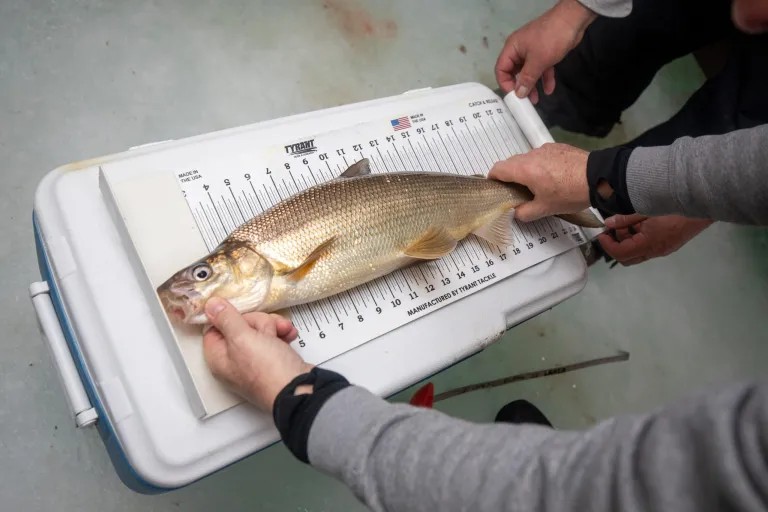
“There we go!” he shouts as a shimmering 23-inch whitefish appears through a hole in the ice. “That’ll make a nice filet.”

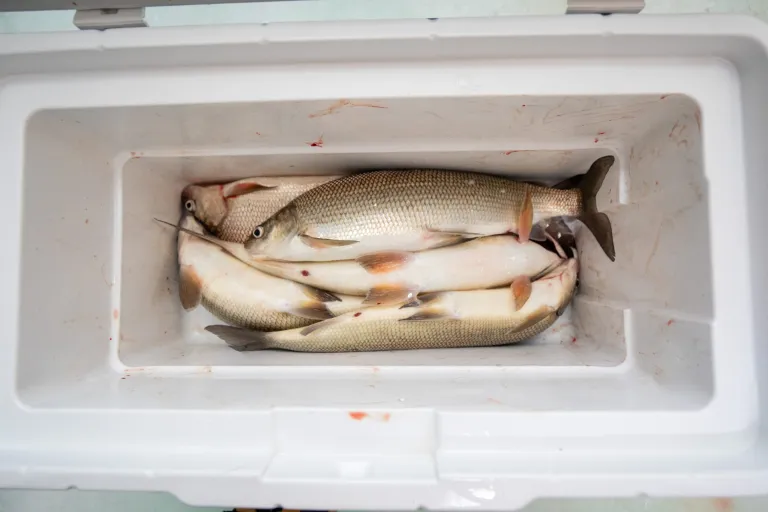
No sooner has Smith tossed it into a cooler than his buddy Terry Gross reels in another one. Five minutes later came another bite, then another, until by 10:30 a.m. the trio had hauled in 15 fish — halfway to their daily limit, even after putting several back. 

Welcome to southern Green Bay. Or as Smith likes to call it, “Whitefish Town, USA.”

Once written off as too polluted to support many whitefish, the shallow, narrow bay in northwest Lake Michigan has produced an unlikely population boom in recent years, even as the iconic species vanishes from most of the lower Great Lakes. The collapse has dealt a blow to Michigan’s environmentcultureeconomy and dinner plates.

Oddly enough, nutrient pollution from farms and factories may help bolster the bay’swhitefish population, spawning a world-class recreational fishing scene while helping a handful of commercial fisheries in Michigan and Wisconsin stay afloat despite the collapse in the wider lake.

“This is a paradise,” Smith said. “The best fishing I can ever remember, for the species I want to catch.”

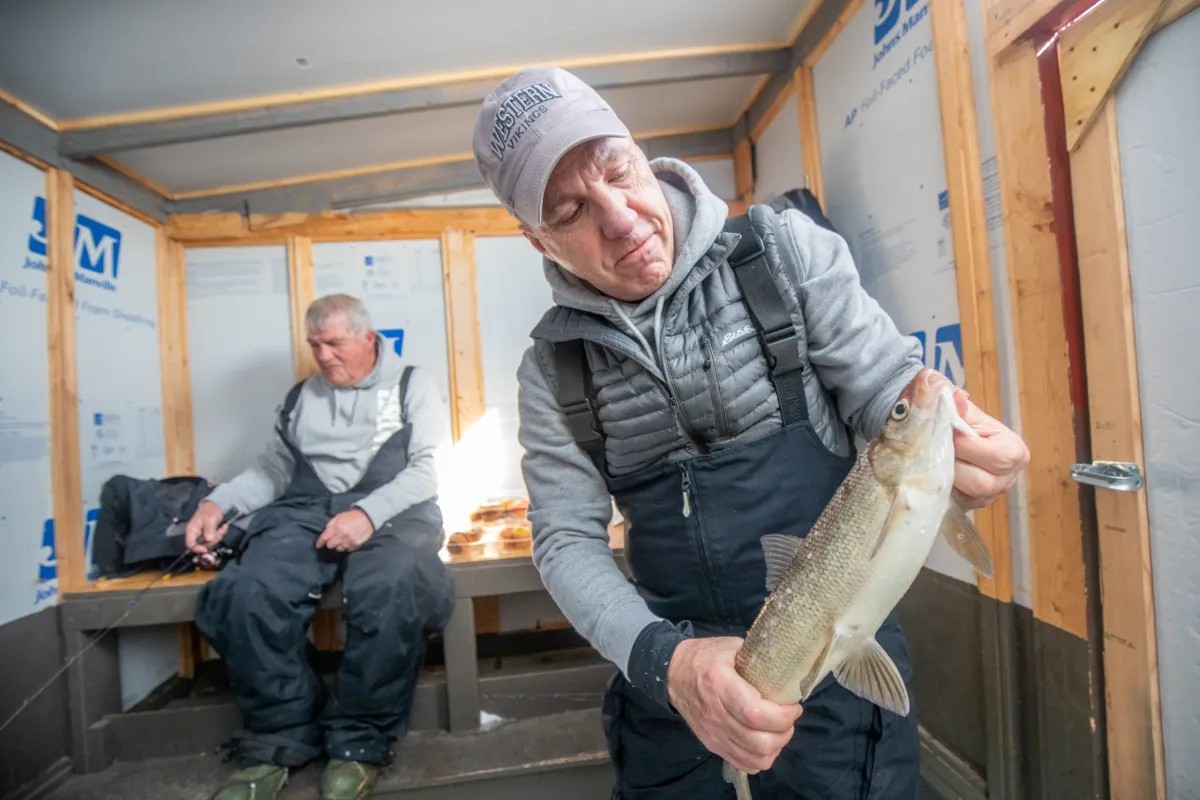
Terry Gross, 63, hauls in a large whitefish in the ice fishing shanty he shares with Ed Smrecek, 73. Both men are from Appleton, Wisconsin. (Daniel Kramer for Bridge Michigan)

As scientists work to understand what makes Green Bay unique, their findings could aid whitefish recovery efforts throughout the Great Lakes. Michigan biologists, for example, have drawn inspiration from Green Bay’s sheltered, nutrient-rich waters as they attempt to transplant the state’s whitefish into areas with similar characteristics.

“Having places they (whitefish) are doing well … gives us context for the places that they aren’t doing well,” said Matt Herbert, a senior conservation scientist with the Nature Conservancy in Michigan. “It helps us to figure out, how can we intervene?”

But lately, sophisticated population models have shown fewer baby fish making their way into the Green Bay population, prompting worries that Lake Michigan’s last whitefish stronghold may be weakening.

A Great Lakes miracle

Not long ago, it seemed impossible that a fishery like this could ever exist in Green Bay.

Before the Clean Water Act of 1972 and subsequent cleanup efforts, paper mills along the lower Fox River — the bay’s largest tributary — dumped toxic polychlorinated biphenyls (PCBs) into the water without restraint while silty, fertilizer-soaked runoff poured off upstream farms.

Southern Green Bay was no place for “a self-respecting whitefish,” said Scott Hansen, senior fisheries biologist with the Wisconsin Department of Natural Resources.

Lake Michigan’s much larger main basin, meanwhile, was full of them. 

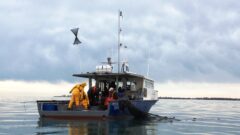
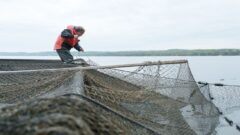
Commercial fisherman Todd Stuth’s business got 80% of its catch from the open waters of Lake Michigan before the turn of the millenium. Now, 90% comes from Green Bay.

How did things change so dramatically?

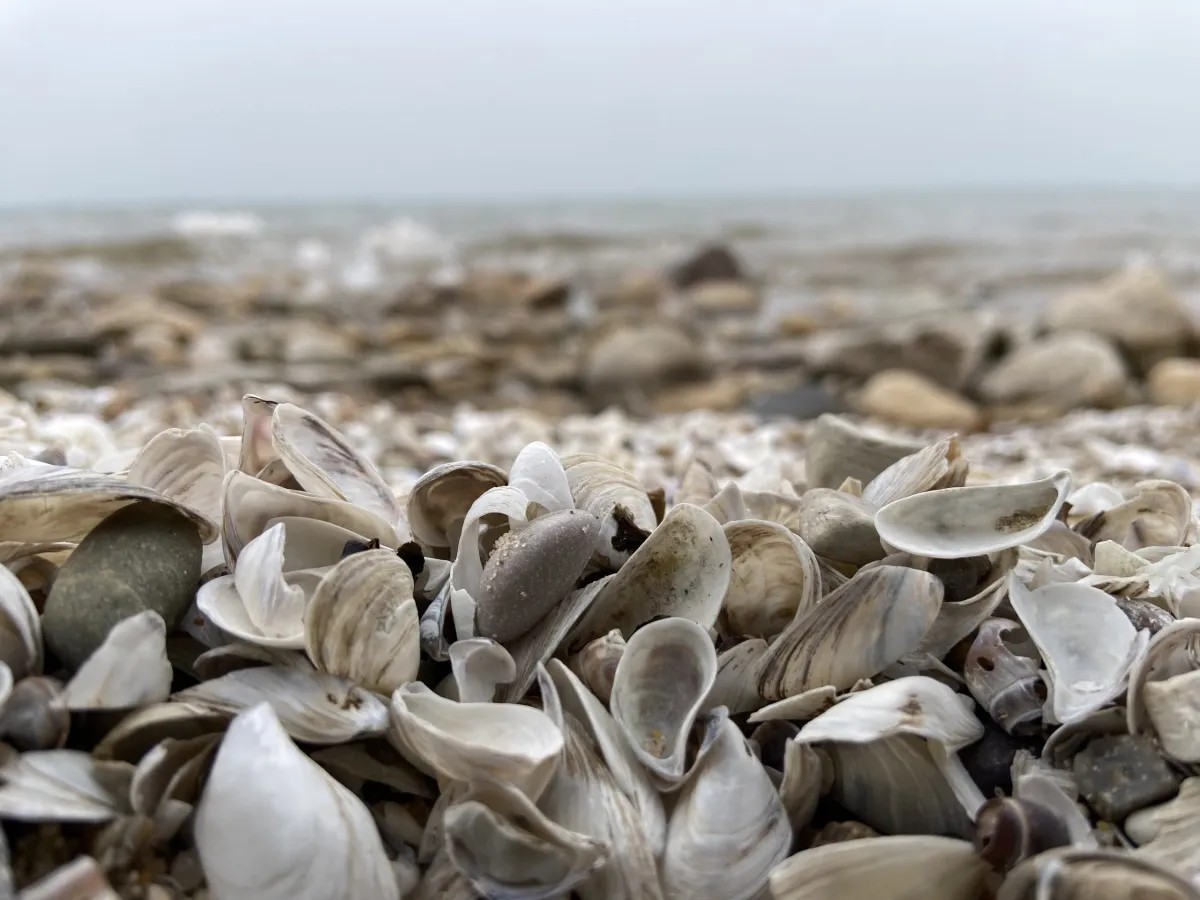
Invasive mussel shells are more common than pebbles on a Lake Michigan beach near Petoskey.  (Kelly House/Bridge Michigan)

First, invasive filter-feeding zebra and quagga mussels arrived in the Great Lakes from Eastern Europe and multiplied over decades, eventually monopolizing the nutrients and plankton that fish need to survive. Whitefish populations in lakes Michigan and Huron have tanked as a result.

Fortunately for Wisconsin and a sliver of Michigan’s Upper Peninsula, Hansen said, “Southern Green Bay kept building.”

In the late 1990s, scientists began spotting the fish in Green Bay area rivers where they hadn’t been seen in a century. Soon the species started showing up during surveys of lower Green Bay. By the early 2010s, models show the bay was teeming with tens of millions of them.

It’s not entirely clear what caused the whitefish revival, but most see cleaner water as part of the equation.

A decades-long restoration project has cleared away more than 6 million yards of sediment laced with PBCs and nutrient-laced farm runoff from the Fox River and lower Green Bay. Phosphorus concentrations near the rivermouth have declined by a third over 40 years — though they’re still considered too high.

“Pelicans are back, and the bird population seems to be thriving,” said Sarah Bartlett, a water resources specialist with the Green Bay Metropolitan Sewerage District, which monitors the bay’s water quality. “And now we have this world-class fishery.”

Hansen’s theory is that back when whitefish were still abundant in Lake Michigan, some wanderers strayed into the newly hospitable bay and decided to stay. Or maybe they were here all along, waiting for the right conditions to multiply.

Either way, the bay has become a lifeline for whitefish and the humans that eat them.

“I feel very fortunate that the bay is doing as well as it is,” said Stuth, who chairs the state commercial fishing board. 

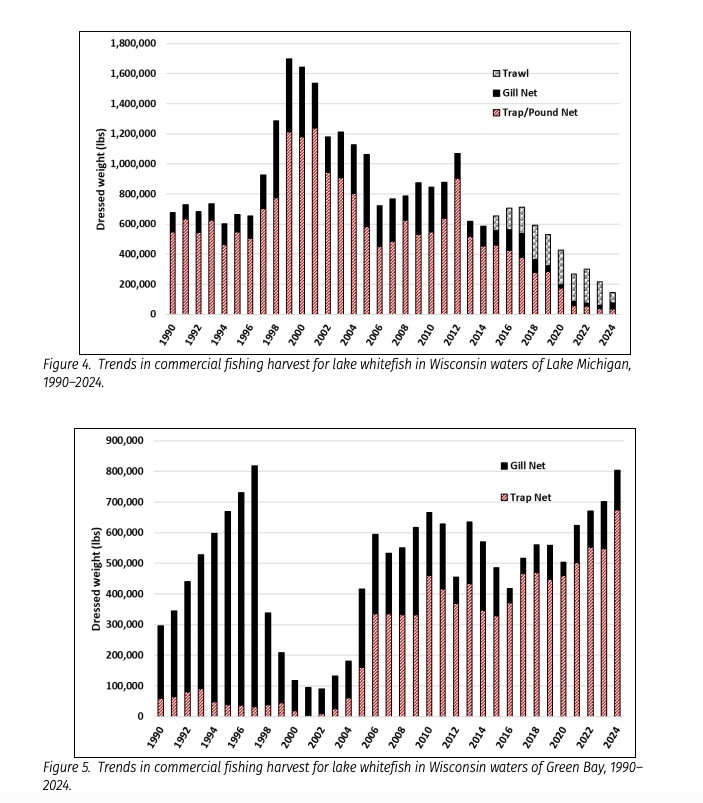
As commercial harvests in the Wisconsin waters of Lake Michigan plummeted from more than 1.6 million pounds in 2000 to less than 200,000 pounds in 2024, harvests in Green Bay skyrocketed from less than 100,000 pounds to more than 800,000.

The bay has also become more important to fishers in Michigan, which has jurisdiction over a portion of its waters.

While the state’s total commercial harvests from Lake Michigan have plummeted 70% since 2009 to just 1.2 million pounds annually, the decline would be steeper were it not for stable stocks in the bay. Once accounting for just a sliver of the catch, the bay now makes up more than half.

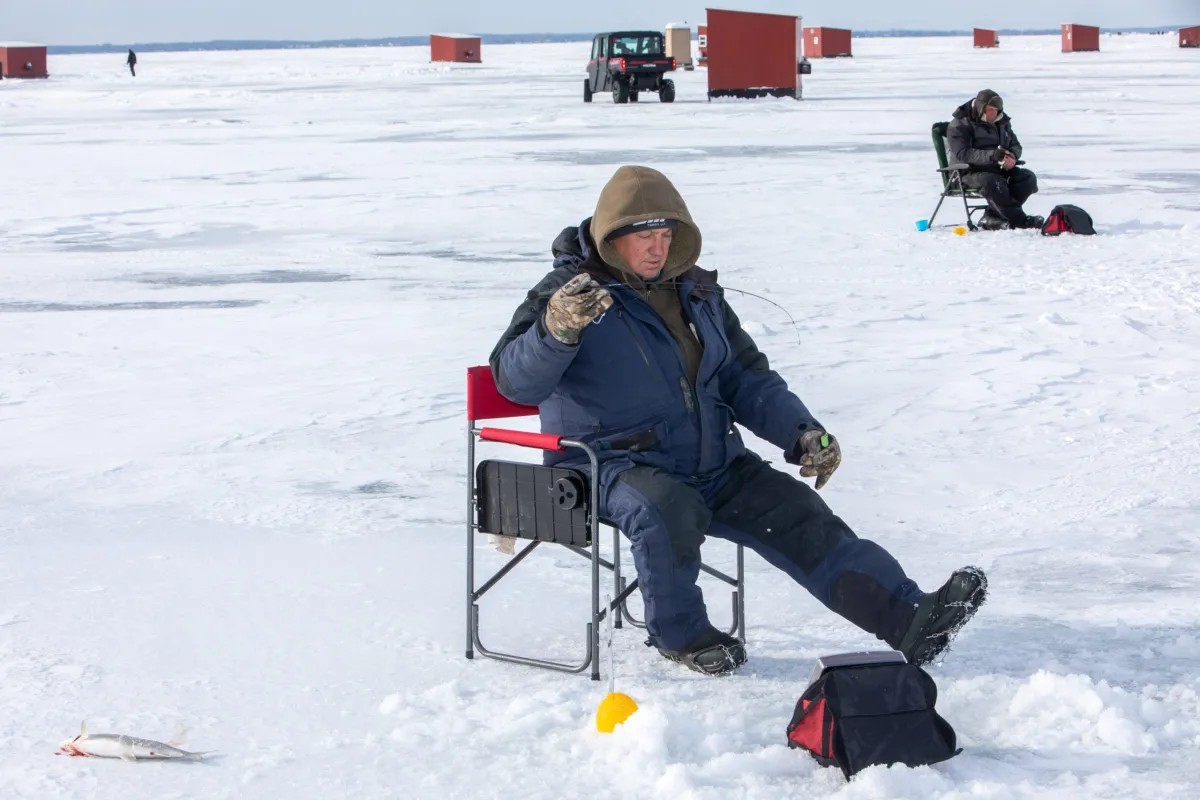
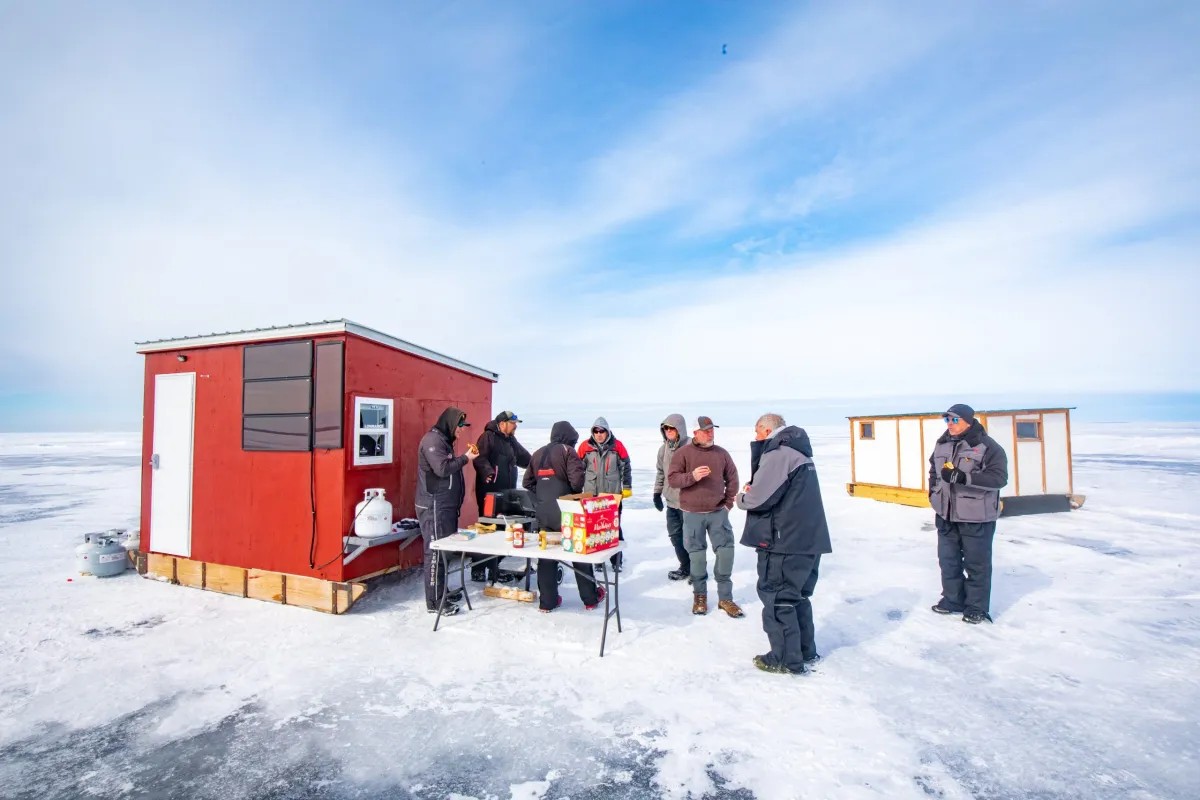
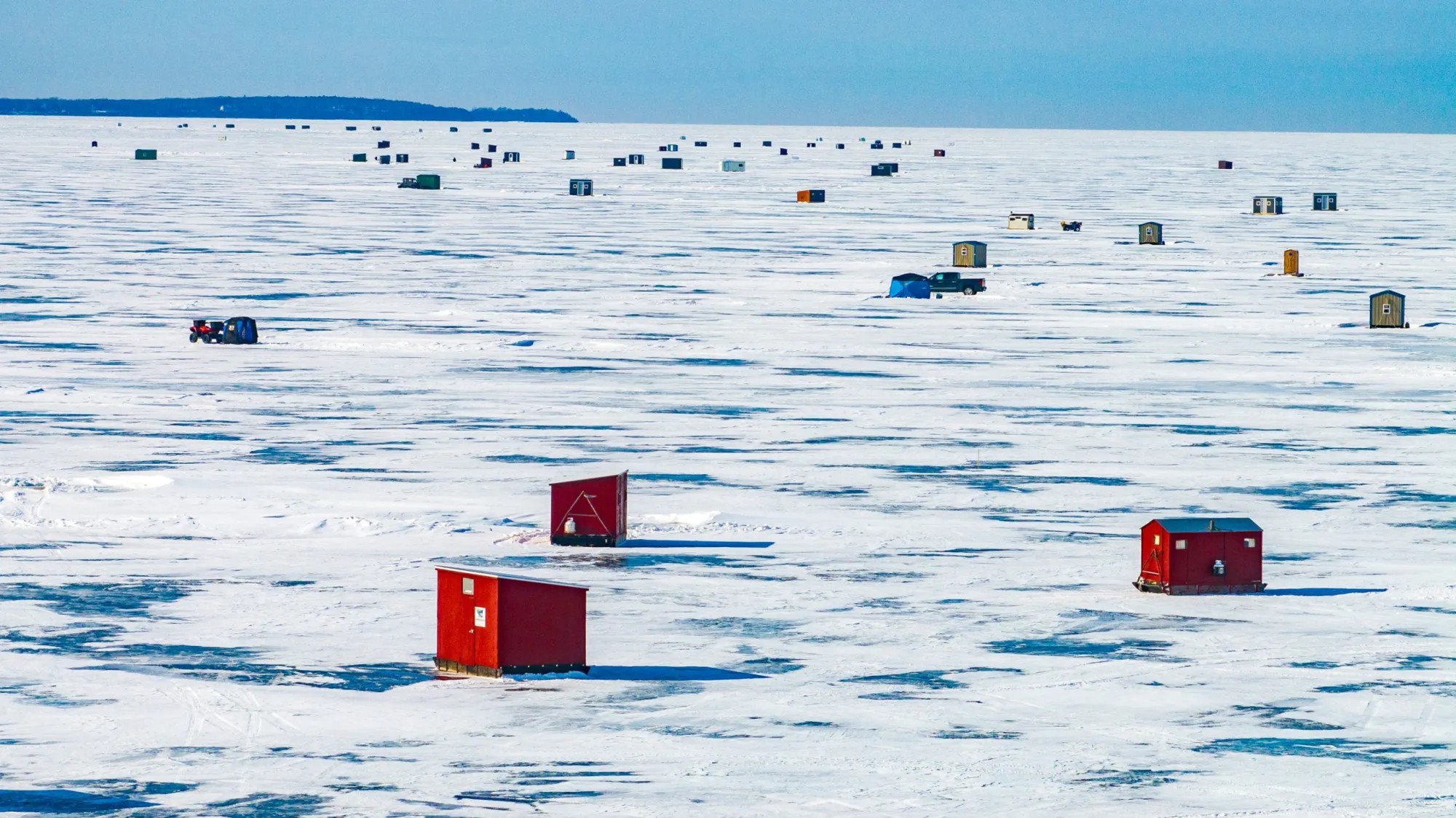
Vytautas Majus, who lives in Chicago, left the city at 2 a.m. to be on the ice fishing for whitefish by 7 a.m. Behind him, the horizon is dotted with ice shanties and anglers also hoping to land a whitefish. (Daniel Kramer for Bridge Michigan)

A recreational ice fishing scene has sprung up too, with thousands of anglers taking to the ice each winter, contributing tens of millions to the local economy.

Ironically, the bay’s lingering nutrient pollution may be helping to some extent – a dynamic also seen in Michigan’s Saginaw Bay. 

Nutrients like phosphorus and nitrogen are the building blocks of life, fueling the growth of aquatic plants and algae at the base of the food web. Plankton eat the algae, small fish eat the plankton, and big fish eat the small fish.

Unlike the main basins, where mussels have hogged nutrients and starved out whitefish, polluted runoff leaves the shallow bays with more than enough for the mussels and everything else. 

Some have even suggested Michigan and its neighbors should start fertilizing the big lakes in hopes of giving whitefish a boost, Herbert said, but “there’s the question of feasibility.” 

First, because the lakes are far deeper and wider than the bays, it would take vast quantities to make an impact. And while excess nutrients may help feed fish, they could also cause oxygen-deprived dead zonesharmful algae blooms and other serious problems.

Green Bay is already offering other lessons for Michigan, though. 

Inspired by whitefish’s return to the bay’s rivers, biologists including Herbert are trying to coax Michigan whitefish to spawn in rivers that connect to nutrient-rich rivermouths like Lake Charlevoix. 

The hope is that if hatchlings can spend a few months fattening up before migrating into the mussel-infested big lake, they’ll stand a better chance of surviving.

Scientists in Green Bay are also tracking whitefish movements, hoping to figure out where they spawn and what makes those habitats special. That kind of information could prove useful to recovery efforts throughout the Great Lakes, said Dan Isermann, a fish biologist with the US Geological Survey.

Living in ‘the good old days’

“We’re really lucky to have what we have here,” said JJ Malvitz, a commercial fishing guide who owes his career to Green Bay’s whitefish resurgence. 

But he lives with fear that “the good old days are now.”

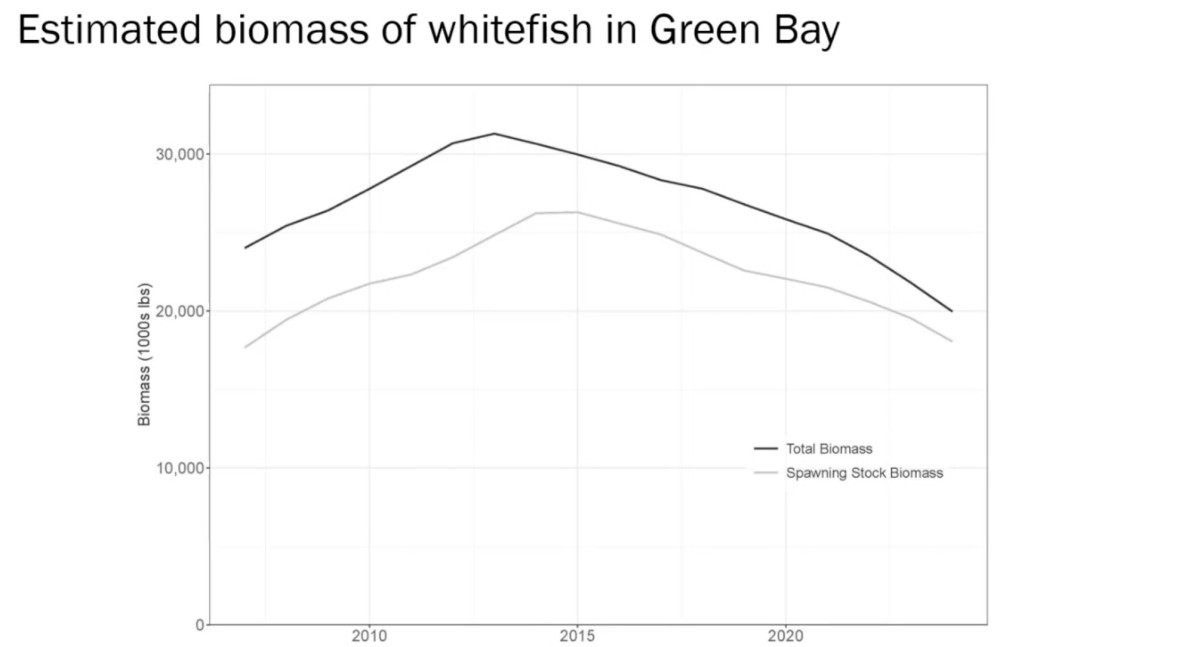
(Courtesy of Wisconsin Department of Natural Resources)

Stocks have shrunk by half since the mid-2010s, according to population models fed with data from DNR surveys and commercial and recreational harvests. The adult whitefish seem to be fat and healthy. But for reasons unknown, fewer of their offspring have been making it to adulthood.  

It’s possible the bay’s population is just leveling off after a period of strong recruitment, Hansen said, “but we want to be vigilant.”

A recent string of lackluster winters adds to the concern. Whitefish lay their eggs on ice-covered reefs. When that protective layer fails to form or melts off early, the eggs can be battered by waves or enticed to hatch early, out of sync with the spring plankton bloom that serves as their main food source.

As whitefish disappeared from the main basin of Lake Michigan, they experienced a resurgence in Green Bay that still isn’t fully understood. (Courtesy of Wisconsin Department of Natural Resources)

While this winter was icier than most, climate change is making low-ice winters more frequent.

“Whitefish are a cold-water species, and we know that’s not where the trends are going,” Hansen said.

Time to cut back?

So far, Wisconsin officials haven’t lowered Green Bay’s annual whitefish quota of 2.28 million pounds, evenly split between the commercial and sport fisheries. Commercial boats are limited to fish bigger than 17 inches, while recreational anglers are limited to 10 fish a day of any size.

But during a recent presentation to the state’s Natural Resources Board, Hansen said it’s time to start keeping closer tabs on the population. 

“If these trends continue,” he said, “We need to have some more serious discussions amongst ourselves about lowering the exploitation rates.”

Malvitz, the guide, believes it’s time for commercial and recreational anglers to collectively agree to harvest fewer fish. He would be satisfied with a five-fish limit for recreational anglers along with smaller quotas for the commercial fishery, which harvests far more fish. 

The bay’s whitefish reappeared quickly and unexpectedly, he said. Who’s to say they couldn’t disappear just as fast?

“I don’t want to be standing on the shore in five years saying ‘remember when,’” he said. 

Stuth, the commercial fishing board chair, isn’t ready to accept tighter quotas in the bay, but said population models should be closely watched. If the declines continue, he said, cuts may be on the table.

“A very conservative approach is going to be necessary,” he said. “Because it’s our last stronghold. If that goes away, what do we have?”

The post A Wisconsin whitefish refuge offers lessons for Michigan. But will it last? appeared first on Great Lakes Now.
Original Article

Great Lakes Now

Great Lakes Now

https://www.greatlakesnow.org/2026/03/12/a-wisconsin-whitefish-refuge-offers-lessons-for-michigan-but-will-it-last/

Kelly House, Bridge Michigan

By Richelle Wilson, Wisconsin Public Radio

This article was republished here with permission from Wisconsin Public Radio.


Paul Ehorn started scuba diving as a teenager in the early 1960s. On his first dive, he was wearing a self-assembly wetsuit he purchased from a Montgomery Ward catalog for $28.

“The water’s cold, probably the low 40s, and I came up just shivering uncontrollably,” Ehorn told WPR’s “Wisconsin Today.” “All I could say was, ‘How long before we can go back in?’”

“I was hooked. That was it,” he added. “It just became a passion and obsession.”

After that, it wasn’t long before Ehorn picked up some sonar gear and started what would become a lifelong career as a shipwreck hunter. Now 80 years old, he has discovered 15 shipwrecks in the Great Lakes. 

His latest find, which he announced to the public in February, is Lac La Belle, a luxury steamer that sank in Lake Michigan more than 150 years ago. The ship has been on Ehorn’s radar from the beginning due to his interest in wooden steamers and because it’s “close to home,” he said in the press release. 

After nearly 60 years of searching, Ehorn got the clue he needed and finally located the sunken wreckage about 20 miles offshore between Racine and Kenosha.

“It was just a wonderful day,” Ehorn said. “Beautiful wreck, it turned out.”

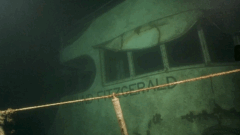
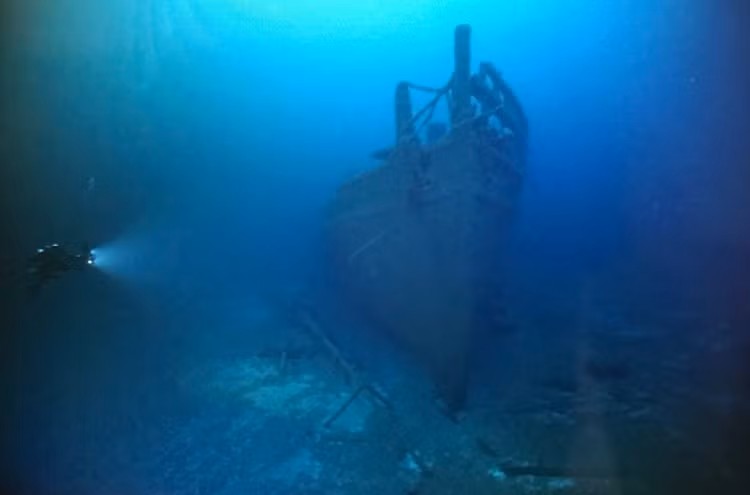
A scuba diver approaches the bow of the Lac La Belle. Photo courtesy of Paul Ehorn

Ehorn and his crew first found the wreckage of Lac La Belle in 2022, but he waited to publicly share his discovery until conditions were right to go down for a dive to film the ship and create a 3D model. Documenting the shipwreck is an important part of the process to educate the public and give historians a unique view into the past.

“All of our wrecks on the Great Lakes have a shelf life — they’re not going to look like this in 100 years,” said Brendon Baillod, president of the Wisconsin Underwater Archaeology Association. “I have to commend Paul for really wanting to do that photogrammetry model, because that’s a good standard for recording exactly how that wreck was at the time he found it.”

As a maritime historian, Baillod has researched a number of Great Lakes shipwrecks. His book “Fathoms Deep But Not Forgotten: Wisconsin’s Lost Ships” includes an entry for Lac La Belle that details its history carrying passengers and cargo — first between Cleveland and Lake Superior starting in 1864, and later on a trade route between Milwaukee and Grand Haven, Michigan. 

On Oct. 13, 1872, the ship sank a couple hours after departing Milwaukee due to a leak that sprung during a storm. The ship was carrying cargo and 53 passengers. Eight people died after one of the lifeboats capsized.

“The Lac La Belle is a time capsule. It’s an underwater museum from 1872,” Baillod told “Wisconsin Today.” “It played such a pivotal role not just in the industrialization of America, but in Milwaukee’s history.”

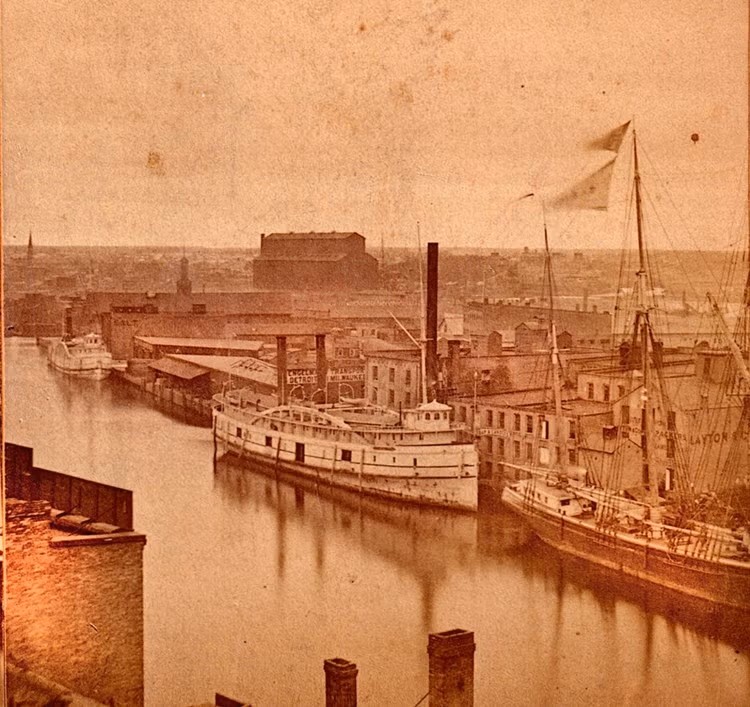
The steamer Lac La Belle docked in Milwaukee in 1872. This image is from an original stereoview by W. H. Sherman. Image courtesy of Brendon Baillod

A ‘golden age’ of shipwreck discovery

The Great Lakes are home to an estimated 6,000 to 10,000 shipwrecks, most of which remain undiscovered, according to the Wisconsin Water Library

But more of these sunken ships are being found, Baillod said, due to advancements in affordable technology and with the help of citizen scientists who are becoming more aware of shipwreck history.

“It’s kind of the golden age, I guess you might say, of shipwreck discovery on the Great Lakes,” he said, “and a tremendous opportunity for us to tell the stories of these ships that played such a huge role in the cultural history of the Midwest, and Wisconsin in particular.”

And the race is on to find more of these wrecks, as invasive quagga mussels congregate around shipwrecks and damage what remains.

For shipwreck hunters, the mussels are a double-edged sword: Despite the damage they cause, the mussels also are clarifying the water, making shipwrecks easier to spot. Whereas Lake Michigan used to have only about 5 or 10 feet of visibility underwater, now divers have a much clearer view.

“We called it ‘Braille diving.’ You’d go down and you’d have to get within a couple of feet of the shipwreck,” Baillod said. “Now, you go down there and you can see sometimes 50, 80, 100 feet — you can see the whole ship.”

While that has created opportunities for “beautiful underwater photos of these shipwrecks” and raised public awareness, Baillod said, the quagga mussels are ultimately decimating the food web and changing Lake Michigan’s biome, leading to the collapse of native species like whitefish.

Baillod is one of the founders of the Ghost Ships Festival, an annual community event to promote research, education and public awareness of Wisconsin’s shipwreck history. This year, the event is being held in Manitowoc on Friday, March 6 and Saturday, March 7 and includes a presentation from Ehorn about his discovery of the Lac La Belle.

“We’re trying to educate the public about the Great Lakes maritime history and about the role these ships played in building America back in the 1800s,” Baillod said. “And we’re having a lot of success — people are learning about it.”

The post Shipwreck hunter discovers sunken 150-year-old luxury liner off the coast of Wisconsin appeared first on Great Lakes Now.

Original Article

Great Lakes Now

Great Lakes Now

https://www.greatlakesnow.org/2026/03/10/shipwreck-hunter-discovers-sunken-150-year-old-luxury-liner-off-the-coast-of-wisconsin/

Wisconsin Public Radio

Fifty years later: The little-known story of the families the Fitz left behind

Wrecked: The Edmund Fitzgerald and the Sinking of the American Economy” is a new book by Thomas Nelson with Jeremy Podair. Below is an adapted excerpt from the chapter “Just Call Toby,” that details the legal mess families were put through after losing their loved ones on the Edmund Fitzgerald. 

Read Now at Great Lakes Now.

Original Article

Great Lakes Now

Great Lakes Now

https://www.greatlakesnow.org/2025/11/fifty-years-later-the-little-known-story-of-the-families-the-fitz-left-behind/

Thomas Nelson

Going Country at Farrand Hall

Situated in a town of a little over a thousand people in Colon, Michigan, is an idyllic and pastoral outdoor dining experience just 250 feet from a main road. Guests are recommended to order a glass of wine, wander the property grounds, and soak in their surroundings before taking a seat at a banquet-style table.

Read Now at Great Lakes Now.

Original Article

Great Lakes Now

Great Lakes Now

https://www.greatlakesnow.org/2025/11/going-country-at-farrand-hall/

S. Nicole Lane

How Michigan’s Inland Fish Farmers Cultivate a Sustainable Future for the Great Lakes

Despite being surrounded by the largest group of freshwater lakes on Earth, Michigan imports the vast majority of its seafood, between 65% and 90%, according to Michigan Sea Grant.

As global aquaculture has grown to meet increasing demand for protein, a small but determined group of inland fish farmers in the Great Lakes region are working to build a more sustainable, local supply.

Read Now at Great Lakes Now.

Original Article

Great Lakes Now

Great Lakes Now

https://www.greatlakesnow.org/2025/08/how-michigans-inland-fish-farmers-cultivate-a-sustainable-future-for-the-great-lakes/

Donte Smith

Bassmaster Elite arrives as Lake St. Clair’s smallmouth break records

As anglers compete in the 2025 Yokohama Tire Bassmaster Elite competition on Lake St. Clair from Aug. 7-10, they’ll likely bring some pretty prize catches to weigh-ins. That’s because the catch-and-release method has allowed smallmouth bass on Lake St. Clair to grow to much greater sizes, according to new research from the Michigan Department of Natural Resources (DNR).

Read Now at Great Lakes Now.

Original Article

Great Lakes Now

Great Lakes Now

https://www.greatlakesnow.org/2025/08/bassmaster-elite-arrives-as-lake-st-clairs-smallmouth-break-records/

Jack Armstrong

Why we don’t bike like the Dutch — yet

How did you get to work today?

Maybe, like 14% of Americans, you didn’t have to go anywhere because you work from home. But most people do need some form of transportation to earn a living. By far the biggest group is the 69% of people who drive to work alone.

Read Now at Great Lakes Now.

Original Article

Great Lakes Now

Great Lakes Now

https://www.greatlakesnow.org/2025/07/why-we-dont-bike-like-the-dutch-yet/
Sean Ericson, Great Lakes Now

‘We can’t regulate ourselves’ out of whitefish crisis, experts say

By Emilio Perez Ibarguen, Bridge Michigan

The Great Lakes News Collaborative includes Bridge Michigan; Circle of Blue; Great Lakes Now at Detroit PBS; Michigan Public, Michigan’s NPR News Leader; and The Narwhal who work together to bring audiences news and information about the impact of climate change, pollution, and aging infrastructure on the Great Lakes and drinking water.

Read Now at Great Lakes Now.

Original Article

Great Lakes Now

Great Lakes Now

https://www.greatlakesnow.org/2025/07/we-cant-regulate-ourselves-out-of-whitefish-crisis-experts-say/
Bridge Michigan

Easy summer foraging adventures the whole family will remember

This is a part of “A Year in the Wild Kitchen of the Great Lakes,” a series in partnership with expert forager Lisa M. Rose, with the mission of nurturing a deeper connection with the natural world through foraging. To get started with your foraging journey, begin here with our “Framework to Sustainable and Safe Practices.” 

As Michigan’s fields burst into berry-laden glory, summer invites us to celebrate nature’s sweet, sun-ripened gifts.

Read Now at Great Lakes Now.

Original Article

Great Lakes Now

Great Lakes Now

https://www.greatlakesnow.org/2025/06/easy-summer-foraging-adventures-the-whole-family-will-remember/

Lisa M. Rose

Cleveland Metroparks breaks down accessibility barriers with all-terrain wheelchairs

By Zaria Johnson, Ideastream Public Media

This story was originally published by Ideastream.

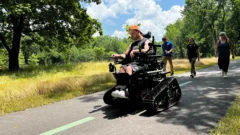
Cleveland Metroparks is expanding access to its trail network for visitors with disabilities. It’s acquired two new wheelchairs – one a motorized Action Trackchair, the other, a manual GRIT Freedom Chair, for use on and off the beaten paths.

Read Now at Great Lakes Now.

Original Article

Great Lakes Now

Great Lakes Now

https://www.greatlakesnow.org/2025/06/cleveland-metroparks-breaks-down-accessibility-barriers-with-all-terrain-wheelchairs/

Ideastream Public Media

White throated sparrow takes first place in fattest bird competition

This article was republished here with permission from Great Lakes Echo.

By Clara Lincolnhol, Great Lakes Echo

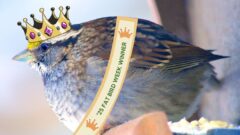
A very round white throated sparrow is the heavyweight champion of the 2025 Wisconsin Fat Bird Week contest.

The bird, coined the “spherical white-throated sparrow,” won by a landslide, receiving 72% of the vote in the final round against its nearest competitor, a “rotund ruby-throated hummingbird.”

The winner made it through eight rounds in the single-elimination, March Madness-style bracket competition against seven other birds.

Read Now at Great Lakes Now.

Original Article

Great Lakes Now

Great Lakes Now

https://www.greatlakesnow.org/2025/06/white-throated-sparrow-takes-first-place-in-fattest-bird-competition/

Great Lakes Echo

Points North: The Longest Paddle

By Ellie Katz, Interlochen Public Radio

Points North is a biweekly podcast about the land, water and inhabitants of the Great Lakes.

This episode was shared here with permission from Interlochen Public Radio. 

In the summer of 2015, Traci Lynn Martin’s mom was in the final weeks of a battle with cancer.

Read Now at Great Lakes Now.

Original Article

Great Lakes Now

Great Lakes Now

https://www.greatlakesnow.org/2025/05/points-north-the-longest-paddle/

Interlochen Public Radio

Everything you need to know about the Biggest Week in American Birding

A fledgling birding festival that hatched 15 years ago has become an international event drawing visitors from around the world to northwest Ohio. While the stars of the show at the Biggest Week in American Birding (BWIAB) are migrating warblers, there are dozens of other species which draw crowds from every state and continent including wading and shore birds, tanagers, songbirds, waterfowl and raptors.

Read Now at Great Lakes Now.

Original Article

Great Lakes Now

Great Lakes Now

https://www.greatlakesnow.org/2025/05/everything-you-need-to-know-about-biggest-week-in-american-birding/

James Proffitt, Great Lakes Now

On the importance of dark sky parks

Summer is just around the corner, and for many in the Great Lakes region, the coming season is synonymous with weekends at the beach, camping trips and — if you’re lucky — stargazing. There are many places in the Great Lakes where the skies are dark enough to enjoy the stars and planets overhead, but specific recognition for such places varies by state.

Read Now at Great Lakes Now.

Original Article

Great Lakes Now

Great Lakes Now

https://www.greatlakesnow.org/2025/04/the-importance-of-dark-sky-parks/

Anna Sysling, Great Lakes Now

Spring Break Staycation: Foraging with the Family

This is a part of “A Year in the Wild Kitchen of the Great Lakes,” a series in partnership with expert forager Lisa M. Rose, with the mission of nurturing a deeper connection with the natural world through foraging. To get started with your foraging journey, begin here with our “Framework to Sustainable and Safe Practices.” 

This spring break, transform your usual holiday into an educational excursion that connects your family with the natural world.

Read Now at Great Lakes Now.

Original Article

Great Lakes Now

Great Lakes Now

https://www.greatlakesnow.org/2025/04/spring-break-staycation-foraging-with-the-family/

Lisa M. Rose

How community gardens serve as ‘third places’ for Detroiters

Toward the end of 2023, I was newly unemployed and living by myself for the first time. 

In between jobs, searching for employment and a means of fulfillment and community, I began to reflect on how my mom got into gardening. In the dead of winter, memories of childhood summers spent pulling weeds, tilling soil and fleeing the occasional garter snake alongside her began to color my mind. 

Read Now at Great Lakes Now.

Original Article

Great Lakes Now

Great Lakes Now

https://www.greatlakesnow.org/2025/04/community-gardens-third-places-for-detroiters/

Ethan Bakuli

What would the Great Lakes region be like with bullet trains?

A few months ago, I was riding on Amtrak’s new Borealis line from St. Paul, Minn., to Chicago. The train was packed that day, and the new line has proved popular.

My coach seat was much nicer than any airline. Plus, I didn’t have to go through security.

Read Now at Great Lakes Now.

Original Article

Great Lakes Now

Great Lakes Now

https://www.greatlakesnow.org/2025/03/what-would-the-great-lakes-region-be-like-with-bullet-trains/

Sean Ericson, Great Lakes Now

National parks see a record number of visitors, including in Wisconsin

By Danielle Kaeding, Wisconsin Public Radio

This article was republished here with permission from Wisconsin Public Radio.

Wisconsin saw more visitors at sites managed by the National Park Service last year, and America’s national parks had a record number of visitors.

News of the growing demand at the parks comes as the Trump administration has cut staff to manage them.

Read Now at Great Lakes Now.

Original Article

Great Lakes Now

Great Lakes Now

https://www.greatlakesnow.org/2025/03/national-parks-see-a-record-number-of-visitors-including-in-wisconsin/

Wisconsin Public Radio

Ian Outside: A Detroiter’s journey to Calumet for CopperDog

It seems like every year winter creeps forward into being one of my favorite seasons. It’s not lost on me that this budding love affair began once I gained the courage to venture into Northern Michigan during the months almost everyone will tell you to avoid. The truth is: Metro Detroit isn’t made for the cold and snow, so I’m allowing the North Woods to change my mind. 

Read Now at Great Lakes Now.

Original Article

Great Lakes Now

Great Lakes Now

https://www.greatlakesnow.org/2025/03/ian-outside-a-detroiters-journey-to-calumet-for-copperdog/

Ian Solomon

Tapping Into Tradition: It’s Maple Syrup Season

This is a part of “A Year in the Wild Kitchen of the Great Lakes,” a series in partnership with expert forager Lisa M. Rose, with the mission of nurturing a deeper connection with the natural world through foraging. To get started with your foraging journey, begin here with our “Framework to Sustainable and Safe Practices.”

In the Great Lakes, the maple syrup harvest season begins when daytime temperatures rise above freezing while nights remain cold — typically from mid to late February for much of the region, and a bit later further north.

Read Now at Great Lakes Now.

Original Article

Great Lakes Now

Great Lakes Now

https://www.greatlakesnow.org/2025/03/tapping-into-tradition-its-maple-syrup-season/

Lisa M. Rose

Ice fishing returns to Lake Erie after years of thin ice and open water

This article was republished here with permission from Great Lakes Echo.

By Clara Lincolnhol, Great Lakes Echo

This year’s winter has been a breath of fresh air for ice fishing enthusiasts and businesses around Lake Erie.

“There were over 300 huts out on the ice on Presque Isle Bay one weekend in January,” said Jerry Skyrpzak, president of the S.O.N.S.

Read Now at Great Lakes Now.

Original Article

Great Lakes Now

Great Lakes Now

https://www.greatlakesnow.org/2025/02/ice-fishing-returns-to-lake-erie-after-years-of-thin-ice-and-open-water/

Great Lakes Echo

Trump firings hit Great Lakes sea lamprey program, Michigan forestry workers

By Kelly House, Bridge Michigan

The Great Lakes News Collaborative includes Bridge Michigan; Circle of Blue; Great Lakes Now at Detroit PBS; Michigan Public, Michigan’s NPR News Leader; and The Narwhal who work together to bring audiences news and information about the impact of climate change, pollution, and aging infrastructure on the Great Lakes and drinking water.

Read Now at Great Lakes Now.

Original Article

Great Lakes Now

Great Lakes Now

https://www.greatlakesnow.org/2025/02/trump-firings-hit-great-lakes-sea-lamprey-program-michigan-forestry/

Bridge Michigan

Trump firings hit Great Lakes sea lamprey program, Michigan forestry workers

By Kelly House, Bridge Michigan

The Great Lakes News Collaborative includes Bridge Michigan; Circle of Blue; Great Lakes Now at Detroit PBS; Michigan Public, Michigan’s NPR News Leader; and The Narwhal who work together to bring audiences news and information about the impact of climate change, pollution, and aging infrastructure on the Great Lakes and drinking water.

Read Now at Great Lakes Now.

Original Article

Great Lakes Now

Great Lakes Now

https://www.greatlakesnow.org/2025/02/trump-firings-hit-great-lakes-sea-lamprey-program-michigan-forestry/

Bridge Michigan

Back to the Boundary Waters

Erik Grams was 12 years old when he first went camping in the Boundary Waters Canoe Area Wilderness in northern Minnesota. Ever since that trip, he’s been coming back again and again. It’s his favorite place in the world.

“I really feel – when I’m in the Boundary Waters – that I’m in my element,” said Erik.

Read Now at Great Lakes Now.

Original Article

Great Lakes Now

Great Lakes Now

https://www.greatlakesnow.org/2025/02/back-to-the-boundary-waters/

Interlochen Public Radio

Saving mussels one dive at a time

Biological collection specialists are divers who travel around the country relocating freshwater mussels and other vulnerable aquatic species before river restoration projects begin.

In September of 2024, a team of 20 divers scoured 40,000 square meters of the Grand River in downtown Grand Rapids, Michigan. In just two weeks, the team found, identified, marked, tagged, and relocated every native freshwater mussel within their search area.

Read Now at Great Lakes Now.

Original Article

Great Lakes Now

Great Lakes Now

https://www.greatlakesnow.org/2025/02/saving-mussels-one-dive-at-a-time/

Great Lakes Now

The early elk hunt was tough last year. Hot weather is likely to blame.

By Izzy Ross, Interlochen Public Radio

This coverage is made possible through a partnership between Interlochen Public Radio and Grist, a nonprofit environmental media organization.

The elk hunting season got off to a tough start last year, and state officials say heat is at least partly to blame.

Read Now at Great Lakes Now.

Original Article

Great Lakes Now

Great Lakes Now

https://www.greatlakesnow.org/2025/02/the-early-elk-hunt-was-tough-last-year-hot-weather-is-likely-to-blame/

Interlochen Public Radio

Report: Great Lakes recreational fishing worth billions to economy, but not as much as often cited

By Lester Graham, Michigan Public

The Great Lakes News Collaborative includes Bridge Michigan, Circle of Blue, Great Lakes Now at Detroit PBS, Michigan Public and The Narwhal who work together to bring audiences news and information about the impact of climate change, pollution, and aging infrastructure on the Great Lakes and drinking water.

Read Now at Great Lakes Now.

Original Article

Great Lakes Now

Great Lakes Now

https://www.greatlakesnow.org/2025/01/report-great-lakes-recreational-fishing-worth-billions-to-economy-but-not-as-much-as-often-cited/

Michigan Public

A Great Lakes ‘Pompeii’? Lake Huron’s depths hold secrets of human history

By Kelly House and Aaron Martin, Bridge Michigan

The Great Lakes News Collaborative includes Bridge Michigan; Circle of Blue; Great Lakes Now at Detroit PBS; Michigan Public, Michigan’s NPR News Leader; and The Narwhal who work together to bring audiences news and information about the impact of climate change, pollution, and aging infrastructure on the Great Lakes and drinking water.

Read Now at Great Lakes Now.

Original Article

Great Lakes Now

Great Lakes Now

https://www.greatlakesnow.org/2025/01/a-great-lakes-pompeii-lake-hurons-depths-hold-secrets-of-human-history/

Bridge Michigan

Great Lakes Moment: Connecting people to nature through The Great Lakes Way

A recent Community Foundation for Southeast Michigan report documents substantial progress in creating The Great Lakes Way — an interconnected set of greenways and water trails stretching from Port Huron, Michigan on southern Lake Huron to Toledo, Ohio on western Lake Erie.

In 2000, the Community Foundation polled metropolitan Detroit communities about obstacles to building greenways.

Read Now at Great Lakes Now.

Original Article

Great Lakes Now

Great Lakes Now

https://www.greatlakesnow.org/2025/01/great-lakes-moment-connecting-people-to-nature-through-the-great-lakes-way/

John Hartig

Winter Wellness Pantry: Elderberry Elixir

Part of “A Year in the Wild Kitchen of the Great Lakes,” a series in partnership with expert forager Lisa M. Rose, with the mission of nurturing a deeper connection with the natural world through foraging. To get started with your foraging journey, begin here with our “Framework to Sustainable and Safe Practices” and check out Part 1 of “Winter Wellness Pantry” for tips and tricks to stay healthy this winter with wild herbs of the Great Lakes. 

Read Now at Great Lakes Now.

Original Article

Great Lakes Now

Great Lakes Now

https://www.greatlakesnow.org/2025/01/winter-wellness-pantry-elderberry-elixir/

Lisa M. Rose

Cuyahoga Valley National Park celebrates 50 years of environmental stewardship

By Zaria Johnson, Ideastream Public Media

This story was originally published by Ideastream.

Cuyahoga Valley National Park is turning 50, and celebrating the milestone by highlighting decades of expansion, development and environmental preservation.

In September, the park kicked off hikes, happy hours and scavenger hunts — events that will continue through the end of 2025 — to showcase how far Northeast Ohio’s national park has come since its founding in 1974.

Read Now at Great Lakes Now.

Original Article

Great Lakes Now

Great Lakes Now

https://www.greatlakesnow.org/2024/12/cuyahoga-valley-national-park-celebrates-50-years-environmental-stewardship/

Ideastream Public Media

Climate takes its toll on the “cherry capital of the world”

By Izzy Ross, Interlochen Public Radio

This coverage is made possible through a partnership with IPR and Grist, a nonprofit independent media organization dedicated to telling stories of climate solutions and a just future.

Walking between rows of dormant cherry and apple trees in mid-November, Raul Gomez, operations manager at Wunsch Farms on the Old Mission Peninsula, pointed out sweet cherry varieties like black pearls.

Read Now at Great Lakes Now.

Original Article

Great Lakes Now

Great Lakes Now

https://www.greatlakesnow.org/2024/12/climate-takes-its-toll-on-the-cherry-capital-of-the-world/

Interlochen Public Radio

Points North: Saving David

By Michael Livingston

Points North is a biweekly podcast about the land, water and inhabitants of the Great Lakes.

This episode was shared here with permission from Interlochen Public Radio. 

On a blustery September day in 2024, 68-year-old David Holtfreter decides to go kayaking in Grand Traverse Bay, Michigan.

Read Now at Great Lakes Now.

Original Article

Great Lakes Now

Great Lakes Now

https://www.greatlakesnow.org/2024/11/points-north-saving-david/

Interlochen Public Radio

5 Reasons to Build a Backyard Frog Pond

Great Lakes Now recently sat down with Margot Fass of the non-profit group, A Frog House. Located in Pittsfield, New York on the banks of the Erie Canal and on the edge of the Lake Ontario sub-basin. A Frog House helps to encourage ecological education, local advocacy and collaboration around clean water and thriving wetlands.

Read Now at Great Lakes Now.

Original Article

Great Lakes Now

Great Lakes Now

https://www.greatlakesnow.org/2024/11/5-reasons-to-build-a-backyard-frog-pond/

Lisa John Rogers, Great Lakes Now

Waves of Change: Meet Protect the Porkies founder Tom Grotewohl

Waves of Change is an online interview series highlighting the diverse faces and perspectives shaping the environmental justice movement throughout the Great Lakes region.

This month, we spoke with Tom Grotewohl, a resident of Wakefield Township in Michigan’s Upper Peninsula and founder of the Protect the Porkies campaign.

Read Now at Great Lakes Now.

Original Article

Great Lakes Now

Great Lakes Now

https://www.greatlakesnow.org/2024/11/waves-of-change-meet-protect-the-porkies-founder-tom-grotewohl/

Great Lakes Now

Winter Wellness Pantry

This story is a part of “A Year in the Wild Kitchen of the Great Lakes,” a series in partnership with expert forager Lisa M. Rose, with the mission of nurturing a deeper connection with the natural world through foraging. To get started with your foraging journey, begin here with our “Framework to Sustainable and Safe Practices.”

As winter sets in, it’s the perfect time to reflect on your year of foraging, plan for the coming seasons, and ensure your pantry is stocked and your health fortified.

Read Now at Great Lakes Now.

Original Article

Great Lakes Now

Great Lakes Now

https://www.greatlakesnow.org/2024/11/winter-wellness-pantry/

Lisa M. Rose

Navigating Northeast Ohio without a car? Planning group wants your ideas on better parks connections

By Zaria Johnson, Ideastream Public Media

This story was originally published by Ideastream.

The Northeast Ohio Areawide Coordinating Agency is seeking feedback on a proposed plan to better connect the region’s county parks systems to each other, and to community resources.

Read Now at Great Lakes Now.

Original Article

Great Lakes Now

Great Lakes Now

https://www.greatlakesnow.org/2024/11/navigating-northeast-ohio-without-a-car-planning-group-wants-your-ideas-on-better-parks-connections/

Ideastream Public Media

Smashing pumpkins in Traverse City to reduce trash

By Izzy Ross, Interlochen Public Radio

This coverage is made possible through a partnership with IPR and Grist, a nonprofit independent media organization dedicated to telling stories of climate solutions and a just future.

Nine-year-old Gunner Vistisen was wearing goggles, a wooden mallet in hand, standing near a blue tarp lined with pumpkins on a lot in Traverse City.

Read Now at Great Lakes Now.

Original Article

Great Lakes Now

Great Lakes Now

https://www.greatlakesnow.org/2024/11/smashing-pumpkins-in-traverse-city-to-reduce-trash/

Interlochen Public Radio

Pressed for powder, study finds ski areas are relying more on snowmaking

By Danielle Kaeding, Wisconsin Public Radio

This article was republished here with permission from Wisconsin Public Radio.

Ski hills in Wisconsin are relying more on snowmaking and other strategies to adapt to changing snow conditions due to climate change, according to a new study.

Read Now at Great Lakes Now.

Original Article

Great Lakes Now

Great Lakes Now

https://www.greatlakesnow.org/2024/11/pressed-for-powder-study-finds-ski-areas-are-relying-more-on-snowmaking/

Wisconsin Public Radio

Presenting Atlas Obscura: The Mysterious Sinkholes of Mount Baldy

By Daniel Wanschura

Points North is a biweekly podcast about the land, water and inhabitants of the Great Lakes.

This episode was shared here with permission from Interlochen Public Radio. 

On July 12, 2013 the Woessner family was hiking in Indiana.

Read Now at Great Lakes Now.

Original Article

Great Lakes Now

Great Lakes Now

https://www.greatlakesnow.org/2024/11/presenting-atlas-obscura-the-mysterious-sinkholes-of-mount-baldy/

Interlochen Public Radio

National Park Service Issues Landmark Order for Tribal Consultations

By Native News Online Staff, Native News Online

This article originally appeared on Native News Online. Founded in 2011, Native News Online reaches millions of Native and non-Native readers annually including American Indians, Alaska Natives, Native Hawaiians and others interested in Native American concerns.

Read Now at Great Lakes Now.

Original Article

Great Lakes Now

Great Lakes Now

https://www.greatlakesnow.org/2024/11/national-park-service-issues-landmark-order-for-tribal-consultations/

Native News Online

Waves of Change: Meet Maji ya Chai Land Sanctuary founder Rebeka Ndosi

Waves of Change is an online interview series highlighting the diverse faces and perspectives shaping the environmental justice movement throughout the Great Lakes region.

This month, we spoke with Rebeka Ndosi, founder of the Maji ya Chai Land Sanctuary, a Black-led healing sanctuary just outside of Two Harbors, Minnesota. 

Read Now at Great Lakes Now.

Original Article

Great Lakes Now

Great Lakes Now

https://www.greatlakesnow.org/2024/10/waves-of-change-meet-maji-ya-chai-land-sanctuary-founder-rebeka-ndosi/

Great Lakes Now

A Foraged Great Lakes Woodland Chai Tea

This story is a part of “A Year in the Wild Kitchen of the Great Lakes,” a series in partnership with expert forager Lisa M. Rose, with the mission of nurturing a deeper connection with the natural world through foraging. To get started with your foraging journey, begin here with our “Framework to Sustainable and Safe Practices.”

As the season shifts and the air chills, I find myself drawn to the warmth and sustenance that the wild foods of fall offer — from roots to mushrooms to nuts to herbs — and take great satisfaction in concocting nourishing recipes for my family and friends.

Read Now at Great Lakes Now.

Original Article

Great Lakes Now

Great Lakes Now

https://www.greatlakesnow.org/2024/10/a-foraged-great-lakes-woodland-chai-tea/

Lisa M. Rose

Spooky Lake Superior: The SS Kamloops

Spooky Lakes: 25 Strange and Mysterious Lakes That Dot Our Planet is a new book by Geo Rutherford. Below is an adapted excerpt from her New York Times best seller, all about Lake Superior. Follow Geo on TikTok or Instagram for more content on spooky lakes.

Read Now at Great Lakes Now.

Original Article

Great Lakes Now

Great Lakes Now

https://www.greatlakesnow.org/2024/10/spooky-lake-superior-the-ss-kamloops/

Geo Rutherford

Points North: The Biggest Buck That Maybe Never Was

By Max Howard

Points North is a biweekly podcast about the land, water and inhabitants of the Great Lakes.

This episode was shared here with permission from Interlochen Public Radio.


A northern Michigan hunter named Mitch Rompola is sitting in a tree stand waiting.

Read Now at Great Lakes Now.

Original Article

Great Lakes Now

Great Lakes Now

https://www.greatlakesnow.org/2024/10/points-north-the-biggest-buck-that-maybe-never-was/

Interlochen Public Radio

Nibi Chronicles: Manoomin as medicine

“Nibi Chronicles,” a monthly Great Lakes Now feature, is written by Staci Lola Drouillard. A Grand Portage Ojibwe direct descendant, she lives in Grand Marais on Minnesota’s North Shore of Lake Superior. Her nonfiction books “Walking the Old Road: A People’s History of Chippewa City and the Grand Marais Anishinaabe” and “Seven Aunts” were published 2019 and 2022, and the children’s story “A Family Tree” in 2024.

Read Now at Great Lakes Now.

Original Article

Great Lakes Now

Great Lakes Now

https://www.greatlakesnow.org/2024/10/nibi-chronicles-manoomin-as-medicine/

Staci Lola Drouillard

The lonely Lake Superior caribou and a lesson in limits

By Emma McIntosh, The Narwhal

Emma and photographer Christopher Katsarov Luna spent four days in northwestern Ontario, reporting from the shore of Lake Superior.

The Great Lakes News Collaborative includes Bridge Michigan, Circle of Blue, Great Lakes Now at Detroit PBS, Michigan Public and The Narwhal who work together to bring audiences news and information about the impact of climate change, pollution, and aging infrastructure on the Great Lakes and drinking water.

Read Now at Great Lakes Now.

Original Article

Great Lakes Now

Great Lakes Now

https://www.greatlakesnow.org/2024/10/the-lonely-lake-superior-caribou-and-a-lesson-in-limits/

Mila Murray

Great Lakes Moment: Mink thriving along the Detroit River

Great Lakes Moment is a monthly column written by Great Lakes Now Contributor John Hartig. Publishing the author’s views and assertions does not represent endorsement by Great Lakes Now or Detroit PBS.

From a distance, I caught a glimpse of a relatively small elongated furry animal moving along the shoreline of the Detroit River.

Read Now at Great Lakes Now.

Original Article

Great Lakes Now

Great Lakes Now

https://www.greatlakesnow.org/2024/10/great-lakes-moment-mink-thriving-along-the-detroit-river/

John Hartig

Nibi Chronicles: The Gift of Manoomin

“Nibi Chronicles,” a monthly Great Lakes Now feature, is written by Staci Lola Drouillard. A Grand Portage Ojibwe direct descendant, she lives in Grand Marais on Minnesota’s North Shore of Lake Superior. Her nonfiction books “Walking the Old Road: A People’s History of Chippewa City and the Grand Marais Anishinaabe” and “Seven Aunts” were published 2019 and 2022, and the children’s story “A Family Tree” in 2024.

Read Now at Great Lakes Now.

Original Article

Great Lakes Now

Great Lakes Now

https://www.greatlakesnow.org/2024/09/nibi-chronicles-the-gift-of-manoomin/

Staci Lola Drouillard

Northeast Ohio composters reduce emissions from food waste, one pile at a time

By Zaria Johnson, Ideastream Public Media

This story was originally published by Ideastream.

In Northeast Ohio, composting is becoming more common due, in part, to local organizations sharing knowledge, resources and the benefits of composting for the planet.

Leftovers often end up in the trash rather than in our stomachs.

Read Now at Great Lakes Now.

Original Article

Great Lakes Now

Great Lakes Now

https://www.greatlakesnow.org/2024/09/northeast-ohio-composters-reduce-emissions-from-food-waste-one-pile-at-a-time/

Ideastream Public Media