You’re wrong if you think the lowly earthworm has little to do with the health of Michigan’s hardwood forests.

To the contrary, “exotic” – non-native – earthworms can have “widespread and complex effects” on individual trees and overall forest health

The post Invasive earthworms threaten hardwood forests in the Great Lakes region first appeared on Great Lakes Echo.

Original Article

Great Lakes Echo

Great Lakes Echo

http://greatlakesecho.org/2023/10/25/invasive-earthworms-threaten-hardwood-forests-in-the-great-lakes-region/

Eric Freedman

NOAA’s Great Lakes Environmental Research Laboratory (GLERL) is pleased to recognize that several of our scientists have recently been recognized on Research.com’s list of “World’s Best Scientists” for 2023. This ranking identifies and celebrates exceptional individual researchers who are having … Continue reading

Original Article

NOAA Great Lakes Environmental Research Laboratory

NOAA Great Lakes Environmental Research Laboratory

https://noaaglerl.blog/2023/10/24/noaa-glerl-and-ciglr-scientists-ranked-in-worlds-best-scientists-list/

Gabrielle Farina

...STRONG THUNDERSTORMS WILL IMPACT SOUTHERN BROWN...SOUTHWESTERN KEWAUNEE...CALUMET...WINNEBAGO...SOUTHEASTERN WAUSHARA...SOUTHEASTERN OUTAGAMIE AND MANITOWOC COUNTIES THROUGH 830 AM CDT... At 729 AM CDT, Doppler radar was tracking strong thunderstorms along a line extending from near Appleton to near Princeton. Movement was east at 60 mph.

Original Article

Current Watches, Warnings and Advisories for Brown (WIC009) Wisconsin Issued by the National Weather Service

Current Watches, Warnings and Advisories for Brown (WIC009) Wisconsin Issued by the National Weather Service

https://alerts.weather.gov/cap/wwacapget.php?x=WI126667019CDC.SpecialWeatherStatement.12666701C388WI.GRBSPSGRB.f78a67b308ead913b6602ecedbbe287d

w-nws.webmaster@noaa.gov

Check your car, kayak or a nearby rail car – it might be providing free transportation for an invasive pest or plant. And you can be part of a renewed effort to stop the invaders.

The post You can help fight invasive species, on land and water first appeared on Great Lakes Echo.

Original Article

Great Lakes Echo

Great Lakes Echo

http://greatlakesecho.org/2023/10/24/you-can-help-fight-invasive-species-on-land-and-water/

Elinor Epperson

Keeping an eye on Michigan’s current environmental legislation

Quite a few bills are going through Michigan State Congress that are poised to radically reshape the state’s approach to energy. These proposed legislations signal Michigan’s commitment to the climate crisis, and could set the stage for a significant shift in the state’s environmental policies. The House introduced bills that environmentalists are keeping their eyes on, many of which would solidify elements of with Governor Gretchen Whitmer’s MI Healthy Climate Plan into law.

Read Now at Great Lakes Now.

Original Article

Great Lakes Now

Great Lakes Now

https://www.greatlakesnow.org/2023/10/keeping-an-eye-on-michigans-current-environmental-legislation/

Lisa John Rogers

...A STRONG THUNDERSTORM WILL IMPACT NORTHWESTERN BROWN AND NORTHEASTERN OUTAGAMIE COUNTIES THROUGH 330 PM CDT... At 244 PM CDT, trained weather spotters reported a strong thunderstorm over Black Creek, or 14 miles north of Appleton, moving east at 40 mph. HAZARD...Pea size hail.

Original Article

Current Watches, Warnings and Advisories for Brown (WIC009) Wisconsin Issued by the National Weather Service

Current Watches, Warnings and Advisories for Brown (WIC009) Wisconsin Issued by the National Weather Service

https://alerts.weather.gov/cap/wwacapget.php?x=WI126666F37120.SpecialWeatherStatement.126666F392B8WI.GRBSPSGRB.1b36d356db7c1151673472c0a7c25cef

w-nws.webmaster@noaa.gov

University of Wisconsin-Madison Interim Vice Chancellor for Research and Graduate Education Cynthia Czajkowski named Christy Remucal as interim director of the Aquatic Sciences Center, which is home to the Wisconsin Sea Grant College Program and the University of Wisconsin Water Resources Institute (WRI). Both programs support multidisciplinary research, education and outreach for the protection and sustainable use of Wisconsin’s water resources. The appointment was effective Oct. 22.

Remucal’s appointment comes after the retirement of Aquatic Sciences Center Director Jim Hurley.

“Since I’ve been at the UW, I have benefitted from so many things at the center—funding opportunities, working with the outreach and communications staff, mentoring undergraduates through the Water@UW REU program,” Remucal said. “The center has helped me grow my own research group, and I’m looking forward to working on the other side. I see this as a way to give back to the water community.”

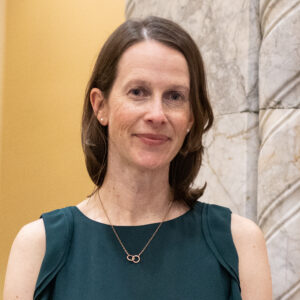
Person near marble post and smiling.

Christy Remucal is the new interim director for Wisconsin Sea Grant. Contributed photo.

A professor in the Department of Civil and Environmental Engineering, the Environmental Chemistry and Technology Program, and the Freshwater and Marine Science Program, Remucal’s research focus is on contaminants that impact water quality and processes to remove those contaminants. Some of her recent studies have been on per- and polyfluoroalkyl substances (PFAS). She serves as the only Universities of Wisconsin representative on the state’s PFAS Action Council.

“We are grateful for the commitment to the Wisconsin Idea and the leadership that Jim Hurley has provided in aquatic sciences research, and outreach and education in support of sustainable uses of our state’s natural resources while serving as director of the Aquatic Sciences Center for the past 11 years,” said Cynthia Czajkowski interim vice chancellor for research and graduate education. “And we welcome Christy to her new leadership role as interim center director. She has as a strong leadership background and ran excellent, relevant research experience that makes her perfectly qualified to serve in this capacity.”

When tapped for the interim center directorship, Remucal was leading the Aquatic Chemistry group at UW-Madison and was acting as the director of the Water Science and Engineering Laboratory. In addition to managing the center, she will continue to teach, mentor and conduct research. Remucal’s mentoring background includes mentoring 20 graduate students and postdoctoral researchers.

WRI came to the state 59 years ago. Wisconsin Sea Grant was founded 55 years ago. The programs with their similar missions merged in 1998 and created a highly efficient and cost-effective model for drawing out the best from Wisconsin’s aquatic scientists who, collaboratively, make a difference statewide, nationwide and around the world. Areas of particular strength for the programs are ecosystems contaminant research, extension service to coastal residents and fostering scholarship and training of the next generation of water science leaders.

Remucal is only the fourth WRI and Sea Grant director in the history of the programs, which is evidence of the steady leadership provided by previous directors that has been marked by excellence. In their most recent reviews by federal funders, both programs ranked top in the nation among their peers. 

Remucal wants to continue seminal successes, build on them and seek research and outreach  opportunities in the areas of diversity, equity and inclusion, and how compromised water quality may disproportionately affect some communities.

In terms of other research priorities, she called out emerging contaminants and microplastics. “There is so much that needs to be done. These water quality challenges are incredibly complex and there is a real need for outreach and communication to help the public understand these issues,” Remucal said.

“There is also a need for basic water research, fundamental work that addresses research questions. At the same time, there is a need to do research that serves the state agencies and the people of Wisconsin. It’s not always possible to have those align, but in many cases they can. Increasing knowledge and conducting actionable research is very valuable,” she said.  

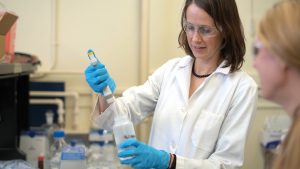
Person wearing white lab coat and safety goggles.

Remucal is a prominent researcher on contaminants in water. Photo by Bonnie Willison

Remucal holds degrees in civil and environmental engineering from the University of California-Berkeley (master’s and Ph.D.) and the Massachusetts Institute of Technology (Bachelor of Science). Before joining Madison’s faculty in 2012, she completed a post-doctoral position in the Institute for Biogeochemistry and Pollutant Dynamics at the Swiss Federal Institute of Technology.

Her background and passion have brought her to the center and Remucal summed it up: “Water is such a critical issue for people in Wisconsin. It is necessary for life and people in our state really do value our water resources. Because there is such a clear importance and relevance for water, this a great opportunity for outreach. It comes back to embracing the Wisconsin Idea and sharing our research with people in Wisconsin.”

Sea Grant is funded by the National Oceanic and Atmospheric Administration and WRI is funded by the U.S. Geological Survey.

The post Remucal named interim director of Sea Grant first appeared on Wisconsin Sea Grant.

Original Article

News Releases | Wisconsin Sea Grant

News Releases | Wisconsin Sea Grant

https://www.seagrant.wisc.edu/news/remucal-named-interim-director-of-sea-grant/

Moira Harrington

University of Wisconsin-Madison Interim Vice Chancellor for Research and Graduate Education Cynthia Czajkowski named Christy Remucal as interim director of the Aquatic Sciences Center, which is home to the University of Wisconsin Water Resources Institute (WRI) and the Wisconsin Sea Grant College Program. Both programs support multidisciplinary research, education and outreach for the protection and sustainable use of Wisconsin’s water resources. The appointment was effective Oct. 22.

Remucal’s appointment comes after the retirement of Aquatic Sciences Center Director Jim Hurley.

“Since I’ve been at the UW, I have benefitted from so many things at the center—funding opportunities, working with the outreach and communications staff, mentoring undergraduates through the Water@UW REU program,” Remucal said. “The center has helped me grow my own research group, and I’m looking forward to working on the other side. I see this as a way to give back to the water community.”

Smiling person learning against a pillar.
New WRI Interim Director Christy Remucal. She officially took over the 59-year-old program yesterday. Contributed photo.

A professor in the Department of Civil and Environmental Engineering, the Environmental Chemistry and Technology Program, and the Freshwater and Marine Science Program, Remucal’s research focus is on contaminants that impact water quality and processes to remove those contaminants. Some of her recent studies have been on per- and polyfluoroalkyl substances (PFAS). She serves as the only Universities of Wisconsin representative on the state’s PFAS Action Council.

“We are grateful for the commitment to the Wisconsin Idea and the leadership that Jim Hurley has provided in aquatic sciences research, and outreach and education in support of sustainable uses of our state’s natural resources while serving as director of the Aquatic Sciences Center for the past 11 years,” said Cynthia Czajkowski interim vice chancellor for research and graduate education. “And we welcome Christy to her new leadership role as interim center director. She has as a strong leadership background and ran excellent, relevant research experience that makes her perfectly qualified to serve in this capacity.”

When tapped for the interim center directorship, Remucal was leading the Aquatic Chemistry group at UW-Madison and was acting as the director of the Water Science and Engineering Laboratory. In addition to managing the center, she will continue to teach, mentor and conduct research. Remucal’s mentoring background includes mentoring 20 graduate students and postdoctoral researchers.

WRI came to the state 59 years ago. Wisconsin Sea Grant was founded 55 years ago. The programs with their similar missions merged in 1998 and created a highly efficient and cost-effective model for drawing out the best from Wisconsin’s aquatic scientists who, collaboratively, make a difference statewide, nationwide and around the world. Areas of particular strength for the programs are ecosystems contaminant research, extension service to coastal residents and fostering scholarship and training of the next generation of water science leaders.

Remucal is only the fourth WRI and Sea Grant director in the history of the programs, which is evidence of the steady leadership provided by previous directors that has been marked by excellence. In their most recent reviews by federal funders, both programs ranked top in the nation among their peers.

Remucal wants to continue seminal successes, build on them and seek research and outreach opportunities in the areas of diversity, equity and inclusion, and how compromised water quality may disproportionately affect some communities.

In terms of other research priorities, she called out emerging contaminants and microplastics. “There is so much that needs to be done. These water quality challenges are incredibly complex and there is a real need for outreach and communication to help the public understand these issues,” Remucal said.

“There is also a need for basic water research, fundamental work that addresses research questions. At the same time, there is a need to do research that serves the state agencies and the people of Wisconsin. It’s not always possible to have those align, but in many cases they can. Increasing knowledge and conducting actionable research is very valuable,” she said.

Remucal holds degrees in civil and environmental engineering from the University of California-Berkeley (master’s and Ph.D.) and the Massachusetts Institute of Technology (Bachelor of Science). Before joining Madison’s faculty in 2012, she completed a post-doctoral position in the Institute for Biogeochemistry and Pollutant Dynamics at the Swiss Federal Institute of Technology.

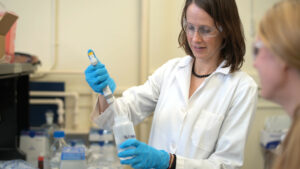
Person in lab coat and safety goggles in a lab.
Remucal in her water research lab. She focuses on contaminants. Photo: Bonnie Willison

Her background and passion have brought her to the center and Remucal summed it up: “Water is such a critical issue for people in Wisconsin. It is necessary for life and people in our state really do value our water resources. Because there is such a clear importance and relevance for water, this a great opportunity for outreach. It comes back to embracing the Wisconsin Idea and sharing our research with people in Wisconsin.”

WRI is funded by the U.S. Geological Survey and Sea Grant by the National Oceanic and Atmospheric Administration.

The post Remucal Named Interim Director of WRI first appeared on WRI.

Original Article

News Release | WRI

News Release | WRI

https://www.wri.wisc.edu/news/remucal-named-interim-director-of-wri/

Moira Harrington

The Alliance of Rouge Communities recently held a summit to recap restoration efforts in the Great Lakes and talk about what’s coming down the pipeline as the result of Great Lakes Restoration Initiative funding. Read the full story by the Press & Guide.

Original Article

Great Lakes Commission

Great Lakes Commission

https://www.glc.org/dailynews/20231023-alliance-of-rouge

Theresa Gruninger

A bill introduced in the Michigan Legislature last week could expand commercial fishing in state waters. House Bill 5108 would allow commercial harvest of certain sport fish previously off-limits to commercial fishers, including species like lake trout, walleye, and yellow perch. Read the full story by Interlochen Public Radio.

Original Article

Great Lakes Commission

Great Lakes Commission

https://www.glc.org/dailynews/20231023-commercial-fishing

Theresa Gruninger

Michigan Attorney General Dana Nessel has lent her support to the Bad River Band of the Lake Superior Tribe of Chippewa Indians’ efforts to shut down part of Enbridge Energy Company’s Line 5. Read the full story by Interlochen Public Radio.

Original Article

Great Lakes Commission

Great Lakes Commission

https://www.glc.org/dailynews/20231023-line-5

Theresa Gruninger

People in the water during potential rip current conditions at public beaches in New Buffalo, Michigan, will now be subject to fines starting at $500. Boaters also face the same penalty if heading to Lake Michigan in the city’s public channel during lake conditions viewed as too dangerous for their watercraft. Read the full story by the South Bend Tribune.

Original Article

Great Lakes Commission

Great Lakes Commission

https://www.glc.org/dailynews/20231023-swimming-fines

Theresa Gruninger

A new book by a Michigan and U.S food policy advocate emphasizes that everyone is needed to create a sustainable and prosperous food economy.

“I hope people who read the book can see themselves in it,” Conners said. “Anybody can be a part of helping to bring locally grown food to people.”

The post Food policy advocate shares 20 years of food and farm lessons first appeared on Great Lakes Echo.

Original Article

Great Lakes Echo

Great Lakes Echo

http://greatlakesecho.org/2023/10/23/food-policy-advocate-shares-20-years-of-food-and-farm-lessons/

Jaclyn Sellentine

...FROST ADVISORY REMAINS IN EFFECT FROM 3 AM TO 9 AM CDT SUNDAY... * WHAT...Low temperatures from 33 to 37 degrees will result in frost formation. * WHERE...Calumet, Manitowoc, Winnebago, Brown, Kewaunee, and Outagamie Counties. * WHEN...From 3 AM to 9 AM CDT Sunday.

Original Article

Current Watches, Warnings and Advisories for Brown (WIC009) Wisconsin Issued by the National Weather Service

Current Watches, Warnings and Advisories for Brown (WIC009) Wisconsin Issued by the National Weather Service

https://alerts.weather.gov/cap/wwacapget.php?x=WI126666E190F4.FrostAdvisory.126666E35A60WI.GRBNPWGRB.5c1960614b9101127ad4d69c4cc31d5f

w-nws.webmaster@noaa.gov

...FROST ADVISORY IN EFFECT FROM 3 AM TO 9 AM CDT SUNDAY... * WHAT...Low temperatures from 33 to 37 degrees will result in frost formation. * WHERE...Calumet, Manitowoc, Winnebago, Brown, Kewaunee, and Outagamie Counties. * WHEN...From 3 AM to 9 AM CDT Sunday.

Original Article

Current Watches, Warnings and Advisories for Brown (WIC009) Wisconsin Issued by the National Weather Service

Current Watches, Warnings and Advisories for Brown (WIC009) Wisconsin Issued by the National Weather Service

https://alerts.weather.gov/cap/wwacapget.php?x=WI126666D4ECA0.FrostAdvisory.126666E35A60WI.GRBNPWGRB.5c1960614b9101127ad4d69c4cc31d5f

w-nws.webmaster@noaa.gov

Nibi Chronicles: Grand Portage Water Warriors

Editor’s Note: “Nibi Chronicles,” a monthly Great Lakes Now feature, is written by Staci Lola Drouillard. A direct descendant of the Grand Portage Band of Ojibwe, she lives and works in Grand Marais on Minnesota’s North Shore of Lake Superior. Her two books “Walking the Old Road: A People’s History of Chippewa City and the Grand Marais Anishinaabe” and “Seven Aunts” were published 2019 and 2022, and she is at work on a children’s story.

Read Now at Great Lakes Now.

Original Article

Great Lakes Now

Great Lakes Now

https://www.greatlakesnow.org/2023/10/nibi-chronicles-grand-portage-water-warriors/

Staci Lola Drouillard

The Detroit News spent four months exploring the ways climate change will send ripple effects through the Great Lakes and their ecosystems. For this series, the article highlights an issue on each Great Lake, interviewing those on the front lines of climate-related research. Read the full story by The Detroit News.

Original Article

Great Lakes Commission

Great Lakes Commission

https://www.glc.org/dailynews/20231020-climate-change

Theresa Gruninger

Republicans in the Michigan Senate are sending a letter to federal and state officials urging the start of a pipeline tunnel project under the Straits of Mackinac. The Great Lakes Tunnel project would house the Line 5 pipeline that currently runs exposed along the lakebed. Read the full story by Michigan Radio.

Original Article

Great Lakes Commission

Great Lakes Commission

https://www.glc.org/dailynews/20231020-line-5

Theresa Gruninger

The U.S. Environmental Protection Agency is revisiting proposed regulations for ballast water standards on ships to reduce the spread of invasive species. That could mean newer vessels on the Great Lakes would have to install treatment systems. Read the full story by Wisconsin Public Radio.

Original Article

Great Lakes Commission

Great Lakes Commission

https://www.glc.org/dailynews/20231020-ballast-water

Theresa Gruninger

Three commercial fishing companies in Door County, Wisconsin are signing on to an innovative new project on the Great Lakes called 100% Great Lakes Fish Pledge. This initiative has a goal of using 100% of each fish by the year 2025. Read the full story by WBAY-TV – Green Bay, WI.

Original Article

Great Lakes Commission

Great Lakes Commission

https://www.glc.org/dailynews/20231020-100-great-lakes-fish

Theresa Gruninger

In the quest to defend Michigan’s rivers against climate change, government officials and fish advocates are increasingly zeroing in on a simple strategy that can lower water temperatures by several degrees and open up miles of new habitat: removing dams. Read the full story by Michigan Radio.

Original Article

Great Lakes Commission

Great Lakes Commission

https://www.glc.org/dailynews/20231020-dam-removal

Theresa Gruninger

The Great Lakes Museum has announced the S.S. Keewatin, the oldest remaining Edwardian-era steamliner in the world, will move from the shipyard where it is currently being refurbished to its new home in Kingston, Ontario on Monday, Oct. 23, 2023. Read the full story by the Kingstonist.

Original Article

Great Lakes Commission

Great Lakes Commission

https://www.glc.org/dailynews/20231020-s.s.-keewatin

Theresa Gruninger

As the days grow shorter and the temperatures tumble, it won’t be much longer before Lake Michigan’s buoys will get pulled in for the season. This winter, however, a new type of buoy is hoping to make sure scientists have access to the vital weather data these buoys provide all year. Read the full story by WWMT-TV – Kalamazoo, MI.

Original Article

Great Lakes Commission

Great Lakes Commission

https://www.glc.org/dailynews/20231020-weather-alert-bouy

Theresa Gruninger

For decades, Michigan’s Keweenaw Peninsula was home to more than 100 copper mines and the mining waste has impacted the shores of Lake Superior. The U.S. Forest Service is hoping that a specialized poplar tree will remove the heavy metals from the soil and stabilize the area, with the goal of preventing the stamp sands from shifting further. Read the full story by WXPR – Rhinelander, WI.

Original Article

Great Lakes Commission

Great Lakes Commission

https://www.glc.org/dailynews/20231020-mining-waste

Theresa Gruninger

The creators of a new television series about climate change describe it as a cross between Stranger Things and a nature documentary narrated by David Attenborough – and they say they hope it’ll help ease anxiety about the existential threat.no

The post New TV show bridges pop culture, climate change education first appeared on Great Lakes Echo.

Original Article

Great Lakes Echo

Great Lakes Echo

http://greatlakesecho.org/2023/10/20/new-tv-show-bridges-pop-culture-climate-change-education/

Jack Armstrong

Federal forecasters predict warm, wet US winter but less snow because of El Nino, climate change

By Seth Borenstein, AP Science Writer

The upcoming United States winter looks likely to be a bit low on snow and extreme cold outbreaks, with federal forecasters predicting the North to get warmer than normal and the South wetter and stormier.

A strong El Nino heavily moderates and changes the storm tracks of what America is likely to face from December to February, with an added warming boost from climate change and record hot oceans, officials at the National Oceanic and Atmospheric Administration said Thursday in releasing their winter outlook.

Read Now at Great Lakes Now.

Original Article

Great Lakes Now

Great Lakes Now

https://www.greatlakesnow.org/2023/10/ap-electrical-grids-keeping-up-green-energy-could-risk-climate-goals/

The Associated Press

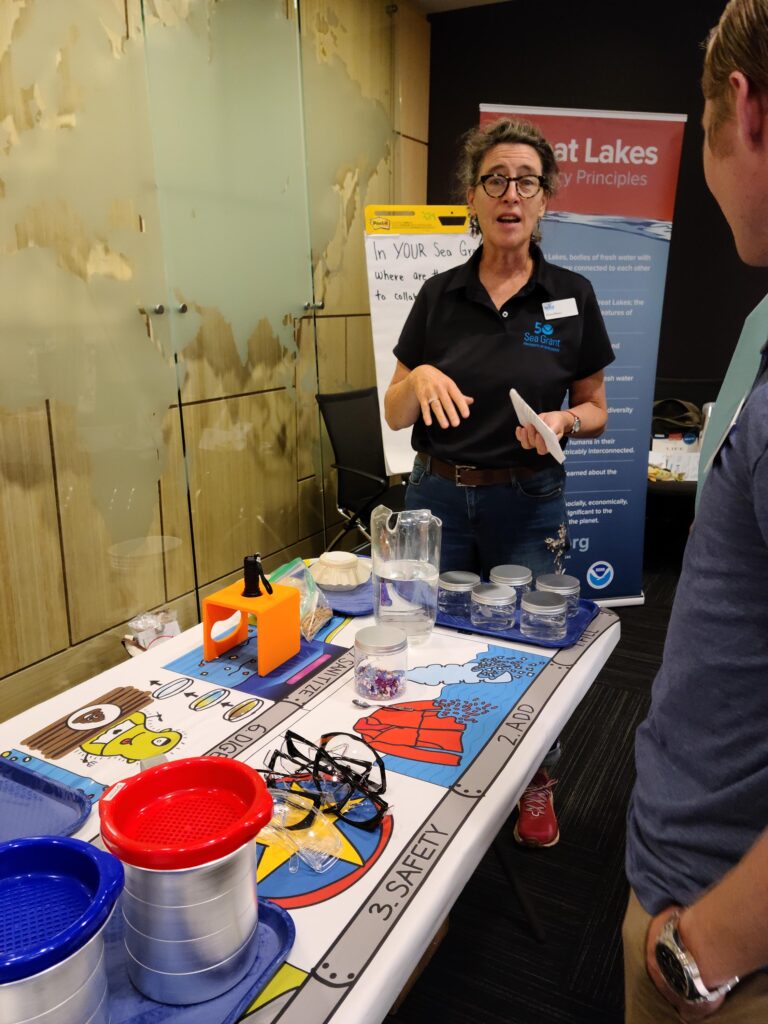
Wisconsin Sea Grant’s Anne Moser presents the Plastic Panic Kit to Great Lakes educators at a conference in Chicago. Image credit: Marie Zhuikov, Wisconsin Sea Grant

When Anne Moser began her librarian career in Seattle in the early 1990s, one of her first experiences was a tour of the city’s wastewater treatment plant.

“It made a big impression on me, watching their operations and what great, amazing miracles can happen there. Wastewater enters the plant, is treated and is clean enough to discharge into Puget Sound. Creating this kit feels like I’ve come full circle in my career,” Moser said.

Wisconsin Sea Grant’s senior special librarian and education coordinator has now learned enough about wastewater treatment to create “Plastic Panic,” a grab-and-go teaching kit that formal and nonformal educators can use to teach about plastic pollution in the Great Lakes, specifically, microplastics.

Unlike larger plastic containers and pieces, microplastics (particles 5 millimeters and smaller) are too small for wastewater treatment plants to filter. What goes into the plant comes right back out into the environment. Fish and other animals can mistake microplastics for food. A belly full of plastic can make them feel full without providing any nutrients. In addition, heavy metals and other pollutants tend to stick to plastics. These can harm animals that eat the plastic, and the pollutants can work their way up the food chain this way.

The kit got its start after a plastic awareness-raising exhibition at the University of Wisconsin-Madison’s Chazen Museum of Art in 2019 called, “Plastic Entanglements.” That led to a prototype learning kit, which has been updated this year. Information in “Plastic Panic” is based on research by Derek Ho, biological systems engineering Ph.D. student under Troy Runge, UW–Madison. Artwork is by Chelsea Mamott, Wisconsin Energy Institute digital media specialist.

Although the curriculum is designed for fourth- to fifth-graders, Moser said the kit has wide appeal.

“When we presented it at the Chazen, we saw it caught visitors’ attention — from the littlest learners, maybe four or five years old, all the way up to the parents and grandparents. The tabletop’s eye-catching, so many people came over to look at it. We also learned that many people don’t know much about what happens to the wastewater leaving their house. The activity demystifies this weird building that treats wastewater,” Moser said.

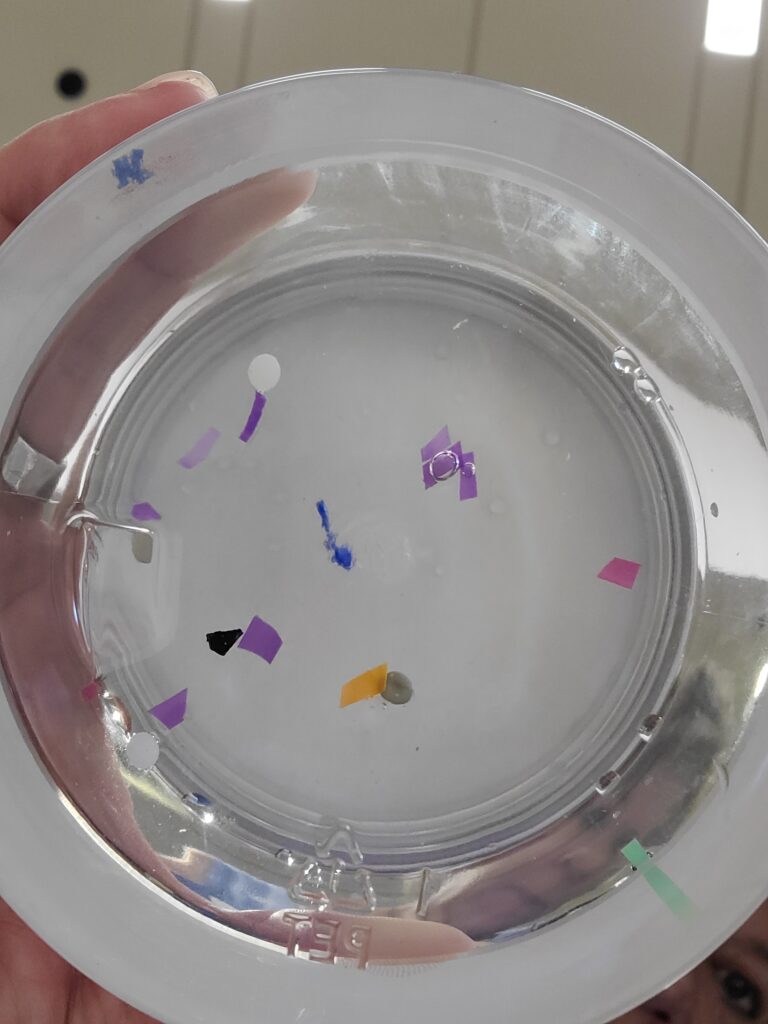
Colorful microplastics filtered out in one of the Plastic Panic Kit activities. Image credit: Marie Zhuikov, Wisconsin Sea Grant

Colorful artwork and colorful plastics enthrall and teach.

“We have included a sample jar that has different types and sizes of plastics,” Moser said. “You get different densities, different weights, so they can experience the way plastic behaves in water. Some of it sinks, some of it floats, some stays in the middle. You get to filter and sanitize the sample, then look at what is ultimately discharged into our water bodies. So, it’s kind of high-level thinking that kids get to enjoy without even realizing it.”

Moser said the kit is “grab-and-go” for educators. “It comes with a guide that has clear instructions so they will be able to present the activity right out of the box.” It also provides questions to ask students, background information for educators and worksheets for classroom use. “So, hopefully, they can just grab it and do it.”

Content is aligned with Sea Grant’s Great Lakes Literacy Principles but not yet aligned to specific state educational standards.

With the help of Great Lakes Restoration Initiative funding, 23 kits were produced by Sea Grant’s Center for Great Lakes Literacy and distributed to Sea Grant programs around the Great Lakes Basin. Five are available free of charge in Wisconsin, and the kit is shipped via UPS.

To order “Plastic Panic,” fill out this form.

The post Plastics learning kit educates and enthralls first appeared on Wisconsin Sea Grant.

Original Article

News Releases | Wisconsin Sea Grant

News Releases | Wisconsin Sea Grant

https://www.seagrant.wisc.edu/news/plastics-learning-kit-educates-and-enthralls/

Marie Zhuikov

The world of collegiate sports is ever-growing as new sports come into the spotlight, but one is emerging that might be a surprise – bass fishing.

“We just have all kinds of sports that are maybe off the beaten path, but have a strong following,” he said.

The post Small college uses niche sport to boost enrollment first appeared on Great Lakes Echo.

Original Article

Great Lakes Echo

Great Lakes Echo

http://greatlakesecho.org/2023/10/19/small-college-uses-niche-sport-to-boost-enrollment/

Guest Contributor

Take 5 Minutes Each Hunt for Invasive Species Prevention

Original Story: WDNR

Invasive species are nonnative plants, animals and diseases that cause great ecological, environmental or economic harm. Some have already been found in Wisconsin, while others pose a large risk of surviving and causing problems if they are introduced and become established here.

Just a few minutes of preventative action can help preserve and protect hunting lands for generations to come.

Before launching into and leaving a waterbody, waterfowl hunters should:

– Inspect waders, boats, trailers, motors and hunting equipment, including boots, blinds and dogs

– Remove all plants, animals and mud to the best of their ability

– Drain all water from decoys, boats, motors, livewells and other hunting equipment

– Remove all seed heads and roots when using vegetation for duck blinds

– Never move plants or live animals, such as snails, away from a water body

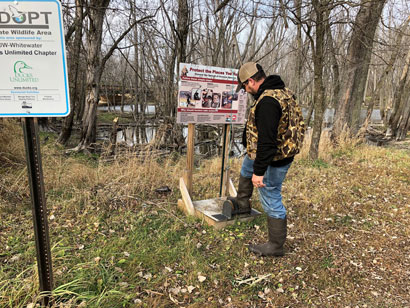
Lots of hunting spots have boot brush stations to help you clean off your gear (see picture). Want to have one installed at your favorite hunting spot? Contact Chris using the info below!


Learn more at https://dnr.wisconsin.gov/topic/Invasives and thank you for helping keep invasives out of our waterways!

Photo Credit: WDNR

Questions? Comments? Contact Chris Acy, the AIS Coordinator covering Brown, Outagamie, Fond du Lac, Calumet, and Winnebago Counties at (920) 460-3674 or chris@fwwa.org!

Follow the Fox Wolf Watershed Alliance’s Winnebago Waterways Program on our Winnebago Waterways Facebook page or @WinnWaterways on X! You can also sign-up for email updates at WinnebagoWaterways.org.

Check out the Keepers of the Fox Program at https://fwwa.org/watershed-recovery/lower-fox-recovery/

Winnebago Waterways and Keepers of the Fox are Fox-Wolf Watershed Alliance programs. The Fox-Wolf Watershed Alliance is an independent nonprofit organization working to protect and restore water resources in the Fox-Wolf River Basin.

Reporting invasive species is a first step in containing their spread. Maintaining and restoring our waters and landscapes can reduce the impacts even when we don’t have other management options to an invasive species.


The post Waterfowl Hunting? Protect Those Places appeared first on Fox-Wolf Watershed Alliance.

Original Article

Fox-Wolf Watershed Alliance

Fox-Wolf Watershed Alliance

https://fwwa.org/2023/10/18/waterfowl-hunting-protect-those-places/?utm_source=rss&utm_medium=rss&utm_campaign=waterfowl-hunting-protect-those-places

Chris Acy

Fox-Wolf Watershed Alliance is excited to host a Field Day event with Outagamie County at VandeWettering Farms in Greenleaf. Farmers are invited to come learn about virtual grazing, grazing on marginal land, and ravine restoration. Please direct any questions to Katie Woodrow, Lower Fox River Program Director: katie@fwwa.org, 920-915-5767.

The post Virtual Grazing Field Day appeared first on Fox-Wolf Watershed Alliance.

Original Article

Fox-Wolf Watershed Alliance

Fox-Wolf Watershed Alliance

https://fwwa.org/2023/10/18/virtual-grazing-field-day/?utm_source=rss&utm_medium=rss&utm_campaign=virtual-grazing-field-day

Katie Woodrow

Be Careful With Those Plants; Dispose but Don’t Release!

Original story: Melinda Myers

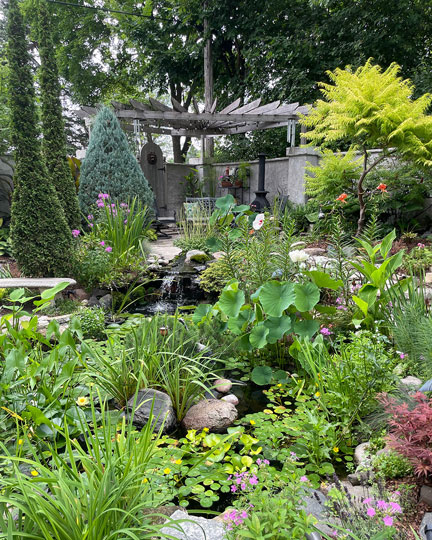
As we start see leaves drop, lots of folks are starting to prepare their homes and gardens for winter. If you’ve got a water garden, you’ll be starting to do the same thing! Water gardens make a great addition to any landscape masking unwanted noise, inviting songbirds to take a drink, and providing a beautiful oasis in any landscape. Fall is the time to prepare your water garden for winter. Tropical plants need to be moved indoors and aggressive or invasive plants should be removed and disposed of properly. Contact your local municipality for tips on disposing these and your local Department of Natural Resources for a list of invasive plants in your area that need to be removed. Eliminating invasive plants from our landscapes helps keep them out of our lakes and waterways!

With a history of popular water garden plants being released in our region, following these steps is an easy way to be a steward for your local waterways and your water garden!

Photo Credit: Chris Acy (Fox-Wolf), Melinda Myers

Questions? Comments? Contact Chris Acy, the AIS Coordinator covering Brown, Outagamie, Fond du Lac, Calumet, and Winnebago Counties at (920) 460-3674 or chris@fwwa.org!

Follow the Fox Wolf Watershed Alliance’s Winnebago Waterways Program on our Winnebago Waterways Facebook page or @WinnWaterways on X! You can also sign-up for email updates at WinnebagoWaterways.org.

Check out the Keepers of the Fox Program at https://fwwa.org/watershed-recovery/lower-fox-recovery/

Winnebago Waterways and Keepers of the Fox are Fox-Wolf Watershed Alliance programs. The Fox-Wolf Watershed Alliance is an independent nonprofit organization working to protect and restore water resources in the Fox-Wolf River Basin.

Reporting invasive species is a first step in containing their spread. Maintaining and restoring our waters and landscapes can reduce the impacts even when we don’t have other management options to an invasive species.

The post Preparing Water Gardens for Winter appeared first on Fox-Wolf Watershed Alliance.

Original Article

Fox-Wolf Watershed Alliance

Fox-Wolf Watershed Alliance

https://fwwa.org/2023/10/18/preparing-water-gardens-for-winter/?utm_source=rss&utm_medium=rss&utm_campaign=preparing-water-gardens-for-winter

Chris Acy

An autonomous quiet vessel that has been traveling across the Great Lakes gathering valuable fish population data is back on dry land in Charlevoix, Michigan. Read the full story by WPBN-TV – Traverse City, MI.

Original Article

Great Lakes Commission

Great Lakes Commission

https://www.glc.org/dailynews/20231018-saildrone-return

Nichole Angell

The radar technology developed to find water on Mars is cheaper and more effective in detecting leaks in public water systems compared to traditional ones, and now it has arrived in five Michigan cities. Read the full story by Great Lakes Echo.

Original Article

Great Lakes Commission

Great Lakes Commission

https://www.glc.org/dailynews/20231018-water-leak-detection-technologies

Nichole Angell

Federal, state and local officials have agreed to spend about $450 million to dredge contaminated sediment from Milwaukee’s Lake Michigan harbor and area rivers. The project calls for removing almost 2 million cubic yards of contaminated sediment from Milwaukee’s Lake Michigan harbor and 12 miles of the Milwaukee, Menomonee and Kinnickinnic rivers in Wisconsin. Read the full story by Great Lakes Now.

Original Article

Great Lakes Commission

Great Lakes Commission

https://www.glc.org/dailynews/20231018-milwaukee-clean-up

Nichole Angell