The village of Elberta, Michigan, has been awarded a $5.3 million grant from the Michigan Department of Natural Resources for the development of a waterfront park. The park project will be on 16 acres of property near the mouth of Betsie Bay, including Lake Michigan shoreline, which will eventually be transferred to the village from the Grand Traverse Regional Land Conservancy. Read the full story by Benzie County Record Patriot.

Original Article

Great Lakes Commission

Great Lakes Commission

https://www.glc.org/dailynews/20251212-waterfront-park-elberta

Hannah Reynolds

John U. Bacon spent nearly four years researching and writing his new book about the Edmund Fitzgerald. The public has caught on to the new release titled The Gales of November: The Untold Story of the Edmund Fitzgerald. Read the full story by the Detroit Free Press.

Original Article

Great Lakes Commission

Great Lakes Commission

https://www.glc.org/dailynews/20251212-john-u-bacon-edmund-fitzgerald-book

Hannah Reynolds

If the predictions turn out to be accurate, it will be a second year in row of normal ice cover on the Great Lakes – a reprieve, given that winter is changing the most. The season has shortened by several weeks and is becoming increasingly warmer and wetter. Read the full story by Milwaukee Journal Sentinel.

Original Article

Great Lakes Commission

Great Lakes Commission

https://www.glc.org/dailynews/20251212-winter-ice-cover-impacts-greatlakes

Hannah Reynolds

Two municipalities in northeast Wisconsin are getting federal funding to replace lead service lines. More than $159 million has been allocated to 29 municipalities across the state, including Manitowoc and Oshkosh, to ensure Wisconsinites have access to clean, safe drinking water that is free of lead. Read the full story by WTAQ – Green Bay, WI.

Original Article

Great Lakes Commission

Great Lakes Commission

https://www.glc.org/dailynews/20251212-manitowoc-oshkosh-replace-lead-water-lines

Hannah Reynolds

Michigan House Republicans have unilaterally blocked about $8.3 million in spending aimed at helping residents of Flint deal with the long-term fallout of the drinking water crisis, as the GOP leader, Speaker Matt Hall, said the emergency in the city is over. Read the full story by The Detroit News.

Original Article

Great Lakes Commission

Great Lakes Commission

https://www.glc.org/dailynews/20251212-house-speaker-flint-watercrisis

Hannah Reynolds

Research shows that the United States would need to invest nearly $3.4 trillion over the next 20 years to sufficiently fix and update its drinking water, wastewater and stormwater infrastructure. Much of the country’s water infrastructure was built 40 to 50 years ago and is showing its age. Michigan’s is no exception. Read the full story by Great Lakes Echo.

Original Article

Great Lakes Commission

Great Lakes Commission

https://www.glc.org/dailynews/20251212-michigan-water-infrastructure-work

Hannah Reynolds

The U.S. Coast Guard Sector Northern Great Lakes began ice-breaking operations in the Great Lakes on Wednesday for the winter shipping season. Currently, the U.S. Coast Guard cutter Spar will manage the ice-breaking needs of Western Lake Superior, specifically Duluth, Minnesota, and Superior, Wisconsin. Read the full story by WXYZ-TV – Detroit, MI.

Original Article

Great Lakes Commission

Great Lakes Commission

https://www.glc.org/dailynews/20251212-coastguard-ice-breaking-greatlakes

Hannah Reynolds

200 years ago, the opening of the Erie Canal solved one of America’s biggest logistical problems: how to quickly move people and goods from the Great Lakes to the Atlantic Ocean.

New York governor DeWitt Clinton pushed for a canal linking Lake Erie to the Hudson River and New York City, drastically cutting travel time and costs and helping launch America’s Industrial Revolution.

Learn more at https://www.greatlakesnow.org/eriecanal/

#GreatLakes #History #Economy #IndustrialRevolution #NewYork #Infrastructure
===========================================
Website: https://greatlakesnow.org
Facebook: https://www.facebook.com/greatlakesnow
X: https://www.x.com/greatlakesnow
Instagram: https://www.instagram.com/greatlakesnoworg
Newsletter: https://www.greatlakesnow.org/great-lakes-now-newsletter/

To learn more about supporting Detroit PBS and Great Lakes Now, visit https://www.detroitpbs.org/

The post Why America Needed the Erie Canal appeared first on Great Lakes Now.

Original Article

Great Lakes Now

Great Lakes Now

https://www.greatlakesnow.org/2025/12/11/why-america-needed-the-erie-canal/

Great Lakes Now

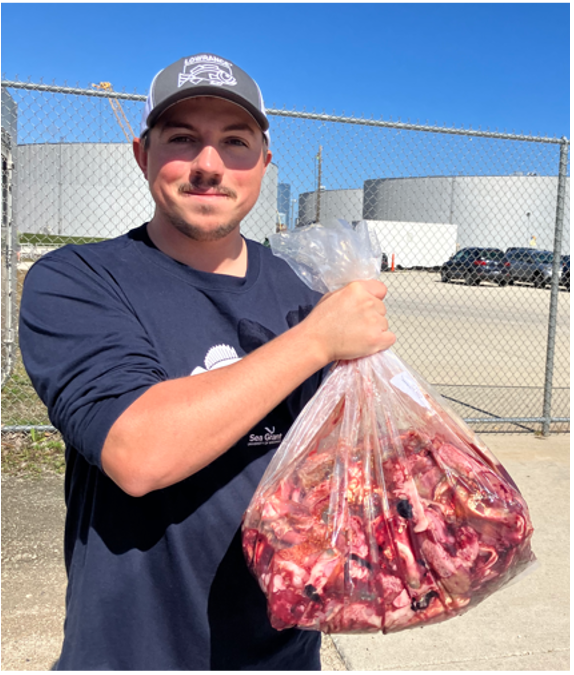
A man in a blue shirt and white hat holds up a big bag of red fish guts

UW–Milwaukee graduate student Kyle Freimuth holding a bag of fish byproducts. Photo: Sharon Moen

When Wisconsin Sea Grant’s Eat Wisconsin Fish team posted the question, “What would you do with a pile of fish guts?,” social media users from across the state creatively responded with ideas that included:

  • Make fly traps
  • Donate them to the raptor center in Spooner
  • Feed them to mink at a mink farm
  • And  – less helpfully – place them under my brother’s car seat on a sweltering July day

“Fertilizer” was the most popular answer to this post, which was one of several that boosted the 100% Wisconsin Fish Contest. The contest ran from September 16-October 24, 2025. It was part of a broader effort to highlight Wisconsin’s sustainable fisheries and the 100% Great Lakes Fish Initiative, which promotes full use of commercially harvested fish – including byproducts.

Grace Elonen of Omro, Wisconsin, submitted the winning entry. She wrote:

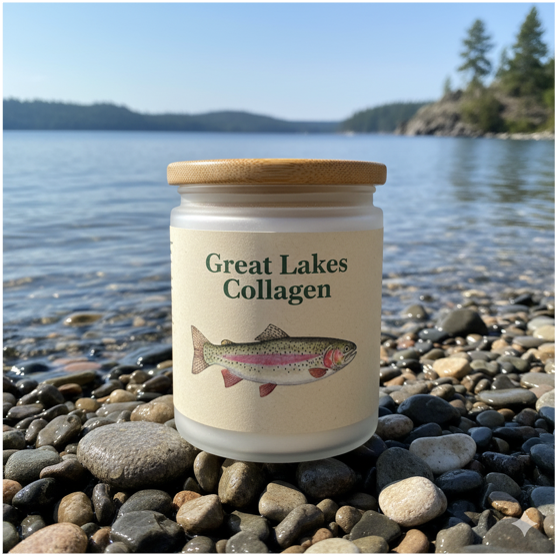
“Fish scales are often the first part discarded when harvesting. Fish scales and skin are comprised of collagen… Knowing the collagen source was sustainably harvested is a good selling point. Knowing the collagen came from our own Great Lakes would be even better. Tagline: Take a little bit of the Great Lakes with you everywhere.”

John Schmidt, program manager for the Conference of the Great Lakes St. Lawrence Seaway Governors and Premiers (GSGP) 100% Great Lakes Fish Initiative, praised the idea. “Collagen from Great Lakes fish scales and skins squarely advances 100% fish goals, has multiple markets, and we’ve already flagged collagen as one of the best-case strategies for the region,” he said.

An AI-generated image of a glass jar of fish collagen sitting on a rocky beach

The winning idea for using more parts of a fish involved scales and skin. Photo credit: Gemini AI-generated image submitted by Grace Elonen.

Judges – including Schmidt, two commercial fishers, and a University of Wisconsin-Madison undergraduate – commended Elonen’s regional branding concept, noting that taglines like the one Elonen offered underscore both local pride and market potential.

Charlie Henriksen, co-owner of Henriksen Fisheries and a contest judge, applauded the thoughtfulness behind many submissions. “All the ideas had some value, and I appreciate the people who provided serious replies,” he said.

He gave special mention to making dog treats from dehydrated fish skins and using fish parts for stock. When it comes to fish stock, he said, “The issue to overcome is producing a stock with consistent flavor and texture. Many chowders now use clam juice, so a genuine whitefish stock would be valuable.”

Led by GSGP, the 100% Great Lakes Fish Initiative brings together dozens of partners – including Wisconsin Sea Grant and Wisconsin commercial fishers, fish farmers, and processors – to demonstrate how every part of Great Lakes fish can be used for food, products, and other innovative purposes. Wisconsin Sea Grant’s online contest may serve as a model for similar efforts in other Great Lakes states according to Schmidt.

The contest was made possible through support from GSGP, along with interns Kyle Freimuth and Wyatt Slack, and Wisconsin Sea Grant’s communications team. Special thanks to judges Charlie Henriksen (Henriksen Fisheries), Jessica Resac (Halvorson Fisheries), John Schmidt (GSGP), and UW–Madison undergraduate Wyatt Slack.

The post Guts and glory: Thinking beyond the fillet first appeared on Wisconsin Sea Grant.

Original Article

News Releases | Wisconsin Sea Grant

News Releases | Wisconsin Sea Grant

https://www.seagrant.wisc.edu/news/guts-and-glory-thinking-beyond-the-fillet/

Andrew Savagian

News

New Great Lakes water use report demonstrates shared stewardship of the world’s largest freshwater system

Ann Arbor, Michigan/Chicago, Illinois — A report released today on Great Lakes water use demonstrates the region’s ongoing commitment to coordinated, science-based management of the world’s largest freshwater system. The 2024 Annual Report of the Great Lakes Regional Water Use Database shows that water withdrawals in the basin remained stable, with the vast majority of withdrawn water returned to the Great Lakes St. Lawrence River Basin.

Overall, the basin gained a total of 345 million gallons of water per day in 2024; by comparison, the basin lost 550 million gallons per day in 2023. This change is primarily due to an increase in the amount of water diverted from the Hudson Bay watershed into the Lake Superior basin through the Long Lac and Ogoki diversions in northern Ontario.

The report found that 35.7 billion gallons of water per day were withdrawn from the Great Lakes basin in 2024, representing a less than 1% increase from 2023. Just under 5% of the total reported water withdrawn was consumed or otherwise lost from the basin. Thermoelectric power production (once-through cooling), public water supply, and industrial use were the primary water use sectors.

The report’s findings were shared at the December meeting of the Great Lakes St. Lawrence River Basin Water Resources Council and the Great Lakes St. Lawrence River Water Resources Regional Body. Since 1988, the eight U.S. states and two Canadian provinces have reported water use data to the Great Lakes Commission, which compiles and summarizes these datasets into an annual report. This report meets requirements of the Great Lakes Compact and Agreement, and strengthens shared stewardship of the basin’s waters by improving access to consistent information on how water is withdrawn, used, and conserved across the region.

“This report gives the Great Lakes states and provinces the information needed to better manage water use in the largest surface freshwater system in the world, but also serves as an example of how interstate compact agencies can leverage each other’s strengths and share expertise to the benefit of everyone in the basin,” said Great Lakes Commission Chair Timothy Bruno, Great Lakes Program Coordinator at the Pennsylvania Department of Environmental Protection.

“The value of shared regional water use reporting is more evident than ever,” said Loren Wobig, chair of the Regional Body and Compact Council. “This reporting is an important tool in supporting the regional water resources management that is so vital to future development in the Great Lakes region.”

“For more than 15 years, the Compact and Agreement have provided a model for regional cooperation and responsible water management,” said Peter Johnson, deputy director of the Conference of Great Lakes St. Lawrence Governors & Premiers (GSGP). “This annual reporting initiative is central to advancing sound decision-making, sustainable economic development, and long-term protection of our region’s waters.”

The 2024 Annual Report of the Great Lakes Regional Water Use Database is available at waterusedata.glc.org.

# # #                             

The Great Lakes Commission, led by Chair Timothy Bruno, is a binational government agency established in 1955 to protect the Great Lakes and the economies and ecosystems they support. Its membership includes leaders from the eight U.S. states and two Canadian provinces in the Great Lakes basin. The GLC recommends policies and practices to balance the use, development, and conservation of Great Lakes water resources and brings the region together to address issues no single entity can tackle alone. Learn more at www.glc.org.

The Great Lakes St. Lawrence River Basin Water Resources Compact Council is comprised of the Governors of the eight Great Lakes States and is responsible for implementing the Great Lakes–St. Lawrence River Basin Water Resources Compact in the United States. The Compact, which is both State and U.S. Federal law, protects the largest freshwater body on earth.

The Great Lakes St. Lawrence River Water Resources Regional Body consists of the Governors of the eight Great Lakes States and the Premiers of Ontario and Québec. Formed under the Great Lakes–St. Lawrence River Basin Sustainable Water Resources Agreement, the Regional Body promotes coordinated review, information sharing, and cooperative action in managing Great Lakes water resources across the international border.

Contact

For media inquiries, please contact Beth Wanamaker, beth@glc.org.

Recent GLC News

Upcoming GLC Events

View GLC Calendar

Archives

Original Article

Great Lakes Commission

Great Lakes Commission

https://www.glc.org/news/wudb-121125

Beth Wanamaker

Library

Annual Reports of the Great Lakes Regional Water Use Database

Visit website to download PDFs |  Published Annually

The Annual Reports of the Great Lakes-St. Lawrence River Regional Water Use Database are available at the Great Lakes Regional Water Use website. The data are provided by the Great Lakes-St. Lawrence River states and provinces to the Great Lakes Commission, which serves as the database repository, under the Great Lakes-St. Lawrence River Basin Water Resources Compact and the Great Lakes St. Lawrence River Basin Sustainable Water Resources Agreement.

To download the latest report and historical reports, please visit: https://waterusedata.glc.org/

Original Article

Great Lakes Commission

Great Lakes Commission

https://www.glc.org/library/great-lakes-water-use-database-report

Laura Andrews