Minnesota has just over 100 lakes and rivers considered prime for muskie fishing, and the Minnesota Department of Natural Resources wants input on how to manage them. This week, the organization started a yearlong process to rewrite the statewide muskie management plan for the next 15 years. Read the full story by the St. Paul Pioneer Press.

Original Article

Great Lakes Commission

Great Lakes Commission

https://www.glc.org/dailynews/20240401-muskie-plan
Taaja Tucker-Silva

Advocates who hope to stop Wisconsin’s freshwater resources from being polluted by road salt are back to the drawing board after Governor Tony Evers vetoed a bill Friday creating a state-run program on safe salt use that would have shielded certificate-holders from lawsuits.  Read the full story by the Milwaukee Journal Sentinel.

Original Article

Great Lakes Commission

Great Lakes Commission

https://www.glc.org/dailynews/20240401-salt-veto

Taaja Tucker-Silva

Increasingly, scientists and regulators are concerned about the presence of pharmaceutical pollution in our waterways, including in the Great Lakes region. More research needs to be done to understand this issue, according to scientists who have studied pharmaceuticals and other contaminants. Read the full story by Great Lakes Now.

Original Article

Great Lakes Commission

Great Lakes Commission

https://www.glc.org/dailynews/20240401-pharmaceutical-pollution

Taaja Tucker-Silva

A Québec shipyard has won a first $19-million contract for the design of six new icebreakers as part of Canada’s National Shipbuilding Strategy. These vessels will replace the Canadian Coast Guard fleet, which serves the waterways of Atlantic Canada and the St. Lawrence River during the winter, as well as the Arctic during the summer. Read the full story by the Montreal Gazette.

Original Article

Great Lakes Commission

Great Lakes Commission

https://www.glc.org/dailynews/20240401-new-icebreakers

Taaja Tucker-Silva

In Michigan, the $80 million Ralph C. Wilson Jr. Centennial Park on the western edge of downtown Detroit is actively under construction and will feature a water garden, basketball courts, fishing, a riverwalk, and more along the Detroit River. Read the full story by The Detroit News.

Original Article

Great Lakes Commission

Great Lakes Commission

https://www.glc.org/dailynews/20240401-detroit-park

Taaja Tucker-Silva

Record high water levels in Lake Erie in February and early March did not back down as the month ended with Lake Erie roughly 573 feet above sea level. That’s about two to three inches higher than the record set in 1986, and one foot higher than March of 2019. Read the full story by Cleveland Scene.

Original Article

Great Lakes Commission

Great Lakes Commission

https://www.glc.org/dailynews/20240401-erie-water-levels

Taaja Tucker-Silva

Whitehall, Michigan, on Lake Michigan was selected to be a stop on the inaugural Kayak Adventure Series, a bass fishing tournament. Whitehall will be the second stop of six for the summer series where anglers will compete to wrangle an 18-inch bass. Read the full story by MLive.

Original Article

Great Lakes Commission

Great Lakes Commission

https://www.glc.org/dailynews/20240401-bass-tourney

Taaja Tucker-Silva

A new memoir details the life of a Great Lakes activist with 50 years of experience in environmental advocacy and leadership. Stories include bringing a live cormorant to a Congressional hearing and providing politicians with a buffet of fish no one could eat because they were highly contaminated. Read the full story by Great Lakes Echo.

Original Article

Great Lakes Commission

Great Lakes Commission

https://www.glc.org/dailynews/20240401-activist-memoir

Taaja Tucker-Silva

The 10-fish limit on yellow perch, imposed a few years ago, will again be in effect in Ohio waters in western Lake Erie. For a number of years, perch have not been reproducing with any sign of vigor within that sizable stretch of lake, and there are multiple theories why. Read the full story by The Columbus Dispatch.

Original Article

Great Lakes Commission

Great Lakes Commission

https://www.glc.org/dailynews/20240401-perch-decline

Taaja Tucker-Silva

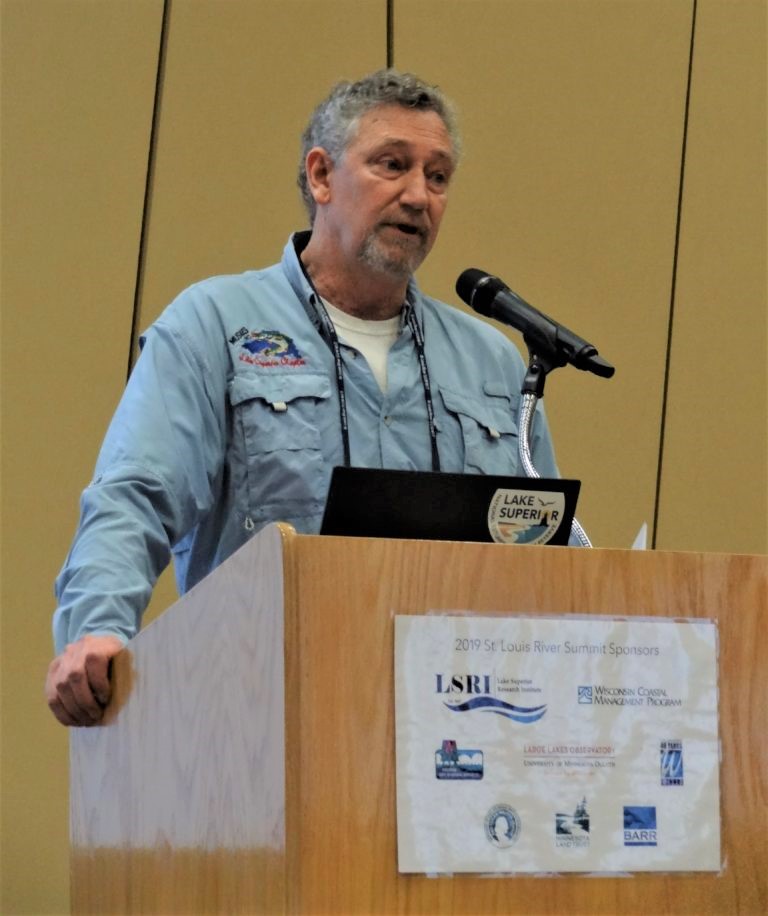
Keith Okeson. Image credit: Marie Zhuikov, Wisconsin Sea Grant

The next River Talk will be at 6:30 p.m. Wednesday, April 10, with “Muskies and the St. Louis River,” an in-person presentation by Keith Okeson with Lake Superior Chapter of Muskies Inc.. His talk will be held at the Lake Superior Estuarium (3 Marina Dr., Superior, Wis.). Refreshments will be provided.

Okeson has been a board member of Muskies Inc. for over two decades. He’ll offer an angler’s perspective on efforts to restore and manage this sport fish species in the St. Louis River, including information about stocking, numbers of muskie in the river and how the resource has recovered. He will be joined by two other members of Muskies Inc. who will talk about fishing the river for muskie.

For accessibility accommodations related to sound, language and translation, mobility or anything else to make engagement possible, please contact Luciana at 715-399-4085 or Luciana.Ranelli@wisc.edu, as soon as possible.

This is the final River Talk of the season. For more information, visit the River Talks page: go.wisc.edu/4uz720.

The River Talks are sponsored by the Lake Superior National Estuarine Research Reserve and the Wisconsin Sea Grant Program.

The post Muskies and the St. Louis River first appeared on Wisconsin Sea Grant.

Original Article

News Releases | Wisconsin Sea Grant

News Releases | Wisconsin Sea Grant

https://www.seagrant.wisc.edu/news/muskies-and-the-st-louis-river/

Marie Zhuikov

Jane Elder once escorted a live cormorant to a Congressional hearing. 

Elder, then a Sierra Club lobbyist, and James Ludwig, a Great Lakes ecologist, in 1989 drove the bird named Cosmos from Michigan’s Upper Peninsula to Washington D.C. 

The post New book explores a lifetime of Great Lakes resilience first appeared on Great Lakes Echo.

Original Article

Great Lakes Echo

Great Lakes Echo

http://greatlakesecho.org/2024/04/01/new-book-explores-a-lifetime-of-great-lakes-resilience/

Reese Carlson

In the wake of the Francis Scott Key Bridge collapse, it was reported that freighters on the Great Lakes and St. Lawrence Seaway lost propulsion, steering, or electrical power more than 200 times between 2012 and 2022. Read the full story by The Detroit News.

Original Article

Great Lakes Commission

Great Lakes Commission

https://www.glc.org/dailynews/20240329-freighter-power-loss

Nichole Angell

The U.S. EPA announced the Sandusky-based Ohio Lake Erie Commission would receive $5.8 million to support underserved communities. These funds will be used to remove barriers and preserve the rich cultural, economic, and environmental role of the Great Lakes for communities across the basin. Read the full story by The Toledo Blade.

Original Article

Great Lakes Commission

Great Lakes Commission

https://www.glc.org/dailynews/20240329-environmental-justice-funding

Nichole Angell

Michigan is slated to get its own chemical recycling facility which would use plastic pyrolysis to turn plastic into fuel. However, environmentalists are weary of the byproducts and legislative roadblocks are currently in place. Read the full story by Great Lakes Echo.

Original Article

Great Lakes Commission

Great Lakes Commission

https://www.glc.org/dailynews/20240329-chemical-recycling

Nichole Angell

A 2014 report released by the U.S. Department of Energy gave the green light to establish wind energy projects in the Great Lakes. Despite this, nearly a decade later, wind farms have yet to become established. Read the full story by Outdoor News.

Original Article

Great Lakes Commission

Great Lakes Commission

https://www.glc.org/dailynews/20240329-wind-energy-funding

Nichole Angell

Steve Hall used to call public health “the invisible profession.”

“Previously, when we did our jobs well, people didn’t know about us,” said Hall, who for 10 years has been the health officer for the Central Michigan District Health Department.

The post Challenges, reduced public trust confront local health agencies first appeared on Great Lakes Echo.

Original Article

Great Lakes Echo

Great Lakes Echo

http://greatlakesecho.org/2024/03/29/challenges-reduced-public-trust-confront-local-health-agencies/

Guest Contributor

Through a Glass Darkly

Increasingly, scientists and regulators are concerned about the presence of pharmaceutical pollution in our waterways, including in the Great Lakes region. This contamination has the potential to harm wildlife and make antibiotics less effective. However, more research needs to be done to understand this issue, according to scientists who have studied pharmaceuticals and other contaminants.

Read Now at Great Lakes Now.

Original Article

Great Lakes Now

Great Lakes Now

https://www.greatlakesnow.org/2024/03/through-a-glass-darkly/

Sean Ericson, Great Lakes Now

Nibi Chronicles: The nation-to-nation fight against extractivism

Ricky DeFoe can tell you all you need to know about fresh water on Earth in one minute or less. He rattles off that “70% of our planet — our Mother Earth is water. Ninety-seven percent of that water is saltwater. That leaves just 3% freshwater — 1% is in the atmosphere, 1% is subsurface, and 1% is on the surface.

Read Now at Great Lakes Now.

Original Article

Great Lakes Now

Great Lakes Now

https://www.greatlakesnow.org/2024/03/nibi-chronicles-the-nation-to-nation-fight-against-extractivism/

Staci Lola Drouillard

Person wearing a suit jacket standing at a podium with clasped hands. A second tall person stands in the background.

U.S. Rep. Mark Pocan announcing a nearly $1 million investment in PFAS research. Photo by Wisconsin Sea Grant.

During a press event at the University of Wisconsin-Madison Water Sciences and Engineering Lab (WSEL) yesterday, U.S. Rep. Mark Pocan announced $963,000 in funding for a new Center of Excellence in PFAS Environmental Science.

PFAS stands for per- and polyfluoroalkyl substances, a class of chemicals used in everyday items such as nonstick cookware, food packaging and stain-repellent products. Many PFAS resist degradation and are highly mobile in the environment. As a result, these chemicals have been detected across the globe and are directly impacting drinking water, as well as fisheries. They are known to cause negative health effects in people.

“UW-Madison is one of the premier research institutions in the United States and it was an honor to secure these federal funds for them,” Pocan said, “PFAS chemicals have been detected throughout our water table, contaminating both surface and groundwater systems. This funding will be used to help conduct research to improve the quality of Wisconsin’s drinking water by removing these harmful PFAS chemical compounds from the environment.”

Close-up of person with long hair.

Sea Grant Interim Director Christy Remucal will lead a new Center of Excellence in PFAS Environmental Science. Photo by Wisconsin Sea Grant.

Sea Grant Interim Director Christy Remucal will lead the new center. She was unable to attend yesterday’s event but provided information to be shared on her behalf. “This support will allow researchers to advance actional research on PFAS. This is necessary to safeguard water quality and protect public health,” she wrote.

The center will be housed at WSEL, which currently offers the only accessible instrumentation on campus for measuring PFAS in environmental samples. In a proposal first suggesting the center, Remucal wrote, “Typical funded research projects support one researcher at a time. This funding will support multiple scientists through a collaborative Center of Excellence framework, enabling scientists to take a holistic approach to address this complex issue for the first time.”

Despite joking that he could explain the chemical makeup of the more than 9,000 PFAS and how the new center would address them, Pocan turned to others at the event during a tour of the lab to gain an understanding of current and future work.

That work will be expanded thanks to the purchase of a state-of-the-art mass spectrometer, using a portion of the new funding. Standard techniques allow researchers to now measure only about 40 different PFAS. The new instrumentation will allow researchers to study more PFAS chemicals.

The new instrument will also have high-resolution capabilities that let scientists detect and identify PFAS they currently can’t measure. This will advance the field of environmental forensics, which uses PFAS chemistry to identify the sources of contamination. This is critical for cleaning up and preventing PFAS contamination.

Three people standing in a line talking.

U.S. Rep. Mark Pocan learns about current PFAS instrumentation from Zhao Yang (center) and Kaitlyn Gruber (left) in Christy Remucal’s lab. Photo by Wisconsin Sea Grant.

This investment also means researchers will increase the quantity of samples processed in the lab. Sample preparation is very time consuming and often limits how many samples can be analyzed. Through the center, Remucal plans to purchase things like automated extraction equipment that will let researchers process more samples.

In her supplied remarks, Remucal noted that researchers are making progress in learning about PFAS and coming up with solutions to address them, especially here in Wisconsin.

Remucal noted the number of researchers in Wisconsin who study PFAS has grown dramatically in the last five years. She wrote that work is ongoing to understand the fate of PFAS and how they are impacting the Great Lakes, quantify the amount of PFAS in waste materials, determine toxicity, find new detection techniques and, finally, conceive of ways to contain or remediate the chemicals.

Sea Grant is currently funding PFAS research in Lake Superior to determine if PFAS accumulate at higher levels at the surface water in foams and ice as compared to lower water depths. If that is the case, it can complicate representative sample collection. A second project will provide a quantitative understanding of PFAS moving through groundwater near Lake Michigan. A final effort is looking at toxicity and bioaccumulation of different types of PFAS in larval fish.

The post New federal funding will boost holistic PFAS research first appeared on Wisconsin Sea Grant.

Original Article

News Releases | Wisconsin Sea Grant

News Releases | Wisconsin Sea Grant

https://www.seagrant.wisc.edu/news/new-federal-funding-will-boost-holistic-pfas-research/

Moira Harrington

Feds award $1.5 billion for Palisades nuclear plant restart

By Kelly House, Bridge Michigan

The Great Lakes News Collaborative includes Bridge Michigan; Circle of Blue; Great Lakes Now at Detroit Public Television; Michigan Public, Michigan’s NPR News Leader; and The Narwhal who work together to bring audiences news and information about the impact of climate change, pollution, and aging infrastructure on the Great Lakes and drinking water.

Read Now at Great Lakes Now.

Original Article

Great Lakes Now

Great Lakes Now

https://www.greatlakesnow.org/2024/03/feds-award-1-5-billion-for-palisades-nuclear-plant-restart/

Bridge Michigan

During a press event at the University of Wisconsin-Madison Water Sciences and Engineering Lab (WSEL) yesterday, U.S. Rep. Mark Pocan announced $963,000 in funding for a new Center of Excellence in PFAS Environmental Science.

PFAS stands for per- and polyfluoroalkyl substances, a class of chemicals used in everyday items such as nonstick cookware, food packaging and stain-repellent products. Many PFAS resist degradation and are highly mobile in the environment. As a result, these chemicals have been detected across the globe and are directly impacting drinking water, as well as fisheries. They are known to cause negative health effects in people.

“UW-Madison is one of the premier research institutions in the United States and it was an honor to secure these federal funds for them,” Pocan said, “PFAS chemicals have been detected throughout our water table, contaminating both surface and groundwater systems. This funding will be used to help conduct research to improve the quality of Wisconsin’s drinking water by removing these harmful PFAS chemical compounds from the environment.”

Group of people standing behind another person in forefront who is speaking.
U.S. Rep. Mark Pocan announcing nearly a $1 million investment in PFAS research. Photo by WRI.

University of Wisconsin Water Resources Institute Interim Director Christy Remucal will lead the new center. She was unable to attend yesterday’s event but provided information to be shared on her behalf. “This support will allow researchers to advance actional research on PFAS. This is necessary to safeguard water quality and protect public health,” she wrote.

Close-up of person with shoulder-length brown hair.
WRI Interim Director Christy Remucal will lead a new Center of Excellence in PFAS Environmental Science.

The center will be housed at WSEL, which currently offers the only accessible instrumentation on campus for measuring PFAS in environmental samples. In a proposal first suggesting the center, Remucal wrote, “Typical funded research projects support one researcher at a time. This funding will support multiple scientists through a collaborative Center of Excellence framework, enabling scientists to take a holistic approach to address this complex issue for the first time.”

Despite joking that he could explain the chemical makeup of the more than 9,000 PFAS and how the new center would address them, Pocan turned to others at the event during a tour of the lab to gain an understanding of current and future work.

That work will be expanded thanks to the purchase of a state-of-the-art mass spectrometer, using a portion of the new funding. Standard techniques allow researchers to now measure only about 40 different PFAS. The new instrumentation will allow researchers to study more PFAS chemicals.

The new instrument will also have high-resolution capabilities that let scientists detect and identify PFAS they currently can’t measure. This will advance the field of environmental forensics, which uses PFAS chemistry to identify the sources of contamination. This is critical for cleaning up and preventing PFAS contamination.

This investment also means researchers will increase the quantity of samples processed in the lab. Sample preparation is very time consuming and often limits how many samples can be analyzed. Through the center, Remucal plans to purchase things like automated extraction equipment that will let researchers process more samples.

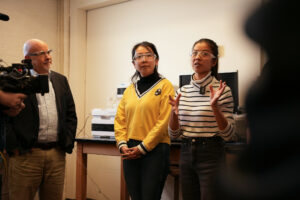
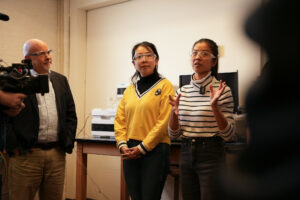
Three people wearing lab safety glasses stand and have a conversation.
U.S. Rep. Mark Pocan learns about current PFAS instrumentation from Zhao Yang (center) and Kaitlyn Gruber (left) in Christy Remucal’s lab. Photo by WRI.

In her supplied remarks, Remucal noted that researchers are making progress in learning about PFAS and coming up with solutions to address them, especially here in Wisconsin.

Remucal also noted the number of researchers in Wisconsin who study PFAS has grown dramatically in the last five years. She wrote that work is ongoing to understand the fate of PFAS and how they are impacting the Great Lakes, quantify the amount of PFAS in waste materials, determine toxicity, find new detection techniques and, finally, conceive of ways to contain or remediate the chemicals.

Through WRI, a researcher is also currently studying PFAS levels in subsistence goods relevant to Indigenous communities—walleye, maple sap and wild rice.

Another current PFAS project is quantifying PFAS export from contaminated soil to underlying groundwater aquifers, and determining how long the contaminated soil can serve as a source of PFAS in the future.

The post New federal funding will boost holistic PFAS research first appeared on WRI.

Original Article

News Release | WRI

News Release | WRI

https://www.wri.wisc.edu/news/new-federal-funding-will-boost-holistic-pfas-research/

Moira Harrington

When Gov. Gretchen Whitmer signed off on expansive recycling reforms in December 2022, she also approved a last-minute amendment allowing chemical recycling — a process decried by many environmentalists — to be classified as a legal manufacturing process.

Chemical recycling, specifically the commonly used plastic pyrolysis process, turns plastic into fuel.

The post Scrutiny builds as Michigan awaits first ‘chemical recycling’ facility first appeared on Great Lakes Echo.

Original Article

Great Lakes Echo

Great Lakes Echo

http://greatlakesecho.org/2024/03/28/scrutiny-builds-as-michigan-awaits-first-chemical-recycling-facility/

Guest Contributor

Ottawa Sands County Park on Lake Michigan near Grand Haven, Michigan, will be closed to the public until later this summer as construction continues on numerous improvements to facilities, including treehouses, yurts, and campsites for overnight stays. Read the full story by MLive.

Original Article

Great Lakes Commission

Great Lakes Commission

https://www.glc.org/dailynews/20240327-lakemichigan-park-closing

Hannah Reynolds

A new study suggests microscopic plastic particles are reaching corners of the world untouched by people, including remote bodies of water in Ontario north of Lake Superior. Read the full story by WJBK-TV – Detroit, MI.

Original Article

Great Lakes Commission

Great Lakes Commission

https://www.glc.org/dailynews/20240327-microplastics-greatlakes-newstudy

Hannah Reynolds

In the 76 days of the 2023 domestic icebreaking season, six U.S. icebreakers combined to deliver 719 hours of icebreaking assistance to the benefit of 52 vessel transits; 18 of these movements required direct icebreaking assistance to ensure commercial vessel safety. Read the full story by WWTV- Cadillac, MI.

Original Article

Great Lakes Commission

Great Lakes Commission

https://www.glc.org/dailynews/20240327-coastguard-greatlakes-icebreakers-52vessels

Hannah Reynolds

Lake Zurich, Illinois, village officials approved new measures last week for a $154 million project that will transition the town’s water source to Lake Michigan, but it comes at a price for its residents. The project will be the most expensive infrastructure project in the village’s history. Read the full story by the Lake and McHenry County Scanner.

Original Article

Great Lakes Commission

Great Lakes Commission

https://www.glc.org/dailynews/20240327-lakezurich-150million-project-lakemichiganwatersource

Hannah Reynolds

Navigating vessels in the Great Lakes might seem a lot easier than spending weeks on the open ocean. However, that doesn’t mean Great Lakes crews are any less vigilant, according to the Lake Carriers’ Association. Read the full story by WPBN-TV – Traverse City, MI.

Original Article

Great Lakes Commission

Great Lakes Commission

https://www.glc.org/dailynews/20240327-greatlakes-shipping-safety

Hannah Reynolds

Environment and Climate Change Canada says ice cover on the Great Lakes reached a record low this winter. Experts say that ice cover on the Great Lakes has declined about 75 percent in the last 50 years. Read the full story by CBC.

Original Article

Great Lakes Commission

Great Lakes Commission

https://www.glc.org/dailynews/20240327-icecover-low-greatlakes-environmentcanada

Hannah Reynolds

Tribal communities have long faced barriers to clean drinking water and testing. The Great Lakes Inter-Tribal Epidemiology Center, based in Lac du Flambeau, Wisconsin, aims to help tribal schools, childcare centers and after-school programs across the Great Lakes region ensure their water is safe through its free drinking water testing program. Read the full story by WUMW – Milwaukee, WI.

Original Article

Great Lakes Commission

Great Lakes Commission

https://www.glc.org/dailynews/20240327-freewatertesting-tribalschools-greatlakesregion

Hannah Reynolds

Every five years, the University of Wisconsin Water Resources Institute (WRI) is evaluated to determine eligibility for continued support under the federal Water Resources Research Act of 1984, which is administered by the U.S. Geological Survey (USGS).

WRI recently received the results of that review of 2016-20 research, student support and information transfer. The headline is the USGS found that WRI is “performing at an outstanding level.”

The USGS review panel assessed WRI’s effectiveness in using its federal grant, as well as required matching funds, which come from the state of Wisconsin. The panel also called out notable features in how WRI operates:

  • The support for high-quality research, with a special call-out to collaborative work on mercury cycling with UW-Madison and the USGS’s Mercury Research Lab. Another factor that was praised was the support for early faculty in the request for proposal process. In fact, the panel complimented the entire proposal review process that effectively draws on subject matter experts to evaluate what prospective investigators would study.
  • An active and innovative information transfer effort that results in quality products. Reviewers particularly appreciated podcasting as a way to convey science stories.
  • The focus on training post-graduates through fellowships with state agencies.
  • The large-scale engagement with USGS, including at least five collaborations and 14 co- authored publications and joint work with students.

“We work every day to leverage our federal and state funding effectively to help communities across Wisconsin, and it is truly a collective team effort,” said Jennifer Hauxwell, WRI’s research director. “From the dozens of researchers at Wisconsin universities across the state who step up to address our shared water challenges to institute staff who coordinate our research program, create student training opportunities, manage the distribution of funding and communicate stories and archive findings, we are so very grateful. We still have a lot to learn about Wisconsin’s water resources and community needs, and we look forward to tackling future challenges and opportunities together.”

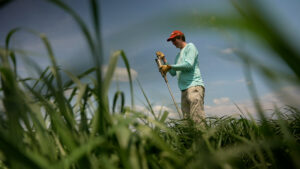
Person in a red cap standing in a corn field with a tool for scientific study.
A WRI researcher prepares a tool to survey groundwater in an area of southern Wisconsin prone to flooding. Photo by WRI.

WRI is one of 54 national water research institutes. For 60 years, it has been a locally focused state and federal partnership supporting unbiased research and information transfer, which leads to safeguarding Wisconsin’s water quantity, quality and management. Some of the research projects supported during this evaluation period looked at naturally occurring contaminants like strontium, radium and manganese. Other projects explored land use practices and the resulting levels of nitrate in groundwater.

The post Water Resources Institute recognized for strong science, science communication and student support first appeared on WRI.

Original Article

News Release | WRI

News Release | WRI

https://www.wri.wisc.edu/news/water-resources-institute-recognized-for-strong-science-science-communication-and-student-support/

Moira Harrington

The number of farmhands in Michigan working on H-2A visas — which allow farms that are struggling to hire U.S. workers to bring in temporary laborers from other countries—increased from 277 in 2010 to over 15,000 in 2023, according to the Michigan Farm Bureau. 

The post Advocates call for more protection of migrant farmworkers first appeared on Great Lakes Echo.

Original Article

Great Lakes Echo

Great Lakes Echo

http://greatlakesecho.org/2024/03/27/advocates-call-for-more-protection-of-migrant-farmworkers/

Guest Contributor

PFAS News Roundup: MIT chemists designed a sensor that detects PFAS

Keep up with PFAS-related developments in the Great Lakes area with Great Lakes Now’s biweekly headline roundup.

Click on the headline to read the full story:


Indiana

A bill to secure industry use of toxic PFAS is dead – for now.

Read Now at Great Lakes Now.

Original Article

Great Lakes Now

Great Lakes Now

https://www.greatlakesnow.org/2024/03/pfas-news-roundup-mit-chemists-designed-a-sensor-that-detects-pfas/

Kathy Johnson, Great Lakes Now

Ontario weakens watershed protections (again) as natural resources minister gets new powers

By Fatima Syed, The Narwhal

The Great Lakes News Collaborative includes Bridge Michigan; Circle of Blue; Great Lakes Now at Detroit Public Television; Michigan Public, Michigan’s NPR News Leader; and The Narwhal who work together to bring audiences news and information about the impact of climate change, pollution, and aging infrastructure on the Great Lakes and drinking water.

Read Now at Great Lakes Now.

Original Article

Great Lakes Now

Great Lakes Now

https://www.greatlakesnow.org/2024/03/ontario-weakens-watershed-protections-again-as-natural-resources-minister-gets-new-powers/

The Narwhal

Discovery is part of first-ever study of viruses in healthy fish across the state.

Researchers at the University of Wisconsin-Madison have detected a suite of new viruses in five species of Wisconsin sport fish. Although none pose a threat to human health, one is a type of coronavirus usually associated with birds. It was found in healthy walleyes from Wisconsin lakes. The finding is part of a Wisconsin Sea Grant-funded study of the natural diversity of viruses (or virome) of fish in Wisconsin and is the first project of its kind in North America.

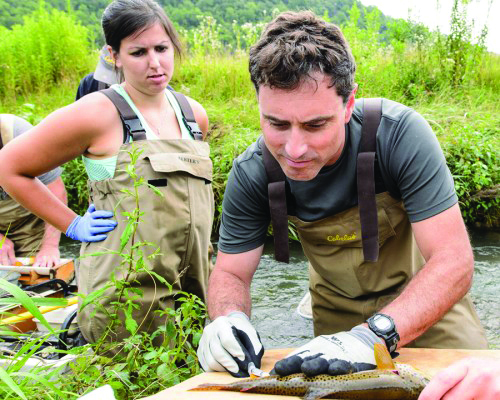
Tony Goldberg takes a blood sample in a non-lethal way from trout caught near Wauzeka, Wisconsin, while Whitney Theil observes. The fish was collected by DNR staff members to test for emerging diseases in the fish population. Image credit: Bryce Richter, UW-Madison

Tony Goldberg, a professor in the Department of Pathobiological Sciences, said his research group identified 19 viruses in blood samples from 103 Wisconsin bluegills, brown trout, lake sturgeon, northern pike and walleye. Seventeen of the 19 viruses were new to science. Among them was the first fish-associated coronavirus from the Gammacrononavirus genus, which differs from the type of virus that causes COVID. It was present in 11 out of 15 walleyes sampled by the Wisconsin Department of Natural Resources (DNR).

While the findings are novel, Goldberg stressed that anglers should not be worried. “None of these viruses can infect people. It’s not a risk for people to catch, handle and eat fish because of these viruses. There’s no evidence that these viruses are causing any problems. They may just be part of the natural ecosystem of these fish,” he said.

The results were recently published in the journal “Pathogens.” Of the different species of fish sampled, lake sturgeon blood contained the most viruses (97% of samples), with brown trout samples showing the least prevalence (6%).

Regarding the coronavirus found in walleye, Goldberg said, “There’s an important poultry disease called infectious bronchitis that is caused by a relative of this new virus, but this is the first example in fish and it is an honest-to-goodness coronavirus.”

This virus survey builds on previous Sea Grant-funded research in which Goldberg studied viral hemorrhagic septicemia in fish. The DNR took blood samples from healthy fish across Wisconsin to test for viral hemorrhagic septicemia antibodies. They saved the blood and used it for this current study on the viromes of Wisconsin fish.

The findings will aid fishery managers when they routinely test the health of fish about to be released into state lakes from hatcheries or for fish that are being shipped out of state.

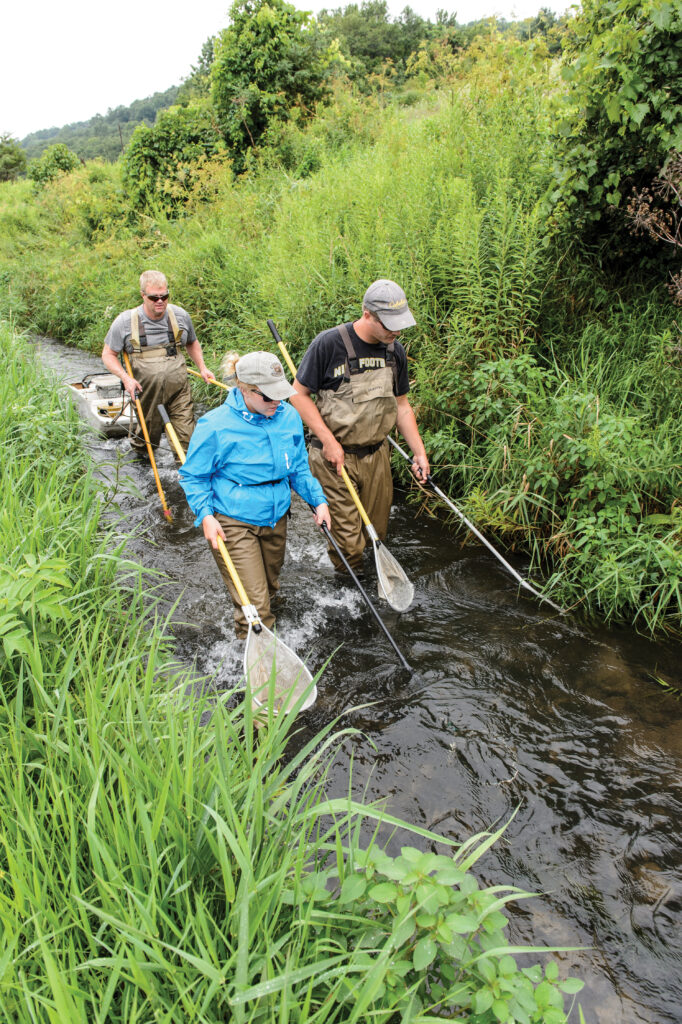
Wisconsin Department of Natural Resources fisheries technicians collect trout from a creek near Viroqua, Wisconsin. Image credit: Bryce Richter, UW-Madison

“This is a huge problem for fisheries managers that happens all the time,” Goldberg said. “We recently had a case where there were thousands of muskies that were ready to be released and they came back with an unknown virus. So, do you release them? Do you just keep them there? Do you kill them all? Maybe there are viruses out there that are a normal part of the ecosystem and they just infect a lot of fish, but they don’t cause disease.” This study’s findings will help managers decide what is normal and what is concerning in terms of fish viruses.

Goldberg said that one thing anglers can do to ensure fish viruses aren’t spread is not to transport fish between water bodies “If you move a fish from one water body to another, you’re moving everything that lives on and in that fish, and potentially causing problems,” he said.

As a follow-up, Goldberg’s collaborators at the U.S. Fish and Wildlife Service have designed specific tests for the various viruses and the team will test a larger set of fish blood samples from around Wisconsin. They will map the viruses so that fisheries managers can tell what’s normal for a particular watershed and whether stocking can or should not proceed.

He also plans to develop a “Fish Get Sick, Too,” educational program. Goldberg said that fish are “animals, like anything else, and they get sick, too. I think if people were more aware of that, it might help reinforce some of the best-handling practices we do for catch-and-release fishing, some of the harvest practices, and food safety things we do.”

Other members of the research team include Charlotte Ford and Christopher Dunn with the UW-Madison Department of Pathobiological Sciences; and Eric Leis and Isaac Standish with the U.S. Fish and Wildlife Service, La Crosse Fish Health Center.

The post Wisconsin sport fish carry suite of new viruses first appeared on Wisconsin Sea Grant.

Original Article

News Releases | Wisconsin Sea Grant

News Releases | Wisconsin Sea Grant

https://www.seagrant.wisc.edu/news/wisconsin-sport-fish-carry-suite-of-new-viruses/

Marie Zhuikov

Every fish studied recently in two southeast Michigan watersheds contained at least one of a family of toxic and persistent health-threatening chemicals.

The chemicals - collectively known as per- and polyfluoroalkyl substances or PFAS - are found in some rivers, lakes, soils, drinking water, fish, cattle and crops.

The post High levels of toxic forever chemicals in Michigan fish alarm scientists first appeared on Great Lakes Echo.

Original Article

Great Lakes Echo

Great Lakes Echo

http://greatlakesecho.org/2024/03/26/high-levels-of-toxic-forever-chemicals-in-michigan-fish-alarm-scientists/

Guest Contributor

Waves of Change: Meet bird conservationist and migration counter Alison Vilag

Waves of Change is an online interview series highlighting the diverse faces and perspectives shaping the environmental justice movement throughout the Great Lakes region.

This month, we spoke with Alison Vilag, a bird conservationist and migration counter based in northern Michigan.

Listen to the full interview

She’s traveled all over the country and has helped document a loss of birds that scientists call staggering.

Read Now at Great Lakes Now.

Original Article

Great Lakes Now

Great Lakes Now

https://www.greatlakesnow.org/2024/03/waves-of-change-meet-bird-conservationist-and-migration-counter-alison-vilag/

Great Lakes Now

CHICAGO, IL (March 25, 2024) Last week on World Water Day, the Alliance for the Great Lakes, Ocean Conservancy, Illinois Environmental Council, and Loyola University scientists held a press conference with partners at the Museum of Science and Industry to discuss protecting the Great Lakes and waterways from the environmental and health risks of microfiber pollution. The Great Lakes provide drinking water for more than 30 million people and are home to diverse and increasingly threatened wildlife. However, the Great Lakes are in the midst of a plastic pollution crisis, with plastic waste increasingly accumulating in our waterways. To address this issue, Illinois lawmakers have introduced a bill that would require microfiber capture devices on all washing machines sold in Illinois by 2030.   

“What happens in Illinois impacts the ocean – whether through the Great Lakes, whose water flows through the St. Lawrence Seaway to the Atlantic, or through the Mississippi River flowing into the Gulf of Mexico. Microplastics can even be carried by evaporated water and spread through our weather systems around the world. Washing machines are a major contributor to plastic microfiber pollution, and Ocean Conservancy is proud to support this bill to stop microplastics at the source,” said Jeff Watters, Vice President, External Affairs at Ocean Conservancy. 

“For over 30 years, Alliance for the Great Lakes Adopt-a-Beach volunteers have been on the front lines of keeping litter off our beaches and out of the Great Lakes by removing over half a million pounds of litter from shorelines since 1991. Most of the litter collected is composed either partially or fully of plastic. The good news is that if we act now, we can stop the pollution before it makes its way into our waterways through simple washing machine filters like those used in dryers. Our dedicated volunteers shouldn’t be the only means to keep plastic pollution out of the Great Lakes. We need smart policies to reduce microplastic pollution, which is why we fully support Illinois House Bill 4269,” said Molly Flanagan, Chief Operating Officer & Vice President for Programs of the Alliance for the Great Lakes.  

“Our research group has been studying litter in our waterways for over 10 years. The vast majority of the trash we find is plastic, and increasingly, microfibers are the most common microplastic in our waterways. Preventing pollution at the source is critical; washing machine filters are a simple and cost-effective solution. This approach is important and can make meaningful improvements to reduce pollution,” said Dr. Tim Hoellein, Associate Professor, Loyola University, Director Aquatic Ecology Lab.  

Plastic microfibers that come from plastic-based textiles and clothing are of growing concern. Microfibers are the most prevalent form of microplastics in environmental samples and represent over 90% of microplastics ingested by marine animals.  In animals, ingestion of microfibers has been shown to reduce food consumption, reduce energy for growth, alter gene expression, and block digestive tracts

In many cases, microfibers that are shed from clothing during household and commercial laundering escape wastewater treatment plants (WWTPs) and flow with the discharge into our waterways. An existing technology, washing machine microfiber filters, have been shown to be a cost-effective solution that can capture up to 90% of microfibers from each load of laundry, leading to a significant reduction in microfibers in wastewater treatment plants. 

A fact sheet on microfibers can be found here.

Photos from the event can be found here.

### 

About Alliance for the Great Lakes 

The Alliance for the Great Lakes is a nonpartisan nonprofit working across the region to protect our most precious resource: the fresh, clean, and natural waters of the Great Lakes. For more information, visit greatlakes.org.  

About Ocean Conservancy   

Ocean Conservancy is working to protect the ocean from today’s greatest global challenges. Together with our partners, we create evidence-based solutions for a healthy ocean and the wildlife and communities that depend on it. For more information, visit oceanconservancy.org, or follow us on Facebook, Twitter or Instagram. 

Contact:

Don Carr, Media Director, Alliance for the Great Lakes, dcarr@greatlakes.org, +1 (651) 395-4270
Roya Fox, Communications Manager, Ocean Conservancy, rfox@oceanconservancy.org, +1 (206) 948-7874

Great Lakes Plastic Pollution

Plastic pollution is a serious problem for the Great Lakes. Learn more about plastic pollution and how to stop it.

Learn More

The post New Bill to Protect Great Lakes, Drinking Water from Microplastics Receives Support from Environmental Groups appeared first on Alliance for the Great Lakes.

Original Article

News - Alliance for the Great Lakes

News - Alliance for the Great Lakes

https://greatlakes.org/2024/03/new-bill-to-protect-great-lakes-drinking-water-from-microplastics-receives-support-from-environmental-groups/

Judy Freed

The owner of the decommissioned Palisades nuclear power plant on the shores of Lake Michigan about five miles south of South Haven, Michigan, is better known for decommissioning nuclear plants. Its endeavor to restart the plant is one that has never been attempted in the United States. Read the full story by Michigan Public.

Original Article

Great Lakes Commission

Great Lakes Commission

https://www.glc.org/dailynews/20240325-nuclear-plant-restart

James Polidori

Alongside the lack of ice coverage, unseasonable winter temperatures in the Great Lakes region are creating the conditions for the proliferation of invasive species, strain on the lakes’ natural, temperature-driven stratification process, and the rise of toxic algal blooms. Read the full story by the Daily Herald.

Original Article

Great Lakes Commission

Great Lakes Commission

https://www.glc.org/dailynews/20240325-climate-impacts

James Polidori