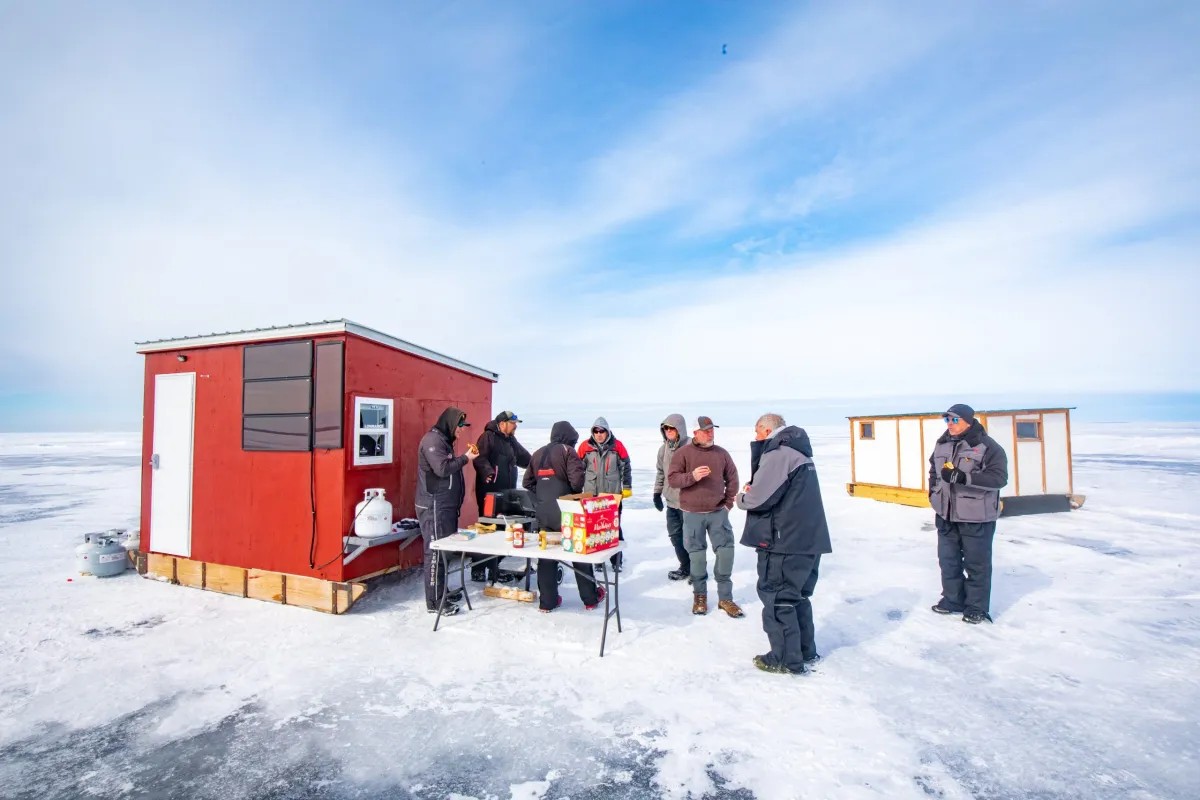
STURGEON BAY, WISCONSIN — It’s midmorning in late February, and Bruce Smith is regaling two ice fishing buddies when a tug on his line interrupts the story.

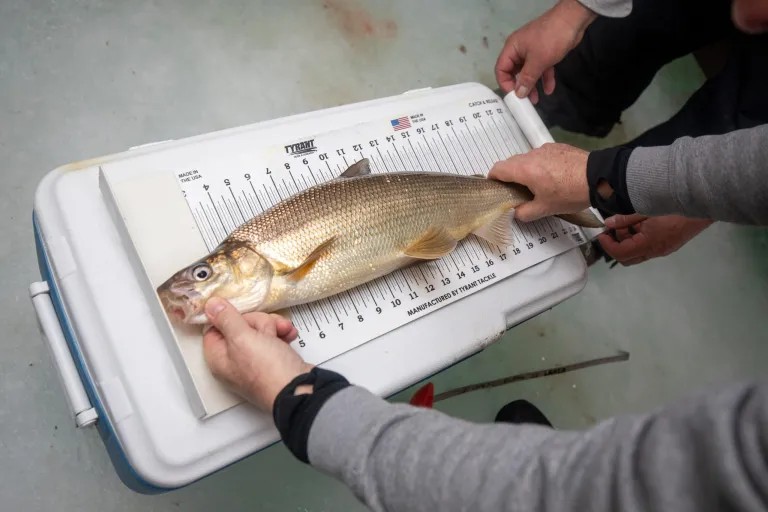
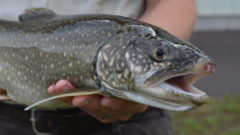
“There we go!” he shouts as a shimmering 23-inch whitefish appears through a hole in the ice. “That’ll make a nice filet.”

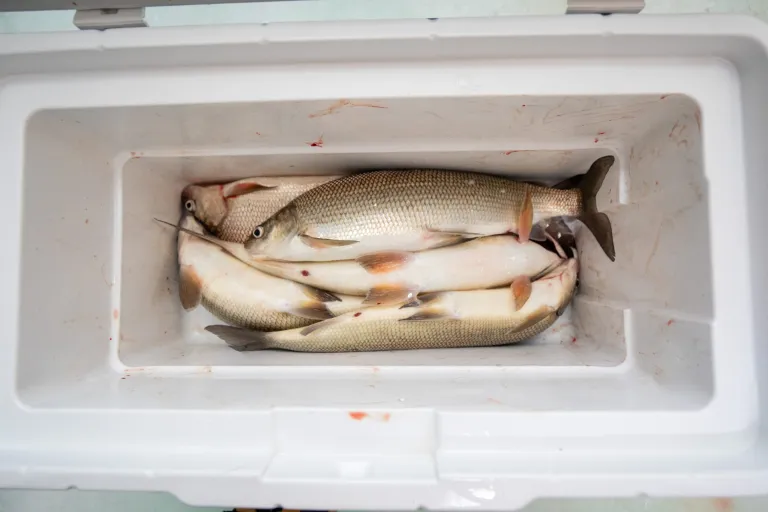
No sooner has Smith tossed it into a cooler than his buddy Terry Gross reels in another one. Five minutes later came another bite, then another, until by 10:30 a.m. the trio had hauled in 15 fish — halfway to their daily limit, even after putting several back. 

Welcome to southern Green Bay. Or as Smith likes to call it, “Whitefish Town, USA.”

Once written off as too polluted to support many whitefish, the shallow, narrow bay in northwest Lake Michigan has produced an unlikely population boom in recent years, even as the iconic species vanishes from most of the lower Great Lakes. The collapse has dealt a blow to Michigan’s environmentcultureeconomy and dinner plates.

Oddly enough, nutrient pollution from farms and factories may help bolster the bay’swhitefish population, spawning a world-class recreational fishing scene while helping a handful of commercial fisheries in Michigan and Wisconsin stay afloat despite the collapse in the wider lake.

“This is a paradise,” Smith said. “The best fishing I can ever remember, for the species I want to catch.”

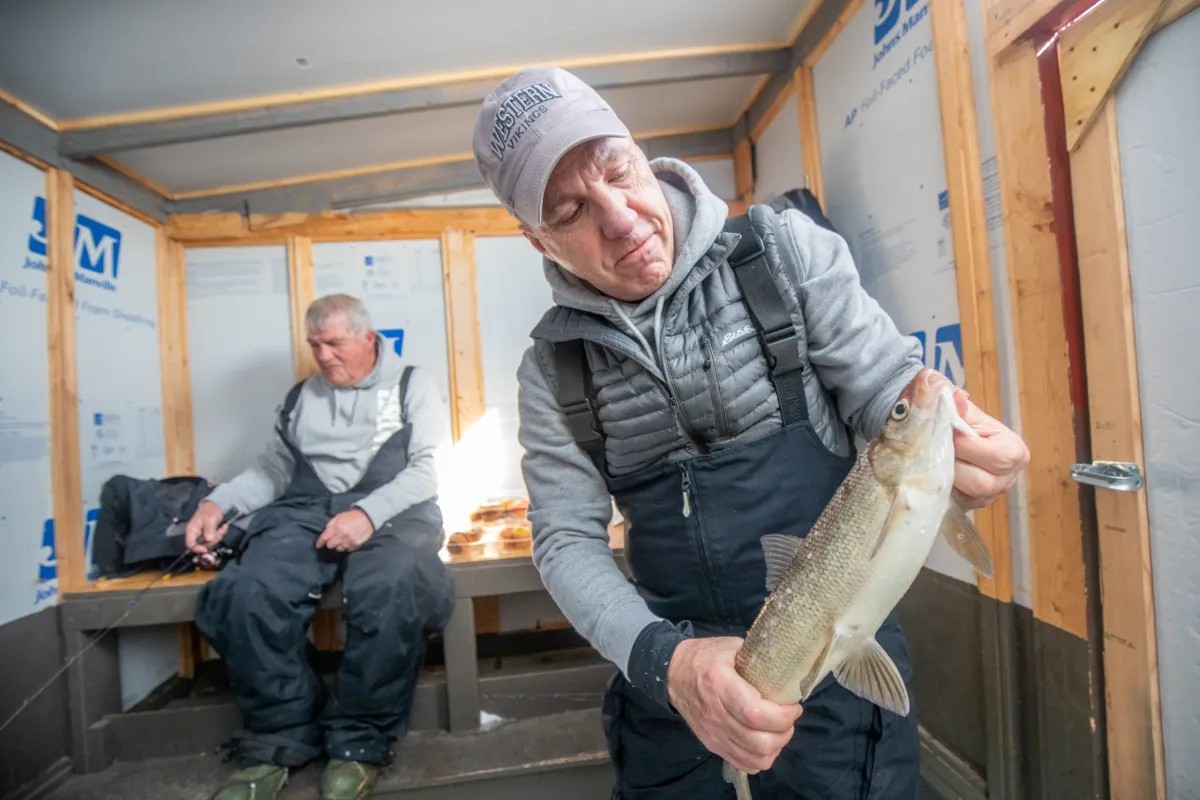
Terry Gross, 63, hauls in a large whitefish in the ice fishing shanty he shares with Ed Smrecek, 73. Both men are from Appleton, Wisconsin. (Daniel Kramer for Bridge Michigan)

As scientists work to understand what makes Green Bay unique, their findings could aid whitefish recovery efforts throughout the Great Lakes. Michigan biologists, for example, have drawn inspiration from Green Bay’s sheltered, nutrient-rich waters as they attempt to transplant the state’s whitefish into areas with similar characteristics.

“Having places they (whitefish) are doing well … gives us context for the places that they aren’t doing well,” said Matt Herbert, a senior conservation scientist with the Nature Conservancy in Michigan. “It helps us to figure out, how can we intervene?”

But lately, sophisticated population models have shown fewer baby fish making their way into the Green Bay population, prompting worries that Lake Michigan’s last whitefish stronghold may be weakening.

A Great Lakes miracle

Not long ago, it seemed impossible that a fishery like this could ever exist in Green Bay.

Before the Clean Water Act of 1972 and subsequent cleanup efforts, paper mills along the lower Fox River — the bay’s largest tributary — dumped toxic polychlorinated biphenyls (PCBs) into the water without restraint while silty, fertilizer-soaked runoff poured off upstream farms.

Southern Green Bay was no place for “a self-respecting whitefish,” said Scott Hansen, senior fisheries biologist with the Wisconsin Department of Natural Resources.

Lake Michigan’s much larger main basin, meanwhile, was full of them. 

Commercial fisherman Todd Stuth’s business got 80% of its catch from the open waters of Lake Michigan before the turn of the millenium. Now, 90% comes from Green Bay.

How did things change so dramatically?

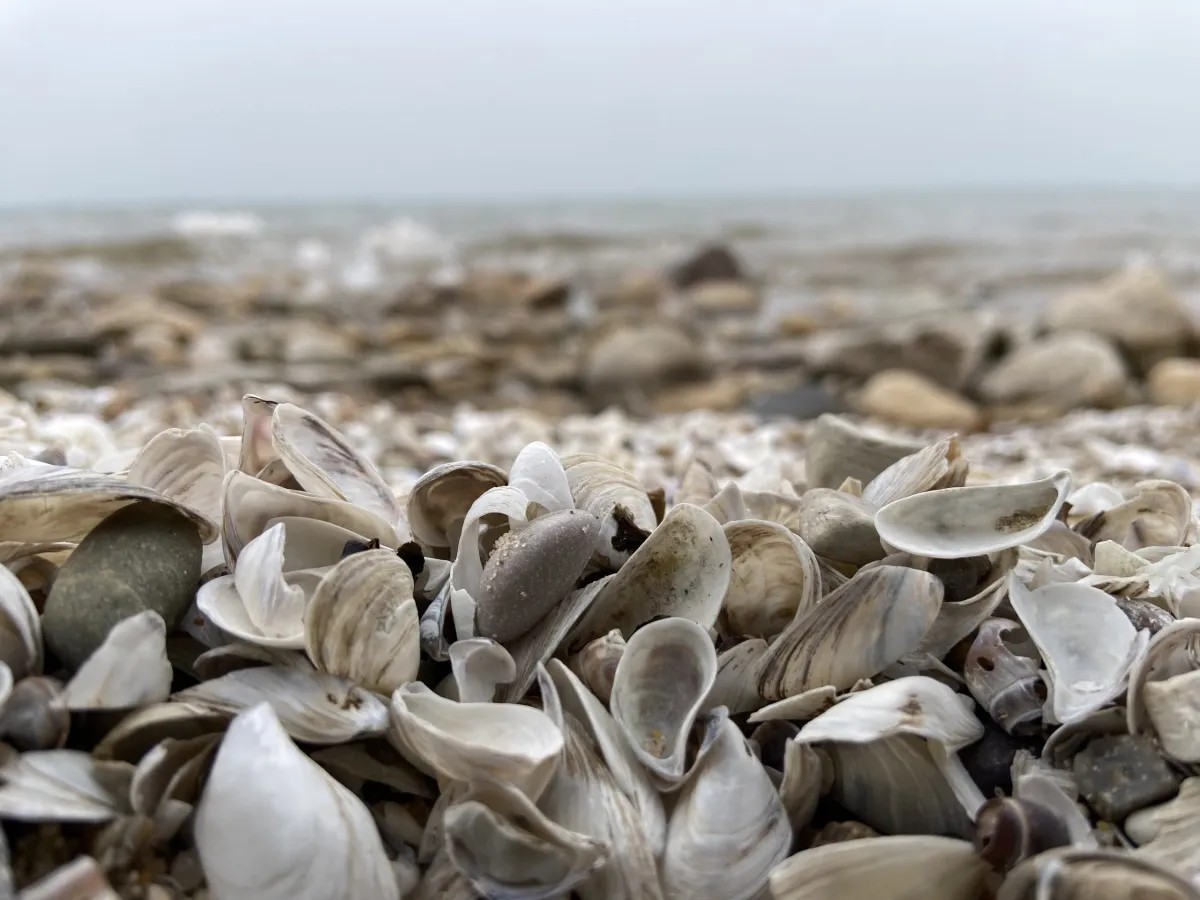
Invasive mussel shells are more common than pebbles on a Lake Michigan beach near Petoskey.  (Kelly House/Bridge Michigan)

First, invasive filter-feeding zebra and quagga mussels arrived in the Great Lakes from Eastern Europe and multiplied over decades, eventually monopolizing the nutrients and plankton that fish need to survive. Whitefish populations in lakes Michigan and Huron have tanked as a result.

Fortunately for Wisconsin and a sliver of Michigan’s Upper Peninsula, Hansen said, “Southern Green Bay kept building.”

In the late 1990s, scientists began spotting the fish in Green Bay area rivers where they hadn’t been seen in a century. Soon the species started showing up during surveys of lower Green Bay. By the early 2010s, models show the bay was teeming with tens of millions of them.

It’s not entirely clear what caused the whitefish revival, but most see cleaner water as part of the equation.

A decades-long restoration project has cleared away more than 6 million yards of sediment laced with PBCs and nutrient-laced farm runoff from the Fox River and lower Green Bay. Phosphorus concentrations near the rivermouth have declined by a third over 40 years — though they’re still considered too high.

“Pelicans are back, and the bird population seems to be thriving,” said Sarah Bartlett, a water resources specialist with the Green Bay Metropolitan Sewerage District, which monitors the bay’s water quality. “And now we have this world-class fishery.”

Hansen’s theory is that back when whitefish were still abundant in Lake Michigan, some wanderers strayed into the newly hospitable bay and decided to stay. Or maybe they were here all along, waiting for the right conditions to multiply.

Either way, the bay has become a lifeline for whitefish and the humans that eat them.

“I feel very fortunate that the bay is doing as well as it is,” said Stuth, who chairs the state commercial fishing board. 

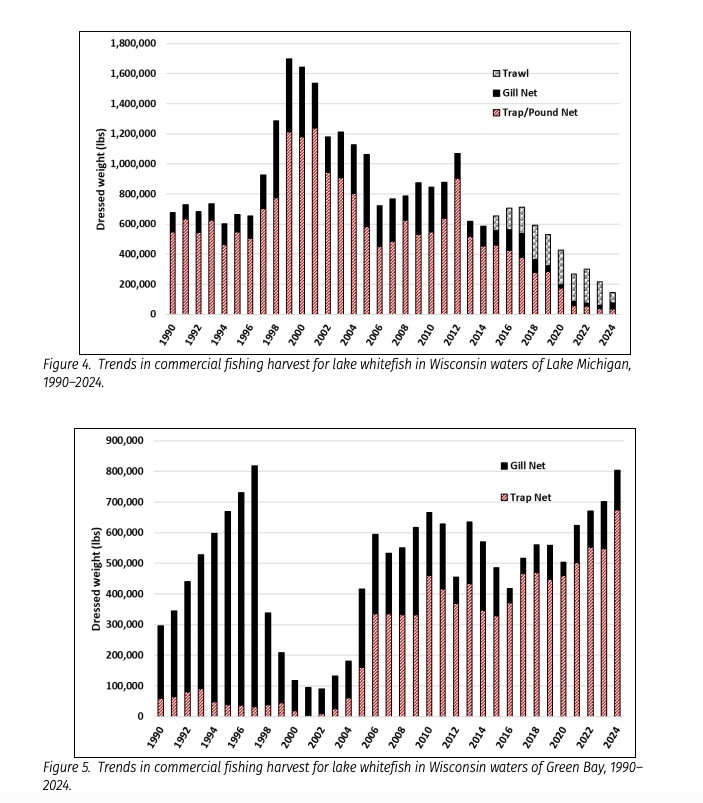
As commercial harvests in the Wisconsin waters of Lake Michigan plummeted from more than 1.6 million pounds in 2000 to less than 200,000 pounds in 2024, harvests in Green Bay skyrocketed from less than 100,000 pounds to more than 800,000.

The bay has also become more important to fishers in Michigan, which has jurisdiction over a portion of its waters.

While the state’s total commercial harvests from Lake Michigan have plummeted 70% since 2009 to just 1.2 million pounds annually, the decline would be steeper were it not for stable stocks in the bay. Once accounting for just a sliver of the catch, the bay now makes up more than half.

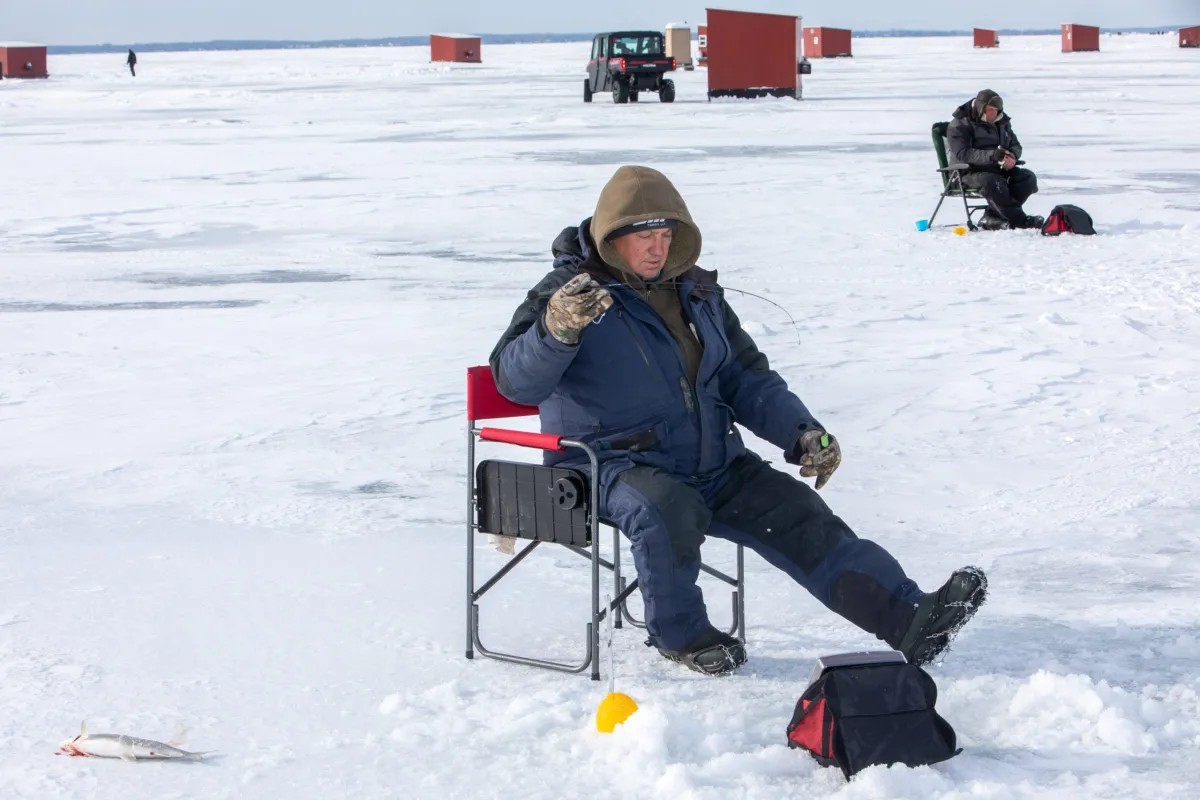
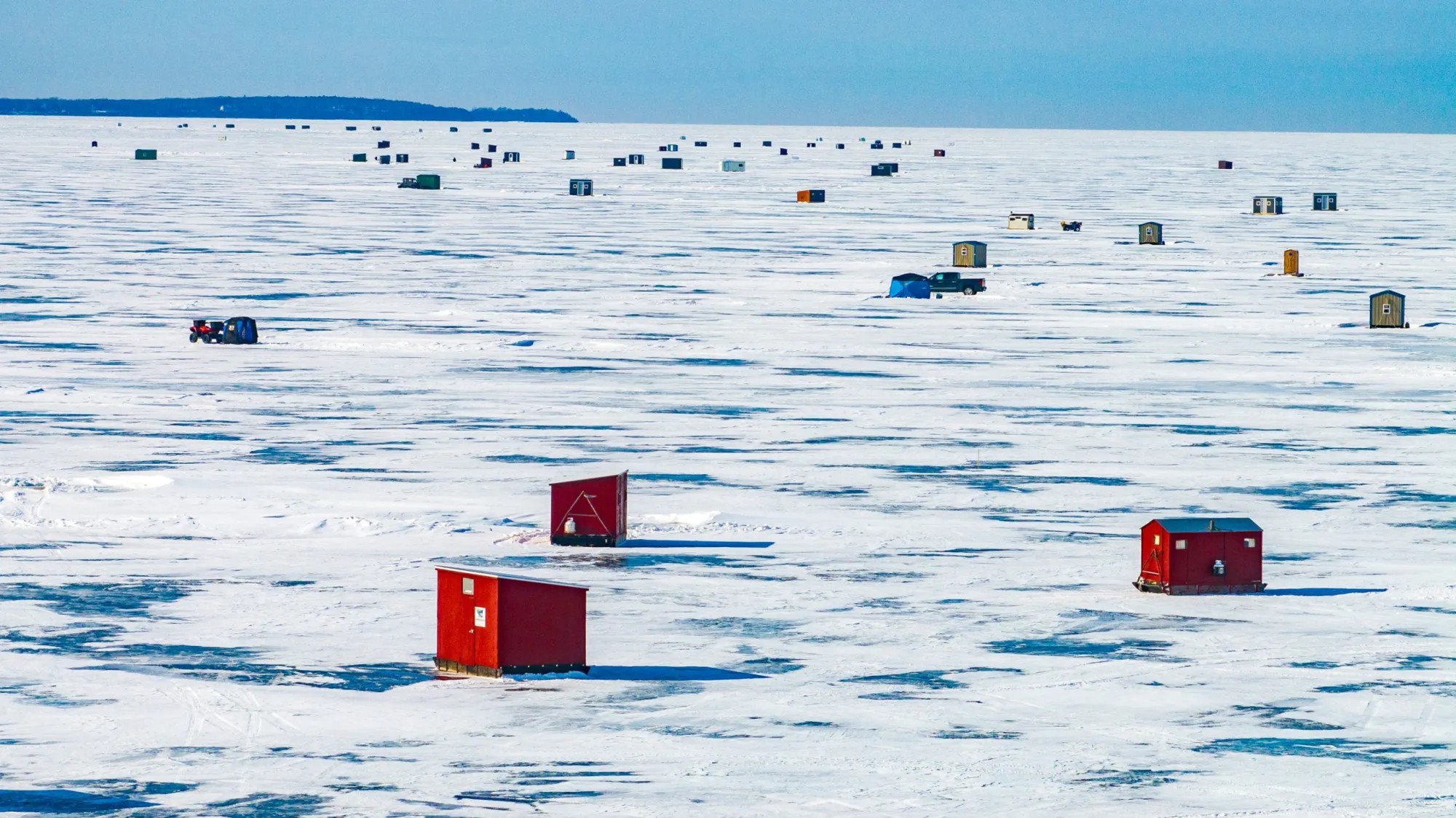
Vytautas Majus, who lives in Chicago, left the city at 2 a.m. to be on the ice fishing for whitefish by 7 a.m. Behind him, the horizon is dotted with ice shanties and anglers also hoping to land a whitefish. (Daniel Kramer for Bridge Michigan)

A recreational ice fishing scene has sprung up too, with thousands of anglers taking to the ice each winter, contributing tens of millions to the local economy.

Ironically, the bay’s lingering nutrient pollution may be helping to some extent – a dynamic also seen in Michigan’s Saginaw Bay. 

Nutrients like phosphorus and nitrogen are the building blocks of life, fueling the growth of aquatic plants and algae at the base of the food web. Plankton eat the algae, small fish eat the plankton, and big fish eat the small fish.

Unlike the main basins, where mussels have hogged nutrients and starved out whitefish, polluted runoff leaves the shallow bays with more than enough for the mussels and everything else. 

Some have even suggested Michigan and its neighbors should start fertilizing the big lakes in hopes of giving whitefish a boost, Herbert said, but “there’s the question of feasibility.” 

First, because the lakes are far deeper and wider than the bays, it would take vast quantities to make an impact. And while excess nutrients may help feed fish, they could also cause oxygen-deprived dead zonesharmful algae blooms and other serious problems.

Green Bay is already offering other lessons for Michigan, though. 

Inspired by whitefish’s return to the bay’s rivers, biologists including Herbert are trying to coax Michigan whitefish to spawn in rivers that connect to nutrient-rich rivermouths like Lake Charlevoix. 

The hope is that if hatchlings can spend a few months fattening up before migrating into the mussel-infested big lake, they’ll stand a better chance of surviving.

Scientists in Green Bay are also tracking whitefish movements, hoping to figure out where they spawn and what makes those habitats special. That kind of information could prove useful to recovery efforts throughout the Great Lakes, said Dan Isermann, a fish biologist with the US Geological Survey.

Living in ‘the good old days’

“We’re really lucky to have what we have here,” said JJ Malvitz, a commercial fishing guide who owes his career to Green Bay’s whitefish resurgence. 

But he lives with fear that “the good old days are now.”

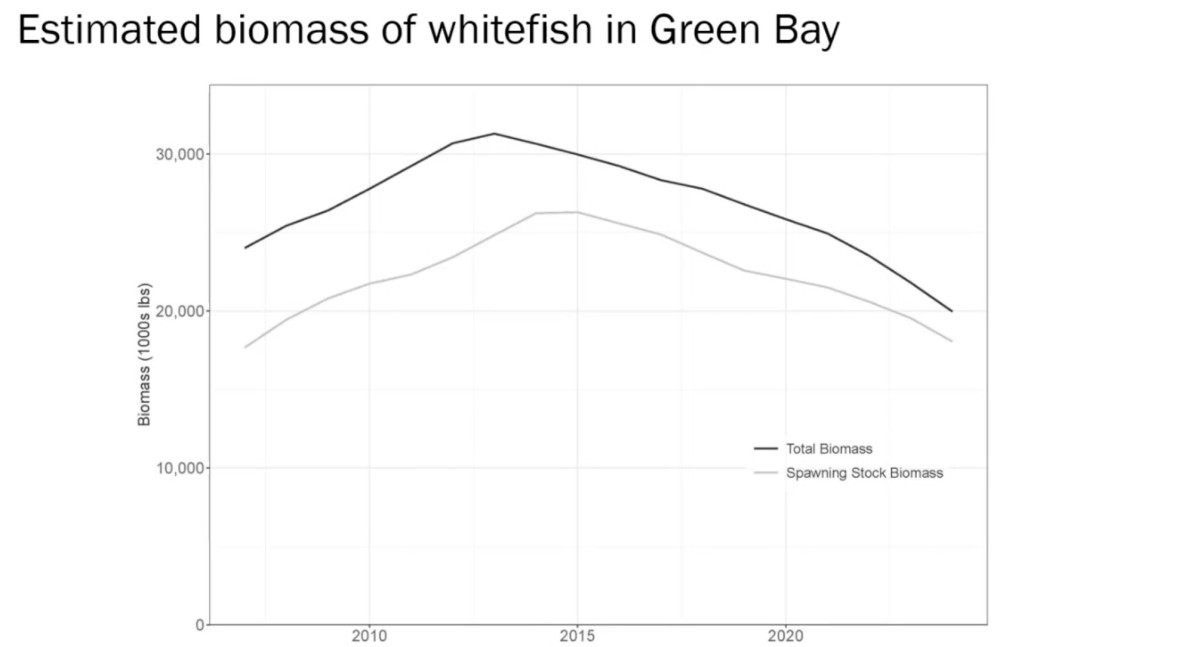
(Courtesy of Wisconsin Department of Natural Resources)

Stocks have shrunk by half since the mid-2010s, according to population models fed with data from DNR surveys and commercial and recreational harvests. The adult whitefish seem to be fat and healthy. But for reasons unknown, fewer of their offspring have been making it to adulthood.  

It’s possible the bay’s population is just leveling off after a period of strong recruitment, Hansen said, “but we want to be vigilant.”

A recent string of lackluster winters adds to the concern. Whitefish lay their eggs on ice-covered reefs. When that protective layer fails to form or melts off early, the eggs can be battered by waves or enticed to hatch early, out of sync with the spring plankton bloom that serves as their main food source.

As whitefish disappeared from the main basin of Lake Michigan, they experienced a resurgence in Green Bay that still isn’t fully understood. (Courtesy of Wisconsin Department of Natural Resources)

While this winter was icier than most, climate change is making low-ice winters more frequent.

“Whitefish are a cold-water species, and we know that’s not where the trends are going,” Hansen said.

Time to cut back?

So far, Wisconsin officials haven’t lowered Green Bay’s annual whitefish quota of 2.28 million pounds, evenly split between the commercial and sport fisheries. Commercial boats are limited to fish bigger than 17 inches, while recreational anglers are limited to 10 fish a day of any size.

But during a recent presentation to the state’s Natural Resources Board, Hansen said it’s time to start keeping closer tabs on the population. 

“If these trends continue,” he said, “We need to have some more serious discussions amongst ourselves about lowering the exploitation rates.”

Malvitz, the guide, believes it’s time for commercial and recreational anglers to collectively agree to harvest fewer fish. He would be satisfied with a five-fish limit for recreational anglers along with smaller quotas for the commercial fishery, which harvests far more fish. 

The bay’s whitefish reappeared quickly and unexpectedly, he said. Who’s to say they couldn’t disappear just as fast?

“I don’t want to be standing on the shore in five years saying ‘remember when,’” he said. 

Stuth, the commercial fishing board chair, isn’t ready to accept tighter quotas in the bay, but said population models should be closely watched. If the declines continue, he said, cuts may be on the table.

“A very conservative approach is going to be necessary,” he said. “Because it’s our last stronghold. If that goes away, what do we have?”

The post A Wisconsin whitefish refuge offers lessons for Michigan. But will it last? appeared first on Great Lakes Now.
Original Article

Great Lakes Now

Great Lakes Now

https://www.greatlakesnow.org/2026/03/12/a-wisconsin-whitefish-refuge-offers-lessons-for-michigan-but-will-it-last/

Kelly House, Bridge Michigan

By Richelle Wilson, Wisconsin Public Radio

This article was republished here with permission from Wisconsin Public Radio.


Paul Ehorn started scuba diving as a teenager in the early 1960s. On his first dive, he was wearing a self-assembly wetsuit he purchased from a Montgomery Ward catalog for $28.

“The water’s cold, probably the low 40s, and I came up just shivering uncontrollably,” Ehorn told WPR’s “Wisconsin Today.” “All I could say was, ‘How long before we can go back in?’”

“I was hooked. That was it,” he added. “It just became a passion and obsession.”

After that, it wasn’t long before Ehorn picked up some sonar gear and started what would become a lifelong career as a shipwreck hunter. Now 80 years old, he has discovered 15 shipwrecks in the Great Lakes. 

His latest find, which he announced to the public in February, is Lac La Belle, a luxury steamer that sank in Lake Michigan more than 150 years ago. The ship has been on Ehorn’s radar from the beginning due to his interest in wooden steamers and because it’s “close to home,” he said in the press release. 

After nearly 60 years of searching, Ehorn got the clue he needed and finally located the sunken wreckage about 20 miles offshore between Racine and Kenosha.

“It was just a wonderful day,” Ehorn said. “Beautiful wreck, it turned out.”

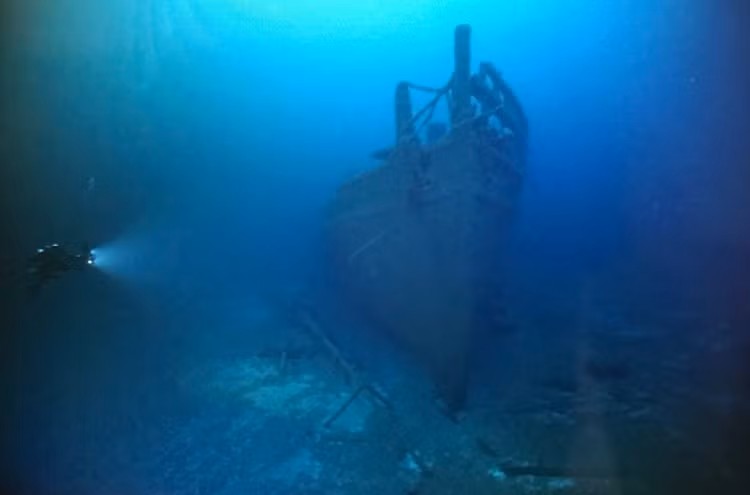
A scuba diver approaches the bow of the Lac La Belle. Photo courtesy of Paul Ehorn

Ehorn and his crew first found the wreckage of Lac La Belle in 2022, but he waited to publicly share his discovery until conditions were right to go down for a dive to film the ship and create a 3D model. Documenting the shipwreck is an important part of the process to educate the public and give historians a unique view into the past.

“All of our wrecks on the Great Lakes have a shelf life — they’re not going to look like this in 100 years,” said Brendon Baillod, president of the Wisconsin Underwater Archaeology Association. “I have to commend Paul for really wanting to do that photogrammetry model, because that’s a good standard for recording exactly how that wreck was at the time he found it.”

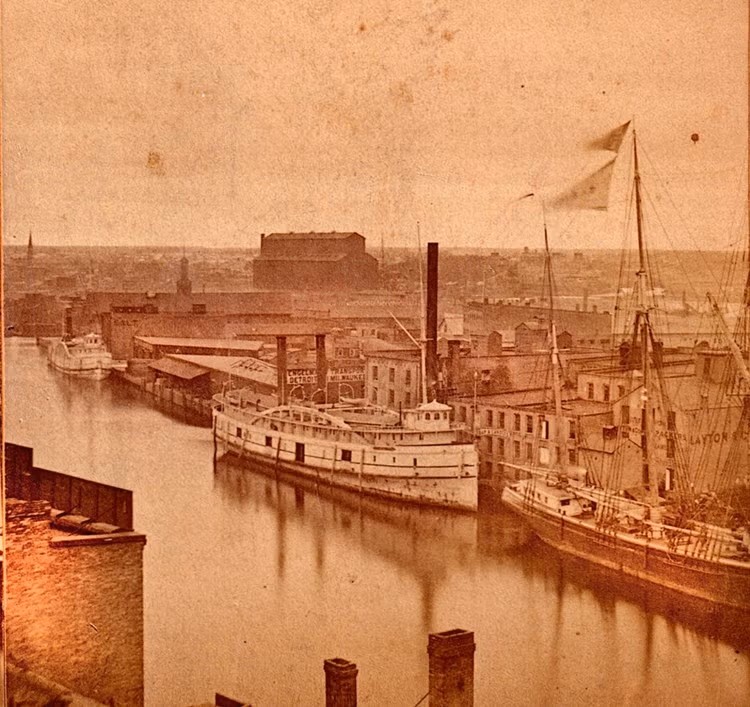
As a maritime historian, Baillod has researched a number of Great Lakes shipwrecks. His book “Fathoms Deep But Not Forgotten: Wisconsin’s Lost Ships” includes an entry for Lac La Belle that details its history carrying passengers and cargo — first between Cleveland and Lake Superior starting in 1864, and later on a trade route between Milwaukee and Grand Haven, Michigan. 

On Oct. 13, 1872, the ship sank a couple hours after departing Milwaukee due to a leak that sprung during a storm. The ship was carrying cargo and 53 passengers. Eight people died after one of the lifeboats capsized.

“The Lac La Belle is a time capsule. It’s an underwater museum from 1872,” Baillod told “Wisconsin Today.” “It played such a pivotal role not just in the industrialization of America, but in Milwaukee’s history.”

The steamer Lac La Belle docked in Milwaukee in 1872. This image is from an original stereoview by W. H. Sherman. Image courtesy of Brendon Baillod

A ‘golden age’ of shipwreck discovery

The Great Lakes are home to an estimated 6,000 to 10,000 shipwrecks, most of which remain undiscovered, according to the Wisconsin Water Library

But more of these sunken ships are being found, Baillod said, due to advancements in affordable technology and with the help of citizen scientists who are becoming more aware of shipwreck history.

“It’s kind of the golden age, I guess you might say, of shipwreck discovery on the Great Lakes,” he said, “and a tremendous opportunity for us to tell the stories of these ships that played such a huge role in the cultural history of the Midwest, and Wisconsin in particular.”

And the race is on to find more of these wrecks, as invasive quagga mussels congregate around shipwrecks and damage what remains.

For shipwreck hunters, the mussels are a double-edged sword: Despite the damage they cause, the mussels also are clarifying the water, making shipwrecks easier to spot. Whereas Lake Michigan used to have only about 5 or 10 feet of visibility underwater, now divers have a much clearer view.

“We called it ‘Braille diving.’ You’d go down and you’d have to get within a couple of feet of the shipwreck,” Baillod said. “Now, you go down there and you can see sometimes 50, 80, 100 feet — you can see the whole ship.”

While that has created opportunities for “beautiful underwater photos of these shipwrecks” and raised public awareness, Baillod said, the quagga mussels are ultimately decimating the food web and changing Lake Michigan’s biome, leading to the collapse of native species like whitefish.

Baillod is one of the founders of the Ghost Ships Festival, an annual community event to promote research, education and public awareness of Wisconsin’s shipwreck history. This year, the event is being held in Manitowoc on Friday, March 6 and Saturday, March 7 and includes a presentation from Ehorn about his discovery of the Lac La Belle.

“We’re trying to educate the public about the Great Lakes maritime history and about the role these ships played in building America back in the 1800s,” Baillod said. “And we’re having a lot of success — people are learning about it.”

The post Shipwreck hunter discovers sunken 150-year-old luxury liner off the coast of Wisconsin appeared first on Great Lakes Now.

Original Article

Great Lakes Now

Great Lakes Now

https://www.greatlakesnow.org/2026/03/10/shipwreck-hunter-discovers-sunken-150-year-old-luxury-liner-off-the-coast-of-wisconsin/

Wisconsin Public Radio

Take your passion for native plants to the next level with the Wild Ones Fox Valley Area 50-hour Native Plant Certification! This unique program offers a comprehensive education in Wisconsin’s native flora, perfect for home gardeners, students, teachers, conservation professionals, and nature enthusiasts. Click here to learn more! Certification Program Highlights: Earn [...]

The post Earn Your Native Plant Certification with Wild Ones appeared first on Fox-Wolf Watershed Alliance.

Original Article

Fox-Wolf Watershed Alliance

Fox-Wolf Watershed Alliance

https://fwwa.org/2026/02/17/wi-plant-cert-2026/?utm_source=rss&utm_medium=rss&utm_campaign=wi-plant-cert-2026

Katie Reed

$18M approved in bill credits for Pennsylvania customers in ‘forever chemicals’ settlement

Catch the latest updates on what’s happening with PFAS in the Great Lakes region. Check back for more PFAS news roundups every other week on our website.


The Pennsylvania Public Utility Commission recently approved a proposal from the Pennsylvania-American Water Company (PAWC) to issue over $18 million in bill credits to customers.

Read Now at Great Lakes Now.

Original Article

Great Lakes Now

Great Lakes Now

https://www.greatlakesnow.org/2025/11/more-than-18m-approved-in-bill-credits-for-pennsylvania-customers-in-forever-chemicals-settlement/

Lisa John Rogers, Great Lakes Now

Wisconsin DNR expands private well PFAS testing to five Oneida County townships

By Katie Thoresen, WXPR

This story was originally published by WXPR. WXPR is a community-licensed public radio station serving north central Wisconsin and adjacent areas of Michigan’s Upper Peninsula. Listen to their stories here.

People on private wells in five Oneida County Townships in Wisconsin may be offered free PFAS testing.

Read Now at Great Lakes Now.

Original Article

Great Lakes Now

Great Lakes Now

https://www.greatlakesnow.org/2025/07/wisconsin-dnr-expands-private-well-pfas-testing-five-oneida-county-townships/

WXPR

Petition seeks state listing of wolves as bills seek to remove federal protections

By Danielle Kaeding, Wisconsin Public Radio

This article was republished here with permission from Wisconsin Public Radio.

Conservation advocates are petitioning the Wisconsin Department of Natural Resources to list the gray wolf as a state-threatened or endangered species as Republicans in Congress seek to remove federal protections for the animal.

Read Now at Great Lakes Now.

Original Article

Great Lakes Now

Great Lakes Now

https://www.greatlakesnow.org/2025/06/petition-seeks-state-listing-of-wolves-as-bills-seek-to-remove-federal-protections/

Wisconsin Public Radio

White throated sparrow takes first place in fattest bird competition

This article was republished here with permission from Great Lakes Echo.

By Clara Lincolnhol, Great Lakes Echo

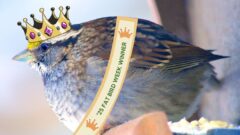
A very round white throated sparrow is the heavyweight champion of the 2025 Wisconsin Fat Bird Week contest.

The bird, coined the “spherical white-throated sparrow,” won by a landslide, receiving 72% of the vote in the final round against its nearest competitor, a “rotund ruby-throated hummingbird.”

The winner made it through eight rounds in the single-elimination, March Madness-style bracket competition against seven other birds.

Read Now at Great Lakes Now.

Original Article

Great Lakes Now

Great Lakes Now

https://www.greatlakesnow.org/2025/06/white-throated-sparrow-takes-first-place-in-fattest-bird-competition/

Great Lakes Echo

Hundreds of fish killed by manure runoff in Monroe County

By Danielle Kaeding, Wisconsin Public Radio

This article was republished here with permission from Wisconsin Public Radio.

Manure runoff from a dairy farm in Monroe County killed hundreds of fish in nearby waterways, according to the Wisconsin Department of Natural Resources.

The agency first received notice of the spill Saturday from a call to its violation hotline.

Read Now at Great Lakes Now.

Original Article

Great Lakes Now

Great Lakes Now

https://www.greatlakesnow.org/2025/05/hundreds-of-fish-killed-by-manure-runoff-in-monroe-county/

Wisconsin Public Radio

It’s ‘all hands on deck’ as hot temps and strong winds bring high risk of wildfires to the Northwoods


By Katie Thoresen, WXPR

This story was originally published by WXPR. WXPR is a community-licensed public radio station serving north central Wisconsin and adjacent areas of Michigan’s Upper Peninsula. Listen to their stories here.

Read Now at Great Lakes Now.

Original Article

Great Lakes Now

Great Lakes Now

https://www.greatlakesnow.org/2025/05/its-all-hands-on-deck-as-hot-temps-and-strong-winds-bring-high-risk-of-wildfires-to-the-northwoods/

WXPR

Wisconsin sees record start to the fire season as climate change drives more blazes

By Danielle Kaeding, Wisconsin Public Radio

This article was republished here with permission from Wisconsin Public Radio.

Wisconsin saw a record number of fires in January and February this year due to a lack of snow as climate change has set the stage for more wildfires.

Read Now at Great Lakes Now.

Original Article

Great Lakes Now

Great Lakes Now

https://www.greatlakesnow.org/2025/04/wisconsin-wildfires-record-climate-change-drought/

Wisconsin Public Radio

Susan Crawford’s Wisconsin Supreme Court win could be a win for PFAS

Catch the latest updates on what’s happening with PFAS in the Great Lakes region. Check back for more PFAS news roundups every other week on our website.

On Tuesday, April 1, Susan Crawford won Wisconsin’s contentious Supreme Court election.

Read Now at Great Lakes Now.

Original Article

Great Lakes Now

Great Lakes Now

https://www.greatlakesnow.org/2025/04/susan-crawfords-wisconsin-supreme-court-win-could-be-a-win-for-pfas/

Lisa John Rogers, Great Lakes Now

Groups fight to preserve future of Michigan’s indigenous wild rice

By Jena Brooker, BridgeDetroit

This article was republished here with permission from BridgeDetroit.

An origin story, a teacher of life, a relative, and a source of crucial nutrition, manoomin now has a new protector.

Once covering much of Michigan’s inland lakes and streams, the wild rice (also known as mnoomin or mnomen) is indigenous to the Great Lakes region but has largely disappeared due to colonization, environmental degradation, and climate change.

Read Now at Great Lakes Now.

Original Article

Great Lakes Now

Great Lakes Now

https://www.greatlakesnow.org/2025/04/groups-fight-to-preserve-future-of-michigans-indigenous-wild-rice/

BridgeDetroit

This content is password protected. To view it please enter your password below: Password:

The post Protected: What Drives Lake Winnebago’s Water Levels—and How to Read the Graph Everyone Talks About appeared first on Fox-Wolf Watershed Alliance.

Original Article

Fox-Wolf Watershed Alliance

Fox-Wolf Watershed Alliance

https://fwwa.org/2025/04/02/reading-the-lake-winnebago-graph/?utm_source=rss&utm_medium=rss&utm_campaign=reading-the-lake-winnebago-graph

Fox-Wolf Watershed Alliance

The NFL Draft is coming to Titletown! But before the picks are made… we’ve got some picking of our own to do. This Earth Day—Tuesday, April 22—join the Fox-Wolf Watershed Alliance and NFL Green for the Fox-Wolf Watershed Cleanup Preseason Pick-Up, a trail cleanup along Green Bay’s Fox River Trail. We’re getting it ready [...]

The post The NFL Draft Is Coming to Green Bay. Let’s Clear the Field (of Trash). appeared first on Fox-Wolf Watershed Alliance.

Original Article

Fox-Wolf Watershed Alliance

Fox-Wolf Watershed Alliance

https://fwwa.org/2025/04/01/preseason-pick-up-nfl-draft-cleanup-green-bay/?utm_source=rss&utm_medium=rss&utm_campaign=preseason-pick-up-nfl-draft-cleanup-green-bay

Dan Beckwith

What would the Great Lakes region be like with bullet trains?

A few months ago, I was riding on Amtrak’s new Borealis line from St. Paul, Minn., to Chicago. The train was packed that day, and the new line has proved popular.

My coach seat was much nicer than any airline. Plus, I didn’t have to go through security.

Read Now at Great Lakes Now.

Original Article

Great Lakes Now

Great Lakes Now

https://www.greatlakesnow.org/2025/03/what-would-the-great-lakes-region-be-like-with-bullet-trains/

Sean Ericson, Great Lakes Now

This content is password protected. To view it please enter your password below: Password:

The post Protected: Lake Winnebago Ice Out: The Last Ice Is Gone—Here’s What It Means appeared first on Fox-Wolf Watershed Alliance.

Original Article

Fox-Wolf Watershed Alliance

Fox-Wolf Watershed Alliance

https://fwwa.org/2025/03/25/lake-winnebago-ice-out/?utm_source=rss&utm_medium=rss&utm_campaign=lake-winnebago-ice-out

Dan Beckwith

This content is password protected. To view it please enter your password below: Password:

The post Protected: Lake Winnebago: Keeping Everyone Afloat appeared first on Fox-Wolf Watershed Alliance.

Original Article

Fox-Wolf Watershed Alliance

Fox-Wolf Watershed Alliance

https://fwwa.org/2025/03/19/lake-winnebago-water-level-management-stakeholders/?utm_source=rss&utm_medium=rss&utm_campaign=lake-winnebago-water-level-management-stakeholders

Dan Beckwith

This content is password protected. To view it please enter your password below: Password:

The post Protected: Why Does Lake Winnebago’s Water Level Change in Winter? appeared first on Fox-Wolf Watershed Alliance.

Original Article

Fox-Wolf Watershed Alliance

Fox-Wolf Watershed Alliance

https://fwwa.org/2025/03/12/lake-winnebago-winter-water-level-management/?utm_source=rss&utm_medium=rss&utm_campaign=lake-winnebago-winter-water-level-management

Dan Beckwith

National parks see a record number of visitors, including in Wisconsin

By Danielle Kaeding, Wisconsin Public Radio

This article was republished here with permission from Wisconsin Public Radio.

Wisconsin saw more visitors at sites managed by the National Park Service last year, and America’s national parks had a record number of visitors.

News of the growing demand at the parks comes as the Trump administration has cut staff to manage them.

Read Now at Great Lakes Now.

Original Article

Great Lakes Now

Great Lakes Now

https://www.greatlakesnow.org/2025/03/national-parks-see-a-record-number-of-visitors-including-in-wisconsin/

Wisconsin Public Radio

This content is password protected. To view it please enter your password below: Password:

The post Protected: Lake Winnebago, Wisconsin: A Powerhouse Waterway with a Changing Past appeared first on Fox-Wolf Watershed Alliance.

Original Article

Fox-Wolf Watershed Alliance

Fox-Wolf Watershed Alliance

https://fwwa.org/2025/03/06/lake-winnebago-history-dams-impact/?utm_source=rss&utm_medium=rss&utm_campaign=lake-winnebago-history-dams-impact

Dan Beckwith

US Forest Service firings decimate already understaffed agency: ‘It’s catastrophic’

By Katie Myers, Juanpablo Ramirez-Franco, & Izzy Ross

This coverage is made possible through a partnership between GristBPR, a public radio station serving western North Carolina, WBEZ, a public radio station serving the Chicago metropolitan region, and Interlochen Public Radio in Northern Michigan.

Read Now at Great Lakes Now.

Original Article

Great Lakes Now

Great Lakes Now

https://www.greatlakesnow.org/2025/02/us-forest-service-firings-decimate-already-understaffed-agency-its-catastrophic/

Grist

Trump administration seeks to fast-track projects in the Great Lakes and Wisconsin

By Danielle Kaeding, Wisconsin Public Radio

This article was republished here with permission from Wisconsin Public Radio.

Permits for hundreds of energy projects may be fast-tracked by the U.S. Army Corps of Engineers under the Trump administration, including plans for a pipeline project in the Great Lakes and a fossil fuel plant in Superior.

Read Now at Great Lakes Now.

Original Article

Great Lakes Now

Great Lakes Now

https://www.greatlakesnow.org/2025/02/trump-administration-seeks-to-fast-track-projects-in-the-great-lakes-and-wisconsin/

Wisconsin Public Radio

Ready to roll up your sleeves and make a real impact? Registration is live for Northeast Wisconsin’s largest volunteer trash cleanup, and we’re calling on you to help protect our beautiful waterways. Let’s come together and transform our local environment—one cleanup at a time! Event Snapshot When: Saturday, [...]

The post Fox-Wolf Watershed Cleanup: Registration Now Open – Join Your Community Today! appeared first on Fox-Wolf Watershed Alliance.

Original Article

Fox-Wolf Watershed Alliance

Fox-Wolf Watershed Alliance

https://fwwa.org/2025/02/24/fox-wolf-watershed-cleanup-2025-join-the-movement/?utm_source=rss&utm_medium=rss&utm_campaign=fox-wolf-watershed-cleanup-2025-join-the-movement

Dan Beckwith

Wisconsin is still sitting on $125 million for PFAS cleanup

This article, first posted here, was republished with permission from Wisconsin Watch.

By Bennet Goldstein, Wisconsin Watch

A year and a half after Wisconsin lawmakers earmarked $125 million to clean up toxic “forever chemicals” known as PFAS, the funds have yet to flow to contaminated communities.

Read Now at Great Lakes Now.

Original Article

Great Lakes Now

Great Lakes Now

https://www.greatlakesnow.org/2025/02/wisconsin-is-still-sitting-on-125-million-for-pfas-cleanup/

Wisconsin Watch

An ecosystem engineer’s vision: mock beaver dams to restore Wisconsin wetlands

This article, first posted here, was republished with permission from Wisconsin Watch.

By Bennet Goldstein, Wisconsin Watch

Jay Dee Nichols stamped and packed stiff willow branches between maple wood posts, with muffled crunches.

At 63, the semi-retired handyman from the Wisconsin city of Black River Falls has trapped beavers before.

Read Now at Great Lakes Now.

Original Article

Great Lakes Now

Great Lakes Now

https://www.greatlakesnow.org/2025/01/an-ecosystem-engineers-vision-mock-beaver-dams-to-restore-wisconsin-wetlands/

Wisconsin Watch

Study finds winter days on the Great Lakes growing shorter due to climate change

By Danielle Kaeding, Wisconsin Public Radio

This article was republished here with permission from Wisconsin Public Radio.

A new study builds on previous research that shows winters on the Great Lakes are growing shorter due to climate change.

The Great Lakes have been losing an average of 14 days of winter conditions each decade since 1995 due to warming air temperatures, according to the study published in the peer-reviewed journal Environmental Research Letters.

Read Now at Great Lakes Now.

Original Article

Great Lakes Now

Great Lakes Now

https://www.greatlakesnow.org/2025/01/study-finds-winter-days-on-the-great-lakes-growing-shorter-due-to-climate-change/

Wisconsin Public Radio

Fertilizer from Sewage, a Utility Money Maker, Faces Uncertain Future

By Brett Walton, Circle of Blue

The Great Lakes News Collaborative includes Bridge Michigan, Circle of Blue, Great Lakes Now at Detroit PBS, Michigan Public and The Narwhal who work together to bring audiences news and information about the impact of climate change, pollution, and aging infrastructure on the Great Lakes and drinking water.

Read Now at Great Lakes Now.

Original Article

Great Lakes Now

Great Lakes Now

https://www.greatlakesnow.org/2025/01/fertilizer-from-sewage-a-utility-money-maker-faces-uncertain-future/

Circle of Blue

Cargo tonnage lagging at Great Lakes ports as shipping season nears its end

By Danielle Kaeding, Wisconsin Public Radio

This article was republished here with permission from Wisconsin Public Radio.

The amount of cargo moving through ports on the Great Lakes is trailing behind shipments at the same time last year as the shipping season nears its end.

Read Now at Great Lakes Now.

Original Article

Great Lakes Now

Great Lakes Now

https://www.greatlakesnow.org/2025/01/cargo-tonnage-lagging-at-great-lakes-ports-as-shipping-season-nears-its-end/

Wisconsin Public Radio

Energy transition sees small wins, major uncertainty in the Upper Midwest

Catch the latest energy news from around the Great Lakes region. Check back for these biweekly Energy News Roundups


Chicago’s commitment to using 100% renewable energy at city-owned buildings went into effect Jan.

Read Now at Great Lakes Now.

Original Article

Great Lakes Now

Great Lakes Now

https://www.greatlakesnow.org/2025/01/energy-transition-small-wins-uncertainty-upper-midwest/
Nicole Pollack, Great Lakes Now

After a dramatic decline, lake trout have recovered in most of Lake Superior

By Danielle Kaeding, Wisconsin Public Radio

This article was republished here with permission from Wisconsin Public Radio.

After decades of work, fishery managers say lake trout have fully recovered in most of Lake Superior after the invasive, fish-killing sea lamprey decimated their numbers.

Read Now at Great Lakes Now.

Original Article

Great Lakes Now

Great Lakes Now

https://www.greatlakesnow.org/2024/11/after-a-dramatic-decline-lake-trout-have-recovered-in-most-of-lake-superior/

Wisconsin Public Radio

Environmentalists, Industry Divided Over Energy Permitting Bill

Melting ice. Wildfire smoke. Crop losses. Climate change is already having an impact on the Great Lakes region. According to a 2022 report by the Intergovernmental Panel on Climate Change, in order to limit global warming to 2 degrees Celsius, humanity would have to reach net-zero emissions by the 2070s.

Read Now at Great Lakes Now.

Original Article

Great Lakes Now

Great Lakes Now

https://www.greatlakesnow.org/2024/11/environmentalists-industry-divided-over-energy-permitting-bill/

Sean Ericson, Great Lakes Now

Pressed for powder, study finds ski areas are relying more on snowmaking

By Danielle Kaeding, Wisconsin Public Radio

This article was republished here with permission from Wisconsin Public Radio.

Ski hills in Wisconsin are relying more on snowmaking and other strategies to adapt to changing snow conditions due to climate change, according to a new study.

Read Now at Great Lakes Now.

Original Article

Great Lakes Now

Great Lakes Now

https://www.greatlakesnow.org/2024/11/pressed-for-powder-study-finds-ski-areas-are-relying-more-on-snowmaking/

Wisconsin Public Radio

Public hearing draws on big questions about Upper Peninsula copper mining

By Izzy Ross, Interlochen Public Radio

This coverage is made possible through a partnership with IPR and Grist, a nonprofit independent media organization dedicated to telling stories of climate solutions and a just future.

In Gogebic County, on the western end of Michigan’s Upper Peninsula, towering old-growth evergreens carpet the landscape as it rolls down toward the deep blue of Lake Superior.

Read Now at Great Lakes Now.

Original Article

Great Lakes Now

Great Lakes Now

https://www.greatlakesnow.org/2024/11/public-hearing-draws-on-big-questions-about-upper-peninsula-copper-mining/

Interlochen Public Radio

Students at Michigan State and Wisconsin win EPA funding for environmental health innovations

This article was republished here with permission from Great Lakes Echo.

By Isabella Figueroa, Great Lakes Echo

Student researchers from Michigan State University and the University of Wisconsin are among the winners of an Environmental Protection Agency contest for innovations in sustainability.

Read Now at Great Lakes Now.

Original Article

Great Lakes Now

Great Lakes Now

https://www.greatlakesnow.org/2024/11/students-at-michigan-state-and-wisconsin-win-epa-funding-for-environmental-health-innovations/

Great Lakes Echo

Climate change isn’t a top issue in this election. Some Wisconsin voters say it should be.

By Danielle Kaeding, Wisconsin Public Radio

This article was republished here with permission from Wisconsin Public Radio.

Outside a September rally with Minnesota Gov. Tim Walz at the University of Wisconsin-Superior, Ashland business owner and Democrat Will Pipkin set up signs with a cavalcade of slogans, including “Another cat lady for democracy” and “Without a healthy climate, there’s no freedom.”

Pipkin said he’s backing Vice President Kamala Harris and Walz in the presidential race because they’re the most progressive choice, and he thinks they would continue President Joe Biden’s work on green initiatives and climate change.

Read Now at Great Lakes Now.

Original Article

Great Lakes Now

Great Lakes Now

https://www.greatlakesnow.org/2024/10/climate-change-isnt-a-top-issue-in-this-election-some-wisconsin-voters-say-it-should-be/

Wisconsin Public Radio

Environmental groups and industry at odds over plan to conserve old-growth forests

By Danielle Kaeding, Wisconsin Public Radio

This article was republished here with permission from Wisconsin Public Radio.

Some Wisconsin groups are urging the Biden administration to do more to protect mature and old-growth forests under its proposal to conserve those trees as logging interests are pushing back against changes.

Read Now at Great Lakes Now.

Original Article

Great Lakes Now

Great Lakes Now

https://www.greatlakesnow.org/2024/10/environmental-groups-and-industry-at-odds-over-plan-to-conserve-old-growth-forests/

Wisconsin Public Radio

Wisconsin towns are trying to limit CAFO growth. Big Dairy is fighting back.

By John McCracken, Investigate Midwest

Investigate Midwest is an independent, nonprofit newsroom. Our mission is to serve the public interest by exposing dangerous and costly practices of influential agricultural corporations and institutions through in-depth and data-driven investigative journalism. Visit us online at www.investigatemidwest.org.

Read Now at Great Lakes Now.

Original Article

Great Lakes Now

Great Lakes Now

https://www.greatlakesnow.org/2024/10/wisconsin-towns-are-trying-to-limit-cafo-growth-big-dairy-is-fighting-back/

Investigate Midwest

Midwest States Struggle to Fund Dam Safety Projects, Even as Federal Aid Hits Historic Highs

By Kristoffer Tigue, Inside Climate News

This article originally appeared on Inside Climate News, a nonprofit, non-partisan news organization that covers climate, energy and the environment. Sign up for their newsletter here.

MINNEAPOLIS—A record amount of federal aid will soon flow to states to help fix, replace or demolish their aging dams, many of which are under increasing pressure as climate change fuels more frequent and severe extreme weather events.

Read Now at Great Lakes Now.

Original Article

Great Lakes Now

Great Lakes Now

https://www.greatlakesnow.org/2024/10/midwest-dam-safety-projects-funding/

Inside Climate News

Joliet, Illinois, Plans to Source Its Future Drinking Water From Lake Michigan. Will Other Cities Follow?

By Nina Elkadi, Inside Climate News

This article originally appeared on Inside Climate News, a nonprofit, non-partisan news organization that covers climate, energy and the environment. Sign up for their newsletter here.

The aquifer from which Joliet, Illinois, sources its drinking water is likely going to run too dry to support the city by 2030—a problem more and more communities are facing as the climate changes and groundwater declines.

Read Now at Great Lakes Now.

Original Article

Great Lakes Now

Great Lakes Now

https://www.greatlakesnow.org/2024/10/joliet-illinois-lake-michigan-drinking-water/

Inside Climate News

PFAS Roundup: Minnesota PFAS regulation said to be the strictest

In a few months, many products with “forever chemicals” will be officially banned in Minnesota. Known as Amara’s Law, starting January 1, 2025 resident’s won’t be able to sell or distribute products with intentionally added PFAS from cookware, cosmetics, dental floss, juvenile products, menstruation products, textile furnishing, ski wax, upholstered furniture, cleaning products, or carpets and rugs — accirding to Vice Magazine.

Read Now at Great Lakes Now.

Original Article

Great Lakes Now

Great Lakes Now

https://www.greatlakesnow.org/2024/09/pfas-roundup-minnesota-pfas-regulation-said-to-be-the-strictest/
Lisa John Rogers, Great Lakes Now

Wisconsin officials ask the public to report algal blooms in Lake Superior

This article was republished here with permission from Great Lakes Echo.

By Anna Barnes, Great Lakes Echo

The Wisconsin Department of Natural Resources is banking on public oversight of the largest Great Lake to help gauge the threat of increasingly common algal blooms.

Read Now at Great Lakes Now.

Original Article

Great Lakes Now

Great Lakes Now

https://www.greatlakesnow.org/2024/09/wisconsin-officials-ask-the-public-to-report-algal-blooms-in-lake-superior/

Great Lakes Echo

Wisconsin Supreme Court to hear case with broad implications for PFAS cleanup

By Danielle Kaeding, Wisconsin Public Radio

This article was republished here with permission from Wisconsin Public Radio.

The Wisconsin Supreme Court will hear a case that could have sweeping effects on state environmental regulators’ authority to force businesses to clean up PFAS pollution under the state’s spills law.

Read Now at Great Lakes Now.

Original Article

Great Lakes Now

Great Lakes Now

https://www.greatlakesnow.org/2024/09/wisconsin-supreme-court-to-hear-case-with-broad-implications-for-pfas-cleanup/

Wisconsin Public Radio

Farmers turn to ‘predator-proof’ fences to deter wolves in northern Wisconsin

By Danielle Kaeding, Wisconsin Public Radio

This article was republished here with permission from Wisconsin Public Radio.

For at least the last decade, Dustin Soyring and his family have struggled with wolves on their farm in the northern Wisconsin town of Maple.

Read Now at Great Lakes Now.

Original Article

Great Lakes Now

Great Lakes Now

https://www.greatlakesnow.org/2024/09/farmers-turn-to-predator-proof-fences-to-deter-wolves-in-northern-wisconsin/

Wisconsin Public Radio

How many manure spills is too many? St. Croix County residents scrutinize big farm’s new owner

This article, first posted here, was republished with permission from Wisconsin Watch.

By Bennet Goldstein, Wisconsin Watch

Gregg Wolf vows “to put a new step forward” on “a new day” at a northwest Wisconsin dairy.

Appleton-based Breeze Dairy Group, where he serves as CEO, purchased Emerald Sky Dairy in March, shortly after the Wisconsin Department of Natural Resources approved the St.

Read Now at Great Lakes Now.

Original Article

Great Lakes Now

Great Lakes Now

https://www.greatlakesnow.org/2024/08/how-many-manure-spills-is-too-many-st-croix-county-residents-scrutinize-big-farms-new-owner/

Wisconsin Watch

Former state toxicologist says nitrate drinking water standards are too lax

By Henry Redman, Wisconsin Examiner

A former Wisconsin state toxicologist who was involved in creating the state’s nitrate standards for drinking water in the 1980s alleges the science that has informed those standards for decades is deeply flawed and the standards should be stricter.

Dave Belluck, who worked as a toxicologist for multiple states and the federal government, says that “the science is the science” and regulating agencies, including the U.S.

Read Now at Great Lakes Now.

Original Article

Great Lakes Now

Great Lakes Now

https://www.greatlakesnow.org/2024/07/former-state-toxicologist-says-nitrate-drinking-water-standards-are-too-lax/

Wisconsin Examiner

Ship doomed on Lake Michigan now moored on National Register of Historic Places

This article was republished here with permission from Great Lakes Echo.

By Eric Freedman, Great Lakes Echo

A Detroit-built sailing ship that sank in Lake Michigan during an 1864 storm has been added to the National Register of Historic Places.

The three-masted Mojave, only 1 year old at the time, went down in heavy weather while northbound on the route from Chicago to Buffalo with a load of grain.

Read Now at Great Lakes Now.

Original Article

Great Lakes Now

Great Lakes Now

https://www.greatlakesnow.org/2024/07/ship-doomed-on-lake-michigan-now-moored-on-national-register-of-historic-places/

Great Lakes Echo

Disappointed dogs, sad skiers, frustrated fishermen

Hayward, Wisconsin got its first snow of the season on Halloween. But then Thanksgiving came, and Christmas, with no more white flakes. The new year started equally warm and snowless, and the organizers of the iconic American Birkebeiner ski race began to really worry. The February 24, 2024 race would be the 50th anniversary of the country’s most famous (and largest) cross-country ski event, and it would also be a World Cup competition, drawing top competitors from around the globe.

Read Now at Great Lakes Now.

Original Article

Great Lakes Now

Great Lakes Now

https://www.greatlakesnow.org/2024/05/disappointed-dogs-sad-skiers-frustrated-fishermen/

Kari Lydersen

Energy News Roundup: Key figure in Ohio bribery scandal dead by suicide

In yet another shakeup in the Ohio energy bribery saga that first came to light in 2020, a former state utility regulator was found dead by suicide last week. Sam Randazzo, 74, a longtime lobbyist who was appointed by Gov. Mike DeWine to chair the Ohio Public Utilities Commission, had been charged with taking a $4.3 million bribe from FirstEnergy Corp.

Read Now at Great Lakes Now.

Original Article

Great Lakes Now

Great Lakes Now

https://www.greatlakesnow.org/2024/04/energy-news-roundup-key-figure-in-ohio-bribery-scandal-dead-by-suicide/

Nicole Pollack, Great Lakes Now

Points North: Not always the apex predator

By Daniel Wanschura, Interlochen Public Radio

Points North is a biweekly podcast about the land, water and inhabitants of the Great Lakes. This episode was shared here with permission from Interlochen Public Radio.

On November 11, 2023, Ben Karasch is up in his treestand, waiting for a deer.

Read Now at Great Lakes Now.

Original Article

Great Lakes Now

Great Lakes Now

https://www.greatlakesnow.org/2024/04/points-north-not-always-the-apex-predator/

Interlochen Public Radio

Take your passion for native plants to the next level with the Wild Ones Fox Valley Area 50-hour Native Plant Certification! This unique program offers a comprehensive education in Wisconsin’s native flora, perfect for home gardeners, students, teachers, conservation professionals, and nature enthusiasts. Click here to learn more! Certification Program Highlights: Earn [...]

The post Earn Your Native Plant Certification with Wild Ones! appeared first on Fox-Wolf Watershed Alliance.

Original Article

Fox-Wolf Watershed Alliance

Fox-Wolf Watershed Alliance

https://fwwa.org/2025/02/17/wi-native-plant-certification-program/?utm_source=rss&utm_medium=rss&utm_campaign=wi-native-plant-certification-program

Katie Reed